Making Plans for a Return to Hay-on-Wye & A Book “Overhaul”
I was last in Hay-on-Wye for my 40th birthday (write-up here). We’ve decided 18 months is a decent length between visits such that we can go back and find enough turnover in the bookshops and changes around the town. The plan is to spend four nights there in early April, in a holiday cottage we’ve not stayed in before. It’s in Cusop, just back over the border into England, which means a pleasant (if not pouring with rain) walk over the fields into the town. Normally we go for just a night or two, so this longer ninth trip to Hay will allow us time to do more local exploring besides thoroughly trawling all the bookshops and rediscovering the best eateries on offer.
An Overhaul of Last Trip’s Book Purchases
Simon of Stuck in a Book has a regular blog feature he calls “The Overhaul,” where he revisits a book haul from some time ago and takes stock of what he’s read, what he still owns, etc. (here’s the most recent one). With his permission, I occasionally borrow the title and format to look back at what I’ve bought. Previous overhaul posts have covered pre-2020 Hay-on-Wye purchases, birthdays, the much-lamented Bookbarn International, and Northumberland. It’s been a good way of holding myself accountable for what I’ve purchased and reminding myself to read more from my shelves.
So, earlier this week I took a look back at the 16 new and secondhand books I acquired in Hay in October 2023. I was quickly dismayed: 18 months might seem like a long time, but as far as my shelves go it is more like the blink of an eye.
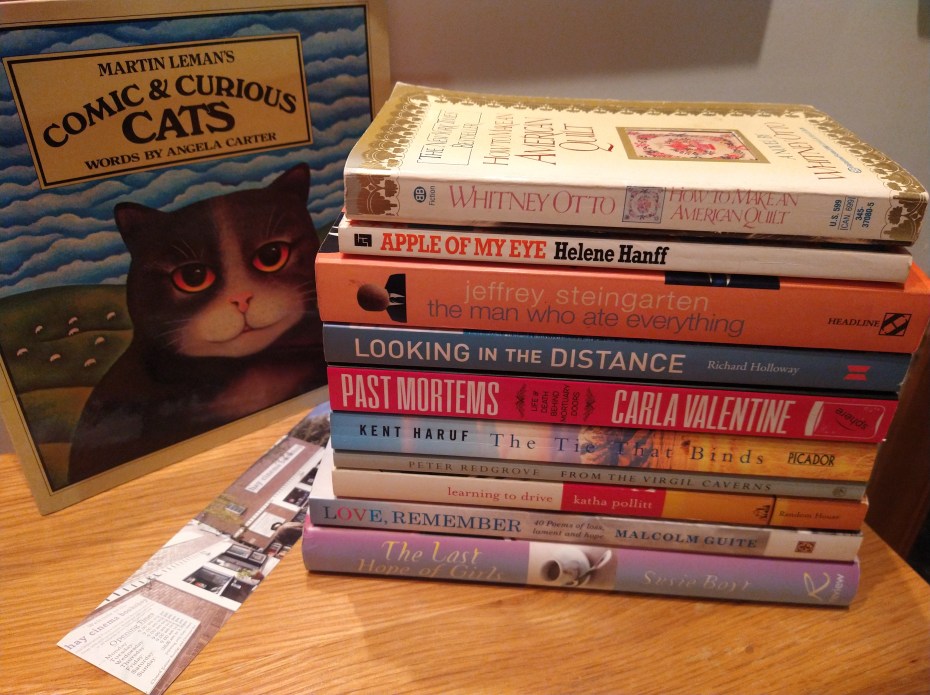
Read: Only 1 – Uh oh…
- Learning to Drive by Katha Pollitt

But also:
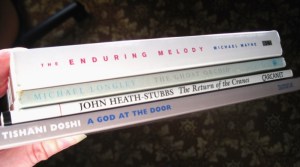
Partially read: 4
- A God at the Door by Tishani Doshi – Doshi is awesome. This is only my second of her poetry collections. I’ll finish it this month for Dewithon.
- Looking in the Distance by Richard Holloway – The problem with Holloway is that all of his books of recent decades are about the same – a mixture of mediations and long quotations from poetry – and I have one from last year on the review catch-up pile already. But I’m sure I’ll finish this at some point.
- The Ghost Orchid by Michael Longley – No idea why I set this one aside, but I’ve put it back on a current stack.
- The Enduring Melody by Michael Mayne – I have this journal of his approaching death as one of my bedside books and read a tiny bit of it at a time. (Memento mori?)
Skimmed: 1
- Love, Remember: 40 Poems of Loss, Lament and Hope by Malcolm Guite – I enjoyed the poetry selection well enough but didn’t find that the author’s essays added value, so I’m donating this to my church’s theological library.
That left 10 still to read. Eager to make some progress, I picked up a quick win, Comic & Curious Cats, illustrated in an instantly recognizable blocky folk art style by Martin Leman (I also have his Twelve Cats for Christmas, a stocking present I gave my husband this past year) and with words by Angela Carter. Yes, that Angela Carter! It’s picture book size but not really, or not just, for children. Each spread of this modified abecedarian includes a nonsense poem that uses the letter as much as possible: the cat’s name, where they live, what they eat, and a few choice adjectives. I had to laugh at the E cat being labelled “Elephantine.” Who knows, there might be some good future cat names in here: Basil and Clarissa? Francesca and Gordon? Wilberforce? “I love my cat with an XYZ [zed] … There is really nothing more to be said.” Charming. (Secondhand purchase – Hay-on-Wye Booksellers)


Total still unread: 9
Luckily, I’m still keen to read all of them. I’ll start with the two I purchased new, So Happy for You by Celia Laskey, a light LGBTQ thriller about a wedding (from Gay on Wye with birthday money from friends, a sweet older lesbian couple – so it felt appropriate to use their voucher there!), and Past Mortems by Carla Valentine, a memoir set at a mortuary (remainder copy from Addymans); as well as a secondhand novel, The Tie that Binds by Kent Haruf (Hay-on-Wye Booksellers) and the foodie essays of The Man Who Ate Everything by Jeffrey Steingarten (Cinema).
Then, if I still haven’t read them before the trip (who am I kidding…), I’ll pack for the car a few small volumes that will fit neatly into my handbag: Apple of My Eye by Helene Hanff, How to Make an American Quilt by Whitney Otto, and one of the poetry collections.
Fathers: Reflections by Daughters (Virago Anthology)
Books that dwell on family bonds often spotlight mothers and daughters, or fathers and sons; it seems a bit less common to examine the relationship with the parent of the opposite sex. In advance of Father’s Day, I picked up Fathers: Reflections by Daughters (1983; 1994) and read the first third. As I once did for Mother’s Day with another Virago anthology, Close Company: Stories of Mothers and Daughters, I’ll end up reading it across several years. Where that was a short fiction collection, though, this is all autobiographical pieces.
The section I’ve read so far contains seven essays counting editor Ursula Owen’s introduction, plus a retelling of the fairy tale “Cap o’ Rushes.” Most of the authors were born in the 1940s or 1950s, so a common element is having a father who served in the Second World War – or the First (for Angela Carter and Doris Lessing). There’s a sense, therefore, of momentous past experience that will never be disclosed. As Lessing writes of her father, “I knew him when his best years were over” – that is, after he had lost a leg, given up his favourite foods due to diabetes, and undertaken a doomed farming enterprise in colonial Africa.

Freudian interpretation seems like a given for several of the memoirists. Anne Boston was a posthumous child whose father was killed in the last days of WWII; in “Growing Up Fatherless,” she explores how this might have affected her.
I’ve always tended to discount the effects of being without a father – quite wrongly, I think now. There were effects, and they continued to influence my entire life, if anything increasingly so.
Among these effects, she enumerates a lack of proper “sexual conditioning.” Anthropologist Olivia Harris, too, wonders how a father determines a woman’s relationships with other men:
How far do women choose in their spouses, encourage in their sons, the ideal remembrance of the father? Am I, but not being married, refusing to exchange my father, or am I diffusing that chain of being?
Two authors specifically interrogate the alignment of the father with God. In “Heavenly Father,” Harris compares visions of fatherhood in various cultures, including in Anglican Christianity. Here the father, in parallel with the deity, is something of a distant moral arbiter. Sara Maitland felt the same about her father:
he really did correspond to the archetype of the Father. Many women grow out of their father when they discover that he is not really like what fathers are supposed, imaginatively, mythologically to be: he is weak, or a failure, or dishonest, or uninterested, or goes away. My father was not a perfect person, but he was very Father-like.
Unknown, aloof, a disciplinarian … I wonder if those descriptions resonate with you as much as they do with me?
In between pieces, Owen has reprinted 1–4 quotes from novels or academic sources that are relevant to fathers and daughters. The result is, as she acknowledges in the introduction, “a sort of collage.” She also remarks on the fact that it was difficult for more than one contributor to find a photo of herself with her father because “Dad always takes the photograph.” The essay I haven’t yet mentioned is a sweet but inconsequential two-pager by 13-year-old Kate Owen; it’s just occurred to me that that’s probably the editor’s daughter.
I’ll be interested to see how Michèle Roberts, Adrienne Rich, Alice Munro and more will clarify or complicate the picture of father–daughter relationships in the rest of the volume. (Secondhand from a National Trust bookshop)
R.I.P. Reads for Halloween: Ashworth, Bazterrica, Hill, Machado & More
I don’t often read anything that could be classed as suspense or horror, so the R.I.P. challenge is a fun excuse to dip a toe into these genres each year. This year I have an eerie relationship study, a dystopian scenario where cannibalism has become the norm, some traditional ghost stories old and new, and a bonus story encountered in an unrelated anthology.

Ghosted: A Love Story by Jenn Ashworth (2021)
Laurie’s life is thrown off kilter when, after they’ve been together 15 years, her husband Mark disappears one day, taking nothing with him. She continues in her job as a cleaner on a university campus in northwest England. After work she visits her father, who is suffering from dementia, and his Ukrainian carer Olena. In general, she pretends that nothing has happened, caring little how odd it will appear that she didn’t call the police until Mark had been gone for five weeks. Despite her obsession with true crime podcasts, she can’t seem to imagine that anything untoward has happened to him. What happened to Mark, and what’s with that spooky spare room in their flat that Laurie won’t let anyone enter?
 If you find unreliable narrators delicious, you’re in the right place. The mood is confessional, yet Laurie is anything but confiding. Occasionally she apologizes for her behaviour: “I realise this does not sound very sane” is one of her concessions to readers’ rationality. So her drinking problem doesn’t become evident until nearly halfway through, and a bombshell is still to come. It’s the key to understanding our protagonist and why she’s acted this way.
Ghosted wasn’t what I expected. Its air of supernatural menace mellows; what is to be feared is much more ordinary. The subtitle should have been more of a clue for me. I appreciated the working class, northern setting (not often represented; Ashworth is up for this year’s Portico Prize) and the unusual relationships Laurie has with Olena, as well as with co-worker Eddie and neighbour Katrina. Reminiscent of Jo Baker’s The Body Lies and Sue Miller’s Monogamy, this story of a storm-tossed marriage was a solid introduction to Ashworth’s fiction – this is her fifth novel – but I’m not sure the payoff lived up to that amazing cover.
With thanks to Sceptre for the free copy for review.
Tender Is the Flesh by Agustina Bazterrica (2017; 2020)
[Translated from the Spanish by Sarah Moses]
 This sledgehammer of a short Argentinian novel has a simple premise: not long ago, animals were found to be infected with a virus that made them toxic to humans. During the euphemistic “Transition,” all domesticated and herd animals were killed and the roles they once held began to be filled by humans – hunted, sacrificed, butchered, scavenged, cooked and eaten. A whole gastronomic culture quickly developed around cannibalism.
Marcos is our guide to this horrific near-future world. Although he works in a slaughterhouse, he’s still uneasy with some aspects of the arrangement. The standard terminology is an attempt at dispassion: the “heads” are “processed” for their “meat.” Smarting from the loss of his baby son and with his father in a nursing home, Marcos still has enough compassion that when he’s gifted a high-quality female he views her as a person rather than potential cuts of flesh. His decisions from here on will call into question his loyalty to the new system.
I wondered if there would come a point where I was no longer physically able to keep reading. But it’s fiendishly clever how the book beckons you into analogical situations and then forces you to face up to cold truths. It’s impossible to avoid the animal-rights message (in a book full of gruesome scenes, the one that involves animals somehow hits hardest), but I also thought a lot about how human castes might work – dooming some to muteness, breeding and commodification, while others are the privileged overseers granted peaceful ends. Bazterrica also conflates sex and death in uncomfortable ways. In one sense, this was not easy to read. But in another, I was morbidly compelled to turn the pages. Brutal but brilliant stuff. (Public library/Edelweiss)
Fear: Tales of Terror and Suspense, selected by Roald Dahl (2017)
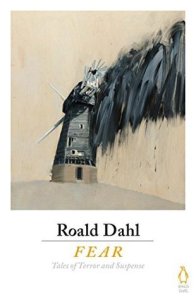 I reviewed the five female-penned ghost stories for R.I.P. back in 2019. This year I picked out another five, leaving a final four for another year. (Review copy)
“W.S.” by L.P. Hartley: The only thing I’ve read of Hartley’s besides The Go-Between. Novelist Walter Streeter is confronted by one of his characters, to whom he gave the same initials. What’s real and what’s only going on in his head? Perfectly plotted and delicious.
“In the Tube” by E.F. Benson: The concept of time is called into question when someone witnesses a suicide on the London Underground some days before it could actually have happened. All recounted as a retrospective tale. Believably uncanny.
“Elias and the Draug” by Jonas Lie: A sea monster and ghost ship plague Norwegian fishermen.
“The Ghost of a Hand” by J. Sheridan Le Fanu: A disembodied hand wreaks havoc in an eighteenth-century household.
“On the Brighton Road” by Richard Middleton: A tramp meets an ill boy on a road in the Sussex Downs. A classic ghost story that pivots on its final line.
The Small Hand: A Ghost Story by Susan Hill (2010)
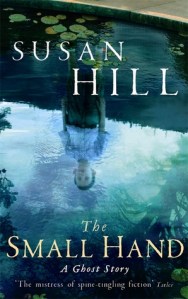 This was my fourth of Hill’s classic ghost stories, after The Woman in Black, The Man in the Picture and Dolly. They’re always concise and so fluently written that the storytelling voice feels effortless. I wondered if this one might have been inspired by “The Ghost of a Hand” (above). It doesn’t feature a disembodied hand, per se, but the presence of a young boy who slips his hand into antiquarian book dealer Adam Snow’s when he stops at an abandoned house in the English countryside, and again when he goes to a French monastery to purchase a Shakespeare First Folio. Each time, Adam feels the ghost is pulling him to throw himself into a pond. When Adam confides in the monks and in his brother, he gets different advice. A pleasant and very quick read, if a little predictable. (Free from a neighbour)
And a bonus story:
 Carmen Maria Machado’s “The Lost Performance of the High Priestess of the Temple of Horror” appears in Kink (2021), a short story anthology edited by Garth Greenwell and R.O. Kwon. (I requested it from NetGalley just so I could read the stories by Machado and Brandon Taylor.) It opens “I would never forget the night I saw Maxa decompose before me.” A seamstress, obsessed with an actress, becomes her dresser. Set in the 19th-century Parisian theatre world, this pairs queer desire and early special effects and is over-the-top sensual in the vein of Angela Carter, with hints of the sadomasochism that got it a place here.
Sample lines: “Women seep because they occupy the filmy gauze between the world of the living and the dead.” & “Her body blotted out the moon. She was an ambulatory garden, a beacon in a dead season, life where life should not grow.”
Also counting the short stories by Octavia E. Butler and Bradley Sides, I did some great R.I.P. reading this year! I think the book that will stick with me the most is Tender Is the Flesh.
Fairy Tales, Outlaws, Experimental Prose: Three More January Novels
Today I’m featuring three more works of fiction that were released this month, as a supplement to yesterday’s review of Mrs Death Misses Death. Although the four are hugely different in setting and style, and I liked some better than others (such is the nature of reading and book reviewing), together they’re further proof – as if we needed it – that female authors are pushing the envelope. I wouldn’t be surprised to see any or all of these on the Women’s Prize longlist in March.
The Charmed Wife by Olga Grushin
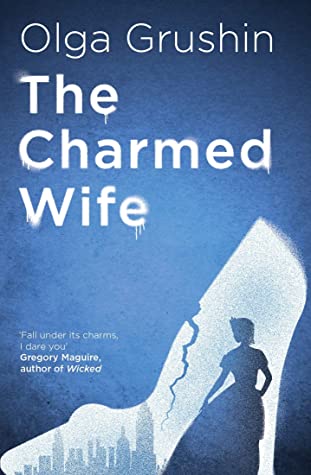 What happens next for Cinderella?
Grushin’s fourth novel unpicks a classic fairy tale narrative, starting 13.5 years into a marriage when, far from being starry-eyed with love for Prince Roland, the narrator hates her philandering husband and wants him dead. As she retells the Cinderella story to her children one bedtime, it only underscores how awry her own romance has gone: “my once-happy ending has proved to be only another beginning, a prelude to a tale dimmer, grittier, far more ambiguous, and far less suitable for children”. She gathers Roland’s hair and nails and goes to a witch for a spell, but her fairy godmother shows up to interfere. The two embark on a good cop/bad cop act as the princess runs backward through her memories: one defending Roland and the other convinced he’s a scoundrel.
Part One toggles back and forth between flashbacks (in the third person and past tense) and the present-day struggle for the narrator’s soul. She comes to acknowledge her own ignorance and bad behaviour. “All I want is to be free—free of him, free of my past, free of my story. Free of myself, the way I was when I was with him.” In Part Two, as the princess tries out different methods of escape, Grushin coyly inserts allusions to other legends and nursery rhymes: a stepsister lives with her many children in a house shaped like a shoe; the witch tells a variation on the Bluebeard story; the fairy godmother lives in a Hansel and Gretel-like candy cottage; the narrator becomes a maid for 12 slovenly sisters; and so on.
 The plot feels fairly aimless in this second half, and the mixture of real-world and fantasy elements is peculiar. I much preferred Grushin’s previous book, Forty Rooms (and Angela Carter’s The Bloody Chamber, one of her chief inspirations). However, her two novels share a concern with how women’s ambitions can take a backseat to their roles, and both weave folktales and dreams into a picture of everyday life. But my favourite part of The Charmed Wife was the subplot: interludes about Brie and Nibbles, the princess’s pet mice; their lives being so much shorter, they run through many generations of a dramatic saga while the narrator (whose name we do finally learn, just a few pages from the end) is stuck in place.
With thanks to Hodder & Stoughton for the free copy for review.
Outlawed by Anna North
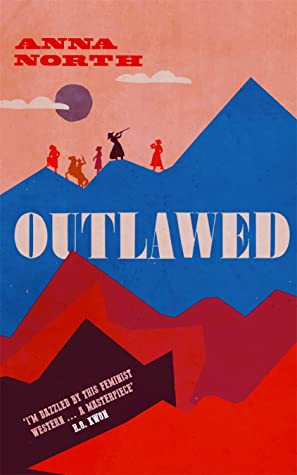 I was a huge fan of North’s previous novel, The Life and Death of Sophie Stark, which cobbles together the story of the title character, a bisexual filmmaker, from accounts by the people who knew her best. Outlawed, an alternative history/speculative take on the traditional Western, could hardly be more different. In a subtly different version of the United States, everyone now alive in the 1890s is descended from those who survived a vicious 1830s flu epidemic. The duty to repopulate the nation has led to a cult of fertility and devotion to the Baby Jesus. From her mother, a midwife and herbalist, Ada has learned the basics of medical care, but the causes of barrenness remain a mystery and childlessness is perceived as a curse.
Ada marries at 17 and fails to get pregnant within a year. After an acquaintance miscarries, rumours start to spread about Ada being a witch. Kicked out by her mother-in-law, she takes shelter first at a convent and then with the Hole in the Wall gang. She’ll be the doctor to this band of female outlaws who weren’t cut out for motherhood and shunned marriage – including lesbians, a mixed-race woman, and their leader, the Kid, who is nonbinary. The Kid is a mentally tortured prophet with a vision of making the world safe for people like them (“we were told a lie about God and what He wants from us”), mainly by, Robin Hood-like, redistributing wealth through hold-ups and bank robberies. Ada, who longs to conduct proper research into reproductive health rather than relying on religious propaganda, falls for another gender nonconformist, Lark, and does what she can to make the Kid’s dream a reality.
Reese Witherspoon choosing this for her Hello Sunshine book club was a great chance for North’s work to get more attention. However, I felt that the ideas behind this novel were more noteworthy than the execution. The similarity to The Handmaid’s Tale is undeniable, though I liked this a bit more. I most enjoyed the medical and religious themes, and appreciated the attention to childless and otherwise unconventional women. But the setup is so condensed and the consequences of the gang’s major heist so rushed that I wondered if the novel needed another 100 pages to stretch its wings. I’ll just have to await North’s next book.
With thanks to W&N for the proof copy for review.
little scratch by Rebecca Watson
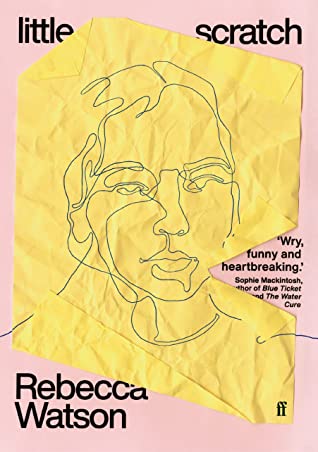 I love a circadian narrative and had heard interesting things about the experimental style used in this debut novel. I even heard Watson read a passage from it as part of the Faber Live Fiction Showcase and found it very funny and engaging. But I really should have tried an excerpt before requesting this for review; I would have seen at a glance that it wasn’t for me. I don’t have a problem with prose being formatted like poetry (Girl, Woman, Other; Stubborn Archivist; the prologue of Wendy McGrath’s Santa Rosa; parts of Mrs Death Misses Death), but here it seemed to me that it was only done to alleviate the tedium of the contents.
A young woman who, like Watson, works for a newspaper, trudges through a typical day: wake up, get ready, commute to the office, waste time and snack in between doing bits of work, get outraged about inconsequential things, think about her boyfriend (only ever referred to as “my him” – probably my biggest specific pet peeve about the book), and push down memories of a sexual assault. Thus, the only thing that really happens happened before the book even started. Her scratching, to the point of open wounds and scabs, seems like a psychosomatic symptom of unprocessed trauma. By the end, she’s getting ready to tell her boyfriend about the assault, which seems like a step in the right direction.
I might have found Watson’s approach captivating in a short story, or as brief passages studded in a longer narrative. At first it’s a fun puzzle to ponder how these mostly unpunctuated words, dotted around the pages in two to six columns, fit together – should one read down each column, or across each row, or both? – but when all the scattershot words are only there to describe a train carriage filling up or repetitive quotidian actions (sifting through e-mails, pedalling a bicycle), the style soon grates. You may have more patience with it than I did if you loved A Girl Is a Half-Formed Thing or books by Emma Glass.


A favourite passage: “got to do this thing again, the waking up thing, the day thing, the work thing, disentangling from my duvet thing, this is something, this is a thing I have to do then,” [appears all as one left-aligned paragraph]
With thanks to Faber & Faber for the free copy for review.
Tomorrow I’ll review three nonfiction works published in January, all on a medical theme.
What recent releases can you recommend?
A Week in Italy and What I Read
We’re relieved to be back in the balmy UK after a sweltering week in northern Italy. Though our sixth-floor Airbnb apartment in Milan suited our needs perfectly, it was a challenge to keep it minimally comfortable. Eventually we worked out that it was essential to get up by 6:30 a.m. to close the balcony doors and shutter. The bedroom happened to be shaded, so I could set up my laptop in there and work until noon, when it was time to close out the heat of the day on that side. In the afternoons I read and napped on the divan, and then sometime between 6 and 10 p.m., depending on how sunny it had been during the day, we could fling the windows and doors wide open again. Fans helped, but we still passed some horribly muggy nights.


My husband was at his conference for four of the days, so we only braved the city centre itself on Monday morning, touring the Duomo and climbing the steps to the roof. This was well worth doing for views over the city. Afterwards we walked through the associated museum (mostly underground, and blissfully cool with air conditioning) and Galleria Vittorio Emanuele II, a luxurious nineteenth-century shopping arcade filled with designer fashions.


Two day trips by train got us out of the city and into slightly cooler temperatures: on Wednesday we explored Varenna and Bellagio on Lake Como, and on Saturday we took a bus and cable car from Lecco into the mountains at Piani d’Erna. We took full advantage of one-euro espressos and glasses of wine, and ate lots of pizza, pasta and gelato.

After much deliberation, this is the book stack I actually packed for our trip. I got through the first half of the Orwell, an excellent account of working as a dishwasher in Paris hotels and having to scrape together enough money to ward off starvation. I’ll be writing it up as my Classic of the Month in a couple of weeks. I also read Sunburn by Laura Lippman, which I’ll hold in reserve for a summer-themed post, and (on Kindle) So Many Rooms by Laura Scott, a debut poetry collection coming out in October that I’ll review here at a later date.
Two of my other Kindle reads ended up being perfect for the setting:
From Scratch: A Memoir of Love, Sicily, and Finding Home by Tembi Locke: This was the perfect book for me to read during the week in Italy. Not only is it set largely in Sicily, but it ticks a lot of boxes in terms of my reading interests: food, travel, bereavement, and the challenges of being an American overseas. During a semester abroad in Florence, Locke (an actress I was previously unfamiliar with) met and fell in love with Saro Gullo, an Italian chef. His parents could hardly accept him marrying someone from outside of Sicily, let alone a black woman from Texas, and refused to attend their wedding. But as the years passed they softened towards Locke, who gradually became accepted in Saro’s hometown of Aliminusa.
In fact, after Saro’s death from bone cancer in 2012, she became like a second daughter to Saro’s mother. The book focuses on the three summers in a row when she and her adopted daughter Zoela traveled to the family home in Sicily to stay with Nonna. I particularly appreciated the exploration of what it’s like to live between countries and cultures. This is one of three Reese Witherspoon book club books I’ve read so far (along with Where the Crawdads Sing and Daisy Jones and the Six), and all have been great – Reese’s recommendations are proving as reliable as Oprah’s. 
 A mudslide blocked the route we should have taken back from Milan to Paris, so we rebooked onto trains via Switzerland. This plus the sub-Alpine setting for our next-to-last day made the perfect context for racing through Where the Hornbeam Grows: A Journey in Search of a Garden by Beth Lynch in just two days. Lynch moved from England to Switzerland when her husband took a job in Zurich. Suddenly she had to navigate daily life, including frosty locals and convoluted bureaucracy, in a second language. The sense of displacement was exacerbated by her lack of access to a garden. Gardening had always been a whole-family passion, and after her parents’ death their Sussex garden was lost to her. Two years later she and her husband moved to a cottage in western Switzerland and cultivated a garden idyll, but it wasn’t enough to neutralize their loneliness.
Much of what Lynch has to say about trying to find genuine connections as an expatriate rang true for me. Paradise Lost provides an unexpected frame of reference as Lynch asks what it means for a person or a plant to be transplanted somewhere new, and what it takes to thrive. Her elegant writing reminded me of Diana Athill’s and Penelope Lively’s, and the exploration of the self through gardens is reminiscent of Allan Jenkins’s Plot 29.
Other successful reads:
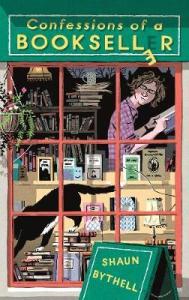 Confessions of a Bookseller by Shaun Bythell: This picks up right where The Diary of a Bookseller left off and carries through the whole of 2015. Again it’s built on the daily routines of buying and selling books, including customers’ and colleagues’ quirks, and of being out and about in a small town. I wished I was in Wigtown instead of Milan! Because of where I was reading the book, I got particular enjoyment out of the characterization of Emanuela (soon known as “Granny” for her poor eyesight and myriad aches and gripes), who comes over from Italy to volunteer in the bookshop for the summer. Bythell’s break-up with “Anna” is a recurring theme in this volume, I suspect because his editor/publisher insisted on an injection of emotional drama.
 City of Girls by Elizabeth Gilbert: There’s a fun, saucy feel to this novel set mostly in 1940s New York City. Twenty-year-old Vivian Morris comes to sew costumes for her Aunt Peg’s rundown theatre and falls in with a disreputable lot of actors and showgirls. When she does something bad enough to get her in the tabloids and jeopardize her future, she retreats in disgrace to her parents’ – but soon the war starts and she’s called back to help with Peg’s lunchtime propaganda shows at the Brooklyn Navy Yard. The quirky coming-of-age narrative reminded me a lot of classic John Irving, while the specifics of the setting made me think of Wise Children, All the Beautiful Girls and Manhattan Beach. The novel takes us to 2010, when Vivian is 90 and still brazenly independent. I was somewhat underwhelmed – while it’s a fairly touching story of how to absorb losses and make an unconventional family, I wondered if it had all meant much. I’ll be expanding this into a Shiny New Books review.
 Judgment Day by Sandra M. Gilbert: English majors will know Gilbert best for her landmark work of criticism, The Madwoman in the Attic (co-written with Susan Gubar). I had no idea that she writes poetry. This latest collection has a lot of interesting reflections on religion, food and art, as well as elegies to those she’s lost. Raised Catholic, Gilbert married a Jew, and the traditions of Judaism still hold meaning for her after husband’s death even though she’s effectively an atheist. “Pompeii and After,” a series of poems describing food scenes in paintings, from da Vinci to Hopper, is particularly memorable.
Not-so-successful reads:
 Vintage 1954 by Antoine Laurain: Dreadful! I would say: avoid this sappy time-travel novel at all costs. I thought the setup promised a gentle dose of fantasy, and liked the fact that the characters could meet their ancestors and Paris celebrities during their temporary stay in 1954. But the characters are one-dimensional stereotypes, and the plot is far-fetched and silly. I know many others have found this delightful, so consider me in the minority…
As well as a few DNFs…
What Dementia Teaches Us about Love by Nicci Gerard: I’ve read a lot of books about dementia, both clinical and anecdotal, and this doesn’t add anything new. (11%)
The Great Railway Bazaar by Paul Theroux: I read the first 32 pages, up to when Theroux arrives in northern Italy. He mostly describes his fellow passengers, as well as the details of meals and sleeping arrangements on trains. The writing struck me as old-fashioned, and I couldn’t imagine getting through another nearly 350 pages of it.
Out of the Woods by Luke Turner: Attempts to fuse nature and sexuality in a way that’s reminiscent of Hidden Nature by Alys Fowler. The writing didn’t draw me in at all. (5%)
A Retrospective of 2018’s Events, Reading Projects and Themes
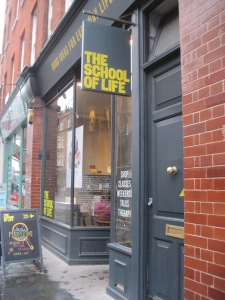 In January I had the tremendous opportunity to have a free personalized bibliotherapy appointment with Ella Berthoud at the School of Life in London. I’ve since read three of her prescriptions plus parts of a few others, but I still have several more awaiting me in the early days of 2019, and will plan to report back at some point on what I got out of all of them.
In March to April I ran a Wellcome Book Prize shadow panel for the second time. This year it was much more successful; I plan to do it again next year, too. (I actually proffered myself as an official judge for next year’s prize and got a very kind but entirely noncommittal e-mail back from the chairwoman, which I will have to take as victory enough.)
 Early April saw us visiting Wigtown, Scotland’s book town, for the first time. It was a terrific trip, but thus far I have not been all that successful at reading the 13 books that I bought! (Just two and a quarter so far.)
I reviewed three novels for Liz Dexter’s Iris Murdoch Readalong project: A Severed Head in March, The Italian Girl in June, and The Nice and the Good in September. In February I’ll pop back in with one more paperback that I own, The Sacred and Profane Love Machine. November was Margaret Atwood Reading Month, hosted by Marcie of Buried in Print and Naomi of Consumed by Ink, and provided me with a good excuse to read her first two novels.
 I did some “buddy reads” for the first time: Andrea Levy’s Small Island with Canadian blogger friends, including Marcie and Naomi; and West With the Night with Laila of Big Reading Life and Late Nights on Air with Naomi as well as Penny of Literary Hoarders during 20 Books of Summer, which I took part in for the first time. In May my mother and I read W. Somerset Maugham’s The Painted Veil and shared reading notes via e-mail. (A planned buddy read of The Left Hand of Darkness with Annabel and Laura was, alas, a fail.)
Besides the official Wellcome Book Prize blog tour in April, I participated in another 11 blog tours, averaging out at one a month. I’m going to scale back on these next year because I have too often found, after I accepted, that the book was a dud and I had to just run an extract because I could see I wasn’t going to get through it and write a review.
I joined my neighborhood book club in September and have attended every month since then. Our first four selections were Ladder of Years by Anne Tyler, The Gracekeepers by Kirsty Logan, Noonday by Pat Barker, and Number 11 by Jonathan Coe. I’d already read the Logan and Coe years ago and didn’t fancy rereading them, so wasn’t able to participate as much in those months, but was still glad to go along for the socializing. My husband even read the Coe and came to December’s meeting (was it just for the mince pies and mulled wine?!). We’ve set our first four reads for 2019 – the three below, in order from left to right, plus Ernest Hemingway’s The Garden of Eden, which I’ll borrow from the university library.

 In October I won tickets to see a production of Angela Carter’s Wise Children at the Old Vic in London. Just a few weeks later I won tickets to see Barbara Kingsolver in conversation about Unsheltered at the Southbank Centre. I don’t often make it into London, so it was a treat to have bookish reasons to go and blogging friends to meet up with (Clare of A Little Blog of Books joined me for both, and Laura T. was also at the Kingsolver event).
November was mostly devoted to novellas, for the third year in a row. Although I didn’t officially participate in Nonfiction November, I still enjoyed coming up with some fiction/nonfiction pairings and an “expert’s” list of women’s religious memoirs.
My husband wrote pretty much his entire PhD thesis this year and on Friday the 14th had his graduation ceremony. I was the moral support / proofreader / preparer of simple meals during the months when he was in the throes of writing up, so I will consider myself as sharing in the accomplishment. Congratulations, Dr. Foster!
This month and into January I’ll be reading the last few nominees for the National Book Critics Circle’s John Leonard Prize.

When the list of finalists was released, I was relieved to see I’d already read four out of seven (and three of those were ones I’d nominated); the other three – the Adjei-Brenyah and Brinkley stories and There There – were books I was keen to read but hadn’t managed to get hold of. About 80 of us NBCC members are reading the shortlist and voting for the best first book of the year by January 8th. Plus I’m technically up for an NBCC prize myself, in that I nominated myself (that’s how it works) for the 2018 Nona Balakian Citation for Excellence in Reviewing and sent in an application with five of my best reviews from the year.
The Ones that Got Away
 Two posts I planned but never got around to putting together would have commemorated the 50th anniversary of Thomas Merton’s death (I own several of his books but am most interested in reading The Seven-Storey Mountain, which celebrated its 70th birthday in October) and the 40th anniversary of the publication of The Snow Leopard by the late Peter Matthiessen. Perhaps I’ll try these authors for the first time next year instead.
Final Book Serendipity Incidents
In the second half of the year I started keeping track of all my weird reading coincidences, posting about them on Twitter or Instagram before collecting them into a blog post a couple months ago. Here are a few that popped up since then or recalled earlier reads from the year:
- Two protagonists named Willa: Anne Tyler’s Clock Dance and Barbara Kingsolver’s Unsheltered
- Two novels featuring bog people: Anne Youngson’s Meet Me at the Museum and Sarah Moss’s Ghost Wall
- Two dogs named Flash: Ben Crane’s Blood Ties and Andrew Marshall’s The Power of Dog
- Multiple sclerosis is an element in Christian Donlan’s The Unmapped Mind: A Memoir of Neurology, Incurable Disease and Learning How to Live, Jennifer Richardson’s Americashire and Michelle Obama’s Becoming (her father had it)
- The ideas of Freud are mentioned in a 1910s setting in Nancy Horan’s Loving Frank, Annabel Abbs’s Frieda and Daniel Mason’s The Winter Soldier
- Mermaids (or ‘mermaids’) and/or mermen appear in Imogen Hermes Gowar’s The Mermaid and Mrs Hancock, Melissa Broder’s The Pisces, Daniel Mason’s The Winter Soldier, and a series of poems in Miriam Darlington’s Windfall
- Bohemian writer dies young of tuberculosis (or similar) in novels about their wives: Annabel Abbs’s Frieda (D.H. Lawrence) and Nancy Horan’s Under the Wide and Starry Sky (Robert Louis Stevenson)
- Two books that mention the Indonesian practice of keeping dead relatives as mummies and bringing them out on occasion for ritual celebrations: From Here to Eternity by Caitlin Doughty and The Hot Young Widows Club by Nora McInerny
- Two books that include a trip to Lourdes for healing: Heal Me by Julia Buckley and Constellations by Sinéad Gleeson
- Two books that mention the irony of some of the most well-loved modern Christmas songs being written by Jews: In Mid-Air by Adam Gopnik and Christmas Days by Jeanette Winterson
Surprise Themes from My Year’s Reading
A few of these make sense – cults fit with my interest in narratives of religious experience, and it doesn’t take a psychologist to see that my relationship with my father has been an ongoing issue in recent years (I wonder how the numbers would compare for books about mothers?) – but most are completely random.
I decided a theme had to show up at least three times to make the list. Some topics I enjoyed so much I’ll keep reading about them next year. Within a category the books are in rough chronological order of my reading, and I include skims, DNFs and books in progress.
 Fathers (absent/difficult) + fatherhood in general: Educated by Tara Westover, And When Did You Last See Your Father? by Blake Morrison, The Italian Teacher by Tom Rachman, In the Days of Rain by Rebecca Stott, Implosion by Elizabeth W. Garber, Little Women by Louisa May Alcott & March by Geraldine Brooks, The Unmapped Mind by Christian Donlan, Never Mind and Bad News by Edward St. Aubyn, The Reading Promise by Alice Ozma, How to Build a Boat by Jonathan Gornall, Lake Success by Gary Shteyngart, Normal People by Sally Rooney, Rosie by Rose Tremain, My Father and Myself by J.R. Ackerley, Everything Under by Daisy Johnson, Ghost Wall by Sarah Moss, Surfacing by Margaret Atwood, Heart Berries by Terese Marie Mailhot, Blood Ties by Ben Crane, To Throw Away Unopened by Viv Albertine, Small Fry by Lisa Brennan-Jobs
Addiction: The Leavers by Lisa Ko, Mayhem by Sigrid Rausing, The Only Story by Julian Barnes, The Small Door of Your Death by Sheryl St. Germain, Writing and Madness in a Time of Terror by Afarin Majidi, Marlena by Julie Buntin, Ninety Days by Bill Clegg, Bad News by Edward St. Aubyn, Pretend I’m Dead by Jen Beagin, Heart Berries by Terese Marie Mailhot
 Greenland: A Wilder Time by William E. Glassley, This Cold Heaven by Gretel Ehrlich, Miss Smilla’s Feeling for Snow by Peter Høeg, On Balance by Sinéad Morrissey (the poem “Whitelessness”), Cold Earth by Sarah Moss, Crimson by Niviaq Korneliussen, The Library of Ice by Nancy Campbell
Cults: Educated by Tara Westover, Harmony by Carolyn Parkhurst, In the Days of Rain by Rebecca Stott, The Incendiaries by R.O. Kwon, A River Could Be a Tree by Angela Himsel
Trees: Ladders to Heaven by Mike Shanahan, The Overstory by Richard Powers, The Man Who Planted Trees by Jean Giono, The Wood and The Secret Life of the Oak by John Lewis-Stempel
 Flying: Skybound by Rebecca Loncraine, West With the Night by Beryl Markham, Going Solo by Roald Dahl, Skyfaring by Mark Vanhoenacker
The Anglo experience in Africa: Free Woman: Life, Love and Doris Lessing by Lara Feigel, Leaving Before the Rains Come by Alexandra Fuller, West With the Night by Beryl Markham, Going Solo by Roald Dahl
Korean-American women: The Incendiaries by R.O. Kwon, If You Leave Me by Crystal Hana Kim, All You Can Ever Know by Nicole Chung, Famous Adopted People by Alice Stephens, Digging to America by Anne Tyler
 New Zealand: The Garden Party and Other Stories by Katherine Mansfield, To the Is-Land by Janet Frame, Dunedin by Shena Mackay
Life in the White House: Living History by Hillary Rodham Clinton, All the Presidents’ Pastries by Roland Mesnier, Becoming by Michelle Obama
Lighthouses: Stargazing: Memoirs of a Young Lighthouse Keeper by Peter Hill, The Bird Artist by Howard Norman, Under the Wide and Starry Sky by Nancy Horan (about Robert Louis Stevenson, whose family built lighthouses)

More lighthouse books ready for next year.
Butterflies: Four Wings and a Prayer by Sue Halpern, Magdalena Mountain by Robert Michael Pyle, Mama Amazonica by Pascale Petit

More butterfly books ready for next year.
What were some of the highlights of your bookish year?
What odd coincidences and recurring themes have you spotted in your year’s reading?
“Cat Poems” & Other Cats I’ve Encountered in Books Recently
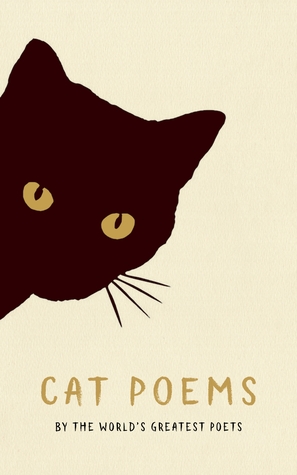 Cat Poems: An enjoyable selection of verse about our feline friends, nicely varied in terms of the time period, original language of composition, and outlook on cats’ contradictory qualities. I was unaware that Angela Carter and Muriel Spark had ever written poetry. There are perhaps too many poems by Stevie Smith – six in total! – though I did enjoy their jokey rhymes.
Some favorite lines:
“Cat sentimentality is a human thing. Cats / are indifferent, their minds can’t comprehend / the concept ‘I shall die’, they just go on living.” (from “Sonnet: Cat Logic” by Gavin Ewart)
“For every house is incomplete without him and a blessing is lacking in the spirit.” (from “Jubilate Agno” by Christopher Smart)
“These adorable things. When my life gives out, they’d eat me up in a second.” (from “I’ll Call Those Things My Cats” by Kim Hyesoon)
My rating: 
Cat Poems was published in the UK on October 4th. My thanks to Serpent’s Tail for the free copy for review.
Even when it’s not a book specifically about cats, cats often turn up in my reading. Maybe it’s simply that I look out for them more since I became a cat owner several years ago. Here are some of the quotes, scenes or whole books featuring cats that I’ve come across this year.
Cats real and imaginary
 Stranger on a Train by Jenni Diski: “I find myself astonished that a creature of another species, utterly different to me, honours me with its presence and trust by sitting on me and allowing me to stroke it. This mundane domestic moment is as enormous, I feel at such moments, as making contact across a universe with another intelligence. This creature with its own and other consciousness and I with mine can sit in silence and enjoy each other’s presence. … This is a perfectly everyday scene but sometimes it takes my breath away that another living thing has allowed me into its life.”
 Certain American States by Catherine Lacey: “This cat wants to destroy beauty—I can tell. He is more than animal, he is evil, a plain enemy of the world. I wish him ill. I do. Almost daily I find a mess of feathers in the dirt. Some mornings there are whole bird carcasses left on my porch—eyes shocked open, brilliant blue wings, ripped and bloody. I have thought often of what it would take to kill a cat, quietly and quickly, with my bare hands. I have thought of this often. In fact I am thinking of it right now.” (from the story “Because You Have To”)
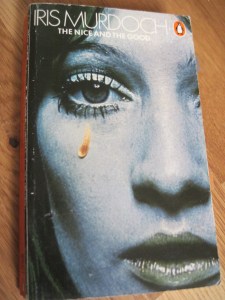 The Nice and the Good by Iris Murdoch: “Montrose was a large cocoa-coloured tabby animal with golden eyes, a square body, rectangular legs and an obstinate self-absorbed disposition, concerning whose intelligence fierce arguments raged among the children. Tests of Montrose’s sagacity were constantly being devised, but there was some uncertainty about the interpretation of the resultant data since the twins were always ready to return to first principles and discuss whether cooperation with the human race was a sign of intelligence at all. Montrose had one undoubted talent, which was that he could at will make his sleek hair stand up on end, and transform himself from a smooth stripey cube into a fluffy sphere. This was called ‘Montrose’s bird look’.”
 Four Bare Legs in a Bed and Other Stories by Helen Simpson: “They found it significant that I called my cat Felony. I argued that I had chosen her name for its euphonious qualities. She used to sink her incisors into the hell of my hand and pause a fraction of a millimeter from breaking the skin, staring at me until her eyes were reduced to sadistic yellow semibreves. She murdered without a qualm. She toyed with her victims, smiling broadly at their squeaks and death throes.
‘Why isn’t she a criminal?’ I asked. …
‘The difference is,’ said Mr Pringle, that we must assume your cat commits her crimes without mischievous discretion.’” (from the story “Escape Clauses”)
 In Delia Owens’s Where the Crawdads Sing, Sunday Justice is the name of the courthouse cat. He sits grooming on the courtroom windowsill during the trial and comes in and curls up to sleep in the cell of a particular prisoner we’ve come to care about.
A recommended picture book
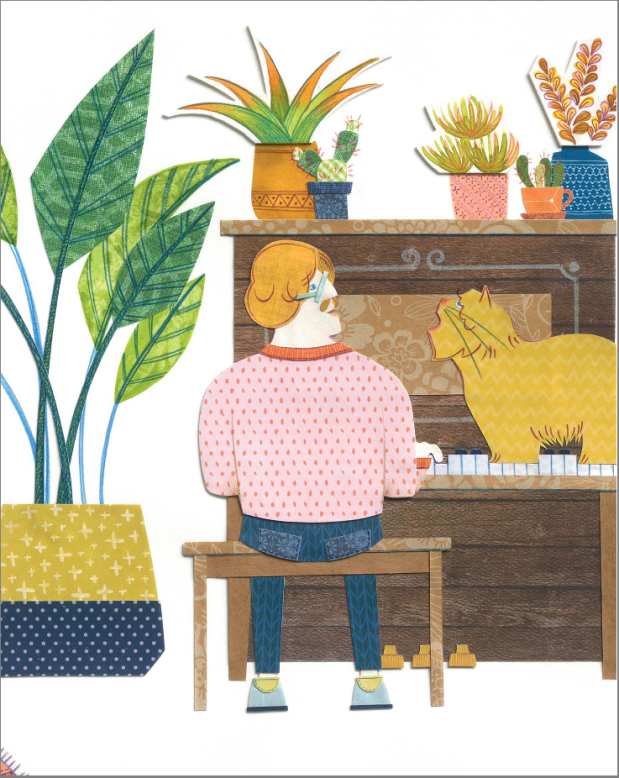
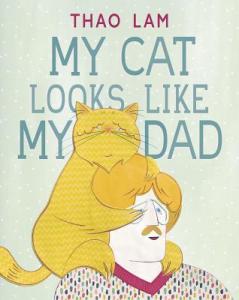 My Cat Looks Like My Dad by Thao Lam: I absolutely loved the papercut collage style of this kids’ book. The narrator explains all the ways in which the nerdy-cool 1970s-styled dad resembles the family cat, who is more like a sibling than a pet. “Family is what you make it.” There’s something of a twist ending, too. (Out on April 15, 2019.)
My rating: 
Later today I’m off to America for two weeks, but I’ll be scheduling plenty of posts, including the usual multi-part year-end run-down of my best reads, to go up while I’m away. Forgive me if I’m less responsive than usual to comments and to your own blogs!
Wise Children by Angela Carter: On the Page and on the Stage
“What a joy it is to dance and sing!”

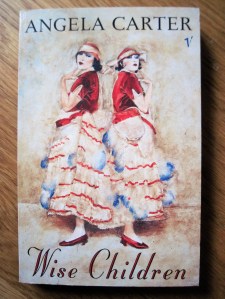
Through a Granta giveaway on Twitter I won two tickets to see Wise Children at London’s Old Vic theatre on October 18th. Clare of A Little Blog of Books joined me for an excellent evening at the theatre, and we both followed it up by reading the novel – Angela Carter’s final book, published in 1991. (Clare’s write-up of the book and play is here.) It has one of the best openers I’ve come across recently:
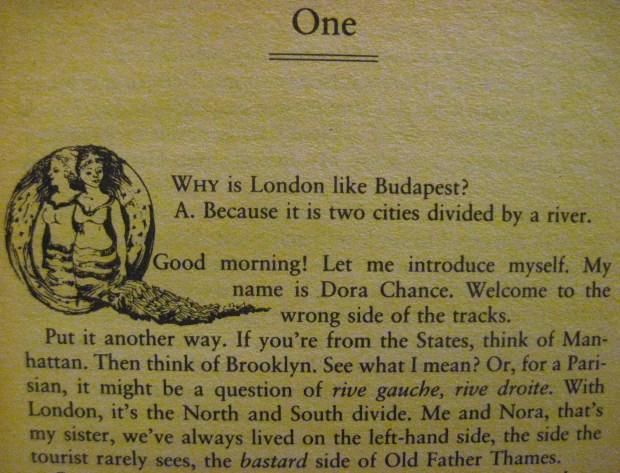
Twins Nora and Dora Chance turn 75 today; their father, Shakespearean actor Melchior Hazard, who has never publicly acknowledged them because they were born out of wedlock to a servant girl who died in childbirth, turns 100. At the last minute an invitation to his birthday party arrives, and between this point and the party Dora fills us in on the sisters’ knotty family history. Their father is also a twin (though fraternal); his brother Peregrine was more of a father to them than Melchior, with “Grandma” Chance, the owner of the boarding house where they were born, the closest thing they had to a mother growing up. By the time they’re teenagers, the girls are on stage at music halls. After a jaunt to Hollywood to appear in Melchior’s filming of A Midsummer Night’s Dream, they’re back in time for wartime deprivation and tragedy in South London, and decades of shabby nostalgia follow.
It’s a big, bawdy story that has, amazingly, been compressed into just 230 pages. There are five sets of twins in total, with multiple cases of doubling, incest and mistaken identity that would make Shakespeare proud. The novel is composed of five long chapters, like the acts in a play, with a Dramatis Personae on the last two pages (though it might have proven more helpful at the start), and the sisters even live at 49 Bard Road. Dora’s voice is slang-filled and gossipy, and she dutifully presents the sisters’ past as the tragicomedy that it was.
Indeed, Wise Children seems perfect for the stage, and Emma Rice’s production recreates everything that’s best about the book, including Dora’s delightful narration. At the start, resplendent in kimonos and turbans, she and Nora greet us from their Brixton home – represented by a kitschy caravan, which with minor redecoration between scenes serves for all the play’s interiors. The 75-year-olds remain on stage for virtually the entire performance, watching along with the audience from the wings and adding in fragments of commentary, often drawn directly from the text, as scenes from their past unfold (including plenty of simulated sex – I wouldn’t recommend taking along any under-15s).
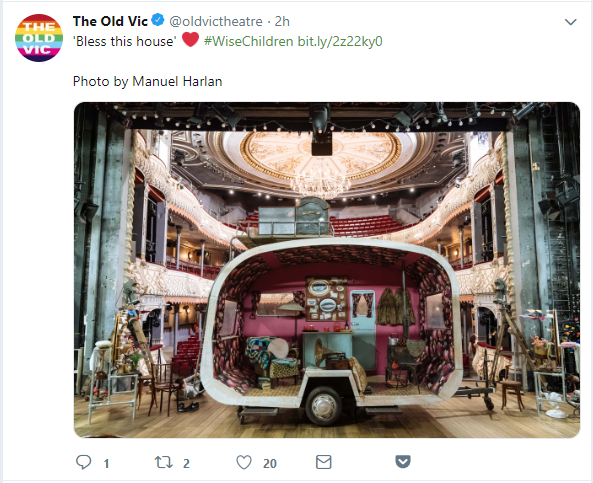
Androgynous extras cycle into various roles as the action proceeds, with the twins represented first by puppets, then by three sets of actors of various races and genders – the teenage/young adult Nora is played by a Black man, while 75-year-old Dora is a man perhaps of South Asian extraction. This adds extra irony to the humor of one of Nora’s lines: “It’s every woman’s tragedy that, after a certain age, she looks like a female impersonator.” Grandma Chance, with her beehive, cat-eye glasses and nude bodysuit, steals the show, with seaside comedian Gorgeous George coming a close second as the most entertaining character.
The play has cut out most of the 1980s layer of characters and made the story line stronger in doing so. The only other scene I wish could have been included is a farcical multiple wedding ceremony in Hollywood. The glitzy costumes, recurring butterflies, and John Waters-esque tacky-chic of the set all felt true to the atmosphere of the book, and the songs mentioned in the text (such as “I Can’t Give You Anything but Love, Baby”) are supplemented by a couple of numbers that evoke the 1980s setting: “Electric Avenue” and “Girls Just Want to Have Fun.”
 This was my fifth book by Carter, and now a joint favorite with The Bloody Chamber and Other Stories – but I liked the play that little bit better. If you get a chance to see it in London or on tour further afield, don’t pass it up. It’s a pure joy.
My rating: Book; Play 
To compare the thoughts of some professional theatregoers and see a few photos, check out the reviews on the Guardian and Telegraph websites.
Review and Q&A: Unruly Creatures by Jennifer Caloyeras
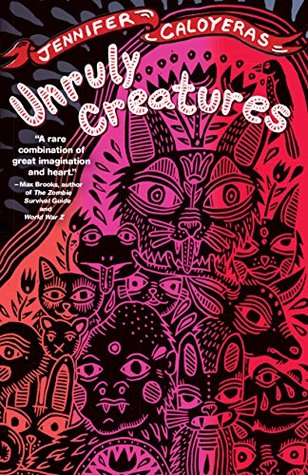
The 11 stories in Jennifer Caloyeras’ new collection, Unruly Creatures (released on October 3rd by West Virginia University Press), feature characters who find themselves in extreme situations and/or are let down by their bodies. Often, their tentative steps outside their own problematic situations involve making unexpected connections with the animal world: a neglected boy learns from a taxidermist, a trainer at the Institute for Privileged Primates is surprised by the depth of her feelings for one of the gorillas in her care, a woman who has just had a double mastectomy empathizes with a cow stuck in the crater left by a crashed meteor, and two teens realize they can only bond with their father when in animal costumes.
 I appreciated the variety of forms and voices here. One story set in a dystopian future has an epistolary element, including letters and memos; two others use second-person or first-person plural narration, respectively. There’s also a lot to think about in terms of gender. For instance, one protagonist frets about out-of-control pubic hair, while another finds it difficult to maintain her trans identity on a male prison ward. “A Real Live Baby” was a stand-out for me. Its title is a tease, though, because Chloe is doing the Egg Baby project in school and ‘babysits’ for her delusional neighbor, who keeps a doll in a stroller. The conflation of dolls and babies is also an element in recent stories by Camilla Grudova and Lesley Nneka Arimah – proof, if we needed it, that modern motherhood is both an enigma and a work in progress.
I’d recommend this story collection to readers of Margaret Atwood and Karen Joy Fowler – and to book clubs. You certainly won’t run out of things to discuss!
My rating:
Jennifer kindly offered to take part in a Q&A over e-mail. We talked about eco-lit, fairy tales gone wild, and how writing and marketing short stories is different from novels.
Animals take on a variety of roles in these stories: research subjects, art projects, friends. Are you an animal lover? Or was that linking theme incidental? And what did you hope to convey about the ways the human and animal worlds intersect?
I am an animal lover. I always have been. When I was younger I really wanted to be a marine biologist. I couldn’t quite get around the math. Then for a while, I thought, animal psychologist. I’ve always been obsessed with animals and animal behavior and the ways in which humans are constantly distancing themselves from animals and their behavior. We have a bit of an unfair superiority complex when it comes to the animal world. I ended up going down an entirely different path (musician and singer) before applying to graduate school for a MA in English and then a MFA in creative writing.
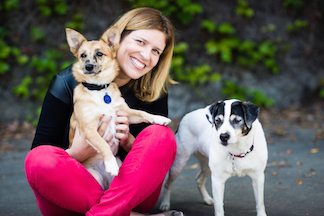
Jennifer with her dogs. Photo by Gene Fama.
But to get back to your question, I didn’t set out to write a collection of linked animal stories; that ended up happening organically. I like to use animals as a mirror or lens through which we see ourselves: sometimes at our worst, most instinctive behavior – sometimes at our best. I think an apt metaphor is that of child staring at an animal at a cage in the zoo, internalizing the thought, “I am nothing like that animal. I am everything like that animal.”
Sometimes the humans are the truly unruly creatures – thinking especially of the obnoxious plane passenger in “Airborne” and Ernest, the persnickety postman in “Big Brother.” How does placing them alongside animal characters point up their flaws?
I am a huge fan of unlikable and unreliable narrators. And I think the short story genre lends itself to utilizing these types of narrators, because you don’t have to sustain this for the duration of an entire novel. In “Big Brother”, the reader aligns with everyone else in the story, not the protagonist. Ernest can’t get over the fact that Les, his co-worker, could have such a bond with a parrot, when Ernest has such a difficult time connecting with anyone, yet in the same story, Ernest’s earnest love for his dog is apparent. He has the key to connecting with people, he just doesn’t have the means to put this knowledge to use.
“H2O” imagines a future extreme drought situation in which only the elite can afford fresh water. Does this feel like a plausible scenario, especially where you live in California?
Oh, the water situation is really scary. I don’t think we’re far off from the scenario presented in this story. It’s always absurd to me when we hear about drought conditions and yet, here I am, driving by a huge verdant golf course. And the access for the wealthy in this particular story resonates in terms of access in general in a capitalistic society. In the story, which is a sort of eco-lit satire (I think I just made up that genre), water is the most coveted commodity, yet it’s marketed differently depending on economic status. Living in Los Angeles, there seems to be a production value to everything here, so I wanted to add that twist in the story – the commercialism of a commodity – how it would be talked about on a production set. How to do the perfect “hard sell” when it comes to water.
I especially love the fairy tale-gone-wild mood of “Unruly”: Caroline loathes the Rapunzel-like abundance of her pubic hair, and instead of a glass slipper we get glass shards in Tom’s arm. How does twisting a fairy tale play with readers’ expectations for a story?
I’ve always been obsessed with fairy tales. My second young adult novel, Strays, has a whole component where a high school English teacher introduces 16-year-old Iris, the protagonist, to Angela Carter’s The Bloody Chamber (if you’re a fairy tale fan, you have to read this one!), which is a feminist reinterpretation of fairy tales. I love how familiar all the fairy tale tropes are. I love the use of magical realism in fairy tales and I love the idea of playing with a familiar and predictable story and undercutting the reader’s expectations. To that end, I recently read (and loved) A. Igoni Barrett’s Blackass – which was a retelling of Kafka’s Metamorphosis. But instead of waking up as a cockroach, in this version – a black man in Lagos wakes up as a white man, afforded all of the benefits of white privilege. As a reader you’re thinking, “I know the story, but I don’t know this story.”
The story “Stuffed” was also inspired loosely by the fairy tale of Hansel and Gretel. The witch in the woods is replaced by a taxidermist (who is not evil) and instead, things with the child go dark pretty quickly.
Occasionally ersatz creatures are on display: doll babies, taxidermied animals, or animal costumes. What are we to make of that gulf between the real thing and the false one on display?
Surrogates are some of my favorite things to explore! I took a deep dive into the world of taxidermy while doing research for “Stuffed”. I really couldn’t get enough. I remember as a child getting lost for hours in the Hall of Mammals at the Natural History Museum in Los Angeles. I think, for me, it’s the idea of creating something to replace something, but the replacement is complete artifice. In terms of taxidermy, essentially, you are replacing death or recreating death to imitate life. A real dead animal is ugly, sunken, decayed. But we have these artists who take death, stuff it with synthetic material, replace eyeballs with beads and you have a recreation of an animal that sometimes looks better off than a live version of that animal. A lot of what is explored in these stories is a stripping down to raw human behavior. People hide behind the masks and costumes and artifice, but placed in certain situations, their animal instincts will always emerge.
[See also my review of the taxidermy-themed English Animals by Laura Kaye.]
Can you remember what the seed was for some of these stories? A particular line, scene, image, or character? Do you start writing a story with a title in mind, or does the title usually suggest itself later on?
Titles always come last for me. Always. I can’t name a thing until I know what that thing is. Writing is such a process and oftentimes I won’t end up where I think I’m going when I’m writing a story. They always surprise me. “Unruly” (the story of the pubic-haired Rapunzel) came directly out of this vivid dream I had when I was pregnant with my first child. I dreamed that I was naked with long flowing hair everywhere and a squirrel came out of a tree, nipped off a chunk of my hair and ran back to her nest and wove the hair into the nest. I remember waking up hysterically laughing. In hindsight it was such an obvious fertility dream; for the sake of the story, I made it a representation of coming-of-age/adolescence – a time where one’s body feels out of control, but I took it to the next level.
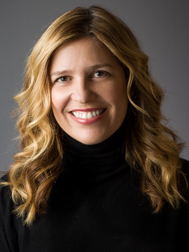
Photo by Gene Fama.
“The Sound of an Infinite Gesture” came directly from Koko the signing gorilla. It’s amazing that a gorilla can use sign language and communicate, but there was also something odd about people putting these very human ideas on a gorilla (remember they got her a pet kitten? And now I see they have her signing PSAs to save the environment?), so I started ruminating on what if we took this idea further – the gorilla communicates so well with her trainer that they begin to develop intimate feelings for one another.
Stories will often come out of an article I read (how leeches are being used in modern medicine led to “Bloodletting”) or from a friend, “Hey, did you know that people go to furry parties where they dress up in costumes and hug one another?” which led to “Plush” and I start playing around with what that might look like. It’s a lot of imaginative play involved. That’s my favorite part of writing – that dreamy time before I actually sit down to type – when it’s all just floating around my head and I’m trying to make a movie of it in my mind.
You’ve previously written YA novels. How different was the experience of writing these short stories? Do you see this work finding a dissimilar audience?
Writing a short fiction collection is not for the faint of heart. I was actually shocked at how slim the collection looked when it arrived in the mail. I kept thinking, “but I did all that work!” Each story, in a way, is treated like a novel. And I’m not talking just about the structure from beginning to end. Every word in a short story is precious; you have to economize. And, in order to get momentum for the collection, you want to publish stories from the collection in literary journals, which takes the same amount of energy and query letters that sending out your novel to an agent or publisher takes!
The audience for this book is completely different than the 13–17 demographic of the two other books. I have had a few people say, “Oh I bought your latest book for my child” and I’m quick to say, “it’s not for kids!” But read at your own risk.
Who are some of your favorite writers? Who has inspired your prose style or your story strategies?
I have so many favorite writers! And I read across all genres. It’s hard to say exactly who has influenced my work, but I will share my favorites! I love Lorrie Moore’s Birds of America. I think she is the best at synthesizing humor and pathos in the same space. I strive to do this in my stories. Pastoralia by George Saunders is another favorite collection. He is a master storyteller, satirist, humorist and his stories bring me to my knees from emotion in unexpected ways. I love Aimee Bender’s use of magical realism. I recently read Ottessa Moshfegh’s Homesick for Another World and loved it! There are so many amazing and varied voices when it comes to contemporary short fiction! The faculty member I worked closely with at the University of British Columbia when I was working on my MFA in creative writing was the Giller-nominated writer, Zsuzsi Gartner. In addition to being an incredible writer herself, she opened up the world of endless possibilities in short fiction, which was incredibly liberating.
What are you working on next?
Last year, I was selected as the writer-in-residence at the Annenberg in Santa Monica and I began working on a contemporary novel about expectations and parenthood. I’m still working on it and hope to be finished by the beginning of the new year. (Now that it’s in writing, maybe I will be further motivated!) I was pretty sure that I was done with short fiction for a while, but then ideas started coming to me again, so it’s my job to listen.
I also teach writing at UCLA Extension’s Writers’ Program. I will be teaching a new course, “Writing the Young Adult Novel”, in the winter and my usual “Intro to Short Fiction” in the spring. The classes are online, so if any of your readers are interested, sign up!
I spend a good amount of my time editing and helping to develop manuscripts and stories for clients. So it’s a nice balance between writing, editing and teaching.
My father, screenwriter Ron Clark, and I are toying with starting a podcast. Stay tuned!
Other places to reach Jennifer on social media:
Facebook Author Page: Jennifer Caloyeras
Twitter: @Jencaloyeras
Instagram: JenniferCaloyeras
Short Stories in September
In 2014 I read 20 short story collections, but in 2015 and 2016 (at least so far) I’ve only managed 10 per year. Three of those have all clumped within the last month or so, though. I started The Pier Falls back in May but set it aside at the halfway point; luckily, when I returned to it earlier this month I devoured the rest within a few hours. I also reviewed the second annual anthology of Best Small Fictions for the Small Press Book Review, a new online venue for me, and tried out Alexandra Kleeman’s short stories after loving her debut novel last year. Mini reviews below…
Best Small Fictions 2016, edited by Stuart Dybek
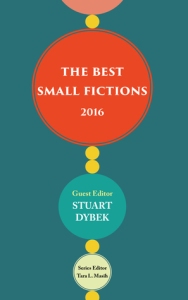 This collects 45 super-short stories that stand out for their structure, voice, and character development—all in spite of often extreme brevity. Humor and pathos provide sharp pivot points. It helps to have an unusual perspective, like that of a Venus flytrap observing a household’s upheavals (Janey Skinner’s “Carnivores”), or of potential names gathering around a baptismal font (Alberto Chimal’s “The Waterfall”). Hard as it is to choose from such a diverse bunch, I do have three favorites: Elizabeth Morton’s “Parting,” in which a divorce causes things to be literally divided; Mary-Jane Holmes’s “Trifle,” where alliteration and culinary vocabulary contrast an English summer with Middle Eastern traces; and Amir Adam’s “The Physics of Satellites,” which uses images from astronomy and a recent suicide to contrast falling, flying, and barely holding on. There are fewer highlights than in the previous volume, but this is still an excellent snapshot of contemporary flash fiction. (See my full review at the Small Press Book Review.)
The Pier Falls by Mark Haddon
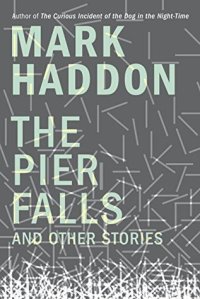 These nine stories examine what characters do in extreme, often violent situations. My three favorites were “Bunny,” reminiscent of The Fattest Man in Britain with its picture of a friendship between an obese man and a young woman who sees more in him than his size; “The Woodpecker and the Wolf,” a brilliantly suspenseful tale set in space – it reminded me of the Sandra Bullock movie Gravity; and “The Weir,” which imagines the unexpectedly lasting relationship between a lonely middle-aged man and the young woman he rescues from a near-suicide by drowning. “Wodwo” starts off as a terrific Christmas horror story but goes on far too long and loses power. I would say that about several of these stories, actually: they’re that bit too long, so that you start waiting for them to be over. I prefer sudden endings that give a bit of a kick. All in all, though, two-thirds of the stories are fairly memorable, and I’d say I liked this better than any of Haddon’s three novels.
Intimations by Alexandra Kleeman
 Kleeman’s debut novel, You Too Can Have a Body Like Mine, was a surprise favorite of mine from last year. Alas, her stories don’t pack the same punch. True, some of them employ a similar combination of surreal plot and in-your-face ideology, but only four out of the 12 stories seemed to me strong enough to stand alone. These were “Lobster Dinner,” surely inspired by David Foster Wallace’s Consider the Lobster, in which crustaceans wreak revenge on their consumers; “The Dancing-Master,” about a man who tries to introduce a nineteenth-century feral boy to culture only for wildness to come creeping back; “I May Not Be the One You Want,” in which Karen, writing a profile about a dairy farmer, avoids men’s attempts to turn her into a sexual object; and “Fake Blood,” another pseudo-horror story about a girl in a nurse costume who can’t decide whether she’s caught up in a murder mystery game or a real serial killer’s trap. Of the rest, four or five – including vignettes from Karen’s future life – are okay and a couple are pointless as well as seemingly endless (“A Brief History of Weather” and “Hylomorphosis”). Students of feminist literature, especially fans of Angela Carter, may be willing to exchange satisfying storytelling for messages about women’s bodies and anxiety about motherhood.
 On Tuesday I finished All That Man Is by David Szalay, from the Booker Prize shortlist. Whether it’s a novel or actually short stories is certainly a matter for debate! After I read Madeleine Thien’s shortlisted novel (I’ll be picking it up from the library on Friday) I’ll report back on both in advance of the prize announcement at the end of October.
 I’m also currently making my way through How Much the Heart Can Hold, a set of seven stories from the likes of Carys Bray and Donal Ryan on the theme of different types of love, and Petina Gappah’s forthcoming collection, Rotten Row. (Both are out in early November.)
Collections on my Kindle that I’m keen to read soon, maybe even before the end of this year, include We Come to Our Senses by Odie Lindsey, Music in Wartime by Rebecca Makkai, and Honeydew by Edith Pearlman.
 Bookish Beck = Rebecca Foster. American transplant to England. Freelance proofreader and book reviewer.
 Bookish Beck