Blog Tour Review: Ask Again, Yes by Mary Beth Keane
Ask Again, Yes is about the inextricable links that form between two Irish-American policemen’s families in New York. Francis Gleeson and Brian Stanhope meet as cops on the same South Bronx beat in July 1973 and soon move upstate, settling in as close neighbors in the suburb of Gillam. After a stillbirth and a miscarriage, Brian and his wife Anne, who’s from Dublin, finally have a son, Peter. Six months later, Francis and Lena’s third daughter, Kate, is born; from the start it’s as if Peter and Kate are destined for each other. They’re childhood best friends, but then, like Romeo and Juliet, have to skirt around the animosity that grows between their families to be together as adults.

Anne’s mental health issues and the Stanhope family history of alcoholism will lead to explosive situations that require heroic acts of forgiveness. I ached for many characters in turn, especially Lena and Kate. The title sets up a hypothetical question: if you had your life to live again, knowing what the future held, would you have it the same way? Keane suggests that for her characters the answer would be yes, even if they knew about all the bad that was to come alongside the good. Impossible to write any more about the plot without giving too much away, so suffice it to say that this is a wrenching story of the ways in which we repeat our family’s mistakes or find the grace to move on and change for the better.
As strong as the novel’s characterization is, and as intricately as the storyline is constructed around vivid scenes, I found this a challenging read and had to force myself to pick it up for 20 pages a day to finish it in time for my blog tour slot. Simply put, it is relentless. And I say that even though I was reading a novel about a school shooting at the same time. There aren’t many light moments to temper the sadness. (Also, one of my pet peeves in fiction is here: skipping over 15 years within a handful of pages.) Still, I expect Keane’s writing will appeal to fans of Celeste Ng and Ann Patchett – the latter’s Commonwealth, in particular, came to mind right away.
My rating: 
Ask Again, Yes was published by Michael Joseph (Penguin) on August 8th. My thanks to the publisher for the proof copy for review.
My Most Anticipated Releases of the Second Half of 2019
Although over 90 books from the second half of the year are already on my radar, I’ve managed to narrow it down to the 15 July to November releases that I’m most excited about. I have access to a few of these already, and most of the rest I will try requesting as soon as I’m back from Milan. (These are given in release date order within thematic sections; the quoted descriptions are from the publisher blurbs on Goodreads.)
[By the way, here’s how I did with my most anticipated releases of the first half of the year:
- 16 out of 30 read; of those 9 were somewhat disappointing (i.e., 3 stars or below) – This is such a poor showing! Is it a matter of my expectations being too high?
- 10 I still haven’t managed to find
- 1 print review copy arrived recently
- 1 I have on my Kindle to read
- 1 I skimmed
- 1 I lost interest in]
Fiction
 The Lager Queen of Minnesota by J. Ryan Stradal [July 23, Pamela Dorman Books] Stradal’s Kitchens of the Great Midwest (2015) is one of my recent favorites. This one has a foodie theme again, and sounds a lot like Louise Miller’s latest – two sisters: a baker of pies and a founder of a small brewery. “Here we meet a cast of lovable, funny, quintessentially American characters eager to make their mark in a world that’s often stacked against them.”
 Hollow Kingdom by Kira Jane Buxton [August 6, Grand Central Publishing / Headline Review] As soon as I heard that this was narrated by a crow, I knew I was going to have to read it. (And the Seattle setting also ties in with Lyanda Lynn Haupt’s book.) “Humanity’s extinction has seemingly arrived, and the only one determined to save it is a foul-mouthed crow whose knowledge of the world around him comes from his TV-watching education.”
 Inland by Téa Obreht [August 13, Random House / Weidenfeld & Nicolson] However has it been eight years since her terrific debut novel?! “In the lawless, drought-ridden lands of the Arizona Territory in 1893, two extraordinary lives collide. … [L]yrical, and sweeping in scope, Inland subverts and reimagines the myths of the American West.” The synopsis reminds me of Eowyn Ivey’s latest.
 A Door in the Earth by Amy Waldman [August 27, Little, Brown and Company] I loved The Submission, Waldman’s 2011 novel about a controversial (imagined) 9/11 memorial. “Parveen Shamsa, a college senior in search of a calling, feels pulled between her charismatic and mercurial anthropology professor and the comfortable but predictable Afghan-American community in her Northern California hometown [and] travels to a remote village in the land of her birth to join the work of his charitable foundation.” (NetGalley download)
 Bloomland by John Englehardt [September 10, Dzanc Books] “Bloomland opens during finals week at a fictional southern university, when a student walks into the library with his roommate’s semi-automatic rifle and opens fire. In this richly textured debut, Englehardt explores how the origin and aftermath of the shooting impacts the lives of three characters.” (print review copy from publisher)
 The Dutch House by Ann Patchett [September 25, Harper / Bloomsbury UK] I’m more a fan of Patchett’s nonfiction, but will keep reading her novels thanks to Commonwealth. “At the end of the Second World War, Cyril Conroy combines luck and a single canny investment to begin an enormous [Philadelphia] real estate empire … Set over … five decades, The Dutch House is a dark fairy tale about two smart people who cannot overcome their past.”
Medical themes
 Will My Cat Eat My Eyeballs?: Big Questions from Tiny Mortals about Death by Caitlin Doughty [September 10, W.W. Norton / September 19, Weidenfeld & Nicolson] I’ve read Doughty’s previous books about our modern attitude towards mortality and death customs around the world. She’s wonderfully funny and iconoclastic. Plus, how can you resist this title?! Although it sounds like it’s geared towards children, I’ll still read the book. “Doughty blends her mortician’s knowledge of the body and the intriguing history behind common misconceptions … to offer factual, hilarious, and candid answers to thirty-five … questions.”
 The Undying: Pain, Vulnerability, Mortality, Medicine, Art, Time, Dreams, Data, Exhaustion, Cancer, and Care by Anne Boyer [September 17, Farrar, Straus and Giroux] “A week after her forty-first birthday, the acclaimed poet Anne Boyer was diagnosed with highly aggressive triple-negative breast cancer. … A genre-bending memoir in the tradition of The Argonauts, The Undying will … show you contemporary America as a thing both desperately ill and occasionally, perversely glorious.” (print review copy from publisher)

From the author’s Twitter page.
Breaking and Mending: A doctor’s story of burnout and recovery by Joanna Cannon [September 26, Wellcome Collection] I haven’t gotten on with Cannon’s fiction, but a memoir should hit the spot. “A frank account of mental health from both sides of the doctor-patient divide, from the bestselling author of The Trouble with Goats and Sheep and Three Things About Elsie, based on her own experience as a doctor working on a psychiatric ward.”
 The Body: A Guide for Occupants by Bill Bryson [October 3, Doubleday / Transworld] His last few books have been somewhat underwhelming, but I’d read Bryson on any topic. He’s earned a reputation for making history, science and medicine understandable to laymen. “Full of extraordinary facts and astonishing stories, The Body: A Guide for Occupants is a brilliant, often very funny attempt to understand the miracle of our physical and neurological makeup.”
 The Depositions: New and Selected Essays on Being and Ceasing to Be by Thomas Lynch [November 26, W.W. Norton] Lynch is such an underrated writer. A Michigan undertaker, he crafts essays and short stories about small-town life, the Irish-American experience and working with the dead. I discovered him through Greenbelt Festival some years back and have read three of his books. Some of what I’ve already read will likely be repeated here, but will be worth a second look anyway.
Other Nonfiction
 Confessions of a Bookseller by Shaun Bythell [August 29, Profile Books] The Diary of a Bookseller was a treat in 2017. I’ve read the first two-thirds of this already while in Milan, and I wish I was in Wigtown instead! This sequel picks up in 2015 and is very much more of the same – the daily routines of buying and selling books and being out and about in a small town – so it’s up to you whether that sounds boring or comforting. I’m finding it strangely addictive. (NetGalley download)
 We Are the Weather: Saving the Planet Begins at Breakfast by Jonathan Safran Foer [September 17, Farrar, Straus and Giroux / October 10, Hamish Hamilton] Foer’s Eating Animals (2009) was a hard-hitting argument against eating meat. In this follow-up he posits that meat-eating is the single greatest contributor to climate change. “With his distinctive wit, insight and humanity, Jonathan Safran Foer presents this essential debate as no one else could, bringing it to vivid and urgent life, and offering us all a much-needed way out.”
 Surfacing by Kathleen Jamie [September 19, Sort of Books] Jamie is a Scottish poet who writes exquisite essays about the natural world. I’ve read her two previous essay collections, Findings and Sightlines, as well as a couple of volumes of her poetry. “From the thawing tundra linking a Yup’ik village in Alaska to its hunter-gatherer past to the shifting sand dunes revealing the impressively preserved homes of neolithic farmers in Scotland, Jamie explores how the changing natural world can alter our sense of time.”
 Unfollow by Megan Phelps-Roper [October 8, Farrar, Straus and Giroux / riverrun] Ties in with my special interest in women’s religious memoirs. “In November 2012, at the age of twenty-six, [Phelps-Roper] left [Westboro Baptist Church], her family, and her life behind. Unfollow is a story about the rarest thing of all: a person changing their mind. It is a fascinating insight into a closed world of extreme belief, a biography of a complex family, and a hope-inspiring memoir of a young woman finding the courage to find compassion.”
Which of these do you want to read, too?
What other upcoming 2019 titles are you looking forward to?
Nonfiction November: Fiction/Nonfiction Pairings
I’d never participated in Nonfiction November before because I tend to read at least 40% nonfiction anyway, but I couldn’t resist the temptation to put together some fiction and nonfiction pairings based on books I’ve read this year and last. (This week of the month-long challenge is posted by Sarah’s Book Shelves, a blog I love for its no-nonsense recommendations of what to read – and what not to read – from the recent U.S. releases.)
My primary example is two books that reveal what it’s really like to have Alzheimer’s disease. Mitchell’s, in particular, is a book that deserves more attention. When it came out earlier this year, it was billed as the first-ever “dementia memoir” (is that an oxymoron?) – except, actually, there had been one the previous year (whoops!): Memory’s Last Breath by Gerda Saunders, which I have on my Kindle and still intend to read. [See also Kate W.’s picks, which include a pair of books with a dementia theme.]
Still Alice by Lisa Genova (2007)
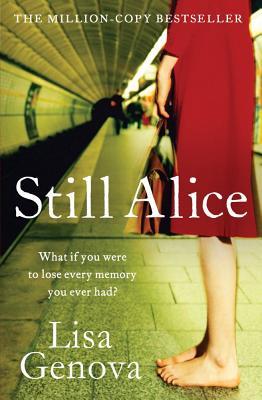 Genova’s writing, Jodi Picoult-like, keeps you turning the pages; I read 225+ pages in an afternoon. There’s true plotting skill to how Genova uses a close third-person perspective to track the mental decline of Harvard psychology professor Alice Howland, who has early-onset Alzheimer’s disease. “Everything she did and loved, everything she was, required language,” yet her grasp of language becomes ever more slippery even as her thought life remains largely intact. I also particularly enjoyed the descriptions of Cambridge and its weather, and family meals and rituals. There’s a certain amount of suspension of disbelief required – Would the disease really progress this quickly? Would Alice really be able to miss certain abilities and experiences once they were gone? – and ultimately I preferred the 2014 movie version, but this would be a great book to thrust at any caregiver or family member who’s had to cope with dementia in someone close to them.
My rating: 
 Other fictional takes on dementia that I can recommend: Unforgettable: Short Stories by Paulette Bates Alden, The Only Story by Julian Barnes, Everything Under by Daisy Johnson and Turn of Mind by Alice LaPlante.
&
Somebody I Used to Know by Wendy Mitchell with Anna Wharton (2018)
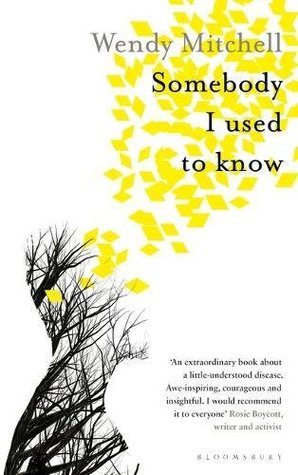 A remarkable insider’s look at the early stages of Alzheimer’s. Mitchell took several falls while running near her Yorkshire home, but it wasn’t until she had a minor stroke in 2012 that she and her doctors started taking her health problems seriously. In July 2014 she got the dementia diagnosis that finally explained her recurring brain fog. She was 58 years old, a single mother with two grown daughters and a 20-year career in NHS administration. Having prided herself on her good memory and her efficiency at everything from work scheduling to DIY, she was distressed that she couldn’t cope with a new computer system and was unlikely to recognize the faces or voices of colleagues she’d worked with for years. Less than a year after her diagnosis, she took early retirement – a decision that she feels was forced on her by a system that wasn’t willing to make accommodations for her.
The book, put together with the help of ghostwriter Anna Wharton, gives a clear sense of progression, of past versus present, and of the workarounds Mitchell uses to outwit her disease. The details and incidents are well chosen to present the everyday challenges of dementia. For instance, baking used to be one of Mitchell’s favorite hobbies, but in an early scene she’s making a cake for a homeless shelter and forgets she’s already added sugar; she weighs in the sugar twice, and the result is inedible. By the time the book ends, not only can she not prepare herself a meal; she can’t remember to eat unless she sets an alarm and barricades herself into the room so she won’t wander off partway through.
In occasional italicized passages Mitchell addresses her past self, running through bittersweet memories of all that she used to be able to do: “It amazes me now how you did it, because you didn’t have anyone to help you. You were Mum, Dad, taxi, chef, counsellor, gardener and housekeeper, all rolled into one.” Yet it’s also amazing how much she still manages to do as an ambassador for the Alzheimer’s Society and Dementia Friends. She crisscrosses the country to give speeches, attend conferences, and advise universities; she writes a blog and has appeared on radio to promote this book. Like many retired people, she’s found she’s busier than ever, and her engagements help her to feel purposeful and like she’s giving a positive impression of early-stage dementia. No matter that she has to rely on dozens of reminders to self in the form of Post-It notes, iPad alarms and a wall of photographs.
The story lines of this and Still Alice are very similar in places – the incidents while running, the inability to keep baking, and so on. And in fact, Mitchell reviewed the film and attended its London premiere, where she met Julianne Moore. Her book is a quick and enjoyable read, and will be so valuable to people looking to understand the experience of dementia. She is such an inspiring woman. I thank her for her efforts, and wish her well. This is one of my personal favorites for the shortlist of next year’s Wellcome Book Prize for medical reads.
My rating: 
 Other nonfiction takes on dementia that I can recommend: In Pursuit of Memory by Joseph Jebelli and The Summer of the Great-Grandmother by Madeleine L’Engle.
Additional pairings I would commend to you (all are books I have read and rated or above):


Talk before Sleep by Elizabeth Berg
&
Let’s Take the Long Way Home by Gail Caldwell and Truth and Beauty by Ann Patchett
- Celebrating the strength of female friendship, even in the face of life-threatening illness.


Bad News by Edward St. Aubyn
&
Portrait of an Addict as a Young Man by Bill Clegg
- Vivid portrayals of drug addiction.


Miss Smilla’s Feeling for Snow by Peter Høeg
&
This Cold Heaven by Gretel Ehrlich
- Armchair traveling in Greenland.


Sweetbitter by Stephanie Danler
&
Cork Dork by Bianca Bosker
- Glimpses into the high-class world of fine dining – and fine wine.
 Dear Fahrenheit 451: Love and Heartbreak in the Stacks by Annie Spence is chock-full of recommendations and reading pairs. The Novel Cure is also good for this sort of thing, though it is (no surprise) overwhelmingly composed of fiction suggestions.
Just Okay for Me, Dawg
This was one of the catchphrases of long-time judge Randy Jackson on the reality TV show American Idol, which was my guilty pleasure viewing for a decade or more. The three recent books for which I provide short-ish reviews below have nothing much in common apart from the fact that I requested or accepted them from publishers and ended up feeling disappointed but like I still owed a review. You can consider them all  .
.
The Friendship Cure by Kate Leaver
(Duckworth, March 22nd)
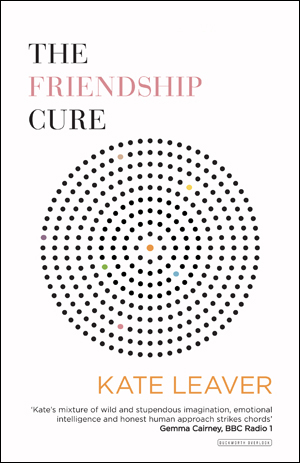 We’re in the middle of a loneliness epidemic, so friends are more important than ever. That’s the impetus for Kate Leaver’s jaunty, somewhat insubstantial book about modern friendship. She observes teen girls on the Tube and reflects on how we as primates still engage in social grooming – though language has replaced much of this more primitive bond-forming behavior. We experience a spike in our number of friends through adolescence and early adulthood, but friendships can fall by the wayside during our thirties as we enter long-term relationships and turn our attention to children and other responsibilities. Leaver argues that female friendships can amplify women’s voices and encourage us to embrace imperfection. She also surveys the bromance, mostly in its TV and film manifestations. There are plenty of pop culture references in the book; while I enjoy a Scrubs or Parks and Recreation scene or quotation as much as the next fan, the reliance on pop culture made the book feel lightweight.
Perhaps the most useful chapter was the one on online friendships (hi, book blogger friends!). We so often hear that these can’t replace IRL friendships, but Leaver sticks up for social media: it allows us to meet like-minded people, and is good for introverted and private people. Anything is better than isolation. The biggest problem I had with the book was the tone: Leaver is going for a Caitlin Moran vibe, and peppers in hip references to Taylor Swift, Lindsay Lohan and the like. But then she sometimes tries for more of a Mary Beard approach, yet doesn’t trust herself to competently talk about science, so renders it in matey, anti-intellectual language like “Robin [Dunbar, of Oxford University] did some fancy maths” (um, I think you mean “Dr. Dunbar”!) or “Let me hit you with a bit of research.”
Favorite lines:
“on some days, somewhere in our souls, we still count the number of social media connections as a measure of who we are”
“When you successfully recruit a new person into your friendship circle, you’re essentially confirming that you are a likable human being, worthy of someone’s time and emotional investment.”
You might choose to read instead: Kory Floyd’s The Loneliness Cure; Ann Patchett’s Truth and Beauty; Anna Quindlen’s essay “Girlfriends” from Lots of Candles, Plenty of Cake.
Writer’s Luck: A Memoir: 1976–1991 by David Lodge
(Harvill Secker, January 11th)
David Lodge has been one of my favorite authors for over a decade. His first memoir, Quite a Good Time to Be Born: A Memoir, 1935–1975 (see my Nudge review), is a good standalone read, even for non-fans, for its insight into the social changes of post-war Britain. However, this volume makes the mistake of covering much less ground, in much more detail – thanks to better record-keeping at the peak of his career – and the result is really rather tedious. The book opens with the publication of How Far Can You Go? and carries through to the reception of Paradise News, with a warning that he cannot promise a third volume; he is now 83. Conferences, lecture tours, and travels are described in exhaustive detail. There’s also a slightly bitter edge to Lodge’s attempts to figure out why ventures flopped or novels got negative reviews (Small World, though Booker-shortlisted, was better received in America), though he concludes that his career was characterized by more good luck than bad.
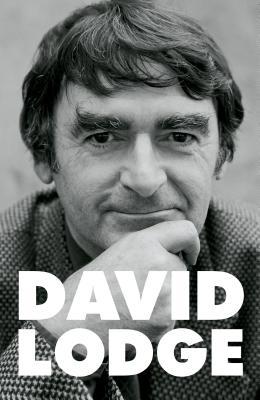 I liked the account of meeting Muriel Spark in Italy, and valued the behind-the-scenes look at the contentious task of judging the 1989 Booker Prize, which went to Kazuo Ishiguro for The Remains of the Days. Especially enjoyable is a passage about getting hooked on saunas via trips to Finland and to Center Parcs, a chain of all-inclusive holiday activity camps in England. Oh how I laughed at his description of nude sauna-going in midlife (whether I was supposed to or not, I’m not sure): “The difference in pleasure between swimming wearing a costume of any kind and the sensation of swimming without one, the water coursing unimpeded round your loins as you move through it, cannot be exaggerated, and I first discovered it in Center Parcs.” I also cringed at the Lodges placing “our Down’s son” Christopher in a residential care home – I do hope thinking about disability has moved on since the mid-1980s.
Ultimately, I’m not sure Lodge has had an interesting enough life to warrant a several-volume project. He’s an almost reassuringly dull chap; “The fact is that I am constitutionally monogamous,” he admits at one point. Although it was fun for me to see the genesis of novels like Paradise News, I don’t think I’d have the stomach for reading any more about why Lodge thinks his star faded starting in the 1990s. However, I’ll keep this on the shelf to go back to for some context when I finally get around to rereading Small World and Nice Work.
Favorite lines:
“there has been a downside to the Prize Culture which the Booker engendered. It has warped the evaluation of new fiction by measuring success as if it were a competitive sport.”
You might choose to read instead: Lodge’s Quite a Good Time to Be Born or John Carey’s The Unexpected Professor: An Oxford Life in Books – overall the better autobiography of a working-class, bookish lad.
The Parentations by Kate Mayfield
(Point Blank [Oneworld], March 29th)
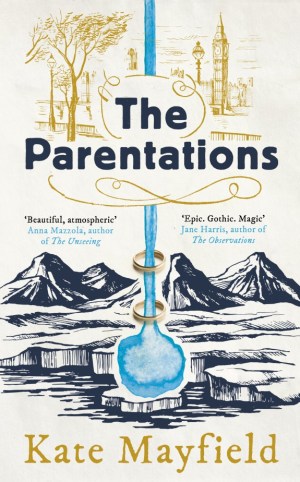 Sisters Constance and Verity Fitzgerald have been alive for over 200 years. A green pool in Iceland, first discovered in 1783, gives them “extended mortality” so long as they take the occasional two-week nap and only swallow two drops of the liquid at a time. In London in 2015, they eat a hearty stew by candlelight and wait for their boy to come. Then they try the churchyard: dead or alive, they are desperate to have him back. Meanwhile, Clovis Fowler is concealing extra phials of the elixir from her husband, their son and the maid. What’s going on here? We go back to Iceland in 1783 to see how the magic pool was first found, and then hop across to 1783 London to meet the sisters as children.
I read the first 67 pages, continued skimming to page 260, and then gave up. At well past the one-third point, the novel still hasn’t established basic connections. A book of nearly 500 pages has to hook the reader in sooner and more securely, not lull them with wordiness (case in point: on the first page of the first chapter, the adjective “macilent” – I looked it up and it means thin or lean, either of which would have been a far preferable word to use).
I could see faint echoes here of so many great books – Jonathan Strange and Mr. Norrell, A Discovery of Witches, Slade House, The Essex Serpent; works by Hannah Kent and Diane Setterfield, maybe even Matt Haig? I liked Mayfield’s memoir The Undertaker’s Daughter and had hoped for improvement with this debut novel. As it is, The Parentations has an interesting premise and lineage, but doesn’t deliver.
Favorite lines:
“His rage foments a decision. He will either take his place in the mounds of the dead, or he will find a good reason to stay alive.”
“Francis and Averil Lawless have impressed upon their daughters the concept of the consequences of a single moment, and there is no better teacher than the river’s majesty and its demand for respect for its waters, which can easily bring violence and ruin as well as wealth and peace.”
You might choose to read instead: Any of the literary fantasy novels listed above.
What books have disappointed or defeated you lately?
Some Accidental Thematic Overlaps in My Recent Reading
Five of the books I’ve read recently (most of them while traveling to and from the States) have shared an overarching theme of loss, with mental illness, alcoholism, suicide, and dogs as subsidiary topics running through two or more of them. I hadn’t deliberately chosen these books for their commonalities, so it was uncanny to see the same elements keep popping up. I wanted to come up with some kind of impressively complex Venn diagram to show off these unexpected connections but couldn’t quite manage it, so you’ll have to imagine it instead.
Mental Illness
The Archivist by Martha Cooley
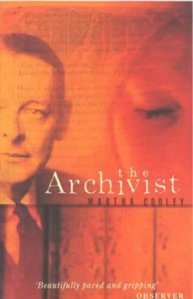 Matthias Lane is the archivist of the Mason Room, a university collection of rare books and literary papers. One of its treasures is a set of letters that passed between T.S. Eliot and his friend Emily Hale (held at Princeton in real life). Matt is haunted by memories of his late wife, Judith, a poet incarcerated in a mental hospital for over five years. A reckoning comes for Matt when he’s approached by Roberta Spire, a graduate student determined to view the Eliot–Hale letters even though they’re legally sealed until 2020. The more time Matt spends with Roberta, the more similarities start to arise between her and Judith; and between his situation and Eliot’s when the latter also put his wife away in a mental hospital. The novel asks what we owe the dead: whether we conform to their wishes or make our own decisions.
The Summer without Men by Siri Hustvedt
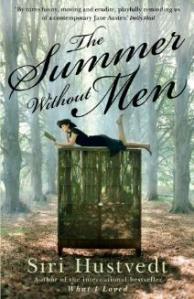 Thirty years on, poet Mia Fredricksen’s husband Boris asks her for a pause in their marriage so he can explore his feelings for his young French lab assistant. First things first: Mia goes crazy and ends up in a mental hospital for a short time. But then she sucks it up and goes back to her Minnesota hometown to teach poetry writing to teen girls for a summer, getting sucked into a bullying drama. This is a capable if not groundbreaking story of the shifts that occur in a long marriage and the strange things we all do as we face down the possibility of death. There are also wry comments about the unappreciated talents of the female artist. However, compared to the other two novels I’ve read from Hustvedt, this seemed feeble. Still, a quick and enjoyable enough read.
The Dogs of Babel by Carolyn Parkhurst
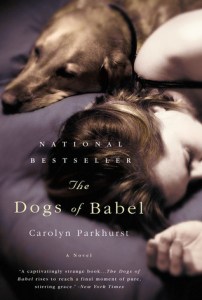 A delicious debut novel intellectual enough to bypass labels like ‘women’s fiction’ and ‘mystery’. One thing that sets it apart is how successfully Parkhurst writes from the perspective of a male narrator, Paul Iverson, who’s been knocked for six by the sudden death of his wife Lexy, a mask designer. While he was at the university where he teaches linguistics, she climbed to the top of the apple tree in their backyard and – what? fell? or jumped? The only ‘witness’ was their Rhodesian Ridgeback, Lorelei; in his grief Paul uses his sabbatical to research efforts to teach dogs to communicate, hoping one day Lorelei might tell all. Woven through are scenes from Paul and Lexy’s courtship and marriage; though Lexy occasionally struggled with her mental health, their dialogue is fun and zippy, like you might hear on The Gilmore Girls.
Suicide
The Archivist by Martha Cooley & The Dogs of Babel by Carolyn Parkhurst


Alcoholism
Don’t Let’s Go to the Dogs Tonight by Alexandra Fuller
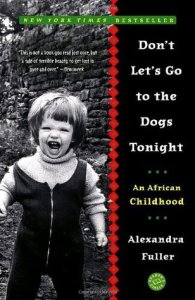 A classic memoir that conjures up all the sights, sounds, smells and feelings of Africa on the cusp of a colonial to postcolonial transition. Fuller’s family were struggling tobacco and cattle farmers in Rhodesia (Zimbabwe), Malawi and Zambia. She had absorbed the notion that white people were there to benevolently shepherd the natives, but came to question it when she met Africans for herself. While giving a sense of the continent’s political shifts, she mostly focuses on her own family: the four-person circus that was Bobo (that’s her), Van (older sister Vanessa), Dad, and Mum (an occasionally hospitalized manic-depressive alcoholic who lost three children) – not to mention an ever-changing menagerie of horses, dogs and other pets. This really takes you away to another place and time, as the best memoirs do, and the plentiful black-and-white photos are a great addition.
Let’s Take the Long Way Home by Gail Caldwell
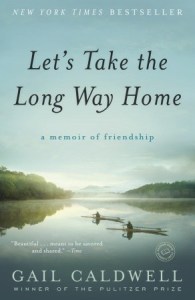 If you loved Ann Patchett’s Truth and Beauty, pick this up immediately. It’s a similar story of best friends: one who dies and one who survives. Caldwell’s best friend was Caroline Knapp (author of Drinking: A Love Story, among other nonfiction), whom she met via puppy ownership in Cambridge, Massachusetts. They were both single and childless, full-time authors with a history of alcoholism. Besides long walks with their dogs, they loved swimming and rowing together. In 2002 Caroline was diagnosed with stage-four lung cancer, inoperable and already metastasized. Despite all their proactive optimism, she was dead a matter of weeks later. In this moving and accessible short memoir, Caldwell drifts through her past, their friendship, Caroline’s illness, and the years of grief that followed the loss of Caroline and then her beloved Samoyed, Clementine, sharing what she learned about bereavement.
Dogs
The Dogs of Babel, Don’t Let’s Go to the Dogs Tonight & Let’s Take the Long Way Home


Do you ever find coincidental thematic connections in your reading?
Summer Reads: The Women of the Castle and The Nest
What do you look for in your summer reading? Terms like “beach read” tend to connote light, frothy stories—especially from genres like romance, mystery, and chick lit—but for me a summer read is any book that happens to be totally absorbing, whatever its length. These two novels I recently read are perfect for the summer because you can sink right into them. Whether a trio of widows in postwar Germany or a dysfunctional family in modern-day New York City, the characters and setting come fully to life and tempt you to settle in on a sofa or a beach towel and stay for a while.
The Women of the Castle by Jessica Shattuck
Like Virginia Baily’s Early One Morning and Caroline Lea’s When the Sky Fell Apart, this is a female-centered World War II story that focuses on a lesser-known aspect of history. The main characters are three German women, Marianne, Benita and Ania, who were aligned with different sides in the Nazism vs. Resistance conflict but have all suffered grave losses. These widows band together to raise their children at Burg von Lingenfels, the dilapidated ancestral castle of Marianne’s late husband’s family, but as the years pass regrets and unburied secrets start to come between them.
 Apart from a short prologue from 1938 and a final section that jumps ahead to 1991, the novel is mainly set in 1945–50. I appreciated the look at postwar Germany, a period you rarely encounter in fiction. Refugees, rape victims, and Russian soldiers are everywhere, while American propaganda heaps shame on Germans for supporting Hitler. As with Barbara Yelin’s Irmina, though, there’s an acknowledgment here that it was never a clear-cut matter of pure evil or utter ignorance; “They had known but not known,” is how Shattuck puts it.
What is most intriguing to watch are the shifting relationships between the three main characters. Marianne, as the widow of one of the conspirators in the plot to assassinate Hitler, feels a compulsion to rescue her fellow widows from work camps and to keep the history of the Resistance alive. When her friends disappoint her—Benita falls in love with a former Nazi officer; Ania admits to a past she’d rather forget—Marianne doesn’t know how to absorb the shocks without judgment. A black-and-white thinker, she has trouble seeing life’s gray areas. Only in her old age is she finally able to realize that people are not simply “good or bad, true or false. They have been laid bare, a collection of choices and circumstances.”
You might think that all the WWII stories have been told by now, yet this novel feels fresh and revelatory. I found it both melancholy and hopeful, with strong characters and a haunting atmosphere:
The next week, a heatwave settled over Burg Lingenfels, a shaggy animal brushing against the hills, panting along the river, quieting the birds and making the castle sweat. The ditches were alive with milkweed, nettles, and creeping phlox. In the warmth, the forest looked soft and dense, a black lump against blue sky.
My rating:
The Women of the Castle was released in the UK by Zaffre, an imprint of Bonnier Publishing, on May 18th. My thanks to Imogen Sebba for the free copy for review.
The Nest by Cynthia D’Aprix Sweeney
Leo Plumb has really blown it this time. He’s had problems with drugs and womanizing before, but this time he got behind the wheel of a car after his cousin’s wedding reception with coke and alcohol in his system and a nineteen-year-old waitress, Matilda Rodriguez, at his side. Matilda is injured in the ensuing accident, and after her hefty payout it looks like the four Plumb siblings’ collective trust fund, “the nest,” will be severely diminished.
 They’re all counting on this money: Melody to send her twin daughters to a good college; Jack to save his floundering antiques business; and Bea to keep her afloat until she can write a long-delayed novel to follow up on the success of her “Archie” short stories (based on a figure suspiciously similar to Leo).
The short chapters switch between the siblings as they tweak their plans for the future. The novel also spends time with Melody’s twins, Nora and Louise, who at 16 are just figuring out what they want from their lives; and with Matilda and her new friend Vinnie as they cope with permanent injuries. All of these characters feel like real people who might be in your neighborhood or your extended family. I especially liked Stephanie, the old girlfriend Leo returns to after his wife finally kicks him out.
In places this reminded me of Ann Patchett’s Commonwealth, Delia Ephron’s Siracusa, and especially Hannah Rothschild’s The Improbability of Love due to a subplot about a stolen sculpture. There’s a rather silly set piece involving the sculpture later on; leaving that aside, I thought this was a compelling story about what happens when the truth comes out and we must readjust our expectations. Realistic rather than rosy, this is a novel about letting go. A nest is, of course, also a home, so for as much as this seems to be about money, it is really more about family and how we reclaim our notion of home after a major upheaval.
My rating:
The Nest was released in paperback in the UK by The Borough Press on June 1st. My thanks to Emilie Chambeyron for the free copy for review.
2016 Runners-Up and Other Superlatives
Let’s hear it for the ladies! In 2016 women writers accounted for 9 out of my 15 top fiction picks, 12 out of my 15 nonfiction selections, and 8 of the 10 runners-up below. That’s 73%. The choices below are in alphabetical order by author, with any full reviews linked in. Many of these have already appeared on the blog in some form over the course of the year.
Ten Runners-Up:
FICTION
 Hag-Seed by Margaret Atwood: Atwood looks more like a good witch every year, and here she works her magic on The Tempest to produce the most satisfying volume of the Hogarth Shakespeare series yet. There’s a really clever play-within-the-play-within-the-play thing going on, and themes of imprisonment and performance resonate in multiple ways.
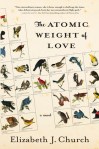 The Atomic Weight of Love by Elizabeth J. Church: In Church’s debut, an amateur ornithologist learns about love and sacrifice through marriage to a Los Alamos physicist and a relationship with a Vietnam veteran. I instantly warmed to Meri as a narrator and loved following her unpredictable life story.
 We Love You, Charlie Freeman by Kaitlyn Greenidge: The Freemans are raising Charlie, a chimpanzee, as part of their family for a Toneybee Institute experiment and teaching him to communicate via sign language. This is a rich and unsettling story of human–human interactions, even more so than human–animal interactions; it’s a great first novel and I will follow Greenidge’s career with interest.
To the Bright Edge of the World by Eowyn Ivey: Ivey’s intricate second novel weaves together diaries, letters, photographs, and various other documents and artifacts to tell the gently supernatural story of an exploratory mission along Alaska’s Wolverine River in 1885 and its effects through to the present day. I can highly recommend this rollicking adventure tale to fans of historical fiction and magic realism.
This Must Be the Place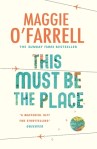 by Maggie O’Farrell: Spreading outward from Ireland and reaching into every character’s past and future, this has all O’Farrell’s trademark insight into family and romantic relationships, as well as her gorgeous prose and precise imagery. I have always felt that O’Farrell expertly straddles the (perhaps imaginary) line between literary and popular fiction; her books are addictively readable but also hold up to critical scrutiny.
Commonwealth by Ann Patchett: This deep study of blended family dynamics starts with an early 1960s christening party Los Angeles policeman Fix Keating is throwing for his younger daughter, Franny; we see the aftermath of that party in the lives of six step-siblings in the decades to come. This is a sophisticated and atmospheric novel I would not hesitate to recommend to literary fiction fans in general and Patchett fans in particular.
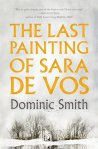 The Last Painting of Sara de Vos by Dominic Smith: Jessie Burton, Tracy Chevalier and all others who try to write historical fiction about the Netherlands in the seventeenth century, eat your hearts out. Such a beautiful epoch-spanning novel about art and regret.
Shelter by Jung Yun: A Korean-American family faces up to violence past and present in a strong debut that offers the hope of redemption. I would recommend this to fans of David Vann and Richard Ford.
NONFICTION
I Will Find You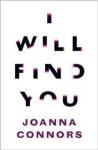 by Joanna Connors: By using present-tense narration, Connors makes the events of 1984 feel as if they happened yesterday: a blow-by-blow of the sex acts forced on her at knife-point over the nearly one-hour duration of her rape; the police reports and trials; and the effects it all had on her marriage and family. This is an excellent work of reconstruction and investigative reporting.
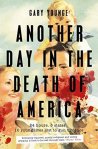 Another Day in the Death of America by Gary Younge: Younge built this book by choosing a 24-hour period (November 22 to 23, 2013) and delving into all 10 gun deaths of young Americans on record for that time: seven black, two Latino, and one white; aged nine to 18; about half at least vaguely gang-related, while in two – perhaps the most crushing cases – there was an accident while playing around with a gun. I dare anyone to read this and then try to defend gun ‘rights’ in the face of such senseless, everyday loss.
Various Superlatives:
Best Discoveries of the Year: Apollo Classics reprints (I reviewed three of them this year); Diana Abu-Jaber, Linda Grant and Kristopher Jansma.
Most Pleasant Year-Long Reading Experience: The seasonal anthologies issued by the UK Wildlife Trusts and edited by Melissa Harrison (I reviewed three of them this year).

Most Improved: I heartily disliked Sarah Perry’s debut novel, After Me Comes the Flood. But her second, The Essex Serpent, is exquisite.
Debut Novelists Whose Next Work I’m Most Looking Forward to: Stephanie Danler, Kaitlyn Greenidge, Francis Spufford, Andria Williams and Sunil Yapa.
The Year’s Biggest Disappointments: Here I Am by Jonathan Safran Foer, Today Will Be Different by Maria Semple, and Swing Time by Zadie Smith. Here’s hoping 2017 doesn’t bring any letdowns from beloved authors.


The Worst Book I Read This Year: Paulina & Fran (2015) by Rachel B. Glaser. My only one-star review of the year. ’Nuff said?
The 2016 Novels I Most Wish I’d Gotten to: (At least the 10 I’m most regretful about)
- The Power by Naomi Alderman
- The Museum of You by Carys Bray
- The Course of Love by Alain de Botton
- What Belongs to You by Garth Greenwell*
 Homegoing by Yaa Gyasi
- The Waiting Room by Leah Kaminsky
- The Inseparables by Stuart Nadler
- Harmony by Carolyn Parkhurst*
- The Nest by Cynthia D’Aprix Sweeney*
- The Underground Railroad by Colson Whitehead*
*Haven’t been able to find anywhere yet; the rest are on my Kindle.
Which of these should I get reading on the double?
Coming tomorrow: Some reading goals for 2017.
The 2017 Releases I’m Most Excited About
2017 hasn’t even begun and already I’m overwhelmed by the quantity and quality of new books to be released. This is by no means a full picture of what’s coming out next year; it’s only 30 titles that I happen to have heard about and/or know I want to seek out. The descriptions are taken from the publisher blurbs on Goodreads, NetGalley or Edelweiss. Some of these I already have access to in galley form; others I’ll be doing my darndest to get hold of! (Within categories, titles are in alphabetical order by author rather than by publication date.)
ASSIGNED
English Animals by Laura Kaye (for the blog tour) [Jan. 12, Little, Brown UK]: “When Mirka [from Slovakia] gets a job in a country house in rural England, she has no idea of the struggle she faces to make sense of a very English couple, and a way of life that is entirely alien to her.”
 Pachinko by Min Jin Lee (for BookBrowse) [Feb. 7, Grand Central]: “Pachinko follows one Korean family through the generations, beginning in [the] early 1900s. … [A] sweeping saga of an exceptional family in exile from its homeland and caught in the indifferent arc of history.”
No One Is Coming to Save Us by Stephanie Watts Powell (for the Pittsburgh Post-Gazette) [Apr. 4, Ecco]: “The Great Gatsby brilliantly recast in the contemporary South: a powerful first novel about an extended African-American family and their colliding visions of the American Dream.”
The Twelve Lives of Samuel Hawley by Hannah Tinti (for The Bookbag) [Mar. 28, Tinder Press]: “A father protects his daughter from the legacy of his past and the truth about her mother’s death in this thrilling new novel … Both a coming-of-age novel and a literary thriller, The Twelve Lives of Samuel Hawley explores what it means to be a hero, and the cost we pay to protect the people we love most.”
NOVELS (all by authors I’ve enjoyed in the past)
Greatest Hits by Laura Barnett [June 15, W&N]: “Cass Wheeler [is] a British singer-songwriter, hugely successful since the early 70s … Her task is to choose 16 songs from among the hundreds she has written … for a uniquely personal Greatest Hits record”
The Idiot by Elif Batuman [Mar. 14, Penguin]: “1995: Selin, the daughter of Turkish immigrants, arrives for her freshman year at Harvard. … With superlative emotional and intellectual sensitivity, mordant wit, and pitch-perfect style, Batuman dramatizes the uncertainty of life on the cusp of adulthood.”
The Hearts of Men by Nickolas Butler [Mar. 7, Ecco]: “Nelson, irrevocably scarred from the Vietnam War, becomes Scoutmaster of Camp Chippewa, while Jonathan marries, divorces, and turns his father’s business into a highly profitable company. … [A] sweeping, panoramic novel about the slippery definitions of good and evil, family and fidelity”
New Boy by Tracy Chevalier [May 16, Hogarth]: “The tragedy of Othello is transposed to a 1970s suburban Washington schoolyard, where kids fall in and out of love with each other before lunchtime, and practice a casual racism picked up from their parents and teachers.”
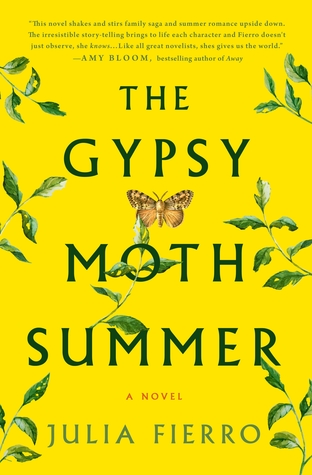 Gypsy Moth Summer by Julia Fierro [June 6, St. Martin’s]: “It is the summer of 1992 and a gypsy moth invasion blankets Avalon Island. … The Gypsy Moth Summer is about love, gaps in understanding, and the struggle to connect: within families; among friends; between neighbors and entire generations.” – Plus, get a load of that gorgeous cover!
Grief Cottage by Gail Godwin [June 6, Bloomsbury USA]: “Grief Cottage is the best sort of ghost story, but it is far more than that—an investigation of grief, remorse, and the memories that haunt us. The power and beauty of this artful novel wash over the reader like the waves on a South Carolina beach.”
The Evening Road by Laird Hunt [Feb. 7, Little, Brown & Co.]: “Reminiscent of the works of Louise Erdrich, Edward P. Jones and Marilynne Robinson, The Evening Road is the story of two remarkable women on the move through an America riven by fear and hatred, and eager to flee the secrets they have left behind.”
 The Awkward Age by Francesca Segal [May 4, Chatto & Windus]: “In a Victorian terraced house, in north-west London, two families have united in imperfect harmony. … This is a moving and powerful novel about the modern family: about starting over; about love, guilt, and generosity; about building something beautiful amid the mess and complexity of what came before.” – Sounds like Ann Patchett’s Commonwealth…
The Best of Adam Sharp by Graeme Simsion [Feb. 9, Penguin]: “The Best of Adam Sharp is about growing old and feeling young, about happy times and sad memories, about staying together and drifting apart, but most of all, it’s about how the music we make together creates the soundtrack that shapes our lives.” – Sounds a lot like the Barnett!
SHORT STORIES (also by authors I’ve enjoyed in the past)
The Dinner Party by Joshua Ferris: [May 2, Little, Brown & Co.]: “Full of the keenly observed, mordant wit that characterizes his beloved, award-winning novels, the stories in The Dinner Party are about people searching for answers in the aftermath of life’s emotional fissures”
Bad Dreams and Other Stories by Tessa Hadley [May 16, Harper]: “Hadley has proven herself to be the champion of revealing the hidden depths in the deceptively simple. In these short stories it’s the ordinary things that turn out to be most extraordinary: the history of a length of fabric or a forgotten jacket.”
NOVELS BY AUTHORS NEW TO ME
 A Separation by Katie Kitamura [Feb. 7, Riverhead Books]: “A mesmerizing, psychologically taut novel about a marriage’s end and the secrets we all carry.”
Hame by Annalena McAfee (Mrs. Ian McEwan) [Feb. 9, Harvill Secker]: “Mhairi McPhail dismantles her life in New York and moves with her 9-year-old daughter, Agnes, to the remote Scottish island of Fascaray. Mhairi has been commissioned to write a biography of the late Bard of Fascaray, Grigor McWatt, a cantankerous poet with an international reputation.”
NONFICTION: memoirs
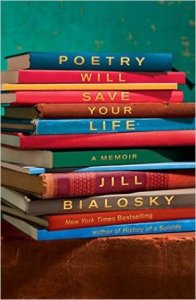 Poetry Can Save Your Life: A Memoir by Jill Bialosky [June 13, Atria]: “[A]n unconventional coming-of-age memoir organized around the 43 remarkable poems that gave her insight, courage, compassion, and a sense of connection at pivotal moments in her life.”
Between Them: Remembering My Parents by Richard Ford [May 2, Harper Collins]: “Ford brings his trademark candor, wit, and empathetic storytelling to the most intimate of landscapes: that of his love for two people who remain a mystery. Mining poignant details of his life in the American South during some iconic periods of the 20th century, Between Them illuminates the writer’s past as well as his beliefs on memory, relationships, and self-knowledge.”
The Mighty Franks: A Family Memoir by Michael Frank [May 16, Farrar, Straus and Giroux]: “A psychologically acute memoir about an unusual and eccentric Hollywood family.”
Sick: A Life of Lyme, Love, Illness, and Addiction by Porochista Khakpour [Aug. 8, Harper Perennial]: “In the tradition of Brain on Fire and The Empathy Exams, an honest, beautifully rendered memoir of chronic illness, misdiagnosis, addiction, and the myth of full recovery that details author Porochista Khakpour’s struggles with late-stage Lyme disease.”
A Stitch of Time: The Year a Brain Injury Changed My Language and Life by Lauren Marks [May 2, Simon & Schuster]: “Lauren Marks was twenty-seven, touring a show in Scotland with her friends, when an aneurysm ruptured in her brain and left her fighting for her life. … [A]n Oliver Sacks-like case study of a brain slowly piecing itself back together”
Homing Instincts: Early Motherhood on a Midwestern Farm by Sarah Menkedick [May 2, Pantheon]: “Fresh, intimate, and radiantly meditative, Homing Instincts is the story of one woman’s ‘coming of age’ as a first-time parent on her family’s rural Ohio farm.”
My Jewish Year: 18 Holidays, One Wondering Jew by Abigail Pogrebin [Mar. 14, Fig Tree Books]: “Although she grew up following some holiday rituals, Pogrebin realized how little she knew about their foundational purpose and contemporary relevance; she wanted to understand what had kept these holidays alive and vibrant, some for thousands of years. Her curiosity led her to embark on an entire year of intensive research, observation, and writing about the milestones on the religious calendar.”
 Theft by Finding: Diaries (1977–2002) by David Sedaris [May 30, Little, Brown & Co.]: “[F]or the first time in print: selections from the diaries that are the source of his remarkable autobiographical essays.”
How to Make a French Family: A Memoir of Love, Food, and Faux Pas by Samantha Vérant [Apr. 4, Sourcebooks]: “When Samantha is given a second chance at love at the age of forty, she moves to southwestern France, thinking she’s prepared for her new role in life as an instant American wife and stepmom. It turns out, though, that making a French family takes more than just good intentions and a quick lesson in croissant-baking.”
NONFICTION: poetry, biography, essays, travel
Eat This Poem: A Literary Feast of Recipes Inspired by Poetry by Nicole Gulotta [Mar. 21, Roost Books]: “The twenty-five inspiring poems in this book—from such poets as Marge Piercy, Louise Glück, Mark Strand, Mary Oliver, Billy Collins, Jane Hirshfield—are accompanied by seventy-five recipes that bring the richness of words to life in our kitchen, on our plate, and through our palate.”
Mozart’s Starling by Lyanda Lynn Haupt [May 16, Little, Brown & Co.]: “A charming story of Mozart and his pet starling, along with a natural history of the bird.”
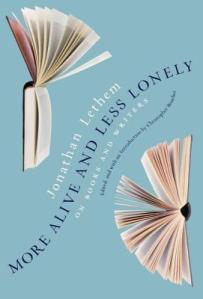 More Alive and Less Lonely: On Books and Writers by Jonathan Lethem [Mar. 14, Melville House]: “[C]ollects more than a decade of Lethem’s finest writing on writing, with new and previously unpublished material, including: impassioned appeals for forgotten writers and overlooked books, razor-sharp essays, and personal accounts of his most extraordinary literary encounters and discoveries.”
The Not-Quite States of America by Doug Mack [Feb. 14, W.W. Norton]: “American Samoa, Guam, Puerto Rico, the Northern Mariana Islands, and the U.S. Virgin Islands—and their 4 million people—are often forgotten, even by most Americans. … When Doug Mack realized just how little he knew about the territories, he set off on a globe-hopping quest covering more than 30,000 miles to see them all.”
What 2017 books are you most looking forward to?
Which of these interest you?
Novellas in November
Taking a lead from Laura over at Reading in Bed, I’ve trawled my shelves and my current library pile for some blissfully short books. For this challenge I limited myself to books with fewer than 150 pages and came up with four fiction books and two ‘nonfiction novellas’.
The Library of Unrequited Love by Sophie Divry
[92 pages]
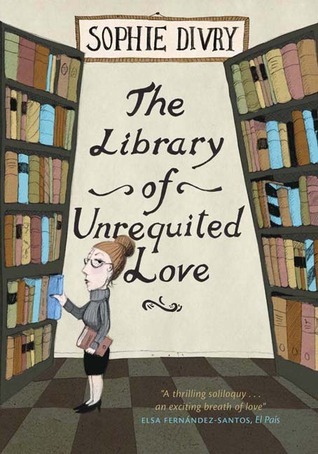 This one-sitting read is a monologue by an embittered librarian who arrives one morning to discover a patron has been locked into the basement overnight—a captive audience. Responsible for Geography, she hopes for a promotion to History, her favorite subject. Alas, no one seems to appreciate this library as a bastion of learning anymore; they only come for DVDs and a place to keep warm. That is, except for Martin, a young PhD researcher who’s caught her eye. But he doesn’t even seem to notice she exists. In one uninterrupted paragraph, this celebrates all that books do for us but suggests that they still can’t fix a broken heart.
My verdict: There are lots of great one-liners about the value of books (“You’re never alone if you live surrounded by books”), but overall it’s a somewhat aimless little experiment and not particularly well translated.
The All of It by Jeannette Haien
[145 pages]
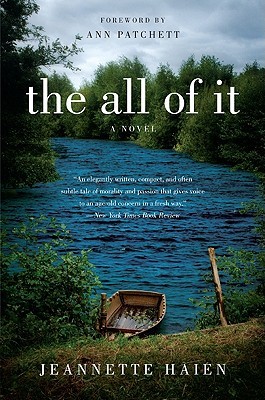 When this won the Sue Kaufman Prize for First Fiction in 1987, the author was in her sixties. It’s since been championed by Ann Patchett, who contributed a Foreword to this 2011 edition. Father Declan de Loughry, fishing for salmon, reflects on the recent death of parishioner Kevin Dennehy. Before he died, Kevin admitted that he and Enda were never properly married. Yet Enda begs the priest to approve a death notice calling Kevin her “beloved husband,” promising she’ll then explain “the all of it” – the very good reason they never married. As she tells her full story, which occupies the bulk of the novella, Father Declan tries to strike a balance between the moral high ground and human compassion.
My verdict: Enda’s initial confession on page 27 is explosive, but the rest of this quiet book doesn’t ever live up to it. I was reminded of Mary Costello’s Academy Street, a more successful short book about an Irish life.
Favorite passage: “One thing I’ve learned, Father—that in this life it’s best to keep the then and the now and the what’s-to-be as close together in your thoughts as you can. It’s when you let gaps creep in, when you separate out the intervals and dwell on them, that you can’t bear the sorrow.”
Thirteen Ways of Looking by Colum McCann
[143 pages]
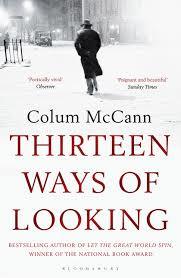 This starts off as the simple story of J. Mendelssohn, an octogenarian who wakes up on a snowy morning in his New York City apartment, contemplating his past – Lithuanian/Polish ancestry, work as a judge and marriage to Eileen, whom he met as a boy in Dublin – and planning to meet his son at a restaurant for lunch. But all of a sudden it turns into a murder mystery on page 24: “Later the homicide detectives will be surprised…” In 13 sections headed by epigraphs from the Wallace Stevens poem “Thirteen Ways of Looking at a Blackbird,” McCann flits through Mendelssohn’s thoughts and flips between the events preceding and immediately following the murder. A late interrogation scene is particularly strong – “unlike our poetry, we like our murders to be fully solved.”
My verdict: This is the first I’ve read from McCann, and it’s terrific. He stuffs so much plot and characterization into not many pages. Mendelssohn’s thought life is rich with allusions and wordplay. I was particularly intrigued to read about the autobiographical overlap in the Author’s Note. I haven’t yet read the short stories included in the volume, but for the novella on its own it’s  .
.
As We Are Now by May Sarton
[134 pages]
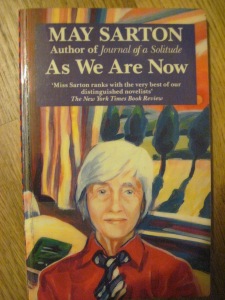 On the surface this is similar to a novel I reviewed earlier in the month, The Secret Diary of Hendrik Groen, 83¼ Years Old. But where spunky Hendrik determines to outwit his care home’s sullen staff, Sarton’s narrator, seventy-six-year-old Caroline Spencer, has given in. A retired high school math teacher, she’s landed in a New England old folks’ home because during her recovery from a heart attack she failed to get along with her brother’s younger wife. She finds kindred spirits in Standish Flint, a tough old farmer, and Reverend Thornhill, but her growing confusion and the home’s pretty appalling conditions drive her to despair.
My verdict: This is enjoyable for the unreliable narrator and the twist ending, but overall it struck me as rather melodramatic. However, I appreciated a lot of Caro’s sentiments.
Favorite passages: “Am I senile, I wonder? The trouble is that old age is not interesting until one gets there, a foreign country with an unknown language to the young, and even to the middle-aged. I wish now that I had found out more about it.” & “And what is left of you? A lapis lazuli pin, a faded rose petal, once pink, slipped into the pages of this copybook.”
And two short works of nonfiction:
Excerpts from a Family Medical Dictionary by Rebecca Brown
[113 pages]
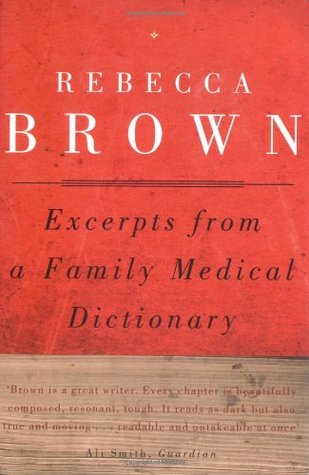 Brown is a novelist from Seattle. This is an account of her mother’s death from what sounds like stomach cancer. The disease progressed quickly and her mother died at home, under hospice care, in New Mexico in 1997. As the title suggests, the brief thematic chapters are arranged around vocabulary words like “anemia” and “metastasis.” My favorite chapters were about washing: her mother’s habit of reading while taking long baths, and the ways Brown and her sister tried to care for their mother’s disintegrating body, including a plan to prepare the corpse themselves. Clinical descriptions of vomiting alternate with magical thinking to accompany her mother’s hallucinations: “You’re packed, Mom, but all of us aren’t going, just you. But you’ve got everything you need.”
My verdict: Brown covers a lot of emotional ground in a very few pages, but I prefer my medical/bereavement memoirs to have more of a narrative and more detail than “when she died it was not peacefully or easy, it was hard.”
Ruined by Reading: A Life in Books by Lynne Sharon Schwartz
[119 pages]
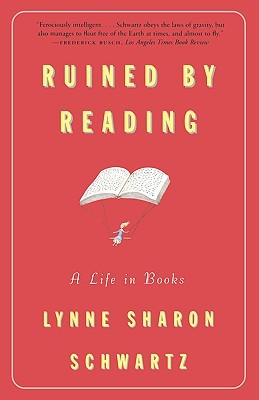 This 1996 memoir was sparked by reading a quote from a Chinese Buddhist in a New York Times article: he suggested that reading is dangerous as it imposes others’ ideas on you and doesn’t allow you to use your own mind freely. Schwartz, of course, begs to differ. As a novelist, reading has been her lifeline. She looks back at her childhood reading and her pretentious college student opinions on Franz Kafka and Henry James, and explains that she lets serendipity guide her reading choices nowadays, rather than a strict TBR list: “reading at random – letting desire lead – feels like the most faithful kind.”
My verdict: It’s a bibliomemoir; I should have loved it. Instead I thought it unstructured and thin. There are some great lines dotted through, but I wasn’t very interested in the examples she focuses on. Five pages about a children’s book by Eleanor Farjeon? Yawn!
Favorite passages: “Like the bodies of dancers or athletes, the minds of readers are genuinely happy and self-possessed only when cavorting around, doing their stretches and leaps and jumps to the tune of words.” & “How are we to spend our lives, anyway? That is the real question. We read to seek the answer, and the search itself – the task of a lifetime – becomes the answer.”
Have you read any of these? Which one takes your fancy?
How do you feel about novellas in general?
A Booker Prize & Libraries Action Plan, Etc.
On Wednesday the Man Booker Prize’s longlist of 13 novels was announced. I never bother making predictions in advance of prize list announcements because inevitably I forget what was released during the eligibility period and I’m no good at squaring personal favorites with what a judging panel is likely to admire. See the Guardian’s photo essay and Karen’s thorough discussion at Booker Talk for more information about the nominees.
It turns out I’ve read and reviewed four of the longlisted books:
The Sellout by Paul Beatty for Shiny New Books: This is such an outrageous racial satire that I kept asking myself how Beatty got away with it. The Sellout struck a chord in America, but I’m slightly surprised that it’s also been received well in the UK.
The North Water by Ian McGuire for BookBrowse: A gritty, graphic novel about 19th-century whaling that traverses the open seas and the forbidding polar regions. It’s a powerful inquiry into human nature and the making of ethical choices in extreme circumstances.
Work Like Any Other by Virginia Reeves on Goodreads: I was meant to review this for BookBrowse but couldn’t rate it highly enough despite the competent writing. Between the blurb and the first paragraph, you already know everything that’s going to happen.
My Name Is Lucy Barton by Elizabeth Strout on Goodreads: I won a free copy through a Goodreads giveaway. I read this in one sitting on a plane ride and found it to be a powerful portrayal of the small connections that stand out in a life.
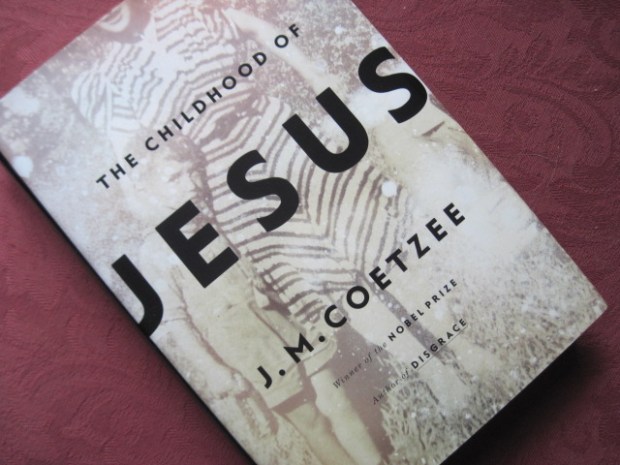
As for what’s next from the longlist, I finally have an excuse to read the copy of The Childhood of Jesus by J.M. Coetzee I won from Goodreads many moons ago – a sequel to which (The Schooldays of Jesus) is among the nominees. It’ll be my first Coetzee; if I like it I’ll be sure to read the follow-up book when it comes out in September.
I already knew I was interested in Eileen by Ottessa Moshfegh, a creepy debut novel about a misfit; All That Man Is by David Szalay, a linked short story collection about stages of men’s lives; and Do Not Say We Have Nothing by Madeleine Thien, set in Canada in the wake of the Tiananmen Square protests. I’ve only read one novel each by A.L. Kennedy and Deborah Levy and wasn’t hugely keen on either author’s style, but the subject matter of both Serious Sweet and Hot Milk is more tempting. I might seek them out from the library.
 And then there’s the books I’d simply never heard of. Of these I’m most interested in His Bloody Project by Graeme Macrae Burnet, based on a true-life murder in Scotland in the 1860s, and The Many by Wyl Menmuir, a debut novella about a village newcomer.
The surprise omission for me is Sarah Perry’s The Essex Serpent. I might also have expected to see Julian Barnes, Adam Haslett, and maybe even Ann Patchett on the longlist.
We’ve found a new rental house and hope to move in on August 15, but we’re waiting for our reference check to be complete and the tenancy contract to be drawn up before we can start doing official things like hire movers, change our address with a zillion service providers, and start packing in earnest.
This past week I’ve busied myself with comparing removals quotes and doing pre-packing tasks I’ve tried to convince myself are useful, like sorting through drawers of mementoes, assessing what’s in storage under the beds, and shifting some unwanted possessions through Freegle, a local web forum for giving away free stuff. So far I’ve gotten rid of a spice rack, 11 empty bottles, 55 empty CD cases, a cat tower plus some food and toys our fussy cat won’t use, and a wildly popular picnic hamper (11 offers came through!). It’s really gratifying to see things go to a good home.
Alas, we did also have to take some items to the local recycling center this weekend, which always seems like something of a failure, but no one’s going to want a broken vacuum cleaner and printer. My hope is that the small appliances dumped there will at least be mined for parts, so it’s better than sending them to landfill.
The weekend has also included berry picking at the local pick-your-own farm and making a summer pudding, a labor-intensive but delicious annual tradition. Plus this afternoon we’re off to Northampton to meet our newest nephew, born on the 20th.

Last year’s summer pudding.
I did finally start boxing up books last night. Much as I love my print library, it’s dispiriting just how much space it takes up. It took five boxes just to empty the small spare room bookcase! Before packing anything I did another full inventory of unread books in the flat and came up with a total of 205, higher than last time but not too bad considering the review books I’ve acquired recently as well as the secondhand shopping I’ve done. I’ve made good progress in my attempt to read mostly books I own for the summer, but it’s a resolution that will have to carry over into the autumn and winter.
The one thing that might scupper me in that plan is that, although we’re only moving 45 minutes away, we’ll be in a new council area where library reservations are free! For years I’ve been a part of library systems where it costs 40 or 50 pence to reserve each book, so I’ve kept holds to an absolute minimum. But from now on you can be sure I’ll be putting myself on the waiting list for every new and forthcoming book that appeals to me! Expect the monthly Library Checkout posts to resume by September.
 Bookish Beck = Rebecca Foster. American transplant to England. Freelance proofreader and book reviewer.
 Bookish Beck