Painting Time by Maylis de Kerangal
Today I’m taking part in the “blog blast” for Painting Time by Maylis de Kerangal (translated from the French by Jessica Moore), which is published today by MacLehose Press.

This is the third novel I’ve read by de Kerangal, after her 2017 Wellcome Book Prize winner, Mend the Living, and 2019’s The Cook. Painting Time resembles the former in the way it revels in niche vocabulary and the latter in that it slowly builds up a portrait of the central character. But all three books could be characterized as deep dives into a particular subject – the human body, gastronomy, and painting, respectively.
The protagonist of Painting Time is Paula Karst, one of 20-some art students who arrive at the Institut de Peinture in Brussels in the autumn of 2007 to learn trompe l’oeil technique. They’re taught to painstakingly imitate every variety of wood and stone so their murals will look as convincing as the real thing. It’s a gruelling course, with many hours spent on their feet every day.
Years later, the only classmates Paula has kept up with are Jonas, her old flatmate, with whom she had a sort-of-almost-not-quite relationship, and their Scottish friend Kate. The novel opens with the three of them having a reunion in Paris. Given this setup, I expected de Kerangal to follow all three characters from 2007 to the near past, but the book sticks closely to Paula, such that the only secondary characters who come through clearly are her parents.
 It’s intriguing to see the work that comes Paula’s way after a degree in decorative painting, including painting backdrops for a Moscow-set film of Anna Karenina and the job of a lifetime: working on a full-scale replica of the prehistoric animal paintings of the Lascaux Caves (Lascaux IV). The final quarter of the novel delves into the history of Lascaux, which was discovered in 1940 and open to the public on and off until the late 1960s. Deep time abuts the troubled present as Paula contemplates what will last versus what is ephemeral.
As de Kerangal did with medical terminology in Mend the Living, so here she relishes art words: colours, tools, techniques; names for types of marble and timber (Paula’s own surname is a word for limestone caves). The long sentences accrete to form paragraphs that stretch across multiple pages. I confess to getting a bit lost in these, and wanting more juicy interactions than austere character study. However, the themes of art and history are resonant. If you’ve enjoyed de Kerangal’s prose before, you will certainly want to read this, too.
My thanks to MacLehose Press for access to an e-copy via NetGalley.
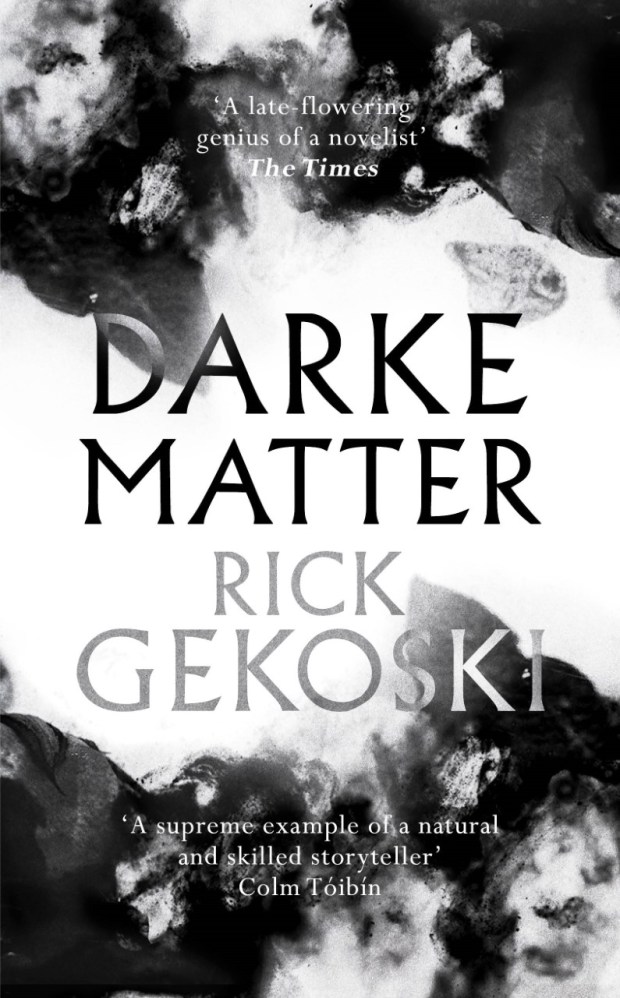
Darke Matter by Rick Gekoski (Blog Tour Review)
Back in 2017, I enjoyed Rick Gekoski’s debut novel, Darke, in which curmudgeonly Dr. James Darke, a retired English teacher, literally seals himself off from the world after his wife Suzy’s death from cancer. I was pleasantly surprised to learn that a sequel was released last year – how appropriate to revisit themes of grief and isolation in 2020! – and right away was reminded of the delights of his grumpy, pompous first-person narration. As the second book opens, Darke is preparing to host his daughter Lucy with her partner Sam and son Rudy for Christmas and is in a Scrooge-like mood: “In my own home, I am blessedly safe from the canvassers, beggars and importuners spreading bubonically from house to house at Yuletide.”
Soon two things happen to shatter his peace: one is an invitation to join a poetry reading club hosted by a literary associate of his late wife – but he soon realizes it’s more of a support group for bereaved spouses. The second and much more serious interruption is a knock on the door from the police, who require more information about Suzy’s death. You see, early on in this book, Darke tells us himself that he gave Suzy a “soothing drink to carry her away,” and even in the face of others’ horror he maintains two seemingly contradictory facts: that he did not want for her to die, but that he did give her a fatal concoction to ease her terrible pain.
By coincidence, I was reading a nonfiction study of assisted dying, The Inevitable by Katie Engelhart, at the same time, and I’d also read That One Patient, a collection of interviews with Dutch medical professionals, some of whom have helped terminally ill patients to commit suicide, earlier this year. It was amusing, but also touching, to see Darke becoming an unwitting spokesman for this movement. He writes a manifesto headed “Easeful Death – Do you love your dog more than your wife?” and gets help disseminating it from a journalist acquaintance. Media attention follows and a scandal erupts.
One of the joys of this pair of novels is Darke’s fondness for literary allusions. In the previous book, these were mostly to Dante and Dickens. Here, the greatest debt is to Jonathan Swift: Darke has been reading Gulliver’s Travels to his grandson at bedtime, and decides to write a pastiche sequel to entertain the boy. Gradually, this turns into a coded story by which he can explain to Rudy what might happen to his grandfather. Will Captain Gulliver be found guilty of heresy? Will he have to flee to avoid jail?
Because we only ever experience Darke’s point of view, he is something of an unreliable narrator, and because he delivers the novel’s finale via his italicized Swiftian narrative, there is some uncertainty about what actually happens to our antihero. I didn’t enjoy this quite as much as the first book, but together they form a striking and witty character study. I especially appreciated how the sequel adds in a gentle note of controversy without allowing it to overtake the pleasures of the voice.
Darke Matter was first published in the UK by Constable in May 2020. The paperback edition came out on April 1st. My thanks to the publisher for the free copy for review.
I was happy to take part in the blog tour for Darke Matter. See below for details of where other reviews and features have appeared or will be appearing.

Born Digital by Robert Wigley (Blog Tour)
 Robert Wigley spent a career in finance and is a father to three teenage sons. For two years, he learned more about their generation by meeting with 200 young entrepreneurs, one per business day. That combination of research and personal experience fuels his first book, Born Digital, which is about the unique challenges faced by Generation Z.
He found that, with young people spending an average of seven hours a day online, technology can exacerbate mental health issues, especially with the doom and gloom and lack of authenticity found on social media. Rather than making people feel more connected, technology tends to increase loneliness and reduce face-to-face interactions. Popularity and hook-ups are sought over meaningful, long-term relationships, while multi-tasking leads to an overall lack of focus.
This book brings up so many issues, including the potential for online surveillance and manipulation, and the problem of anonymity plus a failure to effectively verify users’ age. I’m still a smartphone refusenik because I want to carefully guard my time and attention, so I was particularly interested in the statistics and stories Wigley conveys about what it’s like for young people who have grown up with smartphones. This is a book I’ll be keeping on the shelf for future reference. It would of course be very relevant to parents and teachers, but I found it enlightening as well. Here’s a few-page excerpt to whet your appetite.
Chapter 6
LET’S TALK ABOUT THE JUGGLER’S BRAIN
My youngest son is at home with my wife and me; my older two are in London. We are all glued to Chelsea (who they all avidly support) playing Manchester United in the semi-final of the FA Cup. Chelsea scores, and my son screams with excitement and then starts his hilarious victory dance in front of the TV. The family WhatsApp channel bursts into life. Ping, ping. My wife has sent a picture of my youngest in front of the TV. My eldest has replied saying ‘doing exactly the same’. Everyone is high on a cocktail of Chelsea scoring, WhatsApp pinging and the humorous pictures and messages that it conveys.
Pleasurable human experiences result in the release of dopamine in the brain. The dopamine attaching itself to receptors in the brain causes the feeling of pleasure we experience. Most pleasurable experiences cause the release of a small amount of dopamine. Broadly speaking, to start with, the more dopamine, the more pleasure.
Normally, this release of dopamine is a good thing. It encourages us to seek out what is healthy or beneficial in our environment. It’s so important, in fact, that neuroscientists have given it a central role in a type of fundamental human learning called reinforcement learning. I will explain how technology companies abuse reinforcement learning to modify human behaviour so that we maximise time on their platforms and apps. What scientists have found is that dopamine is related to the prediction of rewards. If a reward is received but not anticipated, an increase in dopamine is seen. And if a reward is anticipated and not seen, a decrease in dopamine is seen. Since our brains are wired to optimise rewards, this means that humans will be motivated to seek out new rewards in any given situation, do anything they know delivers a reward repeatedly and avoid anything which gives them negative effects. Technology companies design their platforms and apps to make them addictive using this science. Receiving a notification, a like on Facebook or Instagram, a match on Tinder or a win in Fortnite all trigger dopamine releases. Being blocked by a friend or killed in the game causes a decrease in dopamine.
The problem starts when you seek out dopamine regularly and repeatedly as most people could be tempted to, given the pleasurable effect. The brain starts to develop a tolerance for dopamine. So more dopamine is needed to generate the same degree of pleasure. In the natural world, the availability of rewards is largely out of humans’ hands. On technology platforms, it is designed in and can be made almost infinitely abundant. Addictions develop because two things happen. The brain produces less dopamine per stimulus, and the brain feels less stimulated by each new release. So more, larger stimuli are needed, requiring the addict to seek them.
Sean Parker, Facebook’s Founding President, said in 2017, ‘We need to give you a little dopamine hit every once in a while … exploiting a vulnerability in human psychology … the inventors, creators … understood it consciously. And we did it anyway. God only knows what it’s doing to our children’s brains.’
Mirror neurons fire in the brain when an animal acts and observes the same action in another. You smile, I smile back. This may explain why some people unwittingly imitate their companions, sitting similarly in terms of leg positions or with their heads cocked at a similar angle. Some neuroscientists believe that mirror neurons form the basis of emotions such as empathy. If true, to develop and display empathy requires the physical observation of a counterparty during the intercourse – something, of course, that social media chat doesn’t deliver.
While neuroscientists debate precise mechanisms, it seems reasonably well accepted that bonding situations – a mother feeding or hugging a child – result in the release of oxytocin, which itself triggers the release of dopamine and serotonin. This leads to pleasurable feelings of comfort and security and builds the bond between the baby and the parent or carer. We have seen that dopamine leads to pleasure, and serotonin boosts feelings of wellbeing and collegiality. Paul Zak, one of the original researchers into the effects of oxytocin, described this as Human Oxytocin Medicated Empathy (‘HOME’). Bonding and empathy require at least physical proximity or engaged face-to-face engagement to occur. This is one of the reasons why it is so important that babies are not distracted with iPads fixed inches in front of their faces in their recliners before they are two, and equally important that parents must not be distracted from fixing their baby’s gaze, eye to eye, by combining feeding or bonding time with use of their own devices.
Eye-to-eye contact seems to be critical not just as a baby, but throughout life. ‘Whether it’s affection, amusement, arrogance or annoyance, our eyes convey how we feel. And the ability to read another person’s eyes, face to face, is one of the best predictors of a person’s social intelligence,’ says King. Referring to the conclusions of Simon Baron-Cohen’s ‘reading the mind in the eye test’, she says. ‘The better you are at inferring someone else’s mental state by looking at their eyes, the more likely you are to be prosocial, perform well in groups and respond empathetically.’
My thanks to Midas PR for the proof copy. I was glad to take part in the blog tour. See below for details of where other reviews and features have appeared.

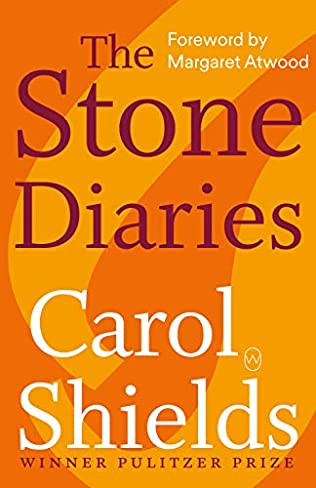
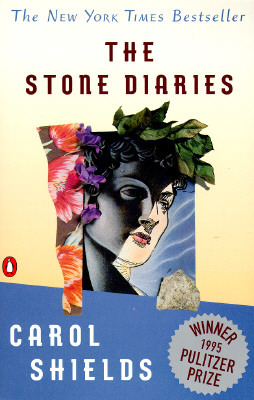
The Stone Diaries by Carol Shields (Blog Tour Review)
Is it possible to capture the complete course of a life, whether looking from the outside or telling it from the inside? What is set in stone and what is fleeting? These are questions Carol Shields addresses in her 1995 Pulitzer Prize winner, which plays with perspective and forms of storytelling as it conveys the extra/ordinary life of Daisy Stone Goodwill Flett. What with the family tree and section of black-and-white photographs, you might expect this to be a family saga; with the chronological chapters proceeding from “Birth” in 1905 to “Death” in the 1990s, you might expect an objective faux-biography. But The Stone Diaries is neither.
 The facts are these. Daisy’s mother, Mercy, dies giving birth to her in rural Manitoba. Raised by a neighbor, Daisy later moves to Indiana with her stonecutter father, Cuyler. After a disastrously short first marriage, Daisy returns to Canada to marry Barker Flett. Their three children and Ottawa garden become her life. She temporarily finds purpose in her empty-nest years by writing a “Mrs. Green Thumb” column for a local newspaper, but her retirement in Florida is plagued by illness and the feeling that she has missed out on what matters most.
What makes this surprising life story so remarkable is its unpicking of (auto)biographical authenticity: Shields switches between the first and third person, between Daisy’s point of view and a feigned omniscience. Some sections foreground others’ opinions: Chapter 6 is composed entirely of letters Daisy receives, while Chapter 7 collects short first-person narratives from her children and friends as they speculate on why she has fallen into a depression.
As in Shields’s Happenstance and Larry’s Party, which I’ve also reread this year, I was struck by the role that chance plays in any life:
History indeed! As though this paltry slice of time deserves such a name. Accident, not history, has called us together, and what an assembly we make. What confusion, what a clamor of inadequacy and portent.
Talk of bias, gaps and unreliability undermines the narrative:
Well, a childhood is what anyone wants to remember of it. It leaves behind no fossils, except perhaps in fiction. Which is why you want to take Daisy’s representation of events with a grain of salt, a bushel of salt.
Daisy herself almost disappears from the parts of the book where she is voiceless, consumed by her roles – by the end she is universally known as “Grandma Flett.” This meant that other characters stood out as more memorable to me: Cuyler for his obsessive building of stone monuments and streams of words, Barker for his love of plants and long-deferred sexual fulfillment, Daisy’s friend Fraidy Hoyt for her careful chronicling of fast living, and Magnus, Barker’s father, who lives long past his 100th birthday after his return to the Orkney Islands.
 As in Moon Tiger, one of my absolute favorites, the author explores how events and memories turn into artifacts. The meta approach also, I suspect, tips the hat to other works of Canadian literature: in her introduction, Margaret Atwood mentions that the poet whose story inspired Shields’s Mary Swann had a collection entitled A Stone Diary, and surely the title’s similarity to Margaret Laurence’s The Stone Angel (1964) can’t be pure coincidence.
Experiencing the novel again after 14 years, I was impressed by the experimentation but ultimately somewhat detached from the story. It was admiration rather than love; I enjoyed earlier chapters more than the last few. But isn’t that just like life, to keep going past the point where it’s fun? And isn’t that the point, that the meaning you long for may not be there at all?
Marcie (Buried in Print) and I have reread – or, in my case for half of them, read for the first time – six Shields novels together in 2020. I hope I’ll find time to respond to the rest of them in the next few weeks. It has been so rewarding to observe how her themes recur and interlock. How heartening to see that, 17 years after her death, Shields is still being read and remembered, through the World Editions reissues (three more are coming in 2021) and through the Carol Shields Prize for Fiction, a new $100,000 annual award for North American women’s writing.
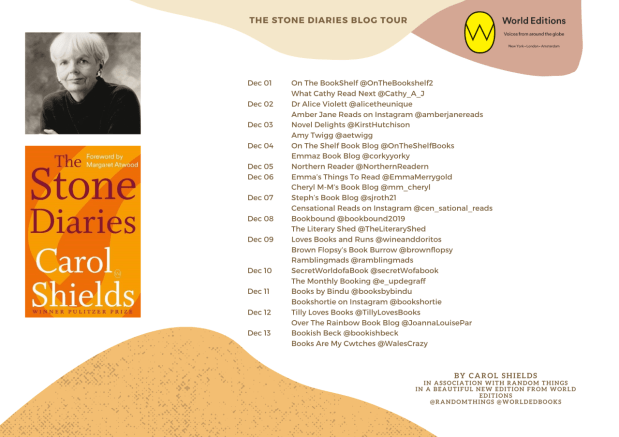
The Stone Diaries was reissued in the UK by World Editions on December 3rd. My thanks to the publisher for the free copy for review.
I was delighted to be invited to help close out the blog tour for The Stone Diaries. See below for details of where other reviews have appeared.
The IRON Book of Tree Poetry (Blog Tour)
 Though I’d only heard of two of the contributors, my love for nature and environmentalist themes made this anthology irresistible. The authors of the 50 poems write about individual and generic trees; forests real and imagined; environmental crisis and personal reckonings. In Sarah Mnatzaganian’s “Father Tree,” a sprawling horse-chestnut symbolizes her dying father and his motherland. Dominic Weston’s “Ancestry.com” literalizes the language of the family tree. In Celia McCulloch’s “Rhododendrons at Stapleford Wood,” an invasive species is a politically charged token of prejudice: “Is it just our xenophobia, this hatred for the Greek-named / tree, the immigrant, the Windrush plantation?”
I enjoyed the playful use of myth in Pauline Plummer’s “The Baobab”: “When God made the baobab He gave / it to the hyena, who laughed and laughed / throwing it into the scrub / where it landed upside down, dancing.” In “Abele,” Di Slaney envisions her post-mortem body feeding a woodland’s worth of creatures and being reincorporated into the flesh of trees.
Again and again, trees serve as a reminder of time passing, of seasons changing, of the vanity of human concerns compared to their centuries-old solidity – as in the final stanza of Mary Anne Perkins’s “To an Unpopular Poplar”:
This summer’s end, if I could translate
just one full hour of the whisperings
between your shimmered leaves,
how much the wiser I might be.
Thematic organization, rather than alphabetical, would have made more sense for this volume, but I appreciated the introduction to many new-to-me poets. Two favorite seasonal poems are pictured below.

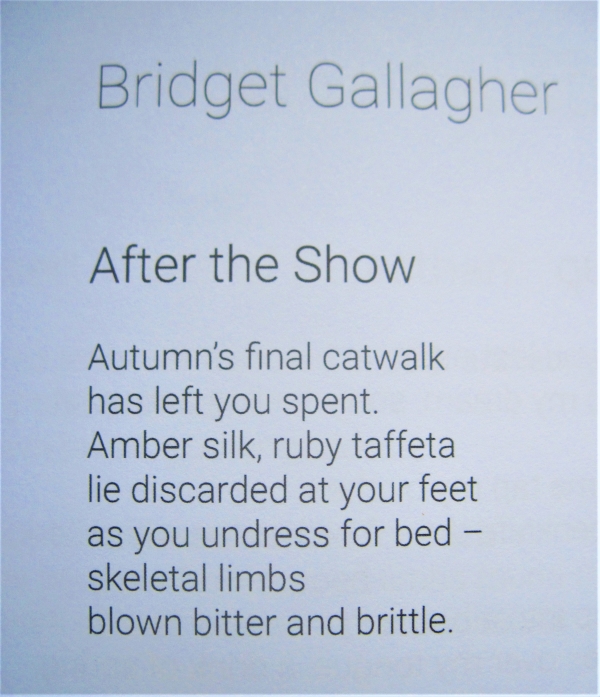
My thanks to IRON Press for the free copy for review.
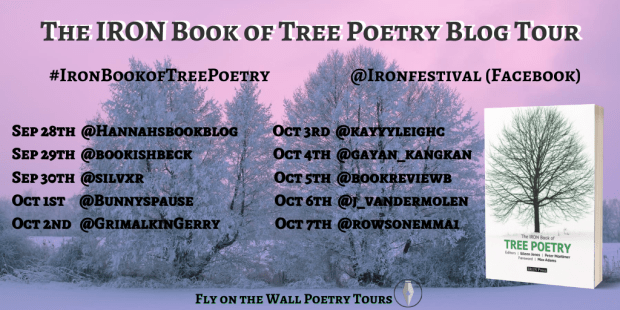
I was delighted to be invited to take part in the blog tour for The IRON Book of Tree Poetry. See below for where more reviews have appeared or will be appearing.
The Bitch by Pilar Quintana: Blog Tour and #WITMonth 2020, Part I
My first selection for Women in Translation Month is an intense Colombian novella originally published in 2017 and translated from the Spanish by Lisa Dillman. The Bitch, which won the Colombian Biblioteca de Narrativa Prize and has been preserved in a time capsule in Bogotá, is Pilar Quintana’s first book to become available in English translation.

The title is literal, yet its harshness is deliberate: It’s clear from the first scene onwards that this is no cosy tale for animal lovers. Doña Elodia, who runs a beachfront restaurant, has just found her dog dead on the sand, killed either accidentally or intentionally by rat poison. Just six days before, the dog had given birth to 10 puppies. Damaris agrees to adopt a grey female from the litter. Her husband Rogelio already keeps three guard dogs at their shantytown shack and is mean to them, but Damaris is determined things will be different with this pup.
Damaris seems to be cursed, though: she’s still haunted by the death by drowning of a neighbour boy, Nicolasito Reyes, who didn’t heed her warning about the dangerous rocks and waves; she lost her mother to a stray bullet when she was 14; and despite trying many herbs and potions she and Rogelio have not been able to have children. Tenderness has ebbed and flowed in her marriage; “She was over forty now, the age women dry up.” Her cousin disapproves of the attention she lavishes on the puppy, Chirli – the name she would have given a daughter.
Chirli doesn’t repay Damaris’ love with the devotion she expects. She’d been hoping for a faithful companion during her work as a caretaker and cleaner at the big houses on the bluff, but Chirli keeps running off – once disappearing for 33 days – and coming back pregnant. The dog serves as a symbol of parts of herself she doesn’t want to acknowledge, and desires she has repressed. This dark story of guilt and betrayal set at the edge of a menacing jungle can be interpreted at face value or as an allegory – the latter was the only way I could accept.
I appreciated the endnotes about the book design. The terrific cover photograph by Felipe Manorov Gomes was taken on a Brazilian beach. The stray’s world-weary expression is perfect.
The Bitch is published by World Editions on the 20th of August. I was delighted to be asked to participate in the blog tour. See below for details of where other reviews and features have appeared or will be appearing soon.

Are you doing any special reading for Women in Translation month this year?
A Hundred Million Years and a Day by Jean-Baptiste Andrea
 Stanislas Armengol remembers finding his first trilobite at the age of six. His fossils and his dog were his best friends during a lonely childhood dominated by a violent father nicknamed “The Commander.” Now, in the summer of 1954, Stan is a 52-year-old paleontologist embarking on the greatest project of his career. He sold his apartment in Paris to finance this expedition to the French/Italian Alps in search of a “dragon” (perhaps a diplodocus) said to be buried in a glacier between three mountain peaks.
“A scientist does not unquestioningly swallow a tall tale without demanding some proof, some concrete detail,” Stan insists. “Doubt is our religion.” But he’s seen a promising bone fragment from the region, and his excitement soon outweighs his uncertainty. This is his chance to finally make a name for himself. Arriving from Turin to join Stan are his friend and former assistant Umberto, and Umberto’s assistant, Peter. Gio, a local, will be their guide. It’s a tough climb requiring ropes and harnesses. As autumn approaches, and then winter, the hunt for the fossil becomes more frantic. The others are prepared to come back next year if it’s no longer sensible to continue, but Stan has staked everything on the venture and won’t quit.
Stan’s obsession puts him in touch with deep time – he’s “someone whose profession forces him to think in terms of millions of years” – but his thoughts keep returning to moments of joy or distress from his childhood. Although she died when he was nine years old, his beloved mother still looms large in his memory. Even as the realities of cold and hunger intensify, his past comes to seem more vivid than his present.
This French bestseller was shortlisted for the Grand Prix de l’Académie Française last year. Sam Taylor’s translation is flawless, as always (I only noted one tiny phrase that felt wrong for the time period – “honestly, what a brat” – though for all I know it’s off in the original, too). However, I found the novella uncannily similar to Snow, Dog, Foot by Claudio Morandini, which is about a hermit in the Italian Alps whose mental illness is exacerbated by snowy solitude. I found Morandini’s witty, macabre story more memorable. Although A Hundred Million Years and a Day is well constructed, there’s something austere about it that meant my admiration never quite moved into fondness.
My rating: 
A Hundred Million Years and a Day will be published in the UK tomorrow, the 11th. My thanks to Gallic Books for the free copy for review.
I was delighted to be invited to participate in the blog tour. See below for details of where other reviews and features have appeared or will be appearing soon.

Blog Tour: The Cabinet of Calm by Paul Anthony Jones
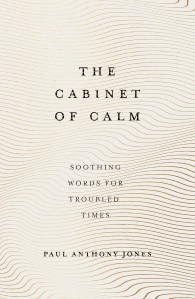 I’m delighted to be on the blog tour for The Cabinet of Calm: Soothing Words for Troubled Times by Paul Anthony Jones, which will be published in the UK by Elliott & Thompson on Thursday the 14th. Jones has a Master’s degree in linguistics and writes about etymology and obscure words. This is his seventh book of English-language trivia.
I was also on the blog tour for The Cabinet of Linguistic Curiosities: A Yearbook of Forgotten Words and enjoyed having that as my daily bedside book for a whole year. The short essays in his books are perfect for reading one or two at a time just before bed. (One of my current bedside reads is Jones’s 2016 book The Accidental Dictionary: The remarkable twists and turns of English words. As soon as I finish that, I’ll launch into the new one.)
The book’s publication, and the blog tour, neatly coincide with Mental Health Awareness Week (18–24 May). Here’s a bit more information about the book, from the press release: “For almost a decade, Paul Anthony Jones has written about the oddities and origins of the English language, amassing a vast collection of some of its more unusual words. Last year, doubly bereaved and struggling to regain his spirits, he turned to words – words that could be applied to difficult, challenging times and found solace. The Cabinet of Calm is the result.
“Paul has unearthed fifty-one linguistic remedies to offer reassurance, inspiration and hope in the face of such feelings as grief and despair, homesickness and exhaustion, missing our friends and a loss of hope. Written with a trademark lightness of touch, The Cabinet of Calm shows us that we’re not alone. From MELORISM, when you’re worried about the future of the world[,] and AGATHISM, when you’re feeling disillusionment or struggling to remain positive[,] to … STOUND, for when you’re grieving, someone else has felt like this before, and so there’s a word to help, whatever the challenge.”
I was assigned at random this exclusive extract from The Cabinet of Calm; how delightful to find that it references one of my favourite books!

Growlery
“Like so many of the English language’s best and most inventive words, growlery is a word we owe to one of our best and most inventive writers. In 1853, Charles Dickens used the word growlery in his novel Bleak House. As the kindly benefactor Mr Jarndyce welcomes one of the novel’s key narrators, Esther Summerson, to his eponymous home, he shows her into ‘a small room next to his bed-chamber’, containing ‘a little library of books and papers, and in part quite a little museum of his boots and shoes and hat-boxes’…
Although the word growlery itself had first appeared in the language somewhat earlier (as a term for the sound of grumbling or complaining) Mr Jarndyce’s growlery is essentially the Dickensian equivalent of what we in our less poetic, twenty-first-century language might call a ‘safe space’. It is a calming, comfortable, solitary room, filled with familiar and enlightening things, in which a bad mood can be privately vented, mused on and assuaged.
We might not all have the luxury of a bespoke room in a rambling country retreat in which to give vent to our problems, but there’s no reason why our own particular growleries have to match Mr Jarndyce’s … Wherever – or, for that matter, whatever – your particular growlery is, it’s undoubtedly a word and a place well worth knowing whenever you need to lighten your spirits.”
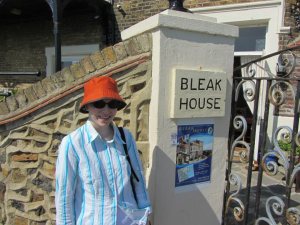
At “Bleak House” in Broadstairs, Kent in August 2012. Dickens occasionally lived here between the 1830s and the 1850s.
If you are in the UK and interested in purchasing a copy, please try to support an independent bookshop nearby. For instance, my local, Hungerford Bookshop, is still delivering. Or have a look for another shop on Twitter using the hashtags #ChooseBookshops and #shopindie.

The Book of Longings by Sue Monk Kidd (& Audiobook Blog Tour)
~This review contains plot spoilers.~
Sue Monk Kidd’s bold fourth novel started as a what-if question: What if Jesus had a wife? Church tradition has always insisted that he remained unmarried, but she felt that, given the cultural norms of the Middle East at that time, it would have been highly unusual for him not to marry. Musing on the motivation for airbrushing a spouse out of the picture, on the last page of the novel Kidd asks, “Did [early Christians] believe making him celibate rendered him more spiritual?” Or “Was it because women were so often invisible?” Although The Book of Longings retells biblical events, it is chiefly an attempt to illuminate women’s lives in the 1st century CE and to chart the female contribution to sacred literature and spirituality.
Fourteen-year-old Ana is a headstrong young woman with a forthright voice and a determination to choose her own life. Privilege and luck are on her side: her father is the head scribe to Herod Antipas, the ruler of Galilee; and the repulsive widower to whom she’s been betrothed dies, freeing her to marry Jesus, a travelling craftsman who caught her eye at the market. Ana’s aunt, Yaltha from Alexandria, is a major influence in her life. She had a rare chance at education and encourages her niece in her writing. Ana knows several ancient languages and fills every papyrus scroll she can get her hands on with stories of the women in the Bible. Yaltha also gives her an incantation bowl in which to write her deeply held prayers.
If you’re familiar with Kidd’s other work (such as The Secret Life of Bees and Traveling with Pomegranates), you know that she often explores the divine feminine and matriarchal units. Historically, Christianity has a poor record of acknowledging its patriarchal tendencies and redressing the balance. But Kidd imagines that, right at the beginning, Jesus valued women and was open to them having a life beyond domestic chores and childrearing. He involves Ana in his discussions about God and the nature of the Kingdom; they both see and take compassion on people’s suffering; together they are baptized by John the Baptist. And when Ana tells Jesus she doesn’t believe she is meant to be a mother – her mother and aunt took herbal potions and have passed on their contraceptive knowledge to her – he accepts her choice, even though childlessness could bring shame on both of them.

I appreciated this picture of a woman who opts for writing and the spiritual life over motherhood. However, Kidd portrays a whole range of women’s experiences: Jesus’s mother and sister-in-law submit to the drudgery of keeping a household going; Ana’s friend is raped and has her tongue cut out in an attempt to silence her, yet finds new ways to express herself; and another major character is a servant involved in the healing rituals at a temple to Isis. A practicing Jew, Ana finds meaning in other religious traditions rather than dismissing them as idolatry. She also participates in wider intellectual life, such as by reading The Odyssey.
Some descriptions make this novel sound like alternative history. If you’re expecting Ana to save the day and change the course of history, you will be disappointed. Ana is simply an observer of the events documented in the Bible. While she recounts the inspirations for some parables and healing incidents, during two years in exile with her aunt she only hears secondhand accounts of Jesus’s ministry. Her brother, a Zealot, disagrees with Jesus on how to usher in the Kingdom of God. By the time Ana returns to Jerusalem, the events leading to the crucifixion have already been set in motion; she can only bear witness. For her, life will continue after Jesus’s death, in a women-led spiritual community. From avoiding motherhood to choosing a monastic-type life, Ana has a lot of freedom. Some readers may be skeptical about how realistic this life course is, but the key, I think, is to consider Ana as an outlier.
Kidd has made wise decisions here: for the most part she makes her story line parallel or tangential to the biblical record, rather than repeating material many will find overly familiar. She takes Jewish teaching as a starting point but builds a picture of a more all-encompassing spirituality drawn from multiple traditions. Her Jesus is recognizable and deeply human; Ana calls him “a peacemaker and a provocateur in equal measures” and remembers him telling her what it was like growing up with the stigma of his illegitimate birth. The novel is rooted in historical detail but the research into the time and place never takes over. Engrossing and convincing, this is a story of women’s intuition and yearning, and of the parts of history that often get overlooked. It wouldn’t be out of place on next year’s Women’s Prize longlist.
My rating: 
The Book of Longings was released on Tuesday the 21st. My thanks to Tinder Press for the proof copy for review.
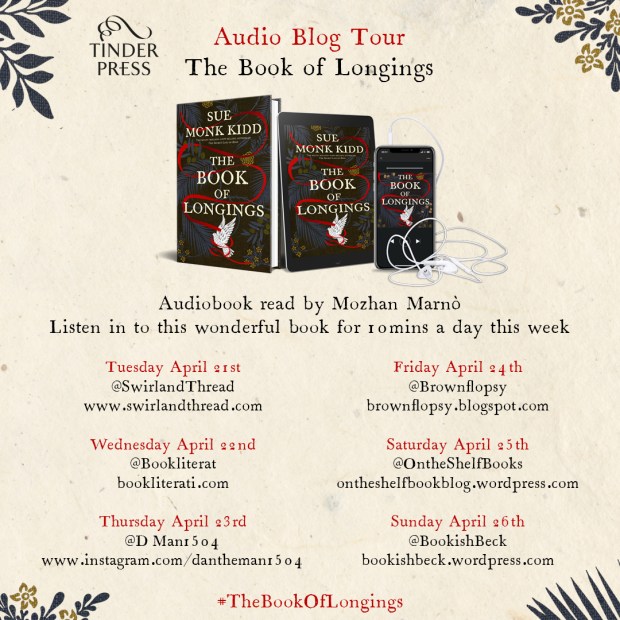
I’m the last stop on a small blog tour for the audiobook release: if you’re interested in listening to the first hour of The Book of Longings, visit the blogs below and follow the links. Each one is hosting a 10-minute excerpt. The final one is available here.
The Not the Wellcome Prize Blog Tour: Francesca Segal and Ian Williams
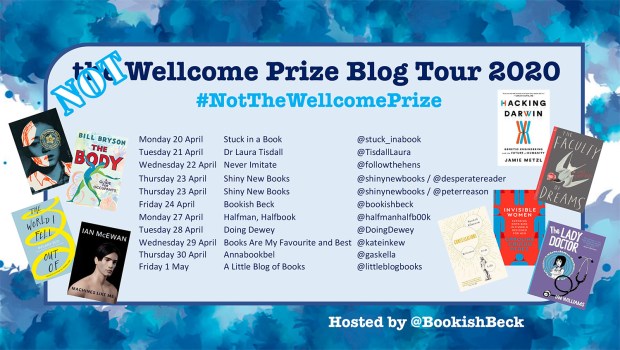
It’s my stop on the “Not the Wellcome Prize” blog tour. With two dozen reviews of health-themed 2019 books to choose from, I decided to nominate these two for the longlist because they’re under the radar compared to some other medical releases, plus they showcase the breadth of the books that the Prize recognizes: from a heartfelt memoir of a mother welcoming premature babies to a laugh-out-loud graphic novel about a doctor practicing in a small town in Wales. (The Prize website says “picture-led books are not eligible,” so in fact it is likely that graphic novels have never been considered, but we’ve been flexible with the rules for this unofficial blog tour.)
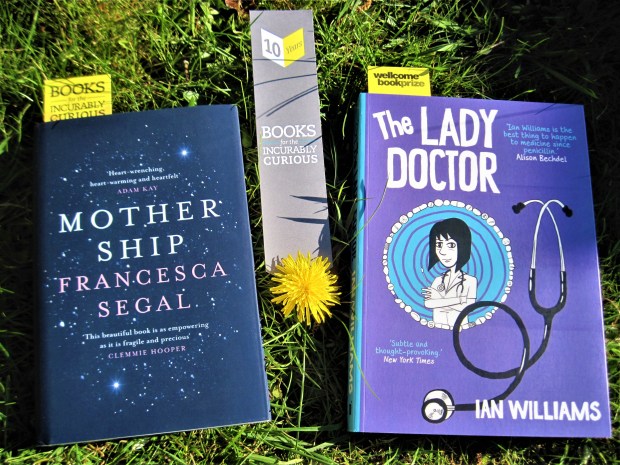
Mother Ship by Francesca Segal
 This first work of nonfiction from the author of the exquisite The Innocents is a visceral diary of the first eight weeks in the lives of her twin daughters, who were born by Caesarean section at 29 weeks in October 2015 and spent the next two months in the NICU, “an extremely well-funded prison or perhaps more accurately a high-tech zoo.” In Mother Ship, she strives to come to terms with this unnatural start to motherhood. “Taking my unready daughters from within me felt not like a birth but an evisceration,” she writes. “My children do not appear to require mothering. Instead they need sophisticated medical intervention.”
Segal describes with tender precision the feeling of being torn: between the second novel she’d been in the middle of writing and the all-consuming nature of early parenthood; and between her two girls (known for much of the book as “A-lette” and “B-lette”), who are at one point separated in different hospitals. Her attitude towards the NHS is pure gratitude.
As well as portraying her own state of mind, she crafts twinkly pen portraits of the others she encountered in the NICU, including the staff but especially her fellow preemie mums, who met in a “milking shed” where they pumped breast milk for the babies they were so afraid of losing that they resisted naming. (Though it was touch and go for a while, A-lette and B-lette finally earned the names Raffaella and Celeste and came home safely.) Female friendship is thus a subsidiary theme in this exploration of desperate love and helplessness.
The Lady Doctor by Ian Williams
 This sequel to 2014’s The Bad Doctor returns to a medical practice in small-town Wales. This time, though, the focus is on Iwan James’s colleague, Dr. Lois Pritchard, who also puts in two days a week treating embarrassing ailments at the local hospital’s genitourinary medicine clinic. At nearly 40, Lois is a divorcee with no children; just a dog. She enjoys her nights out drinking with her best friend, Geeta, but her carefree life is soon beset by various complications: she has to decide whether she wants to join the health centre as a full partner, a tryst with her new fella goes horribly wrong, and her estranged mother suddenly reappears in her life, hoping that Lois will give her a liver transplant. And that’s not to mention all the drug addicts and VD-ridden lotharios hanging about.
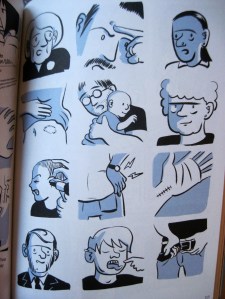 Williams was a GP in North Wales for 20 years, and no doubt his experiences have inspired his comics. His tone is wonderfully balanced: there are plenty of hilarious, somewhat raunchy scenes, but also touching moments where Lois learns that a doctor is never completely off duty and has no idea what medical or personal challenge will crop up next. The drawing style reminded me most of Alison Bechdel’s or Posy Simmonds’, with single shades from rose to olive alternating as the background. I especially loved the pages where each panel depicts a different patient to show the range of people and complaints a doctor might see in a day. Myriad Editions have a whole “Graphic Medicine” series that I’m keen to explore.
See below for details of the blogs where other reviews have appeared or will be appearing soon.
The shadow panel will choose a shortlist of six titles to be announced on 4 May. We will then vote to choose a winner, with the results of a Twitter poll serving as one additional vote. The Not the Wellcome Prize winner will be announced on 11 May.
 Bookish Beck = Rebecca Foster. American transplant to England. Freelance proofreader and book reviewer.
 Bookish Beck