All Souls’ Day Reading: Armitage, Campbell, Mah & Perry
Along with my Halloween-tide R.I.P. reading (here and here), I’ve been reading books about ancestors and the dead – appropriate for All Saints’ Day (yesterday) and All Souls’ Day (today). Both are in the Church calendar but less a part of popular culture.
My mind naturally turns toward the dead as October advances: on the 30th, it was three years since my mother’s death (plus the 25th marked a year since we started losing sweet Alfie). To allay dread at the impending anniversary, I booked myself a treat to look forward to that day. For some reason, Wantage Literary Festival included a Gin Tasting Extravaganza alongside its bookish events. I didn’t fancy any book talks but was keen to try 10 British Isles gins, 9 of which were new to me and 5 of which were ticks in my 101 Gins to Try before You Die book.


Beforehand, I did some secondhand book shopping. Regent is an excellent and enormous maze of a bookshop that I’d been to once before. It has an exhaustive selection and great prices (£2.50 paperbacks / £3–5 hardbacks) that haven’t changed in three years. I considered this return trip a chance for another birthday book haul and was delighted with my finds (the Gleeson was from a charity shop in the town).


My All Souls’ stack includes a poetry collection and three #NonfictionNovember reads.
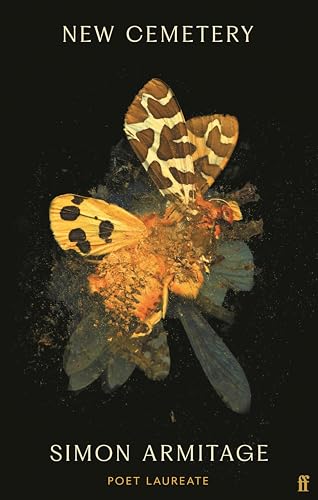
New Cemetery by Simon Armitage (2025)
Not far from the English Poet Laureate’s home in Huddersfield, some cow fields were recently converted into a municipal graveyard. I can’t do better than Armitage’s own description of the style in this collection: “short-lined tercets linked with/by intermittent rhymes and half-rhymes … like threading daisy chains.” Each one is titled in brackets after a species of moth, in a rather arbitrary way, as he acknowledges. The point was to – in a time of climate breakdown – include nature in the inevitable march of death and decay. I most liked the poems about the cemetery, whereas the majority of the book is about everyday moments from a writer’s life.
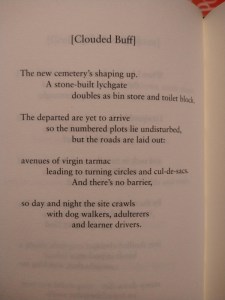
There are some amusing and poignant lines among the rest:
 I died and went
to Bristol Parkway
for my sins,
interchange
between soul and flesh
the whispered half-rhymes
of earth and death
on the spade’s tongue.
I also appreciated this haiku-like stanza: “Almond blossom / slash rotten confetti / clogging the church drains.” But there was little that struck me otherwise. I’ve tried to love Armitage’s poetry, but this third experience again leaves me unmoved. I’ve preferred his travel memoirs. Still, the book ends on the perfect note:
the dead are patiently
killing time
between visiting hours,
deaf, blind, mute
and numb,
unable to love
but capable still
of being loved.
(Public library) 
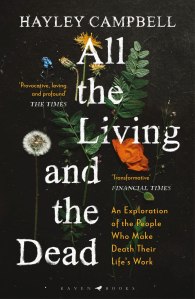 I’ve read the first two chapters of a long-neglected review copy of All the Living and the Dead by Hayley Campbell (2022), in which she shadows various individuals who work in the death industry, starting with a funeral director and the head of anatomy services for the Mayo Clinic in Minnesota. In Victorian times, corpses were stolen for medical students to practice on. These days, more people want to donate their bodies to science than can usually be accommodated. The Mayo Clinic receives upwards of 200 cadavers a year and these are the basis for many practical lessons as trainees prepare to perform surgery on the living. Campbell’s prose is journalistic, detailed and matter-of-fact, but I’m struggling with the very small type in my paperback. Upcoming chapters will consider a death mask sculptor, a trauma cleaner, a gravedigger, and more. If you’ve enjoyed Caitlin Doughty’s books, try this.
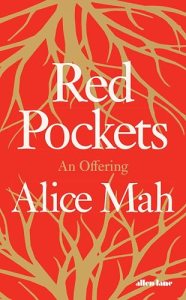 I’m halfway through Red Pockets: An Offering by Alice Mah (2025) from the library. I borrowed it because it was on the Wainwright Prize for Conservation Writing shortlist. During the Qingming Festival, the Chinese return to their hometowns to honour their ancestors. By sweeping their tombs and making offerings, they prevent the dead from coming back as hungry ghosts. When Mah, who grew up in Canada and now lives in Scotland, returns to South China with a cousin in 2017, she finds little trace of her ancestors but plenty of pollution and ecological degradation. Their grandfather wrote a memoir about his early life and immigration to Canada. In the present day, the cousins struggle to understand cultural norms such as gifting red envelopes of money to all locals. This is easy reading but slightly dull; it feels like Mah included every detail from her trips simply because she had the material, whereas memoirs need to be more selective. But I’m reminded of the works of Jessica J. Lee, which is no bad thing.
Death of an Ordinary Man by Sarah Perry (2025)
Perry recognises what a sacred privilege it was to witness her father-in-law’s death, which occurred just nine days after his diagnosis with oesophageal cancer. She concludes, like Simone de Beauvoir does of her mother in A Very Easy Death, that David’s end was as good as one might hope for. Viz., he was in his late seventies, remained at home, was looked after by his son and daughter-in-law, more or less maintained his mental capacity until the end, and showed minimal signs of pain or distress. Still, every death is fraught, to some degree, with bureaucracy, medical error and pangs of regret. There is a searing encounter here with an unfeeling GP; on the other hand, there is such kindness from nurses, relatives and a pastor.
The beauty of Perry’s memoir is its patient, clear-eyed unfolding of every stage of dying, a natural and inexorable process that in other centuries would have been familiar to anyone – having observed it with siblings, children, parents, neighbours, distant relatives and so on. She felt she was joining a specifically womanly lineage of ministering, a destiny so quotidian that she didn’t feel uncomfortable with any of the intimate care involved. I thought of my sister and her mother- and sister-in-law sitting vigil at my brother-in-law’s deathbed in 2015.
 Perry traces the physical changes in David as he moved with alarming alacrity from normal, if slowed, daily life to complete dependency to death’s door. At the same time, she is aware that this is only her own perspective on events, so she records her responses and emotional state and, to a lesser extent, her husband’s. Her quiver of allusions is perfectly chosen and she lands on just the right tone: direct but tender. Because of her and David’s shared upbringing, the points of reference are often religious, but not obtrusive. My only wish is to have gotten more of a sense of David alive. There’s a brief section on his life at the start, mirrored by a short “Afterlife” chapter at the end telling what succeeded his death. But the focus is very much on the short period of his illness and the days of his dying. During this time, he appears confused and powerless. He barely says anything beyond “I’m in a bit of a muddle,” to refer to anything from incontinence to an inability to eat. At first I thought this was infantilizing him. But I came to see it as a way of reflecting how death strips everything away.
As I read, I often had tears in my eyes, thinking of the deaths I have experienced at second hand and the many more that will come my way until my own. In this gift of a book, Perry captures the emotional poles of bearing witness, and the dignity and uniqueness of every life:
There was relief, and there was loss – it was the saddest thing we’d ever seen, and the best thing we had ever done – all these things existing together undiminished, and never cancelling each other out.
now I understand there are no ordinary lives – that every death is the end of a single event in time’s history: an event so improbable it represents a miracle, and irreplaceable in every particular.
(Public library) 
Death and grief are common topics in my stacks at all times of year. I see more books on dying and the dead in my immediate future, starting with two rereads for #NovNov – The Death of Ivan Ilych and Death in Venice, along with The Field by Robert Seethaler (narrated by the inhabitants of a cemetery), the latter two for #GermanLitMonth; and A Single Man by Christopher Isherwood.
June Releases by Caroline Bird, Kathleen Jamie, Glynnis MacNicol and Naomi Westerman
These four books by women all incorporate life writing to an extent. Although the forms differ, a common theme – as in the other June releases I’ve reviewed, Sandwich and Others Like Me – is grappling with what a woman’s life should be, especially for those who have taken an unconventional path (i.e. are queer or childless) or are in midlife or later. I’ve got a poet up to her usual surreal shenanigans but with a new focus on lesbian parenting; a hybrid collection of poetry and prose giving snapshots of nature in crisis; an account of a writer’s hedonistic month in pandemic-era Paris; and mordant essays about death culture.
Ambush at Still Lake by Caroline Bird
 Caroline Bird has become one of my favourite contemporary poets over the past few years. Her verse is joyously cheeky and absurdist. A great way to sample it is via her selected poems, Rookie. This seventh collection is muted by age and circumstance – multiple weddings and a baby – but still hilarious in places. Instead of rehab or hospital as in In These Days of Prohibition, the setting is mostly the domestic sphere. Even here, bizarre things happen. The police burst in at 4 a.m. for no particular reason; search algorithms and the baby monitor go haywire. Her brother calls to deliver a paranoid rant (in “Up and at ’Em”), while Nannie Edna’s dying wish is to dangle her great-grandson from her apartment window (in “Last Rites”). The clinic calls to announce that their sperm donor was a serial killer – then ‘oops, wrong vial, never mind!’ A toddler son’s strange and megalomaniac demands direct their days. My two favourites were “Ants,” in which a kitchen infestation signals general chaos, and “The Frozen Aisle,” in which a couple scrambles to finish the grocery shop and get home to bed before a rare horny moment passes. A lesbian pulp fiction cover, mischievous wit and topics of addiction and queer parenting: this is not your average poetry.
With thanks to Carcanet Press for the free copy for review.
A sample poem:
Siblings
A woman gave birth
to the reincarnation
of Gilbert and Sullivan
or rather, two reincarnations:
one Gilbert, one Sullivan.
What are the odds
of both being resummoned
by the same womb
when they could’ve been
a blue dart frog
and a supply teacher
on separate continents?
Yet here they were, squidged
into a tandem pushchair
with their best work
behind them, still smarting
from the critical reception
of their final opera
described as ‘but an echo’
of earlier collaborations.
Cairn by Kathleen Jamie
 As she approached age 60, Kathleen Jamie found her style changing. Whereas her other essay collections alternate extended nature or travel pieces with few-page vignettes, Cairn eschews longer material and instead alternates poems with micro-essays on climate crisis and outdoor experiences. In the prologue she calls these “distillations and observations. Testimonies” that she has assembled into “A cairn of sorts.”
As in Surfacing, she writes many of the autobiographical fragments in the second person. The book is melancholy at times, haunted by all that has been lost and will be lost in the future:
What do we sense on the moor but ghost folk,
ghost deer, even ghost wolf. The path itself is a
phantom, almost erased in ling and yellow tormentil (from “Moor”)
In “The Bass Rock,” Jamie laments the effect that bird flu has had on this famous gannet colony and wishes desperately for better news:
The light glances on the water. The haze clears, and now the rock is visible; it looks depleted. But hallelujah, a pennant of twenty-odd gannets is passing, flying strongly, now rising now falling They’ll be Bass Rock birds. What use the summer sunlight, if it can’t gleam on a gannet’s back? You can only hope next year will be different. Stay alive! You call after the flying birds. Stay alive!
Natural wonders remind her of her own mortality and the insignificance of human life against deep time. “I can imagine the world going on without me, which one doesn’t at 30.” She questions the value of poetry in a time of emergency: “If we are entering a great dismantling, we can hardly expect lyric to survive. How to write a lyric poem?” (from “Summer”). The same could be said of any human endeavour in the face of extinction: We question the point but still we continue.
My two favourite pieces were “The Handover,” about going on an environmental march with her son and his friends in Glasgow and comparing it with the protests of her time (Greenham Common and nuclear disarmament) – doom and gloom was ever thus – and the title poem, which piles natural image on image like a cone of stones. Although I prefer the depth of Jamie’s other books to the breadth of this one, she is an invaluable nature writer for her wisdom and eloquence, and I am grateful we have heard from her again after five years.
With thanks to Sort Of Books for the free copy for review.
I’m Mostly Here to Enjoy Myself: One Woman’s Pursuit of Pleasure in Paris by Glynnis MacNicol
 I loved New York City freelance writer Glynnis MacNicol’s No One Tells You This (2018), which approached her 40th year as an adventure into the unknown. This second memoir is similarly frank and intrepid as MacNicol examines the unconscious rules that people set for women in their mid-forties and gleefully flouts them, remaining single and childfree and delighting in the freedom that allows her to book a month in Paris on a whim. She knows that she is an anomaly for being “untethered”; “I am ready for anything. To be anyone.”
This takes place in August 2021, when some pandemic restrictions were still in force, and she found the city – a frequent destination for her over the years – drained of locals, who were all en vacances, and largely empty of tourists, too. Although there was still a queue for the Mona Lisa, she otherwise found the Louvre very quiet, and could ride her borrowed bike through the streets without having to look out for cars. She and her single girlfriends met for rosé-soaked brunches and picnics, joined outdoor dance parties and took an island break.
And then there was the sex. MacNicol joined a hook-up app called Fruitz and met all sorts of men. She refused to believe that, just because she was 46 going on 47, she should be invisible or demure. “All the attention feels like pure oxygen. Anything is possible.” Seeing herself through the eyes of an enraptured 27-year-old Italian reminded her that her body was beautiful even if it wasn’t what she remembered from her twenties (“there is, on average, a five-year gap between current me being able to enjoy the me in the photos”). The book’s title is something she wrote while messaging with one of her potential partners.
As I wrote yesterday about Others Like Me, there are plenty of childless role models but you may have to look a bit harder for them. MacNicol does so by tracking down the Paris haunts of women writers such as Edith Wharton and Colette. She also interrogates this idea of women living a life of pleasure by researching the “odalisque” in 18th- and 19th-century art, as in the François Boucher painting on the cover. This was fun, provocative and thoughtful all at once; well worth seeking out for summer reading and armchair travelling.
(Read via Edelweiss) Published in the USA by Penguin Life/Random House.
Happy Death Club: Essays on Death, Grief & Bereavement across Cultures by Naomi Westerman
 Like Erica Buist (This Party’s Dead) and Caitlin Doughty (Smoke Gets in Your Eyes, From Here to Eternity and Will My Cat Eat My Eyeballs?), playwright Naomi Westerman finds the comical side of death. Part of 404 Ink’s Inklings series (“Big ideas, pocket-sized books” – perfect for anyone looking for short nonfiction for Novellas in November!), this is a collection of short essays about her own experiences of bereavement as well as her anthropological research into rituals and beliefs around death. “The Rat King of South London” is about her father’s sudden death from an abdominal aneurysm. An instantaneous death is a good one, she contends. More than 160,000 people die every day, and what to do with all those bodies is a serious question. A subversive sense of humour is there right from the start, as she gives a rundown of interment options. “Mummification: Beloved by Ancient Egyptians and small children going through their Ancient Egypt phase, it’s a classic for a reason!” Meanwhile, she legally owns her father’s plot so also buries dead pet rats there.
Other essays are about taking her mother’s ashes along on world travels, the funeral industry and “red market” sales of body parts, grief as a theme in horror films, the fetishization of dead female bodies, Mexico’s Day of the Dead festivities, and true crime obsession. In “Batman,” an excerpt from one of her plays, she goes to have a terrible cup of tea with the man she believes to be responsible for her mother’s death – a violent one, after leaving an abusive relationship. She also used the play to host an on-stage memorial for her mother since she wasn’t able to sit shiva. In the final title essay, Westerman tours lots of death cafés and finds comfort in shared experiences. These pieces are all breezy, amusing and easy to read, so it’s a shame that this small press didn’t achieve proper proofreading, making for a rather sloppy text, and that the content was overall too familiar for me.
With thanks to 404 Ink and publicist Claire Maxwell for the free copy for review.
Does one or more of these catch your eye?
What June releases can you recommend?
Remainders of the Day by Shaun Bythell & What Remains? by Rupert Callender
I raced to finish all the September releases on my stack by the 30th, thinking I’d review them in one go, but that ended up being far too unwieldy. There was way too much to say about each of these excellent books (the first two pairs are here and here; Blurb Your Enthusiasm by Louise Willder is still to come, probably on Wednesday). I’ve mentioned before that the month’s crop of nonfiction was about either books or death. Here’s one of each, linked by their ‘remain’ titles. Both: 
Remainders of the Day: More Diaries from The Bookshop, Wigtown by Shaun Bythell
 It’s just over five years since many of us were introduced to Wigtown and the ups and downs of running a bookshop there through Shaun Bythell’s The Diary of a Bookseller. (I’ve also reviewed the follow-up, Confessions of a Bookseller, which was an enjoyable read for me during a 2019 trip to Milan, and 2020’s Seven Kinds of People You Find in Bookshops.)
This third volume opens in February 2016. As in its predecessors, each monthly section is prefaced by an epigraph from a historical work on bookselling – this time R. M. Williamson’s 1904 Bits from an Old Bookshop. It’s the same winning formula as ever: the nearly daily entries start with the number of online orders received and filled, and end with the number of customers and the till takings for the day. (The average spend seems to be £10 per customer, which is fine in high tourist season but not so great in November and December when hardly anyone walks through the door.) In between, Bythell details notable customer encounters, interactions with shop helpers or local friends, trips out to buy book collections or go fishing, Wigtown events including the book festival, and the occasional snafu like the boiler breaking during a frigid November or his mum being hospitalized with a burst ulcer.
Reading May Sarton’s Encore recently, I came across a passage where she is reading a fellow writer’s journal (Doris Grumbach’s Coming into the End Zone):
I find hers extremely good reading, so I cannot bear to stop. I am reading it much too fast and I think I shall have to read it again. I know that I must not swallow it whole. There is something about a journal, I think, that does this to readers. So many readers tell me that they cannot put my journals down.
I’ve heard Zadie Smith say the same about Karl Ove Knausgaard’s My Struggle: it’s just the stuff of prosaic, everyday life and yet she refers to his memoirs/autofiction as literary crack.
I often read a whole month’s worth of entries at a sitting. I can think of a few specific reasons why Bythell’s journals are such addictive reading:
- “Sometimes you want to go where everybody knows your name.” Small-town settings are irresistible for many readers, and by now the fairly small cast of characters in Bythell’s books feel like old friends. Especially having been to Wigtown myself, I can picture many of the locations he writes about, and you get the rhythm of the seasons and the natural world as well as the town’s ebb and flow of visitors.
- (A related point) You know what to expect, and that’s a comforting thing. Bythell makes effective use of running gags. You know that when Granny, an occasional shop helper from Italy, appears, she will complain about her aches and pains, curse at Bythell and give him the finger. Petra’s belly-dancing class (held above the shop) will inevitably be poorly attended. If Eliot is visiting, he is sure to leave his shoes right where everyone will trip over them. Captain the cat will be portly and infuriating.
- What I most love about the series is the picture of the life cycle of books, from when they first enter the shop, or get picked up in his van, to when rejects are dropped at a Glasgow recycling plant. What happens in the meantime varies, with once-popular authors falling out of fashion while certain topics remain perennial bestsellers in the shop (railways, ornithology). There’s many a serendipitous moment when he comes across a book and it’s just what a customer wants, or buys a book as part of a lot and then sells it online the very next day. New, unpriced stock is always quick to go.
Also of note in this volume are his break-up with Amazon, after his account falls victim to algorithms and is suspended, the meta moment where he signs his first book contract with Profile, and the increasing presence of the Bookshop Band, who moved to Wigtown later in 2017. Bythell doesn’t seem to get much time to read – it’s a misconception of the bookselling life that you do nothing but read all day; you’d be better off as a book reviewer if that’s what you want – but when he does, it’s generally an intense experience: E.M. Forster’s sci-fi novella The Machine Stops (who knew it existed?!), Barbara Comyns’s A Touch of Mistletoe, Jonathan Safran Foer’s Everything Is Illuminated, and Oscar Wilde’s De Profundis.
I’m torn as to whether I hope there will be more year by year volumes filling in to the present day. As Annabel noted, the ‘where they are now’ approach in the Epilogue rather suggests that he and his publisher will leave it here at a trilogy. This might be for the best, as a few more pre-Covid years of the same routines could get old, though nosey parkers like myself will want to know how a confirmed bachelor turned into a family man…
Some favourite lines:
“Quiet day in the shop; even the cat looked bored.” (31 October)
“The life of the secondhand bookseller mainly involves moving boxes from one place to another, and trying to make them fit into a small space, like some sort of awful game of Tetris.”
(10 February and 15 March are great stand-alone entries that give a sense of what the whole is like. There are a lot of black-and-white photos printed amid the text in the first month; it’s a shame these don’t carry on through.)
With thanks to Profile Books for the free copy for review.
What Remains?: Life, Death and the Human Art of Undertaking by Rupert Callender
Call me morbid or call me realistic; in the last decade and a half I have read a lot of books about death, including terminal illness and bereavements. I’ve even read several nonfiction works by American mortician Caitlin Doughty. But I’ve not read anything quite like punk undertaker Rupert Callender’s manifesto about modern death and how much we get wrong in our conceptualization and conversations. It was poignant to be reading this in the weeks surrounding Queen Elizabeth II’s death – a time when death got more discussion than usual, yes, but when there was also some ridiculous pomp that obscured the basic human facts of it.
Callender is not okay with death, and never has been. When he was seven, his father died of a heart attack at age 63. His 1970s Edinburgh upbringing was shattered and his mother, who he has no doubt was doing her best, made a few terrible mistakes. First, a year before, she’d reassured him that his father wasn’t going to die. Second, she didn’t make him attend the funeral. (I still wish my mother had made me go back to tour my late grandmother’s house one final time when I was seven; instead, I stayed behind and played on a Ouija board with my cousins.) Third, she soon sent Callender away to boarding school, which left him feeling alone and betrayed. And lastly, when she died of cancer when he was 25, she had planned every detail of her funeral – whereas he believes that is a task for the survivors.
An orphan in his late twenties, Callender came across The Natural Death Handbook and it sealed his future. He’d been expelled from school and blown his inheritance; acid house culture had given him a sense of community. Now he had a vocation. The first funeral he coordinated was for a postman named Barry. The fourth was a suicide. Their first child burial was one of his partner’s daughter’s classmates.

Over the next two decades, he and his (now ex-)wife Claire based Totnes’ The Green Funeral Company on old-fashioned values and homespun ceremonies. They oppose the overmedicalization of death and the clinical detachment of places like crematoria. Callender is vehemently anti-embalming – an intrusive process that involves toxic substances. They encourage the bereaved to keep the body at home for the week before a funeral, if they feel able (ice packs like you’d use in a picnic cool bag will work a treat), and to be their own pallbearers to make the memory of the funeral day a physical one. He performs the eulogies himself, and they use cardboard coffins.
This is a slippery work for how it intersperses personal stories with polemic and poetic writing. Despite a roughly chronological throughline, it feels more like a thematic set of essays than a sequential narrative. Callender has turned death rituals into both performance art (including at festivals and in collaboration with The KLF) and political protests (e.g., a public funeral he conducted for a homeless man who died of exposure, the third such death in his town that year). While he doesn’t shy away from the gruesome realities of dealing with corpses, he always brings it back to fundamentals: matter is what we are, but who we were lives on in others’ loving memories. Death rituals plug us into a human lineage and proclaim meaning in the face of nothingness. Whether you’ve seen/read it all or never considered picking up a book about death, I recommend Callender’s sui generis approach.
Some favourite lines:
“[The practice of having official pallbearers] is all part of the emotional infantilising encouraged by the funeral industry, all part of being turned into an audience at one of the most significant moments in your family history, instead of being empowered as a family and a community.”
“each death we experience contains every death we have ever lived through, Russian dolls of bereavement waiting to be unpacked.”
“Only once you are dead can the full arc of your life be clearly seen, and telling that story out loud and truthfully to the people who shared it is a powerful social act that both binds us together and place us within our culture.”
With thanks to Chelsea Green for the proof copy for review.
And as a bonus, given that today is Indigenous Peoples’ Day in the USA, here’s an excerpt from my Shelf Awareness review of another book that came out last month:
No Country for Eight-Spot Butterflies: A Lyric Essay by Julian Aguon
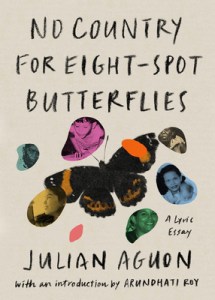 An indigenous human rights lawyer, Aguon is passionate about protecting his homeland of Guam, which is threatened by climate change and military expansion. His tender collage of autobiographical vignettes and public addresses inspires activism and celebrates beauty worth preserving. The U.S. Department of Defense’s plan to site more Marines and firing ranges on Guam will destroy more than 1,000 acres of limestone forest—home to endemic and endangered species, including the Mariana eight-spot butterfly. Aguon has been a lead litigator in appeals rising all the way to the U.S. Supreme Court. Rejecting fatalism, he endorses peaceful resistance. Two commencement speeches, poems, a eulogy and an interview round out the varied and heartfelt collection.
Three on a Theme (and #ReadIndies): Nonfiction I Sponsored Last Year
Here in the UK we’re hunkering down against the high winds of Storm Eunice. We’ve already watched two trees come down in a neighbour’s garden (and they’re currently out there trying to shore up the fence!), and had news on the community Facebook page of a huge conifer down by the canal. Very sad. I hope you’re all safe and well and tucked up at home.
Today I’m looking back at several 2021 nonfiction releases I helped come into existence. The first and third I sponsored via Unbound, and the second through Dodo Ink. Supporting small publishers also ties this post into Karen and Lizzy’s February Read Indies initiative. All: 

This Party’s Dead: Grief, Joy and Spilled Rum at the World’s Death Festivals by Erica Buist
A death tourism book? I’m there! This is actually the third I’ve read in recent years, after From Here to Eternity by Caitlin Doughty and Near the Exit by Lori Erickson. Buist’s journey was sparked off by the sudden death of her fiancé Dion’s father, Chris – he was dead for a week before his cleaner raised the alarm – and her burden of guilt. It’s an act of atonement for what happened to Chris and the fact that she and Dion, who used to lodge with him, weren’t there when he really needed it. It’s also her way of discovering a sense of the sacred around death, instead of simply fearing and hiding from it.
 This takes place in roughly 2018. The author travelled to eight festivals in seven countries, starting with Mexico for the Day of the Dead and later for an exploration of Santa Muerte, a hero of the working class. Other destinations included Nepal, Sicily (“bones of the dead” biscotti), Madagascar (the “turning of the bones” ceremony – a days-long, extravagant party for a whole village), Thailand and Kyoto. The New Orleans chapter was a standout for me. It’s a city where the dead outnumber the living 10 to 1 (and did so even before Katrina), and graveyard and ghost tours are a common tourist activity.
Buist is an entertaining writer, snappy and upbeat without ever seeming flippant as she discusses heavy topics. The mix of experience and research, the everyday and the momentous, is spot on and she recreates dialogue very well. I appreciated the earnest seeking here, and would happily read a book of hers on pretty much any subject. (New purchase from Unbound)
Trauma: Essays on Art and Mental Health, ed. Thom Cuell & Sam Mills
I’ll never learn: I left it nearly 10 months between finishing this and writing it up. And took no notes. So it’s nearly impossible to recreate the reading experience. What I do recall, however, is how wide-ranging and surprising I found this book. At first I had my doubts, thinking it was overkill to describe sad events like a break-up or loss as “traumatic”. But an essay midway through (which intriguingly trades off autobiographical text by Kirsty Logan and Freudian interpretation by Paul McQuade) set me straight: trauma cannot be quantified or compared; it’s all about the “unpreparedness of the subject. A traumatic event overwhelms all the defences laid out in advance against the encroachment of negative experience.”
 The pieces can be straightforward memoir fragments or playful, experimental narratives more like autofiction. (Alex Pheby’s is in the second person, for instance.) Within those broad branches, though, the topics vary widely. James Miller writes about the collective horror at the Trump presidency. Emma Jane Unsworth recounts a traumatic delivery – I loved getting this taste of her autobiographical writing but, unfortunately, it outshone her full-length memoir, After the Storm, which I read later in the year. Susanna Crossman tells of dressing up as a clown for her clinical therapy work. Naomi Frisby (the much-admired blogger behind The Writes of Womxn) uses food metaphors to describe how she coped with the end of a bad relationship with a narcissist.
As is inevitable with a collection this long, there are some essays that quickly fade in the memory and could have been omitted without weakening the book as a whole. But it’s not gracious to name names, and, anyway, it’s likely that different pieces will stand out for other readers based on their own experiences. (New purchase from Dodo Ink)
Four favourites:
- “Inheritance” by Christiana Spens (about investigating her grandparents’ lives through screen prints and writing after her father’s death and her son’s birth)
- “Blank Spaces” by Yvonna Conza (about the lure of suicide)
- “The Fish Bowl” by Monique Roffey (about everyday sexual harassment and an assault she underwent as a teenager; I enjoyed this so much more than her latest novel)
- “Thanks, I’ll Take the Chair” by Jude Cook, about being in therapy.
Women on Nature: 100+ Voices on Place, Landscape & the Natural World, ed. Katharine Norbury
It was over three years between when I pledged support and held the finished book in my hands; I can only imagine what a mammoth job compiling it was for Katharine Norbury (author of The Fish Ladder). The subtitle on the title page explains the limits she set: “An anthology of women’s writing about the natural world in the east Atlantic archipelago.” So, broadly, British and Irish writers, but within that there’s a lot of scope for variety: fragments of fiction (e.g., a passage from Jane Eyre), plenty of poetry, but mostly nonfiction narratives – some work in autobiographical reflection; others are straightforward nature or travel writing. Excerpts from previously published works trade off with essays produced specifically for this volume. So I encountered snippets of works I’d read by the likes of Miriam Darlington, Melissa Harrison, Sara Maitland, Polly Samson and Nan Shepherd. The timeline stretches from medieval mystics to today’s Guardian Country Diarists and BIPOC nature writers.
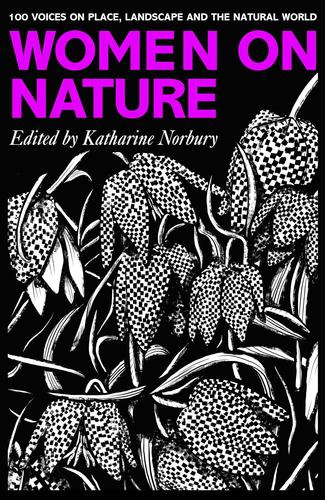 For most of the last seven months of 2021, I kept this as a bedside book, reading one or two pieces on most nights. It wasn’t until early this year that I brought it downstairs and started working it into my regular daily stacks so that I would see more progress. At first I quibbled (internally) with the decision to structure the book alphabetically by author. I wondered if more might have been done to group the pieces by region or theme. But besides being an unwieldy task, that might have made the contents seem overly determined. Instead, you get the serendipity of different works conversing with each other. So, for example, Katrina Porteous’s dialect poem about a Northumberland fisherman is followed immediately by Jini Reddy’s account of a trip to Lindisfarne; Margaret Cavendish’s 1653 dialogue in verse between an oak tree and the man cutting him down leads perfectly into an excerpt from Nicola Chester’s On Gallows Down describing a confrontation with tree fellers.
I’d highly recommend this for those who are fairly new to the UK nature writing scene and/or would like to read more by women. Keep it as a coffee table book or a bedside read and pick it up between other things. You’ll soon find your own favourites. (New purchase from Unbound)
Five favourites:
- “Caravan” by Sally Goldsmith (a Sheffield tree defender)
- “Enlli: The Living Island” by Pippa Marland (about the small Welsh island of Bardsey)
- “An Affinity with Bees” by Elizabeth Rose Murray (about beekeeping, and her difficult mother, who called herself “the queen bee”)
- “An Island Ecology” by Sarah Thomas (about witnessing a whale hunt on the Faroe Islands)
- My overall favourite: “Arboreal” by Jean McNeil (about living in Antarctica for a winter and the contrast between that treeless continent and Canada, where she grew up, and England, where she lives now)
“It occurred to me that trees were part of the grammar of one’s life, as much as any spoken language. … To see trees every day and to be seen by them is a privilege.”
Stay strong, trees!
Sponsored any books, or read any from indie publishers, recently?
Thinking about Dead Bodies with John Troyer (Hay Festival)
My second of three digital Hay Festival talks this year was by John Troyer, director of the interdisciplinary Centre for Death and Society at the University of Bath. Troyer is from Wisconsin (where he was speaking from, having been trapped there during a visit to his parents) and grew up with a father who owned a funeral home. This meant that he was aware of death from a young age: One of his earliest memories is of touching the hand of a dead woman when he went to visit his father at work.
 That’s not the only personal experience that went into his new book, Technologies of the Human Corpse, which I’m now keen to read. In 2018 his younger sister, Julie, died of brain cancer at age 43, so her illness and death became a late addition to the preface and also fed into a series of prose poems interspersed between the narrative chapters. She lived in Italy and her doctors failed to tell her that she was dying – that job fell to Troyer. (Unfortunately, this seems to be a persistent problem in Italy. In Dottoressa, her memoir of being an American doctor in Rome, which I read for a TLS review, Susan Levenstein writes of a paternalistic attitude among medical professionals: they treat their patients as children and might not even tell them about a cancer diagnosis; they just inform their family.)
Troyer discussed key moments that changed how we treat corpses. For instance, during the American Civil War there was a huge market for the new embalming technology; it was a way of preserving the bodies of soldiers so they could be returned home for funerals. Frauds also arose, however, and those taken in might find their loved one’s body arrived in a state of advanced decay. At around the same time, early photography captured corpses looking serene and sleeping. We might still take such photos, but we don’t tend to display them any more.
In the 1970s the “happy death” movement advocated for things like “natural death” and “death with dignity.” This piggybacked on the environmental and women’s movements and envisioned death as a taboo that had to be overcome. In recent decades a “necro-economy” based on the global trafficking of body parts (not organs for regulated transplant, Troyer clarified, but other tissue types) has appeared. While whole bodies may be worth just £2,000, “disarticulated” ones divided into their parts can net more like £100,000. Donating one’s body to science is, of course, a noble decision. Many people are also happy to donate their organs, though there remains a particular wariness about donating the eyes.
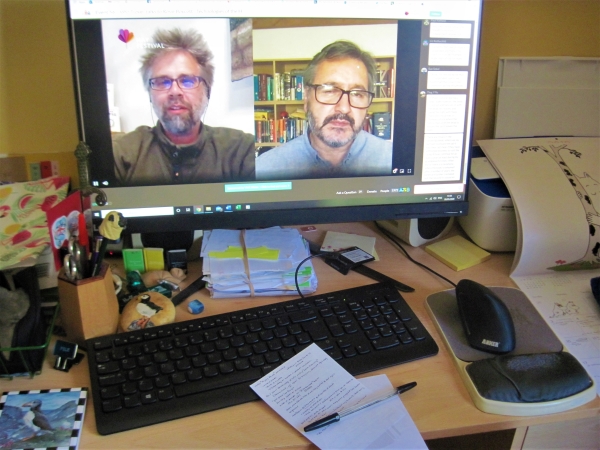
Troyer and Florence on my screen.
One section of Troyer’s book has become “uncannily resonant” in recent days, he noted. This is Chapter 3, on the AIDS corpse, an object of stigma. The biggest changes to death in the time of COVID-19 have been that family members are not able to be with a dying person in the ICU and that funerals cannot proceed as normal. In a viral pandemic, countries are producing a huge number of corpses that they aren’t prepared to deal with. (Indeed, the Washington, D.C. area is so overwhelmed with dead bodies that ice skating rinks have been requisitioned as makeshift morgues. The suburban Maryland rink I visited as a child is one such. Grim.)
Troyer spoke of the need for an everyday-ness to the discussion of death: talking with one’s next of kin, and encountering death in the course of a traditional education – he finds that even his final-year university students, studying in a related field, are very new to talking about death. A good way in that he recommends is simply to ask your loved ones what music they want played at their funerals, and the conversation can go from there.
We may not be able to commemorate the dead as we would like to at this time, but Troyer reminded the audience that funerals are for the living, whereas “the dead are okay with it – they know we’re doing our best.” The event was sensitively chaired by Peter Florence, the co-founder and director of Hay Festival (also responsible for last year’s controversial Booker Prize tie); the fact that Troyer got emotional talking about his sister only gave it more relevance and impact.
 I’ve read an abnormally large number of books about death, especially in the five years since my brother-in-law died of brain cancer (one reason why Troyer’s talk was so meaningful for me). Most recently, I read Bodies in Motion and at Rest (2000) by Thomas Lynch, a set of essays by the Irish-American undertaker and poet from Michigan. I saw him speak at Greenbelt Festival in 2012 and have read four of his books since then. His unusual dual career lends lyrical beauty to his writing about death. However, this collection was not memorable for me in comparison to his 1997 book The Undertaking, and I’d already encountered a shortened version of “Wombs” in the Wellcome Collection anthology Beneath the Skin. But this passage from “The Way We Are” stood out:
After years and years of directing funerals, I’ve come to the conclusion that seeing [the dead body] is the hardest and most helpful part. The truth, even when it hurts, has a healing in it, better than fiction or fantasy. When someone dies it is not them we fear seeing, it is them dead. It is the death. We fear that seeing will be believing. We fear not seeing too. We search the wreckage and the ruins, the battlefields and ocean floors. We must find our dead to let the loss be real.
Just for a bit of morbid fun, I decided to draw up my top 10 nonfiction books about death, dying and the dead. Many of these are personal accounts of facing death or losing a loved one. In contrast to the bereavement and cancer memoirs, the books by Doughty and Gawande are more like cultural studies, and Montross’s is about working with corpses. If you need a laugh, the Bechdel (a graphic memoir) and Doughty are best for black comedy.
 The Light of the World by Elizabeth Alexander
- Fun Home: A Family Tragicomic by Alison Bechdel (her father, too, was a funeral home director)
- Dear Life: A Doctor’s Story of Love and Loss by Rachel Clarke
- The Iceberg by Marion Coutts
- From Here to Eternity: Traveling the World to Find the Good Death by Caitlin Doughty
 Being Mortal: Medicine and What Matters in the End by Atul Gawande
- When Breath Becomes Air by Paul Kalanithi
- Body of Work: Meditations on Mortality from the Human Anatomy Lab by Christine Montross
- The Bright Hour: A Memoir of Living and Dying by Nina Riggs
- To Travel Hopefully: Journal of a Death Not Foretold by Christopher Rush
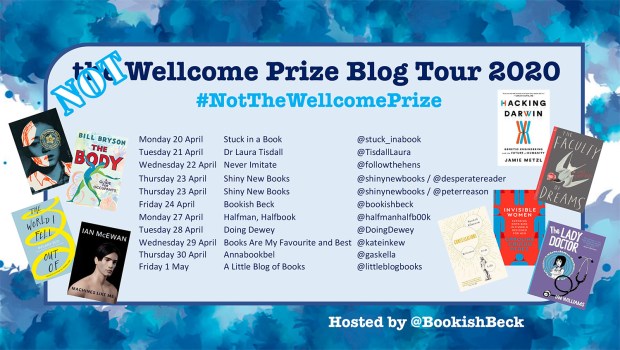
Announcing the NOT the Wellcome Prize and Blog Tour
Soon after I heard that the Wellcome Book Prize would be on hiatus this year, I had the idea to host a “Not the Wellcome Prize” blog tour to showcase some of the best health-themed literature published in 2019. I was finalizing the participants and schedule just before as well as during the coronavirus crisis, which has reinforced the importance of celebrating books that disseminate crucial information about medicine and/or tell stories about how health affects our daily lives. I got the go-ahead for this unofficial tour from the Wellcome Trust’s Simon Chaplin (Director of Culture & Society) and Jeremy Farrar (overall Director).
Starting on Monday and running for the next two weeks (weekdays only), the tour will be featuring 19 books across 10 blogs. One of the unique things about the Wellcome Prize is that both fiction and nonfiction are eligible, so we’ve tried to represent a real variety here: on the longlist we have everything from autobiographical essays to science fiction, including a graphic novel and a couple of works in translation.

Based on the blog tour reviews and the Prize’s aims*, the shadow panel (Annabel of Annabookbel, Clare of A Little Blog of Books, Laura of Dr. Laura Tisdall, Paul of Halfman, Halfbook and I) will choose a shortlist of six titles, to be announced on the 4th of May. We will then vote to choose a winner, with the results of a Twitter poll serving as one additional vote (be sure to have your say!). The overall winner of the Not the Wellcome Prize will be announced on the 11th of May.
I hope you’ll follow along with the reviews and voting. I would like to express my deep thanks to all the blog tour participants, especially the shadow panel for helping with ideas and planning – plus Annabel designed the graphics.
*Here is how the website describes the Prize’s purpose: “At some point, medicine touches all our lives. Books that find stories in those brushes with medicine are ones that add new meaning to what it means to be human. The subjects these books grapple with might include birth and beginnings, illness and loss, pain, memory, and identity. In keeping with its vision and goals, the Wellcome Book Prize aims to excite public interest and encourage debate around these topics.”
Below I’ve appended our preliminary list of eligible books that were considered but didn’t quite make the cut to be featured on the tour, noting major themes and positive blog review coverage I’ve come across. (The official Prize excludes poetry entries, but we were more flexible.)
Nonfiction:
- When Death Takes Something from You Give It Back by Naja Marie Aidt (memoir of child’s sudden death)
- The Man in the Red Coat by Julian Barnes (biography of 19th-century gynecologist)
- Let Me Not Be Mad by A.K. Benjamin (neuropsychologist’s memoir)
- The Story of Sex: From Apes to Robots by Philippe Brenot (medical history/graphic novel, in translation)
- The Prison Doctor by Amanda Brown (doctor’s memoir)
- The Undying by Anne Boyer (essays – cancer)
- Breaking & Mending by Joanna Cannon (doctor’s memoir)
- How to Treat People by Molly Case (nurse’s memoir)
- Will My Cat Eat My Eyeballs? by Caitlin Doughty (popular science – death)
- Happening by Annie Ernaux (memoir, in translation – abortion)
- I Remain in Darkness by Annie Ernaux (memoir, in translation – mother’s dementia)
- Out of Our Minds by Felipe Fernández-Armesto (popular science – evolutionary biology)
- The Heartland by Nathan Filer (medical history/memoir – schizophrenia)
- Childless Voices by Lorna Gibb (cultural history – infertility, etc.)
- Maybe You Should Talk to Someone by Lori Gottlieb (memoir/self-help – therapy)
Books Are My Favourite and Best review
- Once More We Saw Stars by Jayson Greene (memoir – child’s sudden death)
- A Short History of Falling by Joe Hammond (memoir – disability, dying)
- All Things Consoled by Elizabeth Hay (memoir – geriatrics, dementia)
- Hard Pushed by Leah Hazard (midwife’s memoir)
- Life Lessons from a Brain Surgeon by Rahul Jandial (memoir/self-help)
- Twas the Nightshift before Christmas by Adam Kay (doctor’s memoir)
- Why Can’t We Sleep? by Darian Leader (popular science – insomnia)
- Incandescent: We Need to Talk about Light by Anna Levin (light’s effects on health and body rhythms)
- A Puff of Smoke by Sarah Lippett (memoir – growing up with rare disease)
- Hormonal by Eleanor Morgan (popular science – women’s health)
- Critical by Matt Morgan (ICU doctor’s memoir)
- A Short History of Medicine by Steve Parker (medical history, illustrated)
- Notes to Self by Emilie Pine (essays – infertility, rape, etc.)
- That Good Night by Sunita Puri (doctor’s memoir – palliative care)
- An Elegant Defense: The Extraordinary New Science of the Immune System: A Tale in Four Lives by Matt Richtel (popular science)
- The Gendered Brain by Gina Ripon (popular science – neuroscience, gender)
- The Five by Hallie Rubenhold (alcoholism, sex work)
- When I Had a Little Sister by Catherine Simpson (memoir – mental health, suicide)
- Flash Count Diary: Menopause and the Vindication of Natural Life by Darcey Steinke (memoir, female anatomy)
- Skeleton Keys: The Secret Life of Bone by Brian Switek (popular science – anatomy)
- Out of the Woods by Luke Turner (memoir – masculinity, bisexuality)
- The Making of You by Katharina Vestre (popular science, in translation – embryology)
- Transcendence: How Humans Evolved through Fire, Language, Beauty, and Time by Gaia Vince (popular science – human evolution)
- The Knife’s Edge by Stephen Westaby (surgeon’s memoir)
Fiction:
- Starling Days by Rowan Hisayo Buchanan (literary fiction – mental illness, bisexuality)
- Recursion by Blake Crouch (science fiction – memory)
- Expectation by Anna Hope (women’s fiction – infertility, cancer)
- Stillicide by Cynan Jones (speculative fiction – water crisis)
- Things in Jars by Jess Kidd (historical fiction – Victorian medicine)
- Patience by Toby Litt (disability)
- The Migration by Helen Marshall (speculative fiction – immune disorder)
- The Warlow Experiment by Alix Nathan (historical fiction – medical experimentation)
- Night Theatre by Vikram Paralkar (magic realism – surgeon to the dead)
- The Art of Dying by Ambrose Parry (historical mystery – Victorian medicine)
- The Dutch House by Ann Patchett (doctor narrator, diabetes)
- Body Tourists by Jane Rogers (science fiction – body rental technology)
- Children of Ruin by Adrian Tchaikovsky (science fiction – evolutionary biology)
- Oligarchy by Scarlett Thomas (eating disorders)
- Wanderers by Chuck Wendig (science fiction – sleepwalking disorder)
Poetry:
- O Positive by Joe Dunthorne (death, therapy)
- The Carrying by Ada Limon (ageing parents, infertility)
September Recommendations: Boyer, Doughty, Jamie, Patchett
For this second half of the year I chose just 15 of the new releases I was most excited about. Limiting myself in that way has been helpful for focusing the mind: I’ve already read six of my most anticipated books, I’m currently reading another, and I have several more awaiting me. Had I chosen 30 or more titles, I would likely be feeling overwhelmed by now, but as it is I have a good chance of actually getting to all these books before the end of the year. These September releases, while very different – their topics range from cancer and dead bodies to archaeological digs and family inheritance – all lived up to my expectations:
The Undying: Pain, Vulnerability, Mortality, Medicine, Art, Time, Dreams, Data, Exhaustion, Cancer, and Care by Anne Boyer
(Coming from Farrar, Straus and Giroux [USA] on the 17th and Allen Lane [UK] on October 3rd)
In 2014, Boyer, then a 41-year-old poet and professor at the Kansas City Art Institute (and a single mother) was diagnosed with triple-negative breast cancer. The book’s subtitle gives you clues to the sort of practical and emotional territory that’s covered here. Although she survived this highly aggressive cancer, she was not unscathed: the chemotherapy she had is so toxic it leads to lasting nerve damage and a brain fog that hasn’t completely lifted.
 All the more impressive, then, that Boyer has been able to put together this ferociously intellectual response to American cancer culture. Her frame of reference ranges from ancient Greece – Aelius Aristides, who lived in a temple, hoping the gods would reveal the cure to his wasting illness via dreams, becomes an offbeat hero for her – to recent breast cancer vloggers. She is scathing on vapid pink-ribbon cheerleading that doesn’t substantially improve breast cancer patients’ lives, and on profit-making healthcare schemes that inevitably discriminate against poor women of color and send people home from the hospital within a day or two of a double mastectomy. Through her own experience, she reflects on the pressure women are under to be brave, to be optimistic, to go to work as normal, and to look as beautiful as ever when they are in excruciating pain and beyond exhaustion.
Impossible to avoid comparisons to Susan Sontag’s Illness as Metaphor, but this book has a personal power I don’t remember finding in Sontag’s more detached, academic-level work. Boyer sees herself as one in a long lineage of women writing about their cancer – from Fanny Burney to Audre Lorde – and probes the limits of language when describing pain. I was reminded of another terrific, adjacent book from this year, Constellations by Sinéad Gleeson, especially where Boyer describes her imagined 10-part pain scale (Gleeson has a set of 20 poems based on the McGill Pain Index).
I could quote excellent passages all day, but here are a few that stood out to me:
“People with breast cancer are supposed to be ourselves as we were before, but also better and stronger and at the same time heart-wrenchingly worse. We are supposed to keep our unhappiness to ourselves but donate our courage to everyone.”
“The moral failure of breast cancer is not in the people who die: it is in the world that makes them sick, bankrupts them for a cure that also makes them sick, then blames them for their own deaths.”
“If suffering is like a poem, I want mine to be lurid, righteous, and goth.”
My thanks to FSG for the proof copy for review.
Will My Cat Eat My Eyeballs?: Big Questions from Tiny Mortals about Death by Caitlin Doughty
(Coming from W.W. Norton [USA] on the 10th and W&N [UK] on the 19th)
 This is the third book by the millennial mortician, and I’ve taken perverse glee in reading them all. Smoke Gets in Your Eyes explains cremation and combats misconceptions about death; From Here to Eternity surveys death rituals from around the world. This new book seems to be aimed at (morbid) children, but for me it was more like one of those New Scientist books (Why Don’t Penguins’ Feet Freeze?) or Why Do Men Have Nipples?
Some of the questions are more serious than others, but with her usual punning wit and pop culture references Doughty gives biologically sound answers to them all. For instance, she explains what might happen to a corpse in space, why the hair and fingernails of a cadaver appear to keep growing, and why the quantity of ashes from a cremation is about the same no matter the dead person’s girth (all the fat burns away; what would make your ashes weigh more is being taller and thus having longer bones). I was most interested in the chapter on why conjoined twins generally die at roughly the same time.
 Doughty also discusses laws relating to the dead, such as “abuse of corpse” regulations and whether or not deaths at a property have to be reported to potential buyers (it depends on what state or country you live in); and what happens in countries that are literally running out of space for burials. In highly population-dense places like Singapore, but also in countries such as Germany, one is considered to ‘rent’ grave space, which is then recycled after 15 years and the previous set of remains cremated. Or graves might get stacked vertically.
This is good fun, and features lots of cartoonishly gruesome black-and-white illustrations by Dianné Ruz. If you’ve got a particularly curious niece or nephew who might appreciate a dark sense of humor, this would make a good Christmas gift for one who is an older child or young teen.
My thanks to W&N for the free copy for review.
Surfacing by Kathleen Jamie
(Coming from Sort Of Books [UK] on the 19th and Penguin Books [USA] on the 24th)
I’m a big fan of Kathleen Jamie’s work, prose and poetry. Like her two previous essay collections, Sightlines and Findings, both of which I read in 2012, this fuses autobiography with nature and travel writing – two genres that are too often dominated by males. Jamie has a particular interest in birds, islands, archaeology and the oddities of the human body, all subjects that intrigue me, too.
 The bulk of Surfacing is given over to three long pieces set in Alaska, Orkney and Tibet. She was drawn to Quinhagak, Alaska, a village that’s about the farthest you can go before crossing the Bering Sea into Russia, by her fascination with the whaling artifacts found along the UK’s east coast. Here she helped out on a summer archaeological dig and learned about the language and culture of the Yup’ik people. Alarmingly, the ground here should have been frozen most of the way to the surface, forcing the crew to wear thermals; instead, the ice was a half-meter down, and Jamie found that she never needed her cold-weather gear.
On Westray, Orkney (hey, I’ve been there!), there was also evidence of environmental degradation in the form of rapid erosion. This Neolithic site, comparable to the better-known Skara Brae, leads Jamie to think about deep time and whether we’re actually much better off than people in the Bronze Age were. Prehistory fits the zeitgeist, as seen in two entries from the recent Wainwright Prize shortlist: Time Song by Julia Blackburn and Underland by Robert Macfarlane. It’s a necessary corrective to the kind of short-term thinking that has gotten us into environmental crisis.
A cancer biopsy coincides with a dream memory of being bitten by a Tibetan dog, prompting Jamie to get out her notebook from a trip to China/Tibet some 30 years ago. Xiahe was technically in China but ethnically and culturally Tibetan, and so the best they could manage at that time since Tibet was closed to foreigners. There’s an amazing amount of detail in this essay given how much time has passed, but her photos as well as her notebook must have helped with the reconstruction.
The depth and engagement of the long essays are admirable, yet I often connected more with the few-page pieces on experiencing a cave, spotting an eagle or getting lost in a forest. Jamie has made the interesting choice of delivering a lot of the memoir fragments in the second person. My favorite piece of all is “Elders,” which in just five pages charts her father’s decline and death and marks her own passage into unknown territory: grown children and no parents; what might her life look like now?
There is beautiful nature writing to be found in this volume, as you might expect, but also relatable words on the human condition:
What are you doing here anyway, in the woods? … You wanted to think about all the horror. The everyday news … No, not to think about it exactly but consider what to do with the weight of it all, the knowing … You are not lost, just melodramatic. The path is at your feet, see? Now carry on.
My thanks to Sort Of Books for the free copy for review.
The Dutch House by Ann Patchett
(Coming from Bloomsbury [UK] and Harper [USA] on the 24th)
Maeve and Danny Conroy are an inseparable brother-and-sister pair. Their mother left when Danny was little, so his older sister played a maternal role, too. And when their father dies, they become like Hansel and Gretel (or Cinderella and her little brother): cast out into the wilds by an evil stepmother who takes possession of the only home they’ve ever known, a suburban Philadelphia mansion built on the proceeds of the VanHoebeeks’ cigarette empire.
 It’s interesting to see Patchett take on a male perspective in this novel; she does it utterly convincingly. I also loved the medical threads running through: Maeve is diagnosed with diabetes as a teenager, and Danny spends many years in medical training even though his only ambition is to follow in his father’s footsteps as a property developer. There was a stretch in the middle of the book – something like 46% to 58% – when I was really bored with Danny’s dithering (‘but I don’t want to be a doctor … but I don’t want to marry Celeste’), and the chronology is unnecessarily complicated by flashbacks, though this is, I think, meant to convey Danny’s desultory composition of his memoirs.
In the end I didn’t like this quite as much as Commonwealth, but it’s a memorable exploration of family secrets and memories. As the decades pass you see how what happened to Maeve and Danny has been turned into myth: a story they repeat to themselves about how they were usurped, until this narrative has more power than the reality. Readers, meanwhile, are invited to question the people and places we base our security on, and to imagine what it would mean to forgive and forget and start living in a different way.
Patchett is always so good on the psychology of complicated families, and her sharp prose never fails to hit the nail on the head. The Goldfinch comes to mind as a readalike – not least because of the significance of a piece of art: the cover depicts a painting made of Maeve when she was 10 – as well as Nick Hornby’s How to Be Good.
I read an electronic proof copy via Edelweiss.
Have you read any September releases that you would recommend? Which of these tempt you?
My Most Anticipated Releases of the Second Half of 2019
Although over 90 books from the second half of the year are already on my radar, I’ve managed to narrow it down to the 15 July to November releases that I’m most excited about. I have access to a few of these already, and most of the rest I will try requesting as soon as I’m back from Milan. (These are given in release date order within thematic sections; the quoted descriptions are from the publisher blurbs on Goodreads.)
[By the way, here’s how I did with my most anticipated releases of the first half of the year:
- 16 out of 30 read; of those 9 were somewhat disappointing (i.e., 3 stars or below) – This is such a poor showing! Is it a matter of my expectations being too high?
- 10 I still haven’t managed to find
- 1 print review copy arrived recently
- 1 I have on my Kindle to read
- 1 I skimmed
- 1 I lost interest in]
Fiction
 The Lager Queen of Minnesota by J. Ryan Stradal [July 23, Pamela Dorman Books] Stradal’s Kitchens of the Great Midwest (2015) is one of my recent favorites. This one has a foodie theme again, and sounds a lot like Louise Miller’s latest – two sisters: a baker of pies and a founder of a small brewery. “Here we meet a cast of lovable, funny, quintessentially American characters eager to make their mark in a world that’s often stacked against them.”
 Hollow Kingdom by Kira Jane Buxton [August 6, Grand Central Publishing / Headline Review] As soon as I heard that this was narrated by a crow, I knew I was going to have to read it. (And the Seattle setting also ties in with Lyanda Lynn Haupt’s book.) “Humanity’s extinction has seemingly arrived, and the only one determined to save it is a foul-mouthed crow whose knowledge of the world around him comes from his TV-watching education.”
 Inland by Téa Obreht [August 13, Random House / Weidenfeld & Nicolson] However has it been eight years since her terrific debut novel?! “In the lawless, drought-ridden lands of the Arizona Territory in 1893, two extraordinary lives collide. … [L]yrical, and sweeping in scope, Inland subverts and reimagines the myths of the American West.” The synopsis reminds me of Eowyn Ivey’s latest.
 A Door in the Earth by Amy Waldman [August 27, Little, Brown and Company] I loved The Submission, Waldman’s 2011 novel about a controversial (imagined) 9/11 memorial. “Parveen Shamsa, a college senior in search of a calling, feels pulled between her charismatic and mercurial anthropology professor and the comfortable but predictable Afghan-American community in her Northern California hometown [and] travels to a remote village in the land of her birth to join the work of his charitable foundation.” (NetGalley download)
 Bloomland by John Englehardt [September 10, Dzanc Books] “Bloomland opens during finals week at a fictional southern university, when a student walks into the library with his roommate’s semi-automatic rifle and opens fire. In this richly textured debut, Englehardt explores how the origin and aftermath of the shooting impacts the lives of three characters.” (print review copy from publisher)
 The Dutch House by Ann Patchett [September 25, Harper / Bloomsbury UK] I’m more a fan of Patchett’s nonfiction, but will keep reading her novels thanks to Commonwealth. “At the end of the Second World War, Cyril Conroy combines luck and a single canny investment to begin an enormous [Philadelphia] real estate empire … Set over … five decades, The Dutch House is a dark fairy tale about two smart people who cannot overcome their past.”
Medical themes
 Will My Cat Eat My Eyeballs?: Big Questions from Tiny Mortals about Death by Caitlin Doughty [September 10, W.W. Norton / September 19, Weidenfeld & Nicolson] I’ve read Doughty’s previous books about our modern attitude towards mortality and death customs around the world. She’s wonderfully funny and iconoclastic. Plus, how can you resist this title?! Although it sounds like it’s geared towards children, I’ll still read the book. “Doughty blends her mortician’s knowledge of the body and the intriguing history behind common misconceptions … to offer factual, hilarious, and candid answers to thirty-five … questions.”
 The Undying: Pain, Vulnerability, Mortality, Medicine, Art, Time, Dreams, Data, Exhaustion, Cancer, and Care by Anne Boyer [September 17, Farrar, Straus and Giroux] “A week after her forty-first birthday, the acclaimed poet Anne Boyer was diagnosed with highly aggressive triple-negative breast cancer. … A genre-bending memoir in the tradition of The Argonauts, The Undying will … show you contemporary America as a thing both desperately ill and occasionally, perversely glorious.” (print review copy from publisher)

From the author’s Twitter page.
Breaking and Mending: A doctor’s story of burnout and recovery by Joanna Cannon [September 26, Wellcome Collection] I haven’t gotten on with Cannon’s fiction, but a memoir should hit the spot. “A frank account of mental health from both sides of the doctor-patient divide, from the bestselling author of The Trouble with Goats and Sheep and Three Things About Elsie, based on her own experience as a doctor working on a psychiatric ward.”
 The Body: A Guide for Occupants by Bill Bryson [October 3, Doubleday / Transworld] His last few books have been somewhat underwhelming, but I’d read Bryson on any topic. He’s earned a reputation for making history, science and medicine understandable to laymen. “Full of extraordinary facts and astonishing stories, The Body: A Guide for Occupants is a brilliant, often very funny attempt to understand the miracle of our physical and neurological makeup.”
 The Depositions: New and Selected Essays on Being and Ceasing to Be by Thomas Lynch [November 26, W.W. Norton] Lynch is such an underrated writer. A Michigan undertaker, he crafts essays and short stories about small-town life, the Irish-American experience and working with the dead. I discovered him through Greenbelt Festival some years back and have read three of his books. Some of what I’ve already read will likely be repeated here, but will be worth a second look anyway.
Other Nonfiction
 Confessions of a Bookseller by Shaun Bythell [August 29, Profile Books] The Diary of a Bookseller was a treat in 2017. I’ve read the first two-thirds of this already while in Milan, and I wish I was in Wigtown instead! This sequel picks up in 2015 and is very much more of the same – the daily routines of buying and selling books and being out and about in a small town – so it’s up to you whether that sounds boring or comforting. I’m finding it strangely addictive. (NetGalley download)
 We Are the Weather: Saving the Planet Begins at Breakfast by Jonathan Safran Foer [September 17, Farrar, Straus and Giroux / October 10, Hamish Hamilton] Foer’s Eating Animals (2009) was a hard-hitting argument against eating meat. In this follow-up he posits that meat-eating is the single greatest contributor to climate change. “With his distinctive wit, insight and humanity, Jonathan Safran Foer presents this essential debate as no one else could, bringing it to vivid and urgent life, and offering us all a much-needed way out.”
 Surfacing by Kathleen Jamie [September 19, Sort of Books] Jamie is a Scottish poet who writes exquisite essays about the natural world. I’ve read her two previous essay collections, Findings and Sightlines, as well as a couple of volumes of her poetry. “From the thawing tundra linking a Yup’ik village in Alaska to its hunter-gatherer past to the shifting sand dunes revealing the impressively preserved homes of neolithic farmers in Scotland, Jamie explores how the changing natural world can alter our sense of time.”
 Unfollow by Megan Phelps-Roper [October 8, Farrar, Straus and Giroux / riverrun] Ties in with my special interest in women’s religious memoirs. “In November 2012, at the age of twenty-six, [Phelps-Roper] left [Westboro Baptist Church], her family, and her life behind. Unfollow is a story about the rarest thing of all: a person changing their mind. It is a fascinating insight into a closed world of extreme belief, a biography of a complex family, and a hope-inspiring memoir of a young woman finding the courage to find compassion.”
Which of these do you want to read, too?
What other upcoming 2019 titles are you looking forward to?
The 2019 Wellcome Book Prize: Shadow Panel and Wish List
On Tuesday the longlist for the 2019 Wellcome Book Prize will be announced. For the third year in a row I’m running a shadow panel, and it’s composed of the same four wonderful book bloggers who joined me last year: Paul Cheney of Halfman, Halfbook, Annabel Gaskell of Annabookbel, Clare Rowland of A Little Blog of Books, and Dr. Laura Tisdall.
This year we’re going to do things slightly differently: we plan to split up the longlist, taking two to three titles each, so that between us we will have read them all and can announce our own preferred shortlist before the official shortlist is announced in March. At that point we’ll catch up by (re)reading the six shortlisted books, each reviewing the ones we haven’t already. Essentially, I’m adding an extra stage of shadow panel judging, simply because I can. I hope it will be fun – and also less onerous, in that we should get a leg-up on the shortlist and not have to read all six books in March‒April, which has proved to be a challenge in the past.
My Wellcome Prize hopefuls are all the fiction or nonfiction titles I’ve read on a medical theme that were published in the UK in calendar year 2018. I have put asterisks beside the 12 books in this post that I predict for the longlist. (The combination of wishful thinking and likelihood means that these are not exclusively my personal favorites.)

Below is a list of the books I’ve already featured on the blog in some way, with links to my coverage and a few-word summary of their relevance.
Nonfiction
Gross Anatomy by Mara Altman: Female body woes
*Beneath the Skin: Great Writers on the Body: Essays on organs
*All that Remains by Sue Black: Forensic anthropology
Everything Happens for a Reason by Kate Bowler: Living with advanced cancer
Heal Me by Julia Buckley: Tackling chronic pain
*The Unmapped Mind by Christian Donlan: Adjusting to life with MS
From Here to Eternity by Caitlin Doughty: Funerary rites around the world
This Really Isn’t About You by Jean Hannah Edelstein: A genetic disease in the family
Natural Causes by Barbara Ehrenreich: Questioning the wellness culture
On Smaller Dogs and Larger Life Questions by Kate Figes: Pondering breast cancer
Shapeshifters by Gavin Francis: Instances of bodily change
The Reading Cure by Laura Freeman: Healing from an eating disorder
Nine Pints by Rose George: The story of blood
Waiting for the Last Bus by Richard Holloway: Ageing and death
*Heart: A History by Sandeep Jauhar: Heart disease and treatments
Sick by Porochista Khakpour: Chronic Lyme disease
Human Errors by Nathan Lents: Flawed bodies; evolutionary adaptations
Skybound by Rebecca Loncraine: Breast cancer; flying lessons
Amateur by Thomas Page McBee: Memoir of F2M transformation
*Face to Face by Jim McCaul: Tales of facial surgery
*Somebody I Used to Know by Wendy Mitchell: A firsthand account of early Alzheimer’s
*That Was When People Started to Worry by Nancy Tucker: Mental illness from the inside
*The Language of Kindness by Christie Watson: Nursing as a vocation
Fiction
Little by Edward Carey: Anatomical models in wax (thanks to Clare for the reminder!)
Orchid & the Wasp by Caoilinn Hughes: Non-epileptic seizures
*The Winter Soldier by Daniel Mason: Neurology, surgery during WWI
The Way of All Flesh by Ambrose Parry: Medicine in 1840s Edinburgh
Other eligible books that I have read but not happened to mention on the blog:
 In Shock by Rana Awdish: The doctor became the patient when Awdish, seven months pregnant, was rushed into emergency surgery with excruciating pain due to severe hemorrhaging into the space around her liver, later explained by a ruptured tumor. Having experienced brusque, cursory treatment, even from colleagues at her Detroit-area hospital, she was convinced that doctors needed to do better. This memoir is a gripping story of her own medical journey and a fervent plea for compassion from medical professionals.
 Doctor by Andrew Bomback: Part of the Bloomsbury Object Lessons series, this is a wide-ranging look at what it’s like to be a doctor. Bomback is a kidney specialist; his wife is also a doctor, and his father, fast approaching retirement, is the kind of old-fashioned, reassuring pediatrician who knows everything. Even the author’s young daughter likes playing with a stethoscope and deciding what’s wrong with her dolls. In a sense, then, Bomback uses fragments of family memoir to compare the past, present and likely future of medicine.
 A Moment of Grace by Patrick Dillon [skimmed]: A touching short memoir of the last year of his wife Nicola Thorold’s life, in which she battled acute myeloid leukemia. Dillon doesn’t shy away from the pain and difficulties, but is also able to summon up some gratitude.
 Get Well Soon: Adventures in Alternative Healthcare by Nick Duerden: British journalist Nick Duerden had severe post-viral fatigue after a run-in with possible avian flu in 2009 and was falsely diagnosed with ME / CFS. He spent a year wholeheartedly investigating alternative therapies, including yoga, massage, mindfulness and meditation, visualization, talk therapy and more. He never comes across as bitter or sorry for himself. Instead, he considered fatigue a fact of his new life and asked what he could do about it. So this ends up being quite a pleasant amble through the options, some of them more bizarre than others.
 *Sight by Jessie Greengrass [skimmed]: I wanted to enjoy this, but ended up frustrated. As a set of themes (losing a parent, choosing motherhood, the ways in which medical science has learned to look into human bodies and minds), it’s appealing; as a novel, it’s off-putting. Had this been presented as a set of autobiographical essays, perhaps I would have loved it. But instead it’s in the coy autofiction mold where you know the author has pulled some observations straight from life, gussied up others, and then, in this case, thrown in a bunch of irrelevant medical material dredged up during research at the Wellcome Library.
 *Brainstorm: Detective Stories From the World of Neurology by Suzanne O’Sullivan: Epilepsy affects 600,000 people in the UK and 50 million worldwide, so it’s an important condition to know about. It is fascinating to see the range of behaviors seizures can be associated with. The guesswork is in determining precisely what is going wrong in the brain, and where, as well as how medicines or surgery could address the fault. “There are still far more unknowns than knowns where the brain is concerned,” O’Sullivan writes; “The brain has a mind of its own,” she wryly adds later on. (O’Sullivan won the Prize in 2016 for It’s All in Your Head.)
 I’m also currently reading and enjoying two witty medical books, The Mystery of the Exploding Teeth and Other Curiosities from the History of Medicine by Thomas Morris, and Chicken Unga Fever by Phil Whitaker, his collected New Statesman columns on being a GP.
Four additional books I have not read but think might have a chance of making the longlist:
Primate Change: How the World We Made Is Remaking Us by Vybarr Cregan-Reid
 The Beautiful Cure: Harnessing Your Body’s Natural Defences by Daniel M. Davis
Because I Come from a Crazy Family: The Making of a Psychiatrist by Edward M. Hallowell
*She Has Her Mother’s Laugh: The Powers, Perversions, and Potential of Heredity by Carl Zimmer
Look out for the announcement of the longlist on Tuesday afternoon! I’ll report back, perhaps on Wednesday, with some reactions and the shadow panel’s reviewing strategy.
Have you read, or are you interested in, any of these books?
Can you think of other 2018 releases that might be eligible for the Wellcome Book Prize?
A Retrospective of 2018’s Events, Reading Projects and Themes
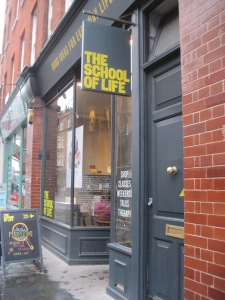 In January I had the tremendous opportunity to have a free personalized bibliotherapy appointment with Ella Berthoud at the School of Life in London. I’ve since read three of her prescriptions plus parts of a few others, but I still have several more awaiting me in the early days of 2019, and will plan to report back at some point on what I got out of all of them.
In March to April I ran a Wellcome Book Prize shadow panel for the second time. This year it was much more successful; I plan to do it again next year, too. (I actually proffered myself as an official judge for next year’s prize and got a very kind but entirely noncommittal e-mail back from the chairwoman, which I will have to take as victory enough.)
 Early April saw us visiting Wigtown, Scotland’s book town, for the first time. It was a terrific trip, but thus far I have not been all that successful at reading the 13 books that I bought! (Just two and a quarter so far.)
I reviewed three novels for Liz Dexter’s Iris Murdoch Readalong project: A Severed Head in March, The Italian Girl in June, and The Nice and the Good in September. In February I’ll pop back in with one more paperback that I own, The Sacred and Profane Love Machine. November was Margaret Atwood Reading Month, hosted by Marcie of Buried in Print and Naomi of Consumed by Ink, and provided me with a good excuse to read her first two novels.
 I did some “buddy reads” for the first time: Andrea Levy’s Small Island with Canadian blogger friends, including Marcie and Naomi; and West With the Night with Laila of Big Reading Life and Late Nights on Air with Naomi as well as Penny of Literary Hoarders during 20 Books of Summer, which I took part in for the first time. In May my mother and I read W. Somerset Maugham’s The Painted Veil and shared reading notes via e-mail. (A planned buddy read of The Left Hand of Darkness with Annabel and Laura was, alas, a fail.)
Besides the official Wellcome Book Prize blog tour in April, I participated in another 11 blog tours, averaging out at one a month. I’m going to scale back on these next year because I have too often found, after I accepted, that the book was a dud and I had to just run an extract because I could see I wasn’t going to get through it and write a review.
I joined my neighborhood book club in September and have attended every month since then. Our first four selections were Ladder of Years by Anne Tyler, The Gracekeepers by Kirsty Logan, Noonday by Pat Barker, and Number 11 by Jonathan Coe. I’d already read the Logan and Coe years ago and didn’t fancy rereading them, so wasn’t able to participate as much in those months, but was still glad to go along for the socializing. My husband even read the Coe and came to December’s meeting (was it just for the mince pies and mulled wine?!). We’ve set our first four reads for 2019 – the three below, in order from left to right, plus Ernest Hemingway’s The Garden of Eden, which I’ll borrow from the university library.

 In October I won tickets to see a production of Angela Carter’s Wise Children at the Old Vic in London. Just a few weeks later I won tickets to see Barbara Kingsolver in conversation about Unsheltered at the Southbank Centre. I don’t often make it into London, so it was a treat to have bookish reasons to go and blogging friends to meet up with (Clare of A Little Blog of Books joined me for both, and Laura T. was also at the Kingsolver event).
November was mostly devoted to novellas, for the third year in a row. Although I didn’t officially participate in Nonfiction November, I still enjoyed coming up with some fiction/nonfiction pairings and an “expert’s” list of women’s religious memoirs.
My husband wrote pretty much his entire PhD thesis this year and on Friday the 14th had his graduation ceremony. I was the moral support / proofreader / preparer of simple meals during the months when he was in the throes of writing up, so I will consider myself as sharing in the accomplishment. Congratulations, Dr. Foster!
This month and into January I’ll be reading the last few nominees for the National Book Critics Circle’s John Leonard Prize.

When the list of finalists was released, I was relieved to see I’d already read four out of seven (and three of those were ones I’d nominated); the other three – the Adjei-Brenyah and Brinkley stories and There There – were books I was keen to read but hadn’t managed to get hold of. About 80 of us NBCC members are reading the shortlist and voting for the best first book of the year by January 8th. Plus I’m technically up for an NBCC prize myself, in that I nominated myself (that’s how it works) for the 2018 Nona Balakian Citation for Excellence in Reviewing and sent in an application with five of my best reviews from the year.
The Ones that Got Away
 Two posts I planned but never got around to putting together would have commemorated the 50th anniversary of Thomas Merton’s death (I own several of his books but am most interested in reading The Seven-Storey Mountain, which celebrated its 70th birthday in October) and the 40th anniversary of the publication of The Snow Leopard by the late Peter Matthiessen. Perhaps I’ll try these authors for the first time next year instead.
Final Book Serendipity Incidents
In the second half of the year I started keeping track of all my weird reading coincidences, posting about them on Twitter or Instagram before collecting them into a blog post a couple months ago. Here are a few that popped up since then or recalled earlier reads from the year:
- Two protagonists named Willa: Anne Tyler’s Clock Dance and Barbara Kingsolver’s Unsheltered
- Two novels featuring bog people: Anne Youngson’s Meet Me at the Museum and Sarah Moss’s Ghost Wall
- Two dogs named Flash: Ben Crane’s Blood Ties and Andrew Marshall’s The Power of Dog
- Multiple sclerosis is an element in Christian Donlan’s The Unmapped Mind: A Memoir of Neurology, Incurable Disease and Learning How to Live, Jennifer Richardson’s Americashire and Michelle Obama’s Becoming (her father had it)
- The ideas of Freud are mentioned in a 1910s setting in Nancy Horan’s Loving Frank, Annabel Abbs’s Frieda and Daniel Mason’s The Winter Soldier
- Mermaids (or ‘mermaids’) and/or mermen appear in Imogen Hermes Gowar’s The Mermaid and Mrs Hancock, Melissa Broder’s The Pisces, Daniel Mason’s The Winter Soldier, and a series of poems in Miriam Darlington’s Windfall
- Bohemian writer dies young of tuberculosis (or similar) in novels about their wives: Annabel Abbs’s Frieda (D.H. Lawrence) and Nancy Horan’s Under the Wide and Starry Sky (Robert Louis Stevenson)
- Two books that mention the Indonesian practice of keeping dead relatives as mummies and bringing them out on occasion for ritual celebrations: From Here to Eternity by Caitlin Doughty and The Hot Young Widows Club by Nora McInerny
- Two books that include a trip to Lourdes for healing: Heal Me by Julia Buckley and Constellations by Sinéad Gleeson
- Two books that mention the irony of some of the most well-loved modern Christmas songs being written by Jews: In Mid-Air by Adam Gopnik and Christmas Days by Jeanette Winterson
Surprise Themes from My Year’s Reading
A few of these make sense – cults fit with my interest in narratives of religious experience, and it doesn’t take a psychologist to see that my relationship with my father has been an ongoing issue in recent years (I wonder how the numbers would compare for books about mothers?) – but most are completely random.
I decided a theme had to show up at least three times to make the list. Some topics I enjoyed so much I’ll keep reading about them next year. Within a category the books are in rough chronological order of my reading, and I include skims, DNFs and books in progress.
 Fathers (absent/difficult) + fatherhood in general: Educated by Tara Westover, And When Did You Last See Your Father? by Blake Morrison, The Italian Teacher by Tom Rachman, In the Days of Rain by Rebecca Stott, Implosion by Elizabeth W. Garber, Little Women by Louisa May Alcott & March by Geraldine Brooks, The Unmapped Mind by Christian Donlan, Never Mind and Bad News by Edward St. Aubyn, The Reading Promise by Alice Ozma, How to Build a Boat by Jonathan Gornall, Lake Success by Gary Shteyngart, Normal People by Sally Rooney, Rosie by Rose Tremain, My Father and Myself by J.R. Ackerley, Everything Under by Daisy Johnson, Ghost Wall by Sarah Moss, Surfacing by Margaret Atwood, Heart Berries by Terese Marie Mailhot, Blood Ties by Ben Crane, To Throw Away Unopened by Viv Albertine, Small Fry by Lisa Brennan-Jobs
Addiction: The Leavers by Lisa Ko, Mayhem by Sigrid Rausing, The Only Story by Julian Barnes, The Small Door of Your Death by Sheryl St. Germain, Writing and Madness in a Time of Terror by Afarin Majidi, Marlena by Julie Buntin, Ninety Days by Bill Clegg, Bad News by Edward St. Aubyn, Pretend I’m Dead by Jen Beagin, Heart Berries by Terese Marie Mailhot
 Greenland: A Wilder Time by William E. Glassley, This Cold Heaven by Gretel Ehrlich, Miss Smilla’s Feeling for Snow by Peter Høeg, On Balance by Sinéad Morrissey (the poem “Whitelessness”), Cold Earth by Sarah Moss, Crimson by Niviaq Korneliussen, The Library of Ice by Nancy Campbell
Cults: Educated by Tara Westover, Harmony by Carolyn Parkhurst, In the Days of Rain by Rebecca Stott, The Incendiaries by R.O. Kwon, A River Could Be a Tree by Angela Himsel
Trees: Ladders to Heaven by Mike Shanahan, The Overstory by Richard Powers, The Man Who Planted Trees by Jean Giono, The Wood and The Secret Life of the Oak by John Lewis-Stempel
 Flying: Skybound by Rebecca Loncraine, West With the Night by Beryl Markham, Going Solo by Roald Dahl, Skyfaring by Mark Vanhoenacker
The Anglo experience in Africa: Free Woman: Life, Love and Doris Lessing by Lara Feigel, Leaving Before the Rains Come by Alexandra Fuller, West With the Night by Beryl Markham, Going Solo by Roald Dahl
Korean-American women: The Incendiaries by R.O. Kwon, If You Leave Me by Crystal Hana Kim, All You Can Ever Know by Nicole Chung, Famous Adopted People by Alice Stephens, Digging to America by Anne Tyler
 New Zealand: The Garden Party and Other Stories by Katherine Mansfield, To the Is-Land by Janet Frame, Dunedin by Shena Mackay
Life in the White House: Living History by Hillary Rodham Clinton, All the Presidents’ Pastries by Roland Mesnier, Becoming by Michelle Obama
Lighthouses: Stargazing: Memoirs of a Young Lighthouse Keeper by Peter Hill, The Bird Artist by Howard Norman, Under the Wide and Starry Sky by Nancy Horan (about Robert Louis Stevenson, whose family built lighthouses)

More lighthouse books ready for next year.
Butterflies: Four Wings and a Prayer by Sue Halpern, Magdalena Mountain by Robert Michael Pyle, Mama Amazonica by Pascale Petit

More butterfly books ready for next year.
 Bookish Beck = Rebecca Foster. American transplant to England. Freelance proofreader and book reviewer.
 Bookish Beck