Reading the Meow, Part II: Books by Bernardine Bishop and Matt Haig
This is my second contribution to the Reading the Meow challenge, hosted by Mallika of Literary Potpourri, after yesterday’s review of Sleeping with Cats by Marge Piercy. One of the below novels is obviously cat-themed; the other less so, but the cover and blurb convinced me to take a chance on a new-to-me author and I discovered a hidden gem.

The Street by Bernardine Bishop (2015)
Prices are so cheap at my local charity warehouse (3/£1 paperbacks) that I recently did something I almost never do: bought a book I’d never heard of, by an author I’d never heard of, and then (something I definitely never do!) read it almost right away instead of letting it gather dust on my shelves for years. Bishop’s biography is wild. As a new Cambridge graduate, she was the youngest witness in the Lady Chatterley trial in 1960, then published two novels in her early twenties. She married twice, had two sons and a psychotherapy career, and returned to writing fiction after 50 years – prompted by a cancer diagnosis. Unexpected Lessons in Love was shortlisted for the Costa Novel Award in 2013, while this and Hidden Knowledge were both published posthumously, after Bishop’s death in 2015.
So: there is a cat on the cover and the blurb mentions it, too: “a beloved cat achieves immortality.” (I should have realized that was a euphemism, but never mind.) The novel opens with news of the death at 90 of formidable Brenda Byfleet, who’d been a Greenham Common woman and taken part in peace protests right into old age. Neighbours quickly realize someone will need to care for her cat Benn (named for Tony Benn), and the duty falls to Anne and Eric, who have also taken in their grandson while his parents are in Canada.
 What follows is a low-key ensemble story that moves with ease between several key residences of Palmerston Street, London, introducing us to a couple struggling with infertility, a war veteran with dementia, an underemployed actor who rescues his wife from her boss’s unwanted attentions, and so on. Most touching is the relationship between Anne and Georgia, a lesbian snail researcher who paints Anne’s portrait. Their friendship shades into quiet, middle-aged love.
There are secrets and threats and climactic moments here, but always the reassuring sense that neighbours are a kind of second family and so someone will be there for you to rely on no matter what you face. (I can think of a certain soap opera theme that expresses a similar sentiment…) Bishop’s style reminds me most of Tessa Hadley’s. She is equally skilled at drawing children and the elderly, and clearly feels love and compassion for her flawed characters: “Everything and everyone in the street was bathed in a blessed ordinariness.”
From Brenda onward, Georgia’s rhetorical question hangs over the short novel: “What is a life?” The implied partial answer is: what is remembered by those left behind. The opening paragraph is perfect –
“Sometimes it is impossible to turn even a short London street into a village. But sometimes it can be easily done. It all depends on one or two personalities.”
… and the last page has kittens. This was altogether a lovely read. Dangit, why didn’t I also buy the other Bishop novel that was on shelf at the charity warehouse?! I’ll have to hope it’s still around the next time I go there. (Secondhand – Community Furniture Project, Newbury) 
To Be a Cat by Matt Haig (2012)
 This was a reasonably cute middle-grade fantasy and careful-what-you-wish-for cautionary tale. On his twelfth birthday, Barney Willow thinks life couldn’t get worse. His parents are divorced, his dad has recently disappeared, he’s bullied by Gavin Needle, and evil head teacher Miss Whipmire seems to have a personal vendetta against him. His only friend is Rissa Fairweather, who lives on a barge. Little does he know that an idle wish to switch places with a cat he pets on the street will set a dangerous adventure in motion. Now he’s a cat and Maurice the cat has his body. Soon Barney realizes there’s a whole subset of cats who are former humans (alongside “swipers,” proper fighting street cats; and “firesides,” who prefer to stay indoors), including Miss Whipmire, who used to be a Siamese cat and has an escape plan that involves Barney. I felt the influence of Roald Dahl and Terry Pratchett, but Haig doesn’t have their writing chops. Apart from Rissa, the characterization is too clichéd. I’m sure I would have enjoyed this at age eight, though. (Little Free Library)
#ReadingtheMeow2024 and 20 Books of Summer, 2: Sleeping with Cats by Marge Piercy
Reviews of books about cats have been a standard element on my blog over the years, and the second annual Reading the Meow challenge, hosted by Mallika of Literary Potpourri, was a good excuse to pick up some more. Tomorrow I’ll review two cat-themed novels; today I have a 2002 memoir that I have been meaning to read for ages.
I discovered Piercy through her poetry, then read Woman on the Edge of Time, a feminist classic that contrasts utopian and dystopian views of the future. Like May Sarton (whom Piercy knew), she devotes equal energy to both fiction and poetry and is an inveterate cat lady. Piercy is still publishing and blogging at 88; I have much to catch up on from her back catalogue. A précis of her life is almost stranger than fiction: she grew up in poverty in Detroit, joining a teen gang and discovering her sexuality first with other girls (“The first time I had an orgasm—I was eleven—I was astonished and also I had a feeling of recognition. Of course, that’s it. As if that was what I had been expecting or looking for”) then with men; had a couple abortions, including one self-administered, then got sterilized; honed her writing craft at college; married three times – briefly to a Frenchman, an unhappy open arrangement, and now for 40+ years to fellow writer Ira Wood; and wrote like a dervish yet has remained on the periphery of the literary establishment and thus struggled financially.
Political activism has been a constant for Piercy, whether protesting the Vietnam War or supporting women’s reproductive rights. She and Wood also nurtured a progressive Jewish community around their Cape Cod home. Again like Sarton, she has always embraced the term feminist but been more resistant to queerness. A generational thing, perhaps; nowadays we would surely call Piercy bisexual or at least sexually fluid, but she’s more apt to dismiss her teen girlfriends and her later affairs with women as a phase. The personal life and career mesh here, though there is more of a focus on the former, such that I haven’t really gotten a clear idea of which of her novels I might want to try. Each chapter ends with one of her poems (wordy, autobiographical free verse), giving a flavour of her work in other genres. She portrays herself as a nomad who wandered various cities before settling into an unexpectedly homely and seasonal existence: “I am a stray cat who has finally found a good home.”

I admired Piercy’s self-knowledge here: her determination to write (including to keep her late mother alive in her) and to preserve the solitude necessary to her work –
I know I am an intense, rather angular passionate woman, not easy to like, not easy to live with, even for myself. Convictions, causes jostle in me. My appetites are large. I have learned to protect my work time and my privacy fiercely. I have been a better writer than a person, and again and again I made that choice. Writing is my core. I do not regret the security I have sacrificed to serve it.
and her conviction that motherhood was not for her –
I did not want children. I never felt I would be less of a woman, but I feared I would be less of a writer if I reproduced. I didn’t feel anything special about my genetic composition warranted replicating it. … I liked many of my friends’ children as they grew older: I was a good aunt. But I never desired to possess them or have one of my own. … I have never regretted staying childless. My privacy, my time for work … are precious. I feel my life is full enough.
“There were no role models for a woman like me,” she felt at the end of college, but she can in her turn be a role model of the female artist’s life, socially engaged and willing to take risks.
As to the title: There is, of course, special delight here for cat lovers. Piercy has had cats since she was a child, and in the Cape Cod era has usually kept a band of five or so. In the interludes we meet some true characters: Arofa the Siamese, Cho-Cho who lived to 21, mother and son Dinah and Oboe, alpha male Jim Beam, and many more. Of course, they age and fall ill and there are some goodbye scenes. She mostly describes these unsentimentally – if you’ve read Doris Lessing on cats, I’d say the attitude is similar. There are extremes of both love and despair: she licks a kitten to bond with her; she euthanizes one beloved cat herself. She wrote this memoir at 65 and felt that her cats were teaching her how to age.
There is a sadness to living with old cats; also a comfort and pleasure, for you know each other thoroughly and the trust is almost absolute. … The knowledge of how much I will miss them is always with me, but so is the sense of my own time flowing out, my life passing and the necessity to value it as I value them. Old cats are precious.
Even those unfamiliar with Piercy’s work might enjoy reading a perspective on the radical movements of the 1960s and 70s. This was right up my street because of her love of cats, her defence of the childfree life, and her interest in identity and memory. Because she doesn’t talk in depth about her oeuvre, you needn’t have read anything else of hers to appreciate reading this. I hope you have a cat who will nap on your lap as you do so. (Secondhand, a gift from my wish list) 
Carol Shields Prize Longlist Reads: Cocktail & Land of Milk and Honey
Two final reviews in advance of tomorrow’s shortlist announcement: a sophisticated, nostalgic short story collection and an intense future-set novel full of the pleasures of the flesh. Both make it onto my wish list at the end of this post.
Cocktail by Lisa Alward
The 12 stories of this debut collection brought to mind Tessa Hadley and Alice Munro for their look back at chic or sordid 1960s–1980s scenes and dysfunctional families or faltering marriages. They’re roughly half and half first-person and third-person (five versus seven). The title story opens the book with a fantastic line: “The problem with parties, my mother says, is people don’t drink enough.” Later, the narrator elaborates:
Her meaning is that if people drank more, they’d loosen up. Parties would be more fun, like they used to be. And I laugh along. Yes, I say, letting her top up my glass of Chardonnay. That’s it, not enough booze. But I’m thinking about Tom Collins.
 Not the drink, but an alias a party guest used when he stumbled into her bedroom looking for a toilet. She was about eleven at this point and she and her brother vaguely resented being shut away from their parents’ parties. While for readers this is an uncomfortable moment as we wonder if she’s about to be molested, in memory it’s taken on a rosy glow for her – a taste of adult composure and freedom that she has sought with every partner and every glass of booze since. This was a pretty much perfect story, with a knock-out ending to boot.
Dependence on alcohol recurs, and “Hawthorne Yellow,” is also about a not-quite affair, between a restless stay-at-home mother and the decorator who discovers antique sketches in the old servants’ quarters of her home. “Orlando, 1974” again contrasts childhood nostalgia with seedy reality: Disney World should have been an idyll, but the narrator mostly remembers a lot of vomiting. “Old Growth” and “Bear Country” have Ray renegotiating his relationship with his son after divorcing Gwyneth. “Hyacinth Girl,” too, is about complicated stepfamilies, while “Wise Men Say” looks back at cross-class romance. The protagonist of “Maeve” feels she can’t match the title character’s perfect parenting skills; the first-person plural in “Pomegranate” portrays a group of wild convent schoolgirls.
“Little Girl Lost” was the most Hadley-meets-Munro, with an alcoholic painter’s daughter seen first as a half-feral child and later as a hippie young woman. “How the Smoke Gets in Your Eyes” was the least essential with its elderly narrator piecing things together in the aftermath of a burglary. Along with the title story, the standout for me was “Bundle of Joy,” about a persnickety grandmother going to her daughter’s place to spend time with her new grandson. She disapproves of just about every decision Erin has made (leaving the dogs’ frozen turds in the backyard all winter, for instance), but her interference threatens to have lasting consequences. Not a dud in the dozen, and a very strong voice I’ll expect to read much more from. (Read via Edelweiss; published by Biblioasis)
Land of Milk and Honey by C Pam Zhang
We all die. We have only the choice, if we are privileged, of whether death comes with a whimper or a bang; of what worlds we taste before we go.
A real step up from How Much of These Hills Is Gold, which I read for book club last year – while it was interesting to see the queer, BIPOC spin Zhang put on the traditional Western, I found her Booker-longlisted debut bleak and strange in such a detached way that it was hard to care about. By contrast, I was fully involved in her sensuous and speculative second novel.
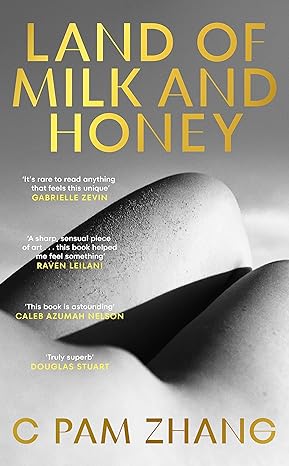 A 29-year-old Chinese American chef is exiled when the USA closes its borders while she’s working in London. On a smog-covered planet where 98% of crops have failed, scarcity reigns – but there is a world apart, a mountaintop settlement at the Italian border where money can buy any ingredient desired and threatened foods are cultivated in a laboratory setting. While peasants survive on mung bean flour, wealthy backers indulge in classic French cuisine. The narrator’s job is to produce lavish, evocative multi-course meals to bring investors on board. Foie gras, oysters, fine wines; heirloom vegetables; fruits not seen for years. But also endangered creatures and mystery meat wrested back from extinction. Her employer’s 21-year-old daughter, Aida, oversees the lab where these rarities are kept alive.
Ironically, surrounded with such delicacies, the chef loses her appetite for all but cigarettes – yet another hunger takes over. Her relationship with Aida is a passionate secret made all the more peculiar by the fact that the chef’s other role is to impersonate Aida’s dead mother, Eun-Young. It’s clear this precarious setup can’t last; ambition and technology keep moving on. The novel presents such a striking picture of desire at the end of the world. Each sentence is honed to flawlessness, with whole paragraphs of fulsome descriptions of meals. Zhang’s prose reminded me of Stephanie Danler’s and R.O. Kwon’s – no surprise, then, that they’re on the Acknowledgments list, as are a cornucopia of foods and other literary influences.
I’m not usually one for a dystopian novel, but the emotional territory keeps this one grounded even as the plot grows more sinister. My only complaint is that I would have left off the final chapter as I don’t think tracing the protagonist through four more decades of life adds much. I would rather have left this world in limbo than thought of the episode as a blip in a facile regeneration process – that’s the most unrealistic element of all. But this has still been my favourite read from the longlist so far. And there’s even a faithful pet cat, a “recalcitrant beast” that keeps coming back to the chef despite benign neglect. (Public library) 
My ideal shortlist, based on what I’ve read and still want to read, would be:


Cocktail by Lisa Alward
Dances by Nicole Cuffey
Brotherless Night by V.V. Ganeshananthan
I Have Some Questions for You by Rebecca Makkai
Land of Milk and Honey by C Pam Zhang
I wouldn’t be averse to seeing The Future or Chrysalis on there either. (Just not Loot, please!)
See Laura’s post for a recap of her reviews and her wish list. Marcie has also been reading from the longlist; see her first write-up here.
The Story Girl by L. M. Montgomery (1911) #ReadingStoryGirl
Six months after the Jane of Lantern Hill readalong, Canadian bloggers Naomi (Consumed by Ink) and Sarah Emsley have chosen an earlier work by Lucy Maud Montgomery, The Story Girl, and its sequel The Golden Road, for November buddy reading.
The book opens one May as brothers Felix and Beverley King are sent from Toronto to Prince Edward Island to stay with an aunt and uncle while their father is away on business. Beverley tells us about their thrilling six months of running half-wild with their cousins Cecily, Dan, Felicity, and Sara Stanley – better known by her nickname of the Story Girl, also to differentiate her from another Sara – and the hired boy, Peter. This line gives a sense of the group’s dynamic: “Felicity to look at—the Story Girl to tell us tales of wonder—Cecily to admire us—Dan and Peter to play with—what more could reasonable fellows want?”
Felicity is pretty and domestically inclined; Sara knows it would be better to be useful like Felicity, but all she has is her storytelling ability. Some are fantasy (“The Wedding Veil of the Proud Princess”); some are local tales that have passed into folk memory (“How Betty Sherman Won a Husband”). Beverley is in raptures over the Story Girl’s orations: “if voices had colour, hers would have been like a rainbow. It made words live. … we had listened entranced. I have written down the bare words of the story, as she told it; but I can never reproduce the charm and colour and spirit she infused into it. It lived for us.”

The cousins’ adventures are gently amusing and quite tame. They all write down their dreams in notebooks. Peter debates which church denomination to join and the boys engage in a sermon competition. Pat the cat has to be rescued from bewitching, and receives a dose of medicine in lard he licks off his paws and fur. The Story Girl makes a pudding with sawdust instead of cornmeal (reminding me of Anne Shirley and the dead mouse in the plum pudding). Life consistently teaches lessons in humility, as when they are all duped by Billy Robinson and his magic seeds, which he says will change whatever each one most resents – straight hair, plumpness, height; and there is a false alarm about the end of the world.
I found the novel fairly twee and realized at a certain point that I was skimming over more than I was reading. As was my complaint about Jane of Lantern Hill, there is a predictable near-death illness towards the end. The descriptions of Felicity and the Story Girl are purple (“when the Story Girl wreathed her nut-brown tresses with crimson leaves it seemed, as Peter said, that they grow on her—as if the gold and flame of her spirit had broken out in a coronal”); I had to remind myself that this reflects on Beverley more so than on Montgomery. From Naomi’s review of The Golden Road, I think that would be more to my taste because it has a clear plot rather than just stringing together pleasant but mostly forgettable anecdotes.
Still, it’s been fun to discover some of L. M. Montgomery’s lesser-known work, and there are sweet words about cats and the seasons:
“I am very good friends with all cats. They are so sleek and comfortable and dignified. And it is so easy to make them happy.”
“The beauty of winter is that it makes you appreciate spring.”
This effectively captures the long, magical summer days of childhood. I thought about when I was a kid and loved trips up to my mother’s hometown in upstate New York, where her brothers still lived. I was in awe of the Judd cousins’ big house, acres of lawn and untold luxuries such as Nintendo and a swimming pool. I guess I was as star-struck as Beverley. (University library) 
R.I.P., Part II: The Last House on Needless Street
My second contribution to this year’s Readers Imbibing Peril challenge (Part I is here), sliding in late on the final day. I’ve become quite the grump about the immense popularity of Halloween in the UK, even though I loved celebrating it as a kid in the States (dressing up and free candy, what’s not to like) and regularly came up with costumes until I was about 20. Year on year it has been turning into a huge thing over here. Creative outfits and pumpkin carving, fine. But instead it seems that all the worst aspects are on display: cheap plastic tat, misbehaving teenagers, unnecessary gore, wildlife-endangering fake cobwebs. Harrumph.
Anyway, I loved my two final R.I.P. selections, only one of which I managed to finish in time.
The Last House on Needless Street by Catriona Ward (2021)
 This came highly recommended by Annabel and Eleanor (and by my husband, who read it on his phone in less than 24 hours). Ted Bannerman lives the life of a hermit in the titular location, a creepy boarded-up house, with his tantrum-prone daughter, Lauren, and his precocious cat, Olivia, who happens to be highly religious and possibly lesbian. All three share narration duties, along with Dee after she moves into the neighbourhood determined to find out what happened to her little sister, Lulu, who disappeared from a local lake 11 years ago. She thinks Ted is the child abductor – or should that be serial killer? – responsible. As Ward sinks us deeper into Ted’s psyche and peculiar behaviours, we have to assume so, too. But, to put that suspense plot cliché to good use, nothing is what it seems here…
In an afterword, Ward describes this as “a book about survival, disguised as a book about horror.” It’s both, really. There is a touch of supernatural dread, what with the little references to the Breton myth of the death-bringing ankou, but the real horror is how damaged people inflict damage on others – and on themselves. (Content warnings for child abuse, self-harm and suicide.) It’s impressive how acutely Ward depicts mental health while still producing a rollicking story with memorable characters. How could you not love a book with the lines “If there’s anything better than a cat on the bed, I don’t know about it” and “Olivia is not a pet. She’s so much more than that. I expect everyone feels this about their cat”?! I’m not usually one for a psychological thriller, but I’d look out for more from Ward. (Public library) 
 I’m also halfway through High Spirits: A Collection of Ghost Stories (1982) by Robertson Davies and enjoying it immensely. Davies was a Master of Massey College at the University of Toronto. These 18 stories, one for each year of his tenure, were his contribution to the annual Christmas party entertainment. They are short and slightly campy tales told in the first person by an intellectual who definitely doesn’t believe in ghosts – until one is encountered. The spirits are historic royals, politicians, writers or figures from legend. In a pastiche of the classic ghost story à la M.R. James, the pompous speaker is often a scholar of some esoteric field and gives elaborate descriptions. “When Satan Goes Home for Christmas” and “Dickens Digested” are particularly amusing. This will make a perfect bridge between Halloween and Christmas. (National Trust secondhand shop)
Happy Birthday & Bookshop Day
Happy Bookshop Day from Hay-on-Wye (and its newest bookshop, Gay on Wye)!


Today is my 40th birthday and I have been spending the weekend book shopping, reading, eating and drinking. What more could I ask for?
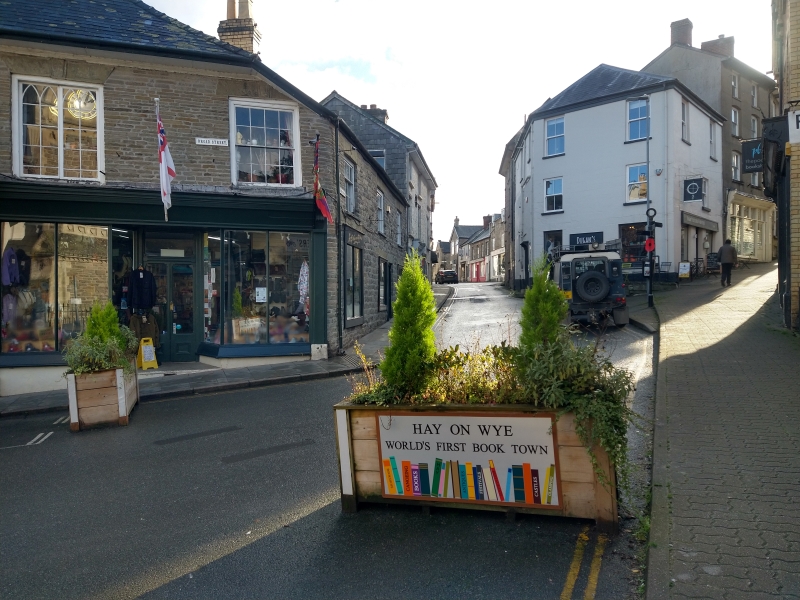


Before we left for Wales, I had my book club over for birthday cakes and bubbles. My husband made me a chocolate Guinness cake (vegan so everyone could share it) and pumpkin chai cupcakes; both recipes were from Hummingbird Bakery cookbooks.


I’ll report back on Monday with my book haul and trip highlights.
For now, here are some sweet lines from a children’s book I read this morning, about cats named Tom and Mot who discover that friendship and imagination are the greatest gifts, and that present has a double meaning: the now that must be appreciated.
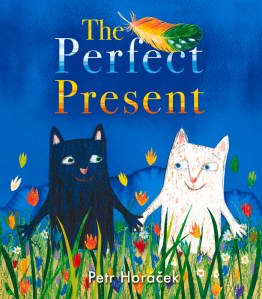
“And then it was time for a hot drink and the cake. The cake tasted like the BEST birthday cake in the world. … ‘Today was the best present in the world,’ said Tom. ‘The perfect present!’”
Reading the Meow: Cat Books by Nadia Mikail, Derek Tangye and Doreen Tovey
Reviews of books about cats have been a standard element on my blog over the years, though not for quite a while now. The new Reading the Meow challenge, hosted by Mallika of Literary Potpourri, was a good excuse to revive the feature. I read all of these from the library. #ReadingtheMeow2023 #LoveYourLibrary
Alfie, who turned 15 last month, accompanies me in all things, including reading. I made him a medallion for his birthday that reads “World’s Best Cat” on one side and “World’s Most Annoying Cat” on the other.


The Cats We Meet Along the Way by Nadia Mikail (2022)
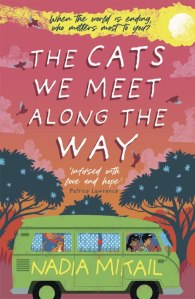 Just the one cat, actually. (Ripoff!) But Fleabag, a one-eared stray ‘the colour of gone-off curry’ who just won’t leave, is a fine companion on this end-of-the-world Malaysian road trip. Mikail’s debut teen novel, which won the Waterstones Children’s Book Prize 2023, imagines that news has come of an asteroid that will make direct contact with Earth in one year. The clock is ticking; just nine months remain. Teenage Aisha and her boyfriend Walter have come to terms with the fact that they’ll never get to do all the things they want to, from attending university to marrying and having children.
Aisha’s father died of cancer when she was young, and her older sister June disappeared two years ago. Aisha decides that what is most important now is finding June and trying to heal their estrangement, so she and Walter set out in a campervan with his parents and her mother (and Fleabag, of course). Mikail sensitively portrays the tangle of anger, grief and fear these characters feel, and it’s interesting to encounter the food and flora of a country that will be unfamiliar to many. Even though everything feels doomed, there are hopeful tasks Aisha and her family can be part of. Teens will no doubt be smart enough to realise that we face a similar calamity in the form of climate breakdown; it’s just that the timescale is a little different.
A Cat in the Window by Derek Tangye (1962)
 My second from Tangye. I’ve read from The Minack Chronicles out of order because I happened to find a free copy of Lama a few years ago and read it for Novellas in November. Tangye wasn’t a cat fan to start with, but Monty won him over. They met in the Savoy hotel when Tangye and Jeannie were newlyweds of three months, and Monty was six weeks old. He lived with them first in the London suburb of Mortlake, then on their flower farm in Cornwall. During the London years they kept long hours and often returned from gatherings at 2 a.m., to be met with Monty in the front window giving a lordly and annoyed glare.
When they moved to Minack there was a sense of giving Monty his freedom and taking joy in watching him live his best life. In between, they were evacuated to St Albans and briefly lived with Jeannie’s parents and Scottie dog, who became Monty’s nemesis. Ever after, he would attack dogs he saw on the canal path. In Cornwall, the threats to a free-roaming cat included foxes and rabbit traps, but Monty survived into his 16th year, happily tolerating a few resident birds: Hubert the gull, Charlie the chaffinch and Tim the robin.
Tangye writes warmly and humorously about Monty’s ways and his own development into a man who is at a cat’s mercy.
I had observed … that cat owners … were apt to fall into two types. Either they ignored the cat, put it out a night whatever the weather, left it to fend for itself when they went away on holidays, and treated it, in fact, as a kind of better class vermin; or else they worshipped the animal like a god. The first category appeared callous, the second devoid of sense.
He portrays life as a series of manageable incidents. This was really the perfect chronicle of life with a cat, from adoption through farewell. It’s the kind of thing I might like to write about Alfie, if only for my husband’s and my benefit, after he shuffles off this kitty coil.
Cats in Concord by Doreen Tovey (2001)
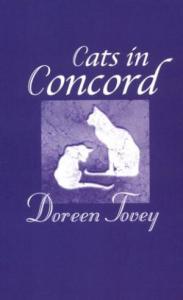 My seventh from Tovey. I can hardly believe that, having started her writing career in the 1950s, she was still publishing into the new millennium! (She lived 1918–2008.) Tovey was addicted to Siamese cats. As this volume opens, she’s so forlorn after the death of Saphra, her fourth male, that she instantly sets about finding a replacement. Although she sets strict criteria she doesn’t think can be met, Rama fits the bill and joins her and Tani, her nine-year-old female. They spar at first, but quickly settle into life together. As always, there are various mishaps involving mischievous cats and eccentric locals (I have a really low tolerance for accounts of folksy neighbours’ doings). The most persistent problem is Rama’s new habit of spraying.
Towards the end, Tani succumbs to a virus while Rama recovers … and guess what, Tovey immediately gets a replacement. In fact, the last lines of the book are “If anyone reading this book has lost a beloved cat and is grieving, I would urge them to get another. I am sure they were put into this world for our admiration—and I think that they think that way too.” I’m probably done with Tovey; Cats in the Belfry and Cats in May were terrific, but it’s been diminishing returns ever since and I’ve ended up skimming most of the last few I tried. 
I also recently enjoyed these two picture books, one about a cat’s mercurial day-and-night moods and the other about an indoor cat who doesn’t realize how good he has it. (Also pictured in the left-hand photograph above.)


Margaret Atwood Reading Month: The Door (#MARM)
It’s my fifth year participating in the annual Margaret Atwood Reading Month (#MARM), hosted by indomitable Canadian blogger Marcie of Buried in Print. In previous years for this challenge, I’ve read Surfacing and The Edible Woman, The Robber Bride and Moral Disorder, and Wilderness Tips; and reread The Blind Assassin. Today is Atwood’s 83rd birthday, so what better time to show her some love?

Like the Beatles, she’s worked in so many different genres and styles that I don’t see how anyone could say they don’t like her – you just haven’t explored her oeuvre deeply enough. Although she’s best known for her fiction, she started off as a poet, with a whole five collections published in the 1960s before her first novel appeared. I’d previously read her Eating Fire: Selected Poetry 1965–1995 and Dearly, my top poetry read of 2020.
 The Door (2007) was at that point her first poetry release in 12 years and features a number of the same themes that permeate her novels and nonfiction: memory, writing, ageing, travel and politics. I particularly like the early poems where she reinhabits memories of childhood and early adulthood, often through objects. Such artifacts are “pocketed as pure mementoes / of some once indelible day,” she writes in “Year of the Hen.”
These are followed by a trilogy about the death of the family’s pet cat, Blackie. “We get too sentimental / over dead animals. / We turn maudlin,” she acknowledges in “Mourning for Cats,” yet “Blackie in Antarctica” injects some humour as she remembers how her sister kept the cat’s corpse in the freezer until she could come home to bury it. Also on the lighter side is a long “where are they now?” update for the Owl and the Pussycat.
There are also meta reflections on poetry, slightly menacing observations on the weather (an implacable, fate-like force) and the seasons (autumn = hunting), virtual visits to the Arctic, mild complaints about the elderly not being taken seriously, and thoughts on duty.
Four in a row muse about war – the Vietnam War in particular, I think? “The Last Rational Man” is a sinister standout, depicting a figure who is doomed under Caligula’s reign. Whoever she may have had in mind when she wrote this, it’s just as relevant 15 years later.
In the final, title poem, which appears to be modelled on the Seven Ages of Man, a door is a metaphor for life’s transitions and, ultimately, for death.
The door swings open:
O god of hinges,
god of long voyages,
you have kept faith.
It’s dark in there.
You confide yourself to the darkness.
You step in.
The door swings closed.
Apart from a few end rhymes, Atwood relies more on theme than on sonic technique or form. That, I think, makes her poetry accessible to those who are new to or suspicious of verse. Happy birthday, M.A., and thank you for your literary wisdom and innovation! (Little Free Library)
Seven Cats I Have Loved by Anat Levit (Translated by Yardenne Greenspan) for #NovNov22
“Most of the cats I come across must be able to sense right away that I am nothing but a cat in human clothes.”
 This short memoir could have fit next week’s nonfiction focus, but because it is translated from the Hebrew I’ve chosen to use it to round off our literature in translation week. Poet Anat Levit didn’t start off as a cat lady, yet in the year following her divorce she adopted five kittens. The first, Shelly, was a present for her small daughters, Daphna and Shlomit, and then another four fluffballs tempted her at the pet store: Afro, Lady, Mocha and Jesse. Add on Cleo, a beautiful Siamese she bought on impulse from a neighbour, and Mishely, a local stray she started to look after, and there you have it: the seven cats who took over her life.
This is a loose narrative filled with little observations on the differences in her cats’ appetites, mannerisms, and relationships to each other and to the author. As much as she loves them, Levit seems to find the animals a heavy emotional burden: she constantly wonders if she’s doing her best for them, treating them all the same (better than her children?), and so on.
Unfortunately, I felt the most attention is paid to the cats’ various illnesses and vet visits, and especially the periods of decline leading to each one’s death. Pets only live a fraction as long as humans, so books about loving them often incorporate death, and some might argue that it’s an essential part of the story: that your care for an animal companion encompasses their whole life and includes the duty to ease their death. Fair enough. But it can be a downer to read about. So, cat lovers, think carefully about whether you can handle the content; if you’re after sweet anecdotes and antics, this is not that book. Something about either the writing or the translation meant that I found the tone either too matter-of-fact (recounting the physical facts of deterioration) or melodramatic, e.g.,
That evening, it dawned on me that I had to hurry up and release Cleo from the relics of existence that survived in his body. Sometimes, death dawdles for no reason. On the threshold of my cats’ demise, it prescribed the kind of suffering that seemed to have erased the sweetness of all their previous years at once.
– and not often finding a balance. Still, there are some sweet moments that pet owners will appreciate. (A similar read from last year: The Writer’s Cats by Muriel Barbery.)
[133 pages]
With thanks to Serpent’s Tail for the free copy for review.
R.I.P. Reads, Part I: Ahlberg, Gaskell, Hinchcliffe and Watson
I don’t generally read horror or suspense, but the R.I.P. challenge is my annual excuse to pick up some slightly scarier material. For this first installment of super-short responses, I have a children’s book about a seriously problematic cat, a Victorian ghost story, and two recent Scotland-set novels about exiles haunted by the unexplained. (All: Public library)

The Improbable Cat by Allan Ahlberg (2003)
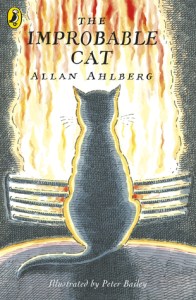 I picked this up expecting a cute cat tale for children, only realizing afterwards that it’s considered horror. When a grey kitten wanders into their garden, Davy is less enamoured than the rest of the Burrell family. His suspicion mounts as the creature starts holding court in the lounge, expecting lavish meals and attention at all times. His parents and sister seem to be under the cat’s spell in some way, and it’s growing much faster than any young animal should. Davy and his pal George decide to do something about it. Since I’m a cat owner, I’m not big into evil cat stories (e.g., Cat out of Hell by Lynne Truss), and this one was so short as to feel underdeveloped.
 “The Old Nurse’s Story” by Elizabeth Gaskell (1852)
(collected in Gothic Tales (2000), ed. Laura Kranzler)
I had no idea that Gaskell had published short fiction, let alone ghost stories. Based on the Goodreads and blogger reviews, I chose one story to read. The title character tells her young charges about when their mother was a child and the ghost of a little girl tried to lure her out onto the Northumberland Fells one freezing winter. It’s predictable for anyone who reads ghost stories, but had a bit of an untamed Wuthering Heights feel to it. 
Hare House by Sally Hinchcliffe (2022)
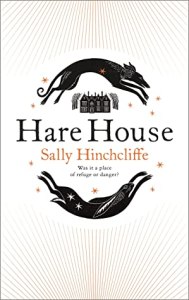 The unnamed narrator is a disgraced teacher who leaves London for a rental cottage on the Hare House estate in Galloway. Her landlord, Grant Henderson, and his rebellious teenage sister, Cass, are still reeling from the untimely death of their brother. The narrator gets caught up in their lives even though her shrewish neighbour warns her not to. There was a lot that I loved about the atmosphere of this one: the southwest Scotland setting; the slow turn of the seasons as the narrator cycles around the narrow lanes and finds it getting dark earlier, and cold; the inclusion of shape-shifting and enchantment myths; the creepy taxidermy up at the manor house; and the peculiar fainting girls/mass hysteria episode that precipitated the narrator’s banishment and complicates her relationship with Cass. The further you get, the more unreliable you realize this narrator is, yet you keep rooting for her. There are a few too many set pieces involving dead animals, and, overall, perhaps more supernatural influences than are fully explored, but I liked Hinchcliffe’s writing enough to look out for what else she will write. (Readalikes: The Haunting of Hill House and Wakenhyrst)
Metronome by Tom Watson (2022)
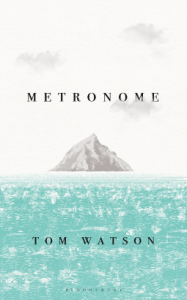 Ever since I read Blurb Your Enthusiasm, I’ve been paying more attention to jacket copy. This is an example of a great synopsis that really gives a sense of the plot: mysterious events, suspicion within a marriage, and curiosity about what else might be out there. Aina and Whitney believe they are the only people on their island. They live simply on a croft and hope that, 12 years after their exile, they’ll soon be up for parole. Whitney stubbornly insists they wait for the warden to rescue them, while Aina has given up thinking anyone will ever come. There’s a slight Beckettian air, then, to the first two-thirds of this dystopian novel. When someone does turn up, it’s not who they expect. The eventual focus on parenthood meant this reminded me a lot of The Road; there are also shades of The Water Cure and Doggerland (though, thankfully, the dual protagonists ensure a less overly male atmosphere than in the latter). This was an easy and reasonably intriguing read, but ultimately a bit vague and bleak for me, and not distinguished enough at the level of the prose (e.g., way too many uses of “onside”).
 Bookish Beck = Rebecca Foster. American transplant to England. Freelance proofreader and book reviewer.
