Three on a Theme: English Gardeners (Bradbury, Laing and Mabey)
These three 2024 releases share a passion for gardening – but not the old-fashioned model of bending nature to one’s will to create aesthetically pleasing landscapes. Instead, the authors are also concerned with sustainability and want to do the right thing in a time of climate crisis (all three mention the 2022 drought, which saw the first 40 °C day being recorded in the UK). They seek to strike a balance between human interference and letting a site go wild, and they are cognizant of the wider political implications of having a plot of land of one’s own. All three were borrowed from the public library. #LoveYourLibrary
One Garden against the World: In Search of Hope in a Changing Climate by Kate Bradbury
Bradbury is Wildlife Editor of BBC Gardeners’ World Magazine and makes television appearances in the UK. She’s owned her suburban Brighton home for four years and has tried to turn its front and back gardens into havens, however small, for wildlife. The book covers April 2022 to June 2023, spotlighting the drought summer. “It’s about a little garden in south Portslade and one terrified, angry gardener.” Month by month, present-tense chapters form not quite a diary, but a record of what she’s planting, pruning, relocating, and so on. There is also a species profile at the end of each chapter, usually of an insect (as in the latest Dave Goulson book) – she’s especially concerned that she’s seeing fewer, yet she’s worried for local birds, trees and hedgehogs, too.
Often, she takes matters into her own hands. She plucks caterpillars from vegetation in the path of strimmers in the park and raises them at home; protects her garden’s robins from predators and provides enough food so they can nest and raise five fledglings; undertakes to figure out where her pond’s amphibians have come from; rescues hedgehogs; and bravely writes to neighbours who have scaffolding up (for roof repairs, etc.) beseeching them to put up swift boxes while they’re at it. Sometimes it works: a pub being refurbished by new owners happily puts up sparrow boxes when she tells them the birds have always nested in crevices in the building. Sometimes it doesn’t; people ignore her letters and she can’t seem to help but take it personally.
For individuals, it’s all too easy to be overtaken by anxiety, helplessness and despair, and Bradbury acknowledges that collective action and solidarity are vital. “I am reminded, once again, that it’s the community that will save these trees, not me. I’m reminded that community is everything.” She bands together with other environmentally minded people to resist a local development, educate the public about hedgehogs through talks, and oppose “Drone Bastard,” who flies drones at seagulls nesting on rooftops (not strictly illegal; disappointingly, their complaint doesn’t get anywhere with the police, RSPB or RSPCA).

Along the way, there are a few insights into the author’s personal life. She lives with her partner Emma and dog Tosca and accesses wild walks even right on the edge of a city in the Downs. Separate visits to her divorced parents are chances for more nature spotting – in Suffolk to see her father, she hears her first curlew and lapwings – but also involve some sadness, as her mother has aphasia and fatigue after a stroke.
Nearly every day of the chronology seems to bring more bad news for nature. “It’s hard, sometimes,” she admits, “trying to enjoy natural, wonderful events, trying to keep the clawing sense of unease at bay”. She is staunch in her fond stance: “I will love it, with all my heart, whatever has managed to remain, whatever is left.” And she models through her own amazingly biodiverse garden the ways we can extend refuge to other creatures if we throw out that pointless notion of ‘tidiness.’ “The UK’s 30 million gardens represent 30 million opportunities to create green spaces that hold on to water and carbon, create shade, grow food and provide habitats for wildlife that might otherwise not survive.” Reading this made me feel less guilty about the feral tangle of buddleia, ragwort, hemp agrimony and bindweed overtaking the parts of our back garden that aren’t given over to meadow, pond and hedge. Every time I venture back there I see tons of insects and spiders, and that’s all that matters.
My main critique is that one year would have been adequate, cutting the book to 250 pages rather than 300 and ensuring less repetition while still being a representative time period. But Bradbury is impressive for her vigilance and resolve. Some might say that she takes herself and life too seriously, but it’s really more that she’s aware of the scale of destruction already experienced and realistic about what we stand to lose. 
The Garden Against Time: In Search of a Common Paradise by Olivia Laing
I consider Laing one of our most important public thinkers. I saw her introduce the book via the online Edinburgh Book Festival event “In Search of Eden,” in which she appeared on screen and was interviewed by JC Niala. Laing explained that this is not a totally new topic for her as she has been involved in environmental activism and in herbalism. But in 2020, when she and her much older husband bought a house in Suffolk – the first home she has owned after a life of renting – she started restoring its walled garden, which had been created in the 1960s by Mark Rumary. For a year, she watched and waited to see what would happen in the garden, only removing obvious weeds. This coincided with lockdown, so visits to gardens and archives were limited; she focused more on the creation of her own garden and travelling through literature. A two-year diary resulted, in seven notebooks.
Niala observed that the structure of the book, with interludes set in the Suffolk garden, means that the reader has a place to come back to between the deep dives into history. Why make a garden? she asked Laing. Beauty, pleasure, activity: these would be pat answers, Laing insisted. Instead, as with all her books, the reason is the impulse to make complicated structures. Repetitive tasks can be soothing; “the drudgery can be compelling as well.”
Laing spoke of a garden as both refuge and resistance, a mix of wild and cultivated. In this context, Derek Jarman’s Dungeness garden was a “wellspring of inspiration” for her, “a riposte to a toxic atmosphere” of nuclear power and the AIDS crisis (Rumary, like Jarman, was gay). It’s hard to tell where the beach ends and his garden begins, she noted, and she tried to make her garden similarly porous by kicking a hole in the door so frogs could get in. She hopes it will be both vulnerable and robust, a biodiversity hotspot. With Niala, she discussed the idea of a garden as a return to innocence. We have a “tarnished Eden” due to climate change, and we have to do what we can to reverse that.
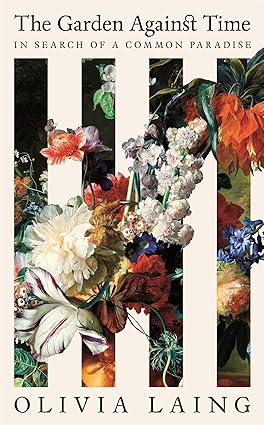
The event was brilliant – just the level of detail I wanted, with Laing flitting between subjects and issuing amazingly intelligent soundbites. The book, though, seemed like page after page about Milton (Paradise Lost) and Iris Origo or the Italian Renaissance. I liked it best when it stayed personal to her family and garden project. There are incredible lyric passages, but just stringing together floral species’ names – though they’re lovely and almost incantatory – isn’t art; it also shuts out those of us who don’t know plants, who aren’t natural gardeners. I wasn’t about to Google every plant I didn’t know (though I did for a few). Also, I have read a lot about Derek Jarman in particular. So my reaction was admiration rather than full engagement, and I only gave the book a light skim in the end. It is striking, though, how she makes this subject political by drawing in equality of access and the climate crisis. (Shortlisted for the Kirkus Prize and the Wainwright Prize.) 
Some memorable lines:
“A garden is a time capsule, as well as a portal out of time.”
“A garden is a balancing act, which can take the form of collaboration or outright war. This tension between the world as it is and the world as humans desire it to be is at the heart of the climate crisis, and as such the garden can be a place of rehearsal too, of experimenting with this relationship in new and perhaps less harmful ways.”
“the garden had become a counter to chaos on a personal as well as a political level”
“the more sinister legacy of Eden: the fantasy of perpetual abundance”
The Accidental Garden: Gardens, Wilderness and the Space in Between by Richard Mabey
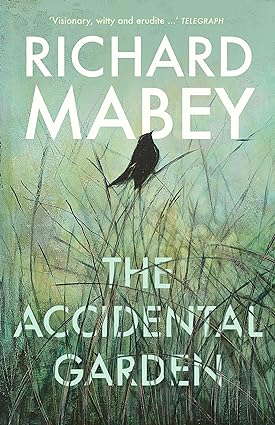 Mabey gives a day-to-day description of a recent year on his two-acre Norfolk property, but also an overview of the past 20 years of change – which of course pretty much always equates to decline. He muses on wildflowers, growing a meadow and hedgerow, bird behaviour, butterfly numbers, and the weather becoming more erratic and extreme. What he sees at home is a reflection of what is going on in the world at large. “It would be glib to suggest that the immeasurably complex problems of a whole world are mirrored in the small confrontations and challenges of the garden. But maybe the mindset needed for both is the same: the generosity to reset the power balance between ourselves and the natural world.” He seeks to create “a fusion garden” of native and immigrant species, trying to intervene as little as possible. The goal is to tend the land responsibly and leave it better off than he found it. As with the Laing, I found many good passages, but overall I felt this was thin – perhaps reflecting his age and loss of mobility – or maybe a swan song. Again, I just skimmed, even though it’s only 160 pages.
Some memorable lines:
“being Earth’s creatures ourselves, we too have a right to a niche. So in our garden we’ve had more modest ambitions, for ‘parallel development’ you might say, and a sense of neighbourliness with our fellow organisms.”
“We feel embattled at times, and that we should try to make some sort of small refuge, a natural oasis.”
“A garden, with its complex interactions between humans and nature, is often seen as a metaphor for the wider world. But if so, is our plot a microcosm of this troubled arena or a refuge from it?”
You might think I would have been more satisfied by Mabey’s contemplative bent, or Laing’s wealth of literary and historical allusions. It turns out that when it comes to gardening, Bradbury’s practical approach was what I was after. But you may gravitate to any of these, depending on whether you want something for the hands, intellect or memory.
Recent Poetry Releases by Allison Blevins, Kit Fan, Lisa Kelly and Laura Scott
I’m catching up on four 2023 poetry collections from independent publishers, three of them from Carcanet Press, which so graciously keeps me stocked up with work by contemporary poets. Despite the wide range of subject matter, style and technique, nature imagery and erotic musings are links. From each I’ve chosen one short poem as a representative.
Cataloguing Pain by Allison Blevins
 Last year I reviewed Allison Blevins’ Handbook for the Newly Disabled. This shares its autobiographical consideration of chronic illness and queer parenting. Specifically, she looks back to her MS diagnosis and three IVF pregnancies, and her spouse’s transition. Both partners were undergoing bodily transformations and coming into new identities, the one as disabled and the other as a man. In later poems she calls herself “The shell”, while “Elegy for My Wife,” which closes Part I, makes way for references to “my husband” in Part II.
“I won’t wail for your dead name. I don’t mean that violence. I wish for a word other than elegy to explain how some of this feels like goodbye.”
In unrhymed couplets or stanzas and bittersweet paragraphs, Blevins marshals metaphors from domestic life – colours, food, furniture, gardening – to chart the changes that pain and disability force onto their family’s everyday routines. “Fall Risk” and “Fly Season” are particular highlights. This is a potent and frankly sexual text for readers drawn to themes of health and queer family-making (see also my Three on a Theme post on that topic).

Published by YesYes Books on 19 April. With thanks to the author for the advanced e-copy for review.
The Ink Cloud Reader by Kit Fan
 Kit Fan was raised in Hong Kong and moved to the UK as an adult. This is his third collection of poetry. “Suddenly” tells a version of his life story in paragraphs or single lines that all incorporate the title word (with an ironic nod, through the epigraph, to Elmore Leonard’s writing ‘rule’ that “suddenly” should never be used). The “IF” statements of “Delphi” then ponder possible future events; a trip to hospital sees him contemplating his mortality (“Glück,” written as a miniature three-act play) and appreciating tokens of beauty (“Geraniums in May”). “Yew,” unusually, is a modified sonnet where every line rhymes.
As the collection’s title suggests, it is equally interested in the natural and the human. There are poems describing the cycles of the moon (the lines of “Moon Salutation” curve into a half-moon parabola) and the wind. Ink pulls together calligraphy, the Chinese zodiac and literature. “The Art of Reading,” which commemorates important moments, real and imaginary, of the poet’s reading life, was a favourite of mine, as was “Derek Jarman’s Garden.” Fan also writes of memory and travels – including to the underworld. His relationship with his husband is a subtle background subject. (“Even though we’ve lived together for nearly twenty years and are always reading sometimes I can’t read you at all which I guess is a good thing”). It’s an opulent and allusive work that has made me eager to try more by Fan. Luckily, I have his debut novel (passed on to me by Laura T.) on the shelf.
Readalike: Moving House by Theophilus Kwek

Published on 27 April. With thanks to Carcanet Press for the advanced e-copy for review.
The House of the Interpreter by Lisa Kelly
 Lisa Kelly’s concern with deafness is sure to bring to mind Raymond Antrobus and Ilya Kaminsky, but I prefer her work. Kelly is half-Danish and has single-sided deafness, and in Part I of this second collection, entitled “Chamber,” her poems engage with questions of split identity:
Is this what it is like for us all? Always having to relearn home
with a strange tongue and alien hands, prepared to open our mouths
as if to beg, to touch tongue-tip with fingertip to reveal ourselves?
The title poem relishes the absurdities of telephone communication, closing with:
In the House of the Interpreter,
Oralism and Manualism, like Passion and Patience,
are rewarded differently and at different times.
Hello, this is your Interpreter. What is your wishlist?
This section ends with “#WhereIsTheInterpreter,” about the Deaf community’s outrage that the Prime Minister’s Covid briefings were not simultaneously translated into BSL.
Bizarrely but delightfully, Kelly then moves onto “Oval Window,” a sequence of alliteration-rich poems about fungi. “Mycology Abecedarian” is a joyful list of species’ common names, while “Mycelium” notes how mushrooms show that different ways of evolution and reproduction are possible. “Darning Mushroom” even combines images of fungi and holey socks. Part III, “Canal,” is a miscellany of autobiographical poems and homages to Faith Ringgold, full of references to colour, language, nature and travel.
Readalike: In the Quaker Hotel by Helen Tookey
Published on 27 April. With thanks to Carcanet Press for the advanced e-copy for review.
The Fourth Sister by Laura Scott
 Back in 2019 I reviewed Laura Scott’s debut collection, So Many Rooms. Her second book reflects some of the same preoccupations: art, birds, colour and Russian literature. Chekhov is a recurring point of reference across the two; here, for instance, we have a found poem composed of excerpts from his letters. Scott also writes about the deaths of her parents, voicing resentment towards her father and remarking on life’s irony. As the title suggests, her family constellation includes sisters. Her godparents loom surprisingly large; her godmother was, apparently, a spy. My favourite of the poems, “Still Life,” imagines the whole of life being prized as a glass in an exhibit, appealingly pristine and praiseworthy in comparison to what we usually perceive: “the raggy sprawl of a life … the wrong turns and longing of it.” Elsewhere, metaphors are drawn from the theatre: performing lines, taking items from a wardrobe. I loved the way the pull of nostalgia is set up in opposition to the now.

Published on 23 February. With thanks to Carcanet Press for the advanced e-copy for review.
Read any good poetry recently?
October Poetry Releases: Bergin, Draycott, Lopez, Rizwan, Skoulding
It was a prolific month for poetry. There is so much variety here in form and topic, from the tongue-in-cheek aphorisms of Tara Bergin’s Savage Tales to the maritime and ornithological portrait of Anglesey in Zoë Skoulding’s A Marginal Sea. Something for everyone, I’d like to think, and I hope these capsule reviews and sample poems give you a taste.
Savage Tales by Tara Bergin
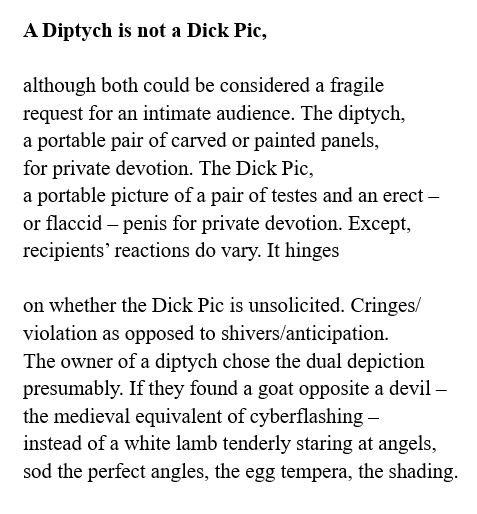
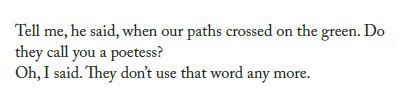
 This is the third collection by the Irish poet; I’d previously read her The Tragic Death of Eleanor Marx. Grouped into nine thematic sections, these very short poems take the form of few-sentence aphorisms or riddles, with the titles, printed in the bottom corner, often acting as something of a punchline – especially because I had them on my e-reader and they only appeared after I’d turned the digital ‘page’. Some appear to be autobiographical, about life for a female academic. Others are political (I loved “Tenants and Landlords”), or about wolves or blackbirds. The verse in “Constructions” takes different shapes on the page. Here are “The Subject Field” and “The Actor”:

With thanks to Carcanet Press for the free e-copy for review.
The Kingdom by Jane Draycott
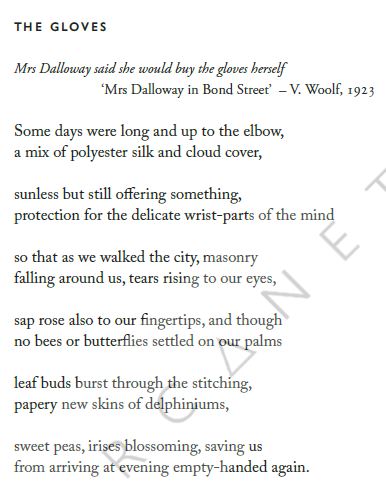
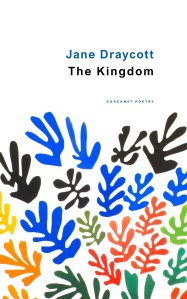 I love the Matisse cut-outs on the cover of Draycott’s fifth collection. The title poem’s archaic spelling (“hyther,” “releyf”) contrast with its picture of a modern woman seeking respite from “the men coming on to you / the taxi drivers saying here jump in no / no you don’t need no money.” Country vs. city, public vs. private, pastoral past and technological future are some of the dichotomies the verse plays with. I enjoyed the alliteration and references to an old English herbarium, Derek Jarman and polar regions. However, it was hard to find overall linking themes to latch onto.
With thanks to Carcanet Press for the free e-copy for review.
We Borrowed Gentleness by J. Estanislao Lopez
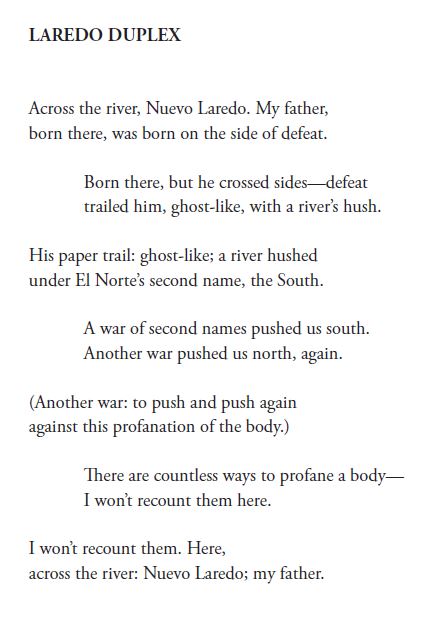
 Brimming with striking metaphors and theological echoes, the first poetry collection by the Houston-based writer is an elegant record of family life on both sides of the Mexican border. “Laredo Duplex” (below) explains how violence prompted the family’s migration. “The Contract” recalls acting as a go-between for a father who didn’t speak English; in “Diáspora” the speaker is dubious about assimilation: “I am losing my brother to whiteness.” The tone is elevated and philosophical (“You take the knife of epistemology and the elegiac fork”), with ample alliteration. Flora and fauna and the Bible are common sources of unexpected metaphors. Lopez tackles big issues of identity, loss and memory in delicate verse suited to readers of Kaveh Akbar. (My full review is on Shelf Awareness.)
With thanks to Alyson Sinclair PR for the free e-copy for review.
Europe, Love Me Back by Rakhshan Rizwan
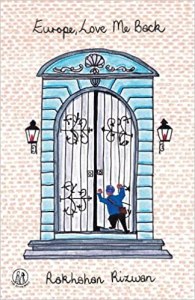 This debut collection has Rizwan juxtaposing East and West, calling out European countries for the prejudice she has experienced as a Muslim Pakistani in academia. She has also lived in the UK and USA, but mostly reflects on time spent in Germany and the Netherlands, where her imperfect grasp of the language was an additional way of standing out. “Adjunct” is the source of the cover image: she knocks and knocks for admittance, but finds herself shut out still. Rizwan takes extended metaphors from marriage, motherhood and women’s health: in “My house is becoming like my country,” she imagines her husband instituting draconian laws; in “I have found in my breast,” a visit to a doctor about a lump only exposes her own exoticism (“Basically, the Muslims are metastasizing”). In “Paris Proper,” she experiences the city differently from a friend because of the colonial history of the art. (See also Liz’s review.)
Some favourite lines:
“my breasts harden / with milk, that peculiar ache of women’s bodies / which do only half the sin / but carry all the history” (from “Half the Sin”)
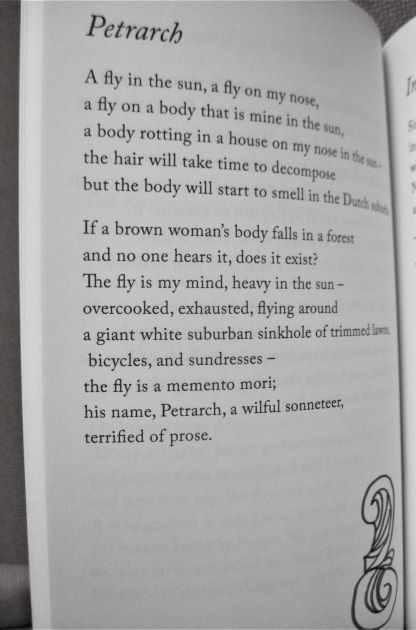
With thanks to The Emma Press for the proof copy for review.
A Marginal Sea by Zoë Skoulding
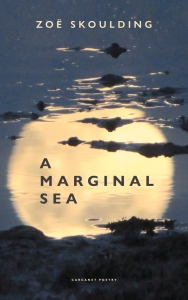 Skoulding’s collection is said to be all about Anglesey in Wales, but from that jumping-off point the poems disperse to consider maps, maritime vocabulary, seabirds, islands, tides and much more. There are also translations from the French, various commissions and collaborations, and pieces about the natural vs. the manmade. Some are in paragraph form and there’s a real variety to how lines and stanzas are laid out on the page. I especially liked “Red Squirrels in Coed Cyrnol.” I’ll read more by Skoulding.
 With thanks to Carcanet Press for the free e-copy for review.
Read any good poetry recently?
Six Degrees of Separation: From Margaret to This Cold Heaven
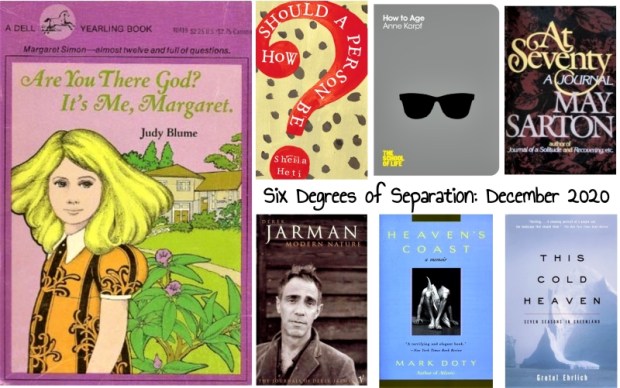
This month we’re starting with Are You There, God? It’s Me, Margaret (which I have punctuated appropriately!). See Kate’s opening post. I know I read this as a child, but other Judy Blume novels were more meaningful for me since I was a tomboy and late bloomer. The only line that stays with me is the chant “We must, we must, we must increase our bust!”
 #1 Another book with a question in the title (and dominating the cover) is How Should a Person Be? by Sheila Heti. I found a hardback copy in the unofficial Little Free Library I ran in our neighborhood during the first lockdown before the public library reopened. Heti is a divisive author, but I loved Motherhood for perfectly encapsulating my situation. I think this one, too, is autofiction, and the title question is one I ask myself variations on frequently.
 #2 I’ve read quite a few “How to” books, whether straightforward explanatory/self-help texts or not. Lots happened to be from the School of Life series. One I found particularly enjoyable and helpful was How to Age by Anne Karpf. She writes frankly about bodily degeneration, the pursuit of wisdom, and preparation for death. “Growth and psychological development aren’t a property of our earliest years but can continue throughout the life cycle.”
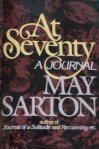 #3 Ageing is a major element in May Sarton’s journals, particularly as she moves from her seventies into her eighties and fights illnesses. I’ve read all but one of her autobiographical works now, and – while my favorite is Journal of a Solitude – the one I’ve chosen as most representative of her usual themes, including inspiration, camaraderie, the pressures of the writing life, and old age, is At Seventy.
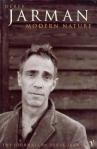 #4 Sarton was a keen gardener, as was Derek Jarman. I learned about him in the context of nature helping people come to terms with their mortality. Modern Nature reproduces the journal the gay, HIV-positive filmmaker kept in 1989–90. Prospect Cottage in Dungeness, Kent, and the unusual garden he cultivated there, was his refuge between trips to London and further afield, and a mental sanctuary when he was marooned in the hospital.
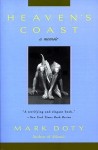 #5 One of the first memoirs I ever read and loved was Heaven’s Coast by Mark Doty, about his partner Wally’s death from AIDS. This sparked my continuing interest in illness and bereavement narratives, and it was through following up Doty’s memoirs with his collections of poems that I first got into contemporary poetry, so he’s had a major influence on my taste. I’ve had Heaven’s Coast on my rereading shelf for ages, so really must get to it in 2021.
 #6 Thinking of heaven, a nice loop back to Blume’s Margaret and her determination to find God … one of the finest travel books I’ve read is This Cold Heaven, about Gretel Ehrlich’s expeditions to Greenland and historical precursors who explored it. Even more than her intrepid wanderings, I was impressed by her prose, which made the icy scenery new every time. “Part jewel, part eye, part lighthouse, part recumbent monolith, the ice is a bright spot on the upper tier of the globe where the world’s purse strings have been pulled tight.”
A fitting final selection for this week’s properly chilly winter temperatures, too. I’ll be writing up my first snowy and/or holiday-themed reads of the year in a couple of weeks.
Join us for #6Degrees of Separation if you haven’t already! (Hosted on the first Saturday of each month by Kate W. of Books Are My Favourite and Best.)
Have you read any of my selections? Are you tempted by any you didn’t know before?
November Plans: Novellas, Margaret Atwood Reading Month & More
My big thing next month will, of course, be Novellas in November, which I’m co-hosting with Cathy of 746 Books as a month-long challenge with four weekly prompts. I’m taking the lead on two alternating weeks and will introduce them with mini-reviews of some of my favorite short books from these categories:
9–15 November: Nonfiction novellas
23–29 November: Short classics

I’m also using this as an excuse to get back into the nine books of under 200 pages that have ended up on my “Set Aside Temporarily” shelf. I swore after last year that I would break myself of the bad habit of letting books linger like this, but it has continued in 2020.
Other November reading plans…
Readalong of Derek Jarman’s Modern Nature
 I learned about this book through Losing Eden by Lucy Jones; she mentions it in the context of nature helping people come to terms with their mortality. Jarman found solace in his Dungeness, Kent garden while dying of AIDS. Shortly after I came across that reference, I learned that his home, Prospect Cottage, had just been rescued from private sale by a crowdfunding campaign. I hope to visit it someday. In the meantime, Creative Folkestone is hosting an Autumn Reads festival on his journal, Modern Nature, running from the 19th to 22nd. I’ve already begun reading it to get a headstart. Do you have a copy? If so, join in!
Margaret Atwood Reading Month
 This is the third year of #MARM, hosted by Canadian bloggers extraordinaires Marcie of Buried in Print and Naomi of Consumed by Ink. (Check out the neat bingo card they made this year!) I plan to read the short story volume Wilderness Tips and her new poetry collection, Dearly,on the way for me to review for Shiny New Books. If I fancy adding anything else in, there are tons of her books to choose from across the holdings of the public and university libraries.
Nonfiction November
I don’t usually participate in this challenge because nonfiction makes up at least 40% of my reading anyway, but the past couple of years I enjoyed putting together fiction and nonfiction pairings and “Being the Expert” on women’s religious memoirs. I might end up doing at least one post, especially as I have some “Three on a Theme” posts in mind to encompass a couple of nonfiction topics I happen to have read several books about. The full schedule is here.

Young Writer of the Year Award
 Being on the shadow panel for the Sunday Times Young Writer of the Year Award was a highlight of 2017 for me. I look forward to following along with the nominated books, as I did last year, and attending the virtual prize ceremony. With any luck I will already have read at least one or two books from the shortlist of four. Fingers crossed for Rowan Hisayo Buchanan, Naoise Dolan, Jessica J. Lee, Olivia Potts and Nina Mingya Powles; Niamh Campbell, Catherine Cho, Tiffany Francis and Emma Glass are a few other possibilities. (By chance, only young women are on my radar this year!)
November is such a busy month for book blogging: it’s also Australia Reading Month and German Literature Month. I don’t happen to have any books on the pile that will fit these prompts, but you might like to think about how you can combine one of them with some of the other challenges out there!
 Bookish Beck = Rebecca Foster. American transplant to England. Freelance proofreader and book reviewer.
 Bookish Beck
