Some 2025 Reading Superlatives
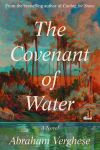
Longest book read this year: The Covenant of Water by Abraham Verghese (724 pages)
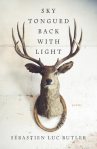
Shortest book read this year: Sky Tongued Back with Light by Sébastien Luc Butler (a 38-page poetry chapbook coming out in 2026)
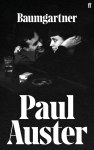
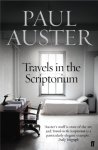
Authors I read the most by this year: Paul Auster and Emma Donoghue (3) [followed by Margaret Atwood, Chloe Caldwell, Michael Cunningham, Mairi Hedderwick, Christopher Isherwood, Rebecca Kauffman, Stephen King, Elaine Kraf, Maggie O’Farrell, Sylvia Plath and Jess Walter (2 each)]
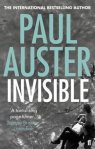
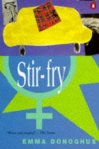
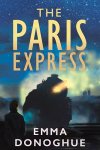
Publishers I read the most from: (Besides the ubiquitous Penguin Random House and its myriad imprints) Faber (14), Canongate (12), Bloomsbury (11), Fourth Estate (7); Carcanet, Picador/Pan Macmillan and Virago (6)
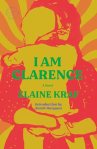
My top author ‘discoveries’ of the year (I’m very late to the party on some of these!): poet Amy Gerstler, Christopher Isherwood, Stephen King, Elaine Kraf, Sylvia Plath, Chloe Savage’s children’s picture books (women + NB characters, science, adventure, dogs), Robin Stevens’s middle-grade mysteries, Jess Walter
Proudest book-related achievement: Clearing 90–100 books from my shelves as part of our hallway redecoration. Some I resold, some I gave to friends, some I put in the Little Free Library, and some I donated to charity shops.
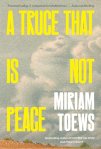
Most pinching-myself bookish moment: Miriam Toews’ U.S. publicist e-mailing me about my Shelf Awareness review of A Truce That Is Not Peace to say, “saw your amazing review! Thank you so much for it – Miriam loved it!”
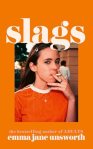
Books that made me laugh: LOTS, including Spent by Alison Bechdel (which I read twice), The Wedding People by Alison Espach, Victorian Psycho by Virginia Feito, Is This My Final Form? by Amy Gerstler, The Diary of a Nobody by George Grossmith, The Sacred Diary of Adrian Plass Aged 37 ¾, and Slags by Emma Jane Unsworth
A book that made me cry: Death of an Ordinary Man by Sarah Perry
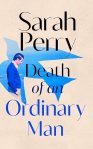
Best book club selections: Leave the World Behind by Rumaan Alam; The Remains of the Day by Kazuo Ishiguro, I Am, I Am, I Am by Maggie O’Farrell and Stoner by John Williams (these three were all rereads)
Best first line encountered this year:
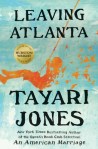
- From Leaving Atlanta by Tayari Jones: “Hard, ugly, summer-vacation-spoiling rain fell for three straight months in 1979.”
Best last lines encountered this year:
- Is a River Alive? by Robert Macfarlane: “Death and love and life, all mingled in the flow.”
(Two quite similar rhetorical questions:)
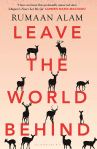 Leave the World Behind by Rumaan Alam: “If they didn’t know how it would end—with night, with more terrible noise from the top of Olympus, with bombs, with disease, with blood, with happiness, with deer or something else watching them from the darkened woods—well, wasn’t that true of every day?”
&
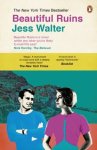
- Beautiful Ruins by Jess Walter: “And even if they don’t find what they’re looking for, isn’t it enough to be out walking together in the sunlight?”
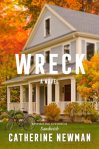
- Wreck by Catherine Newman: “You are still breathing.”
 The Irish Goodbye by Beth Ann Fennelly: “Dear viewer of my naked body, Enjoy the bunions.”
- A Certain Smile by Françoise Sagan: “It was a simple story; there was nothing to make a fuss about.”
- Book of Lives by Margaret Atwood: “We scribes and scribblers are time travellers: via the magic page we throw our voices, not only from here to elsewhere, but also from now to a possible future. I’ll see you there.”
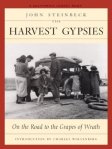
Book that put a song in my head every time I picked it up: The Harvest Gypsies by John Steinbeck (see Kris Drever’s song of the same name). Also, one story of Book of Exemplary Women by Diana Xin mentioned lyrics from “Wild World” by Cat Stevens (“Oh, baby, baby, it’s a wild world. And I’ll always remember you like a child, girl”).
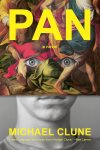
Shortest book titles encountered: Pan (Michael Clune), followed by Gold (Elaine Feinstein) & Girl (Ruth Padel); followed by an 8-way tie! Spent (Alison Bechdel), Billy (Albert French), Carol (Patricia Highsmith), Pluck (Adam Hughes), Sleep (Honor Jones), Wreck (Catherine Newman), Ariel (Sylvia Plath) & Flesh (David Szalay)
Best 2025 book titles: Chopping Onions on My Heart by Samantha Ellis [retitled, probably sensibly, Always Carry Salt for its U.S. release], A Truce That Is Not Peace by Miriam Toews [named after a line from a Christian Wiman poem – top taste there] & Calls May Be Recorded for Training and Monitoring Purposes by Katharina Volckmer.
Best book titles from other years: Dreams of Dead Women’s Handbags by Shena Mackay
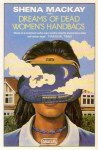
Biggest disappointments: Dream Count by Chimamanda Ngozi Adichie – so not worth waiting 12 years for – and Heart the Lover by Lily King, which kind of retrospectively ruined her brilliant Writers & Lovers for me.

The 2025 books that it seemed like everyone was reading but I decided not to: Helm by Sarah Hall, The Persians by Sanam Mahloudji, What We Can Know by Ian McEwan (I’m 0 for 2 on his 2020s releases)
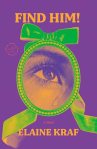
The downright strangest books I read this year: Both by Elaine Kraf: I Am Clarence and Find Him! (links to my Shelf Awareness reviews) are confusing, disturbing, experimental in language and form, but also ahead of their time in terms of their feminist content and insight into compromised mental states. The former is more accessible and less claustrophobic.
Book Serendipity, September through Mid-November
I call it “Book Serendipity” when two or more books that I read at the same time or in quick succession have something in common – the more bizarre, the better. This is a regular feature of mine every couple of months. Because I usually have 20–30 books on the go at once, I suppose I’m more prone to such incidents. People frequently ask how I remember all of these coincidences. The answer is: I jot them down on scraps of paper or input them immediately into a file on my PC desktop; otherwise, they would flit away.
Thanks to Emma and Kay for posting their own Book Serendipity moments! (Liz is always good about mentioning them as she goes along, in the text of her reviews.)
The following are in roughly chronological order.
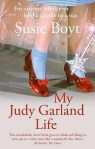
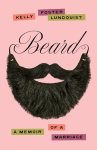
- An obsession with Judy Garland in My Judy Garland Life by Susie Boyt (no surprise there), which I read back in January, and then again in Beard: A Memoir of a Marriage by Kelly Foster Lundquist.
- Leaving a suicide note hinting at drowning oneself before disappearing in World War II Berlin; and pretending to be Jewish to gain better treatment in Aimée and Jaguar by Erica Fischer and The Lilac People by Milo Todd.
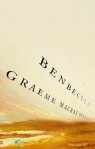
- Leaving one’s clothes on a bank to suggest drowning in The Covenant of Water by Abraham Verghese, read over the summer, and then Benbecula by Graeme Macrae Burnet.
- A man expecting his wife to ‘save’ him in Amanda by H.S. Cross and Beard: A Memoir of a Marriage by Kelly Foster Lundquist.
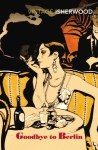 A man tells his story of being bullied as a child in Goodbye to Berlin by Christopher Isherwood and Beard by Kelly Foster Lundquist.
- References to Vincent Minnelli and Walt Whitman in a story from Touchy Subjects by Emma Donoghue and Beard by Kelly Foster Lundquist.
- The prospect of having one’s grandparents’ dining table in a tiny city apartment in Beard by Kelly Foster Lundquist and Wreck by Catherine Newman.
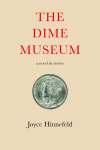
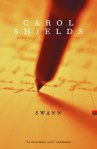
- Ezra Pound’s dodgy ideology was an element in The Dime Museum by Joyce Hinnefeld, which I reviewed over the summer, and recurs in Swann by Carol Shields.
- A character has heart palpitations in Andrew Miller’s story from The BBC National Short Story Award 2025 anthology and Endling by Maria Reva.
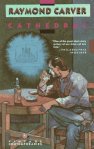
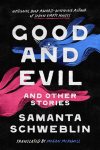
- A (semi-)nude man sees a worker outside the window and closes the curtains in one story of Cathedral by Raymond Carver and one from Good and Evil and Other Stories by Samanta Schweblin.
- The call of the cuckoo is mentioned in The Edge of Silence by Neil Ansell and Of All that Ends by Günter Grass.
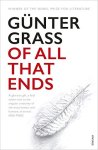 A couple in Italy who have a Fiat in Of All that Ends by Günter Grass and Caoilinn Hughes’s story from The BBC National Short Story Award 2025 anthology.
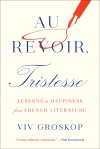
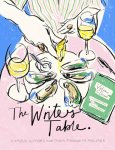
- Balzac’s excessive coffee consumption was mentioned in Au Revoir, Tristesse by Viv Groskop, one of my 20 Books of Summer, and then again in The Writer’s Table by Valerie Stivers.
- The main character is rescued from her suicide plan by a madcap idea in The Wedding People by Alison Espach and Endling by Maria Reva.
- The protagonist is taking methotrexate in Sea, Poison by Caren Beilin and Wreck by Catherine Newman.

- A man wears a top hat in Benbecula by Graeme Macrae Burnet and one story of Cathedral by Raymond Carver.
- A man named Angus is the murderer in Benbecula by Graeme Macrae Burnet and Swann by Carol Shields.
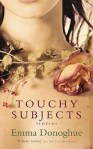 The thing most noticed about a woman is a hair on her chin in the story “Pluck” in Touchy Subjects by Emma Donoghue and Swann by Carol Shields.
- The female main character makes a point of saying she doesn’t wear a bra in Sea, Poison by Caren Beilin and Find Him! by Elaine Kraf.
- A home hairdressing business in one story of Cathedral by Raymond Carver and Emil & the Detectives by Erich Kästner.
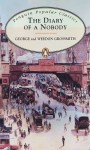
- Painting a bathroom fixture red: a bathtub in The Diary of a Nobody by George Grossmith, one of my 20 Books of Summer; and a toilet in Find Him! by Elaine Kraf.
- A teenager who loses a leg in a road accident in individual stories from A Wild Swan by Michael Cunningham and the Racket anthology (ed. Lisa Moore).
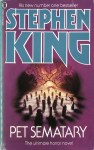
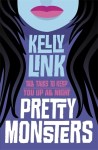
- Digging up the casket of a loved one in the wee hours features in Pet Sematary by Stephen King, one of my 20 Books of Summer; and one story of Pretty Monsters by Kelly Link.
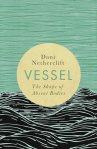
- A character named Dani in the story “The St. Alwynn Girls at Sea” by Sheila Heti and The Silver Book by Olivia Laing; later, author Dani Netherclift (Vessel).
 Obsessive cultivation of potatoes in Benbecula by Graeme Macrae Burnet and The Martian by Andy Weir.
- The story of Dante Gabriel Rossetti digging up the poems he buried with his love is recounted in Sharon Bala’s story in the Racket anthology (ed. Lisa Moore) and one of the stories in Pretty Monsters by Kelly Link.
- Putting French word labels on objects in Alone in the Classroom by Elizabeth Hay and Find Him! by Elaine Kraf.
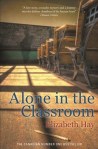
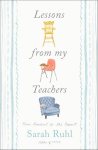 A man with part of his finger missing in Find Him! by Elaine Kraf and Lessons from My Teachers by Sarah Ruhl.
- In Minor Black Figures by Brandon Taylor, I came across a mention of the Italian film director Pier Paolo Pasolini, who is a character in The Silver Book by Olivia Laing.
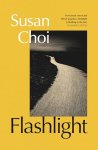
- A character who works in an Ohio hardware store in Flashlight by Susan Choi and Buckeye by Patrick Ryan (two one-word-titled doorstoppers I skimmed from the library). There’s also a family-owned hardware store in Alone in the Classroom by Elizabeth Hay.
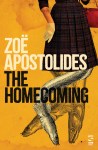
- A drowned father – I feel like drownings in general happen much more often in fiction than they do in real life – in The Homecoming by Zoë Apostolides, Flashlight by Susan Choi, and Vessel by Dani Netherclift (as well as multiple drownings in The Covenant of Water by Abraham Verghese, one of my 20 Books of Summer).
- A memoir by a British man who’s hard of hearing but has resisted wearing hearing aids in the past: first The Quiet Ear by Raymond Antrobus over the summer, then The Edge of Silence by Neil Ansell.
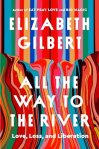 A loved one is given a six-month cancer prognosis but lives another (nearly) two years in All the Way to the River by Elizabeth Gilbert and Lessons from My Teachers by Sarah Ruhl.
- A man’s brain tumour is diagnosed by accident while he’s in hospital after an unrelated accident in Flashlight by Susan Choi and Saltwash by Andrew Michael Hurley.
- Famous lost poems in What We Can Know by Ian McEwan and Swann by Carol Shields.
- A description of the anatomy of the ear and how sound vibrates against tiny bones in The Edge of Silence by Neil Ansell and What Stalks the Deep by T. Kingfisher.
- Notes on how to make decadent mashed potatoes in Beard by Kelly Foster Lundquist, Death of an Ordinary Man by Sarah Perry, and Lessons from My Teachers by Sarah Ruhl.
- Transplant surgery on a dog in Russia and trepanning appear in The Heart of a Dog by Mikhail Bulgakov and the poetry collection Common Disaster by M. Cynthia Cheung.
- Audre Lorde, whose Sister Outsider I was reading at the time, is mentioned in Lessons from My Teachers by Sarah Ruhl. Lorde’s line about the master’s tools never dismantling the master’s house is also paraphrased in Spent by Alison Bechdel.
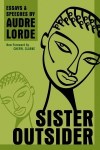
- An adult appears as if fully formed in a man’s apartment but needs to be taught everything, including language and toilet training, in The Heart of a Dog by Mikhail Bulgakov and Find Him! by Elaine Kraf.
 Two sisters who each wrote a memoir about their upbringing in Spent by Alison Bechdel and Vessel by Dani Netherclift.
- The fact that ragwort is bad for horses if it gets mixed up into their feed was mentioned in Ghosts of the Farm by Nicola Chester and Understorey by Anna Chapman Parker.
- The Sylvia Plath line “the O-gape of complete despair” was mentioned in Vessel by Dani Netherclift, then I read it in its original place in Ariel later the same day.
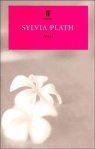
- A mention of the Baba Yaga folk tale (an old woman who lives in the forest in a hut on chicken legs) in Common Disaster by M. Cynthia Cheung and Woman, Eating by Claire Kohda. [There was a copy of Sophie Anderson’s children’s book The House with Chicken Legs in the Little Free Library around that time, too.]
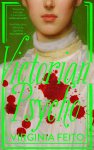
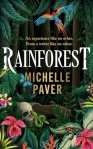
- Coming across a bird that seems to have simply dropped dead in Victorian Psycho by Virginia Feito, Vessel by Dani Netherclift, and Rainforest by Michelle Paver.
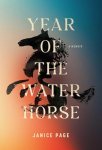
- Contemplating a mound of hair in Vessel by Dani Netherclift (at Auschwitz) and Year of the Water Horse by Janice Page (at a hairdresser’s).
- Family members are warned that they should not see the body of their loved one in Vessel by Dani Netherclift and Rainforest by Michelle Paver.
- A father(-in-law)’s swift death from oesophageal cancer in Year of the Water Horse by Janice Page and Death of an Ordinary Man by Sarah Perry.
- I saw John Keats’s concept of negative capability discussed first in My Little Donkey by Martha Cooley and then in Understorey by Anna Chapman Parker.
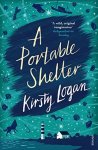
- I started two books with an Anne Sexton epigraph on the same day: A Portable Shelter by Kirsty Logan and Slags by Emma Jane Unsworth.
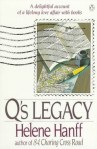
- Mentions of Martin Luther King, Jr.’s assassination in Q’s Legacy by Helene Hanff and Sister Outsider for Audre Lorde, both of which I was reading for Novellas in November.
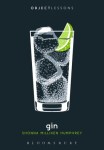
- Mentions of specific incidents from Samuel Pepys’s diary in Q’s Legacy by Helene Hanff and Gin by Shonna Milliken Humphrey, both of which I was reading for Nonfiction November/Novellas in November.
- Starseed (aliens living on earth in human form) in Beautyland by Marie-Helene Bertino and The Conspiracists by Noelle Cook.
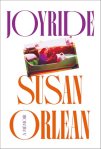
- Reading nonfiction by two long-time New Yorker writers at the same time: Life on a Little-Known Planet by Elizabeth Kolbert and Joyride by Susan Orlean.

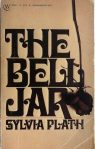
- The breaking of a mirror seems like a bad omen in The Spare Room by Helen Garner and The Bell Jar by Sylvia Plath.
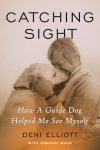 The author’s husband (who has a name beginning with P) is having an affair with a lawyer in Catching Sight by Deni Elliott and Joyride by Susan Orlean.
- Mentions of Lewis Hyde’s book The Gift in Lessons from My Teachers by Sarah Ruhl and The Serviceberry by Robin Wall Kimmerer; I promptly ordered the Hyde secondhand!
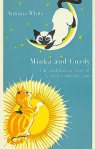
- The protagonist fears being/is accused of trying to steal someone else’s cat in Minka and Curdy by Antonia White and Aunts Aren’t Gentlemen by P.G. Wodehouse, both of which I was reading for Novellas in November.
What’s the weirdest reading coincidence you’ve had lately?
Nine Days in Germany and What I Read, Part I: Berlin
We’ve actually been back for more than a week, but soon after our return I was felled by a nasty cold (not Covid, surprisingly), which has left me with a lingering cough and ongoing fatigue. Finally, I’m recovered just about enough to report back.
This Interrail adventure was more low-key than the one we took in 2016. The first day saw us traveling as far as Aachen, just over the border from France. It’s a nice small city with Christian and culinary history: Charlemagne is buried in the cathedral; and it’s famous for a chewy, spicy gingerbread called printen. Before our night in a chain hotel, we stumbled upon the mayor’s Green Party rally in the square – there was to be an election the following day – and drank and dined well. The Gin Library, spotted at random on the map, is an excellent and affordable Asian-fusion cocktail bar. My “Big Ben,” for instance, featured Tanqueray gin, lemon juice, honey, fresh coriander, and cinnamon syrup. Then at Hanswurst – Das Wurstrestaurant (cue jokes about finding the “worst” restaurant in Aachen!), a superior fast-food joint, I had the vegetarian “Hans Berlin,” a scrumptious currywurst with potato wedges.


The next day it was off to Berlin with a big bag of bakery provisions. For the first time, we experienced the rail cancellations and delays that would plague us for much of the next week. We then had to brave the only supermarket open in Berlin on a Sunday – the Rewe in the Hauptbahnhof – before taking the S-Bahn to Alexanderplatz, the nearest station to our Airbnb flat.


It was all worth it to befriend Lemmy (the ginger one) and Roxanne. It’s a sweet deal the host has here: whenever she goes away, people pay her to look after her cats. At the same time as we were paying for a cat-sitter back home. We must be chumps!


I’ll narrate the rest of the trip through the books I read. I relished choosing relevant reads from my shelves and the library’s holdings – I was truly spoiled for choice for Berlin settings! – and I appreciated encountering them all on location.


As soon as we walked into the large airy living room of the fifth-floor Airbnb flat, I nearly laughed out loud, for there in the corner was a monstera plant. The trendy, minimalist décor, too, was just like that of the main characters’ place in…
Perfection by Vincenzo Latronico (2022; 2025)
[Translated from Italian by Sophie Hughes]
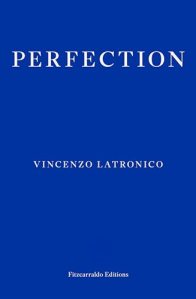 Anna and Tom are digital nomads from Southern Europe who offer up their Berlin flat as a short-term rental. In the listing photographs it looks pristine, giving no hint of the difficulties of the expatriate life such as bureaucracy and harsh winters. “Creative professionals” working in the fields of web development and graphic design, they are part of the micro-generation that grew up as the Internet was becoming mainstream, and they tailor their products and personal lives to social media’s preferences. They are lazy liberals addicted to convenience and materialism; aspiring hedonists who like the idea of sex clubs but don’t enjoy them when they actually get there. When Berlin loses its magic, they try Portugal and Sicily before an unforeseen inheritance presents them with the project of opening their own coastal guesthouse. “What they were looking for must have existed once upon a time, back when you only had to hop onto a train or a ferry to reach a whole other world.” This International Booker Prize shortlistee is a smart satire about online posturing and the mistaken belief that life must be better elsewhere. There are virtually no scenes or dialogue but Latronico gets away with the all-telling style because of the novella length. Were it not for his note in the Acknowledgements, I wouldn’t have known that this is a tribute to Things by Georges Perec. (Read via Edelweiss)
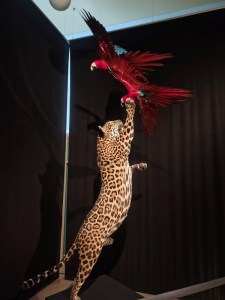 We got to pretend to be hip locals for four days, going up the Reichstag tower, strolling through the Tiergarten, touring the Natural History Museum (which has some excellent taxidermy as at left), walking from Potsdam station through Park Sanssouci and ogling the castles and windmill, chowing down on hand-pulled noodles and bao buns at neighbourhood café Wen Cheng, catching an excellent free lunchtime concert at the Philharmonic, and bringing back pastries or vegan doughnuts to snack on while hanging out with the kitties. The S-Bahn was included on our Interrail passes but didn’t go everywhere we needed, so we were often on the handy U-Bahn and tram system instead. Graffiti is an art form rather than an antisocial activity in Berlin; there is so much of it, everywhere.
-

- Reichstag (Photos 1, 2 and 4 by Chris Foster)
-

- Reichstag tower designed by Norman Foster
-

- The Philharmonic
-
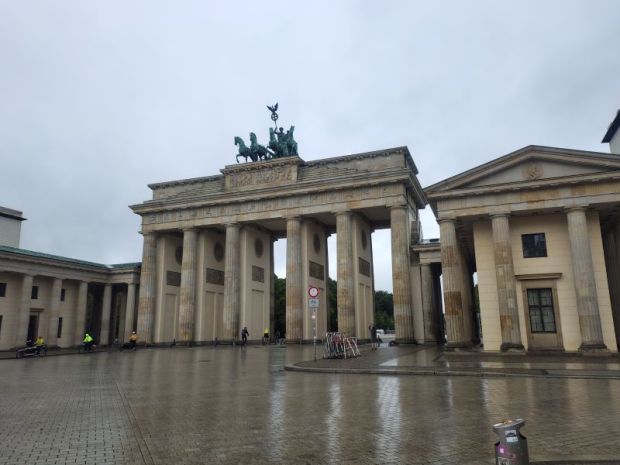
- Brandenburg Gate (Photos 1-3 by Chris Foster)
-
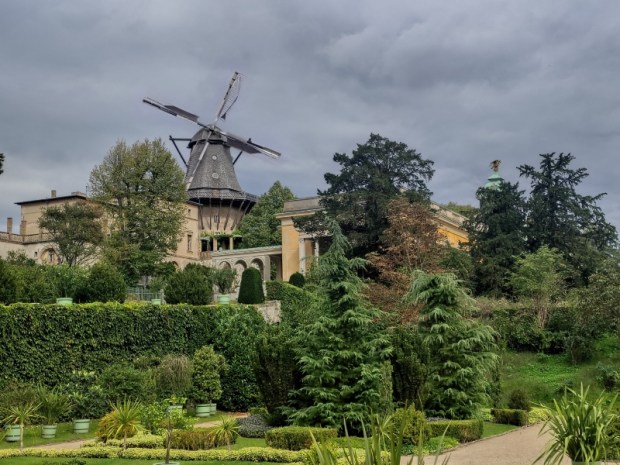
- Postdam’s Park Sanssouci
-
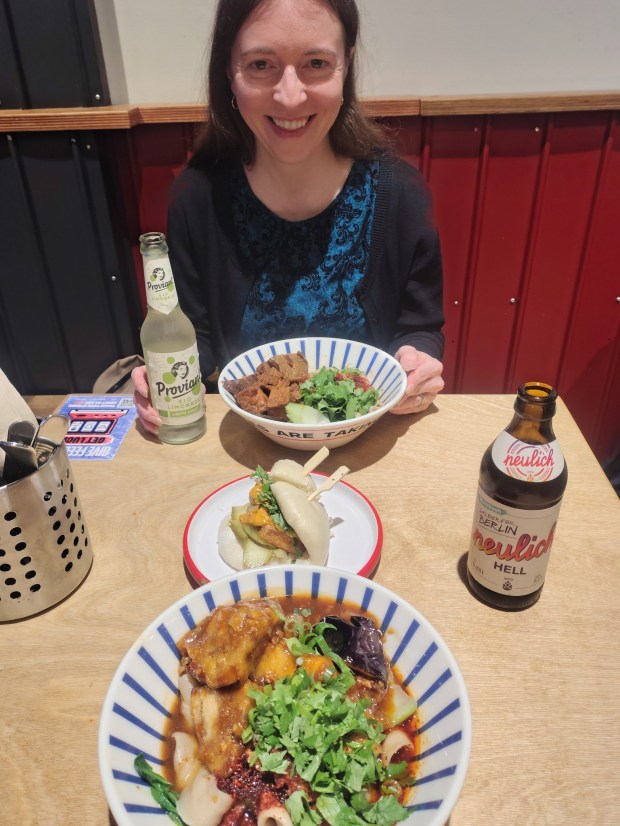
- Wen Cheng noodles
-

- Brammibal’s vegan doughnuts
I brought along another novella that proved an apt companion for our explorations of the city. Even just spotting familiar street and stop names in it felt like reassurance.
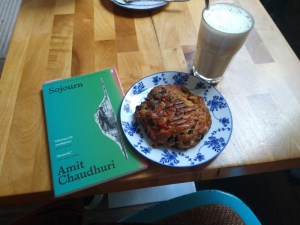
Sojourn by Amit Chaudhuri (2022)
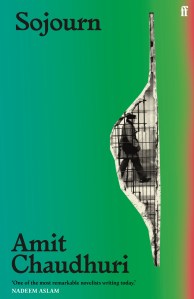 The narrator of this spare text is a Böll Visiting Professor experiencing disorientation yet resisting gestures of familiarity. Like a Teju Cole or Rachel Cusk protagonist, his personality only seeps in through his wanderings and conversations. After his first talk, he meets a fellow Indian from the audience, Faqrul Haq, who takes it upon himself to be his dedicated tour guide. The narrator isn’t entirely sure how he feels about Faqrul, yet meets him for meals and seeks his advice about the best place to buy warm outerwear. An expat friend is a crutch he wishes he could refuse, but the bewilderment of being somewhere you don’t speak the language at all is such that he feels bound to accept. Meanwhile, there is the possibility of another academic admirer, Birgit, becoming his lover. Strangely, his relationship with his cleaning lady, who addresses him only in German, seems the healthiest one on offer. As the book goes on, the chapters get shorter and shorter, presaging some kind of mental crisis. “I keep walking – in which direction I’m not sure; Kreuzberg? I’ve lost my bearings – not in the city; in its history. The less sure I become of it, the more I know my way.” This was interesting, even admirable, but I wanted more story. (Public library)
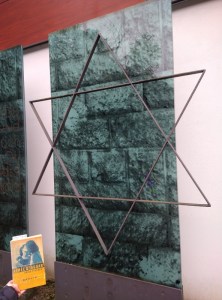
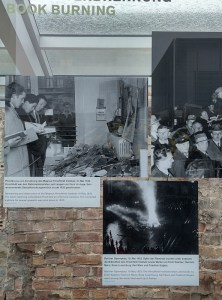
We spent a drizzly and slightly melancholy first day and final morning making pilgrimages to Jewish graveyards and monuments to atrocities, some of them nearly forgotten. I got the sense of a city that has been forced into a painful reckoning with its past – not once but multiple times, perhaps after decades of repression. One morning we visited the claustrophobic monument to the Murdered Jews of Europe, and, in the Tiergarten, the small memorials to the Roma and homosexual victims of the Holocaust. The Nazis came for political dissidents and the disabled, too, as I was reminded at the Topography of Terrors, a free museum where brutal facts are laid bare. We didn’t find the courage to go in as the timeline outside was confronting enough. I spotted links to the two historical works I was reading during my stay (Stella the red-haired Jew-catcher in the former and Magnus Hirschfeld’s institute in the latter). As I read both, I couldn’t help but think about the current return of fascism worldwide and the gradual erosion of rights that should concern us all.


Aimée and Jaguar: A Love Story, Berlin 1943 by Erica Fischer (1994; 1995)
[Translated from German by Edna McCown]
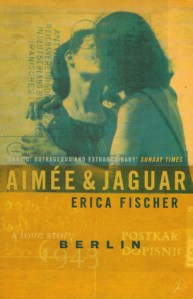 Elisabeth “Lilly” Wust was a good German: the estranged wife of a Nazi and mother of four young sons. She met Felice Schragenheim via her new domestic helper, Inge Wolf. Lilly (aka Aimée) was slow to grasp that Inge and Felice were part of a local lesbian milieu, and didn’t realize Felice (aka Jaguar) was a “U-boat” (Jew living underground) until they’d already become lovers. They got nearly a year and a half together, living almost as a married couple – they had rings engraved and everything – before Felice was taken into Gestapo custody. You know from the outset that this story won’t end well, but you keep hoping – just like Lilly did. It’s not a usual or ‘satisfying’ tragedy, though, because there is no record of what happened to Felice. She was declared legally dead in 1948 but most likely shared the fate of Anne and Margot Frank, dying of typhus at Bergen-Belsen. It’s heartbreaking that Felice, the orphaned daughter of well-off dentists, had multiple chances to flee Berlin – via her sister in London, their stepmother in Palestine, an uncle in America, or friends escaping through Switzerland – but chose to remain.
 The narrative incorporates letters, diaries and interviews, especially with Lilly, who clearly grieved Felice for the rest of her life. The book is unsettling, though, in that Fischer doesn’t let it stand as a simple Juliet & Juliet story; rather, she undermines Lilly by highlighting Felice’s promiscuity (so she likely would not have remained faithful) and Lilly’s strange postwar behaviour: desperately trying to reclaim Felice’s property, and raising her sons as Jewish. This was a time capsule, a wholly absorbing reclamation of queer history, but no romantic vision. (Secondhand purchase – Community Furniture Project)
[A similar recent release: Milena and Margarete: A Love Story in Ravensbrück by Gwen Strauss]
The Lilac People by Milo Todd (2025)
 This was illuminating, as well as upsetting, about the persecution of trans people in Nazi Germany. Todd alternates between the gaiety of early 1930s Berlin – when trans man Bertie worked for Magnus Hirschfeld’s Institute of Sexual Science and gathered with friends at the Eldorado Club for dancing and singing their anthem, “Das Lila Lied” – and 1945 Ulm, where Bert and his partner Sofie have been posing as an older farming couple. At the novel’s start, a runaway from Dachau, a young trans man named Karl, joins their household. Ironically, it is at this point safer to be Jewish than to be different in any other way; even with the war over, rumour has it the Allies are rounding up queer people and putting them in forced labour camps, so the trio pretend to be Jews as they ponder a second round of escapes.
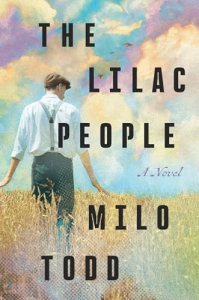 While this is slow to start with, and heavy on research throughout, it does gather pace. The American officer, Ward, is something of a two-dimensional villain who keeps popping back up. Still, the climactic scenes are gripping and the dual timeline works well. Todd explores survivor guilt and gives much valuable context. He is careful to employ language in use at that time (transvestites, transsexuals, “inverts,” “third sex”) and persuasively argues that, in any era, how we treat the vulnerable is the measure of our humanity. (Read via Edelweiss)
[A similar recent release: Under the Pink Triangle by Katie Moore (set in Dachau)]
We might have been at the Eldorado in the early 1930s on the evening when we ventured out to the bar Zosch for a “New Orleans jazz” evening. The music was superb, the German wine tasty, the whole experience unforgettable … but it sure did feel like being in a bygone era. We’re so used to the indoor smoking ban (in force in the UK since 2007) that we didn’t expect to find young people chain-smoking rollies in an enclosed brick basement, and got back to the flat with our clothes reeking and our lungs burning.


It was good to see visible signs of LGTBQ support in Berlin, though they weren’t as prevalent as I perhaps expected.


 For a taste of more recent German history, I’ve started Kairos by Jenny Erpenbeck, which is set in the 1980s not long before the Berlin Wall came down. Unfortunately, my library hold didn’t arrive until too late to take it with me. We made a point of seeing the wall remnants and Checkpoint Charlie on our trip.


Other Berlin highlights: a delicious vegetarian lunch at the canteen of an architecture firm, the Ritter chocolate shop, and the pigeons nesting on the flat balcony – the chicks hatched on our final morning!


And a belated contribution to Short Story September:
Touchy Subjects by Emma Donoghue (2006)
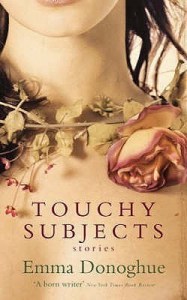 I seem to pluck one or two books at random from Donoghue’s back catalogue per year. I designated this as reliable train reading. The 19 contemporary stories fall into thematic bundles: six about pregnancy or babies, several about domestic life, a few each on “Strangers” and “Desire,” and a final set of four touching on death. The settings range around Europe and North America. It’s impressive how Donoghue imagines herself into so many varied situations, including heterosexual men longing for children in their lives and rival Louisiana crawfishermen setting up as tour-boat operators. The attempts to write Black characters in “Lavender’s Blue” and “The Welcome” are a little cringey, and the latter felt dated with its ‘twist’ of a character being trans. She’s on safer ground writing about a jaded creative writing tutor or football teammates who fall for each other. I liked a meaningful encounter between a tourist and an intellectually disabled man in a French cave (“The Sanctuary of Hands”), an Irishwoman’s search for her missing brother in Los Angeles (“Baggage”) and a contemporary take on the Lazarus myth (“Necessary Noise”), but my two favourites were “The Cost of Things,” about a lesbian couple whose breakup is presaged by their responses to their cat’s astronomical vet bill; and “The Dormition of the Virgin,” in which a studious young traveller to Florence misses what’s right under his nose. There are some gems here, but the topics are so scattershot the collection doesn’t cohere. (Secondhand – Awesomebooks.com)
Trip write-up to be continued (tomorrow, with any luck)…
Book Serendipity, Mid-February to Mid-April
I call it “Book Serendipity” when two or more books that I read at the same time or in quick succession have something in common – the more bizarre, the better. This is a regular feature of mine every couple of months. Because I usually have 20–30 books on the go at once, I suppose I’m more prone to such incidents. People frequently ask how I remember all of these coincidences. The answer is: I jot them down on scraps of paper or input them immediately into a file on my PC desktop; otherwise, they would flit away!
The following are in roughly chronological order.
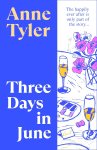
- The protagonist isn’t aware that they’re crying until someone tells them / they look in a mirror in The Remains of the Day by Kazuo Ishiguro and Three Days in June by Anne Tyler.
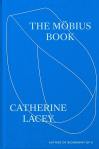
- A residential complex with primal scream therapy in Confessions by Catherine Airey and The Möbius Book by Catherine Lacey.
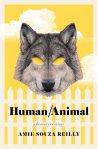
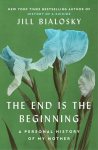
- Memories of wiping down groceries during the early days of the pandemic in The End Is the Beginning by Jill Bialosky and Human/Animal by Amie Souza Reilly.
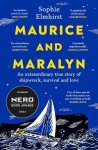
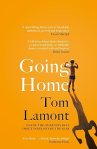
- A few weeks before I read Maurice and Maralyn by Sophie Elmhirst, I’d finished reading the author’s husband’s debut novel (Going Home by Tom Lamont); I had no idea of the connection between them until I got to her Acknowledgements.
- A mention of the same emergency money passing between friends in Alligator Tears by Edgar Gomez ($20) and The Möbius Book by Catherine Lacey ($100).
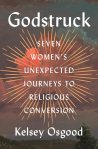
- Autobiographical discussions of religiosity and anorexia in The Möbius Book by Catherine Lacey and Godstruck by Kelsey Osgood.
- The theme of the dark night sky in The Wild Dark by Craig Childs, followed almost immediately by Night Magic by Leigh Ann Henion.
- Last year I learned about Marina Abramović’s performance art where she and her ex trekked to China’s Great Wall from different directions, met in the middle, and continued walking away to dramatize their breakup in The Ritual Effect by Michael Norton. Recently I saw it mentioned again in The Möbius Book by Catherine Lacey. Abramović’s work is also mentioned in Human/Animal by Amie Souza Reilly and is the basis for the opening track on Anne-Marie Sanderson’s album Old Light, “Amethyst Shoes.”
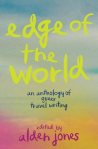
- The idea of running towards danger appears in Alex Marzano-Lesnevich’s essay in Edge of the World, a queer travel anthology edited by Alden Jones; and the bibliography of The Möbius Book by Catherine Lacey.
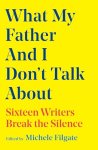
- I then read another Alex Marzano-Lesnevich essay in quick succession (both were excellent, by the way) in What My Father and I Don’t Talk About, edited by Michele Filgate.
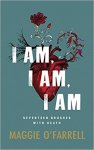
- A scene in which a woman goes to a police station and her concerns are dismissed because she has no evidence and the man/men’s behaviour isn’t ‘bad enough’ in I Am, I Am, I Am by Maggie O’Farrell and Human/Animal by Amie Souza Reilly.
- Too many details as the sign of a lie in Dream Count by Chimamanda Ngozi Adichie and Three Days in June by Anne Tyler.
- Scenes of throwing all of a spouse’s belongings out on the yard/street in Old Soul by Susan Barker, How to Survive Your Mother by Jonathan Maitland, and Human/Animal by Amie Souza Reilly.
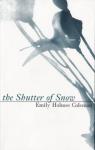
- Reading two lost American classics about motherhood and time spent in a mental institution at the same time: The Shutter of Snow by Emily Holmes Coleman and I Am Clarence by Elaine Kraf.
- Disorientation underwater: a literal experience in I Am, I Am, I Am by Maggie O’Farrell, then used as a metaphor for what it was like to be stuck in a blizzard on Annapurna in 2014 in The Secret Life of Snow by Giles Whittell.
- A teenager who has a job cleaning hotels in Old Soul by Susan Barker and I Am, I Am, I Am by Maggie O’Farrell. (In Stir-Fry by Emma Donoghue, Maria is also a teenaged cleaner, but of office buildings.)
- A vacuum cleaner bag splits in Stir-Fry by Emma Donoghue and one story of Are You Happy? by Lori Ostlund – in the latter it’s deliberate, searching for evidence of the character’s late son after cleaning his room.

- An ailing tree or trees that have to be cut down in one story of The Accidentals by Guadalupe Nettel and The Lost Trees of Willow Avenue by Mike Tidwell.
- Buchenwald was mentioned in one poem each in A God at the Door by Tishani Doshi and The Ghost Orchid by Michael Longley.
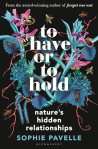
- A reference to Robin Wall Kimmerer’s Braiding Sweetgrass in To Have or to Hold by Sophie Pavelle and Human/Animal by Amie Souza Reilly.

- A mentally unwell woman deliberately burns her hands in I Am Clarence by Elaine Kraf and Every Day Is Mother’s Day by Hilary Mantel.
- A mention of the pollution caused by gas stoves in We Do Not Part by Han Kang and The Lost Trees of Willow Avenue by Mike Tidwell.
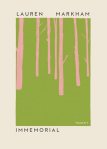
- An art installation involving part-buried trees was mentioned in Immemorial by Lauren Markham and then I encountered a similar project a few months later in We Do Not Part by Han Kang. Burying trees as a method of carbon storage is then discussed in The Lost Trees of Willow Avenue by Mike Tidwell.
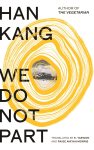

- Imagining the lives of the people living in an apartment you didn’t end up renting in Scaffolding by Lauren Elkin and one story of The Accidentals by Guadalupe Nettel.
- The Anthropocene is mentioned in Scaffolding by Lauren Elkin and The Alternatives by Caoilinn Hughes.
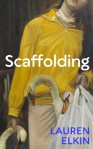
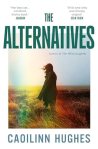
- I was reading three debut novels from the McKitterick Prize longlist at the same time, all of them with very similar page counts of 383, 387, and 389 (i.e., too long!).
- Being appalled at an institutionalized mother’s appearance in The End Is the Beginning by Jill Bialosky and Every Day Is Mother’s Day by Hilary Mantel.
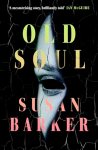 A remote artist’s studio and severed fingers in Old Soul by Susan Barker and We Do Not Part by Han Kang.
- A lesbian couple in New Mexico, the experience of being watched through a window, and the mention of a caftan/kaftan, in Old Soul by Susan Barker and one story of Are You Happy? by Lori Ostlund.
- Refusal to go to a hospital despite being in critical condition in I Am, I Am, I Am by Maggie O’Farrell and one story of Are You Happy? by Lori Ostlund.
- It’s not a niche stylistic decision anymore; I was reading four novels with no speech marks at the same time: Old Soul by Susan Barker, Scaffolding by Lauren Elkin, The Alternatives by Caoilinn Hughes, and We Do Not Part by Han Kang. [And then, a bit later, three more: Wild Boar by Hannah Lutz, Mouthing by Orla Mackey, and How to Be Somebody Else by Miranda Pountney.]
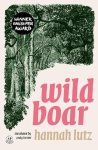
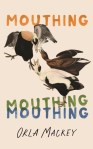
- A lesbian couple is alarmed by the one partner’s family keeping guns in Spent by Alison Bechdel and one story of Are You Happy? by Lori Ostlund.
- Responding to the 2021 murder of eight Asian spa workers in Atlanta in Foreign Fruit by Katie Goh and Find Me as the Creature I Am by Emily Jungmin Yoon.
- Disposing of a late father’s soiled mattress in Mouthing by Orla Mackey and one story of Are You Happy? by Lori Ostlund.
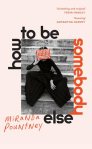 New York City tourist slogans in Apple of My Eye by Helene Hanff and How to Be Somebody Else by Miranda Pountney.
- A Jewish care home for the elderly in The End Is the Beginning by Jill Bialosky and Joanna Rakoff’s essay in What My Father and I Don’t Talk About (ed. Michele Filgate).
- A woman has no memory between leaving a bar and first hooking up with the man she’s having an affair with in If You Love It, Let It Kill You by Hannah Pittard and How to Be Somebody Else by Miranda Pountney.
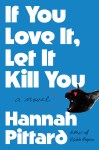 A stalker-ish writing student who submits an essay to his professor that seems inappropriately personal about her in one story of Are You Happy? by Lori Ostlund and If You Love It, Let It Kill You by Hannah Pittard.
- A pygmy goat as a pet (and a one-syllable, five-letter S title!) in Spent by Alison Bechdel and Sleep by Honor Jones.
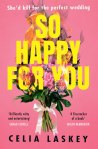
- A Brooklyn setting and thirtysomething female protagonist in Sleep by Honor Jones, So Happy for You by Celia Laskey, and How to Be Somebody Else by Miranda Pountney.
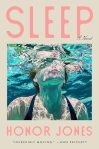
- A mention of the American Girl historical dolls franchise in Sleep by Honor Jones and If You Love It, Let It Kill You by Hannah Pittard, both of which I’m reviewing early for Shelf Awareness.
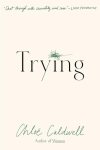 A writing professor knows she’s a hypocrite for telling her students what (not) to do and then (not) doing it herself in Trying by Chloé Caldwell and If You Love It, Let It Kill You by Hannah Pittard. These two books also involve a partner named B (or Bruce), metafiction, porch drinks with parents, and the observation that a random statement sounds like a book title.
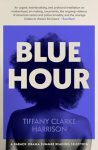
- The protagonist’s therapist asks her to find more precise words for her feelings in Blue Hour by Tiffany Clarke Harrison and So Happy for You by Celia Laskey.
- The protagonist “talks” with a dying dog or cat in The Möbius Book by Catherine Lacey and If You Love It, Let It Kill You by Hannah Pittard.
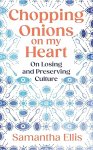 Shalimar perfume is mentioned in Scaffolding by Lauren Elkin and Chopping Onions on My Heart by Samantha Ellis.
- The Rapunzel fairytale is a point of reference in In the Evening, We’ll Dance by Anne-Marie Erickson and Secret Agent Man by Margot Singer, both of which I was reading early for Foreword Reviews.
What’s the weirdest reading coincidence you’ve had lately?
Reading Ireland Month, Part II: Barrett, More Donoghue, O’Farrell x 2
My second set of contributions to Cathy’s Reading Ireland Month. Emma Donoghue also appeared in my first instalment of reviews. Today I’m featuring her latest novel, published just a couple of weeks ago, and taking a quick look at a few other Irish books I’ve read recently: a light-hearted debut featuring small-town criminals, and two by Maggie O’Farrell: a reread of her only nonfiction work to date (for book club), and her newest children’s book.
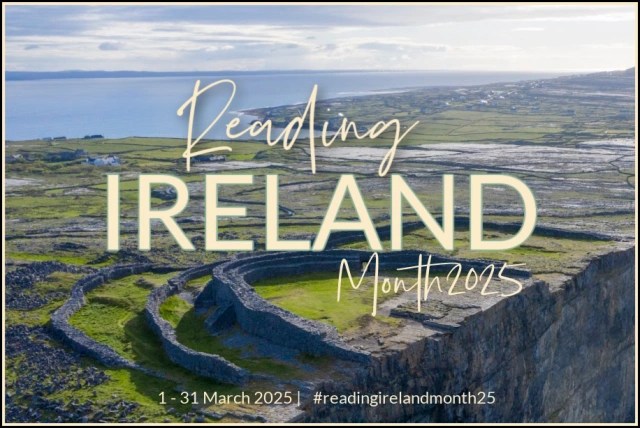
Wild Houses by Colin Barrett (2024)
 When Doll English is kidnapped by the Ferdia brothers in revenge for a huge loss on a drug deal, his girlfriend, mother and brother must go to unexpected lengths to set him free. There’s plenty of cursing and violence in this small-town crime caper, yet Barrett has a light touch; the dialogue, especially, is funny. The dialect is easy enough to decipher. Nicky, Doll’s girlfriend, lost both parents young and works in a hotel bar. She’s a strong character reminiscent of the protagonist in Trespasses. Overall, I felt that this was nicely written but that Barrett’s talent was somewhat wasted on a thin story. I’ve encountered similar plots in better books by Paul Murray and Donal Ryan. (Free from the publisher)
The Paris Express by Emma Donoghue
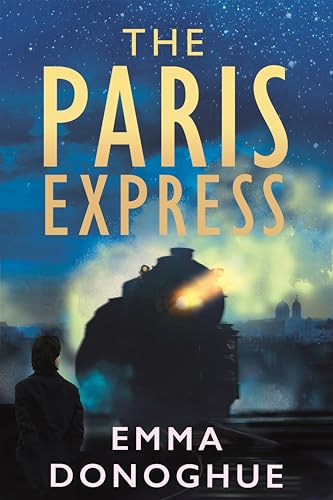 Inspired by a real-life disaster involving a train on the approach to Paris’s Montparnasse station in 1895. The Author’s Note at the end reveals the blend of characters included: people known to have been on that particular train, whether as crew or passengers; those who might have journeyed on it because they spent time in Paris at around that period (such as Irish playwright John Millington Synge); and those made up from scratch. It’s a who’s-who of historical figures, many of whom represent different movements or social issues, such as a woman medical student and an African American painter who can pass as white in certain circumstances. Donoghue clearly intends to encompass the entire social hierarchy, from a maid to a politician with a private carriage. She also crafts a couple of queer encounters.
The premise is appealing: a train hurtling toward catastrophe is in a sense a locked room, seeding much drama and intrigue. A young female radical is on board with a bomb, so all along you speculate about whether she’ll set it off and when. While I found the general thrust engaging, it was harder to develop interest in the large cast of characters. I also found the passages personifying the train (she “carries death in her belly”) hokey and thought that, as has sometimes been the case with Donoghue’s historical work, there’s too much research that’s there just for the sake of it, because she came across a fact she found fascinating and couldn’t bear to leave out (“These days every public building has three rubbish bins—one for the reclaiming of paper and cloth, the next for glass, ceramics, and oyster shells, and the last for perishables, which is where she drops the handkerchief.”). So this was enjoyable enough but not among her best.
With thanks to Picador for the proof copy for review.
I Am, I Am, I Am: Seventeen Brushes with Death by Maggie O’Farrell (2017)
 This was a reread for book club, and oh how brilliant it is. I’m more convinced than ever that the memoir-in-essays is a highly effective form because it focuses on themes or moments of great intensity and doesn’t worry about accounting for all the boring intermediate material. A few of these pieces feel throwaway, but together they form a vibrant picture of a life and also inspire awe at what the human body can withstand. No doubt on Wednesday we will each pick out different essays that resonated the most with us, perhaps because they run very close to our own experience. I imagine our discussion will start there – and with sharing our own NDEs. Stylistically, the book has a lot in common with O’Farrell’s fiction, which often employs the present tense and a complicated chronology. The present tense and a smattering of second person make the work immediate and invite readers to feel their way into her situations. Otherwise, my thoughts are as before – the last two essays are the pinnacle.
My original review from 2018:
We are, all of us, wandering about in a state of oblivion, borrowing our time, seizing our days, escaping our fates, slipping through loopholes, unaware of when the axe may fall.
O’Farrell captures fragments of her life through 17 essays on life-threatening illnesses and other narrow escapes she’s experienced. The pieces aren’t in chronological order and aren’t intended to be comprehensive. Instead, they crystallize the fear and pain of particular moments in time, and are rendered with the detail you’d expect from a scene in one of her novels. (Indeed, you can spot a lot of the real-life influences on her fiction, particularly This Must Be the Place – travels in China and Chile; eczema and stammering.)
She’s been mugged at machete point, has nearly drowned several times, had a risky first labour, and was almost the victim of a serial killer. (My life feels awfully uneventful by comparison!) But the best section of the book is its final quarter: an essay about her childhood encephalitis and its lasting effects, followed by another about her daughter’s extreme allergies. Only now, as a mother, can she understand how terrifying it must have been for her parents to wait at her side during days when she might not have survived. O’Farrell depicts parenthood better than any other author I can think of – letting those of us who haven’t experienced it do so vicariously. (Gift from my wish list)
My original rating (2018): 
My rating now: 
When the Stammer Came to Stay by Maggie O’Farrell (2024)
 This is actually her third children’s book, after Where Snow Angels Go (2020) and The Boy Who Lost His Spark (2022). All are illustrated by Daniela Jaglenka Terrazzini, who has a richly colourful and slightly old-fashioned style; she makes kids look as dignified as adults. The books are intended for slightly older children in that they’re on the longer side, have more words than pictures, and are more serious than average. They all weave in gentle magic as a way of understanding and coping with illness, a mental health challenge, or a disability.
When the Stammer Came to Stay is a perfect follow-on to I Am, I Am, I Am because it, too, draws on O’Farrell’s personal struggles. It’s the fable-like story of two sisters, Bea and Min, who share an attic room. The one is perfectly tidy; the other is a messy tomboy. When the stammer, pictured as a blob of silver ectoplasm above the shoulder, starts stealing Min’s words, they gather advice from their parents and the lodgers about how she can accept her new reality instead of fighting it or closing herself off by not speaking at all. The mycologist’s symbiosis metaphor is perhaps a bit too neat, but it contrasts with the impish connotations of the dibbuk, another useful parallel the girls discover. With this I’ve now read O’Farrell’s complete published works!
Reading Ireland Month, I: Donoghue, Longley, Tóibín
St. Patrick’s Day is a good occasion to compile my first set of contributions to Cathy’s Reading Ireland Month. Today I have an early novel by a favourite author, a poetry collection inspired by nature and mythology, and a sequel that I read for book club.
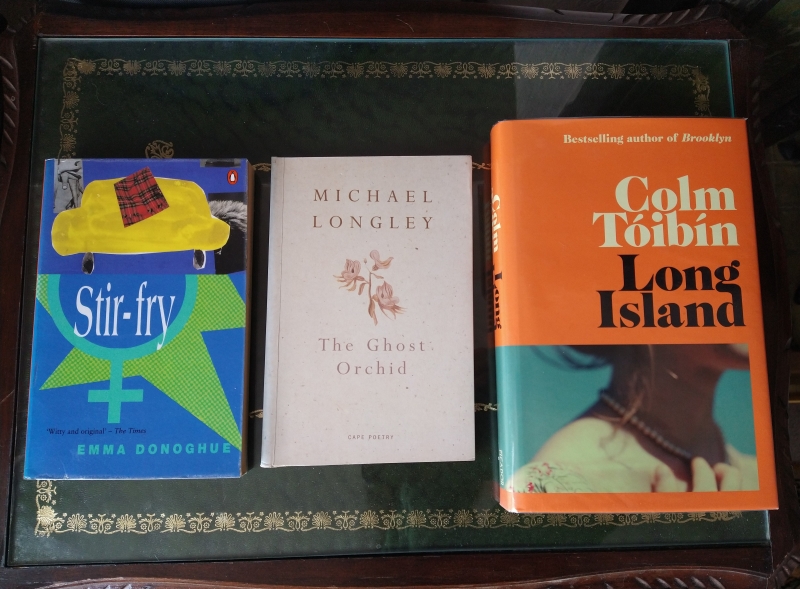
Stir-Fry by Emma Donoghue (1994)
After enjoying Slammerkin so much last year, I decided to catch up on more of Donoghue’s way-back catalogue. She tends to alternate between contemporary and historical settings. I have a slight preference for the former, but she can excel at both; it really depends on the book. I reckon this was edgy for its time. Maria (whose name rhymes with “pariah”) arrives in Dublin for university at age 17, green in every way after a religious upbringing in the countryside. In response to a flat-share advert stipulating “NO BIGOTS,” she ends up living with Ruth and Jael (pronounced “Yale”), two mature students. Ruth is the mother hen, doing all the cooking and fretting over the others’ wellbeing; Jael is a wild, henna-haired 30-year-old prone to drinking whisky by the mug-full. Maria attends lectures, takes a job cleaning office buildings, and finds a friend circle through her backstage student theatre volunteering. She’s mildly interested in American exchange student Galway and then leather-clad Damien (until she realizes he has a boyfriend), but nothing ever goes further than a kiss.
 It’s obvious to readers that Ruth and Jael are a couple, but Maria doesn’t work it out until a third of the way into the book. At first she’s mortified, but soon the realization is just one more aspect of her coming of age. Maria’s friend Yvonne can’t understand why she doesn’t leave – “how can you put up with being a gooseberry?” – but Maria insists, “They really don’t make me feel left out … I think they need me to absorb some of the static. They say they’d be fighting like cats if I wasn’t around to distract them.” Scenes alternate between the flat and the campus, which Donoghue depicts as a place where radicalism and repression jostle for position. Ruth drags Maria to a Tuesday evening Women’s Group meeting that ends abruptly: “A porter put his greying head in the door to comment that they’d have to be out in five minutes, girls, this room was booked for the archaeologists’ cheese ’n’ wine.” Later, Ruth’s is the Against voice in a debate on “That homosexuality is a blot on Irish society.”
Mostly, this short novel is a dance between the three central characters. The Irish-accented banter between them is a joy. Jael’s devil-may-care attitude contrasts with Ruth and Maria’s anxiety about how they are perceived by others. Ruth and Jael are figures in the Hebrew Bible and their devotion/boldness dichotomy is applicable to the characters here, too. The stereotypical markers of lesbian identity haven’t really changed, but had Donoghue written this now I think she would at least have made Maria a year older and avoided negativity about Damien and Jael’s bisexuality. At heart this is a sweet romance and an engaging picture of early 1990s feminism, but it doesn’t completely steer clear of predictability and I would have happily taken another 50–70 pages if it meant she could have fleshed out the characters and their interactions a little more. [Guess what was for my lunch this afternoon? Stir fry!] (Secondhand – Awesomebooks.com)
The Ghost Orchid by Michael Longley (1995)
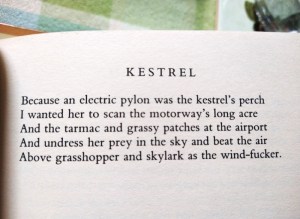
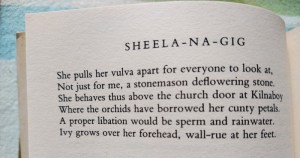
 Longley’s sixth collection draws much of its imagery from nature and Greek and Roman classics. Seven poems incorporate quotations and free translations of the Iliad and Odyssey; elsewhere, he retells the story of Baucis and Philemon and other characters from Ovid. The Orient and the erotic are also major influences; references to Hokusai bookend poems about Chinese artefacts. Poppies link vignettes of the First and Second World Wars. Longley’s poetry is earthy in its emphasis on material objects and sex. Alliteration and slant rhymes are common techniques and the vocabulary is always precise. This was the third collection I’ve read by the late Belfast poet, and with its disparate topics it didn’t all cohere for me. My two favourite poems are naughty indeed:
(Secondhand – Green Ink Booksellers, Hay-on-Wye)
Long Island by Colm Tóibín (2024)
{SPOILERS in this one}
 I read Brooklyn when it first came out and didn’t revisit it (via book or film) before reading this. While recent knowledge of the first book isn’t necessary, it probably would make you better able to relate to Eilis, who is something of an emotional blank here. She’s been married for 20 years to Tony, a plumber, and is a mother to two teenagers. His tight-knit Italian American family might be considered nurturing, but for her it is more imprisoning: their four houses form an enclave and she’s secretly relieved when her mother-in-law tells her she needn’t feel obliged to join in the Sunday lunch tradition anymore.
When news comes that Tony has impregnated a married woman and the cuckolded husband plans to leave the baby on the Fiorellos’ doorstep when the time arrives, Eilis checks out of the marriage. She uses her mother’s upcoming 80th birthday as an excuse to go back to Ireland for the summer. Here Eilis gets caught up in a love triangle with publican Jim Farrell, who was infatuated with her 20 years ago and still hasn’t forgotten her, and Nancy Sheridan, a widow who runs a fish and chip shop and has been Jim’s secret lover for a couple of years. Nancy has a vision of her future and won’t let Eilis stand in her way.
I felt for all three in their predicaments but most admired Nancy’s pluck. Ironically given the title, the novel spends more of its time in Ireland and only really comes alive there. There’s also a reference to Nora Webster – cute that Tóibín is trying out the Elizabeth Strout trick of bringing multiple characters together in the same fictional community. But, all told, this was just a so-so book. I’ve read 10 or so works by Tóibín now, in all sorts of genres, and with its plain writing this didn’t stand out at all. It got an average score from my book club, with one person loving it, a couple hating it, and most fairly indifferent. (Public library)
Another batch will be coming up before the end of the month!
#SciFiMonth: A Simple Intervention (#NovNov24 and #GermanLitMonth) & Station Eleven Reread
It’s rare for me to pick up a work of science fiction but occasionally I’ll find a book that hits the sweet spot between literary fiction and sci-fi. Parable of the Sower by Octavia Butler, The Book of Strange New Things by Michel Faber and The Sparrow by Mary Doria Russell are a few prime examples. It was the comparisons to Margaret Atwood and Kazuo Ishiguro, masters of the speculative, that drew me to my first selection, a Peirene Press novella. My second was a reread, 10 years on, for book club, whose postapocalyptic content felt strangely appropriate for a week that delivered cataclysmic election results.

A Simple Intervention by Yael Inokai (2022; 2024)
[Translated from the German by Marielle Sutherland]
Meret is a nurse on a surgical ward, content in the knowledge that she’s making a difference. Her hospital offers a pioneering procedure that cures people of mental illnesses. It’s painless and takes just an hour.
The doctor had to find the affected area and put it to sleep, like a sick animal. That was his job. Mine was to keep the patients occupied. I was to distract them from what was happening and keep them interacting with me. As long as they stayed awake, we knew the doctor and his instruments had found the right place.
 The story revolves around Meret’s emotional involvement in the case of Marianne, a feisty young woman who has uneasy relationships with her father and brothers. The two play cards and share family anecdotes. Until the last few chapters, the slow-moving plot builds mostly through flashbacks, including to Meret’s affair with her fellow nurse, Sarah. This roommates-to-lovers thread reminded me of Learned by Heart by Emma Donoghue. When Marianne’s intervention goes wrong, Meret and Sarah doubt their vocation and plan an act of heroism.
Inokai invites us to ponder whether what we perceive as defects are actually valuable personality traits. More examples of interventions and their aftermath would be a useful point of comparison, though, and the pace is uneven, with a lot of unnecessary-seeming backstory about Meret’s family life. In the letter that accompanied my review copy, Inokai explained her three aims: to portray a nurse (her mother’s career) because they’re underrepresented in fiction, “to explore our yearning to cut out our ‘demons’,” and to offer “a queer love story that was hopeful.” She certainly succeeds with those first and third goals, but with the central subject I felt she faltered through vagueness.
Born in Switzerland, Inokai now lives in Berlin. This also counts as my first contribution to German Literature Month; another is on the way!
[187 pages]
With thanks to Peirene Press for the free copy for review.


Station Eleven by Emily St. John Mandel (2014)
For synopsis and analysis I can’t do better than when I reviewed this for BookBrowse a few months after its release, so I’d direct you to the full text here. (It’s slightly depressing for me to go back to old reviews and see that I haven’t improved; if anything, I’ve gotten lazier.) A couple book club members weren’t as keen, I think because they’d read a lot of dystopian fiction or seen many postapocalyptic films and found this vision mild and with a somewhat implausible setup and tidy conclusion. But for me this and Cormac McCarthy’s The Road have persisted as THE literary depictions of post-apocalypse life because they perfectly blend the literary and the speculative in an accessible and believable way (this was a National Book Award finalist and won the Arthur C. Clarke Award), contrasting a harrowing future with nostalgia for an everyday life that we can already see retreating into the past.
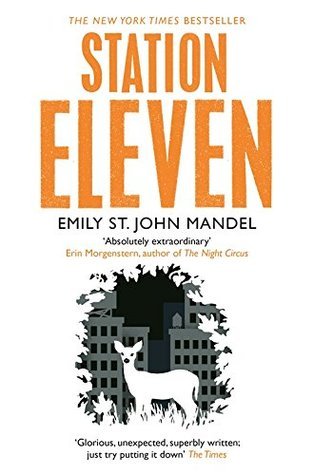 Station Eleven has become a real benchmark for me, against which I measure any other dystopian novel. On this reread, I was captivated by the different layers of the nonlinear story, from celebrity gossip to a rare graphic novel series, and enjoyed rediscovering the links between characters and storylines. I remembered a few vivid scenes and settings. Mandel also seeds subtle connections to later work, particularly The Glass Hotel (island off Vancouver, international shipping and finance) but also Sea of Tranquility (music, an airport terminal). I haven’t read her first three novels, but wouldn’t be surprised if they have additional links.
The two themes that most struck me this time were the enduring power of art and how societal breakdown would instantly eliminate the international – but compensate for it with the return of the extremely local. At a time when it feels difficult to trust central governments to have people’s best interests at heart, this is a rather comforting prospect. Just in my neighbourhood, I see how we implement this care on a small scale. In settlements of up to a few hundred, the remnants of Station Eleven create something like normal life by Year 20.
Book club members sniped that the characters could have better pooled skills, but we agreed that Mandel was wise to limit what could have been tedious details about survival. “Survival is insufficient,” as the Traveling Symphony’s motto goes (borrowed from Star Trek). Instead, she focuses on love, memory, and hunger for the arts. In some ways, this feels prescient of Covid-19, but even more so of the climate-related collapse I expect in my lifetime. I’ve rated this a little bit higher the second time for its lasting relevance. (Free from a neighbour)
Some favourite passages:
the whole of Chapter 6, a bittersweet litany that opens “An incomplete list: No more diving into pools of chlorinated water lit green from below” and includes “No more pharmaceuticals,” “No more flight,” and “No more countries”
“what made it bearable were the friendships, of course, the camaraderie and the music and the Shakespeare, the moments of transcendent beauty and joy”
“The beauty of this world where almost everyone was gone. If hell is other people, what is a world with almost no people in it?”

Short Stories in September Roundup: Alexie, Donoghue, Groff Anthology, Houston, McCracken, Moore, Svoboda, Walker
I gave myself an extra week to finish up the story collections I was in the middle of, so I’ve managed to read 13 during this challenge to self (including my first and second posts). Again I’m borrowing Marcie’s five-sentence review format to keep things simple.
The Lone-Ranger and Tonto Fistfight in Heaven by Sherman Alexie (1993)
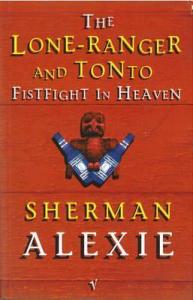 There are 22 stories in this fairly short book, so most top out at no more than 10 pages: little slices of life on and around the reservation at Spokane, Washington. Some central characters recur, such as Victor, Thomas Builds-the-Fire and James Many Horses, but there are so many tales that I couldn’t keep track of them across the book even though I read it quickly. My favourite was “This Is What It Means to Say Phoenix, Arizona,” in which Victor and Thomas fly out to collect the ashes of Victor’s father. Some of the longer titles give a sense of the tone: “Because My Father Always Said He Was the Only Indian Who Saw Jimi Hendrix Play ‘The Star-Spangled Banner’ at Woodstock” and “Jesus Christ’s Half-Brother Is Alive and Well on the Spokane Indian Reservation.” I couldn’t help but think of it as a so-so rehearsal for The Absolutely True Diary of a Part-Time Indian because a similar cast of drunks, jokers, relatives and basketball players populates the stories and a comparable voice prevails. (University library)
The Woman Who Gave Birth to Rabbits by Emma Donoghue (2002)
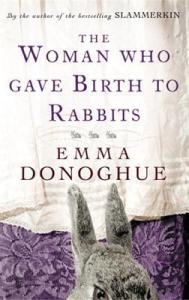 The title story is about Mary Toft – I thought of making her hoax the subject of a Three on a Theme post because I actually have two novels about her downloaded from NetGalley and Edelweiss (Mary and the Rabbit Dream by Noémi Kiss-Deáki and Mary Toft; or, The Rabbit Queen by Dexter Palmer), but the facts as conveyed here don’t seem like nearly enough to fuel a whole book, so I doubt I’ll read those. Donoghue has a good eye for historical curios and incidents and an academic’s gift for research, yet not many of these 17 stories, most of which are in the third person, rise above the novelty. Many protagonists are British or Irish women who were a footnote in the historical record: an animal rights activist, a lord’s daughter, a cult leader, a blind poet, a medieval rioter, a suspected witch. There are mild homoerotic touches, too. I enjoyed “Come, Gentle Night,” about John Ruskin’s honeymoon, and “Cured,” which reveals a terrifying surgical means of controlling women’s moods but, as I found with Astray and Learned by Heart, Donoghue sometimes lets documented details overwhelm other elements of a narrative. (Secondhand – Awesomebooks.com)
The Best Short Stories 2023: The O. Henry Prize Winners, ed. Lauren Groff (2023)
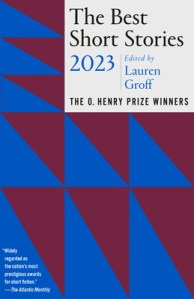 Hard to convey the variety of this 20-story anthology in a concise way because they run the gamut from realist (Nigerian homosexuality in “Happy Is a Doing Word” by Arinze Ifeakandu; Irish gangsters in “The Blackhills” by Eamon McGuinness) to absurd (Ling Ma’s “Office Hours” has academics passing through closet doors into a dream space; the title of Catherine Lacey’s “Man Mountain” is literal; “Ira and the Whale” is Rachel B. Glaser’s gay version of the Jonah legend). Also difficult to encapsulate my reaction, because for every story I would happily have seen expanded into a novel (the gloomy character study “The Locksmith” by Grey Wolfe LaJoie, the teenage friends’ coming-of-age in “After Hours at the Acacia Park Pool” by the marvellous Kirstin Valdez Quade), there was another I thought might never end (“Dream Man” by Cristina Rivera-Garza and “Temporary Housing” by Kathleen Alcott). Three are in translation. I admired Lisa Taddeo’s tale of grief and revenge, “Wisconsin,” and Naomi Shuyama-Gómez’s creepy Colombian-set “The Commander’s Teeth.” But my two favourites were probably “Me, Rory, and Aurora” by Jonas Eika (Danish), which combines an uneasy threesome, the plight of the unhoused and a downright chilling Ishiguro-esque ending; and “Xífù,” K-Ming Chang’s funny, morbid take on daughter/mother-in-law relations in China. (PDF review copy)
Waltzing the Cat by Pam Houston (1998)
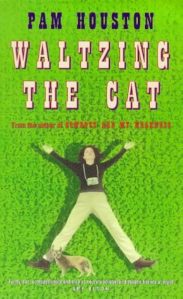 The novel-in-stories is about Lucy, a photographer in her early thirties with a penchant for falling for the wrong men – alcoholics or misogynists or ones who aren’t available. When she’s not working she’s thrill-seeking: rafting in Colorado, travelling in the Amazon, sailing in the Caribbean, or gliding. “Everything good I’ve gotten in life I’ve gotten by plunging in,” she boasts, to which a friend replies, “Sure, and everything bad you’ve gotten in your life you’ve gotten by plunging in.” Ultimately she ‘settles down’ on the Colorado ranch she inherits from her grandmother with a dog, making this – based on what I learned from the autobiographical essays in Deep Creek – even more autofiction for Houston than her debut, Cowboys Are My Weakness, was. Although the final magic realist touch of having her child-self come to her with a box of photographs of traumatic memories is overdone, the themes of accepting vulnerability, seeking to freeze time and creating a home for yourself resonated, and the title story, about the death of Lucy’s mother, is a brilliant and heart-wrenching standalone. (Secondhand – British Red Cross, Berwick)
The Souvenir Museum by Elizabeth McCracken (2021)
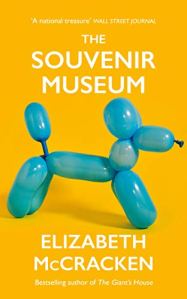 McCracken is terrific in short forms: The Hero of This Book, a novella, was one of my top books of 2022, and I also loved her previous story collection, Thunderstruck. Five of these dozen stories are taken from different points in the lives of Jack and Sadie, English and American academics (who I inevitably read as McCracken and her husband, Edward Carey) who come from large-family zaniness versus claustrophobic mother–daughter melancholy. I kept thinking that McCracken’s are just the sorts of scenarios Lucy and Olive would have told stories about in Tell Me Everything: accidents, misfortunes; random connections. Travel is a major element in many of the stories, including to Denmark (in the title story) and Amsterdam. I couldn’t decide whether I preferred the Jack-and-Sadie material or the rest, but I had a favourite from each: “The Irish Wedding” cracked me up as much as it did Sadie with the accidental use of crass American slang, while “Proof,” about a man communing with his father despite his early dementia, is set on a boat trip I’ve made (in 2004!) to see puffins on the Treshnish islands of Scotland. (Secondhand – Dogs Trust charity shop, Marlborough)
Like Life by Lorrie Moore (1990)
 Compared to Birds of America, this feels a little dated and the plots are overall less memorable. Still, the eight stories of Moore’s second collection are chewy with insight into relationships and the mindsets of youngish and middle-aged women, and there’s an effortless wry wit to her turns of phrase. Her exasperated would-be feminist characters remind me of Helen Simpson’s, while the cheese-selling protagonist of “Joy” made me think of an early Carol Shields story; and who knew a “cute meet” (aka a meet-cute) was a thing back then? New York City contrasts with the Midwest, most notably in “You’re Ugly, Too” and “The Jewish Hunter.” The title story, which comes last, crafts a weirdly muted dystopia built around shortages and marital misery; I preferred the (comparative lightness) of “Vissi d’Arte,” about a lonely playwright, and “Places to Look for Your Mind,” in which an empty-nest entrepreneur hosts an aimless young Englishman her daughter met on her study abroad year. (Secondhand – Bark charity shop, Berwick)
The Long Swim by Terese Svoboda (2023)
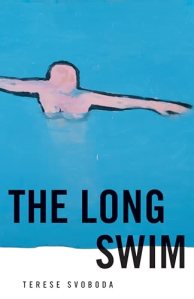 These 44 stories, mostly of flash fiction length, combine the grit of Denis Johnson with the bite of Flannery O’Connor. Siblings squabble over a late parent’s effects or wishes, marriages go wrong, the movie business isn’t as glittering as it’s cracked up to be, and drugs and alcohol complicate everything. The settings range through North America and the Caribbean, with a couple of forays to Europe. There are no speech marks and, whether the narrative is in first person or third, all the voices are genuine and distinctive yet flow together admirably. Svoboda has a poet-like talent for compact, zingy lines; two favourites were “my laziness is born of generalized-looking-to-get-specific grief, like an atom trying to make salt” (“Niagara”) and “Ditziness, a kind of Morse code of shriek-and-stop, erupts around the girls” (“Orphan Shop”).
Winner of the Juniper Prize for Fiction. Published by University of Massachusetts Press. With thanks to the author for the free PDF copy for review.
In Love and Trouble by Alice Walker (1973)
 I’d only ever read The Color Purple, so when I spotted this in a bookshop on our Northumberland holiday it felt like a good excuse to try something else by Walker. I had actually encountered one of the stronger stories before: “Everyday Use” is in the Close Company Virago anthology. In these Southern scenes (“a hate-filled state complete with magnolias, tornadoes and broken-tongued field hands”), Black women oppressed by fathers and partners gain what few advantages they can through deception or folk medicine. I liked “Entertaining God,” which opens with a boy abducting a gorilla from a zoo, and “To Hell with Dying,” about a friendship with an elderly neighbour in cotton country. Setting, style, characters; nothing drew me to any of the others or made me think I’ll read Walker again in the future. (Secondhand – Berrydin Books, Berwick)
Which of these would you read?
Currently reading: I’m not good at picking up short stories in the rest of the year, but I’ve discovered that I really enjoy reviewing them for Shelf Awareness – the length and format of their reviews really suits essay and story collections. So I’m now partway through Save Me, Stranger by Erika Krouse (2025) for an early Shelf Awareness review. Another book I started in Northumberland, Dreams of Dead Women’s Handbags by Shena Mackay, I didn’t finish in time for this challenge but will either continue or set aside and pick back up next year. Both are fantastic!
20 Books of Summer, 7–9: Furies, The Earthquake Bird, and Greta & Valdin
It might seem that I’m very behind on 20 Books of Summer, and I am, but that’s mostly because I’ve done my usual trick of starting loads of books at once so that I’m currently in the middle of another nine with no prospect of finishing any particularly soon. I will eventually review more, but probably all in a rush and on the later side. It doesn’t help that quite a few happen to be lacklustre reads, such that I have to push myself through them instead of enjoying spending time with the stack. For today, though, I have a pretty readable trio made up of feminist short stories, a mild Japan-set mystery, and a highly random queer dysfunctional family novel that rose from indie obscurity in New Zealand. (Also a DNF.)
Furies: Stories of the Wicked, Wild and Untamed (2023)
It was my second attempt at this Virago anthology; I borrowed it from the library last year but never opened it, as far as I can remember. Each story is named after a synonym for “virago,” so the focus is on strong and unconventional women, but given that brief there is huge variety, including memoir (Ali Smith’s “Spitfire,” about her late mother’s WAAF service), historical research (CN Lester on sexology and early trans figures, Emma Donoghue on early-twentieth-century activist and lesbian Kathlyn Oliver, Stella Duffy on menopause) and even one graphic short, the mother–daughter horror story “She-Devil” by comics artist Eleanor Crewes.
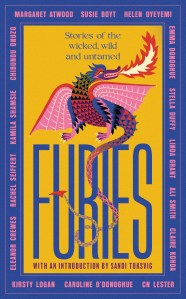 As with any anthology, some pieces stand out more than others. Caroline O’Donoghue, Helen Oyeyemi and Kamila Shamsie’s contributions were unlikely to convert me into a fan. Margaret Atwood is ever sly and accessible, with “Siren” opening with the line “Today’s Liminal Beings Knitting Circle will now be called to order.” I was surprised to get on really well with Kirsty Logan’s “Wench,” about girls ostracized by their religious community because of their desire for each other – I’ll have to read Now She Is Witch, as it’s set in the same fictional world – and Chibundu Onuzo’s “Warrior,” about Deborah, an Israelite leader in the book of Judges. And while I doubt I need to read a whole novel by Rachel Seiffert, I did enjoy “Fury,” about a group of Polish women who fended off Nazi invaders.
A few of my favourites were “Harridan” by Linda Grant, about an older woman who frightens the young couple who share her flat’s garden during lockdown (“this old lady, this hag she sees, this bitter travesty of her celestial youth and beauty is not her. Inside she’s a flame, she’s a pistol”); “Muckraker” by Susie Boyt, in which a woman makes conquests of breast cancer widowers; and “Tygress” by Claire Kohda, where the stereotype of the Asian ‘tiger mother’ turns literal. Duffy’s “Dragon” closes the collection with a very interesting blend of autofiction, interviews and medical reportage about different experiences of objectification in youth and invisibility in ageing. It brings the whole together nicely: “Tell me your tale and, in the telling, feel it all drop away. You are, and you are not, your story. Keep what serves you now, make space for new maybes.” (Free from a neighbour)
The Earthquake Bird: A Novel of Mystery by Susanna Jones (2001)
 Susanna Jones’s When Nights Are Cold is one of my favourite novels that no one else has ever heard of, so I jumped at the chance to buy a bargain copy of her debut back in 2020. Lucy Fly has lived in Tokyo for ten years, working as a translator of machinery manuals. She wanted to get as far away as possible from her conventional family of six brothers, so she’s less than thrilled to meet fellow Yorkshire lass Lily Bridges, a nurse new to the country and looking for someone to help her find an apartment and learn some basic Japanese. Lucy is a prickly loner with only a few friends – and a lover, photographer Teiji – but she reluctantly agrees to be Lily’s guide.
We know from the start that Lucy is in custody being questioned about events leading up to Lily’s murder. She refuses to tell the police anything, but what we are reading is her confession, in which she does eventually tell all. We learn that there have already been three accidental deaths among her family and acquaintances – she seems cursed to attract them – and that her feelings about Lily changed over the months she showed the woman around. This short and reasonably compelling book gives glimpses of mountain scenery, noodle bars, and spartan apartments. Perhaps inevitably, it reminded me a bit of Murakami. It’s hard to resist an unreliable narrator. However, I felt Jones’s habit of having Lucy speak of herself in the third person was overdone. (Secondhand – Broad Street Book Centre, Hay-on-Wye)
Greta & Valdin by Rebecca K Reilly (2021; 2024)
 The title characters are a brother and sister in their late twenties who share a flat and a tendency to sabotage romantic relationships. Both are matter-of-factly queer and biracial (Māori/Russian). The novel flips back and forth between their present-tense first-person narration with each short chapter. It takes quite a while to pick up on who is who in the extended Vladisavljevic clan and their New Zealand university milieu (their father is a science professor and Greta an English department PhD and tutor), so I was glad of the character list at the start.
I was expecting a breezy, snarky read and to an extent that’s what I got. Not a whole lot happens; situations advance infinitesimally through quirky dialogue thick with pop culture references. There are some quite funny one-liners, but the plot is so meandering and the voices so deadpan that I struggled to remain engaged. (On her website, Reilly, who is Māori, ascribes the book’s randomness to her neurodivergence.)
The protagonists seem so affectedly cynical that when they exhibit strong feelings for new partners, you’re a bit taken aback. Really, Reilly can do serious? One of the siblings is reunited with a former partner and starts to think about settling down and even adopting a child. This is the last novel I would have expected to end with a wedding, but so it does. If you’re a big fan of Elif Batuman and Naoise Dolan, this might be up your street. Below are some sample lines that should help you make up your mind (quotes unattributed to minimize spoilers).
I don’t really feel like anything these days, just a beautiful husk filled with opinions about globalism and a strong desire to go out for dinner.
I don’t think you’re the weirdest person I’ve ever met even though you do sometimes talk like a philosophical narrator in an independent film.
I’m trying to write my wedding speech, so I don’t go off on a tangent and start listing my favourite Arnold Schwarzenegger movies. I was thinking I could write an acrostic poem, but I’ve made the foolish decision of marrying someone whose name begins with X.
With thanks to Hutchinson Heinemann (Penguin Random House) for the free copy for review.
And a DNF:
 The Lost Love Songs of Boysie Singh by Ingrid Persaud – I thought Persaud’s debut novel, Love after Love, was fantastic, but I was right to be daunted by the length of this follow-up. The strategy is similar to that in Mrs. Hemingway by Naomi Wood: giving sideways looks at a famous man through the women he collected around him. John Boysie Singh was a real-life Trinidadian gangster who was hanged for his crimes in 1957 (as the article reprinted on the first page reveals). The major problem here is that all four of the dialect voices sound much the same, so I couldn’t tell them apart. Each time I opened the book, I had to look back at the blurb to be reminded that Popo was his prostitute mistress while Mana Lala was the mother of his son Chunksee. In the 103 pages I read (less than one-fifth of the total), there were so few chapters by Doris and Rosie that I never got a handle on who they were. Nor did I come to understand, or care about, Boysie. The editor needed to make drastic changes to this to ensure widespread readability. (Signed copy won in a Faber Instagram giveaway)
Book Serendipity, April to May 2024
I call it “Book Serendipity” when two or more books that I read at the same time or in quick succession have something in common – the more bizarre, the better. Of course, the truer term would be synchronicity, but the branding has stuck. In Liz Jensen’s Your Wild and Precious Life, she mentions that Carl Jung coined the term “synchronicity” for what he described as “a meaningful coincidence of two or more events where something other than the probability of chance is involved.” I like thinking that it’s not just a matter of luck.
This is a regular feature of mine every couple of months. I would normally have waited until the end of June, but I had way too many coincidences stored up! Because I usually have 20–30 books on the go at once, I suppose I’m more prone to finding them. People frequently ask how I remember all of these incidents. The answer is: I jot them down on scraps of paper or input them immediately into a file on my PC desktop; otherwise, they would flit away.
The following are in roughly chronological order.
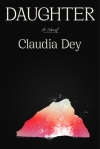
- Reading two King Lear updates at the same time: Private Rites by Julia Armfield and Daughter by Claudia Dey. The former has been specifically marketed as a “lesbian Lear,” but I had no idea that the latter also features two sisters plus a younger half-sister and their interactions with a larger-than-life father.

- Eating beans straight out of the tin in The Waterfall by Margaret Drabble and Of Mice and Men by John Steinbeck.
- Dead mice in Of Mice and Men by John Steinbeck and Stone Yard Devotional by Charlotte Wood.

-

- Screenshot
- Cloth holding the jaw of a corpse closed in one story from Barcelona by Mary Costello and A Woman’s Story by Annie Ernaux.
- Others see a character’s wife as a whore but the husband is oblivious in The Shipping News by E. Annie Proulx and Of Mice and Men by John Steinbeck.
 Setting up a game of solitaire in The Snow Hare by Paula Lichtarowicz and Of Mice and Men by John Steinbeck.
- Main character called Mona in Daughter by Claudia Dey and Mona of the Manor by Armistead Maupin.
- Being surprised at an older man still having his natural hair colour in one story of Barcelona by Mary Costello (where he’s aged 76) and Life in the Balance by Jim Down (where it’s Alan Bennett, at 84!).
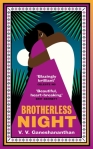
- A character named Anjali in Brotherless Night by V.V. Ganeshananthan and Moral Injuries by Christie Watson.

- A character named Cherry in Daughter by Claudia Dey and one story of This Is Why We Can’t Have Nice Things by Naomi Wood.
- My second memoir in two months in which a twentysomething son dies suddenly of a presumed heart problem: Fi by Alexandra Fuller, followed by Your Wild and Precious Life by Liz Jensen. (And a third in which his young friend died in the same way: The Uptown Local by Cory Leadbeater.) Also, Fuller and Jensen both see signs of their sons’ continued presence in bird sightings.
- Scratches on the inside of a coffin as proof of being buried alive in one story of Barcelona by Mary Costello and Life in the Balance by Jim Down.


- Surprise that one didn’t know the exact moment that a loved one died in one story of Barcelona by Mary Costello and Your Wild and Precious Life by Liz Jensen.
- Discussion of the meaning of brain stem death and a mention of meningococcal sepsis in Life in the Balance by Jim Down and Moral Injuries by Christie Watson.
- A scene set in a Denny’s diner in The Whole Staggering Mystery by Sylvia Brownrigg and After Dark by Haruki Murakami.


- A description of halal butchery in Barcelona by Mary Costello and Between Two Moons by Aisha Abdel Gawad.
- A mention of ballet choreographer George Balanchine in Dances by Nicole Cuffy and The Uptown Local by Cory Leadbeater.
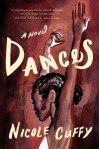
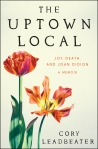
- A woman has an affair with a female postal worker in Mona of the Manor by Armistead Maupin and The Shipping News by Annie Proulx, both of which I DNFed.
- A character named Magdalena in Cloistered by Catherine Coldstream and The Snow Hare by Paula Lichtarowicz. The latter goes by Lena, which is also the name of the main character in Jungle House by Julianne Pachico. And there’s a character named Lina in Between Two Moons by Aisha Abdel Gawad.


- Being presented with powdered milk in Cloistered by Catherine Coldstream and Whale Fall by Elizabeth O’Connor.
- First I read a novel about a convent plagued by mice (Stone Yard Devotional by Charlotte Wood). Then I read a memoir about a convent plagued by feral cats (Cloistered by Catherine Coldstream).
- Buffalo, New York as a setting in Consent by Jill Ciment and The Age of Loneliness by Laura Marris. It’s also mentioned in Enter Ghost by Isabella Hammad.

- Watching pigeons on one’s balcony in Keep by Jenny Haysom, Your Wild and Precious Life by Liz Jensen, and The Uptown Local by Cory Leadbeater.
 The family’s pet chicken is cooked for dinner in Coleman Hill by Kim Coleman Foote and The Snow Hare by Paula Lichtarowicz.
- The mother is named Gloria in Consent by Jill Ciment and Cold Spring Harbor by Richard Yates (and The War for Gloria by Atticus Lish, a DNF).
- A character named Anton in The Snow Hare by Paula Lichtarowicz and Jungle House by Julianne Pachico.
- A cat named Dog in The Door-to-Door Bookstore by Carsten Henn and a dog named Tiger in Jungle House by Julianne Pachico.
- Two nature books that feature wild cold-water swimming (though don’t they all these days?!): In All Weathers by Matt Gaw and Your Wild and Precious Life by Liz Jensen.

- Two nature books that mention W.H. Hudson: In All Weathers by Matt Gaw and North with the Spring by Edwin Way Teale.
 A large anonymous donation to a church in Slammerkin by Emma Donoghue and Excellent Women by Barbara Pym (£10–11, which was much more in the 18th century of the former than in the 1950s of the latter).
- A mention of Poughkeepsie, New York in Birdeye by Judith Heneghan and Woman of Interest by Tracy O’Neill.
- A 1950s scene of perusing a lipstick display in Recipe for a Perfect Wife by Karma Brown and Excellent Women by Barbara Pym.

- A woman with a broken leg worries about how her garden will fare in Recipe for a Perfect Wife by Karma Brown and Remarkably Bright Creatures by Shelby Van Pelt.
- The same silent film image of a spaceship entering the moon’s eye (from Georges Méliès’s A Trip to the Moon) appears in Knife by Salman Rushdie and The Invention of Hugo Cabret by Brian Selznick. (I think this is the uncanniest coincidence of all this time!)

- A cleric who wears a biretta in Excellent Women by Barbara Pym and Daughters of the House by Michèle Roberts.
- A Black single mother who believes in the power of crystals in Company by Shannon Sanders and Another Word for Love by Carvell Wallace.


- An older woman really doesn’t want to leave her home but is moving into a retirement facility in Keep by Jenny Haysom and Remarkably Bright Creatures by Shelby Van Pelt. (There’s also a young woman who refuses to leave her house in Recipe for a Perfect Wife by Karma Brown.)
 A man throws his tie over his shoulder before eating in Recipe for a Perfect Wife by Karma Brown and Keep by Jenny Haysom.
- A mother writing a bad check becomes an important plot point in Remarkably Bright Creatures by Shelby Van Pelt and Another Word for Love by Carvell Wallace.
 A scene of self-induced abortion in Recipe for a Perfect Wife by Karma Brown and Sleeping with Cats by Marge Piercy.
- The Yiddish word feh (an expression of disappointment) appears in Feh by Shalom Auslander (no surprise there!) but also in A Reason to See You Again by Jami Attenberg, both of which are pre-release books I am reading for Shelf Awareness reviews.

What’s the weirdest reading coincidence you’ve had lately?
 Bookish Beck = Rebecca Foster. American transplant to England. Freelance proofreader and book reviewer.
 Bookish Beck