Nine Days in France and What I Read
Who would have predicted that the South of France would be colder and rainier than the England we left behind? Nonetheless, we had a pleasant, low-key week at the Limousin–Dordogne border. We stayed in a gîte at Le Moulin de Pensol, a complex run by an English couple who keep horses, donkeys and chickens but are otherwise rewilding their land (similar to the Wild Finca project we visited in Spain two years ago). Their site is known for butterflies, including multiple almost indistinguishable fritillary species, so there was plenty of insect and bird watching for my husband in brief bursts of sunshine between showers. When it was too wet to go out, we played board games, drank wine and read books.
-

- Our gite. Photos by Chris Foster.
-
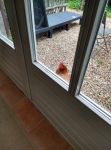
- The chickens wanted in!
-

- Wandering the meadows
-

- Butterfly watching
However, we did manage a few short outings: the Trou de Philippou gorge; a peek at a Saturday morning repair café (I’m a volunteer doing admin and publicity for our local repair café, which started in February) and its “recyclerie” charity shop in a nearby village; and St-Jean-de-Côle, “one of the loveliest villages in the Dordogne” according to the Rough Guide. We were taken by the main square’s church, castle and screaming swift parties – so much bigger than back home – which we’d likewise watched circling the château in the attractive medieval town of Saumur on the Loire, where we stopped for a night on the way down. There were also fresh cheeses and produce, including the most delicious strawberries ever (the “Charlotte” variety), from the two closest markets. Piégut’s is the largest market in southwest France but we had to use our imaginations as the downpour kept plenty of sellers away.


-
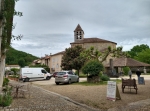
- St-Jean-de-Cole’s main square
-
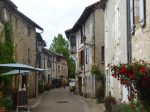
- Photo by Chris Foster.
The highlight of the trip was a visit to Grotte de Villars, a cave network with spectacular stalactites and stalagmites. Less well known than Lascaux, which is now inaccessible to visitors except via a reproduction, it too has prehistoric cave paintings of horses and bison, and 20,000-year-old bear claw marks. The paintings are gradually disappearing behind the constant calcite-creating drips; I pondered whether they will vanish before the human race does. We were lucky to find it so quiet that we got a private English-language tour. Proprietors were also so kind as to speak English to us when we shopped at a nano-brewery and did a tasting at a cider and calvados producer in Normandy on our way back to the ferry. Otherwise, we muddled through with the bare minimum of French at shops and eateries.
-

- Abbaye de Nouaillé-Maupertuis (lunch stop en route)
-

- (Photo at left by Chris Foster.)
-

- Saumur castle
My other highlight was finding two Little Free Libraries, a walk-in one that we happened to pass in Saint-Martin-l’Ars on our initial drive down south and another in Abjat-sur-Bandiat. I felt slightly bad about taking a book at the first because of its insistence on returning or replacing once you’d read it, so I made up for it by donating Cold Spring Harbor to the book exchange box in Abjat when we returned to its crêperie for our one meal out of the holiday.
-
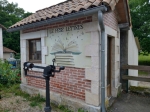
- Le Pese Lettres, Saint-Martin-l’Ars
-
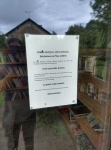
- Stricter than the usual LFL policy
-
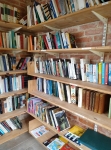
- Several English-language shelves
-
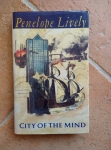
- My chosen book
-
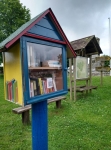
- Abjat-sur-Bandiat book exchange box
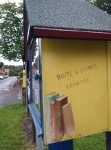
-
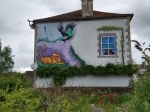
- Cute cat mural in Abjat
What I Read
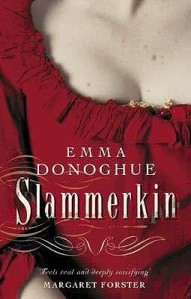 Slammerkin by Emma Donoghue (2000): A slammerkin was, in eighteenth-century parlance, a loose gown or a loose woman. Donoghue was inspired by the bare facts about Mary Saunders, a historical figure. In her imagining, Mary is thrown out by her family at age 14 and falls into prostitution in London. Within a couple of years, she decides to reform her life by becoming a dressmaker’s assistant in her mother’s hometown of Monmouth, but her past won’t let her go. The close third person narration shifts to depict the constrained lives of the other women in the household: the mistress, Mrs Jones, who has lost multiple children and pregnancies; governess Mrs Ash, whose initial position as a wet nurse was her salvation after her husband left her; and Abi, an enslaved Black woman. This was gripping throughout, like a cross between Alias Grace and The Crimson Petal and the White. The only thing that had me on the back foot was that, it being Donoghue, I expected lesbianism. (Secondhand purchase – Awesomebooks.com)
 Paris Trance by Geoff Dyer (1998): Only my second novel from Dyer, an annoyingly talented author who writes whatever he wants, in any genre, inimitably. This reminded me of Jeff in Venice, Death in Varanasi for its hedonistic travels. Luke and Alex, twentysomething Englishmen, meet as factory workers in Paris and quickly become best mates. With their girlfriends, Nicole and Sahra, they form what seems an unbreakable quartet. The couples carouse, dance in nightclubs high on ecstasy, and have a lot of sex. A bit more memorable are their forays outside the city for Christmas and the summer. The first-person plural perspective resolves into a narrator who must have fantasized the other couple’s explicit sex scenes; occasional flash-forwards reveal that only one pair is destined to last. This is nostalgic for the heady days of youth in the same way as Sweetbitter. I was intrigued to learn that random lines were sampled from Fiesta; though it is lad lit, I wouldn’t have expected a Hemingway homage from the style. (Secondhand purchase – Awesomebooks.com)
 Sanctuary in the South: The Cats of Mas des Chats by Margaret Reinhold (1993): Reinhold (still alive at 96?!) is a South African psychotherapist who relocated from London to Provence, taking her two cats with her and eventually adopting another eight, many of whom had been neglected by owners in the vicinity. This sweet and meandering book of vignettes about her pets’ interactions and hierarchy is generally light in tone, but with the requisite sadness you get from reading about animals ageing, falling ill or meeting with accidents, and (in two cases) being buried on the property. “Les chats sont difficiles,” as a local shop owner observes to her. But would we cat lovers have it any other way? Reinhold often imagines what her cats would say to her. Like Doreen Tovey, whose books this closely resembles, she is as fascinated by human foibles as by feline antics. One extended sequence concerns her doomed attempts to hire a live-in caretaker for the cats. She never learned her lesson about putting a proper contract in place; several chancers tried the role and took advantage of her kindness. (Secondhand purchase – Community Furniture Project)
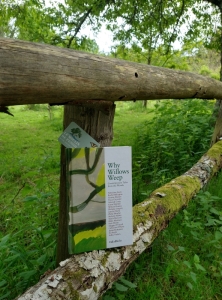
Why Willows Weep: Contemporary Tales from the Woods, ed. Tracy Chevalier and Simon Prosser (2011): These 19 short fictions, rather like Rudyard Kipling’s Just-So Stories, imagine how certain tree species developed their particular characteristics. I wasn’t expecting the fable setup and probably would have preferred a miscellany of essays and various fictional approaches. However, there is a run of great stories in the middle: from Susan Elderkin on “How the Blackthorn Got Its Flowers” to Terence Blacker on “Why Elms Die Young.” The stand-outs for me were by Rachel Billington and Maria McCann. It was a cute touch to have each author’s mini-bio end with their favourite tree, except, um, bamboo isn’t one (it’s a giant grass). I’ll probably keep this for the randomness of where I found it and the Leanne Shapton illustrations. (Secondhand purchase – La Monnerie recyclerie) 
 And the first two-thirds of Daughters of the House by Michèle Roberts (1993): Thérèse and Léonie are cousins: the one French and the other English but making visits to her relatives in Normandy every summer. In the slightly forbidding family home, the adolescent girls learn about life, loss and sex. Each short chapter is named after a different object in the house. That Thérèse seems slightly otherworldly can be attributed to her inspiration, which Roberts reveals in a prefatory note: Saint Thérèse, aka The Little Flower. Roberts reminds me of A.S. Byatt and Shena Mackay; her work is slightly austere and can be slow going, but her ideas always draw me in. (Secondhand – Newbury charity shop)
A DNF: Claudine at School by Colette (a free download), which was dull and in way too small a print on my e-reader.
Plus portions of: various e-books for paid reviews, two May review books, and several library books including Moominpappa at Sea by Tove Jansson and The Invention of Hugo Cabret by Brian Selznick.


I’m happy to be home with my cat and canal, the two things I miss most when we’re away.
Three on a Theme: “Rainbow” Books for Pride Month
Two of these are short story collections (and one almost is); two are specifically queer in outlook; all attracted me for their colorful covers, and all were borrowed from the library. #LoveYourLibrary

Rainbow Rainbow: Stories by Lydia Conklin (2022)
The 10 stories in this confident debut collection are unabashedly queer, and half involve the trans experience, whether ideation or reality. Conklin is nonbinary, so it’s tempting to read several stories as autobiographical: female characters long to get top surgery and transition to male or nonbinary, but worry it will change how they are perceived or desired. “Pink Knives” and “Boy Jump,” especially, have the flavor of autofiction, with protagonists traveling in Poland and feeling attraction to people of various genders. (The former has a pandemic setting, which I’ve noticed has at this point started to feel dated.) My overall favorite was “Sunny Talks,” in which middle-aged Lillia accompanies her trans teenage nephew to a conference for celebrity YouTubers but can’t bring herself to announce her own intended transition. Though life hasn’t been easy for Sunny, he has support she lacked growing up.
 Asher and Ivan, two characters of nebulous sexuality and future gender, are the core of “Cheerful Until Next Time” (check out the acronym), which has the fantastic opening line “The queer feminist book club came to an end.” “Laramie Time” stars a lesbian couple debating whether to have a baby (in the comic Leigh draws, a turtle wishes “reproduction was automatic or mandatory, so no decision was necessary”). “A Fearless Moral Inventory” features a pansexual who is a recovering sex addict. Adolescent girls are the focus in “The Black Winter of New England” and “Ooh, the Suburbs,” where they experiment with making lesbian leanings public and seeking older role models. “Pioneer,” probably my second favorite, has Coco pushing against gender constraints at a school Oregon Trail reenactment. Refusing to be a matriarch and not allowed to play a boy, she rebels by dressing up as an ox instead. The tone is often bleak or yearning, so “Counselor of My Heart” stands out as comic even though it opens with the death of a dog; Molly’s haplessness somehow feels excusable.
Six of the stories are in the third person and four in first person. I’d be interested to try Conklin’s longer-form work, and think first-person narration would particularly suit her. I didn’t really sense that this was a book meant for me, but that’s okay; a lot of readers will feel seen and represented. Pair this with, or have it on hand as a follow-up to, work by Allison Blevins, Melissa Febos and, most of all, Eley Williams. 
Under the Rainbow by Celia Laskey (2020)
In Laskey’s debut, which has been marketed as a novel but reads more like linked short stories, a favorite format of mine, researchers have identified Big Burr, Kansas as the most homophobic town in America. A task force from Acceptance Across America descends on the rural backwater for a targeted two-year program promoting education and friendship. Each chapter is a first-person, present-tense confession from a local or a queer visitor, whose stories interlock and push the chronology forward. For every positive step – a gender-neutral bathroom in the high school, a closeted individual who summons up the courage to come out – there is a regressive one, such as a AAA billboard being set on fire or a house being egged.
 Laskey inhabits all 11 personae with equal skill and compassion. Avery, the task force leader’s daughter, resents having to leave L.A. and plots an escape with her new friend Zach, a persecuted gay teen. Christine, a Christian homemaker, is outraged about the liberal agenda, whereas her bereaved neighbor, Linda, finds purpose and understanding in volunteering at the AAA office. Food hygiene inspector Henry is thrown when his wife leaves him for a woman, and meat-packing maven Lizzie agonizes over the question of motherhood. Task force members David, Tegan and Harley all have their reasons for agreeing to the project, but some characters have to sacrifice more than others.
Little references in later chapters catch you up on what’s happened with the others. I only questioned the need for Elsie as a POV character, and the exclusion of Jamal (presumably Laskey thought it unwise to write from the perspective of a Black man, but he’s a glaring omission). A final chapter, returning to one of the protagonists and set 10 years later, presents a town that’s changed enough to host its first gay wedding and first LGBTQ-owned business.
The novel is realistically sad, but not overly so, and was compellingly readable and heartwarming in a way that reminded me of how I felt about Shotgun Lovesongs. You might not want to live there, but I guarantee you’ll develop a certain fondness for Big Burr. 
Scattered Showers: Stories by Rainbow Rowell; illus. Jim Tierney (2022)
I spotted this collection while shelving in the YA section of the library one day and admired the sky blue naked hardback for its red sprayed edges, chunky rainbow endpapers, distinctive font, and teal and magenta interior color scheme. I’d read one Rowell book before, the graphic novel Pumpkinheads. This is probably a better match for her dedicated fans in that three of the stories are spin-offs from her fiction and a few of the rest are one-offs (Amazon Original Stories, a World Book Day publication, a contribution to an anthology), such that I felt a little like I was reading leftovers. A B-sides volume, if you will.
 Four of the nine are holiday-themed, so this could make a good Twixtmas read if you like seasonality; eight are in the third person and just one has alternating first person narrators. All are what could be broadly dubbed romances, with most involving meet-cutes or moments when long-time friends realize their feelings go deeper (“Midnights” and “The Snow Ball”). Only one of the pairings is queer, however: Baz and Simon (who are a vampire and … a dragon-man, I think? and the subjects of a trilogy) in the Harry Potter-meets Twilight-meets Heartstopper “Snow for Christmas.” The rest are pretty straightforward boy-girl stories.
I liked “Kindred Spirits,” in which Elena joins a small group (“three cold nerds”) of hardcore Star Wars fans waiting in line for the first sequel and notices Gabe, a classmate, as if for the first time; “Winter Songs for Summer,” in which a sensitive jock proves he knows his upstairs dorm mate better than anyone through the breakup-recovery tracks he puts on a mix CD for her; and “If the Fates Allow,” about Nebraska neighbors who bond over Jell-O salad during a couple of pandemic Christmases.
I wasn’t as enamored by the couple of fantasy stories, “The Prince and the Troll,” a fairy tale twisted into a vague environmental dystopian parable (“This isn’t easy. This is just another kind of hard. That’s all that’s left now, for any of us”), and “In Waiting,” about the evolving characters incubating in a writer’s head. “Mixed Messages” was refreshing for having middle-aged characters, two friends texting back and forth to try to work out whether the one missed a period because she’s pregnant or in perimenopause, but I doubt I’d be tempted to seek out the book these characters originated in (Attachments), or any of Rowell’s others. 
There was a clear winner here: Under the Rainbow!
Extra goodies:
Celebrate Pride Month! The Bookshop.org team has curated this list of books by LGBTQIA+ authors for you to enjoy. Please enjoy 20% OFF all titles. [affiliate link]
A song Sufjan Stevens wrote for Pride Month 2019.
Vacation Reading Plans: Spain and Scotland
As treats to look forward to after our DIY and moving adventures, we booked ourselves two summer holidays. Next week we’re off to Northern Spain for eight days. Thanks to a Brittany Ferries voucher from a cancelled trip in 2020, it ended up being a really cheap option – but it means I have to go to sea for 20 hours, each way. And I hate boats. My last sea voyage back from France only lasted four hours or so, but I was so sick. This time, I will be packing all the seasickness remedies known to woman. Your ideas are welcome!
I’ve never been to Spain and have lost my kindergarten Spanish beyond the few bits I’ve picked back up from my husband’s Duolingo practice. We’ve had next to no time to plan what we’re going to do while we’re there, but it should be a great place for hiking and wildlife watching, with a more Atlantic than Mediterranean climate. (We’re no beachgoers.)
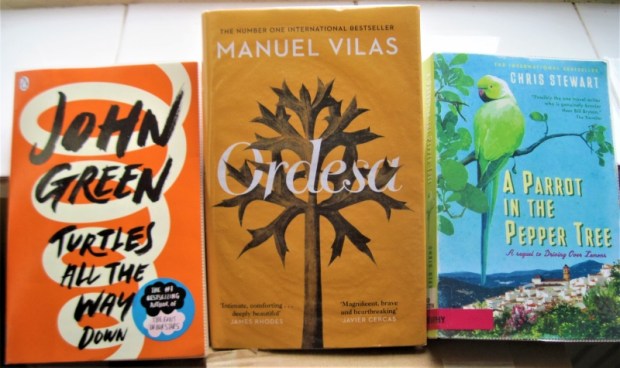
What I have been planning, of course, is what I’ll read. I asked Twitter for recommendations, and got a couple that I followed up on. My library’s holdings weren’t particularly helpful, but I found a few somewhat appropriate reads: As I Walked Out One Midsummer Morning by Laurie Lee, Homage to Catalonia by George Orwell, A Parrot in the Pepper Tree by Chris Stewart, Ordesa by Manuel Vilas, and The Shadow of the Wind by Carlos Ruiz Zafón. Alas that all of these are by men and only two are in translation! For place-specific reading, I’ve supplemented them with Book of Days by Phoebe Power, a book-length poem about the Camino pilgrimage route to Santiago de Compostela, which passes not far from where we’re staying.
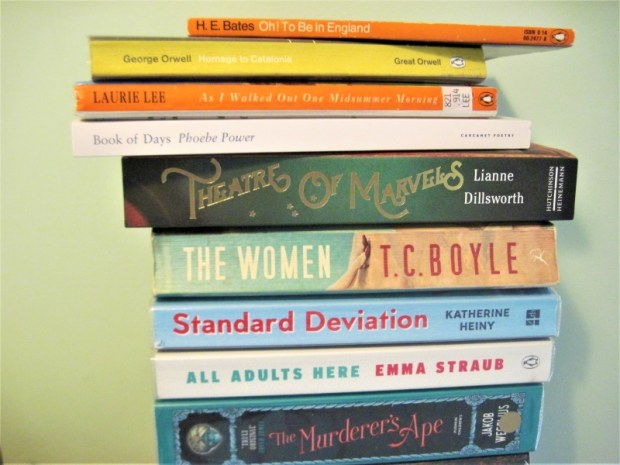
I also amassed a bunch of doorstoppers and slightly lighter literary fiction to help the hours at sea pass. See anything you’d particularly recommend? I’ll likely pack all of these and more (‘sensible’ is not a word that can generally be applied to my reading plans or habits!) because we’re taking a car onto the ferry so space/weight is not an issue.
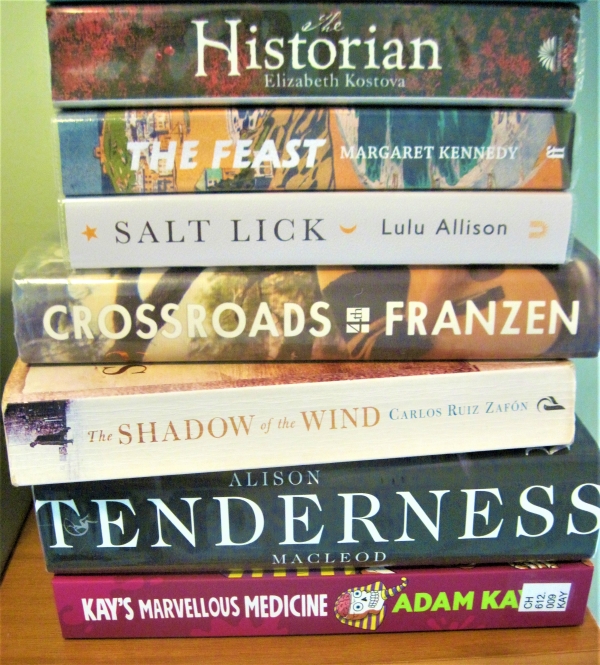
Ironically, I have many more relevant book ideas for our second summer holiday to the Outer Hebrides in late June, but we’re travelling up by train so my book capacity will be minimal! There are loads of novels set on Scottish islands. Here’s what I’m pondering from the library:


Love of Country would be a reread, but is really more for my husband to read. I also fancy a reread of Night Waking by Sarah Moss.
Do you have any trips to look forward to? Will you try for any reading on location?
Three Theology Books for Easter
If you’ve been celebrating Passover or gearing up for Easter this past week, you might be interested in picking up one of these three recent (or forthcoming) theology titles I’ve encountered. (See also the more extensive Easter reading list I compiled two years ago.)
Misfit Faith: Confessions of a Drunk Ex-Pastor, Jason J. Stellman
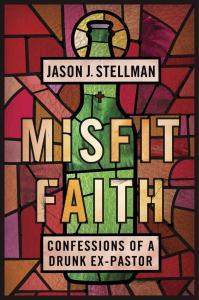 Stellman is a former pastor who runs a podcast called “Drunk Ex-Pastors” with his best friend and agnostic cohost, Christian Kingery. His book suffers a bit, I think, from an unclear aim: it started off as an apologia for his conversion to Catholicism after an unchurched upbringing and fervently Evangelical teen years. What it turned into is more of a theological ramble about how to see God and the world anew. For instance, God is Father, but also flesh, so we don’t need to condemn the secular: “embracing a Christianity that reflects the Incarnation by validating the physical world rather than vilifying it.”
With (dated, geeky) pop culture references, Stellman encourages a rejection of xenophobia and an embrace of narrative and ritual, which Roman Catholicism perhaps makes more space for than your average Protestant tradition. The last few lines of the book are a wonderful plea for openness, hearkening back to the very definition of ‘catholic’ – broad and inclusive:
Is misfit faith about love or suffering? Feasting or fasting? Divinity or humanity? Heaven or earth? The answer is yes, to all of it. And yeah, I want it all: the now and the later, the spirit and the flesh, the head, the heart, and the stations of the cross. I would rather embrace way too much than way too little, because something tells me that as wide as I can open my arms and heart, God’s are always open wider.
I’d recommend this to readers of David Dark and Rob Bell.
My rating:
I received this e-book from Blogging for Books (via Edelweiss) for this review.
What Is the Bible? How an Ancient Library of Poems, Letters, and Stories Can Transform the Way You Think and Feel about Everything, Rob Bell
 Speaking of Rob Bell…this is one of his stronger books. Not as fresh and vibrant as Velvet Elvis, but it will have a big impact on teens and twentysomethings starting to question the narrow interpretations of the Bible they’ve grown up with in conservative churches. Bell stresses the importance of reading the Bible literately rather than literally: always looking deeper than surface facts to see what’s really going on here; striving to understand the background of Jewish practice and Roman occupation at the time of Jesus.
Bell emphasizes that the Bible is a disparate set of books written by fallible people who were defined by their own historical context, yet if you ask why they wrote down these stories of their interactions with the divine in this way – why they mattered to them then – you might get a glimpse of why they might still matter to us now. The “haphazard humanity” of the Bible, then is for him stronger evidence of its reliability than some rigid perfection would be.
He chooses a number of the more unusual incidents in the Bible to illuminate with a closer reading, such as Jesus writing in the dust, Ehud assassinating tubby King Eglon, and the Book of Revelation. Part 4 is usefully structured around FAQs (e.g. “So how would you define the word of God? The creative action of God speaking in and through the world, bringing new creation and new life into being”). This is like listening to a really good sermon series. (Releases May 16th.)
My rating:
My Jewish Year: 18 Holidays, One Wondering Jew, Abigail Pogrebin
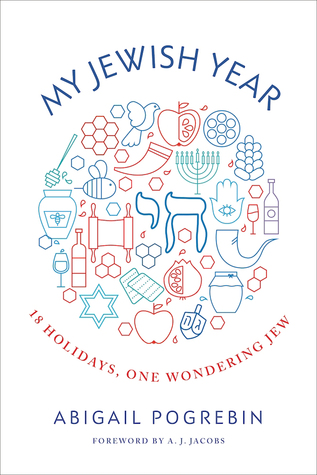 One thing Bell stresses is that Jesus was Jewish, so you can’t understand the stories about him apart from their Jewish context. This bighearted, open-minded book strikes me as a perfect model for how any person of faith should engage with their tradition: not just offering lip service and grudgingly showing up to a few services a year, but knowing what you believe and practice, and why.
Like many an American Jew, Pogrebin marked a limited set of holidays: Hanukkah, the Passover seder, Rosh Hashanah, Yom Kippur, and Shabbat. She circumcised her son, and hosted bar/bat mitzvahs for him and her daughter. Yet she had a nagging feeling that she had never genuinely locked into her own religion, and longed to go beyond the beginner stage.
So from September 2014 to September 2015, she celebrated all the holidays in the Jewish calendar, seeking to move beyond clichés and simplistic interpretations; interviewing rabbis and scholars of every stripe and reading Torah commentaries to discover meanings she’d missed before. Yom Kippur isn’t just a day of atonement; it’s for pondering the fact of your own death, taking stock of your life and asking what must change. Hanukkah, uncomfortably, is not just about persecution but about Jew-on-Jew violence.
There are opposite strands running through the Jewish ritual year: gratitude for survival (Purim) versus sorrow at tragedies (Holocaust Remembrance Day); feasting versus fasting. I was consistently impressed by how Pogrebin draws thematic connections and locates the resonance of religious ritual in her daily life.
Favorite lines:
“[I]t’s a quintessential Jewish act: seeking, grappling. If you’re reaching, it’s because you believe there’s something to grab hold of.”
“I’m beginning to think that Judaism is obsessed with brevity and instability. But rather than finding the message depressing, it’s clarifying.”
“Judaism is always asking us to apply epic stories to everyday decisions.”
“Judaism reminds us not to run from transitions, but to consecrate them.”
My rating: 
Tidings by Ruth Padel & Other Christmassy Reading
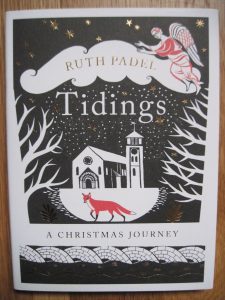 Ruth Padel is one of my favorite poets, so I jumped at the chance to read her new book-length holiday poem, Tidings: A Christmas Journey. Set across one Christmas Eve and Christmas day and narrated by Charoum, the Angel of Silence, the poem switches between Holly, a seven-year-old girl excited for Christmas, and Robin, a forty-four-year-old homeless man who follows a fox to a Crisis Centre. Here he gets a hot meal and some human kindness to make up for the usual bleakness of the holidays:
Christmas is the salt mine.
Salt in the wound, a nothing-time.
I was loved once. Who by? Can’t remember.
I especially liked the fragments that juxtapose this contemporary London story with centuries of history:
Up here the evening glides over golden moss
on the flat-top tomb of Mary Wollstonecraft
&
Pagan Christmas fizzes and teems with ghosts,
midwinter fires, mummers and waites, Yule
logs and mistletoe.
The poem also journeys to Jerusalem and Rome to survey a whole world of Christmas traditions, then and now.
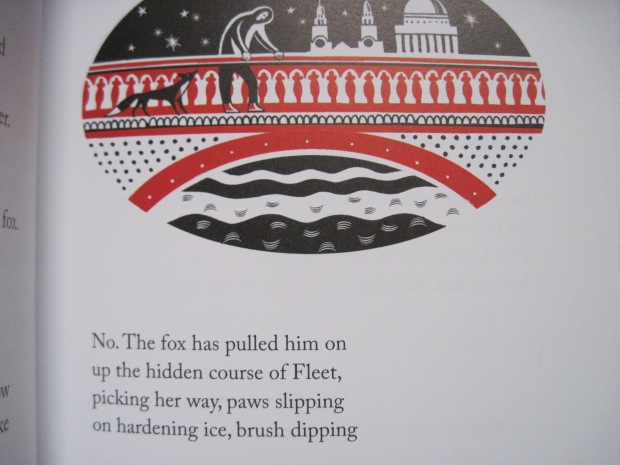
It’s a lovely little volume, with the red, black and white theme offset by touches of gold. The illustrations are gorgeous, but the story line disappointed me: starting with the character names, it all felt rather clichéd. Padel has treated urban foxes much more successfully in her collection The Soho Leopard, and apart from a very few instances – like the above quotes – the verse struck me as largely undistinguished, even awkward (like the out-of-place clinical vocabulary in “Love, / and the lack of it, can change the limbic brain”). This means that, for me, this book fails to earn a place as a Christmas classic I’ll reread year after year.
Tidings was published in the UK by Chatto & Windus on November 3rd. My thanks to Cat Mitchell of Random House for the free review copy.
My rating: 
Other Christmassy Reading
 This year I’m resuming my place in Waiting on the Word, Malcolm Guite’s selection of religious-slanted poems to read from the start of Advent through Epiphany. For those who want to explore the history and interpretation of Christmas, I can recommend The First Christmas by the late Marcus Borg, one of my favorite progressive theologians.
As I have for the past several years, I’ll dip into The Ecco Book of Christmas Stories, edited by Alberto Manguel. My favorites are by Truman Capote, John Cheever, Jane Gardam and Jeanette Winterson (who has a brand-new, full-length Christmas story collection out this year). I’ll also sample some Russian classics via A Very Russian Christmas, which has short stories from Tolstoy, Chekhov and more.
 In addition, I have Cleveland Amory’s The Cat Who Came for Christmas and The Cat Who Stayed for Christmas out from the library, which should make for some very cozy reading under the cat. I’ll browse the numerous Christmas-themed poems in U.A. Fanthorpe’s Collected Poems, another library book. And I may even deign to try Hogfather, one from my husband’s beloved Discworld series by the late Terry Pratchett.
[See also this wonderful list of Christmas reading suggestions from Heaven Ali.]
Are you reading anything special this Christmas season?
European Holiday Reading – A (Temporary) Farewell
Tomorrow we’re off to continental Europe for two weeks of train travel, making stops in Brussels, Freiburg (Germany), two towns in Switzerland, and Salzburg and Vienna in Austria. This will be some of the most extensive travel I’ve done in Europe in the 11 or so years that I’ve lived here – and the first time I’ve been to Switzerland or Austria – so I’m excited. I’ve been working like a fiend recently to catch up and/or get ahead on reviews and blogs, so it will be particularly good to spend two weeks away from a computer. It’s also nice that our adventure doesn’t have to start with going to an airport.
Here’s what I’ve packed:
- Setting Free the Bears by John Irving (his first novel; set in Vienna)
- Diary of a Pilgrimage by Jerome K. Jerome (about a train journey from England to Germany)
- Me and Kaminski by Daniel Kehlmann (the author is Austrian)
- A Whole Life by Robert Seethaler (a novella set in the Austrian Alps)
+ Enchanting Alpine Flowers & the Rough Guide to Vienna
Also on the e-readers, downloaded from Project Gutenberg:
- Three Men on the Bummel by Jerome K. Jerome (further humorous antics in Germany)
- Burning Secret by Stefan Zweig (a novella; the author is Austrian)
+ another 250+ Kindle books from a wide variety of genres and topics – I’ll certainly have no shortage of reading material!
(Looking back now, it occurs to me that this all skews rather towards Austria! Oh well. Vienna is one of our longer stops.)

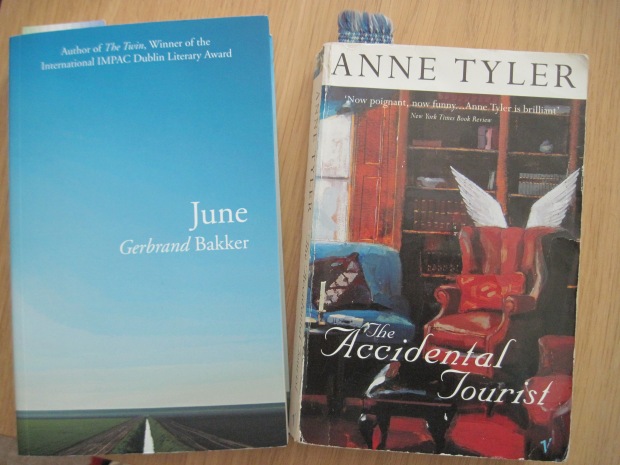
I’m supposed to be making my way through the books we already own, but on Saturday I was overcome with temptation at our local charity shop when I saw that all paperbacks were on sale – 5 for £1. I’m in the middle of one of the novels I bought that day, June by Gerbrand Bakker, along with The Accidental Tourist by Anne Tyler, and need to decide whether to put them on hold while I’m away or take one or both with me. Either way I’ll try to finish June this month; it’s just too appropriate not to!
I was also overcome with temptation at the thought of a new Eowyn Ivey novel coming out in August, so requested a copy for review.

It’s an odd time here in the UK. Readers from North America or elsewhere might be unaware that we’re gearing up for a referendum to decide whether to remain in the European Union. By the time we pass back through Brussels (‘capital’ of the European Union) on the 24th, there’s every chance the UK might no longer be an official member of Europe. I haven’t taken British citizenship so am ineligible to cast a vote; I won’t court debate by elaborating on a comparison of “Brexit” with the specter of Trump in the States. My husband has sent in his postal vote, so collectively we’ve done all we can do and now just have to wait and see.
We’re not back until late on the 24th, but I’ve scheduled a few posts for while we’re away. I will only have sporadic Internet access during these weeks, so won’t be replying to blog comments or reading fellow bloggers’ posts, but I promise to catch up when we get back.
Happy June reading!
Summer Reading Plans
In June my husband and I will be off to Europe for two weeks of train travel, making stops in Brussels, Freiburg (Germany), two towns in Switzerland and another two in Austria. I like picking appropriate reading material for my vacations whenever possible (even though I’ll never forget Jan Morris’s account of reading the works of Jane Austen on a houseboat in Sri Lanka – a case of the context being so wrong it’s right), so I’ve been thinking about what to take with me and what to read ahead of time.
Back in October I picked up a lovely little secondhand hardback of Jerome K. Jerome’s Diary of a Pilgrimage for £1. Given that it’s a novel about a journey by train and boat from England to Germany to see the Oberammergau Passion Play and that Jerome is a safe bet for a funny read, this one is definitely going in my luggage. I also plan to take along a library paperback of A Whole Life by Robert Seethaler, a novella set in the Austrian Alps at the time of the Second World War.
Last year I discovered Austrian writer Daniel Kehlmann through the brilliant F: A Novel, and now have two more of his waiting: Me and Kaminski and Measuring the World, which sound completely different from each other but equally appealing (see Naomi’s review of the latter). What I might do is read one just before the trip and the other soon after we get back.
There are a few thin classics I have on my shelves and might be tempted to slip into a backpack, but for the most part I’ll plan to save space by taking a well-loaded Kindle. (It currently houses 300 books, so there’s no risk of running out of reading material!) I think I’ll treat myself to a few July/August books from my priority advanced reads list, like (fiction) The Hemingway Thief by Shaun Harris and The Book that Matters Most by Ann Hood, and (nonfiction) Playing Dead by Elizabeth Greenwood and On Trails by Robert Moor.
Once we get back to England, my self-imposed restriction for the rest of the summer will be reading only my own books. That means no library books, NetGalley/Edelweiss ARCs, or unpaid review books. This should work out well because it looks like we’ll be moving on August 18th, so I’ll be able to cull some books after reading them to reduce the packing load.
In any case, it will be a good chance to reassess my collection and get through some doorstoppers like A Suitable Boy, City on Fire, and This Thing of Darkness. During moving week itself I may have to stick to Kindle books while the print ones are inaccessible, but then as I rediscover them through unpacking I can try to push myself through a few more.
What are your summer and/or vacation reading strategies?
Thanksgiving Reading
This Thursday marks one of the most American of holidays: Thanksgiving. (My apologies to Canadian readers, who already had their celebration in October, and to British readers, who may find the whole thing a bit mysterious.) If you’ve never experienced a Thanksgiving meal for yourself, you might not know what all the fuss is about. After all, as Bill Bryson puts it in Notes from a Big Country, it’s a holiday where you just try to “get your stomach into the approximate shape of a beach ball.” But something about dysfunctional families crossing the country for a feast and reflecting on the country’s origins – however spurious the Pilgrims-’n-Injuns history behind the tradition might be – makes for intriguing fictional possibilities.
It’s no wonder Thanksgiving turns up all the time in American novels. Jonathan Franzen’s The Corrections is a classic example, but look further and you’ll find references everywhere. For instance, I’m just finishing up Good on Paper by Rachel Cantor (coming in February), set in New York City as Y2K approaches, and what do you know? There’s a Thanksgiving meal. And even a simple list of dishes gives a perfect miniature view of differences in class and perspective: Shira’s neighbor wants “traditional fare—string bean casserole with cornflakes” and yam casserole topped with marshmallows, while her gay, Pakistani co-parent, Ahmad, prefers “the exotic: millet-shitake stuffing with chestnut-and-caper sauce.”
If you’re looking for something seasonal to read this week, here are snippets of books I’ve reviewed, two fiction and two nonfiction. For more ideas, check out this Thanksgiving books list on Goodreads from the Washington Post’s Ron Charles. Anne Tyler, Richard Ford – some great stuff on there!
Fiction:
 Want Not by Jonathan Miles: “Waste not, want not” goes the aphorism, and Miles’s second novel explores both themes to their fullest extent: the concept of waste – from profligate living to garbage and excrement – and ordinary people’s conflicting desires. In three interlocking story lines, Miles looks for what is really of human value at a time when everything seems disposable and possessions both material and digital can exert a dispiriting tyranny. The novel opens on Thanksgiving 2007, with New York City buried under an early snowstorm. The nation’s annual excuse for gluttony makes a perfect metaphorical setting for Miles’s exposé of food waste and consumerist excess. This is a book I wish I had written.


Housebreaking by Dan Pope: This tightly crafted novel of adultery in dysfunctional suburbia is somewhat reminiscent of Tom Perrotta’s Little Children or the movie Far from Heaven, but with less memorable characters and story line overall. The strategy of revisiting the same events of one late summer and fall from different characters’ perspectives makes it feel slightly repetitive and claustrophobic. My favorite touches were the comical dialogue between a handful of old folks and a description of the cookie-cutter buildings in the Connecticut suburbs: “all the little houses, lined up like cereal boxes on a shelf.” Like Want Not, it also revolves around Thanksgiving 2007.

Bet you never thought there would be a third novel set on Thanksgiving 2007! But it appears there is: Strangers at the Feast by Jennifer Vanderbes. You may also like to sample “An Old-Fashioned Thanksgiving,” an 1881 short story by Louisa May Alcott.
Nonfiction:
You won’t have to try too hard to find Thanksgiving scenes in nonfiction either, especially when it comes to memoirs. I read one of Ruth Reichl’s terrific ‘foodoirs’, Comfort Me with Apples, earlier this year and there’s a great moment when she and Michael Singer, who would become her second husband, go to a restaurant for their first Thanksgiving together. It’s a disaster of a meal; the duck isn’t served until midnight. Sure is memorable, though.
 The First Thanksgiving by Nathaniel Philbrick: In this selection from his 2007 book Mayflower: A Story of Courage, Community, and War, reprinted as a mini e-book in the “Penguin Tracks” series, Philbrick tells the true story behind the first Thanksgiving. As with most beloved legends, the circumstances are much more complicated and much less rosy than they appear in our collective memory. Philbrick writes in an informative yet conversational style, and paints an appealing picture of the Pilgrims as reasonable people with humble aims. (See my full review at Bookkaholic.)
 Eating Appalachia: Rediscovering Regional American Flavors by Darrin Nordahl: Nordahl travels through Ohio, West Virginia, Kentucky and North Carolina in search of truly indigenous local ingredients. There are a few recipes and photographs in each chapter, although this is more of a narrative than a cookbook. I loved how he brought it all together with his imagined Appalachian Thanksgiving feast (what we consider traditional today includes very little that would actually have been eaten in the Pilgrims’ place and time):
appetizers of pickled ramps and brook trout crostini, bowls of butternut [the nut, not the squash] cream bisque, plates piled with the showpiece dish of spicebush-peppered roast elk tenderloin and hickory nut stuffing—all washed down with steaming sassafras tea and chilled sumac-ade, capped with a choice of persimmon pudding with black walnut ice cream or pawpaw panna cotta.
Do you like to tailor your reading to the holidays? What will you be reading this Thanksgiving week?
Recommended Easter Reading
Unlike Christmas, Easter is a holiday that might not lend itself so easily to reading lists. December is the perfect time to be reading cozy books with wintry scenes of snow and hearth, or old-time favorites like Charles Dickens. Christmas-themed books and short stories are a whole industry, it seems. Lent and Advent both prize special foods, traditions and symbols, but beyond devotional reading there doesn’t seem to be an Easter book scene. Nonetheless, I have a handful of books I’d like to recommend for the run-up to Easter, whether for this year or the future.
 Easter, Michael Arditti
I hadn’t heard of Michael Arditti until I reviewed his novel The Breath of Night – a taut, Heart of Darkness-inspired thriller about a young man searching for a missing priest in the Philippines – for Third Way magazine in late 2013. He deserves to be better known. Easter (2000), his third novel, earned him comparisons to Iris Murdoch and Barbara Pym. His nuanced picture of modern Christianity, especially the Anglican Church, is spot-on.
I’ve just finished Part One, which traces the week between Palm Sunday and Easter Sunday in a fictional London parish, St Mary-in-the-Vale, Hampstead. Structured around the services of Holy Week and punctuated with bits of liturgy, the novel moves between the close third-person perspectives of various clergy and parishioners. Huxley Grieve, the vicar, is – rather inconveniently – experiencing serious doubts in this week of all weeks. And this at a time when the new Bishop of London, Ted Bishop (“Bishop by name, bishop by calling,” he quips), has announced his mission to root out the poison of liberalism from the Church.
So far I’m reminded of a cross between Susan Howatch and David Lodge (especially in How Far Can You Go?), with a dash of the BBC comedy Rev thrown in. Reverend Grieve’s sermons may be achingly earnest, but the novel is also very funny indeed. Here’s a passage, almost like a set of stage directions, from the Palm Sunday service: “The procession moves up the nave. The Curate leads the donkey around the church. It takes fright at the cloud of incense and defecates by the font.”
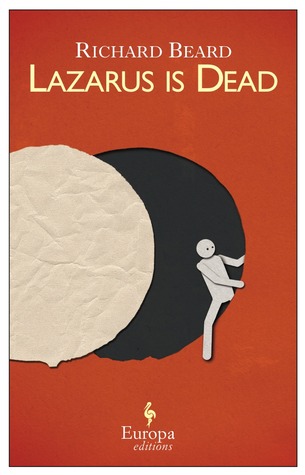 Lazarus Is Dead, Richard Beard
In this peculiar novel-cum-biography, Beard attempts to piece together everything that has ever been said, written and thought about the biblical character of Lazarus. The best sections have Beard ferreting out the many diseases from which Lazarus may have been suffering, and imagining what his stench – both in life and in death – must have been like. (“He stinketh,” as the Book of John pithily puts it.)
Alongside these reasonable conjectures is a strange, invented backstory for Jesus and Lazarus: when they were children Jesus failed to save Lazarus’ younger brother from drowning and Lazarus has borne a lifelong grudge. A Roman official is able to temporarily convince Lazarus that he needs to take up the mantle of the Messiah because he came back to life: he has the miracle to prove the position, whether he wants it or not. The end of the novel follows the strand of the Passion Week, though in a disconnected and halfhearted fashion.
Beard’s interest is not that of a religious devotee or a scriptural scholar, but of a skeptical postmodern reader. Lazarus is a vehicle for questions of textual accuracy, imagination, and the creation of a narrative of life and death. His unprecedented second life must make him irresistible to experimental novelists. Beard’s follow-up novel, Acts of the Assassins, is also Bible-themed; it’s a thriller that imagines the Roman Empire still in charge today.
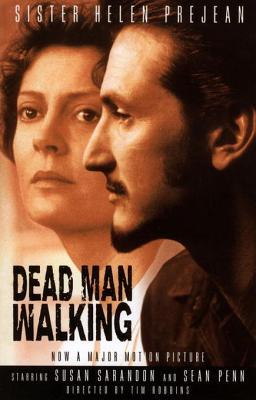 Dead Man Walking, Sister Helen Prejean
No matter your current thoughts on the death penalty, you owe it to yourself to read this book with an open mind. I read it in the run-up to Easter 2007, and would recommend it as perfect reading for the season. As I truly engaged with themes of guilt and retribution, I felt the reality of death row was brought home to me for the first time. Many of the men Prejean deals with in this book we would tend to dismiss as monsters, yet Jesus is the God who comes for the lost and the discounted, the God who faces execution himself.
The film version, which conflates some of the characters and events of the book, is equally affecting. I saw it first, but it does not ruin the reading experience in any way.
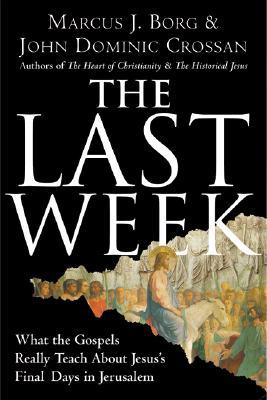 The Last Week: What the Gospels Really Teach about Jesus’s Final Days in Jerusalem, Marcus J. Borg and John Dominic Crossan
Marcus Borg, who just died on January 21st, has been one of the most important theologians in my continuing journey with Christianity. His Reading the Bible Again for the First Time and The Heart of Christianity are essential reading for anyone who’s about to give up on the faith. In this day-by-day account, mostly referencing the Gospel of Mark, Borg and Crossan convey all that is known about the historical Jesus’ last week and death. They collaborated on a second book, The First Christmas, which does the same for Jesus’ birth.
And now for two more unusual, secular selections…
 Bellman & Black, Diane Setterfield
Call me morbid, but I love English graveyards. My most enduring Easter memory is of dawn services at the country church in my husband’s hometown. In the weak half-light, with churchyard rooks croaking a near-deafening chorus, the overwhelming sense was of rampant wildness. The congregation huddled around a bonfire while a black-cloaked vicar intoned the story of scripture, from creation to the coming of Christ, as loudly as possible over the rooks – trying to win mastery over the night, and score a point for civilization in the meantime.
This anecdote goes some way toward explaining why I rather enjoyed Bellman and Black – but why many others won’t. Setterfield’s second novel is a peculiar beast, a bit like a classic suspense story but also an English country fable. Protagonist William Bellman is part Job and part Faustus. At age ten, he makes a catapult that kills a rook. Thereafter, his life is plagued by death, despite his successful career as an entrepreneur at a cloth mill. Can he make a deal with the Devil – or, rather, the sinister Mr. Black – that will stop the cycle of deaths?
Bellman’s daughter Dora is a wonderful character, and because I love birds anyway and have strong, visceral memories involving rooks in particular, I enjoyed Setterfield’s symbolic use of them. However, many will be bored to tears by details of cloth-making and dyeing in early nineteenth-century England. Setterfield evokes her time period cannily, but in such a painstaking manner that the setting does not feel entirely natural. Here’s hoping for a return to form with Setterfield’s third novel.
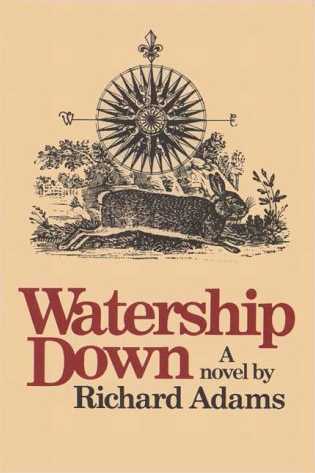 Watership Down, Richard Adams
This was the first book I ever borrowed from the Adult Fiction section of the public library, when I was eight years old. It quickly became a favorite, and though I didn’t reread it over and over like I did the Chronicles of Narnia, it still has a strong place in my childhood memories. Why have I chosen it for this list? Well, it’s about rabbits: a warren comes under threat from English countryside development and human interference.
I loved a little story Rachel Joyce inserts in her novel The Love Song of Miss Queenie Hennessy. Taking over from another nun, a young, air-headed nurse at Queenie’s hospice resumes reading Watership Down to a patient. At the end the patient cries, “Oh, it’s so sad, those poor rabbits” and the nurse replies, “What rabbits?” (You’d think the cover might have given it away!) It’s a good laugh, but also reflects how carefully Adams characterizes – one might say anthropomorphizes – each rabbit; you might forget they’re actually animals.
Do you have any favorite books to read or reread at particular holidays?
Happy spring reading!
 Bookish Beck = Rebecca Foster. American transplant to England. Freelance proofreader and book reviewer.
 Bookish Beck