Three on a Theme of Sylvia Plath (The Slicks by Maggie Nelson for #NonfictionNovember & #NovNov25; The Bell Jar and Ariel)
A review copy of Maggie Nelson’s brand-new biographical essay on Sylvia Plath (and Taylor Swift) was the excuse I needed to finally finish a long-neglected paperback of The Bell Jar and also get a taste of Plath’s poetry through the posthumous collection Ariel, which is celebrating its 60th anniversary. These are the sorts of works it’s hard to believe ever didn’t exist; they feel so fully formed and part of the zeitgeist. It also boggles the mind how much Plath accomplished before her death by suicide at age 30. What I previously knew of her life mostly came from hearsay and was reinforced by Euphoria by Elin Cullhed. For the mixture of nonfiction, fiction and poetry represented below, I’m counting this towards Nonfiction November’s Book Pairings week.
The Slicks: On Sylvia Plath and Taylor Swift by Maggie Nelson (2025)
 Can young women embrace fame amidst the other cultural expectations of them? Nelson attempts to answer this question by comparing two figures who turn(ed) life into art. The link between them was strengthened by Swift titling her 2024 album The Tortured Poets Department. “Plath … serves as a metonym – as does Swift – for a woman who makes art about a broken heart,” Nelson writes. “When women make the personal public, the charge of whorishness always lurks nearby.” What women are allowed to say and do has always, it seems, attracted public commentary, and “anyone who puts their work into the world, at any level, must learn to navigate between self-protectiveness and risk, becoming harder and staying soft.”
Nelson acknowledges a major tonal difference between Plath and Swift, however. Plath longed for fame but didn’t get the chance to enjoy it; she’s the patron saint of sad-girl poetry and makes frequent reference to death, whereas Swift spotlights joy and female empowerment. It’s a shame this was out of date before it went to print; my advanced copy, at least, isn’t able to comment on Swift’s engagement and the baby rumour mill sure to follow. It would be illuminating to have an afterword in which Nelson discusses the effect of spouses’ competing fame and speculates on how motherhood might change Swift’s art.
Full confession: I’ve only ever knowingly heard one Taylor Swift song, “Anti-Hero,” on the radio in the States. (My assessment was: wordy, angsty, reasonably catchy.) Undoubtedly, I would have gotten more out of this essay were I equally familiar with the two subjects. Nonetheless, it’s fluid and well argued, and I was engaged throughout. If you’re a Swiftie as well as a literary type, you need to read this.


[66 pages]
With thanks to Vintage (Penguin) for the advanced e-copy for review.
The Bell Jar by Sylvia Plath (1963)
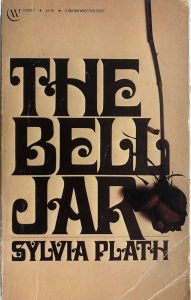 Given my love of mental hospital accounts and women’s autofiction, it’s a wonder I’d not read this before my forties. It was first published under the pseudonym “Victoria Lucas” because Plath thought it immature, “an autobiographical apprentice work which I had to write in order to free myself from the past.” Esther Greenwood is the stand-in for Plath: a talented college student who, after working in New York City during the remarkable summer of 1953, plunges into mental ill health. Chapter 13 is amazing and awful at the same time as Esther attempts suicide thrice in one day, toying with a silk bathrobe cord and ocean waves before taking 50 pills and walling herself into a corner of the cellar. She bounces between various institutional settings, undergoing electroshock therapy – the first time it’s horrible, but later, under a kind female doctor, it’s more like it’s ‘supposed’ to be: a calming reset.
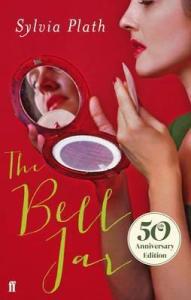 The 19-year-old is obsessed with the notion of purity. She has a couple of boyfriends but decides to look for someone else to take her virginity. Beforehand, the asylum doctor prescribes her a fitting for a diaphragm. A defiant claim to the right to contraception despite being unmarried is a way of resisting the bell jar – the rarefied prison – of motherhood. Still, Esther feels guilty about prioritizing her work over what seems like feminine duty: “Why was I so maternal and apart? Why couldn’t I dream of devoting myself to baby after fat puling baby? … I was my own woman.” Plath never reconciled parenthood with poetry. Whether that’s the fault of Ted Hughes, or the times they lived in, who can say. For her and for Esther, the hospital is a prison as well – but not so hermetic as the turmoil of her own mind. How ironic to read “I took a deep breath and listened to the old brag of my heart. I am, I am, I am” knowing that this was published just a few weeks before this literary genius ceased to be.
Apart from an unfortunate portrayal of a “negro” worker at the hospital, this was an enduringly relevant and absorbing read, a classic to sit alongside Emily Holmes Coleman’s The Shutter of Snow and Janet Frame’s Faces in the Water.
(Secondhand – it’s been in my collection so long I can’t remember where it’s from, but I’d guess a Bowie Library book sale or Wonder Book & Video / Public library – I was struggling with the small type so switched to a recent paperback and found it more readable)
Ariel by Sylvia Plath (1965)
Impossible not to read this looking for clues of her death to come:
Dying
Is an art, like everything else.
I do it exceptionally well.
(from “Lady Lazarus”)
Eternity bores me,
I never wanted it.
(from “Years”)
The woman is perfected.
Her dead
Body wears the smile of accomplishment
(from “Edge”)
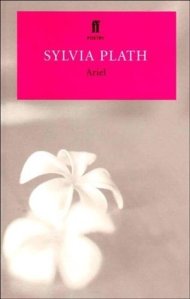 I feel incapable of saying anything fresh about this collection, which takes no prisoners. The images and vocabulary are razor-sharp. First and last lines or stanzas are particularly memorable. (“Morning Song” starts “Love set you going like a fat gold watch”; “Lady Lazarus” ends “Out of the ash / I rise with my red hair / And I eat men like air.”) Words and phrases repeat and gather power as they go. “The Applicant” mocks the obligations of a wife: “A living doll … / It can sew, it can cook. It can talk, talk, talk. … // … My boy, it’s your last resort. / Will you marry it, marry it, marry it.” I don’t know a lot about Plath’s family life, only that her father was a Polish immigrant and died after a long illness when she was eight, but there must have been some daddy issues there – after all, “Daddy” includes the barbs “Daddy, I have had to kill you” and “If I’ve killed one man, I’ve killed two— / The vampire who said he was you / And drank my blood for a year, / Seven years, if you want to know.” It ends, “Daddy, daddy, you bastard, I’m through.” Several later poems in a row, including “Stings,” incorporate bee-related imagery, and Plath’s father was an international bee expert. I can see myself reading this again and again in future, and finding her other collections, too – all but one of them posthumous. (Secondhand – RSPCA charity shop, Newbury)
Short Stories in September Roundup: Munro, Ulrich; Virago Anthology
This comes a few days later than I intended, but better late than never. I’ve been focusing on short stories in September for the last eight years. In September 2021 I read 12 short story collections; last year it was 11.5; this year I finished 11, so pretty much par for the course, and pushing my year-to-date total to 30 story collections – not bad going for someone who feels like she hardly ever reads stories and doesn’t seek them out. This year’s reviews are here, here and here.
Hateship, Friendship, Courtship, Loveship, Marriage by Alice Munro (2001)
I always think I’ve never read Munro before, but that’s not the case. A decade or more ago I read Lives of Girls and Women. The ironic thing is that I chose it because I thought it was the odd one out in her oeuvre, being a novel rather than short stories. In fact, it’s a linked story collection, and really they might as well be discrete stories. That book left no impression, but I’d happened to accumulate several more Munro collections over the years and, especially after she won the Nobel, felt delinquent for not reading her.
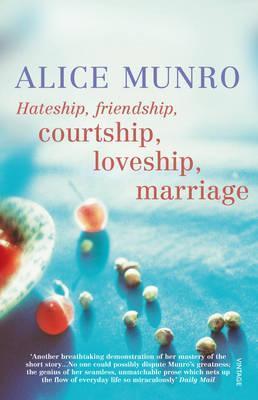 There are nine stories in the 320-page volume, so the average story here is 30–35 pages – a little longer than I tend to like, but it allows Munro to fill in enough character detail that these feel like miniature novels; they certainly have all the emotional complexity. Her material is small-town Ontario and the shifts and surprises in marriages and dysfunctional families.
More commonly, she employs an omniscient third person to allow her to move between minds, yet I found that the three first-person stories were among the most memorable: in “Family Furnishings,” a woman recalls the encounter with her father’s cousin that made her resolve to be a writer; in “Nettles,” childhood friends meet again in midlife and a potential affair is quashed by the report of a tragedy; in “Queenie,” a young woman spends a short time living with her older stepsister and her husband, her music teacher she ran off with. This last one reminded me of Tessa Hadley’s stories – no doubt Munro has been an influence on many.
For instance, the title story, which opens the collection, gave me strong Elizabeth Hay and Mary Lawson vibes. A housekeeper sets off on the train to start a new life, encouraged by a romantic correspondence fabricated by her adolescent charge, Sabitha, and her friend. Munro pays close attention to domestic minutiae like furniture and clothing. Illness and death are frequent seeds of a story: cancer in “Floating Bridge,” the suicide of an ALS patient in “Comfort,” and dementia in the oft-anthologized “The Bear Came Over the Mountain.”
Individual plots are less likely to stay with me than the quality of the prose, the compassionate eye, and the feeling of being immersed in a novel-length narrative when really I was only halfway through a few dozen pages. I’ll certainly read more Munro collections. (Free from a neighbour) 
Close Company: Stories of Mothers and Daughters, ed. Christine Park and Caroline Heaton (1987)
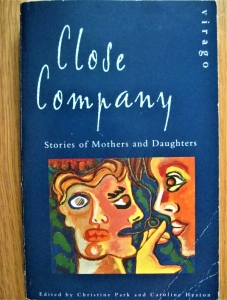 Back in 2021, I read 14 of these 25 stories (reviewed here) and set the book aside. At that time I noted the repeated theme of women’s expectations of their daughters, and that was true of the remainder as well. The editors quote Simone de Beauvoir in the introduction, “the daughter is for the mother at once her double and another person.” So in Emily Prager’s “A Visit from the Footbinder,” Lady Guo Guo subjects her spirited daughter to the same painful procedure she underwent as a child. The cultural detail was overpowering in this one, like the author felt she had to prove she’d done her research on China. The father–daughter relationship struck me more in Judith Chernaik’s Jewish Brooklyn-set “Honor Thy Father and Thy Mother.”
From this batch, two stood out the most: in “Children’s Liberation” by Jan Clausen, Lisa rebels against her lesbian mother’s bohemian lifestyle by idolizing heterosexual love stories; and in Zhang Jie’s “Love Must Not Be Forgotten,” a daughter comes to understand her mother by reading her diary about her doomed romance. My overall favourites, though, were still the stories by Jane Gardam, Janet Frame, Alice Walker and Charlotte Perkins Gilman. (Free mall bookshop) 
Small, Burning Things by Cathy Ulrich (2023)
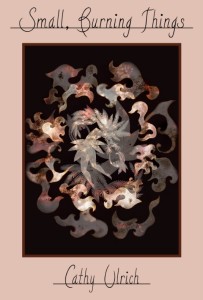 Ulrich’s second collection contains 50 flash fiction pieces, most of which were first published in literary magazines. She often uses the first-person plural and especially the second person; both “we” and “you” are effective ways of implicating the reader in the action. Her work is on a speculative spectrum ranging from magic realism to horror. Some of the situations are simply bizarre – teenagers fall from the sky like rain; a woman falls in love with a giraffe; the mad scientist next door replaces a girl’s body parts with robotic ones – while others are close enough to the real world to be terrifying. The dialogue is all in italics. Some images recur later in the collection: metamorphoses, spontaneous combustion. Adolescent girls and animals are omnipresent. At a certain point this started to feel repetitive and overlong, but in general I appreciated the inventiveness.
Published on 2 July by Okay Donkey Press. With thanks to publicist Lori Hettler for the free e-copy for review.
 I also read the first two stories in The Best Short Stories 2023: The O. Henry Prize Winners, edited by Lauren Groff. If these selections by Ling Ma and Catherine Lacey are anything to go by, Groff’s taste is for gently magical stories where hints of the absurd or explained enter into everyday life. Ma’s “Office Hours” has academics passing through closet doors into a dream space; the title of Lacey’s “Man Mountain” is literal. I’ll try to remember to occasionally open the book on my e-reader to get through the rest.
Reviews: de Jongh, Eipe, Parker and Scull
Today’s roundup includes a graphic novel set during the U.S. Dust Bowl, a Dylan Thomas Prize-shortlisted poetry collection infused with Islamic imagery, a book about adaptive technologies for the disabled, and a set of testimonies from the elderly and terminally ill.
Days of Sand by Aimée de Jongh (2021; 2022)
[Translated from the Dutch by Christopher Bradley]
Dust can drive people mad.
 This terrific Great Depression-era story was inspired by the real-life work of photographers such as Dorothea Lange who were sent by the Farm Security Administration, a new U.S. federal agency, to document the privations of the Dust Bowl in the Midwest. John Clark, 22, is following in his father’s footsteps as a photographer, leaving New York City to travel to the Oklahoma panhandle. He quickly discovers that struggling farmers are believed to have brought the drought on themselves through unsustainable practices. Many are fleeing to California. The locals are suspicious of John as an outsider, especially when they learn that he is working to a checklist (“Orphaned children”, “Family packing car to leave”).
“The best photos have an instant impact. Right away, they grab our attention. They tell a story, or deliver a message. The question is: how do you make that happen?” one of his employers had asked. John grows increasingly uncomfortable with being part of what is essentially a propaganda campaign when he develops a personal fondness for Cliff, a little boy who offers to be his assistant, and Betty, a pregnant widow whose runaway horse he finds. The deprivation and death he sees at close hand bring back memories of his father’s funeral four years ago.
Whether a cityscape or the midst of a dust storm, de Jongh’s scenes are stark and evocative. Each chapter opens with a genuine photograph from the period (de Jongh travelled to the USA for archival and on-the-ground research thanks to a grant from the Dutch Foundation for Literature), and some panes mimic B&W photos the FSA team took. It’s rare for me to find the story and images equally powerful in a graphic novel, but that’s definitely the case here.


With thanks to SelfMadeHero for the free copy for review.
Auguries of a Minor God by Nidhi Zak/Aria Eipe (2021)
 This debut poetry collection is on the Dylan Thomas Prize shortlist. I’ve noted that recent winners – such as Lot by Bryan Washington and Luster by Raven Leilani – have in common a distinctive voice and use of language, which chimes with what Thomas was known for (see my recent review of Under Milk Wood) and clarifies what the judges are looking for.
The placement of words on the page seems to be very important in this volume – spread out or bunched together, sometimes descending vertically, a few in grey. It’s unfortunate, then, that I read an e-copy, as most of the formatting was lost when I put it on my Nook. The themes of the first part include relationships, characterized by novelty or trauma; tokens of home experienced in a new land; myths; and nature. Section headings are in Malayalam.
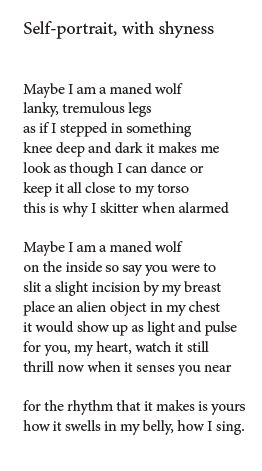
The book culminates in a lengthy, astonishingly nimble abecedarian in which a South Asian single father shepherds his children through English schooling as best he can while mired in grief over their late mother. This bubbles over in connection with her name, Noor, followed by a series of “O” apostrophe statements, some addressed to God and others exhorting fellow believers. Each letter section gets progressively longer. I was impressed at how authentically the final 30-page section echoes scriptural rhythms and content – until I saw in the endnotes that it was reproduced from a 1997 translation of the Quran, and felt a little cheated. Still, “A is for…” feels like enough to account for this India-born poet’s shortlisting. (The Prize winner will be announced on Thursday the 12th.)
With thanks to Midas PR for the free e-copy for review.
Hybrid Humans: Dispatches from the Frontiers of Man and Machine by Harry Parker (2022)
 I approached this as a companion to To Be a Machine by Mark O’Connell and that is precisely what I found, with Parker’s personal insight adding a different angle to the discussion of how technology corrects and transcends flawed bodies. Parker was a captain in the British Army in Afghanistan when an IED took his legs. Now he wears prostheses that make him roughly 12% machine. “Being a hybrid human means expensive kit – you have to pay for the privilege of leading a normal life.” He revisits the moments surrounding his accident and his adjustment to prostheses, and meets fellow amputees like Jack, who was part of a British medical trial on osseointegration (where titanium implants come out of the stump for a prosthesis to attach to) that enabled him to walk much better. Other vets they know had to save up and travel to Australia to have this done because the NHS didn’t cover it.
Travelling to the REHAB trade fair in Karlsruhe, Parker learns that disability, too, can be the mother of invention. Virtual reality and smartphone technology are invaluable, with an iPhone able to replace up to 11 single-purpose devices. Yet he also encounters disabled people who are happy with their lot and don’t look to tech to improve it, such as Jamie, who’s blind and relies only on a cane. And it’s not as if tools to compensate for disability are new; the book surveys medical technologies that have been with us for decades or even centuries: from glass eyes to contact lenses; iron lungs, cochlear implants and more.
Pain management, PTSD, phantom limbs, foreign body rejection, and deep brain stimulation for Parkinson’s disease are other topics in this wide-ranging study that is at the juncture of the personal and political. “A society that doesn’t look after the vulnerable isn’t looking after anyone – I’d learnt first-hand that we’re all just a moment from becoming vulnerable,” Parker concludes. I’ll hope to see this one on next year’s Barbellion Prize longlist.
With thanks to Profile Books/Wellcome Collection for the free copy for review.
Regrets of the Dying: Stories and Wisdom that Remind Us How to Live by Georgina Scull (2022)
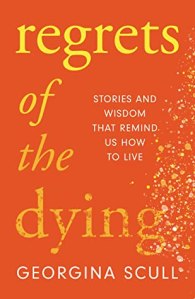 A medical crisis during pregnancy that had her minutes from death was a wake-up call for Scull, leading her to rethink whether the life she was living was the one she wanted. She spent the next decade interviewing people in her New Zealand and the UK about what they learned when facing death. Some of the pieces are like oral histories (with one reprinted from a blog), while others involve more of an imagining of the protagonist’s past and current state of mind. Each is given a headline that encapsulates a threat to contentment, such as “Not Having a Good Work–Life Balance” and “Not Following Your Gut Instinct.” Most of her subjects are elderly or terminally ill. She also speaks to two chaplains, one a secular humanist working in a hospital and the other an Anglican priest based at a hospice, who recount some of the regrets they hear about through patients’ stories.
Recurring features are not spending enough time with family and staying too long in loveless or unequal relationships. Two accounts that particularly struck me were Anthea’s, about the tanning bed addiction that gave her melanoma, and Millicent’s, guilty that she never went to the police about a murder she witnessed as a teenager in the 1930s (with a NZ family situation that sounds awfully like Janet Frame’s). Scull closes with 10 things she’s learned, such as not to let others’ expectations guide your life and to appreciate the everyday. These are readable narratives, capably captured, but there isn’t much here that rises above cliché.
With thanks to publicist Claire Morrison and Welbeck for the free copy for review.
Would you be interested in reading one or more of these?
Six Degrees of Separation: From The End of the Affair to Nutshell

 This month we begin with The End of the Affair by Graham Greene, a perfect excuse for me to review a novel I finished more than a year ago. This was only my second novel from Greene, after The Quiet American many a year ago. It’s subtle: low on action and majoring on recollection and regret. Mostly what we get are the bitter memories of Maurice Bendrix, a writer who had an affair with his clueless friend Henry’s wife Sarah during the last days of the Second World War. After she broke up with him, he remained obsessed with her and hired Parkis, a lower-class private detective, to figure out why. To his surprise, Sarah’s diaries revealed, not that she’d taken up with another man, but that she’d found religion. Maurice finds himself in the odd position of being jealous of … God? (More thoughts here.)
 #1 I asked myself if I’d ever read another book where someone was jealous of a concept rather than a fellow human being, and finally came up with one. I enjoyed Cooking as Fast as I Can by Cat Cora even though I wasn’t aware of this Food Network celebrity and restaurateur. Her memoir focuses on her Mississippi upbringing in a half-Greek adoptive family and the challenges of being gay in the South. Separate obsessions plagued her marriage; I remember at one point she gave her wife an ultimatum: it’s either me or the hot yoga.
 #2 Yoga for People Who Can’t Be Bothered to Do It by Geoff Dyer is one of my favourite-ever book titles. The title is his proposed idea for a self-help book, but … wait for the punchline … he couldn’t be bothered to write it. It’s a book of disparate travel essays, with him as the bumbling antihero, sluggish and stoned. This wasn’t one of his better books, but his descriptions and one-liners are always amusing (my review).
 #3 Another book with a fantastic title that has nothing to do with the contents: Let’s Explore Diabetes with Owls by David Sedaris. Again, not my favourite of his essay collections (try Me Talk Pretty One Day or When You Are Engulfed in Flames instead), but he’s reliable for laughs.
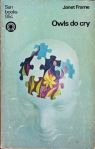 #4 No more about owls than the previous one; Owls Do Cry by Janet Frame is an autobiographical novel that tells the same story as her An Angel at My Table trilogy (but less compellingly): a hardscrabble upbringing in New Zealand and mental illness that led to incarceration in psychiatric hospitals. The title phrase is from Ariel’s song in The Tempest, which the Withers siblings learn at school. I’ve been ‘reading’ this for nearly a year and a half; really, it’s mostly been on the set-aside shelf for that time.
 #5 Another title drawn from Shakespeare: there are more things by Yara Rodrigues Fowler is one of my Most Anticipated Books of 2022. It’s about a female friendship that links Brazil and London. I’m holding out hope for a review copy.
 #6 Fowler’s title comes from Hamlet, which provides the plot for Ian McEwan’s Nutshell, one of his strongest novels of recent years. Within a few pages, I was captivated and utterly convinced by the voice of this contemporary, in utero Hamlet. Not even born and already a snob with an advanced vocabulary and a taste for fine wine, this foetus is a delight to spend time with. His captive state pairs perfectly with Hamlet’s existential despair, but also makes him (and us as readers) part of the conspiracy: even as he wants justice for his father, he has to hope his mother and uncle will get away with their crime; his future depends on it.
Where will your chain take you? Join us for #6Degrees of Separation! (Hosted on the first Saturday of each month by Kate W. of Books Are My Favourite and Best.)
Have you read any of my selections? Tempted by any you didn’t know before?
Three on a Theme for Mother’s Day
In advance of (American) Mother’s Day, I picked up two novels and a set of short stories that explore the bonds between mothers and their children, especially daughters. The relationships can be fraught or fractured, but always provide good fodder for psychologically astute fiction.
Mother for Dinner by Shalom Auslander (2020)
Hope: A Tragedy, Auslander’s 2012 debut, is among my absolute favorites, an outrageously funny novel that imagines Anne Frank is alive and dwelling in a suburban attic, frantically tapping out her endless magnum opus. Solomon Kugel, the sap blessed to have an icon sharing his home, has a deluded mother who actually grew up in Brooklyn but believes she survived the Holocaust and now hoards food and curses the Nazis who ruined her life.
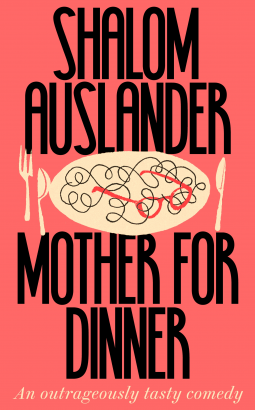 I start with that bit of synopsis because Mother for Dinner showcases rather analogous situations and attitudes, but ultimately didn’t come together as successfully for me. It’s a satire on the immigrant and minority experience in the USA – the American dream of ‘melting pot’ assimilation that we see contradicted daily by tribalism and consumerism. Seventh Seltzer works in Manhattan publishing and has to vet identity stories vying to be the next Great American Novel: “The Heroin-Addicted-Autistic-Christian-American-Diabetic one” and “the Gender-Neutral-Albino-Lebanese-Eritrean-American” one are two examples. But Seventh is a would-be writer himself, compelled to tell the Cannibal-American story.
For years Mudd, the Seltzer family matriarch, has been eating Whoppers for each meal in a customary fattening-up called the Cornucopiacation. She expects her 12 children, who are likely the last of the Cannibal kind, to carry on the tradition of eating her corpse after her death. It’s a way for ancestors to live on in their descendents. The Cannibal Guide, disguised as a deer processing manual, sets out the steps: Drain (within two hours), Purge, Partition, Consume (within 24 hours). Unclish, the Seltzers’ uncle, drilled the rules into them when they were kids through rhymes like “A bite and half / and you won’t need another, / whether it’s your father, your sister, / or even your mother.” From her deathbed, Mudd apportions her body parts to her offspring, some tenderly and some vengefully. Their inheritance – a Brooklyn dump that will still net $5.2 million – is conditional on them performing the ritual.
Interspersed with sections on the practicalities of butchering and cooking a morbidly obese woman are flashbacks to key moments of Cannibal history, which has turned into myth. In 1914, Julius Seltzer left the paradisiacal “Old Country” with his sister Julia, who pretended to be his wife and traveled with him to Detroit to work for Henry Ford. (An overt parody of Jeffrey Eugenides’ Middlesex.) Mudd is vocally intolerant of all other minority groups, from Blacks to homosexuals, and always chooses the version of history that reflects best on her own ancestors, while the Seltzers’ father was more willing to admit flaws.

My proof copy, with a joke on the cover, came with a napkin!
Auslander is pushing the boundary of what an author can get away with, not just with a literal cannibalism storyline but also with jokes about historical atrocities and the recent trend for outing beloved figures as reprehensible (what Seventh calls “Contemporary Assholization Studies”). He shares Lionel Shriver’s glee for tipping sacred cows. I did appreciate his picture of the pervasiveness of xenophobia – the “You’re Not Me” look that anyone can get when walking in an unfamiliar neighborhood – and his willingness to question the value of beliefs and ceremonies once they’ve stopped being reasonable or of use. But with all the siblings known by numbers, it’s hard to distinguish between them. The novel ends up heavy on ideas but light on characterization, and as a whole it leaves a bit of a bad taste in the mouth.
My rating: 
With thanks to Picador for the proof copy for review.
The Mothers by Brit Bennett (2016)
{CONTAINS MILD SPOILERS.}
Like so many who were impressed with the Women’s Prize-shortlisted The Vanishing Half, I rushed to get hold of Bennett’s California-set first novel, which, while not as skillfully put together, is nearly as emotionally engaging. After her mother’s suicide, 17-year-old Nadia Turner only has her father, a Marine, but they are bolstered by their church family at Upper Room Chapel. Nadia is a bright girl headed to Michigan for college, but in her senior year she gets mixed up with Pastor Sheppard’s 21-year-old son, Luke, leading to a pregnancy and abortion that his parents swiftly cover up / pay for. Luke drops her at the clinic and hands over the money, but doesn’t pick her up; that looks the acrimonious end of their relationship.
But in the years to come, especially when Nadia takes a break from law school to care for her father, their lives will intersect again. Nadia’s best friend in that final year of high school was Aubrey Evans, who is estranged from her mother, who failed to protect the girl from sexual abuse at the hands of her own boyfriend. Now Aubrey wears a purity ring, enamored with the idea that faith will make her clean again. Once Nadia leaves, she starts dating Luke, ignorant of her best friend’s history with him. This sets up a love triangle mired in layers of secrets.
 There is dramatic irony here between what the characters know about each other and what we, the readers, know – echoed by what “we,” the church Mothers, observe in the first-person plural sections that open most chapters. I love the use of a Greek chorus to comment on a novel’s action, and The Mothers reminded me of the elderly widows in the Black church I grew up attending. (I watched the video of a wedding that took place there early this month and there they were, perched on aisle seats in their prim purple suits and matching hats.)
Nadia and Aubrey are relatable characters, and Luke earns our sympathy after the cruel return of his football injury. (I was intrigued to see that Peter Ho Davies was one of Bennett’s teachers – his novel A Lie Someone Told You About Yourself is a rare picture of male grief after abortion, also present here.) Bennett explores multiple facets of motherhood: memories of a mother, the absence of a mother, the choice to become a mother, and people who act in the place of a mother by providing physical care or being a source of moral support.
The timeline is a bit too long, which makes the plot wander more than it needs to, but this is a warm and bittersweet novel that always held my interest. Bennett has produced two winners in a row, and I look forward to seeing what she’ll do next.
A favorite line: “Maybe mothers were inherently vast and unknowable.” (not literally vast like in the Auslander!)
Source: Birthday gift (secondhand) from my wishlist last year
My rating:
Close Company: Stories of Mothers and Daughters, ed. by Christine Park and Caroline Heaton (1987)
I read 14 of 25 stories, skipping to the ones that most interested me (by familiar names like Sue Miller, Sylvia Plath, and Jeanette Winterson), and will read the rest next year. The only story I’d encountered before was Margaret Atwood’s “Significant Moments in the Life of My Mother,” originally published in Bluebeard’s Egg. The title phrase comes from Jamaica Kincaid’s story. A recurring theme is women’s expectations for their daughters, who might repeat or reject their own experiences. As the editors quote from Simone de Beauvoir in the introduction, “the daughter is for the mother at once her double and another person.”
I particularly liked “The Pangs of Love” by Jane Gardam, a retelling of the Hans Christian Andersen fairy tale of “The Little Mermaid,” and “Swans” by Janet Frame, in which a mother takes her two little girls for a cheeky weekday trip to the beach. Fay and Totty are dismayed to learn that their mother is fallible: she chose the wrong beach, one without amenities, and can’t guarantee that all will be well on their return. A dusky lagoon full of black swans is an alluring image of peace, quickly negated by the unpleasant scene that greets them at home.
Two overall standouts thus far were “Everyday Use” by Alice Walker and “The Unnatural Mother” by Charlotte Perkins Gilman. In Walker’s story, which draws on the parable of the Prodigal Son, a hip Afro-wearing daughter returns to her mother’s rural home and covets the quilts and butter churn – to her this is quaint folk art that she wants to take away and display, but her mother and sister resent her condescension towards their ‘backward’ lives.
Gilman is best known for The Yellow Wallpaper, but this story has a neat connection with another classic work: the main character is named Esther Greenwood, which is also the protagonist’s name in Plath’s The Bell Jar (consider this a preview of my next Book Serendipity roundup!). A gossiping gaggle of women discuss Esther’s feral upbringing and blame it for her prioritizing altruism over her duty to her child. A perfect story.
Source: Free mall bookshop
My rating: (so far) 
If you read just one … Make it The Mothers. (But do also pick out at least a few stories from the Close Company anthology.)
Book Serendipity, Late 2020 into 2021
I call it Book Serendipity when two or more books that I read at the same time or in quick succession have something pretty bizarre in common. Because I have so many books on the go at once (20+), I suppose I’m more prone to such incidents than some. I also list some of my occasional reading coincidences on Twitter. The following are in chronological order.
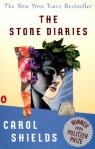
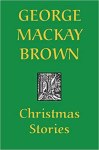
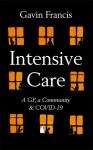
- The Orkney Islands were the setting for Close to Where the Heart Gives Out by Malcolm Alexander, which I read last year. They showed up, in one chapter or occasional mentions, in The Frayed Atlantic Edge by David Gange and The Stone Diaries by Carol Shields, plus I read a book of Christmas-themed short stories (some set on Orkney) by George Mackay Brown, the best-known Orkney author. Gavin Francis (author of Intensive Care) also does occasional work as a GP on Orkney.

- The movie Jaws is mentioned in Mr. Wilder and Me by Jonathan Coe and Landfill by Tim Dee.
- The Sámi people of the far north of Norway feature in Fifty Words for Snow by Nancy Campbell and The Mercies by Kiran Millwood Hargrave.
- Twins appear in Mr. Wilder and Me by Jonathan Coe and Tennis Lessons by Susannah Dickey. In Vesper Flights Helen Macdonald mentions that she had a twin who died at birth, as does a character in Miss Benson’s Beetle by Rachel Joyce. A character in The Light Years by Elizabeth Jane Howard is delivered of twins, but one is stillborn. From Wrestling the Angel by Michael King I learned that Janet Frame also had a twin who died in utero.
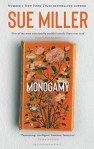
- Fennel seeds are baked into bread in The Mercies by Kiran Millwood Hargrave and The Strays of Paris by Jane Smiley. Later, “fennel rolls” (but I don’t know if that’s the seed or the vegetable) are served in Monogamy by Sue Miller.


- A mistress can’t attend her lover’s funeral in Here Is the Beehive by Sarah Crossan and Tennis Lessons by Susannah Dickey.
- A sudden storm drowns fishermen in a tale from Christmas Stories by George Mackay Brown and The Mercies by Kiran Millwood Hargrave.
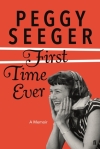 Silver Spring, Maryland (where I lived until age 9) is mentioned in one story from To Be a Man by Nicole Krauss and is also where Peggy Seeger grew up, as recounted in her memoir First Time Ever. Then it got briefly mentioned, as the site of the Institute of Behavioral Research, in Livewired by David Eagleman.
- Lamb is served with beans at a dinner party in Monogamy by Sue Miller and Larry’s Party by Carol Shields.
- Trips to Madagascar in Landfill by Tim Dee and Lightning Flowers by Katherine E. Standefer.
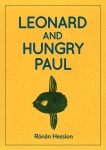 Hospital volunteering in My Year with Eleanor by Noelle Hancock and Leonard and Hungry Paul by Ronan Hession.
- A Ronan is the subject of Emily Rapp’s memoir The Still Point of the Turning World and the author of Leonard and Hungry Paul (Hession).
- The Magic Mountain (by Thomas Mann) is discussed in Scattered Limbs by Iain Bamforth, The Still Point of the Turning World by Emily Rapp, and Snow by Marcus Sedgwick.
- Frankenstein is mentioned in The Biographer’s Tale by A.S. Byatt, The Still Point of the Turning World by Emily Rapp, and Snow by Marcus Sedgwick.


- Rheumatic fever and missing school to avoid heart strain in Foreign Correspondence by Geraldine Brooks and Unsettled Ground by Claire Fuller. Janet Frame also had rheumatic fever as a child, as I discovered in her biography.
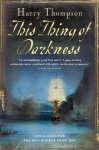
- Reading two novels whose titles come from The Tempest quotes at the same time: Owls Do Cry by Janet Frame and This Thing of Darkness by Harry Thompson.

- A character in Embers by Sándor Márai is nicknamed Nini, which was also Janet Frame’s nickname in childhood (per Wrestling the Angel by Michael King).
- A character loses their teeth and has them replaced by dentures in America Is Not the Heart by Elaine Castillo and The Light Years by Elizabeth Jane Howard.
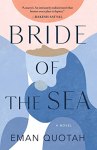
Also, the latest cover trend I’ve noticed: layers of monochrome upturned faces. Several examples from this year and last. Abstract faces in general seem to be a thing.




What’s the weirdest reading coincidence you’ve had lately?
Final 2020 Statistics and Retrospective / 2021 Reading Goals
In 2020…
My mother was supposed to visit us in May – my first visit from family in 13 years – and we were meant to be in the States for Christmas. These planned trips had to be cancelled, of course, and many gigs and regular events we would have attended in London and elsewhere couldn’t go ahead.
We managed two mini-breaks, one to Dorset and Devon and one to Hay-on-Wye, as well as a daytrip to Avebury and Silbury Hill, a night out at an Oxford comedy club, a few meals out, and some outdoor meet-ups with family and friends.
It was also the year we finally started doing video chats with family in America, and we kept up with certain friends better than ever thanks to Zoom meetings.
All told, I have no grounds for complaint about the year that has just passed. I know we are lucky to have had good health, stable employment and a wonderful town and community.
Moreover, I was spoiled for choice with online bookish and musical content last year:
- 45 livestreamed gigs (28+ Bookshop Band, 4 Duke Special, 3 Edgelarks and Megson, 2 Switchfoot, and 1 each by Bellowhead, Krista Detor, Lau, Mark Erelli and Nerina Pallot)
- 8 neighborhood book club meetings
- 8 literary festival events
- 8 quizzes (mostly general trivia; 1 bookish, run by Penguin – I did well among the hundreds of entries!)

- 6 literary prize announcements
- 4 festivals, mostly of folk music
- 4 book launch events
- 3 book club/preview events
- 2 conferences (mostly book-related)
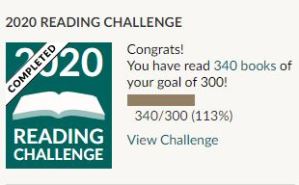
I’m also lucky that, unlike many, my reading was not affected by a stressful year. My reading total was very close to the previous year’s (343), which means that after five years above 300 and climbing, I’ve now figured out what my natural limit is. Next year I will aim for 340 again.
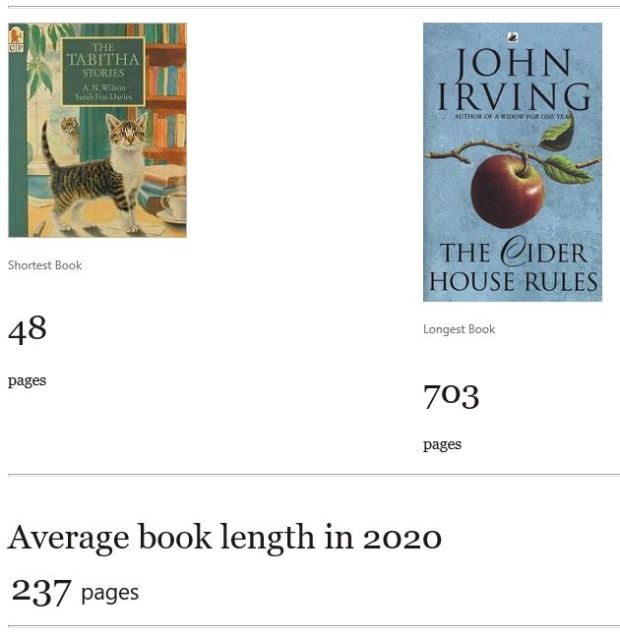
Some interesting additional statistics, courtesy of Goodreads:

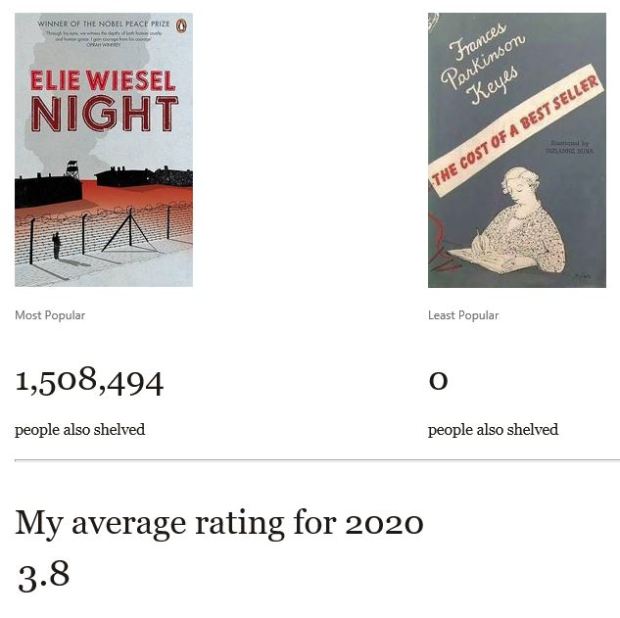
First read of the year: Last read of the year:
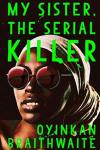

This was my Christmas book haul thus far (I have a feeling more may be marooned at my in-laws’ house), including money to spend the next time I can get to Bookbarn. I started a few of them right away.
My husband reads between one-fifth and one-quarter of what I do in a year, but by anyone’s accounting, 76 books is a lot in a year, especially considering that he has a busy full-time university lecturer job, is a town councillor, and is on lots of other voluntary committees. We overlap in some of our reading tastes (nature and travel writing, and some literary fiction) and I pass a lot of my review copies or library books his way, but he’s less devoted to new books and more likely to pick up books with heavier historical, political, or scientific content. If you’re interested, his rundown of his reading, including his top 3 reads of the year, is here.
2021 Reading Goals
My immediate priorities are to clear my set-aside pile (20 books) and everything I’m currently reading, start some January releases, and get back into some university library books to last me while I have limited access to our public library.
These are the 2021 proofs and finished copies I have received thus far:

Looking further ahead, I plan to continue and/or participate in many of 2020’s reading challenges again, as well as join in Liz’s Anne Tyler readalong for the novels I own and haven’t read yet. (The first one for me will be The Clock Winder in mid- to late February.)
Genres in which my achievement often lags far behind my intentions include literature in translation, biographies, and travel books. To address the first one, I’m going to set up a shelf in my house for unread works in translation, as a visual reminder and area to select from. I’ll start with the one below left as part of my “M” 4-in-a-Row.
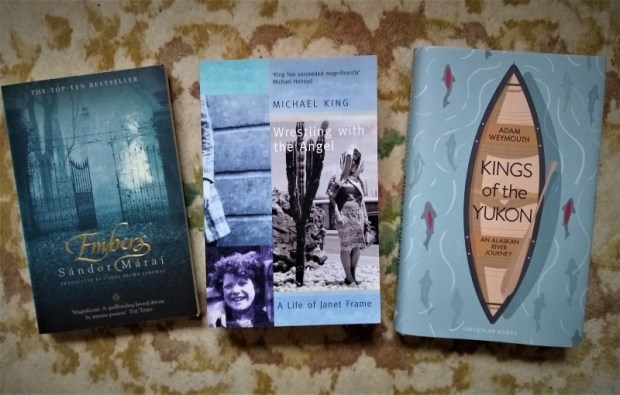
I would be happy to read even one biography this year, since they often take me many months to read. I’m going to make it the one above, of Janet Frame. Standard travel narratives intimidate me for some reason; I get on with them much better if they are in essays or incorporate memoir and/or nature writing. We have a whole shelf of unread travel books, many of which are of the more traditional going somewhere and reporting on what you see type. I want to clear the shelf to give them to my father-in-law, who expressed interest in reading more travel books. I’ll start with the 2018 Young Writer of the Year Award winner, above.
A “Classic of the Month” and “Doorstopper of the Month” are regular features on my blog, yet I don’t always manage to complete one each month. My aim will be to have at least one classic and one doorstopper on the go at all times, and hope that that translates to one a month as much as possible. Here’s my first pair:
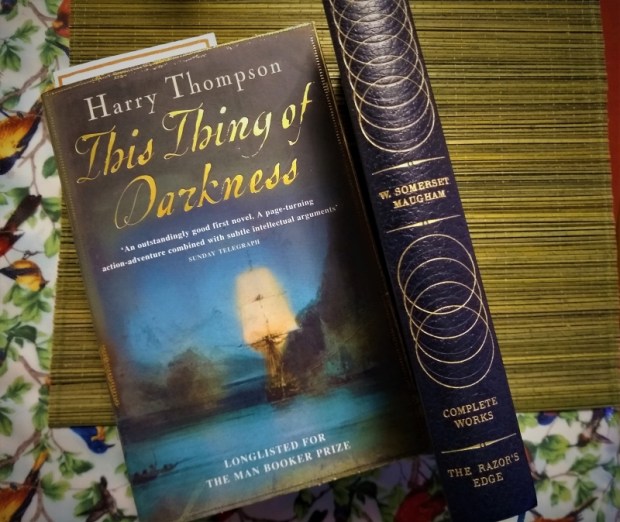
I can see that lots of other book bloggers are prioritizing doorstoppers and backlist reading in 2021. Apart from the modest goals I’ve set here, I expect my reading to be as varied and over-the-top as ever. I know I’ll read lots of 2021 releases, but backlist books are often more memorable, so I’ll try to arrange my stacks and choose my challenges so as to let them shine.
What are some of your reading goals for 2021?
Young Writer of the Year Award 2020: Shortlist Reviews and Predictions
Being on the shadow panel for the Sunday Times Young Writer of the Year Award was a bookish highlight of 2017 for me. I’m pleased for this year’s panelists, especially blogging friend Marina Sofia, to have had the same opportunity, and I look forward to hearing who they choose as their shadow panel winner on December 3rd and then attending the virtual prize ceremony on December 10th.

At the time of the shortlisting, I happened to have already read Exciting Times by Naoise Dolan and was halfway through Catherine Cho’s memoir Inferno. I got the poetry collection Surge by Jay Bernard out from the library to have another go (after DNFing it last year), and the kind folk of FMcM Associates sent me the other two shortlisted books, a poetry collection and a novel, so that I could follow along with the shadow panel’s deliberations. Here are my brief thoughts on all five nominees.
Surge by Jay Bernard (2019)
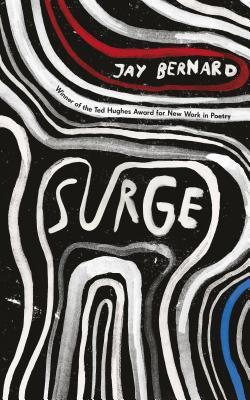 As a writer-in-residence at the George Padmore Institute, a research centre for radical Black history, in 2016, Bernard investigated the New Cross Massacre, a fire that killed 13 young people in 1981. In 2017, the tragedy found a horrific echo in the Grenfell Tower fire, which left 72 dead. This debut poetry collection bridges that quarter-century through protest poems from various perspectives, giving voice to victims and their family members and exploring the interplay between race, sexuality and violence. Patois comes in at several points, most notably in “Songbook.” I especially liked “Peg” and “Pride,” and the indictment of government indifference in “Blank”: “It-has-nothing-to-do-with-us today issued this statement: / those involved have defended their actions and been … acquitted / retired with full pay”. On the whole, I found it difficult to fully engage with this collection, but I am reliably informed that Bernard’s protest poems have more impact when performed aloud.
Readalikes: In Nearby Bushes by Kei Miller, A Portable Paradise by Roger Robinson and Don’t Call Us Dead by Danez Smith
My rating:
Inferno by Catherine Cho (2020)
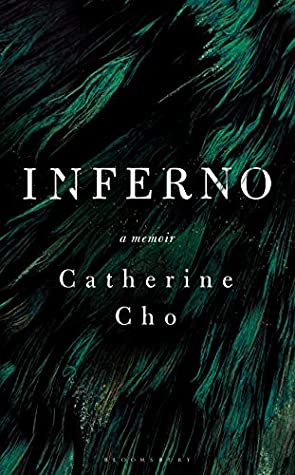 Cho, a Korean American literary agent based in London, experienced stress-induced postpartum psychosis after the birth of her son. She and her husband had returned to the USA when Cato was two months old to introduce him to friends and family, ending with a big Korean 100-day celebration at her in-laws’ home. Almost as soon as they got to her in-laws’, though, she started acting strangely: she was convinced cameras were watching their every move, and Cato’s eyes were replaced with “devil’s eyes.” She insisted they leave for a hotel, but soon she would be in a hospital emergency room, followed by a mental health ward. Cho alternates between her time in the mental hospital and a rundown of the rest of her life before the breakdown, weaving in her family history and Korean sayings and legends. Twelve days: That was the length of her hospitalization in early 2018, but Cho so painstakingly depicts her mindset that readers are fully immersed in an open-ended purgatory. She captures extremes of suffering and joy in this vivid account. (Reviewed in full here.)
Readalikes: An Angel at My Table by Janet Frame and Dear Scarlet by Teresa Wong
My rating:
Exciting Times by Naoise Dolan (2020)
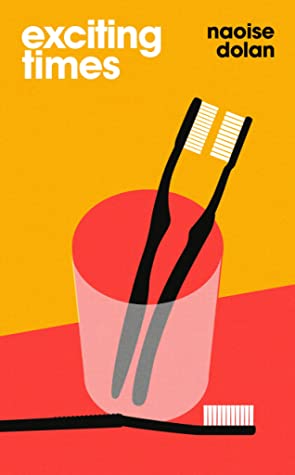 At 22, Ava leaves Dublin to teach English as a foreign language to wealthy preteens in Hong Kong and soon comes to a convenient arrangement with her aloof banker friend, Julian, who lets her live with him without paying rent and buys her whatever she wants. They have sex, yes, but he’s not her boyfriend per se, so when he’s transferred to London for six months, there’s no worry about hard feelings when her new friendship with Edith Zhang turns romantic. It gets a little more complicated, though, when Julian returns and she has to explain these relationships to her two partners and to herself. On the face of it, this doesn’t sound like it would be an interesting plot, and the hook-up culture couldn’t be more foreign to me. But with Ava Dolan has created a funny, deadpan voice that carries the entire novel. I loved the psychological insight, the playfulness with language, and the zingy one-liners (“I wondered if Victoria was a real person or three Mitford sisters in a long coat”). (Reviewed in full here.)
Readalikes: Besotted by Melissa Duclos and Conversations with Friends by Sally Rooney
My rating:
Tongues of Fire by Seán Hewitt (2020)
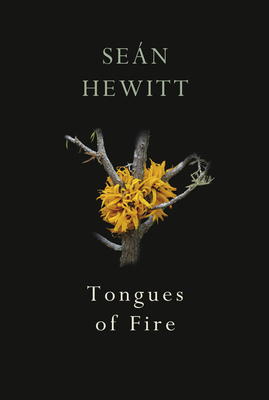 In the title poem, the arboreal fungus from the cover serves as “a bright, ancestral messenger // bursting through from one realm to another” like “the cones of God, the Pentecostal flame”. This debut collection is alive with striking imagery that draws links between the natural and the supernatural. Sex and grief, two major themes, are silhouetted against the backdrop of nature. Fields and forests are loci of meditation and epiphany, but also of clandestine encounters between men: “I came back often, // year on year, kneeling and being knelt for / in acts of secret worship, and now / each woodland smells quietly of sex”. Hewitt recalls travels to Berlin and Sweden, and charts his father’s rapid decline and death from an advanced cancer. A central section of translations of the middle-Irish legend “Buile Suibhne” is less memorable than the gorgeous portraits of flora and fauna and the moving words dedicated to the poet’s father: “You are not leaving, I know, // but shifting into image – my head / already is haunted with you” and “In this world, I believe, / there is nothing lost, only translated”.
Readalikes: Physical by Andrew McMillan and If All the World and Love Were Young by Stephen Sexton
My rating:
Nightingale by Marina Kemp (2020)
 Marguerite Demers, a 24-year-old nurse, has escaped Paris to be a live-in carer for elderly Jérôme Lanvier in southern France. From the start, she senses she’s out of place here – “She felt, as always in this village, that she was being observed”. She strikes up a friendship with a fellow outsider, an Iranian émigrée named Suki, who, in this story set in 2002, stands out for wearing a hijab. Everyone knows everyone here, and everyone has history with everyone else – flirtations, feuds, affairs, and more. Brigitte Brochon, unhappily married to a local farmer, predicts Marguerite will be just like the previous nurses who failed to hack it in service to the curmudgeonly Monsieur Lanvier. But Marguerite sticks up for herself and, though plagued by traumatic memories, makes her own bid for happiness. The novel deals sensitively with topics like bisexuality, euthanasia, and family estrangement, but the French provincial setting and fairly melodramatic plot struck me as old-fashioned. Still, the writing is strong enough to keep an eye out for what Kemp writes next. (U.S. title: Marguerite.)
Readalikes: French-set novels by Joanne Harris and Rose Tremain; The Hoarder by Jess Kidd
My rating:
General thoughts:
After last year’s unexpected winner – Raymond Antrobus for his poetry collection The Perseverance – I would have said that it’s time for a novel by a woman to win. However, I feel like a Dolan win would be too much of a repeat of 2017’s win (for Sally Rooney), and Kemp’s debut novel isn’t quite up to scratch. Much as I enjoyed Inferno, I can’t see it winning over these judges (three of whom are novelists: Kit de Waal, Sebastian Faulks and Tessa Hadley), though it would be suited to the Wellcome Book Prize if that comes back in 2021. So, to my surprise, I think it’s going to be another year for poetry.
I’ve been following the shadow panel’s thoughts via Marina’s blog and the others’ Instagram accounts and it looks like they are united in their admiration for the poetry collections, particularly the Hewitt. That would be my preference, too: I respond better to theme and style in poetry (Hewitt) than to voice and message (Bernard). However, I think that in 2020 the Times may try to trade its rather fusty image for something more woke, bearing in mind the Black Lives Matter significance and the unprecedented presence of a nonbinary author.
My predictions:
Shadow panel winner: Tongues of Fire by Seán Hewitt
Official winner: Surge by Jay Bernard
Have you read anything from this year’s shortlist?
Classic of the Month: Cider with Rosie by Laurie Lee (1959)
 (20 Books of Summer #2) Lee’s quaint family memoir is set in the years immediately after World War I. He was born in 1914 and his childhood unfolded in Stroud, Gloucestershire and nearby village Slad. I started reading Cider with Rosie in April 2019 when we stopped in Stroud for a night on the way back from a holiday in Devon. I got through the first 100 pages quickly, with the voice reminding me slightly of Gerald Durrell’s in his autobiographical trilogy, but then set the book aside for over a year before picking it back up for this summer’s food- and drink-themed reading. Taking such a long break wasn’t a major problem because the book’s vignettes are thematically arranged, so there was no plot as such to lose track of.
Lee was part of his father’s second brood, born out of the widower’s remarriage to his housekeeper. His father left his new family after just a few years, and for the next three decades Lee’s mother dutifully waited for a return that never came. Lee was a sickly child, doted on by his older half-sisters. He was surrounded by a large wider family of brothers, eccentric war-veteran uncles and duelling elderly neighbors who lived one upstairs and one downstairs in a sort of granny annex attached to their untidy, rambling 17th-century stone house. The book depicts a village on the cusp of modernization: everything was still done with wagons and horses, but that was soon to change.
It’s a nostalgic, evocative look at a country childhood. Lee captures a bygone era, portraying himself as similarly on the precipice of losing innocence. The title comes from a late moment when Rosie Burdock tempts the adolescent Lee with alcoholic cider and kisses underneath a hay wagon. This penultimate chapter on the lust of the flesh takes an alarming turn as he describes the village boys’ planned gang rape of a religious 16-year-old, Lizzy. Lee was among the boys who followed her into the woods one Sunday after church. Luckily, they lost their nerve and nothing happened, but Lee’s blasé recounting felt out of keeping and somehow more dated than the rest of his material. It left a sourness I couldn’t get over.
Quintessentially English but not as purely delightful as I expected, this was still a book I valued for its characterization and its description of golden moments in memory.
Some favorite passages:
“Summer, June summer, with the green back on earth and the whole world unlocked and seething – like winter, it came suddenly and one knew it in bed, almost before waking up; with cuckoos and pigeons hollowing the woods since daylight and the chipping of tits in the pear-blossom.”
“Myself, my family, my generation, were born in a world of silence; a world of hard work and necessary patience, of backs bent to the ground, hands massaging the crops, of waiting on weather and growth; of villages like ships in the empty landscapes and the long walking distances between them; … [The horse’s] eight miles an hour was the limit of our movements, as it had been since the days of the Romans. That eight miles an hour was life and death, the size of our world, our prison.”
Source: Free bookshop
My rating:
Ten more childhood memoirs:
A few I’ve written about here and prefer:
- Boy by Roald Dahl
- To the Is-land by Janet Frame
- Don’t Let’s Go to the Dogs Tonight by Alexandra Fuller
- Bookworm by Lucy Mangan
- Period Piece by Gwen Raverat
A couple of favorites I’ve never written up:
- Oleander, Jacaranda by Penelope Lively
- Hellfire and Herring by Christopher Rush
Plus a few that I haven’t liked quite as much:
- Maggie & Me by Damian Barr
- Childhood by Tove Ditlevsen
- Rosie by Rose Tremain
Bookbarn Book Haul & More
 We’re back from our weekend in Bristol and Exeter to hang out with university friends and attend our goddaughter’s dedication service. On the way (ish) down, we stopped at Bookbarn International, one of my favorite places to look for secondhand books. The shop is always coming up with new ideas and ventures – a rare books room, a café, stationery and store-brand merchandise, new stock alongside the used books, and so on – and has recently been doing some renovating of the main shop space. I contributed to a crowdfunder for this and got to pick up my rewards while I was there, including the items at right and a £10 store voucher, which, along with the small balance of my vendor account, more than covered my purchases that day.
We arrived around noon so started with a café lunch of all-day veggie cooked breakfasts plus cakes and coffee. Delicious! Then it was time for some dedicated browsing. All of the books on the main shop floor are £1 each; they’re working on restocking this area after the refurbishment. I found 12 books here, and ordered another two (the Janet Frame biography and Gail Godwin’s nonfiction book Heart) from the warehouse for £2 each.

From my book haul, I’m particularly pleased with:
- The sequel to another Robertson Davies novel I own
- The Frame biography – I loved her three-part autobiography and have also been dipping into her fiction; it will be fascinating to learn the ‘truth’ behind how she presented her life in memoir and autofiction. This copy looks to be in new condition, too.
- The Tulip by Anna Pavord, which I’ve long meant to read
- Another Carolyn Parkhurst novel – I loved The Dogs of Babel and Harmony
- Another Wendy Perriam novel – I read my first last year and have been hoping to find more
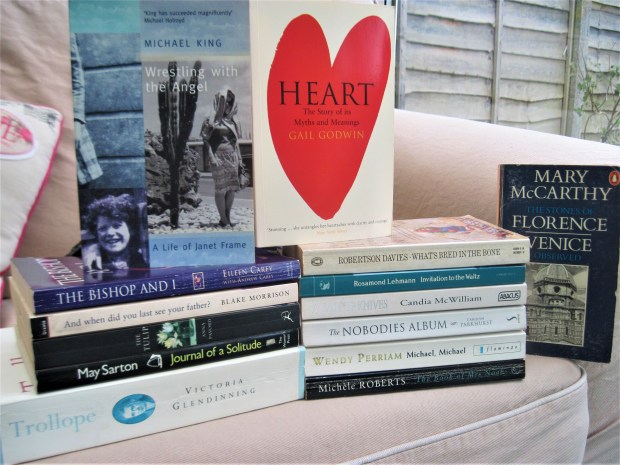
I also bought copies of two of my favorite memoirs, And When Did You Last See Your Father? and Journal of a Solitude (though I own a copy in America, I’d like it to be part of my rereading project this year). I now own two unread novels each by Candia McWilliam and Michèle Roberts and three by Rose Tremain, so I’ll need to be sure I read one from each author this year. I also have a bad habit of hoarding biographies but not reading them, so I want to at least read the Frame one before the year is out.
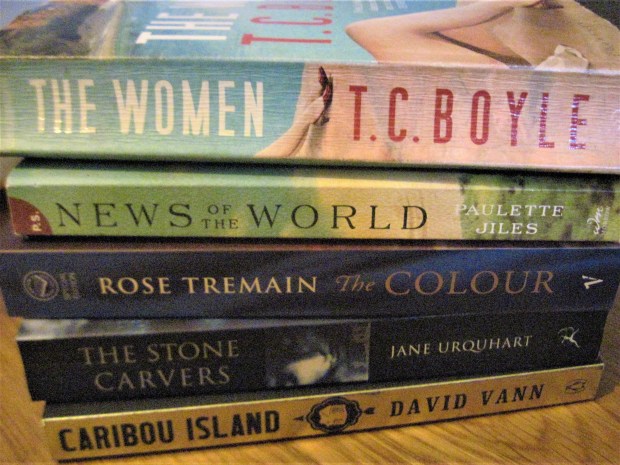
Between Bristol’s charity shops and Book-Cycle in Exeter, I bought another five novels during the weekend, including the Vann to reread and several by authors I want to increase my familiarity with. (Smug points for not buying the £2.50 copy of Boyle’s The Women at Bookbarn and then finding it at Book Cycle for 50 pence instead.) Total weekend spend on 19 books: £2.12.
 Bookish Beck = Rebecca Foster. American transplant to England. Freelance proofreader and book reviewer.
 Bookish Beck