20 Books of Summer, 5: A House Full of Daughters by Juliet Nicolson
Journalist and popular historian Juliet Nicolson is Vita Sackville-West’s granddaughter and one of the few remaining guardians of her living memory. This 2015 family memoir chronicles the lives of seven (eight, really) generations of women and travels from Malaga in the 1830s to present-day England. Nicolson acknowledges the inherited privilege that has typified this clan since the time of Vita’s grandmother but prefers to emphasize the roles that place and talent have played. It is enough of a biography of Vita to have won a Bisexual Book Award but, even though Vita only had sons, the focus is on mother–daughter bonds and how values and experiences have recurred across nearly two centuries.
First came Pepita, who rose from poverty in southern Spain to be a legendary dancer (“the Beyoncé of her day,” Nicolson quipped at an online event I attended – see below) and catch the eye of an English diplomat, Lionel Sackville-West, at a performance in Paris. Although Pepita was already married to her dancing teacher, she shook off her controlling mother and became Sackville-West’s longtime mistress, bearing him seven children. They could all have been disinherited for illegitimacy, however, had Pepita’s daughter Victoria not secured the link – and access to the family estate, Knole – by marrying her cousin, young Lionel Sackville-West. Vita wrote in Pepita, her joint biography of her mother and grandmother, “My mother appears to have been born with the faculty of attracting the most peculiar and improbable happenings,” such as a proposal of marriage from the recently widowed U.S. president, Chester Arthur, when she accompanied her father to Washington, DC.

Vita is the book’s presiding spirit and pivot point, but I already knew a lot about her from reading Victoria Glendinning’s biography plus two of her novels, so this material was too familiar. The fact that we then leap from daughters to a daughter-in-law (Nicolson’s mother, Philippa Tennyson-d’Eyncourt – these figures are all posher than posh!) is unfortunate as it dilutes the theme. However, Nicolson gives a behind-the-scenes look at Sissinghurst and the marriages between Vita and Harold, loving but also a cover for same-sex relationships for both of them; and Nigel and Philippa, which was a disaster almost from the start. Nicolson is also brave to admit the alcoholism that she subconsciously received from her mother. Philippa died at 58, but by admitting she had a problem Nicolson was able to get help and turn things around. Two generations followed: her two daughters and one granddaughter, who is now 11.
Nicolson sees patterns repeating across the generations: emotional abandonment by parents, “the lack of confidence, the fear of failure, and the seeking of approval where there was none” as well as “writing about the life and work of an earlier generation.” She hopes that with this book she has marked the arrival of “an increasingly tolerant and accepting generation, one that is not afraid to learn from the mistakes of the past and is determined not to repeat them”. (Fun but unrelated fact: Penelope Fitzgerald was one of Nicolson’s teachers.)

On the staircase leading up to Vita’s study in the tower, September 2009.
I visited Sissinghurst in 2009 – I can’t believe I haven’t been back in the past 15 years – and when we briefly lived in Sevenoaks in 2012 we also went to Knole. Both are magical places, especially Sissinghurst. For a few years there I was on a kick of reading a lot by and about Vita (I can recommend No Signposts in the Sea) and I also absorbed a fair bit via Adam Nicolson’s books (that’s Juliet’s brother) and his wife Sarah Raven’s – her recipes are to die for, and she’s kept up the gardens in a way that would make Vita proud. So I’d say it probably helps to have an existing interest in the family, but it should be a reasonably engrossing read in any case. (Free from a neighbour) 
Yesterday I watched “The Inspiration of Vita Sackville-West,” a recording of an RSL event held at the London Library in October that was aired to tie in with their annual Dalloway Day as well as the 95th anniversary of the publication of Virginia Woolf’s Orlando (for which Vita was a model) and, of course, Pride Month. The panelists were Juliet Nicolson; trans novelist Shola von Reinhold, whose LOTE (2020) won the Republic of Consciousness and James Tait Black Memorial Prizes; fashion critic Charlie Porter; and writer Olivia Laing. The discussion was expertly chaired by Shahidha Bari, an academic, fashion writer and presenter of BBC Two’s Inside Culture. She opened by asking each speaker to define Vita in one word. Nicolson chose “lover,” which von Reinhold echoed. Porter said “physical.” Laing cheated with a made-up compound word: “androgynous-aristocratic-aesthete.”
And the conversation went on from there. Nicolson spoke of her grandmother as a formidable woman, tall and tobacco-scented, and remembered the exotic treasures she and her siblings found in Vita’s tower study, such as a bottle of emerald-green nail polish. She described Vita as enigmatic and representing duality: she was born a Victorian but has been embraced by modernist and queer studies; she was conventional in some ways, but also a rebel. Porter has written about fashion and the Bloomsbury circle, with Woolf as one of his subjects, so he thinks about Vita mostly as a muse. He read from Vita’s letter to Harold describing meeting Woolf, whom she thought “quite old” and “atrociously dressed.” Nonetheless, she’d lost her heart. Woolf in her turn commented on Vita’s moustache, which was likely a sign of her Spanish heritage rather than excess testosterone as some have theorized.
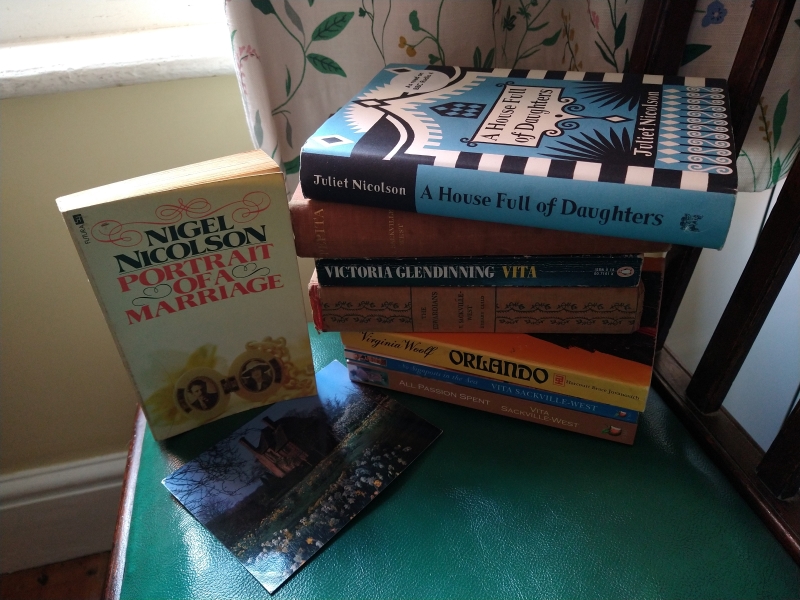
For von Reinhold, Vita is an early example of androgyny, a precursor to today’s trans and nonbinary identities. Laing, who has recently published a book on gardening, focused on Vita as a garden writer and designer. She said she doesn’t really value Vita’s novels but thinks her garden books (collections of her Observer columns) are extraordinary and read a passage in which she dreamt up the famous White Garden she would create at Sissinghurst (I read a kinda crummy novel about it a few years ago, The White Garden by Stephanie Barron).
The event gave a very good sense of Vita as a person but not as a writer. Audience questions brought up her poetry (oh God, it’s awful!) and travel books but that was as far as it went, and there was no discussion of the novels. Nicolson mentioned Pepita in passing but mostly talked about Portrait of a Marriage, which was half written by Vita and then finished by Nigel, a publisher (he was half of Weidenfeld and Nicolson, aka W&N). He had the courage to reveal his mother’s sexuality and Nicolson said that she believes Vita’s legacy is courage – to create a garden from scratch as a self-taught amateur, yes; but mostly to be oneself.
Young Writer of the Year Award Ceremony
It was great to be back at the London Library for last night’s Young Writer of the Year Award prize-giving ceremony. I got to meet Anne Cater (Random Things through my Letterbox) from the shadow panel, who’s coordinated a few blog tours I’ve participated in, as well as Ova Ceren (Excuse My Reading). It was also good to see shadow panelist Linda (Linda’s Book Bag) again and hang out with Clare (A Little Blog of Books), also on the shadow panel in my year, and Eric (Lonesome Reader), who seems to get around to every London literary event.
 In case you haven’t heard, the shadow panel chose Salt Slow by Julia Armfield as their very deserving winner, but the official winner was Raymond Antrobus for his poetry collection The Perseverance. In all honesty, I’d given no thought to the possibility of it winning, mostly because Antrobus has already won several major prizes for the book, including this year’s £30,000 Rathbones Folio Prize (I reviewed it for the Prize’s blog tour). Now, there’s no rule saying you can’t win multiple prizes for the same book, but what struck me strangely about this case is that Kate Clanchy was a judge for both the Folio Prize and the Young Writer Award.
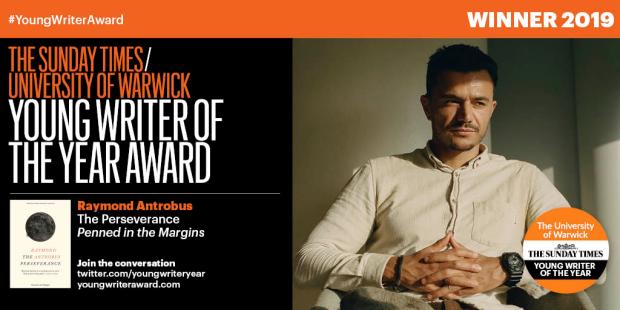
Antrobus seemed genuinely taken aback by his win and gave a very gracious speech in which he said that he looked forward to all the shortlistees contributing to the canon of English literature. He was quickly whisked away for a photo shoot, so I didn’t get a chance to congratulate him or have my book signed, but I did get to meet Julia Armfield and Yara Rodrigues Fowler and get their autographs.


Some interesting statistics for you: in three of the past four years the shadow panel has chosen a short story collection as its winner (and they say no one likes short stories these days!). In none of those four years did the shadow panel correctly predict the official winner – so, gosh, is it the kiss of death to be the shadow panel winner?!
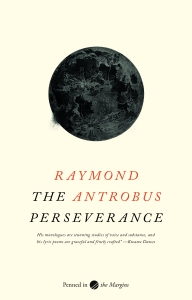 In the official press release, chair of judges and Sunday Times literary editor Andrew Holgate writes that The Perseverance is “both very personal and immensely resonant. The result is a memoir in verse very, very affecting and fresh.” Poet Kate Clanchy adds, “we wanted to find a writer who both speaks for now and who we were confident would continue to produce valuable, central work. … it was the humanity of the book, its tempered kindness, and the commitment not just to recognising difference but to the difficult act of forgiveness that made us confident we had found a winner for this extraordinary year.”
Also present at the ceremony were Sarah Moss (who teaches at the University of Warwick, the Award’s new co-sponsor) and Katya Taylor. I could have sworn I spotted Deborah Levy, too, but after conferring with other book bloggers we decided it was just someone who looked a lot like her.
In any event, it was lovely to see London all lit up with Christmas lights and to spend a couple of hours celebrating up-and-coming writing talent. (And I just managed to catch the last train home and avoid a rail replacement bus nightmare.)
Looking forward to next year already!
November Plans: Novellas, Margaret Atwood Reading Month & More
This is my fourth year joining Laura Frey and others in reading mostly novellas in November. Last year Laura put together a history of the challenge (here); it has had various incarnations but has no particular host or rules. Join us if you like! (#NovNov and #NovellasinNovember) The definition of a novella is loose – it’s based more on the word count than the number of pages – so it’s up to you what you’d like to classify as one. I generally limit myself to books of 150 pages or fewer, though I might go as high as 180-some if there aren’t that many words on a page. Some, including Laura and Susan, would be as generous as 200.


I’ve trawled my shelves for fiction and nonfiction stacks to select from, as well as a few volumes that include several novellas (I’d plan on reading at least the first one) and some slightly longer novels (150–190 pages) for backups. [From the N. West volume, I just have the 52-page novella The Dream Life of Balso Snell, his debut, to read. The Tangye book with the faded cover is Lama.] Also available on my Kindle are The Therapist by Nial Giacomelli*, Record of a Night too Brief by Hiromi Kawakami, Childhood: Two Novellas by Gerard Reve, and Milton in Purgatory by Edward Vass* (both *Fairlight Moderns Novellas, as is Atlantic Winds by William Prendiville).
Other November reading plans…
Margaret Atwood Reading Month
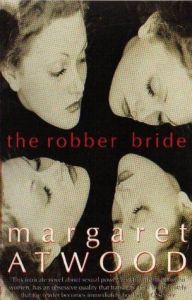 This is the second year of #MARM, hosted by Canadian bloggers extraordinaires Marcie of Buried in Print and Naomi of Consumed by Ink. This year they’re having a special The Handmaid’s Tale/The Testaments theme, but even if you’re avoiding the sequel, join us in reading one or more Atwood works of your choice. She has so much to choose from! Last year I read The Edible Woman and Surfacing. This year I’ve earmarked copies of the novel The Robber Bride (1993) and Moral Disorder (2006), a linked short story collection, both of which I got for free – the former from the free bookshop where I volunteer, and the latter from a neighbor who was giving it away.
Nonfiction November
I don’t usually participate in this challenge because nonfiction makes up at least 40% of my reading anyway, but last year I enjoyed putting together some fiction and nonfiction pairings and ‘being the expert’ on women’s religious memoirs, a subgenre I have a couple of books to add to this year. So I will probably end up doing at least one post. The full schedule is here.
Young Writer of the Year Award
Being on the shadow panel for the Sunday Times/PFD Young Writer of the Year Award was a highlight of 2017 for me. I was sad to not be able to attend any of the events last year. I’m excited for this year’s shadow panelists, a couple of whom are blogging friends (one I’ve met IRL), and I look forward to following along with the nominated books and attending the prize ceremony at the London Library on December 5th.
 With any luck I will already have read at least one or two books from the shortlist, which is to be announced on November 3rd. I have my fingers crossed for Yara Rodrigues Fowler, Daisy Johnson, Elizabeth Macneal, Stephen Rutt and Lara Williams; I expect we may also see repeat appearances from one of the poets recognized by the Forward Prizes and Guy Gunaratne, the winner of the 2019 Dylan Thomas Prize.
Any reading plans for November? Will you be joining in with novellas, Margaret Atwood’s books or Nonfiction November?
Young Writer of the Year Award Ceremony
Yesterday evening all of us on the Sunday Times / Peters Fraser + Dunlop Young Writer of the Year Award shadow panel met up again for the official prize-giving ceremony at the London Library.
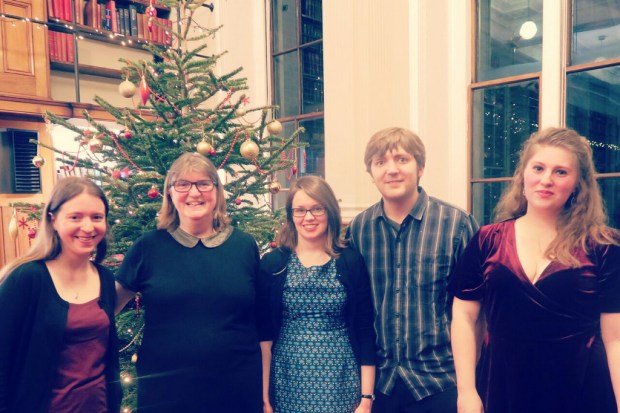
My train arrived late and then I got lost, twice (I don’t own a smartphone and hadn’t brought a map – foolish!), so I walked through the door just moments before the prize announcement, but as that was the most important part of the event it didn’t matter in the end. If you haven’t already heard, the prize went to Sally Rooney for Conversations with Friends. She’s the first Irish winner and the joint youngest along with Zadie Smith.

This did not really come as a surprise to the shadow panel, even though we unanimously chose Julianne Pachico’s The Lucky Ones as our winner.
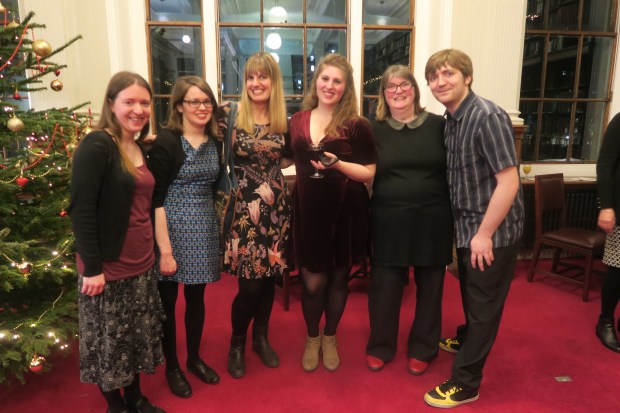
Julianne Pachico is third from left.
Three of us had chosen Rooney’s novel as our runner-up, and when I saw it appear in the Times’ Books of the Year feature, I thought to myself that this was probably a clue. In the official press release, judge and Sunday Times literary editor Andrew Holgate writes, “for line by line quality, emotional complexity, sly sophistication and sheer brio and enjoyment, Sally Rooney’s Conversations with Friends really stood out.”


Judge Elif Shafak states, “I salute Rooney’s intelligent prose, lucid style, and fierce intensity.” Judge Lucy Hughes-Hallett says, “This book stood out for its glittering intelligence, its formal elegance and its capacity to grip the reader. At first reading I was looking forward to bus journeys so that I could read some more. Second time round I was still delighted by the sophistication of its erotic quadrille.”


Being a part of the shadow panel was a wonderful experience and one of the highlights of my literary year.
Sunday Times Young Writer of the Year Award shadow panel
I’m delighted to announce that I’ve been invited to be on the official shadow panel for the Sunday Times / Peters Fraser + Dunlop Young Writer of the Year Award, in association with The University of Warwick (to give it its full and proper title). Here’s a bit of background on the prize, from its website:
The prize “is awarded annually to the best work of published or self-published fiction, non-fiction or poetry by a British or Irish author aged between 18 and 35, and has gained attention and acclaim across the publishing industry and press. £5,000 is given to the overall winner and £500 to each of the three runners-up.
“Since it began in 1991, the award has had a striking impact, boasting a stellar list of alumni that have gone on to become leading lights of contemporary literature. The 2016 Award was presented to Max Porter for his extraordinary debut, Grief Is the Thing with Feathers. Following a five-year break, the prestigious award returned with a bang in 2015, awarding debut poet Sarah Howe the top prize for her phenomenal first collection, Loop of Jade.”
Past winners include Ross Raisin, Adam Foulds, Naomi Alderman, Robert Macfarlane, William Fiennes, Zadie Smith, Sarah Waters, Francis Spufford, Simon Armitage and Helen Simpson.
This year’s official judging panel is made up of Andrew Holgate, literary editor of the Sunday Times, and writers Lucy Hughes-Hallett and Elif Shafak.

I’m joined on the shadow panel by four other book bloggers, several of whom you will recognize as long-time friends of this blog:
- Dane Cobain (SocialBookshelves)
- Eleanor Franzen (Elle Thinks)
- Annabel Gaskell (Annabookbel)
- Clare Rowland (A Little Blog of Books)
Here are some key upcoming dates:
- Sunday October 29th: shortlist announced in Sunday Times
- November 18th: book bloggers event with readings from the shortlisted authors (Groucho Club, London)
- November 27th: deadline for shadow panel winner decision
- November 29th: shadow panel winner announced on STPFD website
- December 3rd: shadow panel winner announced in Sunday Times
- December 7th: prize-giving ceremony and winner announcement (London Library)
I’m so looking forward to getting stuck into the shortlisted books and discussing them! I’ll be posting a review of each one in November.
 Bookish Beck = Rebecca Foster. American transplant to England. Freelance proofreader and book reviewer.
 Bookish Beck