And the Winner of the Not the Wellcome Prize Is…
Constellations: Reflections from Life by Sinéad Gleeson
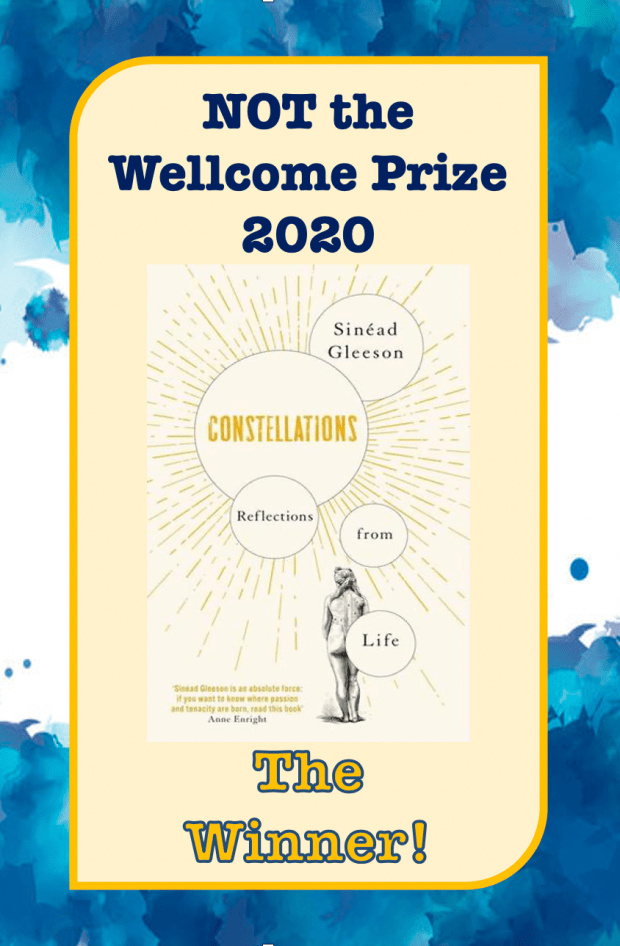
This book best met the criteria of the Wellcome Book Prize: “At some point, medicine touches all our lives. Books that find stories in those brushes with medicine are ones that add new meaning to what it means to be human. The subjects these books grapple with might include birth and beginnings, illness and loss, pain, memory, and identity. In keeping with its vision and goals, the Wellcome Book Prize aims to excite public interest and encourage debate around these topics.”
Jackie says (in her blog tour review): “Constellations is a collection of fourteen essays written by an eloquent storyteller. Each celebrates the imperfect body – its workings and failings. … The stories told are incisive and highly personal. They cover a variety of the author’s lived experiences including: bone disease, cancer treatment, pregnancy, motherhood, and death. … The writing throughout is percipient and exquisitely rendered, arguments expressed with clarity and compassion.”
Annabel says: “Gleeson’s beautifully written essays on her life, her health, pain and illness, motherhood, and being a woman in Ireland are deeply personal, yet speak volumes. Richly varied in style and closing with a poem written to her daughter, the collection explores her themes in elegant prose with not a word wasted. She questions, explains, understands, writing through pain, but also shows her joie de vivre. Superb!” (See more in her 5-star review.)
From my review (December 2018): “Gleeson turns pain into art. … She marvels at all that the body can withstand, but realizes that medical interventions leave permanent marks, physical or emotional. She also remarks on the essential loneliness of illness, and the likelihood of women’s pain not being believed in or acknowledged. This book feels timely and is inventive in how it brings together disparate topics to explore the possibilities and limitations of women’s bodies.”
Some favourite quotes from Constellations:
“Our bodies are sacred, certainly, but they are often not ours alone. Our hospital body, all rivers of scars; the day-to-day form that we present to the world … we create our own matryoshka bodies, and try to keep one that is just for us.”
“Joints can be replaced, organs transplanted, blood transfused, but the story of our lives is still the story of one body. From ill health to heartbreak, we live inside the same skin, aware of its fragility, grappling with our mortality.”
“Illness is an outpost: lunar, Arctic, difficult to reach.”
 (Honorable mention goes to The Remarkable Life of the Skin by Monty Lyman for winning the popular vote on Twitter. I was so pleased that we got 354 votes! We arrived at a winner, as we have in the past few years, through each member of the shadow panel doling out 21 points, assigning each book a point value from 1 to 6. The Twitter scores were assigned in the same way and added in, and the winner was the book with the most points in total.)
Thank you to the rest of the shadow panel (Annabel of Annabookbel, Clare of A Little Blog of Books, Laura of Dr. Laura Tisdall and Paul of Halfman, Halfbook) and to all the bloggers who took part in the blog tour for helping to showcase some of the best health-themed literature published in 2019.
Here’s hoping that this time next year some of us can be meeting up in person to celebrate the awarding of the 2021 Wellcome Book Prize.
April Releases: Motherhood, Medicine, Wine … And an Aardvark
I’m averaging four new releases a month: a nicely manageable number. In April I read a memoir about a mother’s dementia, a bizarre little novel about a stuffed aardvark linking two centuries, a history of medicine in graphic novel form, and a sommelier’s memoir.
My top recommendation for the month is:
What We Carry by Maya Shanbhag Lang
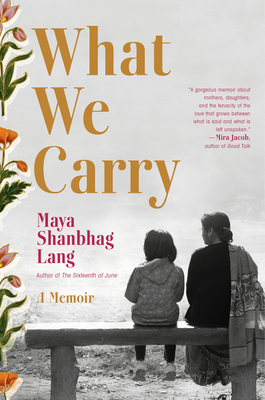 Maya Lang’s novel The Sixteenth of June* was one of my top three novels of 2014, so I was eager to read her next book, a forthright memoir of finding herself in the uncomfortable middle (the “sandwich generation”) of three generations of a female family line. Her parents had traveled from India to the USA for her mother’s medical training and ended up staying on permanently after she became a psychiatrist. Lang had always thought of her mother as a superwoman who managed a career alongside parenthood, never asked for help, and reinvented herself through a divorce and a career change.
When Lang gave birth to her own daughter, Zoe, this model of self-sufficiency mocked her when she had postpartum depression and needed to hire a baby nurse. It was in her daughter’s early days, just when she needed her mother’s support the most, that her mother started being unreliable: fearful and forgetful. Gradually it became clear that she had early-onset Alzheimer’s. Lang cared for her mother at home for a year before making the difficult decision to see her settled into a nearby nursing home.
Like Elizabeth Hay’s All Things Consoled, this is an engaging, bittersweet account of obligation, choices and the secrets that sometimes come out when a parent enters a mental decline. I especially liked how Lang frames her experiences around an Indian folktale of a woman who enters a rising river, her child in her arms. She must decide between saving her child or herself. Her mother first told this story soon after Zoe’s birth to acknowledge life’s ambiguity: “Until we are in the river, up to our shoulders—until we are in that position ourselves, we cannot say what the woman will do. We must not judge. That is the lesson of the story. Whatever a woman decides, it is not easy.” The book is a journey of learning not to judge her mother (or herself), of learning to love despite mistakes and personality changes. 
*One for me to reread in mid-June!
Published by Dial Press on the 28th. I read an e-copy via NetGalley.
Full disclosure: Maya and I are Facebook friends.
Other April releases to look out for:
(All:  )
)
Enter the Aardvark by Jessica Anthony
 On a scoreboard of the most off-the-wall, zany and fun novels I’ve read, this one would be right up there with Ned Beauman’s Boxer, Beetle and Alex Christofi’s Glass. The two story lines, one contemporary and one set in the 1870s, are linked by a taxidermied aardvark that makes its way from Namibia to the Washington, D.C. suburbs by way of Victorian England.
The aardvark was collected by naturalist Sir Richard Ostlet and stuffed by Titus Downing, his secret lover. Ostlet committed suicide in Africa, but his wife could still sense him walking up and down outside her London home. In the present day, Republican congressman Alexander Paine Wilson, who emulates Ronald Reagan in all things, gets a FedEx delivery of a taxidermied aardvark – an apparent parting gift from Greg Tampico before the latter committed suicide. To keep his gay affair from becoming public knowledge, Wilson decides it’s high time he found himself a trophy wife. But the damned aardvark keeps complicating things in unexpected ways.
A scene where a police officer stops Wilson for texting and driving and finds the stuffed aardvark in the back of his SUV had me laughing out loud (“Enter the aardvark, alight on its mount. Enter the aardvark, claw raised, head covered with a goddamned gourmet $22 dish towel that suddenly looks incredibly suspicious hanging over the head of an aardvark, like it’s an infidel”). History repeats itself amusingly and the aardvark is an entertaining prop, but Wilson is too obviously odious, and having his narrative in the second person doesn’t add anything. This is not a debut novel but reads like one: full of bright ideas, but falling a bit short in the execution.
Published by Doubleday on the 23rd. I won a proof copy in a Twitter giveaway.
Medicine: A Graphic History by Jean-Noël Fabiani
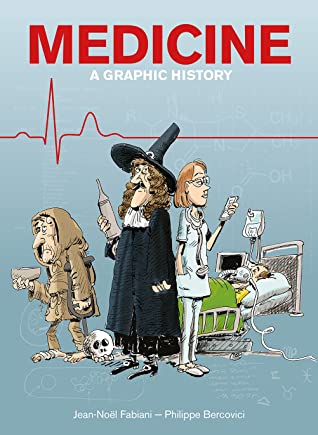 [Illustrated by Philippe Bercovici; translated from the French by Edward Gauvin]
From prehistory to nanotechnology, this is a thorough yet breezy survey of what people have learned about the body and how to treat it. (In approach it reminded me most of another SelfMadeHero graphic novel I reviewed last year, ABC of Typography.) Some specific topics are the discovery of blood circulation, the development of anesthesia, and the history of mental health treatment.
Fabiani, a professor as well as the head of cardiac surgery at Georges Pompidou European Hospital in Paris, focuses on the key moments when ideas became testable theories and when experiments gave groundbreaking results. While he provided the one-page introduction to each chapter and the expository writing at the head of each comic pane, I suspect it was illustrator Philippe Bercovici who added most of the content in the speech bubbles, including plenty of jokes (especially since Fabiani thanks Bercovici for bringing his talent and humor to the project).
This makes for a lighthearted book that contains enough detail so that you feel like you are still getting the full story. Unsurprisingly, I took the most interest in chapters entitled The Great Epidemics and A Few Modern Plagues. I would especially recommend this to teenagers with an interest in medicine.
Published by SelfMadeHero on the 9th. My thanks to the publisher for the free copy for review.
Wine Girl by Victoria James
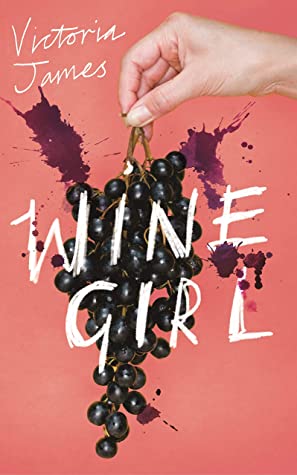 In 2012, at age 21, Victoria James became America’s youngest certified sommelier. Still in her twenties, she has since worked in multiple Michelin-starred restaurants in New York City and became the only American female to win the Sud de France Sommelier Challenge. But behind all the competition wins, celebrity sightings, and international travel for wine festivals and conferences is a darker story.
This is a tell-all about a toxic restaurant culture of overworked employees and casual sexism. James regularly worked 80-hour weeks in addition to her wine school studies, and suffered multiple sexual assaults. In addition, sexual harassment was common – even something as seemingly harmless as the title epithet a dismissive diner launched at her when he ordered a $650 bottle of wine for his all-male table and then told her it was corked and had to be replaced. “Wine girl” was a slur against her for her age, her gender and her presumed lack of experience, even though by that point she had an encyclopedic knowledge of wine varieties and service.
That incident from the prologue was my favorite part of the book; unfortunately, nothing that came afterwards really lived up to it. The memoir goes deep into James’s dysfunctional upbringing (her parents’ bitter divorce, her mother’s depression, her father’s alcoholism and gambling, her own battle with addictions), which I found I had little interest in. It’s like Educated lite, but with a whiney tone: “I grew up in a household of manipulation and neglect, left to fend for myself.”
For those interested in reading about wine and restaurant culture, I’d recommend Cork Dork by Bianca Bosker and Sweetbitter by Stephanie Danler (one of my pairings here) instead.
A favorite line: “Like music, the wonders of art, food, and beverage can transcend all boundaries. … I wanted to capture that feeling, the exhilaration of familiarity, and bring people together through wine.”
Published by Fleet on the 16th. My thanks to the publisher for the free copy for review.
What recent releases can you recommend?
If All the World and Love Were Young by Stephen Sexton: The Dylan Thomas Prize Blog Tour
 For my second spot on the official Dylan Thomas Prize blog tour, I’m featuring the debut poetry collection If All the World and Love Were Young (2019) by Stephen Sexton, which was awarded the Forward Prize for Best First Collection. Sexton lives in Belfast (so this is also an incidental contribution to Reading Ireland Month) and was the winner of the 2016 National Poetry Competition and a 2018 Eric Gregory Award.
The book is a highly original hybrid of video game imagery and a narrative about the final illness of his mother, who died in 2012. As a child the poet was obsessed with Super Mario World. He overlays the game’s landscapes onto his life to create an almost hallucinogenic fairy tale. Into this virtual world, which blends idyll and threat, comes the news of his mother’s cancer:
One summer’s day I’m summoned home to hear of cells which split and glitch
so haphazardly someone is called to intervene with poisons
drawn from strange and peregrine trees flourishing in distant kingdoms.
Her doctors are likened to wizards attempting magic –
In blue scrubs the Merlins apply various elixirs potions
panaceas to her body
– until they give up and acknowledge the limitations of medicine:
So we wait in the private room turn the egg timer of ourselves.
Hippocrates in his white coat brings with him a shake of the head …
where we cannot do some good
at least we must refrain from harm.
Super Mario settings provide the headings: Yoshi’s Island, Donut Plains, Forest of Illusion, Chocolate Island and so on. There are also references to bridges, Venetian canals, mines and labyrinths, as if to give illness the gravity of a mythological hero’s journey. Meanwhile, the title repeats the first line of “The Nymph’s Reply to the Shepherd” by Sir Walter Raleigh, which, as a rebuttal to Christopher Marlowe’s “The Passionate Shepherd to His Love,” eschews romanticism in favor of realism about change and mortality. Sexton wanted to include both views. (He discusses his inspirations in detail in this Irish Times article.)
Apart from one rough pantoum (“Choco-Ghost House”), I didn’t notice any other forms being used. This is free verse; internally unpunctuated, it has a run-on feel. While I do think readers are likely to get more out of the poems if they have some familiarity with Super Mario World and/or are gamers themselves, this is a striking book that examines bereavement in a new way.
Note: Be sure to stick around past “The End” for the Credits, which summarize all the book’s bizarrely diverse elements, and a lovely final poem that’s rather like a benediction.
My thanks to Midas PR for the free copy for review.
The Swansea University International Dylan Thomas Prize recognizes the best published work in the English language written by an author aged 39 or under. All literary genres are eligible, so there are poetry collections nominated as well as novels and short stories.
To recap, the 12 books on this year’s longlist are:
- Surge, Jay Bernard
- Flèche, Mary Jean Chan (my review)
- Exquisite Cadavers, Meena Kandasamy
- Things We Say in the Dark by Kirsty Logan (my preview & an excerpt)
- Black Car Burning, Helen Mort
- Virtuoso, Yelena Moskovich
- Inland, Téa Obreht
- Stubborn Archivist, Yara Rodrigues Fowler (my review)
- If All the World and Love Were Young, Stephen Sexton
- The Far Field, Madhuri Vijay
- On Earth We’re Briefly Gorgeous, Ocean Vuong
- Lot, Bryan Washington
The shortlist will be announced on Tuesday, April 7th.
Recommended March Releases: Magnusson, May, Moor and More
March has been a huge month for new releases. With so many authors feeling let down about book tours and events being cancelled, it’s a great time for bloggers to step in and help. I attended two virtual book launches on Twitter on the 19th and have another one coming up on the 31st. I also have three more March releases on order from my local indie bookstore: Greenery by Tim Dee, tracking the arrival of spring; Footprints by David Farrier, about the fossil traces modern humans will leave behind; and The Bass Rock by Evie Wyld, a novel about violence against women set on the Scottish coast in three different time periods.
Today I have short reviews of five March releases I recommend (plus a bonus one now out in paperback): a Victorian pastiche infused with Scottish folklore, an essay collection about disparate experiences of motherhood, a thriller about victims of domestic violence, poems in graphic novel form, a novel about natural and personal disasters in Australia, and a lovely story of friendship and literature changing a young man’s life forever. All:
The Ninth Child by Sally Magnusson
(Published by Two Roads on the 19th)
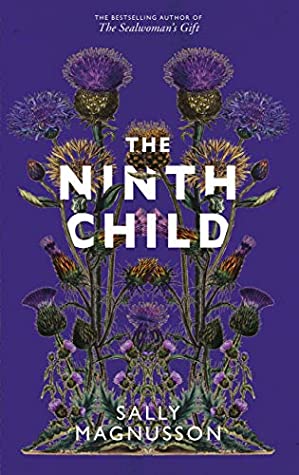 Like Hannah Kent’s The Good People and Sarah Perry’s The Essex Serpent, this is an intense, convincing work of fiction that balances historical realism with magical elements. In mid-1850s Britain, in the wake of a cholera epidemic, there is a drive to ensure clean water. Alexander Aird, hired as the on-site physician for the Glasgow waterworks, moves to the Loch Katrine environs with his wife, Isabel, who has had eight miscarriages or stillbirths. With no living babies requiring her care, Isabel spends her days wandering the hills and meets a strange scarecrow of a man, Reverend Robert Kirke … who died in 1692.
A real-life Episcopalian minister, Kirke wrote a book about fairies and other Celtic supernatural beings and, legend has it (as recounted by Sir Walter Scott and others), was taken into the faery realm after his death and continued to walk the earth looking for rest. It takes a while for Isabel to learn the truth about Kirke – though her servant, Kirsty McEchern, immediately intuits that something isn’t right about the man – and longer still to understand that he wants something from her. “Whatever else, Robert Kirke could be relied on to ruffle this mind of hers that was slowly opening to experience again, and to thinking, and to life.”
This was a rollicking read that drew me in for its medical elements (premature birth, a visit to Joseph Lister, interest in Florence Nightingale’s nursing methods) as well as the plot. It often breaks from the omniscient third-person voice to give testimonies from Kirsty and from Kirke himself. There are also amusing glimpses into the Royal household when Victoria and Albert stay at Balmoral and return to open the waterworks during the “heaviest, windiest, most umbrella-savaging, face-slashing deluge that Scotland had experienced in twenty years.” Best of all, it gives a very different picture of women’s lives in the Victorian period.
My thanks to the publisher for the proof copy for review.
The Best Most Awful Job: Twenty Writers Talk Honestly about Motherhood, edited by Katherine May
(Published by Elliott & Thompson on the 19th)
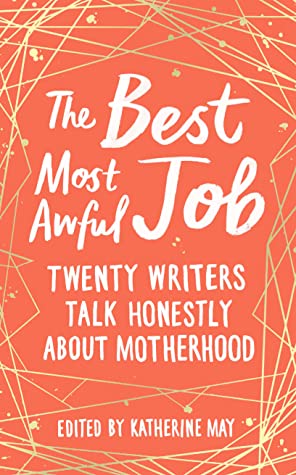 These are essays for everyone who has had a mother – not just everyone who has been a mother. I enjoyed every piece separately, but together they form a vibrant collage of women’s experiences. Care has been taken to represent a wide range of situations and attitudes. The reflections are honest about physical as well as emotional changes, with midwife Leah Hazard (author of Hard Pushed) kicking off with an eye-opening rundown of the intimate scarring some mothers will have for the rest of their lives. We hear from a mother of six who’s “addicted” to pregnancy (Jodi Bartle), but also from a woman who, after an ectopic pregnancy, realized “there are lots of ways to mother, even if your body won’t let you” (Peggy Riley, in one of my two favorite pieces in the book).
Women from BAME communities recount some special challenges related to cultural and family expectations, but others that are universal. An autistic mother (Joanne Limburg) has to work out how to parent a neurotypical child; queer parents (including author Michelle Tea) wonder how to raise a son at a time of toxic masculinity. There are also several single mothers, one of them disabled (Josie George – hers was my other favorite essay; do follow her on Twitter via @porridgebrain if you don’t already).
What I most appreciated is that these authors aren’t saying what they think they should say about motherhood; they’re willing to admit to boredom, disappointment and rage: “motherhood is an infinite, relentless slog from which there is no rest or recuperation … a ceaseless labour, often devoid of acknowledgment, recognition and appreciation” (Javaria Akbar); “I step barefoot on a rogue piece of Lego and it’s game over. I scream” (Saima Mir). These are punchy, distinctive slices of life writing perfectly timed for Mother’s Day. I plan to pass the book around my book club; mothers or not, I know everyone will appreciate it.
My thanks to the publisher for the proof copy for review.
Keeper by Jessica Moor
(Published by Viking/Penguin on the 19th)
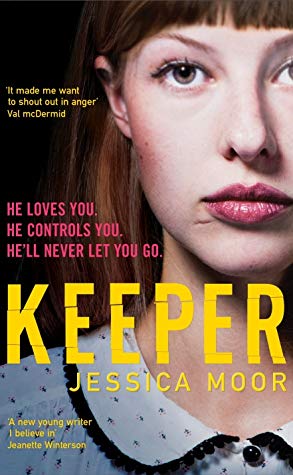 Val McDermid and Jeanette Winterson are among the fans of this, Penguin’s lead debut title of 2020. When a young woman is found drowned at a popular suicide site in the Manchester area, the police plan to dismiss the case as an open-and-shut suicide. But the others at the women’s shelter where Katie Straw worked aren’t convinced, and for nearly the whole span of this taut psychological thriller readers are left to wonder if it was suicide or murder.
The novel alternates between chapters marked “Then” and “Now”: in the latter story line, we follow the police investigation and meet the women of the refuge; in the former, we dive into Katie’s own experience of an abusive relationship back in London. While her mother was dying of cancer she found it comforting to have a boyfriend who was so attentive to her needs, but eventually Jamie’s obsessive love became confining.
I almost never pick up a mystery, but this one was well worth making an exception for. I started suspecting the twist at maybe the two-thirds point, but that didn’t detract from my enjoyment. Based on Moor’s year working in the violence against women sector, it’s a gripping and grimly fascinating story of why women stay with their abusers and what finally drives them to leave.
I picked up a proof copy at a Penguin Influencers event.
 Poems to See by: A Comic Artist Interprets Great Poetry by Julian Peters
(To be published by Plough Publishing House on the 31st)
Peters is a comics artist based in Montreal. Here he has chosen 24 reasonably well-known poems by the likes of e.e. cummings, Emily Dickinson, Robert Frost, Seamus Heaney, Langston Hughes, Edgar Allan Poe, Christina Rossetti and W.B. Yeats and illustrated each one in a markedly different fashion. From black-and-white manga to a riot of color and music, from minimalist calligraphy-like Japanese watercolor to imitations of Brueghel, there is such a diversity of style here that at first I presumed there were multiple artists involved (as in one of my favorite graphic novels of last year, ABC of Typography, where the text was written by one author but each chapter had a different illustrator). But no, this is all Peters’ work; I was impressed by his versatility.
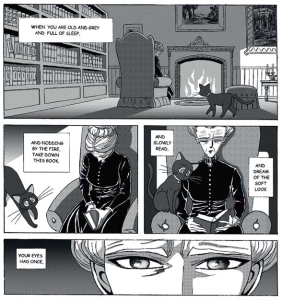
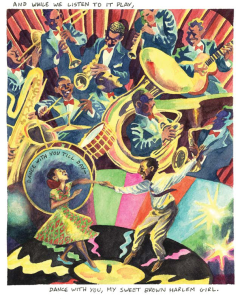
The illustrations range from realistic to abstract, with some more obviously cartoon-like. A couple of sequences reminded me of the style of Raymond Briggs. For “Caged Bird” by Maya Angelou, lines are inlaid on the squares of a painted patchwork quilt. Other sets look to have been done via wood engraving, or with old-fashioned crayons. You could quibble with the more obvious poetry selections, but I encountered a few that were new to me, including “Buffalo Dusk” by Carl Sandburg and “Conscientious Objector” by Edna St. Vincent Millay. Peters has grouped them into six thematic categories: self, others, art, nature, time and death. Teenagers, especially, will enjoy the introduction to a variety of poets and comics styles.
I read an e-copy via NetGalley.
The Inland Sea by Madeleine Watts
(Published by ONE/Pushkin on the 5th)
 “Emergency police fire, or ambulance?” The young female narrator of this debut novel lives in Sydney and works for Australia’s emergency call service. Over her phone headset she gets appalling glimpses into people’s worst moments: a woman cowers from her abusive partner; a teen watches his body-boarding friend being attacked by a shark. Although she strives for detachment, her job can’t fail to add to her anxiety – already soaring due to the country’s flooding and bush fires.
Against that backdrop of natural disasters, a series of minor personal catastrophes play out. The narrator is obsessed with a rape/murder case that’s dominating the television news, and narrowly escapes sexual assault herself. She drinks to excess, keeps hooking up with her ex-boyfriend, Lachlan, even after he gets a new girlfriend, and seems to think abortion and the morning after pill are suitable methods of birth control. Irresponsible to the point of self-sabotage, she’s planning a move to London but in the meantime is drifting through life, resigned to the fact that there is no unassailable shelter and no surefire way to avoid risk.
The title comes from the quest of John Oxley (presented here as the narrator’s ancestor), who in 1817 searched for a water body in the Australian interior. Quotations from his journals and discussions of the work of Patrick White, the subject of Lachlan’s PhD thesis, speak to the search for an Australian identity. But the inland sea is also the individual psyche, contradictory and ultimately unknowable. Like a more melancholy version of Jenny Offill’s Weather or a more cosmic autofiction than Yara Rodrigues Fowler’s Stubborn Archivist, this is a timely, quietly forceful story of how women cope with concrete and existential threats.
My thanks to the publisher for the PDF copy for review.
And a bonus…
The Offing by Benjamin Myers (2019)
(Paperback published by Bloomsbury on the 5th)
 With the Second World War only recently ended and nothing awaiting him apart from the coal mine where his father works, sixteen-year-old Robert Appleyard sets out on a journey. From his home in County Durham, he walks southeast, doing odd jobs along the way in exchange for food and lodgings. One day he wanders down a lane near Robin Hood’s Bay and gets a surprisingly warm welcome from a cottage owner, middle-aged Dulcie Piper, who invites him in for tea and elicits his story. Almost accidentally, he ends up staying for the rest of the summer, clearing scrub and renovating her garden studio.
Dulcie is tall, outspoken and unconventional – I pictured her as (Meryl Streep as) Julia Child in the movie Julie & Julia. She introduces Robert to whole new ways of thinking: that not everyone believes in God, that Germans might not be all bad, that life can be about adventure and pleasure instead of duty. “The offing” is a term for the horizon, as well as the title of a set of poems Robert finds in the dilapidated studio, and both literature and ambition change his life forever. Bright, languid and unpredictable, the novel delights in everyday sensual pleasures like long walks with a dog, dips in the ocean and an abundance of good food. I can’t think of another book I’ve read that’s quite like it – how refreshing is that?
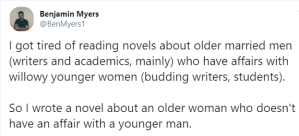
I pre-ordered the paperback using a Waterstones voucher I got for Christmas.
What recent releases can you recommend?
Review Books Roundup: Blackburn, Bryson, Pocock, Setterwall, Wilson
I’m attempting to get through all my 2019 review books before the end of the year, so expect another couple of these roundups. Today I’m featuring a work of poetry about one of Picasso’s mistresses, a thorough yet accessible introduction to how the human body works, a memoir of personal and environmental change in the American West, Scandinavian autofiction about the sudden loss of a partner, and a novel about kids who catch on fire. You can’t say I don’t read a variety! See if one or more of these tempts you.
The Woman Who Always Loved Picasso by Julia Blackburn
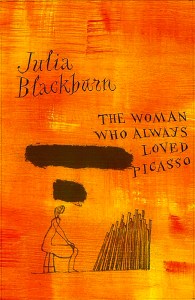 Something different from Blackburn: biographical snippets in verse about Marie-Thérèse Walter, one of Pablo Picasso’s many mistress-muses. When they met she was 17 and he was 46. She gave birth to a daughter, Maya – to his wife Olga’s fury. Marie-Thérèse’s existence was an open secret: he rented a Paris apartment for her to live in, and left his home in the South of France to her (where she committed suicide three years after his death), but unless their visits happened to overlap she was never introduced to his friends. “I lived in the time I was born into / and I kept silent, / acquiescing / to everything.”
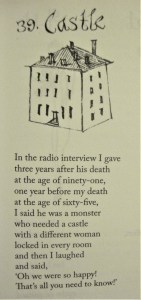 In Marie-Thérèse’s voice, Blackburn depicts Picasso as a fragile demagogue: in one of the poems that was a highlight for me, “Bird,” she describes how others would replace his caged birds when they died, hoping he wouldn’t notice – so great was his horror of death. I liked getting glimpses into a forgotten female’s life, and appreciated the whimsical illustrations by Jeffrey Fisher, but as poems these pieces don’t particularly stand out. (Plus, there are no page numbers! which doesn’t seem like it should make a big difference but ends up being annoying when you want to refer back to something. Instead, the poems are numbered.)
My rating:
With thanks to Carcanet Press for the free copy for review. Published today.
The Body: A Guide for Occupants by Bill Bryson
 Shelve this next to Being Mortal by Atul Gawande in a collection of books everyone should read – even if you don’t normally choose nonfiction. Bryson is back on form here, indulging his layman’s curiosity. As you know, I read a LOT of medical memoirs and popular science. I’ve read entire books on organ transplantation, sleep, dementia, the blood, the heart, evolutionary defects, surgery and so on, but in many cases these go into more detail than I need and I can find my interest waning. That never happens here. Without ever being superficial or patronizing, the author gives a comprehensive introduction to every organ and body system, moving briskly between engaging anecdotes from medical history and encapsulated research on everything from gut microbes to cancer treatment.
Bryson delights in our physical oddities, and his sense of wonder is infectious. He loves a good statistic, and while this book is full of numbers and percentages, they are accessible rather than obfuscating, and will make you shake your head in amazement. It’s a persistently cheerful book, even when discussing illness, scientists whose work was overlooked, and the inevitability of death. Yet what I found most sobering was the observation that, having conquered many diseases and extended our life expectancy, we are now overwhelmingly killed by lifestyle, mostly a poor diet of processed and sugary foods and lack of exercise.
My rating: 
With thanks to Doubleday for the free copy for review.
Surrender: Mid-Life in the American West by Joanna Pocock
 Prompted by two years spent in Missoula, Montana and the disorientation felt upon a return to London, this memoir-in-essays varies in scale from the big skies of the American West to the smallness of one human life and the experience of loss and change. Then in her late forties, Pocock had started menopause and recently been through the final illnesses and deaths of her parents, but was also mother to a fairly young daughter. She explores personal endings and contradictions as a kind of microcosm of the paradoxes of the Western USA.
It’s a place of fierce independence and conservatism, but also mystical back-to-the-land sentiment. For an outsider, so much of the lifestyle is bewildering. The author attends a wolf-trapping course, observes a Native American buffalo hunt, meets a transsexual rewilding activist, attends an ecosexuality conference, and goes foraging. All are attempts to reassess our connection with nature and ask what role humans can play in a diminished planet.
This is an elegantly introspective work that should engage anyone interested in women’s life writing and the environmental crisis. There are also dozens of black-and-white photographs interspersed in the text. In 2018 Pocock won the Fitzcarraldo Editions Essay Prize for this work-in-progress. It came to me as an unsolicited review copy and hung around on my shelves for six months before I picked it up; I’m glad I finally did.
My rating:
With thanks to Fitzcarraldo Editions for the free copy for review.
Let’s Hope for the Best by Carolina Setterwall
[Trans. from the Swedish by Elizabeth Clark Wessel]
 Although this is fiction, it very closely resembles the author’s own life. She wrote this debut novel to reflect on the sudden loss of her partner and how she started to rebuild her life in the years that followed. It quickly splits into two parallel story lines: one begins in April 2009, when Carolina first met Aksel at a friend’s big summer bash; the other picks up in October 2014, after Aksel’s death from cardiac arrest. The latter proceeds slowly, painstakingly, to portray the aftermath of bereavement. In the alternating timeline, we see Carolina and Aksel making their life together, with her always being the one to push the relationship forward.
Setterwall addresses the whole book in the second person to Aksel. When the two story lines meet at about the two-thirds point, it carries on into 2016 as she moves house, returns to work and resumes a tentative social life, even falling in love. This is a wrenching story reminiscent of In Every Moment We Are Still Alive by Tom Malmquist, and much of it resonated with my sister’s experience of widowhood. There are many painful moments that stick in the memory. Overall, though, I think it was too long by 100+ pages; in aiming for comprehensiveness, it lost some of its power. Page 273, for instance (the first anniversary of Aksel’s death, rather than the second, where the book actually ends), would have made a fine ending.
My rating: 
With thanks to Bloomsbury UK for the proof copy for review.
Nothing to See Here by Kevin Wilson
 I’d read a lot about this novel while writing a synopsis and summary of critical opinion for Bookmarks magazine – perhaps too much, as it felt familiar and offered no surprises. Lillian, a drifting twentysomething, is offered a job as a governess for her boarding school roommate Madison’s stepchildren. Madison’s husband is a Tennessee senator in the running for the Secretary of State position, so it’s imperative that they keep a lid on the situation with his 10-year-old twins, Bessie and Roland.
You see, when they’re upset these children catch on fire; flames destroy their clothes and damage nearby soft furnishings, but leave the kids themselves unharmed. Temporary, generally innocuous spontaneous combustion? Okay. That’s the setup. Wilson writes so well that it’s easy to suspend your disbelief about this, but harder to see a larger point, except perhaps creating a general allegory for the challenges of parenting. This was entertaining enough, mostly thanks to Lillian’s no-nonsense narration, but for me it didn’t soar.
My rating:
With thanks to Text Publishing UK for the PDF for review. This came out in the States in October and will be released in the UK on January 30th.
Would you be interested in reading one or more of these?
March’s Doorstopper: Cutting for Stone by Abraham Verghese (2009)
I’m squeaking in here on the 31st with the doorstopper I’ve been reading all month. I started Cutting for Stone in an odd situation on the 1st: We’d attempted to go to France that morning but were foiled by a fatal engine failure en route to the ferry terminal, so were riding in the cab of a recovery vehicle that was taking us and our car home. My poor husband sat beside the driver, trying to make laddish small talk about cars, while I wedged myself by the window and got lost in the early pages of Indian-American doctor Abraham Verghese’s saga of twins Marion and Shiva, born of an unlikely union between an Indian nun, Sister Mary Joseph Praise, and an English surgeon, Thomas Stone, at Missing Hospital in Addis Ababa in 1954.
 What with the flashbacks and the traumatic labor, it takes narrator Marion over 100 pages to get born. That might seem like a Tristram Shandy degree of circumlocution, but there was nary a moment when my interest flagged during this book’s 50-year journey with a medical family starting in a country I knew nothing about. I was reminded of Midnight’s Children, in that the twin brothers are born loosely conjoined at the head and ever after have a somewhat mystical connection, understanding each other’s thoughts even when they’re continents apart.
When Sister Mary Joseph Praise dies in childbirth and Stone absconds, the twins are raised by the hospital’s blunt obstetrician, Hema, and her husband, a surgeon named Ghosh. Both brothers follow their adoptive parents into medicine and gain knowledge of genitourinary matters. We observe a vasectomy, a breech birth, a C-section, and the aftermath of female genital mutilation. While Marion relocates to an inner-city New York hospital, Shiva stays in Ethiopia and becomes a world expert on vaginal fistulas. The novel I kept thinking about was The Cider House Rules, which is primarily about orphans and obstetrics, and I was smugly confirmed by finding Verghese’s thanks to his friend John Irving in the acknowledgments.
Ethiopia’s postcolonial history is a colorful background, with Verghese giving a bystander’s view of the military coup against the Emperor and the rise of the Eritrean liberation movement. Like Marion, the author is an Indian doctor who came of age in Ethiopia, a country he describes as a “juxtaposition of culture and brutality, this molding of the new out of the crucible of primeval mud.” Marion’s experiences in New York City and Boston then add on the immigrant’s perspective on life in the West in the 1980s onwards.
Naomi of Consumed by Ink predicted long ago that I’d love this, and she was right. Of course I thrilled to the accounts of medical procedures, such as an early live-donor liver transplant (this was shortlisted for the Wellcome Book Prize in 2009), but that wasn’t all that made Cutting for Stone such a winner for me. I can’t get enough of sprawling Dickensian stories in which coincidences abound (“The world turns on our every action, and our every omission, whether we know it or not”), minor characters have heroic roles to play, and humor and tragedy balance each other out, if ever so narrowly. (Besides Irving, think of books like The Heart’s Invisible Furies by John Boyne.) What I’m saying, as I strive to finish this inadequate review in the last hour of the last day of the month, is that this was just my sort of thing, and I hope I’ve convinced you that it might be yours, too.
Favorite lines:
Hema: “The Hippocratic oath is if you are sitting in London and drinking tea. No such oaths here in the jungle. I know my obligations.”
“Doubt is a first cousin to faith”
“A childhood at Missing imparted lessons about resilience, about fortitude, and about the fragility of life. I knew better than most children how little separate the world of health from that of disease, living flesh from the icy touch of the dead, the solid ground from treacherous bog.”
Page count: 667
My rating:
Next month: Since Easter falls in April and I’ve been wanting to read it for ages anyway, I’ve picked out The Resurrection of Joan Ashby by Cherise Wolas to start tomorrow.
“Graphic Medicine”: The Lady Doctor by Ian Williams
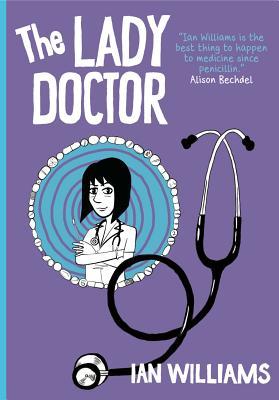 This sequel to Ian Williams’s 2014 graphic novel The Bad Doctor returns to a medical practice in small-town Wales. This time, though, the focus is on Iwan James’s colleague, Dr. Lois Pritchard, who also puts in two days a week treating embarrassing ailments at the local hospital’s genitourinary medicine clinic. At nearly 40, Lois is a divorcee with no children, just a dog. She enjoys nights out drinking with her best friend, Geeta, but her carefree life is soon beset by complications: she has to decide whether she wants to join the health center as a full partner, a tryst with her new fella goes horribly wrong, and her estranged mother suddenly reappears in her life, hoping Lois will give her a liver transplant. And that’s not to mention all the drug addicts and VD-ridden lotharios hanging about.
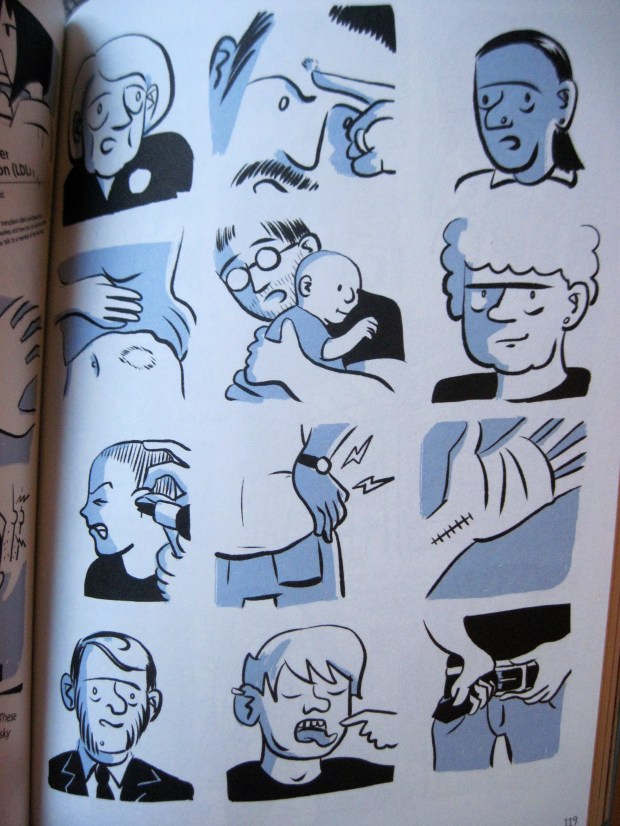
Williams was a GP in North Wales for 20 years; no doubt his experiences have inspired his comics. His tone is wonderfully balanced: there are plenty of hilarious, somewhat raunchy scenes, but also a lot of heartfelt moments as Lois learns that a doctor is never completely off duty and you have no idea what medical or personal challenge will crop up next. The drawing style reminds me of Alison Bechdel’s (and in the cover blurb she says, “Ian Williams is the best thing to happen to medicine since penicillin”), with single colors from pink to olive alternating as the background. I especially loved the pages where each panel depicts a different patient to show the breadth of people and complaints a doctor might see in a day.
This review is on the short side for me, but I don’t want to resort to spoilers, so will just say that if you’re a fan of Bechdel and Posy Simmonds, or if you are unfamiliar with graphic novels and fancy trying one, do seek this out. The medical theme made it a must for me. In fact, Myriad Editions have a whole “Graphic Medicine” series that I’ll be keen to explore.
My rating:
The Lady Doctor will be published in the UK by Myriad Editions on January 31st and in the USA by Penn State University Press on February 18th. My thanks to the publisher and publicist Emma Dowson for the free copy for review.
Two Records of Bodily Transformation: Amateur and Shapeshifters
Amateur: A True Story about What Makes a Man, Thomas Page McBee
 Thomas Page McBee was the first transgender man to box at Madison Square Garden. In his second memoir, which arose from a Quartz article entitled “Why Men Fight,” he recounts the training leading up to his charity match and ponders whether aggression is a natural male trait. McBee grew up in a small town outside Pittsburgh with a stepfather who sexually abused him from age four. In 2011 he started the testosterone injections that would begin his gender transformation. During the years that followed, other men seemed to pick fights with him fairly often, and he was unsure what to do about it. Finally, in 2015, the Manhattan editor decided to confront the belligerent male stereotype by starting boxing training.
What I most appreciated were the author’s observations of how others have related to him since his transition. He notices that he’s taken more seriously at work as a man, and that he can be an object of fear – when jogging behind a woman at night, for instance. One of the most eye-opening moments of the book is when he realizes that he’s been talking over his own sister. Thankfully, McBee is sensitive enough to stop and change, recognizing that kindness and vulnerability are not faults but attributes any person should be proud of.
I have a feeling I would have preferred his previous memoir, Man Alive, which sounds like it has more about the transition itself. Jonathan Eig’s biography of Muhammad Ali is one of the best books I’ve read this year, and in comparison I didn’t find the boxing writing here very interesting. Likewise, this pales beside two similar but more perceptive books I’ve read that have been hugely influential on my own understanding of gender identity: Conundrum by Jan Morris and The Argonauts by Maggie Nelson.
My rating:
Amateur was published in the UK by Canongate on August 2nd. My thanks to the publisher for the free copy for review.
Shapeshifters: On Medicine and Human Change by Gavin Francis
 Gavin Francis is a physician with a practice near Edinburgh. His latest book is like a taster course in medical topics. The overarching theme is the modifications the body undergoes, so there are chapters on, for example, body-building, tattoos, puberty, prosthetic limbs, dementia and menopause. Over his years in general practice Francis has gotten to know his patients’ stories and seen them change, for better or worse. These anecdotes of transformation are one source for his book, but he also applies insight from history, mythology, literature, etymology and more. So in a chapter on conception he discusses the Virgin Mary myth, Leonardo da Vinci’s fetal diagrams, the physiological changes pregnant women experience, and the case of a patient, Hannah, who had three difficult, surprise pregnancies in quick succession.
We are all in the process of various transformations, Francis argues, whether by choice or involuntarily. (I decided on the link with McBee because of a chapter on sex changes.) I was less convinced by the author’s inclusion of temporary, reversible changes such as sleep, hallucinations, jet lag and laughter. And while each chapter is finely wrought, I felt some sort of chronological or anatomical order was necessary to give the book more focus. All the same, I suspect this will be a strong contender for next year’s Wellcome Book Prize because of its broad relevance to human health and its compassionate picture of bodies in flux.
My rating:
Shapeshifters was published by the Wellcome Collection/Profile Books on May 2nd. My thanks to the publisher for the proof copy for review.
Wellcome Book Prize Shortlist Event
Five of the six shortlisted authors (barring Dublin-based Mark O’Connell) were at the Wellcome Collection in London yesterday to share more about their books in mini-interviews with Lisa O’Kelly, the associate editor of the Observer. She called each author up onto the stage in turn for a five-minute chat about her work, and then brought them all up for a general conversation and audience questions. Clare and I found it a very interesting afternoon. Here’s some context that I gleaned about the five books and their writers.
 Ayobami Adebayo says sickle cell anemia is a massive public health problem in Nigeria, as brought home to her when some friends died of complications of sickle cell. She herself was tested for the gene and learned that she is a carrier, so her children would have a 25% chance of having the disease if her partner was also a carrier. Although life expectancy with the disease has improved to 45–50, a cure is still out of reach for most Nigerians because bone marrow/stem cell transplantation and anti-rejection drugs are so expensive. Compared to the 1980s, when her book opens, she believes polygamy is becoming less fashionable in Nigeria and people are becoming more open to other means of becoming parents, whether IVF or adoption. It’s a way of acknowledging, she says, that parenthood is “not just about biology.”
Sigrid Rausing started writing her book soon after her sister-in-law Eva’s body was found: just random paragraphs to make sense of what had happened. From there it became an investigation, a quest to find the nature of addiction. She thinks that as a society we still don’t quite understand what addiction is, and the medical research and public perception are very separate. In addition to nature and nurture, she thinks we should consider the influence of culture – as an anthropologist by training, she’s very interested in drug culture and how that drew in her brother, Hans. Although there have been many memoirs by ex-addicts, she can’t think of another one by a family member. Perhaps, she suggested, this is because the addict is seen as the ultimate victim. She referred to her book as a “collage,” a very apt description.
Kathryn Mannix spoke of how her grandmother, born in 1900, saw so much more death than we do nowadays: siblings, a child, and so on. Today, though, Mannix has encountered people in their sixties who are facing, with their parents, their very first deaths. Death is fairly “gentle” and “dull” if you’re not directly involved, she insists; she blames Hollywood and Eastenders for showing unusually dramatic deaths. She said once you understand what exactly people are afraid of about dying (e.g. hell, oblivion, pain, leaving their families behind) you can address their specific concerns and thereby “beat out the demon of terror and fear.” Mannix never intended to write a book, but someone heard her on the radio and invited her to do so. Luckily, from her medical school days onward, she’d been writing an A4 page about each of her most mind-boggling cases to get them out of her head and move on. That’s why, as O’Kelly put it, the characters in her 30 stories “leap off the page.”
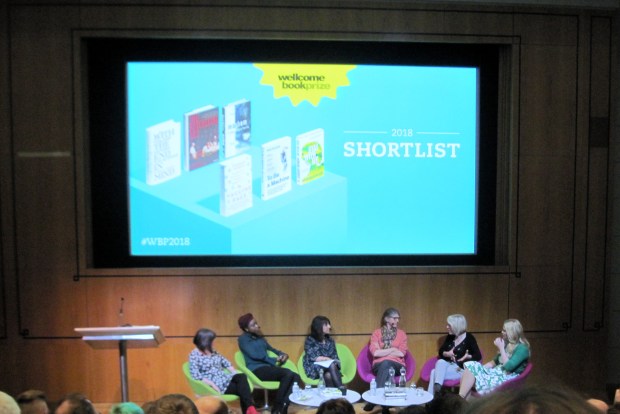
Mannix, Adebayo, O’Kelly, Rausing, Wadman & Fitzharris
Lindsey Fitzharris called The Butchering Art “a love story between science and medicine” – it was the first time that the former (antisepsis) was applied to the latter. She initially thought Robert Liston was her man – he was so colorful, larger than life – but eventually found that the real story was with Joseph Lister, the quiet, persistent Quaker. (However, the book does open with Liston performing the first surgery under ether.) Fitzharris is also involved in the Order of the Good Death, author Caitlin Doughty’s initiative, and affirmed Mannix’s efforts to remove the taboo from talking about death. I think I heard correctly that she said there is a film of The Butchering Art in the works?! I’ll need to look into that some more.
Meredith Wadman started with a brief explanation of how immunization works and why the 1960s were ripe for vaccine research. This segment went really science-y, which I thought was a little unfortunate as it may have made listeners tune out and be less interested in her work than the others’. It was perhaps inevitable given her subject matter, but also a matter of the questions O’Kelly asked – with the others she focused more on stories and themes than on scientific facts. It was interesting to hear what Wadman has been working on recently: for the past 6–8 months, she’s been reporting for Science on sexual harassment in science. For her next book, though, she’s pondering the conflict between a congressman and a Centers for Disease Control scientist over funding into research that might lead to gun control.
The question time brought up the issues of medical misinformation online, the distrust people with chronic illnesses have of medical professionals, and euthanasia – Mannix rather dodged that one, stating that her book is about the natural dying process so that’s not really her area. (Though it does come up in a chapter of her book.) We also heard a bit about the projects up next for each author. Rausing’s next book will be a travel memoir about the Capetown drought, taking in apartheid and her husband’s family’s immigration. Adebayo is at work on a very nebulous novel “about people,” and possibly how privilege affects access to healthcare.
The Essex Serpent by Sarah Perry
This exquisite work of historical fiction explores the gaps – narrower than one might think – between science and superstition and between friendship and romantic love. The Essex Serpent was a real-life legend from the latter half of the seventeenth century, but Perry’s second novel has fear of the sea creature re-infecting Aldwinter, her invented Essex village, in the 1890s. Mysterious deaths and disappearances are automatically attributed to the Serpent who dwells in the depths of the Blackwater. This atmosphere of paranoia triggers some schoolgirls to erupt in frenzied delusions as in The Crucible. It is unclear whether the Church should tolerate a source of mystery or dismiss it all as nonsense – after all, there’s a winged serpent carved onto one of the pews at the parish church.
 In a domestic counterpart to all these supernatural goings-on, we gain entry into two middle-class households. Cora Seaborne’s abusive husband, Michael, has recently died of throat cancer, leaving her to raise their odd (autistic, I wondered?) eleven-year-old son Francis on her own. She has an amateur interest in fossils to rival Mary Anning’s, so when she hears of a cache near Colchester she leaves London for Essex, bringing along Frankie and her companion, Martha. Mutual friends put her in touch with Will Ransome, the vicar of Aldwinter, sure that he and his family – consumptive wife Stella and children Joanna, James and John – will be able to show her around the coast.
Despite an inauspicious first meeting, which sees Cora and Will, still unknown to each other, hauling a drowning sheep out of a lake, theirs soon becomes a close, easy friendship. Cora feels she can speak her mind about the faith she lost and the new marvels she finds in nature:
I had faith, the sort I think you might be born with, but I’ve seen what it does and I traded it in. It’s a sort of blindness, or a choice to be mad – to turn your back on everything new and wonderful – not to see that there’s no fewer miracles in the microscope than in the gospels!
She holds her own in cerebral debates with Will as he deplores his parishioners’ fantasies about the Serpent. Is there really such a big difference between his faith – “all strangeness and mystery – all blood, and brimstone,” Cora teases – and the Serpent legend? In seeming contradiction to his career path, Will is more suspicious than many of the other characters of things he doesn’t understand and can’t explain away, like hypnosis and a Fata Morgana.
The novel’s nuanced treatment of faith and doubt is enhanced by references to Victorian science, including fossil hunting and early medical procedures. Dr. Luke Garrett, Michael’s surgeon, is one of Cora’s best friends back in London; she calls him “The Imp.” In one of the most striking passages of the entire book, he performs rudimentary heart surgery on the young victim of a stab wound. Perry fills in the novel’s background with a plethora of apt Victorian themes, including housing reform and London crime. For a book of 440 pages, it has a large cast and a fairly epic scope. Although there are places where subplots and minor characters might have been expanded upon, Perry wisely refrains from stuffing the novel with evidence of her research. Indeed, it’s a restrained book overall, yet breaks out into effusiveness in just the right places, as in Stella’s mystical adoration of the color blue.
Descriptive passages and the letters passing between the characters give a clear sense of the months passing, yet there is also something timelessly English about the narrative – Dickensian in places (Our Mutual Friend) and Hardyesque in others (Far from the Madding Crowd). I especially loved this picture of the June countryside:
Essex has her bride’s gown on: there’s cow parsley frothing by the road and daisies on the common, and the hawthorn’s dressed in white; wheat and barley fatten in the fields, and bindweed decks the hedges.
Cross this cozy pastoral vision with the Gothic nature of the Serpent craze and you get quite a unique atmosphere. The vague, unexplained sense of menace didn’t work for me at all in Perry’s previous novel, After Me Comes the Flood, but here it’s just right.
It was no doubt true in the late Victorian period that “men and women can’t be friends because the sex part always gets in the way” (as famously declared in When Harry Met Sally). No one is sure what to make of a sexually available, self-assured female like Cora. The different kinds of Greek love, from philia to eros, keep shading into each other here. Like the water that forms the book’s metaphorical substrate, the relationships ebb and flow. Yet there’s no denigrating any connection as just friendship; in fact, friendship is enough to rescue one character from suicide. Like Hanya Yanagihara’s A Little Life, the novel asks whether love is ever enough to save us – and gives a considerably more optimistic answer.

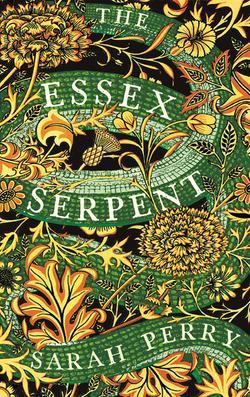
My proof copy didn’t have quite such a gorgeous cover but did come intriguingly wrapped in snakeskin ribbon…
The fact that I have an MA in Victorian literature means I’m drawn to Victorian-set novels but also highly critical about their authenticity. While reading this, though, I thoroughly believed that I was in 1890. Moreover, Perry adroitly illuminates the situation of the independent “New Woman” and the quandary of science versus religion (which were the joint subjects of my dissertation: women’s faith and doubt narratives in Victorian fiction).
I’m delighted, especially having seen Perry speak at Bloxham Festival in February (see my write-up for more on her background and the inspirations behind this novel), to have liked The Essex Serpent three times as much as her debut. It has an elegant, evocative writing style reminiscent of A.S. Byatt and Penelope Fitzgerald. Something holds me back from the full 5 stars – too diffuse? Too much staying on the surface of things? Not quite intimate enough, especially about Cora’s inner life? – but I still declare myself mightily impressed. The Essex Serpent counts as one of my favorite novels of 2016 so far. You can see why Serpent’s Tail (how perfect is her publisher’s name?!) rushed this one into publication a few weeks early. Expect to see it on the Booker Prize shortlist and any other award list you care to mention.
With thanks to Anna-Marie Fitzgerald at Serpent’s Tail for the free review copy.
My rating: 
 Bookish Beck = Rebecca Foster. American transplant to England. Freelance proofreader and book reviewer.
 Bookish Beck