Rathbones Folio Prize 2021 Shortlist Reviews & Prediction
I’ve nearly managed to read the whole Rathbones Folio Prize shortlist before the prize is announced on the evening of Wednesday the 24th. (You can sign up to watch the online ceremony here.) I reviewed the Baume and Ní Ghríofa as part of a Reading Ireland Month post on Saturday, and I’d reviewed the Machado last year in a feature on out-of-the-ordinary memoirs. This left another five books. Because they were short, I’ve been able to read and/or review another four over the past couple of weeks. (The only one unread is As You Were by Elaine Feeney, which I made a false start on last year and didn’t get a chance to try again.)
Nominations come from the Folio Academy, an international group of writers and critics, so the shortlisted authors have been chosen by an audience of their peers. Indeed, I kept spotting judges’ or fellow nominees’ names in the books’ acknowledgements or blurbs. I tried to think about the eight as a whole and generalize about what the judges were impressed by. This was difficult for such a varied set of books, but I picked out two unifying factors: A distinctive voice, often with a musicality of language – even the books that don’t include poetry per se are attentive to word choice; and timeliness of theme yet timelessness of experience.
Poor by Caleb Femi
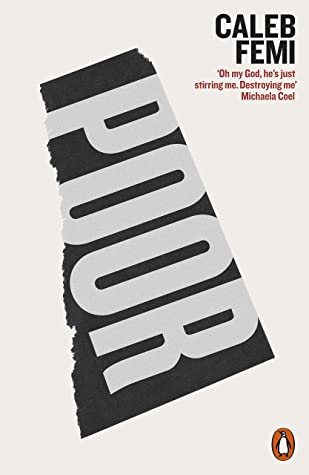 Femi brings his South London housing estate to life through poetry and photographs. This is a place where young Black men get stopped by the police for any reason or none, where new trainers are a status symbol, where boys’ arrogant or seductive posturing hides fear. Everyone has fallen comrades, and things like looting make sense when they’re the only way to protest (“nothing was said about the maddening of grief. Nothing was said about loss & how people take and take to fill the void of who’s no longer there”). The poems range from couplets to prose paragraphs and are full of slang, Caribbean patois, and biblical patterns. I particularly liked Part V, modelled on scripture with its genealogical “begats” and a handful of portraits:
The Story of Ruthless
Anyone smart enough
to study the food chain
of the estate knew exactly
who this warrior girl was;
once she lined eight boys
up against a wall,
emptied their pockets.
Nobody laughed at the boys.
Another that stood out for me was the two-part “A Designer Talks of Home / A Resident Talks of Home,” a found poem partially constructed from dialogue from a Netflix documentary on interior design. It ironically contrasts airy aesthetic notions with survival in a concrete wasteland. If you loved Surge by Jay Bernard, this should be next on your list.
My Darling from the Lions by Rachel Long
 I first read this when it was on the Costa Awards shortlist. As in Femi’s collection, race, sex, and religion come into play. The focus is on memories of coming of age, with the voice sometimes a girl’s and sometimes a grown woman’s. Her course veers between innocence and hazard. She must make her way beyond the world’s either/or distinctions and figure out how to be multiple people at once (biracial, bisexual). Her Black mother is a forceful presence; “Red Hoover” is a funny account of trying to date a Nigerian man to please her mother. Much of the rest of the book failed to click with me, but the experience of poetry is so subjective that I find it hard to give any specific reasons why that’s the case.
The Mermaid of Black Conch by Monique Roffey
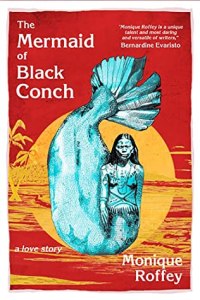 After the two poetry entries on the shortlist, it’s on to a book that, like A Ghost in the Throat, incorporates poetry in a playful but often dark narrative. In 1976, two competitive American fishermen, a father-and-son pair down from Florida, catch a mermaid off of the fictional Caribbean island of Black Conch. Like trophy hunters, the men take photos with her; they feel a mixture of repulsion and sexual attraction. Is she a fish, or an object of desire? In the recent past, David Baptiste recalls what happened next through his journal entries. He kept the mermaid, Aycayia, in his bathtub and she gradually shed her tail and turned back into a Taino indigenous woman covered in tattoos and fond of fruit. Her people were murdered and abused, and the curse that was placed on her runs deep, threatening to overtake her even as she falls in love with David. This reminded me of Ernest Hemingway’s The Old Man and the Sea and Lydia Millet’s Mermaids in Paradise. I loved that Aycayia’s testimony was delivered in poetry, but this short, magical story came and went without leaving any impression on me.
Indelicacy by Amina Cain
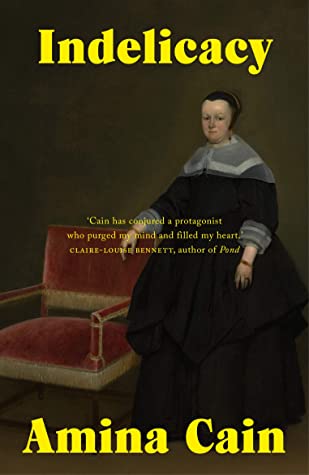 Having heard that this was about a cleaner at an art museum, I expected it to be a readalike of Asunder by Chloe Aridjis, a beautifully understated tale of ghostly perils faced by a guard at London’s National Gallery. Indelicacy is more fable-like. Vitória’s life is in two halves: when she worked at the museum and had to forego meals to buy new things, versus after she met her rich husband and became a writer. Increasingly dissatisfied with her marriage, she then comes up with an escape plot involving her hostile maid. Meanwhile, she makes friends with a younger ballet student and keeps in touch with her fellow cleaner, Antoinette, a pregnant newlywed. Vitória tries sex and drugs to make her feel something. Refusing to eat meat and trying to persuade Antoinette not to baptize her baby become her peculiar twin campaigns.
The novella belongs to no specific time or place; while Cain lives in Los Angeles, this most closely resembles ‘wan husks’ of European autofiction in translation. Vitória issues pretentious statements as flat as the painting style she claims to love. Some are so ridiculous they end up being (perhaps unintentionally) funny: “We weren’t different from the cucumber, the melon, the lettuce, the apple. Not really.” The book’s most extraordinary passage is her husband’s rambling, defensive monologue, which includes the lines “You’re like an old piece of pie I can’t throw away, a very good pie. But I rescued you.”
It seems this has been received as a feminist story, a cheeky parable of what happens when a woman needs a room of her own but is trapped by her social class. When I read in the Acknowledgements that Cain took lines and character names from Octavia E. Butler, Jean Genet, Clarice Lispector, and Jean Rhys, I felt cheated, as if the author had been engaged in a self-indulgent writing exercise. This was the shortlisted book I was most excited to read, yet ended up being the biggest disappointment.
On the whole, the Folio shortlist ended up not being particularly to my taste this year, but I can, at least to an extent, appreciate why these eight books were considered worthy of celebration. The authors are “writers’ writers” for sure, though in some cases that means they may fail to connect with readers. There was, however, some crossover this year with some more populist prizes like the Costa Awards (Roffey won the overall Costa Book of the Year).
The crystal-clear winner for me is In the Dream House by Carmen Maria Machado, her memoir of an abusive same-sex relationship. Written in the second person and in short sections that examine her memories from different angles, it’s a masterpiece and a real game changer for the genre – which I’m sure is just what the judges are looking for.

The only book on the shortlist that came anywhere close to this one, for me, was A Ghost in the Throat by Doireann Ní Ghríofa, an elegant piece of feminist autofiction that weaves in biography, imagination, and poetry. It would be a fine runner-up choice.
(On the Rathbones Folio Prize Twitter account, you will find lots of additional goodies like links to related articles and interviews, and videos with short readings from each author.)
My thanks to the publishers and FMcM Associates for the free copies for review.
The Rathbones Folio Prize 2021 Shortlist
The Rathbones Folio Prize is unique in that nominations come from the Folio Academy, an international group of writers and critics, and any book written in English is eligible, so nonfiction and poetry share space with fiction on the varied shortlist of eight titles:
- handiwork by Sara Baume (Tramp Press)
- Indelicacy by Amina Cain (Daunt Books)
- As You Were by Elaine Feeney (Harvill Secker)
- Poor by Caleb Femi (Penguin)
- My Darling from the Lions by Rachel Long (Picador)
- In the Dream House: A Memoir by Carmen Maria Machado (Serpent’s Tail)
- A Ghost in the Throat by Doireann Ní Ghríofa (Tramp Press)
- The Mermaid of Black Conch by Monique Roffey (Peepal Tree Press)

 I was delighted to be sent the whole shortlist to feature. I’d already read Rachel Long’s poetry collection and Carmen Maria Machado’s memoir (reviewed here), but I’m keen to start on the rest and will read and review as many as possible before the online prize announcement on Wednesday the 24th. I’m starting with the Baume, Cain, Femi and Roffey.
For more information on the prize, these eight authors, and the longlist, see the website.
(The remainder of the text in this post comes from the official press release.)
The Rathbones Folio Prize — known as the “writers’ prize” — rewards the best work of literature of the year, regardless of form. It is the only award governed by an international academy of distinguished writers and critics, ensuring a unique quality and consistency in the nomination and judging process.

The judges (Roger Robinson, Sinéad Gleeson, and Jon McGregor) have chosen books by seven women and one man to be in contention for the £30,000 prize which looks for the best fiction, non-fiction and poetry in English from around the world. Six out of the eight titles are by British and Irish writers, with three out of Ireland alone (two of which are published by the same publisher, Tramp Press). The spirit of experimentation is also reflected in the strong showing of independent publishers and small presses (five out of eight).
Chair of judges Roger Robinson says: “It was such a joy to spend detailed and intimate time with the books nominated for the Rathbones Folio Prize and travel deep into their worlds. The judges chose the eight books on the shortlist because they are pushing at the edges of their forms in interesting ways, without sacrificing narrative or execution. The conversations between the judges may have been as edifying as the books themselves. From a judges’ vantage point, the future of book publishing looks incredibly healthy – and reading a book is still one of the most revolutionary things that one can do.”
 The 2021 shortlist ranges from Amina Cain’s Indelicacy – a feminist fable about class and desire – and the exploration of the estates of South London through poetry and photography in Caleb Femi’s Poor, to a formally innovative, genre-bending memoir about domestic abuse in Carmen Maria Machado’s In the Dream House, and a feminist revision of Caribbean mermaid myths, in Monique Roffey’s The Mermaid of Black Conch.
In the darkly comic novel As You Were, poet Elaine Feeney tackles the intimate histories, institutional failures, and the darkly present past of modern Ireland, while Doireann Ní Ghríofa’s A Ghost in the Throat finds the eighteenth-century poet Eibhlín Dubh Ní Chonaill haunting the life of a contemporary young mother, prompting her to turn detective. Doireann Ní Ghríofa is published by Dublin’s Tramp Press, also publishers of Sara Baume’s handiwork – which charts the author’s daily process of making and writing, and explores what it is to create and to live as an artist – while poet Rachel Long’s acclaimed debut collection My Darling from the Lions skewers sexual politics, religious awakenings and family quirks with wit, warmth and precision.

My thanks to the publishers and FMcM Associates for the free copies for review.
January’s Nonfiction Releases: Clarke, Heminsley and Lalkhen
Three new books with medical themes (no surprise there), including the first Covid wave in the UK; fertility and body issues in a new queer family; and pain management strategies.
Breathtaking: Inside the NHS in a Time of Pandemic by Rachel Clarke
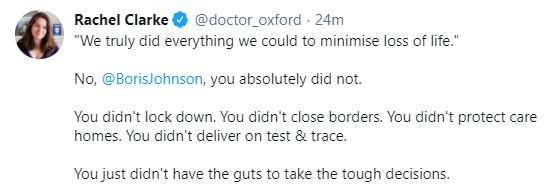
 Clarke is a palliative care doctor based in Oxfordshire. She runs the Katharine House hospice but during the coronavirus pandemic has also been on active duty in the Oxford University Hospitals system. If you’re on social media you have likely come across some of her postings as she has been equally vocal in her praise of the NHS and her criticism of Boris Johnson’s faltering policies, which are often of the too little, too late variety. So I was eager to read her insider’s account of hospital treatment of the first wave of Covid in the UK, especially because her previous book, Dear Life, was one of my top two nonfiction releases of last year.
The focus is on the first four full months of 2020, and the book originated in Clarke’s insomniac diaries and notes made when, even after manically busy shifts, she couldn’t rest her thoughts. Her pilot husband was flying to China even as increasingly alarming reports started coming in from Wuhan. She weaves in the latest news from China and Italy as well as what she hears from colleagues and disease experts in London. But the priority is given to stories: of the first doctor to die in China; of a Yorkshire ICU nurse’s father, who comes down with Covid and is on a ventilator in an Oxford hospital; and of her patients there and in the hospice. She is touched that so many are making great sacrifices, such as by deciding not to visit loved ones at the end of their lives so as not to risk spreading infection.
A shortage of PPE remained a major issue, though Dominic Pimenta (whose Duty of Care was my first COVID-19 book) pulled through for her with an emergency shipment for the hospice – without which it would have had to close. Clarke marvels at the NHS’s ability to create an extra 33,000 beds within a month, but knows that this comes at a cost of other services, including cancer care, being stripped back or cancelled, meaning that many are not receiving the necessary treatment or are pushing inescapable problems further down the road.
From January 26, 2021
A comparison with Gavin Francis’s Intensive Care, published earlier in the month, is inevitable. Both doctors bounce between headlines and everyday stories, government advice and the situation on the ground. Both had their own Covid scare – Clarke didn’t meet the criteria to be tested so simply went back to work two weeks later, when she felt well enough – and had connections to regions that foreshadowed what would soon happen in the UK. Both give a sense of the scope of the crisis and both lament that, just when patients need compassion most, full PPE leads to their doctors feeling more detached from them than ever.
However, within the same page count, Francis manages to convey more of the science behind the virus and its transmission, and helpfully explores the range of effects Covid is having for different groups. He also brings the story more up to the minute with a look back from November, whereas Clarke ends in April and follows up with an epilogue set in August. A book has to end somewhere, yes, but with this crisis ongoing, the later and more relevant its contents can be, the better. And in any book that involves a lot of death, mawkishness is a risk; Clarke so carefully avoided this in Dear Life, but sometimes succumbs here, with an insistence on how the pandemic has brought out the best in people (clapping and rainbows and all that). Her writing is as strong as ever, but I would have appreciated a sharper, more sombre look at the situation a few months later. Perhaps there will be a sequel.

From January 6, 2021
With thanks to Little, Brown UK for the free copy for review.
Some Body to Love: A Family Story by Alexandra Heminsley
 From Heminsley’s previous book, Leap In, I knew about her getting married and undergoing IVF. It was also a book about outdoor swimming; I appreciated her words on acquiring a new skill as an adult and overcoming body issues. This memoir continues the story: in 2017, after a gruelling journey through infertility treatment, Heminsley finally got the baby she wanted. But not before a couple more heart-wrenching moments: the lab made an error and notified her that she shared no DNA with this last embryo, and while heavily pregnant she was assaulted by a drunk man on a train. Both incidents left her feeling a loss of agency. “Why was I consistently being deemed the least reliable witness of my own reality?” she asks.
As they adjusted to new life with a baby, Heminsley started to notice that she wasn’t connecting with her husband, D, like she used to. She felt emotionally unsupported and, in fact, jealous of D’s relationship with their son, L. And while they’d never been the most conventional couple, D’s changes of appearance and wardrobe seemed like a sign of something bigger. Indeed, when L was six months old, D told Heminsley, “this body doesn’t represent who I am” and announced a decision to begin transitioning.
As D moved towards having a body that fit their identity, Heminsley, too, needed to get back in touch with her body. After books like Running Like a Girl, she was considered an exercise guru, but she didn’t see herself in the new obsession with Instagram-ready images of fitness perfection. This is not, then, primarily a memoir of queer family-making, because D’s transitioning was not Heminsley’s story to tell and mostly occurs in the background. Instead she focuses on what she does know and can control: her relationship to her own body.
However, this entails what can feel like irrelevant flashbacks to her teenage years of undergoing rehab at a military clinic in Germany for hypermobility, trips to Trinidad and Italy, and the genesis of her two sporting memoirs. Much as I applaud the sensitivity to trans and body issues, the book ends up feeling scattered. Still, the writing is so candid and the narrative so eventful that you’ll race through this even if you don’t normally pick up nonfiction. (For a bit more information, see my short write-up of the virtual book launch.)
With thanks to Chatto & Windus for the free copy for review.
Pain: The Science of the Feeling Brain by Abdul-Ghaaliq Lalkhen
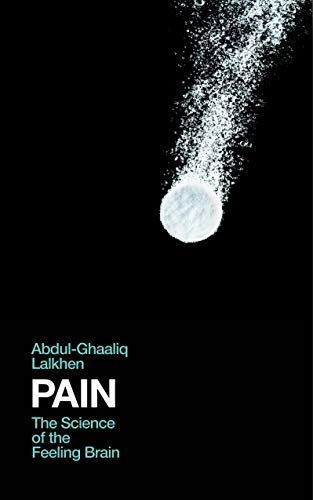 Originally from South Africa, Dr Lalkhen is an anaesthesiology and pain specialist based in Manchester. In a nutshell, his approach is “biopsychosocial,” meaning that he seeks to understand pain not just as a physical phenomenon resulting from acute injury or damage but as an ongoing process that is affected by emotional and psychological factors. Particularly in the context of chronic syndromes, he acknowledges that pain can continue even when its immediate cause has been repaired. Mental preparation can come into the equation: if a patient assumes they’ll wake up from surgery healed, they may be alarmed if pain persists. Lalkhen talks about managing patient expectations, perhaps with something as simple as the promise, “we’ll aim to get your pain down to a 4 after surgery.” In part, he blames Western society’s Cartesian philosophy for treating mind and body as separate rather than a system.
There are genetic and psychological reasons people might be predisposed to chronic pain. Pain itself can then change the brain chemistry, making the body more alert to pain signals. People can choose one of three paths, Lalkhen observes: “You can spend your time agitating about the alarm going off, you can try to ignore it (but the ignoring of it actually takes up more energy), or the final alternative is to learn to live with this deeply unpleasant situation.” Those who opt for pharmacological solutions can become addicted to opiates, which are less effective over time. Non-drug-related therapies involve the desensitization of nerves, the injection of anaesthetics or steroids, or the implanting of spinal cord stimulators. But all of these strategies have their limitations, and can diminish in efficacy. The patients he sees in his pain clinics may be disappointed that, rather than offering a panacea, he wants to wean them off their current pain relief and help them develop a new way of thinking about pain.
I felt I learned a lot from reading this. Lalkhen is careful to state that he is only referring to non-cancer pain (cancer pain in terminal patients will take all the morphine you can throw at it). Like many physicians, he worries about the modern epidemic of overtreatment and our obsession with wellness. I especially enjoyed the discussion of the understanding of pain and its treatment from the ancient world onward, and in particular the history of opiates. The prose is not literary, but this is an accessible and informational read if the subject matter draws you.
With thanks to Atlantic Books for the free copy for review.
What recent nonfiction releases can you recommend?
Review: Intensive Care by Gavin Francis
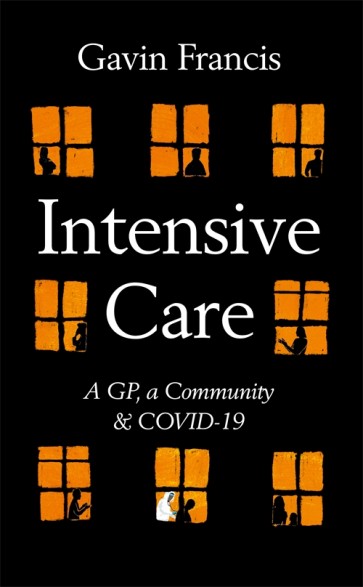
I finally finished a book in 2021! And it’s one with undeniable ongoing relevance. The subtitle is “A GP, a Community & COVID-19.” Francis, a physician who is based at an Edinburgh practice and frequently travels to the Orkney Islands for healthcare work, reflects on what he calls “the most intense months I have known in my twenty-year career.” He draws all of his chapter epigraphs from Daniel Defoe’s A Journal of the Plague Year and journeys back through most of 2020, from the day in January when he and his colleagues received a bulletin about a “novel Wuhan coronavirus” to November, when he was finalizing the book and learned of promising vaccine trials but also a rumored third wave and winter lockdown.
In February, no one knew whether precautions would end up being an overreaction, so Francis continued normal life: attending a conference, traveling to New York City, and going to a concert, pub, and restaurant. By March he was seeing more and more suspected cases, but symptoms were variable and the criteria for getting tested and quarantining changed all the time. The UK at least seemed better off than Italy, where his in-laws were isolating. Initially it was like flu outbreaks he’d dealt with before, with the main differences being a shift to telephone consultations and the “Great Faff” of donning full PPE for home visits and trips to care homes. The new “digital first” model left him feeling detached from his patients. He had his own Covid scare in May, but a test was negative and the 48-hour bug passed.
 Through his involvement in the community, Francis saw the many ways in which coronavirus was affecting different groups of people. He laments the return of mental health crises that had been under control until lockdown. Edinburgh’s homeless, many in a perilous immigration situation thanks to Brexit, were housed in vacant luxury hotels. He visited several makeshift hostels, where some residents were going through drug withdrawal, and also met longtime patients whose self-harm and suicidal ideation were worsening.
Children and the elderly were also suffering. In June, he co-authored a letter begging the Scottish education secretary to allow children to return to school. Perhaps the image that will stick with me most, though, is of the confused dementia patients he met at care homes: “there was a crushing atmosphere of sadness among the residents … [they were] not able to understand why their families no longer came to visit. How do you explain social distancing to someone who doesn’t remember where they are, sometimes even who they are?”
Francis incorporates brief histories of vaccination and the discovery of herd immunity, and visits a hospital where a vaccine trial is underway. I learned some things about COVID-19 specifically: it can be called a “viral pneumonia”; it has two phases, virological (the virus makes you unwell) and immunological (the immune system misdirects messages and the lungs get worse); and it affects the blood vessels as well as the lungs, with one in five presenting with a rash and some developing chilblains in the summer. Amazingly, as the year waned, Francis only knew three patients who had died of Covid, with many more recovered. But in August, a city that should have been bustling with festival tourists was nearly empty.
Necessarily, the book ends in the middle of things; Francis has clear eyes but a hopeful heart. While this is not the first COVID-19 book I’ve encountered (that was Duty of Care by Dominic Pimenta) and will be far from the last – next up for me will be Rachel Clarke’s Breathtaking, out at the end of this month – it is an absorbing first-hand account of a medical crisis as well as a valuable memorial of a time like no other in recent history. A favorite line was “One of the few consolations of this pandemic is its grim camaraderie, a new fellowship among the fear.” Another consolation for me is reading books by medical professionals who can compassionately bridge the gap between expert opinion and everyday experience.
Intensive Care was published by the Wellcome Collection/Profile Books on January 7th. My thanks to the publisher for the free copy for review.
Gavin Francis’s other work includes:
Previously reviewed: Shapeshifters
Also owned: Adventures in Human Being
I’m keen to read: Empire Antarctica, about being the medical officer at the British research centre in Antarctica – ironically, this was during the first SARS pandemic. (In July 2020, conducting medical examinations on the next batch of scientists to ship out there, he envied them the chance to escape: “By the time they came home it would be 2022. Surely we’d have the virus under control by then?”)
My Best Backlist Reads of 2020
Like many book bloggers, I’m irresistibly drawn to the shiny new books released each year. However, I consistently find that many of my most memorable reads were published years or even decades ago. These 29 selections, in alphabetical order by author name, account for the rest of my 4.5- and 5-star ratings of the year. Five rereads made it onto my list.
Fiction
 Americanah by Chimamanda Ngozi Adichie: Through Ifemelu’s years of studying, working, and blogging her way around the Eastern seaboard of the United States, Adichie explores the ways in which the experience of an African abroad differs from that of African Americans. On a sentence level as well as at a macro plot level, this was utterly rewarding.
 Year of Wonders by Geraldine Brooks: In 1665, with the Derbyshire village of Eyam in the grip of the Plague, the drastic decision is made to quarantine it. Frustration with the pastor’s ineffectuality attracts people to religious extremism. Anna’s intimate first-person narration and the historical recreation are faultless, and there are so many passages that feel apt.
 Shotgun Lovesongs by Nickolas Butler: Four childhood friends from Little Wing, Wisconsin. Which bonds will last, and which will be strained to the breaking point? This is a book full of nostalgia and small-town atmosphere. All the characters wonder whether they’ve made the right decisions or gotten stuck. A lot of bittersweet moments, but also comic ones.
 Kindred by Octavia E. Butler: A perfect time-travel novel for readers who quail at science fiction. Dana, an African American writer in Los Angeles, is dropped into early-nineteenth-century Maryland. This was such an absorbing read, with first-person narration that makes you feel you’re right there alongside Dana on her perilous travels.
 Dominicana by Angie Cruz: Ana Canción is just 15 when she arrives in New York from the Dominican Republic on the first day of 1965 to start her new life as the wife of Juan Ruiz. An arranged marriage and arriving in a country not knowing a word of the language: this is a valuable immigration story that stands out for its plucky and confiding narrator.
 Ella Minnow Pea by Mark Dunn: A book of letters in multiple sense. Laugh-out-loud silliness plus a sly message about science and reason over superstition = a rare combination that made this an enduring favorite. On my reread I was more struck by the political satire: freedom of speech is endangered in a repressive society slavishly devoted to a sacred text.
 Love Medicine by Louise Erdrich: Interlocking stories that span half a century in the lives of a couple of Chippewa families that sprawl out from a North Dakota reservation. Looking for love, looking for work. Getting lucky, getting even. Their problems are the stuff of human nature and contemporary life. I adored the descriptions of characters and of nature.
 Notes from an Exhibition by Patrick Gale: Nonlinear chapters give snapshots of the life of a bipolar artist and her interactions with her husband and children. Their Quakerism sets up a calm and compassionate atmosphere, but also allows family secrets to proliferate. The novel questions patterns of inheritance and the possibility of happiness.
 Confession with Blue Horses by Sophie Hardach: When Ella’s parents, East German art historians who came under Stasi surveillance, were caught trying to defect, their children were taken away from them. Decades later, Ella is determined to find her missing brother and learn what really happened to her mother. Eye-opening and emotionally involving.
 The Go-Between by L.P. Hartley: Twelve-year-old Leo Colston is invited to spend July at his school friend’s home, Brandham Hall. You know from the famous first line on that this juxtaposes past and present. It’s masterfully done: the class divide, the picture of childhood tipping over into the teenage years, the oppressive atmosphere, the comical touches.
 Our Souls at Night by Kent Haruf: Addie is a widow; Louis is a widower. They’re both lonely and prone to fretting about what they could have done better. Would he like to come over to her house at night to talk and sleep? Matter-of-fact prose, delivered without speech marks, belies a deep undercurrent of emotion. Understated, bittersweet, realistic. Perfect.
 The Emperor’s Children by Claire Messud: A 9/11 novel. The trio of protagonists, all would-be journalists aged 30, have never really had to grow up; now it’s time to get out from under the shadow of a previous generation and reassess what is admirable and who is expendable. This was thoroughly engrossing. Great American Novel territory, for sure.
 My Year of Meats by Ruth Ozeki: A Japanese-American filmmaker is tasked with finding all-American families and capturing their daily lives – and best meat recipes. There is a clear message here about cheapness and commodification, but Ozeki filters it through the wrenching stories of two women with fertility problems. Bold if at times discomforting.
 Small Ceremonies by Carol Shields: An impeccable novella, it brings its many elements to a satisfying conclusion and previews the author’s enduring themes. Something of a sly academic comedy à la David Lodge, it’s laced with Shields’s quiet wisdom on marriage, parenting, the writer’s vocation, and the difficulty of ever fully understanding another life.
 Larry’s Party by Carol Shields: The sweep of Larry’s life, from youth to middle age, is presented chronologically through chapters that are more like linked short stories: they focus on themes (family, friends, career, sex, clothing, health) and loop back to events to add more detail and new insight. I found so much to relate to in Larry’s story; Larry is really all of us.
 Abide with Me by Elizabeth Strout: Tyler Caskey is a widowed pastor whose five-year-old daughter has gone mute and started acting up. As usual, Strout’s characters are painfully real, flawed people, often struggling with damaging obsessions. She tenderly probes the dark places of the community and its minister’s doubts, but finds the light shining through.
 The Wife by Meg Wolitzer: On the way to Finland, where her genius writer husband will accept the prestigious Helsinki Prize, Joan finally decides to leave him. Alternating between the trip and earlier in their marriage, this is deceptively thoughtful with a juicy twist. Joan’s narration is witty and the point about the greater value attributed to men’s work is still valid.
Nonfiction
 Winter Journal by Paul Auster: Approaching age 64, the winter of his life, Auster decided to assemble his most visceral memories: scars, accidents and near-misses, what his hands felt and his eyes observed. The use of the second person draws readers in. I particularly enjoyed the tour through the 21 places he’s lived. One of the most remarkable memoirs I’ve ever read.
 Heat by Bill Buford: Buford was an unpaid intern at Mario Batali’s famous New York City restaurant, Babbo. In between behind-the-scenes looks at frantic sessions of food prep, Buford traces Batali’s culinary pedigree through Italy and London. Exactly what I want from food writing: interesting trivia, quick pace, humor, and mouthwatering descriptions.
 Sixpence House: Lost in a Town of Books by Paul Collins: Collins moved to Hay-on-Wye with his wife and toddler son, hoping to make a life there. As he edited the manuscript of his first book, he started working for Richard Booth, the eccentric bookseller who crowned himself King of Hay. Warm, funny, and nostalgic. An enduring favorite of mine.
 A Year on the Wing by Tim Dee: From a life spent watching birds, Dee weaves a mesh of memories and recent experiences, meditations and allusions. He moves from one June to the next and from Shetland to Zambia. The most powerful chapter is about watching peregrines at Bristol’s famous bridge – where he also, as a teen, saw a man commit suicide.
 The Frayed Atlantic Edge by David Gange: While kayaking down the western coast of the British Isles and Ireland, Gange delves into the folklore, geology, history, local language and wildlife of each region and island group – from the extreme north of Scotland at Muckle Flugga to the southwest tip of Cornwall. An intricate interdisciplinary approach.
 Traveling Mercies: Some Thoughts on Faith by Anne Lamott: There is a lot of bereavement and other dark stuff here, yet an overall lightness of spirit prevails. A college dropout and addict, Lamott didn’t walk into a church and get clean until her early thirties. Each essay is perfectly constructed, countering everyday angst with a fumbling faith.
 In the Dream House by Carmen Maria Machado: This has my deepest admiration for how it prioritizes voice, theme and scene, gleefully does away with chronology and (not directly relevant) backstory, and engages with history, critical theory and the tropes of folk tales to interrogate her experience of same-sex domestic violence. (Second-person narration again!)
 Period Piece by Gwen Raverat: Raverat was a granddaughter of Charles Darwin. This is a portrait of what it was like to grow up in a particular time and place (Cambridge from the 1880s to about 1909). Not just an invaluable record of domestic history, it is a funny and impressively thorough memoir that serves as a model for how to capture childhood.
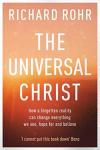 The Universal Christ by Richard Rohr: I’d read two of the Franciscan priest’s previous books but was really blown away by the wisdom in this one. The argument in a nutshell is that Western individualism has perverted the good news of Jesus, which is renewal for everything and everyone. A real gamechanger. My copy is littered with Post-it flags.
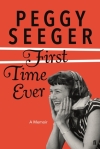 First Time Ever: A Memoir by Peggy Seeger: The octogenarian folk singer and activist has packed in enough adventure and experience for multiple lifetimes, and in some respects has literally lived two: one in America and one in England; one with Ewan MacColl and one with a female partner. Her writing is punchy and impressionistic. She’s my new hero.
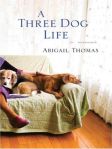 A Three Dog Life by Abigail Thomas: A memoir in essays about her husband’s TBI and what kept her going. Unassuming and heart on sleeve, Thomas wrote one of the most beautiful books out there about loss and memory. It is one of the first memoirs I remember reading; it made a big impression the first time, but I loved it even more on a reread.
 On Silbury Hill by Adam Thorpe: Explores the fragmentary history of the manmade Neolithic mound and various attempts to excavate it, but ultimately concludes we will never understand how and why it was made. A flawless integration of personal and wider history, as well as a profound engagement with questions of human striving and hubris.

(Books not pictured were read digitally, or have already gone back to the library.)
And if I really had to limit myself to just two favorites – my very best fiction and nonfiction reads of the year – they would be Our Souls at Night by Kent Haruf and Winter Journal by Paul Auster.
What were your best backlist reads this year?
The Best Books of 2020: Some Runners-Up
I’ve chosen 25 more cracking reads that were first released in 2020. (Asterisks = my hidden gems of the year.) Between this post and my Fiction/Poetry and Nonfiction best-of lists, I’ve now highlighted about the top 12% of my year’s reading.
Novels:
 The Vanishing Half by Brit Bennett: Like some lost mid-career gem from Toni Morrison, this novel is meaty with questions of racial and sexual identity. Light-skinned African-American twins’ paths divide in 1950s Louisiana. Perceptive and beautifully written, this has characters whose struggles feel genuine and pertinent.
 Piranesi by Susanna Clarke: To start with, Piranesi traverses his watery labyrinth like he’s an eighteenth-century adventurer, his resulting notebooks reading rather like Alexander von Humboldt’s writing. I admired how the novel moved from the fantastical and abstract into the real and gritty. Read it even if you say you don’t like fantasy.
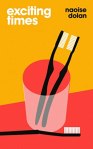 Exciting Times by Naoise Dolan: At 22, Ava leaves Dublin to teach English as a foreign language to wealthy preteens and almost accidentally embarks on affairs with an English guy and a Chinese girl. Dolan has created a funny, deadpan voice that carries the entire novel. I loved the psychological insight, the playfulness with language, and the zingy one-liners.
 *A Good Neighborhood by Therese Anne Fowler: Issues of race and privilege undermine a teen romance in a perfect-seeming North Carolina community. This is narrated in a first-person plural voice, like the Greek chorus of a classical tragedy. If you loved An American Marriage, it should be next on your list. I’m puzzled by how overlooked it’s been this year.
 Transcendent Kingdom by Yaa Gyasi: A more subdued and subtle book than Homegoing, but its treatment of themes of addiction, grief, racism, and religion is so spot on that it packs a punch. Gifty is a PhD student at Stanford, researching reward circuits in the mouse brain. There’s also a complex mother–daughter relationship and musings on love and risk. [To be published in the UK in March]
 The Mercies by Kiran Millwood Hargrave: A rich, natural exploration of a place and time period – full of detail but wearing its research lightly. Inspired by a real-life storm that struck on Christmas Eve 1617 and wiped out the male population of the Norwegian island of Vardø, it intimately portrays the lives of the women left behind. Tender, surprising, and harrowing.
 Sisters by Daisy Johnson: Teenagers September and July were born just 10 months apart, with July always in thrall to her older sister. For much of this short novel, Johnson keeps readers guessing as to why the girls’ mother, Sheela, took them away to Settle House, her late husband’s family home in the North York Moors. As mesmerizing as it is unsettling.
 The Book of Longings by Sue Monk Kidd: Kidd’s bold fourth novel started as a what-if question: What if Jesus had a wife? Although this retells biblical events, it is chiefly an attempt to illuminate women’s lives in the 1st century and to chart the female contribution to sacred literature and spirituality. An engrossing story of women’s intuition and yearning.
 *The Ninth Child by Sally Magnusson: Intense and convincing, this balances historical realism and magical elements. In mid-1850s Scotland, there is a move to ensure clean water. The Glasgow waterworks’ physician’s wife meets a strange minister who died in 1692. A rollicking read with medical elements and a novel look into Victorian women’s lives.
 *The Bell in the Lake by Lars Mytting: In this first book of a magic-fueled historical trilogy, progress, religion, and superstition are forces fighting for the soul of a late-nineteenth-century Norwegian village. Mytting constructs the novel around compelling dichotomies. Astrid, a feminist ahead of her time, vows to protect the ancestral church bells.
 What Are You Going Through by Sigrid Nunez: The narrator is called upon to help a terminally ill friend commit suicide. The voice is not solely or even primarily the narrator’s but Other: art consumed and people encountered become part of her own story; curiosity about other lives fuels empathy. A quiet novel that sneaks up to seize you by the heartstrings.
 Weather by Jenny Offill: A blunt, unromanticized, wickedly funny novel about how eco-anxiety permeates everyday life, written in an aphoristic style. Set either side of Trump’s election in 2016, the novel amplifies many voices prophesying doom. Offill’s observations are dead right. This felt like a perfect book for 2020 and its worries.
 Love and Other Thought Experiments by Sophie Ward: An intriguing set of linked short stories that combine philosophy and science fiction. Rachel and Eliza are preparing to have a baby together when an ant crawls into Rachel’s eye and she falls ill. I was particularly taken by the chapter narrated by the ant. It’s well worth making a rare dip into sci-fi for this one.
 *The Inland Sea by Madeleine Watts: The young female narrator of this debut novel lives in Sydney and works for Australia’s emergency call service. Against a backdrop of flooding and bush fires, a series of personal catastrophes play out. A timely, quietly forceful story of how women cope with concrete and existential threats.
Short Stories:
 To Be a Man by Nicole Krauss: These 10 stories from the last 18 years are melancholy and complex, often featuring several layers of Jewish family history. Europe, Israel, and film are frequent points of reference. “Future Emergencies,” though set just after 9/11, ended up feeling the most contemporary because it involves gas masks and other disaster preparations.
 *Help Yourself by Curtis Sittenfeld: A bonus second UK release from Sittenfeld in 2020 after Rodham. Just three stories, but not leftovers; a strong follow-up to You Think It, I’ll Say It. They share the theme of figuring out who you really are versus what others think of you. “White Women LOL,” especially, compares favorably to Kiley Reid’s Such a Fun Age.
 You Will Never Be Forgotten by Mary South: In this debut collection, characters turn to technology to stake a claim on originality, compensate for losses, and leave a legacy. These 10 quirky, humorous stories never strayed so far into science fiction as to alienate me. I loved the medical themes and subtle, incisive observations about a technology-obsessed culture.
Poetry:
 *Survival Is a Style by Christian Wiman: Wiman examines Christian faith in the shadow of cancer. This is the third of his books that I’ve read, and I’m consistently impressed by how he makes room for doubt, bitterness, and irony – yet a flame of faith remains. There is really interesting phrasing and vocabulary in this volume.
Nonfiction:
 Inferno: A Memoir by Catherine Cho: Cho experienced stress-induced postpartum psychosis after the birth of her son. She alternates between her time in the mental hospital and her life before the breakdown, weaving in family history and Korean sayings and legends. It’s a painstakingly vivid account.
 *The Lost Family: How DNA Testing Is Upending Who We Are by Libby Copeland: DNA tests can find missing relatives within days. But there are troubling aspects to this new industry, including privacy concerns, notions of racial identity, and criminal databases. A thought-provoking book with all the verve and suspense of fiction.
 *Signs of Life: To the Ends of the Earth with a Doctor by Stephen Fabes: Fabes is an emergency room doctor in London and spent six years of the past decade cycling six continents. This warm-hearted and laugh-out-loud funny account of his travels achieves a perfect balance between world events, everyday discomforts, and humanitarian volunteering.
 Losing Eden: Why Our Minds Need the Wild by Lucy Jones: Nature’s positive effect on human mental health is something we know intuitively and can explain anecdotally, but Jones wanted to investigate the scientific mechanism behind it. Losing Eden is full of common sense and passion, cramming in lots of information yet never losing sight of the big picture.
 *Nobody Will Tell You This But Me: A True (As Told to Me) Story by Bess Kalb: Jewish grandmothers are renowned for their fiercely protective love, but also for nagging. Both sides of the stereotypical matriarch are on display in this funny, heartfelt family memoir, narrated in the second person – as if from beyond the grave – by her late grandmother. A real delight.
 Diary of a Young Naturalist by Dara McAnulty: McAnulty is a leader in the UK’s youth environmental movement and an impassioned speaker on the love of nature. This is a wonderfully observant and introspective account of his fifteenth year and the joys of everyday encounters with wildlife. Impressive perspective and lyricism.
 Memorial Drive: A Daughter’s Memoir by Natasha Trethewey: Trethewey grew up biracial in 1960s Mississippi, then moved with her mother to Atlanta. Her stepfather was abusive; her mother’s murder opens and closes the book. Trethewey only returned to their Memorial Drive apartment after 30 years had passed. A striking memoir, delicate and painful.

(Books not pictured were read digitally, or have already gone back to the library.)
Coming tomorrow: My best backlist reads of the year.
My Year in Nonfiction (Thus Far)
If your household is anything like mine, stressful days and nights of lost sleep are ceding to relief after the U.S. election result was finally announced. We celebrated with whoopie pies (a Pennsylvania specialty) and Prosecco.


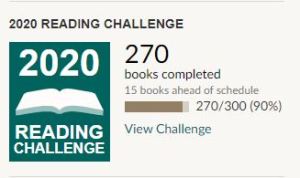
And look: I happened to pass 270 yesterday as well!
I’d taken part in the Six Degrees of Separation meme every month since February, but this time I had no inspiration. I was going to start with these two apple covers…
…but that’s as far as I got. Never mind! I’ll be back next month, when we all start with the YA classic Are You There God? It’s Me, Margaret by Judy Blume.
Instead, I’m catching up with this past week’s Nonfiction November prompt: Your Year in Nonfiction. It was hosted by Leann of Shelf Aware.

 What topics have been prominent in your year’s nonfiction reading?
I’ve read a lot of nature and popular science, probably more than in an average year. Greenery by Tim Dee has been an overall highlight. I managed to read 12 books from the Wainwright Prize longlists, and I’m currently reading four books of nature-themed essays or journals. Thoughtful as well as consoling.

The popular science material has focused on environmentalism and current events, which has inevitably involved politics and long-term planning (Annabel called this category “The State We’re In”): e.g. Losing Eden, Footprints, The Good Ancestor, and Notes from an Apocalypse.


Thanks to the food and drink theme I set for my 20 Books of Summer, I read a number of foodie memoirs. The best one was Heat by Bill Buford, but I also really enjoyed Kitchen Confidential by Anthony Bourdain and My Berlin Kitchen by Luisa Weiss.
 Since the Wellcome Book Prize didn’t run this year, I’ve read fewer health-related books, although I did specially read Not the Wellcome Prize shortlistee The Remarkable Life of the Skin by Monty Lyman, and Dear Life by Rachel Clarke, a palliative care doctor, has been one of my overall best nonfiction reads of the year.
Not very well represented in my nonfiction reading this year were biographies and travel books. I can struggle with the depth and dryness of some books from these genres, but I’d like to find some readable options to get stuck into next year.
What are your favorite nonfiction books you’ve read so far?
I’m a huge memoir junkie. Some of the most memorable ones this year have been Winter Journal by Paul Auster, Traveling Mercies by Anne Lamott (a reread), and A Three Dog Life by Abigail Thomas (another reread).


An incidental theme in the life writing I’ve read in 2020 is childhood (Childhood by Tove Ditlevsen, Cider with Rosie by Laurie Lee, Oleander, Jacaranda by Penelope Lively, Period Piece by Gwen Raverat); I hope to continue reading around this topic next year.
What books have you recommended the most to others?
I’ve mentioned the Clarke (above) in any discussions of books about illness and death.
I recommended the memoir Are You Somebody? by Nuala O’Faolain more than once following Reading Ireland Month.
Entangled Life, Merlin Sheldrake’s enthusiastic book about fungi, is one I can imagine suggesting to readers who don’t often pick up nonfiction.
And Signs of Life by Dr. Stephen Fabes has generated a fair bit of interest among my Goodreads friends.


Besides Annabel, Kate and Liz also wrote about their 2020 nonfiction reading habits.
How has your nonfiction reading been going this year?
Nonfiction Catch-Up: Long-Term Thinking, Finding a Home in Wales, Eels
Not long now until Nonfiction November. I’m highlighting three nonfiction books I’ve read over the last few months; any of them would be well worth your time if you’re still looking for some new books to add to the pile. I’ve got a practical introduction to the philosophy and politics of long-term/intergenerational planning, a group biography about the two gay couples who inhabited a house in the Welsh hills in turn, and a wide-ranging work on eels.
The Good Ancestor: How to Think Long Term in a Short-Term World by Roman Krznaric
 I saw Krznaric introduce this via a digital Hay Festival session back in May. He is an excellent speaker and did an admirable job of conveying all the major ideas from his recent work within a half-hour presentation. Unfortunately, this meant that reading the book itself didn’t add much for me, although it goes deeper into his propositions and is illustrated with unique, helpful figures.
Without repeating from my write-up of the Festival talk, then, I’ll add in points and quotes that struck me:
- “some of the fundamental ways we organise society, from nation states and representative democracy to consumer culture and capitalism itself, are no longer appropriate for the age we live in.”
- 100 years as the minimum timeframe to think about (i.e., a long human life) – “taking us beyond the ego boundary of our own mortality so we begin to imagine futures that we can influence yet not participate in ourselves.”
- “The phones in our pockets have become the new factory clocks, capturing time that was once our own and offering in exchange a continuous electronic now full of infotainment, advertising and fake news. The distraction industry works by cleverly tapping into our ancient mammalian brains: our ears prick up at the ping of an arriving message … Facebook is Pavlov, and we’re the dogs.”
- The Intergenerational Solidarity Index as a way of assessing governments’ future preparation: long-term democracies tend to perform better, though they aren’t perfect; Iceland scores the highest of all, followed by Sweden.
- Further discussion of Doughnut Economics (a model developed by Krznaric’s wife, Kate Raworth), which pictures the sweet spot humans need to live in between a social foundation and the ecological ceiling; failures lead to overshoot or shortfall.
- Four fundamental barriers to change: outdated institutional designs (our basic political systems), the power of vested interests (fossil fuel companies, Amazon, et al.), current insecurity (refugees), and “insufficient sense of crisis” – we’re like frogs in a gradually boiling pot, he says, and need to be jolted out of our complacency.
This is geared more towards economics and politics than much of what I usually read, yet fits in well with other radical visions of the future I’ve engaged with this year (some of them more environmentalist in approach), including Footprints by David Farrier, The Future Earth by Eric Holthaus, and Notes from an Apocalypse by Mark O’Connell.
With thanks to WH Allen for the free copy for review.
On the Red Hill: Where Four Lives Fell into Place by Mike Parker (2019)
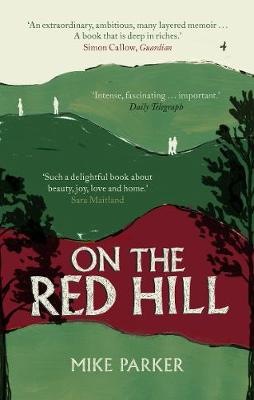 I ordered a copy from Blackwell’s after this made it through to the Wainwright Prize shortlist – it went on to be named the runner-up in the UK nature writing category. It’s primarily a memoir/group biography about Parker, his partner Peredur, and George and Reg, the couple who previously inhabited their home of Rhiw Goch in the Welsh Hills and left it to the younger pair in their wills. In structuring the book into four parts, each associated with an element, a season, a direction of the compass and a main character, Parker focuses on the rhythms of the natural year. The subtitle emphasizes the role Rhiw Goch played, providing all four with a sense of belonging in a rural setting not traditionally welcoming to homosexuals.
Were George and Reg the ‘only gays in the village,’ as the Little Britain sketch has it? Impossible to say, but when they had Powys’ first same-sex civil partnership ceremony in February 2006, they’d been together nearly 60 years. By the time Parker and his partner took over the former guesthouse, gay partnerships were more accepted. In delving back into his friends’ past, then, he conjures up another time: George fought in the Second World War, and for the first 18 years he was with Reg their relationship was technically illegal. But they never rubbed it in any faces, preferring to live quietly, traveling on the Continent and hosting guests at their series of Welsh B&Bs; their politics was conservative, and they were admired locally for their cooking and hospitality (Reg) and endurance cycling (George).
There are lots of in-text black-and-white photographs of Reg and George over the years and of Rhiw Goch through the seasons. Using captioned photos, journal entries, letters and other documents, Parker gives a clear impression of his late friends’ characters. There is something pitiable about both: George resisting ageing with nude weightlifting well into his sixties; Reg still essentially ashamed of his sexuality as well as his dyslexia. I felt I got to know the younger protagonists less well, but that may simply be because their stories are ongoing. It’s remarkable how Welsh Parker now seems: though he grew up in the English Midlands, he now speaks decent Welsh and has even stood for election for the Plaid Cymru party.
It’s rare to come across something in the life writing field that feels genuinely sui generis. There were moments when my attention waned (e.g., George’s feuds with the neighbors), but so strong is the overall sense of time, place and personality that this is a book to prize.
The Gospel of the Eels: A Father, a Son and the World’s Most Enigmatic Fish by Patrik Svensson
[Translated from the Swedish by Agnes Broomé]
“When it comes to eels, an otherwise knowledgeable humanity has always been forced to rely on faith to some extent.”
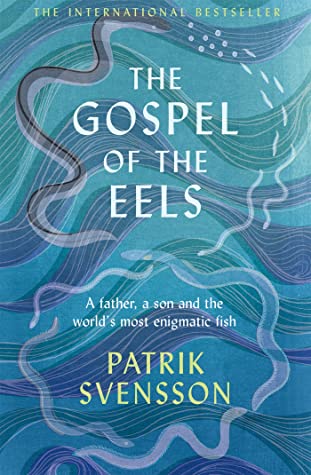 We know the basic facts of the European eel’s life cycle: born in the Sargasso Sea, it starts off as a larva and then passes through three stages that are almost like separate identities: glass eel, yellow eel, silver eel. After decades underwater, it makes its way back to the Sargasso to spawn and die. Yet so much about the eel remains a mystery: why the Sargasso? What do the creatures do for all the time in between? Eel reproduction still has not been observed, despite scientists’ best efforts. Among the famous names who have researched eels are Aristotle, Sigmund Freud and Rachel Carson, all of whom Svensson discusses at some length. He even suggests that, for Freud, the eel was a suitable early metaphor for the unconscious – “an initial insight into how deeply some truths are hidden.”
But there is a more personal reason for Svensson’s fascination with eels. As a boy he joined his father in eel fishing on Swedish summer nights. It was their only shared hobby; the only thing they ever talked about. His father was as much a mystery to him as eels are to science. And it was only as his father was dying of a cancer caused by his long road-paving career that Svensson came to understand secrets he’d kept hidden for decades.
Chapters alternate between this family story and the story of the eels. The book explores eels’ place in culture (e.g., Günter Grass’ The Tin Drum) and their critically endangered status due to factors such as a herpes virus, nematode infection, pollution, overfishing and climate change. A prior curiosity about marine life would be helpful to keep you going through this, but the prose is lovely enough to draw in even those with a milder interest in nature writing.
With thanks to Picador for the free copy for review.
One of my recent borrows from the public library’s children’s section was the picture book Think of an Eel by Karen Wallace. Her unrhymed, alliterative poetry and the paintings by Mike Bostock beautifully illustrate the eel’s life cycle and journey.

You simply must hear folk singer Kitty Macfarlane’s gorgeous song “Glass Eel” – literally about eels, it’s also concerned with migration, borders and mystery.
Would you be interested in reading one or more of these?
The 1956 Club: The Lonely Londoners and Night
It’s my second time participating in one of Simon and Karen’s reading weeks (after the 1920 Club earlier this year). It was a boon that the two books I chose and borrowed from the library were of novella length. As in April, I managed one very enjoyable read and one slightly less successful skim.
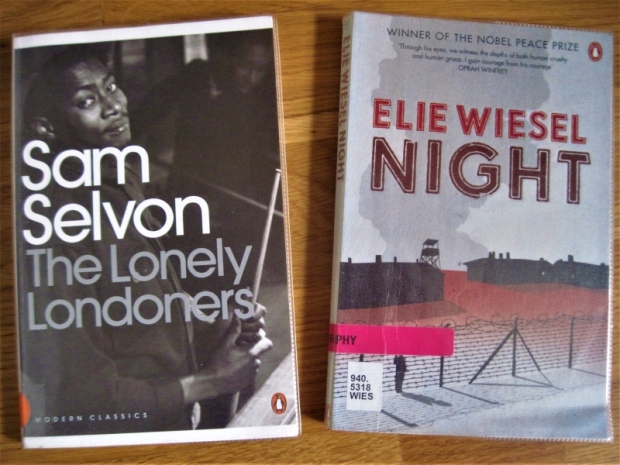
The Lonely Londoners by Sam Selvon
This title was familiar to me because it was one of the texts the London secondary school students could choose to review for a special supplement of Wasafiri literary magazine when I did a few in-school sessions mentoring them in the basics of book reviewing in early 2014. (An experience that was totally outside my comfort zone and now feels like a lifetime away.)
 Selvon, a Trinidadian journalist who settled in London in 1950, became known as the “father of black writing” in Britain. Moses Aloetta, an expert in London life after a few years here, lends a hand to his West Indian brethren who are fresh off the boat. As the book opens, he’s off to meet Henry Oliver, whom he soon dubs “Sir Galahad” for his naïve idealism. Moses warns Galahad that, although racism isn’t as blatant as in America, the British certainly aren’t thrilled about black people coming over and taking their jobs. Galahad reassures him that he’s a “born hustler.” We meet a series of other immigrants, like Cap and Bart, who move flats and change jobs frequently, drink and carouse, and “love woman too bad.”
I read and enjoyed the first 52 pages but skimmed from that point on because the patois, while initially captivating, got to be a bit much – I have a limited tolerance for dialect, and for episodic storytelling. I did love the sequences about Galahad catching pigeons for food and Cap following up with seagulls. There is a strong voice and sense of place here: if you want to experience London in the 1950s and see a rarer immigrant perspective, it would be a great choice. (Also recently reviewed by Liz and Annabel.)
Representative passages:
“It have people living in London who don’t know what happening in the room next to them, far more the street, or how other people living. London is a place like that. It divide up in little worlds, and you stay in the world you belong to and you don’t know anything about what happening in the other ones except what you read in the papers.”
the nine-page stream-of-consciousness paragraph that starts “Oh what a time it is when summer come to the city and all them girls throw away heavy winter coat and wearing light summer frocks so you could see the legs and shapes that was hiding away from the cold blasts”
My rating: 
Night by Elie Wiesel
[Translated from the French by Marion Wiesel]
A short, harrowing memoir of concentration camp life. Eliezer Wiesel was a young teenager obsessed with the Kabbalah when his family was moved into a Romanian ghetto for Jews and then herded onto a transport train. Uniquely in my reading of Holocaust memoirs, Wiesel was not alone but had his father by his side for much of the time as they were shuttled between various concentration camps including Auschwitz and Buchenwald, from which he was liberated in April 1945. But if the presence of family started as a blessing in a life of privation and despair, it became more of a liability as his father fell ill with dysentery.
 Like Viktor Frankl, Wiesel puts his survival down to luck: not once but several times, he and his father were sent to the left (towards the crematoria), but spared at the last minute. They endured infection, a stampede, a snowstorm and near-starvation. But their faith did not survive intact. “For God’s sake, where is God?” someone watching the hanging of a child burst out. “And from within me, I heard a voice answer: ‘Where He is? This is where—hanging here from this gallows.’” I’d heard that story before, twisted by Christian commentators into a “Hey, that’s like Jesus on the cross! God is right here suffering with us” message when actually it’s more “God is dead. God has abandoned us.”
From the preface to a new translation by his wife, I learned that the original Yiddish manuscript was even bleaker in outlook, with opening and closing passages that voice a cynical loss of trust in God and fellow man. “I am not so naïve as to believe that this slim volume will change the course of history or shake the conscience of the world. Books no longer have the power they once did. Those who kept silent yesterday will remain silent tomorrow” was the chilling final line of his first version. And yet Night has been taught in many high schools, and if it opens even a few students’ eyes – given the recent astonishing statistics about American ignorance of the scope of the Holocaust – it has been of value.
Wiesel won the Nobel Peace Prize in 1986. His acceptance speech is appended to the text of my 2008 Penguin paperback. In it he declares: “I swore never to be silent whenever and wherever human beings endure suffering and humiliation. We must take sides. Neutrality helps the oppressor, never the victim. Silence encourages the tormentor, never the tormented. Sometimes we must interfere. When human lives are endangered, when human dignity is in jeopardy, national borders and sensitivities become irrelevant. Wherever men and women are persecuted because of their race, religion, or political views, that place must—at that moment—become the center of the universe.” Wise words with perennial relevance.
My rating: 
20 Books of Summer, #13–14: Ruth Reichl and Alice Steinbach
Just three weeks remain in this challenge. I’m reading another four books towards it, and have two more to pick up during our mini-break to Devon and Dorset this coming weekend. A few of my choices are long and/or slow-moving reads, though, so I have a feeling I’ll be reading right down to the wire…
Today I have another two memoirs linked by France and its cuisine.
Tender at the Bone: Growing Up at the Table by Ruth Reichl (1998)
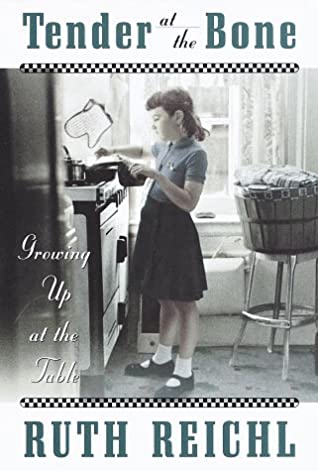 (20 Books of Summer, #13) I’ve read Reichl’s memoirs out of order, starting with Garlic and Sapphires (2005), about her time as a New York Times food critic, and moving on to Comfort Me with Apples (2001), about her involvement in California foodie culture in the 1970s–80s. Whether because I’d been primed by the disclaimer in the author’s note (“I have occasionally embroidered. I learned early that the most important thing in life is a good story”) or not, I sensed that certain characters and scenes were exaggerated here. Although I didn’t enjoy her memoir of her first 30 years as much as either of the other two I’d read, it was still worth reading.
The cover image is a genuine photograph taken by Reichl’s German immigrant father, book designer Ernst Reichl, in 1955. Early on, Reichl had to fend for herself in the kitchen: her bipolar mother hoarded discount food even it was moldy, so the family quickly learned to avoid her dishes made with ingredients that were well past their best. Like Eric Asimov and Anthony Bourdain, whose memoirs I’ve also reviewed this summer, Reichl got turned on to food by a top-notch meal in France. Food was a form of self-expression as well as an emotional crutch in many situations to come: during boarding school in Montreal, her rebellious high school years, and while living off of trendy grains and Dumpster finds at a co-op in Berkeley.
Reichl worked with food in many ways during her twenties. She was a waitress during college in Michigan, and a restaurant collective co-owner in California; she gave cooking lessons; she catered parties; and she finally embarked on a career as a restaurant critic. Her travels took her to France (summer camp counselor; later, wine aficionado), Morocco (with her college roommate), and Crete (a honeymoon visit to her favorite professor). Raised in New York City, she makes her way back there frequently, too. Overall, the book felt a bit scattered to me, with few if any recipes that I would choose to make, and the relationship with a mentally ill mother was so fraught that I will probably avoid Reichl’s two later books focusing on her mother.
Source: Awesomebooks.com
My rating: 
Educating Alice: Adventures of a Curious Woman by Alice Steinbach (2004)
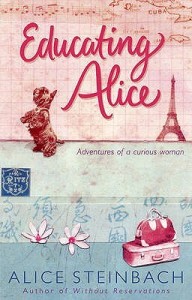 (20 Books of Summer, #14) Steinbach makes a repeat appearance in my summer reading docket: her 2000 travel book Without Reservations was one of my 2018 selections. In that book, she took a sabbatical during her 50s to explore Paris, England, and Italy. Here she continues her efforts at lifelong learning by taking up some sort of lessons everywhere she goes. The long first section sees her back in Paris, enrolling at the Hotel Ritz’s Escoffier École de Gastronomie Française. She’s self-conscious about having joined late, being older than the other students and having to rely on the translator rather than the chef’s instructions, but she’s determined to keep up as the class makes omelettes, roast quail and desserts.
Full disclosure: I’ve only read the first chapter for now as it’s the only one directly relevant to food – in others she takes dance lessons in Japan, studies art in Cuba, trains Border collies in Scotland, etc. – but I was enjoying it and will go back to it before the end of the year.
Source: Free bookshop
 Bookish Beck = Rebecca Foster. American transplant to England. Freelance proofreader and book reviewer.
