20 Books of Summer, 14–16: Polly Atkin, Nan Shepherd and Susan Allen Toth
I’m still plugging away at the challenge. It’ll be down to the wire, but I should finish and review all 20 books by the 31st! Today I have a chronic illness memoir, a collection of poetry and prose pieces, and a reread of a cosy travel guide.
Some of Us Just Fall: On Nature and Not Getting Better by Polly Atkin (2023)
I was heartened to see this longlisted for the Wainwright Prize. It was a perfect opportunity to recognize the disabled/chronically ill experience of nature and the book achieves just what the award has recognised in recent years: the braiding together of life writing and place-based observation. (Wainwright has also done a great job on diversity this year: there are three books by BIPOC and five by women on the nature writing shortlist alone.)
 Polly Atkin knew something was different about her body from a young age. She broke bones all the time, her first at 18 months when her older brother ran into her on his bicycle. But it wasn’t until her thirties that she knew what was wrong – Ehlers-Danlos syndrome and haemochromatosis – and developed strategies to mitigate the daily pain and the drains on her energy and mobility. “Correct diagnosis makes lives bearable,” she writes. “It gives you access to the right treatment. It gives you agency.”
The book assembles long-ish fragments, snippets from different points of her past alternating with what she sees on rambles near her home in Grasmere. She writes in some depth about Lake District literature: Thomas De Quincey as well as the Wordsworths – Atkin’s previous book is a biography of Dorothy Wordsworth that spotlights her experience with illness. In describing the desperately polluted state of Windermere, Atkin draws parallels with her condition (“Now I recognise my body as a precarious ecosystem”). Although she spurns the notion of the “Nature Cure,” swimming is a valuable therapy for her.
Theme justifies form here: “This is the chronic life, lived as repetition and variance, as sedimentation of broken moments, not as a linear progression.” For me, there was a bit too much particularity; if you don’t connect to the points of reference, there’s no way in and the danger arises of it all feeling indulgent. Besides, by the time I opened this I’d already read two Ehlers-Danlos memoirs (All My Wild Mothers by Victoria Bennett and Floppy by Alyssa Graybeal) and another reference soon came my way in The Invisible Kingdom by Meghan O’Rourke. So overfamiliarity was a problem. And by the time I forced myself to pick this off of my set-aside shelf and finish it, I’d read Nina Lohman’s stellar The Body Alone. For those newer to reading about chronic illness, though, especially if you also have an interest in the Lakes, it could be an eye-opener.
With thanks to Sceptre (Hodder) for the free copy for review.
Selected Prose & Poetry by Nan Shepherd (2023)
 I’d read and enjoyed Shepherd’s The Living Mountain, which has surged in popularity as an early modern nature writing classic thanks to Robert Macfarlane et al. I’m not sure I’d go as far as the executor of the Nan Shepherd Estate, though, who describes her in the Preface as “Taylor Swift in hiking boots.” The pieces reprinted here are from her one published book of poems, In the Cairngorms, and the mixed-genre collection Wild Geese. There is also a 28-page “novella,” Descent from the Cross. After World War I, Elizabeth, a workers’ rights organiser for a paper mill, marries a shell-shocked veteran who wants to write a book but isn’t sure he has either the genius or the dedication. It’s interesting that Shepherd would write about a situation where the wife has the economic upper hand, but the tragedy of the sickly failed author put me in mind of George Gissing or D.H. Lawrence, so didn’t feel fresh. Going by length alone, I would have called this a short story, but I understand why it would be designated a novella, for the scope.
None of the miniature essays – field observations and character studies – stood out to me. About half of the book is given over to poetry. As with the nature writing, there is a feeling of mountain desolation. There are a lot of religious references and hints of the mystical, as in “The Bush,” which opens “In that pure ecstasy of light / The bush is burning bright. / Its substance is consumed away / And only form doth stay”. It’s a mixed bag: some feels very old-fashioned and sentimental, with every other line or, worse, every line rhyming, and some archaic wording and rather impenetrable Scots dialect. It could have been written 100 years before, by Robert Burns if not William Blake. But every so often there is a flash of brilliance. “Blackbird in Snow” is quite a nice one, and reminiscent of Thomas Hardy’s “The Darkling Thrush.” I even found the cryptic lines from “Real Presence” that inspired a song on David Gray’s Skellig. My favourite poem by far was:
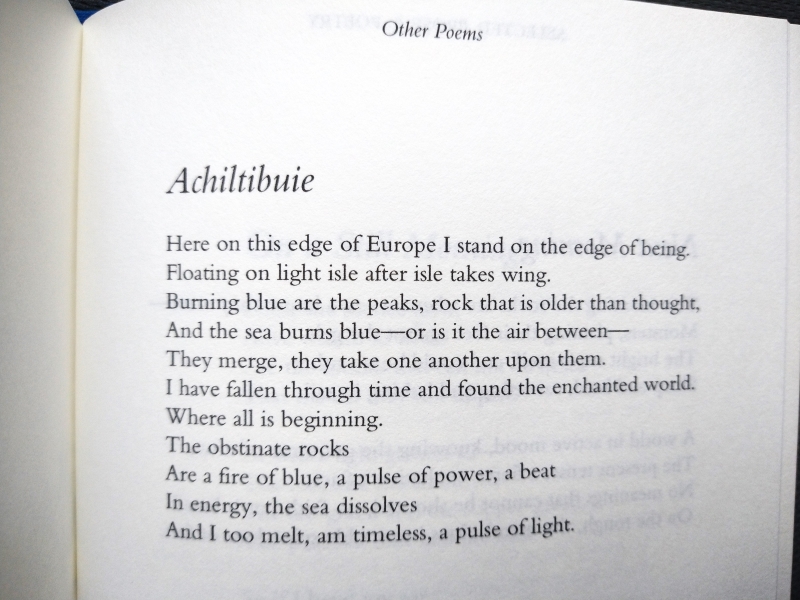
Overall, this didn’t engage me; it’s only for Shepherd fanatics and completists. (Won from Galileo Publishers in a Twitter giveaway)
England As You Like It: An Independent Traveler’s Companion by Susan Allen Toth (1995)
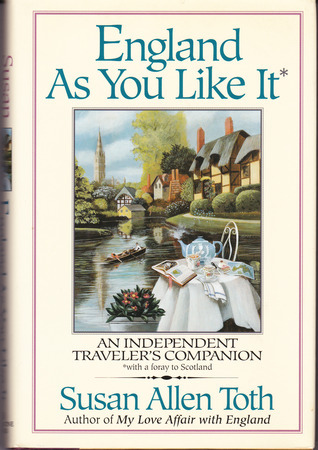 A reread. As I was getting ready to go overseas for the first time in the summer of 2003, Toth’s trilogy of memoirs whetted my appetite for travel in Britain. (They’re on my Landmark Books in My Life, Part II list.) This is the middle book and probably the least interesting in that it mostly recounts stays in particular favourite locations, such as Dorset, the Highlands, and various sites in Cornwall. However, I’ve never forgotten her “thumbprint theory,” which means staying a week or more in an area no larger than her thumb covers on a large-scale map, driving an hour or less for day trips. Not for her those cram-it-all-in trips where you race through multiple countries in a week (I have American friends who did Paris, London and Rome within six days, or five countries in eight days; blame it on stingy vacation policies, I guess). Instead, she wants to really bed into one place and have the time to make serendipitous discoveries such as an obscure museum or a rare opening of a private garden.
I most liked the early general chapters about how to make air travel bearable, her obsession with maps, her preference for self-catering, and her tendency to take home edible souvenirs. Of course, all the “Floating Facts” are hopelessly out-of-date. This being the early to mid-1990s, she had to order paper catalogues to browse cottage options (I still did this for honeymoon prep in 2006–7) and make international phone calls to book accommodation. She recommends renting somewhere from the National Trust or Landmark Trust. Ordnance Survey maps could be special ordered from the British Travel Bookshop in New York City. Entry fees averaged a few pounds. It’s all so quaint! An Anglo-American time capsule of sorts. I’ve always sensed a kindred spirit in Toth, and those whose taste runs toward the old-fashioned will probably also find her a charming tour guide. I’ve also reviewed the third book, England for All Seasons. (Free from The Book Thing of Baltimore)
Learning How to Be Sad via Books by Susan Cain and Helen Russell
There’s been a lot of sadness in my life over the past few months. If there’s a key lesson I learned from the latest work by these authors, who are among the best self-help writers out there, it’s that denying sadness is the worst thing we could do. Accepting sadness helps us to be compassionate towards others and to acknowledge but ultimately let go of generational pain. There are measures we can take to mitigate sadness – a focus of the second half of Russell’s book – but it can’t be avoided altogether. Alongside the classics of bereavement literature I have been rereading, I found these two books to be valuable companions in grief.
Bittersweet: How Sorrow and Longing Make Us Whole by Susan Cain (2022)
Cain’s Quiet must be one of the best-known nonfiction books of the millennium. It felt like vindication for introverts everywhere. Bittersweet is a little more nebulous in strategy but, boiled down, is a defence of the melancholic personality, one of the types identified by Aristotle (also explored in Richard Holloway’s The Heart of Things). Sadness is not the same as clinical depression, Cain rushes to clarify, though the two might coexist. Melancholy is often associated with creativity and sensitivity, and can lead us into empathy for others. Suffering and death seem like things to flee, but if we sit with them, we will truly be part of the human race and, per the “wounded healer” archetype, may also work toward restoration.
 A love for minor-key music, especially songs by Leonard Cohen, is what initially drew Cain to this topic, but there are other autobiographical seeds: the deaths of many ancestors, including her rabbi grandfather’s entire family, in the Holocaust; her difficult relationship with her controlling mother, who now has dementia; and the deaths from Covid of both her brother, a hospital doctor, and her elderly father in 2020.
Through interviews and attendance at conferences and other events, she draws in various side topics, like the longing that prompts mysticism (Kabbalah and Sufism), loving-kindness meditation, an American culture of positivity that demands “effortless perfection,” ways the business world could cultivate empathy, and how knowledge of death makes life precious. (The only chapter I found less than essential was one about transhumance – the hope of escaping death altogether. Mark O’Connell has that topic covered.) Cain weaves together her research with autobiographical material naturally. As a shy introvert with melancholy tendencies, I found both Quiet and Bittersweet comforting.
With thanks to Viking (Penguin) for the proof copy for review.
How to Be Sad: The Key to a Happier Life by Helen Russell (2021)
A reread, though I only skimmed the first time around – my tiny points of criticism would be that the book is a tad long – the print in the paperback is really rather small – and retreads some of the same ground as Leap Year (e.g., how exercise and culture can contribute to a sense of wellbeing). I read that just last year, after enjoying The Year of Living Danishly with my book club. She’s a reliable nonfiction author; I’d liken her to a funnier Gretchen Rubin.
 Russell has an appealingly self-deprecating style and breezily highlights statistics alongside personal anecdotes. Here she faces sources of sadness in her life head-on: her younger sister’s death from SIDS and the silence that surrounded that loss; her parents’ divorce and her sense of being abandoned by her father; struggles with eating disorders and alcohol and exercise addiction; and relationship trials, from changing herself to please boyfriends to undergoing IVF with her husband, T (aka “Legoman”), and adjusting to life as a mother of three.
As in her other self-help work, she interviews lots of experts and people who have gone through similar things to understand why we’re sad and what to do about it. I particularly appreciated chapters on “arrival fallacy” and “summit syndrome,” both of which refer to a feeling of letdown after we achieve what we think will make us happy, whether that be parenthood or the South Pole. Better to have intrinsic goals than external ones, Russell learns.
She also considers cultural differences in how we approach sadness: for instance, Russians relish sadness and teach their children to do the same, whereas the English, especially men, are expected to bury their feelings. Russell notes a waning of the rituals that could help us cope with loss, and a rise in unhealthy coping mechanisms. Like Cain, she also covers sad music (vs. one of her interviewees prescribing Jack Johnson as a mood equalizer). There are lots of laughs to be had, but the epilogue can’t fail to bring a tear to the eye. (Public library)
Both: 
I found this quote from the Russell a handy summary of both authors’ premise. Dr Lucy Johnstone says:
“The key question when encountering someone with mental or emotional distress shouldn’t be, ‘What’s wrong with you?’ but rather, ‘What’s happened to you?’”
Suffering is coming for all of us, so why not arm yourself to deal with it and help others through? That’s always been one of my motivations for reading widely: to understand other people’s situations and prepare myself for what the future holds.
Could you see yourself reading a book about sadness?
For Thy Great Pain… and Ti Amo for #NovNov22
On Friday evening we went to see Aqualung give his first London show in 12 years. (Here’s his lovely new song “November.”) I like travel days because I tend to get loads of reading done on my Kindle, and this was no exception: I read both of the below novellas, plus two-thirds of a poetry collection. Novellas aren’t always quick reads, but these were.
For Thy Great Pain Have Mercy on My Little Pain by Victoria Mackenzie (2023)
 Two female medieval mystics, Julian of Norwich and Margery Kempe, are the twin protagonists of Mackenzie’s debut. She allows each to tell her life story through alternating first-person strands that only braid together very late on when she posits that Margery visited Julian in her cell and took into safekeeping the manuscript of her “shewings.” I finished reading Julian’s Revelations of Divine Love earlier this year and, apart from a couple of biographical details (she lost her husband and baby daughter to an outbreak of plague, and didn’t leave her cell in Norwich for 23 years), this added little to my experience of her work.
I didn’t know Margery’s story, so found her sections a little more interesting. A married mother of 14, she earned scorn for preaching, prophesying and weeping in public. Again and again, she was told to know her place and not dare to speak on behalf of God or question the clergy. She was a bold and passionate woman, and the accusations of heresy were no doubt motivated by a wish to see her humiliated for claiming spiritual authority. But nowadays, we would doubtless question her mental health – likewise for Julian when you learn that her shewings arose from a time of fevered hallucination. If you’re new to these figures, you might be captivated by their bizarre life stories and religious obsession, but I thought the bare telling was somewhat lacking in literary interest. (Read via NetGalley) [176 pages] 
Coming out on January 19th from Bloomsbury.
Ti Amo by Hanne Ørstavik (2020; 2022)
[Translated from the Norwegian by Martin Aitken; Archipelago Books]
 Ørstavik wrote this in the early months of 2020 while she was living in Milan with her husband, Luigi Spagnol, who was her Italian publisher as well as a painter. They had only been together for four years and he’d been ill for half of that. The average life expectancy for someone who had undergone his particular type of pancreatic cancer surgery was 15–20 months; “We’re at fifteen months now.” Indeed, Spagnol would die in June 2020. But Ørstavik writes from that delicate in-between time when the outcome is clear but hasn’t yet arrived:
What’s real is that you’re still here, and at the same time, as if embedded in that, the fact that soon you’re going to die. Often I don’t feel a thing.
She knows, having heard it straight from his doctor’s lips, that her husband is going to die in a matter of months, but he doesn’t know. And now he wants to host a New Year’s Eve party, as is their annual tradition. Ørstavik skips between the present, the couple’s shared past, and an incident from her recent past that she hasn’t yet told anyone else: not long ago, while in Mexico for a literary festival, she fell in love with A., her handler. And while she hasn’t acted on that, beyond a kiss on the cheek, it’s smouldering inside her, a secret from the husband she still loves and can’t bear to hurt. Novels are where she can be most truthful, and she knows the one she needs to write will be healing.
There are many wrenching scenes and moments here, but it’s all delivered in a fairly flat style that left little impression on me. I wonder if I’d appreciate her fiction more. (Read via Edelweiss) [124 pages] 

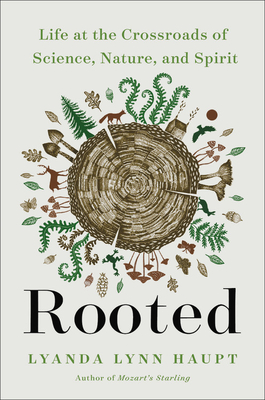
Rooted by Lyanda Lynn Haupt
Lyanda Lynn Haupt’s Crow Planet was the highlight of my 2019 animal-themed summer reading. I admired her determination to incorporate wildlife-watching into everyday life, and appreciated her words on the human connection to and responsibility towards the rest of nature. Rooted, one of my most anticipated books of this year, continues in that vein, yet surprised me with its mystical approach. No doubt some will be put off by the spiritual standpoint and dismiss the author as a barefoot, tree-hugging hippie. Well, sign me up to Haupt’s team, because nature needs all the help it can get, and we know that people won’t save what they don’t love. Start to think about trees and animals as brothers and sisters – or even as part of the self – and actions that passively doom them, not to mention wanton destruction of habitat, will hit closer to home.
 I hadn’t realized that Haupt grew up Catholic, so the language of mysticism comes easily to her, but even as a child nature was where she truly sensed transcendence. Down by the creek, where she listened to birdsong and watched the frog lifecycle, was where she learned that everything is connected. She even confessed her other church, “Frog Church” (this book’s original title), to her priest one day. (He humored her by assigning an extra Our Father.) How to reclaim that childhood feeling of connectedness as a busy, tech-addicted adult?
The Seattle-based Haupt engages in, and encourages, solo camping, barefoot walking, purposeful wandering, spending time sitting under trees, mindfulness, and going out in the dark. This might look countercultural, or even eccentric. Some will also feel called to teach, to protest, and to support environmental causes financially. Others will contribute their talent for music, writing, or the visual arts. But there are subtler changes to be made too, in our attitudes and the way we speak. A simple one is to watch how we refer to other species. “It” has no place in a creature-directed vocabulary.
Haupt’s perspective chimes with the ethos of the New Networks for Nature conference I attend each year, as well as with the work of many UK nature writers like Robert Macfarlane (in particular, she mentions The Lost Words) and Jini Reddy (Wanderland). I also found a fair amount of overlap with Lucy Jones’s Losing Eden. There were points where Haupt got a little abstract and even woo-woo for me – and I say that as someone with a religious background. But her passion won me over, and her book helped me to understand why two things that happened earlier this year – a fox dying in our backyard and neighbors having a big willow tree taken down – wounded me so deeply. That I felt each death throe and chainsaw cut as if in my own body wasn’t just me being sentimental and oversensitive. It was a reminder that I’m a part of all of life, and I must do more to protect it.
Favorite lines:
“In this time of planetary crisis, overwhelm is common. What to do? There is so much. Too much. No single human can work to save the orcas and the Amazon and organize protests to stop fracking and write poetry that inspires others to act and pray in a hermit’s dwelling for transformation and get dinner on the table. How easy it is to feel paralyzed by obligations. How easy it is to feel lost and insignificant and unable to know what is best, to feel adrift while yearning for purpose. Rootedness is a way of being in concert with the wilderness—and wildness—that sustains humans and all of life.”
“No one can do all things. Yet we can hold all things as we trim and change our lives and choose our particular forms of rooted, creative action—those that call uniquely to us.”
With thanks to Little, Brown Spark for sending a proof copy all the way from Boston, USA.
R.I.P. Part II: Wakenhyrst by Michelle Paver
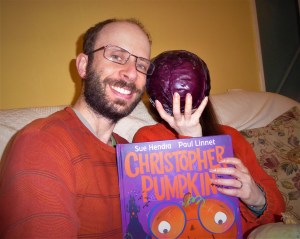
A rainy and blustery Halloween here in southern England, with a second lockdown looming later in the week. I haven’t done anything special to mark Halloween since I was in college, though this year a children’s book inspired me to have some fun with our veg box vegetables for this photo shoot. Just call us Christopher Pumpkin and Rebecca Red Cabbage.
It’s my third year participating in R.I.P. (Readers Imbibing Peril). In each of those three years I’ve reviewed a novel by Michelle Paver. First it was Thin Air, then Dark Matter – two 1930s ghost stories of men undertaking an adventure in a bleak setting (the Himalayas and the Arctic, respectively). I found a copy of her latest in the temporary Little Free Library I started to keep the neighborhood going while the public library was closed during the first lockdown.

Wakenhyrst by Michelle Paver (2019)
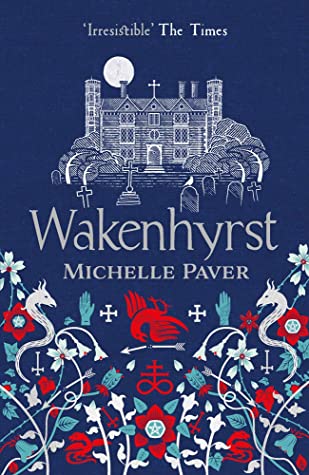 There’s a Gothic flavor to this story of a mentally unstable artist and his teenage daughter. Edmund Stearne is obsessed with the writings of Medieval mystic Alice Pyett (based on Margery Kempe) and with a Bosch-like Doom painting recently uncovered at the local church. Serving as his secretary after her mother’s death, Maud reads his journals to follow his thinking – but also uncovers unpleasant truths about his sister’s death and his relationship with the servant girl. As Maud tries to prevent her father from acting on his hallucinations of demons and witches rising from the Suffolk Fens, she falls in love with someone beneath her class. Only in the 1960s framing story, which has a journalist and scholar digging into what really happened at Wake’s End in 1913, does it become clear how much Maud gave up.
There are a lot of appealing elements in this novel, including Maud’s pet magpie, the travails of her constantly pregnant mother (based on the author’s Belgian great-grandmother), the information on early lobotomies, and the mixture of real (eels!) and imagined threats encountered at the fen. The focus on a female character is refreshing after her two male-dominated ghost stories. But as atmospheric and readable as Paver’s writing always is, here the plot sags, taking too much time over each section and filtering too much through Stearne’s journal. After three average ratings in a row, I doubt I’ll pick up another of her books in the future.
My rating:
My top R.I.P. read this year was Sisters by Daisy Johnson, followed by 666 Charing Cross by Paul Magrs (both reviewed here).
Have you been reading anything spooky for Halloween?
A Recommendation for August
Each month I aim to preview two to four books to be released in the next month that I have already read and can recommend. It’s looking thin on the ground for August because two of my most anticipated reads of the year were disappointments, and another August release I left unfinished; I give mini write-ups of these below. However, I’ve very much enjoyed What It Means When a Man Falls from the Sky, the debut story collection by Lesley Nneka Arimah, which came out in America in April but releases on the 24th over here; I’ll be reviewing it for Shiny New Books shortly. Also, I’m 20% into The Education of a Coroner by John Bateson (releases August 15th), a fascinating set of sometimes gory true crime case studies.
As for the one August book I’m currently able to wholeheartedly recommend, that is…
The Futilitarians: Our Year of Thinking, Drinking, Grieving, and Reading by Anne Gisleson
(Coming from Little, Brown and Company on the 22nd)
 One for angsty, bookish types. In 2012 Anne Gisleson, a New Orleans-based creative writing teacher, her husband, sister and some friends formed an Existential Crisis Reading Group (which, for the record, I think would have been a better title). Each month they got together to discuss their lives and their set readings – both expected and off-beat selections, everything from Kafka and Tolstoy to Kingsley Amis and Clarice Lispector – over wine and snacks.
One of their texts, Arthur Koestler’s The Act of Creation, proposed the helpful notion of the Trivial and Tragic Planes. The Trivial is where we live everyday; the Tragic is where we’re transported when something awful happens. Gisleson had plenty of experience with the latter: not just the suicides of her younger twin sisters, a year and a half apart, and her father’s death from leukemia, but also the collective loss of Hurricane Katrina. She returns again and again to these sources of grief in her monthly chapters structured around the book group meetings, elegantly interweaving family stories and literary criticism.
I found the long quotes from the readings a little much – you probably shouldn’t pick this up if you haven’t the least interest in philosophy and aren’t much troubled by life’s big questions – but in general this is a fascinating, personal look at what makes life worth living when it might be shattered any second. I particularly loved the chapter in which the book club members creatively re-enact the Stations of the Cross for Easter and the sections about her father’s pro bono work as an attorney for death row inmates at Angola prison. Sometimes it really is a matter of life and death.
Favorite passage:
“Generations of parents have put their children to bed in this house and even if I haven’t quite figured out the why and the how of living, others have found reasons to keep moving things forward. In quiet moments I can feel the collective push of these ghost-hands on my back, nudging me on.”
My rating: 
And now for the ones I’m closer to lukewarm on…
(Reviews in the order in which I read the books.)
Mrs. Fletcher by Tom Perrotta
(Coming from Scribner on the 1st)
 I enjoy Tom Perrotta’s novels: they’re funny, snappy, current and relatable; it’s no surprise they make great movies. I’ve somehow read seven of his nine books now, without even realizing it. Mrs. Fletcher is more of the same satire on suburban angst, but with an extra layer of raunchiness that struck me as unnecessary. It seemed something like a sexual box-ticking exercise. But for all the deliberately edgy content, this book isn’t really doing anything very groundbreaking; it’s the same old story of temptations and bad decisions, but with everything basically going back to a state of normality by the end. If you haven’t read any Perrotta before and are interested in giving his work a try, let me steer you towards Little Children instead. That’s his best book by far.
My rating: 
Sour Heart by Jenny Zhang
(Coming from Lenny Books on the 1st [USA] and Bloomsbury Circus on the 10th [UK])
 I read “We Love You Crispina” (13%), about the string of awful hovels a family of Chinese immigrants is forced to move between in early 1990s New York City. You’d think it would be unbearably sad reading about cockroaches and shared mattresses and her father’s mistress, but Zhang’s deadpan litanies are actually very funny: “After Woodside we moved to another floor, this time in my mom’s cousin’s friend’s sister’s apartment in Ocean Hill that would have been perfect except for the nights when rats ran over our faces while we were sleeping and even on the nights they didn’t, we were still being charged twice the cost of a shitty motel.” Perhaps I’m out of practice in reading short story collections, but after I finished this first story I felt absolutely no need to move on to the rest of the book.
My rating:
Forest Dark by Nicole Krauss
(Coming on the 24th from Harper [USA] and Bloomsbury [UK])
 Impressive in scope and structure, but rather frustrating. If you’re hoping for another History of Love, you’re likely to come away disappointed: while that book touched the heart; this one is mostly cerebral. Metafiction, the Kabbalah, and some alternative history featuring Kafka are a few of the major elements, so think about whether those topics attract or repel you. Looking a bit deeper, this is a book about Jewish self-invention and reinvention. Now, when I read a novel with a dual narrative, especially when the two strands share a partial setting – here, the Tel Aviv Hilton – I fully expect them to meet up at some point. In Forest Dark that never happens. At least, I don’t think so.* I sometimes found “Nicole” (the author character) insufferably clever and inward-gazing. All told, there’s a lot to think about here: more questions than answers, really. Interesting, for sure, but not the return to form I’d hoped for.
*Hop over to my Goodreads review to read the marked spoilers and chip in with comments!
My rating:
 Bookish Beck = Rebecca Foster. American transplant to England. Freelance proofreader and book reviewer.
 Bookish Beck