Reading Ireland Month, I: Donoghue, Longley, Tóibín
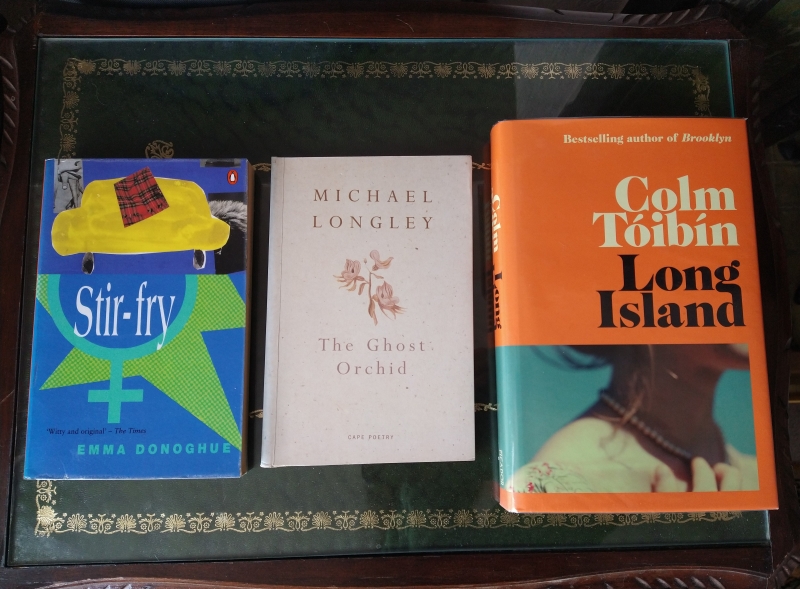
St. Patrick’s Day is a good occasion to compile my first set of contributions to Cathy’s Reading Ireland Month. Today I have an early novel by a favourite author, a poetry collection inspired by nature and mythology, and a sequel that I read for book club.
Stir-Fry by Emma Donoghue (1994)
After enjoying Slammerkin so much last year, I decided to catch up on more of Donoghue’s way-back catalogue. She tends to alternate between contemporary and historical settings. I have a slight preference for the former, but she can excel at both; it really depends on the book. I reckon this was edgy for its time. Maria (whose name rhymes with “pariah”) arrives in Dublin for university at age 17, green in every way after a religious upbringing in the countryside. In response to a flat-share advert stipulating “NO BIGOTS,” she ends up living with Ruth and Jael (pronounced “Yale”), two mature students. Ruth is the mother hen, doing all the cooking and fretting over the others’ wellbeing; Jael is a wild, henna-haired 30-year-old prone to drinking whisky by the mug-full. Maria attends lectures, takes a job cleaning office buildings, and finds a friend circle through her backstage student theatre volunteering. She’s mildly interested in American exchange student Galway and then leather-clad Damien (until she realizes he has a boyfriend), but nothing ever goes further than a kiss.
 It’s obvious to readers that Ruth and Jael are a couple, but Maria doesn’t work it out until a third of the way into the book. At first she’s mortified, but soon the realization is just one more aspect of her coming of age. Maria’s friend Yvonne can’t understand why she doesn’t leave – “how can you put up with being a gooseberry?” – but Maria insists, “They really don’t make me feel left out … I think they need me to absorb some of the static. They say they’d be fighting like cats if I wasn’t around to distract them.” Scenes alternate between the flat and the campus, which Donoghue depicts as a place where radicalism and repression jostle for position. Ruth drags Maria to a Tuesday evening Women’s Group meeting that ends abruptly: “A porter put his greying head in the door to comment that they’d have to be out in five minutes, girls, this room was booked for the archaeologists’ cheese ’n’ wine.” Later, Ruth’s is the Against voice in a debate on “That homosexuality is a blot on Irish society.”
Mostly, this short novel is a dance between the three central characters. The Irish-accented banter between them is a joy. Jael’s devil-may-care attitude contrasts with Ruth and Maria’s anxiety about how they are perceived by others. Ruth and Jael are figures in the Hebrew Bible and their devotion/boldness dichotomy is applicable to the characters here, too. The stereotypical markers of lesbian identity haven’t really changed, but had Donoghue written this now I think she would at least have made Maria a year older and avoided negativity about Damien and Jael’s bisexuality. At heart this is a sweet romance and an engaging picture of early 1990s feminism, but it doesn’t completely steer clear of predictability and I would have happily taken another 50–70 pages if it meant she could have fleshed out the characters and their interactions a little more. [Guess what was for my lunch this afternoon? Stir fry!] (Secondhand – Awesomebooks.com) 
The Ghost Orchid by Michael Longley (1995)
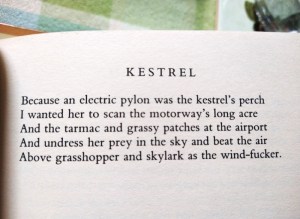
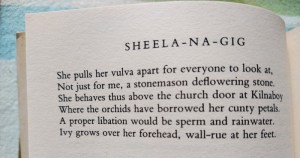
 Longley’s sixth collection draws much of its imagery from nature and Greek and Roman classics. Seven poems incorporate quotations and free translations of the Iliad and Odyssey; elsewhere, he retells the story of Baucis and Philemon and other characters from Ovid. The Orient and the erotic are also major influences; references to Hokusai bookend poems about Chinese artefacts. Poppies link vignettes of the First and Second World Wars. Longley’s poetry is earthy in its emphasis on material objects and sex. Alliteration and slant rhymes are common techniques and the vocabulary is always precise. This was the third collection I’ve read by the late Belfast poet, and with its disparate topics it didn’t all cohere for me. My two favourite poems are naughty indeed:
(Secondhand – Green Ink Booksellers, Hay-on-Wye) 
Long Island by Colm Tóibín (2024)
{SPOILERS in this one}
 I read Brooklyn when it first came out and didn’t revisit it (via book or film) before reading this. While recent knowledge of the first book isn’t necessary, it probably would make you better able to relate to Eilis, who is something of an emotional blank here. She’s been married for 20 years to Tony, a plumber, and is a mother to two teenagers. His tight-knit Italian American family might be considered nurturing, but for her it is more imprisoning: their four houses form an enclave and she’s secretly relieved when her mother-in-law tells her she needn’t feel obliged to join in the Sunday lunch tradition anymore.
When news comes that Tony has impregnated a married woman and the cuckolded husband plans to leave the baby on the Fiorellos’ doorstep when the time arrives, Eilis checks out of the marriage. She uses her mother’s upcoming 80th birthday as an excuse to go back to Ireland for the summer. Here Eilis gets caught up in a love triangle with publican Jim Farrell, who was infatuated with her 20 years ago and still hasn’t forgotten her, and Nancy Sheridan, a widow who runs a fish and chip shop and has been Jim’s secret lover for a couple of years. Nancy has a vision of her future and won’t let Eilis stand in her way.
I felt for all three in their predicaments but most admired Nancy’s pluck. Ironically given the title, the novel spends more of its time in Ireland and only really comes alive there. There’s also a reference to Nora Webster – cute that Tóibín is trying out the Elizabeth Strout trick of bringing multiple characters together in the same fictional community. But, all told, this was just a so-so book. I’ve read 10 or so works by Tóibín now, in all sorts of genres, and with its plain writing this didn’t stand out at all. It got an average score from my book club, with one person loving it, a couple hating it, and most fairly indifferent. (Public library)
Another batch will be coming up before the end of the month!
Miscellaneous #ReadIndies Reviews: Mostly Poetry + Brown, Sands
Catching up on a few final #ReadIndies contributions in early March! Short responses to some indie reading I did from my shelves over the course of last month.

Bloodaxe Books:
Parables & Faxes by Gwyneth Lewis (1995)
 I was surprised to discover this was actually my fourth book by Lewis, a bilingual Welsh author: two memoirs, one of depression and one about marriage; and now two poetry collections. The table of contents suggest there are only 16 poems in the book, but most of the titles are actually headings for sections of anywhere between 6 and 16 separate poems. She ranges widely at home and abroad, as in “Welsh Espionage” and the “Illinois Idylls.” “I shall taste the tang / of travel on the atlas of my tongue,” Lewis writes, an example of her alliteration and sibilance. She’s also big on slant and internal rhymes – less so on end rhymes, though there are some. Medieval history and theology loom large, with the Annunciation featuring more than once. I couldn’t tell you now what that many of the poems are about, but Lewis’s telling is always memorable.
Sample lines:
For the one
who said yes,
how many
said no?
…
But those who said no
for ever knew
they were damned
to the daily
as they’d disallowed
reality’s madness,
its astonishment.
(from “The ‘No’ Madonnas,” part of “Parables & Faxes”)
(Secondhand purchase – Westwood Books, Sedbergh) 
&
Fields Away by Sarah Wardle (2003)
 Wardle’s was a new name for me. I saw two of her collections at once and bought this one as it was signed and the themes sounded more interesting to me. It was her first book, written after inpatient treatment for schizophrenia. Many of the poems turn on the contrast between city (London Underground) and countryside (fields and hedgerows). Religion, philosophy, and Greek mythology are common points of reference. End rhymes can be overdone here, and I found a few of the poems unsubtle (“Hubris” re: colonizers and “How to Be Bad” about daily acts of selfishness vs. charity). However, there are enough lovely ones to compensate: “Flight,” “Word Tasting” (mimicking a wine tasting), “After Blake” (reworking “Jerusalem” with “And will chainsaws in modern times / roar among England’s forests green?”), “Translations” and “Word Hill.”
Favourite lines:
(oh, but the last word is cringe!)
Catkin days and hedgerow hours
fleet like shafts of chapel sun.
Childhood in a cobwebbed bower
guards a treasure chest of fun.
(from “Age of Awareness”)
(Secondhand purchase – Carlisle charity shop) 
Carcanet Press:
Tripping Over Clouds by Lucy Burnett (2019)
 The title is a setup for the often surrealist approach, but where another Carcanet poet, Caroline Bird, is warm and funny with her absurdism, Burnett is just … weird. Like, I’d get two stanzas into a poem and have no idea what was going on or what she was trying to say because of the incomplete phrases and non-standard punctuation. Still, this is a long enough collection that there are a good number of standouts about nature and relationships, and alliteration and paradoxes are used to good effect. I liked the wordplay in “The flight of the guillemet” and the off-beat love poem “Beer for two in Brockler Park, Berlin.” The noteworthy Part III is composed of 34 ekphrastic poems, each responding to a different work of (usually modern) art.
Favourite lines:
This is a place of uncalled-for space
and by the grace of the big sky,
and the serrated under-silhouette of Skye,
an invitation to the sea unfolds
to come and dine with mountain.
(from “Big Sands”)
(New (bargain) purchase – Waterstones website) 
&
The Met Office Advises Caution by Rebecca Watts (2016)
 The problem with buying a book mostly for the title is that often the contents don’t live up to it. (Some of my favourite ever titles – An Arsonist’s Guide to Writers’ Homes in New England, The Voluptuous Delights of Peanut Butter and Jam – were of books I couldn’t get through). There are a lot of nature poems here, which typically would be enough to get me on board, but few of them stood out to me. Trees, bats, a dead hare on the road; maps, Oxford scenes, Christmas approaching. All nice enough; maybe it’s just that the poems don’t seem to form a cohesive whole. Easy to say why I love or hate a poet’s style; harder to explain indifference.
Sample lines:
Branches lash out; old trees lie down and don’t get up.
A wheelie bin crosses the road without looking,
lands flat on its face on the other side, spilling its knowledge.
(from the title poem)
(New (bargain) purchase – Amazon with Christmas voucher)
Faber:
Places I’ve Taken My Body by Molly McCully Brown (2020)
 The title signals right away how these linked autobiographical essays split the ‘I’ from the body – Brown resents the fact that disability limits her experience. Oxygen deprivation at their premature birth led to her twin sister’s death and left her with cerebral palsy severe enough that she generally uses a wheelchair. In Bologna for a travel fellowship, she writes, “There are so many places that I want to be, but I can’t take my body anywhere. But I must take my body everywhere.” A medieval city is particularly unfriendly to those with mobility challenges, but chronic pain and others’ misconceptions (e.g. she overheard a guy on her college campus lamenting that she’d die a virgin) follow her everywhere.
A poet, Brown earned minor fame for her first collection, which was about historical policies of enforced sterilization for the disabled and mentally ill in her home state of Virginia. She is also a Catholic convert. I appreciated her exploration of poetry and faith as ways of knowing: “both … a matter of attending to the world: of slowing my pace, and focusing my gaze, and quieting my impatient, indignant, protesting heart long enough for the hard shell of the ordinary to break open and reveal the stranger, subtler singing underneath.” This is part of a terrific run of three pieces, the others about sex as a disabled person and the odious conservatism of the founders of Liberty University. Also notable: “Fragments, Never Sent,” letters to her twin; and “Frankenstein Abroad,” about rereading this novel of ostracism at its 200th anniversary. (Secondhand purchase – Amazon)
New River Books:
The Hedgehog Diaries: A Story of Faith, Hope and Bristle by Sarah Sands (2023)
 Reasons for reading: 1) I’d enjoyed Sands’s The Interior Silence and 2) Who can resist a book about hedgehogs? She covers a brief slice of 2021–22 when her aged father was dying in a care home. Having found an ill hedgehog in her garden and taken it to a local sanctuary, she developed an interest in the plight of hedgehogs. In surveys they’re the UK’s favourite mammal, but it’s been years since I saw one alive. Sands brings an amateur’s enthusiasm to her research into hedgehogs’ place in literature, philosophy and science. She visits rescue centres, meets activists in Oxfordshire and Shropshire who have made hedgehog welfare a local passion, and travels to Uist to see where hedgehogs were culled in 2004 to protect ground-nesting birds’ eggs. The idea is to link personal brushes with death with wider threats of extinction. Unfortunately, Sands’s lack of expertise is evident. This was well-meaning, but inconsequential and verging on twee. (Christmas gift from my wishlist)
This and That (The January Blahs)
The January blahs have well and truly arrived. The last few months of 2023 (December in particular) were too full: I had so much going on that I was always rushing from one thing to the next and worrying I didn’t have the time to adequately appreciate any of it. Now my problem is the opposite: very little to do, work or otherwise; not much on the calendar to look forward to; and the weather and house so cold I struggle to get up each morning and push past the brain fog to settle to any task. As I kept thinking to myself all autumn, there has to be a middle ground between manic busyness and boredom. That’s the head space where I’d like to be living, instead of having to choose between hibernation and having no time to myself.
At least these frigid January days are good for being buried in books. Unusually for me, I’m in the middle of seven doorstoppers, including King by Jonathan Eig (perfect timing as Monday is Martin Luther King Jr. Day), Wellness by Nathan Hill, and Babel by R.F. Kuang (a nominal buddy read with my husband).
Another is Carol Shields’s Collected Short Stories for a buddy rereading project with Marcie of Buried in Print. We’re partway through the first volume, Various Miracles, after a hiccup when we realized my UK edition had a different story order and, in fact, different contents – it must have been released as a best-of. We’ll read one volume per month in January–March. I also plan to join Heaven Ali in reading at least one Margaret Drabble book this year. I have The Waterfall lined up, and her Arnold Bennett biography lurking. Meanwhile, the Read Indies challenge, hosted by Karen and Lizzy in February, will be a great excuse to catch up on some review books from independent publishers.
Literary prize season will be heating up soon. I put all of the Women’s Prize (fiction and nonfiction!) dates on my calendar and I have a running list, in a file on my desktop, of all the novels I’ve come across that would be eligible for this year’s race. I’m currently reading two memoirs from the Nero Book Awards nonfiction shortlist. Last year it looked like the Folio Prize was set to replace the Costa Awards, giving category prizes and choosing an overall winner. But then another coffee chain, Caffè Nero, came along and picked up the mantle.
This year the Folio has been rebranded as The Writers’ Prize, again with three categories, which don’t quite overlap with the Costa/Nero ones. The Writers’ Prize shortlists just came out on Tuesday. I happen to have read one of the poetry nominees (Chan) and one of the fiction (Enright). I’m going to have a go at reading the others that I can source via the library. I’ll even try The Bee Sting given it’s on both the Nero and Writers’ shortlists (ditto the Booker) and I have a newfound tolerance of doorstoppers.
As for my own literary prize involvement, my McKitterick Prize manuscript longlist is due on the 31st. I think I have it finalized. Out of 80 manuscripts, I’ve chosen 5. The first 3 stood out by a mile, but deciding on the other 2 was really tricky. We judges are meeting up online next week.
I’m listening to my second-ever audiobook, an Audible book I was sent as a birthday gift: There Plant Eyes by M. Leona Godin. My routine is to find a relatively mindless data entry task to do and put on a chapter at a time.
There are a handful of authors I follow on Substack to keep up with what they’re doing in between books: Susan Cain, Jean Hannah Edelstein, Catherine Newman, Anne Boyd Rioux, Nell Stevens (who seems to have gone dormant?), Emma Straub and Molly Wizenberg. So far I haven’t gone for the paid option on any of the subscriptions, so sometimes I don’t get to read the whole post, or can only see selected posts. But it’s still so nice to ‘hear’ these women’s voices occasionally, right in my inbox.
My current earworms are from Belle and Sebastian’s Late Developers album, which I was given for Christmas. These lyrics from the title track – saved, refreshingly, for last; it’s a great strategy to end on a peppy song (an uplifting anthem with gospel choir and horn section!) instead of tailing off – feel particularly apt:
Live inside your head
Get out of your bed
Brush the cobwebs off
I feel most awake and alive when I’m on my daily walk by the canal. It’s such a joy to hear the birdsong and see whatever is out there to be seen. The other day there was a red kite zooming up from a field and over the houses, the sun turning his tail into a burnished chestnut. And on the opposite bank, a cuboid rump that turned out to belong to a muntjac deer. Poetry fragments from two of my bedside books resonated with me.
This is the earnest work. Each of us is given
only so many mornings to do it—
to look around and love
the oily fur of our lives,
the hoof and the grass-stained muzzle.
Days I don’t do this
I feel the terror of idleness
like a red thirst.
That is from “The Deer,” from Mary Oliver’s House of Light, and reminds me that it’s always worthwhile to get outside and just look. Even if what you’re looking at doesn’t seem to be extraordinary in any way…
Importance leaves me cold,
as does all the information that is classed as ‘news’.
I like those events that the centre ignores:
small branches falling, the slow decay
of wood into humus, how a puddle’s eye
silts up slowly, till, eventually,
the birds can’t bathe there. I admire the edge;
the sides of roads where the ragwort blooms
low but exotic in the traffic fumes;
the scruffy ponies in a scrubland field
like bits of a jigsaw you can’t complete;
the colour of rubbish in a stagnant leat.
There are rarest enjoyments, for connoisseurs
of blankness, an acquired taste,
once recognised, it’s impossible to shake,
this thirst for the lovely commonplace.
(from “Six Poems on Nothing,” III by Gwyneth Lewis, in Parables & Faxes)
This was basically a placeholder post because who knows when I’ll next finish any books and write about them … probably not until later in the month. But I hope you’ve found at least one interesting nugget!
What ‘lovely commonplace’ things are keeping you going this month?
Nature Book Catch-Up: Sally Huband, Richard Smyth & Anna Vaught
I’m catching up with a few nature- and travel-based 2023 releases that were sent to me for review. I’ve grouped them together because these British authors share some of the same interests and concerns. They celebrate beloved places that become ours through the time we spend in them and the attention we grant; they mourn the loss of biodiversity from rockpools and gardens and seabird cliffs. What kind of diminished world they’re raising their children into is a major worry for all three, and for Huband and Vaught the unease is exacerbated by chronic illness. Wild creatures, and the fellow authors who have hymned them, ease the hurt.
Sea Bean: A beachcomber’s search for a magical charm by Sally Huband
After more than a decade in her adopted home of Shetland, Sally Huband is still a newcomer. A tricky path to motherhood and ensuing chronic illness (the autoimmune disease palindromic rheumatism) limited her mobility and career. Beachcombing is at once her way of belonging to a specific place and feeling part of the wider world – what washes up on a Shetland beach might come from as far away as Atlantic Canada or the Caribbean. Sea glass, lobster pot tags, messages in bottles, driftwood … and a whole lot of plastic, of course. Early on, Huband sets her sights on a sea bean – also known as a drift-seed, from the tropics – which in centuries past was a talisman for ensuring safe childbirth. Possession of one was enough to condemn a 17th-century local woman to death for witchcraft, she learned.
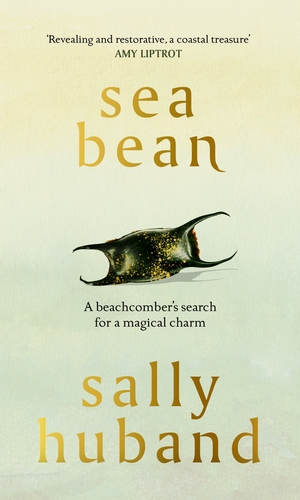 Stories of motherhood, the quest to find effective treatment in a patriarchal medical system, volunteer citizen science projects (monitoring numbers of dead seabirds, returning beached cetaceans to the water, dissecting fulmar stomachs to assess their plastic content), and studying Shetland’s history and customs mingle in a fascinating way. Huband travels around the archipelago and further afield, finding a vibrant beachcombing culture on the Dutch island of Texel. As in Moby-Duck by Donovan Hohn, one of my all-time favourite nonfiction books, there is delight at the randomness of what the ocean delivers.
I requested this book because Huband’s was my favourite essay in the Antlers of Water anthology. In it, she deplored the fact that women were still not allowed to participate in the Up Helly Aa fire festival in Lerwick. Good news: that is no longer the case, thanks to campaigning by Huband and others. In a late chapter, she also reports that blackface was recently banned from the festivals, and a Black Lives Matter demonstration drew 2000 people. Change does come, but slowly to a traditional island community. And sometimes it is not the right sort of change, as with an enormous wind farm, resisted vigorously by residents, that will primarily enrich a multinational company instead of serving the local people.
In many ways, this is a book about coming to terms with loss, and Huband presents the facts with sombre determination. Passages about the threats to birds and marine life had me near tears. But she writes with such poetic tenderness that the evocative specifics of island life point towards what’s true for all of us making the best of our constraints. I was lucky enough to visit several islands of Shetland in 2006; whether you have or not, this is a radiant memoir I would recommend to readers of Kathleen Jamie, Jean Sprackland and Malachy Tallack.
Some favourite lines:
No island can ever live up to the heightened expectations that we always seem to place on them; life catches up with us, sooner or later.
With each loss, emotional pain accretes for those who have paid attention.
If hope is a hierarchy of wishes then I am happy enough, each time that I beachcomb, to find fragments of the bark of paper birch
I’ve come to think of the ocean as an archive of sorts.
With thanks to Hutchinson Heinemann for the proof copy for review.
The Jay, the Beech and the Limpetshell: Finding Wild Things with My Kids by Richard Smyth
all around us
the stuff of spells. Our parents
let us go to scamper deeper,
leap from stumps lush with moss.
Everything aloof about me
fell into the soil once charged
with younger siblings
and freedoms of a wood.
…
I give you a damp valley floor,
this feather for your pocket.
~an extract from “Arger Fen,” from Latch by Rebecca Goss
I know Richard Smyth for his writing on birds (I’ve reviewed both A Sweet, Wild Note and An Indifference of Birds) and his somewhat controversial commentary on modern nature writing. This represents a change in direction for him toward more personal reflection, and with its focus on the phenomena of childhood and parenthood it recalls Wild Child by Patrick Barkham and The Nature Seed by Lucy Jones and Kenneth Greenway. But, as I knew to expect from previous works, he has such talent for reeling in the tangential and extrapolating from the concrete to the abstract that this lively read ends up being about everything: what it is to be human on this fading planet.
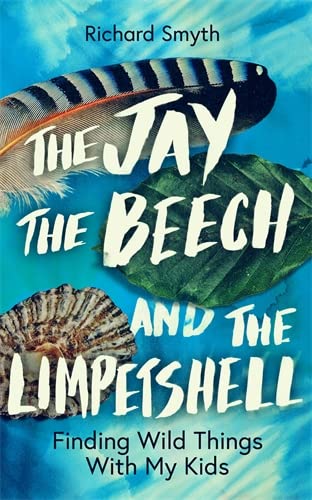 And this despite the fact that four of five chapter headings suggest pandemic-specific encounters with nature. Lockdown walks with his two children, and the totems they found in different habitats – also including a chaffinch nest and an owl pellet – are indeed jumping-off points, punctuating a wide-ranging account of life with nature. Smyth surveys the gateway experiences, whether books or television shows or a school tree-planting programme or collecting, that get young people interested; and talks about the people who beckon us into greater communion – sometimes authors and celebrities; other times friends and family. He also engages with questions of how to live in awareness of climate crisis. He acknowledges that he should be vegetarian, but isn’t; who does not harbour such everyday hypocrisies?
It’s still, unfortunately, rare for men to write about parenthood (and especially pregnancy loss – I only think of Native by Patrick Laurie and William Henry Searle’s books), so it’s great to see that represented, and it’s a charming idea that we create “downfamily” because the “upfamily” doesn’t last forever. Although there’s nostalgia for his childhood here, and anxiety about his kids’ chances of seeing wildlife in abundance, Smyth doesn’t get mired in the past or in existential dread. He has a humanist belief that people are essentially good and can do positive things like build offshore wind farms, and in the meantime he will take Genevieve and Daniel into the woods to play so they will develop a sense of wonder at all that lives on. Even for someone like me who doesn’t have children, this was a captivating, thought-provoking read: We’re all invested in the future of life on this planet.
With thanks to Icon Press for the free copy for review.
These Envoys of Beauty: A Memoir by Anna Vaught
Anna Vaught is a versatile author: I have a copy of her mental health-themed novel Saving Lucia, longlisted for the inaugural Barbellion Prize, on the shelf; she’s written a spooky set of stories, Famished (see Susan’s review); and I gave some early reader feedback on the opening pages of her forthcoming work of quirky historical fiction, The Zebra and Lord Jones. She’s also publishing a book on writing, and editing a collection of pieces submitted for the first Curae Prize for writers who are also carers. I was drawn to her first nonfiction release by reviews by fellow bloggers – it’s always good when a blog tour achieves its aim!
These dozen short essays are about how nature doesn’t necessarily heal, but is a most valued companion in a life marked by chronic illness and depression. The evocative title and epigraphs are from Ralph Waldo Emerson’s essay “Nature” (1836). The pieces loop through Vaught’s past and present, focussing on favourite places in Wiltshire, where she lives, and at the Pembrokeshire coast. It’s the second memoir about complex PTSD that I’ve read this year (see also What My Bones Know). Both at the time and now, when flashbacks of her parents’ verbal and physical abuse haunt her, lying down in a grassy field, exploring a sea cave or sucking on a gorse flower could be a salve. “Nature offered stability and satisfying detail; pattern, form and things that made sense.”
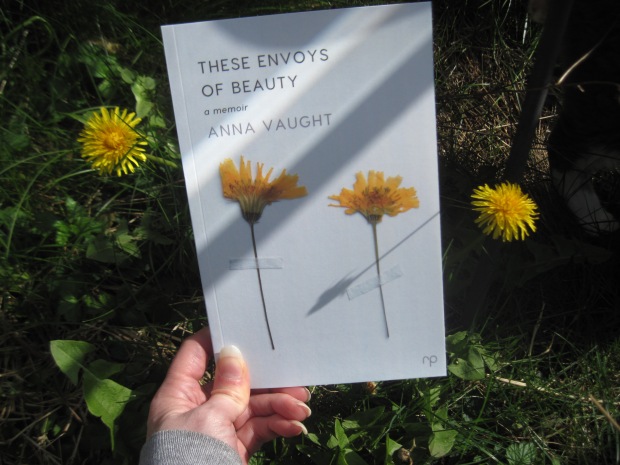
Vaught has a particular love for trees, flowers and moss – even just reciting their Latin names gives her a thrill, and she adds additional information about some species in footnotes. Although her childhood was painful, she retains gratitude for its wide-eyed wonder, and in the exuberance of her prose you can sense a willed childlike perspective (“But back to the list of clouds and writing about clouds!”). I found the frequent self-referential nature of the essays and direct reader address a little precious, but appreciated the thoughts about how nature holds us: “I have always felt a generosity around me, and that I was less lonely outside; at the very least, I could find something to comfort me”. She’s a bookish kindred spirit as well. I’ll be sure to try her work in other genres.
With thanks to Reflex Press for the free copy for review.
Poetry Review Catch-up: Burch, Carrick-Varty, Davidson, Marya, Parsons (#ReadIndies)
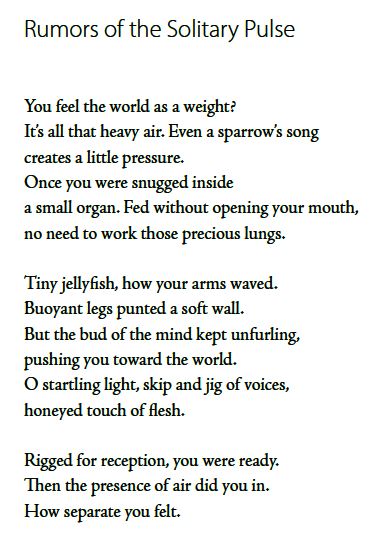
As Read Indies month continues, I’m catching up on poetry collections I’ve been sent by three independent publishers: the UK’s Carcanet Press, and Alice James Books and Terrapin Press, both based in the USA. Various as these five are in style and technique, nature and family ties are linking themes. From each I’ve chosen one short poem as a representative.

Leave Me a Little Want by Beverly Burch (2022)
 Burch’s fourth collection juxtaposes the cosmic and the mundane, marvelling at the behind-the-scenes magic that goes into one human being born but also making poetry of an impatient wait in a long post office queue. We find weather and travel; smell as well as sight and sound; alliteration and internal rhyme. Beset by environmental anxiety and the scale of bad news during the pandemic, she pauses in appreciation of the small and gradual. Often nature teaches these lessons. “Practice slow. Days for a seed to unfurl a shoot, / yawn out true leaves. Stems creep upward like prayers. / Weeks to make a flower, more to shape fruit.” Burch expresses gratitude for what is and what has been: a man carrying an infant outside her kitchen window gives her a pang for the baby days, but when she puts her hunting cat on house arrest she realizes how glad she is that impulsivity is past: “Intensity. More subtle than passion. / Odd to be grateful so much of my life is over.” Each section contains multiple unrhymed sonnets, as well as an “incantation” and/or an exploration of “Ars Poetica”.
With thanks to Terrapin Books for the free e-copy for review.
More Sky by Joe Carrick-Varty (2023)
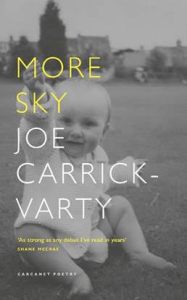 In this debut collection by an Eric Gregory Award-winning poet, his father’s suicide is ever-present – and not just in poems like “54 Questions for the Man Who Sold a Shotgun to My Father” but in seemingly unrelated pieces that start off being about something else. Everything comes around to the reality of a neglectful, alcoholic father and the sordid flat he inhabited before his death. Carrick-Varty alternates between an intimate “you” address and third-person scenarios, auditioning coping mechanisms. His frame of reference is wide: football, rappers, Buddhist cosmology. Some poems are printed sideways up the page; there are stanzas, paragraphs and columns. The word “suicide” itself is repeated to the point where it loses meaning, becoming just a sibilant collection of syllables (as in “From the Perspective of Coral,” where “suicide” is substituted for sea creatures, or the long culminating poem, “sky doc,” in which every stanza opens with “Once upon a time when suicide was…”) The tone is often bitter, as is to be expected, but there is joy in the deft use of language.

With thanks to Carcanet Press for the free e-copy for review.
Arctic Elegies by Peter Davidson (2022)
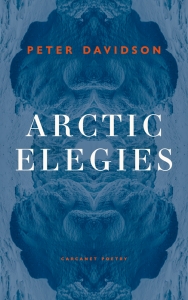 Much of the verse in Davidson’s second collection draws on British religious history and liturgy. Some is also in conversation with art, music or other poetry. In all of these cases, I found the Notes at the end of the volume invaluable for understanding the context and inspiration. While most are in stanzas, some employing traditional forms (e.g., “Sonnet for Trinity Sunday”), a few of the poems are in paragraphs and feel more like essays, such as “Secret Theatres of Scotland.” As the title heralds, an elegiac tone runs throughout, with “Arctic Elegy” (taking material from an oratorio he wrote for performance in St Andrew’s Cathedral in 2015) dedicated to the ill-fated Franklin Expedition of 1845–8:
Wonderful is the patience of the snow
And glorious the violence of the cold.
How lovely is the power of the dark pole
To draw the iron and move the compass rose.
As cold as loss as cold as freezing steel
In this same vein, I also appreciated the wry “The Museum of Loss” and the ornate “The Mourning Virtuoso.” There’s a bit of an Auden flavour here, but the niche topics didn’t always hold my attention. 

With thanks to Carcanet Press for the free copy for review.
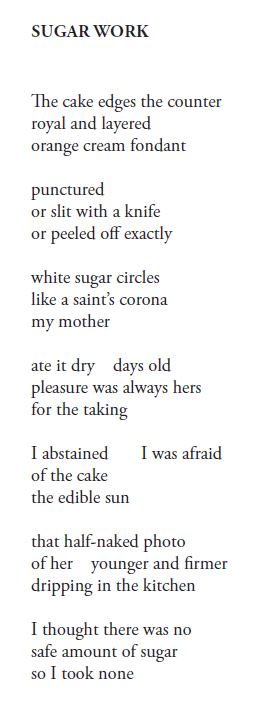
Sugar Work by Katie Marya (2022)
 Marya’s debut collection contains frank autobiographical poems about growing up in Atlanta and Las Vegas with a single mother who was a sex worker and an absentee father. As the pages turn, she gets her first period, loses her virginity, marries and divorces. Her childhood persists in photographs, and the details of places, foods and pop culture form the recognizable texture of American suburbia. Social media haunts or taunts: that photo her addict father posts every year on Facebook of him holding her, aged three, on a beach; the Instagram perfection she wishes she could attain. Marya’s phrasing is carnal, unsentimental and in-your-face (viz. “Valentine’s Day: “Do you think love only exists / because death exists? / I do not want to marry you. // But I do want explosions / of white taffeta and a cake / propped up in my mouth // with your hand for a photo. / Skin is a casing and I hook / mine to yours with a needle.”) There is also a feminist determination to see justice for women who are abused and accused.
With thanks to Alyson Sinclair PR for the free e-copy for review.
The Mayapple Forest by Kim Ports Parsons (2022)
 Parts of this alliteration-rich debut collection respond to the pandemic’s gifts of time and attention. Gardening and baking, two of the activities that sustained so many people during lockdowns, appear as acts of faith – planting seeds and waiting to see what becomes of them – and acts of remembrance (in “The Poetry of Pie,” she’s a child making peach pie with her mother). There is a fresh awareness of nature, especially birds: starlings, a bluebird nest, the lovely portrait in “Barn Owl.” From the forest floor to the stars, this world is full of wonders. Human stories thread through, too: dancing to soul music, fixing an elderly woman’s hair, the layers of history uncovered during a renovation of her childhood home. Contrasting with her temporary residence in the Midwest is her nostalgia for Baltimore. Parsons reflects on the sudden loss of her father (“A quick death’s a blessing / for the one who dies”) and the still-tender absence of her mother, the book’s dedicatee.

With thanks to Terrapin Books for the free e-copy for review.
Read any good poetry recently?
Review Catch-Up: Capildeo, Castillo, Nagamatsu & Wedlich
A second catch-up for April. Today I have a sprightly poetry collection about history, language and nature; a linked short story collection that imagines funerary rituals and human meaning in a post-pandemic future; and a wide-ranging popular science book about the diverse connotations and practical uses of slime. As a bonus, I have a preview essay from a forthcoming collection about how reading promotes empathy and social justice.
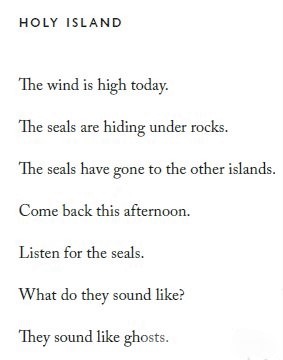
Like a Tree, Walking by Vahni Capildeo (2021)
 Capildeo is a nonbinary Trinidadian Scottish poet and the current University of York writer in residence. Their fourth collection is richly studded with imagery of the natural world, especially birds and trees. “In Praise of Birds” makes a gorgeous start:
“In praise of high-contrast birds, purple bougainvillea thicketing the golden oriole. … In praise of grackles quarrelling on the lawn. / In praise of unbeautiful birds abounding in Old Norse, language of scavenging ravens, thought and memory, a treacherous duo”
and finds a late echo in “In Praise of Trees”: “If I could have translated piano practice into botany, the lichen is that Mozart phrase my left hand trialled endlessly.”
The title section (named after a moment from the book of Mark) draws on several numbered series – “Walk #2,” “Nocturne #1,” “Lullaby 4,” and so on – that appeared in a pamphlet they published last year. These are not uncomplicated idylls, though. Walks might involve dull scenery and asthma-inducing dust, as well as danger: “If nobody has abducted you, I’ll double back to meet you. … Before raper-man corner and the gingerbread house.” Lullabies wish for good sleep despite lawnmowers and a neighbour shooting his guns. There’s more bold defiance of expectations in phrases like “This is the circus for dead horses only”.
Language is a key theme, with translations from the French of Eugène Ionesco, and of Pierre de Ronsard into Trini patois. There are also dual-language erasure poems after Dame Julian of Norwich (Middle English) and Simone Weil (French). Much of the work is based on engagement with literature, or was written in collaboration with performers.
“Death is a thief in a stationery shop. He strolls out. The shopkeeper, a poor man, runs after, shouting. – I saw you! Give that back! – Give back what? Death says, strolling out. Hermes is a tram attendant who holds your coffee, helping you find the coin you dropped; it rolls underfoot.” (from “Odyssey Response”)
“Windrush Reflections” impresses for its research into the situation of Caribbean immigrants to Britain. It’s one of a number of long, multipart pieces, some of them prose poems. The verse relies mostly on alliteration and anaphora for its sonic qualities. Along with history, there is reflection on current events, as in “Plague Poems.” Experiences of casual racism fuel one of my favourite passages:
“the doorbell was ringing / the downstairs american oxford neighbours / wanted to check / by chatting on the intercom / if i was doing terrorism / i was doing transcriptions” (from “Violent Triage”)
Honorifics by Cynthia Miller, which I reviewed last week, had more personal resonance for me, but these are both powerful collections – alive to the present moment and revelling in language and in flora and fauna. However, only Capildeo progressed from the Jhalak Prize longlist onto the shortlist, which was announced yesterday.
With thanks to Carcanet Press for the free e-copy for review.
How High We Go in the Dark by Sequoia Nagamatsu (2022)
“Things are bad in every generation. But we still have to live our life.”
This linked short story collection was one of my most anticipated books of the year. Like two of its fellow entries on that list, Sea of Tranquility by Emily St. John Mandel and To Paradise by Hanya Yanagihara, it’s just the right blend of literary fiction and science fiction – an Octavia E. Butler level of the latter that I can handle. Opening in 2031 and stretching another 70 years into the future, it imagines how a pandemic reshapes the world and how communication and connection might continue after death. In the first story, Cliff is on the ground at the start of the Arctic plague, which emerges from a thawing Siberia (the same setup as in Under the Blue!), where his late daughter, Clara, had been part of a research group that discovered a 30,000-year-old Neanderthal girl they named Annie.
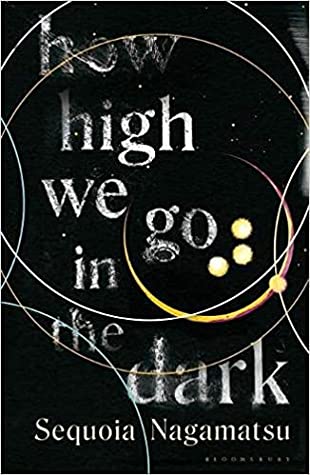 The virus is highly transmissible and deadly, and later found to mostly affect children. In the following 13 stories (most about Asian Americans in California, plus a few set in Japan), the plague is a fact of life but has also prompted a new relationship to death – a major thread running through is the funerary rites that have arisen, everything from elegy hotels to “resomation.” In the stand-out story, the George Saunders-esque “City of Laughter,” Skip works at a euthanasia theme park whose roller coasters render ill children unconscious before stopping their hearts. He’s proud of his work, but can’t approach it objectively after he becomes emotionally involved with Dorrie and her son Fitch, who arrives in a bubble.
All but one of these stories are in the first person, so they feel like intimate testimonies of how a pandemic transforms existence. Almost all of the characters have experienced a bereavement, or are sick themselves. Relatives or acquaintances become protagonists in later stories. For instance, in “Pig Son,” Dorrie’s ex, David, is a scientist growing organs for transplantation. Bereavement coordinator Dennis and his doctor brother Bryan narrate #5 and #8, respectively. Six years on, Cliff’s wife Miki takes their granddaughter on a space mission. My other two favourites were “Through the Garden of Memory,” in which patients on a plague ward build a human pyramid and plot a sacrifice, and “Songs of Your Decay,” about a researcher at a forensic body farm who bonds with her one live donor over rock music.
Some stories are weaker or less original than others, but this is one case where the whole is definitely greater than the sum of its parts. The focus on illness and death, but also on the love that survives, made this a winner for me. I’d be especially likely to recommend it to fans of Kazuo Ishiguro and Karen Russell.
With thanks to Bloomsbury for the free copy for review.
Slime: A Natural History by Susanne Wedlich (2021)
[Translated from the German by Ayça Türkoğlu]
 This is just the sort of wide-ranging popular science book that draws me in. Like Entangled Life by Merlin Sheldrake, a work I’ve had many opportunities to recommend even to those who don’t normally pick up nonfiction, it incorporates many weird and wonderful facts about life forms we tend to overlook. Wedlich, a freelance science journalist in Germany, starts off at the Hunterian Museum in Glasgow, where she seeks a sample of the “primordial slime” collected by the HMS Challenger in 1876. “It seems to be an unwritten rule of horror: slime sells!” she remarks – from H. P. Lovecraft to Ghostbusters, it has provoked disgust. Jellyfish, snails, frogs and carnivorous plants – you’re in for a sticky tour of the natural world.
The technical blanket term for slimy substances is “hydrogels,” which are 99% water and held together by polymers. Biological examples have been inspiring new technologies, like friction reducers (e.g. in fire hoses) modelled on fish mucus, novel adhesives to repair organs and seal wounds, and glue traps to remove microplastics. Looking to nature to aid our lives is nothing new, of course: Wedlich records that slugs were once used to lubricate cart wheels.
The book branches off in a lot of directions. You’ll hear about writers who were spellbound or terrified by marine life (Patricia Highsmith kept snails, while Jean-Paul Sartre was freaked out by sea creatures), the Victorian fascination with underwater life, the importance of the microbiome and the serious medical consequences of its dysfunction, and animals such as amphibians that live between land and water. At times it felt like the narrative jumped from one topic to another, especially between the biological and the cultural, without following a particular plan, but there are enough remarkable nuggets to hold the interest.
With thanks to Granta for the free copy for review.
And a bonus:
 I was delighted to be sent a preview pamphlet containing the author’s note and title essay of How to Read Now by Elaine Castillo, coming from Atlantic in August. This guide to cultural criticism – how to read anything, not just a book – is alive to the biased undertones of everyday life. “Anyone who is perfectly comfortable with keeping the world just as it is now and reading it the way they’ve always read it … cannot be trusted”. Castillo writes that it is not the job of people of colour to enlighten white people (especially not through “the gooey heart-porn of the ethnographic” – war, genocide, tragedy, etc.); “if our stories primarily serve to educate, console and productively scold a comfortable white readership, then those stories will have failed their readers”. This is bold, provocative stuff. I’m sure to learn a lot.
Would you be interested in reading one or more of these?
Seasons’ Greetings: Winter (Part I) & Christmas Reading
My first few wintry reads for the season included a modern children’s classic, a wonderful poetry collection, and a so-so Advent-set novella. For my pre-Christmas reads, I have a couple of story-length classics and two recent novellas.
Winter Story by Jill Barklem (1980)
 My favourite of the series so far (just Spring still to go) for how nostalgic it is for winter traditions.
“Tobogganing tomorrow,” said Wilfred.
“Snow pancakes for tea,” said Clover.
“We’ll make a snow mouse,” said Catkin.
The mice host a Snow Ball at the Ice Hall, with outfits and dances out of Austen and victuals out of Dickens. As always, the tree-trunk interiors are lit up like doll’s house tableaux with cosy rooms and well-stocked larders. Nothing much happens in this one, but that was fine with me: no need for a conflict and its resolution when you’ve got such a lovely, lucky life. (Public library) 
The Winter Orchards by Nina Bogin (2001)
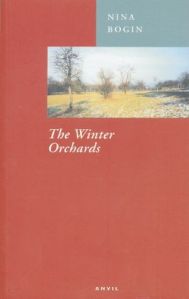 After enjoying Thousandfold in 2019, I was keen to catch up on Bogin’s previous poetry. Themes I’d noted in her latest work, nature and family, are key here, too. There is an overall wistful tone to the book, as in the passages below:
I didn’t like lungwort at first,
its spotted leaves, its furred
flowers, and I didn’t like its name.
But now I want to gather lungwort again,
now that I can’t return
to the brook meadow I picked it in (from “Lungwort”)
I’ll love the fallow and forgotten fields
because I have no choice, and woods
whose paths have been erased. (from “Landscape”)
The losses responded to are sometimes personal – saying Kaddish for her father – and sometimes more broadly representative, as when she writes about a dead bird found on the road or conflicts like the Gulf War and former Yugoslavia. Alongside beautiful nature poetry featuring birds and plants are vignettes from travels in France, Sweden, and upstate New York. (New purchase) 
An Advent Calendar by Shena Mackay (1978)
 I smugly started this on the first day of Advent, and initially enjoyed Mackay’s macabre habit of taking elements of the Nativity scene or a traditional Christmas and giving them a seedy North London twist. So we open on a butcher’s shop and a young man wearing “bloody swabbing cloths” rather than swaddling clothes, having lost a finger to the meat mincer (and later we see “a misty Christmas postman with his billowy sack come out of the abattoir’s gates”). In this way, John Wood becomes an unwitting cannibal after taking a parcel home from the butcher’s that day, and can’t forget about it as he moves his temporarily homeless family into his old uncle’s house and continues halfheartedly in his job as a cleaner. His wife has an affair; so does a teenage girl at the school where his sister works. No one is happy and everything is sordid. “Scouring powder snowed” and the animal at this perverse manger scene is the uncle’s neglected goat. This novella is soon read, but soon forgotten. (Secondhand purchase)
And so to Christmas…
“The Christmas Dinner” by Washington Irving (1820)
 An evocative portrait of an English Christmas meal, hosted by a squire in the great hall of his manor, originally published in Irving’s The Sketch Book of Geoffrey Crayon, Gent. A boar’s head, a mummers’ play, the Lord of Misrule: you couldn’t get much more traditional. “Master Simon covered himself with glory by the stateliness with which, as Ancient Christmas, he walked a minuet with the peerless, though giggling, Dame Mince Pie.” Irving’s narrator knows this little tale isn’t profound or intellectually satisfying, but hopes it will raise a smile. He also has a sense that he is recording something that might soon pass away:
I felt also an interest in the scene, from the consideration that these fleeting customs were posting fast into oblivion. … There was a quaintness, too, mingled with all this revelry, that gave it a peculiar zest; it was suited to the time and place; and as the old Manor House almost reeled with mirth and wassail, it seemed echoing back the joviality of long-departed years.
A pleasant one-sitting read; so much better than a Christmas card!
This Renard Press pamphlet is in support of Three Peas, a charity providing food and medical care to refugees in Europe. Thanks to Annabel for my gifted copy!
Small Things Like These by Claire Keegan (2021)
Always, Christmas brought out the best and the worst in people.
 This was our second most popular read during last month’s Novellas in November challenge. I’d read a lot about it in fellow bloggers’ posts and newspaper reviews so knew to expect a meticulously chiselled and heartwarming story about a coal merchant in 1980s Ireland who comes to value his quiet family life all the more when he sees how difficult existence is for the teen mothers sent to work in the local convent’s laundry service. Born out of wedlock himself nearly 40 years ago, he is grateful that his mother received kindness and wishes he could do more to help the desperate girls he meets when he makes deliveries to the convent.
I found this a fairly predictable narrative, and the nuns are cartoonishly villainous. So I wasn’t as enthusiastic as many others have been, but still enjoyed having this as one of my reads on my travel day to the USA. I was familiar with the Magdalene Laundries from the movie The Magdalene Sisters and found this a touching reminder to be grateful for what you have while helping those less fortunate. A perfect message for Christmas. (NetGalley)
Miss Marley by Vanessa Lafaye (2018)
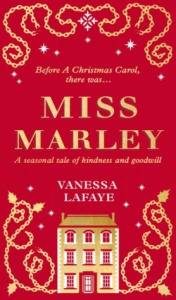 Lafaye was a local-ish author to me, an American expat living in Marlborough. When she died of breast cancer in 2018, she left this A Christmas Carol prequel unfinished, and fellow historical novelist Rebecca Mascull completed it for her. Clara and Jacob Marley come from money but end up on the streets, stealing from the rich to get by. Jacob sets himself up as a moneylender to the poor and then, after serving an apprenticeship alongside Ebenezer Scrooge, goes into business with him. They are a bad influence on each other, reinforcing each other’s greed and hard hearts. Jacob is determined never to be poor again. Because he’s forgotten what it’s like, he has no compassion when Clara falls in love with a luckless Scottish tea merchant. Like Scrooge, Jacob is offered one final chance to mend his ways. This was easy and pleasant reading, but I did wonder if there was a point to reading this when one could just reread Dickens’s original. (Secondhand purchase)
A Child’s Christmas in Wales by Dylan Thomas (1952)
(Illus. Edward Ardizzone, 1978)
 It’s a wonder I’d never managed to read this short story before. I was prepared for something slightly twee; instead, it is sprightly and imaginative, full of unexpected images and wordplay. In the Wales of his childhood, there were wolves and bears and hippos. Young boys could get up to all sorts of mischief, but knew that a warm house packed with relatives and a cosy bed awaited at the end of a momentous day. Reflective and magical in equal measure; a lovely wee volume that I am sure to reread year after year. (Little Free Library)
A favourite passage:
Our snow was not only shaken from whitewash buckets down the sky, it came shawling out of the ground and swam and drifted out of the arms and hands and bodies of the trees; snow grew overnight on the roofs of the houses like a pure and grandfather moss, minutely white-ivied the walls and settled on the postman, opening the gate, like a dumb, numb thunderstorm of white, torn Christmas cards.
If there’s been one adjective linking most of these books, it’s been “nostalgic.” There’s something about winter in general, and the holiday season in particular, that lends itself to thinking back to the past and trying to preserve traditions, isn’t there?
 Bookish Beck = Rebecca Foster. American transplant to England. Freelance proofreader and book reviewer.
 Bookish Beck