Nonfiction Catch-Up: Long-Term Thinking, Finding a Home in Wales, Eels
Not long now until Nonfiction November. I’m highlighting three nonfiction books I’ve read over the last few months; any of them would be well worth your time if you’re still looking for some new books to add to the pile. I’ve got a practical introduction to the philosophy and politics of long-term/intergenerational planning, a group biography about the two gay couples who inhabited a house in the Welsh hills in turn, and a wide-ranging work on eels.
The Good Ancestor: How to Think Long Term in a Short-Term World by Roman Krznaric
 I saw Krznaric introduce this via a digital Hay Festival session back in May. He is an excellent speaker and did an admirable job of conveying all the major ideas from his recent work within a half-hour presentation. Unfortunately, this meant that reading the book itself didn’t add much for me, although it goes deeper into his propositions and is illustrated with unique, helpful figures.
Without repeating from my write-up of the Festival talk, then, I’ll add in points and quotes that struck me:
- “some of the fundamental ways we organise society, from nation states and representative democracy to consumer culture and capitalism itself, are no longer appropriate for the age we live in.”
- 100 years as the minimum timeframe to think about (i.e., a long human life) – “taking us beyond the ego boundary of our own mortality so we begin to imagine futures that we can influence yet not participate in ourselves.”
- “The phones in our pockets have become the new factory clocks, capturing time that was once our own and offering in exchange a continuous electronic now full of infotainment, advertising and fake news. The distraction industry works by cleverly tapping into our ancient mammalian brains: our ears prick up at the ping of an arriving message … Facebook is Pavlov, and we’re the dogs.”
- The Intergenerational Solidarity Index as a way of assessing governments’ future preparation: long-term democracies tend to perform better, though they aren’t perfect; Iceland scores the highest of all, followed by Sweden.
- Further discussion of Doughnut Economics (a model developed by Krznaric’s wife, Kate Raworth), which pictures the sweet spot humans need to live in between a social foundation and the ecological ceiling; failures lead to overshoot or shortfall.
- Four fundamental barriers to change: outdated institutional designs (our basic political systems), the power of vested interests (fossil fuel companies, Amazon, et al.), current insecurity (refugees), and “insufficient sense of crisis” – we’re like frogs in a gradually boiling pot, he says, and need to be jolted out of our complacency.
This is geared more towards economics and politics than much of what I usually read, yet fits in well with other radical visions of the future I’ve engaged with this year (some of them more environmentalist in approach), including Footprints by David Farrier, The Future Earth by Eric Holthaus, and Notes from an Apocalypse by Mark O’Connell.
With thanks to WH Allen for the free copy for review.
On the Red Hill: Where Four Lives Fell into Place by Mike Parker (2019)
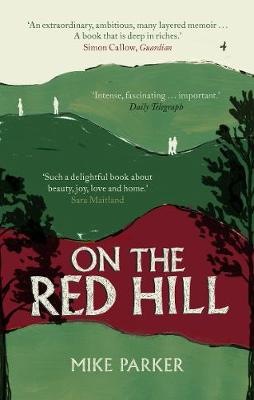 I ordered a copy from Blackwell’s after this made it through to the Wainwright Prize shortlist – it went on to be named the runner-up in the UK nature writing category. It’s primarily a memoir/group biography about Parker, his partner Peredur, and George and Reg, the couple who previously inhabited their home of Rhiw Goch in the Welsh Hills and left it to the younger pair in their wills. In structuring the book into four parts, each associated with an element, a season, a direction of the compass and a main character, Parker focuses on the rhythms of the natural year. The subtitle emphasizes the role Rhiw Goch played, providing all four with a sense of belonging in a rural setting not traditionally welcoming to homosexuals.
Were George and Reg the ‘only gays in the village,’ as the Little Britain sketch has it? Impossible to say, but when they had Powys’ first same-sex civil partnership ceremony in February 2006, they’d been together nearly 60 years. By the time Parker and his partner took over the former guesthouse, gay partnerships were more accepted. In delving back into his friends’ past, then, he conjures up another time: George fought in the Second World War, and for the first 18 years he was with Reg their relationship was technically illegal. But they never rubbed it in any faces, preferring to live quietly, traveling on the Continent and hosting guests at their series of Welsh B&Bs; their politics was conservative, and they were admired locally for their cooking and hospitality (Reg) and endurance cycling (George).
There are lots of in-text black-and-white photographs of Reg and George over the years and of Rhiw Goch through the seasons. Using captioned photos, journal entries, letters and other documents, Parker gives a clear impression of his late friends’ characters. There is something pitiable about both: George resisting ageing with nude weightlifting well into his sixties; Reg still essentially ashamed of his sexuality as well as his dyslexia. I felt I got to know the younger protagonists less well, but that may simply be because their stories are ongoing. It’s remarkable how Welsh Parker now seems: though he grew up in the English Midlands, he now speaks decent Welsh and has even stood for election for the Plaid Cymru party.
It’s rare to come across something in the life writing field that feels genuinely sui generis. There were moments when my attention waned (e.g., George’s feuds with the neighbors), but so strong is the overall sense of time, place and personality that this is a book to prize.
The Gospel of the Eels: A Father, a Son and the World’s Most Enigmatic Fish by Patrik Svensson
[Translated from the Swedish by Agnes Broomé]
“When it comes to eels, an otherwise knowledgeable humanity has always been forced to rely on faith to some extent.”
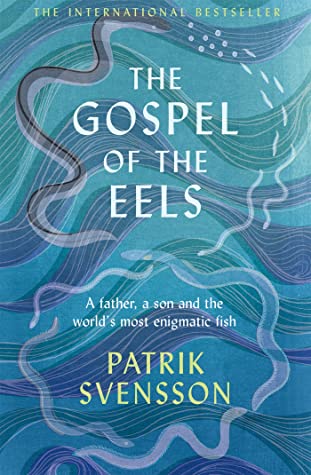 We know the basic facts of the European eel’s life cycle: born in the Sargasso Sea, it starts off as a larva and then passes through three stages that are almost like separate identities: glass eel, yellow eel, silver eel. After decades underwater, it makes its way back to the Sargasso to spawn and die. Yet so much about the eel remains a mystery: why the Sargasso? What do the creatures do for all the time in between? Eel reproduction still has not been observed, despite scientists’ best efforts. Among the famous names who have researched eels are Aristotle, Sigmund Freud and Rachel Carson, all of whom Svensson discusses at some length. He even suggests that, for Freud, the eel was a suitable early metaphor for the unconscious – “an initial insight into how deeply some truths are hidden.”
But there is a more personal reason for Svensson’s fascination with eels. As a boy he joined his father in eel fishing on Swedish summer nights. It was their only shared hobby; the only thing they ever talked about. His father was as much a mystery to him as eels are to science. And it was only as his father was dying of a cancer caused by his long road-paving career that Svensson came to understand secrets he’d kept hidden for decades.
Chapters alternate between this family story and the story of the eels. The book explores eels’ place in culture (e.g., Günter Grass’ The Tin Drum) and their critically endangered status due to factors such as a herpes virus, nematode infection, pollution, overfishing and climate change. A prior curiosity about marine life would be helpful to keep you going through this, but the prose is lovely enough to draw in even those with a milder interest in nature writing.
With thanks to Picador for the free copy for review.
One of my recent borrows from the public library’s children’s section was the picture book Think of an Eel by Karen Wallace. Her unrhymed, alliterative poetry and the paintings by Mike Bostock beautifully illustrate the eel’s life cycle and journey.

You simply must hear folk singer Kitty Macfarlane’s gorgeous song “Glass Eel” – literally about eels, it’s also concerned with migration, borders and mystery.
Would you be interested in reading one or more of these?
September Releases: Gyasi, McKay, Sheldrake, Tremain, Woolfson
September is always a big month in the publishing world, but even more so this year because of all the titles delayed from the spring and summer – apparently 600 books were published in the first week of September in the UK alone.
Still, I only ended up with my usual, manageable five new releases (with a few more on the way from the library). I read a beautiful novel about addiction and religion in contemporary America, speculative fiction about communication with wildlife in mid-pandemic (!) Australia, everything you ever wanted to know about fungi, historical fiction about outsiders in England and Borneo, and a study of our broken relationship with other animals.
Two of these are from my most anticipated list for the second half of 2020. Four of the five can be linked by the tenet that humans are only one species among many others necessary to life on this Earth, and not in some way above and beyond.
Transcendent Kingdom by Yaa Gyasi
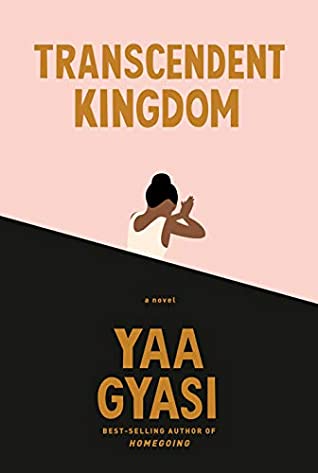 This follow-up to Gyasi’s dazzling, centuries-spanning linked story collection, Homegoing, won’t be out in the UK until March 2021, but I couldn’t resist reading an e-copy of the American edition (Knopf) from Edelweiss. It’s altogether a more subdued and subtle book, but its treatment of themes of addiction, grief, racism and religion is so spot on that it packs a punch. Gifty is a PhD student at Stanford, researching pleasure and reward circuits in the mouse brain. She gets mice hooked on a sugary drink and then performs experiments to see if she can turn off their compulsion to keep pressing a lever for more. Sometimes when they press the lever they get an electric shock. Certain mice give up; others never will. Why?
People who know Gifty well assume she chose her field because of a personal tragedy. When she was 10, her 16-year-old brother, Nana, a high school basketball star in this Ghanaian-American family’s Alabama town, died of an opiate overdose. He’d gotten addicted to prescription drugs after a sports injury. At one level, Gifty acknowledges she is trying to atone for her brother’s death, but she won’t see it in those terms. An intensely private person, she shoulders almost impossible burdens of grief and responsibility for her mother, who has plunged into depression and, when she comes to live with Gifty, spends all her time in bed.
The most compelling aspect of the novel for me was Gifty’s attitude towards the religion of her childhood. Though they were the only black family at their Pentecostal church, she was a model believer, writing prayers in her journal, memorizing scriptures, and never doubting that everything happens for a reason. Nana’s death shattered it all. Though she now looks to science for answers, she misses the certainty she once had: that she was saved, that humans are special, that someone was looking out for her and her family, that it all mattered. I highlighted dozens of passages, but it’s possible the book won’t mean quite as much to readers for whom there’s no personal resonance. The complex mother–daughter relationship is an asset, and musings on love and risk are tenderly expressed. I wanted a more climactic conclusion to take this into 5-star territory, but I’ve still added it to my Best of 2020 shelf.
Favorite lines:
the species Homo sapiens, the most complex animal, [is] the only animal who believed he had transcended his Kingdom, as one of my high school biology teachers used to say.
At times, my life now feels so at odds with the religious teachings of my childhood that I wonder what the little girl I once was would think of the woman I’ve become … I am looking for new names for old feelings. My soul is still my soul, even if I rarely call it that.
the more I do this work the more I believe in a kind of holiness in our connection to everything on Earth. Holy is the mouse.
My rating: 
I read an advanced e-copy via Edelweiss.
The Animals in That Country by Laura Jean McKay
 McKay has a PhD in literary animal studies and serves as an animal expert and presenter on Australia’s ABC radio show Animal Sound Safari. Pair her academic background with the fact that this shares a title with a Margaret Atwood poetry collection and you’ll have some idea of what to expect here: mysterious but mostly believable speculative fiction that hinges on human communication with animals.
Jean Bennett isn’t your average grandma: a wise-cracking alcoholic, she drives the tourist train through the Australian wildlife park her daughter-in-law manages but wishes she could be a fully fledged ranger. Her ex-husband, Graham, left her and went down south, and eventually their only son Lee did the same. Now all Jean has left is Kim, her six-year-old granddaughter. Jean entertains Kim by imagining voices for the park’s animals. This no longer seems like a game, though, when news filters through of the “zooflu,” which has hit epidemic levels and has as a main symptom the ability to understand what animals say.
When Kim is kidnapped, Jean steals a camper van and takes Sue the dingo along to help her find her granddaughter. “There’s a new normal now,” a bus driver tells her. “And around here, not wearing a mask means you’ve gone animal. I’d put on my protective if I was you. Put that mutt in a cage.” It was uncanny reading this in the midst of a pandemic, but the specifics of McKay’s novel are hard to grasp. The animal language isn’t audible, necessarily, but a combination of smells, noises and body language. For a long time, they seem like pure nonsense, but gradually they resemble a sort of rough poetry. Here’s one example from Sue:
My front end
takes the food
quality.
Muzzle
for the Queen
(Yesterday).
(Sue usually calls Jean “Queen” or “Mother,” showing that she respects her authority, and “Yesterday” is frequently used to suggest a primitive sense of the past or of an older person.)
As entertaining a protagonist as Jean is, I lost interest in her road trip. If you focus on the journey into the wilderness and don’t mind a sudden ending, you may find this a worthwhile heir to Hollow Kingdom by Kira Jane Buxton and The Road by Cormac McCarthy.
My rating: 
I read a proof copy for a Nudge review, but it’s never shown up on their website.
Entangled Life: How Fungi Make Our Worlds, Change Our Minds, and Shape Our Futures by Merlin Sheldrake
 I first heard about Sheldrake through Robert Macfarlane’s Underland. He struck me as a mad genius – an impression that was only strengthened by reading his detailed, enthusiastic book about fungi. Sheldrake researches fungal life in the tropical forests of Panama, accompanies truffle hunters in Italy, takes part in a clinical study on the effects of LSD (derived from a fungus), observes lichens off the coast of British Columbia, and attends a conference in Oregon on Radical Mycology. But more than a travel memoir, this is a work of science – there are over 100 pages devoted to notes, bibliography and index.
Basic information you’ll soon learn: mushrooms are only the fruiting bodies of fungi; under the ground is the material bulk, the mycelium, a sprawling network of hyphae. In what’s sometimes called the “Wood Wide Web,” fungal networks link the trees in a forest, and join up with plants, such as in lichens. “I feel a … sense of vertigo when I think about the complexity of mycorrhizal relationships – kilometers of entangled life – jostling beneath my feet,” Sheldrake confesses. He gives examples of fungi navigating and solving problems – what of our concept of intelligence if a creature without a brain can do such things?
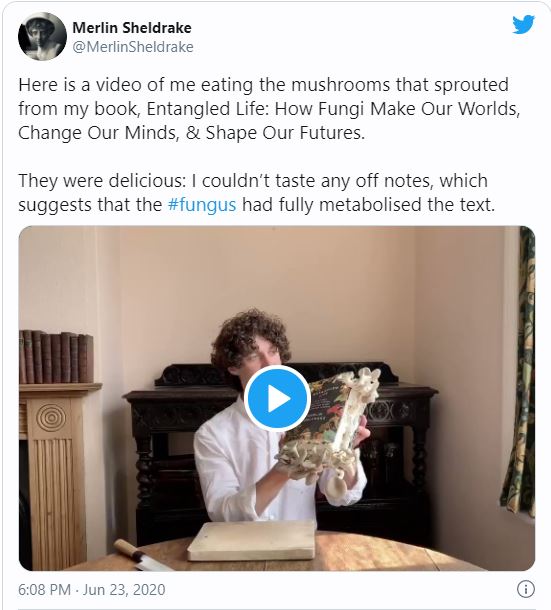
Fungi are very adaptable to extreme conditions. Research is underway to grow edible mushrooms on some of our most troublesome waste, such as used diapers (nappies) and cigarette butts. And, of course, for millennia we’ve relied on certain fungi – yeasts – to create products like bread and beer. Sheldrake is a very hands-on writer: When he wants to know something, he does it, whether that’s scrumping Isaac Newton’s apples in Cambridge and fermenting the juice into cider at home or growing mushrooms on a copy of this very book.
During the month I was reading this, I felt like I kept coming across references to fungi. (I even had a patch of ringworm!)
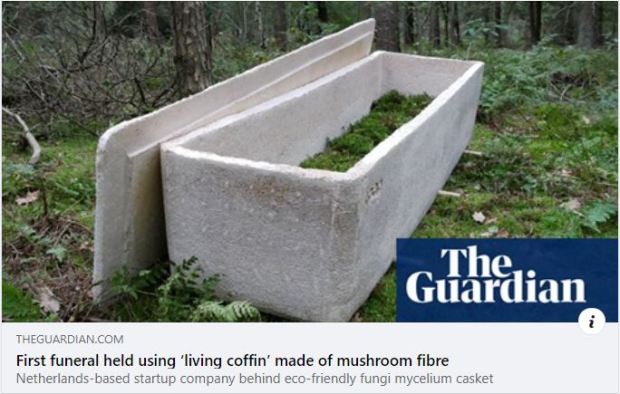
It’s a perspective-altering text, but one that requires solid concentration. I’ll confess that at times it went over my head and I wished for a glossary and diagrams. A greater than average interest in biology and/or botany would thus be a boon to a potential reader. But if you can keep up, the book will elicit many a cry of “wow!” and “what?!” I kept launching “did you know?” questions at my husband, especially about the zombie fungi that parasitize insects. What a strange and wonderful world.
Favorite lines: “Paying more attention to animals than plants contributes to humans’ plant-blindness. Paying more attention to plants than fungi makes us fungus-blind.”
My rating: 
My thanks to Bodley Head for the free copy for review.
Islands of Mercy by Rose Tremain
 I read this back in June to prepare for writing a profile of Tremain for a forthcoming issue of Bookmarks magazine. Here’s the summary I wrote: “In Bath, England in 1865, 24-year-old nurse Jane Adeane is nicknamed ‘The Angel of the Baths’ for her healing touch. If she marries Dr. Valentine Ross, a colleague of her surgeon father, she can earn respectability – but will have to hide her love for Julietta, a married woman. Meanwhile, Dr. Ross’s brother, Edmund, a naturalist following in the footsteps of Alfred Russel Wallace, has journeyed to Borneo. Ill with malaria, he is taken in by British eccentric Sir Ralph Savage, a lover of native men and benevolent local rajah who funds infrastructure projects like a paved road and a hospital. Exiled or inwardly tortured for loving the wrong people, Tremain’s characters search for moments of wonder and comfort – whether those come in a primitive hut in the Malay Archipelago or in a cozy tearoom in Bath.”
It’s a slightly odd title, but tells you a lot about what Tremain is doing in this 14th novel. Often at the mercy of forces internal and external, her outcast characters look for places where they can find rest and refuge after a time of suffering. Will they, in turn, extend mercy? The split perspective and the focus on people who have to hide their sexuality are most similar to Sacred Country. The Victorian tip of the hat is mostly directed, I think, to George Eliot; of recent work, I was reminded of The Doll Factory and The Essex Serpent. I especially liked Jane’s painter aunt, Emmeline, and Clorinda, the Irish woman whose opening of a tearoom sets the plot going. The settings are surprising and vivid, and if Tremain doesn’t quite bring them and their story lines together seamlessly, she is still to be applauded for her ambition. This is probably my joint favorite of her novels that I’ve read so far, with The Road Home.
Favorite lines:
We must be unconventional in our joys and find them wherever we can.
life, so often so cruel in the way it thrust the human soul into prisons from which there seemed to be no escape, could sometimes place it athwart an open door.
My rating:
I read an advanced e-copy via NetGalley.
Between Light and Storm: How We Live with Other Species by Esther Woolfson
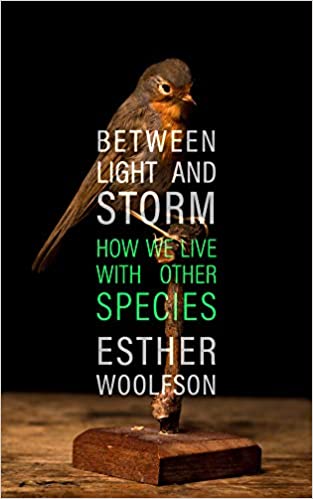 If you’ve read Woolfson’s Corvus, you’ve already met Chicken, an orphaned rook she raised. For over 31 years, Chicken was a constant presence in her home. The recently departed bird is the dedicatee of her new book, feted as “Colleague, companion, friend.” (No mere pet.) Relationships with these creatures with whom she shared her life led her to think differently about how we as humans conceive of the animal world in general. “If I had ever believed humans to be the only ones to live profound and interconnected lives, I couldn’t any more. … If we’re the gods now, shouldn’t we be better than we are?” From her introduction, it’s clear that her sympathy toward the more-than-human world extends even to spiders, and her language throughout – using words like “who” and “his” in reference to animals, rather than “that” or “its” – reinforces the view that all species are equally valuable.
Or, at least, should be. But our attitudes are fundamentally distorted, Woolfson believes, and have been since the days of Aristotle (whose Ladder of Nature is an origin of the ideas that nature is there for man to use) and the Old Testament writers (one of the two creation accounts in Genesis established the idea of “dominion”). From cave paintings to animal sacrifice, intensive farming to fur coats, taxidermy to whaling, she surveys what others have thought and said about how animals are, or should be, perceived. There was more of an academic tone to this book than I expected, and in early chapters I found too much overlap with other works I’ve read about deep time (Time Song, Surfacing, Underland again!).
I most appreciated the fragments of nature writing and memoir and would have liked more in the way of personal reflection. Woolfson’s perspective – as a Jewish woman in Scotland – is quite interesting. She is clearly troubled by how humans exploit animals, but mostly recounts others’ reasoning rather than coming to conclusions of her own. (Though there is a brilliant takedown of the gender politics of Watership Down.) It’s a book that demands more time and attention than I was able to give just now. As I only skimmed it, I’m going to refrain from assigning a rating and will pass this on to my husband and return to it one day. [I do wish the title, on its own (subtitle aside), was more indicative of the contents.]
My thanks to Granta for the free copy for review.
Which of those 600+ September releases can you recommend?
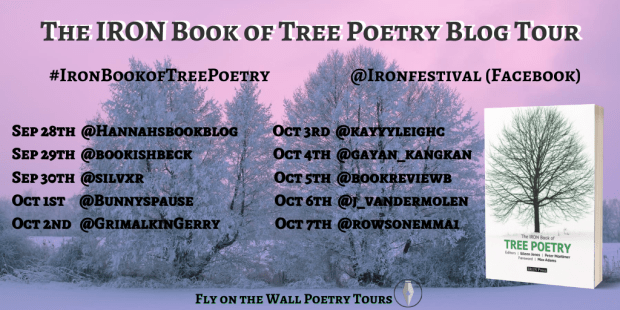
The IRON Book of Tree Poetry (Blog Tour)
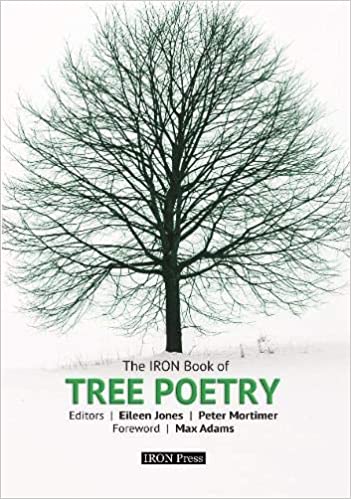 Though I’d only heard of two of the contributors, my love for nature and environmentalist themes made this anthology irresistible. The authors of the 50 poems write about individual and generic trees; forests real and imagined; environmental crisis and personal reckonings. In Sarah Mnatzaganian’s “Father Tree,” a sprawling horse-chestnut symbolizes her dying father and his motherland. Dominic Weston’s “Ancestry.com” literalizes the language of the family tree. In Celia McCulloch’s “Rhododendrons at Stapleford Wood,” an invasive species is a politically charged token of prejudice: “Is it just our xenophobia, this hatred for the Greek-named / tree, the immigrant, the Windrush plantation?”
I enjoyed the playful use of myth in Pauline Plummer’s “The Baobab”: “When God made the baobab He gave / it to the hyena, who laughed and laughed / throwing it into the scrub / where it landed upside down, dancing.” In “Abele,” Di Slaney envisions her post-mortem body feeding a woodland’s worth of creatures and being reincorporated into the flesh of trees.
Again and again, trees serve as a reminder of time passing, of seasons changing, of the vanity of human concerns compared to their centuries-old solidity – as in the final stanza of Mary Anne Perkins’s “To an Unpopular Poplar”:
This summer’s end, if I could translate
just one full hour of the whisperings
between your shimmered leaves,
how much the wiser I might be.
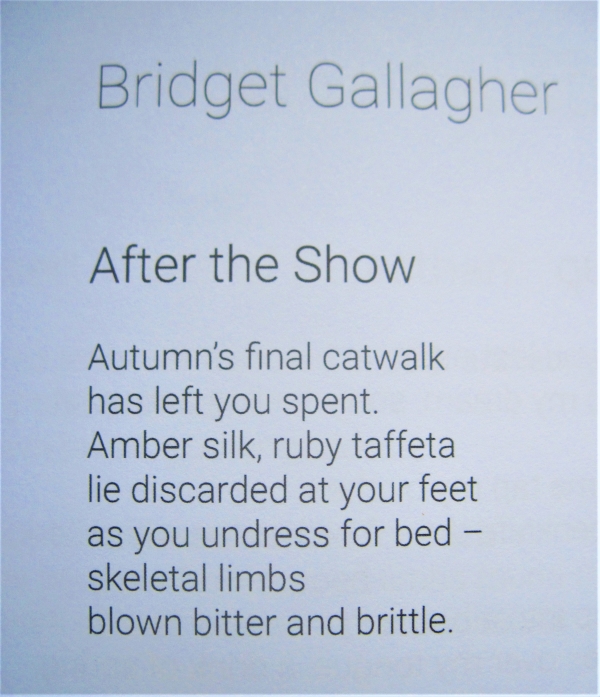
Thematic organization, rather than alphabetical, would have made more sense for this volume, but I appreciated the introduction to many new-to-me poets. Two favorite seasonal poems are pictured below.

My thanks to IRON Press for the free copy for review.
I was delighted to be invited to take part in the blog tour for The IRON Book of Tree Poetry. See below for where more reviews have appeared or will be appearing.
Catching Up on Review Books: Antlers, Arnett, E. Williams, Yamboliev
Four July–August releases: Scottish nature writing, the quirky story of a family taxidermy business in Florida, a dual-timeline novel set at an unusual dictionary’s headquarters, and a critical and personal response to Jeffrey Eugenides’ Middlesex.
Antlers of Water: Writing on the Nature and Environment of Scotland, edited by Kathleen Jamie
 This nature writing anthology of essays, poems and visual art drew me because of contributor names like GP Gavin Francis (reviewed: Shapeshifters), Amy Liptrot (the Wainwright Prize-winning memoir The Outrun), singer/songwriter Karine Polwart, and Shetland chronicler Malachy Tallack (reviewed: The Un-Discovered Islands and The Valley at the Centre of the World), not to mention editor Kathleen Jamie. Archaeology and folk music evoke the past, while climate change scenarios inject a sense of a menacing future. Seabirds circle and coastal and island scenery recurs. Entries from Alec Finlay’s “A Place-Aware Dictionary” disguise political points under tongue-in-cheek language, as in a definition of foraging: “Later sometimes referred to as the Brexit Diet.” The (sub)urban could be more evident, and I didn’t need two bouts of red deer sex, but there’s still a nice mix of tones and approaches here.
Six best pieces (out of 24): Chris Powici on wind turbines and red kites at the Braes of Doune; Jacqueline Bain on how reduced mobility allows her to observe wasps closely; Jim Crumley on sea eagle reintroductions and the ancient sky burials that took place at the Tomb of the Eagles; Jen Hadfield on foraging for whelks at the ocean’s edge, in a run-on hybrid narrative; Sally Huband on how persecution of ravens and of women (still not allowed to take part in Up Helly Aa festivities) continues on Shetland; and Liptrot on how wild swimming prepared her for childbirth and helped her to recover a sense of herself separate from her baby. And if I had to pick just one, the Huband – so brave and righteously angry.
Favorite lines:
“Compromises need to be made. An overlap between the wild and the human has to be negotiated and managed. … So let’s play merry hell with the distinction between what counts as wild and what counts as human, between what’s condemned as a visual obscenity and what’s seen as a marvel of the age. Let’s mess up the boundaries and get a new measure of ourselves as a species.” (Powici)
inspiration to get out walking again: “Don’t wait / thinking you’ve seen it all already … don’t wait thinking you need better boots / or a waterproof that’ll keep out the rain. / It won’t. Don’t wait.” (“Water of Ae” by Em Strang)
My rating:
My thanks to Canongate for the free copy for review.
Mostly Dead Things by Kristen Arnett
“We couldn’t ever leave roadkill behind. Something inside us always made us stop to pick up dead things.”
 After her father’s suicide, Jessa-Lynn Morton takes over the family taxidermy business in central Florida. Despite her excessive drinking and grief over both her father and her best friend and long-time on-and-off girlfriend (also, inconveniently, her brother’s wife) Brynn, who recently took off, she’s just about holding it together. That is, until 1) her mother takes to composing interspecies orgies and S&M scenes in the shop window and 2) her niece and nephew, Lolee and Bastien, start bringing in specimens for taxidermy that they haven’t exactly obtained legally. Gallery owner Lucinda Rex takes an interest in her mother’s ‘art’ and is soon a new romantic interest for Jessa. But the entire family is going to have to face its issues before her professional and love life can be restored.
This debut novel’s title, cover and premise were utterly irresistible to me, and though I loved the humid Florida setting, it was all a bit too much. At 200 pages this could have been a razor-sharp new favorite, but instead there was a lot of sag in its 350+ pages. Alternating chapters based around mounting particular animals give glimpses into the family’s past but mostly have Jessa mooning over Brynn. Her emotional journey starts to feel belabored; it’s as if an editor tried to rein in Arnett’s campy glee at the dysfunctional family’s breakdown and made her add in some amateur psychoanalysis, and for me this diluted the quirky joy.
Skinning and sex scenes are equally explicit here. This never bothered me, but it should go without saying that it is not a book for the squeamish. It’s when sex and taxidermy mix that things get a little icky, as in her mother’s X-rated tableaux and a line like “Often I found myself comparing the limber body of a deer with the long line of [Lucinda’s] legs or the strong cord of her neck.” Believe it or not, this is not the first queer taxidermy novel I’ve read. The other one, English Animals by Laura Kaye, was better. I’d wanted another Swamplandia! but got something closer to Black Light instead.
My rating: 
My thanks to Corsair for the free copy for review.
The Liar’s Dictionary by Eley Williams
 Mallory is five years into an internship at Swansby House, the London headquarters of Swansby’s dictionary. The dictionary is known for being unfinished – too many of its lexicographers left for WWI and never returned – and for having made-up words. In 1899, Peter Winceworth, the butt of jokes among his colleagues, started composing mountweazels (fake entries) and inserting them into the dictionary. In the contemporary story line, Mallory’s job is to remove the mountweazels as the dictionary is prepared for digitization. But her attention is distracted by anonymous bomb threats and by lingering shame about her sexuality – Mallory thinks she’s “out enough,” but her girlfriend Pip begs to differ.
Chapters are headed with vocabulary words running from A to Z, and alternate between Mallory’s first-person narration and a third-person account of Winceworth’s misadventures at the turn of the twentieth century. In any book with this kind of structure I seem to prefer the contemporary strand and itch to get back to it, though there is a quite astounding scene in which Winceworth intervenes to help a choking pelican. Events at Swansby House resonate and mirror each other across the dozen decades, with both main characters emerging with a new sense of purpose after an epiphany that life is about more than work. Though silly in places, this has a winning love of words and characters you’ll care about.
A favorite made-up word: “Mammonsomniate: to dream that money might make anything possible.”
Readalikes: Enter the Aardvark by Jessica Anthony and Boxer, Beetle by Ned Beauman
My rating:
My thanks to William Heinemann for the proof copy for review.
Looking Was Not Enough: Jeffrey Eugenides’ Middlesex by Irena Yamboliev
 When I worked in a university library and read Middlesex during quiet evenings on the circulation desk in 2009, a colleague asked me, “Is that about the London borough?” My reply: “Er, no, it’s about a hermaphrodite.” That’s an off-putting, clinical sort of word, but it does appear in the first paragraph of this family saga with a difference, after the mythological intensity and medical necessity implied by the killer opening line: “I was born twice: first, as a baby girl, on a remarkably smogless Detroit day in January of 1960; and then again, as a teenage boy, in an emergency room near Petoskey, Michigan, in August of 1974.”
Cal, born Calliope but now living as a man and working in the Foreign Service, recounts three generations of family history, from Greece to Detroit to Berlin. “Because … their parents were dead and their village destroyed, because no one in Smyrna knew who they were,” brother and sister Lefty and Desdemona became lovers and got married on the boat over to America. They were his grandparents. Add to that his parents’ first-cousin marriage and you see how inbreeding played genetic havoc and made way for Callie/Cal.
 I intended to reread Middlesex, which I consider one of my all-time favorite books, but only made it through 60 pages on this occasion. Still, Yamboliev, a Bulgarian-American who teaches at Stanford, reminded me of everything I love about it: the medical theme, the exploration of selfhood, the playful recreation of the past. Drawing parallels with her own family’s move to America, she ponders the disconnection from the home country and the creation of a new life story. “To tell ourselves where we come from—to narrate—is to find a pattern retroactively.” She also looks at literary precursors like Ovid’s Metamorphoses, Herculine Barbin’s memoir, and Balzac’s and Barthes’s writings on a castrato. “Does transformation make the self discontinuous?” is one of her central questions, and she likens Cal’s situation to that of trans men who have to train themselves to speak, dress and act in a convincingly masculine way.
This is part of Fiction Advocate’s “Afterwords” series; all its monographs do a wonderful job of blending literary criticism, enthusiastic appreciation, and autobiographical reflection as life dovetails with (re)reading. I’ve previously reviewed the Fiction Advocate books on Blood Meridian, Fun Home, and The Year of Magical Thinking in this post, and the ones on Karl Ove Knausgaard’s My Struggle and Cheryl Strayed’s Wild in this one.
My rating:
My thanks to Fiction Advocate for the free e-copy for review.
What recent releases can you recommend?
Wainwright & Women’s Prize Predictions
A quick second post from me today since tonight is the announcement of the winners of the Wainwright Prize and tomorrow, September 9th, will be the announcement of the winner of the Women’s Prize for Fiction.
Wainwright Prize
I’d read 10 of the nominees before the shortlists were announced (see my mini-reviews and predictions). Since then I’ve managed to read one-third each of the two other books on the UK nature writing shortlist (I correctly predicted four of the seven on it), The Frayed Atlantic Edge by David Gange and On the Red Hill by Mike Parker. This is the first year that I’ve read nearly an entire Wainwright shortlist before the announcement. Even though I’m only partway through it … for its interdisciplinary approach – folklore, geology, history, nature writing and more, all wrapped up in a rollicking, well-written travelogue as he kayaks down the western coasts of the British Isles – I feel Gange should win, but the judges pretty much never pick what I think is the best book.


I’ve only read one of the books from the new global conservation shortlist, so I can’t make any kind of informed prediction. However, as it was my top nonfiction book of last year, I’d be delighted to see Irreplaceable by Julian Hoffman win.
Women’s Prize
It feels like an age since this shortlist was announced. I think the reason for delaying the winner announcement from early June to September was for there to be a chance of the ceremony going ahead as normal (though of course it will be online after all); it also gave people a chance to read the Mantel. If I’m being cynical, it was to drum up more interest and publicity in this 25th anniversary year, but I think that may have backfired – I was quite excited early on (see my thoughts on the longlist; my wish list correctly predicted four of the six on the shortlist), but long ago wearied of hearing about the Prize. It seems forever ago that I read some of the nominees.
I don’t think Cruz or Haynes has a chance of winning, but I could see a case for any of the other four taking the Prize. I’d love for it to go to Jenny Offill’s sharp, timely Weather; I’d be perfectly happy for it to go to Bernardine Evaristo’s stylish, multivocal Girl, Woman, Other; I’d not be surprised at all if it went to Hilary Mantel’s accomplished epic, The Mirror & The Light, though I think her work more suited to the Booker Prize; and I personally did not rate Hamnet (which has something of a pandemic theme) but would still be glad to see some recognition for Maggie O’Farrell. Evaristo or O’Farrell thus seems like the safest bet to me.


Summery Reads of 2020, Part I
Reading with the seasons, I’ve picked up a few books with “summer” or sunshine in their titles. I’ll have more to write up later in August, including novels set during the summer months.
A Summer Bird-Cage by Margaret Drabble (1963)
 Sarah Bennett, who went straight from university in Oxford to Paris for want of a better idea of what to do with her life, is called home to Warwickshire to be a bridesmaid in the wedding of her older sister, Louise, to Stephen Halifax, a wealthy novelist. Afterwards, Sarah decides to move to London and share a flat with a friend whose marriage has recently ended. As the months pass, she figures out life as a single girl in a big city and attends parties hosted by Louise – back from an extended European honeymoon – and others. Sarah eventually works out, from gossip and from confronting Louise herself, that her sister’s marriage isn’t as idyllic as it appeared. Both sisters find themselves at a loss as for what to do next.
Although Drabble’s debut novel is low on action, its characters are sharply drawn and she delights in placing them in situations and conversations where their true values will emerge. I could relate to Sarah for her bookishness, her observant nature, and her feeling that her best days of being a student are behind her. Drabble was only 24 when this was published; though she was already married and a mother, her distinguished university career (a double first from Cambridge) wasn’t long behind her. Given that Drabble’s sister is novelist A.S. Byatt, it’s impossible not to speculate about the autobiographical inspiration for this picture of sisters who are subconscious rivals and don’t even seem to enjoy spending casual time together.
What with the sisters sharing the maiden name Bennett, you also can’t help but think of one of the classic sister novels, Pride and Prejudice. Drabble makes her debt obvious when Sarah goes over to Louise’s for dinner and comments on the “charming convention of the scene – sisters idling away an odd evening in happy companionship. It was like something out of Middlemarch or even Jane Austen.” I was also reminded of the sister pair in Deerbrook: one got all the beauty, but the other seems much more interesting.
The title comes from a John Webster quotation: “’Tis just like a summer bird-cage in a garden: / the birds that are without are desperate to get / in, and the birds that are within despair and / are in a consumption for fear that they will never / get out.” In other words, it’s easy to miss, and idealize, what you don’t have. Sarah still thinks she can have it all; Louise has realized the choices life forces on you. In modern parlance, this is about adulting and FOMO. It still feels relevant, in a way that seems to anticipate the work of Sally Rooney.
My rating: 
Rise and Shine by Anna Quindlen (2006)
 Another sisters novel, and the first book in my Journey through the Day with Books challenge. Meghan Fitzmaurice is a household name as the host of America’s most popular morning talk show, Rise and Shine, but her star fades rapidly when, her microphone still on after she thinks they’ve gone to a commercial break, she murmurs “f***ing a**hole” about a guest who is, admittedly, a creep. It turns out her outburst didn’t come out of nowhere: the night before, her husband, Evan, had announced he was leaving her. Meghan goes to Jamaica to regroup, leaving her younger sister, Bridget, a social worker in the Bronx, to figure out what happened and create a semblance of normalcy for her beloved nephew, Meghan’s college-age son Leo, who’s just back from an exchange program at a farm outside Barcelona.
I liked the New York City setting and the central sister relationship – “Sisters tend to get stuck in their roles and they don’t always know how to get out of them. The pretty one. The practical one,” their aunt Maureen, who raised them after their parents’ deaths, says – but the plot hereafter veers between thin and melodramatic. I didn’t warm to Bridget’s boyfriend Irving, a hardboiled older cop, and I get a little nervous about white ladies creating stereotypical African American characters and giving them names like Tequila (Bridget’s receptionist at the women’s shelter) and Princess Margaret (Tequila’s daughter).

In a nice bit of symmetry, though, the book’s end finds a subdued Meghan hosting a late-night show called Day’s End. I didn’t like this nearly as much as her nonfiction (I loved Lots of Candles, Plenty of Cake), but I would read more by Quindlen: I also have a copy of One True Thing, and I have heard that her recent fiction is good.
My rating:
And a skim from the library that ties in nicely with the cover image above:
The Butterfly Isles: A Summer in Search of Our Emperors and Admirals by Patrick Barkham (2010)
 In 2009, Barkham set out to revive the childhood butterfly-watching hobby he’d shared with his father. The UK is home to 59 species, a manageable number to attempt to see in a season, although it does require a fair bit of travel and insider knowledge. I’ve read too much general history about the human relationship with butterflies (via Rainbow Dust by Peter Marren, which came out a few years later, and An Obsession with Butterflies by Sharman Apt Russell, which Barkham mentions in a Recommended Reading section at the end of the book) to engage with all the context he includes; I focused on the nitty-gritty of the quest running from mid-March to August. I’ll leave it to readers to discover whether he succeeds or not. Nice additions here are the color plates of all the species in question, and the line drawings by Helen Macdonald, yet to come to prominence in her own right – with H Is for Hawk in 2014.
A favorite passage: “Butterflies are symbols of freedom and happiness, sunshine and summer days. They are tokens of romance”
My rating:
Have you been reading anything particularly fitting for summer this year?
Reading from the Wainwright Prize Longlists
Another day, another prize longlist! This year the Wainwright Prize has split into two awards for writing on 1) UK nature and 2) global conservation themes. Tomorrow (July 30th), they will be whittled down to shortlists. I happen to have read and reviewed 10 of the nominees already. I took the opportunity to experience a few more before the shortlist announcement. I give a paragraph on each below (forgive me for, in some cases, repeating the excerpts that appeared in my reviews roundups and best-of lists).
From the UK nature writing longlist:

 Dark, Salt, Clear: Life in a Cornish Fishing Town by Lamorna Ash: In her early 20s, Ash made multiple trips from London to stay in Newlyn: walking to the cove that bears her name, going out on fishing trawlers, and getting accepted into the small community. Gruelling and lonely, the fishermen’s way of life is fading away. The book goes deeper into Cornish history than non-locals need, but I enjoyed the literary allusions – the title is from Elizabeth Bishop. I liked the writing, but this was requested after me at the library, so I could only skim it.
 Wild Child: Coming Home to Nature by Patrick Barkham: Childhood has moved indoors over the course of three generations, the Guardian journalist observes. Highlighting activities that will engage budding naturalists in every season and accompanying his three children to outdoor nursery, he suggests how connection with nature can be part of everyday life. An engaging narrative not just for parents and educators but for anyone who has a stake in future generations’ resolve to conserve the natural world – which is to say, all of us. (Reviewed for Shiny New Books)
 Bird Therapy by Joe Harkness: In 2013, Harkness was in such a bad place that he attempted suicide. Although he’s continued to struggle with OCD and depression in the years since then, birdwatching has given him a new lease on life. Avoiding the hobby’s more obsessive, competitive aspects (like listing and twitching), he focuses on the benefits of outdoor exercise and mindfulness. He can be lyrical when describing his Norfolk patch and some of his most magical sightings, but the writing is weak. (My husband helped crowdfund the book via Unbound.)
 Dancing with Bees: A Journey Back to Nature by Brigit Strawbridge Howard: Bees were the author’s gateway into a general appreciation of nature, something she lost for a time in midlife because of the rat race and family complications. Allotment gardening gives her opportunities to observe bee behaviour and marvel at their various lookalikes (like hoverflies), identify plants, work on herbal remedies, and photograph her finds. She delights in discovery and is devoted to lifelong learning in a book characterized by curiosity and warmth. (On my runners-up of 2019 list)
 Surfacing by Kathleen Jamie: Jamie has a particular interest in birds, islands, archaeology and the oddities of the human body. The bulk of the book is three long pieces set in Alaska, Orkney and Tibet. Neolithic sites lead her to think about deep time – a necessary corrective to short-term thinking that has gotten us into environmental crisis. I connected with the few-page pieces on experiencing a cave, spotting an eagle or getting lost in a forest. Beautiful nature writing and relatable words on the human condition. (My #9 nonfiction book of 2019)
 Native: Life in a Vanishing Landscape by Patrick Laurie: Galloway may be the forgotten corner of Scotland, but this third-generation cattle farmer can’t imagine living anywhere else. In his year-long nature diary, each month brings rewards as well as challenges as he strives to manage the land in a manner beneficial to wildlife. I’m lucky to have visited Wigtown and the surrounding area. You needn’t have been in person, though, to appreciate this pensive account rich with the sense of place and balanced between solastalgia and practicality. (Reviewed for Shiny New Books)
 Wintering by Katherine May: May’s sympathetic memoir considers winter not only as a literal season, but also as an emotional state. Although “depression” could be substituted for “wintering” in most instances, the book gets much metaphorical mileage out of the seasonal reference as she recounts how she attempted to embrace rather than resist the gloom and chill through rituals such as a candlelit St. Lucia service and an early morning solstice gathering at Stonehenge. Wintering alternates travel and research, mind and body. (Reviewed for TLS)
 Diary of a Young Naturalist by Dara McAnulty: McAnulty is the UK’s answer to Greta Thunberg: a leader in the youth environmental movement and an impassioned speaker on the love of nature. This is a wonderfully observant and introspective account of his fifteenth year: of disruptions – moving house and school, of outrage at the state of the world and at individual and political indifference, of the complications of being autistic, but also of the joys of everyday encounters with wildlife. Impressive perspective and lyricism. (Reviewed for Shiny New Books; on my Best of 2020 so far list.)
 Wanderland: A Search for Magic in the Landscape by Jini Reddy: Reddy has often felt like a nomad and an outsider. Through a year of travelling to holy sites, she seeks to be rooted in the country she has come to call home. The quest takes her all over the British Isles, creating an accessible introduction to its sacred spots. Recovering a sense of reverence for nature can only help in the long-term mission to preserve it. Reddy is the first person of colour nominated for the Wainwright Prize in its seven-year history. (Reviewed for Shiny New Books)
 I think this year’s is an especially appealing longlist. It’s great to see small presses and debut authors getting recognition. I’ve now read 8 out of 13 (and skimmed one), and am interested in the rest, too, especially The Frayed Atlantic Edge by David Gange. The final three, all combining nature and (auto)biographical writing, are On the Red Hill by Mike Parker, The Well-Gardened Mind by Sue Stuart-Smith, and Rootbound: Rewilding a Life by Alice Vincent.
From the writing on global conservation longlist:

 Greenery: Journeys in Springtime by Tim Dee: From the Cape of Good Hope to the Arctic Circle, Dee tracks the spring as it travels north. From first glimpse to last gasp, moving between his homes in two hemispheres, he makes the season last nearly half the year. His main harbingers are migrating birds, starting with swallows. The book is steeped in allusions and profound thinking about deep time and what it means to be alive in an era when nature’s rhythms are becoming distorted. A fresh, masterful model of how to write about nature. (Review reprinted at Shiny New Books; on my Best of 2020 so far list.)
 Irreplaceable: The Fight to Save Our Wild Places by Julian Hoffman: Species and habitat loss are hard to comprehend even when we know the facts. This exquisitely written book is about taking stock, taking responsibility, and going beyond the numbers to tell the stories of front-line conservation work. Irreplaceable is an elegy of sorts, but, more importantly, it’s a call to arms. It places environmentalism in the hands of laypeople and offers hope that in working together in the spirit of defiance we can achieve great things. (Reviewed for Shiny New Books; my #1 nonfiction book of 2019)
 Losing Eden: Why Our Minds Need the Wild by Lucy Jones: While nature’s positive effect on human mental health is something we know intuitively and can explain anecdotally, Jones wanted to investigate the scientific mechanism behind it. She makes an empirical enquiry but also attests to the personal benefits nature has. Losing Eden is full of common sense and passion, cramming masses of information into 200 pages yet never losing sight of the big picture. Like Silent Spring, on which it is patterned, I can see this leading to real change. (Reviewed for Shiny New Books; on my Best of 2020 so far list.)
 Notes from an Apocalypse: A Personal Journey to the End of the World and Back by Mark O’Connell: The same satirical outlook that made O’Connell’s first book so funny is perfect for approaches to the end of the world, especially in the early chapter about preppers. Preparing = retreating, so he travels to South Dakota bunkers; a Mars Society Conference in Los Angeles; New Zealand, where billionaires plan to take refuge; and the wilderness of the Scottish Highlands. While pessimism strikes him as the only rational attitude, he decides constant anxiety is no way to live. (More extended thoughts here.)
The other book from this longlist that I’m interested in reading is Rebirding by Benedict Macdonald. I DNFed Bloom (all you ever wanted to know about algae!) last year; the other five seem too similar to other things I’ve read.
My predictions-cum-wish lists:
UK nature writing:
- The Frayed Atlantic Edge by David Gange
- Surfacing by Kathleen Jamie*
- On the Red Hill by Mike Parker
- Diary of a Young Naturalist by Dara McAnulty
- Wanderland by Jini Reddy
- Rootbound: Rewilding a Life by Alice Vincent
Writing on global conservation:
- Greenery by Tim Dee
- What We Need to Do Now for a Zero Carbon Future by Chris Goodall
- Irreplaceable by Julian Hoffman*
- Losing Eden by Lucy Jones
- Bloom by Ruth Kassinger
- Harvest: The Hidden Histories of Seven Natural Objects by Edward Posnett
*Predicted overall winners.
Have you read anything from the Wainwright Prize longlists? Do any of these books interest you?
Four June Releases (Fiction & Poetry): Bennett, Gabrielsen, Kwek and Watts
(A rare second post in a day from me, to make way for tomorrow’s list of the best books of the first half of the year.) My four new releases for June are a novel about the complications of race and sexuality in 1950s–80s America, a novella in translation about a seabird researcher struggling through a time of isolation, and two new poetry books from Carcanet Press. As a bonus just in time for Pride Month, I finish with a mini write-up of The Book of Queer Prophets, an anthology of autobiographical essays that was published late last month.
The Vanishing Half by Brit Bennett
 Like some lost mid-career gem from Toni Morrison, this novel is meaty with questions of racial and sexual identity and seems sure to follow in the footsteps of Ruby and An American Marriage with a spot in Oprah’s book club and on Barack Obama’s summer reading list.
It’s the story of light-skinned African American twins Stella and Desiree Vignes, and how their paths divide in 1954. Both are desperate to escape from Mallard, Louisiana, where their father was lynched and their mother cleans white people’s houses. Desiree works in fingerprinting for the FBI in Washington, D.C., but in 1968 leaves an abusive marriage to return to Mallard with her dark-skinned daughter, Jude Winston. Stella, on the other hand, has been passing as white for over a decade. She was a secretary for the man who became her husband, Blake Sanders, and now lives a life of comfort in a Los Angeles subdivision.
The twins’ decisions affect the next generation, too. Both have one daughter. Jude goes to college in L.A., where she meets and falls in love with photographer Reese (born Therese), who is, in a different sense, “passing” until he can afford the surgery that will align his body with his gender. In a coincidence that slightly strains belief, Jude runs into Stella’s daughter, Kennedy, and over the next seven years the cousins – one a medical student; the other an actress – continue to meet occasionally, marvelling at how two family lines that started in Mallard, a tiny town that doesn’t even exist anymore, could have diverged so dramatically.
This is Bennett’s second novel, after The Mothers, which I’m keen to read. It’s perceptive and beautifully written, with characters whose struggles feel genuine and pertinent. Though its story line ends in the late 1980s, it doesn’t feel passé at all. The themes of self-reinvention and running from one’s past resonate. I expected certain characters to be forced into moments of reckoning, but the plot is a little messier than that – and that’s more like real life. A shoo-in for next year’s Women’s Prize list.
My rating:
My thanks to Dialogue Books for the free copy for review.
Ankomst by Gøhril Gabrielsen (2017)
[Translated from the Norwegian by Deborah Dawkin]
 The unnamed narrator of Gabrielsen’s fifth novel is a 36-year-old researcher working towards a PhD on the climate’s effects on populations of seabirds, especially guillemots. During this seven-week winter spell in the far north of Norway, she’s left her three-year-old daughter behind with her ex, S, and hopes to receive a visit from her lover, Jo, even if it involves him leaving his daughter temporarily. In the meantime, they connect via Skype when signal allows. Apart from that and a sea captain bringing her supplies, she has no human contact.
Daily weather measurements and bird observations still leave too much time alone in a cramped cabin, and this starts to tell in the protagonist’s mental state: she’s tormented by sexual fantasies, by memories of her life with S, and by the thought of a local family, the Berthelsens, who experienced a disastrous house fire in 1870. More and more frequently, she finds herself imagining what happened to Olaf and Borghild Berthelsen. Solitude and this growing obsession with ghosts of the past make her start to lose her grip on reality.
I’d encountered an unreliable narrator and claustrophobic setting before from Gabrielsen with her second novel, The Looking-Glass Sisters. Extreme weather and isolation account for this being paired with Snow, Dog, Foot by Claudio Morandini as the first two books in Peirene’s 2020 “Closed Universe” trilogy. I was also reminded of Sarah Moss’s Night Waking. However, I found this novella’s metaphorical links – how seabirds and humans care for their young; physical and emotional threats; lowering weather and existential doom – too obvious.
My rating:
My thanks to Peirene Press for the free copy for review.
Moving House by Theophilus Kwek
 This is the first collection of the Chinese Singaporean poet’s work to be published in the UK. Infused with Asian history, his elegant verse ranges from elegiac to romantic in tone. Many of the poems are inspired by historical figures and real headlines. There are tributes to soldiers killed in peacetime training and accounts of high-profile car accidents; “The Passenger” is about the ghosts left behind after a tsunami. But there are also poems about the language and experience of love. I also enjoyed the touches of art and legend: “Monologues for Noh Masks” is about the Pitt-Rivers Museum collection, while “Notes on a Landscape” is about Iceland’s geology and folk tales. In most places alliteration and enjambment produce the sonic effects, but there are also a handful of rhymes and half-rhymes, some internal.
My individual favorite poems included “Prognosis,” “Sophia” (made up of two letters Sir Thomas Stamford Raffles writes home to his wife while surveying in Singapore), and “Operation Thunderstorm.” As an expat and something of a nomad, I especially loved the title poem, which comes last and explains the cover image: “every house has a skeleton – / while the body learns it must carry less / from place to place, a kind of tidiness / that builds, hardens. Some call it fear, // of change, or losing what we cannot keep. / Others, experience.” Recommended to fans of Mary Jean Chan, Nausheen Eusuf, Kei Miller and Ocean Vuong.
My rating:
My thanks to Carcanet Press for the PDF copy for review.
Red Gloves by Rebecca Watts
 I noted the recurring comparison of natural and manmade spaces; outdoors (flowers, blackbirds, birds of prey, the sea) versus indoors (corridors, office life, even Emily Dickinson’s house in Massachusetts). The style shifts from page to page, ranging from prose paragraphs to fragments strewn across the layout. Most of the poems are in recognizable stanzas, though these vary in terms of length and punctuation. Alliteration and repetition (see, as an example of the latter, her poem “The Studio” on the TLS website) take priority over rhymes. I was reminded of Elizabeth Bishop in places, while “Whereas” had me thinking of Stephen Dunn’s collection of that name (Layli Long Soldier also has a poetry book of the same title). A few of my individual favorite poems were “Surveillance,” “Building” and “Admission” (on a medical theme: “What am I afraid of? / The breaching of skin. / Violation of laws that / separate outside from in. / Liquidation of the thing / I call me.”).
My rating:
My thanks to Carcanet Press for the PDF copy for review.
And a bonus for Pride Month:
The Book of Queer Prophets: 24 Writers on Sexuality and Religion, edited by Ruth Hunt
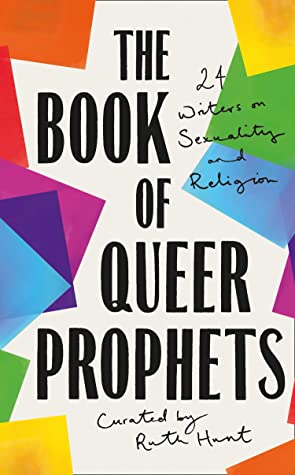 There isn’t, or needn’t be, a contradiction between faith and queerness, as the authors included in this anthology would agree. Many of them are stalwarts at Greenbelt, a progressive Christian summer festival – Church of Scotland minister John L. Bell even came out there, in his late sixties, in 2017. I’m a lapsed regular attendee, so a lot of the names were familiar to me, including those of poets Rachel Mann and Padraig O’Tuama.
Most of the contributors are Christian, then, including ordained priests like Desmond Tutu’s daughter, Mpho, and LGBT ally Kate Bottley, but we also hear from Michael Segalov, a gay Jewish man in London, and from Amrou Al-Kahdi (author of Unicorn: The Memoir of a Muslim Drag Queen), who describes the affirmation they found in the Sufi tradition. Dustin Lance Black tells of the exclusion LGBT Mormons still encounter.
Jarel Robinson-Brown addresses his lament on mistreatment to his nephew, as James Baldwin did in “My Dungeon Shook” (in The Fire Next Time). Tamsin Omond recounts getting married to Melissa on a London bridge in the middle of an Extinction Rebellion protest. Erin Clark, though bisexual, knows she can pass as straight because she’s marrying a man – so is she ‘gay enough?’ Two trans poets write of the way cathedrals drew them into faith. The only weaker pieces are by Jeanette Winterson (there’s nothing new if you’ve read her memoir) and Juno Dawson (entirely throwaway; ‘I’m an atheist, but it’s okay to be religious, too’).
Again and again, these writers voice the certainty that they are who God means them to be. A few of them engage with particular passages from the Bible, offering contextual critiques or new interpretations, but most turn to scripture for its overall message of love and justice. Self-knowledge is a key component of their search for truth. And the truth sets people free.
My rating:
I read an e-copy via NetGalley.
What recent releases can you recommend?
Best of 2019: Nonfiction
For me, 2019 has been a more memorable year for nonfiction than for fiction. Like I did last year, I’ve happened to choose 12 favorite nonfiction books – though after some thematic grouping this has ended up as a top 10 list. Bodies, archaeology, and the environmental crisis are recurring topics, reflecting my own interests but also, I think, something of the zeitgeist.
Let the countdown begin!
 Because Internet: Understanding how language is changing by Gretchen McCulloch: Surprisingly fascinating stuff, even for a late adopter of technology. The Internet popularized informal writing and quickly incorporates changes in slang and cultural references. The book addresses things you may never have considered, like how we convey tone of voice through what we type and how emoji function as the gestures of the written word. Bursting with geeky enthusiasm.
- Surfacing by Kathleen Jamie: A fusion of autobiography with nature and travel writing – two genres that are too often dominated by men. Jamie has a particular interest in birds, islands, archaeology and the oddities of the human body, all subjects that intrigue me. There is beautiful nature writing to be found in this volume, as you might expect, but also relatable words on the human condition.
-
 Mother Ship by Francesca Segal: A visceral diary of the first eight weeks in the lives of the author’s daughters, who were born by Caesarean section at 29 weeks in October 2015 and spent the next two months in the NICU. Segal describes with tender precision the feeling of being torn between writing and motherhood, and crafts twinkly pen portraits of others she encountered in the NICU, including the staff but especially her fellow preemie mums.
-
 Surrender: Mid-Life in the American West by Joanna Pocock: Prompted by two years spent in Missoula, Montana and the disorientation felt upon a return to London, this memoir-in-essays varies in scale from the big skies of the American West to the smallness of one human life and the experience of loss and change. This is an elegantly introspective work that should engage anyone interested in women’s life writing and the environmental crisis.
- (A tie) Constellations by Sinéad Gleeson / The Undying by Anne Boyer / Notes Made while Falling by Jenn Ashworth: Trenchant autobiographical essays about female pain. All three feel timely and inventive in how they bring together disparate topics to explore the possibilities and limitations of women’s bodies. A huge theme in life writing in the last couple of years and a great step toward trauma and chronic pain being taken seriously. (See also Notes to Self by Emilie Pine and the forthcoming Pain Studies by Lisa Olstein.)


-
 Time Song: Searching for Doggerland by Julia Blackburn: Deep time is another key topic this year. Blackburn follows her curiosity wherever it leads as she does research into millions of years of history, including the much shorter story of human occupation. The writing is splendid, and the dashes of autobiographical information are just right, making her timely/timeless story personal. This would have been my Wainwright Prize winner.
-
 The Seafarers: A Journey among Birds by Stephen Rutt: The young naturalist travelled the length and breadth of the British Isles – from Skomer to Shetland – courting encounters with seabirds. Discussion of the environmental threats that hit these species hardest, such as plastic pollution, makes for a timely tie-in to wider issues. The prose is elegantly evocative, and especially enjoyable because I’ve been to a lot of the island locations.
-
 Once More We Saw Stars by Jayson Greene: In 2015 the author’s two-year-old daughter, Greta, was fatally struck in the head by a brick that crumbled off an eighth-story Manhattan windowsill. Music journalist Greene explores all the ramifications of grief. I’ve read many a bereavement memoir and can’t remember a more searing account of the emotions and thoughts experienced moment to moment. The whole book has an aw(e)ful clarity to it.
-
 The Body: A Guide for Occupants by Bill Bryson: Bryson is back on form indulging his layman’s curiosity. Without ever being superficial or patronizing, he gives a comprehensive introduction to every organ and body system. He delights in our physical oddities, and his sense of wonder is contagious. Shelve this next to Being Mortal by Atul Gawande in a collection of books everyone should read – even if you don’t normally choose nonfiction.
- Irreplaceable: The Fight to Save Our Wild Places by Julian Hoffman: Species and habitat loss are hard to comprehend even when we know the facts. This exquisitely written book is about taking stock, taking responsibility, and going beyond the numbers to tell the stories of front-line conservation work. Irreplaceable is an elegy of sorts, but, more importantly, it’s a call to arms. It places environmentalism in the hands of laypeople and offers hope that in working together in the spirit of defiance we can achieve great things. So, if you read one 2019 release, make it this one.
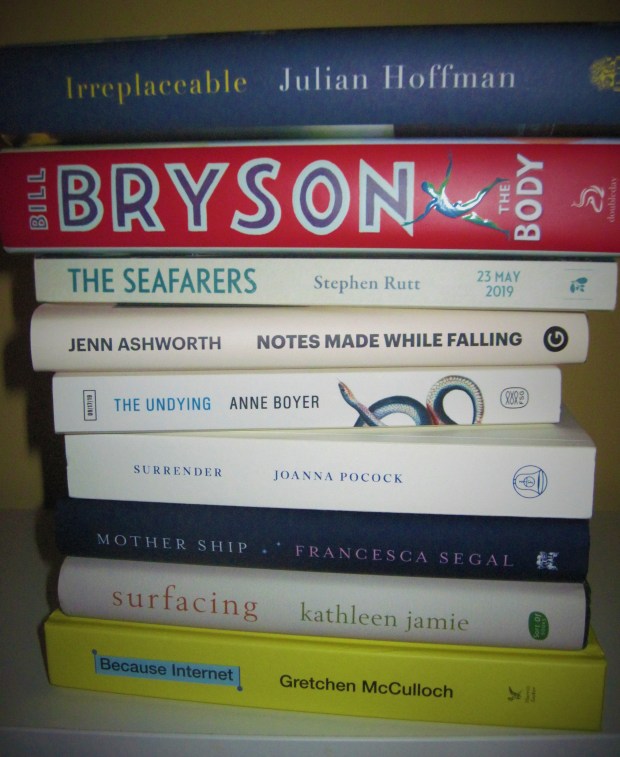
(Books not pictured were read from the library or on Kindle.)
What were some of your top nonfiction reads of the year?
Upcoming posts:
28th: Runners-up
29th: Other superlatives and some statistics
30th: Best backlist reads
31st: The final figures on my 2019 reading
New Networks for Nature 2019
This past weekend was my fifth time attending Nature Matters, the annual New Networks for Nature conference. I’ve written about it on the blog a few times before: last year’s 10th anniversary meeting in Stamford, plus once when there was a particular focus on nature poetry and another time when it was held in Cambridge. This year the theme was “Time for Nature” and the conference was held at the very posh St Peter’s School in York, which dates back to 627 and resembles an Oxford college. We have close friends in York, but our timing was off in that they were in Italy this week. However, they sent us a key to their house and let us stay there while they were away, which saved us having to book an Airbnb or guest house.

York street scene. Photo by Chris Foster.
What makes Nature Matters so special is its interdisciplinary nature: visual artists, poets, musicians, writers, activists, academics and conservationists alike attend and speak. So although the event might seem geared more towards my ecologist husband, there’s always plenty to interest me, too. In particular, I enjoyed the panel discussions on nature in children’s books and new directions for nature writing. This year the organizers were determined to make the speakers’ roster more diverse, so some panels were three-quarters or wholly female, and four people of color appeared on the stage. (That might not seem like a great record, but in a field so dominated by white males it’s at least a start.)
 The Friday was a particularly brilliant day, the best day of sessions I can remember in any year. After a presentation by wildlife photographer and painter Robert Fuller, the first session was “Nature in Deep Time,” featuring three archaeologists from northern universities who talked about cave art, woodcraft, and evidence of rapid climate change. “Taking a long view, we get a very different perspective,” Professor Terry O’Connor of the University of York observed. The topic felt timely and tied in with a number of books that have come out this year, including Time Song by Julia Blackburn, Surfacing by Kathleen Jamie and Underland by Robert Macfarlane.
Next up was “Now or Never – Fighting for Nature,” featuring three female activists: Ruth Peacey, a filmmaker for BBC Wildlife whose subjects have included bird persecution in the Mediterranean; Sally Goldsmith, a campaigner who deployed poems and songs against the mass street tree-cutting campaign in Sheffield and helped save some 10,000 trees; and Hatti Owens, an environmental lawyer with ClientEarth who has partnered with Extinction Rebellion. The panel chair and one of this year’s organizers, writer Amy-Jane Beer, noted that activism is no longer radical, but an obligation.
Either side of lunch, Dr. Sara Goodacre of the University of Nottingham SpiderLab demonstrated how money spiders walk on water and “sail” using two raised legs to cope with wind; and Dr. Geoff Oxford of the University of York told the successful conservation story of the tansy beetle, which has recently been celebrated with a crowdfunded wall mural on the corner of York’s Queen Street and the Tansy Beetle Bar at the Rattle Owl restaurant on Micklegate. After the day’s proceedings, we joined a general movement over to see the mural and toast the bar’s grand opening.

Tansy beetle mural. Photo by Chris Foster.
The children’s books session featured Anneliese Emmans Dean, who gave very entertaining performances of her poems on insects and birds; Gill Lewis, who writes middle grade novels that introduce children to environmental issues; and Yuval Zommer, who writes and illustrates nonfiction guides with titles like The Big Book of Bugs and The Big Book of Blooms. Panel chair Ben Hoare, another of this year’s organizers and a former editor of BBC Wildlife magazine, concluded that children’s books should be joyous and not preachy.
There was still more to come on this jam-packed Friday! “The Funny Thing about Nature…” was essentially three stand-up comedy routines by Simon Watt, creator of the Ugly Animal Appreciation Society; Helen Pilcher, who has written a speculative book about the science of de-extinction; and Hugh Warwick, an author and hedgehog enthusiast. The language got a little crass in this session, but all three speakers were genuinely funny. As Watt put it, “Sincerity should not be our only weapon” in the fight for nature; he’s trying to reach the people who aren’t “already on our side.”
 After free gin and tonics provided by local producers SloeMotion, we had the absolute treat of a performance by Kitty Macfarlane, whose folk songs are inspired by the natural world. The title track of her 2018 album Namer of Clouds is about Luke Howard, who created the naming system for clouds (cumulus, stratus, and so on) in 1802. Other songs are about eels, a starling murmuration and the Sardinian tradition of weaving sea silk. She often incorporates field recordings of birdsong, and writes about her native Somerset Levels. Her voice is gorgeously clear, reminding me of Emily Smith’s. We bought her album and EP at once.
Saturday was a slightly less memorable day, with sessions on insects and the uplands, an interview with clean rivers campaigner (and former pop star) Feargal Sharkey, and the short film Raising the Hare by Bevis Bowden. Most engaging for me was a four-person discussion on new directions for nature writing, chaired by author and academic Richard Kerridge. Katharine Norbury is editing the Women on Nature anthology, which I have supported via Unbound; it’s due out next year. She went all the way back to Julian of Norwich and has included novelists, poets, gardeners and farmers – lots of women who wouldn’t have called themselves ‘nature writers’.

L to R: Kerridge, Norbury, Sethi, McKenzie and Smyth. Photo by Chris Foster.
Anita Sethi, a journalist from Manchester, speaks out about inequality of access to nature due to race, gender and class. She read part of her essay “On Class and the Countryside” from the Common People anthology edited by Kit de Waal. Zakiya McKenzie, a London-born Jamaican, was a Forest England writer in residence and founded the Green & Black project to give underprivileged children trips to the countryside. Richard Smyth, the author of A Sweet, Wild Note, spoke of the need for robust nature writing – and criticism. He stressed that it’s not good enough for nature writing to be “charming” or “lyrical”; it’s too important to be merely pleasant. I would have liked to hear him explore this more and for it to turn into more of a debate, but the discussion drifted into praise for experimental and speculative forms.

Peregrine on York Minster. Photo by Chris Foster.

Finishing off a Bettys lunch with cake and a mocha. Photo by Chris Foster.
There’s something for everyone at this conference; some of the elements that I didn’t get on with or found pretentious were others’ highlights, so it’s all a matter of taste. Spending time in York, one of my favorite cities, was an added bonus. We managed to fit in a trip to the National Railway Museum and lunch at Bettys on the Sunday before our train back.
Next year’s conference will be at the University of East Anglia in Norwich, 10–12 July. I’ve never been to Norwich so look forward to visiting it and attending the full conference once again. It’s always a fascinating, inspiring weekend with a wide range of speakers and ideas.
 Bookish Beck = Rebecca Foster. American transplant to England. Freelance proofreader and book reviewer.
 Bookish Beck