20 Books of Summer, #9–11: Asimov, St. Aubyn, Weiss
My summer reading has been picking up and I have a firm plan – I think – for the rest of the foodie books that will make up my final 20. I’m reading two more at the moment: a classic with an incidental food-themed title and a work of American history via foodstuffs. Today I have a defense of drinking wine for pleasure; a novel about inheritance and selfhood, especially for mothers; and a terrific foodoir set in Berlin, New York City and rural Italy.
How to Love Wine: A Memoir and Manifesto by Eric Asimov (2012)
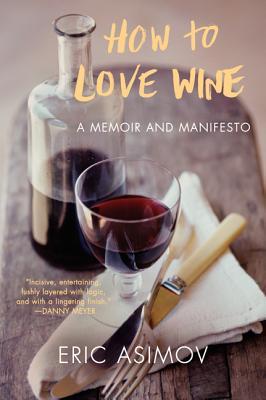 (20 Books of Summer, #9) Asimov may be the chief wine critic for the New York Times, but he’s keen to emphasize that he’s no wine snob. After decades of drinking it, he knows what he appreciates and prefers small-batch to mass market wine, but he’d rather that people find what they enjoy rather than chase after the expensive bottles they feel they should like. He finds tasting notes and scores meaningless and is more interested in getting people into wine simply for the love of it – not as a status symbol or a way of showing off arcane knowledge.
Like Anthony Bourdain (see my review of Kitchen Confidential), Asimov was drawn into foodie culture by one memorable meal in France. He’d had a childhood sweet tooth and was a teen beer drinker, but when he got to grad school in Austin, Texas an $8 bottle of wine from a local Whole Foods was an additional awakening. Following in his father’s footsteps in journalism and moving from Texas to Chicago back home to New York City for newspaper editing jobs, he had occasional epiphanies when he bought a nice bottle of wine for his parents’ anniversary and took a single wine appreciation course. But his route into writing about wine was sideways, through a long-running NYT column about local restaurants.
I might have liked a bit more of the ‘memoir’ than the ‘manifesto’ of the subtitle: Asimov makes the same argument about accessibility over and over, yet even his approachable wine attitude was a little over my head. I can’t see myself going to a tasting of 20–25 wines at a time, or ordering a case of 12 wines to sample at home. Not only can I not tell Burgundy from Bordeaux (his favorites), I can’t remember if I’ve ever tried them. I’m more of a Sauvignon Blanc or Chianti gal. Maybe the Wine for Dummies volume I recently picked up from a Little Free Library is more my speed.
Source: Free from a neighbor
My rating: 
Mother’s Milk by Edward St Aubyn (2006)
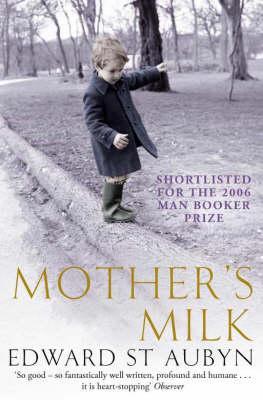 (20 Books of Summer, #10; A buddy read with Annabel, who has also reviewed the first three books here and here as part of her 20 Books of Summer.) I’ve had mixed luck with the Patrick Melrose books thus far: Book 1, Never Mind, about Patrick’s upbringing among the badly-behaving rich in France and his sexual abuse by his father, was too acerbic for me, and I didn’t make it through Book 3, Some Hope. But Book 2, Bad News, in which Patrick has become a drug addict and learns of his father’s death, hit the sweet spot for black comedy.
Mother’s Milk showcases two of St. Aubyn’s great skills: switching effortlessly between third-person perspectives, and revealing the psychology of his characters. It opens with a section from the POV of Patrick’s five-year-old son, Robert, a perfect link back to the child’s-eye view of Book 1 and a very funny introduction to this next generation of precocious mimics. The perspective is shared between Robert, Patrick, his wife Mary, and their younger son Thomas across four long chapters set in the Augusts of 2000–2003.
Patrick isn’t addicted to heroin anymore, but he still relies on alcohol and prescription drugs, struggles with insomnia and is having an affair. Even if he isn’t abusive or neglectful like his own parents, he worries he’ll still be a destructive influence on his sons. Family inheritance – literal and figurative – is a major theme, with Patrick disgruntled with his very ill mother, Eleanor, for being conned into leaving the home in France to a New Age organization as a retreat center. “What I really loathe is the poison dripping from generation to generation,” Patrick says – “the family’s tropical atmosphere of unresolved dependency.” He mentally contrasts Eleanor and Mary, the former so poor a mother and the latter so devoted to her maternal role that he feels there’s no love left for himself from either.
I felt a bit trapped during unpleasant sections about Patrick’s lust, but admired the later focus on the two mothers and their loss of sense of self, Eleanor because of her dementia and Mary because she has been subsumed in caring for Thomas. I didn’t quite see how all the elements were meant to fit together, particularly the disillusioning trip to New York City, but the sharp writing and observations were enough to keep me going through this Booker-shortlisted novella. I’ll have to get Book 5 out from the library to see how St. Aubyn tied everything up.
Source: Free bookshop
My rating: 
My Berlin Kitchen: Adventures in Love and Life by Luisa Weiss (2012)
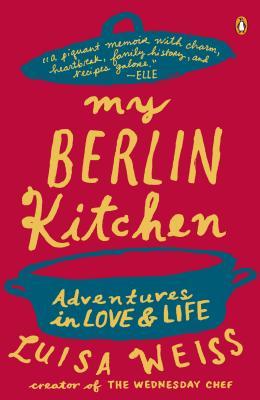 (20 Books of Summer, #11) Blog-to-book adaptations can be hit or miss; luckily, this one joins Julie Powell’s Julie and Julia and Molly Wizenberg’s A Homemade Life in the winners column. Raised in Berlin and Boston by her American father and Italian mother, Weiss felt split between her several cultures and languages. While she was working as a cookbook editor in New York City, she started a blog, The Wednesday Chef, as a way of working through the zillions of recipes she’d clipped from here and there, and of reconnecting with her European heritage: “when I came down with a rare and chronic illness known as perpetual homesickness, I knew the kitchen would be my remedy.”
After a bad breakup (for which she prescribes fresh Greek salad, ideally eaten outside), she returned to Berlin and unexpectedly found herself back in a relationship with Max, whom she’d met in Paris nearly a decade ago but drifted away from. She realized they were meant to be together when he agreed that potato salad should be dressed with oil and vinegar rather than mayonnaise. After a tough year for Weiss as she readjusts to Berlin’s bitter winters and lack of bitter greens, the book ends with the lovely scene of their rustic Italian wedding.
Weiss writes with warmth and candor and gets the food–life balance just right. I found a lot to relate to here (“I couldn’t ever allow myself to think about how annoying airports were, how expensive it was to go back and forth between Europe and the United States … I had to get on an airplane to see the people I love”) and – a crucial criterion for a foodie book – could actually imagine making most of these recipes, everything from plum preserves and a Swiss chard and Gruyère bake to a towering gooseberry meringue cream cake.
Other readalikes: From Scratch: A Memoir of Love, Sicily, and Finding Home by Tembi Locke, My Salinger Year by Joanna Rakoff, and Only in Naples: Lessons in Food and Famiglia from My Italian Mother-in-Law by Katherine Wilson
Source: A birthday gift from my wish list last year
My rating: 
20 Books of Summer: Bourdain, Ozeki and More
Over halfway through the summer and my numbers are looking poor. It’s not that I’m not reading a ton – in general, I am – it’s just that I’m having trouble finishing any foodie books. I’m in the middle of two food-related memoirs plus Cakes and Ale by W. Somerset Maugham, and have recently started buddy-reading Mother’s Milk by Edward St Aubyn with Annabel, so more reviews will be along eventually, but I predict August will be a scramble.
Today I review an in-your-face tell-all about the life of a chef, and a novel set between Japan and the United States that exposes the seamy side of meat production. A lite road trip and an iffy California classic follow as bonuses.
Kitchen Confidential: Adventures in the Culinary Underbelly by Anthony Bourdain (2000)
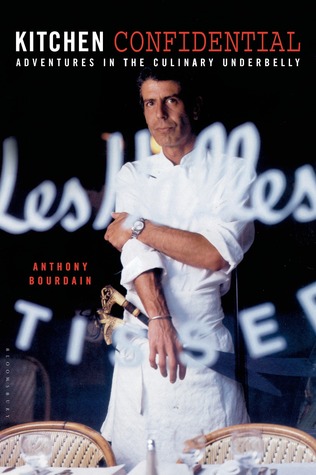 (20 Books of Summer, #5) “Get that dried crap away from my bird!” That random line about herbs is one my husband and I remember from a Bourdain TV program and occasionally quote to each other. It’s a mild curse compared to the standard fare in this flashy memoir about what really goes on in restaurant kitchens. His is a macho, vulgar world of sex and drugs. In the “wilderness years” before he opened his Les Halles restaurant, Bourdain worked in kitchens in Baltimore and New York City and was addicted to heroin and cocaine. Although he eventually cleaned up his act, he would always rely on cigarettes and alcohol to get through ridiculously long days on his feet.
From “Appetizer” to “Coffee and a Cigarette,” the book is organized like a luxury meal. Bourdain charts his development as a chef, starting with a childhood summer in France during which he ate vichyssoise and oysters for the first time and learned that food “could be important … an event” and describing his first cooking job in Provincetown and his time at the Culinary Institute of America. He also discusses restaurant practices and hierarchy, and home cook cheats and essentials. (I learned that you should never order fish in a restaurant on a Monday – it’ll be left over from Thursday’s order.) The pen portraits of his crazy sous-chef and baker are particularly amusing; other subjects include a three-star chef he envies and the dedicated Latino immigrants who are the mainstay of his kitchen staff.
My dad is not a reader but he is a foodie, and he has read Bourdain’s nonfiction (and watched all his shows), so I felt like I was continuing a family tradition in reading this. I loved my first taste of Bourdain’s writing: he’s brash, passionate, and hilariously scornful of celebrity chefs and vegetarianism (“the enemy of everything good and decent in the human spirit, an affront to all I stand for, the pure enjoyment of food”). Being in charge of a restaurant sounds manic, yet you can see why some would find it addictive. How ironic, though, to find a whole seven references to suicide in this book. Sometimes he’s joking; sometimes he’s talking about chefs he’s heard about who couldn’t take the pressure. Eighteen years after this came out, he, too, would kill himself.
(See also this article about rereading Bourdain in the 20th anniversary year of Kitchen Confidential.)
Source: Local swap shop (free)
My rating:
(These two are linked by a late chapter in the Bourdain, “Mission to Tokyo,” in which he advises on a new Les Halles offshoot in Japan and gorges himself on seafood delights.)
My Year of Meats by Ruth Ozeki (1998)
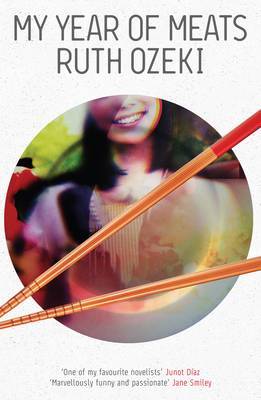 (20 Books of Summer, #6) I don’t know what took me so long to read another novel by Ruth Ozeki after A Tale for the Time Being, one of my favorite books of 2013. This is nearly as fresh, vibrant and strange. Set in 1991, it focuses on the making of a Japanese documentary series, My American Wife, sponsored by a beef marketing firm. Japanese American filmmaker Jane Takagi-Little is tasked with finding all-American families and capturing their daily lives – and best meat recipes. The traditional values and virtues of her two countries are in stark contrast, as are Main Street/Ye Olde America and the burgeoning Walmart culture.
There is a clear message here about cheapness and commodification, but Ozeki filters it through the wrenching stories of two women with fertility problems: Jane, whose reproductive system was damaged by DES, a synthetic estrogen her mother took during pregnancy to prevent a miscarriage; and Akiko, the wife of Jane’s boss, who struggles with an eating disorder and domestic violence.
Jane starts sneaking controversial subjects into her shoots: a lesbian couple, a family formed by interracial adoption, and a five-year-old who has already undergone puberty due to the hormones used on her family’s cattle feedlot. What is “natural,” and what gets branded alien or invasive? From the kudzu that strangles the South to a murdered Japanese exchange student, Ozeki probes the related issues of nativism and racism. Her two protagonists’ stories – one in the first person; the other in the third person – come together in a surprising manner as Jane decides that she has a more pressing obligation than creating a diverting television show.
This is a bold if at times discomforting novel. At first it brought to mind the exaggerated comedy of Julian Barnes’s England, England and Jane Smiley’s Moo, but as it grew darker it reminded me more of Han Kang’s The Vegetarian. It’s tricky, when a work of fiction tackles ethical or environmental matters, to balance storytelling and consciousness-raising, but Ozeki pulls it off with style. The only aspect that didn’t mean much to me, perhaps simply because of my unfamiliarity, was the excerpts from The Pillow Book of Shōnagon. How sad to think that I only have one more Ozeki awaiting me, All Over Creation. She averages a book every 5‒10 years; we can only hope that another is on the way soon.
Source: Charity shop
My rating: 
I picked up another two food-adjacent books that didn’t work for me, though I ended up skimming them to the end.
America Unchained: A Freewheeling Roadtrip in Search of Non-Corporate USA by Dave Gorman (2008)
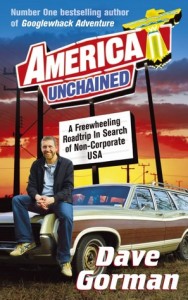 (20 Books of Summer, #7) I read the first couple of chapters, in which he plans his adventure, and then started skimming. I expected this to be a breezy read I would race through, but the voice was neither inviting nor funny. I also hoped to find more about non-chain supermarkets and restaurants – that’s why I put this on the pile for my foodie challenge in the first place – but, from a skim, it mostly seemed to be about car trouble, gas stations and fleabag motels. The only food-related moments are when Gorman (a vegetarian) downs three fast food burgers and orders of fries in 10 minutes and, predictably, vomits them all back up; and when he stops at an old-fashioned soda fountain for breakfast.
Source: Free bookshop
Tortilla Flat by John Steinbeck (1935)
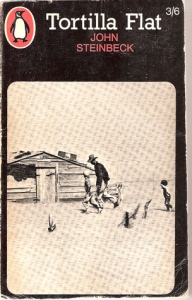 (20 Books of Summer, #8) I read the first 25 pages and then started skimming. This is a story of a group of friends – paisanos, of mixed Mexican, Native American and Caucasian blood – in Monterey, California. During World War I, Danny serves as a mule driver and Pilon is in the infantry. When discharged from the Army, they return to Tortilla Flat, where Danny has inherited two houses. He lives in one and Pilon is his tenant in the other (though Danny will never see a penny in rent). They’re a pair of loveable scamps, like Huck Finn all grown up, stealing wine and chickens left and right.
Steinbeck novels seem to fall into two camps for me. This is one of his inconsequential, largely unlikable novellas (like The Pearl and The Red Pony, which I studied in school – I’m lucky they didn’t put me off Steinbeck forever), whereas The Grapes of Wrath and East of Eden are masterful. It may also have something to do with the slight air of condescension towards characters of a different race: Steinbeck renders their speech with “thee” and “thou,” trying to imitate a Romance language’s informal pronouns, but it feels dated and alienating.
Source: Free bookshop
The Group by Lara Feigel (and Mary McCarthy)
Lara Feigel’s memoir Free Woman was one of my favourite books of 2018. In it she interrogates conventions of marriage and motherhood while rereading the works of Doris Lessing – The Golden Notebook (1962), in particular, dramatizes women’s struggles to combine their disparate roles into a harmonious identity. Drawing inspiration from Lessing as well as from another early feminist novel, The Group by Mary McCarthy (more on this below), Feigel’s debut novel crafts a kaleidoscopic portrait of five women’s lives in 2018.
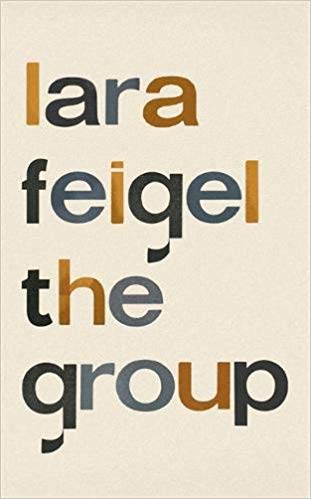 Stella, Kay, Helena, Polly and Priss met at a picnic while studying at Oxbridge and decided to rent a house together. Now 40-ish, they live in London and remain close, though their lives have branched in slightly different directions. Kay is an English teacher but has always wanted to be a novelist like her American husband, Harald. Priss is a stay-at-home mother excited to be opening a café. Polly, a gynaecological consultant at St Thomas’s Hospital, is having an affair with a married colleague. Helena, a single documentary presenter, decides she wants to have a baby and pursues insemination via a gay friend.
Narrating her friends’ lives as well as her own is Stella, an editor at a Faber-like publishing house whose director (also Helena’s uncle) is under investigation for sexual misconduct. Stella, a stand-in for the author, has split from her husband and has a new baby via IVF as well as an older child; this hint of autofiction lends the book an intimacy it might have lacked with an omniscient perspective. Although you have to suspend disbelief in a few places – could Stella really know so many details of her friends’ lives? – it feels apt that she can only understand these other women in relation to herself. Her voice can be catty, but is always candid, and Feigel is astute on the performative aspects of femininity.
Fast-forward a Sally Rooney novel by about 20 years and you’ll have an idea of what to expect here. It is a sexually frank and socially engaged narrative that arose from the context of the #MeToo movement and fully acknowledges the privilege and limitations of its setting. The characters express guilt over lamenting middle-class problems while there is such suffering in the wider world – we glimpse this in Polly’s work with African girls who have undergone genital mutilation. The diversity is limited to Black boyfriends, Helena’s bisexuality, and the fact that one group member decides not to have children (that 1 in 5 is statistically accurate).
The advantage of the apparent heterogeneity in the friend group, though, is that it highlights depths of personality and subtleties of experience. Stella even sees herself as an amateur anthropologist:
So here we are then. Five exact contemporaries who once shared a cluttered, thin-walled student house off the Cowley Road, all privileged, white, middle-class, all vestigial hangers-on, left over from an era when we received free educations at our elite university and then emerged into a world where we could still just about find jobs and buy flats, provided with opportunities for selfishness and leisure by our cleaners and our childminders. Nothing very eventful happens to us, but that gives more room for the ethnographer in me to get to work.
Feigel previously wrote two group biographies of cultural figures of the Second World War era, and she applies that precise skill set – capturing the atmosphere of a time period; noting similarities but also clear distinctions between people – to great effect here. You’ll recognize aspects of yourself in all of the characters, and be reminded of how grateful you are for (or how much you wish you had) friends whom you know will always be there for you. It’s an absorbing and relevant novel that ranks among my few favourites of the year so far.
My rating:
The Group was published by JM Originals (John Murray) on July 2nd. My thanks to the publisher for the free copy for review.
Readalikes: The Radiant Way by Margaret Drabble, Girl, Woman, Other by Bernardine Evaristo, and Expectation by Anna Hope.
See Susan’s review also.
The Group by Mary McCarthy (1963)
As soon as I heard about Lara Feigel’s forthcoming novel, I unearthed the Mary McCarthy paperback I’d plucked from Bookbarn’s shelves in 2017. I decided to read Feigel’s first, lest it feel less than fresh; perhaps inevitably, McCarthy’s felt dated in comparison. I had trouble engaging with it as a whole, but still enjoyed contrasting the two books.
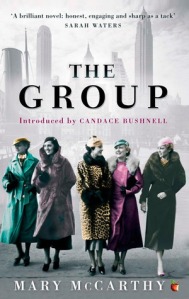 McCarthy focuses on eight girls from the Vassar class of ’33. Kay, the first to marry, has an upper-crust New York City wedding one week after graduation. But after Harald loses his theatre job, his cocktail habit and their luxury apartment soon deplete Kay’s Macy’s salary. Meanwhile, Dottie loses her virginity to Harald’s former neighbour in a surprisingly explicit scene. Contraception is complicated, but not without comic potential – as when Dottie confuses a pessary and a peccary. Career, romance, and motherhood are all fraught matters.
Feigel borrows the names of four of her five group members, plus those of some secondary characters, from McCarthy, with Stella a new character perhaps inspired in part by McCarthy’s Libby, who wants to work with books but, after delivering an earnest report on a 500-page pot-boiler, hears that “we really have no work that you’re uniquely qualified to do. You’re one of thousands of English majors who come pouring out of the colleges every June, stage-struck to go into publishing.” (That sure sounds familiar!)
Narrowing the circle and introducing a first-person narrator were wise choices that made Feigel’s version more accessible. Both, though, are characterized by forthright commentary and a shrewd understanding of human motivations. I’ll try again with McCarthy’s The Group someday, but for now I’m planning to pick up her Memories of a Catholic Girlhood.
Note: Mary McCarthy is one of the authors profiled in Michelle Dean’s Sharp.
Doorstopper of the Month: The Emperor’s Children by Claire Messud (2006)
My impression of Claire Messud is that she’s admired by critics but unpopular with ordinary readers (e.g. this novel has a catastrophically low average rating on Goodreads, probably because of that “unlikable characters” chestnut). I fit into both categories, so was curious to see where I would fall on the appreciation spectrum. Doubly intrigued by Susan’s inclusion of The Emperor’s Children on her list of top New York novels, I finally picked up the copy I’d gotten from the free mall bookshop where I volunteered weekly in ordinary times.
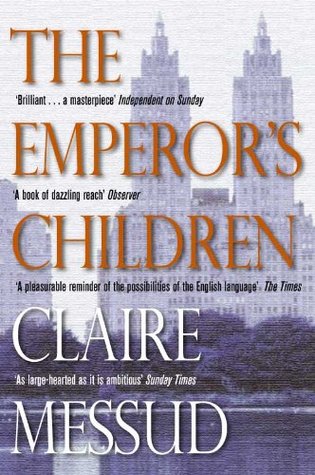 I don’t think it’s a spoiler to tell you that this is a 9/11 novel. It opens in March 2001 and covers the next eight months, with “the towers” first getting a mention at the halfway point. There’s heavy irony in one character commenting to another in the first week of September, “Whatever else they may be, our times are almost criminally uninteresting. The dullest times ever.” As in a couple of novels I read last year (not naming them in case that is a spoiler), the terrorist attacks wake the main characters up from a stupor of entitlement and apathy.
The trio of protagonists, all would-be journalists aged 30, have never really had to grow up. Marina still lives with her parents, social worker Annabel and respected cultural pundit Murray Thwaite. She got an advance to write a book on children’s fashions, but the project has languished for years. Her best friend Danielle is a documentary maker mired in an affair with an older man. Their other close pal is half-Vietnamese Julius, whose new boyfriend keeps him in the luxurious lifestyle to which he’s become accustomed.
The arrival of two young men sets the plot in motion. Through Danielle, Marina meets Ludovic Seeley, who has moved from Australia to New York City to launch a magazine, The Monitor, for which he is soliciting cutting-edge cultural exposés. Meanwhile, Murray’s nephew, college dropout Frederick Tubb, who has the unfortunate nickname of “Bootie,” has moved to the City to seek his fortune. Murray offers him a job as his amanuensis, but what Bootie learns leads him to wish he could expose his idolized uncle as an intellectual fraud.
For these characters, leaving an extended childhood behind means getting out from under the shadow of a previous generation and reassessing what is admirable and who is expendable. As Marina’s book title (The Emperor’s Children Have No Clothes) indicates, appearance and substance do not always match. I won’t give away what 9/11 means for this fictional world, though I’d be interested in discussing it in the comments with anyone who’s read the book. Bootie was my favorite, and what happens with him is particularly interesting.
This was thoroughly engrossing: richly textured and intellectually satisfying in a way that might call to mind George Eliot and Edith Wharton – or, more recently, Jennifer Egan and Zadie Smith. Great American Novel territory, for sure. I’ll be keen to read more by Messud.
Page count: 581
My rating:
Paul Auster Reading Week: Winter Journal & The New York Trilogy
Before this year, I’d read only one book by Paul Auster: Timbuktu, which fit into last year’s all-animal 20 Books of Summer for its canine main character. This year I’ve enjoyed having Annabel’s Paul Auster Reading Week as an excuse to binge on more Auster, including one of his memoirs, Winter Journal, and his most famous set of novels, the New York Trilogy. I’m reading another two Auster books, one fiction and nonfiction, and will see if I can finish and write them up before the week ends.

Winter Journal (2012)
This is one of the most remarkable memoirs I’ve ever read. Approaching age 64 and the winter of his life, Auster decided to assemble his most visceral memories. Here he parades them past in a seemingly random order yet manages to give a sense of the sweep of his life. The use of the second person draws readers in to (re-)experience things along with the author, while also creating an artistic distance between the subject and his reminiscences. Auster describes his aim thus:
Time is running out, after all. Perhaps it is just as well to put aside your stories for now and try to examine what it has felt like to live inside this body from the first day you can remember being alive until this one. A catalogue of sensory data. What one might call a phenomenology of breathing.
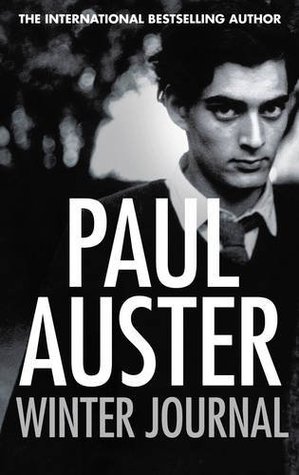 His life reappears through scars, through accidents and near-misses, through what his hands felt and his eyes observed. A three-year-old rips his cheek open on a protruding nail in a department store. A teenager slowly builds up a portfolio of sexual experiences. A young man lives and works in Paris and the South of France. A marriage to one fellow author (Lydia Davis) ends and a relationship with another (Siri Hustvedt) begins. A fiftysomething rushing to get home to the toilet makes an ill-advised turn against traffic and totals his car – luckily, he and his family escape unhurt. Numbness after his mother’s death cedes to a panic attack.
I particularly enjoyed the 53-page section in which Auster gives tours through the 21 places he’s lived since infancy, recounting the details he remembers of the dwellings and what happened during his time there. It’s impressive how much he can condense, but also how much he can convey in just a few pages on each home. This is the sort of format I could imagine borrowing for a short autobiographical piece – it would be a way of redeeming that involuntarily nomadic period when my husband and I moved every six to 18 months.
Reading this alongside the New York Trilogy allowed me to spot the ways, big and small, in which those novels draw on Auster’s life story. I’m now keen to read more of his nonfiction, especially The Invention of Solitude, which offended his relatives by revealing the shameful family story of how his grandmother shot and killed his grandfather in their kitchen. 
Annabel says: “The book is written in the second person – addressing himself; it gives a real sense of intimacy to his story. … Auster is an unconventional, analytical and eloquent writer, and this unconventional memoir was a delight to read, he can look with humour at himself as well as being serious.”
Laura F. says: “You know how people say they’d read anything by their favourite author, even a grocery list? Winter Journal gets pretty close to that territory. … I’ve never read a memoir like this, and though focused on the physical, it’s a fully emotional experience.”
Some favorite lines:
“as long as you continue to travel, the nowhere that lies between the here of home and the there of somewhere else will continue to be one of the places where you live.”
“We are all aliens to ourselves, and if we have any sense of who we are, it is only because we live inside the eyes of others.”
“you can only conclude that every life is marked by a number of close calls, that everyone who manages to reach the age you have come to now has already wriggled out of a number of potentially absurd, nonsensical deaths. All in the course of what you would call ordinary life.”
Readalikes: I Am, I Am, I Am by Maggie O’Farrell & The Lost Properties of Love by Sophie Ratcliffe
The New York Trilogy
(also my Doorstopper of the Month at 580 pages)
City of Glass (1985)
 A metafictional mystery about a crime writer named Daniel Quinn who turns private investigator when he gets a phone call asking for the Paul Auster Detective Agency. This is one of those books where what actually happens is a lot less important than the atmosphere it creates. So what feels essential to me here is the sense of a labyrinthine New York City and a confusion of languages and relationships. Quinn, who is helpfully untethered after the death of his wife and son, is hired to tail Peter Stillman’s father, who has recently been released from a mental hospital, where he was sentenced after being judged insane for keeping his son in isolation in a dark apartment for nine years.
Feral children, maps, eggs, the Tower of Babel and Don Quixote are some of the recurring sources of metaphors in a deliberately disorienting and intertextually rich short novel that kept me turning the pages even when I didn’t know precisely what was going on. We get a glimpse of Auster himself, and are invited to muse on such tiny subjects as destiny, the limitations of language, the purpose of books, and the nature of truth. I’m curious to see whether the other two novels follow on from the story at all or just resemble it thematically. 
Ghosts (1986)
I jumped straight into this from City of Glass, and it suffered by comparison. It is not a sequel per se, because it has different characters and is set in the late 1940s instead of the early 1980s, but it shares some of the same concerns (with literature, identity, doubling, the essential otherness of the writer, and so on) and again is a sort of metafictional mystery.
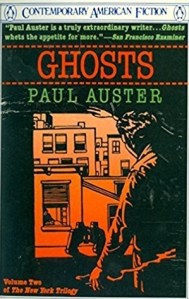 Part of why I couldn’t take this novella entirely seriously is the silly naming: White hires Blue to trail Black (really; all of the secondary characters are named after colors, too). It turns out Black is a writer who does little besides sit in his apartment, writing. Only when Blue disguises himself as a tramp and then as a salesman and meets Black in various other contexts does he realize that Black, too, is an investigator … writing up a case of following a writer who hardly leaves his desk.
While I appreciated the circularity and the uncertainty over whether these accidental twins would destroy each other, as well as the literary references to Whitman, Thoreau and Hawthorne, the whole felt slightly inconsequential (“Blue watches Black, and little of anything happens.”). Plotlessness is part of the point, but makes for only a moderately interesting read.
[There is one coded reference to Auster here: the fact that the book opens on February 3, 1947, the day he was born.]
The Locked Room (1986)
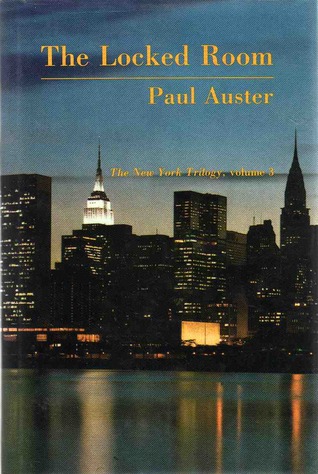 While most of the New York Trilogy is told in the third person, this is a first-person narrative that seems to pick up where City of Glass left off. It begins in 1977, when the unnamed narrator gets a letter from Sophie Fanshawe, the wife of his childhood best friend, telling him that Fanshawe disappeared six months ago, and despite the best efforts of a detective, Quinn (in another link to CoG, the narrator encounters Peter Stillman on a later trip to Paris), no trace can be found. The narrator has been named Fanshawe’s literary executor and takes it upon himself to get the man’s unpublished work out into the world: plays are produced, novels are published. He also starts writing a biography of the friend he always envied.
Except it’s more like he’s becoming Fanshawe, especially when he marries Sophie. Doubling has been a major theme of the trilogy, and here the metaphorical kill-or-be-killed situation seems to turn literal at the conclusion, which I didn’t particularly understand (e.g. he acquires and destroys a red notebook – is this in some way meant to be the same red notebook Quinn left behind at the end of CoG?). The narrator presents himself as the author of all three books, and asserts, “These three stories are finally the same story, but each one represents a different stage in my awareness of what it is about. I don’t claim to have solved any problems.”
The metafictional aspect of this novel is that Fanshawe’s early life is a lot like Auster’s as revealed in Winter Journal, while Sophie’s resembles his wife Siri Hustvedt’s (and the pair would later name their daughter Sophie). 
 Themes of the trilogy:
- Identity complications, including disguises, doubles and substitutes
- Writers and writing; the creator versus characters
- The limits of language (e.g. Stillman’s monologue in CoG is astonishing)
- Freedom/randomness versus fate
One representative passage from each volume:
- “New York was an inexhaustible space, a labyrinth of endless steps, and no matter how far he walked, no matter how well he came to know its neighbourhoods and streets, it always left him with the feeling of being lost. Lost, not only in the city, but within himself as well. … New York was the nowhere he had built around himself” (City of Glass)
- “Writing is a solitary business. It takes over your life. In some sense, a writer has no life of his own. Even when he’s there, he’s not really there. / Another ghost. / Exactly.” (Ghosts)
- “In the end, each life is no more than the sum of contingent facts, a chronicle of chance intersections, of flukes, of random events that divulge nothing but their own lack of purpose.” (The Locked Room)
My rating for the trilogy as a whole:
Have you tried anything by Paul Auster? Grab one of his books and join us for this week’s readalong!
Two Recommended January Releases: Dominicana and Let Me Be Frank
Much as I’d like to review books in advance of their release dates, that doesn’t seem to be how things are going this year. I hope readers will find it useful to learn about recent releases they might have missed.
This month I’m featuring a fictionalized immigration story from the Dominican Republic and a collection of autobiographical comics by a New Zealander.
Dominicana by Angie Cruz
(Published by John Murray on the 23rd)
It’s easy to assume that all the immigration (or Holocaust, or WWI; whatever) stories have been told. This is proof that that is not true; it felt completely fresh to me. Ana Canción is 11 when Juan Ruiz first proposes to her in 1961 – the same year dictator Rafael Trujillo is assassinated, throwing their native Dominican Republic into chaos. The Ruiz brothers are admired for their entrepreneurial spirit; they jet back and forth to New York City to earn money they plan to invest in a restaurant back home. To Ana’s parents, pairing their daughter with a man with such good prospects makes financial sense, so though Ana doesn’t love him and knows nothing about sex, she finds herself married to Juan at age 15. With fake papers that claim she’s 19, she arrives in New York on the first day of 1965 to start a new life.
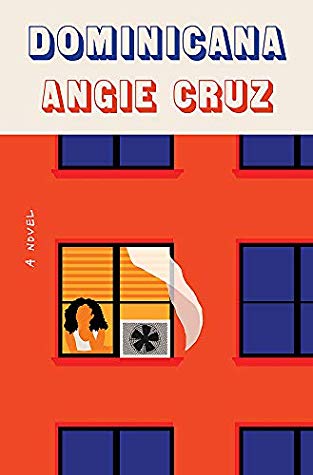 It is not the idyll she expected. Ana often feels confused and isolated in their tiny apartment, and the political unrest in NYC (e.g. the assassination of Malcolm X) and in DR mirrors the turbulence of her marriage. Juan is violent and unfaithful, and although Ana dreams of leaving him she soon learns that she is pregnant and has to think of her duty to her family, who expect to join her in America. The content of the novel could have felt like heavy going, but Ana is such a plucky and confiding narrator that you’re drawn into her world and cheer for her as she comes up with ways to earn money of her own (such as selling pastelitos to homesick factory workers and at the World’s Fair) and figures out what she wants from life.
This allowed me to imagine what it would be like to have an arranged marriage and arrive in a country not knowing a word of the language. Cruz based the story on her mother’s experience, even though her mother thought her life was too common and boring to interest anyone. The literary style – short chapters with no speech marks – could be offputting for some but worked for me, and I loved the tongue-in-cheek references to I Love Lucy. Had I only managed to read this in December, it would have been on my Best of 2019 list – it was first published in September by Flatiron Books, USA.
Let Me Be Frank by Sarah Laing
(Published by Lightning Books on the 16th)
 Laing is a novelist and comics artist from New Zealand known for her previous graphic memoir, Mansfield and Me, about her obsession with acclaimed NZ writer Katherine Mansfield. This collection brings together the autobiographical comics that originally appeared on Laing’s blog of the same title in 2010‒19. She started posting the comics when she was writer-in-residence at the Frank Sargeson Centre in Auckland. (I know the name Sargeson because he helped Janet Frame when she was early in her career.)
So what is the book about? All of life, really: growing up with type 1 diabetes, having boyfriends, being part of a family, the constant niggle of body issues, struggling as a writer, and trying to be a good mother. Other specific topics include her teenage obsession with music (especially Morrissey) and her run-ins with various animals (a surprising number of dead possums!). She ruminates about the times when she hasn’t done enough to help people who were in trouble. She also admits her confusion about fashion: she is always looking for, but never finding, ‘her look’. And is she modeling a proper female identity for her children? “I feel like I’m betraying feminism, buying my daughter a fairy princess dress,” she frets.


But even as she expresses these worries, she wonders how genuine she can be since they form the basis of her art. Is she just “publically performing my neuroses”? The work/life divide is especially tricksy when your life inspires your work.


I took half a month to read these comics on screen, usually just a few pages a day. It’s a tough book to assess as a whole because there is such a difference between the full-color segments and the sketch-like black-and-white ones. There is also a ‘warts-and-all’ approach here, with typos and cross-outs kept in. (Two that made me laugh were “aesophegus” [for oesophagus] and “Diana Anthill”!) Overall, though, I think this is a relatable and fun book that would suit fans of Alison Bechdel and Roz Chast but should also draw in readers new to the graphic novel format.
My thanks to Eye/Lightning Books for sending me an e-book to review.
What recent releases can you recommend?
Final 2019 Review Books: Brodesser-Akner, Cregan & McCulloch
The final three review books of the year (not counting DNFs, which will be briefly dispatched on Sunday): a much-hyped novel set in contemporary New York City, a memoir of suicidal depression and recuperation, and a study of linguistics in the Internet era.
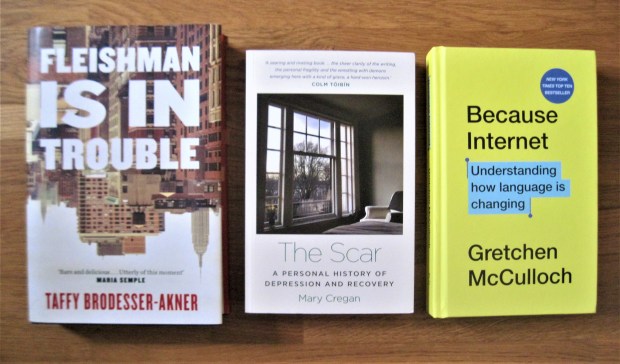
Fleishman Is in Trouble by Taffy Brodesser-Akner
According to the aggregated best-of lists (which Kate has surveyed here), this was one of the top two novels of 2019. I’m going to have to shrug my shoulders and admit, I don’t get it. To me this didn’t stand out at all from the sea of fiction about crumbling marriages and upper-middle-class angst. Toby Fleishman is 41-year-old head of hepatology at a New York City hospital. He recently split from his wife, Rachel, agent to the creator of a Hamilton-style phenomenon. Not content with their comfortable lifestyle, Rachel hankers for true wealth.
 When Rachel goes AWOL at a yoga retreat, Toby is left in charge of their children: Hannah, 11, and Solly, nine. He ferries them to and from summer camp, all the while bombarded with dirty texts and semi-nude selfies from the women he’s flirting with via a dating app. Had this novel been written by a man, people would have been up in arms about the unpleasant sexual content. But this is not just written by a woman; it’s also narrated by a woman: Elizabeth Epstein Slater, a former journalist turned stay-at-home mom. She and Toby became friends on their junior year abroad in Israel and have started hanging out more after his divorce.
So this is a book within a book Elizabeth is writing about one turbulent summer in her friends’ lives, but also her own – she’s dissatisfied with her staid marriage. It’s also Brodesser-Akner’s winking commentary on macho or moralizing fiction: “this was the only way to get someone to listen to a woman—to tell her story through a man” and “none of my characters were likable,” Elizabeth thinks. But attempts to humanize Toby and Rachel fell flat for me. Sadness over the loss of one patient was insufficient to endear me to the randy Toby, and early life with a grim grandmother and severe postpartum trauma couldn’t make me care about whether Rachel was coming back. I also never fully suspended disbelief about Elizabeth’s intimate knowledge of the Fleishmans.
This very New York novel started out promising, with echoes of Where’d You Go, Bernadette? or The Nest. There are some perceptive passages about marriage, and the writing in general is more than capable. But the story didn’t feel nearly fresh enough to justify all that acclaim, or the 373-page length.
With thanks to Wildfire for the free copy for review.
The Scar: A Personal History of Depression and Recovery by Mary Cregan
 Cregan has a scar that reminds her, every time she notices it, of how close she came to taking her own life decades ago. In 1983, at the age of 27, she gave birth to a baby girl, Anna, who died two days later of a heart defect. The loss plunged her into a depression so severe that she made a halfhearted suicide attempt some weeks later and was admitted to a psychiatric hospital, where she was given electroconvulsive therapy. One morning in the hospital, she brought a glass jar of lotion into the shower with her, smashed it, and took a shard to her throat. She only narrowly missed her carotid artery. Cregan wonders if, had she been given appropriate medication, all this heartache could have been avoided.
“I’ve often wished I could undo my own act (if indeed ‘I’ and ‘my’ are accurate words for a self in the condition I was in.)”
“It took a long time to work all of this out, because it’s very hard to see yourself clearly when depressed. The problem is that you think with your mind, but your mind is ill and untrustworthy. Your mind is your enemy.”
Alongside her own winding story, the author surveys the history of mental health treatment in the United States. This felt more familiar and thus engaged me less than the personal material. Nevertheless, I would recommend this forthright memoir to anyone keen to read about the experience of mental illness.
With thanks to the author for arranging my free copy from Lilliput Press, Dublin.
Because Internet: Understanding how language is changing by Gretchen McCulloch
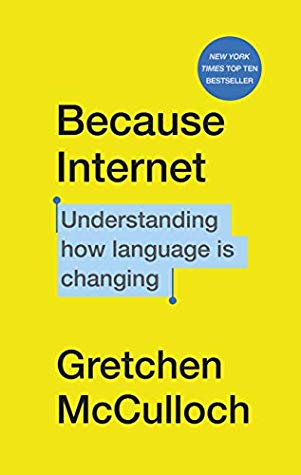 I’m surprised by how fascinating I found this: I’m a late adopter when it comes to technology (I’m still resisting a smartphone) and I haven’t given linguistics a thought since that one class I took in college, but it turns out that my proofreader’s interest in the English language and my daily use of e-mail and social media were enough to make it extremely relevant. The Montreal linguist’s thesis is that the Internet popularized informal writing and quickly incorporates changes in slang and cultural references. At the same time, it still reflects regional and age-specific differences in the way that people speak (write conversationally).
The book goes deep into topics you may never have considered, like how we convey tone of voice through what we type and how emoji function as the gestures of the written word. You’ll get a breakdown of current generations in terms of when the Internet became the default in their life (I belong to what the author calls “Semi Internet People”: I remember first using the Internet in a classroom in seventh grade, getting dial-up AOL at home not long thereafter, and opening my own Hotmail account in high school), a history of lolcats, and musings on the metaphorical use of periods and capital letters. If you are among the unconvinced, you’ll also be schooled in the appeal of gifs and memes.
Some trivia I picked up:
- In 2015 the tears of joy emoji became the most popular emoji, more used than the smiley-face emoticon.
- For many of us the Internet serves as what sociologists call a “third place” besides home and work where we can socialize.
- Only 5–8% of Internet users are bloggers.
- “Subtweeting” (as in subliminal) and “vaguebooking” are when you post about a situation without giving any specifics.
- Parents often refer to a child by an initial or nickname so the child won’t have a searchable social media presence.
- The Library of Congress now archives memes (The Lolcat Bible, Urban Dictionary, etc.).
McCulloch portrays language as a constantly changing network, such that terms like “standard” and “correct” no longer apply. She writes with such geeky enthusiasm that you’ll happily accompany her down any linguistic alley.
With thanks to Harvill Secker for the free copy for review.
Olive Kitteridge and Olive, Again
Although I’ve confessed to being generally wary of sequels, and I am scrupulously avoiding this autumn’s other high-profile sequel (you know the one!), I loved Olive Kitteridge enough to continue straight on to Elizabeth Strout’s sequel, Olive, Again, which I thought even better.
Olive Kitteridge (2008)
I have a soft spot for literature’s curmudgeons – the real-life ones like J. R. Ackerley, Shaun Bythell and Geoff Dyer as well as the fictional protagonists like Dr. James Darke in Rick Gekoski’s debut novel, Cassandra Darke in Posy Simmonds’s graphic novel, Hagar Shipley in The Stone Angel, Hendrik Groen in his two titular Dutch diaries, and Frederick Lothian in Josephine Wilson’s Extinctions. So it’s no surprise that I warmed immediately to Olive Kitteridge, a grumpy retired math teacher in Crosby, Maine. She’s seen and heard it all, and will bluntly say just what she thinks. She has no time for anyone else’s nonsense.
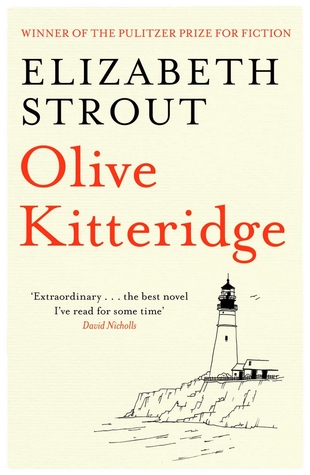 I love our first introduction to her, three pages into the opening piece of this linked short story collection: she dismisses her pharmacist husband Henry’s new employee as “mousy,” and when Henry suggests inviting the girl and her husband over for dinner, snaps, Bartleby-like, “Not keen on it.” The great sadness of Olive’s life is the death of a fellow teacher she never quite had an affair with, but loved in her early forties. The great failure of Olive’s life is not connecting with her only son, Christopher, a podiatrist who marries a woman Olive dislikes and moves to California, then remarries a single mother of two and settles in New York City.
I started this in February and didn’t finish it until this month. I lost momentum after “A Different Road,” in which Olive and Henry are in a hostage situation in the local hospital. This was a darker turn than I was prepared for from Strout – I thought unrequited love and seasonal melancholy was as bleak as she’d go. But I hadn’t read “Tulips” yet, in which we learn that a local boy is in prison for stabbing a woman 29 times.
My least favorite stories were the ones that are about other locals and only mention Olive in passing, perhaps via advice she once gave a student. It almost feels like Strout wrote these as stand-alone stories and then, at her publisher’s behest, inserted a sentence or two so they could fit into a book about Olive. I much prefer the stories that are all about Olive, whether she’s engaging in a small act of rebellion on her son’s wedding day, visiting his new family in New York, or entertaining the prospect of romance some time after Henry’s death.
Olive is a sort of Everywoman; in her loneliness, frustrated desire and occasional depression she’s like us all. I wrote an article on linked short story collections some months ago and pretty much everyone I consulted mentioned Olive as the epitome. I didn’t love the book quite as much as I expected to, but I was very glad to have read it. It won the Pulitzer Prize in 2009.
[Apropos of nothing: this book contains the worst possible nickname for my name that I’ve ever encountered: Bicka-Beck.]
My rating:
Olive, Again (2019)
(Coming from Random House [USA] on October 15th and Viking [UK] on October 31st)
 I liked this that little bit more than Olive Kitteridge for a number of reasons:
1) I read it over a matter of days rather than months, so the characters and happenings stayed fresher in my mind and I experienced it more as a novel-in-stories than as a set of discrete stories.
2) Olive, our Everywoman protagonist, approaches widowhood, decrepitude and death with her usual mixture of stoicism and bad temper. You may hear more about her bowels than you’d like to, but at least Strout is being realistic about the indignities of ageing.
3) Crucially, Olive has started, very late in life, to take a genuine interest in other people, such as her son’s second wife; a local girl who becomes Poet Laureate; and the carers who look after her following a heart attack. “Tell me what it’s like to be you,” she says one day to the Somali nurse who comes over from Shirley Falls. Comparing others’ lives with her own, she realizes she’s been lucky in many ways. Yet that doesn’t make understanding herself, or preparing for death, any easier.
4) There are connections to other Strout novels that made me intrigued to read further in her work. In “Exiles,” Bob and Jim Burgess of The Burgess Boys are reunited in Maine, while in the final story, “Friend,” Olive befriends a new fellow nursing home resident, Isabelle Daignault of Amy and Isabelle.
5) Olive delivers a baby!
As with the previous volume, I most liked the stories that stuck close to Olive, and least liked those that are primarily about others in Crosby or Shirley Falls and only mention Olive in passing, such as via a piece of advice she gave to one of her math students several decades ago. Twice Strout goes sexually explicit – a voyeurism situation, and a minor character who is a dominatrix; I felt these touches were unnecessary. Overall, though, these stories are of very high quality. The two best ones, worth seeking out whether you think you want to read the whole book or not, are “The Poet” and “Heart.”
My rating: 
I read an advanced e-copy via NetGalley.
Are you a fan of Elizabeth Strout’s work? Do you plan to read Olive, Again?
This Really Isn’t About You by Jean Hannah Edelstein
This was the book I wanted Places I Stopped on the Way Home to be: a wry, bittersweet look at the unpredictability of life as an idealistic young woman in the world’s major cities. Edelstein’s memoir also fits into several of my favorite subgenres: it’s a family memoir, a medical memoir and a bereavement memoir all at once. The story opens in Brooklyn in February 2014 as Edelstein, age 32, is trying to build an adult life back in America after 14 years in London and Berlin. Two years earlier her father had told her via Skype from Baltimore that he had lung cancer, and she returned to the States to be closer to help. But when the moment came, she was still unprepared: “if someone had said to me: What would you like to be doing when your father dies? I would not have said, I would like to be looking for love on OKCupid. But I did not have the luxury to make that decision. Who does?”
 Her father never smoked yet died of lung cancer; his mother had colon cancer and died at 42. Both had Lynch syndrome, a genetic disease that predisposes people to various cancers. Six months after her father’s death, Edelstein took a genetic test, as he had wanted her to, and learned that she was positive for the Lynch syndrome mutation. The book’s structure (“Between” – “Before” – “After”) plunges readers right into the middle of the family mess, then pulls back to survey her earlier life, everything from childhood holidays in her mother’s native Scotland to being a secretary to a London literary agent who hated her, before returning to the turning point of that diagnosis. How is she going to live with this knowledge hanging over her? Doctors want her to have a prophylactic hysterectomy, but how can she rule out children when she doesn’t yet have a partner in her life?
So many aspects of this book resonated for me, especially moving between countries and having a genetic disease in the family. Beyond those major themes, there were tiny moments that felt uncannily familiar to me, like when she’s helping her mother prepare for an online auction of the contents of the family home in Maryland, or comparing the average cleanliness and comfort of rental properties in England and the States. There are so many little memorable scenes in this memoir: having an allergic reaction to shellfish two days after her arrival in the States, getting locked out of her sublet and having to call an Uzbek/Israeli locksmith at 3 a.m., and subsisting on oatmeal three times a day in London versus going on all-expenses-paid trips to Estonia and Mauritius for a conference travel magazine.
This is a clear-eyed look at life in all its irony (such as the fact that she’s claustrophobic and dreads getting MRI tests when it was her own father, a nuclear physicist, who built the world’s first full-body MRI scanner at Aberdeen) and disappointment. I’m prizing this as a prime example of life writing that’s not comprehensive or strictly chronological yet gives a clear sense of the self in the context of a family and in the face of an uncertain future.
My rating:
Readalikes:
The Family Gene by Joselin Linder
My Salinger Year by Joanna Rakoff
Mrs Gaskell & Me by Nell Stevens
Favorite lines:
“when I was in London, … I wondered if the problem of having my whole life ahead of me, free and clear and open for anything, was that having an unlimited number of options made the chance of choosing the wrong thing so high.”
“I was not yet old enough to realize that I’d never really know, that there would never be a time when I could think: I am here. This is me, without becoming uncertain again a moment later.”
“When I lived in England I drank a lot of tea, many cups a day, even though I didn’t like it. I learned quite fast after I arrived in London that drinking tea was an important way to connect with people: when I went over to their homes, or if we worked together in an office. Being offered a cup of tea meant that you were being offered an entry to something, and accepting it was important.”
This Really Isn’t About You was published by Picador on August 23rd. My thanks to the publisher for the free copy for review.
Blog Tour: Literary Landscapes, edited by John Sutherland
 The sense of place can be a major factor in a book’s success – did you know there is a whole literary prize devoted to just this? (The Royal Society of Literature’s Ondaatje Prize, “for a distinguished work of fiction, non-fiction or poetry, evoking the spirit of a place.”) No matter when or where a story is set, an author can bring it to life through authentic details that appeal to all the senses, making you feel like you’re on Prince Edward Island or in the Gaudarrama Mountains even if you’ve never visited Atlantic Canada or central Spain. The 75 essays of Literary Landscapes, a follow-up volume to 2016’s celebrated Literary Wonderlands, illuminate the real-life settings of fiction from Jane Austen’s time to today. Maps, author and cover images, period and modern photographs, and other full-color illustrations abound.
Each essay serves as a compact introduction to a literary work, incorporating biographical information about the author, useful background and context on the book’s publication, and observations on the geographical location as it is presented in the story – often through a set of direct quotations. (Because each work is considered as a whole, you may come across spoilers, so keep that in mind before you set out to read an essay about a classic you haven’t read but still intend to.) The authors profiled range from Mark Twain to Yukio Mishima and from Willa Cather to Elena Ferrante. A few of the world’s great cities appear in multiple essays, though New York City as variously depicted by Edith Wharton, Jay McInerney and Francis Spufford is so different as to be almost unrecognizable as the same place.
One of my favorite pieces is on Charles Dickens’s Bleak House. “Dickens was not interested in writing a literary tourist’s guide,” it explains; “He was using the city as a metaphor for how the human condition could, unattended, go wrong.” I also particularly enjoyed those on Thomas Hardy’s The Return of the Native and Robert Louis Stevenson’s Kidnapped. The fact that I used to live in Woking gave me a special appreciation for the essay on H. G. Wells’s The War of the Worlds, “a novel that takes the known landscape and, brilliantly, estranges it.” The two novels I’ve been most inspired to read are Thomas Wharton’s Icefields (1995; set in Jasper, Alberta) and Kate Grenville’s The Secret River (2005; set in New South Wales).

The essays vary subtly in terms of length and depth, with some focusing on plot and themes and others thinking more about the author’s experiences and geographical referents. They were contributed by academics, writers and critics, some of whom were familiar names for me – including Nicholas Lezard, Robert Macfarlane, Laura Miller, Tim Parks and Adam Roberts. My main gripe about the book would be that the individual essays have no bylines, so to find out who wrote a certain one you have to flick to the back and skim through all the contributor biographies until you spot the book in question. There are also a few more typos than I tend to expect from a finished book from a traditional press (e.g. “Lady Deadlock” in the Bleak House essay!). Still, it is a beautifully produced, richly informative tome that should make it onto many a Christmas wish list this year; it would make an especially suitable gift for a young person heading off to study English at university. It’s one to have for reference and dip into when you want to be inspired to discover a new place via an armchair visit.
Literary Landscapes will be published by Modern Books on Thursday, October 25th. My thanks to Alison Menzies for arranging my free copy for review.
 Bookish Beck = Rebecca Foster. American transplant to England. Freelance proofreader and book reviewer.
 Bookish Beck