Reviews: de Jongh, Eipe, Parker and Scull
Today’s roundup includes a graphic novel set during the U.S. Dust Bowl, a Dylan Thomas Prize-shortlisted poetry collection infused with Islamic imagery, a book about adaptive technologies for the disabled, and a set of testimonies from the elderly and terminally ill.
Days of Sand by Aimée de Jongh (2021; 2022)
[Translated from the Dutch by Christopher Bradley]
Dust can drive people mad.
 This terrific Great Depression-era story was inspired by the real-life work of photographers such as Dorothea Lange who were sent by the Farm Security Administration, a new U.S. federal agency, to document the privations of the Dust Bowl in the Midwest. John Clark, 22, is following in his father’s footsteps as a photographer, leaving New York City to travel to the Oklahoma panhandle. He quickly discovers that struggling farmers are believed to have brought the drought on themselves through unsustainable practices. Many are fleeing to California. The locals are suspicious of John as an outsider, especially when they learn that he is working to a checklist (“Orphaned children”, “Family packing car to leave”).
“The best photos have an instant impact. Right away, they grab our attention. They tell a story, or deliver a message. The question is: how do you make that happen?” one of his employers had asked. John grows increasingly uncomfortable with being part of what is essentially a propaganda campaign when he develops a personal fondness for Cliff, a little boy who offers to be his assistant, and Betty, a pregnant widow whose runaway horse he finds. The deprivation and death he sees at close hand bring back memories of his father’s funeral four years ago.
Whether a cityscape or the midst of a dust storm, de Jongh’s scenes are stark and evocative. Each chapter opens with a genuine photograph from the period (de Jongh travelled to the USA for archival and on-the-ground research thanks to a grant from the Dutch Foundation for Literature), and some panes mimic B&W photos the FSA team took. It’s rare for me to find the story and images equally powerful in a graphic novel, but that’s definitely the case here.


With thanks to SelfMadeHero for the free copy for review.
Auguries of a Minor God by Nidhi Zak/Aria Eipe (2021)
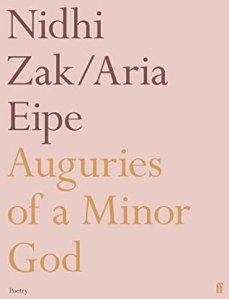 This debut poetry collection is on the Dylan Thomas Prize shortlist. I’ve noted that recent winners – such as Lot by Bryan Washington and Luster by Raven Leilani – have in common a distinctive voice and use of language, which chimes with what Thomas was known for (see my recent review of Under Milk Wood) and clarifies what the judges are looking for.
The placement of words on the page seems to be very important in this volume – spread out or bunched together, sometimes descending vertically, a few in grey. It’s unfortunate, then, that I read an e-copy, as most of the formatting was lost when I put it on my Nook. The themes of the first part include relationships, characterized by novelty or trauma; tokens of home experienced in a new land; myths; and nature. Section headings are in Malayalam.
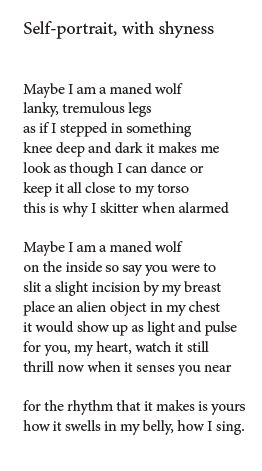
The book culminates in a lengthy, astonishingly nimble abecedarian in which a South Asian single father shepherds his children through English schooling as best he can while mired in grief over their late mother. This bubbles over in connection with her name, Noor, followed by a series of “O” apostrophe statements, some addressed to God and others exhorting fellow believers. Each letter section gets progressively longer. I was impressed at how authentically the final 30-page section echoes scriptural rhythms and content – until I saw in the endnotes that it was reproduced from a 1997 translation of the Quran, and felt a little cheated. Still, “A is for…” feels like enough to account for this India-born poet’s shortlisting. (The Prize winner will be announced on Thursday the 12th.)
With thanks to Midas PR for the free e-copy for review.
Hybrid Humans: Dispatches from the Frontiers of Man and Machine by Harry Parker (2022)
 I approached this as a companion to To Be a Machine by Mark O’Connell and that is precisely what I found, with Parker’s personal insight adding a different angle to the discussion of how technology corrects and transcends flawed bodies. Parker was a captain in the British Army in Afghanistan when an IED took his legs. Now he wears prostheses that make him roughly 12% machine. “Being a hybrid human means expensive kit – you have to pay for the privilege of leading a normal life.” He revisits the moments surrounding his accident and his adjustment to prostheses, and meets fellow amputees like Jack, who was part of a British medical trial on osseointegration (where titanium implants come out of the stump for a prosthesis to attach to) that enabled him to walk much better. Other vets they know had to save up and travel to Australia to have this done because the NHS didn’t cover it.
Travelling to the REHAB trade fair in Karlsruhe, Parker learns that disability, too, can be the mother of invention. Virtual reality and smartphone technology are invaluable, with an iPhone able to replace up to 11 single-purpose devices. Yet he also encounters disabled people who are happy with their lot and don’t look to tech to improve it, such as Jamie, who’s blind and relies only on a cane. And it’s not as if tools to compensate for disability are new; the book surveys medical technologies that have been with us for decades or even centuries: from glass eyes to contact lenses; iron lungs, cochlear implants and more.
Pain management, PTSD, phantom limbs, foreign body rejection, and deep brain stimulation for Parkinson’s disease are other topics in this wide-ranging study that is at the juncture of the personal and political. “A society that doesn’t look after the vulnerable isn’t looking after anyone – I’d learnt first-hand that we’re all just a moment from becoming vulnerable,” Parker concludes. I’ll hope to see this one on next year’s Barbellion Prize longlist.
With thanks to Profile Books/Wellcome Collection for the free copy for review.
Regrets of the Dying: Stories and Wisdom that Remind Us How to Live by Georgina Scull (2022)
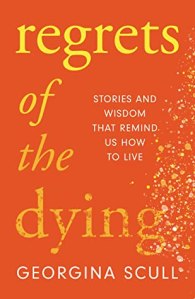 A medical crisis during pregnancy that had her minutes from death was a wake-up call for Scull, leading her to rethink whether the life she was living was the one she wanted. She spent the next decade interviewing people in her New Zealand and the UK about what they learned when facing death. Some of the pieces are like oral histories (with one reprinted from a blog), while others involve more of an imagining of the protagonist’s past and current state of mind. Each is given a headline that encapsulates a threat to contentment, such as “Not Having a Good Work–Life Balance” and “Not Following Your Gut Instinct.” Most of her subjects are elderly or terminally ill. She also speaks to two chaplains, one a secular humanist working in a hospital and the other an Anglican priest based at a hospice, who recount some of the regrets they hear about through patients’ stories.
Recurring features are not spending enough time with family and staying too long in loveless or unequal relationships. Two accounts that particularly struck me were Anthea’s, about the tanning bed addiction that gave her melanoma, and Millicent’s, guilty that she never went to the police about a murder she witnessed as a teenager in the 1930s (with a NZ family situation that sounds awfully like Janet Frame’s). Scull closes with 10 things she’s learned, such as not to let others’ expectations guide your life and to appreciate the everyday. These are readable narratives, capably captured, but there isn’t much here that rises above cliché.
With thanks to publicist Claire Morrison and Welbeck for the free copy for review.
Would you be interested in reading one or more of these?
An Embarrassment of Riches at the (Digital) Hay Festival 2021
There was a phenomenal program for this year’s digital Hay Festival. I signed up to a whopping eight events and enjoyed them all. If you missed watching live, it’s not too late to donate and catch up on the archived talks. For three of these, the host-cum-interviewer appeared in person on a studio stage, with the guest(s) joining, perhaps from thousands of miles away, on a large screen mounted on the wall behind them. I thought this was a neat hybrid approach. The rest of my sessions had interviewer and interviewee appearing remotely on a split screen. Let me know which, if any, events you attended and how you found them.
Richard Flanagan
Flanagan’s The Living Sea of Waking Dreams is my novel of 2021 so far (my review), so it was a delight to hear him say more (and in that fantastic accent) about it in the course of a conversation with Stephanie Merritt. Tasmania, where he lives, had always seemed like an ark for species, but now they are vanishing. Ninety percent of the kelp forest has disappeared within the last 20 years because of warming oceans; there are only 300 swift parrots remaining; and the bushfires of 2018–19 were unprecedented in severity. Although he had already roughed out the novel by the time of the fires, Flanagan said he rewrote it in response to the sense of accelerating environmental collapse.

The novel’s twin themes are species extinction and personal extinction, with an elderly family matriarch being kept alive at all costs. Flanagan spoke of the “evasions of the soul” that make us ignore the environmental losses around us and refuse to die – “the final avoidance of life.” He thinks the pandemic has forced people to rethink these ideas and ponder the meaning of life. At age 21, he nearly drowned while kayaking, and ever since he has been frightened not of death, but of the pain of dying. He is not optimistic per se, but hopeful because the world is still so beautiful – on the island he goes to for writing, he is surrounded by wild creatures.
 Merritt asked about the novel’s magic realist element and how stylistically different his novels have been from each other. He was glad she found the book funny, as “life is tragicomic.” In an effort not to get stuck in a rut, he deliberately ‘breaks the mould’ after each book and starts over. This has not made him popular with his publisher!
Three take-aways:
- The one obligation of a writer? “Not to be boring.”
- Novels are not about messages; “that’s what Twitter is for.”
- “To despair is rational, but to hope is the very essence of what it means to be human.”
Rachel Clarke interviewing Jim Down and Michael Rosen
All three authors have written books about the coronavirus pandemic (I have reviewed Clarke’s Breathtaking and Rosen’s Many Different Kinds of Love). Clarke said that the belief foundational to the NHS is that all lives have equal value, but as an ICU doctor Down found that the question of who would benefit most from the use of ventilation was creeping in as there was a risk that there would be more patients than there was equipment to treat them with. With decisions needing to be made very quickly, his hospital adopted the “three wise people” collaborative method. The element that often felt lost, however, was the patient’s wishes, since they might be unresponsive and no family or other visitors were around.

Rosen, who contracted Covid-19 in March 2020 and was in an induced coma for six weeks, included letters from his medical team in his book to give a 360° view of NHS treatment. He thinks of the NHS as being almost in the role of parents, giving altruistic care and support. “Tell the truth about herd immunity” was his pithy message to the government. He read the poem “These Are the Hands,” which he wrote for the 60th anniversary of the NHS, to close.


Bryan Washington and Raven Leilani
 Last year’s Dylan Thomas Prize winner interviewed this year’s winner, and it was clear that the mutual admiration was strong. Though I had mixed feelings about Luster (my review), I was blown away by this high-level intellectual discussion. Both authors are invested in the debate around what it means to be a Black artist. Leilani said she did not want to make concessions in the form of Edie comporting herself better; this character is open about her wants, giving the novel a libidinal flavour. She said she almost envies her protagonist her autonomy, and thinks of the novel as a letter to her old self, granting permission and reassuring herself that “the mess has merit.”

Three take-aways:
- Writing offers Leilani a sanctuary or sense of control.
- While Washington sees works full of strife, grief, and malice as most likely to be considered the pinnacle of American literary fiction, he admires Luster for its theme of communion (especially via the character Akila).
- Leilani sees her novel as being in conversation with Queenie, Sula, The New Me, and Detransition, Baby.
Maggie Shipstead
 Shipstead (also a Dylan Thomas Prize winner) echoed something Leilani had said: that she starts a novel with questions, not answers. Such humility is refreshing, and a sure way to avoid being preachy in fiction. Her new novel, Great Circle, is among my most anticipated books of the year and tells the stories of a fictional female pilot from the golden age of aviation and the actress playing her in a biopic. The book was long in the gestation: In 2012 Shipstead saw a sculpture commemorating a female pilot in Auckland, and in 2014 she started researching. She came to appreciate the miracle of flight and read many books by and about female pilots. The book is dedicated to her brother, recently retired from 20 years in the Air Force. She told Sameer Rahim that, although she used to say this is not a love story, she has since changed her mind.

Three take-aways:
- Shipstead was a competitive show jumper and applied to a creative writing program on a whim.
- She has made a name for herself as a travel writer, too, often combining magazine assignments with her research for the novel (e.g., various trips to Antarctica).
- While she has appreciated the year off from Covid, she is looking forward to getting back to travelling; her first booking is a women’s wilderness experience in Alaska.
Patricia Lockwood
 Lockwood is the only novelist to be included on the Atlantic’s roster of best tweets. She and Nina Stibbe, who interviewed her, agreed that 1) things aren’t funny when they try too hard and 2) the Internet used to be a taboo subject for fiction – producing time-stamped references that editors used to remove. “I had so many observations and I didn’t know where to put them,” Lockwood said, and it seems to her perverse to not write about something that is such a major part of our daily lives. The title of her Women’s Prize-shortlisted novel, No One Is Talking About This (my review), refers to many things, including this reticence to grant the Internet a place in our discourse.

Lockwood said she has been delighted by the high-quality literary pieces coming out about her book, often in comparison with Lauren Oyler’s Fake Accounts. The timing of the publication meant that her initial (U.S.) media interviews ended up being more about Trump than she would have liked. “I think I’m not a natural fiction writer,” she said; it’s true that the novel is so autobiographical it can only be described as autofiction – the second half is all true and all sincere, she was careful to point out – but it’s a gem.
Julianne Pachico
 Like Lockwood, Pachico was part of the “10 @ 10” series featuring debut novelists (though her first book, the linked story collection The Lucky Ones, was marketed as a novel in the USA). Her new book, The Anthill, another of my most anticipated books of the year, is about a young woman returning to Medellín, Colombia, where Pachico spent her formative years. Although she is not a citizen and only goes back on a tourist visa, it feels like going home each time. For her, writing fiction has been a way of sorting out her feelings about the place. She wrote 50,000 words of the novel at her sister’s apartment in Medellín. Pachico told Rosie Goldsmith that, though she considers herself part of the Latin American literary tradition, she is conscious of presenting the country to English-speaking readers: a politically divided place that has gentrified in pockets, but is still plagued by extreme poverty and hardship. She described The Anthill as “a ghost story without ghosts.” I can’t wait to dive into my copy.

Brit Bennett
 Speaking to Arifa Akbar about The Vanishing Half, Bennett admitted that she was worried a historical setting was a cop-out, but reassured herself that she was not writing out of nostalgia and that she did not allow readers a sense of distance – the characters are so ordinary that we know we’d do the same sorts of things. She thinks of passing as a distinctly American project of self-reinvention but acknowledged that we have no definitive statistics on it because, if someone succeeds, they disappear. Some of Stella’s psychology – a very interior character who makes decisions that are difficult to understand – came from her reading of Playing Dead by Elizabeth Greenwood. She loves writing about small towns because they force people to interact with each other. Akbar noted that passing is a double-edged sword, involving subterfuge but also offering liberation (e.g. for a trans character later in the book).

Three take-aways:
- “That’s the most exciting place to be, writing into a mystery.”
- “Race is a fiction, but racism is a reality.”
- An HBO adaptation is in the works, but Bennett doesn’t know if it will cast real twins, two actors, or meld separate people using CGI.
Rachel Cusk and Sheila Heti
 I’ve read more of and gotten on better with Heti’s work than Cusk’s, so this was a rare case of being perhaps more interested in interviewer than interviewee. Heti said that, compared with the Outline trilogy, Cusk’s new novel Second Place feels wilder and more instinctual. Cusk, speaking from the Greek island of Tinos, where she is researching marble quarrying, described her book in often vague yet overall intriguing terms: it’s about exile and the illicit, she said; about femininity and entitlement to speak; about the domestic space and how things are legitimized; about the adoption of male values and the “rightness of the artist.”

Ironically, given that Cusk initially hesitated over revealing her debt to Mabel Dodge Luhan’s memoir Lorenzo in Taos, much of the discussion ended up revolving around Luhan and D.H. Lawrence, about whom Cusk now considers herself an amateur scholar. In his personal writings he reserved special scorn for Luhan, with whom he stayed in New Mexico in the 1920s. This was something Cusk wanted to explore: misogyny and Luhan’s “voice of obscurity.” She hopes that her book will contribute to a better understanding of Luhan’s; not vice versa.
Three take-aways:
- A reviewer noted the use of exclamation points, counting 189 of them in the novel. Cusk equates an exclamation point to a laying down of arms – proof that someone (especially her protagonist, M) means to be nonthreatening.
- Cusk thinks of this book as being like a play: staged and in the moment.
- A woman observing but not being noticed is, like in the Outline trilogy, Cusk’s basic framework.
The Inevitable: Dispatches on the Right to Die by Katie Engelhart
Why, she wanted to know, was I so interested in the subject?
“Why isn’t everyone?” I asked.
The fact that I read a lot more books about death than the average person is something I attribute not to some morbid curiosity, but to pragmatism. As the title of Canadian reporter and documentary filmmaker Katie Engelhart’s book makes clear, this is the one subject none of us can avoid indefinitely, so why not learn about and understand it as much as possible? The Inevitable focuses on the controversial matter of assisted dying, also known as assisted suicide, euthanasia, or physician-assisted death. It’s a topic that’s already come up in my reading a couple of times this year: in the Dutch context of That One Patient by Ellen de Visser, and as a key part of the narrative in Darke Matter by Rick Gekoski.

Engelhart spends time with doctors and patients who are caught up in the assisted dying argument, chiefly in Western Europe and the United States. Ten states plus Washington, D.C. have assisted dying laws, sparked by Oregon’s Death with Dignity Act in 1994. In California, the author follows Dr. Lonny Shavelson for a month, observing all the meticulous regulations surrounded a physician-assisted death: patients with a terminal diagnosis and less than six months to live have to complete multiple forms, give many signatures, deliver oral testimony, and be able to drink the fatal concoction by themselves (whereas in other countries doctors can administer lethal injections). And if, when the time comes, a patient is too far gone to give spoken consent, the procedure is cancelled.
Other chapters consider specific cases that are not generally covered by current legislation but can drive people to seek assisted suicide: the ravages of old age, chronic degenerative illnesses, dementia, and severe mental illness. Each of these is given its own long chapter, like an extended magazine profile.
- Meet Avril Henry, a former Exeter University professor in her eighties, now living alone with a failing body but no specific diagnosis that would qualify her for AD. Pain has long since outweighed pleasure in her life, so she illegally imports Nembutal from a veterinary supplier in Mexico and makes a careful plan for what will happen with her body, home, and possessions after she takes the drug in the bathtub.
- Meet Maia Calloway, a 39-year-old former filmmaker confined to a wheelchair by multiple sclerosis. Her medicines cost $65,000 a year, not all covered by Medicare, and she can no longer rely on the patience of her boyfriend, who acts as her carer. She decides to raise the money to travel from Taos to a Swiss assisted dying clinic.
- Meet Debra, a 65-year-old widow so rapidly declining with dementia that she knows she has to make her arrangements at once. She contacts the Final Exit Network, which gives advice and equipment (e.g. a nitrogen tank) that can make a death look unexplained or like a standard suicide.
- Meet Adam, a 27-year-old in daily distress from OCD, anxiety, and depersonalization disorder. Though he’s lobbied for the inclusion of mental illness, he doesn’t qualify for AD under Canada’s laws. In 2017 he starts a Facebook livestream from a hotel room, intending to take poison off-screen. He loses his nerve this time, but is determined to try again.
These stories are so wrenching, but so compassionately told. Engelhart explores the nuances of each situation, crafting expert portraits of suffering people and the medical professionals who seek to help them, and adding much in the way of valuable context. Hers is a voice of reason and empathy. She mostly stays in the background, as befits a journalist, but occasionally emotional responses or skepticism come through – Exit International’s Philip Nitschke, vilified as a “Dr. Death” like Jack Kevorkian, is too much of a maverick for her.
And while her sympathy for the AD cause is evident, she also presents opposing arguments: from hospice doctors, from those afraid that the disabled will be pushed into assisted suicide to free up resources, from the family members of her subjects, and from those who have witnessed abuses of the system. There are those who frame this as a question of rights, and others who recognize a rare privilege; some who scorn the notion of escape, and others who speak of dignity and the kindness one would show a dying pet. The book is a vital contribution to an ongoing debate, with human stories at its heart.
With thanks to Atlantic Books for the free copy for review. The Inevitable was published in the UK on March 11th and is available from St. Martin’s Press in the USA.
Novellas in November, Part 1: 3 Nonfiction, 2 Super-Short Fiction
Short books; short reviews.
Nonfiction:
The Measure of My Days by Florida Scott-Maxwell (1968)
[150 pages]
 I learned about this from one of May Sarton’s journals, which shares its concern with ageing and selfhood. The author was an American suffragist, playwright, mother and analytical psychologist who trained under Jung and lived in England and Scotland with her Scottish husband. She kept this notebook while she was 82, partly while recovering from gallbladder surgery. It’s written in short, sometimes aphoristic paragraphs. While I appreciated her thoughts on suffering, developing “hardihood,” the simplicity that comes with giving up many cares and activities, and the impossibility of solving “one’s own incorrigibility,” I found this somewhat rambly and abstract, especially when she goes off on a dated tangent about the equality of the sexes. (Free from The Book Thing of Baltimore)
Hope in the Dark: Untold Histories, Wild Possibilities by Rebecca Solnit (2004)
[143 pages]
 “Activism is not a journey to the corner store, it is a plunge into the unknown. The future is always dark.” This resonated with the Extinction Rebellion handbook I reviewed earlier in the year. Solnit believes in the power of purposeful individuals working towards social justice, even in the face of dispiriting evidence (the largest protests the world had seen didn’t stop the Iraq War). Instead of perfectionism, she advises flexibility and resilience; things could be even worse had we not acted. At first I thought it depressing that 15 years on we’re still dealing with many of the issues she mentions here, and the environmental crisis has only deepened. But her strong and stirring writing is a reminder that, though injustice is always with us, so is everyday heroism. (Free from The Book Thing of Baltimore)
Lama by Derek Tangye (1966)
[160 pages]
 Tangye wrote a series of cozy animal books similar to Doreen Tovey’s. He and his wife Jean ran a flower farm in Cornwall and had a succession of cats, along with donkeys and a Muscovy duck named Boris. After the death of their beloved cat Monty, Jean wanted a kitten for Christmas but Tangye, who considered himself a one-cat man rather than a wholesale cat lover, hesitated. The matter was decided for them when a little black stray started coming round and soon made herself at home. (Her name is a tribute to the Dalai Lama’s safe flight from Tibet.) Mild adventures ensue, such as Lama going down a badger sett and Jeannie convincing herself that she’s identified another stray as Lama’s mother. Pleasant, if slight; I’ll read more by Tangye. (From Kennet Centre free bookshop)
Fiction:
The Small Miracle by Paul Gallico (1951)
[47 pages]
 Like Tangye, Gallico is known for writing charming animal books, but fables rather than memoirs. Set in postwar Assisi, Italy, this stars Pepino, a 10-year-old orphan boy who runs errands with his donkey Violetta to earn his food and board. When Violetta falls ill, he dreads losing not just his livelihood but also his only friend in the world. But the powers that be won’t let him bring her into the local church so that he can pray to St. Francis for her healing. Pepino takes to heart the maxim an American corporal gave him – “don’t take no for an answer” – and takes his suit all the way to the pope. This story of what faith can achieve just manages to avoid being twee. (From Kennet Centre free bookshop)
Birthday Girl by Haruki Murakami (2002; English translation by Jay Rubin, 2003)
[42 pages]
 Reprinted as a stand-alone pamphlet to celebrate the author’s 70th birthday, this is about a waitress who on her 20th birthday is given the unwonted task of taking dinner up to the restaurant owner, who lives above the establishment. He is taken with the young woman and offers to grant her one wish. We never hear exactly what that wish was. It’s now more than 10 years later and she’s recalling the occasion for a friend, who asks her if the wish came true and whether she regrets what she requested. She surveys her current life and says that it remains to be seen whether her wish will be fulfilled; I could only assume that she wished for happiness, which is shifting and subjective. Encountering this in a larger collection would be fine, but it wasn’t particularly worth reading on its own. (Public library)
I’ve also had a number of novella DNFs so far this month, alas: Atlantic Winds by William Prendiville (not engaging in the least), By Grand Central Station I Sat Down and Wept by Elizabeth Smart (fascinating autobiographical backstory; pretentious prose) and The Dream Life of Balso Snell by Nathanael West (even more bizarre and crass than I’m used to from him).
Onwards!
Have you read any of these novellas? Which one takes your fancy?
Heart and Mind: New Nonfiction by Sandeep Jauhar and Jan Morris
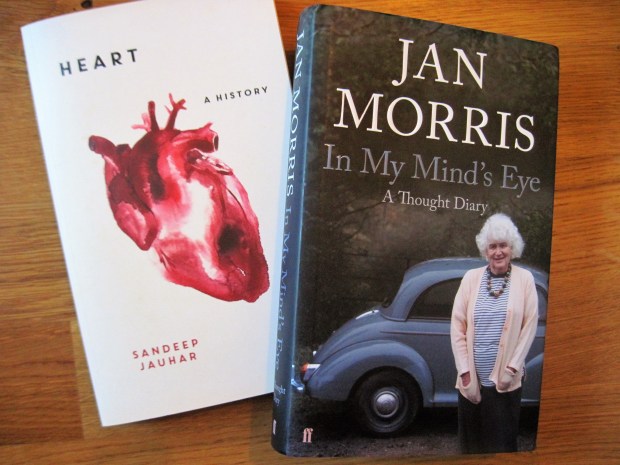
Heart: A History, by Sandeep Jauhar
There could hardly be an author better qualified to deliver this thorough history of the heart and the treatment of its problems. Sandeep Jauhar is the director of the Heart Failure Program at Long Island Medical Center. His family history – both grandfathers died of sudden cardiac events in India, one after being bitten by a snake – prompted an obsession with the heart, and he and his brother both became cardiologists. As the book opens, Jauhar was shocked to learn he had up to a 50% blockage of his own coronary vessels. Things had really gotten personal.
Cardiovascular disease has been the #1 killer in the West since 1910 and, thanks to steady smoking rates and a continuing rise in obesity and sedentary lifestyles, will still affect 60% of Americans. However, the key is that fewer people will now die of heart disease thanks to the developments of the last six decades in particular. These include the heart–lung machine, cardiac catheterization, heart transplantation, and artificial hearts.
 Along the timeline, Jauhar peppers in bits of his own professional and academic experience, like experimenting on frogs during high school in California and meeting his first cadaver at medical school. My favorite chapter was the twelfth, “Vulnerable Heart,” which is about how trauma can cause heart arrhythmias; it opens with an account of the author’s days cataloguing body parts in a makeshift morgue as a 9/11 first responder. I also particularly liked his account of being called out of bed to perform an echocardiogram, which required catching a taxi at 3 a.m. and avoiding New York City’s rats.
Maybe I’ve read too much surgical history this year (The Butchering Art by Lindsey Fitzharris and Face to Face by Jim McCaul), though, because I found myself growing fairly impatient with the medical details in the long Part II, which centers on the heart as a machine, and was drawn more to the autobiographical material in the first and final sections. Perhaps I would prefer Jauhar’s first book, Intern: A Doctor’s Initiation.
In terms of readalikes, I’d mention Siddhartha Mukherjee’s The Gene, in which the personal story also takes something of a backseat to the science, and Gavin Francis’s Shapeshifters, which exhibits a similar interest in the metaphors applied to the body. While I didn’t enjoy this quite as much as two other heart-themed memoirs I’ve read, The Sanctuary of Illness by Thomas Larson and Echoes of Heartsounds by Martha Weinman Lear, I still think it’s a strong contender for next year’s Wellcome Book Prize (the judging panel is announced tomorrow!).
Some favorite lines:
“it is increasingly clear that the biological heart is extraordinarily sensitive to our emotional system—to the metaphorical heart, if you will.”
“Who but the owner can say what lies inside a human heart?”“As a heart-failure specialist, I’d experienced enough death to fill up a lifetime. At one time, it was difficult to witness the grief of loved ones. But my heart had been hardened, and this was no longer that time.”
My rating:
Heart is published in the UK today, September 27th, by Oneworld. My thanks to the publisher for the proof copy for review.
In My Mind’s Eye: A Thought Diary, by Jan Morris
I’ve been an admirer of Jan Morris’s autobiographical and travel writing for 15 years or more. In this diary covering 2017 into early 2018, parts of which were originally published in the Financial Times and the Welsh-language literary newspaper O’r Pedwar Gwynt, we get a glimpse into her life in her early nineties. It was a momentous time in the world at large but a fairly quiet and reflective span for her personally. Though each day’s headlines seem to herald chaos and despair, she’s a blithe spirit – good-natured about the ravages of old age and taking delight in the routines of daily one-mile walks down the lane and errands in local Welsh towns with her beloved partner Elizabeth, who’s in the early stages of dementia.
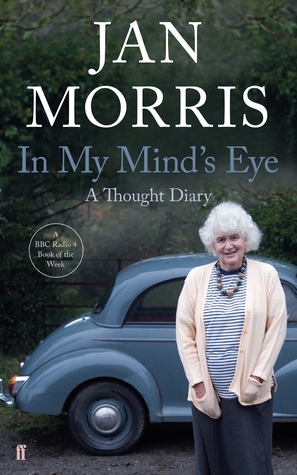 There are thrilling little moments, though, when a placid domestic life (a different kind of marmalade with breakfast each day of the week!) collides with exotic past experiences, and suddenly we’re plunged into memories of travels in Swaziland and India. Back when she was still James, Morris served in World War II, was the Times journalist reporting from the first ascent of Everest, and wrote a monolithic three-volume history of the British Empire. She took her first airplane flight 70 years ago, and is nostalgic for the small-town America she first encountered in the 1950s. Hold all that up against her current languid existence among the books and treasures of Trefan Morys and it seems she’s lived enough for many lifetimes.
There’s a good variety of topics here, ranging from current events to Morris’s love of cats; I particularly liked the fragments of doggerel. However, as is often the case with diaries, read too many entries in one go and you may start to find the sequence of (non-)events tedious. Each piece is only a page or two, so I tried never to read many more than 10 pages at a time. Even so, I noticed that the plight of zoo animals, clearly a hobby-horse, gets mentioned several times. It seemed to me a strange issue to get worked up about, especially as enthusiastic meat-eating and killing mice with traps suggest that she’s not applying a compassionate outlook consistently.
In the end, though, kindness is Morris’s cardinal virtue, and despite minor illness, telephone scams and a country that looks to be headed to the dogs, she’s encouraged by the small acts of kindness she meets with from friends and strangers alike. Like Diana Athill (whose Alive, Alive Oh! this resembles), I think of Morris as a national treasure, and I was pleased to spend some time seeing things from her perspective.
Some favorite lines:
“If I set out in the morning for my statutory thousand daily paces up the lane, … I enjoy the fun of me, the harmless conceit, the guileless complexity and the merriment. When I go walking in the evening, on the other hand, … I shall recognize what I don’t like about myself – selfishness, self-satisfaction, foolish self-deceit and irritability. Morning pride, then, and evening shame.” (from Day 99)
“Good or bad, virile or senile, there’s no life like the writer’s life.” (from Day 153)
My rating: 
In My Mind’s Eye was published by Faber & Faber on September 6th. My thanks to the publisher for the free copy for review.
Waiting for the Last Bus by Richard Holloway
Theology rarely appears on this blog, though I have a dual degree in English and Religion and read a fair number of books with religious themes. Never fear: it’s not your average pie-in-the-sky Christian talk in Waiting for the Last Bus, Richard Holloway’s brand-new book about old age and death. Holloway was a career priest and has written nearly 30 theological works, but he comes at things from a refreshingly different angle. In Leaving Alexandria (2012), one of my all-time favorite memoirs, he recorded his drift away from orthodoxy – even as he rose through the ranks of the Church of Scotland to become Bishop of Edinburgh. He recognizes morality as provisional (like in another of his books I’ve read, Godless Morality (1999)) – the Church has changed its mind about women and gay people, for instance – and doesn’t waste time pondering the supernatural or the chance of eternal life, but he still thinks religion has lessons to teach us about how we can approach death with dignity.

The thematic scaffolding of this short book, which grew out of a Radio 4 series that aired in 2016, is acceptance versus denial. For Holloway, going prematurely bald was like a preview of ageing, and the futility of the quack hair restoration pills he ordered from a magazine was his first lesson in accepting what you cannot change about yourself. Seeing ourselves as we really are is a lifelong struggle, Holloway acknowledges; some only grasp their identity right at the end, as death approaches. Predestination is a doctrine common to Christianity and Islam, but he is more inclined to mix free will and fate. His recurring metaphor is of a deck of cards: life is a hand that you are dealt, but you get to choose exactly how to play it.
This is a richly allusive book, full of snatches of literature (especially poetry), as well as excerpts from obituaries and from funeral addresses Holloway has given. He also discusses the fear of death, the dystopian possibilities of cryogenic freezing, countering regrets with forgiveness, and how the way we face death could redeem a disappointing life. Holloway’s is a voice of wisdom worth heeding, and he is honest and humble instead of giving pat answers to life’s enormous questions. I would be particularly likely to recommend this to readers of Julian Barnes’s Nothing to Be Frightened Of who want a contrasting perspective.
A couple of favorite passages:
“I have ministered [Last Rites] myself and seen the peace they can bring at the end. I have sent good friends into the arms of a merciful God I was no longer sure I believed in. And I was convinced not only of the efficacy but of the honesty of what I was doing. I was not there to ventilate my doubts but to help the dying find the strength to cast off and take the tide that was pulling them out.”
“Religion is at its most compelling when it restrains the urge to explain death away and contents itself with voicing our sorrow and defiance that [death] keeps beating us into the ground. It feels most authentic when it stops preaching and becomes, instead, our song, our protest, the handkerchief waved against the immense tank looming at the corner of the street.”
My rating:
Waiting for the Last Bus is published in the UK today, March 1st. With thanks to Canongate for the free copy for review.
A CanLit Classic: The Stone Angel by Margaret Laurence
Hagar Shipley has earned the right to be curmudgeonly. Now 90 years old, she has already lived with her son Marvin and his wife Doris for 17 years when they spring a surprise on her: they want to sell the house and move somewhere smaller, and they mean to send her to Silver Threads nursing home. What with a recent fall, gallbladder issues and pesky constipation, the old woman’s health is getting to be more than Doris can handle at home. But don’t expect Hagar to give in without a fight.
This is one of those novels where the first-person voice draws you in immediately. “I am rampant with memory,” Hagar says, and as the book proceeds she keeps lapsing back, seemingly involuntarily, into her past. While in a doctor’s waiting room or in the derelict house by the coast where she runs away to escape the threat of the nursing home, she loses the drift of the present and in her growing confusion relives episodes from earlier life.
Many of these are melancholy: her mother’s early death and her difficult relationship with her father, an arrogant, self-made shopkeeper (“Both of us were blunt as bludgeons. We hadn’t a scrap of subtlety between us”); her volatile marriage to Bram, a common fellow considered unworthy of her (“Twenty-four years, in all, were scoured away like sand-banks under the spate of our wrangle and bicker”); and the untimely deaths of both a brother and a son.

The stone angel of the title is the monument on Hagar’s mother’s grave, but it is also an almost oxymoronic description for our protagonist herself. “The night my son died I was transformed to stone and never wept at all,” she remembers. Hagar is harsh-tongued and bitter, always looking for someone or something to blame. Yet she recognizes these tendencies in herself and sometimes overcomes her stubbornness enough to backtrack and apologize. What wisdom she has is hard won through suffering, but she’s still standing. “She’s a holy terror,” son Marvin describes her later in the novel: another paradox.
Originally from 1964, The Stone Angel was reprinted in the UK in September as part of the Apollo Classics series. It’s the first in Laurence’s Manawaka sequence of five novels, set in a fictional town based on her hometown in Manitoba, Canada. It could be argued that this novel paved the way for any number of recent books narrated by or about the elderly and telling of their surprise late-life adventures: everything from Jonas Jonasson’s The Hundred-Year-Old Man Who Climbed Out of the Window and Disappeared to Emma Hooper’s Etta and Otto and Russell and James. I was also reminded of Jane Smiley’s Midwest novels, and wondered if Carol Shields’s The Stone Diaries was possibly intended as an homage.
I loved spending time in Hagar’s company, whether she’s marveling at how age has crept up on her—
I feel that if I were to walk carefully up to my room, approach the mirror softly, take it by surprise, I would see there again that Hagar with the shining hair, the dark-maned colt off to the training ring
trying to picture life going on without her—
Hard to imagine a world and I not in it. Will everything stop when I do? Stupid old baggage, who do you think you are? Hagar. There’s no one like me in this world.
or simply describing a spring day—
The poplar bluffs had budded with sticky leaves, and the frogs had come back to the sloughs and sang like choruses of angels with sore throats, and the marsh marigolds were opening like shavings of sun on the brown river where the tadpoles danced and the blood-suckers lay slimy and low, waiting for the boys’ feet.
It was a delight to experience this classic of Canadian literature.
(The Apollo imprint will be publishing the second Manawaka book, A Jest of God, in March.)
With thanks to Blake Brooks at Head of Zeus/Apollo for the free copy for review.
My rating: 
 Bookish Beck = Rebecca Foster. American transplant to England. Freelance proofreader and book reviewer.
 Bookish Beck