Rathbones Folio Prize Fiction Shortlist: Sheila Heti and Elizabeth Strout
I’ve enjoyed engaging with this year’s Rathbones Folio Prize shortlists, reading the entire poetry shortlist and two each from the nonfiction and fiction lists. These two I accessed from the library. Both Sheila Heti and Elizabeth Strout featured in the 5×15 event I attended on Tuesday evening, so in the reviews below I’ll weave in some insights from that.
Pure Colour by Sheila Heti
 Sheila Heti is a divisive author; I’m sure there are those who detest her indulgent autofiction, though I’ve loved it (How Should a Person Be? and especially Motherhood). But this is another thing entirely: Heti puts two fingers up to the whole notion of rounded characterization or coherent plot. This is the thinnest of fables, fascinating for its ideas and certainly resonant for me what with the themes of losing a parent and searching for purpose in life on an earth that seems doomed to destruction … but is it a novel?
My summary for Bookmarks magazine gives an idea of the ridiculous plot:
Heti imagines that the life we live now—for Mira, studying at the American Academy of American Critics, working in a lamp store, grieving her father, and falling in love with Annie—is just God’s first draft. In this creation myth of sorts, everyone is born a “bear” (lover), “bird” (achiever), or “fish” (follower). Mira has a mystical experience in which she and her dead father meet as souls in a leaf, where they converse about the nature of time and how art helps us face the inevitability of death. If everything that exists will soon be wiped out, what matters?
The three-creature classification is cute enough, but a copout because it means Heti doesn’t have to spend time developing Mira (a bird), Annie (a fish), or Mira’s father (a bear), except through surreal philosophical dialogues that may or may not take place whilst she is disembodied in a leaf. It’s also uncomfortable how Heti uses sexual language for Mira’s communion with her dead dad: “she knew that the universe had ejaculated his spirit into her”.
Heti explained that the book came to her in discrete chunks, from what felt like a more intuitive place than the others, which were more of an intellectual struggle, and that she drew on her own experience of grief over her father’s death, though she had been writing it for a year beforehand.
Indeed, she appears to be tapping into primordial stories, the stuff of Greek myth or Jewish kabbalah. She writes sometimes of “God” and sometimes of “the gods”: the former regretting this first draft of things and planning how to make things better for himself the second time around; the latter out to strip humans of what they care about: “our parents, our ambitions, our friendships, our beauty—different things from different people. They strip some people more and others less. They strip us of whatever they need to in order to see us more clearly.” Appropriately, then, we follow Mira all the way through to her end, when, stripped of everything but love, she rediscovers the two major human connections of her life.
Given Ali Smith’s love of the experimental, it’s no surprise that she as a judge shortlisted this. If you’re of a philosophical bent, don’t mind negligible/non-existent plot in your novels and aren’t turned off by literary pretension, you should be fine. If you are new to Heti or unsure about trying her, though, this is probably not the right place to start. See my Goodreads review for some sample quotes, good and bad. 
Lucy by the Sea by Elizabeth Strout
This was by far the best of the three Amgash books I’ve read. I think it must be the first time that Strout has set a book not in the past or at some undated near-contemporary moment but in the actual world with its current events, which inevitably means it gets political. I had my doubts about how successful she’d be with such hyper-realism, but this really worked.
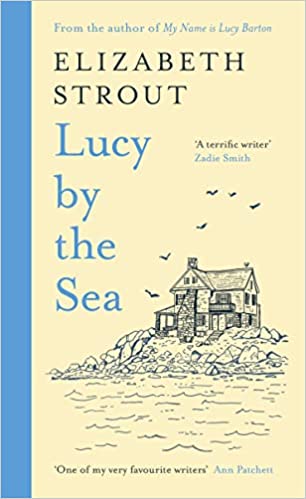 As Covid hits, William whisks Lucy away from her New York City apartment to a house at the coast in Crosby, Maine. She’s an Everywoman recounting the fear and confusion of those early pandemic days, hearing of friends and relatives falling ill and knowing there’s nothing she can do about it. Isolation, mostly imposed on her but partially chosen – she finally gets a writing studio, the first ‘room of her own’ she’s ever had – gives her time to ponder the trauma of her childhood and what went wrong in her marriage to William. She worries for her two adult daughters but, for the first time, you get the sense that the strength and wisdom she’s earned through bitter experience will help her support them in making good choices.
Here in rural Maine, Lucy sees similar deprivation to what she grew up with in Illinois and also meets real people – nice, friendly people – who voted for Trump and refuse to be vaccinated. I loved how Strout shows us Lucy observing and then, through a short story, compassionately imagining herself into the situation of conservative cops and drug addicts. “Try to go outside your comfort level, because that’s where interesting things will happen on the page,” is her philosophy. This felt like real insight into a writer’s inspirations.
Another neat thing Strout does here, as she has done before, is to stitch her oeuvre together by including references to most of her other books. So she becomes friends with Bob Burgess, volunteers alongside Olive Kitteridge’s nursing home caregiver (and I expect their rental house is supposed to be the one Olive vacated), and meets the pastor’s daughter from Abide with Me. My only misgiving is that she recounts Bob Burgess’s whole story, replete with spoilers, such that I don’t feel I need to read The Burgess Boys.
Lucy has emotional intelligence (“You’re not stupid about the human heart,” Bob Burgess tells her) and real, hard-won insight into herself (“My childhood had been a lockdown”). Readers as well as writers have really taken this character to heart, admiring her seemingly effortless voice. Strout said she does not think of this as a ‘pandemic novel’ because she’s always most interested in character. She believes the most important thing is the sound of the sentences and that a writer has to determine the shape of the material from the inside. She was very keen to separate herself from Lucy, and in fact came across as rather terse. I had somehow expected her to have a higher voice, to be warmer and softer. (“Ah, you’re not Lucy, you’re Olive!” I thought to myself.) 
Predictions
This year’s judges are Guy Gunaratne, Jackie Kay and Ali Smith. Last year’s winner was a white man, so I’m going to say in 2023 the prize should go to a woman of colour, and in fact I wouldn’t be surprised if all three category winners were women of colour. My own taste in the shortlists is, perhaps unsurprisingly, very white-lady-ish and non-experimental. But I think Amy Bloom and Elizabeth Strout’s books are too straightforward and Fiona Benson’s not edgy enough. So I’m expecting:
Fiction: Scary Monsters by Michelle de Kretser
Nonfiction: Constructing a Nervous System by Margo Jefferson
Poetry: Quiet by Victoria Adukwei Bulley (or Cane, Corn & Gully by Safiya Kamaria Kinshasa)
Overall winner: Constructing a Nervous System by Margo Jefferson (or Quiet by Victoria Adukwei Bulley)
This is my 1,200th blog post!
Women’s Prize 2023: Longlist Predictions vs. Wishes
I’ve been working on a list of novels eligible for this year’s Women’s Prize since … this time last year. Unusual for me to be so prepared! It shows how invested I’ve become in this prize over the years. For instance, last year my book club was part of an official shadowing scheme, which was great fun.
We’re now less than a month out from the longlist, which will be announced on 7 March. Like last year, I’ve separated my predictions from a wish list; two titles overlap. Here’s a reminder of the parameters, taken from the website:
“Any woman writing in English – whatever her nationality, country of residence, age or subject matter – is eligible. Novels must be published in the United Kingdom between 1 April in the year the Prize calls for entries, and 31 March the following year, when the Prize is announced. … The Prize only accepts novels entered by publishers, who may each submit a maximum of two titles per imprint, depending on size, and one title for imprints with a list of ten fiction titles or fewer published in a year. Previously shortlisted and winning authors are given a ‘free pass’.”
This year I dutifully kept tabs on publisher quotas as I compiled my lists. I also attempted to bear in mind the interests of this year’s judges (also from the website): “Chair of Judges, author and journalist Louise Minchin, is joined by award-winning novelist Rachel Joyce; author, journalist and podcaster Irenosen Okojie; bestselling author and journalist Bella Mackie and MP for Hampstead and Kilburn Tulip Siddiq.”
Predictions
A Spell of Good Things, Ayọ̀bámi Adébáyọ̀
Birnam Wood, Eleanor Catton
Joan, Katherine J. Chen
Maame, Jessica George


Really Good, Actually, Monica Heisey
Trespasses, Louise Kennedy
The Night Ship, Jess Kidd (my review)
Demon Copperhead, Barbara Kingsolver (my review)


Our Missing Hearts, Celeste Ng (my review)
The Marriage Portrait, Maggie O’Farrell
I’m a Fan, Sheena Patel
Elektra, Jennifer Saint


Best of Friends, Kamila Shamsie
River Sing Me Home, Eleanor Shearer
Lucy by the Sea, Elizabeth Strout – currently reading
Tomorrow, and Tomorrow, and Tomorrow, Gabrielle Zevin (my review)


Wish List
How Not to Drown in a Glass of Water, Angie Cruz
The Weather Woman, Sally Gardner (my review)
Maame, Jessica George
The Great Reclamation, Rachel Heng


Bad Cree, Jessica Johns
I Have Some Questions for You, Rebecca Makkai – currently reading
Sea of Tranquillity, Emily St. John Mandel (my review)
The Hero of This Book, Elizabeth McCracken (my review)


Nightcrawling, Leila Mottley (my review)
We All Want Impossible Things, Catherine Newman – currently reading
Everything the Light Touches, Janice Pariat (my review)
Camp Zero, Michelle Min Sterling – review pending for Shelf Awareness


Briefly, A Delicious Life, Nell Stevens (my review)
This Time Tomorrow, Emma Straub (my review)
Fight Night, Miriam Toews – currently reading
Tomorrow, and Tomorrow, and Tomorrow, Gabrielle Zevin (my review)


Of course, even if I’m lucky, I’ll still only get a few right across these two lists, and I’ll be kicking myself over the ones I considered but didn’t include, and marvelling at all the ones I’ve never heard of…
What would you like to see on the longlist?
~BREAKING NEWS: There are plans afoot to start a Women’s Prize for Non-Fiction. Now seeking funding to start in 2024. More details here.~
Appendix
(A further 99 eligible novels that were on my radar but didn’t make the cut:)
Hester, Laurie Lico Albanese
Rose and the Burma Sky, Rosanna Amaka
Milk Teeth, Jessica Andrews
Clara & Olivia, Lucy Ashe
Wet Paint, Chloë Ashby
Shrines of Gaiety, Kate Atkinson
Honey & Spice, Bolu Babalola
Hell Bent, Leigh Bardugo
Either/Or, Elif Batuman
Girls They Write Songs About, Carlene Bauer
seven steeples, Sara Baume
The Witches of Vardo, Anya Bergman
Shadow Girls, Carol Birch
Permission, Jo Bloom
Horse, Geraldine Brooks
Glory, NoViolet Bulawayo
Mother’s Day, Abigail Burdess
Instructions for the Working Day, Joanna Campbell
People Person, Candice Carty-Williams
Disorientation, Elaine Hsieh Chou
The Book of Eve, Meg Clothier
Cult Classic, Sloane Crosley
The Things We Do to Our Friends, Heather Darwent
The Bewitching, Jill Dawson
Common Decency, Susannah Dickey
Theatre of Marvels, L.M. Dillsworth
Haven, Emma Donoghue
History Keeps Me Awake at Night, Christy Edwall
The Candy House, Jennifer Egan
Dazzling, Chikodili Emelumadu
You Made a Fool of Death with Your Beauty, Akwaeke Emezi
there are more things, Yara Rodrigues Fowler
Factory Girls, Michelle Gallen
Lessons in Chemistry, Bonnie Garmus
The Illuminated, Anindita Ghose
Your Driver Is Waiting, Priya Guns
The Rabbit Hutch, Tess Gunty
The Dance Tree, Kiran Millwood Hargrave
Weyward, Emilia Hart
Other People Manage, Ellen Hawley
Stone Blind, Natalie Haynes
The Cloisters, Katy Hays
Motherthing, Ainslie Hogarth
The Unfolding, A.M. Homes
The White Rock, Anna Hope
They’re Going to Love You, Meg Howrey
Housebreaking, Colleen Hubbard
Vladimir, Julia May Jonas
This Is Gonna End in Tears, Liza Klaussmann
The Applicant, Nazli Koca
Babel, R.F. Kuang
Yerba Buena, Nina Lacour
The Swimmers, Chloe Lane
The Book of Goose, Yiyun Li
Amazing Grace Adams, Fran Littlewood
All the Little Bird Hearts, Viktoria Lloyd-Barlow
Now She Is Witch, Kirsty Logan
The Chosen, Elizabeth Lowry
The Home Scar, Kathleen MacMahon
Very Cold People, Sarah Manguso
All This Could Be Different, Sarah Thankam Mathews
Becky, Sarah May
The Dog of the North, Elizabeth McKenzie
Dinosaurs, Lydia Millet
Young Women, Jessica Moor
The Garnett Girls, Georgina Moore
Black Butterflies, Priscilla Morris
Lapvona, Ottessa Moshfegh
Someone Else’s Shoes, Jojo Moyes
The Men, Sandra Newman
True Biz, Sara Nović
Babysitter, Joyce Carol Oates
Tomorrow I Become a Woman, Aiwanose Odafen
Things They Lost, Okwiri Oduor
The Human Origins of Beatrice Porter and Other Essential Ghosts, Soraya Palmer
The Things that We Lost, Jyoti Patel
Still Water, Rebecca Pert
Stargazer, Laurie Petrou
Ruth & Pen, Emilie Pine
Delphi, Clare Pollard
The Whalebone Theatre, Joanna Quinn
The Poet, Louisa Reid
Carrie Soto Is Back, Taylor Jenkins Reid
Kick the Latch, Kathryn Scanlan
Blue Hour, Sarah Schmidt
After Sappho, Selby Wynn Schwartz
Signal Fires, Dani Shapiro
A Dangerous Business, Jane Smiley
Companion Piece, Ali Smith
Memphis, Tara M. Stringfellow
Flight, Lynn Steger Strong
Brutes, Dizz Tate
Madwoman, Louisa Treger
I Laugh Me Broken, Bridget van der Zijpp
I’m Sorry You Feel That Way, Rebecca Wait
The Schoolhouse, Sophie Ward
Sweet, Soft, Plenty Rhythm, Laura Warrell
The Odyssey, Lara Williams
A Complicated Matter, Anne Youngson
Avalon, Nell Zink
Booker Prize Longlist Reading & Shortlist Predictions
I’ve polished off another four from the Booker Prize longlist (my initial reactions and excerpts from existing reviews are here), with one more coming up for me next month.
Trust by Hernan Diaz
“History itself is just a fiction—a fiction with an army. And reality? Reality is a fiction with an unlimited budget.”
My synopsis for Bookmarks magazine:
Set in the 1920s and 1930s, this expansive novel is about the early days of New York City high finance. It is told through four interlocking narratives. The first is Bonds, a novel by Harold Vanner, whose main character is clearly based on tycoon Andrew Bevel. Bevel, outraged at his portrayal as well as the allegation that his late wife, Mildred, was a madwoman, responds by writing a memoir—the book’s second part. Part 3 is an account by Ida Partenza, Bevel’s secretary, who helps him plot revenge on Vanner. In the final section, Mildred finally gets her say. Her journal caps off a sumptuous, kaleidoscopic look at American capitalism.
 Ghostwriter Ida’s section was much my favourite, for her voice as well as for how it leads you to go back to the previous part – some of it still in shorthand (“Father. Describe early memories of him. … MATH in great detail. Precocious talent. Anecdotes.”) and reassess its picture of Bevel. His short selling in advance of the Great Depression made him a fortune, but he defends himself: “My actions safeguarded American industry and business.” Mildred’s journal entries, clearly written through a fog of pain as she was dying from cancer, then force another rethink about the role she played in her husband’s decision making. With her genius-level memory, philanthropy and love of literature and music, she’s a much more interesting character than Bevel – that being the point, of course, that he steals the limelight. This is clever, clever stuff. However, as admirable as the pastiche sections might be (though they’re not as convincing as the first section of To Paradise), they’re ever so dull to read.
With thanks to Picador for the free copy for review.
Case Study by Graeme Macrae Burnet
 That GMB is quite the trickster. From the biographical sections, I definitely assumed that A. Collins Braithwaite was a real psychiatrist in the 1960s. A quick Google when I got to the end revealed that he only exists in this fictional universe. I enjoyed the notebooks recounting an unnamed young woman’s visits to Braithwaite’s office; holding the man responsible for her sister’s suicide, she books her appointments under a false name, Rebecca Smyth, and tries acting just mad (and sensual) enough to warrant her coming back. Her family stories, whether true or embellished, are ripe for psychoanalysis, and the more she inhabits this character she’s created the more she takes on her persona. (“And, perhaps on account of Mrs du Maurier’s novel, Rebecca had always struck me as the most dazzling of names. I liked the way its three short syllables felt in my mouth, ending in that breathy, open-lipped exhalation.” I had to laugh at this passage! I’ve always thought mine a staid name.) But the different documents don’t come together as satisfyingly as I expected, especially compared to His Bloody Project. (Public library)
Those two are both literary show-off stuff (the epistolary found documents strategy, metafiction): the kind of book I would have liked more in my twenties. I’m less impressed with games these days; I prefer the raw heart of this next one.
Nightcrawling by Leila Mottley
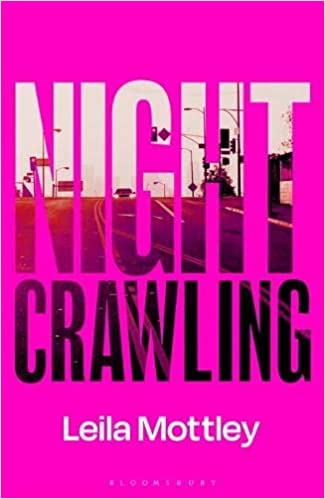 She may be only 20 years old, but Leila Mottley is the real deal. Her debut novel, laden with praise from her mentor Ruth Ozeki and many others, reminded me of Bryan Washington’s work. The first-person voice is convincing and mature as Mottley spins the (inspired by a true) story of an underage prostitute who testifies against the cops who have kept her in what is virtually sex slavery. At 17, Kiara is the de facto head of her household, with her father dead, her mother in a halfway house, and her older brother pursuing his dream of recording a rap album. When news comes of a rise in the rent and Kia stumbles into being paid for sex, she knows it’s her only way of staying in their Oakland apartment and looking after her neglected nine-year-old neighbour, Trevor.
I loved her relationships with Trevor, her best friend Alé (they crash funerals for the free food), and trans prostitute Camila, and the glimpses into prison life and police corruption. This doesn’t feel like misery for the sake of it, just realistic and compassionate documentation. There were a few places where I felt the joins showed, like a teacher had told her she needed to fill in some emotional backstory, and I noticed an irksome habit of turning adjectives into verbs or nouns (e.g., “full of all her loud,” “the sky is just starting to pastel”); perhaps this is an instinct from her start in poetry, but it struck me as precious. However, this is easily one of the more memorable 2022 releases I’ve read, and I’d love to see it on the shortlist and on other prize lists later this year and next. (Public library) 
Oh William! by Elizabeth Strout
 This was a DNF for me last year, but I tried again. The setup is simple: Lucy Barton’s ex-husband, William, discovers he has a half-sister he never knew about. William and Lucy travel from New York City to Maine in hopes of meeting her. For both of them, the quest sparks a lot of questions about how our origins determine who we are, and what William’s late mother, Catherine, was running from and to in leaving her husband and small child behind to forge a different life. Like Lucy, Catherine came from nothing; to an extent, everything that unfolded afterwards for them was a reaction against poverty and neglect.
The difficulty of ever really knowing another person, or even understanding oneself, is one of Strout’s recurring messages. There are a lot of strong lines and relatable feelings here. What I found maddening, though, is Lucy’s tentative phrasing, e.g. “And I cannot explain it except to say—oh, I don’t know what to say! Truly, it is as if I do not exist, I guess is the closest thing I can say.” She employs hedging statements like that all the time; it struck me as false that someone who makes a living by words would be so lacking in confidence about how to say what she means. So I appreciated the psychological insight but found Lucy’s voice annoying, even in such a short book. (Public library)
A Recap
I’ve read 6 of the 13 at this point, have imminent plans to read After Sappho for a Shelf Awareness review, and would still like to read the Mortimer if my library system acquires it. The others? Meh. I might consider catching up if they’re shortlisted.
My book group wasn’t chosen to shadow the Booker Prize this year, which is fair enough since we already officially shadowed the Women’s Prize earlier in the year (here are the six successful book clubs, if you’re interested). However, we have been offered the chance to send in up to five interview questions for the shortlisted authors. The Q&As will then be part of a website feature. And I was pleasantly surprised to see that my non-holiday snap of a Booker Prize nominee turned up in this round-up!
Here’s my (not particularly scientific) reasoning for what might make the shortlist:
A literary puzzle novel
Trust by Hernan Diaz or Case Study by Graeme Macrae Burnet
- Trust feels more impressive, and timely; GMB already had his chance.
A contemporary novel
Nightcrawling by Leila Mottley or Oh William! by Elizabeth Strout
- Oh William! is the weakest Strout novel I’ve read. Mottley’s is a fresh voice that deserves to be broadcast.

A satire
The Trees by Percival Everett or Seven Moons of Maali Almeida by Shehan Karunatilaka
- Without having read either, I’m going to hazard a guess that the Everett is too Ameri-centric/similar to The Sellout. The Booker tends to reward colourful Commonwealth books. [EDITED to add that I forgot to take into my considerations Glory by NoViolet Bulawayo; while it doesn’t perfectly fit this category, as a political allegory it’s close enough that I’ll include it here. I would not be at all surprised if it made the shortlist, along with the Karunatilaka.]

A couple of historical novels
Booth by Karen Joy Fowler or After Sappho by Selby Wynn Schwartz
and/or
A couple of Irish novels
Small Things Like These by Claire Keegan or The Colony by Audrey Magee
- I’m hearing such buzz about the Magee, and there’s such love out there for the Keegan, that I reckon both of these will make it through.


The odd one out?
Treacle Walker by Alan Garner or Maps of Our Spectacular Bodies by Maddie Mortimer
- Maybe nostalgia will spur the judges to give Garner a chance in his 80s.

My predicted shortlist:


On Tuesday evening we’ll find out if I got any of these right!
What have you read from the longlist? What do you most want to read, or see on the shortlist?
Women’s Prize Shadowing & Men Reading Books by Women
Back in April I announced that my book club was one of six selected to shadow this year’s Women’s Prize shortlist by reading and discussing one of the finalists. Our assigned title was one I’d already read, but I skimmed back through it before our meet-up and enjoyed getting reacquainted with Martha Friel. Here’s our group’s review:

Sorrow and Bliss by Meg Mason
Readability: 5/5
Characters: 5/5
Storyline: 4/5
Can’t Put It Down: 4.5/5
Total = 18.5/20
 Our joint highest rating, and one of our best discussions – taking in mental illness and its diagnosis and treatment, marriage, childlessness, alcoholism, sisterhood, creativity, neglect, unreliable narrators and loneliness. For several of us, these issues hit close to home due to personal or family experience. We particularly noted the way that Mason sets up parallels between pairs of characters, accurately reflecting how family dynamics can be replicated in later generations.
Even the minor characters are fully rounded, and although Martha is not always pleasant to spend time with, her voice is impressively rendered. The picture of mental illness from the inside feels authentic, including the fact that Martha uses it as an excuse for her bad behaviour, becoming self-absorbed and not seeing how she is affecting others around her. Our main point of disagreement was about Mason’s decision not to name the mental illness Martha is suffering from. It seemed clear to several of us that it was meant to be bipolar disorder, so we wondered if it was a copout not to identify it as such.
We also thought about the meaning of the term “literary fiction”, and whether this has the qualities of a prize winner and will stand the test of time.
We had to fill out a feedback questionnaire about our experience of shadowing, and most of us sent in individual blurbs in response to the book. Some ended up in the final Reading Agency article. Here was mine:
“This deceptively light novel was a perfect book club selection, eliciting deep discussion about mental illness, family relationships and parenthood. Martha’s (unreliable) narration is a delight, wry and deadpan but also with moments of wrenching emotion. Mason masterfully controls the tone to create something that is witty and poignant all at once.”
Probably the main reason we were chosen for this opportunity is that we have a man – my husband, that is! – who attends regularly. This year the prize has been particularly keen to get more men reading books by women (see more below). So, he was responsible for giving The Male Response to the novel. No pressure, right? Luckily, he enjoyed it just as much as the rest of us. From the cover and blurb, it didn’t necessarily seem like the sort of book that he would pick up to read for himself, but he was fully engaged with the themes of mental illness, family relationships, and the question of whether or not to have children, and was so compelled that he read over half of it in a day.
I’m not sure who I expect to be awarded the Women’s Prize tomorrow. We of West Fields Readers would be delighted if it went to Meg Mason for Sorrow and Bliss, but I’d also be happy with a win for Louise Erdrich or Ruth Ozeki – though I wasn’t taken with their latest works compared with earlier ones I’ve read, they are excellent authors who deserve recognition. I don’t think The Bread the Devil Knead has a chance; I’d be disappointed in a win by Elif Shafak in that I would feel obligated to try her novel – the kind that gives magic realism a bad name – again; and, while I’m a Maggie Shipstead fan in general and admire the ambition of Great Circle, it would be galling for a book I DNFed twice to take the title!
Who are you rooting for/predicting?
I’d like to mock you with that thought,
jeer at the man
who won’t read novels
written by women –
at least not if they’re still alive
~from The Poet by Louisa Reid
Maybe you’ve seen on social media that the Women’s Prize has been canvassing opinion on the books by women that all men should read. This was prompted by some shocking statistics suggesting that even bestselling female authors can only attract a 20% male readership, whereas the best-known male authors are almost equally popular with men and women. They solicited 60 nominations from big names and ran a public poll. I voted for these 10:
Half of a Yellow Sun (Chimamanda Ngozi Adichie)
Possession (A.S. Byatt)
Homegoing (Yaa Gyasi)
The Poisonwood Bible (Barbara Kingsolver)
The Sea, The Sea (Iris Murdoch)
The Stone Diaries (Carol Shields)
We Need to Talk about Kevin (Lionel Shriver)
Olive Kitteridge (Elizabeth Strout)
The Goldfinch (Donna Tartt)
Orlando (Virginia Woolf)
*If I could have added to that list, though, my top recommendations for all men to read would be Station Eleven by Emily St. John Mandel and Bring Up the Bodies by Hilary Mantel (and probably a different Octavia E. Butler novel from the one nominated).


Three of my selections were among the 10 essential reads announced on the WP website. Their list was headed by Margaret Atwood’s The Handmaid’s Tale, though of her works I’d be more likely to direct men to Oryx and Crake.
I’ve seen discussions on Twitter about why men don’t read novels (at all, prioritizing nonfiction), or specifically not ones by women. Do you have any theories?
What one book by a woman do you think all men should read?
Women’s Prize Longlist Reviews (Erdrich, Mendelson, Ozeki) & Predictions
Tomorrow the Women’s Prize shortlist will be revealed. I’ve become much more invested in this prize over the past few years and will be following the 2022 race especially closely – look out for a related announcement soon. In recent years the nominees have tended to cluster thematically, which can feel redundant. This longlist has a notably high ghost quotient. Two novels I review below feature unquiet spirits, an appearance by the author, and the magical powers of books. The third is a straightforward contemporary dysfunctional family story.
The Sentence by Louise Erdrich
My second from Erdrich (I gave Love Medicine, her first novel, 5 stars in 2020). I will be revisiting this in June because it is our first pick for my tenure in the Literary Wives online book club. For that post I’ll focus on the relationship between Tookie and Pollux, which I won’t mention in this more general response. I was worried that a take on very recent events – this is set in Minneapolis between 2019 and 2020 and covers the first six months of the pandemic plus local protests following George Floyd’s murder – would seem either rushed or dated. I’m still unsure how I feel about encountering Covid-19 in fiction (vs. I’ve read 20 or more nonfiction records now), but I think this novel functions as a sturdy time capsule.
 Tookie, the narrator, has a tough exterior but a tender heart. When she spent 10 years in prison for a misunderstanding-cum-body snatching, books helped her survive, starting with the dictionary. Once she got out, she translated her love of words into work as a bookseller at Birchbark Books, Louise Erdrich’s Minnesota independent bookshop (Louise herself is an occasional character). Bibliophiles are sure to enjoy the mentions of the books she presses into customers’ hands; there’s also a fun appendix of recommendations on particular topics.
However, the central mystery about Flora, a dead customer who haunts the store until Tookie figures out why she died and how to exorcise her, struck me as silly. I only appreciated this storyline to the extent that it explores authenticity (Flora may have fabricated her Native heritage) and the inescapability of history. I preferred real life: Tookie getting locked down with her stepdaughter and baby grandson and filling book orders from a closed shop.
Erdrich weaves in Indigenous customs naturally and the banter between the characters, including young shop employees, makes this hip and lighthearted, even as it deals with serious subjects. I smiled at the bookish lingo, like Tookie’s division of her reading into a Lazy Stack and a Hard Stack (“books I would avoid reading until some wellspring of mental energy was uncapped” – my occasional and set-aside titles could comprise the latter) and the “cowbirds,” self-published titles secreted on the shelves that aren’t found until inventory day. There’s also an excellent passage on novellas that I’ll be bringing out in November.
Like a vintage armchair, this is a little overstuffed, but so comfortable you’ll want to stay a while. (See also Laura’s review.) (Public library) 
The Exhibitionist by Charlotte Mendelson
~SPOILERS IN THIS ONE~
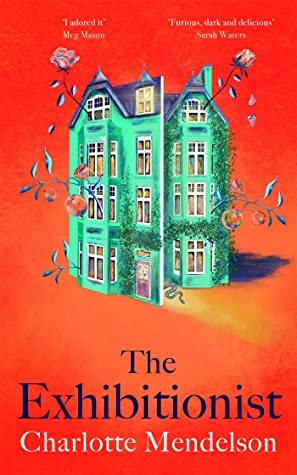 Artists, dysfunctional families, and limited settings (here, one crumbling London house and its environs; and about two days across one weekend) are irresistible elements for me, and I don’t mind a work being peopled with mostly unlikable characters. That’s just as well, because the narrative orbits Ray Hanrahan, a monstrous narcissist who insists that his family put his painting career above all else. His wife, Lucia, is a sculptor who has always sacrificed her own art to ensure Ray’s success. But now Lucia, having survived breast cancer, has the chance to focus on herself. She’s tolerated his extramarital dalliances all along; why not see where her crush on MP Priya Menon leads? What with fresh love and the offer of her own exhibition in Venice, maybe she truly can start over in her fifties.
Ray and Lucia’s three grown children, Leah, Patrick and Jess, are all home for Ray’s new exhibition. They’re mere sketches: Leah is Ray’s staunchest supporter and is infatuated with the no-show caterer; Patrick’s mental health is shaky, interfering with his job prospects; Jess, a teacher in Edinburgh, is pregnant but not sure she’s committed to her boyfriend long term. I wanted more depth from all the characters, but especially the offspring. I also expected a climactic late scene on Hampstead Heath to come to more.
Still, the build-up to the exhibit (followed by a laughably pitiful reveal) and Lucia’s inner life form an adequately strong foundation for Mendelson’s sardonic prose. The dialogue, full of interruptions, is true to life. This is her fifth novel and called to mind Jami Attenberg’s and Claire Fuller’s work. (Liz found shades of Iris Murdoch. Susan loved it, too.) I wouldn’t say I’m compelled to seek out more by Mendelson, but this was a solid read. (Public library)
The Book of Form and Emptiness by Ruth Ozeki
A Tale for the Time Being is one of my favourite novels of the century (and one of my most popular Goodreads reviews ever), My Year of Meats was a terrific backlist read a couple of summers ago, and I’m eager to catch up on All Over Creation. So I’d built up this fourth Ozeki novel in my head, thinking a library setting and magic realist elements presaged something deliciously Murakami-esque.
 What I actually found, having limped through it off and on for seven months, was something of a disappointment. A frank depiction of the mental health struggles of the Oh family? Great. A paean to how books and libraries can save us by showing us a way out of our own heads? A-OK. The problem is with the twee way that The Book narrates Benny’s story and engages him in a conversation about fate versus choice.
When Kenji Oh, a jazz musician, is run over by a chicken truck, Annabelle finds herself a single mother to Benny, a troubled teen who starts to hear everyday objects speaking to him. His voices and Annabelle’s hoarding habit jeopardize the viability of their household: Benny spends time on a psychiatric hospital ward for minors and Annabelle is threatened with eviction. For Benny, the library and the acquaintances he makes there – a fellow pedi-psych patient named Alice who calls herself The Aleph, an Eastern European philosopher who goes by The Bottleman (= Slavoj Žižek?), even the Ozeki figure tapping away on her laptop – may be his salvation; for Annabelle, it could be the book Tidy Magic (modelled on Marie Kondo’s work), written by a Buddhist nun. But until then, their stories get very dark indeed.
Concern for the principal pair and their relationship kept me reading even though this is too long and I wearied of Ozeki’s habit of literalizing metaphors (books speaking to people; being crushed by one’s belongings; crows playing a protective role). I’m still sympathetic to Ozeki’s aims, even if she doesn’t quite pull it all off here. If I pit the rather similar The Sentence and The Book of Form and Emptiness against each other, Erdrich comes out ahead.
With thanks to Canongate for the proof copy for review.
I’ve gotten to six books from the longlist so far and have a few more on order at the library. The others I’ve read, with ratings and links to my reviews, are:
Build Your House around My Body by Violet Kupersmith
Sorrow and Bliss by Meg Mason
I’m also partway through The Final Revival of Opal & Nev by Dawnie Walton, which is enjoyable enough but, alas, suffers in comparison to Daisy Jones and the Six, whose format (a composite oral history of a fictional 1960s/70s musical act) it repeats. The addition of the race issue doesn’t feel sufficient to call it original.
I’ve also DNFed a few from the longlist, two of them multiple times, so I have my fingers crossed that they don’t advance!
- The Paper Palace by Miranda Cowley Heller
- The Island of Missing Trees by Elif Shafak
- Great Circle by Maggie Shipstead
My attitude to the rest of the longlist is…
- The Bread the Devil Knead by Lisa Allen-Agostini – No plans to read.
- Salt Lick by Lulu Allison – I might read this from the library. I’m leery of dystopias, but I’m there for a chorus of cows.
- Careless by Kirsty Capes – No plans to read.
- Remote Sympathy by Catherine Chidgey – I would happily read it if it’s shortlisted, but at over 500 pages I fear it’ll be too dense.
- Flamingo by Rachel Elliott – Maybe. Sounds like pretty standard Sarah Winman-type stuff, but it could go down well with a book club.
- This One Sky Day by Leone Ross – No plans to read.
- Creatures of Passage by Morowa Yejidé – I was actually pretty keen to read this one, so I have it on reserve at the library. Egyptian mythology makes a change from the overdone Greeks, and the Washington, D.C. setting is a big draw. Laura’s review has tempered my expectations, but I might still give it a go.
My ideal shortlist (a wish list based on my reading and what I still want to read):
The Sentence by Louise Erdrich
Build Your House around My Body by Violet Kupersmith
Sorrow and Bliss by Meg Mason
The Exhibitionist by Charlotte Mendelson
The Final Revival of Opal & Nev by Dawnie Walton
Creatures of Passage by Morowa Yejidé
vs.
My predicted shortlist:
Remote Sympathy by Catherine Chidgey
The Sentence by Louise Erdrich
Sorrow and Bliss by Meg Mason
The Exhibitionist by Charlotte Mendelson
This One Sky Day by Leone Ross
The Island of Missing Trees by Elif Shafak
An overall winner? Gosh, it’s too early to tell. But maybe The Sentence, Sorrow and Bliss or The Island of Missing Trees.
See also Laura’s shortlist predictions.
What have you read from the longlist so far?
Which of these books are calling to you?
Quick Thoughts on the Women’s Prize 2022 Longlist & My Reading Plans
Tuesday is my volunteering morning at the library, but at 9:45 I nipped onto one of the public access PCs so I could find out which books were on the Women’s Prize longlist. I just couldn’t wait until I got home! It’s a surprising list. Those who thought Rooney and Yanagihara would be snubbed were absolutely right. Debuts and historical fiction aren’t as plentiful as forecast, but there are two doorstoppers on there, plus another 450+-pager. And it is great to see a list that is half by BIPOC women.
Of my wishes and predictions, 1 and 2 were correct, so I got 3 right overall, with my wildcard choice being the only nominee I’ve read in full so far. I’m currently reading another 2 and have 3 more set to read – the moment I got the news I marched over to borrow a couple more.
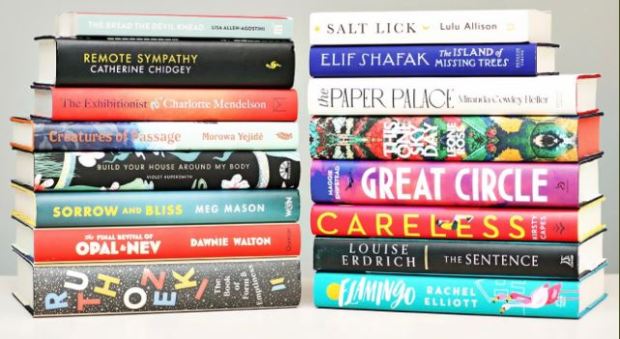
Fair play to the judges – I hadn’t even HEARD of these SIX titles:
- The Bread the Devil Knead by Lisa Allen-Agostini
- Salt Lick by Lulu Allison
- Careless by Kirsty Capes
- Remote Sympathy by Catherine Chidgey
- Flamingo by Rachel Elliott
- Creatures of Passage by Morowa Yejidé
I haven’t had a chance to look into these half-dozen, but will do so later on. I’m only likely to pick them up if a) others rave about them and/or b) they’re shortlisted.
Read:
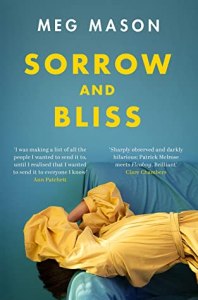 Sorrow and Bliss by Meg Mason: They say turning 40 can do weird things to you. Martha Friel gets a tattoo – so far, so stereotypical – but also blows up her marriage to Patrick, who’s been devoted to her since they were teens and met as family friends. In the year that follows, she looks back on a life that’s been defined by mental illness. As a young woman she was told she should never have children, but recently she met a new psychiatrist who gave her a proper diagnosis and told her motherhood was not out of the question. But is it too late for Martha and Patrick? Martha’s narration is a delight, wry and deadpan but also with moments of wrenching emotion. Her relationship with her sister, Ingrid, who gives birth to her first child on their aunt’s bathroom floor and eventually has four under the age of nine, is a highlight, and it’s touching to see how their mother and their aunt, both initially standoffish, end up being pillars of support. (My full review)
Currently reading:
 Build Your House Around My Body by Violet Kupersmith – I’m just over half done, and loving it. A weird and magical and slightly horror-tinged story set in Vietnam past and present, it builds on her debut ghost stories. Sort of plays the role Our Wives Under the Sea would have had on the longlist (though I dearly wish it could have been nominated as well).
 Set aside last year because it’s twee and annoying, but will now continue (ARGH + le sigh):
The Book of Form and Emptiness by Ruth Ozeki
 Own and will read soon (this was a treat to self with birthday money last year):
The Final Revival of Opal and Nev by Dawnie Walton
 Borrowed from library:
The Paper Palace by Miranda Cowley Heller
The Island of Missing Trees by Elif Shafak
 DNFed last year (twice); will not attempt again:
Great Circle by Maggie Shipstead
 On request from the library:
The Sentence by Louise Erdrich
The Exhibitionist by Charlotte Mendelson
Not interested in reading:
This One Sky Day by Leone Ross – I saw Ross speak about this and read an excerpt as part of a Faber showcase. I have a limited tolerance for magic realism and don’t think this appeals.
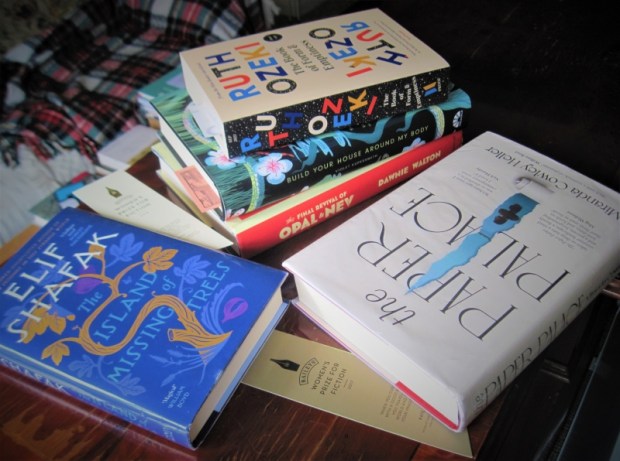
Above: my reading plans. Plenty to be getting on with before the shortlist announcement on 27th April!
What have you read, or might you read, from the longlist?
Women’s Prize 2022: Longlist Wishes vs. Predictions
Next Tuesday the 8th, the 2022 Women’s Prize longlist will be announced.
First I have a list of 16 novels I want to be longlisted, because I’ve read and loved them (or at least thought they were interesting), or am currently reading and enjoying them, or plan to read them soon, or am desperate to get hold of them.
Wishlist
Brown Girls by Daphne Palasi Andreades
Our Wives Under the Sea by Julia Armfield (my review)
Ghosted by Jenn Ashworth (my review)
These Days by Lucy Caldwell

Damnation Spring by Ash Davidson – currently reading
Olga Dies Dreaming by Xóchitl González – currently reading
Burntcoat by Sarah Hall (my review)
Early Morning Riser by Katherine Heiny (my review)


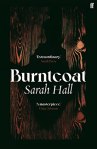
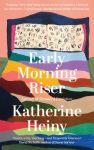
Pure Colour by Sheila Heti
My Monticello by Jocelyn Nicole Johnson (my review)
Devotion by Hannah Kent – currently reading
Build Your House Around My Body by Violet Kupersmith – currently reading

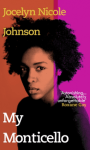


When the Stars Go Dark by Paula McLain (my review)
The Swimmers by Julie Otsuka – review coming to Shiny New Books on Thursday
Brood by Jackie Polzin (my review)
The Performance by Claire Thomas (my review)
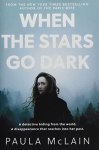


Then I have a list of 16 novels I think will be longlisted mostly because of the buzz around them, or they’re the kind of thing the Prize always recognizes (like danged GREEK MYTHS), or they’re authors who have been nominated before – previous shortlistees get a free pass when it comes to publisher submissions, you see – or they’re books I might read but haven’t gotten to yet.
Predictions
Love Marriage by Monica Ali
When We Were Birds by Ayanna Lloyd Banwo
Second Place by Rachel Cusk (my review)
Matrix by Lauren Groff
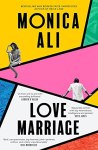
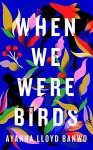
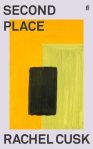

Free Love by Tessa Hadley
The Other Black Girl by Zakiya Dalila Harris (my review)
The Love Songs of W.E.B. Du Bois by Honorée Fanonne Jeffers
The Fell by Sarah Moss (my review)


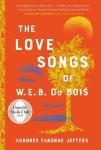

My Phantoms by Gwendoline Riley
Beautiful World, Where Are You by Sally Rooney (my review)
Ariadne by Jennifer Saint
The Island of Missing Trees by Elif Shafak


Great Circle by Maggie Shipstead
Pandora by Susan Stokes-Chapman
Still Life by Sarah Winman
To Paradise by Hanya Yanagihara – currently reading



*A wildcard entry that could fit on either list: Sorrow and Bliss by Meg Mason (my review).*

Okay, no more indecision and laziness. Time to combine these two into a master list that reflects my taste but also what the judges of this prize generally seem to be looking for. It’s been a year of BIG books – seven of these are over 400 pages; three of them over 600 pages even – and a lot of historical fiction, but also some super-contemporary stuff. Seven BIPOC authors as well, which would be an improvement over last year’s five and closer to the eight from two years prior. A caveat: I haven’t given thought to publisher quotas here.
MY WOMEN’S PRIZE FORECAST
Love Marriage by Monica Ali
Our Wives Under the Sea by Julia Armfield
When We Were Birds by Ayanna Lloyd Banwo
Olga Dies Dreaming by Xóchitl González
Matrix by Lauren Groff
The Love Songs of W.E.B. Du Bois by Honorée Fanonne Jeffers
Devotion by Hannah Kent
Build Your House Around My Body by Violet Kupersmith
The Fell by Sarah Moss
My Phantoms by Gwendoline Riley
Beautiful World, Where Are You by Sally Rooney
Ariadne by Jennifer Saint
The Island of Missing Trees by Elif Shafak
Great Circle by Maggie Shipstead
Pandora by Susan Stokes-Chapman
To Paradise by Hanya Yanagihara
What do you think?
See also Laura’s, Naty’s, and Rachel’s predictions (my final list overlaps with theirs on 10, 5 and 8 titles, respectively) and Susan’s wishes.
Just to further overwhelm you, here are the other 62 eligible 2021–22 novels that were on my radar but didn’t make the cut:
In Every Mirror She’s Black by Lola Akinmade Åkerström
Violeta by Isabel Allende
The Leviathan by Rosie Andrews
Somebody Loves You by Mona Arshi
The Stars Are Not Yet Bells by Hannah Lillith Assadi
The Manningtree Witches by A.K. Blakemore
Mary Jane by Jessica Anya Blau
Defenestrate by Renee Branum
Songs in Ursa Major by Emma Brodie
Assembly by Natasha Brown
We Were Young by Niamh Campbell
The Raptures by Jan Carson
A Very Nice Girl by Imogen Crimp
Scary Monsters by Michelle de Kretser
Empire of Wild by Cherie Dimaline
Infinite Country by Patricia Engel
Love & Saffron by Kim Fay
Mrs March by Virginia Feito
Booth by Karen Joy Fowler
Tides by Sara Freeman
I Couldn’t Love You More by Esther Freud
Of Women and Salt by Gabriela Garcia
Libertie by Kaitlyn Greenidge
Listening Still by Anne Griffin
The Twyford Code by Janice Hallett
Mrs England by Stacey Halls
Three Rooms by Jo Hamya
The Giant Dark by Sarvat Hasin
The Paper Palace by Miranda Cowley Heller
Violets by Alex Hyde
Fault Lines by Emily Itami
Beasts of a Little Land by Juhea Kim
Woman, Eating by Claire Kohda
Notes on an Execution by Danya Kukafka
Paul by Daisy Lafarge
Circus of Wonders by Elizabeth Macneal
The Truth About Her by Jacqueline Maley
Wahala by Nikki May
Once There Were Wolves by Charlotte McConaghy
Cleopatra and Frankenstein by Coco Mellors
The Exhibitionist by Charlotte Mendelson
Chouette by Claire Oshetsky
The Book of Form and Emptiness by Ruth Ozeki
The Anthill by Julianne Pachico
The Vixen by Francine Prose
The Five Wounds by Kirstin Valdez Quade
Malibu Rising by Taylor Jenkins Reid
Cut Out by Michèle Roberts
This One Sky Day by Leone Ross
Secrets of Happiness by Joan Silber
Cold Sun by Anita Sivakumaran
Hear No Evil by Sarah Smith
Oh William! by Elizabeth Strout
Animal by Lisa Taddeo
Daughter of the Moon Goddess by Sue Lynn Tan
Lily by Rose Tremain
French Braid by Anne Tyler
We Run the Tides by Vendela Vida
I Love You but I’ve Chosen Darkness by Claire Vaye Watkins
Black Cake by Charmaine Wilkerson
The Dictionary of Lost Words by Pip Williams
Nightbitch by Rachel Yoder
Wainwright and Women’s Prizes: Predictions & Wishes
It’s that time of year when all the literary prize news comes at once. Tonight: the announcement of the Wainwright Prize winners. (I was honoured to be invited to the ceremony, but traveling into London was more than I felt up to handling under the circumstances.) Tomorrow, the 8th, the Women’s Prize for Fiction is awarded. It’s been so long since the shortlist announcement that my enthusiasm has waned, but nonetheless, I make predictions and wishes for it as well as the Wainwright below.
Wainwright Prize
I’d read (or skimmed, or decided against) all 13 of the UK nature writing nominees, as well as a few from the global conservation longlist, before the shortlists were announced (see my mini-reviews and predictions).
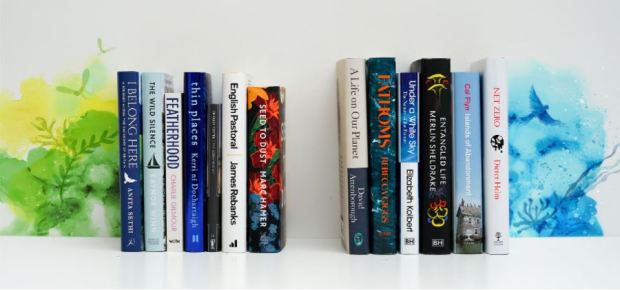
Unfortunately, my favourite from the lists, Vesper Flights by Helen Macdonald, did not make it through to the final round. To some extent it was a victim of the new division into two prizes: the idea seems to be to separate the narrative-driven, personal writing from the scientific, environmentally minded nonfiction. Books that draw on both genres, like Macdonald’s essays this year, and Tim Dee’s and Kathleen Jamie’s excellent travelogues (Greenery and Surfacing) last year, fall into the gap.
Since the shortlist announcement, I’ve read more of Islands of Abandonment by Cal Flyn and started Fathoms by Rebecca Giggs. Both are exceptionally written and impressive in scope, but as her portraits of the world’s derelict places have truly captivated my imagination, I stand by my initial prediction that Cal Flyn will win the global conservation prize.

As for the nature writing prize, I’m torn: The book that I think is of most lasting UK importance, with vital lessons to teach, is English Pastoral by James Rebanks. By contrast, the book that I wholeheartedly loved and admired was Featherhood by Charlie Gilmour. I’d be happy to see either one win.


Women’s Prize
Like last year, the winner announcement was delayed by several months, giving me time to forget all about it. Back in April I was very invested in the race (see my thoughts on the longlist; my wish list correctly predicted four of the six on the shortlist), and since then I’ve read and enjoyed a couple more from the longlist.
I predicted it would be Women’s Prize fodder when I read it back in June 2020, and I still think it the safest, strongest contender: The Vanishing Half by Brit Bennett. It’s easy to see this following in the footsteps of An American Marriage: a book club book concerned with race and relationships.
So that’s what I think will win, whereas I marginally preferred the superficially similar but subtler Transcendent Kingdom by Yaa Gyasi and would like to see its author get some recognition, so that’s what should win.


Next prize to think about: The Booker, whose shortlist will be announced on the 14th. On the 13th I’ll give my thoughts on the longlisted novels that I’ve read so far.
 Bookish Beck = Rebecca Foster. American transplant to England. Freelance proofreader and book reviewer.
