From the Dylan Thomas Prize Shortlist: Seven Steeples & I’m a Fan
The Swansea University International Dylan Thomas Prize recognizes the best published work in the English language written by an author aged 39 or under. All literary genres are eligible, so the shortlist contains a poetry collection as well as novels and short stories.

I’ve read half of the shortlist (also including Warsan Shire’s poems) and would be interested in trying the rest if I can source the two short story collections; Limberlost is at my library. The winner will be announced at 8 p.m. BST on Thursday 11 May.
Seven Steeples by Sara Baume
Isabel and Simon arrive one January at a shabby rental house in coastal Ireland overlooked by a mountain, in the middle of nowhere. They’d been menial workers in Dublin and met climbing a mountain, but somehow never seem to get around to climbing their new local peak. In moving here, these “two solitary misanthropes” are essentially rejecting society and kin; Baume describes them as “post-family.” It appears that they’re post-employment as well – there is never a single reference to how they pay the rent and buy the hipster foods they favour. Could young people’s savings really fund eight years’ rural living?
It’s an appealingly anti-consumerist vision, anyway: They arrive with one van-load of stuff and their adopted dogs, Pip and Voss, and otherwise make do with a haphazard collection of secondhand belongings left by previous tenants or donated by their estranged families. The house starts to fall apart around them, but for the most part they adjust to the decay rather than do anything to reverse it. “They had become poor and shabby without noticing … accustomed to disrepair”; theirs is a “personalized squalor.”
 Bell and Sigh become increasingly hermit-like, with entrenched ways of doing things. Baume several times describes their compost bin, which struck me as a perfect image for how the stuff of daily life builds up and beds down into the foundation of personalities and a relationship. The fact that they only have each other (and the dogs) for company explains how they adopt each other’s mannerisms, develop a private language, and even conflate their separate memories. The starkest symbol of their refusal of societal norms comes when they miss a clock change and effectively live in their own time zone.
I recognized from Spill Simmer Falter Wither and handiwork several elements that reflect Baume’s interests: nature imagery, dogs, and daily routines. She gives a clear sense of time’s passage and the seasons’ turning, of repetition and attrition and ageing. I wearied of the descriptive passages and hoped that at some point there would be some action and dialogue to counterbalance them, but that is not what this novel is about. Occasional flashes from the point-of-view of a mouse in the house, or a spider in the van, tell you that Baume’s scope is wider. This is in fact an allegory about impermanence, from a mountain’s-eye view.
Although I was frustrated with the central characters’ jolly incompetence (“Just buy leashes and a tick twister, you idiots!” I felt like shouting at them after yet another mention of the dogs killing cats and rabbits; and of the difficulty of removing ticks from their coats), I recognized how easy it is to get stuck in lazy habits; how easy it is to live provisionally, as if all is temporary and not your real existence.
Baume spaces lines and paragraphs almost like hybrid poetry and indulges in overwriting in places. Because of the dearth of action, this was a slog of a months-long read for me, but I admired it in the end and enjoyed it more than the other two books of hers that I’ve read.
If you admire lyrical prose and are okay with little to no plot in a novel, you should get on fine with this one. Or it might be that it requires the right time or reading mood, when you’re after something quiet.
Having read more by Dylan Thomas now, I think this is exactly the sort of place-specific and playful, stylized prose that the prize named after him is looking for. So, I’ll predict Baume as the winner.

With thanks to Tramp Press for the free e-copy for review.
I’m a Fan by Sheena Patel
This was one of my correct predictions for the Women’s Prize longlist; I’d heard a lot about it from Best of 2022 roundups and it seemed like the kind of edgy title they might recognise. It’s also perfect for the Dylan Thomas Prize list because of how voice-driven it is. The unnamed narrator, a woman of colour in her early thirties, muses on art, entitlement, obsession, social media and sex in short titled sections ranging from one paragraph to a few pages long. The twin objects of her fanaticism are “the man I want to be with,” who is married and generally keeps her at arm’s length, and “the woman I am obsessed with,” a lifestyle influencer who, like herself, is one of this man’s girlfriends on the side. She stalks the woman via her impeccably curated Instagram images.
 The narrator has a boyfriend, in fact, a peculiarly perfect-sounding one even, but takes him for granted in her compulsive search for indiscriminate sexual experience (also including a female co-worker she calls “the Peach”). They end up parting ways and she moves back in with her parents, an ignominious retreat from attempted adulting.
She reminded me a bit of Bell and Sigh for her haplessness, but whereas the matter of having children literally never arises for them, the question of motherhood is a background niggle for her (“I thought I had the rest of my life to make this decision but I realise I am on a clock and it runs differently for me. I am female. There was never much time and I’ve wasted so much already”; “I want to gain immortality because of my brain and not because of the potential of my womb”). As the novella goes on, she even considers weaponising her fertility as a way of entrapping her crush.
I was reasonably engaged with the narrator’s deliberations about taste and autobiographical influences, but overall found this rather indulgent, slight and repetitive. Books about social media – this reminded me most of Adults by Emma Jane Unsworth – are in danger of becoming irrelevant all too quickly. The sexual frankness fell on the wrong side of unpleasant for me, and the format for referring to other characters leads to inelegant phrasing like “The man I want to be with’s work centres around conflict”. Something like Luster has that little bit more individuality and energy. (Secondhand – charity shop purchase)

Northumberland Trip, Book Haul, and Reading & 20 Books #9 Emerald
We spent the first 11 days of July on holiday in Northumberland (via stays with friends in York on the way up and back) – our longest spell of vacation since 2016, and our longest UK break since 2013. The trip also happened to coincide with our 14th anniversary. It was a fantastic time of exploring England’s northeast corner, a region new to me. I loved the many different types of landscape, from sandy beaches and rocky coasts and islands to moorland and lovely towns. It’s the county for you if you like castles. We joined the National Trust so we could make stops at lots of stately homes and other historic sites. Some highlights were:
- Cherryburn, the off-the-beaten-track home of engraver Thomas Bewick.
- A cheap and delicious meal of authentic Mexican street food in Hexham, of all places (at Little Mexico).
- Walking along a tiny fraction of Hadrian’s Wall from Housesteads Roman Fort.


- Cragside, the over-the-top home of a Victorian inventor (and the first international arms dealer – whoops), nestled in a plantation of pines and rhododendrons.
- A boat trip to the Farne Islands with a landing on Inner Farne, giving close-up views of puffins, other seabirds, and grey seals. We also sailed past the lighthouse made famous by Grace Darling’s rescue of shipwreck victims in 1838. (Relevant song by Duke Special, by way of a Michael Longley poem.)
- Whiling away a rainy morning in Barter Books, one of Britain’s largest secondhand bookshops (located in an old Victorian railway station), and the charity shops of Alnwick.
- An adventurous (and very wet) walk along the coast to the Dunstanburgh Castle ruin.


- Searching the dunes for rare orchids on Holy Island, followed by a delicious and largely vegan lunch at Pilgrims Coffee House.
- Another seabird-filled boat trip, this one round Coquet Island. Sightings included roseate terns and the Duke of Northumberland.
- Our second Airbnb, The Lonnen (near Rothbury), was a rural idyll shared mostly with sheep and gray wagtails. We were spoiled by Ruth’s excellent interior décor and cooked breakfasts. You can get a feel for the place via her Instagram.
- Coffee and snacks at Corbridge Larder’s Heron Café – so good we made a second trip.


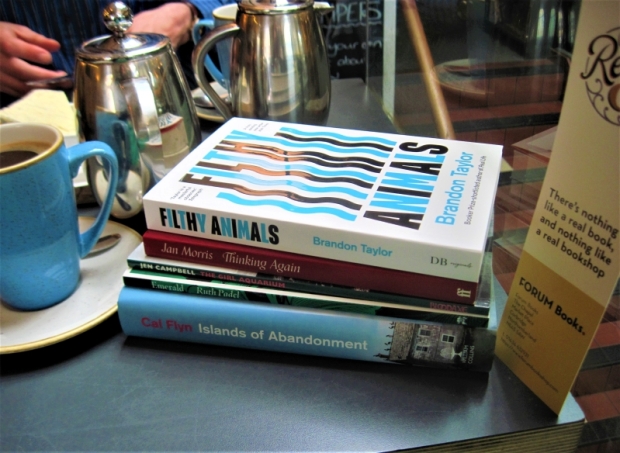
It was also, half unexpectedly, a week filled with book shopping. First up was Forum Books in Corbridge, a lovely independent bookshop. I don’t often buy new books, so enjoyed the splurge here. The Flyn and Taylor were two of my most anticipated releases of 2021. It felt appropriate to pick up a Bloodaxe poetry title as the publisher is based in nearby Hexham.
Next came a bounteous charity shop haul in Hexham.

On the Tuesday we holed up in Barter Books for hours while it rained – and the queue lengthened – outside. I was surprised and delighted that the nine antiquarian books I resold to Barter more than paid for my purchases, leaving me in credit to spend another time (online if, as seems likely, I don’t get back up in person anytime soon).


Alnwick also has a number of charity shops. I had the most luck at the Lions bookshop.

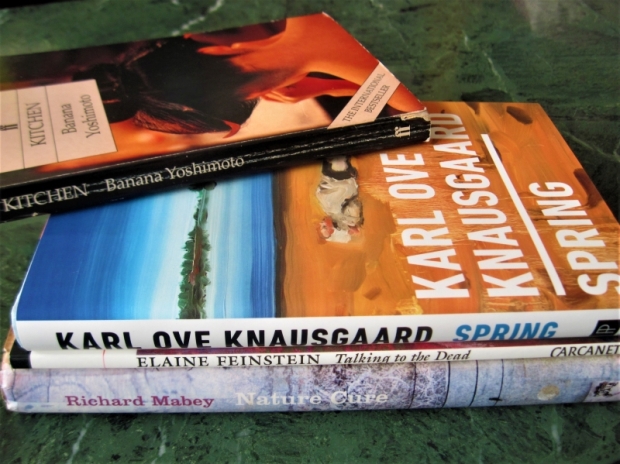
I seemed to keep finding books wherever I went. Kitchen came from a bookshelf in a shop/café on Holy Island. A secondhand/remainders shop near York Minster was the source of the other three.
What I Read:
The holiday involved significant car journeys as Northumberland is a big county with an hour or more between destinations. Alongside my navigating and DJ duties, I got a lot of reading done during the days, as well as in the evenings.
Finished second half or so of:
 Phosphorescence by Julia Baird – An intriguing if somewhat scattered hybrid: a self-help memoir with nature themes. Many female-authored nature books I’ve read recently (Wintering, A Still Life, Rooted) have emphasized paying attention and courting a sense of wonder. To cope with recurring abdominal cancer, Baird turned to swimming at the Australian coast and to faith. Indeed, I was surprised by how deeply she delves into Christianity here. She was involved in the campaign for the ordination of women and supports LGBTQ rights.
 Open House by Elizabeth Berg – When her husband leaves, Sam goes off the rails in minor and amusing ways: accepting a rotating cast of housemates, taking temp jobs at a laundromat and in telesales, and getting back onto the dating scene. I didn’t find Sam’s voice as fresh and funny as Berg probably thought it is, but this is as readable as any Oprah’s Book Club selection and kept me entertained on the plane ride back from America and the car trip up to York. It’s about finding joy in the everyday and not defining yourself by your relationships.
 Site Fidelity by Claire Boyles – I have yet to review this for BookBrowse, but can briefly tell you that it’s a terrific linked short story collection set on the sagebrush steppe of Colorado and featuring several generations of strong women. Boyles explores environmental threats to the area, like fracking, polluted rivers and an endangered bird species, but never with a heavy hand. It’s a different picture than what we usually get of the American West, and the characters shine. The book reminded me most of Love Medicine by Louise Erdrich.
 Every Minute Is a Day by Robert Meyer, MD and Dan Koeppel – The Bronx’s Montefiore Medical Center serves an ethnically diverse community of the working poor. Between March and September 2020, it had 6,000 Covid-19 patients cross the threshold. Nearly 1,000 of them would die. Unfolding in real time, this is an emergency room doctor’s diary as compiled from interviews and correspondence by his journalist cousin. (Coming out on August 3rd. Reviewed for Shelf Awareness.)
 Virga by Shin Yu Pai – Yoga and Zen Buddhism are major elements in this tenth collection by a Chinese American poet based in Washington. She reflects on her family history and a friend’s death as well as the process of making art, such as a project of crafting 108 clay reliquary boxes. “The uncarved block,” a standout, contrasts the artist’s vision with the impossibility of perfection. The title refers to a weather phenomenon in which rain never reaches the ground because the air is too hot. (Coming out on August 1st.)
Read most or all of:
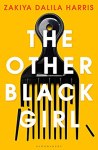 The Other Black Girl by Zakiya Dalila Harris – I feel like I’m the last person on Earth to read this buzzy book, so there’s no point recounting the plot, which initially is reminiscent of Luster by Raven Leilani but morphs into its own thing as Nella realizes her rivalry with Hazel, her new Black colleague at Wagner Books, is evidence of a wider social experiment. The prose is hip, bringing to mind Queenie and Such a Fun Age. It was a fun road trip read for me, but I could have done without the silliness of magical hair care products.
 Heartstopper, Volume 1 by Alice Oseman – It’s well known at Truham boys’ school that Charlie is gay. Luckily, the bullying has stopped and the others accept him. Nick, who sits next to Charlie in homeroom, even invites him to join the rugby team. Charlie is smitten right away, but it takes longer for Nick, who’s only ever liked girls before, to sort out his feelings. This black-and-white YA graphic novel is pure sweetness, taking me right back to the days of high school crushes. I raced through and placed holds on the other three volumes.
 The Vacationers by Emma Straub – Perfect summer reading; perfect holiday reading. Like Jami Attenberg, Straub writes great dysfunctional family novels featuring characters so flawed and real you can’t help but love and laugh at them. Here, Franny and Jim Post borrow a friend’s home in Mallorca for two weeks, hoping sun and relaxation will temper the memory of Jim’s affair. Franny’s gay best friend and his husband, soon to adopt a baby, come along. Amid tennis lessons, swims and gourmet meals, secrets and resentment simmer.
 Kitchen by Banana Yoshimoto – A pair of poignant stories of loss and what gets you through. In the title novella, after the death of the grandmother who raised her, Mikage takes refuge with her friend Yuichi and his mother (once father), Eriko, a trans woman who runs a nightclub. Mikage becomes obsessed with cooking: kitchens are her safe place and food her love language. Moonlight Shadow, half the length, repeats the bereavement theme but has a magic realist air as Satsuki meets someone who lets her see her dead boyfriend again.
I also made a good start on a few of my other purchases from the trip: Islands of Abandonment, No Time to Spare, Filthy Animals, and Female Friends.
Alas, most of the in-demand library books I brought along with me – Great Circle by Maggie Shipstead, Malibu Rising by Taylor Jenkins Reid, and Still Life by Sarah Winman – didn’t hit the spot, so I’ve returned them unread and will borrow them at another point later in the year (except Malibu Rising, which felt soapy and insubstantial).
It’s been a struggle getting back into the routines of work and writing since we got back, but I’ve managed to review one more of my 20 Books of Summer. This is #9, slipped in from my Forum Books pile, and I’m currently working on books #10–13.
Emerald by Ruth Padel (2018)
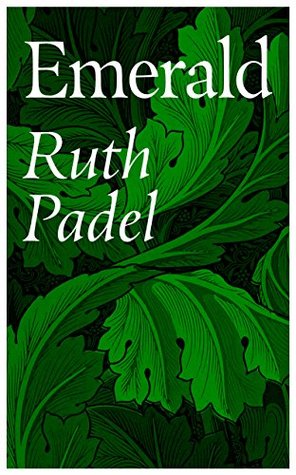 This was my 11th book from Padel; I’ve read a mixture of her poetry, fiction, narrative nonfiction and poetry criticism. Emerald consists mostly of poems in memory of her mother, Hilda, who died in 2017 at the age of 97. The book pivots on her mother’s death, remembering the before (family stories, her little ways, moving her into sheltered accommodation when she was 91, sitting vigil at her deathbed) and the letdown of after. It made a good follow-on to one I reviewed last month, Kate Mosse’s An Extra Pair of Hands.
Emerald, the hue and the gemstone, recurs frequently in ornate imagery of verdant outdoor scenes and expensive art objects. Two favourites were travel-based: “Jaipur,” about the emerald-cutters of India, where Padel guiltily flew while her mother was ill; and “Salon Noir,” about a trip down into prehistoric caves of France the summer after Hilda’s death. Overall, I expected the book to resonate with me more than it did. The bereavement narrative never broke through to touch me; it remained behind a silk screen of manners and form.
Two favourite stanzas:
“Your voice is your breath.
The first thing that’s yours
and the last.” (from “Fragile as Breath”)
“that’s all of us
sifting the dark
in our anonymities and hope.” (from “Above is the Same as Below”)
My rating:
Next books in progress: The Glitter in the Green by Jon Dunn and Nothing but Blue Sky by Kathleen MacMahon
An Embarrassment of Riches at the (Digital) Hay Festival 2021
There was a phenomenal program for this year’s digital Hay Festival. I signed up to a whopping eight events and enjoyed them all. If you missed watching live, it’s not too late to donate and catch up on the archived talks. For three of these, the host-cum-interviewer appeared in person on a studio stage, with the guest(s) joining, perhaps from thousands of miles away, on a large screen mounted on the wall behind them. I thought this was a neat hybrid approach. The rest of my sessions had interviewer and interviewee appearing remotely on a split screen. Let me know which, if any, events you attended and how you found them.
Richard Flanagan
Flanagan’s The Living Sea of Waking Dreams is my novel of 2021 so far (my review), so it was a delight to hear him say more (and in that fantastic accent) about it in the course of a conversation with Stephanie Merritt. Tasmania, where he lives, had always seemed like an ark for species, but now they are vanishing. Ninety percent of the kelp forest has disappeared within the last 20 years because of warming oceans; there are only 300 swift parrots remaining; and the bushfires of 2018–19 were unprecedented in severity. Although he had already roughed out the novel by the time of the fires, Flanagan said he rewrote it in response to the sense of accelerating environmental collapse.

The novel’s twin themes are species extinction and personal extinction, with an elderly family matriarch being kept alive at all costs. Flanagan spoke of the “evasions of the soul” that make us ignore the environmental losses around us and refuse to die – “the final avoidance of life.” He thinks the pandemic has forced people to rethink these ideas and ponder the meaning of life. At age 21, he nearly drowned while kayaking, and ever since he has been frightened not of death, but of the pain of dying. He is not optimistic per se, but hopeful because the world is still so beautiful – on the island he goes to for writing, he is surrounded by wild creatures.
 Merritt asked about the novel’s magic realist element and how stylistically different his novels have been from each other. He was glad she found the book funny, as “life is tragicomic.” In an effort not to get stuck in a rut, he deliberately ‘breaks the mould’ after each book and starts over. This has not made him popular with his publisher!
Three take-aways:
- The one obligation of a writer? “Not to be boring.”
- Novels are not about messages; “that’s what Twitter is for.”
- “To despair is rational, but to hope is the very essence of what it means to be human.”
Rachel Clarke interviewing Jim Down and Michael Rosen
All three authors have written books about the coronavirus pandemic (I have reviewed Clarke’s Breathtaking and Rosen’s Many Different Kinds of Love). Clarke said that the belief foundational to the NHS is that all lives have equal value, but as an ICU doctor Down found that the question of who would benefit most from the use of ventilation was creeping in as there was a risk that there would be more patients than there was equipment to treat them with. With decisions needing to be made very quickly, his hospital adopted the “three wise people” collaborative method. The element that often felt lost, however, was the patient’s wishes, since they might be unresponsive and no family or other visitors were around.

Rosen, who contracted Covid-19 in March 2020 and was in an induced coma for six weeks, included letters from his medical team in his book to give a 360° view of NHS treatment. He thinks of the NHS as being almost in the role of parents, giving altruistic care and support. “Tell the truth about herd immunity” was his pithy message to the government. He read the poem “These Are the Hands,” which he wrote for the 60th anniversary of the NHS, to close.


Bryan Washington and Raven Leilani
 Last year’s Dylan Thomas Prize winner interviewed this year’s winner, and it was clear that the mutual admiration was strong. Though I had mixed feelings about Luster (my review), I was blown away by this high-level intellectual discussion. Both authors are invested in the debate around what it means to be a Black artist. Leilani said she did not want to make concessions in the form of Edie comporting herself better; this character is open about her wants, giving the novel a libidinal flavour. She said she almost envies her protagonist her autonomy, and thinks of the novel as a letter to her old self, granting permission and reassuring herself that “the mess has merit.”

Three take-aways:
- Writing offers Leilani a sanctuary or sense of control.
- While Washington sees works full of strife, grief, and malice as most likely to be considered the pinnacle of American literary fiction, he admires Luster for its theme of communion (especially via the character Akila).
- Leilani sees her novel as being in conversation with Queenie, Sula, The New Me, and Detransition, Baby.
Maggie Shipstead
 Shipstead (also a Dylan Thomas Prize winner) echoed something Leilani had said: that she starts a novel with questions, not answers. Such humility is refreshing, and a sure way to avoid being preachy in fiction. Her new novel, Great Circle, is among my most anticipated books of the year and tells the stories of a fictional female pilot from the golden age of aviation and the actress playing her in a biopic. The book was long in the gestation: In 2012 Shipstead saw a sculpture commemorating a female pilot in Auckland, and in 2014 she started researching. She came to appreciate the miracle of flight and read many books by and about female pilots. The book is dedicated to her brother, recently retired from 20 years in the Air Force. She told Sameer Rahim that, although she used to say this is not a love story, she has since changed her mind.

Three take-aways:
- Shipstead was a competitive show jumper and applied to a creative writing program on a whim.
- She has made a name for herself as a travel writer, too, often combining magazine assignments with her research for the novel (e.g., various trips to Antarctica).
- While she has appreciated the year off from Covid, she is looking forward to getting back to travelling; her first booking is a women’s wilderness experience in Alaska.
Patricia Lockwood
 Lockwood is the only novelist to be included on the Atlantic’s roster of best tweets. She and Nina Stibbe, who interviewed her, agreed that 1) things aren’t funny when they try too hard and 2) the Internet used to be a taboo subject for fiction – producing time-stamped references that editors used to remove. “I had so many observations and I didn’t know where to put them,” Lockwood said, and it seems to her perverse to not write about something that is such a major part of our daily lives. The title of her Women’s Prize-shortlisted novel, No One Is Talking About This (my review), refers to many things, including this reticence to grant the Internet a place in our discourse.

Lockwood said she has been delighted by the high-quality literary pieces coming out about her book, often in comparison with Lauren Oyler’s Fake Accounts. The timing of the publication meant that her initial (U.S.) media interviews ended up being more about Trump than she would have liked. “I think I’m not a natural fiction writer,” she said; it’s true that the novel is so autobiographical it can only be described as autofiction – the second half is all true and all sincere, she was careful to point out – but it’s a gem.
Julianne Pachico
 Like Lockwood, Pachico was part of the “10 @ 10” series featuring debut novelists (though her first book, the linked story collection The Lucky Ones, was marketed as a novel in the USA). Her new book, The Anthill, another of my most anticipated books of the year, is about a young woman returning to Medellín, Colombia, where Pachico spent her formative years. Although she is not a citizen and only goes back on a tourist visa, it feels like going home each time. For her, writing fiction has been a way of sorting out her feelings about the place. She wrote 50,000 words of the novel at her sister’s apartment in Medellín. Pachico told Rosie Goldsmith that, though she considers herself part of the Latin American literary tradition, she is conscious of presenting the country to English-speaking readers: a politically divided place that has gentrified in pockets, but is still plagued by extreme poverty and hardship. She described The Anthill as “a ghost story without ghosts.” I can’t wait to dive into my copy.

Brit Bennett
 Speaking to Arifa Akbar about The Vanishing Half, Bennett admitted that she was worried a historical setting was a cop-out, but reassured herself that she was not writing out of nostalgia and that she did not allow readers a sense of distance – the characters are so ordinary that we know we’d do the same sorts of things. She thinks of passing as a distinctly American project of self-reinvention but acknowledged that we have no definitive statistics on it because, if someone succeeds, they disappear. Some of Stella’s psychology – a very interior character who makes decisions that are difficult to understand – came from her reading of Playing Dead by Elizabeth Greenwood. She loves writing about small towns because they force people to interact with each other. Akbar noted that passing is a double-edged sword, involving subterfuge but also offering liberation (e.g. for a trans character later in the book).

Three take-aways:
- “That’s the most exciting place to be, writing into a mystery.”
- “Race is a fiction, but racism is a reality.”
- An HBO adaptation is in the works, but Bennett doesn’t know if it will cast real twins, two actors, or meld separate people using CGI.
Rachel Cusk and Sheila Heti
 I’ve read more of and gotten on better with Heti’s work than Cusk’s, so this was a rare case of being perhaps more interested in interviewer than interviewee. Heti said that, compared with the Outline trilogy, Cusk’s new novel Second Place feels wilder and more instinctual. Cusk, speaking from the Greek island of Tinos, where she is researching marble quarrying, described her book in often vague yet overall intriguing terms: it’s about exile and the illicit, she said; about femininity and entitlement to speak; about the domestic space and how things are legitimized; about the adoption of male values and the “rightness of the artist.”

Ironically, given that Cusk initially hesitated over revealing her debt to Mabel Dodge Luhan’s memoir Lorenzo in Taos, much of the discussion ended up revolving around Luhan and D.H. Lawrence, about whom Cusk now considers herself an amateur scholar. In his personal writings he reserved special scorn for Luhan, with whom he stayed in New Mexico in the 1920s. This was something Cusk wanted to explore: misogyny and Luhan’s “voice of obscurity.” She hopes that her book will contribute to a better understanding of Luhan’s; not vice versa.
Three take-aways:
- A reviewer noted the use of exclamation points, counting 189 of them in the novel. Cusk equates an exclamation point to a laying down of arms – proof that someone (especially her protagonist, M) means to be nonthreatening.
- Cusk thinks of this book as being like a play: staged and in the moment.
- A woman observing but not being noticed is, like in the Outline trilogy, Cusk’s basic framework.
Review Book Catch-Up: Ante, Evans, Foster and White
Today I have a book of poems about the Filipinx experience in the UK, a collection of short stories reflecting on racial injustice, a monograph on a bird that spells summer for many of us, and a biographical investigation into a little-understood medical condition.
Antiemetic for Homesickness by Romalyn Ante
I was drawn to this debut collection by the terrific title and cover, but also by the accolades it received: it was on the Dylan Thomas Prize longlist and the Jhalak Prize shortlist. I hope we’ll see it on the Sunday Times Young Writer of the Year Award shortlist, too. Ante grew up in the Philippines but at age 16 joined her mother in the UK, where she had moved years before to work as a nurse in the NHS. She has since followed in her mother’s footsteps as a nurse – indeed, overseas Filipinx workers (Jamaicans, too) are a mainstay of the NHS.
 Ante remembers the years when her mother was absent but promised to send for the rest of the family soon: “You said all I needed to do was to sleep and before I knew it, / you’d be back. But I woke to the rice that needed rinsing, / my siblings’ school uniforms that needed ironing.” The medical profession as a family legacy and noble calling is a strong element of these poems, especially in “Invisible Women,” an ode to the “goddesses of caring and tending” who walk the halls of any hospital. Hard work is a matter of survival, and family – whether physically present or not – bolsters weary souls. A series of short, untitled poems are presented as tape recordings made for her mother.
Food is inextricably entwined with memory (reminding me of Nina Mingya Powles’s approach in Tiny Moons) and provides some of the standout metaphors, especially in “Patis” and “Ode to a Pot Noodle.” Ante uses a lot of alliteration and adapts various forms. I especially liked “Tagay!”, a traditional drinking song, and “Mateo,” printed in the shape of a pound sign. The nuanced look at the immigrant experience reminded me of Jenny Xie’s Eye Level. Movement entails losses as well as benefits. The focus on the Filipinx experience also made me think of America Is Not the Heart. My favourite single poem was “The Making of a Smuggler,” which opens “Wherever we travel, we carry / the whole country with us – // our rice terraces are folded garments, / we have pillars of trees, a rainforest // on a hairbrush.”
Favourite lines:
“Gone are the nights he steals / the moon with a mango picker / and swaps it for her pocket mirror”
“The yellow admission papers in my hands escaped / flustering at my face into a flight of orioles.”
“I am halved in order to be whole – / I rebuild by leaving / everything I love.”
With thanks to Chatto & Windus for the free copy for review.
The Office of Historical Corrections by Danielle Evans
To boil these six stories and a novella down to the topic of race in America risks painting them as solemn or strident – more concerned with meaning than with art – when the truth is that they are playful and propulsive even though they keep cycling back to bereavement and injustice. Several of the protagonists are young Black women coming to terms with a loss.
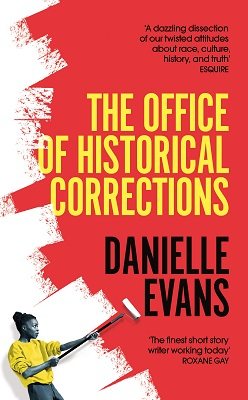 In “Happily Ever After,” Lyssa works in the gift shop of a Titanic replica and is cast as an extra in a pop star’s music video. Mythical sea monsters are contrasted with the real dangers of her life, like cancer and racism. “Anything Could Disappear” was a favourite of mine, though it begins with that unlikely scenario of a single woman acquiring a baby as if by magic. What starts off as a burden becomes a bond she can’t bear to let go. A family is determined to clear the name of their falsely imprisoned ancestor in “Alcatraz.” In “Richard of York Gave Battle in Vain” (a mnemonic for the colours of the rainbow), photojournalist Rena is wary about attending the wedding of a friend she met when their plane was detained in Africa some years ago. The only wedding she’s been in is her sister’s, which ended badly.
Mistakes and deceit seem to follow these characters. In the title novella that closes the book, Cassie and her colleagues combat fake news, going around putting correction labels on plaques that whitewash history. When she and her former colleague meet up in Wisconsin to find the truth behind a complex correction case, a clash with a white supremacist group quickly turns pedantry into a matter of life and death. The story I’d heard the most about beforehand was “Boys Go to Jupiter,” about a college girl who dons a Confederate flag bikini, not caring what message it sends to others in her dorm. It turns out she has history with a Black family, but has chosen to airbrush this experience out of her life.
There was only one story I didn’t care for, “Why Won’t Women Just Say What They Want,” about a celebrity who turns apologizing into performance art. Overall, this is a very strong collection I would recommend to readers of Brit Bennett and Raven Leilani, with some stories also reminding me of recent work by Curtis Sittenfeld and Mary South. I’ll be sure to seek out Evans’s previous book (also short stories), too.
With thanks to Picador for the proof copy for review.
The Screaming Sky by Charles Foster
The other week I was volunteering at our local community garden and looked up to see a dozen common swifts wheeling over the Kennet & Avon canal and picking off insects among the treetops. I hope this fellow Foster (for whom my husband was once confused on a nature conference attendee list) would be proud of me for pausing to gaze at the birds for a while. My impression of the author is as a misanthropic eccentric. A Renaissance man as well versed in law and theology as he is in natural history, he’s obsessed with swifts and ashamed of his own species: for looking down at their feet when they could be watching the skies; for the “pathological tidiness” that leaves swifts and so many other creatures no place to live.
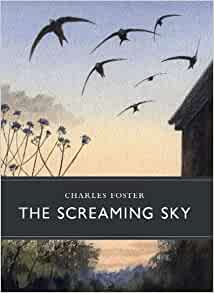 The obsession began when he was eight years old and someone brought him a dead swift fledgling for his taxidermy hobby. Ever since, he’s dated the summer by their arrival. “It is always summer for them,” though, as his opening line has it. This monograph is structured chronologically. Much like Tim Dee does in Greenery, Foster follows the birds for a year: from their winter territory in Africa to the edges of Europe in spring and then to his very own Oxford street in high summer. When they leave, he’s bereft and ready to book a flight back to Africa.
Along the way, Foster delivers heaps of information: the fossil evidence of swifts, how they know where to migrate (we have various theories but don’t really know), their nesting habits and lifespan, and the typical fates of those individuals that don’t survive. But, thumbing his nose at his “ex-friend” (a closed-minded biologist he repeatedly, and delightfully, rails against), he refuses to stick to a just-the-facts approach. Acknowledging the risks of anthropomorphizing, he speaks of swifts as symbols of aspiration, of life lived with intensity. He believes that we can understand animal emotions analogously through our own, so that, inappropriate as such words might seem, we can talk about what birds hope and plan for. He scorns reductive ecosystem services lingo that defines creatures by what we get out of them.
Also like Dee, Foster quotes frequently from poetry. His prose is full of sharp turns of phrase and moments of whimsy and made me eager to try more of his work (I know the most about but have not yet read Being a Beast).
Swifts know the roar of lions better than the roar of the M25, the piping of hornbills better than the Nunc Dimittis of parish Evensong … Are memories of our eaves spiralling high above the Gulf of Guinea? … They don’t seem to prevaricate. One moment they’re there, the next they’re off, diving straight into the journey. It’s the way we should run into cold water.
 As I’ve found with a number of Little Toller releases now (On Silbury Hill, Snow, Landfill), knowledge meets passion to create a book that could make an aficionado of the most casual of readers. Towards the close I was also reminded of Richard Smyth’s An Indifference of Birds: “When Homo sapiens has gone there will be lots of ideal swift holes in the decaying buildings we’ll leave behind.” It’s comforting to think of natural cycles continuing after we’re gone … but let’s start making the space for them now. Jonathan Pomroy’s black-and-white illustrations of swift behaviour only add to this short book’s charms.
With thanks to Little Toller Books for the free copy for review.
Waiting for Superman: One Family’s Struggle to Survive – and Cure – Chronic Fatigue Syndrome by Tracie White
Like Suzanne O’Sullivan’s books (most recently, The Sleeping Beauties), this is presented as an investigation into a medical mystery. White, a Stanford Medicine journalist, focuses on one family that has been indelibly changed by chronic fatigue syndrome – now linked with myalgic encephalomyelitis and termed ME/CFS for short. Whitney Dafoe was a world traveller and promising photographer before, in 2010, a diagnosis of ME/CFS explained his exhaustion and gastrointestinal problems. By the time White first met the family in 2016, the thirtysomething was bedbound in his parents’ home with a feeding tube, only able to communicate via gestures and rearranging Scrabble tiles. He couldn’t bear loud noises, or to be touched. At times he was nearly comatose.
 Whitney’s father, Ron Davis, is a Stanford geneticist whose research has contributed to the Human Genome Project. He has devoted himself to studying ME/CFS, which affects 20 million people worldwide yet receives little research funding; he calls it “the last major disease we know nothing about.” Testing his son’s blood, he found a problem with the citric acid cycle that produces ATP, essential fuel for the body’s cells – proof that there was a physiological reason for Whitney’s condition. Frustratingly, though, a Stanford colleague who examined Whitney prescribed a psychological intervention. This is in line with the current standard of care for ME/CFS: a graded exercise regime (nigh on impossible for someone who can’t get out of bed) and cognitive behavioural therapy.
White delves into Whitney’s past, looking for clues to what could have triggered his illness (having mono in high school? a parasite he picked up in India?). She also goes back to the mid-1980s to consider the Lake Tahoe outbreak of ME/CFS, whose victims “looked too healthy to be sick and were repeatedly disbelieved.” The media called it “yuppie flu,” downplaying the extreme fatigue involved. White also meets Laura Hillenbrand, author of Seabiscuit, who suffers from ME/CFS and managed to write her bestselling books from bed. Like Whitney, she only has a certain allotment of energy and mustn’t use it up too fast.
- A neat connection: Stephanie Land, author of Maid, was Whitney’s ex-girlfriend when he was 19 and living in Alaska; she wrote a Longreads article about their relationship.
- The title is from a Flaming Lips lyric and expresses Whitney’s trust in his dad’s ability to cure him; the U.S. title is The Puzzle Solver and the working title was The Invisible Patient.
With thanks to Atlantic Books for the free copy for review.
Would you be interested in reading one or more of these?
The 2021 Dylan Thomas Prize Shortlist
The Swansea University International Dylan Thomas Prize recognizes the best published work in the English language written by an author aged 39 or under. All literary genres are eligible, so the longlist contained poetry collections as well as novels and short stories. Remaining on the shortlist are these six books (five novels and one short story collection; four of the works are debuts):
- Alligator and Other Stories by Dima Alzayat – Stories of the Syrian American experience.
- Kingdomtide by Rye Curtis – A novel about an elderly plane crash victim and the alcoholic park ranger who tries to find her. (See Annabel’s review.)
- The Death of Vivek Oji by Akwaeke Emezi – A coming-of-age story set in Nigeria.
- Pew by Catherine Lacey – A mysterious fable about a stranger showing up in a Southern town in the week before an annual ritual.
- Luster by Raven Leilani – A young Black woman and would-be painter negotiates a confusing romantic landscape and looks for meaning beyond dead-end jobs.
- My Dark Vanessa by Kate Elizabeth Russell – A nuanced look at the #MeToo phenomenon through the prism of one young woman’s relationship with her teacher.
It’s an American-dominated set this year, but, refreshingly, five of the six nominees are women or non-binary. I happen to have already read the last three of the novels on the list. I’m most keen to try Alligator and Other Stories and Kingdomtide and hope to still have a chance to read them. No review copies reached me in time, so today I’m giving an overview of the list.
This is never an easy prize to predict, but if I had to choose between the few that I’ve read, I would want Kate Elizabeth Russell to win for My Dark Vanessa.

(The remaining information in this post comes from the official Midas PR press release.)
The shortlist “was selected by a judging panel chaired by award-winning writer, publisher and co-director of the Jaipur Literature Festival Namita Gokhale, alongside founder and director of the Bradford Literature Festival Syima Aslam, poet Stephen Sexton, writer Joshua Ferris, and novelist and academic Francesca Rhydderch.
“This year’s winner will be revealed at a virtual ceremony on 13 May, the eve of International Dylan Thomas Day.”
Namita Gokhale, Chair of Judges, says: “We are thrilled to present this year’s extraordinary shortlist – it is truly a world-class writing showcase of the highest order from six exceptional young writers. I want to press each and every one of these bold, inventive and distinctive books into the hands of readers, and celebrate how they challenge preconceptions, ask new questions about how we define identity and our relationships, and how we live together in this world. Congratulations to these tremendously talented writers – they are master storytellers in every sense of the word.”
Francesca Rhydderch on Alligator and Other Stories by Dima Alzayat: “Dima Alzayat’s visceral, innovative Alligator & Other Stories marks the arrival of a major new talent. While the range of styles and stories is impressively broad, there is a unity of voice and tone here which must have been so very difficult to achieve, and a clear sense that all these disparate elements are part of an overriding, powerful examination of identity.”
Joshua Ferris on Kingdomtide by Rye Curtis: “Kingdomtide is a propulsively readable and frequently very funny book about the resources, personal and natural, necessary to survive a patently absurd world. The winning voice of Texas-native Cloris Waldrip artfully takes us through her eighty-eight-day ordeal in the wilds of Montana as the inimitable drunk and park ranger Debra Lewis searches for her. This fine novel combines the perfect modern yarn with something transcendent, lyrical and wise.”
Namita Gokhale on The Death of Vivek Oji by Akwaeke Emezi: “The Death of Vivek Oji by Akwaeke Emezi is a powerful novel that carries the authenticity of cultural and emotional context. The story unfolds brilliantly, with the prescient foreboding about Vivek Oji’s death already announced in the brief line that constitutes the opening chapter. Yet the suspense is paced and carefully maintained until the truth is finally communicated in the final chapter. A triumph of narrative craft.”


Francesca Rhydderch on Pew by Catherine Lacey: “In this brilliant novel Catherine Lacey shows herself to be completely unafraid as a writer, willing to tackle the uglier aspects of a fictional small town in America, where a stranger’s refusal to speak breeds paranoia and unease. Beautifully written, sharply observed, and sophisticated in its simplicity, Pew is a book I’m already thinking of as a modern classic.”
Syima Aslam on Luster by Raven Leilani: “Sharp and incisive, Luster speaks a fearless truth that takes no hostages. Leilani is unflinchingly observant about the realities of being a young, black woman in America today and revelatory when it comes to exploring unconventional family life and 21st-century adultery, in this darkly comic and strangely touching debut.”
Stephen Sexton on My Dark Vanessa by Kate Elizabeth Russell: “My Dark Vanessa is an articulate, uncompromising and compelling novel about abuse, its long trail of damage and its devastating iterations. In Vanessa, Russell introduces us to a character of immense complexity, whose rejection of victimhood—in favour of something more like love—is tragic and unforgettable. Timely, harrowing, of supreme emotional intelligence, My Dark Vanessa is the story of one girl; of many girls, and of the darknesses of Western literature.”
Book Serendipity, Mid-March to Early May 2021
In early April, the publisher Canongate ran a newsletter competition for one reader to win a stack of their recent releases. All you had to do was reply with your favourite word. On Twitter they gave a rundown of the most popular responses. Turning up several times each were petrichor, mellifluous, and oleaginous. Most frequent of all was serendipity: I was one of 15 to submit it! And one of those entries, but not mine, won. Anyway, fun little story there.
I call it Book Serendipity when two or more books that I read at the same time or in quick succession have something pretty bizarre in common. Because I have so many books on the go at once (usually 20‒30), I suppose I’m more prone to such incidents. I’ve realized that, of course, synchronicity is really the more apt word, but this branding has stuck.
The following are in roughly chronological order.
- A white peacock is mentioned in Indelicacy by Amina Cain and The Mermaid of Black Conch by Monique Roffey, both of which were on the 2021 Rathbones Folio Prize shortlist.

- Speaking of that Rathbones Folio Prize shortlist, four of the eight were paperbacks with French flaps.
- The main character takes ballet lessons in Indelicacy by Amina Cain and A Feather on the Breath of God by Sigrid Nunez.
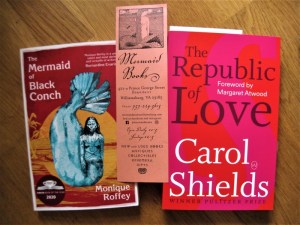
- Mermaids! A big theme in The Mermaid of Black Conch by Monique Roffey (of course) and The Republic of Love by Carol Shields, but they’re also mentioned in the opening story of The Office of Historical Corrections by Danielle Evans and are main characters in “The Pangs of Love” by Jane Gardam in the anthology Close Company.
- The Brothers Grimm story about brothers who have been transformed into swans and their sister who sews shirts out of nettles to turn them back is reworked in The Charmed Wife by Olga Grushin and used as a metaphor in Dusk, Night, Dawn by Anne Lamott.
- An electric carving knife is mentioned as a means of suicide (yipes!) in The Inevitable by Katie Engelhart and Woman on the Edge of Time by Marge Piercy.
- A discussion of the distinction between the fear of dying and the fear of being dead in This Party’s Dead by Erica Buist and The Inevitable by Katie Engelhart.
- Two novels in a row in which an older man is appalled by the squalor of his young girlfriend’s apartment, and she calls him “daddy” during sex (double yipes!), made the Dylan Thomas Prize shortlist: Luster by Raven Leilani and My Dark Vanessa by Kate Elizabeth Russell.
- Architect husbands in The Push by Ashley Audrain and The Art of Falling by Danielle McLaughlin (and, last year, in A Celibate Season by Blanche Howard and Carol Shields), as well as a female architect as a main character in The Living Sea of Waking Dreams by Richard Flanagan earlier this year.
- The next-to-last essay in the Trauma anthology quotes from The Bell Jar by Sylvia Plath, which I was also reading at the time.
- A mention of the eels in London absorbing cocaine from the Thames in the final essay in the Trauma anthology; I then moved right on to the last 40 pages of Nobody Is Talking About This by Patricia Lockwood and the same bizarre fact was mentioned. A week and a half later, there it was again, this time in Asylum Road by Olivia Sudjic.
- A mention of sailors’ habit of getting tattoos of swallows in The Circling Sky by Neil Ansell (who has a swallow tattoo, even though he’s not a sailor) and Birdsong in a Time of Silence by Steven Lovatt.

- A father and teenage child wander an unfamiliar city and enter a sex shop together (yipes yet again!) in Three O’Clock in the Morning by Gianrico Carofiglio and Ten Days by Austin Duffy.
- A mention of the same University of Virginia study in which people self-administered electric shocks to alleviate the boredom of sitting alone with their thoughts in Rooted by Lyanda Lynn Haupt and You’re Not Listening by Kate Murphy.
- Basho’s poetry and George Monbiot’s Feral are both cited in The Circling Sky by Neil Ansell and Rooted by Lyanda Lynn Haupt.
- A dead sister named Mattie in Consent by Annabel Lyon and Drowning Ruth by Christina Schwarz.

- A young Black female protagonist and the same family dynamic (the mother committed suicide and the father is in the Marines/Navy) in The Mothers by Brit Bennett and Luster by Raven Leilani.
- On the same night, I read about two pets encountering snow for the first time: a cat in Close Encounters of the Furred Kind by Tom Cox and a dog in Open Water by Caleb Azumah Nelson.
- A character is described as being as wide as they are tall in Mother for Dinner by Shalom Auslander and The Absolute Book by Elizabeth Knox.


- A character is known as Seventh in Mother for Dinner by Shalom Auslander and the story “The Pangs of Love” by Jane Gardam in the Close Company anthology. Plus, there’s Septimus in Mrs Dalloway by Virginia Woolf, which I’m reading concurrently with those two.
What’s the weirdest reading coincidence you’ve had lately?
Women’s Prize Longlist Reviews (Leilani, Lockwood, and Lyon) & Predictions
Tomorrow, Wednesday the 28th, the Women’s Prize shortlist will be revealed. I have read just over half of the longlist so far and have a few more of the nominees on order from the library – though I may cancel one or two of my holds if they don’t advance to the shortlist. Also, my neighbourhood book club has applied to be one of six reading groups shadowing the shortlist this year via a Reading Agency initiative. If I do say so myself, I think we put in a rather strong application. We’ll hear later this week if we’ve been chosen – fingers crossed!
The three longlisted novels I’ve read most recently were all by L authors:
Luster by Raven Leilani
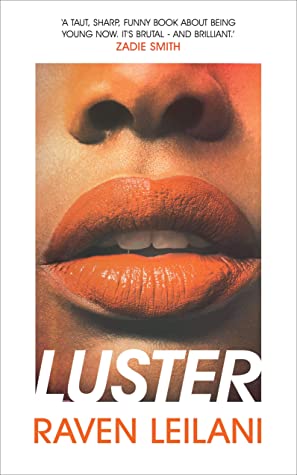 Edie’s voice is immediately engaging: cutting, funny, pithy. It reminded me of Ava’s in a fellow Women’s Prize nominee, Exciting Times, and both novels even employ a near-identical metaphor: “I wondered if Victoria was a real person or three Mitford sisters in a long coat” (Dolan) versus “all the kids stacked underneath my trench coat rejoice” (Leilani). They are also both concerned with how young women negotiate a confusing romantic landscape and look for meaning beyond a dead-end career. The African-American Edie’s entry-level work for a New York City publisher barely covers her rent at a squalid shared apartment. She’s shagged every male in the office and is now on to one she met online: Eric, a white, middle-aged archivist with an open marriage and a Black adopted daughter.
As Edie insinuates herself into Eric’s suburban New Jersey life in peculiar and sometimes unwitting ways, we learn more about her traumatic past: Both of her parents are dead, one by suicide, and she had an abortion at age 16. Along with sex, her main escape is her painting, which is described in tender detail. There are a number of amusing scenes set at off-the-wall locations, like a theme park, a clown school, and Comic Con. Leilani has a knack for capturing an entire realm of experience in just a few pages, as when she satirizes current publishing trends or encapsulates what it’s like to be a bicycle delivery person.
But, as a Goodreads acquaintance put it, all this sharp writing is rather wasted on the plot. I found the direction of the book in its second half utterly unrealistic, and never believed that Edie would have found Eric attractive in any way. (His interest in her is beyond creepy, really.) What I found most intriguing, along with the painting hobby, were Edie’s interactions with other Black characters, such as a publishing company colleague and Eric’s adopted daughter – there’s an uncomfortable sense that they should have a natural camaraderie and/or that Edie should be some kind of role model. I might have liked more of that dynamic, instead of the unbearable awkwardness of temporary instalment in a white neighbourhood. Other readalikes: Queenie, Here Is the Beehive, and On Beauty.
No One Is Talking About This by Patricia Lockwood
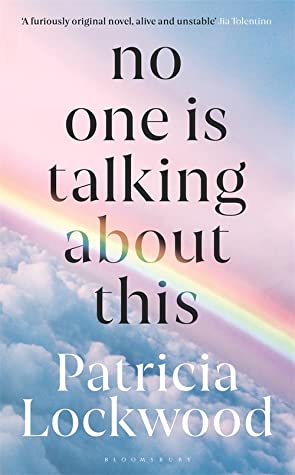 Priestdaddy is one of my absolute favourite books, so Lockwood’s debut novel was one of the 2021 releases I was most looking forward to reading. It took me a while to warm to, but ultimately did not disappoint. It probably helped that I was familiar with the author’s iconoclastic sense of humour. This is a work of third-person autofiction – much more so than I’d realized before I read the Acknowledgments – and to start with it feels like a flippant skewering of modern life, which for some is all about online personality and performance. A woman who became a social media star by tweeting quips like “Can a dog be twins?” reflects on life on “the portal” and under “the dictator.”
Midway through the book, she receives a wake-up call in the form of texts from her mother summoning her back to the Midwest for a family emergency. “It was a marvel how cleanly and completely this lifted her out of the stream of regular life.” Shit just got real, as they say. But “Would it change her?” she asks herself. Apparently, this very thing happened to Lockwood’s own family, which accounts for how heartfelt the second half is – still funny, but with an ache behind it, the same that I sensed and loved in Priestdaddy.
It is the about-face that makes this novel, forcing readers to question the value of a digital existence based on glib pretence. As the protagonist tells her students at one point, “Your attention is holy,” and with life so fragile there is no time to waste. What Lockwood is trying to do here is even bigger than that, though, I think. She mocks the whole idea of plot yet takes up the mantle of the “social novel,” as if creating a new format for the Internet-age novel in short, digestible sections. I’m not sure this is as earth-shattering as all that, but it is entertaining and deceptively deep. It also feels like a very current book, playing the role that Weather did in last year’s Women’s Prize race. (See my Goodreads review for more quotes, spoiler-y discussion, and why this book held personal poignancy for me.)
Consent by Annabel Lyon
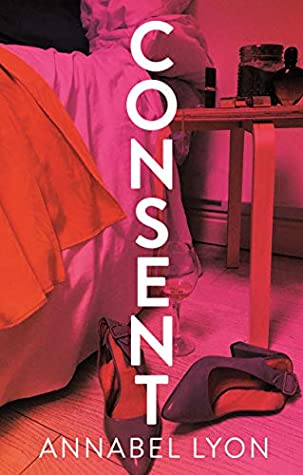 I’m always drawn to stories of sisters and this was an intriguing one, though the jacket text sets it up to be more of a thriller than it actually is. After their mother’s death, Sara, a medical ethicist, looks after Mattie, her intellectually disabled sister. When Mattie is lured into eloping, Sara’s protective instinct goes into overdrive. Meanwhile, Saskia, a graduate student in French literature, feels obliged to put her twin sister Jenny’s needs first after a car accident leaves Jenny in a coma. There are two decades separating the sets of sisters, but aspects of their experiences reverberate, with fashion, perfume, and alcoholism appearing as connecting elements even before a more concrete link emerges.
For much of the novel, Lyon bounces between the two storylines. I occasionally confused Sara and Saskia, but I think that’s part of the point (why else would an author select two S-a names?) – their stories overlap as they find themselves in the position of making decisions on behalf of an incapacitated sister. The title invites deliberation about how control is parcelled out in these parallel situations, but I’m not sure consent was the right word to encapsulate the whole plot; it seems to give too much importance to some fleeting sexual relationships.
At times I found Lyon’s prose repetitive or detached, but I enjoyed the overall dynamic and the medical threads. There are some stylish lines that land perfectly, like “There she goes … in her lovely coat, that cashmere-and-guilt blend so few can afford. That lovely perfume she trails, lilies and guilt.” The Vancouver setting and French–English bilingualism, not things I often encounter in fiction, were also welcome, and the last few chapters are killer.
The other nominees I’ve read, with ratings and links to reviews, are:
The Vanishing Half by Brit Bennett
Piranesi by Susanna Clarke
Exciting Times by Naoise Dolan
Transcendent Kingdom by Yaa Gyasi
Burnt Sugar by Avni Doshi
Unsettled Ground by Claire Fuller
The rest of the longlist is:
- Small Pleasures by Clare Chambers – I might read this from the library.
- The Golden Rule by Amanda Craig – I’d thought I’d give this one a miss, but I recently found a copy in a Little Free Library. My plan is to read it later in the year as part of a Patricia Highsmith kick, but I’ll move it up the stack if it makes the shortlist.
- Because of You by Dawn French – Not a chance. Right? Please!
- How the One-Armed Sister Sweeps Her House by Cherie Jones – A DNF; I would only try it again from the library if it was shortlisted.
- Nothing but Blue Sky by Kathleen MacMahon – I might read this from the library.
- Detransition, Baby by Torrey Peters – I will definitely read this from the library.
- Summer by Ali Smith – I struggle with her work and haven’t enjoyed this series; I would only read this if it was shortlisted and my book club was assigned it!
My ideal shortlist (a wish list based on my reading and what I still want to read):
- The Vanishing Half by Brit Bennett
- Piranesi by Susanna Clarke
- Exciting Times by Naoise Dolan
- Transcendent Kingdom by Yaa Gyasi
- No One Is Talking About This by Patricia Lockwood
- Detransition, Baby by Torrey Peters
vs.
My predicted shortlist and reasoning:
 The Vanishing Half by Brit Bennett – A dead cert. I’ve said so since I reviewed it in June 2020.
- Burnt Sugar by Avni Doshi – Others don’t seem to fancy Doshi’s chances, and it’s true that she was already shortlisted for the Booker, but I feel like this could be more unifying a choice for the judges than, e.g. Clarke or Lockwood.
- Transcendent Kingdom by Yaa Gyasi – Another definite.
- Luster by Raven Leilani – Not as strong as the Dolan, in my opinion, but it seems to have a lot of love from these judges (especially Vick Hope, who emphasized how perfectly it captured what it’s like to be young today), and from critics generally.
- Detransition, Baby by Torrey Peters – Ordinarily I would have said the Prize is too staid to shortlist a trans author, but after all the online abuse that has been directed at Peters, I think the judges will want to make a stand in support of her legitimacy.
- Summer by Ali Smith – The most establishment author on the list, and not one I generally care for, but this would be a way of recognizing the four-part Seasons opus and her work in general. Of the middle-aged white cohort, she seems most likely.
I will happily accept some mixture of my wished-for and predicted titles, and would be surprised if any of the five books I have not mentioned is shortlisted. (Though quite a few others are predicting that Claire Fuller will advance; I’d have no problem with that.) I don’t think my book club would get a say in which of the six titles we’d be sent to read for the shadowing project, which is risky as I may have already read it and not want to reread, or it may be a surprise nominee that I don’t want to read, but I’ll cross that bridge if we come to it.
Callum, Eric, Laura and Rachel have been posting lots of reviews and thoughts related to the Women’s Prize. Have a look at their blogs!
Rachel also produced a priceless spreadsheet of all the Prize nominees by year, so you can tick off the ones you’ve read. I’m up to 150 now!
Recent Literary Awards & Online Events: Folio Prize and Claire Fuller
Literary prize season is in full swing! The Women’s Prize longlist, revealed on the 10th, contained its usual mixture of the predictable and the unexpected. I correctly predicted six of the nominees, and happened to have already read seven of them, including Claire Fuller’s Unsettled Ground (more on this below). I’m currently reading another from the longlist, Luster by Raven Leilani, and I have four on order from the library. There are only four that I don’t plan to read, so I’ll be in a fairly good place to predict the shortlist (due out on April 28th). Laura and Rachel wrote detailed reaction posts on which there has been much chat.
Rathbones Folio Prize
This year I read almost the entire Rathbones Folio Prize shortlist because I was lucky enough to be sent the whole list to feature on my blog. The winner, which the Rathbones CEO said would stand as the “best work of literature for the year” out of 80 nominees, was announced on Wednesday in a very nicely put together half-hour online ceremony hosted by Razia Iqbal from the British Library. The Folio scheme also supports writers at all stages of their careers via a mentorship scheme.
It was fun to listen in as the three judges discussed their experience. “Now nonfiction to me seems like rock ‘n’ roll,” Roger Robinson said, “far more innovative than fiction and poetry.” (Though Sinéad Gleeson and Jon McGregor then stood up for the poetry and fiction, respectively.) But I think that was my first clue that the night was going to go as I’d hoped. McGregor spoke of the delight of getting “to read above the categories, looking for freshness, for excitement.” Gleeson said that in the end they had to choose “the book that moved us, that enthralled us.”
All eight authors had recorded short interview clips about their experience of lockdown and how they experiment with genre and form, and seven (all but Doireann Ní Ghríofa) were on screen for the live announcement. The winner of the £30,000 prize, author of an “exceptional, important” book and teller of “a story that had to be told,” was Carmen Maria Machado for In the Dream House. I was delighted with this result: it was my first choice and is one of the most remarkable memoirs I’ve read. I remember reading it on my Kindle on the way to and from Hungerford for a bookshop event in early March 2020 – my last live event and last train ride in over a year and counting, which only made the reading experience more memorable.

I like what McGregor had to say about the book in the media release: “In the Dream House has changed me – expanded me – as a reader and a person, and I’m not sure how much more we can ask of the books that we choose to celebrate.”
There are now only two previous Folio winners that I haven’t read, the memoir The Return by Hisham Matar and the novel Lost Children Archive by Valeria Luiselli, so I’d like to get those two out from the library soon and complete the set.
Other literary prizes
 The following day, the Dylan Thomas Prize shortlist was announced. Still in the running are two novels I’ve read and enjoyed, Pew by Catherine Lacey and My Dark Vanessa by Kate Elizabeth Russell, and one I’m currently reading (Luster). Of the rest, I’m particularly keen on Kingdomtide by Rye Curtis, and I would also like to read Alligator and Other Stories by Dima Alzayat. I’d love to see Russell win the whole thing. The announcement will be on May 13th. I hope to participate in a shortlist blog tour leading up to it.
I also tuned into the Edward Stanford Travel Writing Awards ceremony (on YouTube), which was unfortunately marred by sound issues. This year’s three awards went to women: Dervla Murphy (Edward Stanford Outstanding Contribution to Travel Writing), Anita King (Bradt Travel Guides New Travel Writer of the Year; you can read her personal piece on Syria here), and Taran N. Khan for Shadow City: A Woman Walks Kabul (Stanford Dolman Travel Book of the Year in association with the Authors’ Club).
Other prize races currently in progress that are worth keeping an eye on:
- The Jhalak Prize for writers of colour in Britain (I’ve read four from the longlist and would be interested in several others if I could get hold of them)
- The Republic of Consciousness Prize for work from small presses (I’ve read two; Doireann Ní Ghríofa gets another chance – fingers crossed for her)
- The Walter Scott Prize for historical fiction (next up for me: The Dictionary of Lost Words by Pip Williams, to review for BookBrowse)
Claire Fuller
Yesterday evening, I attended the digital book launch for Claire Fuller’s Unsettled Ground (my review will be coming soon). I’ve read all four of her novels and count her among my favorite contemporary writers. I spotted Eric Anderson and Ella Berthoud among the 200+ attendees, and Claire’s agent quoted from Susan’s review – “A new novel from Fuller is always something to celebrate”! Claire read a passage from the start of the novel that introduces the characters just as Dot starts to feel unwell. Uniquely for online events I’ve attended, we got a tour of the author’s writing room, with Alan the (female) cat asleep on the daybed behind her, and her librarian husband Tim helped keep an eye on the chat.
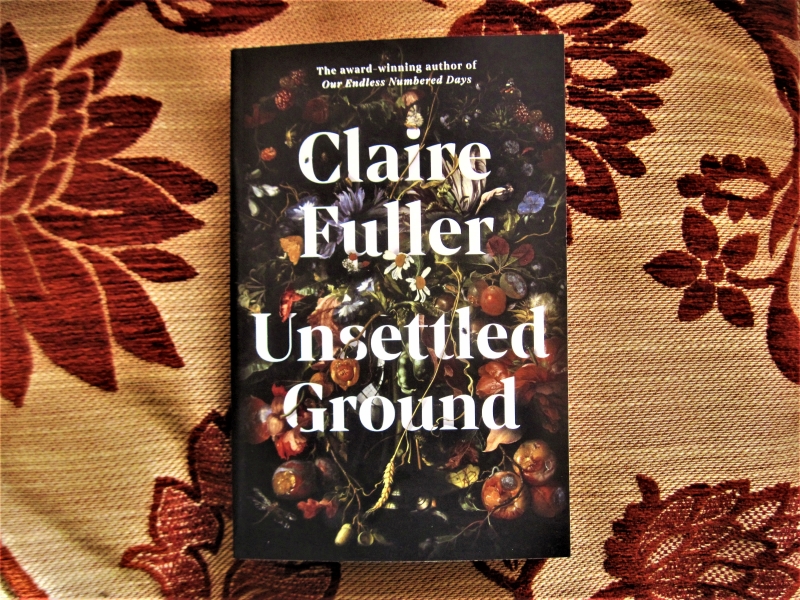
After each novel, as a treat to self, she buys a piece of art. This time, she commissioned a ceramic plate from Sophie Wilson with lines and images from the book painted on it. Live music was provided by her son Henry Ayling, who played acoustic guitar and sang “We Roamed through the Garden,” which, along with traditional folk song “Polly Vaughn,” are quoted in the novel and were Claire’s earworms for two years. There was also a competition to win a chocolate Easter egg, given to whoever came closest to guessing the length of the new novel in words. (It was somewhere around 89,000.)
Good news – she’s over halfway through Book 5!
 Bookish Beck = Rebecca Foster. American transplant to England. Freelance proofreader and book reviewer.
 Bookish Beck