I own too many unread books by…
A side effect of packing my library in preparation for moving: I’ve noticed there are certain authors whose works I tend to acquire secondhand and then stockpile rather than read. (I’ve also included in the tallies copies that I know are sitting in boxes in the USA.)
 D.H. Lawrence: 9+ (Aaron’s Rod, Kangaroo, The Lost Girl, The Plumed Serpent, a Complete Poems volume, Sea and Sardinia, a Selected Short Stories volume, Studies in Classic American Literature, The Woman Who Rode Away)
Lawrence was one of my research specialties as an undergraduate, so I read all his major works in my early twenties, as well as some lesser-known stuff, but haven’t felt compelled to pick up anything by him since. I’m not sure I’d care for him anymore, and it’s as if I don’t want to destroy the mystique. Yet I also can’t bring myself to get rid of these.
 T.C. Boyle: 7 (A Friend of the Earth, The Inner Circle, Riven Rock, The Tortilla Curtain, Water Music, The Women, World’s End)
I’ve read five of Boyle’s books and have had a mixed experience, but his plots – whether biographical (Alfred Kinsey! the wives and lovers of Frank Lloyd Wright!) or environmental – tend to attract me. My husband has actually become the bigger fan, so has read 3–4 of these that I haven’t.
 W. Somerset Maugham: 7 (Ashenden, Christmas Holiday, Creatures of Circumstance, Liza of Lambeth, The Magician, The Razor’s Edge, The Summing Up)
I read four of Maugham’s novels between 2014 and 2020. He’s an unappreciated author these days. Back when we had a free bookshop in my local mall, I volunteered weekly and most weeks came away with a backpack full of goodies. One week it was a partial leatherbound set of Maugham, which I’ve since supplemented with other paperbacks.
 Robertson Davies: 6.5 (The Salterton Trilogy, The Deptford Trilogy, The Cornish Trilogy)
I loved Fifth Business and The Rebel Angels, read for subsequent Robertson Davies week challenges run by Lory, but made aborted attempts at both ‘sequels’, so the rest of his three major trilogies remain unread on my shelves.
 Barbara Comyns: 5 (The Juniper Tree, The House of Dolls, Mr Fox, The Skin Chairs, A Touch of Mistletoe)
I blame Liz for this one: after I read Who Was Changed and Who Was Dead during Novellas in November last year, she passed on her Comyns stash in a lovely Christmas parcel. Most are short enough to suit a future #NovNov, but I have The Juniper Tree earmarked for 20 Books of Summer (flora themed) and A Touch of Mistletoe for Christmastide.

 Wendy Perriam: 5 (Absinthe for Elevenses, Breaking and Entering, Cuckoo, Michael, Michael, Sin City)
Again, mostly Liz’s fault. (Though two others came from my Hay-on-Wye haul in September 2020.) I’ve still only read the one novel by Perriam, The Stillness The Dancing, but it was great and made me confident that I’d enjoy engaging with her repeated themes.
 Richard Mabey: 4 (The Common Ground, Gilbert White biography, Nature Cure, The Unofficial Countryside)
Considering that Mabey is the father of modern British nature writing, it’s kind of shocking that I’ve never read anything by him. I’ve put Nature Cure on my bedside pile to start soon.
 Virginia Woolf: 4 (Between the Acts, The Waves, The Years, a volume of her diaries)
I’ve tried The Waves and The Years and didn’t get further than a few pages; I find Woolf unreadably dense in a way I didn’t in my early twenties, when I studied To the Lighthouse (go figure). But there’s still this compulsion to have read them so that I can be a well-rounded literary person.
 Kent Haruf: 3 (Plainsong, Eventide, Benediction)
Our Souls at Night topped my backlist reads in 2020, but an attempt at reading Plainsong soon after failed. I think it was more involved, with more strands, than I was expecting after the simplicity of his novella. So the trilogy, acquired piecemeal secondhand, has languished on my shelves. I’ll try again with Plainsong this year.
 Elizabeth Jane Howard: 3 (Marking Time, Confusion, Casting Off)
I loved sinking into The Light Years, the first volume of The Cazalet Chronicles (read for a book club meeting last January), and even read the first 60 pages of the sequel, Marking Time, but then tailed off – you can see I’m terrible about continuing with series. But I’d like to get back into this one and, when I do, I have Books 2–4 out of five awaiting me.
 Mary Karr: 3 (The Liars’ Club, Cherry, Lit)
Karr was key to the resurgence in popularity of memoirs in the 1990s. I’ve read her book about memoir (as well as a commencement speech she gave, and a volume of her poems), but not yet one of her actual memoirs. I found them all free or secondhand on trips back to the States. I don’t know whether it’s important to go in the chronological order listed above, or if I should just jump in with whichever, maybe Lit, about her struggle with alcoholism.
 Sue Miller: 3 (The Lake Shore Limited, While I Was Gone, The World Below)
After I read Monogamy in December 2020 and it ended up on my Best-of list for that year, I scurried to get hold of a bunch of her other books. I’ve since read The Senator’s Wife, which was a big disappointment, but I’m looking forward to trying more.
 Howard Norman: 3 (Devotion, The Northern Lights, What Is Left the Daughter)
I’ve read six of Norman’s books; he’s an underrated treasure of an author. I have no idea why I haven’t read these yet. Two are marooned in America, but The Northern Lights could make it onto a reading stack anytime. I just need the right excuse, it seems.
I’m thinking back to 2020, when I realized I had four unread Chimamanda Ngozi Adichie books on my shelves. Through various challenges – doorstoppers, summer reads, short stories, novellas – I managed to read them ALL that year, followed by another two in 2021. I don’t usually enjoy binging on particular authors in that way, but her books are different enough from each other (and just so good) that I didn’t mind.
I can’t promise to try the same tactic with these underread authors this year, but I can at least resolve to read one book by each of them, to reduce the backlog.
Do you have particular authors you own a lot by … but fail to read?
#NonFicNov Review Book Catch-Up: Cohen, Gilbert, Hodge, Piesse, Royle
I have a big backlog of review books piled beside my composition station (a corner of the lounge by the front window; an ancient PC inherited from my mother-in-law and not connected to the Internet; a wooden chair with leather seat that had been left behind in a previous rental house’s garage). Nonfiction November is the excuse I need to finally get around to writing about lots of them; at least one more catch-up will be coming later this month. My apologies to the publishers for the brief reviews.
Today I have a therapist’s take on classic literature, an optimist’s research on data use, a journalist’s response to her sister’s and father’s deaths, a professor’s search for the remnants of Charles Darwin at his family home, and a bibliophile’s tales of book-collecting exploits.
How to Live. What to Do.: In Search of Ourselves in Life and Literature by Josh Cohen
“Literature and psychoanalysis are both efforts to make sense of the world through stories, to discover the recurring problems and patterns and themes of life. Read and listen enough, and we soon come to notice how insistently the same struggles, anxieties and hopes repeat themselves down the ages and across the world.”
 This is the premise for Cohen’s work life, and for this book. Moving through the human experience from youth to old age, he examines anonymous case studies and works of literature that speak to the sorts of situations encountered in that stage. For instance, he recommends Alice in Wonderland as a tonic for the feeling of being stuck – Lewis Carroll’s “let’s pretend” attitude can help someone return to the playfulness and openness of childhood. William Maxwell’s They Came Like Swallows, set during the Spanish flu, takes on new significance for Cohen in the days of Covid as his appointments all move online; he also takes from it the importance of a mother for providing emotional security. A bibliotherapy theme would normally be catnip for me, but I often found the examples too obvious and the discussion too detailed (and thus involving spoilers). Not a patch on The Novel Cure.
(Ebury Press, February 2021.) With thanks to the publicist for the free copy for review.
Good Data: An Optimist’s Guide to Our Digital Future by Sam Gilbert
 Gilbert worked for Experian before going back to university to study politics; he is now a researcher at the Bennett Institute for Public Policy at the University of Cambridge. At a time of much anxiety about “surveillance capitalism,” he seeks to provide reassurance. He explains that Facebook and the like, with their ad-based business models, use profile data and behavioural data to make inferences about you. This is not the same as “listening in,” he is careful to assert. Gilbert contrasts broad targeting and micro-targeting, and runs through trends in search data. He highlights instances where social media and data mining have been beneficial, such as in creating jobs, increasing knowledge, or aiding communication during democratic protests. I have to confess that a lot of this went over my head; I’d overestimated my interest in a full book on technology, having reviewed Born Digital earlier in the year.
(Welbeck, April 2021.) With thanks to the publisher for the proof copy for review.
The Consequences of Love by Gavanndra Hodge (2020)
 In 1989, Hodge’s younger sister Candy died on a family holiday in Tunisia when a rare virus brought on rapid organ failure. The rest of the family exhibited three very different responses to grief: her father retreated into existing addictions, her mother found religion, and she went numb and forgot her sister as much as possible – despite having a photographic memory in general. After her father’s death, Hodge finally found the courage to look back to her early life and the effect of Candy’s death. Hers was no ordinary upbringing; her father was a drug dealer who constantly disappointed her and from her teens on roped her into his substance abuse evenings. Often she was the closest thing to a sober and rational adult in the drug den their home had become. This is a very fluidly written bereavement memoir and a powerful exploration of memory and trauma. It was unfortunate that it felt that little bit too similar to a couple of other books I’ve read in recent years: When I Had a Little Sister by Catherine Simpson and especially Featherhood by Charlie Gilmour.
(Paperback: Penguin, July 2021.) With thanks to the publicist for the free copy for review.
The Ghost in the Garden: In Search of Darwin’s Lost Garden by Jude Piesse
 When Piesse’s academic career took her back to her home county of Shropshire, she became fascinated by the Darwin family home in Shrewsbury, The Mount. A Victorian specialist, she threw herself into research on the family and particularly on the traces of the garden. Her thesis is that here, and on long walks through the surrounding countryside, Darwin developed the field methods and careful attention that would serve him well as the naturalist on board the Beagle. Piesse believes the habit of looking closely was shared by Darwin and his mother, Susannah. The author contrasts Susannah’s experience of childrearing with her own – she has two young daughters when she returns to Shropshire, and has to work out a balance between work and motherhood. I noted that Darwin lost his mother early – early parent loss is considered a predictor of high achievement (it links one-third of U.S. presidents, for instance).
I think what Piesse was attempting here was something like Rebecca Mead’s wonderful My Life in Middlemarch, but the links just aren’t strong enough: There aren’t that many remnants of the garden or the Darwins here (all the family artefacts are at Down House in Kent), and Piesse doesn’t even step foot into The Mount itself until page 217. I enjoyed her writing about her domestic life and her desire to create a green space, however small, for her daughters, but this doesn’t connect to the Darwin material. Despite my fondness for Victoriana, I was left asking myself what the point of this project was.
(Scribe, May 2021.) With thanks to the publisher for the free copy for review.
White Spines: Confessions of a Book Collector by Nicholas Royle
 From the 1970s to 1990s, Picador released over 1,000 paperback volumes with the same clean white-spined design. Royle has acquired most of them – no matter the author, genre or topic; no worries if he has duplicate copies. To build this impressive collection, he has spent years haunting charity shops and secondhand bookshops in between his teaching and writing commitments. He knows where you can get a good bargain, but he’s also willing to pay a little more for a rarer find. In this meandering memoir-of-sorts, he ponders the art of cover design, delights in ephemera and inscriptions found in his purchases (he groups these together as “inclusions”), investigates some previous owners and the provenance of his signed copies, interviews Picador staff and authors, and muses on the few most ubiquitous titles to be found in charity shops (Once in a House on Fire by Andrea Ashworth, Bridget Jones’s Diary by Helen Fielding, anything by Kathy Lette, and Last Orders by Graham Swift). And he does actually read some of what he buys, though of course not all, and finds some hidden gems.
In 2013 I read Royle’s First Novel, which also features Picador spines on its cover and a protagonist obsessed with them. I’d read enthusiastic reviews by fellow bibliophiles – Paul, Simon, Susan – so couldn’t resist requesting White Spines. While I enjoyed the conversational writing, ultimately I thought it quite an indulgent undertaking (especially the records of his dreams!), not dissimilar to a series of book haul posts. The details of shopping trips aren’t of much interest because he’s solely focused on his own quest, not on giving any insight into the wider offerings of a shop or town, e.g., Hay-on-Wye and Barter Books. But if you’re a fan of Shaun Bythell’s books you may well want to read this too. It’s also a window into the collector’s mindset: You know Royle is an extremist when you read that he once collected bread labels!
(Salt Publishing, July 2021.) With thanks to the publicist for the free copy for review.
Are you interested in reading one or more of these?
Birthday Book Haul and More
This week I received some very good bookish news that I should be able to share in early November. I’m not quite sure why, but I’ve made it a habit of posting something about each birthday I’ve celebrated since I started blogging. Maybe because, otherwise, the years pass so quickly that I can’t remember from one to another what I did, ate, or received as presents! So, to follow on from my posts from 2015, 2016, 2017, 2018, 2019, and 2020, here’s this year’s rundown. (I haven’t read any more birthday acquisitions since last year’s overhaul. It’s a good thing books are patient.)
It was a lovely, warm autumn day yesterday. I took off work and spent some time reading (of course) and charity shopping for books and a cute new autumn-colours sweater (UK: jumper) before putting in my usual couple of hours volunteering at the library. I did my good deed for the day there by spotting that a copy of the new Sally Rooney novel had gone onto a display shelf instead of to one of the 26 people in the holds queue – oops!

Charity shop haul
 Despite a busy termtime week at work, my husband made deep-dish pizzas and the very decadent Bananas Foster cupcakes from the American-in-London Hummingbird Bakery cookbook Life Is Sweet. Next weekend we have a concert by Nerina Pallot, one of our favourite singer-songwriters, and managed to get a Saturday lunchtime table at Henry and Joe’s, the closest our town has to fine dining, so I’ll consider those additional birthday treats. We’ll be spending this weekend down with our goddaughter and her parents – her second birthday (today) being much more important than my 38th – including a trip to the zoo.

Here’s my book haul thus far, with a few more to come, I expect. I also got some birthday money that I may well spend on books. After all, there are some novellas, poetry collections and recent releases that have been calling my name…

Northumberland Trip, Book Haul, and Reading & 20 Books #9 Emerald
We spent the first 11 days of July on holiday in Northumberland (via stays with friends in York on the way up and back) – our longest spell of vacation since 2016, and our longest UK break since 2013. The trip also happened to coincide with our 14th anniversary. It was a fantastic time of exploring England’s northeast corner, a region new to me. I loved the many different types of landscape, from sandy beaches and rocky coasts and islands to moorland and lovely towns. It’s the county for you if you like castles. We joined the National Trust so we could make stops at lots of stately homes and other historic sites. Some highlights were:
- Cherryburn, the off-the-beaten-track home of engraver Thomas Bewick.
- A cheap and delicious meal of authentic Mexican street food in Hexham, of all places (at Little Mexico).
- Walking along a tiny fraction of Hadrian’s Wall from Housesteads Roman Fort.


- Cragside, the over-the-top home of a Victorian inventor (and the first international arms dealer – whoops), nestled in a plantation of pines and rhododendrons.
- A boat trip to the Farne Islands with a landing on Inner Farne, giving close-up views of puffins, other seabirds, and grey seals. We also sailed past the lighthouse made famous by Grace Darling’s rescue of shipwreck victims in 1838. (Relevant song by Duke Special, by way of a Michael Longley poem.)
- Whiling away a rainy morning in Barter Books, one of Britain’s largest secondhand bookshops (located in an old Victorian railway station), and the charity shops of Alnwick.
- An adventurous (and very wet) walk along the coast to the Dunstanburgh Castle ruin.


- Searching the dunes for rare orchids on Holy Island, followed by a delicious and largely vegan lunch at Pilgrims Coffee House.
- Another seabird-filled boat trip, this one round Coquet Island. Sightings included roseate terns and the Duke of Northumberland.
- Our second Airbnb, The Lonnen (near Rothbury), was a rural idyll shared mostly with sheep and gray wagtails. We were spoiled by Ruth’s excellent interior décor and cooked breakfasts. You can get a feel for the place via her Instagram.
- Coffee and snacks at Corbridge Larder’s Heron Café – so good we made a second trip.


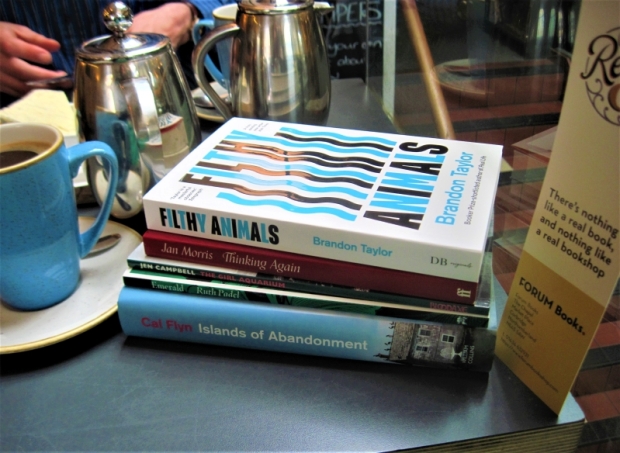
It was also, half unexpectedly, a week filled with book shopping. First up was Forum Books in Corbridge, a lovely independent bookshop. I don’t often buy new books, so enjoyed the splurge here. The Flyn and Taylor were two of my most anticipated releases of 2021. It felt appropriate to pick up a Bloodaxe poetry title as the publisher is based in nearby Hexham.
Next came a bounteous charity shop haul in Hexham.

On the Tuesday we holed up in Barter Books for hours while it rained – and the queue lengthened – outside. I was surprised and delighted that the nine antiquarian books I resold to Barter more than paid for my purchases, leaving me in credit to spend another time (online if, as seems likely, I don’t get back up in person anytime soon).


Alnwick also has a number of charity shops. I had the most luck at the Lions bookshop.

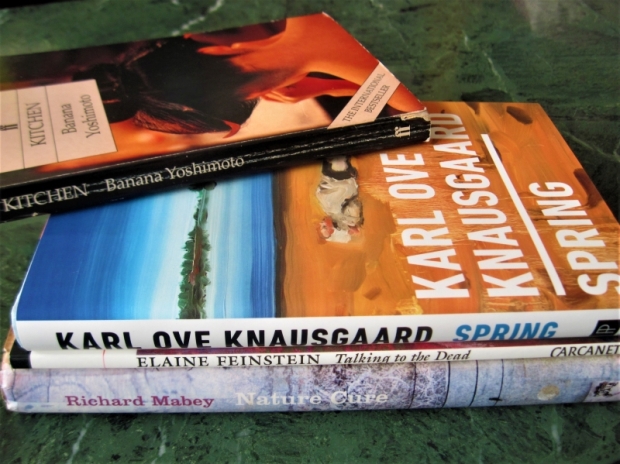
I seemed to keep finding books wherever I went. Kitchen came from a bookshelf in a shop/café on Holy Island. A secondhand/remainders shop near York Minster was the source of the other three.
What I Read:
The holiday involved significant car journeys as Northumberland is a big county with an hour or more between destinations. Alongside my navigating and DJ duties, I got a lot of reading done during the days, as well as in the evenings.
Finished second half or so of:
 Phosphorescence by Julia Baird – An intriguing if somewhat scattered hybrid: a self-help memoir with nature themes. Many female-authored nature books I’ve read recently (Wintering, A Still Life, Rooted) have emphasized paying attention and courting a sense of wonder. To cope with recurring abdominal cancer, Baird turned to swimming at the Australian coast and to faith. Indeed, I was surprised by how deeply she delves into Christianity here. She was involved in the campaign for the ordination of women and supports LGBTQ rights.
 Open House by Elizabeth Berg – When her husband leaves, Sam goes off the rails in minor and amusing ways: accepting a rotating cast of housemates, taking temp jobs at a laundromat and in telesales, and getting back onto the dating scene. I didn’t find Sam’s voice as fresh and funny as Berg probably thought it is, but this is as readable as any Oprah’s Book Club selection and kept me entertained on the plane ride back from America and the car trip up to York. It’s about finding joy in the everyday and not defining yourself by your relationships.
 Site Fidelity by Claire Boyles – I have yet to review this for BookBrowse, but can briefly tell you that it’s a terrific linked short story collection set on the sagebrush steppe of Colorado and featuring several generations of strong women. Boyles explores environmental threats to the area, like fracking, polluted rivers and an endangered bird species, but never with a heavy hand. It’s a different picture than what we usually get of the American West, and the characters shine. The book reminded me most of Love Medicine by Louise Erdrich.
 Every Minute Is a Day by Robert Meyer, MD and Dan Koeppel – The Bronx’s Montefiore Medical Center serves an ethnically diverse community of the working poor. Between March and September 2020, it had 6,000 Covid-19 patients cross the threshold. Nearly 1,000 of them would die. Unfolding in real time, this is an emergency room doctor’s diary as compiled from interviews and correspondence by his journalist cousin. (Coming out on August 3rd. Reviewed for Shelf Awareness.)
 Virga by Shin Yu Pai – Yoga and Zen Buddhism are major elements in this tenth collection by a Chinese American poet based in Washington. She reflects on her family history and a friend’s death as well as the process of making art, such as a project of crafting 108 clay reliquary boxes. “The uncarved block,” a standout, contrasts the artist’s vision with the impossibility of perfection. The title refers to a weather phenomenon in which rain never reaches the ground because the air is too hot. (Coming out on August 1st.)
Read most or all of:
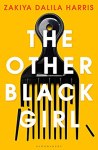 The Other Black Girl by Zakiya Dalila Harris – I feel like I’m the last person on Earth to read this buzzy book, so there’s no point recounting the plot, which initially is reminiscent of Luster by Raven Leilani but morphs into its own thing as Nella realizes her rivalry with Hazel, her new Black colleague at Wagner Books, is evidence of a wider social experiment. The prose is hip, bringing to mind Queenie and Such a Fun Age. It was a fun road trip read for me, but I could have done without the silliness of magical hair care products.
 Heartstopper, Volume 1 by Alice Oseman – It’s well known at Truham boys’ school that Charlie is gay. Luckily, the bullying has stopped and the others accept him. Nick, who sits next to Charlie in homeroom, even invites him to join the rugby team. Charlie is smitten right away, but it takes longer for Nick, who’s only ever liked girls before, to sort out his feelings. This black-and-white YA graphic novel is pure sweetness, taking me right back to the days of high school crushes. I raced through and placed holds on the other three volumes.
 The Vacationers by Emma Straub – Perfect summer reading; perfect holiday reading. Like Jami Attenberg, Straub writes great dysfunctional family novels featuring characters so flawed and real you can’t help but love and laugh at them. Here, Franny and Jim Post borrow a friend’s home in Mallorca for two weeks, hoping sun and relaxation will temper the memory of Jim’s affair. Franny’s gay best friend and his husband, soon to adopt a baby, come along. Amid tennis lessons, swims and gourmet meals, secrets and resentment simmer.
 Kitchen by Banana Yoshimoto – A pair of poignant stories of loss and what gets you through. In the title novella, after the death of the grandmother who raised her, Mikage takes refuge with her friend Yuichi and his mother (once father), Eriko, a trans woman who runs a nightclub. Mikage becomes obsessed with cooking: kitchens are her safe place and food her love language. Moonlight Shadow, half the length, repeats the bereavement theme but has a magic realist air as Satsuki meets someone who lets her see her dead boyfriend again.
I also made a good start on a few of my other purchases from the trip: Islands of Abandonment, No Time to Spare, Filthy Animals, and Female Friends.
Alas, most of the in-demand library books I brought along with me – Great Circle by Maggie Shipstead, Malibu Rising by Taylor Jenkins Reid, and Still Life by Sarah Winman – didn’t hit the spot, so I’ve returned them unread and will borrow them at another point later in the year (except Malibu Rising, which felt soapy and insubstantial).
It’s been a struggle getting back into the routines of work and writing since we got back, but I’ve managed to review one more of my 20 Books of Summer. This is #9, slipped in from my Forum Books pile, and I’m currently working on books #10–13.
Emerald by Ruth Padel (2018)
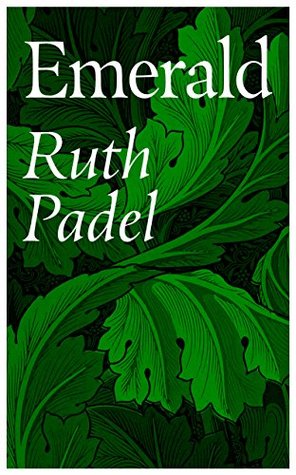 This was my 11th book from Padel; I’ve read a mixture of her poetry, fiction, narrative nonfiction and poetry criticism. Emerald consists mostly of poems in memory of her mother, Hilda, who died in 2017 at the age of 97. The book pivots on her mother’s death, remembering the before (family stories, her little ways, moving her into sheltered accommodation when she was 91, sitting vigil at her deathbed) and the letdown of after. It made a good follow-on to one I reviewed last month, Kate Mosse’s An Extra Pair of Hands.
Emerald, the hue and the gemstone, recurs frequently in ornate imagery of verdant outdoor scenes and expensive art objects. Two favourites were travel-based: “Jaipur,” about the emerald-cutters of India, where Padel guiltily flew while her mother was ill; and “Salon Noir,” about a trip down into prehistoric caves of France the summer after Hilda’s death. Overall, I expected the book to resonate with me more than it did. The bereavement narrative never broke through to touch me; it remained behind a silk screen of manners and form.
Two favourite stanzas:
“Your voice is your breath.
The first thing that’s yours
and the last.” (from “Fragile as Breath”)
“that’s all of us
sifting the dark
in our anonymities and hope.” (from “Above is the Same as Below”)
My rating:
Next books in progress: The Glitter in the Green by Jon Dunn and Nothing but Blue Sky by Kathleen MacMahon
USA Trip and Book Acquisitions
On Wednesday I got back from my first trip to the USA in two years. It was for the special occasion of my mother getting remarried, so was well worth the extra complications of pandemic travelling. While quarantining at my sister’s house for a week, I observed the chaos of a household with FIVE members in virtual schooling. When it all got too noisy for me, I’d retreat upstairs to read with Pierre the cat.

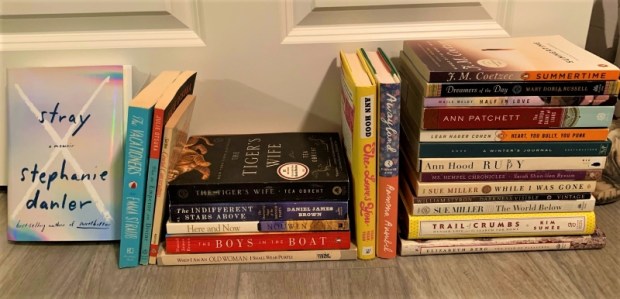
I also spent some time, as always, going through my boxes of mementoes and books in her basement. I later sold back several boxes’ worth of books that I’d weeded out, but of course I acquired more as well. Below are a super-belated Christmas 2019 gift, my Wonder Book haul, hand-me-downs from my stepfather, two Dollar Tree purchases, and my 2nd & Charles haul (mostly from the clearance shelves). Subtracting buyback credit, my total spend was $3.76!
Almost purchased, just for the title.

The wedding itself (and meeting my new stepfather and his daughters) went beautifully. We had hot but not unbearable weather, and bright sun for picture-taking. The below passage from Carol Shields’s The Box Garden, which I’d noted last year while buddy reading it with Buried in Print, felt particularly apt for the occasion.


I also acquired two new U.S. releases to review for BookBrowse.

I squeezed most of the new acquisitions, plus another 37 books from storage, into my suitcases. I focused on bringing back books I’m eyeing up for certain challenges, appealing memoirs, and books I want to reread (the far left stack below).


As for those mementoes, I made some amusing finds, including my childhood blankie; the “medical kit” I made at about age nine, inspired by a visit to the National Museum of Health and Medicine and my love for the television show Dr. Quinn, Medicine Woman; and a few early writing attempts. “A Day in the Life of a Gangster” is a story I wrote at probably age seven. I love the old typewriter font, but my “About the Author” note was the funniest bit – I am so not a mystery reader anymore, and I doubt I’d been on a single proper hike at that point in my life. Newsboys: Take Me to Your Concert was my co-written entry for the Write-a-Book Contest in eighth grade, and What Is a Llama? I wrote and illustrated with my own photographs at age 14 as a county 4H project. I even won a ribbon and a cash prize in the random amount of $4.34.


Back in self-isolation here in the UK, I had seven review copies waiting for me, and another five have arrived in the last couple of days, so the cycle never ends: acquire books, read books, write about books, part with or figure out how to store and/or display books…
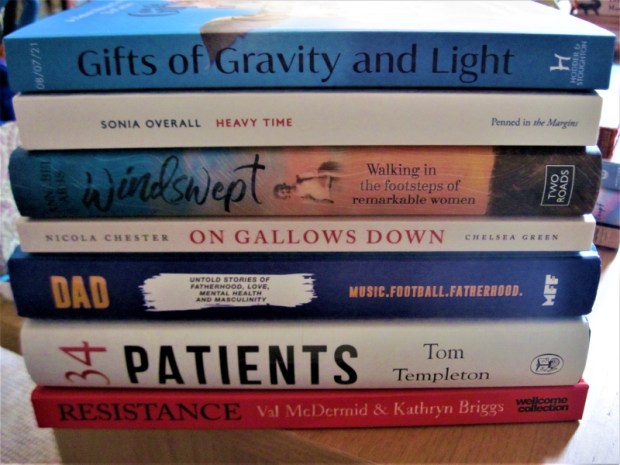
On with the summer reading!
Somerset Trip & Bookbarn Haul and Overhauls
Last week we managed a few days’ holiday in Somerset – our first trip away from home in over seven months (the last one was to Hay-on-Wye). Though only an hour and a half from where we live, it felt like a world away. We were very lucky with the weather, too. We wandered the quiet nature reserves of the Avalon Marshes, toured Glastonbury and Wells (the smallest cathedral city in the UK; alas, we missed the limited cathedral opening hours, but had a nice walk around the outside and saw a plaque marking where Elizabeth Goudge lived), and climbed Glastonbury Tor and Ebber Gorge. Not wanting to chance any pubs, we ate daytime meals outdoors at a few cafés and brought posh supermarket takeaways with us to heat up in the Airbnb kitchen for dinners.


(Photos by Chris Foster)
I read from lots of different books on the trip, but my most appropriate selection was Skylarks with Rosie, Stephen Moss’s diary of the coronavirus spring experienced in Somerset. By coincidence, my husband saw Moss (a mentor of his; we’ve met him a number of times before) filming at Ham Wall when he went back there early one morning!
On the last day, we drove back via Bookbarn International, a favourite secondhand bookshop of mine. Below is my book haul from the trip: the top five were from a Little Free Library we found in a bus shelter in the delightfully named town of Queen Camel and the bottom stack was from Bookbarn, which was looking well stocked after the lockdown. I was particularly pleased to find books by Amy Bloom, Sue Miller, and Jane Smiley, authors you don’t come across so often in the UK. Some of the LFL books have rather hideous covers, but it’s the inside that counts, yes?

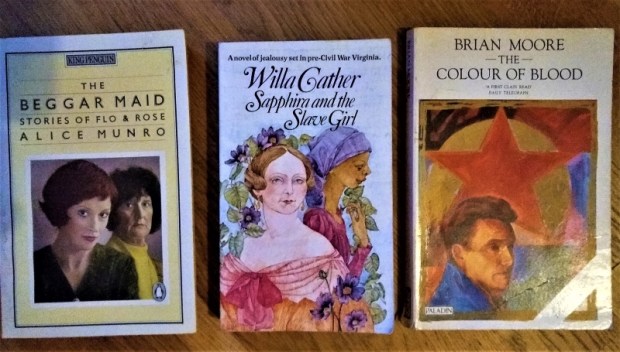
Overhaul of Previous Trips’ Purchases
This was our seventh trip to Bookbarn since June 2013. I don’t seem to have any photos of that first visit, but for all the rest I have at least one book haul photo.
Simon of Stuck in a Book runs a regular blog feature he calls “The Overhaul,” where he revisits a book haul from some time ago and takes stock of what he’s read, what he still owns, etc. (here’s the most recent one). With his permission, I’m borrowing the title and format to look back at what I’ve bought at Bookbarn over the years and how much I still have left to read.
Date: July 2015
Number of books bought: 8 [the Allen and Cobbett are reference books for my husband]

- Read: 7
- No longer owned: 2 (I resold the Fitzgerald and Levy)
- Remaining unread: 1 (Drowning Ruth by Christina Schwarz – so I took it with me on the Somerset trip and have read the first 50 pages so far.)
This is a very good showing for me! I suppose I did have nearly six years to get through them all. I’ve done less well on the other years’ hauls…
Date: July 2016
Number of books bought: 10
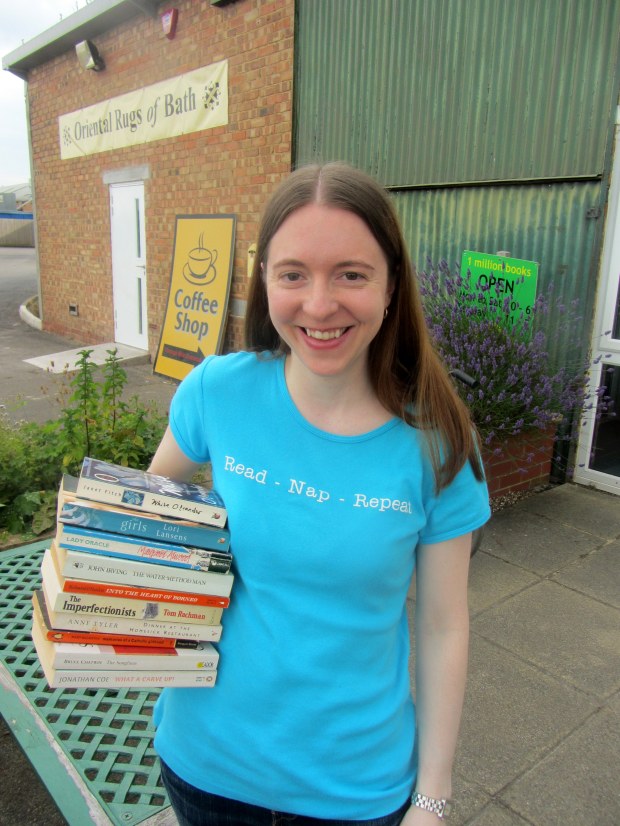
- Had read already: 1 (Rachman)
- Read since: 4
- No longer owned: 1 (Irving’s early work hasn’t been to my taste, so after my husband read The Water-Method Man, I donated it; its only virtue in my eyes is that the main character is called “Bogus Trumper”)
- Remaining unread: 4 (Chatwin, Coe, McCarthy, O’Hanlon)
Date: December 2016
Number of books bought: 13 (the two pictured at left were from another shop)
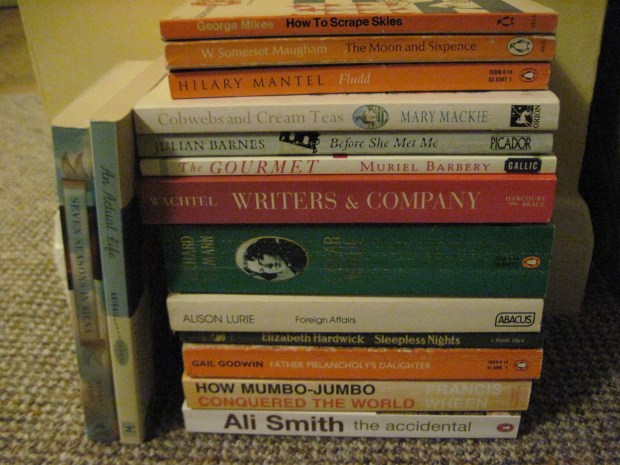
- Read: 6
- DNFed and gave away: 3 (Lurie, Smith, Wheen)
- Remaining unread: 4 (Barnes, Ellman biography, Godwin, Mantel)
Date: October 2017 (multiple photos in this post)
Number of books bought: 15
- Read: 5
- Skimmed: 1 (McCarthy)
- DNFed: 1 (McNeillie)
- Remaining unread: 8! (I have a bad habit of letting biographies sit around unread)
Date: February 2020
Number of books bought: 14
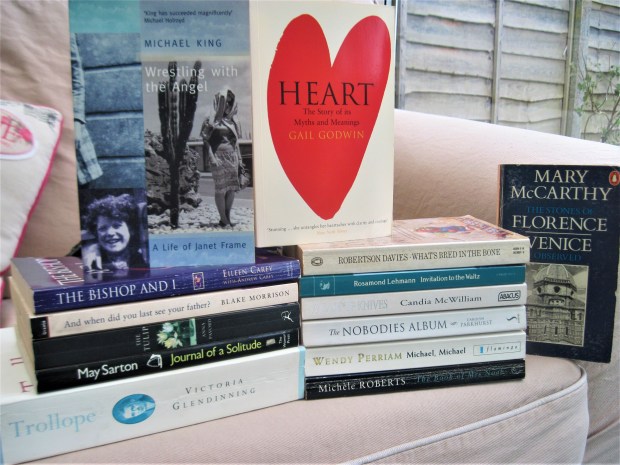
- Had read already: 2
- Skimmed: 2
- Started reading but set aside: 2, so…
- Remaining unread: 10!
To encourage myself to get to more of these previous acquisitions, I’ve added six of them to my bedside stack.
First Four in a Row: Márai, Maupin, McEwan, McKay
I announced a few new TBR reading projects back in May 2020, including a Four in a Row Challenge (see the ‘rules’, such as they are, in my opening post). It only took me, um, nearly 11 months to complete a first set! The problem was that I kept changing my mind on which four to include and acquiring more that technically should go into the sequence, e.g. McCracken, McGregor; also, I stalled on the Maupin for ages. But here we are at last. Debbie, meanwhile, took up the challenge and ran with it, completing a set of four novels – also by M authors, clearly a numerous and tempting bunch – back in October. Here’s hers.

I’m on my way to completing a few more sets: I’ve read one G, one and a bit H, and I selected a group of four L. I’ve not chosen a nonfiction quartet yet, but that could be an interesting exercise: I file by author surname even within categories like science/nature and travel, so this could throw up interesting combinations of topics. Do feel free to join in this challenge if, like me, you could use a push to get through more of the books on your shelves.
Embers by Sándor Márai (1942)
[Translated from the Hungarian by Carol Brown Janeway]
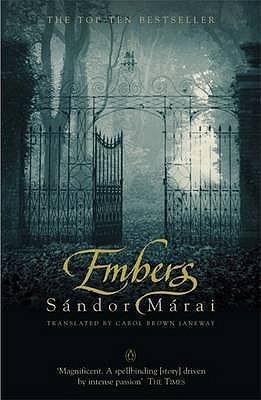 My first work of Hungarian literature.* This was a random charity shop purchase, simply because I’m always trying to read more international literature and had enjoyed translations by Carol Brown Janeway before. In 1940, two old men are reunited for the first time in 41 years at a gloomy castle, where they will dine by candlelight and, over the course of a long conversation, face up to the secret that nearly destroyed their friendship. This is the residence of 75-year-old Henrik, usually referred to as “the General,” who lives alone apart from Nini, his 91-year-old wet nurse. His wife, Krisztina, died 33 years ago.
Henrik was 10 when he met Konrad at an academy school. They were soon the best of friends, but two things came between them: first was the difference in their backgrounds (“each forgave the other’s original sin: wealth on the one hand and poverty on the other”); second was their love for the same woman.
I appreciated the different setup to this one – a male friendship, just a few very old characters, the probing of the past through memory and dialogue – but it was so languid that I struggled to stay engaged with the plot.
*My next will be Journey by Moonlight by Antal Szerb, another charity shop find.
Favourite lines:
“My homeland was a feeling, and that feeling was mortally wounded.”
“Life becomes bearable only when one has come to terms with who one is, both in one’s own eyes and in the eyes of the world.”
Tales of the City by Armistead Maupin (1978)
I’d picked this up from the free bookshop we used to have in the local mall (the source of my next two as well) and started it during Lockdown #1 because in The Novel Cure it is given as a prescription for Loneliness. Berthoud and Elderkin suggest it can make you feel like part of a gang of old friends, and it’s “as close to watching television as literature gets” due to the episodic format – the first four Tales books were serialized in the San Francisco Chronicle.
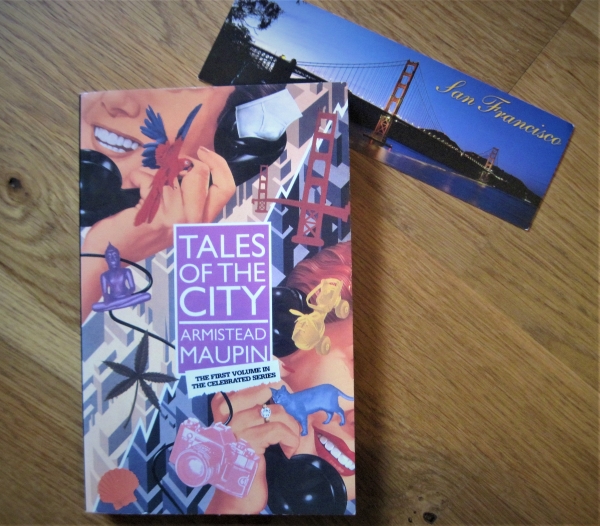
How I love a perfect book and bookmark combination!
The titled chapters are each about three pages long, which made it an ideal bedside book – I would read a chapter per night before sleep. The issue with this piecemeal reading strategy, though, was that I never got to know any of the characters; because I’d often only pick up the book once a week or so, I forgot who people were and what was going on. That didn’t stop individual vignettes from being entertaining, but meant it didn’t all come together for me.
Maupin opens on Mary Ann Singleton, a 25-year-old secretary who goes to San Francisco on vacation and impulsively decides to stay. She rooms at Anna Madrigal’s place on Barbary Lane and meets a kooky assortment of folks, many of them gay – including her new best friend, Michael Tolliver, aka “Mouse.” There are parties and affairs, a pregnancy and a death, all told with a light touch and a clear love for the characters; dialogue predominates. While it’s very much of its time, it manages not to feel too dated overall. I can see why many have taken the series to heart, but don’t think I’ll go further with Maupin’s work.
Note: Long before I tried the book, I knew about it through one of my favourite Bookshop Band songs, “Cleveland,” which picks up on Mary Ann’s sense of displacement as she ponders whether she’d be better off back in Ohio after all. Selected lyrics:
Quaaludes and cocktails
A story book lane
A girl with three names
A place, post-Watergate
Freed from its bird cage
Where the unafraid parade
[…]
Perhaps, we should all
Go back to Cleveland
Where we know what’s around the bend
[…]
Citizens of Atlantis
The Madrigal Enchantress cries
And we decide, to stay and bide our time
On this far-out, far-flung peninsula.
The Children Act by Ian McEwan (2014)
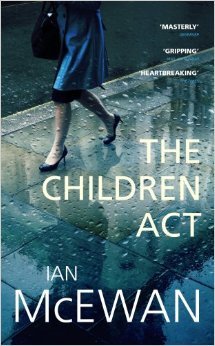 Although it’s good to see McEwan take on a female perspective – a rarer choice for him, though it has shown up in Atonement and On Chesil Beach – this is a lesser novel from him, only interesting insomuch as it combines elements from two of his previous works, The Child in Time (legislation around child welfare) and Enduring Love (a religious stalker). Fiona Maye, a High Court judge, has to decide whether 17-year-old Adam, a bright and musical young man with acute leukaemia, should be treated with blood transfusions despite his Jehovah’s Witness parents’ objection.
[SPOILERS FOLLOW]
She rules that the doctors should go ahead with the treatment. “He must be protected from his religion and from himself.” Adam, now better but adrift from the religion he was raised in, starts stalking Fiona and sending her letters and poems. Estranged from her husband, who wants her to condone his affair with a young colleague, and fond of Adam, Fiona spontaneously kisses the young man while traveling for work near Newcastle. But thereafter she ignores his communications, and when he doesn’t seek treatment for his recurring cancer and dies, she blames herself.
[END OF SPOILERS]
It’s worth noting that the AI in McEwan’s most recent full-length novel, Machines Like Me, is also named Adam, and in both books there’s uncertainty about whether the Adam character is supposed to be a child substitute. 
The Birth House by Ami McKay (2006)
Dora is the only daughter to be born into the Rare family of Nova Scotia’s Scots Bay in five generations. At age 17, she becomes an apprentice to Marie Babineau, a Cajun midwife and healer who relies on ancient wisdom and appeals to the Virgin Mary to keep women safe and grant them what they want, whether that’s a baby or a miscarriage. As the 1910s advance and the men of the village start leaving for the war, the old ways represented by Miss B. and Dora come to be seen as a threat. Dr. Thomas wants women to take out motherhood insurance and commit to delivering their babies at the new Canning Maternity Home with the help of chloroform and forceps. “Why should you ladies continue to suffer, most notably the trials of childbirth, when there are safe, modern alternatives available to you?” he asks.
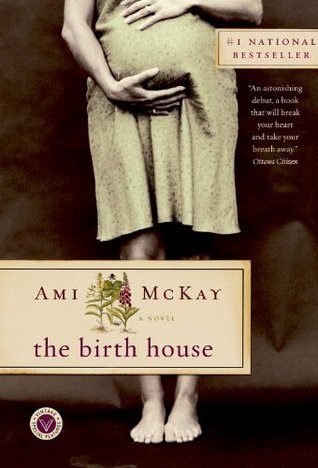 Encouraged into marriage at an early age, Dora has to put her vocation on hold to be a wife to Archer Bigelow, a drunkard with big plans for how he’s going to transform the area with windmills that generate electricity. Dora’s narration is interspersed with journal entries, letters, faux newspaper articles, what look like genuine period advertisements, and a glossary of herbal remedies – creating what McKay, in her Author’s Note, calls a “literary scrapbook.” I love epistolary formats, and there are so many interesting themes and appealing secondary characters here. Early obstetrics is not the only aspect of medicine included; there is also an exploration of “hysteria” and its treatment, and the Spanish flu makes a late appearance. Dora, away in Boston at the time, urges her friends from the Occasional Knitters’ Society to block the road to the Bay, make gauze masks, and wash their hands with hot water and soap.
There are a few places where the narrative is almost overwhelmed by all the (admittedly, fascinating) facts McKay, a debut author, turned up in her research, and where the science versus superstition dichotomy seems too simplistic, but for the most part this was just the sort of absorbing, atmospheric historical fiction that I like best. McKay took inspiration from her own home, an old birthing house in the Bay of Fundy. 
Ex Libris x 2: Who Wears It Better, Anne Fadiman or Michiko Kakutani?
When I heard about the new book by Michiko Kakutani, former chief book critic of the New York Times, I rushed to put it on my wish list – though I ended up accessing it via the library instead. I also felt a hankering to reread Anne Fadiman’s essay collection by the same title, so I ordered myself a secondhand copy earlier this year. Both books are by (more or less) famous New York City bibliophiles and take old-fashioned bookplate designs as an inspiration. Here’s how the two fared in a head-to-head battle.
Ex Libris: Confessions of a Common Reader by Anne Fadiman (1998)
Like many a bibliophile, I have a soft spot for books about books. However, I’m also a real stickler about them, because all too often they make common mistakes: they’re too generic or too obscure in their points of reference, they slip into plot summary and include spoilers, or they alienate the reader by presenting the author as being on another echelon.
Fadiman, though, is a very relatable narrator in these expanded versions of 18 essays originally written for publication in Civilization, the Library of Congress magazine published from 1994 to 2000. (Can you imagine, your own bookish column in which you could write whatever you like?!) Her father was the well-known intellectual Clifton Fadiman. Theirs was a family of book-obsessed, vocabulary-loving, trivia-spouting readers, and she was also crafting her own with her husband and two young children.
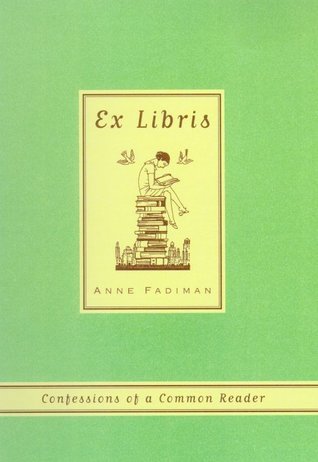 I saw my family – especially my mother and me – in a number of these pieces: in “The Joy of Sesquipedalians,” about the love of obscure words and word games played on a board or along with the TV (I was a spelling bee champion, and we’re all Scrabble fiends to a greater or lesser extent), in “Insert a Caret [Inset a Carrot],” about compulsive proofreading, in “The Catalogical Imperative,” about a build-up of print catalogues and the different selves one can imagine using the products therein, and in “Secondhand Prose,” about collecting used books.
There’s one respect in which I differ from the Fadiman family, though. Tom Mole’s The Secret Life of Books had reminded me of Fadiman’s division of readers into “courtly” and “carnal” lovers of books: the courtly ones keep a book pristine, while the carnal ones use and abuse them however they wish. She introduces this piece with an episode from a family trip to Copenhagen when she was a teenager. Her brother left a book open, facedown, on the bedside table at their hotel and the next day they found that the chambermaid had carefully put a marker at the right page, closed the book, and set a note on top reading, “Sir, you must never do that to a book.” I wholeheartedly agree. While I always say “your books, your rules” to other readers, I would have to suppress a cringe if I witnessed dog-earing, reading in the bath, cracking the spine, tearing out pages, doodling in the margins, and so on.
What I can get on board with, though, is the love of books as both narratives and physical objects. In the former camp, you get essays on books about polar exploration, sonnets, outdated guides to femininity, food literature, and reading aloud. On the latter, you’ll hear about her New York City apartment groaning with books absorbed from her husband’s and father’s collections, the good and bad of inscriptions, and Prime Minister William Gladstone’s tips for storing books.
Two essays have not aged well: one on a beloved pen (though she acknowledges that this was already multiply outdated by that time, by the typewriter and then by the computer she now uses for composition) and especially one on the quandary of gender-neutral pronouns (as opposed to “every man for himself” types of constructions) – nowadays we have no qualms about employing “them” for the unknown and the nonbinary.
My favorite essay overall was “You Are There,” about the special joy of reading on location. Additional irony points for Joe Biden being mentioned in the piece on plagiarism! I’d read this from a library some years before. I enjoyed it just as much the second time around, and certain essays will reward additional future rereadings, too.
My original rating (c. 2008):
My rating now:
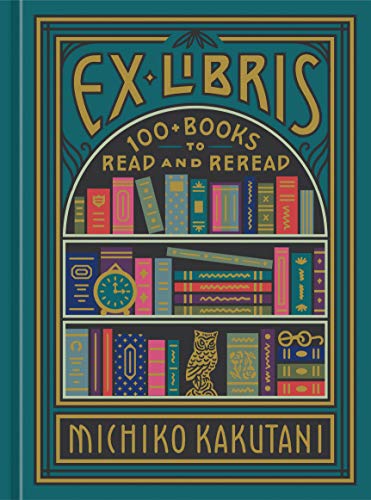
Ex Libris: 100+ Books to Read and Reread by Michiko Kakutani (2020)
In my more morbid moments, when I imagine how I would approach the remainder of my life if I knew that I was going to die young of a terminal illness, I think about self-publishing a selection of my best blog posts and book reviews. A personal greatest hits, if you would, and anyone could forgive the self-indulgence because, hey, she’s probably going to die soon. But then I open a book like this and realize that a collection of book reviews can actually be pretty tedious, even when written by one of the greats.
“Like all lists and anthologies, the selections here are subjective and decidedly arbitrary,” Kakutani warns in her introduction. What this means in practice is that: a) if I’d read a particular book, I didn’t need to read a ~1000-word review of it; b) if I hadn’t read the book but wanted to, I avoided the essay in fear of spoilers (e.g. she does reveal some specific incidents from Mary Karr’s The Liars’ Club, which I have on the shelf and was looking forward to; I’ll just wait until I’ve forgotten); and c) if I hadn’t read the book and didn’t want to (there is LOTS of history and politics here, with plenty of Trump jabs shoehorned in; you do know her only previous book was a diatribe against Trump, right?), I wasn’t interested. So, while there were a few pieces I appreciated, such as one on the enduring appeal of The Great Gatsby, which I recently read a third time for book club, not many caught my eye as I skimmed the book.
In any case, it’s not a book for reading all the way through but one for having on the coffee table to read the occasional essay. It is gorgeously put together, what with Dana Tanamachi’s illustrations in the style of vintage bookplates, so would still be a lovely reference book to have around. Think of it as a collection of amuse-bouches to whet your appetite to read the books you’ve always meant to pick up but haven’t managed yet (for me, that would be As I Lay Dying and Mason & Dixon). See Susan’s more judicious review here.
My rating:
 I found plenty of other books on Goodreads with the title Ex Libris, such as this one, a compendium of library-themed fantasy and science fiction stories. (Yes, really.)
Have you read one of these? Which did you prefer?
Sad Souvenirs: Defunct Bookshops’ Bookmarks
I’m a dedicated bookmark user and probably have at least 120–150 that I rotate through, matching marker to book subject matter or reading location whenever possible. A sorry subset of my collection commemorates bookshops (secondhand and/or new stock) that no longer exist. I was a customer at a couple of these, but only know of the others through bookmarks that I found at random, e.g. in secondhand purchases from other stores. Through Google Earth, I tracked down what you’ll find where these shops used to be.

Shops I visited:
Déjà Vu Books (Bowie, Maryland)
This was my local secondhand bookshop when I was a teenager. I would wheedle occasional visits out of my mother until my friends and I got our driving licenses and could go by ourselves. My friend Rachael and I would stop there after karate on a Saturday morning.
What I remember purchasing there: A near-complete set of Dickens’s works, blue/green cloth hardbacks, early 20th century, for $30; an Agatha Christie omnibus I gave to my mother.
What it is now: Chi Bella Natural Hair Boutique
Water Lane Book Shop (Salisbury, England)
My husband is a Hampshire lad. Salisbury was a relatively nearby town we would explore when I went to visit him while we were dating or engaged. An average daytrip would include touring the cathedral, having tea at the Polly Tearooms, and – in a waterside location just along from the cathedral square – having a nose through the well-stocked shelves of this compact shop.
What I remember purchasing there: Lots of my secondhand David Lodge paperbacks.
What it is now: A private residence (it had just sold as of Streetview in June 2018)
Others I only learned about through their orphan bookmarks:
Barnwood Books (Hagerstown, Maryland)
The bookmark looks old enough that I had to ask myself whether the shop might have been supplanted by Wonder Book & Video, a small chain I first discovered as a young teen. It has branches in Frederick (where I went to college; I worked there part-time in my senior year) and Hagerstown, and most recently opened in Gaithersburg. At the least, Wonder Book probably absorbed their stock when they closed.
What it is now: An empty storefront between a gastropub and a home fashions store (as of October 2019)
The Book Mark (Toronto, Canada)
I found this bookmark inside a secondhand book I bought from the Frederick Wonder Book & Video. I assumed the shop was still extant, but I checked in with Marcie (Buried in Print) and she sent me an article explaining that it was priced out of the neighbourhood and closed in 2012. It had been the oldest independent bookstore in Toronto. (This article gives more information.)
What it is now: Nails on Bloor, a nails and waxing parlour
Paperback Exchange (Hereford, England)
I can’t recall where I found this bookmark, but I wish a shop with this policy still existed! From the reverse: “The Paperback Exchange system: up to HALF the purchase price of books bought from us, against further purchases; up to a QUARTER on good quality paperbacks bought elsewhere.”
What it is now: On the June 2018 Streetview, it’s either the closed-down charity shop or the school uniform shop.
A nice postscript:
Royal Oak Bookshop (Front Royal, Virginia)
The bookmark I found in a used book looked so old I wasn’t sure if the shop would still exist. I was going to include it in the post as one of the defunct ones. But just to be sure, I decided to try hunting it down through the website…
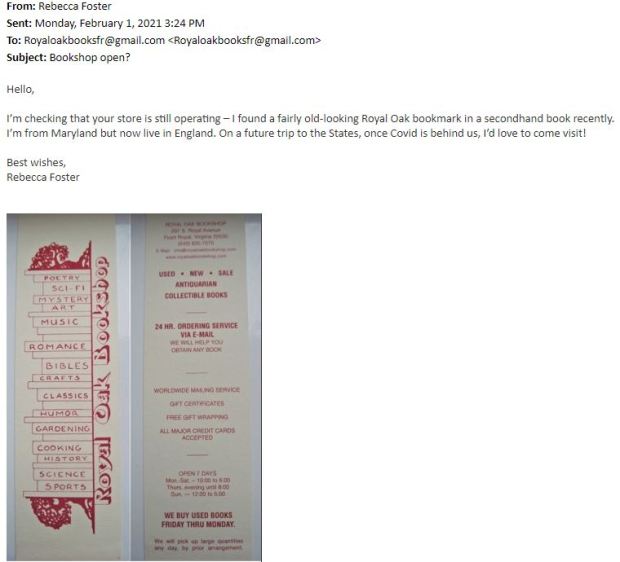

Do you commemorate any deceased bookshops through their memorabilia?
A Reading Malady, a Book Haul, a Book Launch, and a TBR Challenge
A bit of a miscellany today, as a placeholder until I finally have some more reviews to share.
Stuck in the Middle
 I’ve been reading up a storm in 2021, of course, but I’m having an unusual problem: I can’t seem to finish anything. Okay, I’ve finished three books so far – Intensive Care, my first read and only proper review so far of the year; In These Days of Prohibition by Caroline Bird, a surprising and funny poetry collection about mental illness and the crutches people turn to, including drugs and sex; and one more poetry book, a recent release I’ll round up later in the month – but compare that to January 2020, when I’d finished 11 books within the first 11 days. Half a month gone and I’m way behind on my Goodreads challenge already.
Most of you know that I take multi-reading to an extreme: I currently have nearly 30 books on the go, plus piles of set-aside and occasional-reading titles that I try to reintroduce a few at a time. All in all, that’s nearly 60 books I’m partway through, whether by a mere 10 pages or over 200. These stacks represent thousands of pages read, but no finished books. By the end of this month, I will at least have finished and reviewed the five more January releases, but it’s still an awfully slow start to the year for me. Maybe I’ve spread myself too thin.
Current Stars
I often stretch the definition of “currently reading” in that most days I don’t sit with every book on my stack; instead, I end up spending time with a changing subset of 10‒15. Some books I have barely touched since Christmas. But there are others that consistently hold my attention and that I look forward to reading 20 or more pages in each day. Here are some of the highlights on the pile:
 Spinster by Kate Bolick: Written as she was approaching 40, this is a cross between a memoir, a social history of unmarried women (mostly in the USA), and a group biography of five real-life heroines who convinced her it was alright to not want marriage and motherhood. First was Maeve Brennan; now I’m reading about Neith Boyce. The writing is top-notch.
 America Is Not the Heart by Elaine Castillo: Set in the 1990s in the Philippines and in the Filipino immigrant neighborhoods of California, this novel throws you into an unfamiliar culture and history right at the deep end. The characters shine and the story is complex and confident – I’m reminded especially of Chimamanda Ngozi Adichie’s work.
 Some Body to Love by Alexandra Heminsley: Finally pregnant after a grueling IVF process, Heminsley thought her family was perfect. But then her husband began transitioning. This is not just a memoir of queer family-making, but, as the title hints, a story of getting back in touch with her body after an assault and Instagram’s obsession with exercise perfection.
 The Light Years by Elizabeth Jane Howard: We’re reading the first volume of The Cazalet Chronicles for a supplementary book club meeting. I can hardly believe it was published in 1990; it’s such a detailed, convincing picture of 1937‒8 for a large, wealthy family in London and Sussex as war approaches. It’s so Downton Abbey; I love it and will continue the series.
 Outlawed by Anna North: After Reese Witherspoon chose it for her book club, there’s no chance you haven’t heard about this one. I requested it because I’m a huge fan of North’s previous novel, The Life and Death of Sophie Stark, but I’m also enjoying this alternative history/speculative take on the Western. It’s very Handmaid’s, with a fun medical slant.
 Love After Love by Ingrid Persaud: It was already on my TBR after the Faber Live Fiction Showcase in November, but my interest was redoubled by this recently winning the Costa First Novel Award. Set in Trinidad, it’s narrated, delightfully, in turn by Betty, a young widow; Solo, her teenage son; and Mr. Chetan, their lodger. Perfect for fans of Mr Loverman.
Acquiring More
Last week I ordered 21 books in one day. (In my defense, only 18 of them were for me.) It started like this: “Ah, must find a clearance 2021 calendar. Waterstones had a good selection last year…” And indeed, I found the perfect calendar, for half price. But then I continued browsing the online sale items and before I knew it there were also seven books in my basket. While I was at it, I went onto Awesomebooks.com and put together an order of secondhand books by authors I’ve been wanting to try or read more by. Add to that a couple more review books coming through the door and a couple of giveaways from neighbors (the Nicolson in the first photo, and Stoner for me to reread) and it’s been a big week for book acquisitions.


Attending a Book Launch
My fifth book launch since March 2020; my first to take place on Instagram. Hosted by Damian Barr, who runs a literary salon, it was for one I’ve already mentioned, Some Body to Love by Alexandra Heminsley, which came out on the 14th. (Barr and his husband are the book’s dedicatees.) “I am not ashamed of what happened,” she said about how her family has changed, adding that writing about such recent events has been a way of solidifying how she felt about them. Her ex has not read the book but wrote to Chatto & Windus saying she completely trusted Heminsley and consented to the publication. Some of her offers were for a more mass-market memoir about the marriage, whereas the book ended up being more diffuse, including other medical experiences and challenges to self-belief. It was amusing to hear that after the BLM movement her manuscript went through a “Karen edit” to make sure she hadn’t taken her privilege for granted.
A New TBR Challenge
“Hands. Face. Space.” is a current UK public health campaign slogan. It inspired me to trawl through my TBR shelves for appropriate covers and titles. I don’t know if I’m actually serious about reading these particular books I selected (I could have chosen any of dozens for the Face covers), but it was fun to put together the photo shoot. I had two replies from people on Twitter who came up with their own trio of titles.


And to cap off this miscellany, something non-book-related…
Top 5 albums from 2020
I originally wrote this little note for Facebook.
 Banana Skin Shoes, Badly Drawn Boy – His best since his annus mirabilis of 2002. Funky pop gems we’ve been caught dancing to by people walking past the living room window … oops! A track to try: “Is This a Dream?” (psychedelic music video)!
 Where the World Is Thin, Kris Drever – You may know him from Lau. Top musicianship and the most distinctive voice in folk. Nine folk-pop winners, including a lockdown anthem. A track to try: “I’ll Always Leave the Light On.”
 Henry Martin, Edgelarks – Mention traditional folk and I’ll usually run a mile. But the musical skill and new arrangements, along with Hannah Martin’s rich alto, hit the spot. A track to try: “Bird in a Cage.”
 Blindsided, Mark Erelli – We saw him perform the whole of his new folk-Americana album live in lockdown. Love the Motown and Elvis influences; his voice is at a peak. A track to try: “Rose-Colored Rearview.”
 American Foursquare, Denison Witmer – A gorgeous ode to family life in small-town Pennsylvania from a singer-songwriter whose career we’ve been following for upwards of 15 years. A track to try: “Birds of Virginia.”
 Bookish Beck = Rebecca Foster. American transplant to England. Freelance proofreader and book reviewer.
 Bookish Beck