Recent Writing for BookBrowse, Foreword, Shelf Awareness, Shiny New Books, and the TLS
I’ve compiled excerpts from some reviews I’ve contributed to other websites and publications this year. I link to the full text where available. (When writing a paid review, I seek to be balanced but positive. Ratings reflect my personal response.)
BookBrowse
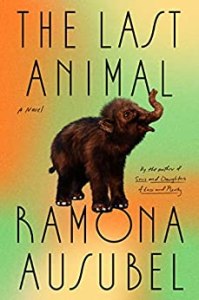 The Last Animal by Ramona Ausubel: In Ausubel’s offbeat third novel, a widowed scientist and her two daughters embark on a rogue plan to make history by resurrecting the woolly mammoth. There is a quirky combination of cosmic and domestic concerns here. A winsome sister duo is at the heart of the unusual and timely story, with priority given to the points of view of teenagers Eve and Vera, whose banter is a highlight. Ausubel has wisely chosen not to dwell on the scientific details of de-extinction, yet that means that this becomes more like speculative fiction or a fairy tale. Ironically, the fabulist-leaning novel is best when most realist, documenting struggles with bereavement, sexism and parenting teens.
 The Lost Wife by Susanna Moore: Moore’s hard-hitting novella is based in part on the memoir Six Weeks in the Sioux Tepees: A Narrative of Indian Captivity. In Moore’s version, Sarah, 25, leaves her baby behind when she flees an abusive husband, and once in Minnesota Territory marries John Brinton, who becomes a doctor on a Sioux reservation. By 1862, Sarah is friendly with the Native women. Although the Civil War is unfolding, the greater threat here is of revolt by the starving Indigenous residents. There is much of anthropological and historical interest, but Sarah’s flat storytelling, which may represent a pastiche of period style, means threatening or climactic scenes lose some of their potential gravity.
Foreword
 My Mother Says by Stine Pilgaard (trans. from the Danish by Hunter Simpson): After breaking up with her zookeeper girlfriend over their age gap and their conflicting takes on motherhood, the heroine moves back in with her father, a pastor who’s obsessed with Pink Floyd, and her stepmother. Her mother visits often, nagging her to finish her thesis. The line between her conversations and internal thoughts is thin. From her mansplaining doctor, she learns that the brain’s hippocampus is named for its seahorse shape. This inspires “Monologues of a Seahorse,” interludes of stream-of-consciousness association. Experimental and whimsical, this delivers deadpan narration of everyday woes.
 In Vitro: On Longing and Transformation by Isabel Zapata (trans. from the Spanish by Robin Myers): A Mexican poet probes the enduring mysteries of pregnancy and birth in a memoir in fragments that travels from fertility treatment through to the early weeks of pandemic-time motherhood. The clinical language of a gynecological history—late menstruation, polycystic ovary syndrome, eighteen years on the pill, and infertility—and the embryo transfer process contrasts with Zapata’s mystical thinking. The microessays integrate family stories, history, and artistic explorations. This resolute account of a personal metamorphosis alchemizes tender experiences into enchanting vignettes.
Shelf Awareness
Fiction
 Daughters of Nantucket by Julie Gerstenblatt: This engrossing debut novel explores the options for women in the mid-19th century while bringing a historical tragedy to life. Metaphorical conflagrations blaze in the background in the days leading up to the great Nantucket fire of 1846: each of three female protagonists (a whaling captain’s wife, a museum curator, and a pregnant Black entrepreneur) holds a burning secret and longs for a more expansive, authentic life. The action spans two tense weeks, one week before the fire through eight days after. The women’s lives collide in two climactic scenes. Gerstenblatt’s eye for detail results in sultry historical fiction for Sue Monk Kidd’s readers.
 Camp Zero by Michelle Min Sterling: Sterling’s brilliantly unsettling debut novel is set in mid-21st-century, post-oil North America. Prioritizing perspectives from two all-female communities, it contrasts the heights of opulence and technology with the basic instinct for survival. How the strands connect is a mystery sustained through much of the book. Characters go by multiple names and harbor ulterior motives; scenes echo each other as disparate subplots meet in unexpected ways. The background is all too plausible. Sterling also takes to its logical extreme the state of being constantly online. Compelling dystopian cli-fi with three-dimensional characters—perfect for fans of Station Eleven and To Paradise.
 Dear Chrysanthemums by Fiona Sze-Lorrain: In this elegant collection of 11 linked short stories by a poet and translator, China’s mid-20th-century political upheaval casts a long shadow. Music and food, not to mention love, bring meaning to those displaced in the aftermath of dissent. The stories—set in China, Singapore, Paris, and New York—span seven decades but always take place in a year ending in a six, a sacred number in Chinese divination. A highlight is “News from Saigon,” in which a prostitute meets Marguerite Duras in a Paris café. The connections are subtle, with the final story pulling together many strands. Ideal for readers of Madeleine Thien’s Do Not Say We Have Nothing.
Nonfiction
 Stranded by Maddalena Bearzi: Bearzi developed a deep love for marine fauna during childhood summers in Sardinia and cofounded the Ocean Conservation Society in the 1990s. Temporarily confined to land by Covid-19 lockdowns, she adopts a different tactic for exploring animal behavior: “an urban safari in my backyard and neighborhood.” These nature essays exemplify evenhandedness, curiosity, and close observation. From wasps to night-blooming flowers, her interest is wide-ranging. Gardening is a relaxing pastime and a connection to her mother while they are separated. As a behavioral ecologist, she views even her dog as a subject of study. A passionate primer to appreciating everyday nature.
Poetry
 Lo by Melissa Crowe: This incandescent autobiographical collection travels from girlhood to marriage and motherhood in post-pandemic USA. Crowe delves into sexual abuse and growing up in rural poverty. Yet the collection is so carefully balanced in tone that it never feels bleak. The emotional range is enhanced by alliteration and botanical imagery.
 Dislocations by Karen Enns: The fourth collection by Canadian poet Enns skillfully evokes a rural upbringing and revels in the beauty of nature and music. One of its aphorisms could encapsulate the entire collection: “The ratio of love to grief / we understood as music.” Updating the pastoral tradition, the bittersweet verse also takes solace in the past.
Shiny New Books
A Fortunate Woman by Polly Morland & A Fortunate Man by John Berger: The similarities go much further than the title and subject matter: these two biographical works, both illustrated with black-and-white photographs, are set in the same English valley and the female subject of Morland’s is the next-but-one successor of the doctor who stars in Berger’s.
 Berger (1926–2017), an art critic and Booker Prize-winning novelist, spent six weeks shadowing the doctor, to whom he gives the pseudonym John Sassall, with Swiss documentary photographer Jean Mohr, his frequent collaborator. Sassall’s dedication was legendary: he attended every birth in this community, and nearly every death. Sassall’s middle-class origins set him apart from his patients. There’s something condescending about how Berger depicts the locals as simple peasants. Mohr’s photos include soft-focus close-ups on faces exhibiting a sequence of emotions, a technique that feels outdated in the age of video. Along with recording the day-to-day details of medical complaints and interventions, Berger waxes philosophical on topics such as infirmity and vocation. A Fortunate Man is a curious book, part intellectual enquiry and part hagiography.
 With its layers of local history and its braided biographical strands, A Fortunate Woman takes up many of the same heavy questions but feels more subtle and timely. It also soon delivers a jolting surprise: the doctor Berger called John Sassall was likely bipolar and, soon after the death of his beloved wife Betty, committed suicide in 1982. His story still haunts this community, where many of the older patients remember going to him for treatment. Like Berger, Morland keenly follows a range of cases. As the book progresses, we see this beautiful valley cycle through the seasons, with certain of Richard Baker’s landscape shots deliberately recreating Mohr’s scene setting. The timing of Morland’s book means that it morphs from a portrait of the quotidian for a doctor and a community to, two-thirds through, an incidental record of the challenges of medical practice during COVID-19.
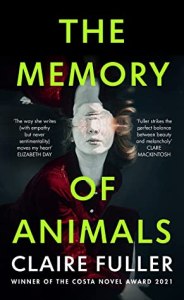 The Memory of Animals by Claire Fuller: Neffy has nothing to lose when she enrolls in a controversial vaccine trial in a familiar mid-pandemic landscape. The novel is presented as her journal. The bulk takes place in two weeks she spends on a locked unit with four fellow test subjects. In the meantime, she is introduced to an experimental technology for reliving memories. The characterisation of the four other cast members is somewhat thin, and the elements feel randomly assembled. The world-building and tech are unlikely to stand up to science fiction fans’ scrutiny, but this has just the right dose of the speculative for literary fiction readers. It also happens to fit into a recent vogue for octopus novels.
Times Literary Supplement
A late-twenties journalist sets out to survey the situation on the ground for ten British species being squeezed out by anthropogenic climate change: The mission is very similar, and both authors embody passionate dedication to conservation, but the difference in tone of these travel narratives makes them likely to appeal to separate audiences…
In Search of One Last Song by Patrick Galbraith & Forget Me Not by Sophie Pavelle:
 Galbraith’s is an elegiac tour through imperilled countryside and urban edgelands. Each chapter resembles an in-depth magazine article: a carefully crafted profile of a beloved bird species, with a focus on the specific threats it faces. Galbraith recognises the nuances of land use. However, shooting plays an outsized role. (Curious for his bio not to disclose that he is editor of the Shooting Times.) The title’s reference is to literal birdsong, but the book also celebrates birds’ cultural importance through their place in Britain’s folk music and poetry. He is clearly enamoured of countryside ways, but too often slips into laddishness, with no opportunity missed to mention him or another man having a “piss” outside. Readers could also be forgiven for concluding that “Ilka” (no surname, affiliation or job title), who briefs him on her research into kittiwake populations in Orkney, is the only female working in nature conservation in the entire country; with few exceptions, women only have bit parts: the farm wife making the tea, the receptionist on the phone line, and so on.
 Pavelle’s book is a tonic in more ways than one. Employed by Beaver Trust, she is enthusiastic and self-deprecating. Her nature quest has a broader scope, including insects like the marsh fritillary and marine species such as seagrass and the Atlantic salmon. Travelling between lockdowns in 2020–1, Pavelle took low-carbon transport wherever possible and bolsters her trip accounts with context, much of it gleaned from Zoom calls and e-mail correspondence with experts from museums and universities. Refreshingly, around half of these interviewees are women, and the animal subjects are never the obvious choices. Instead, she seeks out “underdog” species. The explanations are at a suitable level for laymen, true to her job as a science communicator. The snappy, casual prose (“the future of the bilberry bumblebee and its Aperol arse can be bright, but only if we get off our own”) could even endear her to teenage readers. As image goes, Pavelle’s cheerful naïveté holds more charm than Galbraith’s hardboiled masculinity.
 Taking Flight by Lev Parikian: Parikian’s accessible account of the animal kingdom’s development of flight exhibits a layman’s enthusiasm for an everyday wonder. He explicates the range of flying strategies and the structural adaptations that made them possible. The archaeopteryx section, chronicling the transition between dinosaurs and birds, is a highlight. Though the most science-heavy of the author’s six works, this, perhaps ironically, has fewer footnotes. His usual wit is on display: he describes the feral pigeon as “the Volkswagen Golf of birds” and penguins as “piebald blubber tubes”. This makes it a pleasure to tag along on a journey through evolutionary time, one sure to engage even history- and science-phobes.
Do any of these catch your eye?
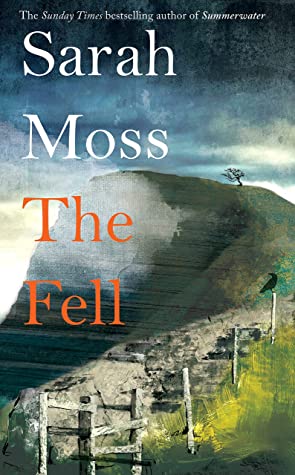
The Fell by Sarah Moss for #NovNov
Sarah Moss’s latest three releases have all been of novella length. I reviewed Ghost Wall for Novellas in November in 2018, and Summerwater in August 2020. In this trio, she’s demonstrated a fascination with what happens when people of diverging backgrounds and opinions are thrown together in extreme circumstances. Moss almost stops time as her effortless third-person omniscient narration moves from one character’s head to another. We feel that we know each one’s experiences and motivations from the inside. Whereas Ghost Wall was set in two weeks of a late-1980s summer, Summerwater and now the taut The Fell have pushed that time compression even further, spanning a day and about half a day, respectively.
A circadian narrative holds a lot of appeal – we’re all tantalized, I think, by the potential difference that one day can make. The particular day chosen as the backdrop for The Fell offers an ideal combination of the mundane and the climactic because it was during the UK’s November 2020 lockdown. On top of that blanket restriction, single mum Kate has been exposed to Covid-19 via a café colleague, so she and her teenage son Matt are meant to be in strict two-week quarantine. Except Kate can’t bear to be cooped up one minute longer and, as dusk falls, she sneaks out of their home in the Peak District National Park to climb a nearby hill. She knows this fell like the back of her hand, so doesn’t bother taking her phone.
Over the next 12 hours or so, we dart between four stream-of-consciousness internal monologues: besides Kate and Matt, the two main characters are their neighbour, Alice, an older widow who has undergone cancer treatment; and Rob, part of the volunteer hill rescue crew sent out to find Kate when she fails to return quickly. For the most part – as befits the lockdown – each is stuck in their solitary musings (Kate regrets her marriage, Alice reflects on a bristly relationship with her daughter, Rob remembers a friend who died up a mountain), but there are also a few brief interactions between them. I particularly enjoyed time spent with Kate as she sings religious songs and imagines a raven conducting her inquisition.
What Moss wants to do here, is done well. My misgiving is to do with the recycling of an identical approach from Summerwater – not just the circadian limit, present tense, no speech marks and POV-hopping, but also naming each short chapter after a random phrase from it. Another problem is one of timing. Had this come out last November, or even this January, it might have been close enough to events to be essential. Instead, it seems stuck in a time warp. Early on in the first lockdown, when our local arts venue’s open mic nights had gone online, one participant made a semi-professional music video for a song with the refrain “everyone’s got the same jokes.”
That’s how I reacted to The Fell: baking bread and biscuits, a family catch-up on Zoom, repainting and clearouts, even obsessive hand-washing … the references were worn out well before a draft was finished. Ironic though it may seem, I feel like I’ve found more cogent commentary about our present moment from Moss’s historical work. Yet I’ve read all of her fiction and would still list her among my favourite contemporary writers. Aspiring creative writers could approach the Summerwater/The Fell duology as a masterclass in perspective, voice and concise plotting. But I hope for something new from her next book.
[180 pages]
With thanks to Picador for the free copy for review.
Other reviews:
Booker Prize 2020: Two More Shortlist Reviews and a Prediction
The 2020 Booker Prize will be announced on Thursday the 19th. (Delayed from the 17th, the date on my commemorative bookmark, so as not to be overshadowed by the release of the first volume of Barack Obama’s presidential memoirs.) After I reviewed Burnt Sugar and correctly predicted half of the shortlist in this post, I’ve managed to finish another two of the novels on the shortlist, along with two more from the longlist. As sometimes happens with prize lists – thinking also of the Women’s Prize race in 2019 – this year’s shortlist fell into rough pairs: two stark mother–daughter narratives, two novels set in Africa, and two gay coming-of-age stories.

The New Wilderness by Diane Cook
In a striking opening to a patchy novel, Bea goes off to the woods to give birth alone to a stillborn daughter. It’s such a different experience to when she birthed Agnes in a hospital eight years ago. Now, with coyotes and buzzards already circling, there’s no time for sentimentality; she turns her back on the baby and returns to the group. Bea is part of a wilderness living experiment that started out with 20 volunteers, but illness and accidents have since reduced their number.
 Back in the toxic, overcrowded City, Bea was an interior decorator and her partner a professor of anthropology. Bea left to give Agnes a better chance at life; like so many other children, she had become ill from her polluted surroundings. Now she is a bright, precocious leader in the making, fully participating in the community’s daily chores. Settlement tempts them, but the Rangers enforce nomadism. Newcomers soon swell their numbers, and there are rumors of other groups, too. Is it even a wilderness anymore if so many people live in it?
The cycles of seasons and treks between outposts make it difficult to get a handle on time’s passing. It’s a jolt to realize Agnes is now of childbearing age. Only when motherhood is a possibility can she fully understand her own mother’s decisions, even if she determines to not repeat the history of abandonment. The blurb promised a complex mother–daughter relationship, but this element of the story felt buried under the rigor of day-to-day survival.
It is as if Cook’s primary interest was in how humans would react to being returned to primitive hunter–gatherer conditions – she did a lot of research into Native American practices, for instance, and she explores the dynamics of sex and power and how legends arise. As a child I was fascinated by Native cultures and back-to-the-land stories, so I enjoyed the details of packing lists, habits, and early rituals that form around a porcelain teacup.
But for me some nuts and bolts of storytelling were lacking here: a propulsive plot, a solid backstory, secondary characters that are worthwhile in their own right and not just stereotypes and generic roles. The appealing description induced me to overcome my usual wariness about dystopian novels, but a plodding pace meant it took me months to read. A lovely short epilogue narrated by Agnes made me wonder how much less tedious this chronicle might have been if told in the first person by Bea and Agnes in turn. I’ll try Cook’s story collection, Man V. Nature, to see if her gifts are more evident in short form.
My rating: 
My thanks to Oneworld for the free copy for review.
Real Life by Brandon Taylor
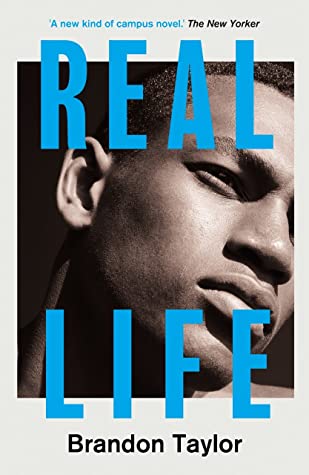 Over the course of one late summer weekend, Wallace questions everything about the life he has built. As a gay African American, he has always been an outsider at the Midwestern university where he’s a graduate student in biochemistry. Though they vary in background and include several homosexuals, some partnered and some unattached, most of his friends are white, and he’s been so busy that he’s largely missed out on evening socializing by the lake – and skipped his father’s funeral (though there are other reasons for that as well).
Tacit prejudice comes out into the open in ugly ways in these few days. When he finds his nematode experiments sabotaged, a female colleague at his lab accuses him of misogyny, brandishing his identity as a weapon against him: “you think that you get to walk around because you’re gay and black and act like you can do no wrong.” Then, in a deliciously awkward dinner party scene, an acquaintance brings up Wallace’s underprivileged Alabama upbringing as if it explains why he’s struggling to cope in his academic career.
Meanwhile, Wallace has hooked up with a male – and erstwhile straight – friend, and though there is unwonted tenderness in this relationship, there is also a hint of menace. The linking of sexuality and violence echoes the memories of abuse from Wallace’s childhood, which tumble out in the first-person stream of consciousness of Chapter 5. Other male friends, too, are getting together or breaking apart over mismatched expectations. Kindness is possible, but built-in injustice and cruelty, whether vengeful or motiveless, too often take hold.
There are moments when Wallace seems too passive or self-pitying, but the omniscient narration emphasizes that all of the characters have hidden depths and that emotions ebb and flow. What looks like despair on Saturday night might feel like no big deal come Monday morning. I so admired how this novel was constructed: the condensed timeframe, the first and last chapters in the past tense (versus the rest in the present tense), the contrast between the cerebral and the bodily, and the thematic and linguistic nods to Virginia Woolf. A very fine debut indeed.
My rating: 
I also read two more of the longlisted novels from the library:
Such a Fun Age by Kiley Reid
 Such a fun book! I’d read the first chapter earlier in the year and set it aside, thinking it was too hip for me. I’m glad I decided to try again – it was a great read, so assured and contemporary. Once I got past a slightly contrived first chapter, I found it completely addictive. The laser-precision plotting and characterization reminded me of Jennifer Egan, Jonathan Franzen and Zadie Smith at their peak, but the sassy voice is all Reid’s own. There are no clear villains here; Alix Chamberlain could easily have filled that role, but I felt for her and for Kelley as much as I did for Emira. The fact that I didn’t think anyone was completely wrong shows how much nuance Reid worked in. The question of privilege is as much about money as it is about race, and these are inextricably intertwined.
Love and Other Thought Experiments by Sophie Ward
 An intriguing set of linked short stories that combine philosophy and science fiction. Rachel and Eliza are preparing to have a baby together when an ant crawls into Rachel’s eye and she falls ill. Eliza wants to believe her partner but, as a scientist, can’t affirm something that doesn’t make sense (“We don’t need to resort to the mystical to describe physical processes,” she says). Other chapters travel to Turkey, Brazil and Texas – and even into space. It takes 60+ pages to figure out, but you can trust all the threads will converge around Rachel and her son, Arthur, who becomes an astronaut. I was particularly taken by a chapter narrated by the ant (yes, really) as it explores Rachel’s brain. Each section is headed by a potted explanation of a thought experiment from philosophy. I wasn’t entirely sure what to make of the alternative future of the two final chapters. Still, I was impressed with the book’s risk-taking and verve. It’s well worth making a rare dip into sci-fi for this one.
Back in September I still thought Hilary Mantel would win the whole thing, but since her surprise omission from the shortlist I’ve assumed the prize will go to Shuggie Bain by Douglas Stuart. This was a DNF for me, but I’ll try it again next year in case it was just a matter of bad timing (like the Reid and The Go-Between – two books I attempted a second time this year and ended up loving). Given that it was my favorite of the ones I read, I would be delighted to see Real Life win, but I think it unlikely. My back-up prediction is The Shadow King by Maaza Mengiste, which I would consider reserving from the library if it wins.

Have you read anything from the Booker shortlist?
Which book do you expect to win?
Imitation Is the Sincerest Form of Flattery: Costello, O’Shaughnessy & Smyth
These three books – two novels and a memoir – pay loving tribute to a particular nineteenth- or twentieth-century writer. In each case, the author incorporates passages of pastiche, moving beyond thematic similarity to make their language an additional homage.
Although I enjoyed the three books very much, they differ in terms of how familiar you should be with the source material before embarkation. So while they were all  reads for me, I have added a note below each review to indicate the level of prior knowledge needed.
The River Capture by Mary Costello
 Luke O’Brien has taken a long sabbatical from his teaching job in Dublin and is back living at the family farm beside the river in Waterford. Though only in his mid-thirties, he seems like a man of sorrows, often dwelling on the loss of parents, aunts and romantic relationships with both men and women. He takes quiet pleasure in food, the company of pets, and books, including his extensive collection on James Joyce, about whom he’d like to write a tome of his own. The novel’s very gentle crisis comes when Luke falls for Ruth and it emerges that her late father ruined his beloved Aunt Ellen’s reputation.
At this point a troubled Luke is driven into 100+ pages of sinuous contemplation, a bravura section of short fragments headed by questions. Rather like a catechism, it’s a playful way of organizing his thoughts and likely more than a little Joycean in approach – I’ve read Portrait of the Artist and Dubliners but not Ulysses or Finnegans Wake, so I feel less than able to comment on the literary ventriloquism, but I found this a pleasingly over-the-top stream-of-consciousness that ranges from the profound (“What fear suddenly assails him? The arrival of the noonday demon”) to the scatological (“At what point does he urinate? At approximately three-quarters of the way up the avenue”).
While this doesn’t quite match Costello’s near-perfect novella, Academy Street, it’s an impressive experiment in voice and style, and the treatment of Luke’s bisexuality struck me as sensitive – an apt metaphorical manifestation of the novel’s focus on fluidity. (See also Susan’s excellent review.)
Why Joyce? “integrity … commitment to the quotidian … refusal to take conventions for granted”
Familiarity required: Moderate
Also recommended: The Sixteenth of June by Maya Lang
With thanks to Canongate for the free copy for review.
In Love with George Eliot by Kathy O’Shaughnessy
Many characters, fictional and historical, are in love with George Eliot over the course of this debut novel by a literary editor. The whole thing is a book within a book – fiction being written by Kate, an academic at London’s Queen Elizabeth College who’s preparing for two conferences on Eliot and a new co-taught course on life writing at the same time as she completes her novel, which blends biographical information and imagined scenes.
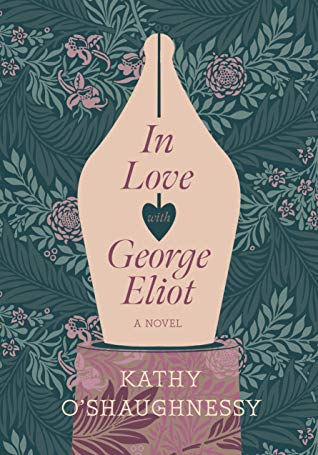 1857: Eliot is living with George Henry Lewes, her common-law husband, and working on Adam Bede, which becomes a runaway success, not least because of speculation about its anonymous author. 1880: The great author’s death leaves behind a mentally unstable widower 20 years her junior, John Walter Cross, once such a close family friend that she and Lewes called him “Nephew.”
Between these points are intriguing vignettes from Eliot’s life with her two great loves, and insight into her scandalous position in Victorian society. Her estrangement from her dear brother (the model for Tom in The Mill on the Floss) is a plangent refrain, while interactions with female friends who have accepted the norms of marriage and motherhood reveal just how transgressive her life is perceived to be.
In the historical sections O’Shaughnessy mimics Victorian prose ably, yet avoids the convoluted syntax that can make Eliot challenging. I might have liked a bit more of the contemporary story line, in which Kate and an alluring colleague make their way to Venice (the site of Eliot’s legendarily disastrous honeymoon trip with Cross), but by making this a minor thread O’Shaughnessy ensures that the spotlight remains on Eliot throughout.
Highlights: A cameo appearance by Henry James; a surprisingly sexy passage in which Cross and Eliot read Dante aloud to each other and share their first kiss.
Why Eliot? “As an artist, this was her task, to move the reader to see people in the round.”
Familiarity required: Low
Also recommended: 142 Strand by Rosemary Ashton, Sophie and the Sibyl by Patricia Duncker, and My Life in Middlemarch by Rebecca Mead
With thanks to Scribe UK for the free copy for review.
All the Lives We Ever Lived: Seeking Solace in Virginia Woolf by Katharine Smyth
 Smyth first read To the Lighthouse in Christmas 2001, during her junior year abroad at Oxford. Shortly thereafter her father had surgery in Boston to remove his bladder, one of many operations he’d had during a decade battling cancer. But even this new health scare wasn’t enough to keep him from returning to his habitual three bottles of wine a day. Woolf was there for Smyth during this crisis and all the time leading up to her father’s death, with Lighthouse and Woolf’s own life reflecting Smyth’s experience in unanticipated ways. The Smyths’ Rhode Island beach house, for instance, was reminiscent of the Stephens’ home in Cornwall. Woolf’s mother’s death was an end to the summer visits, and to her childhood; Lighthouse would become her elegy to those bygone days.
Often a short passage by or about Woolf is enough to launch Smyth back into her memories. As an only child, she envied the busy family life of the Ramsays in Lighthouse. She delves into the mystery of her parents’ marriage and her father’s faltering architecture career. She also undertakes Woolf tourism, including the Cornwall cottage, Knole, Charleston and Monk’s House (where Woolf wrote most of Lighthouse). Her writing is dreamy, mingling past and present as she muses on time and grief. The passages of Woolf pastiche are obvious but short enough not to overstay their welcome; as in the Costello, they tend to feature water imagery. It’s a most unusual book in the conception, but for Woolf fans especially, it works. However, I wished I had read Lighthouse more recently than 16.5 years ago – it’s one to reread.
Why Woolf? “I think it’s Woolf’s mastery of moments like these—moments that hold up a mirror to our private tumult while also revealing how much we as humans share—that most draws me to her.”
Undergraduate wisdom: “Woolf’s technique: taking a very complex (usually female) character and using her mind as an emblem of all minds” [copied from notes I took during a lecture on To the Lighthouse in a “Modern Wasteland” course during my sophomore year of college]
Familiarity required: High
Also recommended: Virginia Woolf in Manhattan by Maggie Gee, Vanessa and Her Sister by Priya Parmar, and Adeline by Norah Vincent
With thanks to Atlantic Books for the free copy for review.
Die, My Love by Ariana Harwicz
This intense Argentinian novella, originally published in 2012 and nominated for this year’s Republic of Consciousness and Man Booker International Prizes, is an inside look at postpartum depression as it shades into what looks like full-blown psychosis. We never learn the name of our narrator, just that she’s a foreigner living in France (like Harwicz herself) and has a husband and young son. The stream-of-consciousness chapters are each composed of a single paragraph that stretches over two or more pages. From the first page onwards, we get the sense that this character is on the edge: as she’s hanging laundry outside, she imagines a sun shaft as a knife in her hand. But for now she’s still in control. “I wasn’t going to kill them. I dropped the knife and went to hang out the washing like nothing had happened.”
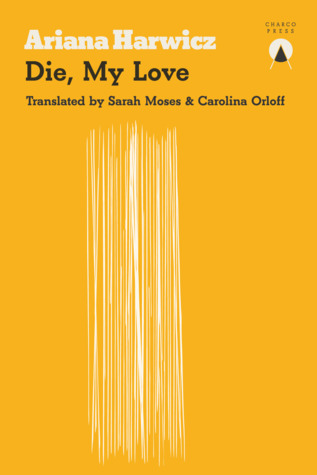 Not a lot happens over the course of the book; what’s more important is to be immersed in this character’s bitter and perhaps suicidal or sadistic outlook. But there are a handful of concrete events. Her father-in-law has recently died, so she tells of his funeral and what she perceives as his sad little life. Her husband brings home a stray dog that comes to a bad end. Their son attends a children’s party and they take along a box of pastries that melt in the heat.
The only escape from this woman’s mind is a chapter from the point of view of a neighbor, a married radiologist with a disabled daughter who passes her each day on his motorcycle and desires her. With such an unreliable narrator, though, it’s hard to know whether the relationship they strike up is real. This woman is racked by sexual fantasies, but doesn’t seem to be having much sex; when she does, it’s described in disturbing terms: “He opened my legs. He poked around with his calloused hands. Desire is the last thing there is in my cries.”
The language is jolting and in-your-face, but often very imaginative as well. Harwicz has achieved the remarkable feat of showing a mind in the process of cracking up. It’s all very strange and unnerving, and I found that the reading experience required steady concentration. But if you find the passages below intriguing, you’ll want to seek out this top-class translation from new Edinburgh-based publisher Charco Press. It’s the first book in what Harwicz calls “an involuntary trilogy” and has earned her comparisons to Virginia Woolf.
“My mind is somewhere else, like I’ve been startled awake by a nightmare. I want to drive down the road and not stop when I reach the irrigation ditch.”
“I take off my sleep costume, my poisonous skin. I recover my sense of smell and my eyelashes, go back to pronouncing words and swallowing. I look at myself in the mirror and see a different person to yesterday. I’m not a mother.”
“The look I’m going for is Zelda Fitzgerald en route to Switzerland, and not for the chocolate or watches, either.”
My rating:
Translated from the Spanish by Sarah Moses and Carolina Orloff. My thanks to the publisher for the free copy for review.
 Bookish Beck = Rebecca Foster. American transplant to England. Freelance proofreader and book reviewer.
 Bookish Beck