Spring Reads, Part I: Violets and Rain
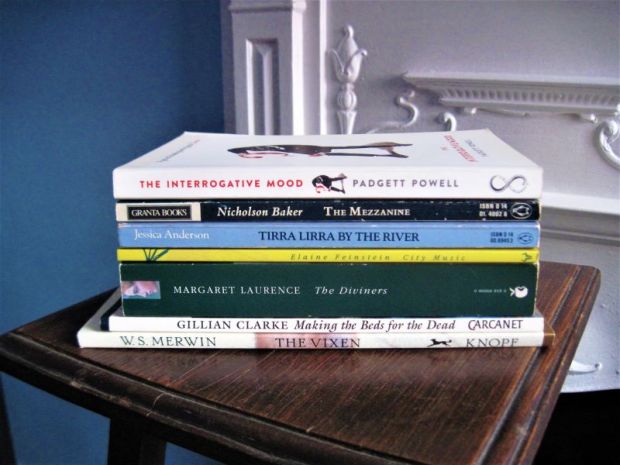
We had both rain and spring sunshine on a recent overnight trip to Bridport, Dorset – a return visit after enjoying it so much in 2019. Several elements were repeated: Dorset Nectar cider farm, dinner at Dorshi, and a bookshop and charity shop crawl of the main streets. While we didn’t revisit Thomas Hardy sites, I spent plenty of time at Max Gate by reading Elizabeth Lowry’s The Chosen. Beach walks plus one in the New Forest on the way back were splendid. This was my haul from Bridport Old Books. Stocking up on novellas and poetry, plus a novel by a Canadian author I’ve enjoyed work from before.
Now for a quick look at two tangentially spring-related books I’ve read recently: a short novel about two women’s wartime experiences of motherhood and an elegiac and allusive poetry collection.
Violets by Alex Hyde (2022)
I was intrigued by the sound of this debut novel, which juxtaposes the lives of two young British women named Violet at the close of the Second World War. One miscarries twins and, told she’ll not be able to bear children, has to rethink her whole future; another sails from Wales to Italy on ATS war service, hiding the fact that she’s pregnant by a departed foreign soldier. Hyde’s spare style – no speech marks; short paragraphs or solitary lines separated by spaces – alternates between their stories in brief numbered chapters, bringing them together in a perhaps predictable way that also forms a reimagining of her father’s life story. The narration at times addresses this future character in poems that I think are supposed to be fond and prophetic but I instead found strangely blunt and even taunting (as in the excerpt below). There’s inadequate time to get to know, or care about, either Violet. 

Can you feel it, Pram Boy?
Can you march in time?
A change, a hardening,
the jarring of the solid ground as she treads,
gets her pockets picked.
[…]
Quick! March!
And your Mama, Pram Boy,
yeasty in her private parts.
Granta sent a free copy. Violets came out in paperback in February.
Rain by Don Paterson (Faber, 2009)
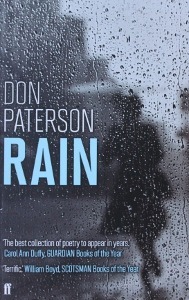 I’d previously read Paterson’s 40 Sonnets, in 2015. This collection is in memoriam of the late poet Michael Donaghy, the subject of the late multi-part “Phantom.” There are a couple of poems in Scots and a sequence of seven nature-infused ones designated as being “after” poets from Li Po to Robert Desnos. Several appear to express concern for a son. There’s a haiku-like rhythm to the short stanzas of “Renku: My Last Thirty-Five Deaths.” I didn’t understand why “Unfold i.m. Akira Yoshizawa” was a blank page until I looked him up and learned that he was a famous origamist. The title poem closes the collection:
I love all films that start with rain:
rain, braiding a windowpane
or darkening a hung-out dress
or streaming down her upturned face;
one big thundering downpour
right through the empty script and score
before the act, before the blame,
before the lens pulls through the frame
to where the woman sits alone
beside a silent telephone
I liked individual passages or images but didn’t find much of a connecting theme behind Paterson’s disparate interests. (University library) 
Another favourite passage:
So I collect the dull things of the day
in which I see some possibility
[…]
I look at them and look at them until
one thing makes a mirror in my eyes
then I paint it with the tear to make it bright.
This is why I sit up through the night.
(from “Why Do You Stay Up So Late?”)
And a DNF:
 Corpse Beneath the Crocus by N.N. Nelson – I loved the title and the cover, and a widow’s bereavement memoir in poems seemed right up my street. I wish I’d realized Atmosphere is a vanity press, which would explain why these are among the worst poems I’ve read: cliché-riddled and full of obvious sentiments and metaphors as she explores specific moments but mostly overall emotions. Three excerpts:
All things die
In the flowering cycle
Of growth and life
Time passes
Like sand in an hourglass
Feelings are changeful
Like the tide
Ebbing and flowing
“Love Letter,” a prose piece, held the most promise, which suggests Nelson would have been better off attempting memoir. I slogged (hate-read, really) my way through to the halfway point but could bear it no longer. (NetGalley) 
I have a few more spring-themed books on the go: Hoping for a better set next time!
Any spring reads on your plate?
Sapphira and the Slave Girl & Portrait of the Artist as a Young Dog (#1940Club)
(I was disgusted by the ad-ridden appearance of my blog, and defeated by the task of culling my media library, so I’ve upgraded to a paid plan for a trial year. I had until now vowed not to spend any money on the site since I don’t make any money from it, but WordPress hooked me in with a 30% off deal, and I’ll appreciate the no ads and extra storage space. I hope it looks better now!)

A year club hosted by Karen and Simon is always a great excuse to read more classics. One of these was a winner, if peculiar; the other was so-so, but helped clarify for me what a particular literary prize is looking for.
Sapphira and the Slave Girl by Willa Cather
{SPOILERS IN THIS ONE}
I was surprised to find that this was my seventh book by Cather, so I’ve actually read over half of her novels now. I think all her other works I know were set on the prairies of the Midwest (or in Santa Fe in the case of Death Comes for the Archbishop), so Sapphira and the Slave Girl feels like an odd one out not just for its antebellum historical subject matter but also for its setting in Cather’s hometown of Winchester, Virginia.
In 1856, the Colberts’ is a house divided: Henry, a miller from Quaker stock, disapproves of slavery; his wife, Sapphira, grew up with slaves and treats them severely. While the other Colbert brothers’ meddling with Black women is an open secret – one of them is assumed to have fathered Henry and Sapphira’s mixed-race teenage slave, Nancy – Henry looks fondly on Nancy and thinks of her almost like a second daughter. Sapphira resents that attention. When her Colbert nephew, Martin, a known cad, comes to visit, she arranges, or at least allows, convenient opportunities for Martin to be alone with Nancy.
 Nancy appeals to the Colberts’ adult daughter, Rachel Blake, to accompany her on her walks so that Martin will not “overtake” her in the woods. Although none of the white characters take the repeated threat of attempted rape seriously enough, Henry and Rachel do eventually help Nancy escape to Canada via the Underground Railroad. When Sapphira realizes her ‘property’ has been taken from her, she informs Rachel she is now persona non grata, but changes her mind when illness brings tragedy into Rachel’s household.
Had this been written 40–80 years later, it would have been completely different: first of all, I would expect it to much more graphically recount Black suffering, rather than depicting generally happy “darkies” with folksy accents and quirky character traits; secondly, there would be either a redemptive or a punitive plot arc for Sapphira. Instead, Cather paints her as a flawed human being who accepts the status quo but is also graceful in disability (she has dropsy and is in a wheelchair) and accepting of the approach of death.
I wish I remembered from the Hermione Lee biography more about the immediate inspiration for this novel, and its reception. Simply taking an interest in Black characters must have set it apart. For instance, there is a whole chapter on Nancy’s grandmother, Aunt Jezebel, the first generation kidnapped from Africa; and the final section has Nancy, now a sophisticated Montreal housekeeper dressed in silk and fur, visiting her mother 20 years after the Civil War. That Cather’s characterization otherwise doesn’t rise above cheerful mammy stereotypes can hardly be counted against her given the time period, right? It was good to experience a lesser-known American classic that I can imagine appealing to fans of Thomas Hardy and Edith Wharton as well. (From a Little Free Library in Queen Camel, Somerset; April 2021)
Portrait of the Artist as a Young Dog by Dylan Thomas
 Published when Thomas was in his mid-twenties, this is a series of 10 sketches, some of which are more explicitly autobiographical (as in first person, with a narrator named Dylan Thomas) than others. There is a rough chronological trajectory to the stories, with the main character a mischievous boy, then a grandstanding teenager, then a young journalist in his first job. The countryside and seaside towns of South Wales recur as settings, and – as will be no surprise to readers of Under Milk Wood – banter-filled dialogue is the priority. I most enjoyed the childhood japes in the first two pieces, “The Peaches” and “A Visit to Grandpa’s.” The rest failed to hold my attention, but I marked out two long passages that to me represent the voice and scene-setting that the Dylan Thomas Prize is looking for. The latter is the ending of the book and reminds me of the close of James Joyce’s “The Dead.” (University library)
I was a lonely night-walker and a steady stander-at-corners. I liked to walk through the wet town after midnight, when the streets were deserted and the window lights out, alone and alive on the glistening tram-lines in dead and empty High Street under the moon, gigantically sad in the damp streets by ghostly Ebenezer Chapel. And I never felt more a part of the remote and overpressing world, or more full of love and arrogance and pity and humility, not for myself alone, but for the living earth I suffered on… [etc.]
For a long time he waited on the stairs, though there was no love now to wait for and no bed but his own too many miles away to lie in, and only the approaching day to remember his discovery. All around him the disturbed inhabitants of the house were falling back into sleep. Then he walked out of the house on to the waste space and under the leaning cranes and ladders. The light of the one weak lamp in a rusty circle fell across the brick-heaps and the broken wood and the dust that had been houses once, where the small and hardly known and never-to-be-forgotten people of the dirty town had lived and loved and died and, always, lost.
(I’ve previously participated in the 1920 Club, 1956 Club, 1936 Club, 1976 Club, 1954 Club and 1929 Club.)
Summery Reads from Holly Hopkins, Sarah McCoy, Phil Stamper and Edith Wharton
Every season, I try to choose a few books that feel appropriate for their settings or titles. A few of these I’ve already mentioned briefly, as part of my heat wave reading suggestions. Much as I love autumn, the end of summer tends to coincide with gloomy musings for me. However, it’s farewell to August with four reasonably cheerful books: a poetry collection about England then and now, city and country; an escapist novel set on the Caribbean island of Mustique in the 1970s; the story of four gay friends going their separate ways for a high school summer of adventure; and a less-tragic-than-expected American classic.
The English Summer by Holly Hopkins (2022)
 Colour, geology and history are major sources of imagery in this debut full-length collection. Churches and cemeteries, museums and manor houses, versus hospitals and rental flats: this is the stuff of a country that has swapped its illustrious past for the dismal reality of the everyday. The collection closes with “England, Where Did You Go?” which ends, “should I get out in search of you, … / I’d be left wandering down dual carriageways, / looking across bean fields and filthy ditches.” Hopkins imagines a government that decides to address climate change by assigning weekly community service hours – nearly twice as many for women, who always bear the greater burden for domestic work.
It’s mostly alliteration, repetition, and internal or slant rhymes here. I particularly liked the pair “Rows of Differently Coloured Houses,” which contrasts bright seaside facades with the “Lakes of postwar pebbledash / grey on grey on grey on grey” seen from a Megabus, and “Stratigraphy,” about the archaeologist’s work. Not many standouts otherwise, but it was still worth a try. (New purchase – the publisher, Penned in the Margins, lured me with a sale)
Mustique Island by Sarah McCoy (2022)
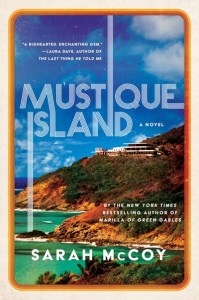 Mustique is a private island in the St. Vincent archipelago that became a playground of the rich and famous in the 1970s, with Princess Margaret and Mick Jagger regular visitors. In McCoy’s novel – inspired by real events and people, and featuring cameos from the aforementioned celebrities as well as the island’s owners at the time, the baron Colin Tennant and his wife, Lady Anne Glenconner (who, I was amused to spot at the library the other day, has written her own fictional tribute to the island, Murder on Mustique) – Willy May, a Texan with a small fortune at her disposal thanks to her divorce from an English brewing magnate, sails in on a private boat and decides to build her own villa on Mustique. She’s uncomfortable with the way locals, who only have service jobs, are sometimes paraded out for colonial displays of pomp. Her two young adult daughters, Hilly and Joanne, later join her. The one has been a model in Paris, where she became addicted to amphetamines.
Love is on the cards for all three main female characters, but there’s heartache along the way as well. Closer to women’s fiction than I generally choose, this was a frothy indulgence that was fun to read but could be shorter and needn’t have tried so hard to make serious points about motherhood and to evoke the time period, e.g., with a list of what’s on the radio. I have also reviewed McCoy’s Marilla of Green Gables. (Offered by publicist via NetGalley)
Golden Boys by Phil Stamper (2022)
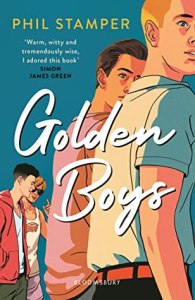 Four gay high schoolers in small-town Ohio look forward to a summer of separate travels for jobs and internships and hope their friendships will stay the course. We have Gabriel, a nature lover off to volunteer for a Boston save-the-trees non-profit; Sal, his friend with benefits, who dreams of bypassing college for a career in politics so interns at his local senator’s office in Washington, DC; Reese, headed to Paris for a fashion design course; and Heath, escaping his parents’ divorce and moving chaos to stay with an aunt and cousin in Florida and work at their beach café. With alternating first-person passages from all four characters, plus transcriptions of their conversation threads, this moves quickly.
Reese has been secretly infatuated with Heath for ages, but three of the four will consider new dating opportunities this summer (the fourth just becomes a workaholic). Secondary characters are pansexual and nonbinary – it’s a whole new world from when I was in high school! Initially, I found the inner monologues too one-note, but I think Stamper’s aim was to recreate the teenage struggle for self-confidence and individuality and has captured that life stage’s inherent anxiety. I also would have trimmed the preparatory stuff; nearly 100 pages before the first of them leaves Ohio is a bit much. This YA novel was a sweet, fun page turner and the perfect replacement to the Heartstopper series as my summer crush. However, I don’t think I was taken enough with the characters to read next year’s projected sequel. (Public library)
Summer by Edith Wharton (1917)
 Charity Royall was born into poverty but brought down the mountain and adopted by a kindly couple into respectable North Dormer society. Mrs. Royall has died before the action starts, but as a young woman Charity still lives with Lawyer Royall, her guardian, and works at the library. When a stranger, Mr. Harney, arrives in their New England town to survey the local architecture, it’s clear right away that he’ll be a romantic prospect for her. “She had always thought of love as something confused and furtive, and he made it as bright and open as the summer air.” However, shame over her lowly origins – she is so snobbish every time she comes into contact with someone from the mountain – continues to plague her.
Although Harney returns her affections and they set up a little love nest in an abandoned house in the woods, uncertainty lingers as to whether he’ll consider marriage to Charity beneath him. This skirts Tess of the d’Urbervilles territory but doesn’t turn nearly as tragic as Ethan Frome (apparently, Wharton called this a favourite among her works, and referred to it as “the Hot Ethan”). Charity isn’t as vain as another Hardy heroine, Bathsheba Everdene; she’s an endearing blend of innocent and worldly, and her realistic reaction to what fate seems to decree feels like about the best one can expect for her time. Melodrama aside, I truly enjoyed the descriptions of a quintessential American summer with picnics and Fourth of July fireworks. Ethan fan or not, you should definitely read this one. (University library)
Review Catch-Up: Brackenbury, McLaren, Wellcome Collection
As usual, I have a big backlog of 2021–22 releases I’m working my way through. I’ll get there eventually! Today I’m reporting on a poetry collection about English ancestry and wildlife, a vision of post-doubt Christian faith, and a set of essays on connection to nature, specifically flora. (I also take a brief look at some autofiction that didn’t work for me.)
Thorpeness by Alison Brackenbury (2022)
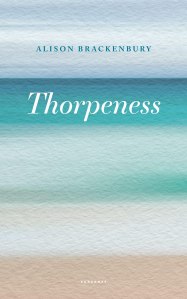 I’m familiar with Brackenbury from her appearance at New Networks for Nature in 2016 and her latest selected poems volume, Gallop. This, her tenth stand-alone collection, features abundant imagery of animals and the seasons, as in “Cucu” and “Postcard,” which marks the return of swifts. Alliteration is prominent, but there is also a handful of rhymes, like in “Fern.” Family history and the perhaps-idyllic rural underpin the verse set in Lincolnshire and Gloucestershire as Brackenbury searches for ancestral graves and delivers elegies.
I especially loved “Aunt Margaret’s Pudding,” a multipart poem about her grandmother’s life as a professional cook and then a mother of four, and “My Grandmother Waits for Christmas,” about a simple link between multiple generations’ Christmases: a sugar mouse. Caring for horses is another recurring theme; a 31-year-old blind pony receives a fond farewell.
There are also playful meetings between historical figures (“Purple Haze,” a dialogue between George Frideric Handel and Jimi Hendrix, who saw the composer’s ghost in their shared London home) and between past and contemporary, like “Thomas Hardy sends an email” (it opens “I need slide no confessions under doors”). “Charles Dickens at Home” was another favourite of mine. The title is the never-to-be-reached destination in the final poem, “Shingle.” A number of these poems were first broadcast on BBC Radio. 
With thanks to Carcanet Press for the e-copy for review.
Faith after Doubt: Why Your Beliefs Stopped Working and What to Do about It by Brian McLaren (2021)
I’ve explained before how McLaren’s books were pivotal to my spiritual journey, even before I attended the church he founded in Maryland. (I’ve also reviewed his previous book, God Unbound). His progressive, environmentalist theology is perfect for continuing searchers like me. At one of last year’s online Church Times Festival events, I saw him introduce the schema that underpins this book. He proposes that the spiritual life (not just Christian) has four stages that may overlap or repeat: simplicity, complexity, perplexity and harmony. The first stage is for new zealots who draw us–them divisions and are most concerned with orthodoxy. In the second, practitioners are more concerned with practicalities: what works, what makes life better. Perplexity is provoked by cynicism about injustice and hypocrisy, while harmony moves beyond dualism and into connection with other people and with nature.
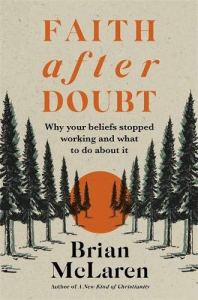 McLaren suggest that honest doubting, far from being a problem, might present an opportunity for changing in the right direction, getting us closer to the “revolutionary love” at the heart of the gospel. He shares stories from his own life, in and out of ministry, and from readers who have contacted him remotely or come up to him after events, caught in dilemmas about what they believe and whether they want to raise their children into religion. Though he’s fully aware of the environmental crisis and doesn’t offer false hope that we as a species will survive it, he isn’t ready to give up on religion; he believes that a faith seasoned by doubt and matured into an understanding of the harmony of all things can be part of a solution.
It’s possible some would find McLaren’s ideas formulaic and his prose repetitive. His point of view always draws me in and gives me much to think about. I’ve been stuck in perplexity for, ooh, 20 years? I frequently ask myself why I persist in going to church when it’s so boring and so often feels like a social club for stick-in-the-mud white people instead of a force for change. But books like this and Robin Wall Kimmerer’s Braiding Sweetgrass, my current soul food, encourage me to keep pursuing spiritual connection as a worthwhile path. I’ll be seeking out his forthcoming book (due out in May), Do I Stay Christian?, too.
Some favourite lines:
“only doubt can save the world. Only doubt will open a doorway out of hostile orthodoxies – whether religious, cultural, economic or political. Only through the difficult passage of doubt can we emerge into a new stage of faith and a new regenerative way of life. Everything depends on making this passage.”
“Among all the other things doubt is – loss, loneliness, crisis, doorway, descent, dissent [these are each the subject of individual chapters early on in the book] – it is also this: a crossroads. At the crossroads of doubt, we either become better or bitter. We either break down or break through. We become cynics or sages, hollow or holy. We choose love or despair.”
“Blessed are the wonderers, for they shall find what is wonderful. … Blessed are the doubters, for they shall see through false gods. Blessed are the lovers, for they shall see God everywhere.”
With thanks to Hodder & Stoughton for the free copy for review.
This Book Is a Plant: How to Grow, Learn and Radically Engage with the Natural World (2022)
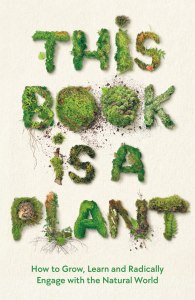 This collection of new essays and excerpts from previously published volumes accompanies the upcoming Wellcome Collection exhibition Rooted Beings (a collaboration with La Casa Encendida, Madrid, it’s curated by Bárbara Rodríguez Muñoz and Emily Sargent and will run from 24 March to 29 August). The overarching theme is our connection with plants and fungi, and the ways in which they communicate. Some of the authors are known for their nature writing – there’s an excerpt from Merlin Sheldrake’s Entangled Life, Jessica J. Lee (author of Turning and Two Trees Make a Forest) contributes an essay on studying mosses, and a short section from Kimmerer’s Braiding Sweetgrass closes the book – while others are better known in other fields, like Susie Orbach and Abi Palmer (author of Sanatorium).
I especially enjoyed novelist Rowan Hisayo Buchanan’s “Wilder Flowers,” which is about landscape painting, balcony gardening in pots, and what’s pretty versus what’s actually good for nature. (Wildflowers aren’t the panacea we are sometimes sold.) I was also interested to learn about quinine, which comes from the fever tree, in Kim Walker and Nataly Allasi Canales’ “Bitter Barks.” Sheila Watt-Cloutier’s essay on the Western influence on Inuit communities in northern Canada, reprinted from Granta, is one of the best individual pieces – forceful and with a unique voice, it advocates reframing the climate change debate in terms of human rights as opposed to the economy – but has nothing to do with plants specifically. There are also a couple of pieces that go strangely mystical, such as one on plant metaphors in the Kama Sutra. So, a mixed bag that jumbles science, paganism and postcolonial thought, but if you haven’t already encountered the Kimmerer and Sheldrake (or, e.g., Rooted by Lyanda Lynn Haupt and Losing Eden by Lucy Jones) you might find this a good primer. 
With thanks to Profile Books / Wellcome Collection for the free copy for review.
And one that really didn’t work for me; my apologies to the author and publisher.
I Love You but I’ve Chosen Darkness by Claire Vaye Watkins (2021)
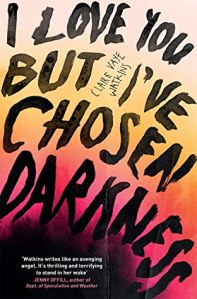 What a letdown after Gold Fame Citrus, one of my favourite novels of 2015. I’d also read Watkins’s debut short story collection, Battleborn, which won the Dylan Thomas Prize. Despite the amazing title and promising setup – autofiction that reflects on postpartum depression and her Mojave Desert upbringing as a daughter of one of the Manson Family cult members – this is indulgent, misguided, and largely unreadable.
A writer named Claire Vaye Watkins flies to Nevada to give a lecture and leaves her husband and baby daughter behind – for good? To commemorate her mother Martha, who died of an opiate overdose, she reprints Martha’s 1970s letters, which are unspeakably boring. I feel like Watkins wanted to write a memoir but didn’t give herself permission to choose nonfiction, so tried to turn her character Claire’s bad behaviour into a feminist odyssey of sexual freedom and ended up writing such atrocious lines as the below:
“I mostly boinked millennial preparers of beverages and schlepped to book festivals to hook up with whatever adequate rando lurked at the end of my signing line. This was what our open marriage looked like”
“‘Psychedelics tend to find me when I need them,’ she said, sending a rush of my blood to my vulva.”
Her vagina dentata (a myth, or a real condition?!) becomes a bizarre symbol of female power and rage. I could only bear to skim this. 
Some lines I liked:
Listen: I am a messenger from the future. I am you in ten years. Pay attention! Don’t fetishize marriage and babies. Don’t succumb to the axial tilt of monogamy! I don’t pretend to know the details of your…situation, but I guarantee you, you’re as free as you’ll ever be. Have sex with anyone you want. Enjoy the fact that it might happen any minute. You could have sex with a man, a woman, both—tonight!
I went from being raised by a pack of coyotes to a fellowship at Princeton where I sat next to John McPhee at a dinner and we talked about rocks and he wasn’t at all afraid of me.
With thanks to riverrun for the proof copy for review.
Would you be interested in reading one or more of these?
Ethan Frome by Edith Wharton (#NovNov Classics Week Buddy Read)
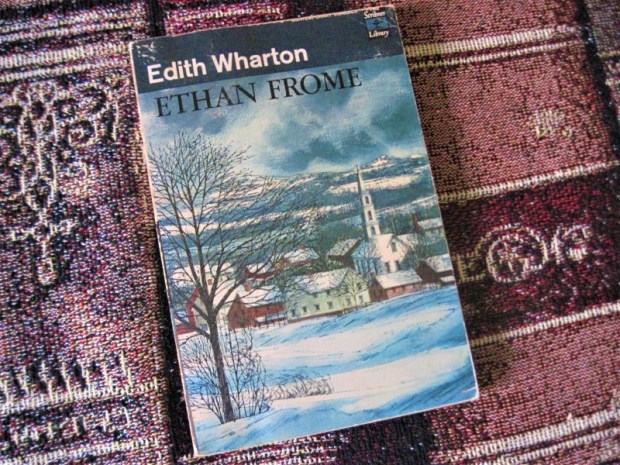
For the short classics week of Novellas in November, our buddy read is Ethan Frome by Edith Wharton (1911). You can download the book for free from Project Gutenberg here if you’d still like to join in.
Did you have to read Ethan Frome in school? For American readers, it’s likely that it was an assigned text in high school English. I didn’t happen to read it during my school days, but caught up in 2006 or 2008, I think, and was impressed with this condensed tragedy and the ambiance of a harsh New England winter. It struck me even more on a reread as a flawless parable of a man imprisoned by circumstance and punished for wanting more.
I had forgotten that the novella is presented as a part-imagined reconstruction of the sad events of Ethan Frome’s earlier life. A quarter-century later, the unnamed narrator is in Wharton’s fictional Starkfield, Massachusetts on business, and hears the bare bones of Ethan’s story from various villagers before meeting the man himself. Ethan, who owns a struggling sawmill, picks up extra money from odd jobs. He agrees to chauffeur the narrator to engineering projects in his sleigh, and can’t conceal his jealousy at a technical career full of travel – a reminder of what could have been had he been able to continue his own scientific studies. A blizzard forces the narrator to stay overnight in Ethan’s home, and the step over the threshold sends readers back in time to when Ethan was a young man of 28.
*There are SPOILERS in the following.*
Ethan’s household contains two very different women: his invalid wife, Zeena, eight years his elder; and her cousin, Mattie Silver, who serves as her companion and housekeeper. Mattie is dreamy and scatter-brained – not the practical sort you’d want in a carer role, but she had nowhere else to go after her parents’ death. She has become the light of Ethan’s life. By contrast, Zeena is shrewish, selfish, lazy and gluttonous. Wharton portrays her as either pretending or exaggerating about her chronic illness. Zeena has noticed that Ethan has taken extra pains with his appearance in the year since Mattie came to live with them, and conspires to get rid of Mattie by getting a new doctor to ‘prescribe’ her a full-time servant.
The plot turns on an amusing prop, “Aunt Philura Maple’s pickle-dish.” While Zeena is away for her consultation with Dr. Buck, Ethan and Mattie get one evening alone together. Mattie lays the table nicely with Zeena’s best dishes from the china cabinet, but at the end of their meal the naughty cat gets onto the table and knocks the red glass pickle dish to the floor, where it smashes. Before Ethan can obtain glue to repair it in secret, Zeena notices and acts as if this never-used dish was her most prized possession. She and Ethan are both to have what they most love taken away from them – but at least Ethan’s is a human being.
I had remembered that Ethan fell in love with a cousin (though I thought it was his cousin) and that there is a dramatic sledding accident. What I did not remember, however, was that the crash is deliberate: knowing they can never act on their love for each other, Mattie begs Ethan to steer them straight into the elm tree mentioned twice earlier. He dutifully does so. I thought I recalled that Mattie dies, while he has to live out his grief ever more. I was gearing myself up to rail against the lingering Victorian mores of the time that required the would-be sexually transgressing female to face the greatest penalty. Instead, in the last handful of pages, Wharton delivers a surprise. When the narrator enters the Frome household, he meets two women. One is chair-bound and sour; the other, tall and capable, bustles about getting dinner ready. The big reveal, and horrible irony, is that the disabled woman is Mattie, made bitter by suffering, while Zeena rose to the challenges of caregiving.
Ethan is a Job-like figure who lost everything that mattered most to him, including his hopes for the future. Unlike the biblical character, though, he finds no later reward. “Sickness and trouble: that’s what Ethan’s had his plate full up with, ever since the very first helping,” as one of the villagers tells the narrator. “He looks as if he was dead and in hell now!” the narrator observes. This man of sorrow is somehow still admirable: he and Zeena did the right thing in taking Mattie in again, and even when at his most desperate Ethan refused to swindle his customers to fund an escape with Mattie. In the end, Mattie’s situation is almost the hardest to bear: she only ever represented sweetness and love, and has the toughest lot. In some world literature, e.g. the Russian masters, suicide might be rendered noble, but here its attempt warrants punishment.
{END OF SPOILERS.}
I can see why some readers, especially if encountering this in a classroom setting, would be turned off by the bleak picture of how the universe works. But I love me a good classical tragedy, and admired this one for its neat construction, its clever use of foreshadowing and dread, its exploration of ironies, and its use of a rustic New England setting – so much more accessible than Wharton’s usual New York City high society. The cozy wintry atmosphere of Little Women cedes to something darker and more oppressive; “Guess he’s been in Starkfield too many winters,” a neighbor observes of Ethan. I could see a straight line from Jude the Obscure through Ethan Frome to The Great Gatsby: three stories of an ordinary, poor man who pays the price for grasping for more. I reread this in two sittings yesterday morning and it felt to me like a perfect example of how literature can encapsulate the human condition.
(Secondhand purchase) [181 pages]
My original rating (c. 2008): 
My rating now: 
Keep in touch via Twitter (@bookishbeck / @cathy746books) and Instagram (@bookishbeck / @cathy_746books), using the hashtag #NovNov. We’ll add any of your review links in to our master posts.
Short Stories in September, Part I: Byatt, Hildyard, Okorie, Simpson
Each September I make a special effort to read short stories, which otherwise tend to languish on my shelves unread. In 2020 I read eight collections for this challenge. This year I hope to outdo myself. I’m knee-deep in seven more collections at the moment, including a couple from the library and two from my set-aside-temporarily shelf. Here’s my first four.
Medusa’s Ankles: Selected Stories by A.S. Byatt (2021)
I’ve long considered Byatt my favourite author, and have read all of her published short story collections before. One I even reread last year. So when approaching this chronological selection of 18 stories, I skipped the couple I’d read recently, even though that includes perhaps my favourite stand-alone story of all time (“Medusa’s Ankles”), plus a few more that I’d read before. This time around, I found I wasn’t as interested in the historical stories in the Angels and Insects or Possession vein – chiefly “Precipice-Encurled,” a long story about Robert Browning from her first collection – and instead focused on stories where fantasy or horror breaks into everyday life, and writerly or metafictional ones.
As David Mitchell notes in his introduction, Byatt’s range, from fairy tales to historical realism, is almost overwhelming; it’s hard to do it justice in a short review, but I’ll highlight five brilliant stories beyond the title one. “The July Ghost,” an early story, is another that has stuck with me over the years, turning up in one of my Six Degrees posts. It’s a straight-up ghost story but also a tale within a tale being recounted by a man at a party, and blends sex and death in a creepy way. “Racine and the Tablecloth” pits a clever boarding school girl and her literature professor against each other in a tacit psychological conflict. “Who won, you will ask, Emily or Miss Crichton-Walker, since the Reader is mythical and detached?”

“A Lamia in the Cévennes,” about a seductive snake-spirit living in a painter’s swimming pool, provides a delicious lick of magic. I’m surprised I didn’t remember “Raw Material,” as it was a favourite on this reread. A working-class author teaches his creative writing students to write what they know and avoid melodrama. Yet most of them craft over-the-top graphic tales of torture and revenge. Only an unassuming octogenarian follows his instructions, spinning lovingly meticulous accounts of polishing stoves and washing laundry by hand in the old days. He is captivated by her stories, reading them aloud to an unappreciative class and even entering them into a competition. But the old woman’s life holds a sordid surprise. It’s mind-blowing how Byatt turns all our expectations for this story on their head and forces us to question nostalgia and the therapeutic value of writing fiction.
Five of the late stories were originally printed in other publications and had not previously been collected. Of these, I most liked “Dolls’ Eyes” (2013), which is available as a Comma Singles e-book and was in the anthology The New Uncanny. A schoolteacher who lives in a house full of dolls welcomes a new fellow teacher to be her lodger and trusts her with her love and her dolls, only to be betrayed and call down vengeance. “Sea Story,” which appeared in the Guardian, is a thoroughly depressing closer about the persistence of plastic (but how about that last line?!).
One of the things I most admire about Byatt is her use of colour, and visual detail in general. As Mitchell puts it, “It is not easy to think of another writer with so painterly and exact an eye for the colours, textures and appearances of things. The visual is in constant dialogue with the textual.” Witness in the autobiographical “Sugar” the descriptions of boiled sweets being made almost like blown glass in a grandfather’s factory, or the colourful minerals participating in the metamorphosis in “A Stone Woman.”
If you’re new to Byatt’s work, picking a handful of stories from this collection would be a great way of trying out her style and figuring out which of her full-length books you might like to read. Fans of Margaret Atwood, Julian Barnes and Michèle Roberts are specially invited to the feast. (Public library)
Some favourite lines:
“Such wonder, such amazement, are the opposite, the exact opposite, of boredom, and many people only know them after fear and loss. Once known, I believe, they cannot be completely forgotten; they cast flashes and floods of paradisal light in odd places and at odd times.”
“the world is full of light and life, and the true crime is not to be interested in it. You have a way in. Take it. It may incidentally be a way out, too, as all skills are.”
After that in-depth review, I’ll give just brief responses to the next three slim volumes.
Slaughter by Rosanna Hildyard (2021)
 A debut trio of raw stories set in the Yorkshire countryside. In “Offcomers,” the 2001 foot and mouth disease outbreak threatens the happiness of a sheep-farming couple. The effects of rural isolation on a relationship resurface in “Outside Are the Dogs.” In “Cull Yaw,” a vegetarian gets involved with a butcher who’s keen on marketing mutton and ends up helping him with a grisly project. This was the stand-out for me. I appreciated the clear-eyed look at where food comes from. At the same time, narrator Star’s mother is ailing: a reminder that decay is inevitable and we are all naught but flesh and blood. I liked the prose well enough, but found the characterization a bit thin. One for readers of Andrew Michael Hurley and Cynan Jones. (See also Annabel’s review.)
A favourite passage:
“his mother silently spoons out second helpings of beef lasagne. Outside, the lasagne’s sisters cavort in the paddock.”
This story pamphlet was released by Broken Sleep Books, an indie publisher in Wales, in March. My thanks to Annabel for passing on her review copy.
This Hostel Life by Melatu Uche Okorie (2018)
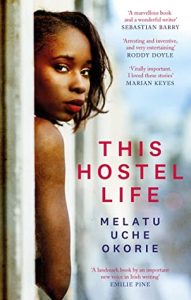 Okorie emigrated from Nigeria to Ireland in 2005. Her time living in a direct provision hostel for asylum seekers informed the title story about women queuing for and squabbling over food rations, written in an African pidgin. In “Under the Awning,” a Black woman fictionalizes her experiences of racism into a second-person short story her classmates deem too bleak. The Author’s Note reveals that Okorie based this one on comments she herself got in a writers’ group. “The Egg Broke” returns to Nigeria and its old superstition about twins.
Fans of Chimamanda Ngozi Adichie will find a similar voice here, and enough variety to distract from the low page count (the book is padded out with an essay on refugees in Ireland) and so-so writing. (Little Free Library)
Dear George and Other Stories by Helen Simpson (1995)
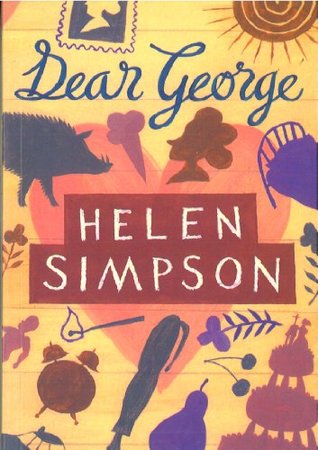 This is the third time Simpson has made it into one of my September features (after Four Bare Legs in a Bed in 2018 and In the Driver’s Seat in 2019); safe to say she’s becoming one of my favourite short story writers. Deciding to have children (or not) looms large. In “When in Rome,” Geraldine is relieved to get her period as her relationship limps to an end. In “Last Orders,” the heavily pregnant protagonist, now 12 days overdue, fears the transformation ahead of her. “To Her Unready Boyfriend,” echoing Andrew Marvell’s “To His Coy Mistress,” has the narrator warn him time runs short for babymaking.
I also liked “Bed and Breakfast,” about a young couple hoping not to turn into their boring parents; “Caput Apri” and its magical twist on the story behind “The Boar’s Head Carol” (a Christmas story or two is a trademark of Simpson’s collections, like the focus on motherhood); and “Heavy Weather,” in which parents of two small children have a manic Dorset holiday that takes in some beloved sites like Hardy’s cottage and marvel at the simultaneous joys and tyranny of childrearing.
The gentle absurdity of “The Immaculate Bridegroom” reminded me of a previous Simpson story in which a woman marries herself, and “Creative Writing” connects back to two of the other collections I’ve featured here with its writers’ workshop setting. (Secondhand purchase from Oxfam Books, Hexham)
Some favourite lines:
“You will not be you any more, her ego told her id. Not only will you have produced somebody else from inside you, someone quite different and separate, but you yourself will change into somebody quite different, overnight – a Mother.”
“Children were petal-skinned ogres, Frances realized, callous and whimsical, holding autocratic sway over lower, larger vassals like herself.”
Are you a short story fan? Read any good ones recently?
Classic of the Month & 20 Books of Summer #5: A Pair of Blue Eyes by Thomas Hardy (1873)
While going through my boxes stored in my sister’s basement, I came across an antiquarian copy of this lesser-known Hardy novel. I used to place a lot more value on books’ age and rarity, whereas now I tend to just acquire readable paperback copies. I also used to get on much better with Victorian novels – I completed an MA in Victorian Literature, after all – but these days I generally find them tedious. Two years ago, I DNFed Hardy’s The Well-Beloved, and I ended up mostly skimming A Pair of Blue Eyes after the first 100 pages. In any case, it fit into my 20 Books of Summer colour theme. It’s sad for me that I’ve lost my love for my academic speciality, but life is long and I may well go back to Victorian literature someday.
I found similarities to Far from the Madding Crowd, my favourite Hardy novel, as well as to Hardy’s own life. As in FFTMC, the focus is on a vain young woman with three suitors. Elfride Swancourt is best known for her eyes, rapturously described as “blue as autumn distance—blue as the blue we see between the retreating mouldings of hills and woody slopes on a sunny September morning. A misty and shady blue, that had no beginning or surface, and was looked into rather than at.” Her vicar father, suffering from gout and sounding much older than his actual age (40 was a different prospect in that time!), warns her that architects will soon be arriving from London to plan restoration work on the church tower.
The young architectural assistant who arrives at the Swancourts’ coastal parish in “Lower Wessex” (North Devon?) is Stephen Smith, a clear Hardy stand-in, desperate to hide his humble background as he seeks to establish himself in his profession. Stephen emulates his friend Henry Knight, a dilettante essayist and book reviewer. Book learning has given Stephen passable knowledge of everything from Latin to chess, but he doesn’t know how to do practical things like ride a horse. Elfride and Stephen, predictably, fall in love, and she is determined to go ahead with an engagement even when she learns that his parents are a mason and a milkmaid, but her father refuses to grant permission. It’s intriguing that this poor clergyman fancies himself of the class of the Luxellians, local nobility, than of the Smiths.
{SPOILERS FOLLOW}
Elfride’s previous love died, and his pauper mother, Mrs Jethway, blames her still for toying with her boy’s affections. When Stephen takes a position in India and Mr Swancourt remarries and moves the family to London, Elfride’s eye wanders. Time for love interest #3. The family runs into Knight, who is a distant cousin of Mrs Swancourt. There’s another, juicier, connection: Elfride is a would-be author (she writes her father’s sermons for him, putting passages in brackets with the instruction “Leave this out if the farmers are falling asleep”) and publishes a medieval romance under a male pseudonym. A negative write-up of her book needles her. “What a plague that reviewer is to me!” And who is it but Knight?
They begin a romance despite this inauspicious coincidence and his flirty/haughty refusal to admire her fine eyes – “I prefer hazel,” he says. Some of the novel’s most memorable scenes, famous even beyond its immediate context, come from their courtship. Knight saves her from falling off the church tower, while she tears her dress into linen strips and ties them into a rope to rescue him from a sea cliff (scandalous!). Somewhere I’d read an in-depth account of this scene: as Knight dangles from the rock face, he spots a trilobite, which, in its very ancientness, mocks the precariousness of his brief human life. Lovingly created and personally watched over by a supreme being? Pshaw. Hardy’s was a godless vision, and I’ve always been interested in that Victorian transition from devoutness to atheism.
The novel’s span is too long, requiring a lot of jumps in time. I did appreciate that Mrs Jethway becomes the instrument of downfall, writing a warning letter to Knight about Elfride’s mistreatment of her son and another former fiancé. Knight breaks things off and it’s not until 15 months later, after he and Stephen bump into each other in London and Knight realizes that Stephen was her other suitor, that they travel back to Wessex to duke it out over the girl. When they arrive, though, it’s too late: Elfride had married but then fallen ill and died; her funeral is to take place the very next day. As the book closes at the vault, it’s her widower, Lord Luxellian, who has the right to mourn and not either of her previous loves.
{END OF SPOILERS}
As always with Hardy, I enjoyed the interplay of coincidence and fate. There were a few elements of this novel that I particularly liked: the coastal setting, the characters’ lines of work (including a potential profession for Elfride, though Knight told her in future she should stick to domestic scenes in her writing!) and the role played by a book review, but overall, this was not a story that is likely to stick with me. I did wonder to what extent it inspired Lars Mytting’s The Bell in the Lake, about a country girl who falls in love with the man who comes to oversee construction at the local church.
Source: Secondhand purchase, most likely from Wonder Book and Video in the early 2000s
My rating:
Adventures in Rereading: Madeleine L’Engle and Posy Simmonds
I’m not doing as well with my rereading goal this year as I did in 2020. So far I’ve gotten to The Republic of Love by Carol Shields and the two below (with another DNF). Considering that I completed 16 rereads last year, I’m looking seriously behind. I still have a bulging shelf of books I’d like to reread, but they never seem to make it onto my current reading stack…
A Wrinkle in Time by Madeleine L’Engle (1962)
 I probably picked this up at age seven or so as a natural follow-on from the Chronicles of Narnia – both are well-regarded children’s sci fi/fantasy from an author with a Christian worldview. In my memory I didn’t connect with L’Engle’s work particularly well, finding it vague and cerebral, if creative, compared to Lewis’s. I don’t think I ever went on to the multiple sequels. As an adult I’ve enjoyed L’Engle’s autobiographical and spiritual writing, especially the Crosswicks Journals, so I thought I’d give her best-known book another try.
On a proverbially dark and stormy night, Meg Murry and her precocious little brother Charles Wallace come down to the kitchen to join their mother for a snack. In blows Mrs. Whatsit with the promise of a way of rescuing their missing scientist father through a “tesseract,” or wrinkle in time. Mrs. Who and Mrs. Which, rounding out a trio of Macbeth-like witches, accompany the children and their friend Calvin on a perilous journey to face up to cosmic darkness in the form of a disembodied brain called IT that keeps their father hostage and tries to entrance Charles Wallace as well.
Interplanetary stories have never held a lot of interest for me. (As a child, I was always more drawn to talking-animal stuff.) Again I found the travels and settings hazy. It’s admirable of L’Engle to introduce kids to basic quantum physics, and famous quotations via Mrs. Who, but this all comes across as consciously intellectual rather than organic and compelling. Even the home and school talk feels dated. I most appreciated the thought of a normal – or even not very bright – child like Meg saving the day through bravery and love. This wasn’t for me, but I hope that for some kids, still, it will be pure magic.
Favorite lines:
“The only way to cope with something deadly serious is to try to treat it a little lightly.”
“we can’t take any credit for our talents. It’s how we use them that counts.”
Original rating (as remembered from childhood):
My rating now: 
Tamara Drewe by Posy Simmonds (2007)
This must be one of the first graphic novels I ever read. Hearing that it was an adaptation of Thomas Hardy’s Far from the Madding Crowd, one of my favorite novels, was enough to attract me. During the years that I worked at King’s College London, I took full advantage of Lambeth Library’s extensive graphic novel collection and would pick up big piles of all sorts of books on my lunch breaks – I got a gentle ribbing from library staff nearly every time I showed up. Anyway, this is all backstory to me finding a severely underpriced secondhand copy (99p! the dear old ladies pricing things couldn’t have known what they had) in the Hay-on-Wye Oxfam shop in April 2017. It took me until earlier this year to reread it, though.
 Simmonds recreates the central situation of FFTMC – an alluring young woman returns to her ancestral village and enraptures three very different men – but doesn’t stick slavishly to its plot. Her greatest innovation is in the narration. Set in and around a writers’ retreat, the novel is told in turns by Dr. Glen Larson, a (chubby, Bryson-esque) visiting American academic trying to get to grips with his novel; Beth Hardiman, who runs the retreat center and does all the admin for her philandering crime writer husband, Nicholas; and Casey Shaw, a lower-class teenager who, with her bold pal Jody, observes all the goings-on among the posh folk from the local bus shelter and later gets unexpectedly drawn in to their lives.
Tamara is a hotshot London journalist and, after a nose job, is irresistible to men. Andy Cobb, the Hardimans’ groundsman, runs a small organic food business and is a clear stand-in for Hardy’s Farmer Oak. He’s known Tamara nearly all their lives, and isn’t fussed about her new appearance and glitzy reputation. But she certainly turns Nicholas’s head, and also draws the attention of Ben, former drummer for a washed-up band. Tamara and Ben are a power couple in this sleepy village, and stir up jealousy. Ben is closest to Sergeant Troy, but he and Nicholas (who’s most like Boldwood) aren’t one-to-one equivalents. Casey and Jody fill the role of the servants and rustics, with chavs serving as the early 21st-century peasantry.
So Simmonds takes what she wants from Hardy, but adapts it as it suits her. There are a lot of words on the page compared to some graphic novels, so this would be a good halfway house for someone who’s new to comics for adults and still wants a good story to get the teeth into. At nearly 150 pages, there’s plenty of time for Simmonds to spin an involved, dramatic tale and give insight into her characters and their interactions. One ends up feeling, perhaps inevitably, more sympathy for the narrators than for the other characters, but all are well drawn. There’s a surprise ending, too. Back in 2010 I was probably more interested in getting a straight Hardy remake, so might have been disappointed when Simmonds strayed from the source material, but now I thoroughly enjoyed this for its own sake.
Original rating (2010?):
My rating now:
And a DNF:
 I’ve long considered A.S. Byatt a favorite author, and early last year my reread of one of her story collections was successful. But trying again with The Biographer’s Tale (2000) – which I remember reading in an airport as I traveled to or from Leeds, where I was doing a Master’s degree, to see my family for Christmas in 2005/6 – was a lost cause. I remembered an intricate, clever, witty take on the biographer’s art, but couldn’t have recited any details for you. I managed about the first 100 pages this time. Phineas G. sets out to write a biography of famous biographer Scholes Destry-Scholes, whose subjects included Francis Galton, Henrik Ibsen, and Carl Linnaeus. The novel quotes extensively from Destry-Scholes’s writing on these three, and his general notes on writing biography. I got lost somewhere in the documents. I think in my early twenties I was more impressed by virtuoso faux-scholarly writing like you often get in Byatt or Julian Barnes. Alas, it engages me less now.
Done any rereading lately?
Novellas in November: 10 Favorite Classic Novellas
For this final week of Novellas in November, we’re focusing on classic literature. The more obscure the better, as far as I’m concerned. Maybe a few of the favorites I feature below will be new to you? (The two not pictured were read from the library.)

 Giovanni’s Room by James Baldwin [150 pages]: David, a penniless American, came to Paris to find himself. His second year there he meets Giovanni, an Italian barman. They fall in love and move in together. There’s a problem, though: David has a fiancée. We know from the first pages that David has fled to the south of France and that Giovanni faces the guillotine in the morning, but throughout Baldwin maintains the tension as we wait to hear why he has been sentenced to death. Deeply sad, but also powerful and brave.
 The Darling Buds of May by H.E. Bates [137 pages]: “Perfick” reading for an afternoon sitting or two; The Novel Cure even prescribes it as a tonic for cynicism. Just like tax inspector Cedric Charlton, you’ll find yourself drawn into the orbit of junk dealer Pop Larkin, Ma, and their six children at their country home in Kent – indomitably cheery hedonists, the lot of them. Ma and Pop are more calculating than they let on, but you can’t help but love them. Plus Bates writes so evocatively about the British countryside in late spring.
 Breakfast at Tiffany’s by Truman Capote [91 pages]: Whether you’ve seen the Audrey Hepburn film or not, this is delightful. Holly Golightly has remade herself as a New York City good-time girl, but her upstairs neighbor discovers her humble origins. This was from my pre-reviewing days, so I have no more detail to add. But whenever I think of its manic cocktail party scenes, I think of a holiday do from my final year of college: packed like sardines, everyone talking over each other, and my professor couldn’t stop shaking my hand.
 A Month in the Country by J.L. Carr [108 pages]: Summer 1920: Tom Birkin, a WWI veteran, arrives in North Yorkshire to uncover a local church’s medieval wall painting of the Judgment Day. With nothing awaiting him back in London, he gives himself over to the rhythms of working, eating and sleeping. Also embarked on a quest into the past is Charles Moon, searching for the grave of their patroness’ 14th-century ancestor in the churchyard. Moon, too, has a war history he’d rather forget. A Hardyesque, tragicomic romance.
 The Pumpkin Eater by Penelope Mortimer [144 pages]: Aged 31 and already on her fourth husband, the narrator, known only as Mrs. Armitage, has an indeterminate number of children. A breakdown at Harrods is the sign that Mrs. A. isn’t coping, and she starts therapy. Meanwhile, her filmmaker husband is having a glass tower built as a countryside getaway, allowing her to contemplate an escape from motherhood. A razor-sharp period piece composed largely of dialogue, it gives a sense of a woman overwhelmed by responsibility.
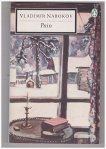 Pnin by Vladimir Nabokov [177 pages]: A comic novel about a Russian professor on an American college campus. In this episodic narrative spanning 1950–4, Timofey Pnin is a figure of fun but also of pathos: from having all his teeth pulled out and entertaining the son his ex-wife had by another man to failing to find and keep a home of his own, he deserves the phrase Nabokov originally thought to use as a title, “My Poor Pnin”. There are shades of Lucky Jim here – I laughed out loud at some of Pnin’s verbal gaffes and slapstick falls.
 No Signposts in the Sea by Vita Sackville-West [156 pages]: Sackville-West’s last novel, published a year before her death, was inspired by world cruises she and her husband, Harold Nicolson, took in later life. Fifty-year-old Edmund Carr, a journalist with a few months to live, has embarked on a cruise ship voyage to be close to the woman he loves, 40-year-old war widow Laura Drysdale. He dares to hope she might return his feelings … but doesn’t tell her of his imminent demise. The novel is presented as Edmund’s diary, found after his death.
 The Catcher in the Rye by J.D. Salinger [192 pages]: Believe it or not, I didn’t read this until December 2018! From the start I found Holden Caulfield’s voice funny and surprising, so drenched in period American slang you can never forget when and where it’s set. He’s a typical lazy teenager, flunking four subjects when he’s kicked out of Pencey Prep. The first part is a languorous farewell tour to classmates and teachers before he takes the train back to NYC. Once there, he lives it up in a hotel for a few days. A shocker of an ending is to come.
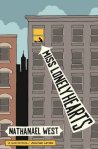 Miss Lonelyhearts by Nathanael West [110 pages]: Like The Great Gatsby, this is a very American tragedy and state-of-the-nation novel. “Miss Lonelyhearts” is a male advice columnist for the New York Post-Dispatch. His letters come from a pitiable cross section of humanity: the abused, the downtrodden and the unloved. Not surprisingly, these second-hand woes start to get him down, and he turns to drink and womanizing for escape. West’s picture of how beleaguered compassion can turn to indifference feels utterly contemporary.
 Ethan Frome by Edith Wharton [181 pages]: Unlike Wharton’s NYC society novels, this has a rural setting, but the plot is not dissimilar to that of The Age of Innocence, with extra tragic sauce. The title character makes the mistake of falling in love with his wife’s cousin, and the would-be lovers are punished one New England winter. A quarter of a century later, the narrator learns what happened to this sad old man. It’s probably been 15 years since I’ve read this, and I like the catharsis of a good old-fashioned tragedy. Maybe I’ll reread it soon.
Not enough women on my list! I should redress that by reading some more Jean Rhys…

Keep in touch via Twitter (@bookishbeck / @cathy746books) and Instagram (@bookishbeck / @cathy_746books). We’ll keep adding your review links in to our master posts. Feel free to use the terrific feature image Cathy made and don’t forget the hashtag #NovNov.
Any suitably short classics on your shelves?
Two Recent Reviews for BookBrowse
The Bell in the Lake by Lars Mytting
 A legend from Mytting’s hometown tells of two centuries-old church bells that, like conjoined twins, were never meant to be separated. Inspired by that story and by the real-life move of a stave church from Norway to what is now Poland, he embarked on a trilogy in which history and myth mingle to determine the future of the isolated village of Butangen. The novel is constructed around compelling dichotomies. Astrid Hekne, a feminist ahead of her time, is in contrast with the local pastor’s conventional views on gender roles. She also represents the village’s unlearned folk; Deborah Dawkin successfully captures Mytting’s use of dialect in her translation, making Astrid sound like one of Thomas Hardy’s rustic characters.
- See my full review at BookBrowse.
- See also my related article on stave churches.
- One of the coolest things I did during the first pandemic lockdown in the UK was attend an online book club meeting on The Bell in the Lake, run by MacLehose Press, Mytting’s UK publisher. It was so neat to see the author and translator speak “in person” via a Zoom meeting and to ask him a couple of questions in the chat window.
- A readalike (and one of my all-time favorite novels) is Carsten Jensen’s We, the Drowned.
Memorial by Bryan Washington
 In Washington’s debut novel, set in Houston and Osaka, two young men reassess their commitments to their families and to each other. The narration is split between Benson and Mike, behind whose apparent lack of affect is a quiet seam of emotion. Both young men are still shaken by their parents’ separations, and haunted by patterns of abuse and addiction. Flashbacks to how they met create a tender backstory for a limping romance. Although the title (like most of the story titles in Lot) refers to a Houston neighborhood, it has broader significance, inviting readers to think about the place our loved ones have in our memories. Despite the tough issues the characters face, their story is warm-hearted rather than grim. Memorial is a candid, bittersweet work from a talented young writer whose career I will follow with interest.
- See my full review at BookBrowse.
- See also my related article on the use of quotation marks (or not!) to designate speech.
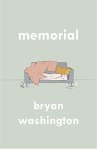 I enjoyed this so much that I immediately ordered Lot with my birthday money. I’d particularly recommend it if you want an earthier version of Brandon Taylor’s Booker-shortlisted Real Life (which I’m halfway through and enjoying, though I can see the criticisms about its dry, slightly effete prose).
- This came out in the USA from Riverhead in late October, but UK readers have to wait until January 7th (Atlantic Books).
 Bookish Beck = Rebecca Foster. American transplant to England. Freelance proofreader and book reviewer.
 Bookish Beck