Wellcome Book Prize Longlist: Freshwater by Akwaeke Emezi
“This is all, ultimately, a litany of madness—the colors of it, the sounds it makes in heavy nights, the chirping of it across the shoulder of the morning.”
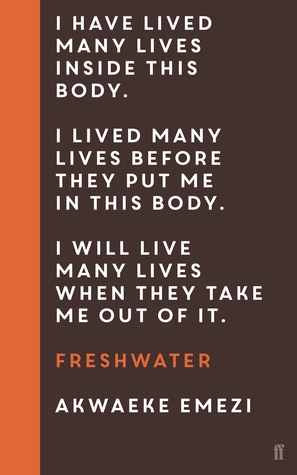 Magic realism and mental illness fuel a swirl of disorienting but lyrical prose in this debut novel by a Nigerian–Tamil writer. Much of the story is told by the ọgbanje (an Igbo term for evil spirits) inhabiting Ada’s head: initially we have the first person plural voice of “Smoke” and “Shadow,” who deem “the Ada” a daughter of the python goddess Ala and narrate her growing-up years in Nigeria; later we get a first-person account from Asụghara, who calls herself “a child of trauma” and leads Ada into promiscuity and drinking when she is attending college in Virginia.
The unusual choice of narrators links Freshwater to other notable works of Nigerian literature: a spirit child relates Ben Okri’s Booker Prize-winning 1991 novel, The Famished Road, while Chigozie Obioma’s brand-new novel, An Orchestra of Minorities, is from the perspective of the main character’s chi, or life force. Emezi also contrasts indigenous belief with Christianity through Ada’s troubled relationship with “Yshwa” or “the christ.”
These spirits are parasitic and have their own agenda, yet express fondness for their hostess. “The Ada should have been nothing more than a pawn, a construct of bone and blood and muscle … But we had a loyalty to her, our little container.” So it’s with genuine pity that they document Ada’s many troubles, starting with her mother’s departure for a mental hospital and then for a job in Saudi Arabia, and continuing on through Ada’s cutting, anorexia and sexual abuse by a boyfriend. Late on in the book, Emezi also introduces gender dysphoria that causes Ada to get breast reduction surgery; to me, this felt like one complication too many.

The U.S. cover
From what I can glean from the Acknowledgments, it seems Ada’s life story might mirror Emezi’s own – at the very least, a feeling of being occupied by multiple personalities. It’s a striking book with vivid scenes and imagery, but I wanted more of Ada’s own voice, which only appears in a few brief sections totalling about six pages. The conflation of the abstract and the concrete didn’t quite work for me, and the whole is pretty melodramatic. Although I didn’t enjoy this as much as some other inside-madness tales I’ve read (such as Die, My Love and Everything Here Is Beautiful), I can admire the attempt to convey the reality of mental illness in a creative way.
My rating: 
My gut feeling: I’ve only gotten to two of the five novels longlisted for the Prize, so it’s difficult to say what from the fiction is strong enough to make it through to the shortlist. Of the two, though, I think Sight would be more likely to advance than Freshwater.
Do you think this is a novel that you’d like to read?
Longlist strategy:
- I’m about one-fifth of the way through Mind on Fire by Arnold Thomas Fanning, which I plan to review in early March.
- I’ve also been sent review copies of The Trauma Cleaner by Sarah Krasnostein and My Year of Rest and Relaxation by Ottessa Moshfegh and look forward to reading them, though I might not manage to before the shortlist announcement.
- I’ve placed a library hold on Murmur by Will Eaves; if it arrives in time, I’ll try to read it before the shortlist announcement, since it’s fairly short.
- Barring these, there are only two remaining books that I haven’t read and don’t have access to: Astroturf and Polio. I’ll only read these if they make the shortlist.
The Wellcome Book Prize shortlist will be announced on Tuesday, March 19th, and the winner will be revealed on Wednesday, May 1st.
We plan to choose our own shortlist to announce on Friday, March 15th. Follow along here and on Halfman, Halfbook, Annabookbel, A Little Blog of Books, and Dr. Laura Tisdall for reviews and predictions.
The Wellcome Book Prize 2019 Longlist: Reactions & Shadow Panel Reading Strategy
The 2019 Wellcome Book Prize longlist was announced on Tuesday. From the prize’s website, you can click on any of these 12 books’ covers, titles or authors to get more information about them.
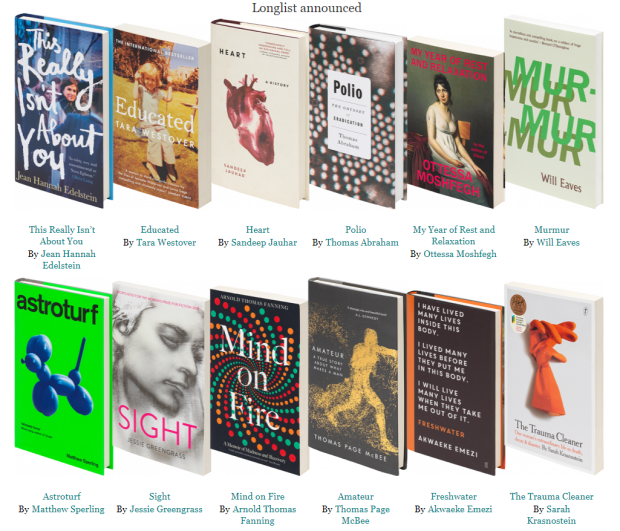
This year marks the 10th anniversary of the prize. As always, it’s a strong and varied set of nominees, with an overall focus on gender and mental health. Here are some initial thoughts (see also Laura’s thorough rundown of the 12 nominees):

- I correctly predicted just two, Sight by Jessie Greengrass and Heart: A History by Sandeep Jauhar, but had read another three: This Really Isn’t About You by Jean Hannah Edelstein, Amateur by Thomas Page McBee, and Educated by Tara Westover (reviewed for BookBrowse).
- I’m particularly delighted to see Edelstein on the longlist as her book was one of my runners-up from last year and deserves more attention.
- I’m not personally a huge fan of the Greengrass or McBee books, but can certainly see why the judges thought them worthy of inclusion.
- Though it’s a brilliant memoir, I never would have thought to put Educated on my potential Wellcome list. However, the more I think about it, the more health elements it has: her father’s possible bipolar disorder, her brother’s brain damage, her survivalist family’s rejection of modern medicine, her mother’s career in midwifery and herbalism, and her own mental breakdown at Cambridge.
- Books I knew about and was keen to read but hadn’t thought of in conjunction with the prize: The Trauma Cleaner by Sarah Krasnostein and My Year of Rest and Relaxation by Ottessa Moshfegh.
- Novels I had heard of but wasn’t necessarily interested in beforehand: Murmur by Will Eaves and Freshwater by Akwaeke Emezi. I went to get Freshwater from the library the afternoon of the longlist announcement and am now 60 pages in. I’d be tempted to call it this year’s Stay with Me except that the magic realist elements are much stronger here, reminding me of what I know about work by Chigozie Obioma and Ben Okri. The novel is narrated in the first person plural by a pair of (gods? demons? spirits?) inhabiting Ada’s head.
- And lastly, there are a few books I had never even heard of: Polio: The Odyssey of Eradication by Thomas Abraham, Mind on Fire: A Memoir of Madness and Recovery by Arnold Thomas Fanning, and Astroturf by Matthew Sperling. I’m keen on the Fanning but not so much on the other two. Polio will likely make it to the shortlist as this year’s answer to The Vaccine Race; if it does, I’ll read it then.

Some statistics on this year’s longlist, courtesy of a press release sent by Midas PR:
- Five novels (two more than last year – I think we can see the influence of novelist Elif Shafak), five memoirs, one biography, and one further nonfiction title
- Six debut authors
- Six titles from independent publishers (Canongate, CB Editions, Faber & Faber, Oneworld, Hurst Publishers, and The Text Publishing Company)
- Most of the authors are British or American, while Fanning is Irish (Emezi is Nigerian-American, Jauhar is Indian-American, and Krasnostein is Australian-American).
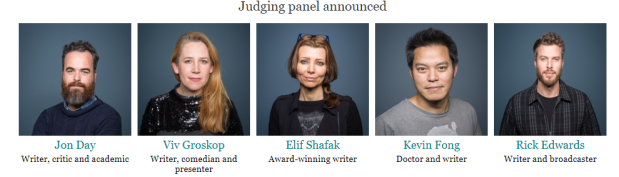
Chair of judges Elif Shafak writes: “In a world that remains sadly divided into echo chambers and mental ghettoes, this prize is unique in its ability to connect various disciplines: medicine, health, literature, art and science. Reading and discussing at length all the books on our list has been fascinating from the very start. We now have a wonderful longlist, of which we are all very proud. Although it sure won’t be easy to choose the shortlist, and then, finally, the winner, I am thrilled about and truly grateful for this fascinating journey through stories, ideas, ground-breaking research and revolutionary knowledge.”
We of the shadow panel have divided up the longlist titles between us as follows (though we may well each get hold of and read more of the books, simply out of personal interest) and will post reviews on our blogs within the next five weeks.
Amateur: A true story about what makes a man by Thomas Page McBee – LAURA
Astroturf by Matthew Sperling – PAUL
Educated by Tara Westover – CLARE
Freshwater by Akwaeke Emezi – REBECCA
Heart: A history by Sandeep Jauhar – LAURA
Mind on Fire: A memoir of madness and recovery by Arnold Thomas Fanning – REBECCA
Murmur by Will Eaves – PAUL
My Year of Rest and Relaxation by Ottessa Moshfegh – CLARE
Polio: The odyssey of eradication by Thomas Abraham – ANNABEL
[Sight by Jessie Greengrass – 4 of us have read this; I’ll post a composite of our thoughts]
The Trauma Cleaner: One woman’s extraordinary life in death, decay and disaster by Sarah Krasnostein – ANNABEL
This Really Isn’t About You by Jean Hannah Edelstein – LAURA
The Wellcome Book Prize shortlist will be announced on Tuesday, March 19th, and the winner will be revealed on Wednesday, May 1st.
We plan to choose our own shortlist to announce on Friday, March 15th. Follow along here and on Halfman, Halfbook, Annabookbel, A Little Blog of Books, and Dr. Laura Tisdall for reviews and predictions.
Are there any books on here that you’d like to read?
The 2019 Wellcome Book Prize: Shadow Panel and Wish List
On Tuesday the longlist for the 2019 Wellcome Book Prize will be announced. For the third year in a row I’m running a shadow panel, and it’s composed of the same four wonderful book bloggers who joined me last year: Paul Cheney of Halfman, Halfbook, Annabel Gaskell of Annabookbel, Clare Rowland of A Little Blog of Books, and Dr. Laura Tisdall.
This year we’re going to do things slightly differently: we plan to split up the longlist, taking two to three titles each, so that between us we will have read them all and can announce our own preferred shortlist before the official shortlist is announced in March. At that point we’ll catch up by (re)reading the six shortlisted books, each reviewing the ones we haven’t already. Essentially, I’m adding an extra stage of shadow panel judging, simply because I can. I hope it will be fun – and also less onerous, in that we should get a leg-up on the shortlist and not have to read all six books in March‒April, which has proved to be a challenge in the past.
My Wellcome Prize hopefuls are all the fiction or nonfiction titles I’ve read on a medical theme that were published in the UK in calendar year 2018. I have put asterisks beside the 12 books in this post that I predict for the longlist. (The combination of wishful thinking and likelihood means that these are not exclusively my personal favorites.)

Below is a list of the books I’ve already featured on the blog in some way, with links to my coverage and a few-word summary of their relevance.
Nonfiction
Gross Anatomy by Mara Altman: Female body woes
*Beneath the Skin: Great Writers on the Body: Essays on organs
*All that Remains by Sue Black: Forensic anthropology
Everything Happens for a Reason by Kate Bowler: Living with advanced cancer
Heal Me by Julia Buckley: Tackling chronic pain
*The Unmapped Mind by Christian Donlan: Adjusting to life with MS
From Here to Eternity by Caitlin Doughty: Funerary rites around the world
This Really Isn’t About You by Jean Hannah Edelstein: A genetic disease in the family
Natural Causes by Barbara Ehrenreich: Questioning the wellness culture
On Smaller Dogs and Larger Life Questions by Kate Figes: Pondering breast cancer
Shapeshifters by Gavin Francis: Instances of bodily change
The Reading Cure by Laura Freeman: Healing from an eating disorder
Nine Pints by Rose George: The story of blood
Waiting for the Last Bus by Richard Holloway: Ageing and death
*Heart: A History by Sandeep Jauhar: Heart disease and treatments
Sick by Porochista Khakpour: Chronic Lyme disease
Human Errors by Nathan Lents: Flawed bodies; evolutionary adaptations
Skybound by Rebecca Loncraine: Breast cancer; flying lessons
Amateur by Thomas Page McBee: Memoir of F2M transformation
*Face to Face by Jim McCaul: Tales of facial surgery
*Somebody I Used to Know by Wendy Mitchell: A firsthand account of early Alzheimer’s
*That Was When People Started to Worry by Nancy Tucker: Mental illness from the inside
*The Language of Kindness by Christie Watson: Nursing as a vocation
Fiction
Little by Edward Carey: Anatomical models in wax (thanks to Clare for the reminder!)
Orchid & the Wasp by Caoilinn Hughes: Non-epileptic seizures
*The Winter Soldier by Daniel Mason: Neurology, surgery during WWI
The Way of All Flesh by Ambrose Parry: Medicine in 1840s Edinburgh
Other eligible books that I have read but not happened to mention on the blog:
 In Shock by Rana Awdish: The doctor became the patient when Awdish, seven months pregnant, was rushed into emergency surgery with excruciating pain due to severe hemorrhaging into the space around her liver, later explained by a ruptured tumor. Having experienced brusque, cursory treatment, even from colleagues at her Detroit-area hospital, she was convinced that doctors needed to do better. This memoir is a gripping story of her own medical journey and a fervent plea for compassion from medical professionals.
 Doctor by Andrew Bomback: Part of the Bloomsbury Object Lessons series, this is a wide-ranging look at what it’s like to be a doctor. Bomback is a kidney specialist; his wife is also a doctor, and his father, fast approaching retirement, is the kind of old-fashioned, reassuring pediatrician who knows everything. Even the author’s young daughter likes playing with a stethoscope and deciding what’s wrong with her dolls. In a sense, then, Bomback uses fragments of family memoir to compare the past, present and likely future of medicine.
 A Moment of Grace by Patrick Dillon [skimmed]: A touching short memoir of the last year of his wife Nicola Thorold’s life, in which she battled acute myeloid leukemia. Dillon doesn’t shy away from the pain and difficulties, but is also able to summon up some gratitude.
 Get Well Soon: Adventures in Alternative Healthcare by Nick Duerden: British journalist Nick Duerden had severe post-viral fatigue after a run-in with possible avian flu in 2009 and was falsely diagnosed with ME / CFS. He spent a year wholeheartedly investigating alternative therapies, including yoga, massage, mindfulness and meditation, visualization, talk therapy and more. He never comes across as bitter or sorry for himself. Instead, he considered fatigue a fact of his new life and asked what he could do about it. So this ends up being quite a pleasant amble through the options, some of them more bizarre than others.
 *Sight by Jessie Greengrass [skimmed]: I wanted to enjoy this, but ended up frustrated. As a set of themes (losing a parent, choosing motherhood, the ways in which medical science has learned to look into human bodies and minds), it’s appealing; as a novel, it’s off-putting. Had this been presented as a set of autobiographical essays, perhaps I would have loved it. But instead it’s in the coy autofiction mold where you know the author has pulled some observations straight from life, gussied up others, and then, in this case, thrown in a bunch of irrelevant medical material dredged up during research at the Wellcome Library.
 *Brainstorm: Detective Stories From the World of Neurology by Suzanne O’Sullivan: Epilepsy affects 600,000 people in the UK and 50 million worldwide, so it’s an important condition to know about. It is fascinating to see the range of behaviors seizures can be associated with. The guesswork is in determining precisely what is going wrong in the brain, and where, as well as how medicines or surgery could address the fault. “There are still far more unknowns than knowns where the brain is concerned,” O’Sullivan writes; “The brain has a mind of its own,” she wryly adds later on. (O’Sullivan won the Prize in 2016 for It’s All in Your Head.)
 I’m also currently reading and enjoying two witty medical books, The Mystery of the Exploding Teeth and Other Curiosities from the History of Medicine by Thomas Morris, and Chicken Unga Fever by Phil Whitaker, his collected New Statesman columns on being a GP.
Four additional books I have not read but think might have a chance of making the longlist:
Primate Change: How the World We Made Is Remaking Us by Vybarr Cregan-Reid
 The Beautiful Cure: Harnessing Your Body’s Natural Defences by Daniel M. Davis
Because I Come from a Crazy Family: The Making of a Psychiatrist by Edward M. Hallowell
*She Has Her Mother’s Laugh: The Powers, Perversions, and Potential of Heredity by Carl Zimmer
Look out for the announcement of the longlist on Tuesday afternoon! I’ll report back, perhaps on Wednesday, with some reactions and the shadow panel’s reviewing strategy.
Have you read, or are you interested in, any of these books?
Can you think of other 2018 releases that might be eligible for the Wellcome Book Prize?
Birthday Goings-on & Booker Prize Predictions
For a low-key early birthday outing we went to The Living Rainforest, a local tourist attraction run by a conservation charity. It’s on the small side, but our tickets got us free annual entry, so we’ll likely come back with family and friends with kids. Along with the tropical plants (including various fig trees I sought out especially!), there are birds both free-roaming and in cages, marmosets and monkeys, fish and turtles, an armadillo, and an elusive sloth we didn’t manage to see. Afterwards we went around the corner for cappuccinos and generous slabs of cake at the Hampstead Norreys community shop café.


My birthday itself was a gloomy day, but I didn’t mind at all; I filled it with reading and feasting, plus listening to music, working on a jigsaw puzzle, and having the cat on my lap. Each year my husband happily takes on impressive cooking and baking projects of my choice. This year we had acorn squash and black bean enchiladas with homemade salsa and guacamole, followed by Mexican rice pudding flavored with cinnamon and lime. In the afternoon with presents we’d had David Lebovitz’s Banana Cake with Mocha Frosting and Salted Candied Peanuts from Ready for Dessert. A delicious and decadent grown-up cake.


I got chocolate, notebooks, Lush shampoo, a bunch of llama/alpaca stuff, and 10 books as gifts (I suspect there might be more books to come, though). Looking back at my birthday book hauls from 2016 and 2017, I can see that I’ve had mixed success with getting through the acquisitions in a timely fashion: I’ve now read 9 out of 12 of 2016’s, but only 4 out of 11 of 2017’s. Though I’m very excited about some of my new books – I marked them as high priority on my wish list, after all – that doesn’t always translate into reading them soon. However, I’ve added two of them to my novellas pile for November, and I’ll read the first L’Engle journal in December as it starts around Christmastime.
Tomorrow the Man Booker Prize will be announced. Although I’ve only read one and a third books from the shortlist, I’m going to have a go at making predictions anyway. Here are the six nominees in what I think is their likelihood of winning:
 #1: I fully expect Richard Powers to win for The Overstory. This is the one I’m partway through; I started reading a library copy on Friday. I’m so impressed by the novel’s expansive nature. It seems to have everything: love, war, history, nature, politics, technology, small-town life, family drama, illness, accidents, death. And all of human life is overshadowed and put into perspective by the ancientness of trees, whose power we disregard at a cost. I’m reminded of the work of Jonathan Franzen (Freedom + Purity), as well as Barbara Kingsolver’s latest, Unsheltered – though Powers is prophetic where she’s polemic.
 #2: Washington Black by Esi Edugyan is a good old-fashioned adventure story about a slave who gets the chance to leave his Barbados sugar plantation behind when he becomes an assistant to an abolitionist inventor, Christopher “Titch” Wilde. Wash discovers a talent for drawing and a love for marine life and pursues these joint interests in the disparate places where life takes him. Part One was much my favorite; none of what followed quite matched it in depth or pace. Still, I enjoyed following along on Wash’s escapades, and I wouldn’t mind seeing this take the prize – it would be great to see a woman of color win.
 #3: The Mars Room by Rachel Kushner: Kushner is well respected, though I’ve failed to get on with her fiction before. An inside look at the prison system, this could be sufficiently weighty and well-timed to win.
 #4: Everything Under by Daisy Johnson: A myth-infused debut novel about a mother and daughter. On my library stack to read next, and the remaining title from the shortlist I’m most keen to read.
 #5: The Long Take by Robin Robertson: A novel, largely in verse, about the aftermath of war service. Also on my library stack. Somewhat experimental forms like this grab Booker attention, but this might be too under-the-radar to win.
 #6: Milkman by Anna Burns: Set in Belfast during the Troubles or a dystopian future? From my Goodreads friends’ reviews this sounds wooden and overwritten. Like the Kushner, I’d consider reading it if it wins but probably not otherwise.
Do you follow the Booker Prize? Which novel do you expect to win?
Last-Minute Thoughts on the Booker Longlist
Tomorrow, the 20th, the Man Booker Prize shortlist will be announced. This must be my worst showing for many years: I’ve read just two of the longlisted books, and both were such disappointments I had to wonder why they’d been nominated at all. I have six of the others on request from the public library; of them I’m most keen to read The Overstory and Sabrina, the first graphic novel to have been recognized (the others are by Gunaratne, Johnson, Kushner and Ryan, but I’ll likely cancel my holds if they don’t make the shortlist). I’d read Robin Robertson’s novel-in-verse if I ever managed to get hold of a copy, but I’ve decided I’m not interested in the other four nominees (Bauer, Burns, Edugyan, Ondaatje*).
The Water Cure by Sophie Mackintosh
(Excerpted from my upcoming review for New Books magazine’s Booker Prize roundup.)
 The first word of The Water Cure may be “Once,” but what follows is no fairy tale. Here’s the rest of that sentence: “Once we have a father, but our father dies without us noticing.” The tense seems all wrong; surely it should be “had” and “died”? From the very first line, then, Sophie Mackintosh’s debut novel has the reader wrong-footed, and there are many more moments of confusion to come. The other thing to notice in the opening sentence is the use of the first person plural. That “we” refers to three sisters: Grace, Lia and Sky. After the death of their father, King, it’s just them and their mother in a grand house on a remote island.
There are frequent flashbacks to times when damaged women used to come here for therapy that sounds more like torture. The sisters still engage in similar sadomasochistic practices: sitting in a hot sauna until they faint, putting their hands and feet in buckets of ice, and playing the “drowning game” in the pool by putting on a dress laced with lead weights. Despite their isolation, the sisters are still affected by the world at large. At the end of Part I, three shipwrecked men wash up on shore and request sanctuary. The men represent new temptations and a threat to the sisters’ comfort zone.
This is a strange and disorienting book. The atmosphere – lonely and lowering – is the best thing about it. Its setup is somewhat reminiscent of two Shakespeare plays, King Lear and The Tempest. With the exception of a few lines like “we look towards the rounded glow of the horizon, the air peach-ripe with toxicity,” the prose draws attention to itself in a bad way: it’s consciously literary and overwritten. In terms of the plot, it is difficult to understand, at the most basic level, what is going on and why. Speculative novels with themes of women’s repression are a dime a dozen nowadays, and the interested reader will find a better example than this one.
My rating:
Normal People by Sally Rooney
Conversations with Friends was one of last year’s sleeper hits and a surprise favorite of mine. You may remember that I was part of an official shadow panel for the 2017 Sunday Times Young Writer of the Year Award, which I was pleased to see Sally Rooney win. So I jumped at the chance to read her follow-up novel, which has been earning high praise from critics and ordinary readers alike as being even better than her debut. Alas, though, I was let down.
 Normal People is very similar to Tender – which for some will be high praise indeed, though I never managed to finish Belinda McKeon’s novel – in that both realistically address the intimacy between a young woman and a young man during their university days and draw class and town-and-country distinctions (the latter of which might not mean much to those who are unfamiliar with Ireland).
The central characters here are two loners: Marianne Sheridan, who lives in a white mansion with her distant mother and sadistic older brother Alan, and Connell Waldron, whose single mother cleans Marianne’s house. Connell doesn’t know who his father is; Marianne’s father died when she was 13, but good riddance – he hit her and her mother. Marianne and Connell start hooking up during high school in Carricklea, but Connell keeps their relationship a secret because Marianne is perceived as strange and unpopular. At Trinity College Dublin they struggle to fit in and keep falling into bed with each other even though they’re technically seeing other people.
The novel, which takes place between 2011 and 2015, keeps going back and forth in time by weeks or months, jumping forward and then filling in the intervening time with flashbacks. I kept waiting for more to happen, skimming ahead to see if there would be anything more to it than drunken college parties and frank sex scenes. The answer is: not really; that’s mostly what the book is composed of.
I can see what Rooney is trying to do here (she makes it plain in the next-to-last paragraph): to show how one temporary, almost accidental relationship can change the partners for the better, giving Connell the impetus to pursue writing and Marianne the confidence to believe she is loveable, just like ‘normal people’. It is appealing to see into these characters’ heads and compare what they think of themselves and each other with their awareness of what others think. But page to page it is pretty tedious, and fairly unsubtle.
I was interested to learn that Rooney was writing this at the same time as Conversations, and initially intended it to be short stories. It’s possible I would have appreciated it more in that form.
My rating: 
My thanks to Faber & Faber for the free copy for review.
 *I’ve only ever read the memoir Running in the Family plus a poetry collection by Ondaatje. I have a copy of The English Patient on the shelf and have felt guilty for years about not reading it, especially after it won the “Golden Booker” this past summer (see Annabel’s report on the ceremony). I had grand plans of reading all the Booker winners on my shelf – also including Carey and Keneally – in advance of the 50th anniversary celebrations, but didn’t even make it through the books I started by the two South African winners; my aborted mini-reviews are part of the Shiny New Books coverage here. (There are also excerpts from my reviews of Bring Up the Bodies, The Sellout and Lincoln in the Bardo here.)
Last year I’d read enough from the Booker longlist to make predictions and a wish list, but this year I have no clue. I’ll just have a look at the shortlist tomorrow and see if any of the remaining contenders appeal.
What have you managed to read from the Booker longlist? Do you have any predictions for the shortlist?
The Wellcome Book Prize 2018 Awards Ceremony
 Hey, we got it right! Mark O’Connell’s To Be a Machine, our shadow panel’s pick, won the Wellcome Book Prize 2018 last night. Of the three shadow panels I’ve participated in and the many others I’ve observed, this is the only time I remember the shadow winner matching the official one. Clare, Paul and I were there in person for the announcement at the Wellcome Collection in London. When we briefly spoke to the judges’ chair, Edmund de Waal, later in the evening, he said he was “relieved” that their decision matched ours – but I think it was definitely the other way around!
Simon Chaplin, Director of Culture & Society at the Wellcome Trust, said that each year more and more books are being considered for the prize. De Waal revealed that the judges read 169 books over nine months in what was for him his most frightening book club ever. “To bring the worlds of medicine and health into urgent conversation” requires a “lyrical and disciplined choreography,” he said, and “how we shape stories of science … is crucial.” He characterized the judges’ discussions as both “personal and passionate.” The Wellcome-shortlisted books make a space for public debate, he insisted.

Judges Gordon, Paul-Choudhury, Critchlow, Ratcliffe and de Waal. Photo by Clare Rowland.
The judges brought each of the five authors present onto the stage one at a time for recognition. De Waal praised Ayobami Adebayo’s “narrative of hope and fear and anxiety” and Meredith Wadman’s “beautifully researched and paced thriller.” Dr Hannah Critchlow of Magdalene College, Cambridge called Lindsey Fitzharris’s The Butchering Art “gruesome yet fascinating.” Oxford English professor Sophie Ratcliffe applauded Kathryn Mannix’s book and its mission. New Scientist editor-in-chief Sumit Paul-Choudhury said Mark O’Connell’s book is about the future “just as much as what it means to be human in the twenty-first century.” Journalist and mental health campaigner Bryony Gordon thanked Sigrid Rausing for her “great honesty and stunning prose.”
But there can only be one winner, and it was Mark O’Connell, who couldn’t be there as his wife is/was giving birth to their second child imminently. The general feeling in the room was that he’d made the right call by deciding to stay with his family. He must be feeling like the luckiest man on earth right now, to have a baby plus £30,000! Max Porter, O’Connell’s editor at Granta and the author of Grief Is the Thing with Feathers, received the award on his behalf and read out the extremely witty speech he’d written in advance.
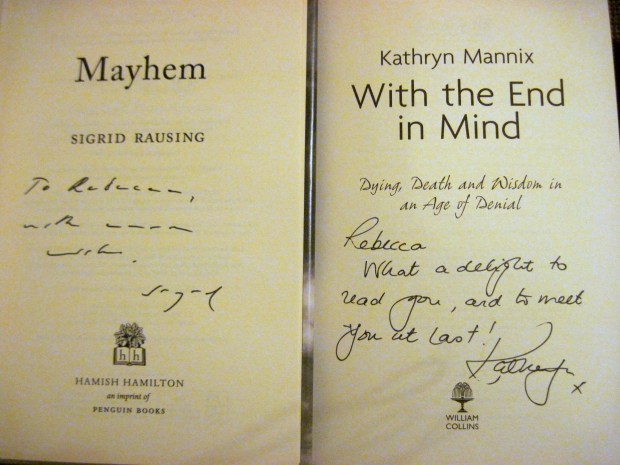
Afterwards we spoke to three of the shortlisted authors. Kathryn Mannix said she’d so enjoyed following our shadow panel reviews and that it was for the best that O’Connell won, as any other outcome might have spoiled the lovely girls’ club the others had going on during the weekend’s events. I got two signatures and we nabbed a quick photo with Lindsey Fitzharris. It was also great to meet Simon Savidge, the king of U.K. book blogging, and author and vlogger Jen Campbell. Other ‘celebrities’ spotted: Sarah Bakewell and Ben Goldacre.
This time I stayed long enough for pudding canapés to come around – raspberry cake pops and mini meringues with strawberries. What a great idea! On the way out I again acquired a Wellcome goody bag: this year’s tote with a copy of The Butchering Art, which I only had on Kindle before. I’d also treated myself to this brainy necklace from the Wellcome shop and wore it to the ceremony. An all-round great evening. I’m looking forward to next year’s prize season already!

Paul, Lindsey Fitzharris, Clare and me.


Wellcome Book Prize Shortlist Event
Five of the six shortlisted authors (barring Dublin-based Mark O’Connell) were at the Wellcome Collection in London yesterday to share more about their books in mini-interviews with Lisa O’Kelly, the associate editor of the Observer. She called each author up onto the stage in turn for a five-minute chat about her work, and then brought them all up for a general conversation and audience questions. Clare and I found it a very interesting afternoon. Here’s some context that I gleaned about the five books and their writers.
 Ayobami Adebayo says sickle cell anemia is a massive public health problem in Nigeria, as brought home to her when some friends died of complications of sickle cell. She herself was tested for the gene and learned that she is a carrier, so her children would have a 25% chance of having the disease if her partner was also a carrier. Although life expectancy with the disease has improved to 45–50, a cure is still out of reach for most Nigerians because bone marrow/stem cell transplantation and anti-rejection drugs are so expensive. Compared to the 1980s, when her book opens, she believes polygamy is becoming less fashionable in Nigeria and people are becoming more open to other means of becoming parents, whether IVF or adoption. It’s a way of acknowledging, she says, that parenthood is “not just about biology.”
Sigrid Rausing started writing her book soon after her sister-in-law Eva’s body was found: just random paragraphs to make sense of what had happened. From there it became an investigation, a quest to find the nature of addiction. She thinks that as a society we still don’t quite understand what addiction is, and the medical research and public perception are very separate. In addition to nature and nurture, she thinks we should consider the influence of culture – as an anthropologist by training, she’s very interested in drug culture and how that drew in her brother, Hans. Although there have been many memoirs by ex-addicts, she can’t think of another one by a family member. Perhaps, she suggested, this is because the addict is seen as the ultimate victim. She referred to her book as a “collage,” a very apt description.
Kathryn Mannix spoke of how her grandmother, born in 1900, saw so much more death than we do nowadays: siblings, a child, and so on. Today, though, Mannix has encountered people in their sixties who are facing, with their parents, their very first deaths. Death is fairly “gentle” and “dull” if you’re not directly involved, she insists; she blames Hollywood and Eastenders for showing unusually dramatic deaths. She said once you understand what exactly people are afraid of about dying (e.g. hell, oblivion, pain, leaving their families behind) you can address their specific concerns and thereby “beat out the demon of terror and fear.” Mannix never intended to write a book, but someone heard her on the radio and invited her to do so. Luckily, from her medical school days onward, she’d been writing an A4 page about each of her most mind-boggling cases to get them out of her head and move on. That’s why, as O’Kelly put it, the characters in her 30 stories “leap off the page.”
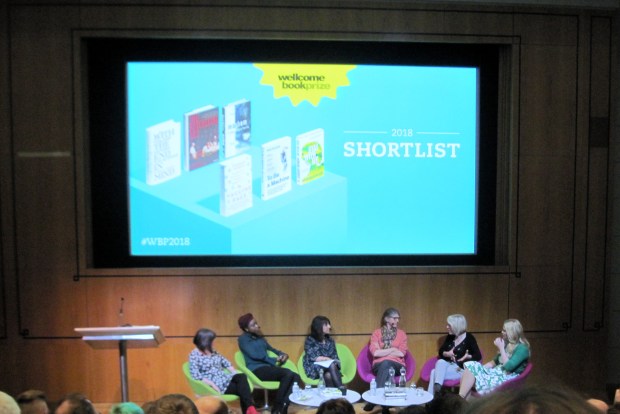
Mannix, Adebayo, O’Kelly, Rausing, Wadman & Fitzharris
Lindsey Fitzharris called The Butchering Art “a love story between science and medicine” – it was the first time that the former (antisepsis) was applied to the latter. She initially thought Robert Liston was her man – he was so colorful, larger than life – but eventually found that the real story was with Joseph Lister, the quiet, persistent Quaker. (However, the book does open with Liston performing the first surgery under ether.) Fitzharris is also involved in the Order of the Good Death, author Caitlin Doughty’s initiative, and affirmed Mannix’s efforts to remove the taboo from talking about death. I think I heard correctly that she said there is a film of The Butchering Art in the works?! I’ll need to look into that some more.
Meredith Wadman started with a brief explanation of how immunization works and why the 1960s were ripe for vaccine research. This segment went really science-y, which I thought was a little unfortunate as it may have made listeners tune out and be less interested in her work than the others’. It was perhaps inevitable given her subject matter, but also a matter of the questions O’Kelly asked – with the others she focused more on stories and themes than on scientific facts. It was interesting to hear what Wadman has been working on recently: for the past 6–8 months, she’s been reporting for Science on sexual harassment in science. For her next book, though, she’s pondering the conflict between a congressman and a Centers for Disease Control scientist over funding into research that might lead to gun control.
The question time brought up the issues of medical misinformation online, the distrust people with chronic illnesses have of medical professionals, and euthanasia – Mannix rather dodged that one, stating that her book is about the natural dying process so that’s not really her area. (Though it does come up in a chapter of her book.) We also heard a bit about the projects up next for each author. Rausing’s next book will be a travel memoir about the Capetown drought, taking in apartheid and her husband’s family’s immigration. Adebayo is at work on a very nebulous novel “about people,” and possibly how privilege affects access to healthcare.
Wellcome Book Prize Shadow Panel Decision
Addiction, death, infertility, surgery, transhumanism and vaccines: It’s been quite the varied reading list for the five of us this spring! Lots of science, lots of medicine, but also a lot of stories and imagination.
After some conferring and voting, we have arrived at our shadow panel winner for the Wellcome Book Prize 2018: To Be a Machine by Mark O’Connell.
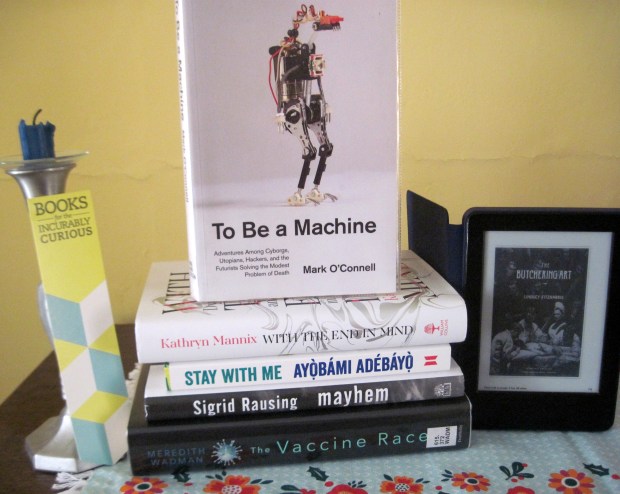
Rarely have I been so surprised to love a book. It’s a delight to read, and no matter what your background or beliefs are, it will give you plenty to think about. It goes deep down, beneath our health and ultimately our mortality, to ask what the essence of being human is.
Here’s what the rest of the shadow panel has to say about our pick:
Annabel: “O’Connell, as a journalist and outsider in the surprisingly diverse field of transhumanism, treats everyone with respect: asking the questions, but not judging, to get to the heart of the transhumanists’ beliefs. For a subject based in technology, To Be a Machine is a profoundly human story.”
Clare: “The concept of transhumanism may not be widely known or understood yet, but O’Connell’s engaging and fascinating book explains the significance of the movement and its possible implications both in the distant future and how we live now.”
Laura: “My brain feels like it’s been wired slightly differently since reading To Be a Machine. It’s not just about weird science and weird scientists, but how we come to terms with the fact that even the luckiest of us live lives that are so brief.”
Paul: “An interesting book that hopefully will provoke further discussion as we embrace technology and it envelops us.”

On Monday we’ll find out which book the official judges have chosen. I could see three or four of these as potential winners, so it’s very hard to say who will take home the £30,000.
Who are you rooting for?
Wellcome Book Prize: Shortlist Recap
Tomorrow morning we will announce our Wellcome Book Prize 2018 shadow panel winner. Beforehand I wanted to do a quick recap of my reviews, especially for the two books that I read before the shortlist announcement. My full reviews are here:
Stay with Me by Ayobami Adebayo
To Be a Machine by Mark O’Connell
Mayhem by Sigrid Rausing
The Vaccine Race by Meredith Wadman
I give some extra thoughts on and favorite quotes from the other two below:
The Butchering Art by Lindsey Fitzharris
 This is a great blend of medical history and popular science that should draw in readers who wouldn’t normally gravitate to either topic – provided they aren’t too squeamish. Fitzharris has recently returned to Oxford as a visiting academic, and this has also been nominated for the Wolfson History Prize. Follow her on Instagram (@drlindseyfitzharris) for a steady stream of gruesomely fascinating photos (I wish The Butchering Art had been illustrated!). Her next book will be much of a muchness, it seems, documenting the early years of plastic surgery after World War I through the story of pioneering surgeon Harold Gillies.
In the days before Joseph Lister…
“Operating theaters were gateways to death. It was safer to have an operation at home than in a hospital, where mortality rates were three to five times higher than they were in domestic settings.”
“The surgeon was very much viewed as a manual labourer who used his hands to make his living, much like a key cutter or plumber today.”
See what the rest of the shadow panel has to say about this book:
Annabel’s review: “[A]n extremely readable account of a ground-breaking career which led to real advances in hospital medicine. I enjoyed the whole, but particularly the grisly bits!”
Laura’s review: “It’s easy for me to feel a bit impatient with popular histories of periods or subjects that I know well, but Fitzharris strikes exactly the right note, writing clearly and accessibly with no dumbing down.”
Paul’s review: “It is one of the better books that I have read on medical history[;] Fitzharris writes in an engaging way on a subject that is not going to appeal to everyone, but in amongst all the blood is the fascinating story of Joseph Lister.”
With the End in Mind by Kathryn Mannix
 “It’s time to talk about dying. This is my way of promoting the conversation,” Mannix writes in her introduction to this accessible and reassuring book about death. She believes we are afraid of death because of our misconception that it is inevitably painful and undignified. In her decades of working in hospice care, this has rarely been the case. (Thank goodness that, compared to the earlier nineteenth-century situation Fitzharris surveys, we have reliable pain control options.) Mannix sees the role of the hospice worker as being like a midwife for the dying, a helpful idea I first encountered in Henry Fersko-Weiss’s Caring for the Dying: The Doula Approach to a Meaningful Death.
Many of the stories in this book are of peaceful deaths the patient and family had time to prepare for. Others are sad stories of denial. One, though, is quite gruesome, yet magnificently described. Alex, a young man with testicular teratoma, has a massive GI bleed:
“Alex’s head is thrown back, almost as though it is a voluntary movement. A huge, dark-red python slithers rapidly out of his mouth, pushing his head backwards as it coils itself onto the pillow beside him; the python is wet and gleaming and begins to stain the pillowcase and sheets with its red essence as Alex takes one snoring breath, and then stops breathing. His mother screams as he realises that the python is Alex’s blood. Probably all of his blood.”
See what the rest of the shadow panel has to say about this book:
Annabel’s review: “[I]t is helping patients, and their families and loved ones, to understand the process of dying, and dispelling the taboos around it that make this book such a valuable and compelling read. I wish I’d read something like this book before my mum died.”
Clare’s review: “For me, this enlightening book is a strong potential winner for the Wellcome Book Prize and I hope it brings comfort and guidance for those who need it.”
Laura’s review: “[The book is] written from her own experiences as a specialist in palliative care, and this proved, for me, both its strength and its downfall. … Mannix writes particularly well on the characteristic patterns of somebody who is entering a gradual decline.”
Paul’s review: “Can highly recommend this moving book and I think it should be essential reading for anyone who has any concerns about death.”
I wouldn’t be at all surprised to see either of these win the Wellcome Book Prize on Monday. Stay tuned for tomorrow’s shadow panel winner announcement, and Sunday’s write-up of a shortlist event I’m attending in London.
Quick Reactions to the Wellcome Book Prize Shortlist
From 12, we are now down to six. The 2018 Wellcome Book Prize shortlist is here!

Some quick thoughts:
I sort-of predicted three out of the six in yesterday’s post: The Butchering Art by Lindsey Fitzharris, With the End in Mind by Kathryn Mannix, and To Be a Machine by Mark O’Connell.
I’m relieved that I’d already gotten to two of the shortlisted titles (Fitzharris and Mannix), so I can focus on reading the other four over the next 5+ weeks, and will briefly revisit those first two on my Kindle when it’s decision time.
I am pretty shocked that Maggie O’Farrell’s I Am, I Am, I Am did not advance to the shortlist. Mayhem will have to be a truly amazing memoir to outdo it; I wanted to read it anyway, but now I’m particularly keen – it would be a good one for me to feature on the official blog tour if that happens to work out.
I’m not feeling very cheerful about having to start Stay with Me again (I DNFed it last year), but I’ll try to approach it with an open mind.
To Be a Machine is currently on shelf at my local library (fingers crossed that it’s still there when I go on Friday) and I’ve reserved The Vaccine Race from another branch. I’ll start with one of those.
I’ve also been promised two review copies at random in the post – let’s hope it’s not the two I’ve already read!
(See also Laura’s initial thoughts.)
 Bookish Beck = Rebecca Foster. American transplant to England. Freelance proofreader and book reviewer.
