#DoorstoppersInDecember: Book of Lives by Margaret Atwood & The End of Mr. Y by Scarlett Thomas
Later than intended, I’m reporting back on Margaret Atwood’s memoir, which I started in late November, and a long-neglected 500+-page novel I plucked from my shelves. Both offered page-turning intrigue and a blend of history, magic, and pure weirdness. Many thanks to Laura for hosting Doorstoppers in December, which encouraged me to pick them up!
Book of Lives: A Memoir of Sorts by Margaret Atwood (2025)
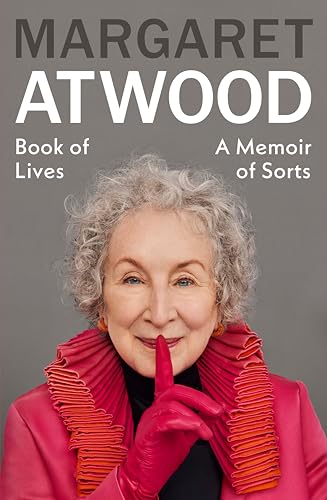 I gave some initial thoughts about the book here to tie in with Margaret Atwood Reading Month. What I said then proved true of the book as a whole: it’s delightful though dense with detail and historical context. I did get a little bogged down in the names and details of decades worth of publishing, but there is some tasty gossip, such as the fact that Margaret Laurence spread mean rumours about her (and was a drunk) but later changed her ways. It’s been a lucky window of time for Atwood to live through: she has known simplicity and the need for do-it-yourself practicality, but has also experienced privilege, even luxury (multiple homes and worldwide travel). Mostly, she had the good fortune of being at the start of Canada’s literary boom. In the early 1960s, only five Canadian novels were published per year. Through her involvement with literary magazines and House of Anansi Press and her books on Susanna Moodie and the tropes of Canadian literature, she helped create the scene.
There are frequent mentions of how people or events made their way into her fiction and poetry. Coyly, she writes, “I just have a teeming imagination. Also, like all novelists, I’m a kleptomaniac.” The page or two of context on each book is illuminating and it never becomes the tedious “I published this book … then I published this book” that she mentioned wanting to avoid in the introduction. Rather, these sections made me want to go reread lots of her books to appreciate them anew. I was also reminded how often she’s been ahead of her time, with topics and details that seem prophetic (she proposed Payback before the financial crisis hit, for instance). Some elements felt particularly timely: she experienced casual misogyny and an alarming number of near-misses – she says things like “I won’t give his name … you know who you are … though you’re probably dead” – and, through her involvement in bird conservation, she’s well aware of the disastrous environmental trajectory we’re on.
For a memoir, this is not especially forthcoming about the author’s inner life and emotions. Where it is, she masks the material in a layer of technique. So when she’s confessing to having an affair while married to Jim Polk (whom she met at Harvard), she writes it like a fairytale scene in which she went into the woods with a wolf. When she was fretting about Graeme Gibson’s reluctance to divorce her first wife and marry her, she imagines letters to her ‘inner advice columnist’. (Note: Gibson was her long-time partner and his sons were like her stepchildren but they never did marry – and he only ‘allowed’ her the one child, though she wanted two of her own. One ‘Jess Gibson’ has a speculative short story collection, The Good Eye, coming out in May 2026. No doubt her work will be compared with her mother’s, but bully for her for not using the name Atwood to try to ride her coattails.)
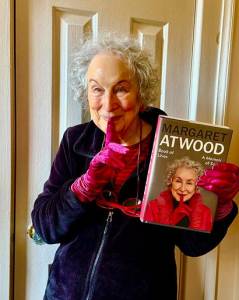
A cute pic from her Substack in November
One of the successful literary touches is the recurring “We Nearly Lose Graeme” segments about his risky behaviour and various mishaps. He had dementia and mini strokes before suffering a major one while in London with her for The Testaments tour; he died five days later. Her reflections on his death are poignant, but generic: “We can all believe three things simultaneously: The person is in the ground. The person is in the Afterlife. The person is in the next room. You keep expecting to see him. Even when you know it’s coming, a death is a shock.” At the crucial moment, she turns to the first-person plural and the second person.
I skimmed some of the bits about Graeme’s earlier life and the behind-the-scenes of publishing; I felt that he and many of her literary pals are more important to her than they are to readers. But that’s okay. The same goes for her earlier life; I noted that the account of her time as a summer camp counsellor felt more detailed than necessary. However, with her gift for storytelling, even the smallest incident can be rendered amusing. She looks for the humour, coincidence, or irony in any situation, and her summations and asides are full of dry humour. Some examples:
- “Spoiler: Jim and I eventually got married, one of the odder things to happen to both of us.”
- “After a while, the hand [at the window of her Harvard student accommodation] went away. It’s what you wish for in a disembodied hand.”
- “Eventually the iguana [inherited from her roommate] was given a new home at a zoo among other iguanas, where it was probably happier. Hard to tell.”
It’s not a book for the casual reader who kinda liked one or two Atwood novels; it’s more for the diehard fans among us, and offers a veritable trove of stories and photographs. But don’t expect a tell-all. Think of this more as a companion to her oeuvre. The title feels literal in that it’s as if she’s lived several lives: the wilderness kid, the literary ingénue, the family and career woman, the philanthropist and elder stateswoman. She doesn’t try to pull all of her incarnations into one, instead leaving all of the threads trailing into the beyond. If anything, “Peggy Nature” (her name from summer camp) is the role that has persisted. I probably liked the childhood material most, which makes sense as it’s what she’s looking back on with most fondness. Towards the close, Atwood mentions her heart condition and seems perfectly accepting of the fact that she won’t be around for much longer. But her body of work will endure. I’m so grateful for it and for the gift of this self-disclosure, however coy. (Can I be greedy and hope for another novel?) She leaves this message: “We scribes and scribblers are time travellers: via the magic page we throw our voices, not only from here to elsewhere, but also from now to a possible future. I’ll see you there.” [570 pages] (Public library) 
The End of Mr. Y by Scarlett Thomas (2006)
 This is a mash-up of the campus novel, the Victorian pastiche, and the time travel adventure. Ariel Manto is a PhD student working on thought experiments. Inciting incidents come thick and fast: her supervisor disappears, the building that houses her office partially collapses as it’s on top of an old railway tunnel, and she finds a copy of Thomas Lumas’s vanishingly rare The End of Mr. Y in a box of mixed antiquarian stock going for £50 at a secondhand bookshop. Rumour has it the book is cursed, and when Ariel realises that the key page – giving a Victorian homoeopathic recipe for entering the “Troposphere,” a dream/thought realm where one travels through time and space – has been excised, she knows the quest has only just begun. It will involve the book within a book, Samuel Butler novels, a theologian and a shrine, lab mice plus the God of Mice, and a train line whose destinations are emotions.
The plot is pretty bonkers and I’m not sure I can satisfactorily explain its internal logic now, but as is true of the best doorstoppers, it absorbed me completely. I read it very quickly (for me) and even read 120 pages in one sitting thanks to my cat pinning me to the sofa. It also felt prescient in discussing “machine consciousness” – a topic adjacent to artificial intelligence. Ariel is a Disaster Woman avant la lettre, living on noodles and cut-price wine. Her current ‘relationship’ consisting of rough sex with a married professor is the latest in a string of unhealthy connections. But time travel offers the possibility not just of reversing her own mistakes, but of going right back to the start of humanity. Verging on steampunk, this was much better than the other Thomas novels I’ve read, The Seed Collectors and Oligarchy. It was longlisted for the Orange (Women’s) Prize and would be a great choice for readers of Nicola Barker and Susanna Clarke. [502 pages] (Secondhand – Book-Cycle, Exeter; it’s been on my shelves since 2016!) 
20 Books of Summer, 19–20: Emily St. James and Abraham Verghese
Going out on a high! My last three books for the challenge (also including Beautiful Ruins) were particularly great, just the sort of absorbing and rewarding reading that I wish I could guarantee for all of my summer selections.
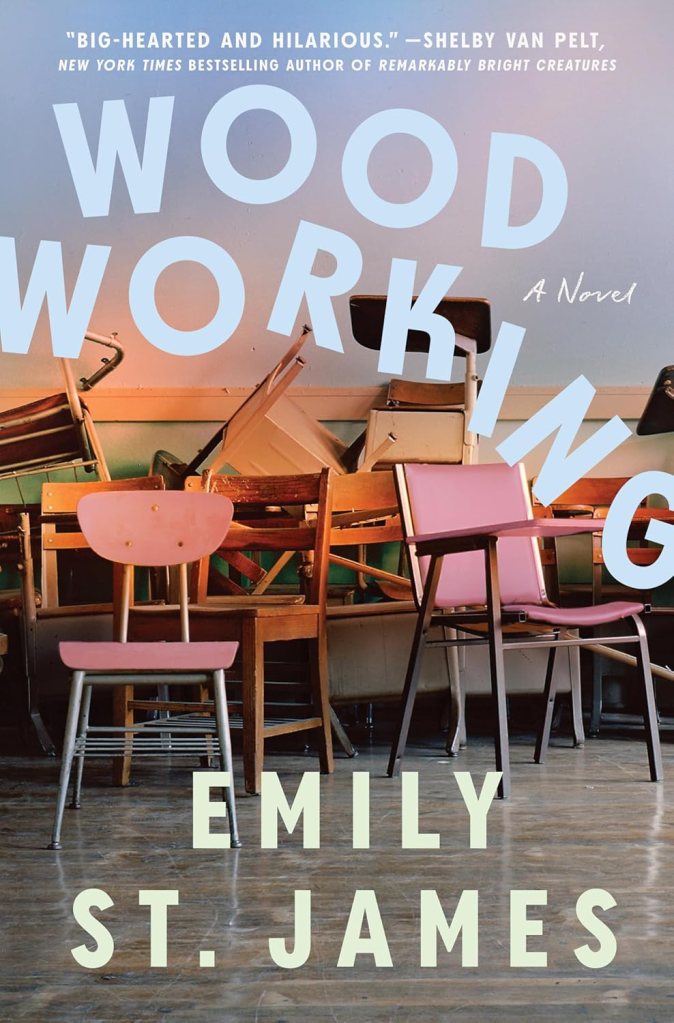
Woodworking by Emily St. James (2025)
Colloquially, “woodworking” is disappearing in plain sight; doing all you can to fade into the woodwork. Erica has only just admitted her identity to herself, and over the autumn of 2016 begins telling others she’s a woman – starting with her ex-wife Constance, who is now pregnant by her fiancé, John. To everyone else, Erica is still Mr. Skyberg, a 35-year-old English teacher at Mitchell High involved in local amateur dramatics. When Erica realizes that not only is there another trans woman in her small South Dakota town but that it’s one of her students, Abigail Hawkes, she lights up. Abigail may be half her age but is further along in her transition journey and has sassy confidence. But this foul-mouthed new mentor has problems of her own, starting with parents who refuse to refer to her by her chosen name. Abigail lives with her adult sister instead, and gains an unexpected surrogate family via her boyfriend Caleb, a Korean adoptee whose mother, Brooke Daniels, is directing Our Town. Brooke is surprisingly supportive given that she attends Isaiah Rose’s megachurch.
As Trump/Pence signs proliferate, a local election is heating up, too: Pastor Rose is running for State Congress on the Republican ticket, opposed by Helen Swee. Erica befriends Helen and becomes faculty advisor for the school’s Democrat club (which has all of two members: Abigail and her Leslie Knope-like friend Megan). The plot swings naturally between the personal and political, emphasizing how the personal business of 1% of the population has been made into a political football. Chapters alternate between Abigail in first person and Erica in third. The characters feel utterly real and the dialogue is as genuine as the narrative voices. The support group Erica and Abigail attend presents a range of trans experiences based on when one came of age. Some are still deep undercover. There’s a big reveal I couldn’t quite accept, though I can see its purpose. It’s particularly effective how St. James lets second- and third-person narration shade into first as characters accept their selves. Grey rectangles cover up deadnames all but once, making the point that even allies can get it wrong.
This was pure page-turning enjoyment with an important message to convey. It reminded me a lot of Under the Rainbow by Celia Laskey but also had the flavour of classic Tom Perrotta (Election). In the Author’s Note, St. James writes, “They say the single greatest determinant of whether someone will support and affirm trans people is if they know a trans person.” I feel lucky to count three trans people among my friends. It’s impossible to make detached pronouncements about bathrooms and slippery slopes if you care about people whose rights and very existence are being undermined. We should all be reading books by and about trans women. (New purchase from Bookshop.org)
The Covenant of Water by Abraham Verghese (2023)
All too often, I shy away from doorstoppers because they seem like too much of a time commitment. Why read 715 pages in one novel when I could read 3.5 of 200 pages each? Yet there’s something special about being lost in the middle of a great big book and trusting that wherever the story goes will be worthwhile. I let this review copy languish on the shelf for over TWO YEARS when I should have known that the author of the amazing Cutting for Stone couldn’t possibly let me down. Verghese’s second novel is very much in the same vein: a family saga that spans decades and in every generation focuses on medical issues. Verghese is a practicing doctor as well as a Stanford professor and you can tell he glories in the details of hand and brain surgeries, disability and rare diseases – and luckily, so do I.
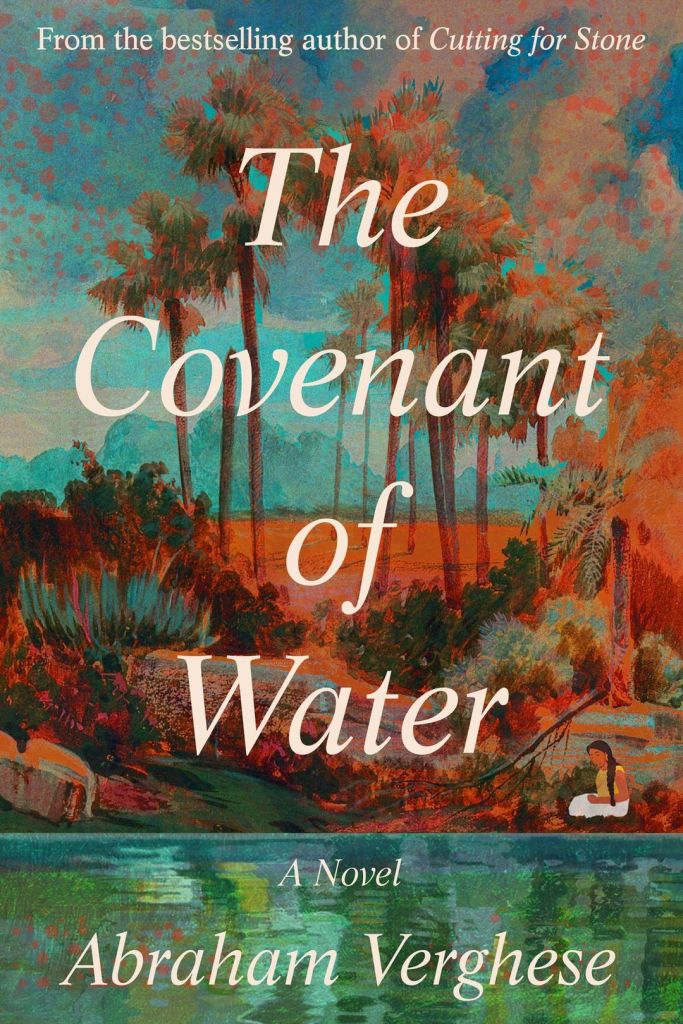
Wider events play out in the background (wars, partition, the fall of the caste system), but the focus is always on one family in Kerala, starting in 1900 when a 12-year-old girl is brought to the Parambil estate for her arranged marriage to a 40-year-old widower. One day she will be Big Ammachi, the matriarch of a family with a mysterious Condition: In every generation, someone drowns. As a result, they all avoid water, even if it requires going hours out of their way. Her son Philipose longs to be a scholar, but is so hard of hearing that his formal education is cut short. He becomes a columnist in a local newspaper and marries Elsie, a spirited artist. Their daughter, Mariamma, trains as a doctor. In parallel, we follow the story of Digby Kilgour, a Glaswegian surgeon whose career takes him to India. Through Digby and Mariamma’s interactions with colleagues, we watch colonial incompetence and sexism play out. Addiction and suicide recur across the years. Destiny and choice lock horns. I enjoyed the window onto the small community of St. Thomas Christians and felt fond of all the characters, including Damodaran the elephant. It’s also really clever how Verghese makes the Condition a cross between a mystical curse and a diagnosable ailment. An intellectual soap opera that makes you think about storytelling, purpose and inheritance, this is extraordinary. 
With thanks to Atlantic Books for the proof copy for review.

I read 10 of the books I selected in my initial planning post. I’m pleased that I picked off a couple of long-neglected review copies and several recent purchases. The rest were substituted at whim. There were two duds, but the overall quality was high, with 10 books I rated 4 stars or higher! Along with the above and Beautiful Ruins, Pet Sematary and Storm Pegs were overall highlights. I also managed to complete a row on the Bingo card, a fun add-on. And, bonus: I cleared 7 books from my shelves by reselling or giving them away after I read them.
May Releases, Part II (Fiction): Le Blevennec, Lynch, Puchner, Stanley, Ullmann, and Wald
A cornucopia of May novels, ranging from novella to doorstopper and from Montana to Tunisia; less of a spread in time: only the 1980s to now. Just a paragraph on each to keep things simple. I’ll catch up soon with May nonfiction and poetry releases I read.
Friends and Lovers by Nolwenn Le Blevennec (2023; 2025)
[Translated from French by Madeleine Rogers]
 Armelle, Rim, and Anna are best friends – the first two since childhood. They formed a trio a decade or so ago when they worked on the same magazine. Now in their mid-thirties, partnered and with children, they’re all gripped by a sexual “great awakening” and long to escape Paris and their domestic commitments – “we went through it, this mutiny, like three sisters,” poised to blow up the “perfectly executed choreography of work, relationships, children”. The friends travel to Tunisia together in December 2014, then several years later take a completely different holiday: a disaster-prone stay in a lighthouse-keeper’s cottage on an island off the coast of Brittany. They used to tolerate each other’s foibles and infidelities, but now resentment has sprouted up, especially as Armelle (the narrator) is writing a screenplay about female friendship that’s clearly inspired by Rim and Anna. Armelle is relatably neurotic (a hilarious French blurb for the author’s previous novel is not wrong: “Woody Allen meets Annie Ernaux”) and this is wise about intimacy and duplicity, yet I never felt invested in any of the three women or sufficiently knowledgeable about their lives.
With thanks to Peirene Press for the free copy for review.
A Family Matter by Claire Lynch
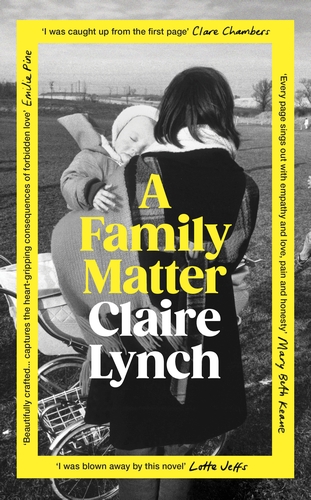 “The fluke of being born at a slightly different time, or in a slightly different place, all that might gift you or cost you.” At events for Small, Lynch’s terrific memoir about how she and her wife had children, women would speak up about how different their experience had been. Lesbians born just 10 or 20 years earlier didn’t have the same options. Often, they were in heterosexual marriages because that’s all they knew to do; certainly the only way they thought they could become mothers. In her research into divorce cases in the UK in the 1980s, Lynch learned that 90% of lesbian mothers lost custody of their children. Her aim with this earnest, delicate debut novel, which bounces between 2022 and 1982, is to imagine such a situation through close portraits of Heron, an ageing man with terminal cancer; his daughter, Maggie, who in her early forties bears responsibility for him and her own children; and Dawn, who loved Maggie desperately but felt when she met Hazel that she was “alive at last, at twenty-three.” How heartbreaking that Maggie knew only that her mother abandoned her when she was little; not until she comes across legal documents and newspaper clippings does she understand the circumstances. Lynch made the wise decision to invite sympathy for Heron from the start, so he doesn’t become the easy villain of the piece. Her compassion, and thus ours, is equal for all three characters. This confident, tender story of changing mores and steadfast love is the new Carol for our times. (Such a lovely but low-key novel was liable to make few ripples, so I’m delighted for Lynch that the U.S. release got a Read with Jenna endorsement.)
With thanks to Chatto & Windus (Penguin) for the proof copy for review.
Dream State by Eric Puchner
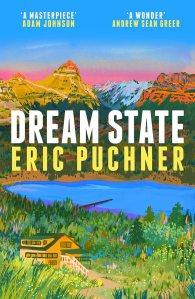 If it starts and ends with a wedding, it must be a comedy. If much of the in between is marked by heartbreak, betrayal, failure, and loss, it must be a tragedy. If it stretches towards 2050 and imagines a Western USA smothered in smoke from near-constant forest fires, it must be an environmental dystopian. Somehow, this novel is all three. The first 163 pages are pure delight: a glistening romantic comedy about the chaos surrounding Charlie and Cece’s wedding at his family’s Montana lake house in the summer of 2004. First half the wedding party falls ill with norovirus, then Charlie’s best friend, Garrett (who’s also the officiant), falls in love with the bride. Do I sound shallow if I admit this was the section I enjoyed the most? The rest of this Oprah’s Book Club doorstopper examines the fallout of this uneasy love triangle. Charlie is an anaesthesiologist, Cece a bookstore owner, and Garrett a wolverine researcher in Glacier National Park, which is steadily losing its wolverines and its glaciers. The next generation comes of age in a diminished world, turning to acting or addiction. There are still plenty of lighter moments: funny set-pieces, warm family interactions, private jokes and quirky descriptions. But this feels like an appropriately grown-up vision of idealism ceding to a reality we all must face. I struggled with a lack of engagement with the children, but loved Puchner’s writing so much on the sentence level that I will certainly seek out more of his work. Imagine this as a cross between Jonathan Franzen and Maggie Shipstead.
With thanks to Sceptre (Hodder) for the proof copy for review.
Consider Yourself Kissed by Jessica Stanley
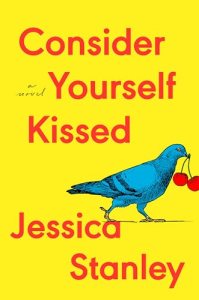 Coralie is nearing 30 when her ad agency job transfers her from Australia to London in 2013. Within a few pages, she meets Adam when she rescues his four-year-old, Zora, from a lake. That Adam and Coralie will be together is never really in question. But over the next decade of personal and political events, we wonder whether they have staying power – and whether Coralie, a would-be writer, will lose herself in soul-destroying work and motherhood. Adam’s job as a political journalist and biographer means close coverage of each UK election and referendum. As I’ve thought about some recent Jonathan Coe novels: These events were so depressing to live through, who would want to relive them through fiction? I also found this overlong and drowning in exclamation points. Still, it’s so likable, what with Coralie’s love of literature (the title is from The Group) and adjustment to expat life without her mother; and secondary characters such as Coralie’s brother Daniel and his husband, Adam’s prickly mother and her wife, and the mums Coralie meets through NCT classes. Best of all, though, is her relationship with Zora. This falls solidly between literary fiction and popular/women’s fiction. Given that I was expecting a lighter romance-led read, it surprised me with its depth. It may well be for you if you’re a fan of Meg Mason and David Nicholls.
With thanks to Hutchinson Heinemann for the proof copy for review.
Girl, 1983 by Linn Ullmann (2021; 2025)
[Translated from Norwegian by Martin Aitken]
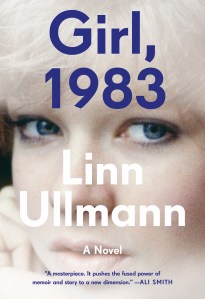 Ullmann is the daughter of actress Liv Ullmann and film director Ingmar Bergman. That pedigree perhaps accounts for why she got the opportunity to travel to Paris in the winter of 1983 to model for a renowned photographer. She was 16 at the time and spent the whole trip disoriented: cold, hungry, lost. Unable to retrace the way to her hotel and wearing a blue coat and red hat, she went to the only address she knew – that of the photographer, K, who was in his mid-forties. Their sexual relationship is short-lived and unsurprising, at least in these days of #MeToo revelations. Its specifics would barely fill a page, yet the novel loops around and through the affair for more than 250. Ullmann mostly pulls this off thanks to the language of retrospection. She splits herself both psychically and chronologically. There’s a “you” she keeps addressing, a childhood imaginary friend who morphs into a critical voice of conscience and then the self dissociated from trauma. And there’s the 55-year-old writer looking back with empathy yet still suffering the effects. The repetition made this something of a sombre slog, though. It slots into a feminist autofiction tradition but is not among my favourite examples.
With thanks to Hamish Hamilton (Penguin) for the proof copy for review.
The Bayrose Files by Diane Wald
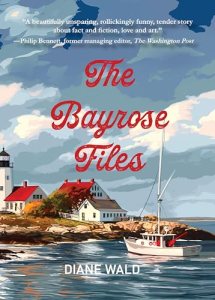 In the 1980s, Boston journalist Violet Maris infiltrates the Provincetown Home for Artists and Writers, intending to write a juicy insider’s exposé of what goes on at this artists’ colony. But to get there she has to commit a deception. Her gay friend Spencer Bayrose has a whole sheaf of unpublished short stories drawing on his Louisiana upbringing, and he offers to let her submit them as her own work to get a place at PHAW. Here Violet finds eccentrics aplenty, and even romance, but when news comes that Spence has AIDS, she has to decide how far she’ll go for a story and what she owes her friend. At barely over 100 pages, this feels more like a long short story, one with a promising setting and a sound plot arc, but not enough time to get to know or particularly care about the characters. I was reminded of books I’ve read by Julia Glass and Sara Maitland. It’s offbeat and good-natured but not top tier.
Published by Regal House Publishing. With thanks to publicist Jackie Karneth of Books Forward for the advanced e-copy for review.
A Family Matter was the best of the bunch for me, followed closely by Dream State.
Which of these do you fancy reading?
May Graphic Novels by Alison Bechdel, Peter Kuper & Craig Thompson
May has been chock-full of new releases for me! For this first batch of reviews, I’m featuring three fantastic graphic novels that have made it onto my Best of 2025 (so far) list. I don’t read graphic books as often as I’d like to – my library tends to major on superhero comics and manga, which aren’t my cup of tea – but I sometimes get a chance to access them for paid review purposes. (The first two below are ones I was sent for potential Shelf Awareness reviews, but I missed the deadlines.) Reading these took me back to the early 2010s when I worked for a university library in South London and would walk to Lambeth Library on my lunch breaks to borrow huge piles of books, mostly taking advantage of their excellent graphic novel selection. That was where my education and fascination began.
Spent: A Comic Novel by Alison Bechdel
 I’ve read all but one of Bechdel’s works now. Fun Home was among the first graphic books I read and is a great choice if you’re new to this form of storytelling. It’s a family memoir about her father’s funeral home business and closeted lifestyle, which emerged shortly after her own coming-out – and shortly before his accidental death. In Spent, Alison and her handy wife Holly live on a Vermont pygmy goat farm. Alison has writer’s block and is struggling financially despite her famous memoir about her taxidermist father having been made into a successful TV series, Death & Taxidermy. Mostly, she’s consumed with anxiety about the state of the world, what with the ongoing pandemic, her sister’s right-wing opinions, and the litany of awful headlines. “Who can draw when the world is burning?” she exclaims.
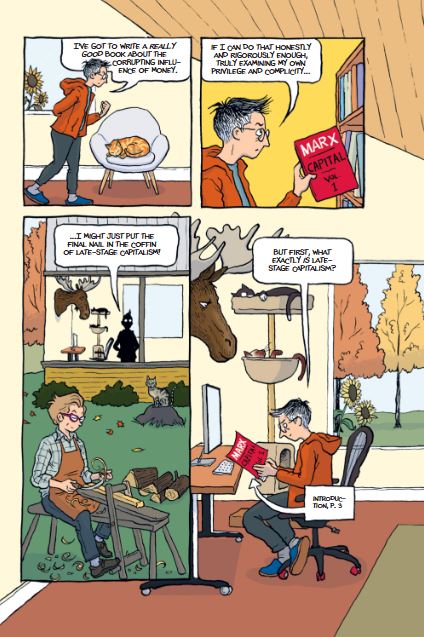
Then Alison has an idea for a book – or maybe a reality TV series – called $UM that will wean people off of capitalism. That creative journey is mirrored in Spent, which is composed of 12 “episodes” titled after Marxist terminology. Through Alison’s ageing hippie friends and their kids, Bechdel showcases alternative ways of living: a commune, a throuple, nonbinary identity, unpaid internships, Just Stop Oil demos, and the influencer lifestyle versus rejection of technology. It’s (auto)fiction exaggerated to the brink of absurdity, with details changed enough to mock but not enough to hide (e.g., she’s published by “Megalopub,” the hardware store is “Home Despot,” her show airs on “Schmamazon”).

Tiny details in the drawings reward close attention, such as Alison and Holly’s five cats’ antics during their morning routine, and a stuffed moose head rolling its eyes. It’s the funniest I can remember Bechdel being, with much broad humour derived from the outrageous screen mangling of her book – cannibalism, volcanoes and dragons come out of nowhere – and her middle-class friends’ hand-wringing over their liberal credentials. Even the throwaway phrases are hilarious. It’s a gleeful and zeitgeist-y satire, yet draws to a touching close as Alison has the epiphany that she can’t fix everything herself so must simply do what she can, “with a little help from her annoying, tender-hearted, and utterly luminous friends.”
Accessed as an e-book from Mariner Books. Published in the UK by Jonathan Cape (Penguin).
Insectopolis: A Natural History by Peter Kuper
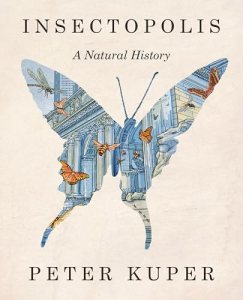 Nearly a decade ago, I reviewed Peter Kuper’s Ruins, which features monarch migration and has as protagonist a laid-off Natural History Museum entomologist. Here insects have even more of a starring role. The E. O. Wilson epigraph sets the stage: “If all mankind were to disappear, the world would regenerate back to the rich state of equilibrium that existed ten thousand years ago. If insects were to vanish, the environment would collapse into chaos.” We follow an African American brother-and-sister pair, the one dubious and the other eager, as they walk downtown to the New York Public Library. The sister, who holds a PhD in entomology, promises that its exhibition on insects is going to be amazing. But just before they reach the building, a red alert flashes up on every smartphone and sirens start blaring. A week later, the city is a ruin of overturned cabs and debris. Only insects remain and, group by group, they guide readers through the empty exhibit, interacting within and across species.


It’s a sly blend of science, history, stories and silliness. I loved the scenes of mosquitoes and ants railing against how they’ve been depicted as villainous, and dignified dung beetles resisting scatological jokes and standing up for their importance in ecosystems. There are interesting interludes about insects in literature (not just Kafka and Nabokov, but the Japanese graphic novel The Book of Human Insects by Osamu Tezuka), and unsung heroines of entomology get their moment in the sun. The pages in which Margaret Collins, an African American termite researcher in the 1950s, and Rachel Carson appear to a dragonfly as ghosts and tell their stories of being dismissed by male researchers were among my favourites. Informative and entertaining at once; what could be better? Welcome our insect overlords!
Accessed as an e-book from W. W. Norton & Company.
Ginseng Roots by Craig Thompson
 I’d read several of Thompson’s works and especially enjoyed his previous graphic memoir, Blankets, about his first love and loss of faith. When I read this blurb, I worried the niche subject couldn’t possibly sustain my attention for nearly 450 pages. But I was wrong; this is a vital book about everything, by way of ginseng. It begins with childhood summers working on American ginseng farms with his siblings in Marathon, Wisconsin. Theirs was a blue collar and highly religious family, but Thompson and his little brother Phil were allowed to spend their earnings from the back-breaking labour of weeding and picking rocks as they pleased. Each hour, each dollar, meant a new comic from the pharmacy. “Comics helped me survive my childhood. But what will help me survive my adulthood?” Thompson asks.

Together with Phil, he travels first to Midwest ginseng farms and festivals and then through China and Korea to learn about the plant’s history, cultivation practices, lore, and medicinal uses. As he meets producers – including a Hmong man whose early life mirrors his own – he feels sheepish about how he makes a living: “I carry this working-class guilt – what I do isn’t real work.” When his livelihood is threatened by worsening autoimmune conditions, he tries everything from acupuncture to psychotherapy to save his hands and his creativity.
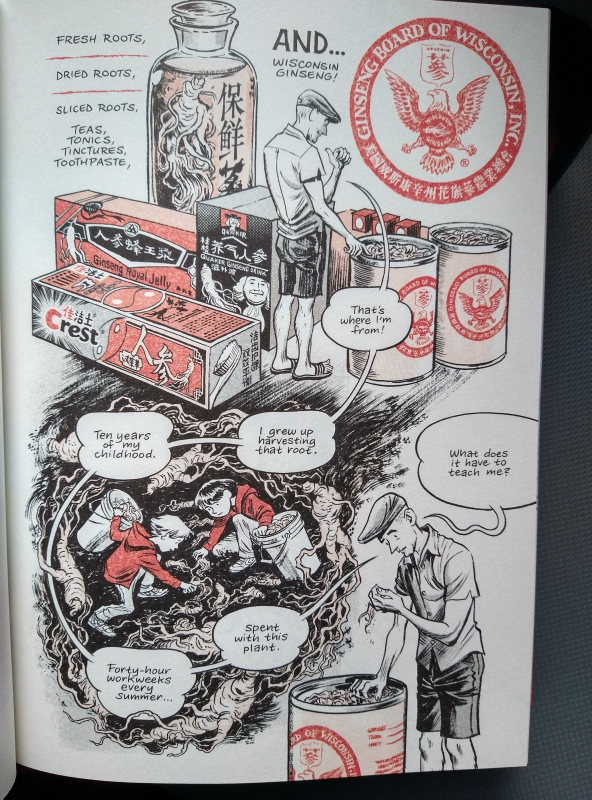
This chunky book has an appealing earth-tones palette and shifts smoothly between locations and styles, memories and research. When interviewing growers and Chinese medicine practitioners, the depictions are almost photorealistic, but there are also superhero pastiche panels and a cute ginseng mascot who pops up throughout the book. Like Spent, this pulls in class and economic issues in a lighthearted way and also explores its own composition process.
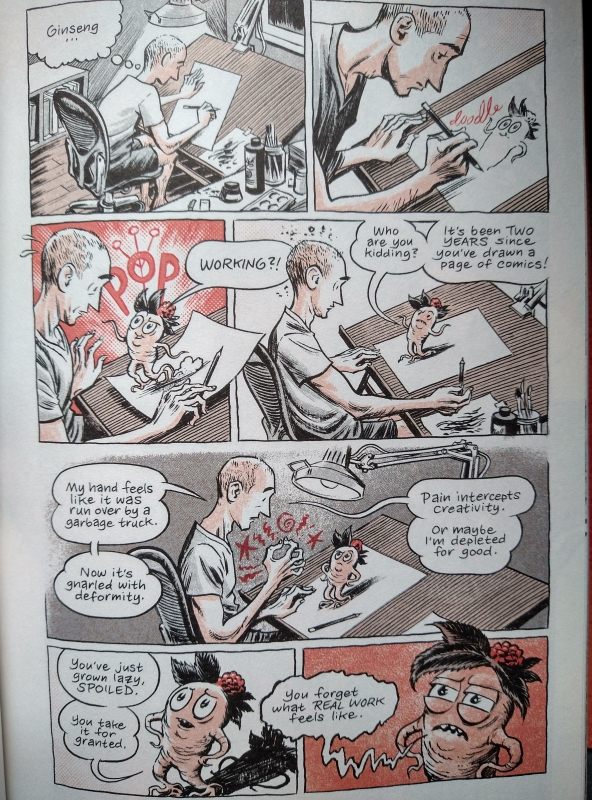
The story of ginseng is often sobering, involving the exploitation of immigrants (in the Notes, Thompson regrets that he was unable to speak with any of the Mexican migrant workers on whom the American ginseng harvest now depends), soil degradation, and pesticide pollution. The roots of the title are both literal and symbolic of the family story that unfolds in parallel. Both strands are captivating, but especially the autobiographical material: Thompson’s relationship with Phil, his new understanding but ongoing frustration with his parents, and the way all three siblings exhibit the damage of their upbringing – Phil’s marriage is crumbling; their sister Sarah, who has moved 26 times as an adult, wonders what she’s running from. A conversation with a Chinese herbal pharmacist gets to the heart of the matter: “I learned home is not WHERE I am. Home is HOW I am.”
Both expansive and intimate, this is a surprising gem from one of the best long-form graphic storytellers out there.
With thanks to Faber for the free copy for review. Published in the USA by Pantheon (Penguin).
20 Books of Summer, 10: Babel by R. F. Kuang (2022)
I substituted this in as my one doorstopper of the challenge after I failed with the new Persaud. It’s a bit of a cheat in that I actually started reading Babel in January, but I only just finished it this morning. I raced through the first 200 pages or so at the start of the year and loved all the geeky etymological footnotes and musings on translation. I thought I’d read it within a matter of days, which would have been a real feat for me. It’s hard to say why, instead, I stalled and found it difficult to regain sustained interest in the months that followed. Initially, it was a buddy read for me and my husband (his bookmark is still stranded at p. 178). His pithy comment, early on, was, “So, this is basically a woke Harry Potter?” And that’s actually a pretty apt summary. Four students at a magical academy – the Royal Institute of Translation at Oxford University, also known as Babel – find themselves questioning their responsibilities and loyalties as they confront the forces of evil, specifically colonialism.
When Robin Swift’s mother dies of cholera, he’s rescued from Canton by Professor Lovell and taken to England to train for entrance into Babel, a tower beside the Radcliffe Camera. He, Ramy (Indian), Victoire (Haitian) and Letty, the only white member of the quartet, are soon inseparable. While Victoire and Letty face prejudice for being female, it’s nothing to the experience of being racially other. Luckily, Babel values foreignness: intimate knowledge of other languages is an asset. In Kuang’s speculative 1830s setting, Britain’s economy is founded on a warped alchemy: silver is turned into energy to keep everyday life running smoothly in the industrializing nation. This is accomplished by harnessing the power of words. Silver bars are engraved with match-pairs – a phrase in a foreign language and its closest English counterpart – and the incantation of that untranslatable meaning sparks action. Spells keep bridges standing and traffic flowing; used for ill, they kill and destroy.
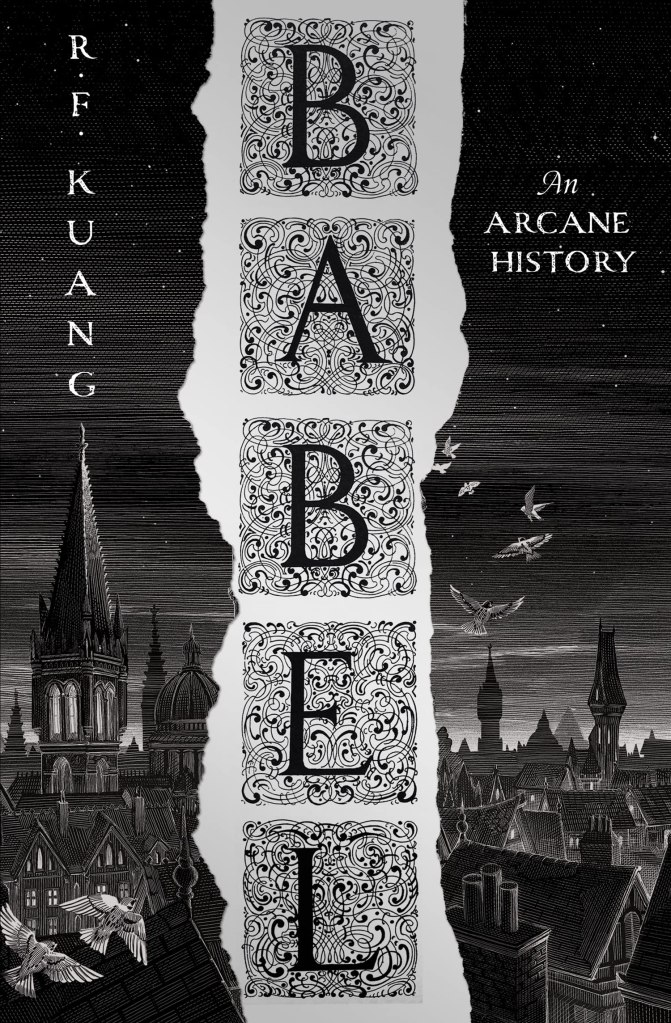
Robin and his friends gradually realise that their work at Babel is reinforcing mass poverty and the colonial system and, ultimately, fuelling future wars. “Truly, the only ones who seemed to profit from the silver industrial revolution were those who were already rich, and the select few others, who were cunning or lucky enough to make themselves so.” He becomes radicalized via the clandestine Hermes Society, which, Robin Hood-like, siphons silver resources away from where they are concentrated in Oxford to where they can help the oppressed. Surprised to learn who else is involved in Hermes, Robin (name not coincidental!) starts working behind the backs of his friends and professors, driven by conscience yet loath to give up the prospects he has through the tremendous privilege of being part of Babel. It goes from being an ivory tower of academia to being a hideaway for strikers and the besieged. And if you know your Bible stories, you’ll remember that Babel is destined to fall.
In faux-archaic fashion, Kuang has given her novel a lengthy subtitle: “Or: The Necessity of Violence – An Arcane History of the Oxford Translators’ Revolution.” The principle behind Hermes is that justice will never be achieved by negotiation; only by force. “Violence was the only thing that brought the colonizer to the table; violence was the only option.” Kuang published this fourth novel at age 26 and it manifests a certain youthful idealism. The sense of retrospective righteous anger is justified but also unsubtle; I felt similarly about Kuang’s Yellowface. Although there are exciting twists in the latter half of the book, I preferred the early semi-Dickensian atmosphere as Robin investigates his parentage and learns the joy of language and friendship. Kuang also adds a queer angle: an unrequited heterosexual crush comes to nothing because two same-sex friends are in love, even if they can never say. For as full-on and high-stakes as the plot becomes, I wished I could stay in this quieter mode.
Kuang has rendered the historical setting admirably and, though this is a typical adventure novel in that she has prioritized action over depth of characterization, one does get invested in the central characters and their interactions. The whole silver-working motif at first seems implausible but quickly becomes an accepted part of the background. Longstanding fantasy readers will probably have no problem reading this, but if you’re unsure and daunted by the 540-page length, ask yourself just how interested you are in word meanings and the history of colonialism and uprisings. (Little Free Library) 
[P.S. OMG, have you seen her wedding photos from a few weeks ago?!]
Also two DNFs, argh!
 The Museum of Whales You Will Never See: Travels among the Collectors of Iceland by A. Kendra Greene (2020) – This sounded quirky and fun, but it turns out it was too niche for me. I read the first two “Galleries” (78 pp.) about the Icelandic Phallological Museum and one woman’s stone collection. Another writer might have used a penis museum as an excuse for lots of cheap laughs, but Greene doesn’t succumb. Still, “no matter how erudite or innocent you imagine yourself to be, you will discover that everything is funnier when you talk about a penis museum. … It’s not salacious. It’s not even funny, except that the joke is on you.” I think I might have preferred a zany Sarah Vowell approach to the material. (Secondhand – Bas Books and Home, Newbury)
 Because I Don’t Know What You Mean and What You Don’t by Josie Long (2023) – A free signed copy – and, if I’m honest, a cover reminiscent of Ned Beauman’s Glow – induced me to try an author I’d never heard of. She’s a stand-up comic, apparently, not that you’d know it from these utterly boring, one-note stories about unhappy adolescents and mums on London council estates. I read 108 pages but could barely tell you what a single story was about. Long is decent at voices, but you need compelling stories to house them. (Little Free Library)
Recent Releases by Nathan Hill, Hisham Matar, Sigrid Nunez and More
One key way in which 2024’s reading has already differed from previous years’ is that I no longer avoid doorstoppers. I now classify any book with over 400 pages as a doorstopper, and by that definition I have already gotten through three this year: The Tidal Year plus two of the below, with Wellness standing out as the true whopper at 597 small-print pages. January offered a set of releases full of variety: gritty yet funny flash fiction; a novel of big ideas and big empathy for its flawed characters; an exile’s elegant love letter to Libya from London; a coy pandemic-era reflection on connection and creation; and a tour of nature close to home.
Universally Adored and Other One Dollar Stories by Elizabeth Bruce
 This was a great collection of 33 stories, all of them beginning with the words “One Dollar” and most of flash fiction length. Bruce has a knack for quickly introducing a setup and protagonist. The voice and setting vary enough that no two stories sound the same. What is the worth of a dollar? In some cases, where there’s a more contemporary frame of reference, a dollar is a sign of desperation (for the man who’s lost house, job and wife in “Little Jimmy,” for the coupon-cutting penny-pincher whose unbroken monologue makes up the whole of “Grocery List”), or maybe just enough for a small treat for a child (as in “Mouse Socks” or “Boogie Board”). In the historical stories, a dollar can buy a lot more. It’s a tank of gas – and a lesson on the evils of segregation – in “Gas Station”; it’s a huckster’s exorbitant charge for a mocked-up relic in “The Grass Jesus Walked On.”
The tone ranges from black comedy (“Festus”) to high tragedy (“Votive Candle”), but the book mostly falls within the realm of dirty realism with the attention to working-class country folk, so I’d recommend the collection to fans of authors who perch on the lighter side of that subgenre, such as Barbara Kingsolver or Denis Johnson. A few of my favorite stories, in addition to the above, were “Ice-Cold Water,” which I appreciated for the Washington D.C. setting and the way that an assumption about who would be racist was overturned by a moment of simple compassion; “Dolores,” in which a slick humanitarian fundraiser meets a waitress who has his number; and “Boiling the Buggers,” a window onto Covid-exacerbated mental illness. (Read via BookSirens)
Wellness by Nathan Hill
Somehow nearly eight years have passed since Hill’s debut novel, The Nix, which I dubbed “a rich, multi-layered story about family curses and failure.” I admired it as much for its prose as for its ideas, and Wellness is just as effervescent and insightful. It’s a state-of-the-nation novel filtered through one Chicago family: experimental photographer and underperforming academic Jack; his wife Elizabeth, a placebo researcher at Wellness; and their YouTube-obsessed son Toby. They’ve recently invested their life savings in a new condo and are considering trendy features like open shelves and separate master bedrooms. It would be oversimplifying, but true, to say that this couple is experiencing midlife and marital crises. Their nineties college romance – and a time of life when everything felt open and possible – is so remote now. When Elizabeth suggests they join a friend at a swingers’ club and a patient of hers who’s also a parent at Toby’s school sees them outside, chaos ensues.
Some elements from The Nix carry over, such as campus politics, the American Midwest, and mother–son relationships, but also broader questions of authenticity, purpose and nurture. Is love itself a placebo? The novel spends time with Jack and Elizabeth at the dawn of their relationship and in the present day, but also looks back to their early careers and first years of parenthood. Hill is clearly fascinated with the sort of psychological experimentation Elizabeth engages in (there’s a whole bibliography of scientific papers consulted) but also turns it to humorous effect, as when Elizabeth subjects Toby to the marshmallow test. A lot of information is conveyed through dialogue, yet it never feels forced. A couple of long asides, on Elizabeth’s family history and the algorithms guiding Jack’s interactions with his conspiracy theorist father, tried my patience, but I loved a four-page chapter on a funeral supper where every sentence starts “There was.” Sooooo many quotable lines throughout.
The only fault in an addictive and spot-on novel (how did he know?! you’ll find yourself thinking about your own attitude to work/marriage/children) is that Hill is so committed to excavating these characters’ backstory of stunted emotion – Jack estranged from his religious Kansas farmer parents after a traumatic incident you feel right in the gut; Elizabeth glad to jettison her father’s wealth with his anger – that he hurries through the denouement. Still, this is sure to be a fiction highlight of my year. It’s one for readers of Jonathan Franzen, sure, but I also thought it reminiscent of Katherine Heiny’s Standard Deviation and Meg Wolitzer’s The Interestings.
With thanks to Picador for the proof copy for review.
My Friends by Hisham Matar
“Benghazi was the one place I longed for the most, it was also the place I most feared to return to.”
 Taking a long walk through London one day, Khaled looks back from midlife on the choices he and his two best friends have made. He first came to the UK as an eighteen-year-old student at Edinburgh University. Everything that came after stemmed from one fateful day. Matar places Khaled and his university friend Mustafa at a real-life demonstration outside the Libyan embassy in London in 1984, which ended in a rain of bullets and the accidental death of a female police officer. Khaled’s physical wound is less crippling than the sense of being cut off from his homeland and his family. As he continues his literary studies and begins teaching, he decides to keep his injury a secret from them, as from nearly everyone else in his life. On a trip to Paris to support a female friend undergoing surgery, he happens to meet Hosam, a writer whose work enraptured him when he heard it on the radio back home long ago. Decades pass and the Arab Spring prompts his friends to take different paths.
I’d previously only read Matar’s short nonfiction work A Month in Siena. The slow, meditative style I enjoyed so much there didn’t translate well into doorstopper length; by the 300-page mark I found myself skimming to see if anything else might happen. Despite the title, we come to know Mustafa and Hosam much less well than we do Khaled. I would happily have had the book’s plot and sentiment concentrated into a taut 200 pages. However, I’m still interested in trying other books by Matar. In the Country of Men is significantly shorter and available from the backroom storage area of my library, and his Folio Prize-winning memoir The Return, too, is on shelf and I reckon will be right up my street.
With thanks to Viking (Penguin) for the proof copy for review.
The Vulnerables by Sigrid Nunez
I’m a huge Nunez fan after reading The Friend, What Are You Going Through, and especially A Feather on the Breath of God. Her last three books have been very much of a piece: autofiction voiced by an unnamed woman who has a duty of care towards a friend or a friend’s pet and ponders, in wry meta fashion, the nature of autobiographical writing and the meaning of life and death at a time of climate breakdown. Alas, The Vulnerables seems like no more than a rehashing of The Friend, with flanking main characters chosen at random from central casting: a parrot named Eureka and a mentally ill college drop-out called Vetch. This quirky trio is thrown together in a lavish New York City apartment during lockdown and nothing much happens but conversation brings them closer.
 A second problem: Covid-19 stories feel dated. For the first two years of the pandemic I read obsessively about it, mostly nonfiction accounts from healthcare workers or ordinary people looking for community or turning to nature in a time of collective crisis. But now when I come across it as a major element in a book, it feels like an out-of-place artefact; I’m almost embarrassed for the author: so sorry, but you missed your moment. My disappointment may primarily be because my expectations were so high. I’ve noted that two blogger friends new to Nunez were enthusiastic about this (but so was Susan, who’d enjoyed her before). That’s not to say this wasn’t a pleasantly fluid and incisive read, even if its message of essential human vulnerability is an obvious one. Anyway, I’ll take Nunez musing on familiar subjects over most other contemporary writers any day:
“Never write ‘I don’t remember,’ Editor says; it undermines your authority. But write as if you remember everything and Reader will smell a rat.”
“You can start with fiction or start with documentary, according to Jean-Luc Goddard. Either way, you will inevitably find the other.”
“I like this clarification by the narrator of a book by Stendhal: ‘It is not out of egotism that I say “I”; it is simply the quickest way to tell the story.’)”
(À propos of the doorstoppers above)
“Does that mean a long novel is easier to write than a short one? / Um, no. But, to borrow from a certain critic, in almost every long book I read I see a short one shirking its job.”
With thanks to Virago for the proof copy for review.
And a bonus work of nonfiction:
Local: A Search for Nearby Nature and Wildness by Alastair Humphreys
Lev Parikian alerted me to this amiable record of weekly discoveries of the nature on one’s home turf. Humphreys has been an international adventure traveller and written many books about his exploits. Here, by contrast, he zooms the lens in about as far as it will go, ordering a custom-made 20-km-square OS map that has his house at the centre and choosing one surrounding grid square per week (so 52 out of a total of 400) to cycle to and explore. He’s chosen to leave his town unnamed so this can function as an Everyman’s journey through edgelands. And his descriptions and black-and-white photographs really do present an accurate microcosm of modern England: fields, woods, waterways, suburban streets.
 From one November to the next, he watches the seasons advance and finds many magical spaces with everyday wonders to appreciate. “This project was already beginning to challenge my assumptions of what was beautiful or natural in the landscape,” he writes in his second week. True, he also finds distressing amounts of litter, no-access signs and evidence of environmental degradation. But curiosity is his watchword: “The more I pay attention, the more I notice. The more I notice, the more I learn.”
Each week’s observations send him down a research rabbit hole, with topics including caves, land management, mudlarking, plant species, and much more. The nature of the short chapters means that there can only ever be a cursory look at huge issues like rewilding and veganism, but Humphreys is nimble in weaving in the brief, matter-of-fact discussions. His eagerness is irrepressible. “How you look, what you see, and the way all this makes you feel: a single map and the best of all possible worlds.” (See also: Paul’s review.)
With thanks to the author for the free copy for review.
10 Days in Spain (or at Sea) and What I Read
(Susan is the queen of the holiday travel and reading post – see her latest here.)
We spent the end of May in Northern Spain, with 20+-hour ferry rides across the English Channel either way. Thank you for your good thoughts – we were lucky to have completely flat crossings, and the acupressure bracelets that I wore seemed to do the job, such that not only did I not feel sick, but I even had an appetite for a meal in the ship’s café each day.

Not a bad day to be at sea. (All photos in this post are by Chris Foster.)
With no preconceived ideas of what the area would be like and zero time to plan, we went with the flow and decided on hikes each morning based on the weather. After a chilly, rainy start, we had warm but not uncomfortable temperatures by the end of the week. My mental picture of Spain was of hot beaches, but the Atlantic climate of the north is more like that of Britain’s. Green gorse-covered, livestock-grazed hills reminded us of parts of Wales. Where we stayed near Potes (reached by a narrow road through a gorge) was on the edge of Picos de Europa national park. The mountain villages and wildflower-rich meadows we passed on walks were reminiscent of places we’ve been in Italy or the Swiss and Austrian Alps.


The flora and fauna were an intriguing mix of the familiar (like blackbirds and blue tits) and the exotic (black kites, Egyptian vultures; some different butterflies; evidence of brown bears, wolves and wild boar, though no actual sightings, of course). One special thing we did was visit Wild Finca, a regenerative farming project by a young English couple; we’d learned about it from their short film shown at New Networks for Nature last year. We’d noted that the towns have a lot of derelicts and properties for sale, which is rather sad to see. They told us farm abandonment is common: those who inherit a family farm and livestock might just leave the animals on the hills and move to a city apartment to have modern conveniences.


I was especially taken by this graffiti-covered derelict restaurant and accommodation complex. As I explored it I was reminded of Cal Flyn’s Islands of Abandonment. It’s a wonder no one has tried to make this a roadside eatery again; it has a fantastic view!


It so happens that we were there for the traditional weekend when cattle are moved to new pastures. A cacophony of cowbells alerted us to herds going past our cottage window a couple of times, and once we were stopped on the road to let a small group through. We enjoyed trying local cheese and cider and had two restaurant meals, one at a trendy place in Potes and one at a roadside diner where we tried the regional speciality fabada, a creamy bean stew with sausage chunks.
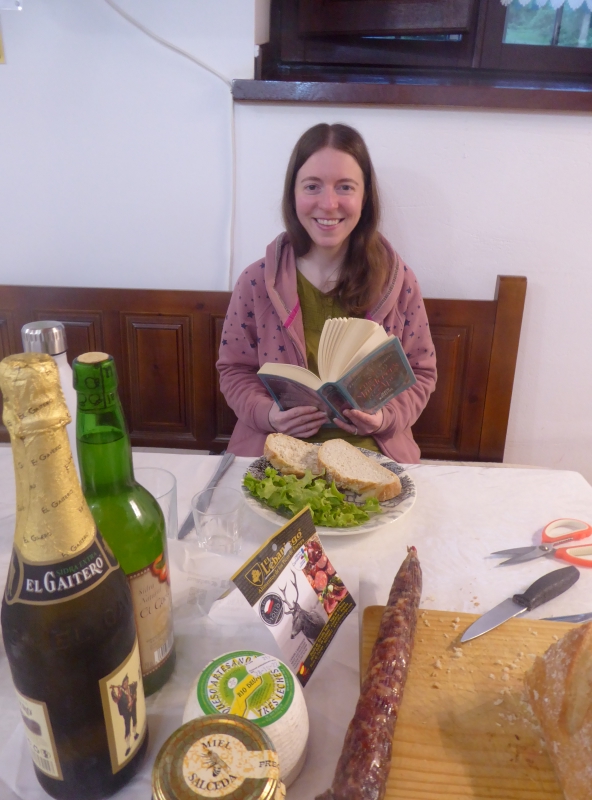
Sampling local products and reading The Murderer’s Ape.
With our meager Spanish we just about got by. I used a phrase book so old it still referred to pesetas to figure out how to ask for roundtrip tickets, while my husband had learned a few useful restaurant-going phrases from the Duolingo language-learning app. For communicating with the cottage owner, though, we had to resort to Google Translate.
A highlight of our trip was the Fuente Dé cable car to 1900 meters / ~6200 feet above sea level, where we found snowbanks, Alpine choughs, and trumpet gentians. That was a popular spot, but on most of our other walks we didn’t see another human soul. We felt we’d found the real, hidden Spain, with a new and fascinating landscape around every corner. We didn’t make it to any prehistoric caves, alas – we would probably have had to book that well in advance – but otherwise experienced a lot of the highlights of the area.


On our way back to Santander for the ferry, we stopped in two famous towns: Comillas, known for its modernist architecture and a palace designed by Gaudí; and Santillana del Mar, which Jean-Paul Sartre once called the most beautiful town in Spain. We did not manage any city visits – Barcelona was too far and there was no train service; that will have to be for another trip. It was a very low-key, wildlife-filled and relaxing time, just what we needed before plunging back into work and DIY.
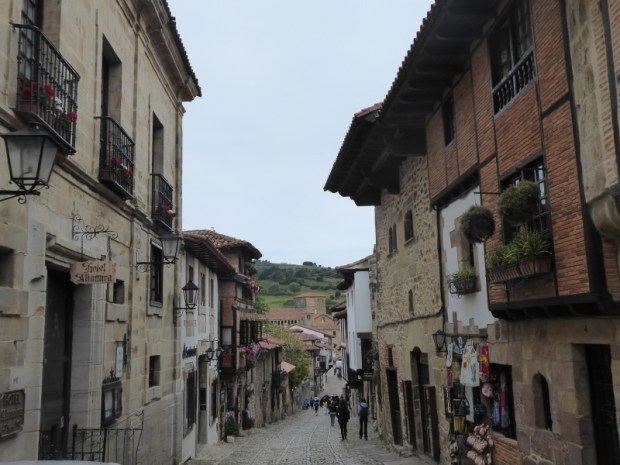
Santillana del Mar
What I Read
On the journey there and in the early part of the trip:
 The Murderer’s Ape by Jakob Wegelius (translated from the Swedish by Peter Graves): Sally Jones is a ship’s engineer who journeys from Portugal to India to clear her captain’s name when he is accused of murder. She’s also a gorilla. Though she can’t speak, she understands human language and communicates via gestures and simple written words. This was the perfect rip-roaring adventure story to read at sea; the twisty plot and larger-than-life characters who aid or betray Sally Jones kept the nearly 600 pages turning quickly. I especially loved her time repairing accordions with an instrument maker. This is set in the 1920s or 30s, I suppose, with early airplanes and maharajahs, but still long-distance sea voyages. Published by Pushkin Children’s, it’s technically a teen novel and the middle book in a trilogy, but neither fact bothered me at all.
& to see me through the rest of the week:
The Feast by Margaret Kennedy: Originally published in 1950, this was reissued by Faber in 2021 with a foreword by Cathy Rentzenbrink – had she not made much of it, I’m not sure how well I would have recognized the allegorical framework of the Seven Deadly Sins. In August 1947, we learn, a Cornish hotel was buried under a fallen cliff, and with it seven people. Kennedy rewinds a month to let us watch the guests arriving, and to plumb their interactions and private thoughts. We have everyone from a Lady to a lady’s maid; I particularly liked the neglected Cove children. It took me until the very end to work out precisely who died and which sin each one represented. The characters and dialogue glisten. This is intelligent, literary yet light, and so makes great vacation/beach reading. 

 Book of Days by Phoebe Power: A set of autobiographical poems about walking the Camino pilgrimage route. Power writes about the rigours of the road – what she carried in her pack; finding places to stay and food to eat – but also gives tender pen portraits of her fellow walkers, who have come from many countries and for a variety of reasons: to escape an empty nest, to make amends, to remember a departed lover. Whether the pilgrim is religious or not, the Camino seems like a compulsion. Often the text feels more like narrative prose, though there are some sections laid out in stanzas or forming shapes on the page to remind you it is verse. I think what I mean to say is, it doesn’t feel that it was essential for this to be poetry. Short vignettes in a diary may have been more to my taste.
Two favourite passages:
into cobbled elegance; it’s opening time for shops
selling vegetables and pan and gratefully I present my
Spanish and warmth so far collected, and receive in return
smiles, interest, tomatoes, cheese.
We are resolute, though unknowing
if we will succeed at this.
We are still children here –
arriving, not yet grown
up.
With thanks to Carcanet Press for the free copy for review.
 I’d also downloaded from Edelweiss the recent travel memoir The Way of the Wild Goose by Beebe Bahrami, in which she walks sections of the Camino in France and Spain and reflects on why the path keeps drawing her back. It’s been a probing, beautiful read so far – I think this is the mild, generically spiritual quest feel Jini Reddy was trying to achieve with Wanderland.
Plus, I read a few e-books for paid reviews and parts of other library books, including a trio of Spain-appropriate memoirs: As I Walked Out One Midsummer Morning by Laurie Lee, Homage to Catalonia by George Orwell, and A Parrot in the Pepper Tree by Chris Stewart – more about this last one in my first 20 Books of Summer post, coming up on Sunday.
Our next holiday, to the Outer Hebrides of Scotland, is just two weeks away! It’ll be very different, but no doubt equally welcome and book-stuffed.
To Paradise by Hanya Yanagihara (Doorstopper of the Quarter)
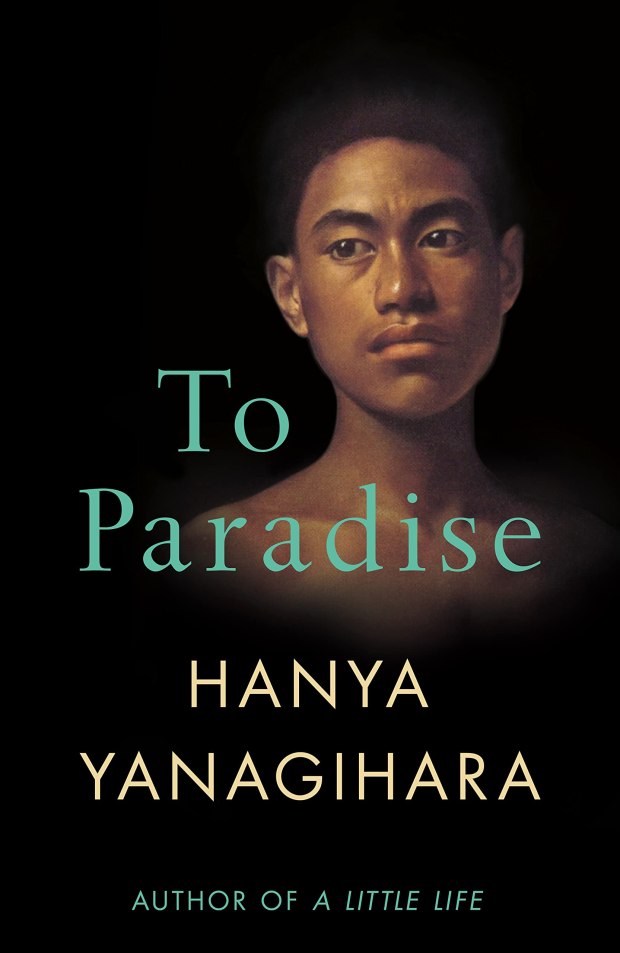
When I expressed interest in Hanya Yanagihara’s To Paradise on Twitter, having loved A Little Life and tepidly admired The People in the Trees, I didn’t expect to be chosen to receive one of my most anticipated releases of the year. A proof arrived while I was in the States for Christmas. As soon as I got back, I started it – with a vision of doing little else but reading it for a few days and reviewing it early in January. Instead, I read about 30 pages and set it aside, the 700-page heft mocking me from my coffee table stack for the better part of two months. Finally, I forced myself to set a daily reading goal: first 30 pages, then 40, then 60; and on Friday I read the last 100 pages over a couple sessions in the summerhouse. That regimented approach was what it took for me to get through my first doorstopper of the year.
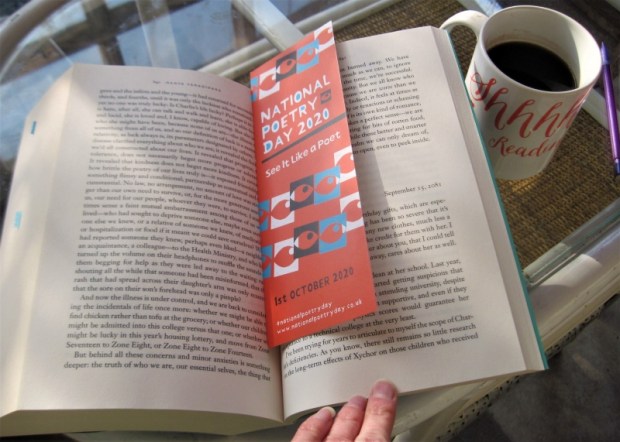
The novel is in three parts – discrete enough to feel like separate books – set largely in 1893, 1993, and 2093. New York City’s Washington Square, even one particular house, recurs as a setting in all three, with some references to the American West and South and with flashbacks to time in Hawaii linking Books II and III.
The overarching theme is the American project: is freedom, both individual and collective, a worthy and attainable goal? Or are the country’s schisms too deep to be overcome? Class, race, sexuality, and physical and mental illness are some of the differences that Yanagihara explores. Even when equality of treatment has been won in one time and scenario – same-sex marriage is de rigueur in her alternative version of the 1890s, where the USA is divided into several nations – there is always the threat of a taken-for-granted right being retracted.
In Book I, David Bingham, who is to inherit his grandfather’s Washington Square property, considers a family-approved arranged marriage with an older man, Charles, versus eloping with a lower-class male teacher, Edward, with whom he has fallen in love. Edward wants them to light out for California, where new opportunities await but homosexuality is outlawed. Can they live in freedom if they’re repressing an essential part of their identity? The austere, elegant tone is a pitch-perfect pastiche of Henry James or Edith Wharton. Although this section took me the longest to read, it was the one I most appreciated for its flawless evocation of the time period and a rigid class structure. As in The Underground Railroad, though, the alt-history angle wasn’t really the most memorable aspect.
In Book II, David Bingham, also known as Kawika, is a paralegal having a secret affair with Charles, a partner in his law firm. Various friends and former lovers in their circle have AIDS, but Charles’s best friend Peter is dying of cancer. Before Peter flies to Switzerland for an assisted death, Charles throws him one last dinner party. Meanwhile, David receives a long letter from his ill father recounting their descent from Indigenous nobility and his failed attempt to set up a self-sufficient farm on their inherited land in Hawaii. This strand is closest to Yanagihara’s previous novels, the gay friendship circle reminiscent of A Little Life and the primitive back-to-the-land story recalling The People in the Trees. I also thought of Mrs Dalloway – David wanted to get the flowers for the party himself – and of Three Junes.
 Book III is set in a dystopian future of extreme heat, rationing and near-constant pandemics. The totalitarian state institutes ever more draconian policies, with censorship, quarantine camps and public execution of insurgents. The narrator, intellectually disabled after a childhood illness, describes the restrictions with the flat affect of the title robot from Kazuo Ishiguro’s Klara and the Sun. When a stranger offers her the chance to escape, she is forced to weigh up freedom against safety. An alternating strand, based around letters sent by a Chinese Hawaiian character, traces how things got this bad, from the 2040s onwards.
While the closing speculative vision is all too plausible, two other literary/science fiction releases I’ve read this year, Sea of Tranquillity by Emily St. John Mandel and How High We Go in the Dark by Sequoia Nagamatsu, are more powerful and direct. Book III takes up half of the text and could stand alone, but the fact that it appears as a culmination of two other narratives creates false expectations that it can’t meet. The connections between the three are incidental – abandonment by a mother, a child raised by a grandparent, an arranged marriage, isolating illness – with recurring tactics like stories within stories and epistolary sections. The most overt cohesive strategy, the repeating of names across time periods, feels gimmicky and, again, sets readers up for a letdown by promising meaning that isn’t there.
Ultimately, the message seems to be: America’s problems are inherent, and so persist despite apparent progress. It takes a lot of words to build to that somewhat obvious point. I couldn’t suppress my disappointment that none of the storylines are resolved – this does, however, mean that one can choose to believe things will turn out happily for the characters. Their yearning for a more authentic life, even in a rotten state, makes it easy to empathize with their situations. I had high regard for the self-assured cross-genre prose (my interest waning only during the elder Kawika’s improbably long letter), but felt the ambition perhaps outshone the achievement.
As I learned when reviewing a recent book about American utopian projects, Heaven Is a Place on Earth, and interviewing its author, Adrian Shirk, an imagined utopia and a projected dystopia aren’t actually so different. Here was her response to one of my questions:
At one point you say, “utopia is never far from its opposite.” Dystopian novels are as popular as ever. To what extent do you think real-life utopias and fictional dystopias have the same aims?
I think real-life utopian experiments and fictional dystopias both offer warnings about the dangers of relying too much on ideology, and not enough on living, or choosing the person over the belief. So, in that way, real utopian experiments and fictional dystopian narratives are two sides of the same coin: a dystopia is a utopia that lost sight of—or never included—understanding itself as resistance to a violent empire, and thus starts to look like a violent empire itself.
Both start by diagnosing a societal sickness. The question is how we then get to paradise.
Page count: 701
Book I: 
Book II:
Book III: 
My overall rating:
With thanks to Picador for the proof copy for review.
The Blind Assassin Reread for #MARM, and Other Doorstoppers
It’s the fourth annual Margaret Atwood Reading Month (#MARM), hosted by Canadian blogger extraordinaire Marcie of Buried in Print. In previous years, I’ve read Surfacing and The Edible Woman, The Robber Bride and Moral Disorder, and Wilderness Tips. This year Laila at Big Reading Life and I did a buddy reread of The Blind Assassin, which was historically my favourite Atwood novel. I’d picked up a free paperback the last time I was at The Book Thing of Baltimore. Below are some quick thoughts based on what I shared with Laila as I was reading.

The Blind Assassin (2000)
Winner of the Booker Prize and Hammett Prize; shortlisted for the Orange Prize
I must have first read this about 13 years ago. The only thing I remembered before I started my reread was that there is a science fiction book-within-the-book. I couldn’t recall anything else about the setup before I read in the blurb about the suspicious circumstances of Laura’s death in 1945. Indeed, the opening line, which deserves to be famous, is “Ten days after the war ended, my sister Laura drove a car off a bridge.”
I always love novels about sisters, and Iris is a terrific narrator. Now a cantankerous elderly woman, she takes us back through her family history: her father’s button factory and his clashes with organizing workers, her mother’s early death, and her enduring relationship with their housekeeper, Reenie. Iris and Laura met a young man named Alex Thomas, a war orphan with radical views, at the factory’s Labour Day picnic, and it was clear early on that Laura was smitten, while Iris went on to marry Richard Griffen, a nouveau riche industrialist.

Interspersed with Iris’s recollections are newspaper articles that give a sense that the Chase family might be cursed, and excerpts from The Blind Assassin, Laura’s posthumously published novel. Daring for its time in terms of both explicit content and literary form (e.g., no speech marks), it has a storyline rather similar to 1984, with an upper-crust woman having trysts with a working-class man in his squalid lodgings. During their time snatched together, he also tells her a story inspired by the pulp sci-fi of the time. I was less engaged by the story-within-the-story(-within-the-story) this time around compared to Iris’s current life and flashbacks.
In the back of my mind, I had a vague notion that there was a twist coming, and in my impatience to see if I was right I ended up skimming much of the second half of the novel. My hunch was proven correct, but I was disappointed with myself that I wasn’t able to enjoy the journey more a second time around. Overall, this didn’t wow me on a reread, but then again, I am less dazzled by literary “tricks” these days. At the sentence level, however, the writing was fantastic, including descriptions of places, seasons and characters’ psychology. It’s intriguing to think about whether we can ever truly know Laura given Iris’s guardianship of her literary legacy.
If you haven’t read this before, find a time when you can give it your full attention and sink right in. It’s so wise on family secrets and the workings of memory and celebrity, and the weaving in of storylines in preparation for the big reveal is masterful.
Some favourite passages:
“What fabrications they are, mothers. Scarecrows, wax dolls for us to stick pins into, crude diagrams. We deny them an existence of their own, we make them up to suit ourselves – our own hungers, our own wishes, our own deficiencies.”
“Beginnings are sudden, but also insidious. They creep up on you sideways, they keep to the shadows, they lurk unrecognized. Then, later, they spring.”
“The only way you can write the truth is to assume that what you set down will never be read. Not by any other person, and not even by yourself at some later date. Otherwise you begin excusing yourself. You must see the writing as emerging like a long scroll of ink from the index finger of your right hand; you must see your left hand erasing it. Impossible, of course.”
My original rating (c. 2008):
My rating now:
What to read for #MARM next year, I wonder??
In general, I have been struggling mightily with doorstoppers this year. I just don’t seem to have the necessary concentration, so Novellas in November has been a boon. I’ve been battling with Ruth Ozeki’s latest novel for months, and another attempted buddy read of 460 pages has also gone by the wayside. I’ll write a bit more on this for #LoveYourLibrary on Monday, including a couple of recent DNFs. The Blind Assassin was only my third successful doorstopper of the year so far. After The Absolute Book, the other one was:
The Lincoln Highway by Amor Towles
 In Towles’ third novel – a big, old-fashioned dose of Americana – brothers and pals set out from Nebraska on road and rail adventures to find a fortune in 1950s New York. The book features some fantastic characters. Precocious Billy steals every scene he appears in. Duchess is a delightfully flamboyant bounder, peppering his speech with malapropisms and Shakespeare quotes. However, Emmett is a dull protagonist, and it’s disappointing that Sally, one of just two main female characters, plays such a minor role. A danger with an episodic narrative is that random events and encounters pile up but don’t do much to further the plot. At nearly 200 pages in, I realized little of consequence had happened yet. A long road, then, with some ups and downs along the way, but Towles’ fans will certainly want to sign up for the ride.
See my full review for BookBrowse; see also my related article on Studebaker cars.
With thanks to Hutchinson for the free copy for review.
Anything by Atwood, or any doorstoppers, on your pile recently?
Doorstopper of the Month: The Absolute Book by Elizabeth Knox (2019)
Epic fantasy is far from my usual fare, but this was a book worth getting lost in. The reading experience reminded me of what I had with A Discovery of Witches by Deborah Harkness, The Wind-Up Bird Chronicle by Haruki Murakami, or perhaps Jonathan Strange & Mr. Norrell by Susanna Clarke – though it’s possible this last association was only in my mind because of Dan Kois. You see, we have Kois, an editor at Slate, to thank for this novel being published outside of Knox’s native New Zealand. He wrote an enthusiastic Slate review of an amazing novel he’d found that was only available through a small university press, and Clarke’s novel was his main point of reference. How’s that for the power of a book review?
Taryn Cornick, 33, has adapted her PhD thesis into a popular history of libraries – the search for absolute knowledge; the perennial threats that libraries face, from budget cuts to burnings – that she’s been discussing at literary festivals around the world. One particular burning looms large in her family’s history: the library at her grandfather’s country estate near the border of England and Wales, Princes Gate. As girls, Taryn and her older sister, Beatrice, helped to raise the alarm and saved the bulk of their grandfather’s collection. But one key artifact has been missing ever since: the Firestarter, an ancient scroll box that is said to have been through five fires and will survive another arson attempt before the book is through.

Nearly 15 years ago now, Beatrice was the victim of a random act of violence. Soon after her killer was released from prison, he turned up dead in unusual circumstances. Ever since, Detective Inspector Jacob Berger has suspected that Taryn arranged a revenge killing, but he has no proof. His cold case heats back up when Taryn lands in the hospital and complains of a series of prank calls.
What ensues is complicated, but in essence, the ongoing fallout of Beatrice’s murder and a cosmic battle over the Firestarter are twin forces that plunge Taryn and Jacob into the faerie realm (Sidh). Their guide to the Sidh is Shift, a shapeshifter who can create impromptu gates between the two worlds (while others, like Princes Gate, are permanent passageways).
Fairies (sidhe), demons, talking ravens … there’s some convoluted world-building here, and when I reached the end I realized I still had many ‘how’ and ‘why’ questions, though often this was because I hadn’t paid close enough attention and if I glanced back I’d see that Knox did indeed tell us how characters got from A to B, and who was after the Firestarter and why.
The book travels everywhere from Provence to Purgatory, but I particularly liked the descriptions of the primitive lifestyle in the faerie realm. Knox gives enough detail about things like food and clothing that you can really imagine yourself into each setting, and there’s the occasional funny turn of phrase that inserts the magical into everyday life in a tongue-in-cheek way, like “The Nespresso [machine] made hatching-dragon sounds.”
My two favorite scenes were an intense escape from a marsh and one that delightfully blends the human world and faerie: Taryn’s father, Basil Cornick, is a Kiwi actor best known for his role in a Game of Thrones-style television show. He’s roped into what he thinks is a screen test, playing Odin opposite a very convincing animatronic monster and pair of talking birds. We and Taryn know what he doesn’t: that he was used to negotiate with a real demon. The terrific epilogue also offers an appealing vision of how the sidhe might save the world.
If, like me, all you know of Knox’s previous work is the bizarre and kind of awful The Vintner’s Luck (which I read for a book club a decade or so ago), you’ll be intrigued to learn that angels play a role here, too. But beneath all the magical stuff, which is sometimes hard to follow or believe in, the novel is a hymn to language and libraries. A number of books are mentioned, starting with the one that was in Beatrice’s backpack at the time of her death: “the blockbuster of that year, 2003, a novel about tantalising, epoch-spanning conspiracies. Beatrice enjoyed those books, perhaps because they were often set in libraries.” (That’s The Da Vinci Code, of course.) Also mentioned: Labyrinth by Kate Mosse, the Moomin books, and the film Spirited Away – no doubt these were beloved influences for Knox.
I appreciated the words about libraries’ enduring value, even on a poisoned planet. “I want there to be libraries in the future. I want today to give up being so smugly sure about what tomorrow won’t need,” Taryn says. She knows that, for this to happen, people must “care about the transmission of knowledge from generation to generation, and about keeping what isn’t immediately necessary because it might be vital one day. Or simply intriguing, or beautiful.” That’s an analogy for species, too, I think, and a reminder of our responsibility: to preserve human accomplishments, yes, but also the more-than-human world (even if that ‘more’ might not include fairies).
Page count: 626 (my only 500+-page doorstopper so far this year!)
My rating:
 Bookish Beck = Rebecca Foster. American transplant to England. Freelance proofreader and book reviewer.
 Bookish Beck