Women’s Prize Winners Reading Project: Grant, Martin, Shields et al.
In this 25th anniversary year of the Women’s Prize, readers are being encouraged to catch up on all the previous winners. I’d read 14 of them (including Hamnet) as of mid-April and have managed five more since then – plus a reread, a DNF and a skim. I recently reviewed Fugitive Pieces by Anne Michaels, and Half of a Yellow Sun by Chimamanda Ngozi Adichie and A Crime in the Neighborhood by Suzanne Berne as part of this summer reading post. This leaves just four more for me to read before voting for my all-time favorite in November.
When I Lived in Modern Times by Linda Grant (2000)
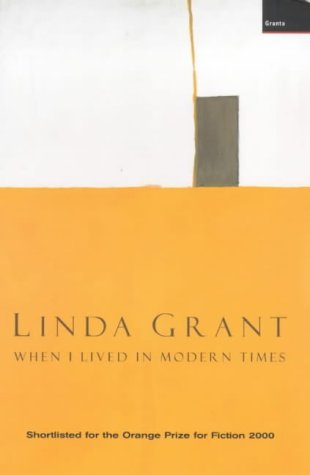 Some settings have been done to death, but here’s one I don’t think I’d ever encountered before: Israel in the final year before statehood. Grant dramatizes the contrast between Palestine, a doomed British colony, and the Jewish hope of a homeland. In 1946 twenty-year-old Evelyn Sert leaves her home in London, masquerading as a Gentile tourist (though she has Latvian Jewish ancestry) so as to jump ahead of thousands of displaced persons awaiting entry visas. With her mother recently dead of a stroke, she takes advice and money from her mother’s married boyfriend, “Uncle Joe,” a Polish Jew and Zionist, and heads to Palestine.
After six weeks on a kibbutz, Evelyn sets out to make her own life in Tel Aviv as a hairdresser and falls in with Johnny, a Jew who fought for the British. It’s safer to be part of the colonial structure here, so she once again passes as Gentile, dyeing her hair blonde and going by Priscilla Jones. In a land where all kinds of people have been thrown together by the accident of their ethnicity and the suffering it often entailed, one man’s terrorist is another’s freedom fighter. For Evelyn, who’s never known anywhere apart from suburban London and arrived in Palestine a virgin, the entire year is a journey of discovery. Will a place of ancient religious significance embrace modern architecture, technology and government? Grant really captures this period of transition for an individual and for a nascent nation of exiles. I loved the supporting characters and the nostalgic look back from half a century on. 
Favorite passages:
In a country with its face turned towards the future, our stories sat on our shoulders like a second head, facing the way we had come from. We were the tribe of Janus, if there is such a thing.
With hindsight it always seems easy to do the right thing, but we were trying to decide something in those days that people don’t often get a chance to have a say in and it was this: would we be a free nation after two thousand years of wandering or would we always be a subject race? Would we be ghetto Jews or new Jews?
Property by Valerie Martin (2003)
 A compact study of slavery that unfolds through the relationship between a New Orleans plantation owner’s wife and her husband’s mistress. Manon Gaudet has never been happy in her marriage, but when their slave girl, Sarah, bears her husband a second child, she decides she has had enough of silently condoning his behavior. A slave uprising and cholera and yellow fever outbreaks provide some welcome drama, but the bulk of this short novel is an examination of the psyche of a woman tormented by hatred and jealousy. Ownership of another human being is, if not technically impossible, certainly not emotionally tenable. Manon’s situation is also intolerable because she has no rights as a woman in the early nineteenth century: any property she inherits will pass directly to her husband. Though thoroughly readable, for me this didn’t really add anything to the corpus of slavery fiction.
A reread (as well as a buddy read with Buried in Print):
Larry’s Party by Carol Shields (1997)
“The whole thing about mazes is that they make perfect sense only when you look down on them from above.”
 Larry Weller is an Everyman: sometimes hapless and sometimes purposeful; often bewildered with where life has led him, but happy enough nonetheless. From the start, Shields dwells on the role that “mistakes” have played in making Larry who he is, like a floral arts catalogue coming in the mail from the college instead of one on furnace repair and meeting Dorrie at a Halloween party he attended with a different girl. Before he knows it he and a pregnant Dorrie are getting married and he’s been at his flower shop job for 12 years. A honeymoon tour through England takes in the Hampton Court Palace maze and sparks an obsession that will change the course of Larry’s life, as he creates his first maze at their Winnipeg home and gradually becomes one of a handful of expert maze-makers.
The sweep of Larry’s life, from youth to middle age, is presented roughly chronologically through chapters that are more like linked short stories: they focus on themes (family, friends, career, sex, clothing, health) and loop back to events to add more detail and new insight. I found the repetition of basic information about Larry somewhat off-putting in that it’s as if we start over with this character with each chapter – the same might be said of Olive Kitteridge, but that book’s composition was drawn out and it involves a multiplicity of perspectives, which explains the slight detachment from Olive. Here the third-person narration sticks close to Larry but gives glimpses into other points of view, tiny hints of other stories – a man with AIDS, a woman trying to atone for lifelong selfishness, and so on.
From my first reading I remembered a climactic event involving the Winnipeg maze; a ribald chapter entitled “Larry’s Penis,” about his second marriage to a younger woman and more; and the closing dinner party, a masterful sequence composed almost entirely of overlapping dialogue (like the final wedding reception scene in her earlier novel, The Box Garden) as Larry hosts his two ex-wives, his current girlfriend, his sister and his partner, and a colleague and boss. What is it like to be a man today? someone asks, and through the responses Shields suggests a state of uneasiness, of walking on eggshells and trying not to be a chauvinist in a world whose boundaries are being redrawn by feminism. That process has continued in the decades since, though with predictable backlash from those who consider women a threat.
It seems slightly ironic that Shields won the Women’s Prize for this episodic fictional biography of a man, but I found so much to relate to in Larry’s story – the “how did I get here?” self-questioning, the search for life’s meaning, “the clutter of good luck and bad” – that I’d say Larry is really all of us.
One of Shields’s best, and quite possibly my winner of winners.
My original rating (2008?):
My rating now: 
Currently rereading: Gilead by Marilynne Robinson
A skim:
A Spell of Winter by Helen Dunmore (1995)
 An annoying thing happened with this one: the back cover blurb gave away a central theme. It’s one I’m keen to avoid yet feel I have encountered disproportionately often in fiction, especially recently (I won’t name any titles as that would give it away instantly). Dunmore writes nicely – from my quick skim of this one it seemed very atmospheric – but I am not particularly drawn to her plots. I’ve read Exposure for book club and own two more of her novels, Talking to the Dead and Zennor in Darkness, so by the time I’ve read those I will have given her a solid try. So far I’ve preferred her poetry – I’ve read three of her collections.
A favorite passage:
“It is winter in the house. This morning the ice on my basin of water is so thick I can not break it. The windows stare back at me, blind with frost. … I can see nothing through the frost flowers on the glass. I wonder if it is snowing yet, but I think it is too cold. … I look at the house, still and breathless in the frost. I have got what I wanted. A spell of winter hangs over it, and everyone has gone.”
And a DNF:
The Song of Achilles by Madeline Miller (2011)
 Patroclus is a disappointment of a prince. He has no chance of winning Helen of Troy’s hand in marriage, and exile awaits him when he is responsible for an accidental death. As a foster child in the household of another king, he becomes obsessed with Achilles. The two young men take part in music lessons and military training, and Patroclus follows Achilles away from the palace to be taught by a centaur. That’s as far as I got before I couldn’t bear any more. The homoerotic hints are laughably unsubtle: (of a lyre) “‘You can hold it, if you like.’ The wood would be smooth and known as my own skin” & (fighting) “he rolled me beneath him, pinning me, his knees in my belly. I panted, angry but strangely satisfied.”
I got a free download from Emerald Street, the Stylist magazine e-newsletter. The ancient world, and Greek mythology in particular, do not draw me in the least, and I have had bad experiences with updates of Greek myths before (e.g. Bright Air Black by David Vann). I never thought this would be a book for me, but still wanted to attempt it so I could complete the set of Women’s Prize winners. I read 77 pages out of 278 in the e-book, but when I have to force myself to pick up a book, I know it’s a lost cause. As with the Dunmore, I think it’s safe to say this one never would have gotten my vote anyway.
The final four to complete my project:
(On the stack to read soon)
The Idea of Perfection by Kate Grenville – free from mall bookshop
The Glorious Heresies by Lisa McInerney – public library copy
How to Be Both by Ali Smith – public library copy; a planned buddy read with B.I.P.
(To get from the university library)
A Girl Is a Half-formed Thing by Eimear McBride
Read any Women’s Prize winners lately?
Booker Prize 2020: Longlist Progress & Shortlist Predictions
The 2020 Booker Prize shortlist will be announced tomorrow, September 15th. Following on from my initial thoughts … I’ve only managed to read one more book from the longlist, reviewed in brief below along with some thoughts on a few other nominees I’ve sampled.
Burnt Sugar by Avni Doshi
 This short, intense novel is about two women locked into resentful competition. Tara and Antara also happen to be mother and daughter. When the long-divorced Tara shows signs of dementia, artist Antara and her American-born husband Dilip take her into their home in Pune, India. Her mother’s criticism and strange behavior stir up flashbacks to the 1980s and 1990s, when Antara felt abandoned by Tara during the four years they lived in an ashram and then her time at boarding school. Emotional turmoil led to medical manifestations like excretory issues and an eating disorder, and both women fell in love in turn with a homeless photographer named Reza Pine.
When Antara learns she is pregnant, the whole cycle of guilt and maternal ambivalence looks set to start again. Memory is precarious and full of potential hurt here, and Antara’s impassive narration is perfectly suited to the story of a toxic relationship. Neither the UK title nor the one for the original Indian publication (Girl in White Cotton) seems quite right to me; I might have chosen something related to the cover and endpaper image of the aloe plant: something that is as spiky as a cactus yet holds out hope of balm. This was a good fictional follow-up to a memoir I read earlier in the year about dementia’s effect on an Indian-American mother–daughter pair, What We Carry by Maya Shanbhag Lang.
Favorite passages:
It seems to me now that this forgetting is convenient, that she doesn’t want to remember the things she has said and done. It feels unfair that she can put away the past from her mind while I’m brimming with it all the time. I fill papers, drawers, entire rooms with records, notes, thoughts, while she grows foggier with each passing day.
I will never be free of her. She’s in my marrow and I’ll never be immune.
My rating: 
My thanks to Hamish Hamilton for the free copy for review.
DNFed:
Apeirogon by Colum McCann
 Reminiscent of the work of David Grossman, this is the story of two fathers, one Israeli and one Palestinian, who lost their daughters to the ongoing conflict between their nations: Rami Elhanan’s 13-year-old daughter Smadar was killed by a Palestinian suicide bomber, while Bassam Aramin’s 10-year-old daughter Abir was shot by Israeli border police. The two men become unlikely friends through their work with a peacemaking organization, with Bassam also expanding his sense of compassion through his studies of the Holocaust.
It doesn’t take long to piece the men’s basic stories together. But the novel just keeps going. It’s in numbered vignettes ranging in length from one line to a few pages, and McCann brings in many tangentially related topics such as politics, anatomy, and religious history. Bird migration is frequently used as a metaphor. Word association means some lines feel arbitrary and throwaway. Looking ahead, I could see the numbering goes up to 500, at which point there is a long central section narrated in turn by the two main characters, and then goes back down to 1, mimicking the structure of the One Thousand and One Nights, mentioned in #101.
The narrative sags under the challenge McCann has set for himself. At 200 pages, this might have been a masterpiece. Though still powerful, it sprawls into repetition and pretension. (I read the first 150 pages.)
My rating:
Set aside temporarily:
 The New Wilderness by Diane Cook: The blurb promised an interesting mother–daughter relationship, but so far this is dystopia by numbers. A wilderness living experiment started with 20 volunteers, but illnesses and accidents have reduced their number. Bea was an interior decorator and her partner, Glen, a professor of anthropology – their packing list and habits echo primitive human culture. I loved the rituals around a porcelain teacup, but in general the plot and characters weren’t promising. I read Part I (47 pages) and would only resume if this makes the shortlist, which seems unlikely. (See this extraordinarily detailed 1-star Goodreads review from someone who DNFed the novel near where I am now.)
 Shuggie Bain by Douglas Stuart: Dialect + depressing subject matter = a hard slog. Poverty and alcoholism make life in 1980s Glasgow a grim prospect for Agnes Bain and her three children. So far, the novel is sticking with the parents and the older children, with the title character barely getting a mention. I did love the scene where Catherine goes to Leek’s den in the pallet factory. This is a lot like the account Damian Barr gives of his childhood in Maggie & Me. I left off on page 82 but will go back to this if it makes the shortlist.
So that makes a total of 2 read, 4 DNFed, 2 set aside (and might yet DNF), 2 I still hope to read (one of which I’m awaiting from the library; the other is on my birthday wish list), and 3 I don’t intend to read. Not a great showing at all this year!
Still, I can never resist an opportunity to make predictions about a prize shortlist, so here’s what I expect to still be in the running after tomorrow. Weighty, diverse; a mixture of historical and contemporary.
- The Mirror & The Light by Hilary Mantel (will win)
- Apeirogon by Colum McCann
- The Shadow King by Maaza Mengiste
- Shuggie Bain by Douglas Stuart
- Real Life by Brandon Taylor
- How Much of These Hills Is Gold by C. Pam Zhang
What have you read from the longlist? What do you expect to be shortlisted?
Short Stories in September, Part I
Each September I make a bit more of an effort to read short stories, which otherwise tend to sit on my shelves and Kindle unread. I’ve read three collections recently, all of them released this August or September, and I have a few more on the go to report on later in the month.
Likes by Sarah Shun-Lien Bynum
 This was a hit and miss collection for me: I only loved one of the stories, and enjoyed another three; touches of magic realism à la Aimee Bender produce the two weakest stories, and there are a few that simply tail off without having made a point. My favorite was “Many a Little Makes,” about a trio of childhood best friends whose silly sleepover days come to an end as they develop separate interests and one girl sleeps with another one’s brother. In “Tell Me My Name,” set in a post-economic collapse California, an actress who was a gay icon back in New York City pitches a TV show to the narrator’s wife, who makes kids’ shows.
“Julia and Sunny,” about two couples – one that makes it and one that doesn’t – who all met in medical school, reminded me of a Wallace Stegner plot. “The Bears” has a wispy resemblance to Goldilocks and the Three Bears and stars a woman convalescing from a miscarriage at a retreat center while writing a chapter on William James. In James’s famous metaphor involving a bear, bodily action precedes emotion – we are afraid because we flee; not vice versa. The touch of magic in this story is light enough to not be off-putting, whereas “The Erlking” and “The Young Wife’s Tale” take their fairy tale similarities too far.
The title story, about a father trying to understand his 12-year-old through her Instagram posts either side of the Trump election, is promising but doesn’t go anywhere, and “The Burglar” and “Bedtime Story” struck me as equally insubstantial, making nothing of their setups. Seven of these nine stories had been previously published in other publications in some form.
My rating:
Published in the USA by Farrar, Straus and Giroux. I read an advanced e-copy via Edelweiss.
Black Light by Kimberly King Parsons
 Parsons’s debut collection, longlisted for the U.S. National Book Award in 2019, contains a dozen gritty stories set in or remembering her native Texas. Eleven of the 12 are in the first person, with the mostly female narrators unnamed or underdeveloped and thus difficult to differentiate from each other. The homogeneity of voice and recurring themes – drug use, dysfunctional families, overweight bodies, lesbian or lopsided relationships – lead to monotony.
“Glow Hunter” and “We Don’t Come Natural to It” are representative: in the former, Sarah and her girlfriend Bo have sex and go for a drive while tripping on magic mushrooms; in the latter, the narrator has a crush on her co-worker Suki, who has lost 200 pounds, and they remain obsessed with their and others’ fat bodies (the references are inescapable: “a pudgy,” “the fatty,” “some cow,” “thinspiration”). The opening story, “Guts,” is uncomfortable for the way that it both fetishizes fat and medicalizes sex: when unreliable, alcoholic receptionist Sheila turns up at her boyfriend Tim’s hospital saying there’s something wrong with her internally, he performs an examination that’s part striptease and part children playing doctor.
“The Light Will Pour In” is refreshingly different for its Lolita-type situation. “Into the Fold,” set at a girls’ boarding school, reminded me of Scarlett Thomas’s Oligarchy. In “Fiddlebacks,” my favorite, siblings on a night hunt for creepy-crawlies come across their newly religious mother and the handyman trysting in a car. “Starlite,” the only one in the third person, has colleagues, one a supervisor and both married, meet up in a seedy motel for drugs and junk food. The shortest stories at just a few pages each, “In Our Circle” and “The Animal Part” animate art therapy in a mental hospital and urban legends told while camping (though I’d forgotten it, I’d encountered the former in The Best Small Fictions 2017).
These stories engaged me at neither the sentence level nor the plot level, but many readers (and critics) have felt otherwise. Here are two lines I liked, from “Glow Hunter”: “Bo says everything that scares you is something to poke at with a stick, to pick up and turn in your hands” & “I’m very aware that we are organisms on the surface of a rock, orbiting a burning star.”
My rating: 
My thanks to Atlantic Books for the free copy for review.
You Will Never Be Forgotten by Mary South
“In the modern world, you might be easily forgotten, but you could also carve out your own niche.”

In the 10 stories of this debut collection, characters turn to technology to stake a claim on originality, compensate for their losses, and leave a legacy. In “Keith Prime,” a widowed nurse works at a warehouse that produces unconscious specimens for organ harvesting. When her favorite Keith wakes up, she agrees to raise him at home, but human development and emotional connection are inconveniences in a commodity. The narrator of “FAQs about Your Craniotomy” is a female brain surgeon who starts out by giving literal answers to potential patient questions and then segues into bitterly funny reflections on life after her husband’s suicide.
In “Architecture for Monsters,” a young woman interviews Helen Dannenforth, a formidable female architect whose designs are inspired by anatomy, specifically by her disabled daughter’s condition. The narrator’s mother, a molecular biologist, was assaulted and murdered by a lab technician. Dannenforth is a hero/replacement mother figure to her, even after she learns about the complicated situation with the architect’s sister, who was the surrogate for her niece but then got cut out of the child’s life.
I particularly liked “The Age of Love,” a funny one in which the nurses at a nursing home listen in to their elderly patients’ calls to phone sex lines. Their conversations aren’t about smut so much as they’re about loneliness and nostalgia. Another favorite of mine was “Camp Jabberwocky for Recovering Internet Trolls,” about a Martha’s Vineyard camp for teens who need a better relationship with social media. When camper Rex Hasselbach, who had posted foul content in his father’s name to get revenge on being beaten up at home, goes missing, three counselors with guilt or identity issues of their own go looking for him. The title story also engages with social media as a woman obsessively tracks her rapist and works as a “digital media curator” deleting distressing video content.
All of the characters have had a bereavement or other traumatic incident and are looking for the best way to move on, but some make bizarre and unhealthy decisions – such as to restage events from a dead daughter’s life, to breastfeed grown men, or to communicate by text with a deceased wife. These quirky, humorous stories never strayed so far into science fiction as to alienate me. I loved the medical themes and the subtle, incisive observations about a technology-obsessed culture. I’ll be looking out for what Mary South does next.
(Note: The cover image is a creepily pixelated version of the author’s photo.)
My rating: 
My thanks to Picador for the proof copy for review.
Are you a short story fan? Read any good ones recently?
Library Checkout, August 2020 & #WITMonth 2020, Part II
I’ve been volunteering at my local library twice a week since the start of the month, shelving and picking books off the shelves to fulfill reservations. Every time I’m there I spot more titles to add to my online wish list. It’s been a convenient excuse to return and pick up books, including book group sets. I was first in the queue for some brand-new releases this month.

Have you been able to borrow more books lately? Feel free to use the image above and leave a link to your blog in the comments if you’ve taken part in Library Checkout (which runs on the last Monday of every month), or tag me on Twitter and/or Instagram (@bookishbeck / #TheLibraryCheckout).
READ
- Queenie by Candice Carty-Williams
- Addition by Toni Jordan [book club choice]
- Kim Jiyoung, Born 1982 by Cho Nam-Joo (reviewed below)
SKIMMED
- Dark, Salt, Clear: Life in a Cornish Fishing Town by Lamorna Ash

- The Butterfly Isles: A Summer in Search of Our Emperors and Admirals by Patrick Barkham
- Water Ways: A Thousand Miles along Britain’s Canals by Jasper Winn
CURRENTLY READING
- Close to Where the Heart Gives Out: A Year in the Life of an Orkney Doctor by Malcolm Alexander
- A Traveller at the Gates of Wisdom by John Boyne
- Exciting Times by Naoise Dolan
- Maid: Hard Work, Low Pay, and a Mother’s Will to Survive by Stephanie Land

CURRENTLY SKIMMING
- Can You Hear Me? A Paramedic’s Encounters with Life and Death by Jake Jones
- Dear NHS: 100 Stories to Say Thank You, edited by Adam Kay
CHECKED OUT, TO BE READ
- The Girl with the Louding Voice by Abi Daré
- What Have I Done? An Honest Memoir about Surviving Postnatal Mental Illness by Laura Dockrill
- How to Be Both by Ali Smith
- Adults by Emma Jane Unsworth
- The Interestings by Meg Wolitzer
ON HOLD, TO BE PICKED UP
- Dependency by Tove Ditlevsen

IN THE RESERVATION QUEUE
- Persuasion by Jane Austen
- Piranesi by Susanna Clarke
- The Hungover Games by Sophie Heawood
- Just Like You by Nick Hornby
- 33 Meditations on Death: Notes from the Wrong End of Medicine by David Jarrett
- Sisters by Daisy Johnson
- Vesper Flights: New and Selected Essays by Helen Macdonald
- English Pastoral: An Inheritance by James Rebanks
- Such a Fun Age by Kiley Reid
- Dear Reader: The Comfort and Joy of Books by Cathy Rentzenbrink
- Jack by Marilynne Robinson
- Love and Other Thought Experiments by Sophie Ward
- The Courage to Care: A Call for Compassion by Christie Watson
- The Wild Silence by Raynor Winn
RETURNED UNFINISHED
- Apeirogon by Colum McCann – I only made it through the first 150 pages. A work that could have been very powerful if condensed instead sprawls into repetition and pretension. I still expect it to make the Booker shortlist, but not to win. I’ll add further thoughts closer to the time.
- That Reminds Me by Derek Owusu – I was expecting a memoir in verse about life in foster care; this is autofiction in dull fragments. I read the first 23 pages out of 113, waiting for it to get better.
RETURNED UNREAD
- Their Eyes Were Watching God by Zora Neale Hurston – I needed to make room for some new books on my account, so will request this at another time.
- Utopia Avenue by David Mitchell – I realized the subject matter didn’t draw me enough to read 500+ pages. So I passed it to my husband, a big Mitchell fan, and he read it happily, but mentioned that he didn’t find it compelling until about 2/3 through and he thought the combination of real-life and made-up figures (including from Mitchell’s previous oeuvre) was a bit silly.
- 1Q84 by Haruki Murakami – Again, I needed to make space on my card and was, unsurprisingly, daunted by the length of this 1,000+-page omnibus paperback. When I do try the novel, I’ll borrow it in its three separate volumes!
What appeals from my stacks?
My second choice for Women in Translation Month (after The Bitch by Pilar Quintana) was:
Kim Jiyoung, Born 1982 by Cho Nam-Joo (2016)
[Translated from the Korean by Jamie Chang]
 The title character is a sort of South Korean Everywoman whose experiences reveal the ways in which women’s lives are still constrained by that country’s patriarchal structures and traditions. She and her fellow female students and colleagues are subject to myriad microaggressions, from being served cafeteria lunches after the boys to being excluded from leadership of university clubs to having no recourse when security guards set up cameras in the female toilets at work. Jiyoung is wary of marriage and motherhood, afraid of derailing her budding marketing career, and despite her determination to do things differently she is disappointed at how much she has to give up when she has her daughter. “Her career potential and areas of interest were being limited just because she had a baby.”
The prose is flat, with statistics about women’s lives in Korea unnaturally inserted in the text. Late on we discover there’s a particular reason for the clinically detached writing, but it’s not enough to fully compensate for a dull style. I also found the translation shaky in places, e.g. “She cautiously mentioned shop sales … to the mother who’d dropped by at home to make dinner” and “Jiyoung made it home safely on her boyfriend’s back, but their relationship didn’t.” I most liked Jiyoung’s entrepreneurial mother, who occasionally shows her feisty spirit: “The porridge shop was my idea, and I bought the apartment. And the children raised themselves. Yes, you’ve made it, but you didn’t do it all by yourself,” she says to her husband. “Run wild!” she exhorts Jiyoung, but the system makes that vanishingly difficult. 
Robertson Davies Weekend 2020: The Rebel Angels
Last year for the Robertson Davies readalong, hosted annually by Lory of The Emerald City Book Review, I reviewed Fifth Business, the first volume in The Deptford Trilogy. This time I chose to read the first volume in The Cornish Trilogy, The Rebel Angels (1981). Published 11 years after Fifth Business, it shares a number of that book’s features, including a campus setting and a preoccupation with good and evil. If I can generalize about Davies from having read just two of his books, I would say that his novels engage with philosophy and the Christian tradition, and though he dives into the dark things of life his is an essentially comic vision, giving his work an attractively puckish air.
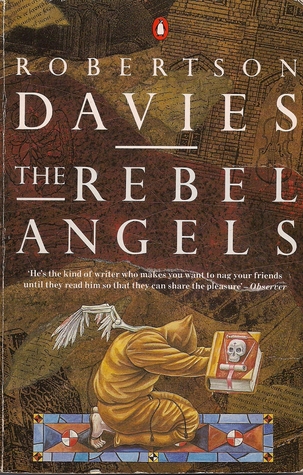 Maria Magdalena Theotoky is a 23-year-old graduate student at the College of St. John and the Holy Ghost (nicknamed “Spook”) in Toronto. She slept with her advisor, Clement Hollier, precisely once in his office last term. Two events spark the plot: the return of Brother John Parlabane, an ex-monk and -drug addict, and the death of Francis Cornish, a local patron of the arts. Parlabane becomes a university parasite, sleeping on couches and hitting up Maria, Hollier and Anglican priest Simon Darcourt for money. Along with Darcourt and Hollier, Urquhart McVarish, Hollier’s lecherous academic rival, is a third co-executor of Cornish’s artworks and manuscripts. Rumor has it the collection includes a lost manuscript by François Rabelais, the subject of Maria’s research, and Hollier and McVarish fight over it.
They also fight over Maria – no fewer than five male characters fall in love with her over the course of the novel. A sort of Helen of Troy (her first names bring to mind the presumed harlot from the Bible, while her surname means “God-bearer”), she is so beautiful that she sows conflict and heartache wherever she goes. Maria narrates about half of the novel – the other half, in alternating chapters, is by Father Darcourt, who’s writing an everyday history of the university inspired by Aubrey’s Brief Lives – and her coming to terms with her Gypsy heritage is a key element: Maria’s mother, Mamusia, is an entertaining character who tells fortunes and administers love potions, but Maria mostly finds her embarrassing.
Gypsy culture recurs in the book. So does poop. Professor Ozias Froats does research into what effect body type (endomorph, mesomorph, ectomorph) has on fecal samples. Rabelais was a notably scatological writer, and Maria’s mother repairs subpar stringed instruments by storing them in barrels of wool and horse dung. Hollier has an academic interest in medieval excrement therapies, and asks to go see Mamusia’s folk remedy in action. I found this strand very amusing, but it’s further evidence that this novel is not for the squeamish – it also includes one of the most hideous murder methods I’ve encountered in fiction, so beware.

Lucifer thrown out of heaven. Gustave Doré’s engraving for Paradise Lost (Public domain).
The title refers to angels thrown out of heaven, and is Maria’s shorthand for the trio of Darcourt, Hollier and Parlabane. Parlabane is explicitly likened to Lucifer and Satan, making him an embodiment of evil. For much of the book the homosexual hedonist seems harmless, yet he does engage in all the deadly sins. Gluttony and pride, especially: he has two enormous meals on Maria’s dime, and is determined to get his dense, pretentious autobiographical novel published by any means necessary. However, he carries the book, and I wanted even more of him. (They say Satan is the most interesting character in Paradise Lost, too.)
“To thine own self be true” is a message one might extract from the novel – phrased subtly differently in the Paracelsus quote that gives Parlabane’s novel its title, Be Not Another. Accepting all parts of oneself, even the hidden ones, prevents an inconvenient return of the repressed. Davies’s exploration of the types of human relationships, chaste versus base, suggests that true friendship is superior to sexual love. I greatly enjoy his novels of ideas and would recommend them to readers of Michael Arditti, Julian Barnes, D.H. Lawrence and Iris Murdoch. Shall I go straight on to the Booker-shortlisted What’s Bred in the Bone? I’m intrigued to see what characters and themes will carry over into the second volume.
Some favorite lines:
“The house stank; a stench all its own pervaded every corner. It was a threnody in the key of Cat minor, with a ground-bass of Old Dog, and modulations of old people, waning lives, and relinquished hopes.”
(this seems apt for Davies’s work in general) “some grotesquerie, some wrenching originality, is a necessary part of real scholarship, and brings a special glory with it.”
Source: Oxfam charity shop, Newbury
My rating:
Summery Reads, Part II: Sun and Summer Settings
Typically for the late August bank holiday, it’s turned chilly and windy here, with a fair bit of rain around. The past two weeks have felt more like autumn, but I’ve still been seeing out the season with a few summery reads.
What makes for good summer reading? I love reading with the seasons, picking up a book set during a heat wave just as the temperature is at a peak, but of course there can also be something delicious about escaping by reading about Arctic cold. Marcie of Buried in Print wrote here that she likes her summer books to offer just the right combination of the predictable and the unexpected, and that probably explains why I’m more likely to dip into genre fiction in the summer than at any other time of year. To her criteria I would also add addictiveness and a strong sense of place so as to be transporting – especially important this year when so many of us haven’t been able to have the vacations we might have planned on.
My best two summer binge reads this year were Rodham and Americanah; my two summery classics, though more subtle, were also perfect. Mostly Dead Things by Kristen Arnett, which I’m reading for a Shiny New Books review, has also felt apt for its swampy Florida setting. More recently, I picked up a couple of books with “sun” in the title, plus two novels set entirely in the course of one summer. Two of my selections are also towards my project of reading all of the Women’s Prize winners by November so I can vote on my all-time favorite.
Here comes the sun…
Half of a Yellow Sun by Chimamanda Ngozi Adichie (2006)
 Adichie filters an epic account of Nigeria’s civil war through the experience of twin sisters, Olanna and Kainene, and those closest to them. The wealthy chief’s daughters from Lagos drift apart: Olanna goes to live with Odenigbo, a math professor; Kainene is a canny businesswoman with a white lover, Richard Churchill, who is fascinated by Igbo art and plans to write a book about his experiences in Africa. Gradually, though, he realizes that the story of Biafra is not his to tell.
The novel alternates between the close third-person perspectives of Olanna, Richard and Ugwu, Odenigbo’s houseboy, and moves between the early 1960s and the late 1960s. These shifts underscore stark contrasts between village life and sophisticated cocktail parties, blithe prewar days and witnessed atrocities and starvation. Kainene runs a refugee camp, while Ugwu is conscripted into the Biafran army. Violent scenes come as if out of nowhere, as suddenly as they would have upturned real lives. A jump back in time reveals an act of betrayal by Odenigbo, and apparently simple characters like Ugwu are shown to have hidden depths.
In the endmatter of my paperback reissue, Adichie writes, “If fiction is indeed the soul of history, then I was equally committed to the fiction and the history, equally keen to be true to the spirit of the time as well as to my artistic vision of it.” Copious research must have gone into a book about events that occurred before her birth (both of her grandfathers died in the conflict), but its traces are light; this is primarily about storytelling and conveying emotional realities rather than ensuring readers grasp every detail of the Biafran War. This was my second attempt to read the novel, and while again I did not find it immediately engaging, by one-quarter through it had me gripped. I’m a firm Adichie fan now, and look forward to reading her other three new-to-me books sooner rather than later.
Orange Prize (now Women’s Prize) for Fiction winner, 2007
Source: Birthday gift from my wish list some years back
My rating:
The Shadow of the Sun: My African Life by Ryszard Kapuściński (1998)
[Translated from the Polish by Klara Glowczewska in 2001]
 Kapuściński was a foreign correspondent in Africa for 40 years and lent his name to an international prize for literary reportage. This book of essays spans several decades and lots of countries, yet feels like a cohesive narrative. The author sees many places right on the cusp of independence or in the midst of coup d’états – including Nigeria, a nice tie-in to the Adichie. Living among the people rather than removed in some white enclave, he develops a voice that is surprisingly undated and non-colonialist. While his presence as the observer is undeniable – especially when he falls ill with malaria and then tuberculosis – he lets the situation on the ground take precedence over the memoir aspect. I’m only halfway through, but I fully expect this to stand out as one of the best travel books I’ve ever read.
Evocative opening lines:
“More than anything, one is struck by the light. Light everywhere. Brightness everywhere. Everywhere, the sun.”
Source: Free bookshop
It happened one summer…
A Crime in the Neighborhood by Suzanne Berne (1997)
 Berne, something of a one-hit wonder, is not among the more respected Women’s Prize alumni – look at the writers she was up against in the shortlist and you have to marvel that she was considered worthier than Barbara Kingsolver (The Poisonwood Bible) and Toni Morrison (Paradise). However, I enjoyed this punchy tale. Marsha remembers the summer of 1972, when her father left her mother for Aunt Ada and news came of a young boy’s sexual assault and murder in the woods behind a mall. “If you hadn’t known what had happened in our neighborhood, the street would have looked like any other suburban street in America.”
Laid up with a broken ankle from falling out of a tree, 10-year-old Marsha stays out of the way of her snide older twin siblings and keeps a close eye on the street’s comings and goings. Like Harriet the Spy or Jimmy Stewart’s convalescent character in Rear Window, she vows to note anything relevant in her Book of Evidence to pass on to the police. Early on, her suspicion lands on Mr. Green, the bachelor who lives next door. Feeling abandoned by her father and underappreciated by the rest of her family, Marsha embellishes the facts to craft a more exciting story, not knowing or caring that she could ruin another person’s life.
The novel is set in Montgomery County, Maryland, where I grew up, and the descriptions of brutally humid days fit with my memory of the endless summer days of a childhood in the Washington, D.C. area. Although I usually avoid child narrators, I’ve always admired novels that can point to the dramatic irony between what a child experiences at the time and what a person can only understand about their situation when looking back. Stylish and rewarding.
Orange Prize (now Women’s Prize) for Fiction winner, 1999
Source: Free bookshop
My rating:
Modern Lovers by Emma Straub (2016)
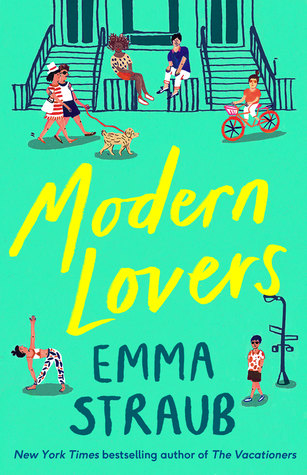 Just as the Berne is a coming-of-age story masquerading as a mystery, from the title and cover this looked like it would be chick lit, but – though it has an overall breezy tone – it’s actually pretty chewy New York City literary fiction that should please fans of The Nest and/or readers of Jennifer Egan and Ann Patchett.
Elizabeth Marx and Zoe Kahn-Bennett have been best friends ever since starting the student band Kitty’s Mustache at Oberlin. Now in their forties with a teenager each, they live half a block apart in Brooklyn. Zoe and her wife Jane run a neighborhood restaurant, Hyacinth; their daughter Ruby is dragging her feet about college and studying to retake the SAT over the summer. Elizabeth, a successful real estate agent, still keeps the musical flame alive; her husband Andrew, her college sweetheart from the band, is between jobs, not that his parents’ money isn’t enough to keep him afloat forever; their son, Harry, is in puppy love with Ruby.
Several things turn this one ordinary-seeming summer on its head. First, a biopic is being made about the Kitty’s Mustache singer turned solo star turned 27 Club member, Lydia, and the filmmaker needs the rest of the band on board – and especially for Elizabeth to okay their use of the hit song she wrote that launched Lydia’s brief career. Second, Andrew gets caught up in a new cult-like yoga studio run by a charismatic former actor. Third, the Kahn-Bennetts have marital and professional difficulties. Fourth, Harry and Ruby start sleeping together.
Short chapters flip between all the major characters’ perspectives, with Straub showing that she completely gets each one of them. The novel is about reassessing as one approaches adulthood or midlife, about reviving old dreams and shoring up flagging relationships. It’s nippy and funny and smart and sexy. I found so many lines that rang true:
Elizabeth was happy in her marriage, she really was. It was just that sometimes she thought about all the experiences she’d never gotten to have, and all the nights she’d listened to the sound of her husband’s snores, and wanted to jump out a window and go home with the first person who talked to her. Choices were easy to make until you realized how long life could be.
Andrew was always surprised by people’s ages now. When he was a teenager, anyone over the age of twenty looked like a grown-up, with boring clothes and a blurry face, only slightly more invisible than Charlie Brown’s teacher, but life had changed. Now everyone looked equally young, as if they could be twenty or thirty or even flirting with forty, and he couldn’t tell the difference. Maybe it was just that he was now staring in the opposite direction.
“I mean, it’s never too late to decide to do something else. Becoming an adult doesn’t mean that you suddenly have all the answers.”
I’ll definitely read more by Straub. I’d especially recommend picking this up if you enjoyed Writers & Lovers.
Source: Free bookshop
My rating:
What was your best summery read this year?
#17–18: Marrow & The Hundred-Foot Journey
Almost there! Today I have a family memoir about the repercussions of cancer and a novel about an Indian chef who becomes a guardian of traditional French cuisine.
Marrow: A Love Story by Elizabeth Lesser (2016)
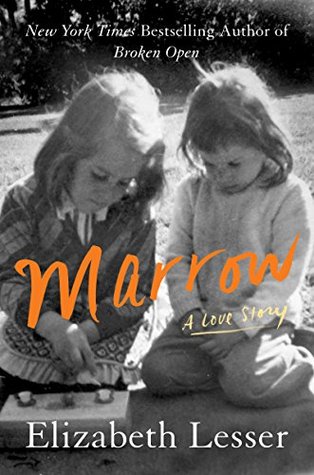 (20 Books of Summer, #17) I put this on the pile for my foodie-themed summer reading challenge because a marrow is an overgrown courgette (zucchini), but of course bone marrow is also eaten and is what is being referred to here. When they were in middle age and Lesser’s younger sister Maggie had a recurrence of her lymphoma, the author was identified as a perfect match to donate bone marrow. She charts the ups and downs of Maggie’s treatment but also goes deep into their family history: parents who rejected the supernatural in reaction to her mother’s Christian Science upbringing; a quartet of sisters who competed for love and attention; and different approaches to life – Maggie was a back-to-the-land Vermont farmer, nurse and botanical artist, while Elizabeth had bucked the trend by moving to New York City and exploring spirituality (she co-founded the Omega Institute, a holistic retreat center).
By including unedited “field notes” Maggie wrote periodically, Lesser recreates the drama and heartache of the cancer journey. She also muses a lot about attempts to repair family relationships through honest conversations and therapy. “Marrow” is not just a literal substance but also a metaphor for getting to the heart of what matters in life. I expect this memoir will be too New Age-y for many readers, but I appreciated its insights and the close sister bonds. I also loved the deckle edge and Maggie’s botanical prints on the endpapers. Recommended to fans of Elizabeth Gilbert and Anne Lamott.
Source: A clearance book from Blackwell’s in Oxford (bought on a trip with Annabel last summer)
My rating:
The Hundred-Foot Journey by Richard C. Morais (2008)
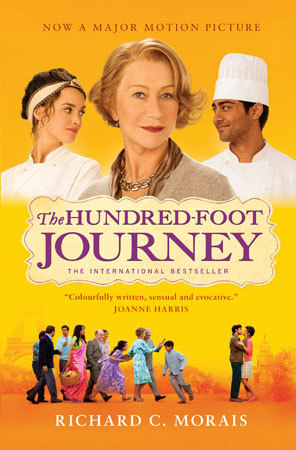 (20 Books of Summer, #18) From the acknowledgments I learned that this was written specifically to be filmed by the author’s friend Ismail Merchant; though Merchant died in 2005, it’s no surprise that it went on to become a well-received 2014 movie. I think the story probably worked better on the big screen, what with the Indian and French settings, the swirls of color and the bustle of restaurant kitchens. Still, I’d forgotten enough about the story line to enjoy the book, too.
Hassan Haji, the narrator, is born in Mumbai, one of six children of a restaurateur, and has his interest in other food cultures awakened early by a memorable French meal (a common experience in several other books I’ve reviewed this summer: Kitchen Confidential, How to Love Wine and Tender at the Bone). After his mother’s death, the extended family relocates to London and then to provincial France. Stranded in Lumière by a car breakdown, the family decides to stay, opening a curry house across from a fine dining establishment run by Gertrude Mallory. Madame Mallory engages in a battle of wills with the uncouth new arrivals. It nearly takes a tragedy for her to get over her snobbishness and xenophobia and realize Hassan has a perfect palate. She takes him on as an apprentice and he makes the title’s 100-foot journey across the street to join her staff.
The film was undoubtedly a Helen Mirren vehicle, and the Lumière material from the middle of the book holds the most interest. The remainder goes more melancholy as Hassan loses many family members and colleagues and deplores the rise of French bureaucracy and fads like molecular gastronomy. Although he eventually earns a third Michelin star for his Paris restaurant, the 40-year time span means that the warm ending somewhat loses its luster. (I can’t remember if the film went so far into the future.) A pleasant summer read nonetheless.
Source: Free from a neighbor
My rating:
August Releases: Fiction Advocate, Kingsolver Poetry, Sarah Moss & More
My five new releases for August include two critical responses to contemporary classics; two poetry books, one a debut collection from Carcanet Press and the other by an author better known for fiction; and a circadian novel by one of my favorite authors.
I start with two of the latest releases from Fiction Advocate’s “Afterwords” series. The tagline is “Essential Readings of the New Canon,” and the idea is that “acclaimed writers investigate the contemporary classics.” (I reviewed the monographs on Blood Meridian, Fun Home, and The Year of Magical Thinking in this post.)
Dear Knausgaard: Karl Ove Knausgaard’s My Struggle by Kim Adrian
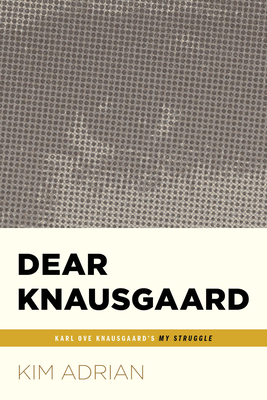 Karl Ove Knausgaard turned his pretty ordinary life into thousands of pages of autofiction that many readers have found addictive. Adrian valiantly grapples with his six-volume exploration of identity, examining the treatment of time and the dichotomies of intellect versus emotions, self versus other, and life versus fiction. She marvels at the ego that could sustain such a project, and at the seemingly rude decision to use all real names (whereas in her own family memoir she assigned aliases to most major figures). At many points she finds the character of “Karl Ove” insufferable, especially when he’s a teenager in Book 4, and the books’ prose dull. Knausgaard’s focus on male novelists and his stereotypical treatment of feminine qualities, here and in his other work, frequently madden her.
So why is My Struggle compelling nonetheless? It occupies her mind and her conversations for years. Is it something about the way that Knausgaard extracts meaning from seemingly inconsequential details? About how he stretches and compresses time in a Proustian manner to create a personal highlights reel? She frames her ambivalent musings as a series of letters written as if to Knausgaard himself (or “KOK,” as she affectionately dubs him) between February and September 2019. Cleverly, she mimics his style in both the critical enquiry and the glimpses into her own life, including all its minutiae – the weather, daily encounters, what she sees out the window and what she thinks about it all. It’s bold, playful and funny, and, all told, I enjoyed it more than Knausgaard’s own writing.
(I myself have only read Book 1, A Death in the Family, and wasn’t planning on continuing with My Struggle, but I think I will make an exception for Book 3 because of my recent fascination with childhood memoirs. I had better luck with Knausgaard’s Seasons Quartet, of which I’ve read all but Spring. I’ve reviewed Summer and Winter.)
My rating:
My thanks to Fiction Advocate for the free e-copy for review.
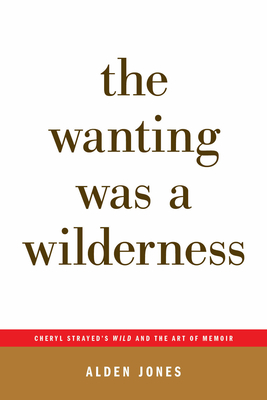
The Wanting Was a Wilderness: Cheryl Strayed’s Wild and the Art of Memoir by Alden Jones
Hiking is boring, yet Cheryl Strayed turned it into a beloved memoir. Jones explores how Wild works: how Strayed the author creates “Cheryl,” likeable despite her drug use and promiscuity; how the fixation on the boots and the backpack that carry her through her quest reflect the obsession over the loss of her mother; how the flashbacks break up the narrative and keep you guessing about whether she’ll reach her literal and emotional destinations.
 Jones also considers the precedents of wilderness literature and the 1990s memoir boom that paved the way for Wild. I most enjoyed this middle section, which, like Mary Karr’s The Art of Memoir, surveys some of the key publications from a burgeoning genre. Another key point of reference is Vivian Gornick, who draws a distinction between “the situation” (the particulars or context) and “the story” (the message) – sometimes the map or message comes first, and sometimes you only discover it as you go along.
I was a bit less interested in Jones’s reminiscences of her own three-month wilderness experience during college, when, with Outward Bound, she went to North Carolina and Mexico and hiked part of the Appalachian Trail and a volcano. This was the trip on which she faced up to her sexuality and had a short-lived relationship with a fellow camper, Melissa. But working out that she was bisexual and marrying a woman were both, as presented here, false endings. The real ending was her decision to leave her marriage – even though they had three children; even though the relationship was often fine. She attributes her courage to go, believing something better was possible, to Strayed’s work. And that’s the point of this series: rereading a contemporary classic until it becomes part of your own story.
My rating:
My thanks to Fiction Advocate for the free e-copy for review.
Two poetry releases:
Growlery by Katherine Horrex
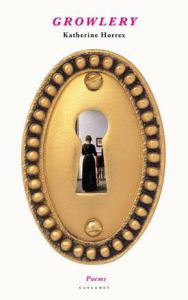 As in Red Gloves by Rebecca Watts, released by Carcanet in June, I noted the juxtaposition of natural and industrial scenes. Horrex’s “Four Muses” include a power plant and a steelworks, and she writes about pottery workers and the Manchester area, but she also explores Goat Fell on foot. Two of my favorite poems were nature-based: “Omen,” about corpse flowers, and “Wood Frog.” Alliteration, metaphors and smells are particularly effective in the former. Though I quailed at the sight of an entry called “Brexit,” it’s a subtle offering that depicts mistrust and closed minds – “People personable as tents zipped shut”. By contrast, “House of Other Tongues” revels in the variety of languages and foods in an international student dorm. A few poems circle around fertility and pregnancy. The linking themes aren’t very strong across the book, but there are a few gems.
My rating:
My thanks to Carcanet Press for the free e-copy for review.
How to Fly (in Ten Thousand Easy Lessons) by Barbara Kingsolver
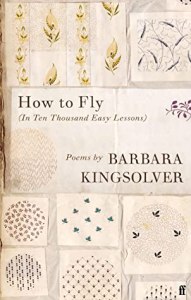 Kingsolver may not be well known for her poetry, but this is actually her second collection of verse after the bilingual Another America/Otra America (1992). The opening segment, “How to Fly,” is full of folk wisdom from nature and the body’s intuitive knowledge. “Pellegrinaggio” is a set of travel poems about accompanying her Italian mother-in-law back to her homeland. “This Is How They Come Back to Us” is composed of elegies for the family’s dead; four shorter remaining sections are inspired by knitting, literature, daily life, and concern for the environment. As with The Undying by Michel Faber, the book’s themes are stronger than its poetic techniques, but Kingsolver builds striking natural imagery and entrancing rhythms.
Two favorite passages to whet your appetite:
How to drink water when there is wine— / Once I knew all these brick-shaped things, / took them for the currency of survival. / Now I have lived long and I know better.
Tiptoe past the dogs of the apocalypse / asleep in the shade of your future. / Pay at the window. You’ll be surprised: you / can pass off hope like a bad check. You still / have time, that’s the thing. To make it good.
(To be reviewed in full, in conjunction with other recent/upcoming poetry releases, including Dearly by Margaret Atwood, for Shiny New Books.)
My rating:
I read an advanced e-copy via Edelweiss. (I’m unsure of the line breaks above because of the formatting.)
And finally, a much-anticipated release – bonus points for it having “Summer” in the title!
Summerwater by Sarah Moss
This is nearly as compact as Moss’s previous novella, Ghost Wall, yet contains a riot of voices. Set on one long day at a Scottish holiday park, it moves between the minds of 12 vacationers disappointed by the constant rain – “not that you come to Scotland expecting sun but this is a really a bit much, day after day of it, torrential” – and fed up with the loud music and partying that’s come from the Eastern Europeans’ chalet several nights this week. In the wake of Brexit, the casual xenophobia espoused by several characters is not surprising, but still sobering, and paves the way for a climactic finale that was not what I expected after some heavy foreshadowing involving a teenage girl going off to the pub through the woods.
 The day starts at 5 a.m. with Justine going for a run, despite a recent heart health scare, and spends time with retirees, an engaged couple spending most of their time in bed, a 16-year-old kayaker, a woman with dementia, and more. We see different aspects of family dynamics as we revisit a previous character’s child, spouse or sibling. I had to laugh at Milly picturing Don Draper during sex with Josh, and at Claire getting an hour to herself without the kids and having no idea what to do with it beyond clean up and make a cup of tea. Moss gets each stream-of-consciousness internal monologue just right, from a frantic mum to a sarcastic teen.
Yet I had to wonder what it all added up to; this feels like a creative writing student exercise, with the ending not worth waiting for. Cosmic/nature interludes are pretentious à la Reservoir 13. It’s not the first time this year that I’ve been disappointed by the latest from a favorite author (see also Hamnet). But my previous advice stands: If you haven’t read Sarah Moss, do so immediately.
My rating:
My thanks to Picador for the free copy for review.
What August releases can you recommend?
20 Books of Summer, #15–16: Andrew Beahrs and Elizabeth Graver
Today I have a biography-cum-cultural history of America’s wild foods and a novel about beekeeping and mental illness.
Twain’s Feast: Searching for America’s Lost Foods in the Footsteps of Samuel Clemens by Andrew Beahrs (2010)
 (20 Books of Summer, #15) In 1879, Mark Twain, partway through the Grand Tour immortalized in A Tramp Abroad, was sick of bland, poor-quality European food and hankering for down-home American cooking. He drew up a list of 80 foodstuffs he couldn’t wait to get back to: everything from soft-shell crabs to proper ice water. “The menu shouts of a joyous abundance,” Beahrs writes. “It testifies to a deep bond in Twain’s mind between eating and tasting and celebrating … rooted food that would live forever in his memory.”
Beahrs goes in search of some of those trademark dishes and explores their changes in production over the last 150 years. In some cases, the creatures and their habitats are so endangered that we don’t eat them anymore, like Illinois’ prairie chickens and Maryland’s terrapins, but he has experts show him where remnant populations live. In San Francisco Bay, he helps construct an artificial oyster reef. He meets cranberry farmers in Massachusetts and maple tree tappers in Vermont. At the Louisiana Foodservice EXPO he gorges on “fried oysters and fried shrimp and fries. I haven’t had much green, but I’ve had pecan waffles with bacon, and I’ve inserted beignets and café au lait between meals with the regularity of an Old Testament prophet chanting ‘begat.’”
But my favorite chapter was about attending a Coon Supper in Arkansas, a local tradition that has been in existence since the 1930s. Raccoons are hunted, butchered, steamed in enormous kettles, and smoked before the annual fundraising meal attended by 1000 people. Raccoon meat is greasy and its flavor sounds like an acquired taste: “a smell like nothing I’ve smelled before but which I’ll now recognize until I die (not, I hope, as a result of eating raccoon).” Beahrs has an entertaining style and inserts interesting snippets from Twain’s life story, as well as recipes from 19th-century cookbooks. There are lots of books out there about the country’s increasingly rare wild foods, but the Twain connection is novel, if niche.
Source: A remainder book from Wonder Book (Frederick, Maryland)
My rating:
The Honey Thief by Elizabeth Graver (1999)
 (20 Books of Summer, #16) Ever since I read The End of the Point (which featured in one of my Six Degrees posts), I’ve meant to try more by Graver. This was her second novel, a mother-and-daughter story that unearths the effects of mental illness on a family. Eleven-year-old Eva has developed a bad habit of shoplifting, so her mother Miriam moves them out from New York City to an upstate farmhouse for the summer. But in no time Eva, slipping away from her elderly babysitter’s supervision and riding her bike into the countryside, is stealing jars of honey from a roadside stand. She keeps going back and strikes up a friendship with the middle-aged beekeeper, Burl, whom she seems to see as a replacement for her father, Francis, who died of a heart attack when she was six.
Alternating chapters look back at how Miriam met Francis and how she gradually became aware of his bipolar disorder. This strand seems to be used to prop up Miriam’s worries about Eva (since bipolar has a genetic element); while it feels true to the experience of mental illness, it’s fairly depressing. Meanwhile, Burl doesn’t become much of a presence in his own right, so he and the beekeeping feel incidental, maybe only included because Graver kept/keeps bees herself. Although Eva is an appealingly plucky character, I’d recommend any number of bee-themed novels, such as The Secret Life of Bees by Sue Monk Kidd, The History of Bees by Maja Lunde, and even Generation A by Douglas Coupland, over this one.
Source: Secondhand copy from Beltie Books, Wigtown
My rating:
The Bitch by Pilar Quintana: Blog Tour and #WITMonth 2020, Part I
My first selection for Women in Translation Month is an intense Colombian novella originally published in 2017 and translated from the Spanish by Lisa Dillman. The Bitch, which won the Colombian Biblioteca de Narrativa Prize and has been preserved in a time capsule in Bogotá, is Pilar Quintana’s first book to become available in English translation.

The title is literal, yet its harshness is deliberate: It’s clear from the first scene onwards that this is no cosy tale for animal lovers. Doña Elodia, who runs a beachfront restaurant, has just found her dog dead on the sand, killed either accidentally or intentionally by rat poison. Just six days before, the dog had given birth to 10 puppies. Damaris agrees to adopt a grey female from the litter. Her husband Rogelio already keeps three guard dogs at their shantytown shack and is mean to them, but Damaris is determined things will be different with this pup.
Damaris seems to be cursed, though: she’s still haunted by the death by drowning of a neighbour boy, Nicolasito Reyes, who didn’t heed her warning about the dangerous rocks and waves; she lost her mother to a stray bullet when she was 14; and despite trying many herbs and potions she and Rogelio have not been able to have children. Tenderness has ebbed and flowed in her marriage; “She was over forty now, the age women dry up.” Her cousin disapproves of the attention she lavishes on the puppy, Chirli – the name she would have given a daughter.
Chirli doesn’t repay Damaris’ love with the devotion she expects. She’d been hoping for a faithful companion during her work as a caretaker and cleaner at the big houses on the bluff, but Chirli keeps running off – once disappearing for 33 days – and coming back pregnant. The dog serves as a symbol of parts of herself she doesn’t want to acknowledge, and desires she has repressed. This dark story of guilt and betrayal set at the edge of a menacing jungle can be interpreted at face value or as an allegory – the latter was the only way I could accept.
I appreciated the endnotes about the book design. The terrific cover photograph by Felipe Manorov Gomes was taken on a Brazilian beach. The stray’s world-weary expression is perfect.
The Bitch is published by World Editions on the 20th of August. I was delighted to be asked to participate in the blog tour. See below for details of where other reviews and features have appeared or will be appearing soon.

Are you doing any special reading for Women in Translation month this year?
 Bookish Beck = Rebecca Foster. American transplant to England. Freelance proofreader and book reviewer.
