March Releases by Rebecca Brown, Luis Carrasco, A.J. Lees et al.
As busy as I am with house stuff, I’m endeavouring to keep up with the new releases publishers have been kind enough to send. Today I have a collection of essays on the seasons and mental health, a novella inhabiting a homeless girl’s situation, and a memoir about how skills of observation have been invaluable to a neurologist’s career. (I also mention a few other March releases that I have written about elsewhere or will be reviewing soon.)
You Tell the Stories You Need to Believe: On the four seasons, time and love, death and growing up by Rebecca Brown
 Brown has shown up twice now in my November novella reading (Excerpts from a Family Medical Dictionary in 2016 and the excellent The Gifts of the Body in 2018). I was delighted to learn from a recent Shelf Awareness newsletter that she had a new book, and its Didion-esque title intrigued me. These four essays, which were originally commissioned for The Stranger, Seattle’s alternative weekly, and appeared in print between 2014 and 2016, move methodically through the four seasons and through the weather of the heart, which doesn’t always follow nature’s cues. Depression can linger and mock by contrast the external signs of growth and happiness; it’s no wonder that spring is dubbed the “suicide season.”
The relaxed collages of experience and research blend stories from childhood and later life with references to etymology, literature, music, mythology and poetry. Spring brings to mind the Persephone legend and Vivaldi’s compositions. Summer makes her think of riding bikes on dusty roads and a pregnant dog that turned up just before a storm. Autumn has always been for falling in or out of love. Winter is hard to trudge through, but offers compensatory blessings: “You stand inside the house of your friends and feel and see and everyone is in love and alive and you get to be here, grateful, too, however long, this time, the winter lasts.”
A danger with seasonal books is that, with nostalgia tingeing everything, you end up with twee, obvious reflections. Here, the presence of grief and mental health struggles creates a balanced tone, and while the book as a whole feels a little evanescent, it’s a lovely read.
Another favorite passage:
Maybe like how in the winter it’s hard to imagine spring, I forgot there was anything else besides despair. I needed—I need—to remember the seasons change. I need to remember the dark abates, that light and life return. This is a story I need to believe.
With thanks to Chatwin Books for the e-copy for review.
Ghosts of Spring by Luis Carrasco
Carrasco’s second novella (after 2018’s El Hacho) takes an intimate journey with a young woman who sleeps rough on the streets of a city in the west of England (Cheltenham? Gloucester?). Elemental concerns guide her existence: where can she shelter for the night? Where can she store her meagre belongings during the day? Does she have enough coins to buy a cup of tea from a café, and how long can she stretch out one drink so she can stay in the warm? The creeping advance of the winter (and the holiday season) sets up an updated Christmas Carol type of scenario where the have-nots are mostly invisible to the haves but rely on their charity:
 Hidden in plain sight amongst them, in nooks and doorways and sitting with heads hanging against cold stone walls are huddled shapes, blanketed and inert, with faces of indifferent boredom. Too cold to fish for cash and pity[,] they sit with their faces wrapped in dirty scarves and stolen hats, working the empty corners of tobacco pouches and sucking cold coffee from yesterday’s cups. Ghosts of flesh, they are here and everywhere and nobody sees a thing.
With no speech marks, the narrative flows easily between dialogue and a third-person limited point of view. The protagonist, generally just called “the girl,” is friends with a group of prostitutes and tries out a night in a homeless hostel and sleeping in an allotment shed when she takes a bus to the suburbs. Carrasco is attentive to the everyday challenges she faces, such as while menstruating. We get hints of the family issues that drove her away, but also follow her into a new opportunity.
The book has an eye to her promising future but also bears in mind the worst that can happen to those who don’t escape poverty and abuse. At times underpowered, at others overwritten (as I found for my only other époque press read, What Willow Says), this succeeds as a compassionate portrait of extreme circumstances, something I always appreciate in fiction, and would make a good pairing with another story of homelessness, Kerstin Hensel’s Dance by the Canal from Peirene Press.
With thanks to époque press for the proof copy for review.
Brainspotting: Adventures in Neurology by A.J. Lees
 Dr Andrew Lees is a professor of neurology at the National Hospital in London and a world-renowned Parkinson’s disease researcher. The essays in this short autobiographical volume emphasize the importance of listening and noticing. The opening piece, in fact, is about birdwatching, a boyhood hobby that first helped him develop this observational ability. In further chapters he looks back to his medical education and early practice in London’s East End and in Paris in the 1960s and 1970s. He profiles the hospitals he has known over the last five decades, and the neurologists who paved the way for the modern science, such as Jean-Martin Charcot and François Lhermitte.
The professors whose lessons have most stuck with him are those who insisted on weaving patient histories and symptoms into a story. Lees likens the neurologist’s work to Sherlock Holmes’s deductions – even the smallest signs can mean so much. Indeed, Arthur Conan Doyle, himself a doctor, is known to have modelled Holmes on Joseph Bell, a Scottish surgeon. I particularly liked the essay “The Lost Soul of Neurology,” about science versus spirituality. As a whole, this didn’t particularly stand out for me compared to many of my other medical reads, but I’d still liken it to the works of Gavin Francis and Henry Marsh.
With thanks to Notting Hill Editions for the free copy for review.
Plus a few more March releases I’ve read recently:
Reviewed for BookBrowse:
Booth by Karen Joy Fowler
 In an epic fictional sweep from 1822 to nearly the close of the century, Fowler surveys the Booth family’s triumphs and tragedies. Short asides chronicle Lincoln’s rise in parallel. The foreshadowing is sometimes heavy-handed, and the extended timeline means there is also some skating over of long periods. Booth is low on scenes and dialogue, with Fowler conveying a lot of information through exposition. Luckily, the present-tense narration goes a long way toward making this less of a dull group biography and more of an unfolding story. I also appreciated that the Booth sisters are given major roles as point-of-view characters. The issues considered, like racial equality, political divisions and mistrust of the government, are just as important in our own day. Recommended to fans of March and Hamnet. (I also wrote a related article on the Booth family actors and Shakespeare in performance in the 19th-century USA.)
With thanks to Serpent’s Tail for the proof copy for review.
To review for BookBrowse soon: Groundskeeping by Lee Cole, one of my favourite 2022 releases so far; just the sort of incisive contemporary American novel I love. Big questions of class, family, fate and politics are bound up in a campus-set love story between a drifting manual labourer with literary ambitions and a visiting writer. (Faber)
And coming up tomorrow in my Reading Ireland Month roundup: Vinegar Hill, Colm Tóibín’s terrific debut collection of poems about current events, religion and travels. (Carcanet Press)
Do any of these books appeal to you?
Two Memoirs by Freaks and Geeks Alumni
 These days, I watch no television. At all. I haven’t owned a set in over eight years. But as a kid, teen and young adult, I loved TV. I devoured cartoons and reruns every day after school (Pinky and the Brain, I Love Lucy, Gilligan’s Island, The Brady Bunch, etc.); I was a devoted watcher of the TGIF line-up, and petitioned my parents to let me stay up late to watch Murphy Brown. We subscribed to the TV Guide magazine, and each September I would eagerly read through the pilot descriptions with a highlighter, planning which new shows I was going to try. It’s how I found ones like Alias, Felicity, Scrubs and 24 that I followed religiously. Starting in my freshman year of college, I was a mega-fan of American Idol for its first 12 seasons. And so on. Versus now I know nothing about what’s on telly and all the Netflix and box set hits have passed me by.
Ahem. On to the point.
Freaks and Geeks was my favourite show in high school (it aired in 1999–2000, when I was a junior) and the first DVD series I ever owned – a gift from my sister’s boyfriend, who became her first husband. It’s now considered a cult classic, but I can smugly say that I recognized its brilliance from the start. So did critics, but viewers? Not so much, or at least not enough; it was cancelled after just one season. I’ve vaguely followed the main actors’ careers since then, and though I normally don’t read celebrity autobiographies I’ve picked up two by former cast members in the last year. Both: 
Yearbook by Seth Rogen (2021)
 I have seen a few of Rogen’s (generally really dumb) movies. The fun thing about this autobiographical essay collection is that you can hear his deadpan voice in your head on every line. That there are three F-words within the first three paragraphs of the book tells you what to expect; if you have a problem with a potty mouth, you probably won’t get very far.
Rogen grew up Jewish in Vancouver in the 1980s and did his first stand-up performance at a lesbian bar at age 13. During his teens he developed an ardent fondness for drugs (mostly pot, but also mushrooms, pills or whatever was going), and a lot of these stories recreate the ridiculous escapades he and his friends went on in search of drugs or while high. My favourite single essay was about a trip to Amsterdam. He also writes about weird encounters with celebrities like George Lucas and Steve Wozniak. A disproportionately long section is devoted to the making of the North Korea farce The Interview, which I haven’t seen.
.jpg)
Seth Rogen speaking at the 2017 San Diego Comic Con International. Photo by Gage Skidmore, from Wikimedia Commons.
Individually, these are all pretty entertaining pieces. But by the end I felt that Rogen had told some funny stories with great dialogue but not actually given readers any insight into his own character; it’s all so much posturing. (Also, I wanted more of the how he got from A to B; like, how does a kid in Canada get cast in a new U.S. TV series?) True, I knew not to expect a sensitive baring of the soul, but when I read a memoir I like to feel I’ve been let in. Instead, the seasoned comedian through and through, Rogen keeps us laughing but at arm’s length.
This Will Only Hurt a Little by Busy Philipps (2018)
I hadn’t kept up with Philipps’s acting, but knew from her Instagram account that she’d gathered a cult following that she spun into modelling and paid promotions, and then a short-lived talk show hosting gig. Although she keeps up a flippant, sarcastic façade for much of the book, there is welcome introspection as she thinks about how women get treated differently in Hollywood. I also got what I wanted from the Rogen but didn’t get: insight into the how of her career, and behind-the-scenes gossip about F&G.
Philipps grew up first in the Chicago outskirts and then mostly in Arizona. She was a headstrong child and her struggle with anxiety started early. When she lost her virginity at age 14, it was actually rape, though she didn’t realize it at the time. At 15, she got pregnant and had an abortion. She developed a habit of seeking validation from men, even if it meant stringing along and cheating on nice guys.
 I enjoyed reading about her middle and high school years because she’s just a few years older than me, so the cultural references were familiar (each chapter is named after a different pop song) and I could imagine the scenes – like one at a junior high dance where she got trapped in a mosh pit and dislocated her knee, the first of three times that specific injury happens in the book – taking place in my own middle school auditorium and locker hallway.
She never quite made it to the performing arts summer camp she was supposed to attend in upstate New York, but did act in school productions and got an agent and headshots, so that when Mattel came to Scottsdale looking for actresses to play Barbie dolls in her junior year, she was perfectly placed to be cast as a live-action Cher from Clueless. She enrolled in college in Los Angeles (at LMU) but focused more on acting than on classes. After F&G, Dawson’s Creek was her biggest role. It involved moving to Wilmington, North Carolina and introduced her to her best friend, Michelle Williams, but she never felt she fit with the rest of the cast; her impression is that it was very much a star vehicle for Katie Holmes.

Busy Philipps at the Television Critics Association Awards in 2010. Photo by Greg Hernandez, from Wikimedia Commons.
Other projects that get a lot of discussion here are the Will Ferrell ice-skating movie Blades of Glory, which was her joint idea with her high school boyfriend Craig, and had a script written with him and his brother Jeff – there was big drama when they tried to take away her writing credit; and Cougar Town (with Courteney Cox), for which she won the inaugural Television Critics’ Choice Award. She auditioned a lot, including for TV pilots each year, but roles were few and far between, and she got rejected based on her size (when carrying baby weight after her daughters’ births, or once being cast as “the overweight friend”).
Anyway, I was here for the dish on Freaks and Geeks, and it’s juicy, especially about James Franco, who was her character Kim Kelly’s love interest on the show. Kim and Daniel had an on-again, off-again relationship, and the tension between them on camera reflected real life.
“Franco had come back from our few months off and was clearly set on being a VERY SERIOUS ACTOR … [he] had decided that the only way to be taken seriously was to be a fucking prick. Once we started shooting the series, he was not cool to me, at all. Everything was about him, always. His character’s motivation, his choices, his props, his hair, his wardrobe. Basically, he fucking bullied me. Which is what happens a lot on sets. Most of the time, the men who do this get away with it, and most of the time they’re rewarded.”
At one point, he pushed her over on the set; the directors slapped him on the wrist and made him apologize, but she knew nothing was going to come of it. Still, it was her big break:
what we were doing was totally different from the unrealistic teen shows every other network was putting out.
I didn’t know it then, but getting the call about was the first of many you-got-it calls I would get over the course of my career.
when [her daughter] Birdie turns thirteen, I’m going to watch the entire series with her.
And as a P.S., “Seth Rogen was cast as a guest star on [Dawson’s Creek] and he came out and did an episode with me, which was fun. He and Judd had brought me back to L.A. to do two episodes of Undeclared” & she was cast on one season of ER with Linda Cardellini.
The reason I don’t generally read celebrity autobiographies is that the writing simply isn’t strong enough. While Philipps conveys her voice and personality through her style (cursing, capital letters, cynical jokes), some of the storytelling is thin. I mean, there’s not really a chapter’s worth of material in an anecdote about her wandering off when she was two years old. And I think she overeggs it when she insists she’s always gone out and gotten what she wants; the number of rejections she’s racked up says otherwise. I did appreciate the #MeToo feminist perspective, though, looking back to her upbringing and the Harvey Weinsteins of the Hollywood world and forward to how she hopes things will be different for her daughters. I also admired her honesty about her mental health. But I wouldn’t really recommend this unless you are a devoted fan.

I loved these Freaks and Geeks-themed Valentines that a fan posted to Judd Apatow on Twitter this past February.


Review Catch-Up: Brackenbury, McLaren, Wellcome Collection
As usual, I have a big backlog of 2021–22 releases I’m working my way through. I’ll get there eventually! Today I’m reporting on a poetry collection about English ancestry and wildlife, a vision of post-doubt Christian faith, and a set of essays on connection to nature, specifically flora. (I also take a brief look at some autofiction that didn’t work for me.)
Thorpeness by Alison Brackenbury (2022)
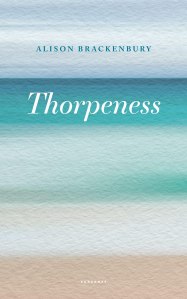 I’m familiar with Brackenbury from her appearance at New Networks for Nature in 2016 and her latest selected poems volume, Gallop. This, her tenth stand-alone collection, features abundant imagery of animals and the seasons, as in “Cucu” and “Postcard,” which marks the return of swifts. Alliteration is prominent, but there is also a handful of rhymes, like in “Fern.” Family history and the perhaps-idyllic rural underpin the verse set in Lincolnshire and Gloucestershire as Brackenbury searches for ancestral graves and delivers elegies.
I especially loved “Aunt Margaret’s Pudding,” a multipart poem about her grandmother’s life as a professional cook and then a mother of four, and “My Grandmother Waits for Christmas,” about a simple link between multiple generations’ Christmases: a sugar mouse. Caring for horses is another recurring theme; a 31-year-old blind pony receives a fond farewell.
There are also playful meetings between historical figures (“Purple Haze,” a dialogue between George Frideric Handel and Jimi Hendrix, who saw the composer’s ghost in their shared London home) and between past and contemporary, like “Thomas Hardy sends an email” (it opens “I need slide no confessions under doors”). “Charles Dickens at Home” was another favourite of mine. The title is the never-to-be-reached destination in the final poem, “Shingle.” A number of these poems were first broadcast on BBC Radio. 
With thanks to Carcanet Press for the e-copy for review.
Faith after Doubt: Why Your Beliefs Stopped Working and What to Do about It by Brian McLaren (2021)
I’ve explained before how McLaren’s books were pivotal to my spiritual journey, even before I attended the church he founded in Maryland. (I’ve also reviewed his previous book, God Unbound). His progressive, environmentalist theology is perfect for continuing searchers like me. At one of last year’s online Church Times Festival events, I saw him introduce the schema that underpins this book. He proposes that the spiritual life (not just Christian) has four stages that may overlap or repeat: simplicity, complexity, perplexity and harmony. The first stage is for new zealots who draw us–them divisions and are most concerned with orthodoxy. In the second, practitioners are more concerned with practicalities: what works, what makes life better. Perplexity is provoked by cynicism about injustice and hypocrisy, while harmony moves beyond dualism and into connection with other people and with nature.
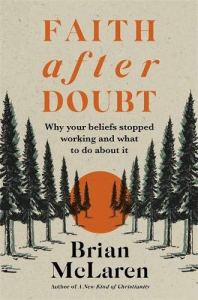 McLaren suggest that honest doubting, far from being a problem, might present an opportunity for changing in the right direction, getting us closer to the “revolutionary love” at the heart of the gospel. He shares stories from his own life, in and out of ministry, and from readers who have contacted him remotely or come up to him after events, caught in dilemmas about what they believe and whether they want to raise their children into religion. Though he’s fully aware of the environmental crisis and doesn’t offer false hope that we as a species will survive it, he isn’t ready to give up on religion; he believes that a faith seasoned by doubt and matured into an understanding of the harmony of all things can be part of a solution.
It’s possible some would find McLaren’s ideas formulaic and his prose repetitive. His point of view always draws me in and gives me much to think about. I’ve been stuck in perplexity for, ooh, 20 years? I frequently ask myself why I persist in going to church when it’s so boring and so often feels like a social club for stick-in-the-mud white people instead of a force for change. But books like this and Robin Wall Kimmerer’s Braiding Sweetgrass, my current soul food, encourage me to keep pursuing spiritual connection as a worthwhile path. I’ll be seeking out his forthcoming book (due out in May), Do I Stay Christian?, too.
Some favourite lines:
“only doubt can save the world. Only doubt will open a doorway out of hostile orthodoxies – whether religious, cultural, economic or political. Only through the difficult passage of doubt can we emerge into a new stage of faith and a new regenerative way of life. Everything depends on making this passage.”
“Among all the other things doubt is – loss, loneliness, crisis, doorway, descent, dissent [these are each the subject of individual chapters early on in the book] – it is also this: a crossroads. At the crossroads of doubt, we either become better or bitter. We either break down or break through. We become cynics or sages, hollow or holy. We choose love or despair.”
“Blessed are the wonderers, for they shall find what is wonderful. … Blessed are the doubters, for they shall see through false gods. Blessed are the lovers, for they shall see God everywhere.”
With thanks to Hodder & Stoughton for the free copy for review.
This Book Is a Plant: How to Grow, Learn and Radically Engage with the Natural World (2022)
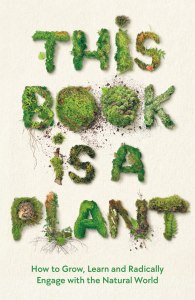 This collection of new essays and excerpts from previously published volumes accompanies the upcoming Wellcome Collection exhibition Rooted Beings (a collaboration with La Casa Encendida, Madrid, it’s curated by Bárbara Rodríguez Muñoz and Emily Sargent and will run from 24 March to 29 August). The overarching theme is our connection with plants and fungi, and the ways in which they communicate. Some of the authors are known for their nature writing – there’s an excerpt from Merlin Sheldrake’s Entangled Life, Jessica J. Lee (author of Turning and Two Trees Make a Forest) contributes an essay on studying mosses, and a short section from Kimmerer’s Braiding Sweetgrass closes the book – while others are better known in other fields, like Susie Orbach and Abi Palmer (author of Sanatorium).
I especially enjoyed novelist Rowan Hisayo Buchanan’s “Wilder Flowers,” which is about landscape painting, balcony gardening in pots, and what’s pretty versus what’s actually good for nature. (Wildflowers aren’t the panacea we are sometimes sold.) I was also interested to learn about quinine, which comes from the fever tree, in Kim Walker and Nataly Allasi Canales’ “Bitter Barks.” Sheila Watt-Cloutier’s essay on the Western influence on Inuit communities in northern Canada, reprinted from Granta, is one of the best individual pieces – forceful and with a unique voice, it advocates reframing the climate change debate in terms of human rights as opposed to the economy – but has nothing to do with plants specifically. There are also a couple of pieces that go strangely mystical, such as one on plant metaphors in the Kama Sutra. So, a mixed bag that jumbles science, paganism and postcolonial thought, but if you haven’t already encountered the Kimmerer and Sheldrake (or, e.g., Rooted by Lyanda Lynn Haupt and Losing Eden by Lucy Jones) you might find this a good primer.
With thanks to Profile Books / Wellcome Collection for the free copy for review.
And one that really didn’t work for me; my apologies to the author and publisher.
I Love You but I’ve Chosen Darkness by Claire Vaye Watkins (2021)
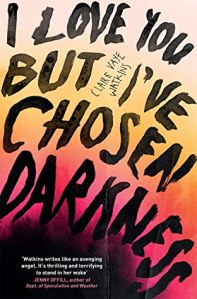 What a letdown after Gold Fame Citrus, one of my favourite novels of 2015. I’d also read Watkins’s debut short story collection, Battleborn, which won the Dylan Thomas Prize. Despite the amazing title and promising setup – autofiction that reflects on postpartum depression and her Mojave Desert upbringing as a daughter of one of the Manson Family cult members – this is indulgent, misguided, and largely unreadable.
A writer named Claire Vaye Watkins flies to Nevada to give a lecture and leaves her husband and baby daughter behind – for good? To commemorate her mother Martha, who died of an opiate overdose, she reprints Martha’s 1970s letters, which are unspeakably boring. I feel like Watkins wanted to write a memoir but didn’t give herself permission to choose nonfiction, so tried to turn her character Claire’s bad behaviour into a feminist odyssey of sexual freedom and ended up writing such atrocious lines as the below:
“I mostly boinked millennial preparers of beverages and schlepped to book festivals to hook up with whatever adequate rando lurked at the end of my signing line. This was what our open marriage looked like”
“‘Psychedelics tend to find me when I need them,’ she said, sending a rush of my blood to my vulva.”
Her vagina dentata (a myth, or a real condition?!) becomes a bizarre symbol of female power and rage. I could only bear to skim this. 
Some lines I liked:
Listen: I am a messenger from the future. I am you in ten years. Pay attention! Don’t fetishize marriage and babies. Don’t succumb to the axial tilt of monogamy! I don’t pretend to know the details of your…situation, but I guarantee you, you’re as free as you’ll ever be. Have sex with anyone you want. Enjoy the fact that it might happen any minute. You could have sex with a man, a woman, both—tonight!
I went from being raised by a pack of coyotes to a fellowship at Princeton where I sat next to John McPhee at a dinner and we talked about rocks and he wasn’t at all afraid of me.
With thanks to riverrun for the proof copy for review.
Would you be interested in reading one or more of these?
Smile: The Story of a Face by Sarah Ruhl
“Ten years ago, my smile walked off my face, and wandered out in the world. This is the story of my asking it to come back.”
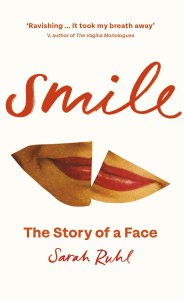 Sarah Ruhl is a lauded New York City playwright (Eurydice et al.). These warm and beautifully observed autobiographical essays stem from the birth of her twins and the slow-burning medical crises that followed. Shortly after the delivery, she developed Bell’s palsy, a partial paralysis of the face that usually resolves itself within six months but in rare cases doesn’t go away, and later discovered that she had celiac disease and Hashimoto’s disease, two autoimmune disorders. Having a lopsided face, grimacing and squinting when she tried to show expression on her paralyzed side – she knew this was a minor problem in the grand scheme of things, yet it provoked thorny questions about to what extent the body equates to our identity:
Can one experience joy when one cannot express joy on one’s face? Does the smile itself create the happiness? Or does happiness create the smile?
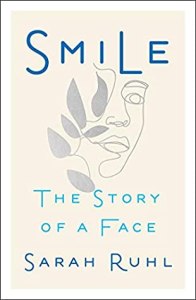
As (pretty much) always, I prefer the U.S. cover.
Women are accustomed to men cajoling them into a smile, but now she couldn’t comply even had she wanted to. Ruhl looks into the psychology and neurology of facial expressions, such as the Duchenne smile, but keeps coming back to her own experience: marriage to Tony, a child psychiatrist; mothering Anna and twins William and Hope; teaching and writing and putting on plays; and seeking alternative as well as traditional treatments (acupuncture and Buddhist meditation versus physical therapy; she rejected Botox and experimental surgery) for the Bell’s palsy. By the end of the book she’s achieved about a 70% recovery, but it did take a decade. “A woman slowly gets better. What kind of story is that?” she wryly asks. The answer is: a realistic one. We’re all too cynical these days to believe in miracle cures. But a story of graceful persistence, of setbacks alternating with advances? That’s relatable.
The playwright’s skills are abundantly evident here: strong dialogue and scenes; a clear sense of time, such that flashbacks to earlier life, including childhood, are interlaced naturally; a mixture of exposition and forceful one-liners. She is also brave to include lots of black-and-white family photographs that illustrate the before and after. While reading I often thought of Lucy Grealy’s Autobiography of a Face and Terri Tate’s A Crooked Smile, which are both about life with facial deformity after cancer surgery. I’d also recommend this to readers of Flesh & Blood by N. West Moss, one of my 2021 favourites, and Anne Lamott’s essays on facing everyday life with wit and spiritual wisdom.
More lines I loved:
imperfection is a portal. Whereas perfection and symmetry create distance. Our culture values perfect pictures of ourselves, mirage, over and above authentic connection. But we meet one another through the imperfect particular of our bodies.
Lucky the laugh lines and the smile lines especially: they signify mobility, duration, and joy.
My rating: 
With thanks to Bodley Head for the free copy for review.
March Reading Plans
It’s beginning to look a lot like spring, with daffodils a-blooming, so I have amassed a set of appropriate reads and aim to report on them in two installments between April and May. I was already partway through Davidson’s novel, I’m getting stuck into the Fitzgerald and Knausgaard, and I hope to start the Woolf soon. I also have a review copy of Ghosts of Spring by Luis Carrasco.

Much as I tried with #FinishItFebruary, I still have some set-aside titles I couldn’t get through before the end of last month. It’s a good thing that (as I’ll never forget Damian Barr commenting) books are patient. I’ll reintroduce these to my stacks in the weeks to come, but NO MORE BOOKS can join them. I’m going to be strict with myself: keep going with a book or DNF it; no more limbo.
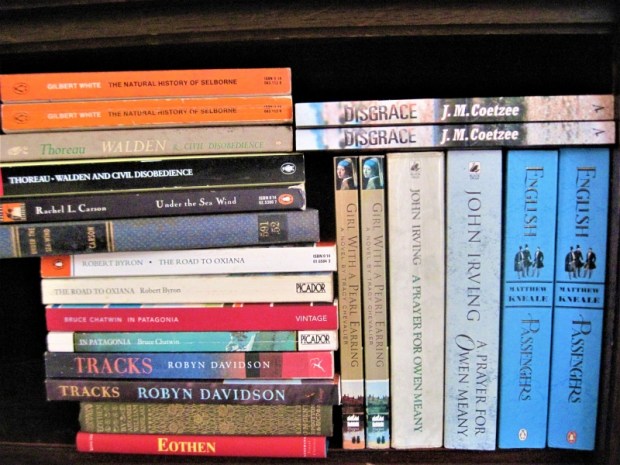
One of my informal goals for the rest of the year is to have a buddy read on the go with my husband at all times. I’d noticed that I happened to have duplicate copies of a couple of books, and then started to look out for extra copies at the free mall bookshop and Little Free Library in 2019–21, so I’ve ended up with 11 books in total: three nature classics, four travel books, three novels to reread, and one to read for the first time. Nature/travel is where our taste most often overlaps, but John Irving is our mutual favourite author and English Passengers is a novel we both loved. We’ll work out a schedule for 1–2 per month. He reads faster than I do (but has much less time to read overall), so we’ll agree on a time frame and chat either as we go or when we’ve both finished a book. Let me know if you fancy joining in with any of these.
Of course, it’s also Reading Ireland Month, hosted by Cathy of 746 Books, and I’ve earmarked these fiction options for the next few weeks. So far I’ve started Maggie O’Farrell’s debut novel. Plus I just got Wendy Erskine’s story collection Dance Move out from the library, and I have Colm Tóibín’s forthcoming poetry collection on my e-reader.
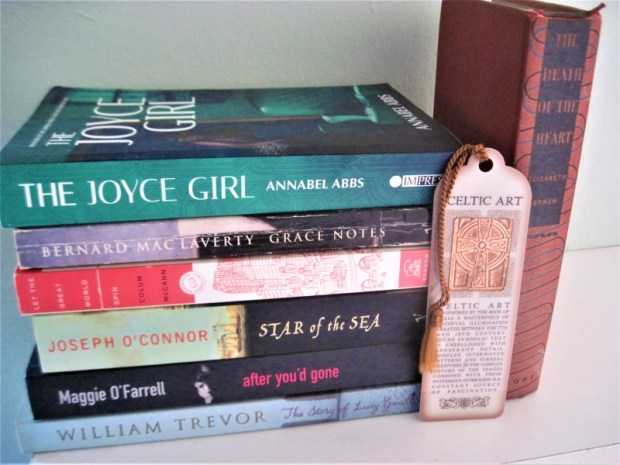
I’m currently reading A Portrait of the Artist as a Young Girl, a collection of autobiographical essays by Irish women writers that originated on the radio. I also got a jump-start in late February by reading these two short books by writers from Ireland:
Wild Child: A Journey through Nature by Dara McAnulty; illus. Barry Falls (2021)
 I’d expected this to be just a picture book. Instead, it’s a guided tour through four landscapes – the garden, the woods, the uplands, and a river – and it combines Robert Macfarlane-esque poetry (the rhyming and alliteration are reminiscent of The Lost Words books) with facts and crafts/activities. It starts small, with the birds a child in the UK might be able to see out their window, and then ventures further afield. There is a teaching focus, with information on species’ classification, life cycles and migrations. I also learned to recognize hazel catkins and flowers, and then identified them on our walk later the same day! But the main aim, I think, is simply to encourage wonder and inspire children to get outside and explore the nature around them. I liked the illustrations, but wish the birds hadn’t been given slightly googly eyes. (Public library)
To Star the Dark by Doireann Ní Ghríofa (2021)
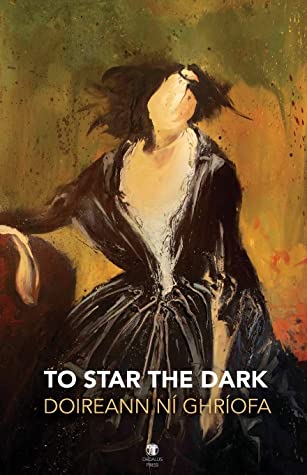 Like many, I discovered Ní Ghríofa through A Ghost in the Throat, a genre-bending work of feminist autofiction. I treated myself to a copy of this, her sixth poetry collection, as part of a Waterstones haul with my Christmas book token. One poem actually mentions Eibhlín Dubh, subject of A Ghost in the Throat, and the work as a whole has some of the same attributes, blending biographical portraits and historical reflection with autobiographical material.
“Two Daydreams” connects a teenager in a history exam with the generations leading back to the Famine. “An Experiment to Engineer an Inheritance of Fear” wonders if there is an inherited Irish trauma: “Give her terror in a meadow. / Bind her fear to a black potato. … / When exposed to the ancestral scent, great-grandchildren will show signs of distress.” A newborn’s stay in the NICU occasions “Seven Postcards from a Hospital” (originally addressed to Sara Baume, Ní Ghríofa reveals in the Notes). Marine biologist Maude Delap is the subject of one multi-part poem.
Sensual imagery abounds, and there are several incantatory spells, including the spring one below. My favourite poem was “Craquelure,” likening cracks in a fellow bus passenger’s phone screen to the weathering old paintings develop. (New purchase)
Winter Reads, Part II: Au, Glück, Hall, Rautiainen, Slaght
In the week before Christmas I reviewed a first batch of wintry reads. We’ve had hardly any snowfall here in southern England this season, so I gave up on it in real life and sought winter weather on the page. After we’ve seen the back of Storm Franklin (it’s already moved on from Eunice!), I hope it will feel appropriate to start right in on some spring reading. But for today I have a Tokyo-set novella, sombre poems, an OTT contemporary Gothic novel, historical fiction in translation from the Finnish, and – the cream of the crop – a real-life environmentalist adventure in Russia.
Cold Enough for Snow by Jessica Au (2022)
 This slim work will be released in the UK by Fitzcarraldo Editions on the 23rd and came out elsewhere this month from New Directions and Giramondo. I actually read it in December during my travel back from the States. It’s a delicate work of autofiction – it reads most like a Chloe Aridjis or Rachel Cusk novel – about a woman and her Hong Kong-raised mother on a trip to Tokyo. You get a bit of a flavour of Japan through their tourism (a museum, a temple, handicrafts, trains, meals), but the real focus is internal as Au subtly probes the workings of memory and generational bonds.
The woman and her mother engage in surprisingly deep conversations about the soul and the meaning of life, but these are conveyed indirectly rather than through dialogue: “she said that she believed that we were all essentially nothing, just series of sensations and desires, none of it lasting. … The best we could do in this life was to pass through it, like smoke through the branches”. Though I highlighted a fair few passages, I find that no details have stuck with me. This is just the sort of spare book I can admire but not warm to. (NetGalley)
Winter Recipes from the Collective by Louise Glück (2021)
 The only other poetry collection of Glück’s that I’d read was Vita Nova. This, her first release since her Nobel Prize win, was my final read of 2021 and my shortest, at 40-some pages; it’s composed of just 15 poems, a few of which stretch to five pages or more. “The Denial of Death,” a prose piece with more of the feel of an autobiographical travel essay, was a standout; the title poem, again in prose paragraphs, and the following one, “Winter Journey,” about farewells, bear a melancholy chill. Memories and dreams take pride of place, with the poet’s sister appearing frequently. “How heavy my mind is, filled with the past.” There are also multiple references to Chinese concepts and characters (as on the cover). The overall style is more aphoristic and reflective than expected. Few individual lines or images stood out to me.
With thanks to Carcanet Press for the e-copy for review.
The Snow Collectors by Tina May Hall (2020)
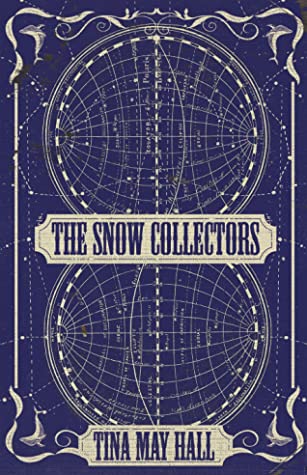 Henna is alone in the world since her parents and twin sister disappeared in a boating accident. She lives a solitary existence with her sister’s basset hound Rembrandt in a New England village, writing encyclopaedia entries on the Arctic, until she stumbles on a corpse and embarks on an amateur investigation involving scraps of 19th-century correspondence. The dead woman asked inconvenient questions about a historical cover-up; if she takes up the thread, Henna could be a target, too. Her collaboration with the police chief, Fletcher, turns into a flirtation. After her house burns down, she ends up living with him – and his mother and housekeeper – in a Gothic mansion stuffed with birds of prey and historical snow samples. She’s at the mercy of this quirky family and the weather, wearing ancient clothing from Fletcher’s great-aunts and tramping through blizzards looking for answers.
This is a kitchen-sink novel with loads going on, as if Hall couldn’t decide which of her interests to include so threw them all in. Yet at only 221 pages, it might actually have been expanded a little to flesh out the backstory and mystery plot. It gets more than a bit ridiculous in places, but its Victorian fan fiction vibe is charming escapism nonetheless. What with the historical fiction interludes about the Franklin expedition, this reminded me most of The Still Point, but also of The World Before Us and The Birth House. I’d happily read Hall’s 2010 short story collection, too. (Christmas gift)
Land of Snow and Ashes by Petra Rautiainen (2022)
[Translated from the Finnish by David Hackston]
 In the middle years of World War II, Finland was allied with Nazi Germany against Russia, a mutual enemy. After the Moscow Armistice, the Germans retreated in disgrace, burning as many buildings and planting as many landmines as they could (“the Lapland War”). I gleaned this helpful background information from Hackston’s preface. The story that follows is in two strands: one is set in 1944 and told via diary entries from Väinö Remes, a Finnish soldier called up to interpret at a Nazi prison camp in Inari. The other, in third person, takes place between 1947 and 1950, the early years of postwar reconstruction. Inkeri, a journalist, has come to Enontekiö to find out what happened to her husband. An amateur photographer, she teaches art to the local Sámi children and takes on one girl, Bigga-Marja, as her protégée.
Collusion and secrets; escaped prisoners and physical measurements being taken of the Sámi: there are a number of sinister hints that become clearer as the novel goes on. I felt a distance from the main characters that I could never quite overcome, such that the reveals didn’t land with as much power as I think was intended. Still, this has the kind of forthright storytelling and precise writing that fans of Hubert Mingarelli should appreciate. For another story of the complexities of being on the wrong side of history, see The Women in the Castle by Jessica Shattuck.
With thanks to Pushkin Press for the proof copy for review.
Winter words:
“Fresh snow has fallen, forming drifts across the terrain. White. Grey. Undulating. The ice has cracked here and there, raising its head in the thawed sections of the river. There is only a thin layer of ice left.”
Owls of the Eastern Ice: The Quest to Find and Save the World’s Largest Owl by Jonathan C. Slaght (2020)
Slaght has become an expert on the Blakiston’s fish owl during nearly two decades of fieldwork in the far east of Russia – much closer to Korea and Japan than to Moscow, the region is also home to Amur tigers. For his Master’s and PhD research at the University of Minnesota, he plotted the territories of breeding pairs of owls and fit them with identifying bands and data loggers to track their movements over the years. He describes these winter field seasons as recurring frontier adventures. Now, I’ve accompanied my husband on fieldwork from time to time, and I can tell you it would be hard to make it sound exciting. Then again, gathering beetles from English fields is pretty staid compared to piloting snowmobiles over melting ice, running from fire, speeding to avoid blockaded logging roads, and being served cleaning-grade ethanol when the vodka runs out.
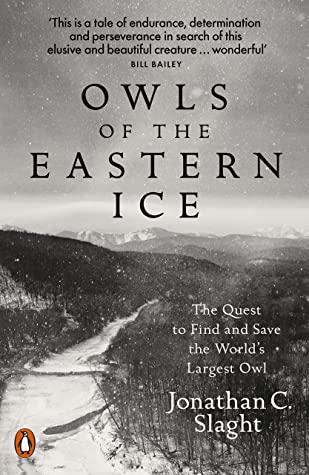 The sorts of towns Slaght works near are primitive places where adequate food and fuel is a matter of life and death. He and his assistants rely on the hospitality of Anatoliy the crazy hermit and also stay in huts and caravans. Tracking the owls is a rollercoaster experience, with expensive equipment failures and trial and error to narrow down the most effective trapping methods. His team develops a new low-tech technique involving a tray of live fish planted in the river shallows under a net. They come to know individuals and mourn their loss: the Sha-Mi female he’s holding in his author photo was hit by a car four years later.
Slaght thinks of Russia as his second home, and you can sense his passion for the fish owl and for conservation in general. He boils down complicated data and statistics into the simple requirements for this endangered species (fewer than 2000 in the wild): valleys containing old-growth forest with large trees and rivers that don’t fully freeze over. There are only limited areas with these characteristics. These specifications and his ongoing research – Slaght is now the Northeast Asia Coordinator for the Wildlife Conservation Society – inform the policy recommendations given to logging companies and other bodies.
Amid the science, this is just a darn good story, full of bizarre characters like Katkov, a garrulous assistant exiled for his snoring. (“He fueled his monologue with sausage and cheese, then belched zeppelins of aroma into that confined space.”) Slaght himself doesn’t play much of a role in the book, so don’t expect a soul-searching memoir. Instead, you get top-notch nature and travel writing, and a ride along on a consequential environmentalist quest. This is the kind of science book that, like Lab Girl and Entangled Life, I’d recommend even if you don’t normally pick up nonfiction. (Christmas gift) 
And a bonus children’s book:
If Winter Comes, Tell It I’m Not Here by Simona Ciraolo (2020)

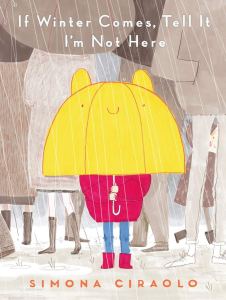 The little boy loves nothing more than to spend hours at the swimming pool and then have an ice cream cone. His big sister warns him the carefree days of summer will be over soon; it will turn cold and dark and he’ll be cooped up inside. Her words come to pass, yet the boy realizes that every season has its joys and he has to take advantage of them while they last. Cute and colourful, though the drawing style wasn’t my favourite. And a correction is in order: as President Biden would surely tell you, ice cream is a year-round treat! (Public library)
Any snowy or icy reading (or weather) for you lately?
Three on a Theme (and #ReadIndies): Nonfiction I Sponsored Last Year
Here in the UK we’re hunkering down against the high winds of Storm Eunice. We’ve already watched two trees come down in a neighbour’s garden (and they’re currently out there trying to shore up the fence!), and had news on the community Facebook page of a huge conifer down by the canal. Very sad. I hope you’re all safe and well and tucked up at home.
Today I’m looking back at several 2021 nonfiction releases I helped come into existence. The first and third I sponsored via Unbound, and the second through Dodo Ink. Supporting small publishers also ties this post into Karen and Lizzy’s February Read Indies initiative. All:

This Party’s Dead: Grief, Joy and Spilled Rum at the World’s Death Festivals by Erica Buist
A death tourism book? I’m there! This is actually the third I’ve read in recent years, after From Here to Eternity by Caitlin Doughty and Near the Exit by Lori Erickson. Buist’s journey was sparked off by the sudden death of her fiancé Dion’s father, Chris – he was dead for a week before his cleaner raised the alarm – and her burden of guilt. It’s an act of atonement for what happened to Chris and the fact that she and Dion, who used to lodge with him, weren’t there when he really needed it. It’s also her way of discovering a sense of the sacred around death, instead of simply fearing and hiding from it.
 This takes place in roughly 2018. The author travelled to eight festivals in seven countries, starting with Mexico for the Day of the Dead and later for an exploration of Santa Muerte, a hero of the working class. Other destinations included Nepal, Sicily (“bones of the dead” biscotti), Madagascar (the “turning of the bones” ceremony – a days-long, extravagant party for a whole village), Thailand and Kyoto. The New Orleans chapter was a standout for me. It’s a city where the dead outnumber the living 10 to 1 (and did so even before Katrina), and graveyard and ghost tours are a common tourist activity.
Buist is an entertaining writer, snappy and upbeat without ever seeming flippant as she discusses heavy topics. The mix of experience and research, the everyday and the momentous, is spot on and she recreates dialogue very well. I appreciated the earnest seeking here, and would happily read a book of hers on pretty much any subject. (New purchase from Unbound)
Trauma: Essays on Art and Mental Health, ed. Thom Cuell & Sam Mills
I’ll never learn: I left it nearly 10 months between finishing this and writing it up. And took no notes. So it’s nearly impossible to recreate the reading experience. What I do recall, however, is how wide-ranging and surprising I found this book. At first I had my doubts, thinking it was overkill to describe sad events like a break-up or loss as “traumatic”. But an essay midway through (which intriguingly trades off autobiographical text by Kirsty Logan and Freudian interpretation by Paul McQuade) set me straight: trauma cannot be quantified or compared; it’s all about the “unpreparedness of the subject. A traumatic event overwhelms all the defences laid out in advance against the encroachment of negative experience.”
 The pieces can be straightforward memoir fragments or playful, experimental narratives more like autofiction. (Alex Pheby’s is in the second person, for instance.) Within those broad branches, though, the topics vary widely. James Miller writes about the collective horror at the Trump presidency. Emma Jane Unsworth recounts a traumatic delivery – I loved getting this taste of her autobiographical writing but, unfortunately, it outshone her full-length memoir, After the Storm, which I read later in the year. Susanna Crossman tells of dressing up as a clown for her clinical therapy work. Naomi Frisby (the much-admired blogger behind The Writes of Womxn) uses food metaphors to describe how she coped with the end of a bad relationship with a narcissist.
As is inevitable with a collection this long, there are some essays that quickly fade in the memory and could have been omitted without weakening the book as a whole. But it’s not gracious to name names, and, anyway, it’s likely that different pieces will stand out for other readers based on their own experiences. (New purchase from Dodo Ink)
Four favourites:
- “Inheritance” by Christiana Spens (about investigating her grandparents’ lives through screen prints and writing after her father’s death and her son’s birth)
- “Blank Spaces” by Yvonna Conza (about the lure of suicide)
- “The Fish Bowl” by Monique Roffey (about everyday sexual harassment and an assault she underwent as a teenager; I enjoyed this so much more than her latest novel)
- “Thanks, I’ll Take the Chair” by Jude Cook, about being in therapy.
Women on Nature: 100+ Voices on Place, Landscape & the Natural World, ed. Katharine Norbury
It was over three years between when I pledged support and held the finished book in my hands; I can only imagine what a mammoth job compiling it was for Katharine Norbury (author of The Fish Ladder). The subtitle on the title page explains the limits she set: “An anthology of women’s writing about the natural world in the east Atlantic archipelago.” So, broadly, British and Irish writers, but within that there’s a lot of scope for variety: fragments of fiction (e.g., a passage from Jane Eyre), plenty of poetry, but mostly nonfiction narratives – some work in autobiographical reflection; others are straightforward nature or travel writing. Excerpts from previously published works trade off with essays produced specifically for this volume. So I encountered snippets of works I’d read by the likes of Miriam Darlington, Melissa Harrison, Sara Maitland, Polly Samson and Nan Shepherd. The timeline stretches from medieval mystics to today’s Guardian Country Diarists and BIPOC nature writers.
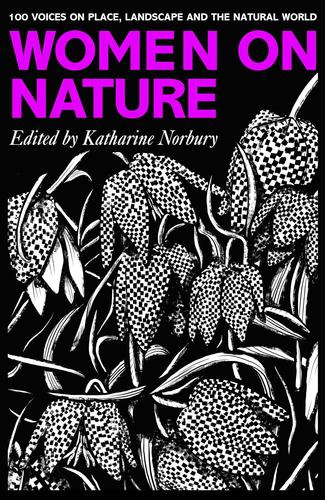 For most of the last seven months of 2021, I kept this as a bedside book, reading one or two pieces on most nights. It wasn’t until early this year that I brought it downstairs and started working it into my regular daily stacks so that I would see more progress. At first I quibbled (internally) with the decision to structure the book alphabetically by author. I wondered if more might have been done to group the pieces by region or theme. But besides being an unwieldy task, that might have made the contents seem overly determined. Instead, you get the serendipity of different works conversing with each other. So, for example, Katrina Porteous’s dialect poem about a Northumberland fisherman is followed immediately by Jini Reddy’s account of a trip to Lindisfarne; Margaret Cavendish’s 1653 dialogue in verse between an oak tree and the man cutting him down leads perfectly into an excerpt from Nicola Chester’s On Gallows Down describing a confrontation with tree fellers.
I’d highly recommend this for those who are fairly new to the UK nature writing scene and/or would like to read more by women. Keep it as a coffee table book or a bedside read and pick it up between other things. You’ll soon find your own favourites. (New purchase from Unbound)
Five favourites:
- “Caravan” by Sally Goldsmith (a Sheffield tree defender)
- “Enlli: The Living Island” by Pippa Marland (about the small Welsh island of Bardsey)
- “An Affinity with Bees” by Elizabeth Rose Murray (about beekeeping, and her difficult mother, who called herself “the queen bee”)
- “An Island Ecology” by Sarah Thomas (about witnessing a whale hunt on the Faroe Islands)
- My overall favourite: “Arboreal” by Jean McNeil (about living in Antarctica for a winter and the contrast between that treeless continent and Canada, where she grew up, and England, where she lives now)
“It occurred to me that trees were part of the grammar of one’s life, as much as any spoken language. … To see trees every day and to be seen by them is a privilege.”
Stay strong, trees!
Sponsored any books, or read any from indie publishers, recently?
Swedish Death Cleaning (#NordicFINDS and #ReadIndies) & Three Rereads
An unexpected opportunity to contribute another post for Nordic FINDS this week (after my skim of Sophie’s World): yesterday we went into London – for just the second time since the pandemic started – and I took along a couple of novella-length books, one of them this Swedish nonfiction work that I picked up from a charity shop the other week. As it was released by Canongate in 2017, it also fits into Karen and Lizzy’s Read Indies challenge.
Our previous London trip was to see Bell X1 play at Union Chapel back in December. Yesterday was also for a gig, this time The Lost Words: Spell Songs playing Cadogan Hall. I’d been dubious about this ensemble project based on Robert Macfarlane and Jackie Morris’s The Lost Words and The Lost Spells but ended up loving both books as well as the two albums of folk/world music based on them, and it was a brilliant evening of music.
Anyway, on to the books. I also reread a novella in advance of book club, so afterwards I’ll take a quick look at the rereading I’ve done so far this year.
Döstädning: The Gentle Art of Swedish Death Cleaning by Margareta Magnusson
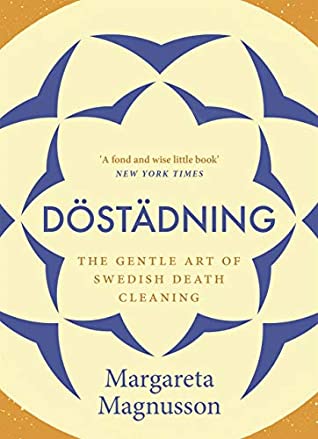 This is not about trauma cleaning, but downsizing and culling possessions so that the burden doesn’t fall to your children or other relatives after your death. Magnusson, who is in her 80s, has experience with death cleaning: first after her mother’s death, then after her mother-in-law’s, and finally after her husband’s, when she decided to move from the family home to a small flat. I enjoyed the little glimpses into her life as a mother of five and an artist. The family moved around a lot for her husband’s work, living in the USA and Singapore. She makes more of an allowance for possessions that hold sentimental value (especially photos and letters), being more concerned about the accumulation of STUFF.
As for general strategies, she suggests starting the process c. age 65 and beginning with the big things, from furniture on down, so that you make visible progress right away. “I’ve discovered that it is rewarding to spend time with these objects one last time and then dispose of them.” She goes category by category through her possessions. Clothing and cookbooks are pretty easy to shed: get rid of whatever doesn’t fit or suit you anymore, and only keep a couple of much-used cookbooks; you can find most any recipe on the Internet these days, after all. Leave the emotional material for last or you’ll get bogged down, she advises – you can take your time and enjoy reminiscing as you look through mementoes later on. She even considers what to do about old pets.
To let things, people and pets go when there is no better alternative is a lesson that has been very difficult for me to learn, and it is a lesson that life, as it goes further along, is teaching me more and more often.
Magnusson writes that she does not intend this to be a sad book, and it’s mostly very practical and unsentimental, even funny at times: on disposing of secret stuff, “save your favourite dildo but throw away the other fifteen!”; a little section on the perils of “man caves” and her memories of her clumsy cat Klumpeduns. I also laughed at the concept of a fulskåp (“a cabinet for the ugly”) for unwanted gifts that must eventually be rehomed or disposed of.
One problem that I have with decluttering books in general is that there isn’t enough of an anti-consumerist and green message. One, don’t accumulate the stuff in the first place (and reuse and buy secondhand wherever possible); two, possessions should almost never be thrown away, and only as an absolute last resort after doing everything possible to repair, refurbish, rehome or recycle them.
This was an enjoyable little book that I’ll pass on to someone else who might find it useful (so long as it’s not considered too on the nose as a book recommendation!), but it didn’t necessarily add anything for me beyond what I’d encountered in Outer Order, Inner Calm by Gretchen Rubin and Year of No Clutter by Eve O. Schaub. (Secondhand purchase)
[I’m a little confused as to whether this is in translation or not. It first appeared in Swedish, but as no translator is listed anywhere in the copyright info, I assume that Magnusson translated it herself. Apart from some wrong number/amount and during/over choices, it reads like a native speaker’s work.]
2022’s Rereading
I’ve reread three books so far this year, which for me is pretty good going. It helped that all three were novella length, and I had book club as an excuse to return to the two novels.
 The Sense of an Ending by Julian Barnes was the other book I popped in the back of my purse for yesterday’s London outing. Barnes is one of my favourite authors – I’ve read 21 books by him now! – but I remember not being very taken with this Booker winner when I read it just over 10 years ago. (I prefer to think of his win as being for his whole body of work as he’s written vastly more original and interesting books, like Flaubert’s Parrot.) It’s the story of an older man looking back on his youth, and his friend’s suicide, in the light of what he learns after a somewhat mysterious bequest. The themes of history, memory and regret certainly mean more to me now in my late 30s than they did in my late 20s, but I still find this work a little lightweight; sordid, too. (Free from mall bookshop)
Readalikes: Any Human Heart by William Boyd, Moon Tiger by Penelope Lively, The Child in Time by Ian McEwan
 The Prime of Miss Jean Brodie by Muriel Spark was January’s book club selection. I had remembered no details apart from the title character being a teacher. It’s a between-the-wars story set in Edinburgh. Miss Brodie’s pet students are girls with attributes that remind her of aspects of herself. Our group was appalled at what we today would consider inappropriate grooming, and at Miss Brodie’s admiration for Hitler and Mussolini. Educational theory was interesting to think about, however. Spark’s work is a little astringent for me, and I also found this one annoyingly repetitive on the sentence level. (Public library)
 Brit-Think, Ameri-Think: A Transatlantic Survival Guide by Jane Walmsley: This is the revised edition from 2003, so I must have bought it as preparatory reading for my study abroad year in England. This may even be the third time I’ve read it. Walmsley, an American in the UK, compares Yanks and Brits on topics like business, love and sex, parenting, food, television, etc. I found my favourite lines again (in a panel entitled “Eating in Britain: Things that Confuse American Tourists”): “Why do Brits like snacks that combine two starches? (a) If you’ve got spaghetti, do you really need the toast? (b) What’s a ‘chip-butty’? Is it fatal?” The explanation of the divergent sense of humour is still spot on, and I like the Gray Jolliffe cartoons. Unfortunately, a lot of the rest feels dated – she’d updated it to 2003’s pop culture references, but these haven’t aged well. (New purchase?)
Any Nordic reads, or rereads, for you lately?
January Releases, Part III: Taylor Harris, Cathy Rentzenbrink & Tanya Shadrick
Rounding off my three-part look at some of the month’s new releases with two memoirs plus a memoir-writer’s self-help guide today. (Can you tell I’m a memoir junkie?) Topics range from medical mysteries and covert racism to a reclaiming of life after a near-death experience, but these three nonfiction works by women are linked by the determination to overcome self-doubt.
This Boy We Made: A Memoir of Motherhood, Genetics, and Facing the Unknown by Taylor Harris
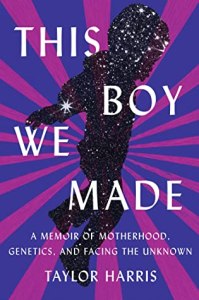 One morning, Taylor Harris and her husband (an African American family based in Charlottesville, Virginia) found their 22-month-old son Christopher, nicknamed “Tophs,” awake but unresponsive in his crib. In the years that followed, she and his doctors looked for answers as to why his body couldn’t regulate his blood sugar levels, sometimes leading to seizures, and to why his speech and mental processing remained delayed. All their tests and theories have never amounted to a conclusive diagnosis. This was a book that repeatedly surprised me. I’d assumed it would be exclusively about the medical mystery of Tophs’s physical and intellectual disability. But Harris elegantly weaves in a lot of other themes, too: mental illness, her own physical concerns (a BRCA2 mutation), racism, faith, and advocating for her children’s health and education. (Full review at BookBrowse.)
Write It All Down: How to put your life on the page by Cathy Rentzenbrink
Cathy Rentzenbrink is a lovely human being, and I’ve always appreciated her enthusiastic support of books. I’ve read all of her work even though I’ve been disappointed with her last few releases. There are so many writing guides out there – including several on memoir-writing specifically – that the first question to ask about one is, does it offer anything new? For me, this one doesn’t. In fact, it’s more of a therapy session than a practical writing guide.
 The undemanding prose slides right down, but 60 pages in (at the end of Part One, “Preparation”) I realized all we’d had thus far was enumerating and countering the hang-ups of unconfident, procrastinating would-be writers. The rest of the book does then get into the nitty-gritty of producing a first draft (“Excavation”) of a life story and editing it into a more polished form. Rentzenbrink peppers in little tricks to keep oneself at the desk, like setting a timer or micro-goals, writing a section in the form of a letter, and dredging up sensory details. Most of the mini chapters are just a couple of pages. Several end with a series of prompts. I’m notorious for skipping the application questions in self-help books, but I’d be interested to hear if other readers have actually gone through these exercises and found them helpful.
I’m so familiar with the author’s own story from her three autobiographical works that I was less than patient about encountering certain incidents again here – though I was intrigued to learn that she gave up alcohol in the recent past after realizing that she was a problem drinker. I’ve also read most of the material in her Further Reading list; all told, I didn’t feel this book offered me much, as a lay reader or a maybe-some-day memoirist. But it seems to have been enormously popular among critics and readers (its average Goodreads rating is 4.38), so clearly a lot of people have been finding Rentzenbrink’s down-to-earth approach reassuring.
With thanks to Emma Finnigan PR and Bluebird for the proof copy for review.
The Cure for Sleep: Memoir of a Late-Waking Life by Tanya Shadrick
From my Most Anticipated list. Shadrick hangs around the fringes of nature writing cliques on Twitter, so I expected this to have more of a nature/travel element. Instead, it bears a fairy tale ambience, of a little girl lost in the woods and craving freedom; of a sleepwalking woman deciding to live more deliberately. It opens with a near-death experience: Shadrick, new mother to a son conceived after infertility treatment, suffered a severe haemorrhage after the placenta tore an artery and was rushed to hospital for emergency surgery.
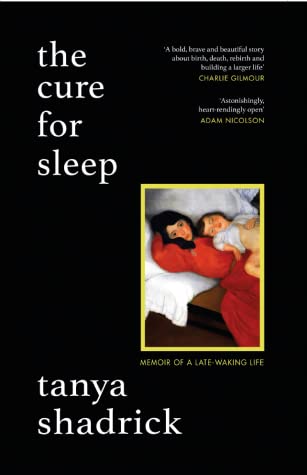 From this point she returns to the beginning of her life and proceeds chronologically, pausing at joyful or traumatic moments. Her childhood feels like the key to understanding everything else: her father left when she was a baby; her mother, all too aware of being of lower class, was driven to improve herself. Shadrick wanted her mother all to herself, at the same time as she felt trapped by her. She injured herself jumping off an outhouse roof in protest at her mother’s new boyfriend, who became her stepfather. At university she reacted against her upbringing in predictable ways, failing her first year and having an abortion. Even once happily married, she kept unconsciously searching for surrogate father (older male) figures.
After the postnatal operation, she felt a need to escape – by suicide if necessary – yet forced herself to stay, make connections in her town and be present for her children. But she remained a free spirit, swimming and writing a mile-long scroll as public performance art. Her work with hospice patients, recording their memories, qualified her to edit Lynne Roper’s wild swimming diaries into a Wainwright Prize-longlisted book.
Awakening versus sleep is the figurative framework for the memoir, with a feminist insistence on freedom and self-fulfilment at the same time as being a mother. This is an unusual book – at times overwritten and too deliberately moulded into tropes as a rebuttal to randomness, even though, looking back, I can’t decipher a coherent plot to the events – that reminded me most of Free Woman by Lara Feigel and I Am, I Am, I Am by Maggie O’Farrell.
With thanks to W&N for the free copy for review.
Does one of these books appeal to you?
January Releases II: Nick Blackburn, Wendy Mitchell & Padraig Regan
The January new releases continue! I’ll have a final batch of three tomorrow. For today, I have an all-over-the-place meditation masquerading as a bereavement memoir, an insider’s look at what daily life with dementia is like, and a nonbinary poet’s debut.
The Reactor: A Book about Grief and Repair by Nick Blackburn
I’ll read any bereavement memoir going, and the cover commendations from Olivia Laing and Helen Macdonald made this seem like a sure bet. Unfortunately, this is not a bereavement memoir but an exercise in self-pity and free association. The book opens two weeks after Blackburn’s father’s death – “You have died but it’s fine, Dad.” – and proceeds in titled fragments of one line to a few paragraphs. Blackburn sometimes addresses his late father directly, but more often the “you” is himself. He becomes obsessed with the Chernobyl disaster (even travelling to Belarus), which provides the overriding, and overstretched, title metaphor – “the workings of grief are unconscious, invisible. Like radiation.”
 From here the author indulges in pop culture references and word association: Alexander McQueen’s fashion shows, Joni Mitchell’s music, Ingmar Bergman’s films, Salvador Dalí’s paintings and so on. These I at least recognized; there were plenty of other random allusions that meant nothing to me. All of this feels obfuscating, as if Blackburn is just keeping busy: moving physically and mentally to distract from his own feelings. A therapist focusing on LGBT issues, he surely recognizes his own strategy here. This seems like a diary you’d keep in a bedside drawer (there’s also the annoyance of no proper italicization or quotation marks for works of art), not something you’d try to get published as a bereavement memoir.
The bigger problem is there is no real attempt to convey a sense of his father. It would be instructive to go back and count how many pages actually mention his father. One page on his death; a couple fleeting mentions of his mental illness being treated with ECT and lithium. Most revealing of all, ironically, is the text of a postcard he wrote to his mother on a 1963 school trip to Austria. “I want to tell you more about my father, but honestly I feel like I hardly knew him. There was always his body and that was enough,” Blackburn writes. Weaselling out of his one task – to recreate his father for readers – made this an affected dud.
With thanks to Faber for the free copy for review.
What I Wish People Knew About Dementia: From Someone Who Knows by Wendy Mitchell
I loved Mitchell’s first book, Somebody I Used to Know. She was diagnosed with early-onset Alzheimer’s at age 58 in 2014. This follow-up, too, was co-written with Anna Wharton (they have each written interesting articles on their collaboration process, here and here). Whereas her previous work was a straightforward memoir, this has more of a teaching focus, going point by point through the major changes dementia causes to the senses, relationships, communication, one’s reaction to one’s environment, emotions, and attitudes.
 I kept shaking my head at all these effects that would never have occurred to me. You tend not to think beyond memory. Food is a major issue for Mitchell: she has to set iPad reminders to eat, and chooses the same simple meals every time. Pasta bowls work best for people with dementia as they can get confused trying to push food around a plate. She is extra sensitive to noises and may have visual and olfactory hallucinations. Sometimes she is asked to comment on dementia-friendly building design. For instance, a marble floor in a lobby looks like water and scares her, whereas clear signage and bright colours cheer up a hospital trip.
The text also includes anonymous input from her friends with dementia, and excerpts from recent academic research on what can help. Mitchell and others with Alzheimer’s often feel written off by their doctors – her diagnosis appointment was especially pessimistic – but her position is that the focus should be on what people can still do and adaptations that will improve their everyday lives. Mitchell lives alone in a small Yorkshire village and loves documenting the turning of the seasons through photographs she shares on social media. She notes that it’s important for people to live in the moment and continue finding activities that promote a flow state, a contrast to some days that pass in a brain haze.
This achieves just what it sets out to: give a picture of dementia from the inside. As it’s not a narrative, it’s probably best read in small doses, but there are some great stories along the way, like the epilogue’s account of her skydive to raise money for Young Dementia UK.
With thanks to Bloomsbury for the proof copy for review.
Some Integrity by Padraig Regan
The sensual poems in this debut collection are driven by curiosity, hunger and queer desire. Flora and foods are described as teasing mystery, with cheeky detail:
I’m thinking of how mushrooms will haunt a wet log like bulbous ghosts
The chicken is spatchcocked & nothing
like a book, but it lies open & creases
where its spine once was.
For as long as it take a single drop of condensation to roll its path
down the curve of a mojito glass before it’s lost in the bare wood of the table,
everything is held // in its hall of mirrors

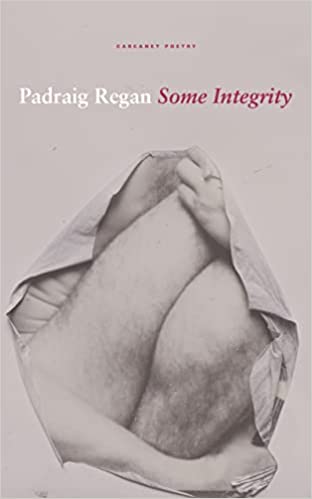 An unusual devotion to ampersands; an erotic response to statuary, reminiscent of Richard Scott; alternating between bold sexuality and masochism to the point of not even wanting to exist; a central essay on the Orlando nightclub shooting and videogames – the book kept surprising me. I loved the fertile imagery, and appreciated Regan’s exploration of a nonbinary identity:
Often I envy the Scandinavians for their months of sun,
unpunctuated. I think I want some kind of salad. I want to feel like a real boy, sometimes.
Thank you
for this chain of daisies to wear around my neck — it makes me look so pretty.
Highly recommended, especially to readers of Séan Hewitt and Stephen Sexton.
With thanks to Carcanet Press for the free copy for review.
Does one of these books appeal to you?
 Bookish Beck = Rebecca Foster. American transplant to England. Freelance proofreader and book reviewer.
