Five Early March Releases: Jami Attenberg, Tayari Jones and More
Last week was one of the biggest weeks in the UK’s publishing year. Even though I’ve cut down drastically on the number of review books I’m receiving in 2020, I still had six on my shelf with release dates last week. Of course, THE biggest title out on the 5th was The Mirror and the Light, the final volume in Hilary Mantel’s Thomas Cromwell trilogy, which I’m eagerly awaiting from the library – I’m #3 in a holds queue of 34 people, but there are three copies, all showing as “Received at HQ,” so mine should come in any day now.
But for those who are immune to Mantel fever, or just seeking other material, there’s plenty to keep you busy. I give short reviews of five books today: a couple of dysfunctional family stories, two very different graphic novels and some feminist nonfiction.
All This Could Be Yours by Jami Attenberg
(Published by Serpent’s Tail on the 5th; came out in the USA from Houghton Mifflin in October)
Most of the action in Attenberg’s seventh book takes place on one day, as 73-year-old Victor Tuchman, struck down by a heart attack, lies on his deathbed in a New Orleans hospital. There’s more than a whiff of Trump about Victor, who has a shadowy mobster past and was recently hit with 11 sexual harassment charges. Forced to face the music for the first time, he fled Connecticut with his wife Barbra, citing the excuse of wanting to live closer to their son Gary in Louisiana. Victor had been abusive to Barbra throughout their marriage, and was just as violent in his speech: he could crush their daughter Alex with one remark on her weight.
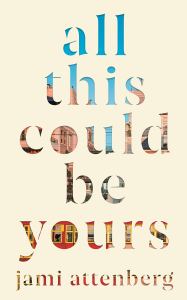 So no one is particularly sad to see Victor dying. Alex goes through the motions of saying goodbye and telling her father she forgives him, knowing she doesn’t mean a word. Meanwhile, Gary is AWOL on a work trip to California, leaving his wife Twyla to take his place at Victor’s bedside. Twyla’s newfound piety is her penance for a dark secret that puts her at the heart of the family’s breakdown.
Attenberg spends time with each family member on this long day supplemented by flashbacks, following Alex from bar to bar in downtown New Orleans as she tries to drown her sorrows and exploring other forms of addiction through Barbra (redecorating; not eating or ageing) and Twyla – in a particularly memorable scene, she heaps a shopping cart full of makeup at CVS and makes it all the way to the checkout before she snaps out of it. There’s also an interesting pattern of giving brief glimpses into the lives of the incidental characters whose paths cross with the family’s, including the EMT who took Victor to the hospital.
This is a timely tragicomedy, realistic and compassionate but also marked by a sardonic tone. Although readers only ever see Victor through other characters’ eyes, any smug sense of triumph they may feel about seeing the misbehaving, entitled male brought low is tempered by the extreme sadness of what happens to him after his death. I didn’t love this quite as much as The Middlesteins, but for me it’s a close second out of the four Attenberg novels I’ve read. She’s a real master of the dysfunctional family novel.
My thanks to the publisher for the free copy for review.
Silver Sparrow by Tayari Jones (2011)
(Published for the first time in the UK by Oneworld on the 5th)
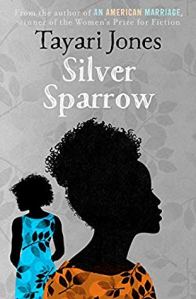 Speaking of messed-up families … Growing up in 1980s Atlanta, Dana and Chaurisse both call James Witherspoon their father – but Chaurisse’s mother doesn’t even know that Dana exists. Dana’s mother, however, has always been aware of her husband’s other family. That didn’t stop her from agreeing to a quick marriage over the state line. Jones establishes James’s bigamy in the first line; the rest of the novel is mostly in two long sections, the first narrated by Dana and the second by Chaurisse. Both girls recount how their parents met, as well as giving a tour through their everyday life of high school and boyfriends.
I was eager to read this after enjoying Jones’s Women’s Prize winner, An American Marriage, so much. Initially I liked Dana’s narration as she elaborates on her hurt at being in a secret family. The scene where she unexpectedly runs into Chaurisse at a science fair and discovers their father bought them matching fur coats is a highlight. But by the midpoint the book starts to drag, and Chaurisse’s voice isn’t distinct enough for her narration to add much to the picture. A subtle, character-driven novel about jealousy and class differences, this failed to hold my interest. Alternating chapters from the two girls might have worked better?
My thanks to the publisher for the proof copy for review.
New graphic novels from SelfMadeHero:
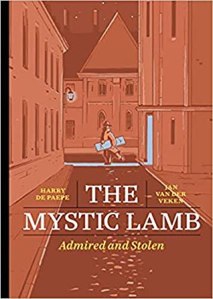 The Mystic Lamb: Admired and Stolen by Harry De Paepe and Jan Van Der Veken
[Translated by Albert Gomperts]
I’ve been to Ghent, Belgium twice. Any visitor will know that one of the city’s not-to-be-missed sights is the 15th-century altarpiece in St Bavo’s Cathedral, Jan van Eyck’s Adoration of the Mystic Lamb. On our first trip we bought timed tickets to see this imposing and vibrantly colored multi-paneled artwork, which depicts various figures and events from the Bible as transplanted into a typically Dutch landscape. De Paepe gives a comprehensive account of the work’s nearly six-century history.

Ghent altarpiece (Jan van Eyck / Public domain)
It’s been hidden during times of conflict or taken away as military spoils; it’s been split into parts and sold or stolen; it narrowly escaped a devastating fire. Overall, there was much more detail here than I needed, and far fewer illustrations than I expected. If you have a special interest in art history, you may well enjoy this. Just bear in mind that, although marketed as a graphic novel, it is mostly text.
Thoreau and Me by Cédric Taling
[Translated by Edward Gauvin]
 I can’t seem to get away from Henry David Thoreau in my recent reading. Last year I reviewed for the TLS two memoirs that consciously appropriated the 19th-century environmentalist’s philosophy and language; the other night I found mentions of Thoreau in a Wallace Stegner novel, a new nature book by Lucy Jones, and travel books by Nancy Campbell and Charlie English. So I knew I had to read this debut graphic novel (but is it a memoir or autofiction?) about a Paris painter who is plagued by eco-anxiety and plans to build his own off-grid home in the woods.
Cédric and his middle-class friends are assailed by “white hipster guilt.” A brilliant sequence has a dinner party discussion descend into a cacophony of voices as they list the ethical minefields they face. Though Cédric wishes he were a prepared alpha male with advanced survival skills that could save his family, his main strategy seems to be panic buying cold-weather gear. Thoreau, depicted sometimes as a wolf or faun and always with a thin, tubular mosquito’s nose (like a Socratic gadfly?), comes to him as an invisible friend and guru, with quotes from Walden and his journal appearing in jagged speech bubbles. This was a good follow-up to Jenny Offill’s Weather with its themes of climate-related angst and perceived helplessness. I enjoyed the story even though I found the drawing style slightly grotesque.

My thanks to the publisher for the free copies for review.
And one extra:
 The Home Stretch: Why It’s Time to Come Clean about Who Does the Dishes by Sally Howard
(Published by Atlantic Books on the 5th)
I only gave this feminist book about the domestic labor gap a quick skim as, unfortunately, it repeats a lot of the examples and statistics that were familiar to me from works like Invisible Women by Caroline Criado-Pérez (e.g. the Iceland women’s strike in the 1970s) and Fair Play by Eve Rodsky. The only chapter that stood out for me somewhat was about the “yummy mummy” stereotype perpetuated by the likes of Jools Oliver and Gwyneth Paltrow.
My thanks to the publisher for the proof copy for review.
What recent releases can you recommend?
Four February Releases: Napolitano, Offill, Smyth, Sprackland
Much as I’d like to review books in advance of their release dates, that doesn’t seem to be how things are going this year. I hope readers will find it useful to learn about recent releases they might have missed. This month I’m featuring a post-plane crash scenario, a reflection on modern anxieties, an essay about the human–birds relationship, and a meditation on graveyards.
Dear Edward by Ann Napolitano
(Published by Penguin/Viking on the 20th; came out in USA from Dial Press last month)
 June 2013: a plane leaves Newark Airport for Los Angeles, carrying 192 passengers. Five hours after takeoff, it crashes in the flatlands of northern Colorado, a victim to stormy weather and pilot error. Only 12-year-old Edward Adler is found alive in the wreckage. In alternating storylines, Napolitano follows a select set of passengers (the relocating Adler family, an ailing tycoon, a Wall Street playboy, an Afghanistan veteran, a Filipina clairvoyant, a pregnant woman visiting her boyfriend) in their final hours, probing their backstories to give their soon-to-end lives context (and meaning?), and traces the first six years of the crash’s aftermath for Edward.
While this is an expansive and compassionate novel that takes seriously the effects of trauma and the difficulty of accepting random suffering, I found that I dreaded returning to the plane every other chapter – I have to take regular long-haul flights to see my family, and while I don’t fear flying, I also don’t need anything that elicits catastrophist thinking. I would read something else by Napolitano (she’s written a novel about Flannery O’Connor, for instance), but I can’t imagine ever wanting to open this up again.
I picked up a proof copy at a Penguin Influencers event.
Weather by Jenny Offill
(Published by Knopf [USA] on the 11th and Granta [UK] on the 13th)
 Could there be a more perfect book for 2020? A blunt, unromanticized but wickedly funny novel about how eco-anxiety permeates everyday life, Weather is written in the same aphoristic style as Offill’s Dept. of Speculation but has a more substantial story to tell. Lizzie Benson is married with a young son and works in a New York City university library. She takes on an informal second job as PA to Sylvia, her former professor, who runs a podcast on environmental issues and travels to speaking engagements.
Set either side of Trump’s election, the novel amplifies many voices prophesying doom, from environmentalists to Bible-thumpers (like Lizzie’s mother) to those who aren’t sure they’ll even make it past tomorrow (like her brother, a highly unstable ex-addict who’s having a baby with his girlfriend). It’s a wonder it doesn’t end up feeling depressing. Lizzie’s sardonic narration is an ideal way of capturing relatable feelings of anger and helplessness, cringing fear and desperate hope. Don’t expect to come away with your worries soothed, though there is some comfort to be found in the feeling that we’re all in this together.
Favorite lines:
“Young person worry: What if nothing I do matters? Old person worry: What if everything I do does?”
“Once sadness was considered one of the deadly sins, but this was later changed to sloth. (Two strikes then.)”
“My husband is reading the Stoics before breakfast. That can’t be good, can it?”
I read an e-ARC via Edelweiss.
An Indifference of Birds by Richard Smyth
(Published by Uniformbooks on the 14th)
 Birds have witnessed the whole of human history, sometimes profiting from our behavior – our waste products provide them with food, our buildings can be handy nesting and hunting platforms, and our unintentional wastelands and demilitarized zones turn into nature reserves – but more often suffering incidental damage. That’s not even considering our misguided species introductions and the extinctions we’ve precipitated. Eighty percent of bird species are now endangered. For as minimal as the human fossil record will be, we have a lot to answer for.
From past to future, archaeology to reintroduction and de-extinction projects, this is a wide-ranging essay that still comes in at under 100 pages. It’s a valuable shift in perspective from human-centric to bird’s-eye view. The prose is not at all what I’ve come to expect from nature writing (earnest, deliberately lyrical); it’s more rhetorical and inventive, a bit arch but still passionate – David Foster Wallace meets Virginia Woolf? The last six paragraphs, especially, soar into sublimity. A niche book, but definitely recommended for bird-lovers.
Favorite lines:
“They must see us, watch us, from the same calculating perspective as they did two million years ago. We’re still galumphing heavy-footed through the edgelands, causing havoc, small life scattering wherever we tread.”
“Wild things lease these places from a capricious landlord. They’re yours, we say, until we need them back.”
I pre-ordered my copy directly from the publisher.
These Silent Mansions: A life in graveyards by Jean Sprackland
(Published by Jonathan Cape on the 6th)
 I’m a big fan of Sprackland’s beachcombing memoir, Strands, and have also read some of her poetry. Familiarity with her previous work plus a love for graveyards induced me to request a copy of her new book. In it she returns to the towns and cities she has known, wanders through their graveyards, and researches and imagines her way into the stories of the dead. For instance, she finds the secret burial place of persecuted Catholics in Lancashire, learns about a wrecked slave ship in a Devon cove, and laments two dead children whose bodies were sold for dissections in 1890s Oxford. She also remarks on the shifts in her own life, including the fact that she now attends more funerals than weddings, and the displacement involved in cremation – there is no site she can visit to commune with her late mother.
I most enjoyed the book’s general observations: granite is the most prized headstone material, most graves go unvisited after 15 years, and a third of Britons believe in angels despite the country’s overall decline in religious belief. I also liked Sprackland’s list of graveyard charms she has seen. While I applaud any book that aims to get people thinking and talking about death, I got rather lost in the historical particulars of this one.
Favorite lines:
“This is the paradox at the heart of our human efforts to remember and memorialise: the wish to last forever, and the knowledge that we are doomed to fail.”
“Life, under such a conscious effort of remembering, sometimes resembles a series of clumsy jump-cuts rather than one continuous narrative.”
My thanks to the publisher for the free copy for review.
What recent releases can you recommend?
Paul Auster Reading Week: Oracle Night and Report from the Interior
Paul Auster Reading Week continues! Be sure to check out Annabel’s excellent post on why you should try Auster. On Monday I reviewed Winter Journal and the New York Trilogy. Adding in last year’s review of Timbuktu, I’ve now read six of Auster’s books and skimmed another one (the sequel to Winter Journal). It’s been great to have this project as an excuse to get more familiar with his work and start to recognize some of the recurring tropes.
Oracle Night (2003)
This reminded me most of The Locked Room, the final volume of the New York Trilogy. There’s even a literal locked room in a book within the book by the narrator, a writer named Sidney Orr. It’s 1982 and Orr is convalescing from a sudden, life-threatening illness. At a stationer’s shop, he buys a fine blue notebook from Portugal, hoping its beauty will inspire him to resume his long-neglected work. When he and his wife Grace go to visit John Trause, Grace’s lifelong family friend and a fellow novelist, Orr learns that Trause uses the same notebooks. Only the blue ones, mind you. No other color fosters the same almost magical creativity.
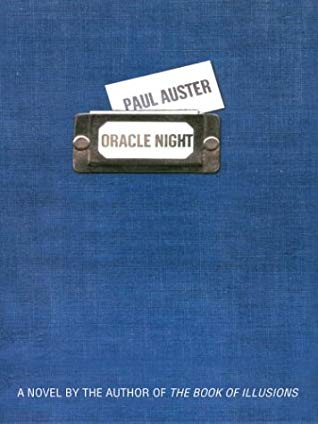 For long stretches of the novel, Orr is lost in his notebook (“I was there, fully engaged in what was happening, and at the same time I wasn’t there—for the there wasn’t an authentic there anymore”), writing in short, obsessive bursts. In one project, a mystery inspired by an incident from The Maltese Falcon, Nick Bowen, a New York City editor, has a manuscript called Oracle Night land on his desk. Spooked by a near-death experience, he flees to Kansas City, where he gets a job working on a cabdriver’s phone book archive, “The Bureau of Historical Preservation,” which includes a collection from the Warsaw ghetto. But then he gets trapped in the man’s underground bunker … and Orr has writer’s block, so leaves him there. Even though it’s fiction (within fiction), I still found that unspeakably creepy.
In the real world, Orr’s life accumulates all sorts of complications over just nine September days. Some of them are to do with Grace and her relationship with Trause’s family; some of them concern his work. There’s a sense in which what he writes is prescient. “Maybe that’s what writing is all about, Sid,” Trause suggests. “Not recording events from the past, but making things happen in the future.” The novel has the noir air I’ve come to expect from Auster, while the layering of stories and the hints of the unexplained reminded me of Italo Calvino and Haruki Murakami. I even caught a whiff of What I Loved, the novel Auster’s wife Siri Hustvedt published the same year. (It wouldn’t be the first time I’ve spotted similar themes in husband‒wife duos’ work – cf. Jonathan Safran Foer and Nicole Krauss; Zadie Smith and Nick Laird.)
This is a carefully constructed and satisfying novel, and the works within the work are so absorbing that you as the reader get almost as lost in them as Orr himself does. I’d rank this at the top of the Auster fiction I’ve read so far, followed closely by City of Glass. 
Report from the Interior (2013)
This sequel to Winter Journal came out a year later. Again, the autobiographical rendering features second-person narration and a fragmentary style. I had a ‘been there, done that’ feeling about the book and only gave it a quick skim. It might be one to try another time.
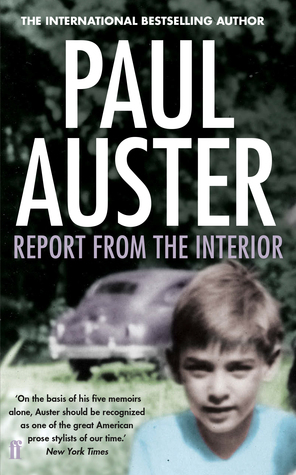 In the first 100-page section Auster highlights key moments from the inner life of a child. For instance, he remembers that the epiphany that a writer can inhabit another mind came while reading Robert Louis Stevenson’s poetry, and he emulated RLS in his own first poetic attempts. The history and pop culture of the 1950s, understanding that he was Jewish, and reaping the creative rewards of boredom are other themes. I especially liked a final anecdote about smashing his seventh-grade teacher’s reading challenge and being driven to tears when the man disbelieved that he’d read so many books and accused him of cheating.
Other sections give long commentary on two films (something he also does in Winter Journal with 10 pages on the 1950 film D.O.A.), select from letters he wrote to his first wife in the late 1960s while living in Paris, and collect an album of black-and-white period images such as ads, film stills and newspaper photographs. There’s a strong nostalgia element, such that the memoir would appeal to Auster’s contemporaries and those interested in learning about growing up in the 1950s.
Ultimately, though, this feels unnecessary after Winter Journal. Auster repeats a circular aphorism he wrote at age 20: “The world is in my head. My body is in the world. You will stand by that paradox, which was an attempt to capture the strange doubleness of being alive, the inexorable union of inner and outer”. But I’m not sure that body and mind can be so tidily separated as these two works posit. I got more of an overall sense of Auster’s character from the previous book, even though it was ostensibly focused on his physical existence. 
The library at the university where my husband works holds another four Auster novels, but I’ll wait until next year to dive back into his work. After reading other people’s reviews, I’m now most keen to try The Brooklyn Follies, Invisible and In the Country of Last Things.
Have you tried anything by Paul Auster this week?
Classic of the Month: Period Piece by Gwen Raverat (1952)
Later today we’re making a pilgrimage to Bookbarn International,* one of my favorite secondhand bookshops in the UK, on the way (ish) to seeing friends in Bristol and Exeter for the weekend. In the past we’ve managed to drop in to Bookbarn annually, but it’s been nearly 2.5 years since our last visit. At that special Harvest Supper and Scrabble** tournament in October 2017 (which I wrote about here), I got to meet William Pryor, the chairman of Bookbarn, and he gave me a copy of his grandmother Gwen Raverat’s memoir, Period Piece.
 Raverat was a granddaughter of Charles Darwin (the first child of his son George) but never got to meet him as he died three years before her birth. Her book has the subtitle “A Cambridge Childhood,” which perfectly conveys the aim. This is not a comprehensive family history or autobiography, but a portrait of what it was like to grow up in a particular time and place. Raverat was born in 1885, but she begins two years earlier, when her American mother, Maud Du Puy, was 21 and in England for the first time to spend a summer with her great-aunt and -uncle. She had three suitors during that time, all of them Fellows of Trinity College. The rules had only just been changed to allow Fellows to marry, so George Darwin would be among the first married members, and Gwen was in the first batch of offspring.
Period Piece is a charming, witty look at daily life from the 1880s through about 1909 – ending with the marriage of her cousin Frances, which seemed to signal a definitive end to their collective youth. Raverat focuses on everyday sights and sounds but also points out life’s little absurdities. She proceeds thematically rather than chronologically, taking up topics like her mother’s parenting theories; her boarding school education and budding love of art; visits to Grandmamma at Down House, Kent; childhood fears and ghost stories; the five Darwin uncles; religion; sports and games; clothing; and social events such as dances.

Raverat’s childhood home in Cambridge, now part of Darwin College, University of Cambridge. CC BY-SA (https://creativecommons.org/licenses/by-sa/2.5).
Writing towards the end of her life and in the middle of the twentieth century, Raverat neatly draws contrasts between old-fashioned propriety and modern mores. For example, as a child she was often called upon to act as a chaperone to courting couples, and when ladies boated past a watering hole where boys swam naked, they would cover their faces with parasols. She herself managed to avoid the matter of sex entirely until she was an adult, though she does remember looking to an encyclopedia to find out where babies come from.
The utter reliance on servants, a profusion of buttons on every garment, and forced trips to church are a few elements that might strike today’s readers as alien. One incident felt eerily contemporary to me, though: once, walking home alone at around 10 p.m., Gwen saw a gang of dodgy-looking undergraduates carrying a drunk or dead young woman down the street and into a pub. After much internal debate, she decided not to say a word about it to her parents.
I often wonder how novelists and filmmakers get a historical setting just right. The answer is, probably by reading books like this one that so clearly convey quotidian details most people would leave out, e.g. a list of every piece of clothing a lady wore or a rundown of the steps to getting her mother out the door to catch the 8:30 train for a day out in London. Those who have visited or lived in Cambridge will no doubt enjoy spotting familiar locations. There are also amusing cameo appearances from Virginia Stephen (Woolf) and E.M. Forster.
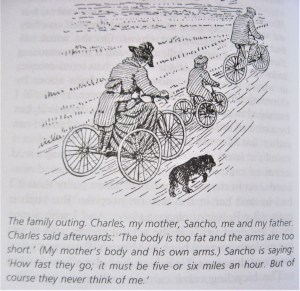 Raverat, a wood engraver, peppered Period Piece with her own illustrations (I have photographed one favorite, at left, but you can see them all in the archive here) – a lovely supplement to the highly visual text. Not just an invaluable record of domestic history, this is a very funny and impressively thorough memoir that could be used by anyone as a model for how to capture childhood. It has never been out of print, and still deserves to be widely read.
*They’ve recently had a renovation that I helped to crowdfund; I’m looking forward to seeing the results. I’ll also be sure to report back on my book haul.
**I was especially delighted to see that the Darwin family had a favorite word-making game, described in the middle of the “Sport” chapter, that sounds a fair bit like Scrabble – except that you only added one letter at a time and could scramble the letters to change the meaning.
Some favorite lines:
(describing one of her mother’s early letters home to America) “They got [rooms for the night] at last at ‘the St Pancreas Hotel’. I was delighted to find this spelling so early, as, to the end of her days, my mother always considered the saint and the internal organ as identical.”
(of their French nurserymaids) “By a provision of Providence they were always called Eugenie, so that when a new one came she could be called Newgenie.”
“The faint flavour of the ghost of my grandfather hung in a friendly way about the whole place [Down] – house, garden and all. … In fact, he was obviously in the same category as God and Father Christmas.”
My rating: 
I read the 2014 Collector’s Library edition, an attractive pocket-sized book with gilt edging and a built-in red ribbon bookmark.

Exploring Darkness and Light: Nonfiction by Gaw, Geddes and May
I’ve recently read a number of books that engage with topics of sunlight, darkness and the winter, exploring all the practical implications of the season and the night sky as well as their metaphorical associations. (See also: my review of An Ode to Darkness by Sigri Sandberg.)
Two of these are brand new as of this month; the other came out in paperback late last year and was one of my Christmas gifts.
Under the Stars: A Journey into Light by Matt Gaw (2020)
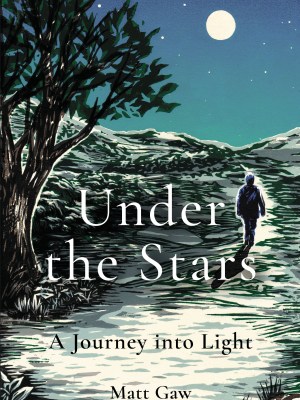 I very much enjoyed Matt Gaw’s The Pull of the River (2018), a jolly yet reflective travelogue of canoe trips down Britain’s rivers. His follow-up nature book is broader in focus but again rooted in on-the-ground knowledge, chiefly gained through a series of night walks. He travels everywhere from London to Isle of Coll, a Dark Sky Community in Scotland’s Inner Hebrides, to compare the quality of darkness and to ponder the emotions these places elicit at night. Fear of darkness feels innate, while for him the stars are almost overwhelming.
In London and in Bury St Edmunds, where he lives, Gaw observes that cities seem removed from nature and that artificial illumination is causing light pollution that negatively affects flora and fauna. At the beach or in Dartmoor or Scotland, though, being outside at night allowed him to feel “part of the natural world in a way that I rarely have during the day. … To be open to the night, to welcome it, embrace it, rather than shut it out, does bring with it an extra richness. To walk at night has been a night twice lived.”
Whether making a jaunt to a 24-hour supermarket after hearing a tawny owl or awaking to a cow nibbling at his sleeping bag on Coll, Gaw is an entertaining and knowledgeable tour guide through the nature of night. I admire his writing and hope that with this second book he will continue to find the wider audience he deserves. Under the Stars covers a lot of ground in under 200 pages and would be a perfect primer for someone looking forward to the supermoon on March 9th.
A favorite passage:
“Over the horizon of the North Sea comes the moon. First a glow. Then a pale, pinkish cuticle that swells into a weakling light. It continues to rise, an ever-expanding, ever-brightening island, until after only a couple of minutes she tears away from the membrane of water, dripping light onto the earth, shining back at the sunken sun. The birth of the full moon.”
Under the Stars is published by Elliott & Thompson today, February 20th. My thanks to the publisher for the free copy for review.
Chasing the Sun: The new science of sunlight and how it shapes our bodies and minds by Linda Geddes (2019)
 Circadian rhythms govern just about every bodily process, from blood pressure to digestion, so even minor changes in our sleep and sunlight exposure can have drastic effects. Like Matthew Walker’s Why We Sleep, this is a book chock-full of facts that should be common sense, yet are more like a body of knowledge we have lost as we have become disconnected from natural human behavioral patterns. We weren’t meant to work nights, or to stay awake for many hours in the glow of artificial light after the sun has gone down on a winter’s day.
Geddes experiments with making do with only candlelight after sunset for several weeks. She also investigates seasonal affective disorder and “circadian lighting,” surveys the history of sunlight as a medical treatment, gives practical advice for minimizing jet lag, and weighs the case for abolishing daylight savings time. Whether you’re a regular reader of popular science or not, you should pick up this concise and highly readable book by a science journalist; it delves into topics that affect us all. It’s one to keep on the shelf and refer to the next time you cross time zones or change your work schedule.
Wintering: How I learned to flourish when life became frozen by Katherine May (2020)
 May’s sympathetic memoir considers winter not only as a literal season, but also as an emotional state. Although “depression” could be substituted for “wintering” in most instances, the book gets much metaphorical mileage out of the seasonal reference as she recounts how she attempted to embrace rather than resist the gloom and chill through rituals such as a candlelit St. Lucia service and an early morning solstice gathering at Stonehenge. Wintering alternates travel and research, and mind and body. Cold-water swimming becomes the author’s primary strategy for invigorating a winter-fogged brain and frozen limbs. (My full review will appear in a forthcoming issue of the Times Literary Supplement.)
Wintering was published by Rider Books on February 6th. My thanks to the publisher for the free copy for review.
Paul Auster Reading Week: Winter Journal & The New York Trilogy
Before this year, I’d read only one book by Paul Auster: Timbuktu, which fit into last year’s all-animal 20 Books of Summer for its canine main character. This year I’ve enjoyed having Annabel’s Paul Auster Reading Week as an excuse to binge on more Auster, including one of his memoirs, Winter Journal, and his most famous set of novels, the New York Trilogy. I’m reading another two Auster books, one fiction and nonfiction, and will see if I can finish and write them up before the week ends.

Winter Journal (2012)
This is one of the most remarkable memoirs I’ve ever read. Approaching age 64 and the winter of his life, Auster decided to assemble his most visceral memories. Here he parades them past in a seemingly random order yet manages to give a sense of the sweep of his life. The use of the second person draws readers in to (re-)experience things along with the author, while also creating an artistic distance between the subject and his reminiscences. Auster describes his aim thus:
Time is running out, after all. Perhaps it is just as well to put aside your stories for now and try to examine what it has felt like to live inside this body from the first day you can remember being alive until this one. A catalogue of sensory data. What one might call a phenomenology of breathing.
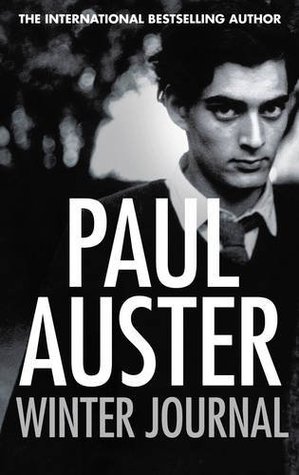 His life reappears through scars, through accidents and near-misses, through what his hands felt and his eyes observed. A three-year-old rips his cheek open on a protruding nail in a department store. A teenager slowly builds up a portfolio of sexual experiences. A young man lives and works in Paris and the South of France. A marriage to one fellow author (Lydia Davis) ends and a relationship with another (Siri Hustvedt) begins. A fiftysomething rushing to get home to the toilet makes an ill-advised turn against traffic and totals his car – luckily, he and his family escape unhurt. Numbness after his mother’s death cedes to a panic attack.
I particularly enjoyed the 53-page section in which Auster gives tours through the 21 places he’s lived since infancy, recounting the details he remembers of the dwellings and what happened during his time there. It’s impressive how much he can condense, but also how much he can convey in just a few pages on each home. This is the sort of format I could imagine borrowing for a short autobiographical piece – it would be a way of redeeming that involuntarily nomadic period when my husband and I moved every six to 18 months.
Reading this alongside the New York Trilogy allowed me to spot the ways, big and small, in which those novels draw on Auster’s life story. I’m now keen to read more of his nonfiction, especially The Invention of Solitude, which offended his relatives by revealing the shameful family story of how his grandmother shot and killed his grandfather in their kitchen.
Annabel says: “The book is written in the second person – addressing himself; it gives a real sense of intimacy to his story. … Auster is an unconventional, analytical and eloquent writer, and this unconventional memoir was a delight to read, he can look with humour at himself as well as being serious.”
Laura F. says: “You know how people say they’d read anything by their favourite author, even a grocery list? Winter Journal gets pretty close to that territory. … I’ve never read a memoir like this, and though focused on the physical, it’s a fully emotional experience.”
Some favorite lines:
“as long as you continue to travel, the nowhere that lies between the here of home and the there of somewhere else will continue to be one of the places where you live.”
“We are all aliens to ourselves, and if we have any sense of who we are, it is only because we live inside the eyes of others.”
“you can only conclude that every life is marked by a number of close calls, that everyone who manages to reach the age you have come to now has already wriggled out of a number of potentially absurd, nonsensical deaths. All in the course of what you would call ordinary life.”
Readalikes: I Am, I Am, I Am by Maggie O’Farrell & The Lost Properties of Love by Sophie Ratcliffe
The New York Trilogy
(also my Doorstopper of the Month at 580 pages)
City of Glass (1985)
 A metafictional mystery about a crime writer named Daniel Quinn who turns private investigator when he gets a phone call asking for the Paul Auster Detective Agency. This is one of those books where what actually happens is a lot less important than the atmosphere it creates. So what feels essential to me here is the sense of a labyrinthine New York City and a confusion of languages and relationships. Quinn, who is helpfully untethered after the death of his wife and son, is hired to tail Peter Stillman’s father, who has recently been released from a mental hospital, where he was sentenced after being judged insane for keeping his son in isolation in a dark apartment for nine years.
Feral children, maps, eggs, the Tower of Babel and Don Quixote are some of the recurring sources of metaphors in a deliberately disorienting and intertextually rich short novel that kept me turning the pages even when I didn’t know precisely what was going on. We get a glimpse of Auster himself, and are invited to muse on such tiny subjects as destiny, the limitations of language, the purpose of books, and the nature of truth. I’m curious to see whether the other two novels follow on from the story at all or just resemble it thematically.
Ghosts (1986)
I jumped straight into this from City of Glass, and it suffered by comparison. It is not a sequel per se, because it has different characters and is set in the late 1940s instead of the early 1980s, but it shares some of the same concerns (with literature, identity, doubling, the essential otherness of the writer, and so on) and again is a sort of metafictional mystery.
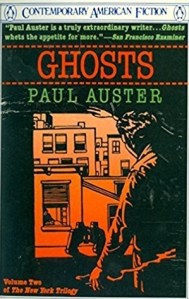 Part of why I couldn’t take this novella entirely seriously is the silly naming: White hires Blue to trail Black (really; all of the secondary characters are named after colors, too). It turns out Black is a writer who does little besides sit in his apartment, writing. Only when Blue disguises himself as a tramp and then as a salesman and meets Black in various other contexts does he realize that Black, too, is an investigator … writing up a case of following a writer who hardly leaves his desk.
While I appreciated the circularity and the uncertainty over whether these accidental twins would destroy each other, as well as the literary references to Whitman, Thoreau and Hawthorne, the whole felt slightly inconsequential (“Blue watches Black, and little of anything happens.”). Plotlessness is part of the point, but makes for only a moderately interesting read.
[There is one coded reference to Auster here: the fact that the book opens on February 3, 1947, the day he was born.]
The Locked Room (1986)
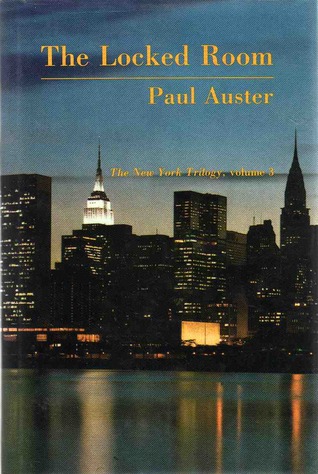 While most of the New York Trilogy is told in the third person, this is a first-person narrative that seems to pick up where City of Glass left off. It begins in 1977, when the unnamed narrator gets a letter from Sophie Fanshawe, the wife of his childhood best friend, telling him that Fanshawe disappeared six months ago, and despite the best efforts of a detective, Quinn (in another link to CoG, the narrator encounters Peter Stillman on a later trip to Paris), no trace can be found. The narrator has been named Fanshawe’s literary executor and takes it upon himself to get the man’s unpublished work out into the world: plays are produced, novels are published. He also starts writing a biography of the friend he always envied.
Except it’s more like he’s becoming Fanshawe, especially when he marries Sophie. Doubling has been a major theme of the trilogy, and here the metaphorical kill-or-be-killed situation seems to turn literal at the conclusion, which I didn’t particularly understand (e.g. he acquires and destroys a red notebook – is this in some way meant to be the same red notebook Quinn left behind at the end of CoG?). The narrator presents himself as the author of all three books, and asserts, “These three stories are finally the same story, but each one represents a different stage in my awareness of what it is about. I don’t claim to have solved any problems.”
The metafictional aspect of this novel is that Fanshawe’s early life is a lot like Auster’s as revealed in Winter Journal, while Sophie’s resembles his wife Siri Hustvedt’s (and the pair would later name their daughter Sophie). 
 Themes of the trilogy:
- Identity complications, including disguises, doubles and substitutes
- Writers and writing; the creator versus characters
- The limits of language (e.g. Stillman’s monologue in CoG is astonishing)
- Freedom/randomness versus fate
One representative passage from each volume:
- “New York was an inexhaustible space, a labyrinth of endless steps, and no matter how far he walked, no matter how well he came to know its neighbourhoods and streets, it always left him with the feeling of being lost. Lost, not only in the city, but within himself as well. … New York was the nowhere he had built around himself” (City of Glass)
- “Writing is a solitary business. It takes over your life. In some sense, a writer has no life of his own. Even when he’s there, he’s not really there. / Another ghost. / Exactly.” (Ghosts)
- “In the end, each life is no more than the sum of contingent facts, a chronicle of chance intersections, of flukes, of random events that divulge nothing but their own lack of purpose.” (The Locked Room)
My rating for the trilogy as a whole:
Have you tried anything by Paul Auster? Grab one of his books and join us for this week’s readalong!
Adventures in Rereading: A. S. Byatt and Abigail Thomas
At the end of last year, I picked out a whole shelf’s worth of books I’ve been meaning to reread. I know that others of you are devoted re-readers, returning to childhood favorites for comfort or poring over admired novels two or three times to figure out how they work. Alas, I’m usually resistant to rereading because I feel like it takes away time that I could be spending reading new or at least new-to-me books. Yet along with the nostalgia there is also a certain relief to returning to a favorite: here’s a book that is guaranteed not to disappoint.
So far this year I’ve finished two rereads, and I’m partway through a third. I’m not managing the one-every-other-week pace I would need to keep up to get through the whole shelf this year, but for me this is still good progress. I’ll report regularly on my experience of rereading.
The Matisse Stories by A. S. Byatt (1993)
Byatt is my favorite author. My memory for individual short stories is pitiful, yet I have never forgotten the first of three stories in this volume, so I focus on it here with a close rereading. In “Medusa’s Ankles,” a middle-aged woman goes berserk in a hair salon but it all turns out fine. I remember imagining what that would be like: to let go, to behave badly with no thought for others’ opinions, to act purely on instinct – and for there to be no consequences.
I’d forgotten all the particulars of the event. Susannah, a linguist, is drawn to the salon by the Rosy Nude reproduction she sees through the window. She becomes a reluctant receptacle for her stylist Lucian’s stories, including tales of his wife’s fat ankles and his mistress’ greater appeal. He confides in her his plan to run away. “I don’t want to put the best years of my life into making suburban old dears presentable. I want something more.”
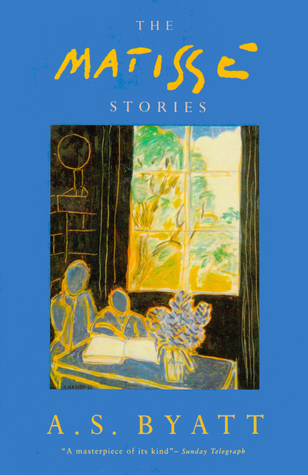 Susannah holds in all her contempt for Lucian and his hip shop redesign until the day he fobs her off on another stylist – even though she’s said she needs an especially careful job this time because she is to appear on TV to accept the Translator’s Medal. When Deirdre is done, Susannah forgets about English politeness and says just what she thinks: “It’s horrible. I look like a middle-aged woman with a hair-do.” (Never mind that that’s exactly what she is.)
In a whirlwind of fury, she trashes the salon. Byatt describes the aftermath, indulging her trademark love of colors: “It was a strange empty battlefield, full of glittering fragments and sweet-smelling rivulets and puddles of venous-blue and fuchsia-red unguents, patches of crimson-streaked foam and odd intense spills of orange henna or cobalt and copper.”
You can just imagine the atmosphere in the salon: everyone exchanging horrified looks and cautiously approaching Susannah as if she’s a dangerous dog. Lucian steps in to reassure her: “We all feel like that, sometimes. Most of us don’t dare. … The insurance’ll pay. Don’t worry. … You’ve done me a good turn in a way.” Maybe he’ll go off with his girlfriend and start a new business, after all. Predictably, the man has made it all about him.
The ironic kicker to this perfect story about middle age and female rage comes after Susannah goes home to a husband we hadn’t heard about yet. “He saw her. (Usually he did not.) ‘You look different. You’ve had your hair done. I like it. You look lovely. It takes twenty years off you. You should have it done more often.’”
“Art Work” briefly, unnecessarily, uses a Matisse painting as a jumping-off point. A bourgeois couple, a painter and magazine design editor, hire Mrs. Brown, a black woman, to clean their house and are flabbergasted when she turns out to be an artist in her own right. “The Chinese Lobster,” the final story, is the only one explicitly about Matisse. An academic dean invites her colleague out to lunch at a Chinese restaurant to discuss a troubled student he’s supervising. This young woman has eating disorders and is doing a portfolio of artwork plus a dissertation on Matisse’s treatment of female bodies. Her work isn’t up to scratch, and now she’s accused her elderly supervisor of sexual harassment. The racial and sexual politics of these two stories don’t quite hold up, though both are well constructed.
I reread the book in one morning sitting last week.
My original rating (c. 2005):
My rating now: 
A Three Dog Life by Abigail Thomas (2006)
In April 2000 Thomas’s husband Rich was hit by a car and incurred a traumatic brain injury when their dog Harry got off the leash and Rich ran out into the road near their New York City home to save him. It was a miracle that Rich lived, but his disability was severe enough that he had to be moved to an upstate nursing home. This is one of the first memoirs I ever remember reading, and it made a big impression. I don’t think I realized at the time that it was written in discrete essays, many of which were first published in magazines and anthologies. It represents an advance on the highly fragmentary nature of her first memoir, Safekeeping.
 Thomas maintains a delicate balance of emotions: between guilt every time she bids Rich goodbye in the nursing home and relief that she doesn’t have to care for him 24/7; between missing the life they had and loving the cozy one she’s built on her own with her three dogs. (The title is how Aborigines refer to the coldest nights.) As in One Hundred Names for Love and All Things Consoled, Rich’s aphasia produces moments of unexpectedly poetic insight.
Before rereading I remembered one phrase and one incident (though I’d thought the latter was from Safekeeping): doctors described Rich’s skull as “shattered like an eggshell,” and Thomas remembers a time she was driving and saw the car ahead hit a raccoon; she automatically swerved to avoid the animal, but saw in her rearview mirror that it was still alive and realized the compassionate thing would have been to run it over again. I’ve never forgotten these disturbing images.
Unassuming and heart on sleeve, Thomas wrote one of the most beautiful books out there about loss and memory. I’d recommend this to fans of Anne Lamott and readers of bereavement memoirs in general. This is what I wanted from the rereading experience: to find a book that was even better the second time around.
My original rating (c. 2006):
My rating now:
Currently rereading: Flaubert’s Parrot by Julian Barnes
Considering rereading next: On Beauty by Zadie Smith
Done any rereading lately?
Two Recommended January Releases: Dominicana and Let Me Be Frank
Much as I’d like to review books in advance of their release dates, that doesn’t seem to be how things are going this year. I hope readers will find it useful to learn about recent releases they might have missed.
This month I’m featuring a fictionalized immigration story from the Dominican Republic and a collection of autobiographical comics by a New Zealander.
Dominicana by Angie Cruz
(Published by John Murray on the 23rd)
It’s easy to assume that all the immigration (or Holocaust, or WWI; whatever) stories have been told. This is proof that that is not true; it felt completely fresh to me. Ana Canción is 11 when Juan Ruiz first proposes to her in 1961 – the same year dictator Rafael Trujillo is assassinated, throwing their native Dominican Republic into chaos. The Ruiz brothers are admired for their entrepreneurial spirit; they jet back and forth to New York City to earn money they plan to invest in a restaurant back home. To Ana’s parents, pairing their daughter with a man with such good prospects makes financial sense, so though Ana doesn’t love him and knows nothing about sex, she finds herself married to Juan at age 15. With fake papers that claim she’s 19, she arrives in New York on the first day of 1965 to start a new life.
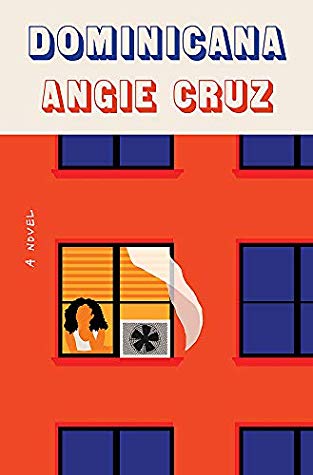 It is not the idyll she expected. Ana often feels confused and isolated in their tiny apartment, and the political unrest in NYC (e.g. the assassination of Malcolm X) and in DR mirrors the turbulence of her marriage. Juan is violent and unfaithful, and although Ana dreams of leaving him she soon learns that she is pregnant and has to think of her duty to her family, who expect to join her in America. The content of the novel could have felt like heavy going, but Ana is such a plucky and confiding narrator that you’re drawn into her world and cheer for her as she comes up with ways to earn money of her own (such as selling pastelitos to homesick factory workers and at the World’s Fair) and figures out what she wants from life.
This allowed me to imagine what it would be like to have an arranged marriage and arrive in a country not knowing a word of the language. Cruz based the story on her mother’s experience, even though her mother thought her life was too common and boring to interest anyone. The literary style – short chapters with no speech marks – could be offputting for some but worked for me, and I loved the tongue-in-cheek references to I Love Lucy. Had I only managed to read this in December, it would have been on my Best of 2019 list – it was first published in September by Flatiron Books, USA.
Let Me Be Frank by Sarah Laing
(Published by Lightning Books on the 16th)
 Laing is a novelist and comics artist from New Zealand known for her previous graphic memoir, Mansfield and Me, about her obsession with acclaimed NZ writer Katherine Mansfield. This collection brings together the autobiographical comics that originally appeared on Laing’s blog of the same title in 2010‒19. She started posting the comics when she was writer-in-residence at the Frank Sargeson Centre in Auckland. (I know the name Sargeson because he helped Janet Frame when she was early in her career.)
So what is the book about? All of life, really: growing up with type 1 diabetes, having boyfriends, being part of a family, the constant niggle of body issues, struggling as a writer, and trying to be a good mother. Other specific topics include her teenage obsession with music (especially Morrissey) and her run-ins with various animals (a surprising number of dead possums!). She ruminates about the times when she hasn’t done enough to help people who were in trouble. She also admits her confusion about fashion: she is always looking for, but never finding, ‘her look’. And is she modeling a proper female identity for her children? “I feel like I’m betraying feminism, buying my daughter a fairy princess dress,” she frets.


But even as she expresses these worries, she wonders how genuine she can be since they form the basis of her art. Is she just “publically performing my neuroses”? The work/life divide is especially tricksy when your life inspires your work.


I took half a month to read these comics on screen, usually just a few pages a day. It’s a tough book to assess as a whole because there is such a difference between the full-color segments and the sketch-like black-and-white ones. There is also a ‘warts-and-all’ approach here, with typos and cross-outs kept in. (Two that made me laugh were “aesophegus” [for oesophagus] and “Diana Anthill”!) Overall, though, I think this is a relatable and fun book that would suit fans of Alison Bechdel and Roz Chast but should also draw in readers new to the graphic novel format.
My thanks to Eye/Lightning Books for sending me an e-book to review.
What recent releases can you recommend?
11 Days, 11 Books: 2020’s Reads, from Best to Worst
I happen to have finished 11 books so far this year – though a number of them were started in 2019 (one as far back as September) and several of them are novelty books and/or of novella length. Just for kicks, I’ve arranged them from best to worst. Here’s how my reading year has started off…
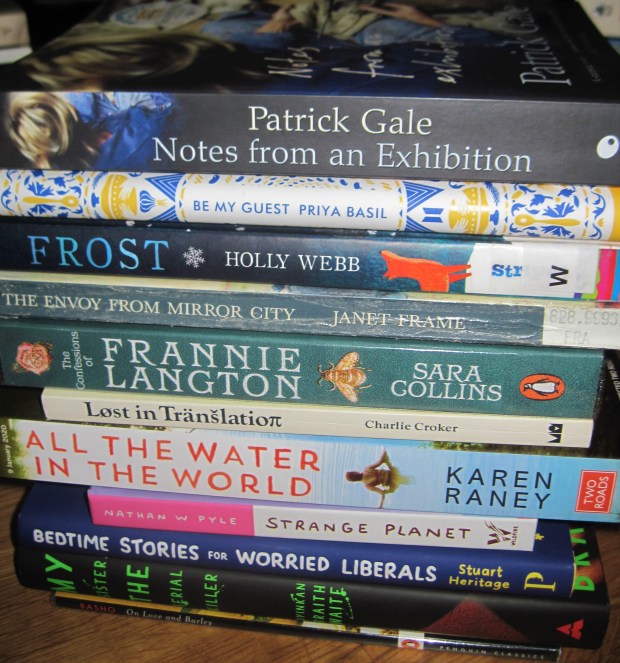
 Notes from an Exhibition by Patrick Gale – Nonlinear chapters give snapshots of the life of bipolar Cornwall artist Rachel Kelly and her interactions with her husband and four children, all of whom are desperate to earn her love. Quakerism, with its emphasis on silence and the inner light in everyone, sets up a calm and compassionate atmosphere, but also allows for family secrets to proliferate. There are two cameo appearances by an intimidating Dame Barbara Hepworth, and three wonderfully horrible scenes in which Rachel gives a child a birthday outing. The novel questions patterns of inheritance (e.g. of talent and mental illness) and whether happiness is possible in such a mixed-up family. (Our joint highest book club rating ever, with Red Dust Road. We all said we’d read more by Gale.)
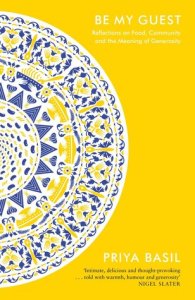 Be My Guest: Reflections on Food, Community and the Meaning of Generosity by Priya Basil – An extended essay whose overarching theme of hospitality stretches into many different topics. Part of an Indian family that has lived in Kenya and England, Basil is used to a culture of culinary abundance. Greed, especially for food, feels like her natural state, she acknowledges. However, living in Berlin has given her a greater awareness of the suffering of the Other – hundreds of thousands of refugees have entered the EU, often to be met with hostility. Yet the Sikhism she grew up in teaches unconditional kindness to strangers. She asks herself, and readers, how to cultivate the spirit of generosity. Clearly written and thought-provoking. (And typeset in Mrs Eaves, one of my favorite fonts.) See also Susan’s review, which convinced me to order a copy with my Christmas bookstore voucher.
 Frost by Holly Webb – Part of a winter animals series by a prolific children’s author, this combines historical fiction and fantasy in an utterly charming way. Cassie is a middle child who always feels left out of her big brother’s games, but befriending a fox cub who lives on scrubby ground near her London flat gives her a chance for adventures of her own. One winter night, Frost the fox leads Cassie down the road – and back in time to the Frost Fair of 1683 on the frozen Thames. I rarely read middle-grade fiction, but this was worth making an exception for. It’s probably intended for ages eight to 12, yet I enjoyed it at 36. My library copy smelled like strawberry lip gloss, which was somehow just right.
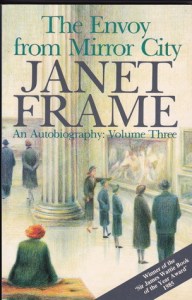 The Envoy from Mirror City by Janet Frame – This is the last and least enjoyable volume of Frame’s autobiography, but as a whole the trilogy is an impressive achievement. Never dwelling on unnecessary details, she conveys the essence of what it is to be (Book 1) a child, (2) a ‘mad’ person, and (3) a writer. After years in mental hospitals for presumed schizophrenia, Frame was awarded a travel fellowship to London and Ibiza. Her seven years away from New Zealand were a prolific period as, with the exception of breaks to go to films and galleries, and one obsessive relationship that nearly led to pregnancy out of wedlock, she did little else besides write. The title is her term for the imagination, which leads us to see Plato’s ideals of what might be.
 The Confessions of Frannie Langton by Sara Collins – Collins won the first novel category of the Costa Awards for this story of a black maid on trial in 1826 London for the murder of her employers, the Benhams. Margaret Atwood hit the nail on the head in a tweet describing the book as “Wide Sargasso Sea meets Beloved meets Alias Grace” (she’s such a legend she can get away with being self-referential). Back in Jamaica, Frances was a house slave and learned to read and write. This enabled her to assist Langton in recording his observations of Negro anatomy. Amateur medical experimentation and opium addiction were subplots that captivated me more than Frannie’s affair with Marguerite Benham and even the question of her guilt. However, time and place are conveyed convincingly, and the voice is strong.
(The next one is a book my husband received for Christmas, as are the Heritage and Pyle, further down, which were from me. Yes, I read them as well. What of it?)
 Lost in Translation by Charlie Croker – This has had us in tears of laughter. It lists examples of English being misused abroad, e.g. on signs, instructions and product marketing. China and Japan are the worst repeat offenders, but there are hilarious examples from around the world. Croker has divided the book into thematic chapters, so the weird translated phrases and downright gobbledygook are grouped around topics like food, hotels and medical advice. A lot of times you can see why mistakes came about, through the choice of almost-but-not-quite-right synonyms or literal interpretation of a saying, but sometimes the mind boggles. Two favorites: (in an Austrian hotel) “Not to perambulate the corridors in the hours of repose in the boots of ascension” and (on a menu in Macao) “Utmost of chicken fried in bother.”
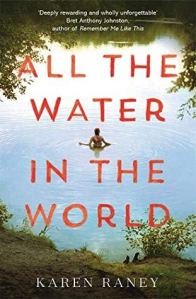 All the Water in the World by Karen Raney – Like The Fault in Our Stars (though not YA), this is about a teen with cancer. Sixteen-year-old Maddy is eager for everything life has to offer, so we see her having her first relationship – with Jack, her co-conspirator on an animation project to be used in an environmental protest – and contacting Antonio, the father she never met. Sections alternate narration between her and her mother, Eve. I loved the suburban D.C. setting and the e-mails between Maddy and Antonio. Maddy’s voice is sweet yet sharp, and, given that the main story is set in 2011, the environmentalism theme seems to anticipate last year’s flowering of youth participation. However, about halfway through there’s a ‘big reveal’ that fell flat for me because I’d guessed it from the beginning.
This was published on the 9th. My thanks to Two Roads for the proof copy for review.
 Strange Planet by Nathan W. Pyle – I love these simple cartoons about aliens and the sense they manage to make of Earth and its rituals. The humor mostly rests in their clinical synonyms for everyday objects and activities (parenting, exercise, emotions, birthdays, office life, etc.). Pyle definitely had fun with a thesaurus while putting these together. It’s also about gentle mockery of the things we think of as normal: consider them from one remove, and they can be awfully strange. My favorites are still about the cat. You can also see his work on Instagram.

 Bedtime Stories for Worried Liberals by Stuart Heritage – I bought this for my husband purely for the title, which couldn’t be more apt for him. The stories, a mix of adapted fairy tales and new setups, are mostly up-to-the-minute takes on US and UK politics, along with some digs at contemporary hipster culture and social media obsession. Heritage quite cleverly imitates the manner of speaking of both Boris Johnson and Donald Trump. By its nature, though, the book will only work for those who know the context (so I can’t see it succeeding outside the UK) and will have a short shelf life as the situations it mocks will eventually fade into collective memory. So, amusing but not built to last. I particularly liked “The Night Before Brexmas” and its all-too-recognizable picture of intergenerational strife.
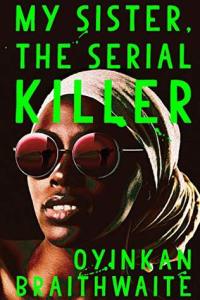 My Sister, the Serial Killer by Oyinkan Braithwaite – The Booker Prize longlist and the Women’s Prize shortlist? You must be kidding me! The plot is enjoyable enough: a Nigerian nurse named Korede finds herself complicit in covering up her gorgeous little sister Ayoola’s crimes – her boyfriends just seem to end up dead somehow; what a shame! – but things get complicated when Ayoola starts dating the doctor Korede has a crush on and the comatose patient to whom Korede had been pouring out her troubles wakes up. My issue was mostly with the jejune writing, which falls somewhere between high school literary magazine and television soap (e.g. “My hands are cold, so I rub them on my jeans” & “I have found that the best way to take your mind off something is to binge-watch TV shows”).
 On Love and Barley – Haiku of Basho [trans. from the Japanese by Lucien Stryk] – These hardly work in translation. Almost every poem requires a contextual note on Japan’s geography, flora and fauna, or traditions; as these were collected at the end but there were no footnote symbols, I didn’t know to look for them, so by the time I read them it was too late. However, here are two that resonated, with messages about Zen Buddhism and depression, respectively: “Skylark on moor – / sweet song / of non-attachment.” (#83) and “Muddy sake, black rice – sick of the cherry / sick of the world.” (#221; reminds me of Samuel Johnson’s “tired of London, tired of life” maxim). My favorite, for personal relevance, was “Now cat’s done / mewing, bedroom’s / touched by moonlight.” (#24)
Any of these you have read or would read?
Onwards with the 2020 reading!
Some Early Recommendations for 2020
I haven’t done much dipping into 2020 releases yet, but I do have two that I would highly recommend to pretty much anyone, plus some more that are also worth highlighting.
My top recommendations (so far) for 2020:
American Dirt by Jeanine Cummins
[Coming on January 21st from Tinder Press (UK) / Flatiron Books (USA)]
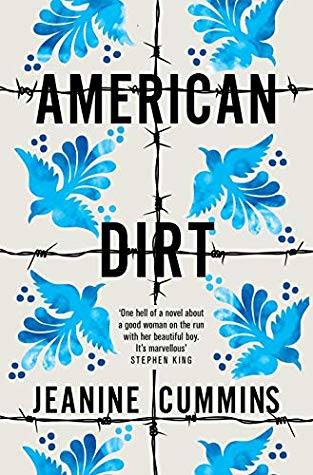 You’ve most likely already heard of this novel about the plight of migrants crossing the U.S. border in search of a better life. What’s interesting is that the main characters are not your typical border crossers: Lydia was a middle-class Acapulco bookshop owner whose journalist husband was murdered for his pieces exposing the local drug cartel. She and her eight-year-old son, Luca, know that the cartel is after them, too, and its informers are everywhere. They join Central American migrants in hopping onto La Bestia, a dangerous freight train network running the length of Mexico. Their fellow travelers’ histories reveal the traumatic situations migrants leave and the hazards they face along the way. Cummins alternates between the compelling perspectives of Lydia and Luca, and the suspense is unrelenting. It feels current and crucial. (My full review will be in Issue 491 of Stylist magazine, so if you are in London or another city that hands it out and can pick up a copy, keep an eye out!)
The Lost Family: How DNA Testing Is Upending Who We Are by Libby Copeland
[Coming on March 3rd from Abrams Press (USA)]
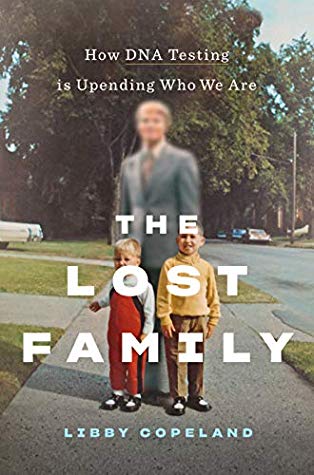 A terrific follow-up to one of my runners-up from last year, Inheritance by Dani Shapiro. I learned that “non-paternity events” such as Shapiro experienced are not as uncommon as you might think. Copeland spoke to scientists, DNA testing companies, and some 400 ordinary people who sent off saliva samples to get their DNA profile and, in many cases, received results they were never expecting. There are stories of secret second families, of people who didn’t find out they were adopted until midlife, and of babies switched at birth. We’ve come a long way since the days when people interested in family history had to trawl through reams of microfilm and wait months or years to learn anything new; nowadays a DNA test can turn up missing relatives within a matter of days. But there are a lot of troubling aspects to this new industry, including privacy concerns, notions of racial identity, and criminal databases. It’s a timely and thought-provoking book, written with all the verve and suspense of fiction.
Also of note (in release date order):
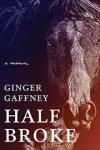 Half Broke: A Memoir by Ginger Gaffney: Horse trainer Gaffney has volunteered at the Delancey Street Foundation’s New Mexico ranch, an alternative prison for drug offenders, for six years. She chronicles how feral horses and humans can help each other heal. Great for fans of Cheryl Strayed. (February 4, W.W. Norton)
 Survival Is a Style: Poems by Christian Wiman: Wiman examines Christian faith in the shadow of cancer. This is the third of his books that I’ve read; I’m consistently impressed by how he makes room for doubt, bitterness and irony, yet a flame of faith remains. Really interesting phrasing and vocabulary here. (February 4, Farrar, Straus and Giroux)
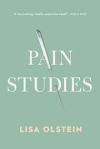 Pain Studies by Lisa Olstein: Another in a growing number of hard-hitting books about female pain. Specifically, Olstein has chronic migraines. In these essays she ranges from ancient philosophy to recent television in her references, and from lists of symptoms to poetic descriptions in her format. A little rambly, but stylish nonetheless. (March 4, Bellevue Literary Press)
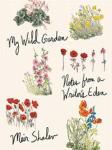 My Wild Garden: Notes from a Writer’s Eden by Meir Shalev: The Israeli novelist tells of how he took a derelict garden in the Jezreel Valley and made it thrive. He blends botanical knowledge with Jewish folklore. I particularly enjoyed his good-natured feud against his local mole rats. Gentle and charming. (March 31, Shocken)
 The Alekizou and His Terrible Library Plot! by Nancy Turgeon: The Alekizou can’t read! Jealous of the fun he sees children having at the library, he breaks in and steals all the vowels. Without them, books and speech don’t make sense. Luckily, the children know sign language and use it to create replacement letters. A fun picture book with rhymes reminiscent of Dr. Seuss, this also teaches children vowels and basic signing. (April 6, CrissCross AppleSauce)
With thanks to the publisher for the free PDF copy for review.
 Why We Swim by Bonnie Tsui: A personal history with swimming, but also a wide-ranging study of humans’ relationship with the water – as a source of food, exercise, healing, competition and enjoyment. Tsui meets scientists, coaches, Olympians and record holders, and recounts some hard-to-believe survival tales. (April 14, Algonquin Books)
 Bookish Beck = Rebecca Foster. American transplant to England. Freelance proofreader and book reviewer.
