Young Writer of the Year Award: Shortlist Reviews and Predictions
Being on the shadow panel for the Sunday Times Young Writer of the Year Award was a bookish highlight of 2017 for me. I’m pleased for this year’s shadow panelists, a couple of whom are blogging friends (one I’ve met IRL), to have had the same opportunity, and I look forward to attending the prize ceremony at the London Library on December 5th.
I happened to have already read two of the shortlisted titles, the poetry collection The Perseverance by Raymond Antrobus and the debut novel Stubborn Archivist by Yara Rodrigues Fowler, which was one of my specific wishes/predictions. The kind folk of FMcM Associates sent me the other two shortlisted books, a short story collection and another debut novel, for blog reviews so that I could follow along with the shadow panel’s deliberations.
Salt Slow by Julia Armfield (2019)
These nine short stories are steeped in myth and magic, but often have a realistic shell. Only gradually do the fantastical or dystopian elements emerge, with the final paragraph delivering a delicious surprise. For instance, the narrator of “Mantis” attends a Catholic girls’ school and is caught up in a typical cycle of self-loathing and obsessing over boys. It’s only at the very end that we realize her extreme skin condition is actually a metamorphosis that enables her to protect herself. The settings are split between the city and the seaside; the perspective is divided almost perfectly down the middle between the first and third person. The body is a site of transformation, or a source of grotesque relics, as in “The Collectables,” in which a PhD student starts amassing body parts she could only have acquired via grave-robbing.
 Two favorites for me were “Formerly Feral,” in which a 13-year-old girl acquires a wolf as a stepsister and increasingly starts to resemble her; and the final, title story, a post-apocalyptic one in which a man and a pregnant woman are alone in a fishing boat, floating above a drowned world and living as if outside of time. This one is really rather terrifying. I also liked “Cassandra After,” in which a dead girlfriend comes back – it reminded me of Margaret Atwood’s The Robber Bride, which I’m currently reading for #MARM. “Stop Your Women’s Ears with Wax,” about a girl group experiencing Beatles-level fandom on a tour of the UK, felt like the odd one out to me in this collection.
Armfield’s prose is punchy, with invented verbs and condensed descriptions that just plain work: “Jenny had taken to poltergeisting round the house”; “skin like fork-clawed cottage cheese,” “the lobster shells gleam a slick vermilion” and “The sky is gory with stars.” There’s no shortage of feminist fantasy stories out there nowadays – Aimee Bender, Kelly Link, Carmen Maria Machado and Karen Russell are just a few others working in this vein – but the writing in Salt Slow really grabbed me even when the plots didn’t. I’ll be following Armfield’s career with interest.
Testament by Kim Sherwood (2018)
Eva Butler is a 24-year-old MA student specializing in documentary filmmaking. She is a live-in carer for her grandfather, the painter Joseph Silk (real name: József Zyyad), in his Fitzroy Park home. When Silk dies early on in the book, she realizes that she knows next to nothing about his past in Hungary. Learning that he wrote a testament about his Second World War experiences for the Jewish Museum in Berlin, she goes at once to read it and is distressed at what she finds. With the help of Felix, the museum’s curator, who did his PhD on Silk’s work, she travels to Budapest to track down the truth about her family.
 Sherwood alternates between Eva’s quest and a recreation of József’s time in wartorn Europe. Cleverly, she renders the past sections more immediate by writing them in the present tense, whereas Eva’s first-person narrative is in the past tense. Although József escaped the worst of the Holocaust by being sentenced to forced labor instead of going to a concentration camp, his brother László and their friend Zuzka were in Theresienstadt, so readers get a more complete picture of the Jewish experience at the time. All three wind up in the Lake District after the war, rebuilding their lives and making decisions that will affect future generations.
It’s almost impossible to write anything new about the Holocaust these days, and overfamiliarity was certainly a roadblock for me here. I was especially reminded of Julie Orringer’s The Invisible Bridge, what with its focus on the Hungarian Jewish experience. However, I did appreciate the way Sherwood draws on her family history – her grandmother is a Hungarian Holocaust survivor – to consider how trauma still affects the second and third generation. This certainly doesn’t feel like a debut novel. It’s highly readable, and the emotional power of the story cannot be denied. The Young Writer of the Year Award is great for highlighting books that risk being overlooked: in a year dominated by The Testaments, poor Testament was otherwise likely to sink without notice.
Note: “Testament” is also the title of the poem written by Sherwood’s great-grandfather that she recited at her grandfather’s funeral – just as Eva does in the novel. It opens this Telegraph essay (paywalled, but reprinted in the paperback of Testament) that Sherwood wrote about her family history.
General thoughts and predictions:
Any of these books would be a worthy winner. However, as Raymond Antrobus has already won this year’s £30,000 Rathbones Folio Prize as well as the 2018 Geoffrey Dearmer Award from the Poetry Society, The Perseverance has had sufficient recognition – plus it’s a woman’s turn. Testament is accomplished, and likely to hold the widest appeal, but it strikes me as the safe choice. Salt Slow would be an edgier selection, and feels quite timely and fresh. But Stubborn Archivist has stuck with me since I reviewed it in March. I called it “Knausgaard for the Sally Rooney generation” and wrote that “the last book to have struck me as truly ‘novel’ in the same way was Lincoln in the Bardo.” From a glance at the shadow panel’s reviews thus far, I fear it may prove too divisive for them, though.
Based on my gut instincts and a bit of canny thinking about the shadow panelists and judges, here are my predictions:
Shadow Panel:
- What they will pick: Testament [but they might surprise me and go with Salt Slow or Stubborn Archivist]
- What they should pick: Salt Slow
Official Judging Panel:
- What they will pick: Stubborn Archivist [but they might surprise me and go with Salt Slow]
- What they should pick: Stubborn Archivist
I understand that the shadow panel is meeting today for their in-person deliberations. I wish them luck! Their pick will be announced on the 28th. I’ll be intrigued to see which book they select, and how it compares with the official winner on December 5th.
Have you read anything from this year’s shortlist?
Women in the Polar Night: Christiane Ritter and Sigri Sandberg
I’m continuing a Nonfiction November focus with reviews of two recently (re-)released memoirs about women spending time in the Arctic north of Norway. I enjoy reading about survival in extreme situations – it’s the best kind of armchair traveling because you don’t have to experience the cold and privation for yourself.
A Woman in the Polar Night by Christiane Ritter (1938; English text, 1954)
[Translated by Jane Degras]
 In 1934, Ritter, an Austrian painter, joined her husband Hermann for a year in Spitsbergen. He’d participated in a scientific expedition and caught the Arctic bug, it seems, for he stayed on to fish and hunt. They shared a small, remote hut with a Norwegian trapper, Karl. Ritter was utterly unprepared for the daily struggle, having expected a year’s cozy retreat: “I could stay by the warm stove in the hut, knit socks, paint from the window, read thick books in the remote quiet and, not least, sleep to my heart’s content.” Before long she was disabused of her rosy vision. “It’s a ghastly country, I think to myself. Nothing but water, fog, and rain.” The stove failed. Dry goods ran out; they relied on fresh seal meat. Would they get enough vitamins? she worried. Every time Hermann and Karl set off hunting, leaving her alone in the hut, she feared they wouldn’t return. And soon the 132 straight days of darkness set in.
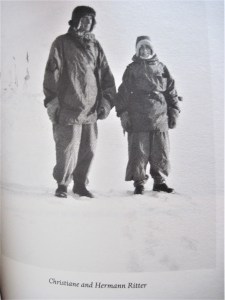 I was fascinated by the details of Ritter’s daily tasks, but also by how her perspective on the landscape changed. No longer a bleak wilderness, it became a tableau of grandeur. “A deep blue-green, the mountains rear up into a turquoise-coloured sky. From the mountaintops broad glaciers glittering in the sun flow down into the fjord.” She thought of the Arctic almost as a site of spiritual pilgrimage, where all that isn’t elemental falls away. “Forgotten are all externals; here everything is concerned with simple being.” The year is as if outside of time: she never reminisces about her life back home, and barely mentions their daughter. By the end you see that the experience has changed her: she’ll never fret over trivial things again. She lived to age 103 (only dying in 2000), so clearly the time in the Arctic did her no harm.
Ritter wrote only this one book. A travel classic, it has never been out of print in German but has been for 50 years in the UK. Pushkin Press is reissuing the English text on the 21st with a foreword by Sara Wheeler, a few period photographs and a hand-drawn map by Neil Gower.
My rating: 
With thanks to Pushkin Press for the free copy for review.
Notes: Michelle Paver drew heavily on this book when creating the setting for Dark Matter. (There’s even a bear post outside the Ritters’ hut.)
I found some photos of the Ritters’ hut here.
(Although I did not plan it this way, this book also ties in with German Literature Month!)
An Ode to Darkness by Sigri Sandberg (2019)
[Translated by Siân Mackie]
Ritter’s book is a jumping-off point for Norwegian journalist Sandberg’s investigation of darkness as both a physical fact and a cultural construct. She travels alone from her home in Oslo to her cabin in the mountains at Finse, 400 miles south of the Arctic Circle. Ninety percent of Norway’s wildlife sleeps through the winter, and she often wishes she could hibernate as well. Although she only commits to five days in the far north compared to Ritter’s year, she experiences the same range of emotions, starting with a primitive fear of nature and the dark.
It is a fundamental truth that darkness does not exist from an astronomical standpoint. Happy fact. I’m willing to accept this. I try to find it comforting, helpful. But I still struggle to completely believe that darkness does not actually exist. Because what does it matter to a small, poorly designed human whether darkness is real or perceived? And what about the black holes in the universe, what about dark matter, what about the night sky and the threats against it, and … and now I’m exhausted. I’m done for the day. I feel so small, and I’m tired of being afraid.
 Over the course of the book she talks to scientists about the human need for sleep and sunshine, discusses solitude and dark sky initiatives, and quotes from a number of poets, especially Jon Fosse, “Norway’s greatest writer,” who often employs metaphors of light and dark: “Deep inside me / … it was like the empty darkness was shining”.
In occasional passages labeled “Christiane” Sandberg also recounts fragments of Ritter’s experiences. I read Sandberg’s book first, so these served as a tantalizing introduction to A Woman in the Polar Night. “Is there anywhere as silent as a white winter plateau on a windless day? And how long can anyone spend alone before they start to feel, like Christiane did, as if their very being is disintegrating?”
This is just the sort of wide-ranging nonfiction I love; it intersperses biographical and autobiographical information with scientific and cultural observations.
 [Another recent book tries to do a similar thing but is less successful – partially due to the author’s youthful optimism, but also due to the rambly, shallow nature of the writing. (My
  review will be in the November 29th issue of the Times Literary Supplement.)]
My rating: 
With thanks to Sphere for the free copy for review.
Related reading: This Cold Heaven: Seven Seasons in Greenland by Gretel Ehrlich
Do you like reading about polar exploration, or life’s extremes in general?
“Being the Expert” on Women’s Religious Memoirs Again: Unfollow & Leaving the Witness
 I’ve fallen behind on the weekly prompts for Nonfiction November, but wanted to post a follow-up to my 2018 list of a baker’s dozen of memoirs I’ve read that explore women’s religious experiences. I’ve read a couple more this year that are worth adding to the list; in addition to their themes of doubt and making a new life outside the church, they also share an interesting detail: it’s an online friend that goads each author into questioning her beliefs. Even if you aren’t typically interested in this subgenre, you’ve likely heard of Unfollow because of the high-profile story behind it. (This week is hosted by Katie of Doing Dewey.)
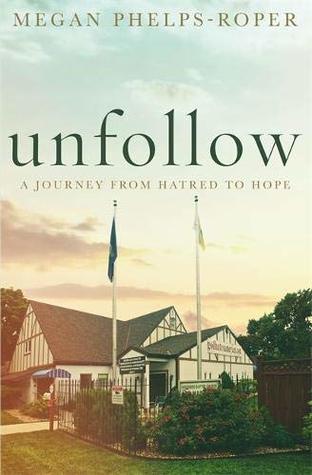
Unfollow: A Journey from Hatred to Hope, Leaving the Westboro Baptist Church by Megan Phelps-Roper
“God hates f*gs.” If you know one thing about Westboro Baptist Church of Topeka, Kansas, it’s that this slogan plastered their signs and was part of their armory of in-your-face chants at nationwide protests.

Fred Phelps in 2002. (User Rudolf 1922 on sv.wikipedia.)
Megan Phelps-Roper grew up in the Church, which was founded by her grandfather, Fred Phelps, and made up mostly of her extended family: Phelps had 13 children, and Phelps-Roper is one of 11. In 1989 Phelps learned that nearby Gage Park was a gay cruising spot and wrote in disgust to the mayor and other city officials. In a sense, he never got over it. The anti-homosexuality message would become Westboro’s trademark, at least until the church started its picketing of military funerals after the Iraq War – which, like 9/11, was interpreted as being God’s just punishment of American immorality.
By portraying it from the inside and recreating her shifting perspective from early childhood onwards, Phelps-Roper initially makes her extreme upbringing seem normal. After all, it’s the only thing she knew, and it never would have occurred to her that her family could be wrong. The Phelpses were fiercely intelligent and also ran a law firm, so it’s impossible to just dismiss them as redneck idiots. Frequent passages from the King James Bible appear in italics to echo the justifications the Church cited for its beliefs and actions.
 Only gradually did doubts start to creep in for the author as various uncles and brothers left the church. Phelps-Roper was even the voice of Westboro on Twitter, but defending funeral protests became increasingly difficult for her. Two things brought her to a breaking point. First, in something of a coup, the Church appointed a new body of elders – all male, of course – who instituted ever more draconian rules, such as a dress code for women, and effectively removed her mother from leadership. (Ultimately, they would kick the dying Fred Phelps himself out of the church.) Secondly, the Church started to spread fake news via doctored photos. For example, they claimed to be protesting a royal wedding in London, when in fact Westboro members never go anywhere the First Amendment can’t protect them.
All along, Phelps-Roper had been corresponding with “C.G.,” an online acquaintance with whom she played Words with Friends. Chad gently encouraged her to ask why Westboro believed as it did, and to unpick rather than ignore any doctrines that didn’t make sense. “What if we’re wrong? What if this isn’t The Place led by God Himself? What if we’re just people?” she wondered. In November 2012, she and her sister Grace left the Church and the family home, where she’d lived until age 26, and retreated to a Deadwood, South Dakota Airbnb to hike, read and think about what they’d left behind and what came next. I’d had just about enough of Westboro and its infighting by that point in the book – the chapter about her leaving gets a little melodramatic – so, like the author, I was glad to move on to another setting, and this interlude ended up being my favorite section.

Westboro Baptist Church demonstration outside the Virginia Holocaust Museum, March 2010. (JCWilmore [CC BY 3.0 (https://creativecommons.org/licenses/by/3.0)%5D.)
Note: Westboro was the subject of a Louis Theroux documentary in 2006, and in a nice full-circle moment, he’s now interviewing Phelps-Roper on some of her UK book tour spots. And, in another lovely aside, she married C.G.
My rating:
With thanks to riverrun for the free copy for review.
Leaving the Witness: Exiting a Religion and Finding a Life by Amber Scorah
Like In the Days of Rain by Rebecca Stott, this is the story of growing up in a cult and what happens when, as an adult, a woman has to build a new life free from the constraints – but also unmoored from the comforting framework – of a previously unquestioned belief system. Scorah grew up in Vancouver’s community of Jehovah’s Witnesses and, although she was temporarily disfellowshipped as a teenager for having premarital sex, the faith was her home and gave her a sense of purpose. Witnesses are discouraged from attending university or pursuing careers; without exception, they’re expected to preach and win converts – the only task worth engaging in given that the world is headed towards Armageddon.
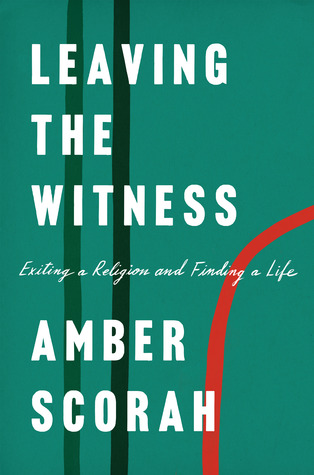 Scorah and her husband went to China as clandestine JW missionaries. Her Mandarin skills were good enough that she could become friends with her English-language pupils and then start to talk to them about religion. In the meantime, she became an early podcast host with the program “Dear Amber,” which offered advice on the Chinese language and culture. She embarked on a flirtatious correspondence with one of her regular listeners, Jonathan from Los Angeles, who goaded her into rethinking everything she’d been taught to believe. “I was questioning with a mind that had been trained not to. It was highly uncomfortable.”
As her marriage and faith simultaneously crumbled, Scorah had to decide what was left to form the foundation of a new life on her own in New York City. “My eye-glazing peace, unquestioning contentment, and eternal life were gone, and the time ahead of me was filled with people I didn’t yet know, uncertainty about the future, and, one day, death.” I was absorbed in the bittersweet outworkings of this before and after: a process of losing faith and deciding what’s next.
The final chapter is a whirlwind tour through her first years in NYC, including the tragic death of her infant son, Karl. This makes for something of an abrupt end to the book; I might have liked to get as much detail on all this as we got about the time in China. But it was clearly a deliberate decision to present such life and death matters from a hard-won secular perspective, without the false balm of a religion that promises she’ll see her son again. There’s a lot of secrecy about the Jehovah’s Witnesses, so this is a rare insider’s view as well as a wrenching account of loss and starting over.
My rating: 
Full disclosure: Amber Scorah offered me a copy through a Facebook group we are both a part of.
Thanks to her and Viking for sending a free copy for review.
Can you see yourself reading either of these books?
Novellas in November, Part 1: 3 Nonfiction, 2 Super-Short Fiction
Short books; short reviews.
Nonfiction:
The Measure of My Days by Florida Scott-Maxwell (1968)
[150 pages]
 I learned about this from one of May Sarton’s journals, which shares its concern with ageing and selfhood. The author was an American suffragist, playwright, mother and analytical psychologist who trained under Jung and lived in England and Scotland with her Scottish husband. She kept this notebook while she was 82, partly while recovering from gallbladder surgery. It’s written in short, sometimes aphoristic paragraphs. While I appreciated her thoughts on suffering, developing “hardihood,” the simplicity that comes with giving up many cares and activities, and the impossibility of solving “one’s own incorrigibility,” I found this somewhat rambly and abstract, especially when she goes off on a dated tangent about the equality of the sexes. (Free from The Book Thing of Baltimore)
Hope in the Dark: Untold Histories, Wild Possibilities by Rebecca Solnit (2004)
[143 pages]
 “Activism is not a journey to the corner store, it is a plunge into the unknown. The future is always dark.” This resonated with the Extinction Rebellion handbook I reviewed earlier in the year. Solnit believes in the power of purposeful individuals working towards social justice, even in the face of dispiriting evidence (the largest protests the world had seen didn’t stop the Iraq War). Instead of perfectionism, she advises flexibility and resilience; things could be even worse had we not acted. At first I thought it depressing that 15 years on we’re still dealing with many of the issues she mentions here, and the environmental crisis has only deepened. But her strong and stirring writing is a reminder that, though injustice is always with us, so is everyday heroism. (Free from The Book Thing of Baltimore)
Lama by Derek Tangye (1966)
[160 pages]
 Tangye wrote a series of cozy animal books similar to Doreen Tovey’s. He and his wife Jean ran a flower farm in Cornwall and had a succession of cats, along with donkeys and a Muscovy duck named Boris. After the death of their beloved cat Monty, Jean wanted a kitten for Christmas but Tangye, who considered himself a one-cat man rather than a wholesale cat lover, hesitated. The matter was decided for them when a little black stray started coming round and soon made herself at home. (Her name is a tribute to the Dalai Lama’s safe flight from Tibet.) Mild adventures ensue, such as Lama going down a badger sett and Jeannie convincing herself that she’s identified another stray as Lama’s mother. Pleasant, if slight; I’ll read more by Tangye. (From Kennet Centre free bookshop)
Fiction:
The Small Miracle by Paul Gallico (1951)
[47 pages]
 Like Tangye, Gallico is known for writing charming animal books, but fables rather than memoirs. Set in postwar Assisi, Italy, this stars Pepino, a 10-year-old orphan boy who runs errands with his donkey Violetta to earn his food and board. When Violetta falls ill, he dreads losing not just his livelihood but also his only friend in the world. But the powers that be won’t let him bring her into the local church so that he can pray to St. Francis for her healing. Pepino takes to heart the maxim an American corporal gave him – “don’t take no for an answer” – and takes his suit all the way to the pope. This story of what faith can achieve just manages to avoid being twee. (From Kennet Centre free bookshop)
Birthday Girl by Haruki Murakami (2002; English translation by Jay Rubin, 2003)
[42 pages]
 Reprinted as a stand-alone pamphlet to celebrate the author’s 70th birthday, this is about a waitress who on her 20th birthday is given the unwonted task of taking dinner up to the restaurant owner, who lives above the establishment. He is taken with the young woman and offers to grant her one wish. We never hear exactly what that wish was. It’s now more than 10 years later and she’s recalling the occasion for a friend, who asks her if the wish came true and whether she regrets what she requested. She surveys her current life and says that it remains to be seen whether her wish will be fulfilled; I could only assume that she wished for happiness, which is shifting and subjective. Encountering this in a larger collection would be fine, but it wasn’t particularly worth reading on its own. (Public library)
I’ve also had a number of novella DNFs so far this month, alas: Atlantic Winds by William Prendiville (not engaging in the least), By Grand Central Station I Sat Down and Wept by Elizabeth Smart (fascinating autobiographical backstory; pretentious prose) and The Dream Life of Balso Snell by Nathanael West (even more bizarre and crass than I’m used to from him).
Onwards!
Have you read any of these novellas? Which one takes your fancy?
Humiliation: Stories by Paulina Flores
Paulina Flores, a young Chilean author and high school teacher, won the Roberto Bolaño Short Story Prize for the title story in her debut collection. These nine stories are about how we relate to the past, particularly our childhood – whether with nostalgia or regret – and about the pivotal moments that stand out in the memory. The first two, “Humiliation” and “Teresa,” I previewed in one of my Women in Translation Month posts. They feature young fathers and turn on a moment of surprise: An unemployed father takes his two daughters along to his audition; a college student goes home with a single father for a one-night stand.
 Of the rest, my favorites were “Talcahuano,” about teenage friends whose plan to steal musical instruments from the local evangelical church goes awry when there’s a crisis with the narrator’s father, a laid-off marine (readalike: Sweet Sorrow by David Nicholls); and “Forgetting Freddy,” in which a young woman who ends up back in her mother’s apartment after a breakup listens to the neighbors fighting and relives childhood fears during her long baths (readalike: History of Wolves by Emily Fridlund).
“American Spirit” recalls two friends’ time waitressing (readalike: Sweetbitter by Stephanie Danler), and in “Last Vacation” a young man recounts his last trip to La Serena with his aunt before everything went wrong for his family. “Laika” is a troubling one in that the protagonist remembers her childhood brush with pedophilia not with terror or disgust but with a sort of fondness. A number of the stories conclude that you can’t truly remake your life, nor can you escape the memories that have shaped you – even if you might like to.
A fairly common feature in story volumes is closing with a novella. Almost invariably, I like these long stories the least, and sometimes skip them. Here, the 72-page “Lucky Me” could easily be omitted. Denise, a librarian who watches porn and reads the Old Testament in her spare time (“what she needed was to feel something. She needed pleasure and spirituality”), lets the upstairs neighbor use her bedroom for sex; Nicole, a fourth-grader, has her world turned upside down when her best friend’s mother becomes their housekeeper. Although the story brings its strands, one in the first person and one in the third (giving the book an even 4.5/4.5 split), together in a satisfying manner, it was among my least favorites in the collection.
Overall, though, these are sharp and readable stories I can give a solid recommendation.
My rating:
Humiliation (2016; English translation by Megan McDowell, 2019) is published by Oneworld today, November 7th,; it came out on the 5th from Catapult in the USA. My thanks to Margot Weale for a proof copy for review.
R.I.P. Classics for Halloween: The Haunting of Hill House, Dr. Jekyll & Mr. Hyde
I’ve enjoyed my second year participating in the Readers Imbibing Peril challenge. The highlights from my spooky October of reading were the classic ghost stories from my first installment and the Shirley Jackson novel below.
As this goes live I’m preparing to catch a train to York for the New Networks for Nature conference. Ever since the year I did my Master’s at Leeds, York is a place I’ve often contrived to be in late October or early November. What with ghost tours and fireworks for Bonfire Night, its cobbled streets are an atmospheric place to spend chilly evenings.
The Haunting of Hill House by Shirley Jackson (1959)
 The only thing I’d read by Jackson before is “The Lottery,” which I studied in a high school English class. I’d long meant to read one of her full-length books, so I snapped this up when it came into the free bookshop where I volunteer.
Dr. Montague, an anthropologist, assembles a small team to live at Hill House one summer and record any evidence that it is indeed haunted. Joining him are Luke Sanderson, the flippant heir to the house; Theodora (“Theo”), rumoured to have psychic abilities; and Eleanor Vance, a diffident 32-year-old who experienced an unexplained event when she was a child and now, after the recent death of the mother for whom she was a nurse for years, determines to have an adventure all of her own. As the four become familiar with the house’s history of tragedies and feuds, their attempts to explore the house and grounds leave them feeling disoriented and, later, terrified.
Things really heat up at about the halfway point. There’s a feeling that the house has power –
“the evil is the house itself, I think … it is a place of contained ill will” (Dr. Montague)
“It’s the house. I think it’s biding its time.” (Eleanor)
– what could it make them all do? I don’t often read from the suspense or horror genre, but I did find this gripping and frightening, and I never saw the ending coming. Hard to believe the book is 60 years old.
(I wondered if Claire Fuller could have taken this as partial inspiration for Bitter Orange, in which a thirtysomething woman who was her mother’s carer for many years until the older woman’s death undertakes a summer of study at a dilapidated house.)
The Strange Case of Dr. Jekyll and Mr. Hyde by Robert Louis Stevenson (1886)
 As with The Picture of Dorian Gray, which I attempted in 2017, I think the problem here was that the story was too culturally familiar to me. Everyone knows the basics of Jekyll & Hyde: a respectable doctor occasionally transforms into a snarling boor and commits acts of violence. The only thing that was murky for me was exactly how this happens. (Jekyll has been experimenting with drugs that will provoke mystical experiences and a taste of the dark side of humanity; to become Hyde he takes a potion of his own devising. At first the metamorphosis is something he can control, but eventually he starts becoming Hyde without any warning, until it seems there’s no returning to his normal life.)
The novella is mostly from the point of view of Mr. Utterson, Jekyll’s lawyer friend, who drew up his will leaving everything to Hyde. Utterson has always been uncomfortable with the terms of the will, but even more so as he hears of Hyde knocking over a young girl and beating a gentleman to death in the street. The third-person narrative is interspersed with documents including letters and confessions, a bit like in Dracula. For its first readers this must have been a thrilling read full of shocking revelations, but I found my mind wandering. I’ve tried a few Stevenson books now; I think this was probably my last.
(Available as a free download from Project Gutenberg.)
Happy Halloween!
Five Nonfiction Review Books: Hammond, Iorio, Rault, Riley & Rutt
A diagnosis of motor neurone disease; a father’s dispiriting experience of censorship trials. An illustrated history of fonts; an essay on grief; a cold weather-appropriate record of geese-watching. I gear up for Nonfiction November by catching up on five nonfiction review books I’ve been sent over the last couple of months. You can’t say that I don’t read a variety, even within nonfiction! See if one or more of these tempts you.
A Short History of Falling: Everything I Observed about Love whilst Dying by Joe Hammond
 Hammond, a playwright, takes a wry, clear-eyed approach to his diagnosis of motor neurone disease (ALS) and the knowledge that his physical capacities will only deteriorate from here on out. “New items arrive almost daily and I am unexpectedly becoming the curator of the Museum of my own Decline.” Yet he also freezes funnier moments, like blowing his nose on a slice of bread because he couldn’t reach a tissue box, or spending “six hours of my fiftieth birthday sat on this hospice toilet, with a bottle of good Scotch wedged between my knees.”
Still, Hammond regrets that he’s become like a third small child for his wife Gill to look after, joining his sons Tom and Jimmy, and that he won’t see his boys grow up. (This book arose from an article he wrote for the Guardian in 2018 about making 33 birthday cards for his sons to open in the years after his death.) Although I wasn’t as interested in the details of Hammond’s earlier life, or his relationship with his narcissistic father, I appreciated his quiet acceptance of disability, help and impending death.
Favorite lines:
“I’ve waited all my life to know this peace. To know that I am nothing more than this body.”
“my place in all of this is becoming smaller, historic and just the right size of important.”
With thanks to 4th Estate for the free copy for review.
An Author on Trial: The Story of a Forgotten Writer by Luciano Iorio
 The author’s father, Giuseppe Jorio, was a journalist and schoolteacher who wrote an infamous novel based on an affair he had in the 1930s. Using italicized passages from his father’s diary and letters to Tina, who was 19 when their affair started, Iorio reconstructs the sordid events and unexpected aftermath in fairly vivid detail. Tina fell pregnant and decided to abort the baby. Meanwhile, Giuseppe’s wife, Bruna, got the truth out of him and responded with more grace than might be expected. Giuseppe was devastated at the loss of his potential offspring, and realized he wanted to have a child with Bruna. He bid Tina farewell and the family moved to Rome, where the author was born in 1937.
Giuseppe’s novel inspired by the affair, Il Fuoco del Mondo (The Fire of the World) was rejected by all major publishers and accused of obscenity in a series of five trials that threatened his reputation and morale. It’s a less familiar echo of the Lady Chatterley’s Lover trial, and a poignant portrait of a man who felt he never lived up to his potential because of bad luck and societal disapproval. I enjoyed learning a bit about Italian literature. However, inconsistent use of tenses and shaky colloquial English (preposition issues, etc.) suggest that a co-writer or translator was needed to bring this self-published work up to scratch.
With thanks to the publicist for the free copy to review as part of a blog tour.
ABC of Typography by David Rault
[Translated from the French by Edward Gauvin]
 From cuneiform to Gutenberg to Comic Sans, this history of typography is delightful. Graphic designer David Rault wrote the whole thing, but each chapter has a different illustrator, so the resulting book is like a taster course in comics styles. As such, I would highly recommend it to those who are fairly new to graphic novels and want to see whose work appeals to them, as well as to anyone who enjoyed Simon Garfield’s book about fonts, Just My Type.
I found it fascinating to explore the technical characteristics (serif vs. sans serif, etc.) and aesthetic associations of various fonts. For instance, I didn’t realize that my mainstay – Times New Roman – is now seen as a staid choice: “Highly readable, but overexposed in the early days of the Internet, it took on a reputation for drabness that it hasn’t shed since the ’90s.” Nowadays, some newspapers and brands pay typeface creators to make a font for their exclusive use. Can you name the typeface that is used on German road signs, or in Barack Obama’s campaign materials? (You’ll be able to after you read this.)


With thanks to SelfMadeHero for the free copy for review.
Time Lived, Without Its Flow by Denise Riley
 What Virginia Woolf’s essay “On Being Ill” does for sickness, this does for bereavement. Specifically, Riley, whose son Jake died suddenly of a heart condition, examines how the experience of time changes during grief. “I’ll not be writing about death, but about an altered condition of life,” she opens. In short vignettes written from two weeks to three years after her son’s death, she reflects on how her thinking and feelings have morphed over time. She never rests with an easy answer when a mystery will do instead. “What if” questions and “as if” imaginings proliferate. Poetry – she has also written an exquisite book of poems, Say Something Back, responding to the loss of Jake – has a role to play in the acceptance of this new reality: “rhyme may do its minute work of holding time together.”
Max Porter provides a fulsome introduction to this expanded version of Riley’s essay, which first appeared in 2012. This small volume meant a lot more to him than it did to me; I preferred Riley’s poetic take on the same events. Still, this is sure to be a comfort for the bereaved.
Favorite passages:
“I’ll try to incorporate J’s best qualities of easy friendliness, warmth, and stoicism, and I shall carry him on in that way. Which is the only kind of resurrection of the dead that I know about.”
“I don’t experience him as in the least dead, but simply as ‘away’. Even if he’ll be away for my remaining lifetime. My best hope’s to have a hallucination of his presence when I’m dying myself.”
With thanks to Picador for the free copy for review.
Wintering: A Season with Geese by Stephen Rutt
 Rutt’s The Seafarers: A Journey among Birds, one of my favorite recent nature/travel books, came out in May. What have we done to deserve another publication from this talented young author just four months later?! I didn’t enjoy this as much as The Seafarers, yet it does a lot of the same things well: it provides stunning word portraits of individual bird species, explores the interaction between nature and one’s mental state, and gathers evidence of the cultural importance of birds through legends and classical writings.
Here the focus is on geese, which the author had mostly overlooked until the year he moved to southern Scotland. Suddenly they were impossible to ignore, and as he became accustomed to his new home these geese sightings were a way of marking the seasons’ turn. Ethical issues like hunting, foie gras and down production come into play, and, perhaps ironically, the author eats goose for Christmas dinner!
Rutt’s points of reference include Paul Gallico (beware plot spoilers!), Aldo Leopold, Mary Oliver and Peter Scott. The writing in this short book reminded me most of Horatio Clare (especially The Light in the Dark) and Jim Crumley (who’s written many short seasonal and single-species nature books) this time around.
A favorite passage (I sympathize with the feelings of nomadism and dislocation):
“I envy the geese their certainty, their habits of home. I am forever torn between multiple places that feel like home. Scotland where I live or Suffolk, Essex, Norfolk: the flatlands of golden evenings and reeds, mud and water and sand. The distant horizon and all the space in between I grew up with, which seems to lurk somewhere, subconsciously calling me back.”
[Neat aside: My husband and I both got quotes (about The Seafarers) on the press release for this book!]

With thanks to Elliott & Thompson for the free copy.
Would you be interested in reading one or more of these?
“All to Do with the Moon”: Four Books with Moon in the Title
I happened to read two books with the word moon in their titles within a couple of weeks in September, which prompted me to ransack my shelves and find two more. While these four are in completely different genres – one women’s fiction, one poetry, one memoir and one Booker-winning literary novel – they are all by women (naturally more in touch with the moon?) and all worth reading. In the weeks that I was undertaking this mini reading project, I couldn’t get Krista Detor’s song “All to Do with the Moon” out of my head (on this video, a live recording of the entire “Night Light” suite of three songs, it starts at about 6:15). She’s one of our favorite singer-songwriters, though, so this was no problem.
The Pull of the Moon by Elizabeth Berg (1996)
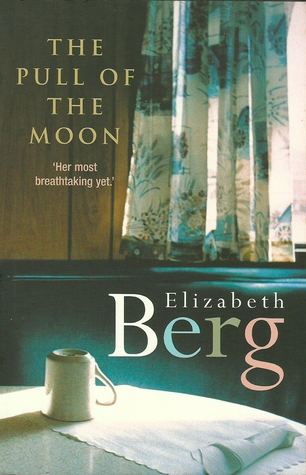 This is my second contemporary novel from Berg. I find her work effortlessly readable. She’s comparable to those other Elizabeths, McCracken and Strout, but also to Alice Hoffman and Anne Tyler. This one reminded me most of Tyler’s Ladder of Years in that both are about a middle-aged woman who takes a break from her marriage to figure out what she wants from life. Nan, “a fifty-year-old runaway,” takes off from her suburban Boston home and drives west, stopping at motels and cabins, eating at diners, and meeting the locals; eventually she gets as far as South Dakota. Her narration is in the form of letters to her husband, Martin, alternated with italicized passages from her journal. She reflects on everything that has made up her life – her upbringing, her marriage and other sexual encounters, raising her daughter, Ruthie – as well as on the small-town folk she meets in Iowa and Minnesota. The moon is a symbol of the femininity Nan fears she’s losing through menopause and hopes to reclaim on this journey.
The Moon Is Almost Full by Chana Bloch (2017)
 This was a lucky find in the clearance section at Blackwell’s on my Oxford day with Annabel. It’s a beautifully produced book from Autumn House, the small Pittsburgh press that released my favorite poetic work of last year: The Small Door of Your Death by Sheryl St. Germain. This was Bloch’s sixth and final book of poetry, published in the year of her death. She writes in the awareness that this cancer will be her end and doesn’t gloss over losses of function and dignity, but still finds delight in life through her family, writing and Jewish rituals: “Never forget / you were put on earth to gather joy // with melancholy hands” (from “Instructions for the Bridegroom”). A favorite poem was “The Will,” in which she imagines how the physical and intangible relics of her life will be distributed (“My plans and projects I hereby bequeath to the air / of which they were conceived. … Let the doctors pack up my heart / and keep it humming for the right customer.”).
Off-topic note: This was typeset in Mrs Eaves, which may well be one of my favorite fonts.
To the Moon and Back: A Childhood under the Influence by Lisa Kohn (2018)
 My special interest in women’s religious memoirs led me to list this among my most anticipated titles of 2018. I had it on my wish list for quite a while and then, when I saw it available for a bargain price online, snapped it up for myself. Lisa Kohn grew up in the New York City environs, the child of hippie parents she called Mimi and Danny rather than Mom and Dad. After their parents divorced, she and her brother lived in New Jersey with their mother and went into the City to visit their father, who was very lax about things like drugs. By the time Kohn was 10, her mother had gotten caught up in Reverend Moon’s Unification Church.
I knew next to nothing about the “Moonies,” so I found it fascinating to learn about this cult led by a South Korean reverend who let it be assumed that he was the new incarnation of Jesus Christ and the flourishing of his family on Earth would usher in God’s Kingdom. The Church became Kohn’s whole life until internal questioning set in during high school, and by the time she went to college she was adrift and into drugs instead. The book recreates scenes and dialogue well, but I found myself losing interest once the cult itself stopped being the main focus.
Readalikes: Small Fry by Lisa Brennan-Jobs and In the Days of Rain by Rebecca Stott
Moon Tiger by Penelope Lively (1987)
 Seventy-six-year-old Claudia Hampton, on her deathbed in a nursing home, determines to write a history of the world – or at least, the world as she’s seen it. She’s been an author of popular history books (one of which, on Mexico, was made into a film), but she’s also been a daughter, a sister, a lover and a mother. As the book shifts between the first person and the third person, the present and the past, we learn volumes about Claudia and how her memory has preserved the layers of her personal history. There are a couple of big reveals, about her relationship with her brother Gordon and her time as a Second World War correspondent in Egypt, but what’s more impressive than these plot surprises is how Lively packs the whole sweep of a life into just 200 pages, all with such rich, wry commentary on how what we remember constructs our reality.
I made the fine choice to start reading this on holiday at the Jurassic coast in Dorset, which was fitting because Claudia grew up in Dorset and uses ammonites and rock strata as recurring metaphors. This won a well-deserved Booker Prize and is the best of the five Lively books I’ve read. I wasn’t particularly taken with the first couple I read by her, so I’m glad I tried again this year (with Heat Wave and then this). It’s just a shame that the copy I found in the free bookshop where I volunteer has such a dreadfully inappropriate cover, making it look like contemporary chick lit rather than serious literature. 
Some favorite lines:
“Argument, of course, is the whole point of history. Disagreement; my word against yours; this evidence against that. If there were such a thing as absolute truth the debate would lose its lustre. I, for one, would no longer be interested.”
“In life as in history the unexpected lies waiting, grinning from around corners. Only with hindsight are we wise about cause and effect.”
“Once it is all written down we know what really happened.”
A note on the title: From the context, it seems that a moon tiger was a special inflammatory device, maybe like a citronella candle, used to repel mosquitoes and other insects.
 Other ‘Moon’ books I have happened to review:
Crossing the Moon by Paulette Bates Alden
The Moon and Sixpence by W. Somerset Maugham
Doris Lessing’s Centenary & The Grass Is Singing
Today would have been Doris Lessing’s 100th birthday; she in fact died in 2013. Reading Lara Feigel’s Free Woman last year encouraged me to try more from Lessing, and I’m glad that I did so this month. I started with The Fifth Child, a horror novella for R.I.P., followed by the novel Lessing brought with her when she left Southern Rhodesia (now Zimbabwe) for England.
.jpg)
Doris Lessing at Cologne Literature Festival, 2006. Elke Wetzig / Juan Pablo Arancibia Medina [CC BY-SA 3.0 (http://creativecommons.org/licenses/by-sa/3.0/)%5D.
The Grass Is Singing (1950)
I had trouble believing that this novel a) was Lessing’s debut and b) is now nearly 70 years old. It felt both fresh and timeless, and I could see how it has inspired writing about the white experience in Africa ever since, especially a book like Fiona Melrose’s Midwinter, in which an English farmer and his son are haunted by the violent death of the young man’s mother back in Zambia 10 years ago.
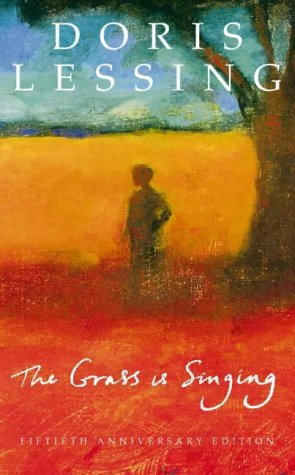 For The Grass Is Singing begins with two sly words, “MURDER MYSTERY”: a newspaper headline announcing that Mary, wife of Rhodesian farmer Dick Turner, has been found murdered by their houseboy. It’s a tease because in one sense there’s no mystery to this at all: we know from the first lines what happened to Mary. And yet we are drawn in, wondering why she was killed and how the Turners went from an idealistic young couple enthusiastic about their various money-making schemes – a shop, chickens, tobacco – to a jaded, distant pair struggling for their health, both mental and physical.
The breakdown of their marriage and the failure of their farm form a dual tragedy that Lessing explores in searing psychological detail, all while exposing (with neither judgment nor approval) how Anglos felt about the natives at that time.
There’s a sense in which this was all fated: Dick is weak, someone Mary pities rather than loves and respects; and Mary’s mixed-up feelings toward her black servants – fear, contempt, curiosity and attraction – were bound to lead to an explosion. The land itself seems to be conspiring against them, too, or is at least indifferent to their plans and dreams.
So many passages struck me for their effortless profundity. I cringed to see myself so clearly in Mary’s boredom and restlessness, along with her ambivalence about the idea of motherhood: “She hated the idea of a baby, when she thought of its helplessness, its dependence, the mess, the worry. But it would give her something to do.”
This was the fifth full-length book I’ve read by Lessing, and by far the best.
My rating:
Alas, I had a Lessing DNF this month, too:
The Memoirs of a Survivor (1974)
 This was shelved in with the memoirs in The Bookshop, Wigtown. I’m not blaming Mr. Bythell or his staff, as this would be a very easy shelving error to make, even for those well versed in literature. But I was disappointed to realize that it’s actually one of Lessing’s detached, dreamy dystopian novels. I tried really hard with this but couldn’t make it past page 48. There’s just not much detail to latch onto. You know that it is set in a vague but believable near future (London?) in which there has been political and social breakdown, followed by gangs, looting and fighting. The narrator hides out in her apartment and is able to live a fairly normal life (“We can get used to anything at all”), at least until an adolescent girl named Emily Cartright is deposited into her care. The novel still feels relevant – the comments on rumor and gossip being as important as news; the sense that the narrator’s generation has ruined things for Emily’s generation and should accept guilt and responsibility – but there is just no plot to speak of.
Next up for me from Lessing’s works will be at least one of her heavily autobiographical Martha Quest novels.
R.I.P. Reads: Dahl, Le Guin, Lessing, Paver
This is my second year participating in R.I.P. – Readers Imbibing Peril, now in its 14th year. I assembled a lovely pile of magical or spooky reads to last me through October and noticed they were almost all by women, so I decided to make it an all-female challenge (yes, even with a Dahl title – see below) this year. I’m in the middle of another book and have a few more awaiting me, but with just two weeks left in the month I don’t know if I’ll manage to follow up this post with a Part II. At any rate, these first four were solid selections: classic ghost stories, children’s fantasy, a horror novella about an evil child, and an Arctic chiller.
Fear: Tales of Terror and Suspense (selected by Roald Dahl) (2017)
“Spookiness is, after all, the real purpose of the ghost story. It should give you the creeps and disturb your thoughts.”
I was sent this selection of Dahl-curated ghost stories as part of a book bundle in advance of a blog tour for Roald Dahl Day last year. For now I’ve read just the five stories by women, and will polish off the rest next year.
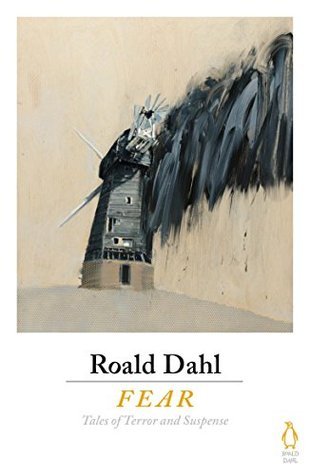 This collection originated from a television series on ghost stories that Dahl proposed for the American market in 1958 (the pilot was poorly received and it never got made). For his research he read nearly 750 ghost stories and whittled them down to the top 24. Women authors dominated early on in the selection process, but by the end the genders came out nearly even, with 13 men and 11 women. It’s disappointing, then, that only five of the 14 stories included here are by women – one of whom gets two entries, so there’s just four female authors recognized. And this even though Dahl claims that, when it comes to ghost stories, “it is the women who have written some of the very best ones.”
Any road, these are the five stories I read, all of which I found suitably creepy, though the Wharton is overlong. Each one pivots on a moment when the narrator realizes that a character they have been interacting with is actually dead. Even if you’ve seen the twist coming, there’s still a little clench of the heart when you have it confirmed by a third party.
“Harry” and “Christmas Meeting” by Rosemary Timperley: A little girl who survived a murder attempt is reclaimed by her late brother; a woman meets a century-dead author one lonely holiday – I liked that in this one each character penetrates the other’s time period.
“The Corner Shop” by Cynthia Asquith: An inviting antique shop is run by two young women during the day, but by a somber old man in the evenings. He likes to give his customers a good deal to atone for his miserly actions of the past.
“The Telephone” by Mary Treadgold: A man continues communicating with his dead ex-wife via the phone line.
“Afterward” by Edith Wharton: An American couple settles in a home in Dorset, and the husband disappears, after a dodgy business deal, in the company of a mysterious stranger.
A Wizard of Earthsea by Ursula K. Le Guin (1968)
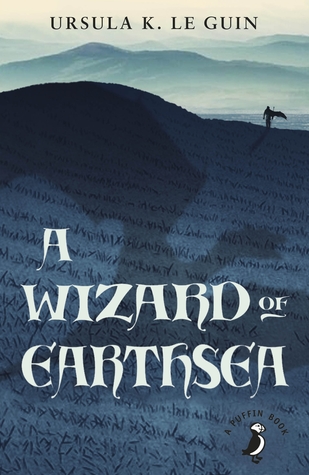 This was my second attempt with the late Le Guin, who would be turning 90 on the 21st; I didn’t get far at all with a buddy read of The Left Hand of Darkness last year. I enjoyed this a fair bit more, perhaps because it’s meant for children – I reckon I would have liked it most when I was ages nine to 11 and obsessed with various series of fantasy novels featuring dragons.
Long before Harry Potter was a glimmer, this was the archetypal story of a boy wizard learning magic at school. Ged meets many cryptic mentors and realizes that naming a thing gives you power over it. In his rivalry with the other boys, he accidentally releases a shadow beast and has to try to gain back control of it. It’s slightly difficult to keep on top of all the names and places (Le Guin created a whole archipelago, which you can see in the opening map) and I found my interest waning after the halfway point, but I did love the scene of Ged fighting with a dragon. 
A favorite passage: “But you must not change one thing, one pebble, one grain of sand, until you know what good and evil will follow on the act. … A wizard’s power of Changing and of Summoning can shake the balance of the world.”
The Fifth Child by Doris Lessing (1988)
Shelve this alongside We Need to Talk about Kevin as a book to make you rethink having kids. Harriet and David Lovatt buy a large Victorian house within commuting distance of London and dream of filling it with children – six, eight; however many. Their first four children are all they’d hoped for, if not spaced out as much as they intended. The Lovatts enjoy hosting the extended family at Easter and Christmas and during the summer holidays. Although there are good-natured jokes about the couple’s fertility, everyone enjoys the cozy, bustling atmosphere. “The Lovatts were a happy family. It was what they had chosen and what they deserved.”
[MILD SPOILERS ENSUE]
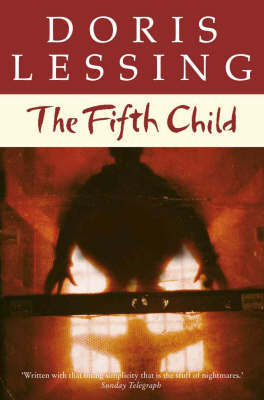 Everything changes with pregnancy #5, which is different right from the off. This “savage thing inside her” is kicking Harriet black and blue from the inside and grown to full term by eight months. When Ben is born Harriet thinks, “He’s like a troll, or a goblin.” Like a succubus, he sucks her dry, biting her nipples black and blue; he screams and thrashes non-stop; he’s freakishly strong and insatiably hungry. He strangles house pets and eats a raw chicken with his bare hands. Although he learns basic language and social skills from watching his older siblings and mimicking his idols from a motorcycle gang, something in him is not human. Yet Harriet cannot bear to leave Ben to rot in an institution.
At first I wondered if this was a picture of an extremely autistic child, but Lessing makes the supernatural element clear. “We are being punished,” Harriet says to David. “For presuming … we could be happy.” I think I was waiting for a few more horrific moments and a climactic ending, whereas Lessing almost normalizes Ben, making him part of a gang of half-feral youths who rampage around late-1980s Britain (and she took up his story in a sequel, Ben in the World). But I raced through this in just a few days and enjoyed the way dread overlays the fable-like simplicity of the family’s early life.
Dark Matter: A Ghost Story by Michelle Paver (2010)
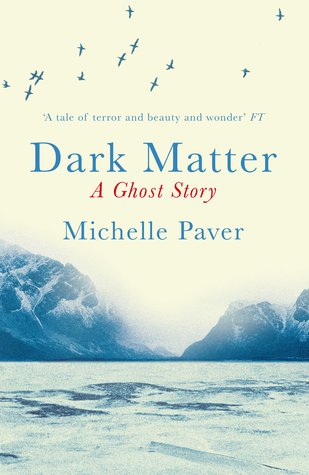 I read Paver’s Thin Air as part of last year’s R.I.P. challenge and it was very similar: a 1930s setting, an all-male adventure, an extreme climate (in that case: the Himalayas). Most of Dark Matter is presented as a journal written by Jack Miller, a lower-class lad who wanted to become a physicist but had to make a living as a clerk instead. He feels he doesn’t truly belong among the wealthier chaps on this Arctic expedition, but decides this is his big chance and he’s not going to give it up.
Even as the others drop out due to bereavement and illness, he stays the course, continuing to gather meteorological data and radio it back to England from this bleak settlement in the far north of Norway. For weeks his only company is a pack of sled dogs, and his grasp on reality becomes shaky as he begins to be visited by the ghost of a trapper who was tortured to death nearby – “the one who walks again.” Paver’s historical thrillers are extremely readable. I tore through this, yet never really found it scary.
Note: This book is the subject of the Bookshop Band song “Steady On” (video here).
And, alas, three DNFs:
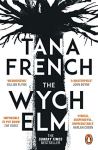 The Wych Elm by Tana French – French writes really fluid prose and inhabits the mind of a young man with admirable imagination. I read the first 100 pages and skimmed another 50 and STILL hadn’t gotten to the main event the blurb heralds: finding a skull in the wych elm in the garden at Ivy House. I kept thinking, “Can we get on with it? Let’s cut to the chase!” I have had French’s work highly recommended so may well try her again.
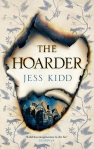 The Hoarder by Jess Kidd – Things in Jars was terrific; I thought Kidd’s back catalogue couldn’t fail to draw me in. This was entertaining enough that I made it to page 152, if far too similar to Jars (vice versa, really, as this came first; ghosts/saints only the main character sees; a transgender landlady/housekeeper); I then found that picking it back up didn’t appeal at all. Maud Drennan is a carer to a grumpy giant of a man named Cathal Flood whose home is chock-a-block with stuff. What happened to his wife? And to Maud’s sister? Who cares!
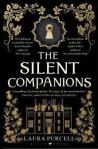 The Silent Companions by Laura Purcell – Purcell is now on her third Gothic novel in three years. I had a stab at her first and it was distinctly okay. I read the first 24 pages and skimmed to p. 87. Reminiscent of The Shadow Hour, The Familiars, etc.
 Bookish Beck = Rebecca Foster. American transplant to England. Freelance proofreader and book reviewer.
 Bookish Beck