Book vs. Film: What Are You Going Through / The Room Next Door
Film, because…
I’m borrowing the idea from a post series by Kate of Books Are My Favourite and Best that compares books and their adaptations. It’s now vanishingly rare for me to see movies – I can probably count on the fingers of one hand the ones I’ve seen in the last three years – because we haven’t had a television for a decade or more, don’t subscribe to any streaming services, find going to the cinema too expensive, and mostly can’t be bothered to get out an old laptop to watch our measly collection of DVDs. It’s kind of a shame, because I was a real cinephile in my high school and early college years, making my way through the American Film Institute’s top 100 list, recording B&W classics from late-night TV, and following the Oscars race to enter a low-value pool. It certainly means a lot more time for books, though.
BUT I watched two streamed movies while I was staying with my sister in the States, both chosen for their literary influences or similarities. (I ran out of time to watch Women Talking, which I was eyeing up but it would have incurred a separate cost.) One was The Menu, about a megalomaniac chef for whose extravagant multi-course meals the mega-rich travel to a private island. Elle suggested it as a companion to Land of Milk and Honey with its chef protagonist and questions of power, sexuality and wealth. The Menu, starring Ralph Fiennes, was good fun, with a twisty plot and strong performances, but got darker and gorier than expected as Fiennes’ character uses dishes to explore childhood trauma and settle old scores.
The other was Pedro Almodóvar’s first English-language feature, The Room Next Door (2024). It’s based on Sigrid Nunez’s What Are You Going Through (2020), which I read at its release. It’s the story of a writer whose friend, ravaged by cancer, asks her to be present when she ends her life. As is typical of Nunez’s sparse, Cusk-like autofiction, the characters have no names and minimal histories, there are no speech marks, and the scant plot is layered with various other found stories and aphorisms. The film is, of necessity, very different: it zeroes in on the assisted suicide plot, makes events more concrete, and goes as far as the aftermath rather than just-before-the-end. I watched it with my sister because, as a hospice nurse, she has an interest in the topic.

Julianne Moore at The Room Next Door premiere (BFI LFF: Royal Festival Hall, 19 October 2024) (Raph_PH, CC BY 2.0, via Wikimedia Commons).
{SPOILERS IN THE REMAINDER}
In The Room Next Door, Ingrid (Julianne Moore) is a writer whose latest book explores her fear of death. She and Martha (Tilda Swinton) were acquaintances when they worked for the same magazine, but they seem to have lost touch over the decades. Martha’s journalistic career was much more exciting, taking her to war zones as a correspondent. Martha has a daughter, Michelle, whom she’s really not in touch with, partly as a result of not being frank about the identity of Michelle’s father. Ingrid is shocked by Martha’s request and it takes her a while to come around to the idea of being the person ‘in the room next door’ when Martha takes the euthanasia drug she’s bought off the dark web.
Nunez’s novel opens with the narrator attending a doom-and-gloom lecture by her ex, who is convinced that climate change won’t be addressed and the human race will die out. I was surprised that he’s included in the film and in fact given an expanded role: not only is there the scene from the book in which Ingrid meets Damian (John Turturro) for lunch and tells him what’s going on with her friend, but we learn that he was an ex for both of them, and he helps Ingrid deal with the fallout of Martha’s actions. He also seems to function as a reminder of sexuality, which remains a powerful impulse even in the face of individual or collective death.
When I got home from the States, I reread the Nunez and – though she’s a favourite of mine – I confess I was disappointed. The philosophical and storytelling asides seem like unnecessary distractions when all you want to know is what happens with her friend. (I have, of course, also read The Spare Room, which preceded the Nunez by 12 years, in the meantime.) My original review seems generous as well as admirably succinct. (It’s depressing for me to go back to old reviews; not only have I not gotten any better, my writing has deteriorated, if anything. Is it laziness? Erosion of formality? Lack of time? Loss of focus?)

My sole complaint then was that Nunez spent too much time recounting the plot of a mystery novel the narrator reads. Well! Having reviewed her collected short stories, It Will Come Back to You, I can report that said plot is that of her “The Plan,” published in LitMag in 2019. How (playful and meta, yes, but) self-indulgent to borrow her own short story! So while I still appreciated the overall theme of empathy and the wise observations (“The only thing harder than seeing yourself grow old is seeing the people you’ve loved grow old … most people are in denial about aging, just as they are about dying”), and enjoyed the monologue from a cat which I’d forgotten about, I got bored and impatient the second time around. (I’m still a Nunez stan, though. – Am I using that right? Are we still saying that?)
Ultimately, then, The Room Next Door surpasses its source material for its focus, its performances, its locations, and its weirdness. Almodóvar cuts most of the peripheral material and makes it all about the women’s relationship with each other, as well as Ingrid’s with her ex and Martha’s with her daughter. The elegant Moore does a fine job in the role; the only way to have given a flavour of Nunez’s narration would have been to use voiceover or diary-writing scenes, which could have been naff. But Swinton is a marvel. Her American accent is ever so slightly strange, but that works; she’s such a striking person that it fits for her to be somewhat otherworldly. She is a perfect vessel for Martha’s frustrated rage and her body language, as well as the costuming and makeup, highlight the differences between her well periods, when she’s vibrant, and her worst relapses, when she’s pale and gaunt. (I was astonished to learn that both actors are now 65, by the way!)

Tilda Swinton, Pedro Almodóvar, and Julianne Moore at 81st Venice International Film Festival (Harald Krichel, CC BY-SA 4.0, via Wikimedia Commons).
In the book, the friends stay in an Airbnb in upstate New York. In the film, Casa Szoke, an hour from Madrid in Spain, stands in. It’s a stunning Modernist (also described as “brutalist”) house, and the pool terrace and the staircase dividing Martha’s room from Ingrid’s downstairs are key features. Probably the single most interesting decision Almodóvar made was to have Swinton play Michelle as well, which emphasizes the persistence of family traits and – because Michelle has a scene after Martha is dead – makes it seem like she’s not completely gone. Of course, Almodóvar has always gone in for surrealism and doubling, and I loved this hint of the mysterious. I also appreciated the repeated quotes from James Joyce’s novella The Dead (“faintly falling … upon all the living and the dead.”).
The gist may be the same, but the reading and viewing experiences are really very dissimilar and, while I wouldn’t dissuade you from either, it was the film that impressed me most.
Book
My original rating: 
My rating now: 
Film
Bad Christians and Good Cocktails
On Tuesday evening, we attended a talk at a local church by Dave Tomlinson, author of The Post-Evangelical and How to Be a Bad Christian. It’s hard to believe the latter was published 14 years ago already, while the former is over 30 years old and coincided with a growing social shift away from conservative Christianity-as-usual in the UK and USA. Other authors who have been particularly influential on my thinking such as Brian McLaren and Peter Rollins were allied with this movement, which was sometimes called “the emerging church.”
What is a ‘bad’ Christian? One who’s not fussed about dogma. Tomlinson is an Anglican priest and believes the Church still has value for people at times of joy or sorrow – a bereavement, a wedding, a baptism – moments of epiphany that might encourage them to stop skating on the surface of life and go deeper in a search for spirituality and meaning. However, he stressed how easy it is to find people who are following the way of Jesus outside of churches: anyone working toward peace, justice, or environmental restoration, for instance. He’d rather people focus on ethical lifestyles rather than beliefs. This resonated with me as I don’t believe a line of the creed literally and most of the time don’t think the supernatural exists, yet keep attending church and reading theology. But I know I’ll get more spiritual uplift from the Queer Folk Festival at the end of the month than I often do at a Sunday service, and my secular community volunteering sometimes seems to be of more practical use.
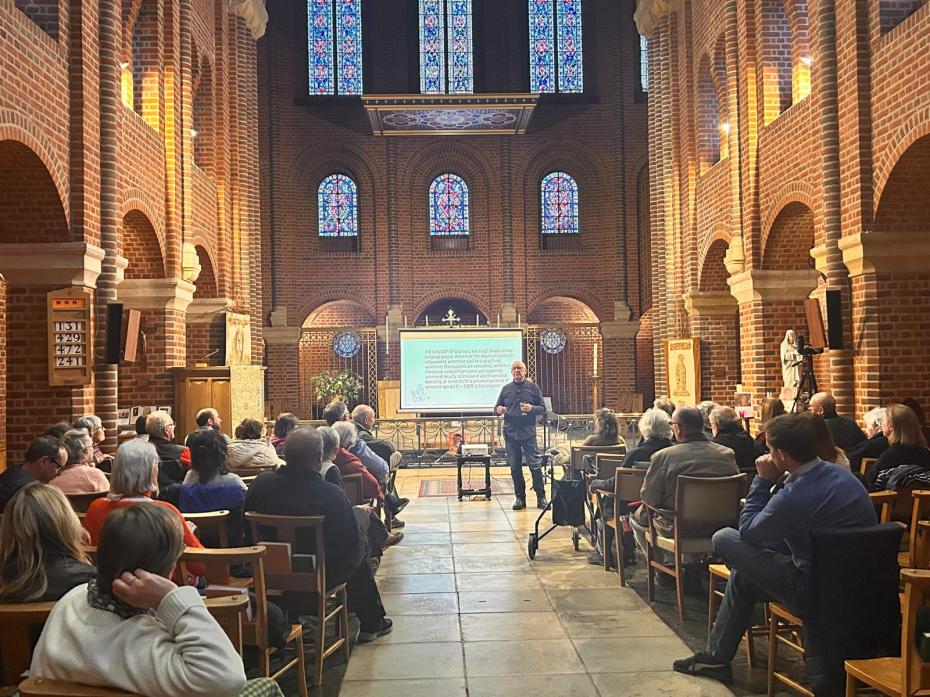
Photo by Rev. Gary Collins
Yesterday (13 May) was World Cocktail Day – the second year I’ve known of its existence and planned to ‘celebrate’ it. Often, I can’t make appealing cocktails because I don’t have the right ingredients, and leaving them out or substituting is frustrating. So, in preparation, I picked up a modest click-and-collect order from Sainsbury’s on Tuesday of dry vermouth, fino sherry, and Angostura orange bitters to take my cocktail-making to the next level.


 It may surprise you given that I’m such a gin lover, but I’d never actually had a martini. I’m not sure how authentic my version, the “England” dry martini from the hilarious 1976 handbook above, was, but it was tasty! (I’ve always thought a Noilly Prat would be a good thing to call a Tory.) Then I tried a “London Calling” (recipe from the book Equal Parts Cocktails by Fred Siggins – I have a habit of downloading any cocktail cookbooks I find on Edelweiss and browsing them on screen to find one or two recipes to save as screenshots) combining navy-strength gin and fino sherry. It was a strong, complex and satisfying drink.


After C got home from band practice, I made him his first whisky old fashioned. The orange bitters went in all three of those so were a good purchase. I wasn’t feeling great yesterday, so had a few sips of each of my two cocktails and then used a funnel to store them in miniature bottles in the fridge for another night. I capped off the evening with a thimbleful of what I’m calling a Chocolate Cherry Truffle: chocolate rum and Portuguese sour cherry liqueur in a 4:1 ratio.
20 Books of Summer 2026 Plan
It’s my ninth year participating in the 20 Books of Summer challenge, hosted this year by Annabel. #20BOS26 starts on 1 June and runs through 31 August.
Some years I have chosen a theme (colours, foodie, flora or fauna) or other criterion (all hardbacks by women), but the danger in limiting my options, let alone pre-selecting particular books, is that I tend to lose interest as soon as I list them. Most times I only read 7–10 of the 20 books I earmark, so what’s the point! My only firm rule this year is that all 20 books must be from my own shelves. Beyond that? I’d love to make progress towards various low-key goals:
- My long-neglected Four in a Row and Journey through the Day projects
- Review catch-up books or part-read books, many dating back to 2022 or earlier
- My ongoing quest to read books published in my birth year of 1983
- Chipping away at the list of authors I own two or more (Michael Crummey, Sigrid Nunez, Jeet Thayil) or even three or more (Jenny Diski, Wendy Perriam, Jane Urquhart) unread books by
I also like to achieve a good balance between new acquisitions and long-term shelf sitters; doorstoppers and slim volumes (novellas or poetry collections). Ideally at least 5 of my choices would be by BIPOC. Overlapping with other summer challenges such as June’s Reading the Meow, Paris in July and August’s Women in Translation, would be handy.
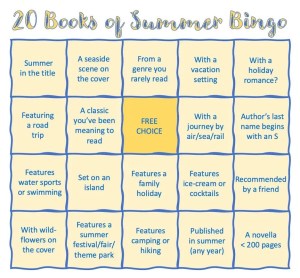
And then there’s this year’s Bingo card to consider. I’m pondering the 4-book diagonal consisting of:
- Summer in the title
- A classic you’ve been meaning to read
- Features a family holiday
- Published in summer (any year)
Or column 4, which is:
- With a vacation setting
- With a journey by air/sea/rail
- Features ice cream or cocktails
- Published in summer (any year)
I tend to skew towards fiction in the summers, so I’m guessing I’ll manage 15 works of fiction (one short story collection would be good), a few memoirs or other nonfiction, and a couple of poetry collections.
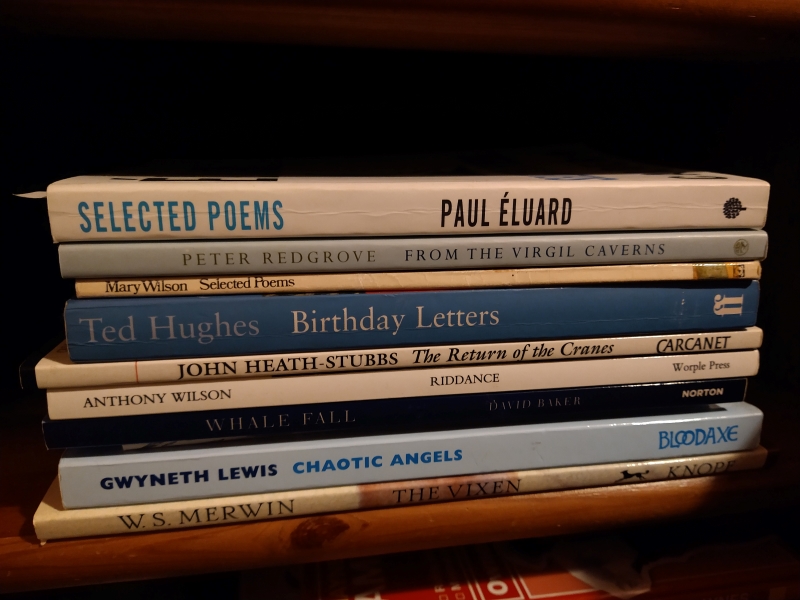
Unread poetry books from my bedside table
Here are a few specific books I currently have my eye on…
Ongoing project:
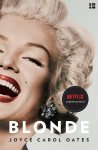 Blonde by Joyce Carol Oates – Marcie (Buried in Print) and I are doing a mini Oates buddy reading project and I made the mistake of starting with Blonde, which is over 700 pages, all of them crammed full of tiny type. So it may well take me the entire summer.
Review copies:
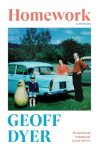 Homework by Geoff Dyer – The paperback has just arrived for me and I’m eager to get stuck in, having sampled it on my Kindle earlier in the year. Dyer is an annoyingly versatile author whose writing always feels effortless. This is his memoir of growing up in typical English suburbia in the 1960s and 70s.
 George by Frieda Hughes – Having recently read a novel about Sylvia Plath (the excellent The Daffodil Days by Helen Bain), I fancy picking up this memoir by her daughter about raising a fledgling magpie as a pet.
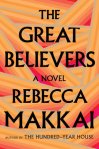 The Great Believers by Rebecca Makkai – This is a proof copy from (gulp) 2018! I only got about 60 pages into it at that time, but I love Makkai and would like to try again. It’s the story of a group of arty friends in Chicago at the start of the AIDS crisis.
Recent acquisitions:
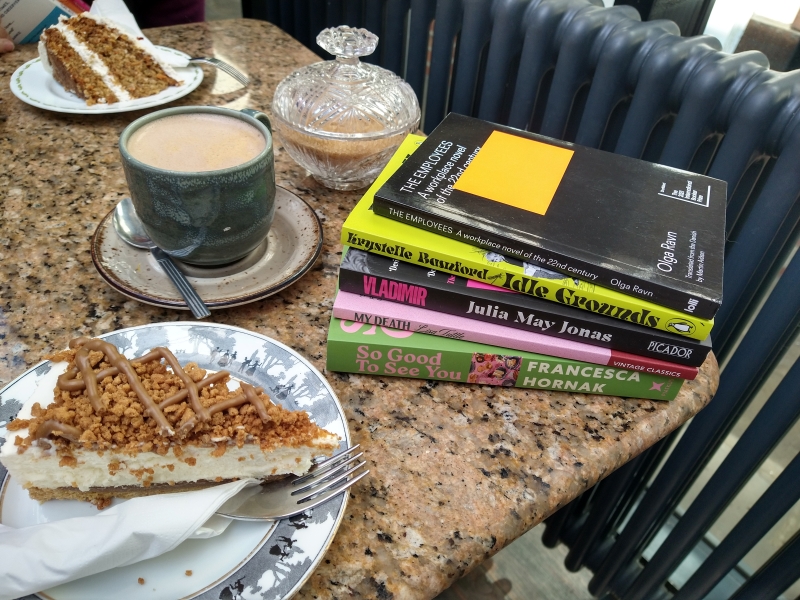
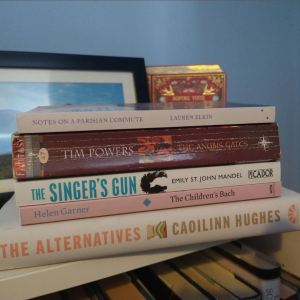
(Elkin for Paris in July; Powers for 1983 challenge)
The new Emily St. John Mandel novel coming out in September, Exit Party, is a sequel of sorts to The Singer’s Gun, I’ve heard, so I will definitely read it ahead.
Tying into other challenges:
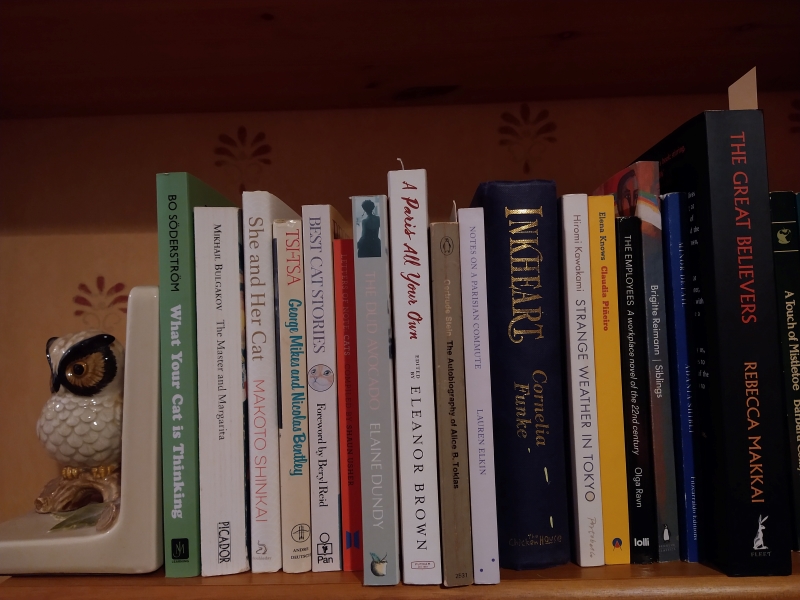
Reading the Meow; Paris in July; Women in Translation options
The Master and Margarita by Mikhail Bulgakov would be for Reading the Meow but would also cross off “A classic you’ve been meaning to read.”
Left over from last year:
 I fancy a reread of Prodigal Summer by Barbara Kingsolver – “From her outpost in an isolated mountain cabin, Deanna Wolfe, a reclusive wildlife biologist, watches a den of coyotes that have recently migrated into the region. She is caught off-guard by a young hunter who invades her most private spaces and confounds her self-assured, solitary life.”
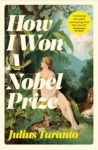 How I Won a Nobel Prize by Julius Taranto – I believe it was Susan’s review that put this on my radar, though the title and the fact that it’s an academic satire would have been enough to get it onto my TBR.
Just because…
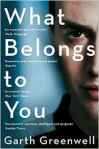 What Belongs to You by Garth Greenwell – Small Rain was my book of 2024, and I keep meaning to read something else by him. It’s his debut’s 10th anniversary, so why not now?
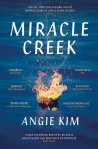 Miracle Creek by Angie Kim – I got this from my wish list for Christmas. I loved her second novel, Happiness Falls, and this one looks right up my street, too, with its theme of experimental treatment for autistic children and gentle thriller plot.
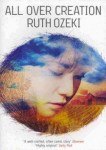 All Over Creation by Ruth Ozeki – Her only novel I’ve not yet read. An environmentalist novel set in the northwestern USA sounds like a good follow-up to our latest book club read, the so-so The Mighty Red by Louise Erdrich.
I’m not committing to a particular set of 20, but you can see from this and my recent library reorganization photos that I have plenty on the shelves to choose from!
See anything here that I should prioritize?
An Inventory of My Bookmark Collection
In March, I worked on rearranging my home library. Last month, I followed up by taking stock of all my bookmarks. I’ve written about subsets of my bookmark collection before: ones I found in books, and ones from bookshops that have since closed. When I wrote the latter post, I estimated that I had 120–150 bookmarks. I always use a bookmark and take simple joy in finding the one that seems most appropriate to a book’s setting or subject matter when possible. Now I know, having categorized and counted them all, that my collection has grown to 228. This exercise was really for my own record and amusement, but perhaps you’ll recognize some familiar objects – or at least the hoarding impulse. Here’s a look at them all:
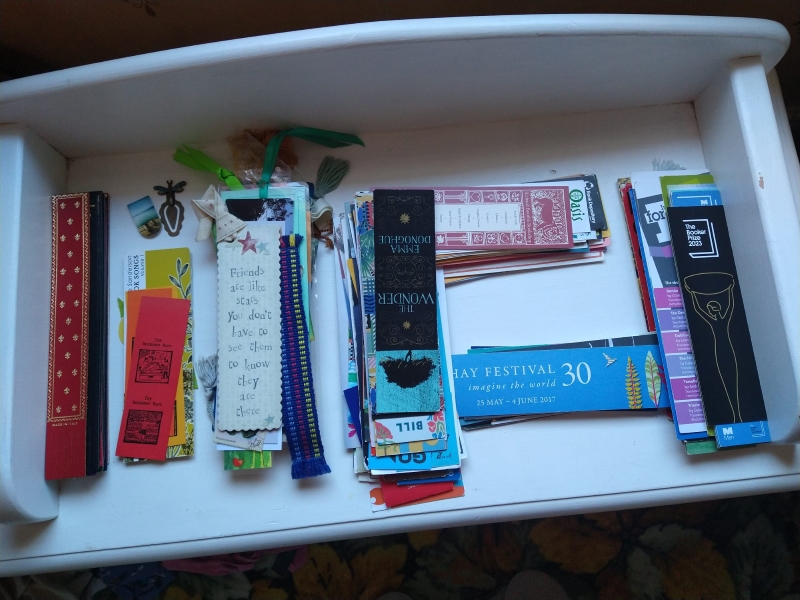
And here they are by category:
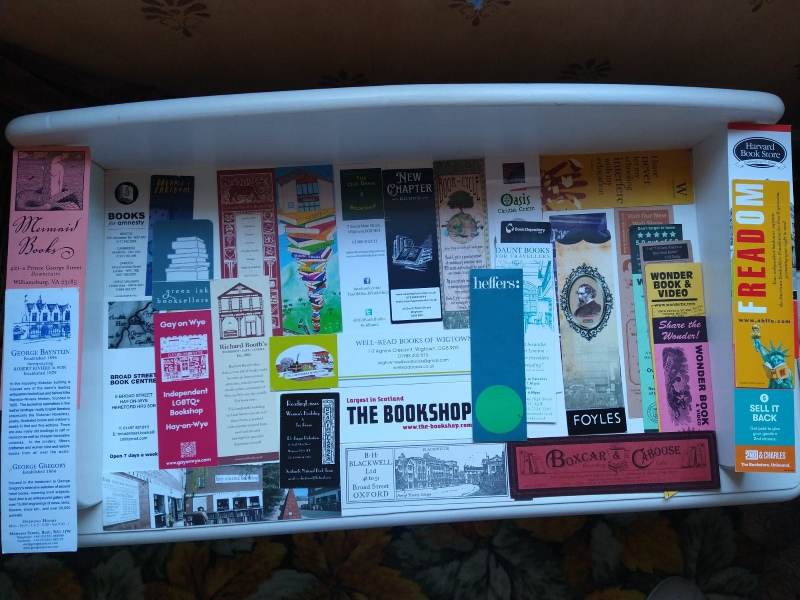
Bookseller-specific bookmarks. I’ve been to all of these establishments / used the online ones. Note the strong representation for Hay-on-Wye and Wigtown! (35)
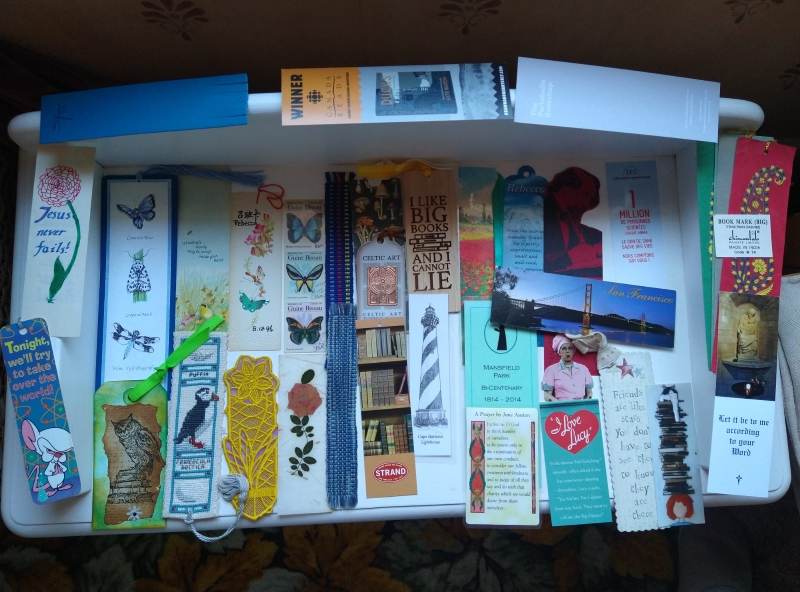
Gifted. From left to right they are roughly from my mother, my aunt, my sister, my in-laws, and friends. Special mention must be made of certain ones: the puffin cross-stitch bookmark my mother made for me, and the daffodil she bought me from Sandham Memorial Chapel; the two blue-patterned ones my aunt wove on her loom (the bottom one is probably my single favourite bookmark in the whole collection and is so precious to me I once ran back to collect it from an out-of-service bus where I’d nodded off on the top deck); and a set of four paisley paper bookmarks given to me by one of my flatmates from my Master’s year at Leeds. A clever gift to bring over from India as they’re flat and extremely lightweight! (35)
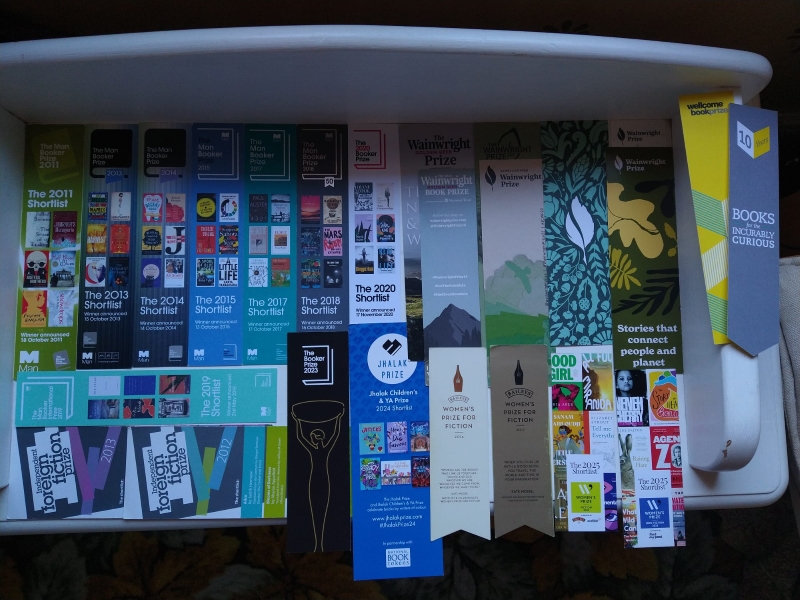
Literary prizes – I generally get these from the library. It’s fun to look back at previous years’ shortlists. (25)
More bookshop and festival bookmarks, this time ones I’ve not frequented myself, which probably means I found the bookmark in a book or at a library. I’ve added five more, at bottom right, to my sad stack of bookmarks from defunct bookshops. I looked up what they’ve all become since.
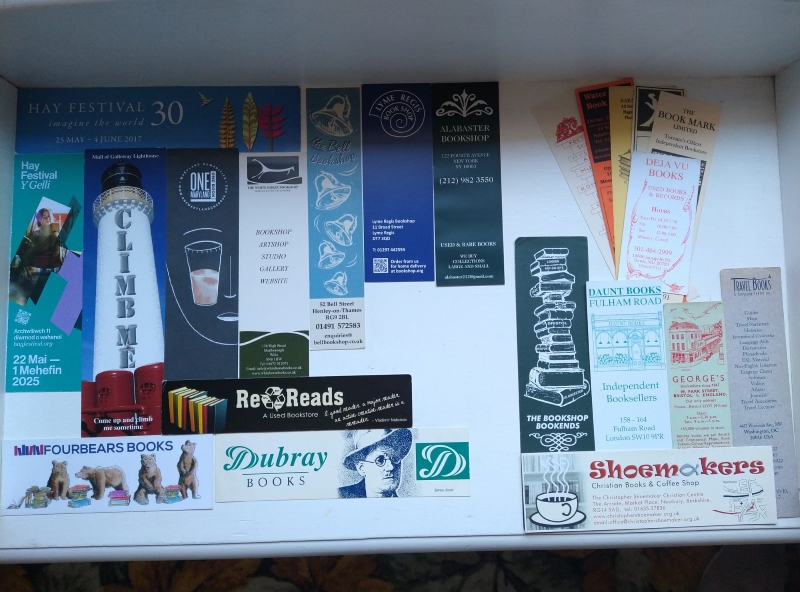
- Bookends, Hay-on-Wye (two branches) is now the Oil & Oak gift shop (Castle Street) and The Pavement Palace hotel (The Pavement)
- Daunt Books, Fulham Road is now Sloane Street Auctions
- George’s is now the Bristol and Bath Rum Distillery
- Travel Books in Washington, DC is now a Mattress Warehouse
- Shoemakers, a Christian bookstore we used to have in Newbury, is now an antique shop, or vacant; I haven’t been down this alleyway in a while.
I was pleased to find that Alabaster Bookshop in New York City is still going, and the Dubray chain in Ireland is not only still around but has expanded. (22)
Other places I’ve been, events I’ve attended, or organizations I’m associated with (21)
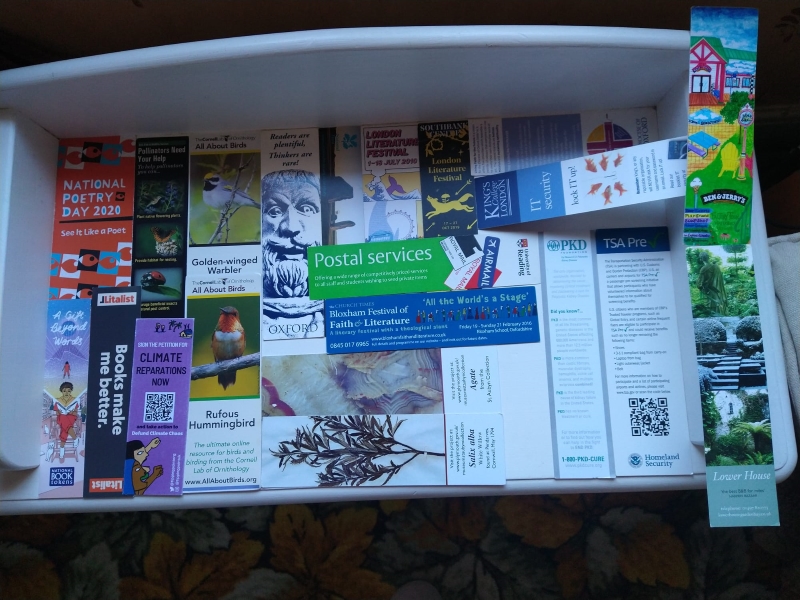
Library-specific bookmarks, all from libraries I’ve visited and/or services I’ve used (16)
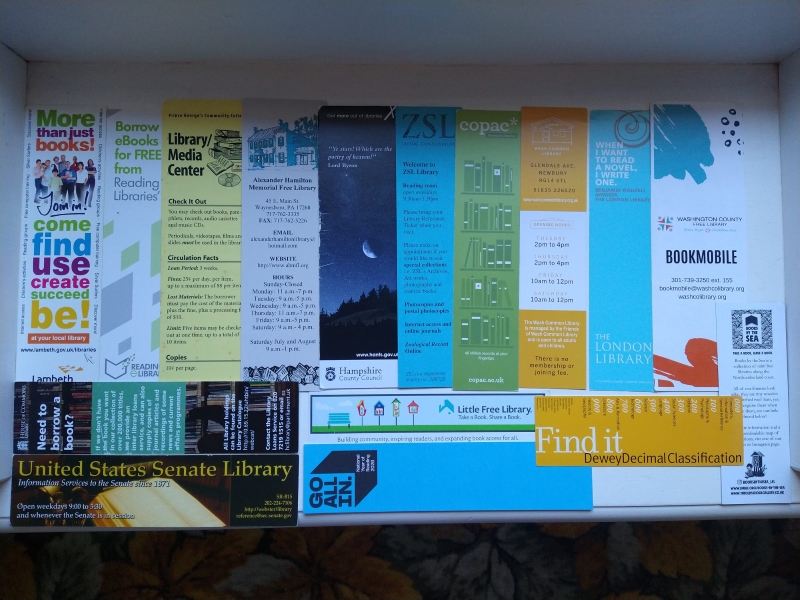
Found in secondhand or library books (15)
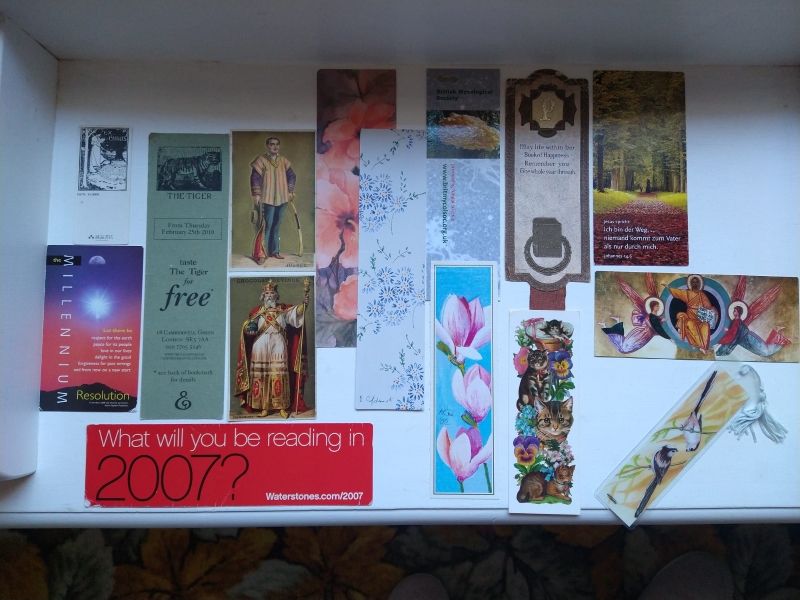
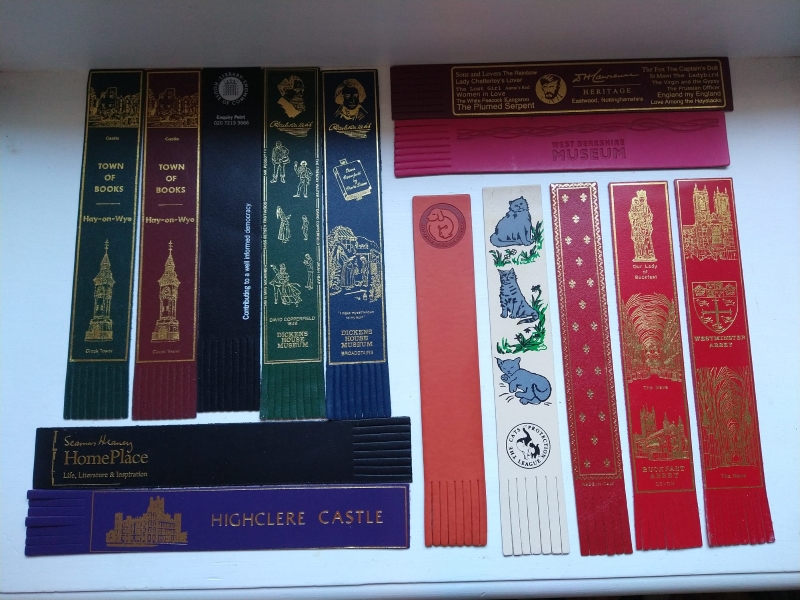
I collect leather bookmarks from places I’ve been. The four at bottom right I actually found abandoned in library books – although I have been to Buckfast and Westminster Abbeys! Cathy sent me the one from Seamus Heaney HomePlace and my mother bought me the one from Highclere Castle. (14)
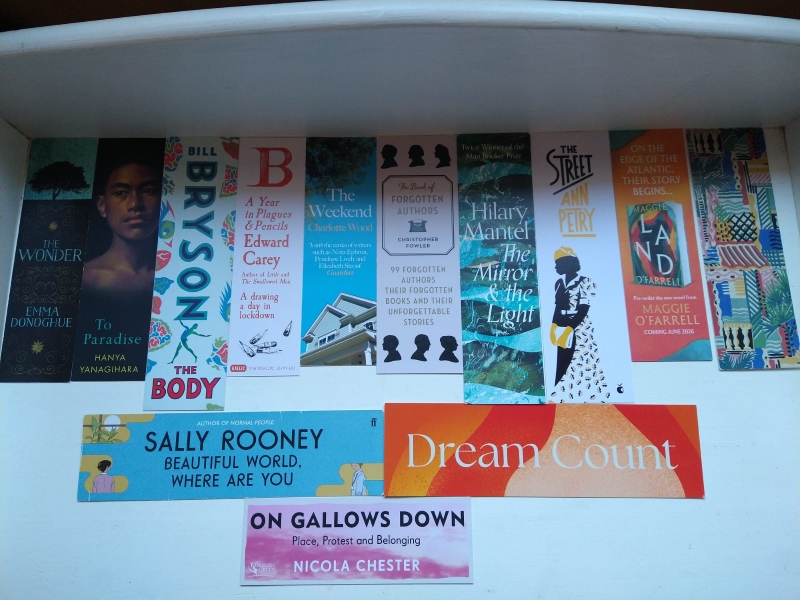
Book-specific bookmarks that came with the book or that I picked up at Waterstones or at an event with the author. I’ve read all but the four at top right (at far right is one I found that originally came from The Persephone Book of Short Stories). (13)
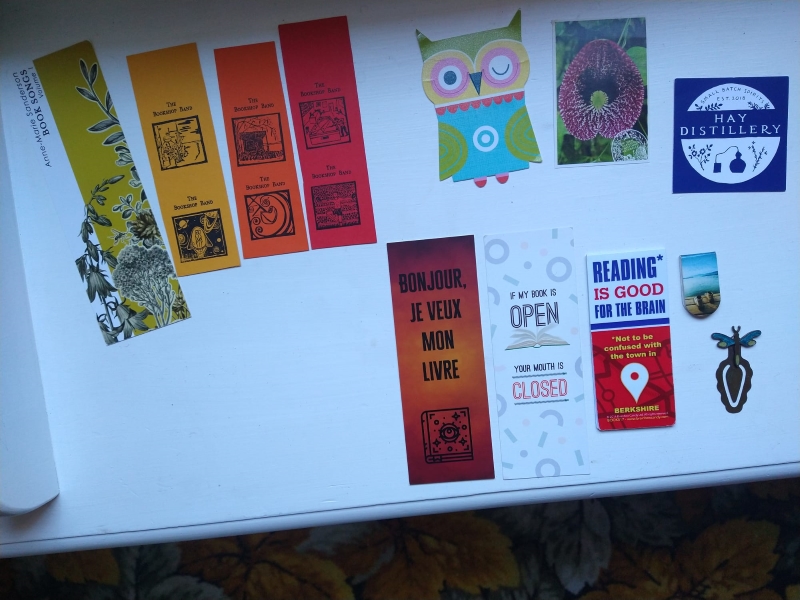
Special ones: came with albums by The Bookshop Band and Anne-Marie Sanderson; I acquired for the in-your-face message (I found “Bonjour, Je veux mon livre” in the Little Free Library; it reads “Hello, I want my book” on the reverse side); are actually other objects – Target gift card, Paris botanical garden ticket, Hay Distillery business card – but I have always used as bookmarks; magnets and metal bookmarks. I’ve gotten rid of other wood/bamboo and metal bookmarks in the past as being so thick as to leave an imprint in the text block or slice page tops. (12)
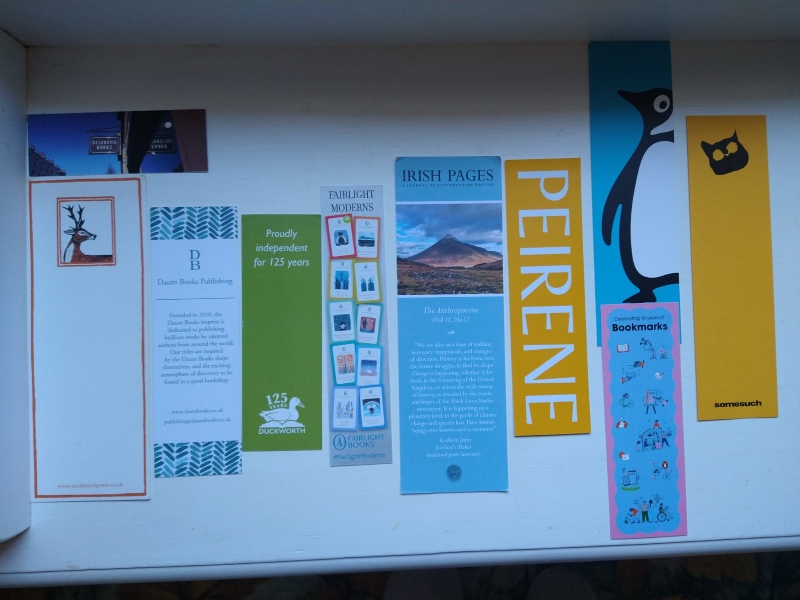
Publisher-specific bookmarks; all are ones I’ve read from (10)
Do you have Opinions on bookmarks, too? Do you collect them? Where do you tend to get them from, and which are your favourites?
12 Days in Portugal and Spain & What I Read
 It’s the second time we’ve braved the 20+-hour ferry crossing from the south coast of England to Santander in the north of Spain. Four years ago, we stayed on the edge of the Picos de Europa national park in Spain. This time we prioritized Portugal, spending a night in Spain on the way out and back. (In Léon, we acquired a taste for vermouth – and the free tapas that come with it. So cheap, too. What a fun eating-out culture!)
Portugal was a new country for us and we thoroughly enjoyed getting a taste of it. Spring seemed to be a month ahead of the UK and blossom was abundant. We stayed in three places in the north: Guimarães, the Douro Valley, and the Côa Valley. We took our new-to-us EV and found the distances manageable and charging cheaper and easier than in the UK. Going by car made packing easy and allowed us to bring back some port, Mr. F’s favourite tipple. However, there were hairy drives along confusing city streets and narrow mountain roads.


Our first stay was at Pousada de Santa Marinha, overlooking Portugal’s oldest city. One of a chain of state-restored castles and convents, it was originally a 12th-century monastery. We relished the bountiful breakfast buffet and manicured grounds but wished for more free time to relax in the grand common areas. Mostly we used this as a base for the first of two day trips to Porto, where we got good views from the cathedral tower, had delicious coffee and veggie snacks at 7g Roaster, and did a tour and tasting at Taylor’s port house. Portugal does a good line in doorstep cats. We also had our first sighting of swifts for the year on the 7th, flying above the azulejos (painted tiles) and cobbled streets of Guimarães before a traditional taverna meal of bacalhau (salt cod) fritters and bean stew with vinho verde.


Quinta dos Murças was, if anything, even more luxurious than the pousada. We were the only guests on our first of three nights at the winery, and after a private English-language cellar tour and wine and port tasting, a sit on the wisteria-covered balcony, and a three-course meal in the dining room, we were feeling like royalty. Along with grapes, they grow almonds, olives and several types of citrus. The lemon trees were dripping with the biggest fruits I’ve ever seen, and the smell of the orange blossom was truly intoxicating. The next morning we got up early and took a pack-up picnic on the train back into Porto, which was so hot and busy that we wondered why we’d bothered – though we did have an excellent tasting experience at a smaller producer, Poças, that included white and red wine, several ports, and a cocktail of white port, lime juice, and blood orange tonic served with a salt rim.


Portuguese is significantly more challenging than Spanish, so I was pleased with myself for managing an all-Portuguese transaction with the conductor on the rural branch line. The old-fashioned train carriages were spacious with comfortable seats, though the ride was not what one would call speedy. The journey back was fraught because we found ourselves pressed to catch the final train of the day (at just after 5:30 p.m.!), couldn’t figure out how to buy tickets at the station machines, were short of cash to pay the conductor on board, and arrived 2 hours late after a car collided with a telegraph pole and left the track blocked for an hour. The following day, what did we do? Got back on a train! (In the opposite direction, with tickets we’d carefully purchased ahead online.) This time we traveled toward the eastern end of the scenic Douro Valley so that we managed to see the whole river in pieces. The village of Tua had no particular sights, but we had a pleasant amble along its river boardwalk.


 We’d earmarked the Côa Valley because it’s home to a sizable rewilding project. On the way, we stopped at Penascosa, an outdoor rock art site with etchings of ibex, aurochs and deer – and even ancient attempts at animation! The Rewilding Centre, where we stayed, is similar to a hostel and has an industrial kitchen because it also operates as a café for the villagers. In cities, we had tended to find English speakers, but the centre manager here had no English, so we happily switched to French (a true lingua franca!) to communicate with her.
The accommodation may have felt like a step down after our two previous splurges, but we’d booked a different treat to selves: an English-speaking guide from Wildlife Portugal who took us out in a Land Rover and found us loads of eagles, vultures and warblers. Bee-eaters and black storks were particular highlights. We were impressed by the array of landscapes: vines and olive groves, granite boulders, high cliffs, pools created by former mining, and green glens. At the hostel we met an English couple (one half a botanist) who are exploring Europe on Interrail passes during a three-month sabbatical, and they joined us for the second day of wildlife tourism; we discovered that Fernando is just as good with plants as with birds.


It was a varied, comfy, boozy trip. There was the touristy experience in Porto and parts of the Douro Valley, but also the ‘real’ countryside. Things ended on something of a sour note due to a rough return crossing of the Bay of Biscay. We’ll be back in Spain next summer to meet up with my sister and our nephew on his school trip to Barcelona, but that jaunt will be by train!


What I Read
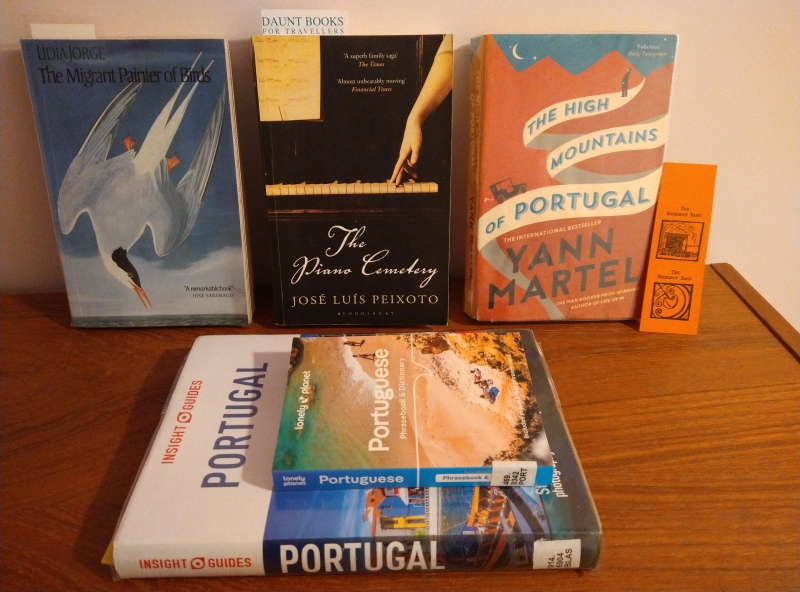
En route: Rita Hayworth and Shawshank Redemption by Stephen King, which I’ll review for a spring-themed post as it’s the first in a quartet of loosely seasonal novellas. You likely know this prison story from the film version.
In Portugal: three Portugal-set novels I’d proudly sourced, including two in translation. My only previous knowledge of Portuguese literature had been a DNF of a José Saramago novel.
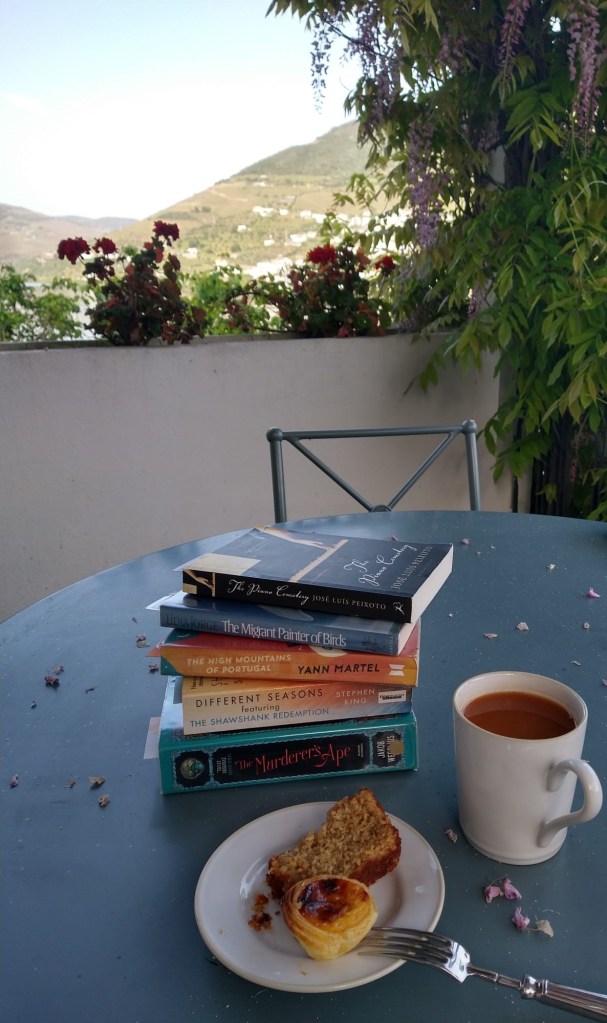
The Migrant Painter of Birds by Lídia Jorge (1998; 2001)
[Translated by Margaret Jull Costa]
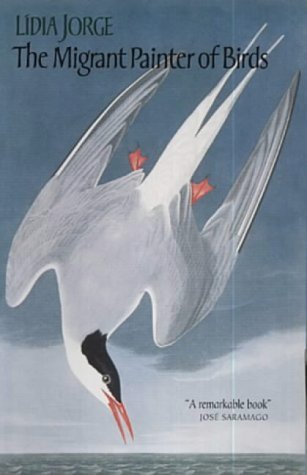 The title figure is Walter, a former soldier who wanders the world and sends his bird paintings back to his daughter at the Dias family home in (fictional) Valmares. His actual visits are few and clandestine: Jorge keeps returning to a scene of him holding his shoes in his hand so he can soundlessly climb the stairs to see his daughter. You see, his daughter is officially his ‘niece’, born of an affair Maria Ema had with her husband Custódio’s brother. That act of adultery is the foundation of the novel but so tacit that it influences everything, including the language and narration. “Walter’s daughter” narrates – in third person or first – and frequently refers to herself as “Walter’s niece” instead.
The slippery narrative moves back and forth in time, pausing at a few landmark years. Very little happens, per se, apart from Walter’s daughter having a liaison with her mother’s therapist and then going to find her father in Argentina, but throughout we are invited to observe the family’s shifting dynamic and understand the narrator’s growing bitterness – “so bruised are we all by the passing of time.” I found the writing intermittently beautiful (“the sun was setting, persimmon red, behind the smooth fields”; “A tangle of living ghosts, the magical cortège of all tyrannies”) but sometimes pretentious or obfuscating to no purpose (“I invoke the decade of irony, the decade of silence pierced by the oblique laughter of cynicism”). (Interlibrary loan) 
The High Mountains of Portugal by Yann Martel (2016)
 I knew of Martel’s obscure fourth novel through The Bookshop Band’s song “Why I Travel This Way,” about a bereaved man who starts walking backwards. What I didn’t realize is that the book is essentially three linked novellas and that song responds to just the first one, “Homeless.” Within a week, museum curator Tomás’s son, common-law wife, and father all died. Tomás sets off in his uncle’s early motorcar (this being 1904) to find a religious relic he learned about from a 17th-century priest’s journal written in São Tomé. But he has no idea how to drive, and accidents and persecution continue to beset him. A Job-like figure, he has set “his back to the world, his back to God” as a way of “not grieving” but “objecting.” Next, pathologist Eusebio and his wife have a high-minded discussion of the morality of murder mysteries in the 1939-set “Homeward.” Eusebio then undertakes an unexpected late-night job when an old woman arrives with her late husband’s corpse in a suitcase. Every cut reveals the substance of the man’s life rather than the reason for his death.
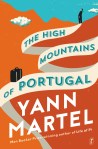 After religious parable and magic realism, “Home” initially seems more straightforward with its story of a widowed Canadian senator who buys Odo the chimpanzee from a research centre and relocates to rural Portugal. If you’ve read Life of Pi and/or Beatrice and Virgil, you know that Martel really goes in for his animal allegories. Odo might be considered symbolic of simplicity and joy in life. There are apt connections with the other novellas: not only an overarching theme of grief, but the specifics of one northern Portuguese village and its events that have become legend. And, yes, chimpanzees. A line from the first part serves as Martel’s mantra: “We are risen apes, not fallen angels.” Weird but satisfying. (Public library)
The Piano Cemetery by José Luís Peixoto (2006; 2010)
[Translated by Daniel Hahn]
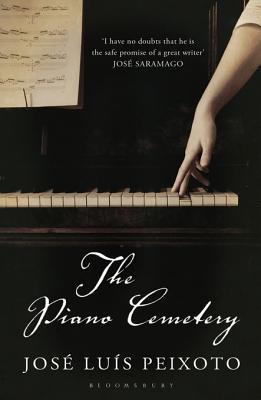 It may be premature, but I feel I can pinpoint some trademarks of Portuguese literature based on the few examples I’ve now read (plus Martel’s pastiche): narrative trickery, family dysfunction, metaphors of blindness, philosophical and religious dialogues, and a fine line between life and death. Unfortunately, in this case I found the appealing elements buried under an off-putting style. The Lázaro family are carpenters in 1910s Lisbon with a back room housing busted pianos that they use for their instrument-repair side business. To start with, the narrator is the dead patriarch of the family, who remembers how he met his wife at the piano cemetery and keeps watch over his children and grandchildren in the present day. There are also two long sections of stream-of-consciousness memories of his son Francisco as he runs the marathon at the 1912 Stockholm Olympics. Francisco Lázaro was a historical figure who died in that athletic pursuit, but the family backstory of estrangement, domestic violence, and adultery that Peixoto builds around him is fictional. Punctuated by distance markers (“Kilometre one” and so on), Francisco’s fragments are decontextualised and often don’t join up or even form complete sentences. Add in the father’s fatphobic attitude toward one of his daughters and the laughably circuitous phrasing (“my thick hand in a single movement, like an impulse, but not even an impulse, like a desire you have for a moment and which becomes concrete in that same moment, another person’s desire within me, a desire which is not thought, but which rises up like a flame” – huh? can I blame the translator?) and you might see why this was a slog for me. (Secondhand purchase – Awesomebooks.com)
Plus a partial reread of a delightful teen novel we both read the last time we were in Spain:
The Murderer’s Ape by Jakob Wegelius
[Translated from the Swedish by Peter Graves]
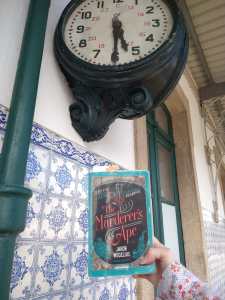 Talk about a risen ape! Sally Jones is an animal narrator extraordinaire: a ship’s engineer who meets every challenge that comes her way with aplomb, traveling from Portugal to India and back just to clear the Chief’s name after he’s falsely accused of murder. She happens to be a gorilla, but her only real limitation is that she can’t voice human language; she understands and writes it perfectly, and can beat most people at chess. This doorstopper never feels like one because it races along on a tide of adventure and intrigue. The technology suggests a 1920s date. All the settings are evocative, but historical Lisbon is especially enticing (and not dissimilar to Peixoto’s): Sally Jones lives with Ana Molina, a famous fado singer, and works in her neighbour Signor Fidardo’s instrument workshop repairing accordions.
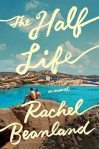
 Plus the latter half of another novel or two I had on the go, and most of a couple of pre-release e-books for Shelf Awareness reviews: the odd Kitten by Stacey Yu, about a cat-identifying millennial Disaster woman, and The Half Life by Rachel Beanland. Set in 1970s Sardinia, this was a perfect summer read – intelligent as well as sultry – about a young Navy wife’s sexual coming of age and casual investigation into the ongoing effect of American nuclear submarines on the island’s natural environment.
Rearranging and Culling My Library
I’m a thrill-seeker, me; when life gets boring, it’s time to engage in the extreme sport of rearranging my home library. My goal this month has been to shake things up and trick myself into being lured by my own books. After all, I was attracted enough to acquire them all. But at some point it’s as if I stop seeing the individual books and they collectively become a sort of wallpaper.
And as I’ve mentioned to some of you, I’ve been disappointed that attempts to highlight segments of my collection – e.g. shelves devoted to BIPOC authors and Women’s Prize nominees – failed: these books seemed more likely to sit unread for years. It must be something to do with creating a feeling of obligation. Even my piles of foodie reads and medical memoirs, two of my favourite subgenres, have gotten ignored.
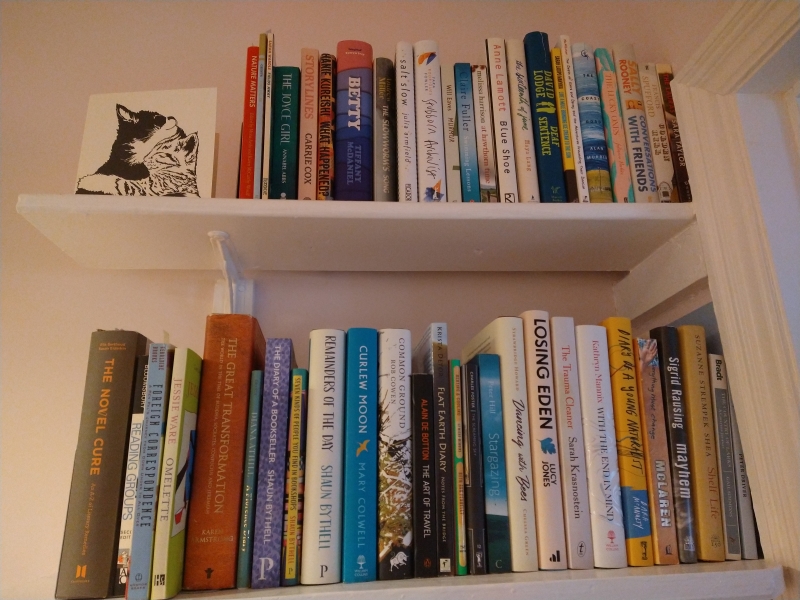
Signed copies shelves: fiction; nonfiction
Setting up special-interest sections backfired, so what next? First, I switched up locations in the upstairs; second, I adjusted the classifications. The one hard and fast rule in my collection is that I separate read from unread books. I don’t currently have room to display read paperbacks, which are in boxes upstairs awaiting built-in shelving in our lounge. I only have one bookcase for read hardbacks, and it’s at capacity; I’ll soon have to reconsider how I display them (and double-stack in the meantime).
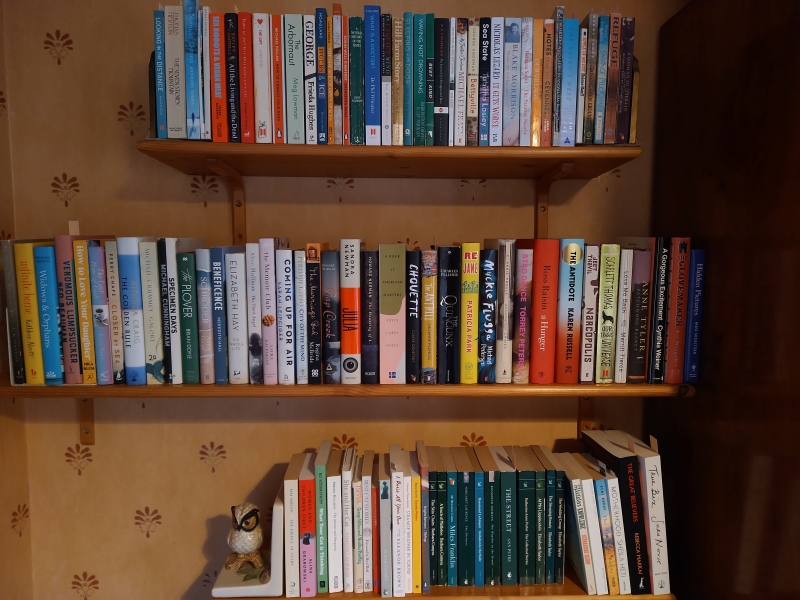
Nonfiction priority; hardback fiction; upcoming challenges and miscellaneous
For my fiction TBR, I interfiled everything into one sequence. Previously, I had kept story collections and novellas separate, but the latter are easy to spot. I’m a librarian at heart and could never eradicate alphabetical order. But, as Jan Morris observed in A Writer’s House in Wales, “I am … stymied in my methodical ordering of this library by the matter of size. Books can be maddeningly un-uniform, meaning that some … which should be side by side with their fellows, are too tall to get on the proper shelves.” Thus a separate shelf for hardbacks and oversize paperbacks.
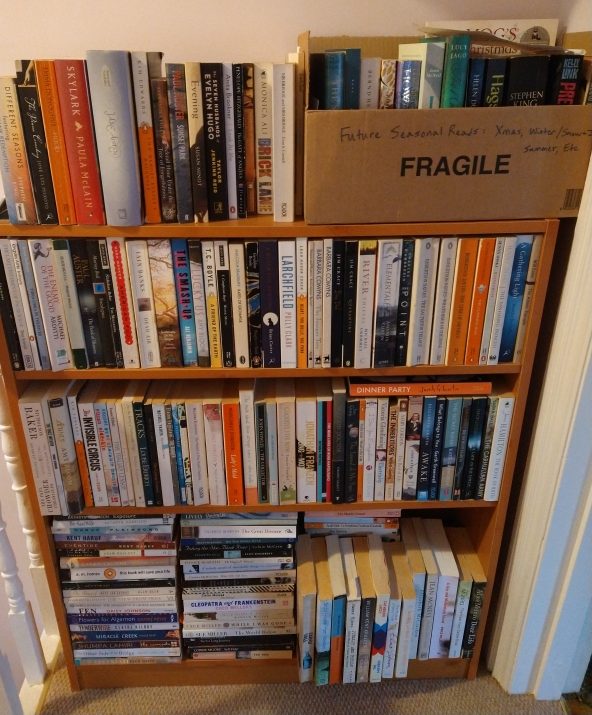
Upcoming and seasonal reads; first half of Fiction A-Z
Then, on a whim, I decided to mix it up by creating a rainbow bookcase on the landing. (To make it more of a challenge, I told myself I could use no Penguins for orange. And I put all the green Viragos together on a different shelf for visual impact.) This made me appreciate just how many books have blue spines, and dull white or black ones! I’m rather pleased with the result, but I will have to be loose about the contents: books will come and go as I read and pass them on, and add others in. In fact, I slotted three in yesterday – two green and a pink – after a trip to our local indie bookstore for my friend’s belated 70th birthday treat.
Other areas I’ve created:
- Priority shelves for time-sensitive books (to be reviewed at publication or for challenges)
- Nonfiction priority – two shelves, one in approximated Dewey order; another that includes review copies and some part-read
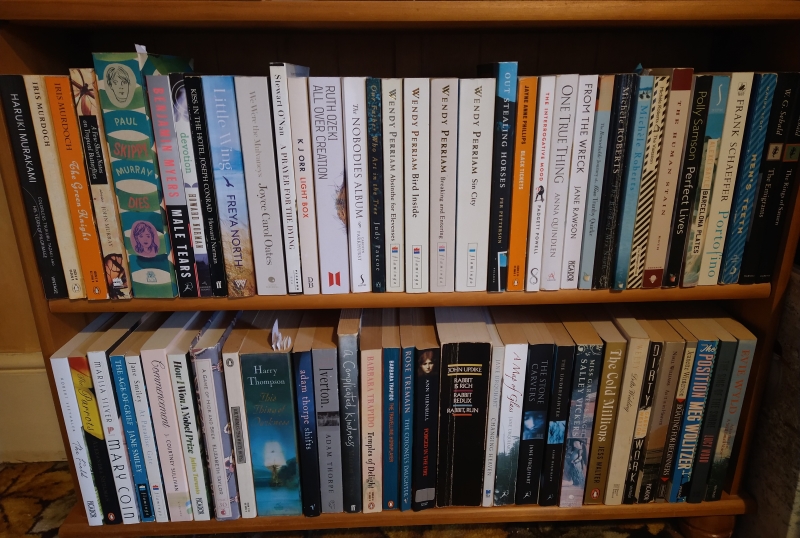
Fiction A-Z, part II
Plus some I’ve maintained:
- Priority to reread
- Seasonal books, in a box
- Signed copies – fiction and nonfiction separate; the handful of unread ones are offset
All through this process, I kept an eye out for books I was no longer keen to read. I ended up jettisoning another 81 (after the 90–100 I culled last year during our hallway redecoration), 17 of which I’ll sell; the rest will be donated to charity or the Little Free Library or given to book club friends as part of the book swap game we do for our holiday social each year.
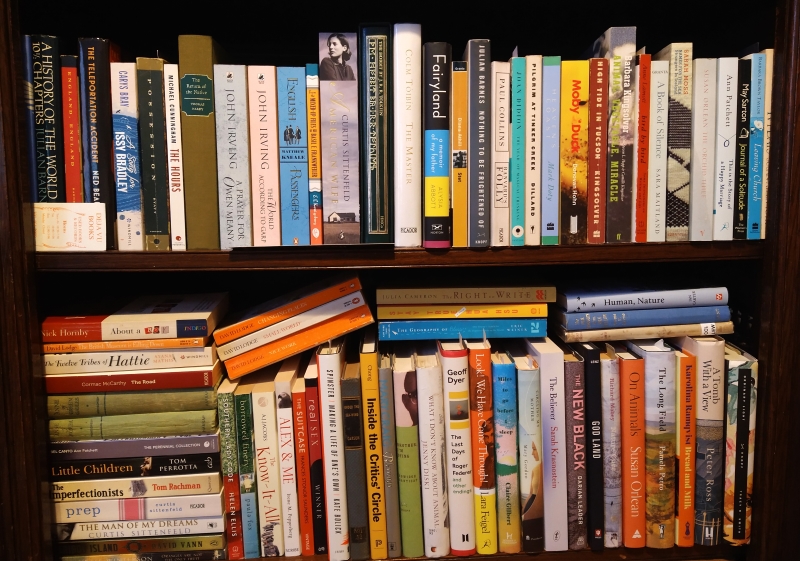
To reread (top shelf and bottom left stack); nonfiction priority
My criteria for getting rid of books were, as I’ve expounded in several posts before:
- Is it a duplicate copy? I used to keep two copies of certain books, thinking I’d do buddy reads with my husband. I have to face facts, though: buddy reads don’t work for us. He tends to read one book at a time and races ahead, while I falter or give up entirely (ahem, Cloud Atlas). I’ve only kept multiple copies where I think it’s a book we might consider setting for book club.
- Is the condition too poor? I’m not usually overly picky about this, but I did ditch four books whose spines were so faded that the title was no longer legible.
- Am I really going to read it? This is a difficult one. I like the idea of certain books but forget that I have random pet peeves, and only so much space – and time. If unsure, I checked the Goodreads page. Ratings and reviews from my friends, but also from randoms whose taste I’ve come to know, can be very helpful in telling me if something is likely to be for me. Some examples of books I decided against keeping, and the reasons:
- Peculiar Ground by Lucy Hughes-Hallett: A doorstopper of a saga that starts in the 17th century, one of my last choices of historical period to read about.
- The Mammoth Cheese by Sheri Holman: Shortlisted for the Orange Prize, but it’s over 400 pages and has great potential to be hokey.
- Eothen by Alexander Kinglake: I had two copies and rid myself of both, even though Jan Morris called it one of the best travel books of all time, because I can’t bear straight travelogues, especially antiquated ones.
- The Mars Room by Rachel Kushner: I DNFed her previous novel and decided against reading her latest; why would the one in between suit me any better?
- The Men Who Stare at Goats and Them by Jon Ronson: I enjoyed two of his books pre-pandemic, but when I look at these now, they just seem dated.
- Pharmakon by Dirk Wittenborn: Bought at The Works in Whitby in 2016 and kept all these years because I was amused by the sales stickers layering up from £2 to £1 to 50p to 25p to 10p. Yes, I bought it for 10 pence. But after a decade, I accepted that I was never going to read this 400+-page novel about an invented drug that induces happiness but then leads to a murder.
As I was going through my groaning set-aside shelf, especially, I had to be honest with myself. Sometimes I misjudge and request a review copy, then for years feel guilty about not reading something that turned out not to be for me. Or I might have liked something enough to get 50–100 pages, or more, into it but then ran out of steam. My choices for these (80+) books were: resume it right away; shelve it with the TBR, either with my progress marked with a slip of paper, or with the intention of starting over at the beginning; or call it unfinished and get rid of it.
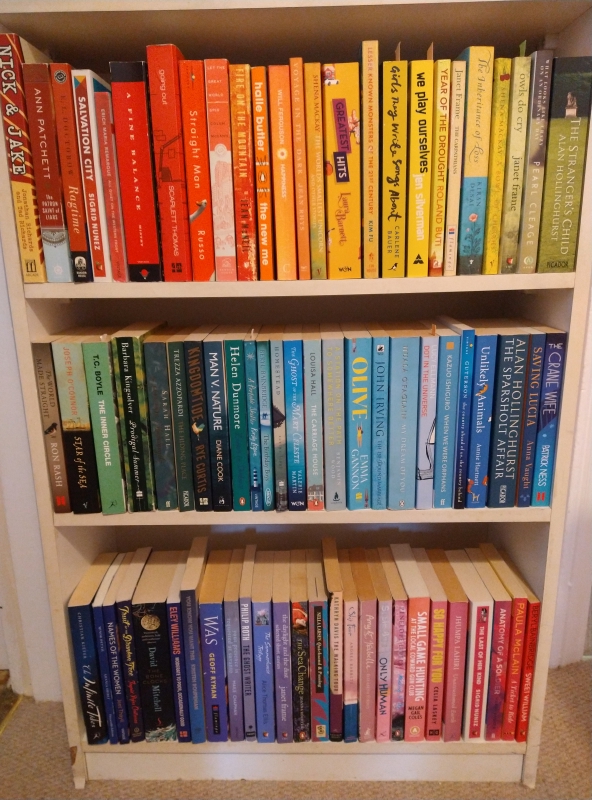
The rainbow bookcase! Have you ever made one of these?
This will be an ongoing task and an evolving system, especially if I ship the remainder of my books over from the USA in June. They’ve been in boxes in my sister’s basement – before that, my dad’s storage unit; before that, my parents’ garage – for far too long. It’s time for a final prune and a reunion with the rest of their family across the pond.
Whether all this honing and rearranging of my collection has been successful, time will tell: my end-of-year stats will reveal whether I’ve managed to read more from my own shelves. I reckon I’ll enjoy the mental athletics of remembering where I’ve moved a book and finding something to fit a seasonal challenge or personal goal. Now that the books have new neighbours, I might be tempted by my long-neglected Four in a Row project again. And for 20 Books of Summer, the only parameter will be that they must be from my own shelves.
How have you kept your TBR under control recently? Do you also have to ‘trick’ yourself into reading your own books?
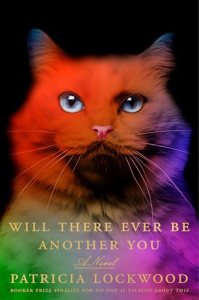
Cover Love 2025
As I did in 2019, 2020, 2021, 2022, 2023 and 2024, I’ve picked out some favourite book covers from the past year’s new releases. This time, I’ve read all of the books featured!
I’m drawn to flora and fauna on book covers; and to adapted artworks.
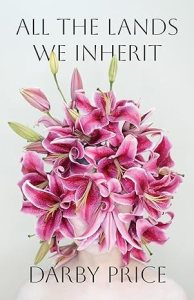
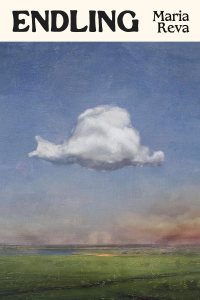
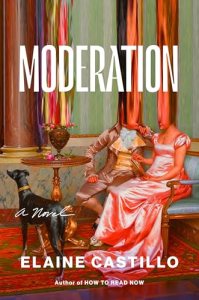
These two stood out for their psychedelic colour choices.
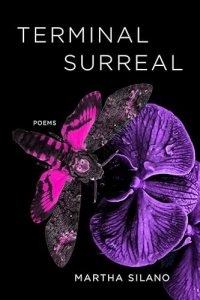
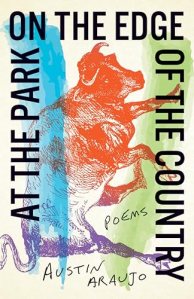
I like an unusual, elegant font. Can anyone identify the one below? I actually wonder if I would have chosen to read all four books had the font not attracted me.
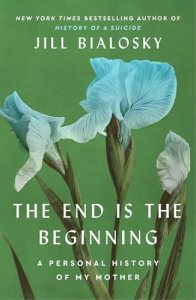
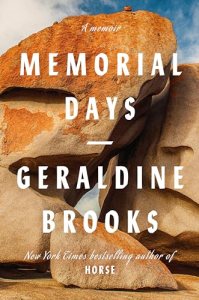
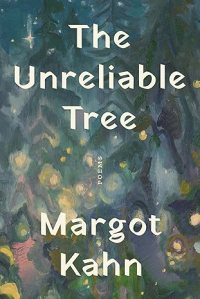
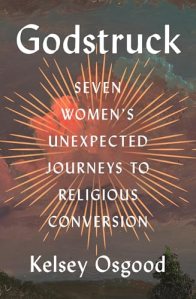
Neat that the image and/or (most of the) title are vertically aligned – a rarer choice.
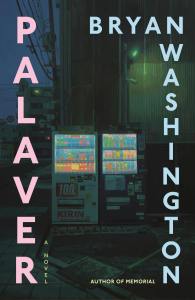
I found this paper cut-out striking, and loved how a cheekily torn matchbook gives the middle finger.
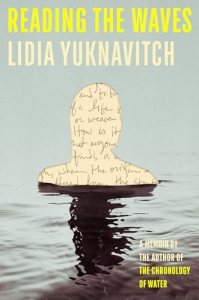
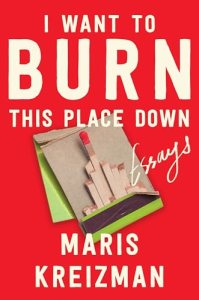
But my two favourite title and cover combinations of the year were:
- Calls May Be Recorded for Training and Monitoring Purposes by Katharina Volckmer – The cover is totally appropriate to the bonkers and raunchy contents (see my Shelf Awareness review – even though I technically reviewed the North American release I’m sticking with the full title and sex doll of the UK edition).
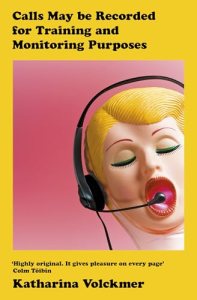
(Overall favourite:)
- Pan by Michael Clune – The cover perfectly captures the mood of this weird novel about a teenage boy who has panic attacks and muses about attributing them to the god Pan. The painting snippet is from The Drunkenness of Noah by Camillo Procaccini; but the eyes, look at those eyes!
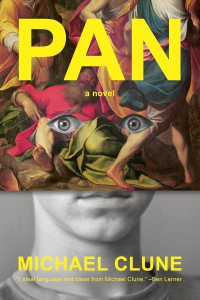
Postscript: In January 2026, Lit Hub chose their 75 best book covers of the past decade. Pan tied for third place for 2025.
What cover trends have you noticed this year? Which ones tend to grab your attention?
Guest Review of Greene Ferne Farm by Richard Jefferies (#NovNov25)
As busy as he is as a lecturer in animal ecology at the University of Reading (and a multi-instrumentalist in several folk/Americana bands), my husband, Dr Chris Foster, managed to find time to read and review (below) something for Novellas in November. This is a random, obscure Victorian novel (from 1880) that we picked up at a book sale in Kingsclere last month.
“The 19th-century author Richard Jefferies is better remembered as a nature writer than as a novelist, and in this slight early novella (albeit published only seven years before his death from tuberculosis at age 38) it is indeed his evocation of the landscapes, wildlife and weather of rural Wiltshire that stand out most.
 “Jefferies conjures atmosphere skilfully, from an uneasy night lost on chalk downland in thick fog to the lonely, dust-filled room where an avaricious old farmer looks out at the sunset from his armchair. There’s a sense of abundant nature as a backdrop for rural life that can be taken for granted, a sense of connectivity across generations – “the cuckoo came and went; the swallows sailed for the golden sands of the south; the leaves, brown and orange and crimson, dropped and died” – but also a prescient fear expressed here by a landowning squire that modern farming methods such as ‘ploughing engines’ might “suck every atom out of the soil.” The abundance of corncrakes portrayed around Greene Ferne is just one reminder for contemporary readers of how much wildlife has been lost from farmland since Jefferies was writing.
“The plot is lacklustre in comparison to the prose: a Hardyesque blend of love triangles and scenes from rural life, with no sense that the occasionally dramatic events portrayed are helping to build any narrative momentum. The portrayals of rustic village folk, complete with thick country accents, feel clichéd and idealised, especially given the decidedly un-Hardyesque happy ending, but the quality of Jefferies’ writing for much of Greene Ferne Farm is at least an encouragement to check out his other, better-known work.” [126 pages]
#NovNov25 Begins! & My Year in Novellas
Welcome to Novellas in November! The link-up is open (see my pinned post). At the start of the month, we’re inviting you to tell us about any novellas you’ve read since last November.

I have a designated shelf of short books that I keep adding to throughout the year. Whenever I’m at secondhand bookshops, charity shops, the Little Free Library, or the public library volunteering, I’m always eyeing up thin volumes and thinking about my piles for November.
But I read novellas other times of year, too. Forty-five of them between December 2024 and now, according to my Goodreads shelves (last year the figure was 44 and the year before it was 46, so that’s my natural average). I often choose to review books of novella length for BookBrowse, Foreword and Shelf Awareness, so that helps to account for the number. I’ve read a real mixture, but predominantly literature in translation and autobiographical works.
My four favourites are ones I’ve already covered on the blog (links to my reviews): The Most by Jessica Anthony, Pale Shadows by Dominique Fortier and Three Days in June by Anne Tyler; and, in nonfiction, Mornings without Mii by Mayumi Inaba. Two works of historical fiction, one contemporary story; and a memoir of life with a cat.


What are some of your recent favourite novellas?
R.I.P. Reads, Part I: Apostolides, Dahl, Harkness, Kingfisher & Kohda
Ghosts, witches, vampires, creepy underground things: It can only be Readers Imbibing Peril time of year! Here’s my first five reviews.

The Homecoming by Zoë Apostolides (2025)
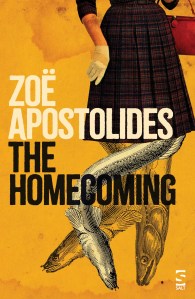 This debut novel dropped through my door as a total surprise: not only was it unsolicited, but I’d not heard about it. In this modern take on the traditional haunted house story, Ellen is a ghostwriter sent from London to Elver House, Northumberland, to work on the memoirs of its octogenarian owner, Catherine Carey. Ellen will stay in the remote manor house for a week and record 20 hours of audio interviews – enough to flesh out an autobiography. Miss Carey isn’t a forthcoming subject, but Ellen manages to learn that her father drowned in the nearby brook and that all Miss Carey did afterwards was meant to please her grieving mother and the strictures of the time. But as strange happenings in the house interfere with her task, Ellen begins to doubt she’ll come away with usable material. I was reminded of The Woman in Black, The Thirteenth Tale, and especially Wakenhyrst what with the local eel legends. The subplot about Ellen drifting apart from her best friend, a new mother, felt unnecessary, though I suppose was intended to bolster the main theme of women’s roles. There’s a twist that more seasoned readers of Gothic fiction and ghost stories might see coming. While I found this very readable and perfectly capably written, I didn’t get a sense of where the author hopes to fit in the literary market; she’s previously published a true crime narrative. Full disclosure: I once collaborated with Zoë on a Stylist assignment.
With thanks to Salt Publishing for the proof copy for review.
The Witches by Roald Dahl (1983)
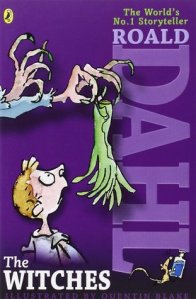 I’m sure I read all of Dahl’s major works when I was a child, though I had no specific memory of this one. After his parents’ death in a car accident, a boy lives in his family home in England with his Norwegian grandmother. She tells him stories from Norway and schools him in how to recognize and avoid witches. They wear wigs and special shoes to hide their baldness and square feet, and with their wide nostrils they sniff out children to turn them into hated creatures like slugs. When Grandmamma falls ill with pneumonia, she and the boy travel to a Bournemouth hotel for her recovery only to stumble upon a convention of witches under the guise of the Royal Society for the Prevention of Cruelty to Children. The Grand High Witch (Anjelica Huston, if you know the movie) has a new concoction that will transform children into mice at enough of a delay to occur the following morning at school. It’s up to the boy and his grandmother to save the day. I really enjoyed this caper, which I interpreted as being – like Tove Jansson’s The Summer Book – about imagination and making the most of one’s time with grandparents. But in the back of my mind was Jen Campbell’s objection to the stereotypical equating of disfigurement with villainy. The Grand High Witch also speaks with a heavy German accent. It would be understandable to dismiss this as dated and clichéd, but I still found it worthwhile. It also fit into my project to read books from my birth year. (Free from a neighbour)
The Black Bird Oracle by Deborah Harkness (2024)
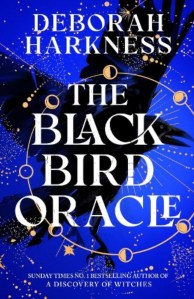 Somehow I’ve read this entire series even though none of the subsequent books lived up to A Discovery of Witches. What I loved about that first novel was how the author drew on her knowledge of the history of science to create a believable backdrop for a story of witches, vampires and other supernatural beings that took place largely in Oxford and its medieval libraries. Each sequel has elaborated further adventures for Diana Bishop, a witch; her vampire husband, Matthew de Clermont; and their family members and other hangers-on. Their twins, especially Becca, have inherited some of Diana’s power. I read the first half of this last year and finally skimmed to the end last week, so I haven’t retained much. Diana is summoned to the ancestral seat of the Bishops in Massachusetts and finds herself part of a community of gossipy, catty witches. (Dahl was right, they’re everywhere!) She has some fun, folksy interactions but things soon get more serious as she girds herself for a showdown with the darker implications of her gift. Overall, this didn’t add much to the ongoing narrative and the love scenes veered too close to romantasy for my liking. (Public library)
What Stalks the Deep by T. Kingfisher [Ursula Vernon] (2025)
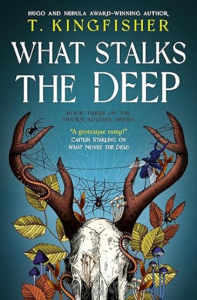 The third in the “Sworn Soldier” series, after What Moves the Dead and What Feasts at Night. Alex Easton is a witty, gender-nonconforming narrator, which is why I persist with these novellas even though I’m underwhelmed by the plots. Denton, the American doctor friend from the first book, begs Easton to come to West Virginia: his cousin Oscar has gone missing in a mine after sending a series of alarming letters about a red light he saw in the depths. Easton and their right-hand man, Angus, soon encounter claustrophobia-inducing cave systems, various kinds of bad air and siphonophore-like marine creatures that can assemble to imitate other beings. (Why aren’t these on the cover, huh?!) In other intriguing matters, Denton seems to have something going on with his friend John Ingold, an Indigenous scientist. Though, as Easton frequently reminds themself, that’s none of our business. There are some great set-pieces and funny, if anachronistic, asides (on learning how to flick a lighter just right: “I used to practice it for hours as a teenager, in hopes of impressing girls. Look, girls were more easily impressed in those days. Shut up.”) But my feeling with all three books is that they’re over before they’ve barely begun, and they never deliver the expected horror. Smart-ass, queer fantasy/horror: these will be some people’s perfect books, just not mine. If you’re intrigued, do at least try the first one, which riffs on Poe. (Read via Edelweiss)
Woman, Eating by Claire Kohda (2022)
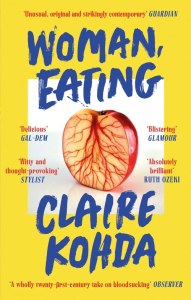 A very different sort of vampire novel. Twenty-three-year-old Lydia is half Japanese and half Malaysian; half human and half vampire. She’s trying to follow in her late father’s footsteps as an artist through an internship at a Battersea gallery, which comes with studio space where she’ll sleep to save money. But she can only drink blood like her mother, who turned her when she was a baby. Mostly she subsists on pig blood – which she can order dried if she can’t buy it fresh from a butcher – though, in one disturbing sequence, she brings home a duck carcass. When she falls for Ben, one of her studio-mates, she imagines what it would be like to be fully human: to make art together, to explore Asian cuisine, to bond over losing their mothers (his is dying of cancer; hers is in a care home with violence-tinged dementia). But Ben is already seeing someone, the internship is predictably dull, and a first attempt at consuming regular food goes badly wrong. There are a lot of promising threads in this debut. It’s fascinating how Lydia can intuit a creature’s whole life story by drinking their blood. She becomes obsessed with the Baba Yaga folk tale (and also mentions Malay vampire legends) and there’s a neat little bit of #MeToo revenge. But overall, it’s half-baked. Really, it’s just a disaster-woman book in disguise. The way Lydia’s identity determines her attitudes towards food and sex feels like a symbol of body dysmorphia. I’ll look out to see if Kohda does something more distinctive in future. (Secondhand – Awesomebooks.com)
More coming up on Halloween (thankfully, including books I liked better on average)!
 Bookish Beck = Rebecca Foster. American transplant to England. Freelance proofreader and book reviewer.
