Nine Days in Germany and What I Read, II: Lübeck
(Part I covered Berlin.) Three works of short fiction embodied the rest of our journeying, from Berlin to Lübeck to home. We were sad to say goodbye to Lemmy and Roxanne, the affectionate, fluffy cats who came with our Berlin flat, but there were further adventures to be had. The hosts of our Lübeck Airbnb apartment also owned two cats we briefly met, but it wasn’t the same as having surrogate pets around.
Goodbye to Berlin by Christopher Isherwood (1939)
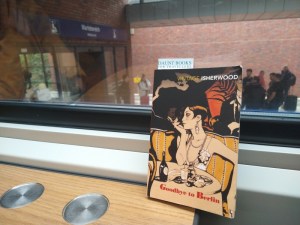 Isherwood intended for these six autofiction stories to contribute to a “huge episodic novel of pre-Hitler Berlin” titled The Lost. Two “Berlin Diary” segments from 1930 and 1933 bear witness to a change in tenor accompanying the rise of Nazism. Even in lighter pieces about a holiday at the Baltic coast and his friendship with a family who run a department store, menace creeps in through characters’ offhand remarks about “dirty Jews” ruining the country. The narrator, Christopher Isherwood, is a private English tutor staying in squalid boarding houses or spare rooms. His living conditions are mostly played for laughs – his landlady, Fraulein Schroeder, calls him “Herr Issyvoo” – but I was also reminded of George Orwell’s didactic realism. I had it in mind that Isherwood was homosexual; the only evidence of that here is his observation of the homoerotic tension between two young men, Otto and Peter, whom he meets on the Ruegen Island vacation, so he was still being coy in print. Famously, the longest story introduces Sally Bowles (played by Liza Minnelli in Cabaret), the lovable club singer who flits from man to man and feigns a carefree joy she doesn’t always feel. This is the second of two Berlin books; I will have to find the other and explore the rest of Isherwood’s work as I found this witty and humane, restrained but vigilant. (Little Free Library)
On balance, we planned the division well: busy city days first, followed by a more restful long weekend; reliable English-speaking opportunities while we built up our confidence, then a more provincial setting where we could try out a bit of German. Friends were curious why we chose Lübeck. Two charitably assumed that I went for the Thomas Mann connections, but that was an incidental side benefit. (I quailed at the prospect of reading the 700+-page debut novel based on his family history, Buddenbrooks; instead, I intended to reread Death in Venice, but my Project Gutenberg download didn’t work, so I’ve earmarked it for Novellas in November instead.)
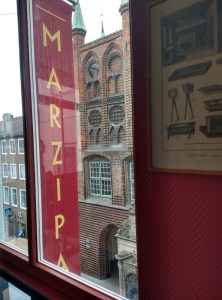
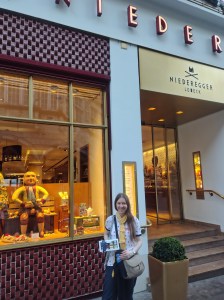
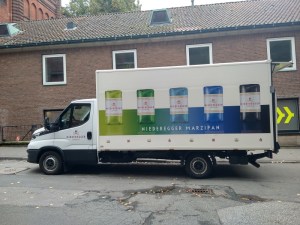
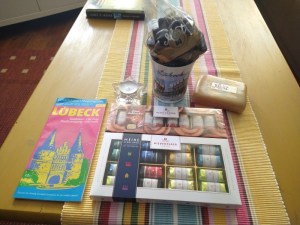
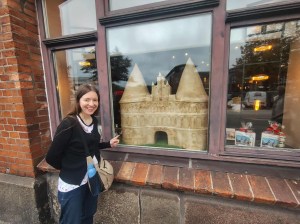
Nope, I was in it for the marzipan. Lübeck has been known for its marzipan since 1795. In 1926, there were 36 marzipan manufacturers in this northern city; three remain today and of course we visited both cafes and all three shops. Niederegger has a small museum above the Bettys-like café. You would not believe the scale or number of tableaux made entirely of almond paste! Nor the variety of flavours and packaging in the shop downstairs. We enjoyed marzipan hot chocolate, cappuccino and cakes, and came away with a modest supply of treats. We also dropped into a trendy restaurant where I had a “Lübecker martini” combining rum, marzipan liqueur and espresso.
-
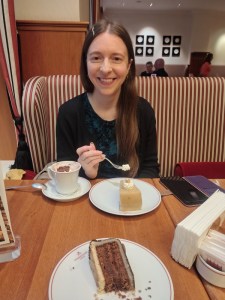
- Marzipan hot chocolate and traditional nusstorte at the Niederegger cafe.
-
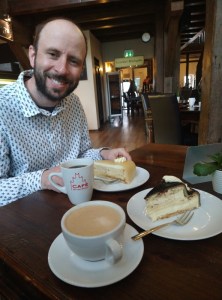
- Marzipanland was better! I had Othello Torte and a marzipan cappuccino.


In a German Pension by Katherine Mansfield (1911)
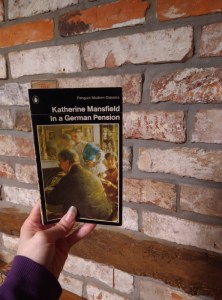 Mansfield was 19 when she composed this slim debut collection of arch sketches set in and around a Bavarian guesthouse. The narrator is a young Englishwoman traveling to take the waters for her health. A quiet but opinionated outsider (“I felt a little crushed … at the tone – placing me outside the pale – branding me as a foreigner”), she crafts pen portraits of a gluttonous baron, the fawning Herr Professor, and various meddling or air-headed fraus and frauleins. There are funny lines that rest on stereotypes (“you English … are always exposing your legs on cricket fields, and breeding dogs in your back gardens”; “a tired, pale youth … was recovering from a nervous breakdown due to much philosophy and little nourishment”) but also some alarming scenarios. One servant girl narrowly escapes being violated, while “The-Child-Who-Was-Tired” takes drastic action when another baby is added to her workload. Most of the stories are unmemorable, however. Mansfield renounced this early work as juvenile and inferior – her first publisher went bankrupt and when war broke out in Europe, sparking renewed interest in a book that pokes fun at Germans, she refused republishing rights. (Secondhand – Well-Read Books, Wigtown)
On our travels, I also read…
- portions of various e-books for paid Shelf Awareness reviews: Benbecula by Graeme Macrae Burnet, Beard by Kelly Foster Lundquist, Wreck by Catherine Newman;
- part of Bright Lights, Big City by Jay McInerney, which I’ll finish for Novellas in November;
- and portions of e-books for fun: Startlement by Ada Limón and An Oral History of Atlantis by Ed Park (more short story catch-up reviews to come).
Aside from marzipan, Lübeck has a lot going for it: lovely medieval Brick Gothic architecture – the iconic Holstentor gate once featured on the 50-mark note; proximity to the Baltic Sea; and connections with three Nobel Prize winners, two for literature – the other being Günter Grass. On the Saturday morning, we took a bus to Travemünde, a popular seaside resort town, for a walk along the cliffs. The path was busy with cyclists but the dog beach was nearly deserted. We watched a ferry setting off for Sweden. (Had we had a few more days to play with, we would have liked to tack on trips to Denmark from here and into Poland from Berlin.)


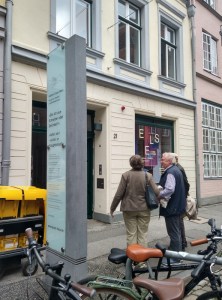
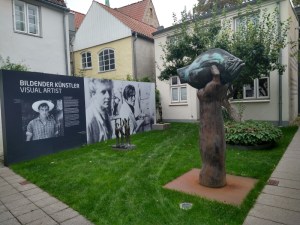
Buddenbrookhaus, the home of Mann’s grandparents, is undergoing a several-year renovation and expansion project. I wasn’t too upset about missing out on it, and there was a Mann exhibit in the tourist information centre. Instead, I went to the Günter Grass House museum, which opened in 2002. Grass spent his last 20 years living 15 miles south of Lübeck and kept an office in this building. For future reference, there’s a good-value day-ticket one can buy that covers all the museums in Lübeck. My husband went to the natural history museum while I learned about Grass, whom I’d never read before, and about Else Lasker-Schüler, whose works were on display in the rotating upstairs exhibit featuring figures who, like Grass, were writers and visual artists.


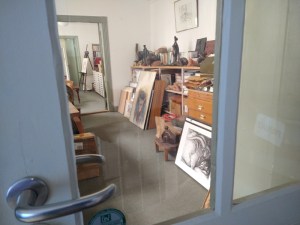
Grass grew up in what is now Danzig, Poland and was drafted into the Waffen-SS at age 17. He was lucky in that he soon received a minor injury that landed him in American custody. The Tin Drum, his well-known debut novel, drew on his military background, which he otherwise rarely discussed. Formally trained in art, he illustrated his works with the same motifs that appear in words. Flora and fauna run all through: fruit, onions; birds, snails, the flounder, cats and dogs. A multitalented writer, he also produced plays, poetry and political commentary. He won the Nobel Prize in 1999 and died in 2015. I found the material on his life and work unexpectedly diverting. I read the short volume below as soon as we got back.
-
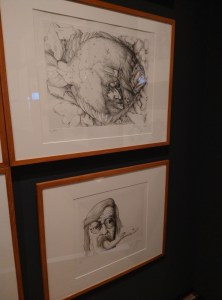
- Some of Grass’s grotesque hybrid animal drawings
-
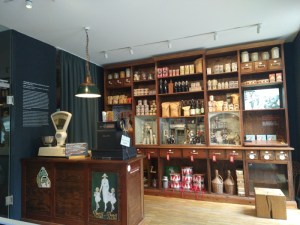
- Replica of the Grass family’s store in Danzig
-
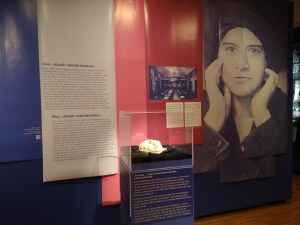
- Else Lasker-Schüler exhibit, including her death mask
Of All that Ends by Günter Grass (2015)
[Translated from German by Breon Mitchell]
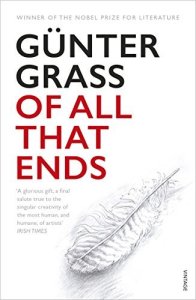 This posthumous prosimetric collection contains miniature essays, stories and poems, many of which seem autobiographical. By turns nostalgic and morbid, the pieces are very much concerned with senescence and last things. The black-and-white sketches, precise like Dürer’s but looser and more impressionistic, obsessively feature dead birds, fallen leaves, bent nails and shorn-off fingers. The speaker and his wife order wooden boxes in which their corpses will lie and store them in the cellar. One winter night they’re stolen, only to be returned the following summer. He has lost so many friends, so many teeth; there are few remaining pleasures of the flesh that can lift him out of his naturally melancholy state. Though, in Lübeck for the Christmas Fair, almonds might just help? The poetry happened to speak to me more than the prose in this volume. I’ll read longer works by Grass for future German Literature Months. My library has his first memoir, Peeling the Onion, as well as The Tin Drum, both doorstoppers. (Public library)


Of all that ends: books, holidays, seasons. It was a trip that, like so many we take these days, was sometimes irksome and exhausting, and could be overwhelming (Berlin) or boring (Lübeck) by turns – yet was still far preferable to the humdrum of home life. And – isn’t it always the way? – just as we’d gotten comfortable with greetings, farewells and other everyday phrases in a new language, it was time to leave. We were more comfortable with French when ordering a vegan supper at a café and drinks in a bustling Art Deco bar during our quick overnight stay in Brussels, then it was onto the Eurostar to come back home. Somewhere on those many train rides back, I caught this monster cold that will not die after 10 days and counting. And the very day we arrived back in the UK, we felt a sudden shift to late autumn weather.
November will be here before we know it.
Letters and Papers from Prison by Dietrich Bonhoeffer (#NovNov22 and #GermanLitMonth)
I’m rounding out our nonfiction week of Novellas in November with a review that also counts towards German Literature Month, hosted by Lizzy Siddal.

Dietrich Bonhoeffer, a German pastor and theologian, was hanged at a Nazi concentration camp in 1945 for his role in the Resistance and in planning a failed 1944 assassination attempt on Adolf Hitler.
 The version I read (a 1959 Fontana reprint of the 1953 SCM Press edition) is certainly only a selection, as Bonhoeffer’s papers from prison in his Collected Works now run to 800 pages. After some letters to his parents, the largest section here is made up of “Letters to a Friend,” who I take it was the book’s editor, Eberhard Bethge, a seminary student of Bonhoeffer’s and his literary executor as well as his nephew by marriage.
Bonhoeffer comes across as steadfast and cheerful. He is grateful for his parents’ care packages, which included his latest philosophy and theology book requests as well as edible treats, and for news of family and acquaintances. To Bethge he expresses concern over the latter’s military service in Italy and delight at his marriage and the birth of a son named Dietrich in his honour. (Among the miscellaneous papers included at the end of this volume are a wedding sermon and thoughts on baptism to tie into those occasions.)
Maintaining a vigorous life of the mind sustained Bonhoeffer through his two years in prison. He downplays the physical challenges of his imprisonment, such as poor food and stifling heat during the summer, acknowledging that the mental toll is more difficult. The rhythm of the Church year is a constant support for him. In his first November there he writes that prison life is like Advent: all one can do is wait and hope. I noted many lines about endurance through suffering and striking a balance between defiance and acceptance:
Resistance and submission are both equally necessary at different times.
It is not some religious act which makes a Christian what he is, but participation in the suffering of God in the life of the world.
not only action, but also suffering is a way to freedom.
Bonhoeffer won over wardens who were happy to smuggle out his letters and papers, most of which have survived apart from a small, late selection that were burned so as not to be incriminating. Any references to the Resistance and the plot to kill Hitler were in code; there are footnotes here to identify them.
The additional non-epistolary material – aphorisms, poems and the abovementioned sermons – is a bit harder going. Although there is plenty of theological content in the letters to Bethge, much of it is comprehensible in context and one could always skip the couple of passages where he goes into more depth.
Reading the foreword and some additional information online gave me an even greater appreciation for Bonhoeffer’s bravery. After a lecture tour of the States in 1939, American friends urged him to stay in the country and not return to Germany. He didn’t take that easier path, nor did he allow a prison guard to help him escape. For as often as he states in his letters the hope that he will be reunited with his parents and friends, he must have known what was coming for him as a vocal opponent of the regime, and he faced it courageously. It blows my mind to think that he died at 39 (my age), and left so much written material behind. His posthumous legacy has been immense.
[Translated from the German by Reginald H. Fuller]
(Free from a fellow church member)
[187 pages]

Nonfiction November “Stranger than Fiction”: The Boys in the Boat
I’m taking a quick break from novellas coverage but keeping up the nonfiction focus with this week’s Nonfiction November prompt, “Stranger than Fiction,” hosted by Christopher at Plucked from the Stacks: “This week we’re focusing on all the great nonfiction books that almost don’t seem real. A sports biography involving overcoming massive obstacles, a profile on a bizarre scam, a look into the natural wonders in our world—basically, if it makes your jaw drop, you can highlight it for this week’s topic.” I would also interpret this brief to refer to nonfiction that reads as fluently as a novel, and on both counts this book stands out.
The Boys in the Boat: Nine Americans and Their Epic Quest for Gold at the 1936 Berlin Olympics by Daniel James Brown (2013)
We read this for my book club a couple of months ago, on the recommendation of one of our members’ spouses. I was dubious because I don’t read history books, and don’t enjoy playing or watching sports, so a sport + history book sounded like a real snoozefest, but that couldn’t have been further from the truth.

Brown focuses on one of the University of Washington rowers, Joe Rantz, in effect making him the protagonist of a classic underdog story. The college team in general, and Rantz in particular, were unlikely champions. Rantz lost his mother young and, abandoned by his father multiple times, had to make a living by his wits in the Seattle area, sometimes resorting to illegal schemes like poaching and selling liquor during Prohibition, but also logging and working in dam construction. Even among the teammates who became his de facto family, he was bullied for coming from poverty and for his enthusiasm for folksy music. That we come to know and care deeply for Rantz testifies to how well Brown recreates his life story – largely via Rantz’s daughter’s reminiscences, though Brown did meet Rantz before his death.
Another central character is world-renowned boat designer George Pocock, an Englishman who set up shop on the Washington campus. Boatbuilding and rowing both come across as admirable skills involving hard physical labour, scientific precision and an artist’s mind. I was surprised by how much I enjoyed reading about the technical details of woodworking and rowing. Brown emphasizes the psychological as well as the physical challenges of rowing – “mind in boat” is a catchphrase reminding rowers to give their total attention for there to be harmony between teammates. Individual talent is only useful insomuch as it boosts collective performance, and there has to be a perfect balance between speed, power and technique. Often, it means going past the pain barrier: “Competitive rowing is an undertaking of extraordinary beauty preceded by brutal punishment,” as the author sums it up.
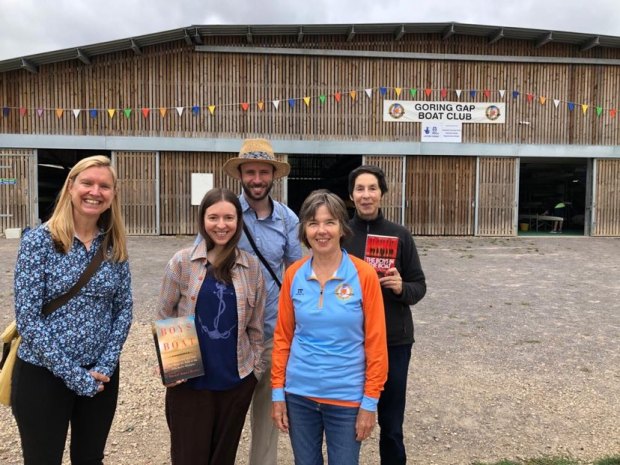
(After reading the book, some of us went on a fieldtrip to see the boating club where the woman who recommended the book rows as an amateur. It wasn’t until I saw the rowers out on the Thames that I realized that only the coxswain – the one who sits at the back of the boat and calls out the orders – faces forward, while all the other rowers are facing backwards. That feels metaphorically significant, like you have to trust where the journey is taking you all together rather than relying on your own sight.)
All along, Brown subtly weaves in the historical background: Depression-era Seattle with its shantytowns, and the rise of Hitler in Germany. Joseph Goebbels and Leni Riefenstahl were key propagandists, whitewashing the city in advance of the Olympics to make a good impression on foreign visitors. Some atrocities had already been committed, and purification policies were in place, yet the Nazis fooled many with a façade of efficiency and cleanliness.
I have deep admiration for books, fiction or non-, that can maintain suspense even though you know the outcome. The pacing really works here. Most of the action is pre-Berlin, which keeps the tension high. (The only times when my attention waned was in the blow-by-blow accounts of preliminary races.) There were so many mishaps associated with the Olympic race that it truly is amazing that the U.S. team pulled through to win – I’ll leave the specifics for future readers to discover. But there are a couple ‘stranger than fiction’ details of the book that I do want to pull out: Joe’s father and brother each married one sister from a set of twins; and actor Hugh Laurie’s father was on the Great Britain rowing team at the 1936 Olympics.
The fires and heatwave of 1936 felt familiar, as did the hairstyles and fashions in the black-and-white photos (but the ‘boys’ themselves look more like 35-year-olds than modern college students). In some ways it seemed that little has changed, but then other facts feel impossibly outdated – e.g., sperm whale oil was used to oil the boats.
This might seem like a ‘dad book’ – indeed, several of us passed the book on to our fathers/-in-law after reading – but in fact it has very broad appeal and is one I’d be likely to recommend to any big readers, even if they’re not keen on nonfiction. It’s one of my most memorable reads of the year so far. And whether you fancy reading the book or not, you may want to look out for the George Clooney-directed film, coming out next year. (Secondhand purchase) 
Five Novellas in Translation
We’re coming to the close of Literature in Translation week of Novellas in November. Cathy and I have both noted that novellas seem more common in other languages, with the work more likely to take on experimental forms. We wondered why this is – do foreign languages and cultures somehow lend themselves to concise storytelling that takes more risks? However, a commenter on a post of Cathy’s suggested that economic realities may have something to do with it: translating short works is faster and cheaper. In a recent blog post, Louise Walters, whose indie publishing imprint is preparing to release its shortest book yet (In the Sweep of the Bay by Cath Barton, 22,000 words), confirms that production and shipping costs are lower for novellas, so she has the chance of recouping her investment.

I’ve gotten to five short translated works this month: three fiction and two nonfiction. (Or should that be four fiction and one nonfiction? With autofiction it’s hard to tell.)
Dependency by Tove Ditlevsen (1971; 2019)
[Translated from the Danish by Michael Favala Goldman]
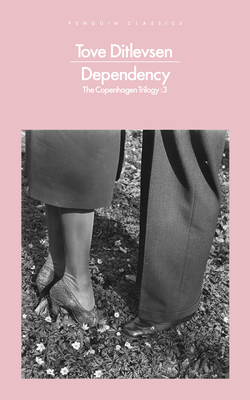 The final volume of the autobiographical Copenhagen Trilogy, after Childhood and Youth. Ditlevsen recalls her upbringing in poverty and her early success as a poet. By the end of the second book, she’s engaged to a much older literary editor. A series of marriages and affairs follows: Viggo, Ebbe, Carl and Victor are the major names, with some others in between. She produces stories and poems as well as a daughter and a son, but also has two abortions. Carl performs one of these and gives her a Demerol shot; ever afterwards, she takes advantage of his obsession with her chronic ear infection to beg for painkiller shots. “Then time ceases to be relevant. An hour could be a year, and a year could be an hour. It all depends on how much is in the syringe.” Addiction interferes with her work and threatens her relationships, but it’s an impulse that never leaves her even when she swaps the harder stuff for alcohol.
I only skimmed this one because from the other volumes I knew how flat and detached the prose is, even when describing desperate circumstances. I can admire this kind of writing – the present-tense scenes, the lack of speech marks, the abrupt jumps between time periods and emotional states, all coldly expressed – but I’m not sure I’ll ever love it. Of the three books, I liked Childhood the best for its universal observations. 
La Symphonie Pastorale by André Gide (1919; 1931)
[Translated from the French by Dorothy Bussy]
“Love is blindness / I don’t want to see” (U2)
 I had a secondhand French copy when I was in high school, always assuming I’d get to a point of fluency where I could read it in its original language. It hung around for years unread and was a victim of the final cull before my parents sold their house. Oh well! There’s always another chance with books. In this case, a copy of this plus another Gide novella turned up at the free bookshop early this year. A country pastor takes Gertrude, the blind 15-year-old niece of a deceased parishioner, into his household and, over the next two years, oversees her education as she learns Braille and plays the organ at the church. He dissuades his son Jacques from falling in love with her, but realizes that he’s been lying to himself about his own motivations. This reminded me of Ethan Frome as well as of other French classics I’ve read (Madame Bovary and Thérèse Raquin). Melodramatic, maybe, but I loved the religious and medical themes (deaf-blind Laura Bridgman gets a mention; when the preacher and Gertrude attend the title symphony, he encourages her synesthetic thinking).
Stammered Songbook: A Mother’s Book of Hours by Erwin Mortier (2011; 2015)
[Translated from the Dutch by Paul Vincent]
 In fragmentary vignettes, some as short as a few lines, Belgian author Mortier chronicles his mother’s Alzheimer’s, which he describes as a “twilight zone between life and death.” His father tries to take care of her at home for as long as possible, but it’s painful for the family to see her walking back and forth between rooms, with no idea of what she’s looking for, and occasionally bursting into tears for no reason. Most distressing for Mortier is her loss of language. As if to compensate, he captures her past and present in elaborate metaphors: “Language has packed its bags and jumped over the railing of the capsizing ship, but there is also another silence … I can no longer hear the music of her soul”. He wishes he could know whether she feels hers is still a life worth living. There are many beautifully meditative passages, some of them laid out almost like poetry, but not much in the way of traditional narrative; it’s a book for reading piecemeal, when you have the fortitude.
Bonjour Tristesse by Françoise Sagan (1954; 1955)
[Translated from the French by Irene Ash]
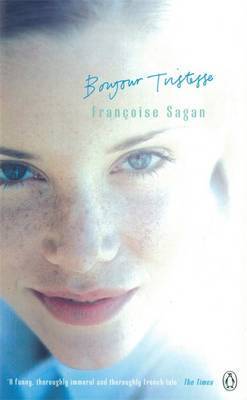 Like The Go-Between and Atonement, this is overlaid with regret about childhood caprice that has unforeseen consequences. That Sagan, like her protagonist, was only a teenager when she wrote it only makes this 98-page story the more impressive. Although her widower father has always enjoyed discreet love affairs, seventeen-year-old Cécile has basked in his undivided attention until, during a holiday on the Riviera, he announces his decision to remarry a friend of her late mother. Over the course of one summer spent discovering the pleasures of the flesh with her boyfriend, Cyril, Cécile also schemes to keep her father to herself. Dripping with sometimes uncomfortable sensuality, this was a sharp and delicious read.
The Order of the Day by Éric Vuillard (2017; 2018)
[Translated from the French by Mark Polizzotti]
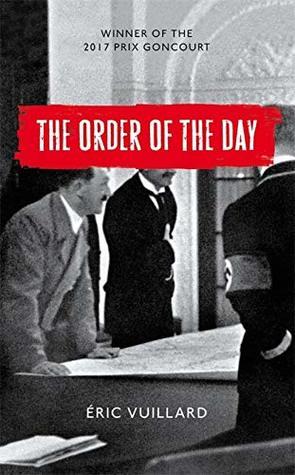 February 1933: 24 German captains of industry meet with Hitler to consider the advantages of a Nazi government. I loved the pomp of the opening chapter: “Through doors obsequiously held open, they stepped from their huge black sedans and paraded in single file … they doffed twenty-four felt hats and uncovered twenty-four bald pates or crowns of white hair.” As the invasion of Austria draws nearer, Vuillard recreates pivotal scenes featuring figures who will one day commit suicide or stand trial for war crimes. Reminiscent in tone and contents of HHhH, The Tobacconist, and the film Downfall, this starts off promisingly and ends with clear relevance to the present moment (“a mysterious respect for lies. Political manoeuvring tramples facts”) and a brilliant final paragraph, but in between was dull. You’d have to have more interest in history than I do to love this Prix Goncourt winner.
Publishers that specialize in novellas in translation:
Charco Press – I’ve reviewed:
 The Wind that Lays Waste by Selva Almada
Fish Soup by Margarita García Robayo
Die, My Love by Ariana Harwicz
Peirene Press – I’ve reviewed:
Mr. Darwin’s Gardener by Kristina Carlson
The Looking-Glass Sisters by Gøhril Gabrielsen
Ankomst by Gøhril Gabrielsen
 Dance by the Canal by Kerstin Hensel
The Last Summer by Ricarda Huch
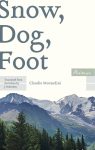
Snow, Dog, Foot by Claudio Morandini
Her Father’s Daughter by Marie Sizun
The Orange Grove by Larry Tremblay
The Man I Became by Peter Verhelst
A few more favorite novellas in translation:
The Plimsoll Line by Juan Gracia Armendáriz
 Silk by Alessandro Baricco
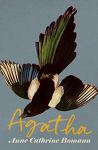
Agatha by Anne Cathrine Bomann
Swallowing Mercury by Wioletta Greg
Next week, we’re closing out Novellas in November with a focus on short classics. I’ll introduce the week’s theme with some of my favorite examples on Monday.
Any theories as to why so many novellas are from other languages?
What are some of your favorites?
A Publisher Party and a One-Man Play
I was a veritable social butterfly this past week: I went out two evenings in a row! (Believe me, that’s rare.) On Tuesday I met up with bloggers Annabel, Eric and Kim at the Faber Spring Party held at Crypt on the Green in London, and on Wednesday my husband and I attended a performance at the University of Reading of Michael Mears’s one-man play on the plight of Britain’s conscientious objectors during World War I, This Evil Thing.
Faber Spring Party
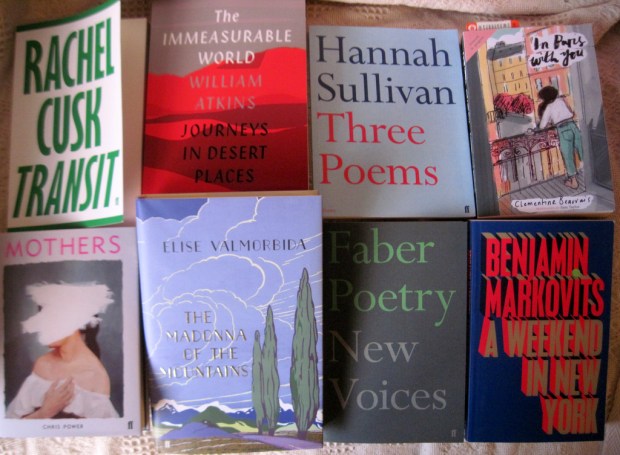
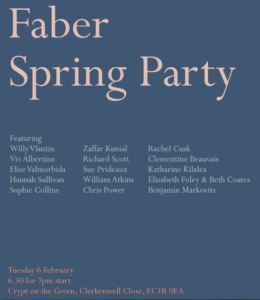 I’ve never been to an event quite like this. Publisher Faber & Faber, which will be celebrating its 90th birthday in 2019, previewed its major releases through to September. Most of the attendees seemed to be booksellers and publishing insiders. Drinks were on a buffet table at the back; books were on a buffet table along the side. Glass of champagne in hand, it was time to plunder the free books on offer. I ended up taking one of everything, with the exception of Rachel Cusk’s trilogy: I couldn’t make it through Outline and am not keen enough on her writing to get an advanced copy of Kudos, but figured I might give her another try with the middle book, Transit.

For the evening’s presentation, each featured author had a few minutes to introduce their new book and/or give a short reading.
Rachel Cusk opened the evening with a reading from Kudos. If you’re familiar with her recent work, you won’t be surprised at this synopsis: a man on a plane recounts having his dog put to sleep. (Out on May 3rd.)
William Atkins’s book on deserts, The Immeasurable World, is based on three years of travel and is, he is not ashamed to say, in the old-fashioned travel writing tradition. (Out on June 7th.)
Hannah Sullivan’s Three Poems is a hybrid work of poem-essays. #2 is more philosophical, she said; #3 is about her father’s death and her son’s birth. She read sonnet 3.21. (Out now.)
Clémentine Beauvais’s In Paris with You is a YA romance in free verse, loosely based on Eugene Onegin. I don’t know the source text but started this on the train ride home and it’s enjoyable thus far. I’m in awe at how translator Sam Taylor has taken the French of her Songe à la douceur and turned it into English poetry. (Out on June 7th.)
Chris Power’s Mothers is a book of linked short stories, three of which are about a character named Eva. He read a portion of a story about her having an encounter with an unpleasant man in Innsbruck. (Out on March 1st.)
Elise Valmorbida’s The Madonna of the Mountains, set in 1923–50, is a saga that resembles “an Italian Mother Courage,” she says. She read a scene in which a character comes across a madwoman. (Out on April 5th.)
Zaffar Kunial read the poem “Spark Hill” from his forthcoming collection Us. It’s about a childhood fight in the area of Birmingham where he grew up. He had a folder open in front of him but, impressively, recited the long poem completely from memory. (Out on July 5th.)
American novelist Benjamin Markovits was a professional basketball player in Germany for six months. Like the tennis-playing protagonist of his upcoming book, A Weekend in New York, he got tired of being measured. After 15 years, his hero is eager to escape a life of being constantly ranked. This is the first in a quartet of novels that inevitably invites comparison with John Updike’s “Rabbit” books. (Out on June 7th.)
I confess I didn’t previously know the name Viv Albertine; she was the guitarist for the female punk band The Slits, and To Throw Away Unopened is her second memoir. Albertine realized that it was her mother who had made her an angry rebel; the title is the label on a bag she found in her mother’s room after her death. (Out on April 5th.)
Sophie Collins incorporates hybrid forms in her poetry – what she calls “lyric essays.” The theme of her book Who Is Mary Sue? is perceptions of women’s writing (with “Mary Sue” as a metonym for the stereotypical good girl). She read from “Engine.” (Out now.)
Katharine Kilalea’s debut novel Ok, Mr Field is about an injured concert pianist who becomes obsessed with a house he buys in South Africa. (Out on June 7th.)
Elizabeth Foley and Beth Coates are the authors of two Homework for Grown-Ups books. Their new book, What Would Boudicca Do?, is about lessons we can draw from the women of history. For instance, the sampler booklet has pieces called “Dorothy Parker and Handling Jerks” and “Frida Kahlo and Finding Your Style.” There’s a heck of a lot of books like this out this year, though, and I’m not so sure this one will stand out. (Out on September 6th.)
Richard Scott read two amazingly intimate poems from his upcoming collection, Soho. One, “cover-boys,” was about top-shelf gay porn; the other was about mutilated sculptures of male bodies in the Athens archaeological museum. If you appreciated Andrew McMillan’s Physical, you need to get hold of this the second it comes out. I went back and read “cover-boys” in the sampler booklet and it wasn’t nearly as powerful as it was aloud; Scott’s reading really brought it to life, in contrast to some other authors’ dull delivery. (Out on April 5th.)
Sue Prideaux’s forthcoming biography of Friedrich Nietzsche is entitled I Am Dynamite! She encountered her subject when she wrote her first biography, of Edvard Munch. Although Nietzsche has been embraced by far-right groups in America, he was in fact against racism, nationalism, and anti-semitism, so he has important messages for us today. I’ll be keen to get hold of this one. (Out on September 6th.)
Guitar in hand, Willy Vlautin closed the evening with a performance of the title track from the soundtrack album to his fifth novel, Don’t Skip Out on Me – he was the singer in Portland, Oregon alt-country band Richmond Fontaine, which has recently stopped touring. He said the novel asks, “can you make the scars of broken people bearable?” (Out now.)

Now that I’ve got this terrific stack of books, wherever do I start?! I’m currently reading the Beauvais; from there I’ll focus on ones that have already been released, starting with Vlautin and the two poetry collections. The titles that aren’t out until June can probably wait – though it’s tempting to be one of the privileged few who get to read them nearly four months early. One Faber book per week should see me getting through all these by the final release date.
This Evil Thing
Michael Mears plays about 50 different characters in this one-man production. He’s an actor and pacifist who has written a number of solo pieces over 20 years. In this commemorative year of the end of the First World War, he knew we would hear a lot about battles, soldiers, and their families back home. But conscientious objectors weren’t likely to be remembered: theirs is a “story that’s rarely told,” he realized. This Evil Thing sets out to correct that omission. The title phrase refers not to war in general but specifically to conscription.
 The two main characters Mears keeps coming back to in the course of the play are Bert Brocklesby, a Yorkshire preacher, and philosopher Bertrand Russell. Brocklesby refused to fight and, when he and other COs were shipped off to France anyway, resisted doing any work that supported the war effort, even peeling the potatoes that would be fed to soldiers. He and his fellow COs were beaten, placed in solitary confinement, and threatened with execution. Meanwhile, Russell and others in the No-Conscription Fellowship fought for their rights back in London. There’s a wonderful scene in the play where Russell, clad in nothing but a towel after a skinny dip, pleads with Prime Minister Asquith.
As in solo shows I’ve seen before (e.g. A Christmas Carol with Patrick Stewart), Mears had to find subtle ways to distinguish between characters: he used a myriad different voices, including regional accents; he quickly donned a jacket, hat, or pair of glasses. Russell was identified by his ever-present pipe. The most challenging scene, Mears said in the Q&A at the end, was one with four characters in a French street café.
Mears reveals during the play that his grandfather fought in WWI and his father in WWII, but he has never had to put his own pacifist views to the test. What about Hitler? people always ask. Mears is honest and humble enough to admit that he doesn’t know what he would have done had he been called on to fight Hitler, or had he faced persecution as a CO in WWI. Ultimately, what Mears hopes audiences take from his play, which won acclaim at the Edinburgh Festival Fringe, is that “this is not an irrelevant piece of history.” Standing up for what you believe in, especially if it goes against the spirit of the times, is always valuable.
German Lit Month: The Tobacconist by Robert Seethaler
I don’t participate in a lot of blogger challenges (though I’ll be doing “Novellas in November” on Monday); it’s more of a coincidence that I finished Austrian writer Robert Seethaler’s excellent The Tobacconist (translated from the German by Charlotte Collins) towards the end of German literature month.
You may recall that I read Seethaler’s previous novel, A Whole Life, on my European travels this past summer, and didn’t think too much of it. I’d read so much praise for its sparse style, but I couldn’t grasp the appeal. Here’s what I wrote about it at the time: “This novella set in the Austrian Alps is the story of Andreas Egger – at various times a farmer, a prisoner of war, and a tourist guide. Various things happen to him, most of them bad. I have trouble pinpointing why Stoner is a masterpiece whereas this is just kind of boring. There’s a great avalanche scene, though.”
 But I’m very glad that I tried again with Seethaler, because The Tobacconist is one of the few best novels I’ve read this year, and very much a book for our times despite being set in 1937–8.
Seventeen-year-old Franz Huchel’s life changes for good when his mother sends him away from his quiet lakeside village to work for her old friend Otto Trsnyek, a Vienna tobacconist. “In [Franz’s] mind’s eye the future appeared like the line of a far distant shore materializing out of the morning fog: still a little blurred and unclear, but promising and beautiful, too.”
Though the First World War left him with only one leg, Trsnyek is a firebrand. Instead of keeping his head down while selling his cigars and newspapers, he makes his political opinions known. This sees him branded as a “Jew lover” and persecuted accordingly. One of the Jews he dares to associate with is Sigmund Freud, who is a regular customer even though he already has throat cancer and will die just two years later.
Especially after he falls in love with Anezka, a flirtatious but mercurial Bohemian girl, Franz turns to Professor Freud for life advice. “So I’m asking you: have I gone mad? Or has the whole world gone mad?” The professor replies, “yes, the world has gone mad. And … have no illusions, it’s going to get a lot madder than this.”
Through free indirect speech, the thought lives of the various characters, and the postcards and letters that pass between Franz and his mother, Seethaler gradually and subtly reveals the deepening worry over the rise of Hitler and the situation of the Jews. This novel is so many things: a coming-of-age story, a bittersweet romance, an out-of-the-ordinary World War II/Holocaust precursor, and a perennially relevant reminder of the importance of finding the inner courage to stand up to oppressive systems.
Freud and his family had enough money and influence to buy their way to England. So many did not escape Hitler’s regime. I knew that, but discovered it anew in this outstanding novel.
Some favorite passages:
Dear Mother,
I’ve been here in the city for quite a while now, yet to be honest it seems to me that everything just gets stranger. But maybe it’s like that all through life—from the moment you’re born, with every single day, you grow a little bit further away from yourself until one day you don’t know where you are any more. Can that really be the way it is?
And as more than twenty thousand supporters bellowed their assent into the clear Tyrolean mountain air, Adolf Hitler was probably sitting beside the radio somewhere in Berlin, licking his lips. Austria lay before him like a steaming schnitzel on a plate. Now was the time to carve it up. … People were cosseting their faint-hearted troubles and hadn’t even noticed yet that the earth beneath their feet was burning.
(from a letter from Mama) Just imagine, Hitler hangs on the wall even in the restaurant and the school now. Right next to Jesus. Although we have no idea what they think of each other.
Freud: “Most paths do at least seem vaguely familiar to me. But it’s not actually our destiny to know the paths. Our destiny is precisely not to know them. We don’t come into this world to find answers, but to ask questions. We grope around, as it were, in perpetual darkness, and it’s only if we’re very lucky that we sometimes see a little flicker of light. And only with a great deal of courage or persistence or stupidity—or, best of all, all three at once—can we make our mark here and there, indicate the way.”
My rating: 
Happy Thanksgiving to all my American readers! In previous years we’ve been able to find canned pumpkin in the UK to make a pumpkin pie, but alas, this year there have been supply issues (my husband blames Brexit). Nor can we find a real pumpkin – they disappear from the shops after Halloween. Without pumpkin pie it doesn’t feel much like Thanksgiving.
At any rate, here’s a flashback to the seasonal posts I wrote last year, one about five things I was grateful for as a freelance writer (they all still hold true!) and a list of recommended Thanksgiving reading.
 Bookish Beck = Rebecca Foster. American transplant to England. Freelance proofreader and book reviewer.
 Bookish Beck