2025 Releases Read So Far, Including a Review of Aerth by Deborah Tomkins
I’ve gotten to 22 books with a 2025 publication date so far, most of them for paid reviews for Foreword Reviews or Shelf Awareness. I give review excerpts, links where available, and ratings below to pique your interest. (I’ll follow up on Friday with a list of my 25 Most Anticipated titles for the first half of the year!) First, though, it’s time to introduce you to the joint winner of the inaugural Weatherglass Novella Prize, as chosen by Ali Smith – I reviewed the other winner, Astraea by Kate Kruimink, as part of Novellas in November.
Aerth by Deborah Tomkins
At Weatherglass Books’ “The Future of the Novella” event in September (my write-up is here), I was intrigued to learn about this sci-fi novella in flash set on alternative Earths. The draft title was “First, Do No Harm,” referring to one of the five mantras for life on Aerth, a peaceful matriarchal planet that has been devastated by a pandemic. Magnus, the Everyman protagonist, is his parents’ only surviving offspring after their first nine children died of the virus. We meet Magnus in what seems an idyllic childhood of seasonal celebrations and his mother’s homemade cakes. But the weight of his parents’ expectations is too much, and after his relationship with Tilly disintegrates, he decides to fulfil a long-held ambition of becoming an astronaut and travelling to Urth. Here he starts off famous – a sought-after talking head in the media with the ear of the prime minister – but public opinion eventually turns against him.

Urth could be modelled on contemporary London: polluted, capitalist and celebrity-obsessed. But it would be oversimplifying to call Aerth a pre-industrial foil; although at first its lifestyle seems more wholesome, later revelations force us to question why it developed in this way. The planets are twins with potentially parallel environmental and societal trajectories and some exact counterparts; the hints about this “mirrorverse” are eerie. It all could have added up to an unsubtle allegory in which Aerth represents what we should aspire to and Urth symbolizes what we must resist, but Tomkins makes it more nuanced than that. Magnus’s homesickness when he fears he’s trapped on Urth is a heart-rending element, and the diverse styles and formats (such as lists, documents, and second-person sections) keep things interesting. The themes of parenting and loneliness are particularly potent.
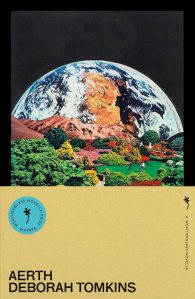 Tomkins first wrote this for the Bath Prize in 2018 and was longlisted. She initially sent the book out to science fiction publishers but was told that it wasn’t ‘sci-fi enough’. I can see how it could fall into the gap between literary fiction and genre fiction: though it’s set on other planets and involves space travel, its speculative nature is understated; it feels more realist. A memorable interrogation of longing and belonging, this novella ponders the value of individuals and their choices in the midst of inexorable planetary trajectories.
(Wowee, Aerth made it onto Eric of Lonesome Reader’s Top Ten list for 2024!)
With thanks to Weatherglass Books for the free copy for review. Aerth will be released on 25 January.
My top recommendations so far for 2025:
(in alphabetical order) All: 
 Save Me, Stranger by Erika Krouse (Flatiron Books, January 21): These 12 first-person narratives are voiced by people in crisis, for whom encounters with strangers tender the possibility of transformation. In the title story, the narrator is taken hostage in a convenience store hold-up. Krouse frequently focuses on young women presented with dilemmas. In “The Pole of Cold,” Vera meets Theo, the son of the American weather researchers who died in the same Siberian plane crash that killed her reindeer herder father. Travel is a recurring element, with stories set in Thailand and Japan as well as various U.S. states. The book exhibits tremendous range, imagining a myriad places, minds, and situations. Krouse often eschews tidy endings, leaving characters on the brink and allowing readers to draw inferences about what they will decide. Fans of Danielle Evans and Lauren Groff have a treat in store.
 Immemorial by Lauren Markham (Transit Books, February 4): This outstanding book-length essay compares language, memorials, and rituals as strategies for coping with climate anxiety and grief. The dichotomies of the physical versus the abstract and the permanent versus the ephemeral are explored; the past, present, and future dance through the text. With language not changing at the pace of the climate, Markham turns to the “Bureau of Linguistical Reality” for help coining a new term for anticipatory ecological grief. The title is one candidate, “premation” another. Forthright, wistful, and determined, the book treats grief as a positive, as “fuel” or a “portal.” Hope is not theoretical in this setup, but solidified in action. In Markham’s case, becoming a parent embodied her trust in the future. Immemorial is an elegant meditation on memory and impermanence in an age of climate crisis.
 Y2K: How the 2000s Became Everything (Essays on the Future that Never Was) by Colette Shade (out today from Dey Street Books!): Shade’s debut collection contains 10 perceptive essays that contrast the promise and political pitfalls of “the Y2K Era” (1997–2008). The author was an adolescent at the turn of the millennium and recalls the thrill of early Internet use and celebrity culture. Consumerism was a fundamental doctrine but the financial crash prompted a loss of faith in progress. It’s a feast of millennial nostalgia but also a hard-hitting work of cultural criticism.
 Show Don’t Tell by Curtis Sittenfeld (Random House, February 25; Transworld, 27 February): Sittenfeld’s second collection features characters negotiating principles and privilege in midlife. The 12 stories spotlight everyday marital and parenting challenges. Dual timelines offer opportunities for hindsight on the events of decades ago. College and boarding school experiences, in particular, remain pivotal. The arbitrary nature of wealth and celebrity is a central theme. Warm, witty, and insightful.
Other 2025 releases:
(in publication date order)
 How Isn’t It Going? Conversations after October 7 by Delphine Horvilleur [trans. from the French by Lisa Appignanesi] (out today from Europa Editions!): There is by turns a stream of consciousness or folktale quality to the narrative as Horvilleur enacts 11 dialogues – some real and others imagined – with her late grandparents, her children, or even abstractions. She draws on history, scripture and her own life, wrestling with thoughts that come during insomniac early mornings. It’s a lament for the Jewish condition, and a warning of the continuing and insidious nature of antisemitism. But it’s not all mourning; there is sometimes a wry sense of humour that feels very Jewish.
 Cold Kitchen: A Year of Culinary Travels by Caroline Eden (Out in UK since May 2024; U.S. release: Bloomsbury, January 14): Eden cooks and writes in the basement kitchen of her Edinburgh apartment. When wanderlust strikes, she revisits favorite places via their cuisine. Her sumptuous fourth book journeys across Central Asia and Eastern Europe, harvesting memories and recipes. (Plus my Shelf Awareness interview)
 North of Ordinary by John Rolfe Gardiner (Bellevue Literary Press, January 14): I read 5 of 10 stories about young men facing life transitions and enjoyed the title one set at a thinly veiled Liberty University but found the rest dated in outlook; all have too-sudden endings.
 If Nothing by Matthew Nienow (Alice James Books, January 14): Straightforward poems about giving up addiction and seeking mental health help in order to be a good father.
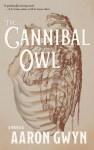 The Cannibal Owl by Aaron Gwyn (Belle Point Press, January 28): An orphaned boy is taken in by the Comanche in 1820s Texas in a brutal novella for fans of Cormac McCarthy.
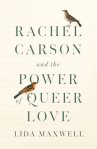 Rachel Carson and the Power of Queer Love by Lida Maxwell (Stanford University Press, January 28): Maxwell’s enthusiastic academic study reappraises scientist Rachel Carson’s motivations in light of ecological crisis and queer studies.
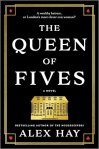 The Queen of Fives by Alex Hay (Graydon House, January 21; Headline, 30 January): Quinn Le Blanc, the latest in a dynasty of London con artists, resolves to pose as a debutante and marry a duke for his fortune – all in just five days in 1898. Like The Housekeepers, it’s a playful romp featuring strong female characters.
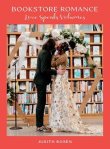 Bookstore Romance: Love Speaks Volumes by Judith Rosen (Brandeis University Press, February 1): A bibliophile’s time capsule and an enduring record of love and literary obsessions, this is a swoon-worthy coffee table book about couples who formalized their relationships in bookstores.
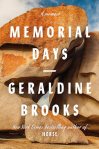 Memorial Days by Geraldine Brooks (Viking, February 4): This elegant bereavement memoir chronicles the sudden death of Brooks’s husband (journalist Tony Horwitz) in 2019 and her grief retreat to Flinders Island, Australia.
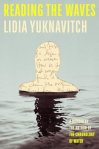 Reading the Waves by Lidia Yuknavitch (Riverhead, February 4): Yuknavitch’s bold memoir-in-essays focuses on pivotal scenes and repeated themes from her life as she reckons with trauma and commemorates key relationships. (A little too much repeated content from The Chronology of Water for me.)
 The Book of Flaco: The World’s Most Famous Bird by David Gessner (Blair, February 11): Gessner’s engaging nature book tells the story of the escaped Central Park Zoo Eurasian eagle-owl. It’s a touching tribute and a subtle challenge to reconsider human effects on wildlife.
 We Would Never by Tova Mirvis (Avid Reader Press, February 11): Mirvis’s fourth novel, inspired by real-life headlines, tells the taut story of an acrimonious divorce case gone horribly wrong. It explores the before and after of a murder, as the victim’s soon-to-be-ex-wife comes under suspicion and her family huddles around to protect her.
 The Café with No Name by Robert Seethaler [trans. from the German by Katy Derbyshire] (Europa Editions, 25 February): Set in 1960s and 1970s Vienna, where World War II still reverberates, this tender novel about a restaurateur’s interactions with acquaintances and customers meditates on the passage of time and bonds that last.
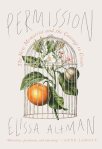 Permission: The New Memoirist and the Courage to Create by Elissa Altman (David R. Godine, March 4): Full of stories drawn from Altman’s life and other authors’ experience, this is an inspirational guide to defusing shame through self-disclosure and claiming the time and focus to write.
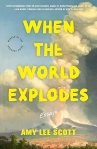 When the World Explodes: Essays by Amy Lee Scott (Mad Creek Books, March 6): Eleven inquisitive pieces set personal crises alongside natural disasters and gun violence. Scott was adopted as a baby from Korea; motherhood and adoption are potent themes across the book.
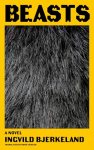 Beasts by Ingvild Bjerkeland [trans. from the Norwegian by Rosie Hedger] (Levine Querido, April 1): In this chilling young adult novella, a teenager tries to keep his little sister safe and reunite with their father in a hazardous postapocalyptic world.
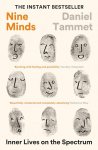 Nine Minds: Inner Lives on the Spectrum by Daniel Tammet (Out in UK since July 2024; U.S. release: The Experiment, April 1): A biographical mosaic of neurodivergence built of stories of individuals whose struggles and achievements defy the clichés surrounding autism. (Notable inclusions: actor Dan Aykroyd, novelist Naoise Dolan.)
Will you look out for one or more of these?
Any other 2025 reads you can recommend?
Book Serendipity, June to Mid-August 2024
I call it “Book Serendipity” when two or more books that I read at the same time or in quick succession have something in common – the more bizarre, the better. This is a regular feature of mine every couple of months. Because I usually have 20–30 books on the go at once, I suppose I’m more prone to such incidents. People frequently ask how I remember all of these coincidences. The answer is: I jot them on scraps of paper or input them immediately into a file on my PC desktop; otherwise, they would flit away!
The following are in roughly chronological order.
- A self-induced abortion scene in Recipe for a Perfect Wife by Karma Brown and Sleeping with Cats by Marge Piercy.
- A woman who cleans buildings after hours, and a character named Tova who lives in the Seattle area in A Reason to See You Again by Jami Attenberg and Remarkably Bright Creatures by Shelby Van Pelt.
- Flirting with a surf shop employee in Sandwich by Catherine Newman and Remarkably Bright Creatures by Shelby Van Pelt.
- Living in Paris and keeping ticket stubs from all films seen in Paris Trance by Geoff Dyer and The Invention of Hugo Cabret by Brian Selznick.
- A schefflera (umbrella tree) is mentioned in Cheri by Jo Ann Beard and Company by Shannon Sanders.

- The Plague by Albert Camus is mentioned in Knife by Salman Rushdie and Stowaway by Joe Shute.
- Making egg salad sandwiches is mentioned in Cheri by Jo Ann Beard and Sandwich by Catherine Newman.
- Pet rats in Stowaway by Joe Shute and Happy Death Club by Naomi Westerman. Rats are also mentioned in Mammoth by Eva Baltasar, The Tale of Despereaux by Kate DiCamillo, and The Colour by Rose Tremain.
- Eels feature in Our Narrow Hiding Places by Kristopher Jansma, Late Light by Michael Malay, and The Colour by Rose Tremain.
- Atlantic City, New Jersey is a location in Florence Adler Swims Forever by Rachel Beanland and Company by Shannon Sanders.
 The father is a baker in Florence Adler Swims Forever by Rachel Beanland and Our Narrow Hiding Places by Kristopher Jansma.
- A New Zealand setting (but very different time periods) in Greta & Valdin by Rebecca K Reilly and The Colour by Rose Tremain.
- A mention of Melanie Griffith’s role in Working Girl in I’m Mostly Here to Enjoy Myself by Glynnis MacNicol and Happy Death Club by Naomi Westerman.
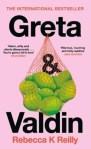 Ermentrude/Ermyntrude as an imagined alternate name in Greta & Valdin by Rebecca K Reilly and a pet’s name in Stowaway by Joe Shute.
- A poet with a collection that was published on 6 August mentions a constant ringing in the ears: Joshua Jennifer Espinoza (I Don’t Want to Be Understood) and Keith Taylor (What Can the Matter Be?).
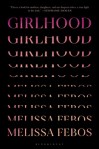
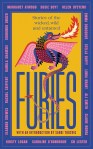
- A discussion of the original meaning of “slut” (a slovenly housekeeper) vs. its current sexualized meaning in Girlhood by Melissa Febos and Sandi Toksvig’s introduction to the story anthology Furies.
- An odalisque (a concubine in a harem, often depicted in art) is mentioned in I’m Mostly Here to Enjoy Myself by Glynnis MacNicol and The Shark Nursery by Mary O’Malley.
- Reading my second historical novel of the year in which there’s a disintegrating beached whale in the background of the story: first was Whale Fall by Elizabeth O’Connor, then Come to the Window by Howard Norman.
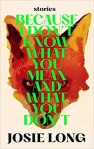 A short story in which a woman gets a job in online trolling in Because I Don’t Know What You Mean and What You Don’t by Josie Long and in the Virago Furies anthology (Helen Oyeyemi’s story).
- Her partner, a lawyer, is working long hours and often missing dinner, leading the protagonist to assume that he’s having an affair with a female colleague, in Recipe for a Perfect Wife by Karma Brown and Summer Fridays by Suzanne Rindell.
- A fierce boss named Jo(h)anna in Summer Fridays by Suzanne Rindell and Test Kitchen by Neil D.A. Stewart.
- An OTT rendering of a Scottish accent in Greta & Valdin by Rebecca K Reilly and Test Kitchen by Neil D.A. Stewart.
- A Padstow setting and a mention of Puffin Island (Cornwall) in The Cove by Beth Lynch and England as You Like It by Susan Allen Toth.
- A mention of the Big and Little Dipper (U.S. names for constellations) in Directions to Myself by Heidi Julavits and How We Named the Stars by Andrés N. Ordorica.
- A mention of Binghamton, New York and its university in We Are Animals by Jennifer Case and We Would Never by Tova Mirvis.
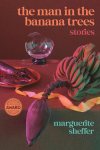
- A character accidentally drinks a soapy liquid in We Would Never by Tova Mirvis and one story of The Man in the Banana Trees by Marguerite Sheffer.
 The mother (of the bride or groom) takes over the wedding planning in We Would Never by Tova Mirvis and Summer Fridays by Suzanne Rindell.
- The ex-husband’s name is Jonah in The Mourner’s Bestiary by Eiren Caffall and We Would Never by Tova Mirvis.
- The husband’s name is John in Dot in the Universe by Lucy Ellmann and Liars by Sarah Manguso.
- An affair is discovered through restaurant receipts in Summer Fridays by Suzanne Rindell and Test Kitchen by Neil D.A. Stewart.
- A mention of eating fermented shark in The Museum of Whales You Will Never See by A. Kendra Greene and Test Kitchen by Neil D.A. Stewart.
- A mention of using one’s own urine as a remedy in Thunderstone by Nancy Campbell and Terminal Maladies by Okwudili Nebeolisa.

- The main character tries to get pregnant by a man even though one of the partners is gay in Mammoth by Eva Baltasar and Until the Real Thing Comes Along by Elizabeth Berg.
- Motherhood is for women what war is for men: this analogy is presented in We Are Animals by Jennifer Case, Parade by Rachel Cusk, and Want, the Lake by Jenny Factor.
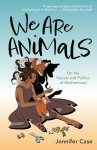 Childcare is presented as a lifesaver for new mothers in We Are Animals by Jennifer Case and Liars by Sarah Manguso.
- A woman bakes bread for the first time in Mammoth by Eva Baltasar and A Year of Biblical Womanhood by Rachel Held Evans.
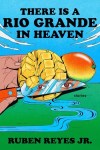
- A gay couple adopts a Latino boy in Greta & Valdin by Rebecca K Reilly and one story of There Is a Rio Grande in Heaven by Ruben Reyes, Jr.
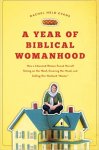 A husband who works on film projects in A Year of Biblical Womanhood by Rachel Held Evans and Liars by Sarah Manguso.
- A man is haunted by things his father said to him years ago in Parade by Rachel Cusk and one story in There Is a Rio Grande in Heaven by Ruben Reyes, Jr.
- Two short story collections in a row in which a character is a puppet (thank you, magic realism!): The Man in the Banana Trees by Marguerite Sheffer, followed by There Is a Rio Grande in Heaven by Ruben Reyes, Jr.
- A farm is described as having woodworm in Mammoth by Eva Baltasar and Parade by Rachel Cusk.
- Sebastian as a proposed or actual name for a baby in Signs, Music by Raymond Antrobus and Birdeye by Judith Heneghan.
What’s the weirdest reading coincidence you’ve had lately?
Carol Shields Prize Longlist Reading: The Future and Chrysalis
My first two dedicated reads for our informal Carol Shields Prize shadowing project exhibit one main way in which the prize is different from the Women’s Prize for Fiction: works in translation and short story collections are eligible. I have one of each to review today. Laura and I did a buddy read of an atmospheric dystopian novel translated from the French, and I caught up on a magical, erotic story collection I’d had on my Kindle for a long time. These were both very good, but my minor misgivings are such that I’d rate them the same: 
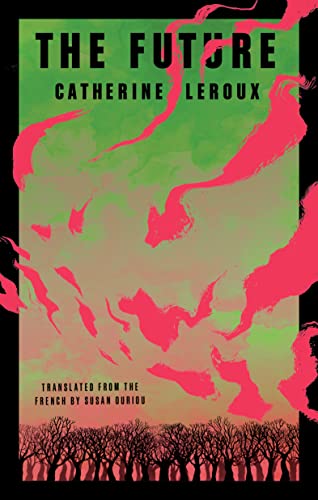
The Future by Catherine Leroux (2020; 2023)
[Translated from the French by Susan Ouriou]
For such a monolithic title, this has a limited stage: a few derelict districts of the ailing city we know as Detroit, Michigan – but in Leroux’s alternate version, it remained part of French Canada, with lingering Indigenous influence, and so is known as Fort Détroit. No doubt she was inspired by the many vacant properties that characterized Detroit in the 2010s; there’s even a ruins tour bus. In her Fort Détroit, a handful of determined adults cling on in their own homes, but the streets and parks have been abandoned to animals and to a gang of half-feral children who have developed their own nicknames (Adidas, Lego, Wolfpup), social hierarchy and vernacular. Worlds meet when Gloria determines to find her granddaughters Cassandra and Mathilda, who ran away after their addict mother Judith’s suspicious death. At the same time, her neighbour Eunice wants to find out who ran her father down in the street.
 Despite their fierce independence and acts of protest, the novel’s children still rely on the adult world. Ecosystems are awry and the river is toxic, but Gloria’s friend Solomon, a former jazz pianist, still manages to grow crops. He overlooks the children’s thefts from his greenhouse and eventually offers to help them grow their own food supply, and other adults volunteer to prepare a proper winter shelter to replace their shantytown. Puberty threatens their society, too: we learn that Fiji, the leader, has been binding her breasts to hide her age.
I expected to be reminded strongly of Station Eleven, and while there were elements that were reminiscent of Emily St John Mandel’s work, Leroux’s is a more consciously literary approach. The present-tense omniscient narration occupies many perspectives, including that of a dog, and the descriptions and musings are more lyrical than literal. Where another author would site high drama – sixtysomething Gloria’s night quest, a few children rafting down the river – Leroux moves on swiftly to other character interactions. What did bring Mandel to mind was the importance of art during societal collapse: the children spin nursery rhyme mash-ups and fairytales, Stutt rescues a makeshift library and insists on Huckleberry Finn going along on the river journey, and Solomon plays the piano again after decades.
The opening mysteries of death and disappearance are resolved before the end, but don’t seem to have been the point. The Future is more subtle and slippery than many dystopian novels I’ve read in that there’s not really a warning, or a message here. Instead, there’s an intriguing situation that opens out and alters slightly, but avoids resolution. It’s all about atmosphere and language – I was especially impressed by Ouriou’s rendering of Leroux’s made-up dialect via folksy slang (“She figgers she’s growed-up”). I loved the details and one-on-one moments more than the momentous scenes. On the whole, I found the story elegant but somewhat frustrating. You might be drawn to it if you enjoyed To Paradise or the MaddAddam books. (Read via Edelweiss; published by Biblioasis)
See also Laura’s review.
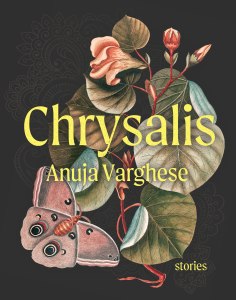
Chrysalis: Stories by Anuja Varghese (2023)
This debut collection of 15 stories brims with magic and horror, and teems with women of colour and queer people. Indeed, Varghese dedicates the book to “all the girls and women who don’t see themselves in most stories.” Most of the characters are of South Asian extraction. Adoption recurs in a couple of places. Two of the rarer realist stories, “Milk” and “Stories in the Language of the Fist,” have protagonists dealing with schoolgirl bullying and workplace microaggressions. More often, there are unexplained phenomena that position the players between life and death. “In the Bone Fields” focuses on the twin daughters of an Indian immigrant family on a Canadian farm. The house and the bone field behind are active and hungry, and only one twin will survive. (I got mild North Woods vibes.)
 In the title story, Radhika visits her mother’s grave and wonders whether her life is here in Montreal with her lover or back in Toronto with her husband. Fangs and wings symbolize her desire for independence. Elsewhere, watery metaphors alternately evoke fear of drowning or sexual fluidity. “Midnight at the Oasis” charts the transformation of a trans woman and “Cherry Blossom Fever,” one of my two favourites, bounces between several POVs. Marjan is in love with Talia, but she’s married to Sunil, who’s also in love with Silas. “People do it — open their relationships and negotiate rules and write themselves into polyamorous fairy tales … Other people. Not brown people,” Talia sighs. They are better off, at least, than they would be back in India, where homophobia can be deadly (“The Vetala’s Song”).
My other favourite was “Bhupati,” about a man who sets up multiple Lakshmi figures in the backyard, hoping devotion will earn him and his wife a better future. The statues keep being burned up by lightning; we learn his wife may be petitioning for different things. “Chitra” is a straightforward Cinderella retelling whose title character lives with two mean stepsisters and works in food service at the mall. A Shoe Chateau BOGO closing sale gives her the chance to get a bargain – and catch the manager’s eye. Despite a striking ending signalled by the story’s subtitle, all I could conclude about this one was “cute.” The three flash horror stories (a murder hotel, ghosts in a basement, werewolves) were much the weakest for me.
There’s a pretty even split of third- and first-person stories (nine versus six) here, and the genre shifts frequently. The quality wasn’t as consistent as I’d hoped, but it was an engaging read. The overall blend of feminism and horror had me thinking of Her Body and Other Parties by Carmen Maria Machado, but I’d be most likely to recommend this to fans of Julia Armfield, Violet Kupersmith and Vauhini Vara. (Read via Edelweiss; published by House of Anansi Press)
Both of these are worthwhile books and it’s great that readers outside of Canada can discover them. I wouldn’t personally shortlist either, but the judges may well be dazzled enough to do so. I don’t yet have a sense of where they’d fit for me in the rankings.
Up next:
Cocktail by Lisa Alward (short story collection from Edelweiss)
A Council of Dolls by Mona Susan Power (buddy read with Laura)
Land of Milk and Honey by C Pam Zhang (from library)

I’m aiming for one or two more batches of reviews before the shortlist is announced on 9 April.
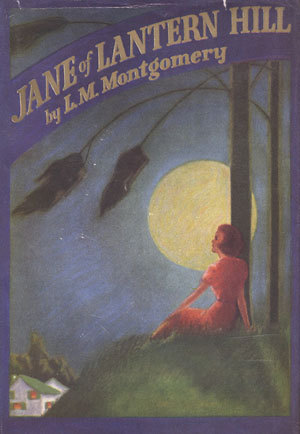
Jane of Lantern Hill by L.M. Montgomery (1937) #ReadingLanternHill
I’m grateful to Canadian bloggers Naomi (Consumed by Ink) and Sarah for hosting the readalong: It’s been a pure pleasure to discover this lesser-known work by Lucy Maud Montgomery.
{SOME SPOILERS IN THE FOLLOWING}
Like Anne of Green Gables, this is a cosy novel about finding a home and a family. Fairytale-like in its ultimate optimism, it nevertheless does not avoid negative feelings. It also seemed to me ahead of its time in how it depicts parental separation.
Jane Victoria Stuart lives with her beautiful, flibbertigibbet mother and strict grandmother in a “shabby genteel” mansion on the ironically named Gay Street in Toronto. Grandmother calls her Victoria and makes her read the Bible to the family every night, a ritual Jane hates. Jane is an indifferent student, though she loves writing, and her best friend is Jody, an orphan who is in service next door. Her mother is a socialite breezing out each evening, but she doesn’t seem jolly despite all the parties. Jane has always assumed her father is dead, so it is a shock when a girl at school shares the rumour that her father is alive and living on Prince Edward Island. Apparently, divorce was difficult in Canada at that time and would have required a trip to the USA, so for nearly a decade the couple have been estranged.
It’s not just Jane who feels imprisoned on Gay Street: her mother and Jody are both suffering in their own ways, and long to live unencumbered by others’ strictures. For Jane, freedom comes when her father requests custody of her for the summer. Grandmother is of a mind to ignore the summons, but the wider family advise her to heed it. Initially apprehensive, Jane falls in love with PEI and feels like she’s known her father, a jocular writer, all the time. They’re both romantics and go hunting for a house that will feel like theirs right away. Lantern Hill fits the bill, and Jane delights in playing the housekeeper and teaching herself to cook and garden. Returning to Toronto in the autumn is a wrench, but she knows she’ll be back every summer. It’s an idyll precisely because it’s only part time; it’s a retreat.
Jane is an appealing heroine with her can-do attitude. Her everyday adventures are sweet – sheltering in a barn when the car breaks down, getting a reward and her photo in the paper for containing an escaped circus lion – but I was less enamoured with the depiction of the quirky locals. The names alone point to country bumpkin stereotypes: Shingle Snowbeam, Ding-dong, the Jimmy Johns. I did love Little Aunt Em, however, with her “I smack my lips over life” outlook. Meddlesome Aunt Irene could have been less one-dimensional; Jody’s adoption by the Titus sisters is contrived (and closest in plot to Anne); and Jane’s late illness felt unnecessary. While frequent ellipses threatened to drive me mad, Montgomery has sprightly turns of phrase: “A dog of her acquaintance stopped to speak to her, but Jane ignored him.”
Could this have been one of the earliest stories of a child who shuttles back and forth between separated or divorced parents? I wondered if it was considered edgy subject matter for Montgomery. There is, however, an indulging of the stereotypical broken-home-child fantasy of the parents still being in love and reuniting. If this is a fairytale setup, Grandmother is the evil ogre who keeps the princess(es) locked up in a gloomy castle until the noble prince’s rescue. I’m sure both Toronto and PEI are lovely in their own way – alas, I’ve never been to Canada – and by the end Montgomery offers Jane a bright future in both.
Small qualms aside, I loved reading Jane of Lantern Hill and would recommend it to anyone who enjoyed the Anne books. It’s full of the magic of childhood. What struck me most, and will stick with me, is the exploration of how the feeling of being at home (not just having a house to live in) is essential to happiness. (University library) 
#ReadingLanternHill
Buy Jane of Lantern Hill from Bookshop.org [affiliate link]
Recommended March Releases by Jane Aldous, Danielle Evans, Katherine May & Genanne Walsh
Sonnets, short stories, nature-fuelled wonder, and an autobiographical essay about a father’s death … from postwar Edinburgh to modern-day San Francisco and from fiction about young African American women to pilgrimages along the English coast, I have a real variety to recommend this month. (And coming up in a separate post: Womb by Leah Hazard.)
More Patina than Gleam by Jane Aldous
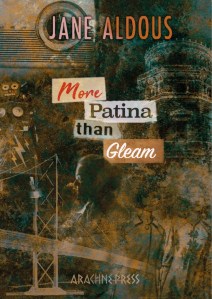 This was my second Arachne Press collection after Routes by Rhiya Pau. Intriguingly, it’s a story composed of 70 sonnets, untraditional in that they do not follow a particular rhyme scheme apart from the odd couplet. There is scant punctuation, with within-line spaces separating the phrases. Aldous, who has recently been featured in a Guardian article on debut authors over 60, imagines a sort of alternative future for her mother had she run away with her when she was a baby. Here, Linda escapes her abusive common-law husband, Vernon, and travels from England to Edinburgh with her 11-year-old daughter, Angie. They settle with an eccentric older woman named Elsie Datlow, who hires Linda as a lady’s companion and keeps her on as a housekeeper when financial struggles force her to accept paying guests. It’s impressive how much Aldous fits into comparatively little text, including Angie’s coming of age, the ups and downs of the Datlows’ picture restoring business, and transgressive romance as both Elsie and Linda fall in love across accepted gender or racial boundaries. This was a pleasant surprise that called to mind works by Muriel Spark and Sarah Waters.
With thanks to Arachne Press for the free copy for review.
Before You Suffocate Your Own Fool Self by Danielle Evans (2010)
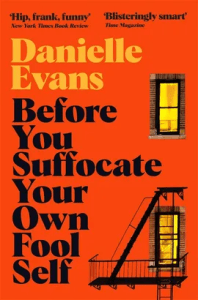 A couple of years ago I reviewed Evans’s second short story collection, The Office of Historical Corrections. This was her first book but has only just been published in the UK. Six of the eight stories are in the first person, the other two in third person. The protagonists tend to be young African American women in moments of transition or clinging to unhealthy relationships. In “Virgins,” 15-year-old Erica and Jasmine want to shed their innocence but can’t necessarily control how it happens. “Snakes” has Tara, a transracial adoptee, spending her ninth summer with her white cousin, Allison, down at their grandmother’s home in Florida. The response to a series of accidents makes it clear to her who is valued in this family. The college girls in “Harvest” consider a variety of reproductive experiences, from selling their eggs to abortion. In “The King of a Vast Empire,” a brother and sister decide to track down a survivor of a car accident their family had when they were children. “Jellyfish” sees a father and daughter meeting for lunch in Harlem and pondering their separate futures.
Many settings were familiar to me from the Delmarva area where I grew up. Here on the cusp of the South, Confederate sympathy still exists, as high schoolers Crystal and Geena discover in “Robert E. Lee Is Dead.” The best friends collaborate on pranks, but Crystal’s grades point to a promising future whereas everyone has given up on Geena, including herself. Along with that one, my two favourites were “Someone Ought to Tell Her There’s Nowhere to Go” and “Wherever You Go, There You Are.” In the former, military veteran Georgie tries to ingratiate himself with his ex-girlfriend by treating her daughter to a princess experience; in the latter, Carla takes her would-be-sexpot 14-year-old niece, Chrissie, on a road trip to North Carolina to meet her ex’s fiancée. Both are exemplary of the assets of the whole collection: strong characters, natural dialogue, and subtle treatment of themes of class and race. I’d proffer this for fans of Sidik Fofana, and as a better option than Dantiel Moniz’s stories.
With thanks to Picador for the proof copy for review.
Enchantment: Reawakening wonder in an exhausted age by Katherine May
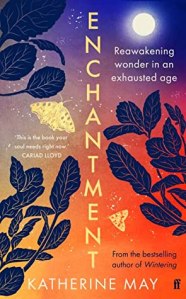 I was a big fan of Katherine May’s Wintering, which published just before the pandemic and, as if presciently, offers strategies for coping with seasons of depression. Coming after a few years of upheaval and disconnection, this follow-up voices May’s longing for rituals of the transcendent that will allow her to live in harmony and close attention to the world around her. Her usual way of communing with nature and other people was group swims in the sea, but that temporarily stopped with lockdown. She sought alternatives, such as visiting a sacred well with a friend, beekeeping, cultivating a wild garden, and chasing a meteor shower. The Earth – Water – Fire – Air structure is sometimes forced, and the content sparse; like Raynor Winn, May, I feel, was pressured to capitalize on the success of her previous work and quickly publish unfinished and rather nebulous material. It’s all surprisingly woo-woo from an English author. Yet May’s writing is unfailingly lovely and this went down easy a chapter at a time. It’s a comparable read to Wanderland by Jini Reddy.
With thanks to Faber for the proof copy for review.
Eggs in Purgatory by Genanne Walsh
I reviewed Genanne Walsh’s novel Twister as part of my summer reading in 2018. This autobiographical essay, recently published by WTAW Press and a finalist in their Alcove Chapbook Series Open, tells the story of the last few months of her father’s life. Aged 89, he lived downstairs from Walsh and her wife in San Francisco. He was quite the character: idealist, stubborn, outspoken; a former Catholic priest influenced by A Course in Miracles and convinced of the oneness of everything. Although he had no terminal conditions, he was sick of old age and its indignities and ready to exit. (“He wanted to be put on an ice floe and pushed offshore. The problem was, I lived above him on the iceberg and would be tasked with shoving him off.”) However, there was confusion about California state laws and whether doctors could help him with this, and at one point the police showed up at the door.
 The title refers to a Middle Eastern dish (see this Nigella Lawson recipe) I’ve known as shakshuka. It was the last proper meal her father ate, Christmas morning 2017 with her and her wife, before he went on his final hunger strike. Later Walsh writes, “Mourning is a kind of purgatory. You exist between worlds. For a long time I walked through, not fully feeling the world of the living or the world of the dead but aware of both.”
The task of a memoir is to fully mine the personal details of a situation but make of it something universal, and that’s just what she does here. Her father’s past with her mother (who died decades before, following a stroke) renders the family dynamic a backdrop to a final pyrrhic battle. Aware that she doesn’t come out of this a saint, Walsh admits to contradictory feelings, including “my life will be so much easier when he dies.” The prediction, no less than its reality, makes her feel guilty. Though she has no faith as such, she senses her father’s influence in her very desire to keep communing with him after his death.
This stunning little book met me at a deep place and I can highly recommend it, especially if you were a fan of In Love by Amy Bloom and All Things Consoled by Elizabeth Hay. (See also The Inevitable – one of its case studies reminded me of this.)
With thanks to the author for the free e-copy for review.
And one dud:
 Birnam Wood by Eleanor Catton – This year’s Klara and the Sun for me: I have trouble remembering why I was so excited about Catton’s third novel that I put it on my Most Anticipated list for 2023, especially given my decidedly mixed feelings about The Luminaries. I’d read a lot about Birnam Wood so its plot held no surprises for me. An American tech billionaire is up to no good on a New Zealand nature reserve; though the members of a guerrilla gardening group summon courage to fight back, his drones see all.
From early on I had little interest in the cast and their doings, especially the buzzword-filled dialogues, and skimmed the rest. Literary fiction usually distinguishes itself from commercial genre fiction by its focus on character depth (and prose quality), but in Catton’s case that was achieved through endless backstory. Her attempt at edginess entails adding at least one F-word to each spoken sentence. (The Bookshop Band, usually so mild-mannered, reflected this by dropping an F-bomb in their song based on the book – see the music video, which cleverly employs a derelict greenhouse and drones.) I’d heard that the ending was a knockout, so I skipped ahead and did find the last 40 pages gripping and the gruesome final tableau worthy of the Shakespearean allusions, but there’s a lot of blah to wade through before that.
With thanks to Granta for the free copy for review.
Would you be interested in reading one or more of these?
20 Books of Summer, 17–20: Bennett, Davidson, Diffenbaugh, Kimmerer
As per usual, I’m squeezing in my final 20 Books of Summer reviews late on the very last day of the challenge. I’ll call it a throwback to the all-star procrastination of my high school and college years. This was a strong quartet to finish on: two novels, the one about (felling) trees and the other about communicating via flowers; and two nonfiction books about identifying trees and finding harmony with nature.
Tree-Spotting: A Simple Guide to Britain’s Trees by Ros Bennett; illus. Nell Bennett (2022)
Botanist Ros Bennett has designed this as a user-friendly guide that can be taken into the field to identify 52 of Britain’s most common trees. Most of these are native species, plus a few naturalized ones. “Walks in the countryside … take on a new dimension when you find yourself on familiar, first-name terms with the trees around you,” she encourages. She introduces tree families, basics of plant anatomy and chemistry, and the history of the country’s forests before moving into identification. Summer leaves make ID relatively easy with a three-step set of keys, explained in words as well as with impressively detailed black-and-white illustrations of representative species’ leaves (by her daughter, Nell Bennett).

Seasonality makes things trickier: “Identifying plants is not rocket science, though occasionally it does require lots of patience and a good hand lens. Identifying trees in winter is one of those occasions.” This involves a close look at details of the twigs and buds – a challenge I’ll be excited to take up on canalside walks later this year. The third section of the book gives individual profiles of each featured species, with additional drawings. I learned things I never realized I didn’t know (like how to pronounce family names, e.g., Rosaceae is “Rose-A-C”), and formalized other knowledge. For instance, I can recognize an ash tree by sight, but now I know you identify an ash by its 9–13 compound, opposite, serrated leaflets.

Some of the information was more academic than I needed (as with one of my earlier summer reads, The Ash Tree by Oliver Rackham), but it’s easy to skip any sections that don’t feel vital and come back to them another time. I most valued the approachable keys and their accompanying text, and will enjoy taking this compact naked hardback on autumn excursions. Bennett never dumbs anything down, and invites readers to delight in discovery. “So – go out, introduce yourself to your neighbouring trees and wonder at their beauty, ingenuity and variety.”
With thanks to publicist Claire Morrison and Welbeck for the free copy for review.
Damnation Spring by Ash Davidson (2021)
When this would-be Great American Novel* arrived unsolicited through my letterbox last summer, I was surprised I’d not encountered the pre-publication buzz. The cover blurb is from Nickolas Butler, which gives you a pretty good sense of what you’re getting into: a gritty, working-class story set in what threatens to be an overwhelmingly male milieu. For generations, Rich Gundersen’s family has been involved in logging California’s redwoods. Davidson is from Arcata, California, and clearly did a lot of research to recreate an insider perspective and a late 1970s setting. There is some specialist vocabulary and slang (the loggers call the largest trees “big pumpkins”), but it’s easy enough to understand in context.
 What saves the novel from going too niche is the double billing of Rich and his wife, Colleen, who is an informal community midwife and has been trying to get pregnant again almost ever since their son Chub’s birth. She’s had multiple miscarriages, and their family and acquaintances have experienced alarming rates of infant loss and severe birth defects. Conservationists, including an old high school friend of Colleen’s, are attempting to stop the felling of redwoods and the spraying of toxic herbicides.
A major element, then, is people gradually waking up to the damage chemicals are doing to their waterways and, thereby, their bodies. The problem, for me, was that I realized this much earlier than any of the characters, and it felt like Davidson laid it on too thick with the many examples of human and animal deaths and deformities. This made the book feel longer and less subtle than, e.g., The Overstory. I started it as a buddy read with Marcie (Buried in Print) 11 months ago and quickly bailed, trying several more times to get back into the book before finally resorting to skimming to the end. Still, especially for a debut author, Davidson’s writing chops are impressive; I’ll look out for what she does next. 
*I just spotted that it’s been shortlisted for the $25,000 Mark Twain American Voice in Literature Award.
With thanks to Tinder Press for the proof copy for review.
The Language of Flowers by Vanessa Diffenbaugh (2011)
The cycle would continue. Promises and failures, mothers and daughters, indefinitely.
 The various covers make this look more like chick lit than it is. Basically, it’s solidly readable issues- and character-driven literary fiction, on the lighter side but of the caliber of any Oprah’s Book Club selection. It reminded me most of White Oleander by Janet Fitch, one of my 20 Books selections in 2018, because of the focus on the foster care system and a rebellious girl’s development in California, and the floral metaphors.
In Diffenbaugh’s debut, Victoria Jones ages out of foster care at 18 and leaves her group home for an uncertain future. She spends time homeless in San Francisco but her love of flowers, and particularly the Victorian meanings assigned to them, lands her work in a florist’s shop and reconnects her with figures from her past. Chapters alternate between her present day and the time she came closest to being adopted – by Elizabeth, who owned a vineyard and loved flowers, when she was nine. We see how estrangements and worries over adequate mothering recur, with Victoria almost a proto-‘Disaster Woman’ who keeps sabotaging herself. Throughout, flowers broker reconciliations.
I won’t say more about a plot that would be easy to spoil, but this was a delight and reminded me of a mini flower dictionary with a lilac cover and elaborate cursive script that I owned when I was a child. I loved the thought that flowers might have secret messages, as they do for the characters here. Whatever happened to that book?! (Charity shop)
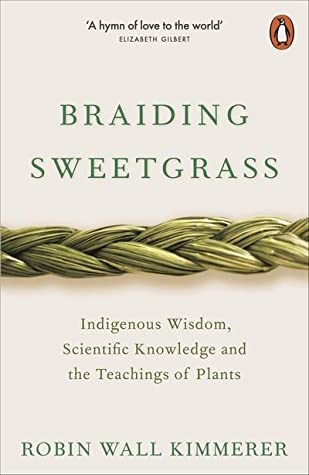
Braiding Sweetgrass: Indigenous Wisdom, Scientific Knowledge and the Teachings of Plants by Robin Wall Kimmerer (2013)
I’d heard Kimmerer recommended by just about every nature writer around, North American or British, and knew I needed this on my shelf. Before I ever managed to read it, I saw her interviewed over Zoom by Lucy Jones in July 2021 about her other popular science book, Gathering Moss, which was first published 18 years ago but only made it to the UK last year. So I knew what a kind and peaceful person she is: she just emanates warmth and wisdom, even over a computer screen.
And I did love Braiding Sweetgrass nearly as much as I expected to, with the caveat that the tiny-print 400 pages of my paperback edition make the essays feel very dense. I could only read a handful of pages in a sitting. Also, after about halfway, it started to feel a bit much, like maybe she had given enough examples from her life, Native American legend and botany. The same points about gratitude for the gifts of the Earth, kinship with other creatures, responsibility and reciprocity are made over and over.
 However, I feel like this is the spirituality the planet needs now, so I’ll excuse any repetition (and the basket-weaving essay I thought would never end). “In a world of scarcity, interconnection and mutual aid become critical for survival. So say the lichens.” (She’s funny, too, so you don’t have to worry about the contents getting worthy.) She effectively wields the myth of the Windigo as a metaphor for human greed, essential to a capitalist economy based on “emptiness” and “unmet desires.”
I most enjoyed the shorter essays that draw on her fieldwork or her experience of motherhood. “The Gift of Strawberries” – “An Offering” – “Asters and Goldenrod” make a stellar three-in-a-row, and “Collateral Damage” is an excellent later one about rescuing salamanders from the road, i.e. doing the small thing that we can do rather than being overwhelmed by the big picture of nature in crisis. “The Sound of Silverbells” is one of the most well-crafted individual pieces, about taking a group of students camping when she lived in the South. At first their religiosity (creationism and so on) grated, but when she heard them sing “Amazing Grace” she knew that they sensed the holiness of the Great Smoky Mountains.
But the pair I’d recommend most highly, the essays that made me weep, are “A Mother’s Work,” about her time restoring an algae-choked pond at her home in upstate New York, and its follow-up, “The Consolation of Water Lilies,” about finding herself with an empty nest. Her loving attention to the time-consuming task of bringing the pond back to life is in parallel to the challenges of single parenting, with a vision of the passing of time being something good rather than something to resist.
Here are just a few of the many profound lines:
For all of us, becoming indigenous to a place means living as if your children’s future mattered, to take care of the land as if our lives, both material and spiritual, depended on it.
I’m a plant scientist and I want to be clear, but I am also a poet and the world speaks to me in metaphor.
Ponds grow old, and though I will too, I like the ecological idea of aging as progressive enrichment, rather than progressive loss.
This will be a book to return to time and again. (Gift from my wish list several years ago)
I also had one DNF from this summer’s list:
Human Croquet by Kate Atkinson: This reminded me of a cross between The Crow Road by Iain Banks and The Heavens by Sandra Newman, what with the teenage narrator and a vague time travel plot with some Shakespearean references. I put it on the pile for this challenge because I’d read it had a forest setting. I haven’t had much luck with Atkinson in the past and this didn’t keep me reading past page 60. (Little Free Library)
A Look Back at My 20 Books of Summer 2022
Half of my reads are pictured here. The rest were e-books (represented by the Kindle) or have already had to go back to the library.

My fiction standout was The Language of Flowers, reviewed above. Nonfiction highlights included Forget Me Not and Braiding Sweetgrass, with Tree-Spotting the single most useful book overall. I also enjoyed reading a couple of my selections on location in the Outer Hebrides. The hands-down loser (my only 1-star rating of the year so far, I think?) was Bonsai. As always, there are many books I could have included and wished I’d found the time for, like (on my Kindle) A House among the Trees by Julia Glass, This Is Your Mind on Plants by Michael Pollan and Finding the Mother Tree by Suzanne Simard.
At the start, I was really excited about my flora theme and had lots of tempting options lined up, some of them literally about trees/flowers and others more tangentially related. As the summer went on, though, I wasn’t seeing enough progress so scrambled to substitute in other things I was reading from the library or for paid reviews. This isn’t a problem, per se, but my aim with this challenge has generally been to clear TBR reads from my own shelves. Maybe I didn’t come up with enough short and light options (just two novella-length works and a poetry collection; only the Diffenbaugh was what I’d call a page-turner); also, even with the variety I’d built in, having a few plant quest memoirs got a bit samey.

Next year…
I’m going to skip having a theme and set myself just one simple rule: any 20 print books from my shelves (NOT review copies). There will then be plenty of freedom to choose and substitute as I go along.
Summery Reads from Holly Hopkins, Sarah McCoy, Phil Stamper and Edith Wharton
Every season, I try to choose a few books that feel appropriate for their settings or titles. A few of these I’ve already mentioned briefly, as part of my heat wave reading suggestions. Much as I love autumn, the end of summer tends to coincide with gloomy musings for me. However, it’s farewell to August with four reasonably cheerful books: a poetry collection about England then and now, city and country; an escapist novel set on the Caribbean island of Mustique in the 1970s; the story of four gay friends going their separate ways for a high school summer of adventure; and a less-tragic-than-expected American classic.
The English Summer by Holly Hopkins (2022)
 Colour, geology and history are major sources of imagery in this debut full-length collection. Churches and cemeteries, museums and manor houses, versus hospitals and rental flats: this is the stuff of a country that has swapped its illustrious past for the dismal reality of the everyday. The collection closes with “England, Where Did You Go?” which ends, “should I get out in search of you, … / I’d be left wandering down dual carriageways, / looking across bean fields and filthy ditches.” Hopkins imagines a government that decides to address climate change by assigning weekly community service hours – nearly twice as many for women, who always bear the greater burden for domestic work.
It’s mostly alliteration, repetition, and internal or slant rhymes here. I particularly liked the pair “Rows of Differently Coloured Houses,” which contrasts bright seaside facades with the “Lakes of postwar pebbledash / grey on grey on grey on grey” seen from a Megabus, and “Stratigraphy,” about the archaeologist’s work. Not many standouts otherwise, but it was still worth a try. (New purchase – the publisher, Penned in the Margins, lured me with a sale)
Mustique Island by Sarah McCoy (2022)
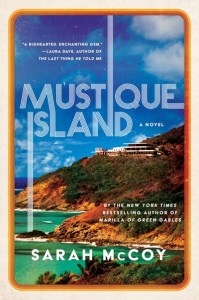 Mustique is a private island in the St. Vincent archipelago that became a playground of the rich and famous in the 1970s, with Princess Margaret and Mick Jagger regular visitors. In McCoy’s novel – inspired by real events and people, and featuring cameos from the aforementioned celebrities as well as the island’s owners at the time, the baron Colin Tennant and his wife, Lady Anne Glenconner (who, I was amused to spot at the library the other day, has written her own fictional tribute to the island, Murder on Mustique) – Willy May, a Texan with a small fortune at her disposal thanks to her divorce from an English brewing magnate, sails in on a private boat and decides to build her own villa on Mustique. She’s uncomfortable with the way locals, who only have service jobs, are sometimes paraded out for colonial displays of pomp. Her two young adult daughters, Hilly and Joanne, later join her. The one has been a model in Paris, where she became addicted to amphetamines.
Love is on the cards for all three main female characters, but there’s heartache along the way as well. Closer to women’s fiction than I generally choose, this was a frothy indulgence that was fun to read but could be shorter and needn’t have tried so hard to make serious points about motherhood and to evoke the time period, e.g., with a list of what’s on the radio. I have also reviewed McCoy’s Marilla of Green Gables. (Offered by publicist via NetGalley)
Golden Boys by Phil Stamper (2022)
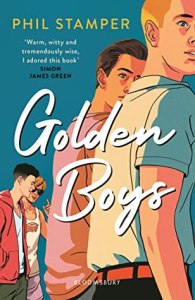 Four gay high schoolers in small-town Ohio look forward to a summer of separate travels for jobs and internships and hope their friendships will stay the course. We have Gabriel, a nature lover off to volunteer for a Boston save-the-trees non-profit; Sal, his friend with benefits, who dreams of bypassing college for a career in politics so interns at his local senator’s office in Washington, DC; Reese, headed to Paris for a fashion design course; and Heath, escaping his parents’ divorce and moving chaos to stay with an aunt and cousin in Florida and work at their beach café. With alternating first-person passages from all four characters, plus transcriptions of their conversation threads, this moves quickly.
Reese has been secretly infatuated with Heath for ages, but three of the four will consider new dating opportunities this summer (the fourth just becomes a workaholic). Secondary characters are pansexual and nonbinary – it’s a whole new world from when I was in high school! Initially, I found the inner monologues too one-note, but I think Stamper’s aim was to recreate the teenage struggle for self-confidence and individuality and has captured that life stage’s inherent anxiety. I also would have trimmed the preparatory stuff; nearly 100 pages before the first of them leaves Ohio is a bit much. This YA novel was a sweet, fun page turner and the perfect replacement to the Heartstopper series as my summer crush. However, I don’t think I was taken enough with the characters to read next year’s projected sequel. (Public library)
Summer by Edith Wharton (1917)
 Charity Royall was born into poverty but brought down the mountain and adopted by a kindly couple into respectable North Dormer society. Mrs. Royall has died before the action starts, but as a young woman Charity still lives with Lawyer Royall, her guardian, and works at the library. When a stranger, Mr. Harney, arrives in their New England town to survey the local architecture, it’s clear right away that he’ll be a romantic prospect for her. “She had always thought of love as something confused and furtive, and he made it as bright and open as the summer air.” However, shame over her lowly origins – she is so snobbish every time she comes into contact with someone from the mountain – continues to plague her.
Although Harney returns her affections and they set up a little love nest in an abandoned house in the woods, uncertainty lingers as to whether he’ll consider marriage to Charity beneath him. This skirts Tess of the d’Urbervilles territory but doesn’t turn nearly as tragic as Ethan Frome (apparently, Wharton called this a favourite among her works, and referred to it as “the Hot Ethan”). Charity isn’t as vain as another Hardy heroine, Bathsheba Everdene; she’s an endearing blend of innocent and worldly, and her realistic reaction to what fate seems to decree feels like about the best one can expect for her time. Melodrama aside, I truly enjoyed the descriptions of a quintessential American summer with picnics and Fourth of July fireworks. Ethan fan or not, you should definitely read this one. (University library)
Three on a Theme: Queer Family-Making
Several 2021 memoirs have given me a deeper understanding of the special challenges involved when queer couples decide they want to have children.
“It’s a fundamentally queer principle to build a family out of the pieces you have”
~Jennifer Berney
“That’s the thing[:] there are no accidental children born to homosexuals – these babies are always planned for, and always wanted.”
~Michael Johnson-Ellis
The Other Mothers by Jennifer Berney
Berney remembers hearing the term “test-tube baby” for the first time in a fifth-grade sex ed class taught by a lesbian teacher at her Quaker school. By that time she already had an inkling of her sexuality, so suspected that she might one day require fertility help herself.
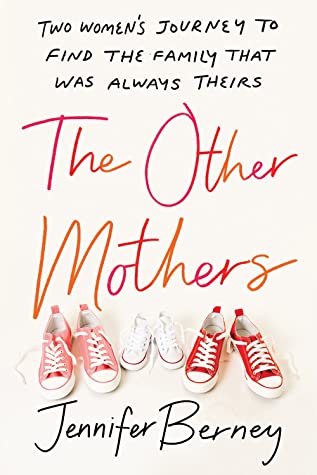 By the time she met her partner, Kellie, she knew she wanted to be a mother; Kellie was unsure. Once they were finally on the same page, it wasn’t an easy road to motherhood. They purchased donated sperm through a fertility clinic and tried IUI, but multiple expensive attempts failed. Signs of endometriosis had doctors ready to perform invasive surgery, but in the meantime the couple had met a friend of a friend (Daniel, whose partner was Rebecca) who was prepared to be their donor. Their at-home inseminations resulted in a pregnancy – after two years of trying to conceive – and, ultimately, in their son. Three years later, they did the whole thing all over again. Rebecca had sons at roughly the same time, too, giving their boys the equivalent of same-age cousins – a lovely, unconventional extended family.
It surprised me that the infertility business seemed entirely set up for heterosexual couples – so much so that a doctor diagnosed the problem, completely seriously, in Berney’s chart as “Male Factor Infertility.” This was in Washington state in c. 2008, before the countrywide legalization of gay marriage, so it’s possible the situation would be different now, or that the couple would have had a different experience had they been based somewhere like San Francisco where there is a wide support network and many gay-friendly resources.
Berney finds the joy and absurdity in their journey as well as the many setbacks. I warmed to the book as it went along: early on, it dragged a bit as she surveyed her younger years and traced the history of IVF and alternatives like international adoption. As the storyline drew closer to the present day, there was more detail and tenderness and I was more engaged. I’d read more from this author. (Published by Sourcebooks. Read via NetGalley) 
small: on motherhoods by Claire Lynch
A line from Berney’s memoir makes a good transition into this one: “I felt a sense of dread: if I turned out to be gay I believed my life would become unbearably small.” The word “small” is a sort of totem here, a reminder of the microscopic processes and everyday miracles that go into making babies, as well as of the vulnerability of newborns – and of hope.
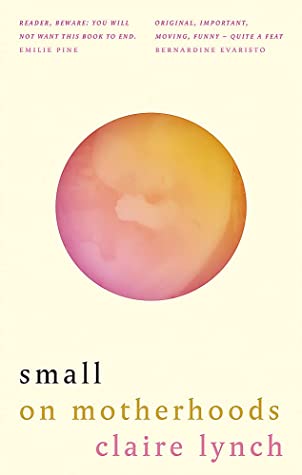
Lynch and her partner Beth’s experience in England was reminiscent of Berney’s in many ways, but with a key difference: through IVF, Lynch’s eggs were added to donor sperm to make the embryos implanted in Beth’s uterus. Mummy would have the genetic link, Mama the physical tie of carrying and birthing. It took more than three years of infertility treatment before they conceived their twin girls, born premature; they were followed by another daughter, creating a crazy but delightful female quintet. The account of the time when their daughters were in incubators reminded me of Francesca Segal’s Mother Ship.
There are two intriguing structural choices that make small stand out. The first you’d notice from opening the book at random, or to page 1. It is written in a hybrid form, the phrases and sentences laid out more like poetry. Although there are some traditional expository paragraphs, more often the words are in stanzas or indented. Here’s an example of what this looks like on the page. It also happens to be from one of the most ironically funny parts of the book, when Lynch is grouped in with the dads at an antenatal class:
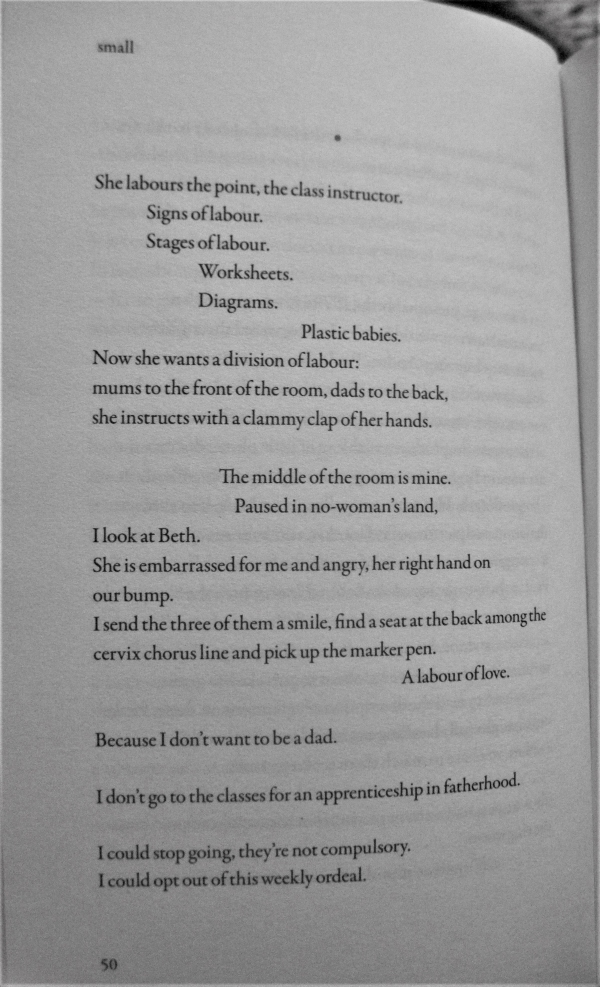
It’s a fast-flowing, artful style that may remind readers of Bernardine Evaristo’s work (and indeed, Evaristo gives one of the puffs). The second interesting decision was to make the book turn on a revelation: at the exact halfway mark we learn that, initially, the couple intended to have opposite roles: Lynch tried to get pregnant with Beth’s baby, but miscarried. Making this the pivot point of the memoir emphasizes the struggle and grief of this experience, even though we know that it had a happy ending.
With thanks to Brazen Books for the free copy for review.
How We Do Family by Trystan Reese
We mostly have Trystan Reese to thank for the existence of a pregnant man emoji. A community organizer who works on anti-racist and LGBTQ justice campaigns, Reese is a trans man married to a man named Biff. They expanded their family in two unexpected ways: first by adopting Biff’s niece and nephew when his sister’s situation of poverty and drug abuse meant she couldn’t take care of them, and then by getting pregnant in the natural (is that even the appropriate word?) way.
 All along, Reese sought to be transparent about the journey, with a crowdfunding project and podcast ahead of the adoption, and media coverage of the pregnancy. This opened the family up to a lot of online hatred. I found myself most interested in the account of the pregnancy itself, and how it might have healed or exacerbated a sense of bodily trauma. Reese was careful to have only in-the-know and affirming people in the delivery room so there would be no surprises for anyone. His doctor was such an ally that he offered to create a more gender-affirming C-section scar (vertical rather than horizontal) if it came to it. How to maintain a sense of male identity while giving birth? Well, Reese told Biff not to look at his crotch during the delivery, and decided not to breastfeed.
I realized when reading this and Detransition, Baby that my view of trans people is mostly post-op because of the only trans person I know personally, but a lot of people choose never to get surgical confirmation of gender (or maybe surgery is more common among trans women?). We’ve got to get past the obsession with genitals. As Reese writes, “we are just loving humans, like every human throughout all of time, who have brought a new life into this world. Nothing more than that, and nothing less. Just humans.”
This is a very fluid, quick read that recreates scenes and conversations with aplomb, and there are self-help sections after most chapters about how to be flexible and have productive dialogue within a family and with strangers. If literary prose and academic-level engagement with the issues are what you’re after, you’d want to head to Maggie Nelson’s The Argonauts instead, but I also appreciated Reese’s unpretentious firsthand view.
And here’s further evidence of my own bias: the whole time I was reading, I felt sure that Reese must be the figure on the right with reddish hair, since that looked like a person who could once have been a woman. But when I finished reading I looked up photos; there are many online of Reese during pregnancy. And NOPE, he is the bearded, black-haired one! That’ll teach me to make assumptions. (Published by The Experiment. Read via NetGalley)
Plus a bonus essay from the Music.Football.Fatherhood anthology, DAD:
“A Journey to Gay Fatherhood: Surrogacy – The Unimaginable, Manageable” by Michael Johnson-Ellis
 The author and his husband Wes had both previously been married to women before they came out. Wes already had a daughter, so they decided Johnson-Ellis would be the genetic father the first time. They then had different egg donors for their two children, but used the same surrogate for both pregnancies. I was astounded at the costs involved: £32,000 just to bring their daughter into being. And it’s striking both how underground the surrogacy process is (in the UK it’s illegal to advertise for a surrogate) and how exclusionary systems are – the couple had to fight to be in the room when their surrogate gave birth, and had to go to court to be named the legal guardians when their daughter was six weeks old. Since then, they’ve given testimony at the Houses of Parliament and become advocates for UK surrogacy.
(I have a high school acquaintance who has gone down this route with his husband – they’re about to meet their daughter and already have a two-year-old son – so I was curious to know more about it, even though their process in the USA might be subtly different.)
On the subject of queer family-making, I have also read: The Argonauts by Maggie Nelson ( ) and The Fixed Stars by Molly Wizenberg (
 ).
).
If you read just one … Claire Lynch’s small was the one I enjoyed most as a literary product, but if you want to learn more about the options and process you might opt for Jennifer Berney’s The Other Mothers; if you’re particularly keen to explore trans issues and LGTBQ activism, head to Trystan Reese’s How We Do Family.
Have you read anything on this topic?
20 Books of Summer, #6–8: Aristide, Hood, Lamott
This latest batch of colour-themed summer reads took me from a depleted post-pandemic landscape to the heart of dysfunctional families in Rhode Island and California.
Under the Blue by Oana Aristide (2021)
Fans of Station Eleven, this one’s for you: the best dystopian novel I’ve read since Mandel’s. Aristide started writing this in 2017, and unknowingly predicted a much worse pandemic than Covid-19. In July 2020, Harry, a middle-aged painter inhabiting his late nephew’s apartment in London, finally twigs that something major is going on. He packs his car and heads to his Devon cottage, leaving its address under the door of the cute neighbour he sometimes flirts with. Hot days stack up and his new habits of rationing food and soap are deeply ingrained by the time the gal from #22, Ash – along with her sister, Jessie, a doctor who stocked up on medicine before fleeing her hospital – turn up. They quickly sink into his routines but have a bigger game plan: getting to Uganda, where their mum once worked and where they know they will be out of range of Europe’s at-risk nuclear reactors. An epic road trip ensues.
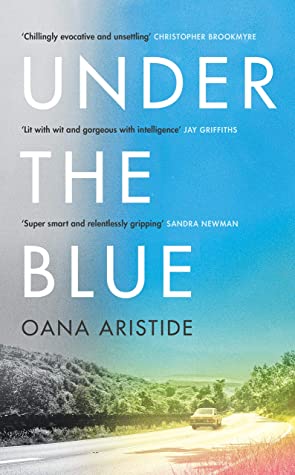 It gradually becomes clear that Harry, Ash and Jessie are among mere thousands of survivors worldwide, somehow immune to a novel disease that spread like wildfire. There are echoes of Cormac McCarthy’s The Road in the way that they ransack the homes of the dead for supplies, and yet there’s lightness to their journey. Jessie has a sharp sense of humour, provoking much banter, and the places they pass through in France and Italy are gorgeous despite the circumstances. It would be a privilege to wander empty tourist destinations were it not for fear of nuclear winter and not finding sufficient food – and petrol to keep “the Lioness” (the replacement car they steal; it becomes their refuge) going. While the vague sexual tension between Harry and Ash persists, all three bonds are intriguing.
In an alternating storyline starting in 2017, Lisa and Paul, two computer scientists based in a lab at the Arctic Circle, are programming an AI, Talos XI. Based on reams of data on history and human nature, Talos is asked to predict what will happen next. But when it comes to questions like the purpose of art and whether humans are worth saving, the conclusions he comes to aren’t the ones his creators were hoping for. These sections are set out as transcripts of dialogues, and provide a change of pace and perspective. Initially, I was less sure about this strand, worrying that it would resort to that well-worn trope of machines gone bad. Luckily, Aristide avoids sci-fi clichés, and presents a believable vision of life after the collapse of civilization.
The novel is full of memorable lines (“This absurd overkill, this baroque wedding cake of an apocalypse: plague and then nuclear meltdowns”) and scenes, from Harry burying a dead cow to the trio acting out a dinner party – just in case it’s their last. There’s an environmentalist message here, but it’s subtly conveyed via a propulsive cautionary tale that also reminded me of work by Louisa Hall and Maja Lunde. (Public library)
Ruby by Ann Hood (1998)
Olivia had the perfect life: fulfilling, creative work as a milliner; a place in New York City and a bolthole in Rhode Island; a new husband and plans to try for a baby right away. But then, in a fluke accident, David was hit by a car while jogging near their vacation home less than a year into their marriage. As the novel opens, 37-year-old Olivia is trying to formulate a letter to the college girl who struck and killed her husband. She has returned to Rhode Island to get the house ready to sell but changes her mind when a pregnant 15-year-old, Ruby, wanders in one day.
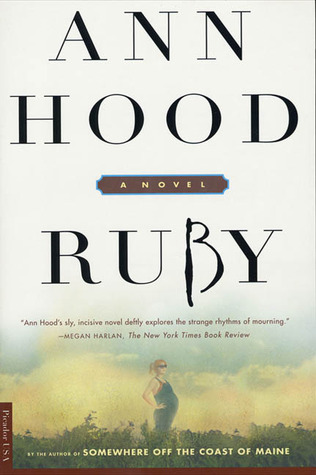 At first, I worried that the setup would be too neat: Olivia wants a baby but didn’t get a chance to have one with David before he died; Ruby didn’t intend to get pregnant and looks forward to getting back her figure and her life of soft drugs and petty crime. And indeed, Olivia suggests an adoption arrangement early on. But the outworkings of the plot are not straightforward, and the characters, both main and secondary (including Olivia’s magazine writer friend, Winnie; David’s friend, Rex; Olivia’s mother and sister; a local lawyer who becomes a love interest), are charming.
It’s a low-key, small-town affair reminiscent of the work of Anne Tyler, and I appreciated how it sensitively explores grief, its effects on the protagonist’s decision-making, and how daunting it is to start over (“The idea of that, of beginning again from nothing, made Olivia feel tired.”). It was also a neat touch that Olivia is the same age as me, so in some ways I could easily imagine myself into her position.
This was the ninth book I’ve read by Hood, an author little known outside of the USA – everything from grief memoirs to a novel about knitting. Ironically, its main themes of adoption and bereavement were to become hallmarks of her later work: she lost her daughter in 2002 and then adopted a little girl from China. (Secondhand purchase, June 2021)
[I’ve read another novel titled Ruby – Cynthia Bond’s from 2014.]
Blue Shoe by Anne Lamott (2002)
I’m a devoted reader of Lamott’s autobiographical essays about faith against the odds (see here), but have been wary of trying her fiction, suspecting I wouldn’t enjoy it as much. Well, it’s true that I prefer her nonfiction on the whole, but this was an enjoyably offbeat novel featuring the kind of frazzled antiheroine who wouldn’t be out of place in Anne Tyler’s work.
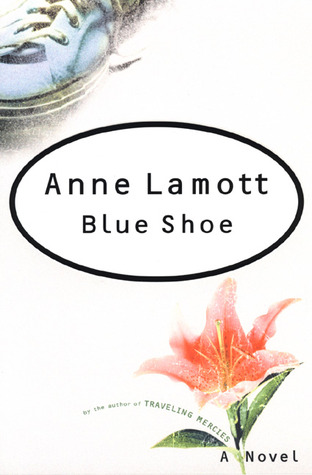 Mattie Ryder has left her husband and returned to her Bay Area family home with her young son and daughter. She promptly falls for Daniel, the handyman she hires to exterminate the rats, but he’s married, so she keeps falling into bed with her ex, Nicky, even after he acquires a new wife and baby. Her mother, Isa, is drifting ever further into dementia. A blue rubber shoe that Mattie finds serves as a totem of her late father – and his secret life. She takes a gamble that telling the truth, no matter what the circumstances, will see her right.
As in Ruby, I found the protagonist relatable and the ensemble cast of supporting characters amusing. Lamott crafts some memorable potted descriptions: “She was Jewish, expansive and yeasty and uncontained, as if she had a birthright for outrageousness” and “He seemed so constrained, so neatly trimmed, someone who’d been doing topiary with his soul all his life.” She turns a good phrase, and adopts the same self-deprecating attitude towards Mattie that she has towards herself in her memoirs: “She usually hoped to look more like Myrna Loy than an organ grinder’s monkey when a man finally proclaimed his adoration.”
At a certain point – maybe two-thirds of the way through – my inward reply to a lot of the novel’s threads was “okay, I get it; can we move on?” Yes, the situation with Isa is awful; yes, something’s gotta give with Daniel and his wife; yes, the revelations about her father seem unbearable. But with a four-year time span, it felt like Mattie was stuck in the middle for far too long. It’s also curious that she doesn’t apply her zany faith (a replica of Lamott’s) to questions of sexual morality – though that’s true of more liberal Christian approaches. All in all, I had some trouble valuing this as a novel because of how much I know about Lamott’s life and how closely I saw the storyline replicating her family dynamic. (Secondhand purchase, c. 2006 – I found a signed hardback in a library book sale back in my U.S. hometown for $1.) 
Hmm, altogether too much blue in my selections thus far (4 out of 8!). I’ll have to try to come up with some more interesting colours for my upcoming choices.
Next books in progress: The Other’s Gold by Elizabeth Ames and God Is Not a White Man by Chine McDonald.
Read any of these? Interested?
Women’s Prize Longlist Reviews (Leilani, Lockwood, and Lyon) & Predictions
Tomorrow, Wednesday the 28th, the Women’s Prize shortlist will be revealed. I have read just over half of the longlist so far and have a few more of the nominees on order from the library – though I may cancel one or two of my holds if they don’t advance to the shortlist. Also, my neighbourhood book club has applied to be one of six reading groups shadowing the shortlist this year via a Reading Agency initiative. If I do say so myself, I think we put in a rather strong application. We’ll hear later this week if we’ve been chosen – fingers crossed!
The three longlisted novels I’ve read most recently were all by L authors:
Luster by Raven Leilani
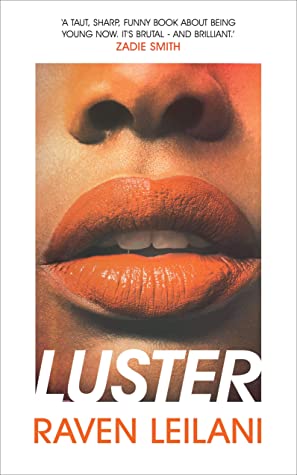 Edie’s voice is immediately engaging: cutting, funny, pithy. It reminded me of Ava’s in a fellow Women’s Prize nominee, Exciting Times, and both novels even employ a near-identical metaphor: “I wondered if Victoria was a real person or three Mitford sisters in a long coat” (Dolan) versus “all the kids stacked underneath my trench coat rejoice” (Leilani). They are also both concerned with how young women negotiate a confusing romantic landscape and look for meaning beyond a dead-end career. The African-American Edie’s entry-level work for a New York City publisher barely covers her rent at a squalid shared apartment. She’s shagged every male in the office and is now on to one she met online: Eric, a white, middle-aged archivist with an open marriage and a Black adopted daughter.
As Edie insinuates herself into Eric’s suburban New Jersey life in peculiar and sometimes unwitting ways, we learn more about her traumatic past: Both of her parents are dead, one by suicide, and she had an abortion at age 16. Along with sex, her main escape is her painting, which is described in tender detail. There are a number of amusing scenes set at off-the-wall locations, like a theme park, a clown school, and Comic Con. Leilani has a knack for capturing an entire realm of experience in just a few pages, as when she satirizes current publishing trends or encapsulates what it’s like to be a bicycle delivery person.
But, as a Goodreads acquaintance put it, all this sharp writing is rather wasted on the plot. I found the direction of the book in its second half utterly unrealistic, and never believed that Edie would have found Eric attractive in any way. (His interest in her is beyond creepy, really.) What I found most intriguing, along with the painting hobby, were Edie’s interactions with other Black characters, such as a publishing company colleague and Eric’s adopted daughter – there’s an uncomfortable sense that they should have a natural camaraderie and/or that Edie should be some kind of role model. I might have liked more of that dynamic, instead of the unbearable awkwardness of temporary instalment in a white neighbourhood. Other readalikes: Queenie, Here Is the Beehive, and On Beauty.
No One Is Talking About This by Patricia Lockwood
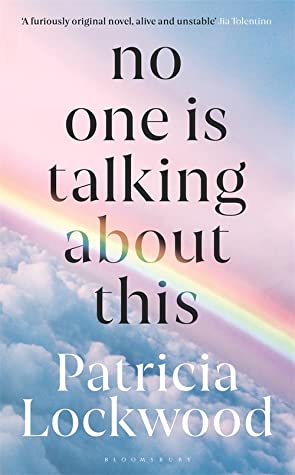 Priestdaddy is one of my absolute favourite books, so Lockwood’s debut novel was one of the 2021 releases I was most looking forward to reading. It took me a while to warm to, but ultimately did not disappoint. It probably helped that I was familiar with the author’s iconoclastic sense of humour. This is a work of third-person autofiction – much more so than I’d realized before I read the Acknowledgments – and to start with it feels like a flippant skewering of modern life, which for some is all about online personality and performance. A woman who became a social media star by tweeting quips like “Can a dog be twins?” reflects on life on “the portal” and under “the dictator.”
Midway through the book, she receives a wake-up call in the form of texts from her mother summoning her back to the Midwest for a family emergency. “It was a marvel how cleanly and completely this lifted her out of the stream of regular life.” Shit just got real, as they say. But “Would it change her?” she asks herself. Apparently, this very thing happened to Lockwood’s own family, which accounts for how heartfelt the second half is – still funny, but with an ache behind it, the same that I sensed and loved in Priestdaddy.
It is the about-face that makes this novel, forcing readers to question the value of a digital existence based on glib pretence. As the protagonist tells her students at one point, “Your attention is holy,” and with life so fragile there is no time to waste. What Lockwood is trying to do here is even bigger than that, though, I think. She mocks the whole idea of plot yet takes up the mantle of the “social novel,” as if creating a new format for the Internet-age novel in short, digestible sections. I’m not sure this is as earth-shattering as all that, but it is entertaining and deceptively deep. It also feels like a very current book, playing the role that Weather did in last year’s Women’s Prize race. (See my Goodreads review for more quotes, spoiler-y discussion, and why this book held personal poignancy for me.)
Consent by Annabel Lyon
 I’m always drawn to stories of sisters and this was an intriguing one, though the jacket text sets it up to be more of a thriller than it actually is. After their mother’s death, Sara, a medical ethicist, looks after Mattie, her intellectually disabled sister. When Mattie is lured into eloping, Sara’s protective instinct goes into overdrive. Meanwhile, Saskia, a graduate student in French literature, feels obliged to put her twin sister Jenny’s needs first after a car accident leaves Jenny in a coma. There are two decades separating the sets of sisters, but aspects of their experiences reverberate, with fashion, perfume, and alcoholism appearing as connecting elements even before a more concrete link emerges.
For much of the novel, Lyon bounces between the two storylines. I occasionally confused Sara and Saskia, but I think that’s part of the point (why else would an author select two S-a names?) – their stories overlap as they find themselves in the position of making decisions on behalf of an incapacitated sister. The title invites deliberation about how control is parcelled out in these parallel situations, but I’m not sure consent was the right word to encapsulate the whole plot; it seems to give too much importance to some fleeting sexual relationships.
At times I found Lyon’s prose repetitive or detached, but I enjoyed the overall dynamic and the medical threads. There are some stylish lines that land perfectly, like “There she goes … in her lovely coat, that cashmere-and-guilt blend so few can afford. That lovely perfume she trails, lilies and guilt.” The Vancouver setting and French–English bilingualism, not things I often encounter in fiction, were also welcome, and the last few chapters are killer.
The other nominees I’ve read, with ratings and links to reviews, are:
The Vanishing Half by Brit Bennett
Piranesi by Susanna Clarke
Exciting Times by Naoise Dolan
Transcendent Kingdom by Yaa Gyasi
Burnt Sugar by Avni Doshi
Unsettled Ground by Claire Fuller
The rest of the longlist is:
- Small Pleasures by Clare Chambers – I might read this from the library.
- The Golden Rule by Amanda Craig – I’d thought I’d give this one a miss, but I recently found a copy in a Little Free Library. My plan is to read it later in the year as part of a Patricia Highsmith kick, but I’ll move it up the stack if it makes the shortlist.
- Because of You by Dawn French – Not a chance. Right? Please!
- How the One-Armed Sister Sweeps Her House by Cherie Jones – A DNF; I would only try it again from the library if it was shortlisted.
- Nothing but Blue Sky by Kathleen MacMahon – I might read this from the library.
- Detransition, Baby by Torrey Peters – I will definitely read this from the library.
- Summer by Ali Smith – I struggle with her work and haven’t enjoyed this series; I would only read this if it was shortlisted and my book club was assigned it!
My ideal shortlist (a wish list based on my reading and what I still want to read):
- The Vanishing Half by Brit Bennett
- Piranesi by Susanna Clarke
- Exciting Times by Naoise Dolan
- Transcendent Kingdom by Yaa Gyasi
- No One Is Talking About This by Patricia Lockwood
- Detransition, Baby by Torrey Peters
vs.
My predicted shortlist and reasoning:
 The Vanishing Half by Brit Bennett – A dead cert. I’ve said so since I reviewed it in June 2020.
- Burnt Sugar by Avni Doshi – Others don’t seem to fancy Doshi’s chances, and it’s true that she was already shortlisted for the Booker, but I feel like this could be more unifying a choice for the judges than, e.g. Clarke or Lockwood.
- Transcendent Kingdom by Yaa Gyasi – Another definite.
- Luster by Raven Leilani – Not as strong as the Dolan, in my opinion, but it seems to have a lot of love from these judges (especially Vick Hope, who emphasized how perfectly it captured what it’s like to be young today), and from critics generally.
- Detransition, Baby by Torrey Peters – Ordinarily I would have said the Prize is too staid to shortlist a trans author, but after all the online abuse that has been directed at Peters, I think the judges will want to make a stand in support of her legitimacy.
- Summer by Ali Smith – The most establishment author on the list, and not one I generally care for, but this would be a way of recognizing the four-part Seasons opus and her work in general. Of the middle-aged white cohort, she seems most likely.
I will happily accept some mixture of my wished-for and predicted titles, and would be surprised if any of the five books I have not mentioned is shortlisted. (Though quite a few others are predicting that Claire Fuller will advance; I’d have no problem with that.) I don’t think my book club would get a say in which of the six titles we’d be sent to read for the shadowing project, which is risky as I may have already read it and not want to reread, or it may be a surprise nominee that I don’t want to read, but I’ll cross that bridge if we come to it.
Callum, Eric, Laura and Rachel have been posting lots of reviews and thoughts related to the Women’s Prize. Have a look at their blogs!
Rachel also produced a priceless spreadsheet of all the Prize nominees by year, so you can tick off the ones you’ve read. I’m up to 150 now!
 Bookish Beck = Rebecca Foster. American transplant to England. Freelance proofreader and book reviewer.
 Bookish Beck