Booker and Young Writer Ceremonies & Tracy Chevalier Book Club
This year I correctly predicted Shuggie Bain by Douglas Stuart and Surge by Jay Bernard as the winners of the Booker Prize and the Sunday Times Young Writer of the Year Award, respectively. Patting myself on the back!


(Earlier in the year, I had a feeling Maggie O’Farrell would win the Women’s Prize, but wasn’t confident enough to single her out; and I got the Wainwright Prizes all wrong.)
I watched both the Booker Prize (live) and Young Writer of the Year Award (pre-recorded) ceremonies online; not having to secure an invitation or pay £30 for the train into London has been an ongoing bonus of pandemic arrangements.
 The Booker ceremony was nicely tailored to viewers at home, incorporating brief, informal pre-recorded interviews with each nominated author and a video chat between last year’s winners, Margaret Atwood and Bernardine Evaristo. When Evaristo asked Atwood about the difference between winning the Booker in 2019 versus in 2000, she replied, deadpan, “I was older.” I especially liked the short monologues that well-known UK actors performed from each shortlisted book. Only a few people – the presenter, Evaristo, chair of judges and publisher Margaret Busby, and a string quartet – appeared in the studio, while all the other participants beamed in from other times and places. Stuart is only the second Scottish winner of the Booker, and seemed genuinely touched for this recognition of his tribute to his mother.
I’ve attended the Young Writer ceremony at the London Library twice: in 2017, when I was on the shadow panel, and again last year. It was a shame not to be able to meet up with fellow bloggers and the shortlisted authors, but I appreciated hearing the judges’ thoughts on each nominee. Tessa Hadley said the whole shortlist was “so full of young energy.” Kit de Waal called Catherine Cho’s Inferno “an absolute page-turner.” All the judges remarked at how funny, cutting and original Naoise Dolan’s Exciting Times is. Critic Houman Barekat referred to Seán Hewitt’s Tongues of Fire as “unabashedly earnest.” Hadley said Marina Kemp’s Nightingale is just the kind of novel she loves, a “delicate, full notation,” and Barekat observed that it is a timely reminder of the value of care work.


It was clear that, for the judges, all five books were terrifically accomplished and would be worthy winners. Still, the unanimous decision was in favor of Surge, which Sunday Times literary editor Andrew Holgate said is “remarkable for its passionate engagement and diversity of voices.” Bernard read “Hiss” (also up on the Granta website) and said that “poems can take on another life” through performance and short films, so the poet can’t predict whether they will stay in poetry or branch out into other genres.
 Back on 18 November, I attended another online event to which I’d gotten a last-minute invitation: a “book club” featuring Tracy Chevalier in conversation with her literary agent, Jonny Geller, on Girl with a Pearl Earring at 20 and her new novel, A Single Thread. In 1996 she sent Geller a letter asking if he’d read Virgin Blue, which she’d written for the MA at the University of East Anglia – the only UK Creative Writing course out there at the time. After VB, she started a contemporary novel set at Highgate Cemetery, where she was a tour guide. It was to be called Live a Little (since a Howard Jacobson title). But shortly thereafter, she was lying in bed one day, looking at a Vermeer print on the wall, and asked herself what the look on the girl’s face meant and who she was. She sent Geller one page of thoughts and he immediately told her to stick Live a Little in a drawer and focus on the Vermeer idea.
Intriguingly, Chevalier stated that the deadline of her pregnancy determined the form of Girl with a Pearl Earring: she knew she had to keep things simple, with a linear narrative, one point of view, and spare prose. While the novel had a quiet publication in August 1999, a good review from Deborah Moggach helped, and it became a “word of mouth success,” never hitting #1 but selling continuously. Chevalier believes this was due to a rare coming together of story and writing; sometimes good stories are hampered by mediocre writing, or vice versa. She and Geller discussed the strange coincidence of two other Vermeer novels coming out at the same time (e.g. Girl in Hyacinth Blue by Susan Vreeland); she had the good luck of being the victor. The film version is “lovely,” she said. Geller has never forgotten Scarlett Johansson, who turned 18 on set, leaving her gum in during a cast supper of spaghetti.


Chevalier’s actual Highgate novel, Falling Angels, didn’t borrow at all from her contemporary-set draft as it was set in 1900. Incorporating suffragette history, it felt like an untold story ripe for the plucking. Falling Angels has long been the one I consider my favorite Chevalier – as of last month, when we did The Last Runaway in book club, I’ve read all her work – but after this event I’m eager to reread it and GwaPE to see what I think.
 Lastly, Chevalier and Geller talked about her new novel, A Single Thread, which was conceived before Trump and Brexit but had its central themes reinforced by the constant references back to 1930s fascism during the Trump presidency. She showed off the needlepoint spectacles case she’d embroidered for the novel. This wasn’t the first time she’d taken up a craft featured in her fiction: for The Last Runaway she learned to quilt, and indeed still quilts today. Geller likened her to a “method actor,” and jokingly fretted that they’ll lose her to one of these hobbies one day. Chevalier’s work in progress features Venetian glass. I’m already looking forward to it.
Like me, she moved to England from the Washington, D.C. area and has never lost the ‘accent’, so I feel like she’s a kindred spirit.
Bookish online events coming up soon: Penguin book quiz, followed by book club holiday social (a Zoom meeting with glasses of wine in hand!), on the 15th
Have you taken advantage of any online literary events recently?
Book Serendipity in the Final Months of 2020
I call it Book Serendipity when two or more books that I read at the same time or in quick succession have something pretty bizarre in common. Because I have so many books on the go at once (20+), I suppose I’m more prone to such incidents than some. I also list these occasional reading coincidences on Twitter. (Earlier incidents from the year are here, here, and here.)
- Eel fishing plays a role in First Love, Last Rites by Ian McEwan and The Gospel of the Eels by Patrik Svensson.
- A girl’s body is found in a canal in First Love, Last Rites by Ian McEwan and Carrying Fire and Water by Deirdre Shanahan.
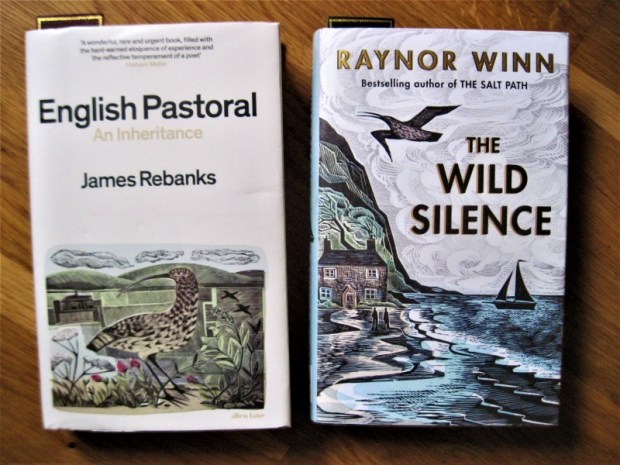
- Curlews on covers by Angela Harding on two of the most anticipated nature books of the year, English Pastoral by James Rebanks and The Wild Silence by Raynor Winn (and both came out on September 3rd).
- Thanksgiving dinner scenes feature in 666 Charing Cross Road by Paul Magrs and Such a Fun Age by Kiley Reid.
- A gay couple has the one man’s mother temporarily staying on the couch in 666 Charing Cross Road by Paul Magrs and Memorial by Bryan Washington.
- I was reading two “The Gospel of…” titles at once, The Gospel of Eve by Rachel Mann and The Gospel of the Eels by Patrik Svensson (and I’d read a third earlier in the year, The Gospel of Trees by Apricot Irving).

- References to Dickens’s David Copperfield in The Cider House Rules by John Irving and Mudbound by Hillary Jordan.
- The main female character has three ex-husbands, and there’s mention of chin-tightening exercises, in The Idea of Perfection by Kate Grenville and The Pumpkin Eater by Penelope Mortimer.
- A Welsh hills setting in On the Red Hill by Mike Parker and Along Came a Llama by Ruth Janette Ruck.


- Rachel Carson and Silent Spring are mentioned in A Year on the Wing by Tim Dee, The Frayed Atlantic Edge by David Gange, English Pastoral by James Rebanks and The Gospel of the Eels by Patrik Svensson. SS was also an influence on Losing Eden by Lucy Jones, which I read earlier in the year.
- There’s nude posing for a painter or photographer in The Glass Hotel by Emily St. John Mandel, How to Be Both by Ali Smith, and Adults by Emma Jane Unsworth.
- A weird, watery landscape is the setting for The Swallowed Man by Edward Carey and Piranesi by Susanna Clarke.
- Bawdy flirting between a customer and a butcher in The Idea of Perfection by Kate Grenville and Just Like You by Nick Hornby.


- Corbels (an architectural term) mentioned in The Idea of Perfection by Kate Grenville and Wakenhyrst by Michelle Paver.
- Near or actual drownings (something I encounter FAR more often in fiction than in real life, just like both parents dying in a car crash) in The Idea of Perfection, The Glass Hotel, The Gospel of Eve, Wakenhyrst, and Love and Other Thought Experiments.
- Nematodes are mentioned in The Gospel of the Eels by Patrik Svensson and Real Life by Brandon Taylor.
- A toxic lake features in The New Wilderness by Diane Cook and Real Life by Brandon Taylor (both were also on the Booker Prize shortlist).


- A black scientist from Alabama is the main character in Transcendent Kingdom by Yaa Gyasi and Real Life by Brandon Taylor.
- Graduate studies in science at the University of Wisconsin, and rivals sabotaging experiments, in Artifact by Arlene Heyman and Real Life by Brandon Taylor.
- A female scientist who experiments on rodents in Transcendent Kingdom by Yaa Gyasi and Artifact by Arlene Heyman.
- There are poems about blackberrying in Dearly by Margaret Atwood, Passport to Here and There by Grace Nichols, and How to wear a skin by Louisa Adjoa Parker. (Nichols’s “Blackberrying Black Woman” actually opens with “Everyone has a blackberry poem. Why not this?” – !)


What’s the weirdest reading coincidence you’ve had lately?
Booker Prize 2020: Two More Shortlist Reviews and a Prediction
The 2020 Booker Prize will be announced on Thursday the 19th. (Delayed from the 17th, the date on my commemorative bookmark, so as not to be overshadowed by the release of the first volume of Barack Obama’s presidential memoirs.) After I reviewed Burnt Sugar and correctly predicted half of the shortlist in this post, I’ve managed to finish another two of the novels on the shortlist, along with two more from the longlist. As sometimes happens with prize lists – thinking also of the Women’s Prize race in 2019 – this year’s shortlist fell into rough pairs: two stark mother–daughter narratives, two novels set in Africa, and two gay coming-of-age stories.

The New Wilderness by Diane Cook
In a striking opening to a patchy novel, Bea goes off to the woods to give birth alone to a stillborn daughter. It’s such a different experience to when she birthed Agnes in a hospital eight years ago. Now, with coyotes and buzzards already circling, there’s no time for sentimentality; she turns her back on the baby and returns to the group. Bea is part of a wilderness living experiment that started out with 20 volunteers, but illness and accidents have since reduced their number.
 Back in the toxic, overcrowded City, Bea was an interior decorator and her partner a professor of anthropology. Bea left to give Agnes a better chance at life; like so many other children, she had become ill from her polluted surroundings. Now she is a bright, precocious leader in the making, fully participating in the community’s daily chores. Settlement tempts them, but the Rangers enforce nomadism. Newcomers soon swell their numbers, and there are rumors of other groups, too. Is it even a wilderness anymore if so many people live in it?
The cycles of seasons and treks between outposts make it difficult to get a handle on time’s passing. It’s a jolt to realize Agnes is now of childbearing age. Only when motherhood is a possibility can she fully understand her own mother’s decisions, even if she determines to not repeat the history of abandonment. The blurb promised a complex mother–daughter relationship, but this element of the story felt buried under the rigor of day-to-day survival.
It is as if Cook’s primary interest was in how humans would react to being returned to primitive hunter–gatherer conditions – she did a lot of research into Native American practices, for instance, and she explores the dynamics of sex and power and how legends arise. As a child I was fascinated by Native cultures and back-to-the-land stories, so I enjoyed the details of packing lists, habits, and early rituals that form around a porcelain teacup.
But for me some nuts and bolts of storytelling were lacking here: a propulsive plot, a solid backstory, secondary characters that are worthwhile in their own right and not just stereotypes and generic roles. The appealing description induced me to overcome my usual wariness about dystopian novels, but a plodding pace meant it took me months to read. A lovely short epilogue narrated by Agnes made me wonder how much less tedious this chronicle might have been if told in the first person by Bea and Agnes in turn. I’ll try Cook’s story collection, Man V. Nature, to see if her gifts are more evident in short form.
My rating: 
My thanks to Oneworld for the free copy for review.
Real Life by Brandon Taylor
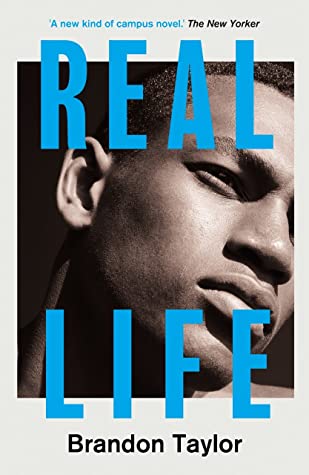 Over the course of one late summer weekend, Wallace questions everything about the life he has built. As a gay African American, he has always been an outsider at the Midwestern university where he’s a graduate student in biochemistry. Though they vary in background and include several homosexuals, some partnered and some unattached, most of his friends are white, and he’s been so busy that he’s largely missed out on evening socializing by the lake – and skipped his father’s funeral (though there are other reasons for that as well).
Tacit prejudice comes out into the open in ugly ways in these few days. When he finds his nematode experiments sabotaged, a female colleague at his lab accuses him of misogyny, brandishing his identity as a weapon against him: “you think that you get to walk around because you’re gay and black and act like you can do no wrong.” Then, in a deliciously awkward dinner party scene, an acquaintance brings up Wallace’s underprivileged Alabama upbringing as if it explains why he’s struggling to cope in his academic career.
Meanwhile, Wallace has hooked up with a male – and erstwhile straight – friend, and though there is unwonted tenderness in this relationship, there is also a hint of menace. The linking of sexuality and violence echoes the memories of abuse from Wallace’s childhood, which tumble out in the first-person stream of consciousness of Chapter 5. Other male friends, too, are getting together or breaking apart over mismatched expectations. Kindness is possible, but built-in injustice and cruelty, whether vengeful or motiveless, too often take hold.
There are moments when Wallace seems too passive or self-pitying, but the omniscient narration emphasizes that all of the characters have hidden depths and that emotions ebb and flow. What looks like despair on Saturday night might feel like no big deal come Monday morning. I so admired how this novel was constructed: the condensed timeframe, the first and last chapters in the past tense (versus the rest in the present tense), the contrast between the cerebral and the bodily, and the thematic and linguistic nods to Virginia Woolf. A very fine debut indeed.
My rating: 
I also read two more of the longlisted novels from the library:
Such a Fun Age by Kiley Reid
 Such a fun book! I’d read the first chapter earlier in the year and set it aside, thinking it was too hip for me. I’m glad I decided to try again – it was a great read, so assured and contemporary. Once I got past a slightly contrived first chapter, I found it completely addictive. The laser-precision plotting and characterization reminded me of Jennifer Egan, Jonathan Franzen and Zadie Smith at their peak, but the sassy voice is all Reid’s own. There are no clear villains here; Alix Chamberlain could easily have filled that role, but I felt for her and for Kelley as much as I did for Emira. The fact that I didn’t think anyone was completely wrong shows how much nuance Reid worked in. The question of privilege is as much about money as it is about race, and these are inextricably intertwined.
Love and Other Thought Experiments by Sophie Ward
 An intriguing set of linked short stories that combine philosophy and science fiction. Rachel and Eliza are preparing to have a baby together when an ant crawls into Rachel’s eye and she falls ill. Eliza wants to believe her partner but, as a scientist, can’t affirm something that doesn’t make sense (“We don’t need to resort to the mystical to describe physical processes,” she says). Other chapters travel to Turkey, Brazil and Texas – and even into space. It takes 60+ pages to figure out, but you can trust all the threads will converge around Rachel and her son, Arthur, who becomes an astronaut. I was particularly taken by a chapter narrated by the ant (yes, really) as it explores Rachel’s brain. Each section is headed by a potted explanation of a thought experiment from philosophy. I wasn’t entirely sure what to make of the alternative future of the two final chapters. Still, I was impressed with the book’s risk-taking and verve. It’s well worth making a rare dip into sci-fi for this one.
Back in September I still thought Hilary Mantel would win the whole thing, but since her surprise omission from the shortlist I’ve assumed the prize will go to Shuggie Bain by Douglas Stuart. This was a DNF for me, but I’ll try it again next year in case it was just a matter of bad timing (like the Reid and The Go-Between – two books I attempted a second time this year and ended up loving). Given that it was my favorite of the ones I read, I would be delighted to see Real Life win, but I think it unlikely. My back-up prediction is The Shadow King by Maaza Mengiste, which I would consider reserving from the library if it wins.

Have you read anything from the Booker shortlist?
Which book do you expect to win?
Booker Prize 2020: Longlist Progress & Shortlist Predictions
The 2020 Booker Prize shortlist will be announced tomorrow, September 15th. Following on from my initial thoughts … I’ve only managed to read one more book from the longlist, reviewed in brief below along with some thoughts on a few other nominees I’ve sampled.
Burnt Sugar by Avni Doshi
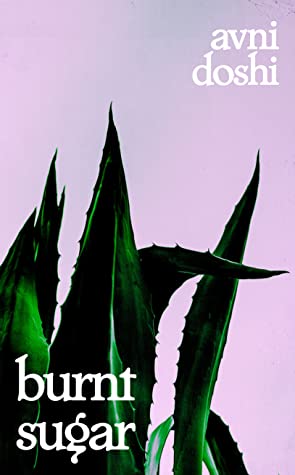 This short, intense novel is about two women locked into resentful competition. Tara and Antara also happen to be mother and daughter. When the long-divorced Tara shows signs of dementia, artist Antara and her American-born husband Dilip take her into their home in Pune, India. Her mother’s criticism and strange behavior stir up flashbacks to the 1980s and 1990s, when Antara felt abandoned by Tara during the four years they lived in an ashram and then her time at boarding school. Emotional turmoil led to medical manifestations like excretory issues and an eating disorder, and both women fell in love in turn with a homeless photographer named Reza Pine.
When Antara learns she is pregnant, the whole cycle of guilt and maternal ambivalence looks set to start again. Memory is precarious and full of potential hurt here, and Antara’s impassive narration is perfectly suited to the story of a toxic relationship. Neither the UK title nor the one for the original Indian publication (Girl in White Cotton) seems quite right to me; I might have chosen something related to the cover and endpaper image of the aloe plant: something that is as spiky as a cactus yet holds out hope of balm. This was a good fictional follow-up to a memoir I read earlier in the year about dementia’s effect on an Indian-American mother–daughter pair, What We Carry by Maya Shanbhag Lang.
Favorite passages:
It seems to me now that this forgetting is convenient, that she doesn’t want to remember the things she has said and done. It feels unfair that she can put away the past from her mind while I’m brimming with it all the time. I fill papers, drawers, entire rooms with records, notes, thoughts, while she grows foggier with each passing day.
I will never be free of her. She’s in my marrow and I’ll never be immune.
My rating: 
My thanks to Hamish Hamilton for the free copy for review.
DNFed:
Apeirogon by Colum McCann
 Reminiscent of the work of David Grossman, this is the story of two fathers, one Israeli and one Palestinian, who lost their daughters to the ongoing conflict between their nations: Rami Elhanan’s 13-year-old daughter Smadar was killed by a Palestinian suicide bomber, while Bassam Aramin’s 10-year-old daughter Abir was shot by Israeli border police. The two men become unlikely friends through their work with a peacemaking organization, with Bassam also expanding his sense of compassion through his studies of the Holocaust.
It doesn’t take long to piece the men’s basic stories together. But the novel just keeps going. It’s in numbered vignettes ranging in length from one line to a few pages, and McCann brings in many tangentially related topics such as politics, anatomy, and religious history. Bird migration is frequently used as a metaphor. Word association means some lines feel arbitrary and throwaway. Looking ahead, I could see the numbering goes up to 500, at which point there is a long central section narrated in turn by the two main characters, and then goes back down to 1, mimicking the structure of the One Thousand and One Nights, mentioned in #101.
The narrative sags under the challenge McCann has set for himself. At 200 pages, this might have been a masterpiece. Though still powerful, it sprawls into repetition and pretension. (I read the first 150 pages.)
My rating: 
Set aside temporarily:
 The New Wilderness by Diane Cook: The blurb promised an interesting mother–daughter relationship, but so far this is dystopia by numbers. A wilderness living experiment started with 20 volunteers, but illnesses and accidents have reduced their number. Bea was an interior decorator and her partner, Glen, a professor of anthropology – their packing list and habits echo primitive human culture. I loved the rituals around a porcelain teacup, but in general the plot and characters weren’t promising. I read Part I (47 pages) and would only resume if this makes the shortlist, which seems unlikely. (See this extraordinarily detailed 1-star Goodreads review from someone who DNFed the novel near where I am now.)
 Shuggie Bain by Douglas Stuart: Dialect + depressing subject matter = a hard slog. Poverty and alcoholism make life in 1980s Glasgow a grim prospect for Agnes Bain and her three children. So far, the novel is sticking with the parents and the older children, with the title character barely getting a mention. I did love the scene where Catherine goes to Leek’s den in the pallet factory. This is a lot like the account Damian Barr gives of his childhood in Maggie & Me. I left off on page 82 but will go back to this if it makes the shortlist.
So that makes a total of 2 read, 4 DNFed, 2 set aside (and might yet DNF), 2 I still hope to read (one of which I’m awaiting from the library; the other is on my birthday wish list), and 3 I don’t intend to read. Not a great showing at all this year!
Still, I can never resist an opportunity to make predictions about a prize shortlist, so here’s what I expect to still be in the running after tomorrow. Weighty, diverse; a mixture of historical and contemporary.
- The Mirror & The Light by Hilary Mantel (will win)
- Apeirogon by Colum McCann
- The Shadow King by Maaza Mengiste
- Shuggie Bain by Douglas Stuart
- Real Life by Brandon Taylor
- How Much of These Hills Is Gold by C. Pam Zhang
What have you read from the longlist? What do you expect to be shortlisted?
Quick Thoughts on the Booker Prize Longlist
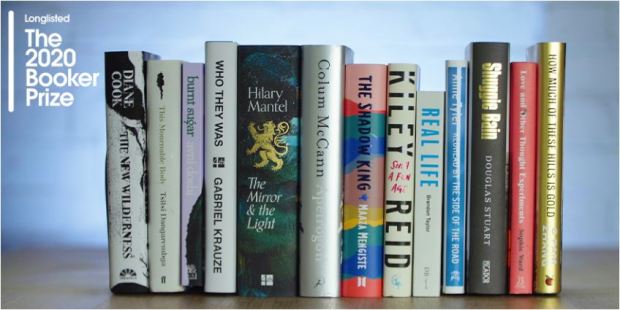
The 13-strong 2020 Booker Prize longlist was announced this morning. Looking at friends’ Booker predictions/wish lists (Clare’s and Susan’s), I didn’t think I would be invested in this year’s prize race, yet the moment I saw the longlist I scurried to look up the titles I hadn’t heard of and to request others I realized I wanted to read after all.
In general, the list achieves a nice balance between established names and debut authors, and the gender, ethnicity and sexuality statistics are good.
(Descriptions of books not experienced are from the Goodreads blurbs.)
Read:
Only one so far and, alas, I thought it among the author’s poorest work to date:
- Redhead by the Side of the Road by Anne Tyler (Chatto & Windus) – While this novella is perfectly readable – Tyler could write sympathetic characters like Micah and his Baltimore neighbors in her sleep – it felt incomplete and inconsequential, like an early draft that needed another subplot and plenty more scenes added in before it was ready for publication. Any potential controversy (illegitimate offspring and a few post-apocalyptic imaginings) is instantly neutralized, making the story feel toothless.
DNFed earlier in the year (but what do I know?):
 The Mirror & The Light by Hilary Mantel (4th Estate) – I only managed to read 80 pages or so, then skimmed to page 200 before admitting defeat. I would be totally engrossed for up to 10 pages (exposition and Cromwell one-liners), but then everything got talky or plotty and I’d skim for 20‒30 pages and set it down. I lacked the necessary singlemindedness and felt overwhelmed by the level of detail and cast of characters, so never built up momentum. Still, I can objectively recognize the prose as top-notch. But is 900 pages not a wee bit indulgent? No editor would have dared cut it…
- Such a Fun Age by Kiley Reid (Bloomsbury) – “In the midst of a family crisis one late evening, white blogger Alix Chamberlain calls her African American babysitter, Emira, asking her to take toddler Briar to the local market for distraction. There, the security guard accuses Emira of kidnapping Briar, and Alix’s efforts to right the situation turn out to be good intentions selfishly mismanaged.”
- How Much of These Hills Is Gold by C. Pam Zhang (Virago) – “Both epic and intimate, blending Chinese symbolism and re-imagined history with fiercely original language and storytelling, How Much of These Hills Is Gold is a haunting adventure story … An electric debut novel set against the twilight of the American gold rush, two siblings are on the run in an unforgiving landscape—trying not just to survive but to find a home.”
On the shelf to read soon:
- Shuggie Bain by Douglas Stuart (Picador) – “The unforgettable story of young Hugh ‘Shuggie’ Bain, a sweet and lonely boy who spends his 1980s childhood in run-down public housing in Glasgow, Scotland. Thatcher’s policies have put husbands and sons out of work, and the city’s notorious drugs epidemic is waiting in the wings.” (Out on August 6th. Proof copy from publisher)
Already wanted to read:
 Such a Fun Age by Kiley Reid (Bloomsbury) – Yes, I’m going to try this one again! (Requested from library)
- Real Life by Brandon Taylor (Daunt Books) – “An introverted young man from Alabama, black and queer, he has left behind his family without escaping the long shadows of his childhood. But over the course of a late-summer weekend, a series of confrontations with colleagues, and an unexpected encounter with an ostensibly straight, white classmate, conspire to fracture his defenses while exposing long-hidden currents of hostility and desire within their community.”
- Love and Other Thought Experiments by Sophie Ward (Corsair) – “Rachel and Eliza are hoping to have a baby. The couple spend many happy evenings together planning for the future. One night Rachel wakes up screaming and tells Eliza that an ant has crawled into her eye and is stuck there. She knows it sounds mad – but she also knows it’s true. As a scientist, Eliza won’t take Rachel’s fear seriously and they have a bitter fight. Suddenly their entire relationship is called into question.” (Requested from library)
Heard about for the first time and leapt to find:
- The New Wilderness by Diane Cook (Oneworld) – “Bea, Agnes, and eighteen others volunteer to live in the Wilderness State as part of a study to see if humans can co-exist with nature … [This] explores a moving mother‒daughter relationship in a world ravaged by climate change and overpopulation.” (Out on August 13th. Requested from publisher)
- Burnt Sugar by Avni Doshi (Hamish Hamilton) – “A searing debut novel about mothers and daughters, obsession and betrayal – for fans of Deborah Levy, Jenny Offill and Diana Evans … unpicks the slippery, choking cord of memory and myth that binds two women together, making and unmaking them endlessly.” (Out on July 30th. Requested from publisher)
Thought I didn’t want to read, but changed my mind:
 Apeirogon by Colum McCann (Bloomsbury) – I’ve only read one book by McCann and have always meant to read more. But I judged this one by the title and assumed it was going to be yet another Greek myth update. (What an eejit!) “Bassam Aramin is Palestinian. Rami Elhanan is Israeli. They inhabit a world of conflict that colors every aspect of their daily lives, from the roads they are allowed to drive on, to the schools their daughters, Abir and Smadar, each attend, to the checkpoints, both physical and emotional, they must negotiate.” (Reading from library)
Would read if it fell in my lap, but I’m not too bothered:
- Who They Was by Gabriel Krauze (4th Estate) – “An electrifying autobiographical British novel … This is a story of a London you won’t find in any guidebooks. This is a story about what it’s like to exist in the moment, about boys too eager to become men, growing up in the hidden war zones of big cities – and the girls trying to make it their own way.”
- The Shadow King by Maaza Mengiste (Canongate) – “A gripping novel set during Mussolini’s 1935 invasion of Ethiopia, The Shadow King takes us back to the first real conflict of World War II, casting light on the women soldiers who were left out of the historical record.” I have seen unenthusiastic reviews from friends.
Don’t plan to read:
- This Mournable Body by Tsitsi Dangarembga (Faber & Faber) – “Anxious about her prospects after leaving a stagnant job, Tambudzai finds herself living in a run-down youth hostel in downtown Harare. … at every turn in her attempt to make a life for herself, she is faced with a fresh humiliation, until the painful contrast between the future she imagined and her daily reality ultimately drives her to a breaking point.” This is the third book in a trilogy and I have seen unfavorable reviews from friends.
Of course, Hilary will win; skip the shortlist announcement in September and go ahead and give her the Triple Crown! But I always discover at least a couple of gems through the Booker longlist each year, so I’m grateful to the judges (Margaret Busby (chair), editor, literary critic and former publisher; Lee Child, author; Sameer Rahim, author and critic; Lemn Sissay, writer and broadcaster; and Emily Wilson, classicist and translator) for highlighting some exciting books that I may not have been induced to try otherwise. I will probably end up reading only half of the longlist, but may readjust my plans after the shortlist comes out.
What do you think about the longlist? Have you read anything from it? Which nominees appeal to you?
Thinking about Dead Bodies with John Troyer (Hay Festival)
My second of three digital Hay Festival talks this year was by John Troyer, director of the interdisciplinary Centre for Death and Society at the University of Bath. Troyer is from Wisconsin (where he was speaking from, having been trapped there during a visit to his parents) and grew up with a father who owned a funeral home. This meant that he was aware of death from a young age: One of his earliest memories is of touching the hand of a dead woman when he went to visit his father at work.
 That’s not the only personal experience that went into his new book, Technologies of the Human Corpse, which I’m now keen to read. In 2018 his younger sister, Julie, died of brain cancer at age 43, so her illness and death became a late addition to the preface and also fed into a series of prose poems interspersed between the narrative chapters. She lived in Italy and her doctors failed to tell her that she was dying – that job fell to Troyer. (Unfortunately, this seems to be a persistent problem in Italy. In Dottoressa, her memoir of being an American doctor in Rome, which I read for a TLS review, Susan Levenstein writes of a paternalistic attitude among medical professionals: they treat their patients as children and might not even tell them about a cancer diagnosis; they just inform their family.)
Troyer discussed key moments that changed how we treat corpses. For instance, during the American Civil War there was a huge market for the new embalming technology; it was a way of preserving the bodies of soldiers so they could be returned home for funerals. Frauds also arose, however, and those taken in might find their loved one’s body arrived in a state of advanced decay. At around the same time, early photography captured corpses looking serene and sleeping. We might still take such photos, but we don’t tend to display them any more.
In the 1970s the “happy death” movement advocated for things like “natural death” and “death with dignity.” This piggybacked on the environmental and women’s movements and envisioned death as a taboo that had to be overcome. In recent decades a “necro-economy” based on the global trafficking of body parts (not organs for regulated transplant, Troyer clarified, but other tissue types) has appeared. While whole bodies may be worth just £2,000, “disarticulated” ones divided into their parts can net more like £100,000. Donating one’s body to science is, of course, a noble decision. Many people are also happy to donate their organs, though there remains a particular wariness about donating the eyes.
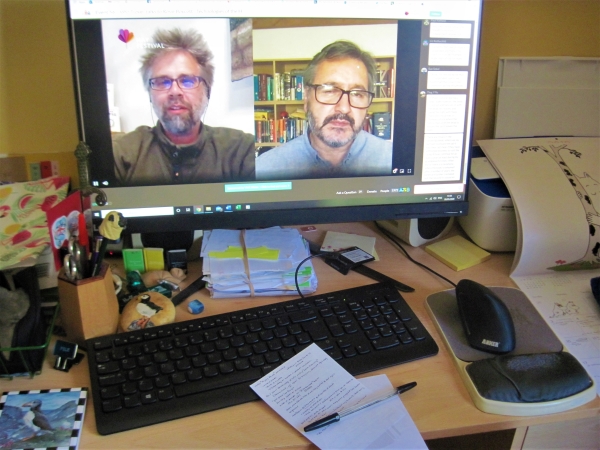
Troyer and Florence on my screen.
One section of Troyer’s book has become “uncannily resonant” in recent days, he noted. This is Chapter 3, on the AIDS corpse, an object of stigma. The biggest changes to death in the time of COVID-19 have been that family members are not able to be with a dying person in the ICU and that funerals cannot proceed as normal. In a viral pandemic, countries are producing a huge number of corpses that they aren’t prepared to deal with. (Indeed, the Washington, D.C. area is so overwhelmed with dead bodies that ice skating rinks have been requisitioned as makeshift morgues. The suburban Maryland rink I visited as a child is one such. Grim.)
Troyer spoke of the need for an everyday-ness to the discussion of death: talking with one’s next of kin, and encountering death in the course of a traditional education – he finds that even his final-year university students, studying in a related field, are very new to talking about death. A good way in that he recommends is simply to ask your loved ones what music they want played at their funerals, and the conversation can go from there.
We may not be able to commemorate the dead as we would like to at this time, but Troyer reminded the audience that funerals are for the living, whereas “the dead are okay with it – they know we’re doing our best.” The event was sensitively chaired by Peter Florence, the co-founder and director of Hay Festival (also responsible for last year’s controversial Booker Prize tie); the fact that Troyer got emotional talking about his sister only gave it more relevance and impact.
 I’ve read an abnormally large number of books about death, especially in the five years since my brother-in-law died of brain cancer (one reason why Troyer’s talk was so meaningful for me). Most recently, I read Bodies in Motion and at Rest (2000) by Thomas Lynch, a set of essays by the Irish-American undertaker and poet from Michigan. I saw him speak at Greenbelt Festival in 2012 and have read four of his books since then. His unusual dual career lends lyrical beauty to his writing about death. However, this collection was not memorable for me in comparison to his 1997 book The Undertaking, and I’d already encountered a shortened version of “Wombs” in the Wellcome Collection anthology Beneath the Skin. But this passage from “The Way We Are” stood out:
After years and years of directing funerals, I’ve come to the conclusion that seeing [the dead body] is the hardest and most helpful part. The truth, even when it hurts, has a healing in it, better than fiction or fantasy. When someone dies it is not them we fear seeing, it is them dead. It is the death. We fear that seeing will be believing. We fear not seeing too. We search the wreckage and the ruins, the battlefields and ocean floors. We must find our dead to let the loss be real.
Just for a bit of morbid fun, I decided to draw up my top 10 nonfiction books about death, dying and the dead. Many of these are personal accounts of facing death or losing a loved one. In contrast to the bereavement and cancer memoirs, the books by Doughty and Gawande are more like cultural studies, and Montross’s is about working with corpses. If you need a laugh, the Bechdel (a graphic memoir) and Doughty are best for black comedy.
 The Light of the World by Elizabeth Alexander
- Fun Home: A Family Tragicomic by Alison Bechdel (her father, too, was a funeral home director)
- Dear Life: A Doctor’s Story of Love and Loss by Rachel Clarke
- The Iceberg by Marion Coutts
- From Here to Eternity: Traveling the World to Find the Good Death by Caitlin Doughty
 Being Mortal: Medicine and What Matters in the End by Atul Gawande
- When Breath Becomes Air by Paul Kalanithi
- Body of Work: Meditations on Mortality from the Human Anatomy Lab by Christine Montross
- The Bright Hour: A Memoir of Living and Dying by Nina Riggs
- To Travel Hopefully: Journal of a Death Not Foretold by Christopher Rush
11 Days, 11 Books: 2020’s Reads, from Best to Worst
I happen to have finished 11 books so far this year – though a number of them were started in 2019 (one as far back as September) and several of them are novelty books and/or of novella length. Just for kicks, I’ve arranged them from best to worst. Here’s how my reading year has started off…
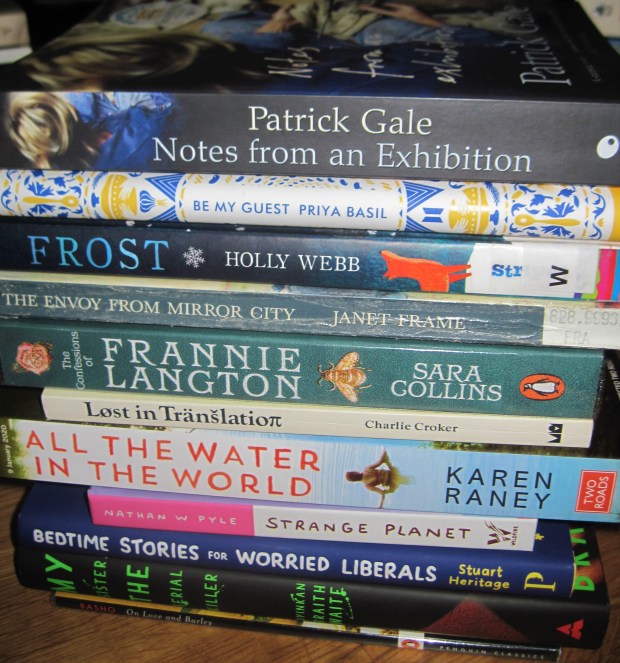
 Notes from an Exhibition by Patrick Gale – Nonlinear chapters give snapshots of the life of bipolar Cornwall artist Rachel Kelly and her interactions with her husband and four children, all of whom are desperate to earn her love. Quakerism, with its emphasis on silence and the inner light in everyone, sets up a calm and compassionate atmosphere, but also allows for family secrets to proliferate. There are two cameo appearances by an intimidating Dame Barbara Hepworth, and three wonderfully horrible scenes in which Rachel gives a child a birthday outing. The novel questions patterns of inheritance (e.g. of talent and mental illness) and whether happiness is possible in such a mixed-up family. (Our joint highest book club rating ever, with Red Dust Road. We all said we’d read more by Gale.)
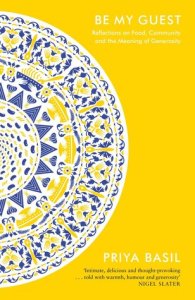 Be My Guest: Reflections on Food, Community and the Meaning of Generosity by Priya Basil – An extended essay whose overarching theme of hospitality stretches into many different topics. Part of an Indian family that has lived in Kenya and England, Basil is used to a culture of culinary abundance. Greed, especially for food, feels like her natural state, she acknowledges. However, living in Berlin has given her a greater awareness of the suffering of the Other – hundreds of thousands of refugees have entered the EU, often to be met with hostility. Yet the Sikhism she grew up in teaches unconditional kindness to strangers. She asks herself, and readers, how to cultivate the spirit of generosity. Clearly written and thought-provoking. (And typeset in Mrs Eaves, one of my favorite fonts.) See also Susan’s review, which convinced me to order a copy with my Christmas bookstore voucher.
 Frost by Holly Webb – Part of a winter animals series by a prolific children’s author, this combines historical fiction and fantasy in an utterly charming way. Cassie is a middle child who always feels left out of her big brother’s games, but befriending a fox cub who lives on scrubby ground near her London flat gives her a chance for adventures of her own. One winter night, Frost the fox leads Cassie down the road – and back in time to the Frost Fair of 1683 on the frozen Thames. I rarely read middle-grade fiction, but this was worth making an exception for. It’s probably intended for ages eight to 12, yet I enjoyed it at 36. My library copy smelled like strawberry lip gloss, which was somehow just right.
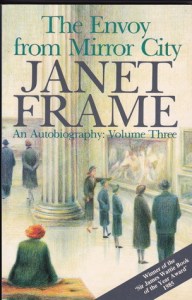 The Envoy from Mirror City by Janet Frame – This is the last and least enjoyable volume of Frame’s autobiography, but as a whole the trilogy is an impressive achievement. Never dwelling on unnecessary details, she conveys the essence of what it is to be (Book 1) a child, (2) a ‘mad’ person, and (3) a writer. After years in mental hospitals for presumed schizophrenia, Frame was awarded a travel fellowship to London and Ibiza. Her seven years away from New Zealand were a prolific period as, with the exception of breaks to go to films and galleries, and one obsessive relationship that nearly led to pregnancy out of wedlock, she did little else besides write. The title is her term for the imagination, which leads us to see Plato’s ideals of what might be.
 The Confessions of Frannie Langton by Sara Collins – Collins won the first novel category of the Costa Awards for this story of a black maid on trial in 1826 London for the murder of her employers, the Benhams. Margaret Atwood hit the nail on the head in a tweet describing the book as “Wide Sargasso Sea meets Beloved meets Alias Grace” (she’s such a legend she can get away with being self-referential). Back in Jamaica, Frances was a house slave and learned to read and write. This enabled her to assist Langton in recording his observations of Negro anatomy. Amateur medical experimentation and opium addiction were subplots that captivated me more than Frannie’s affair with Marguerite Benham and even the question of her guilt. However, time and place are conveyed convincingly, and the voice is strong.
(The next one is a book my husband received for Christmas, as are the Heritage and Pyle, further down, which were from me. Yes, I read them as well. What of it?)
 Lost in Translation by Charlie Croker – This has had us in tears of laughter. It lists examples of English being misused abroad, e.g. on signs, instructions and product marketing. China and Japan are the worst repeat offenders, but there are hilarious examples from around the world. Croker has divided the book into thematic chapters, so the weird translated phrases and downright gobbledygook are grouped around topics like food, hotels and medical advice. A lot of times you can see why mistakes came about, through the choice of almost-but-not-quite-right synonyms or literal interpretation of a saying, but sometimes the mind boggles. Two favorites: (in an Austrian hotel) “Not to perambulate the corridors in the hours of repose in the boots of ascension” and (on a menu in Macao) “Utmost of chicken fried in bother.”
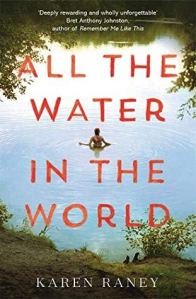 All the Water in the World by Karen Raney – Like The Fault in Our Stars (though not YA), this is about a teen with cancer. Sixteen-year-old Maddy is eager for everything life has to offer, so we see her having her first relationship – with Jack, her co-conspirator on an animation project to be used in an environmental protest – and contacting Antonio, the father she never met. Sections alternate narration between her and her mother, Eve. I loved the suburban D.C. setting and the e-mails between Maddy and Antonio. Maddy’s voice is sweet yet sharp, and, given that the main story is set in 2011, the environmentalism theme seems to anticipate last year’s flowering of youth participation. However, about halfway through there’s a ‘big reveal’ that fell flat for me because I’d guessed it from the beginning.
This was published on the 9th. My thanks to Two Roads for the proof copy for review.
 Strange Planet by Nathan W. Pyle – I love these simple cartoons about aliens and the sense they manage to make of Earth and its rituals. The humor mostly rests in their clinical synonyms for everyday objects and activities (parenting, exercise, emotions, birthdays, office life, etc.). Pyle definitely had fun with a thesaurus while putting these together. It’s also about gentle mockery of the things we think of as normal: consider them from one remove, and they can be awfully strange. My favorites are still about the cat. You can also see his work on Instagram.

 Bedtime Stories for Worried Liberals by Stuart Heritage – I bought this for my husband purely for the title, which couldn’t be more apt for him. The stories, a mix of adapted fairy tales and new setups, are mostly up-to-the-minute takes on US and UK politics, along with some digs at contemporary hipster culture and social media obsession. Heritage quite cleverly imitates the manner of speaking of both Boris Johnson and Donald Trump. By its nature, though, the book will only work for those who know the context (so I can’t see it succeeding outside the UK) and will have a short shelf life as the situations it mocks will eventually fade into collective memory. So, amusing but not built to last. I particularly liked “The Night Before Brexmas” and its all-too-recognizable picture of intergenerational strife.
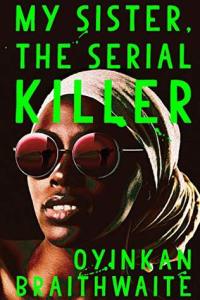 My Sister, the Serial Killer by Oyinkan Braithwaite – The Booker Prize longlist and the Women’s Prize shortlist? You must be kidding me! The plot is enjoyable enough: a Nigerian nurse named Korede finds herself complicit in covering up her gorgeous little sister Ayoola’s crimes – her boyfriends just seem to end up dead somehow; what a shame! – but things get complicated when Ayoola starts dating the doctor Korede has a crush on and the comatose patient to whom Korede had been pouring out her troubles wakes up. My issue was mostly with the jejune writing, which falls somewhere between high school literary magazine and television soap (e.g. “My hands are cold, so I rub them on my jeans” & “I have found that the best way to take your mind off something is to binge-watch TV shows”).
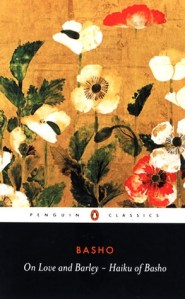 On Love and Barley – Haiku of Basho [trans. from the Japanese by Lucien Stryk] – These hardly work in translation. Almost every poem requires a contextual note on Japan’s geography, flora and fauna, or traditions; as these were collected at the end but there were no footnote symbols, I didn’t know to look for them, so by the time I read them it was too late. However, here are two that resonated, with messages about Zen Buddhism and depression, respectively: “Skylark on moor – / sweet song / of non-attachment.” (#83) and “Muddy sake, black rice – sick of the cherry / sick of the world.” (#221; reminds me of Samuel Johnson’s “tired of London, tired of life” maxim). My favorite, for personal relevance, was “Now cat’s done / mewing, bedroom’s / touched by moonlight.” (#24)
Any of these you have read or would read?
Onwards with the 2020 reading!
“All to Do with the Moon”: Four Books with Moon in the Title
I happened to read two books with the word moon in their titles within a couple of weeks in September, which prompted me to ransack my shelves and find two more. While these four are in completely different genres – one women’s fiction, one poetry, one memoir and one Booker-winning literary novel – they are all by women (naturally more in touch with the moon?) and all worth reading. In the weeks that I was undertaking this mini reading project, I couldn’t get Krista Detor’s song “All to Do with the Moon” out of my head (on this video, a live recording of the entire “Night Light” suite of three songs, it starts at about 6:15). She’s one of our favorite singer-songwriters, though, so this was no problem.
The Pull of the Moon by Elizabeth Berg (1996)
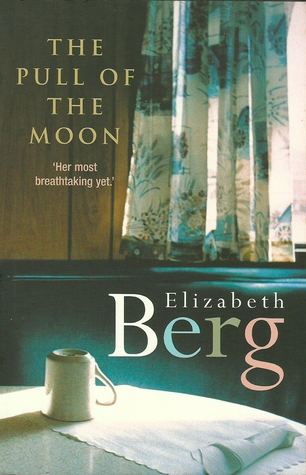 This is my second contemporary novel from Berg. I find her work effortlessly readable. She’s comparable to those other Elizabeths, McCracken and Strout, but also to Alice Hoffman and Anne Tyler. This one reminded me most of Tyler’s Ladder of Years in that both are about a middle-aged woman who takes a break from her marriage to figure out what she wants from life. Nan, “a fifty-year-old runaway,” takes off from her suburban Boston home and drives west, stopping at motels and cabins, eating at diners, and meeting the locals; eventually she gets as far as South Dakota. Her narration is in the form of letters to her husband, Martin, alternated with italicized passages from her journal. She reflects on everything that has made up her life – her upbringing, her marriage and other sexual encounters, raising her daughter, Ruthie – as well as on the small-town folk she meets in Iowa and Minnesota. The moon is a symbol of the femininity Nan fears she’s losing through menopause and hopes to reclaim on this journey.
The Moon Is Almost Full by Chana Bloch (2017)
 This was a lucky find in the clearance section at Blackwell’s on my Oxford day with Annabel. It’s a beautifully produced book from Autumn House, the small Pittsburgh press that released my favorite poetic work of last year: The Small Door of Your Death by Sheryl St. Germain. This was Bloch’s sixth and final book of poetry, published in the year of her death. She writes in the awareness that this cancer will be her end and doesn’t gloss over losses of function and dignity, but still finds delight in life through her family, writing and Jewish rituals: “Never forget / you were put on earth to gather joy // with melancholy hands” (from “Instructions for the Bridegroom”). A favorite poem was “The Will,” in which she imagines how the physical and intangible relics of her life will be distributed (“My plans and projects I hereby bequeath to the air / of which they were conceived. … Let the doctors pack up my heart / and keep it humming for the right customer.”).
Off-topic note: This was typeset in Mrs Eaves, which may well be one of my favorite fonts.
To the Moon and Back: A Childhood under the Influence by Lisa Kohn (2018)
 My special interest in women’s religious memoirs led me to list this among my most anticipated titles of 2018. I had it on my wish list for quite a while and then, when I saw it available for a bargain price online, snapped it up for myself. Lisa Kohn grew up in the New York City environs, the child of hippie parents she called Mimi and Danny rather than Mom and Dad. After their parents divorced, she and her brother lived in New Jersey with their mother and went into the City to visit their father, who was very lax about things like drugs. By the time Kohn was 10, her mother had gotten caught up in Reverend Moon’s Unification Church.
I knew next to nothing about the “Moonies,” so I found it fascinating to learn about this cult led by a South Korean reverend who let it be assumed that he was the new incarnation of Jesus Christ and the flourishing of his family on Earth would usher in God’s Kingdom. The Church became Kohn’s whole life until internal questioning set in during high school, and by the time she went to college she was adrift and into drugs instead. The book recreates scenes and dialogue well, but I found myself losing interest once the cult itself stopped being the main focus.
Readalikes: Small Fry by Lisa Brennan-Jobs and In the Days of Rain by Rebecca Stott
Moon Tiger by Penelope Lively (1987)
 Seventy-six-year-old Claudia Hampton, on her deathbed in a nursing home, determines to write a history of the world – or at least, the world as she’s seen it. She’s been an author of popular history books (one of which, on Mexico, was made into a film), but she’s also been a daughter, a sister, a lover and a mother. As the book shifts between the first person and the third person, the present and the past, we learn volumes about Claudia and how her memory has preserved the layers of her personal history. There are a couple of big reveals, about her relationship with her brother Gordon and her time as a Second World War correspondent in Egypt, but what’s more impressive than these plot surprises is how Lively packs the whole sweep of a life into just 200 pages, all with such rich, wry commentary on how what we remember constructs our reality.
I made the fine choice to start reading this on holiday at the Jurassic coast in Dorset, which was fitting because Claudia grew up in Dorset and uses ammonites and rock strata as recurring metaphors. This won a well-deserved Booker Prize and is the best of the five Lively books I’ve read. I wasn’t particularly taken with the first couple I read by her, so I’m glad I tried again this year (with Heat Wave and then this). It’s just a shame that the copy I found in the free bookshop where I volunteer has such a dreadfully inappropriate cover, making it look like contemporary chick lit rather than serious literature. 
Some favorite lines:
“Argument, of course, is the whole point of history. Disagreement; my word against yours; this evidence against that. If there were such a thing as absolute truth the debate would lose its lustre. I, for one, would no longer be interested.”
“In life as in history the unexpected lies waiting, grinning from around corners. Only with hindsight are we wise about cause and effect.”
“Once it is all written down we know what really happened.”
A note on the title: From the context, it seems that a moon tiger was a special inflammatory device, maybe like a citronella candle, used to repel mosquitoes and other insects.
 Other ‘Moon’ books I have happened to review:
Crossing the Moon by Paulette Bates Alden
The Moon and Sixpence by W. Somerset Maugham
Booker Prize and Birthday Goings-On
The Booker Prize was announced last night in a live feed I watched over a glass of wine between my yoga class and birthday dessert. As chair of judges Peter Florence recapped each book, he said the most, and most effusively, about Ducks, Newburyport, so I thought Ellmann had it in the bag. Then, when it became clear there would be joint winners, I thought maybe Ellmann and Evaristo would share the Prize. But that’s not how things panned out…
I don’t have much to add to the conversation after yesterday’s Twitter storm; I remain entirely uninterested in reading The Testaments, an unnecessary sequel and, by all accounts, subpar Atwood work that didn’t need more buzz than it’s already attracted. Atwood won the Booker in 2000 for a brilliant novel, The Blind Assassin, one of my absolute favorites, and while she’s enough of a legend to be among the few authors to have won the Prize twice (along with Peter Carey, J.M. Coetzee and Hilary Mantel), maybe not for this book?

I am, however, delighted for Evaristo. If you haven’t yet picked up Girl, Woman, Other, I’d urge you to give it a try. I’m 1/3 into it now. Through a giveaway on Eric’s blog I won a copy plus two tickets to see Evaristo in conversation with Jennifer Nansubuga Makumbi (author of Manchester Happened, which I’ll be covering for the Ake Book Festival blog tour later this month) at the London Literature Festival on the 20th, but I couldn’t wait until I pick up my copy from the Southbank Centre so have been reading a library copy in the meantime.
You probably know that Girl, Woman, Other is a linked short story collection about 12 characters (mostly Black women) navigating twentieth-century and contemporary Britain, balancing external and internal expectations and different interpretations of feminism to build lives of their own. I’ve been surprised by the structure and style, however. It’s in four long chapters, each divided between three characters. These are almost like musical suites, with the three stories interlocking (I’m not in far enough to know if there is overlap between the suites). The prose is mostly uncapitalized and unpunctuated, with only a handful of full stops closing sections. This makes it more like poetry: a wry, radical stream of consciousness. I’d compare it, content-wise, to Homegoing by Yaa Gyasi and The Female Persuasion by Meg Wolitzer.
This is the third tie in Booker history – though after a 1992 tie the rules were changed so that it shouldn’t have happened again. As Gaby Wood, literary director of the Booker Prize Foundation, puts it, “The thinking was it just doesn’t work—it sort of detracts attention from both, rather than drawing attention to either.” So while it’s wonderful that Evaristo is the first Black woman to win the Booker, there is something almost sinister about the fact that, due to the tie, she gets just £25,000 in prize money rather than the full £50,000. However, both she and Atwood were extremely graceful in their acceptance speeches (Atwood sheepish and apologetic at the same time), so I will try to be as well. It’s a turn-up for the books, anyway!
 Yesterday was also my 36th birthday. A dismally wet Monday may not be ideal for a birthday, but I’d had the whole previous weekend for celebrating so can’t really complain. Saturday was a very Newbury day of volunteer gardening in the drizzle; an excellent lunch at Henry & Joe’s, a reasonably new restaurant with small plates of seasonal food, exquisitely presented – on the way to Michelin star quality; an early evening showing of Downton Abbey in the intimate upstairs theatre at the Corn Exchange; and a wander around the Fire Garden art installation, which features giant candles and automata. On Sunday I helped out at a fun and chaotic pet blessing service at church, followed by cake, presents and a homemade feast.


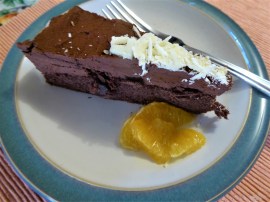 One of the best parts of preparing for my birthday is finding recipes for my husband to make for me. This year I picked a Chocolate Orange Truffle Cake from Perfect Chocolate Desserts (which includes photographs of every step), a veganized Chicken Jackfruit Mole with Red Cabbage Slaw and flatbreads from Pip & Nut: The Nut Butter Cookbook, and A Rum of One’s Own (aka hot buttered rum) from the Tequila Mockingbird literary cocktails book. All amazingly rich and delicious; by nightcap time, I could only manage a sip or two of the rum.

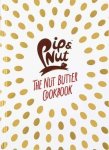
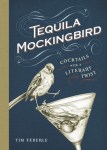
I gave myself the Monday off work (the nice thing about being a freelancer, even if I don’t get paid) and spent much of it reading in comfy spots around the house and looking out at the rain. I also picked out a pile of books I’ve been meaning to reread, but only got around to starting the Thomas. I hadn’t read it since it came out in 2006 yet I remember it so well, even particular phrasing. It was one of the first memoirs to make a really big impression on me.


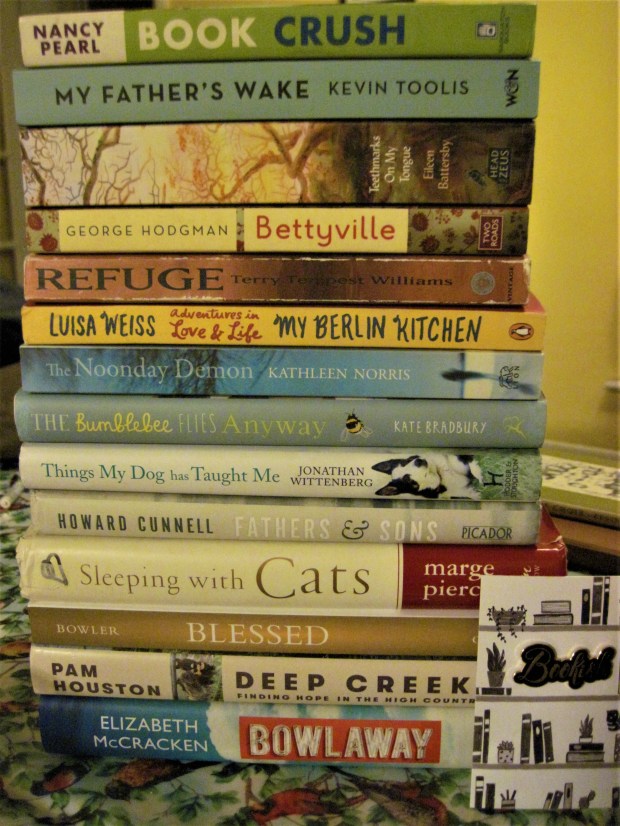
It won’t surprise you that my wish list contained only books this year, so with the exception of a mug mat, puffin socks and notecards, a couple of CDs, some chocolate and the perfect pin badge (“Bookish”), I received 14 books as presents: two novels and the rest nonfiction, mostly memoirs. I get much of my fiction from the library or from NetGalley/Edelweiss (particularly the American releases I can’t find elsewhere), but there are lots of nonfiction authors whose work I can’t find other than secondhand. I know where I’ll start with this pile: the Houston and McCracken are 2019 releases, so I want to read them before the end of the year in case they make a Best Of list. After that, I’ll let whimsy be my guide. A great haul!
Any additional Booker thoughts?
What caught your eye from my birthday stacks?
My (Not the) Booker Prize Reading
A week from today, on the 14th (my birthday, as well as Susan’s – be sure to wish her a happy one!), this year’s Booker Prize will be announced. The Prize’s longlist didn’t contain much that piqued my interest this time around; I read one book from it and didn’t get on with it well at all, and I also DNFed another three.
Read
Frankissstein by Jeanette Winterson
 Winterson does her darndest to write like Ali Smith here (no speech marks, short chapters and sections, random pop culture references). Cross Smith’s Seasons quartet with the vague aims of the Hogarth Shakespeare project and Margaret Atwood’s The Heart Goes Last and you get this odd jumble of a novel that tries to combine the themes and composition of Frankenstein with the modern possibilities of transcending bodily limitations. Her contemporary narrator is Ry Shelley, a transgender doctor sponsored by the Wellcome Trust who supplies researcher Victor Stein with body parts for his experiments in Manchester. In Memphis for a tech expo, Ry meets Ron Lord, a tactless purveyor of sexbots.
Their interactions alternate with chapters narrated by Mary Shelley in the 1810s; I found this strand much more engaging and original, perhaps because I haven’t read that much about Shelley and her milieu, whereas it feels like I’ve read a lot about machine intelligence and transhumanism recently (To Be a Machine, Murmur, Machines Like Me). I think Winterson’s aim was to link the two time periods through notions of hybridness and resistance to death. It never really came together for me. 
DNFed
 Night Boat to Tangier by Kevin Barry – I read the first 76 pages. The other week two grizzled Welsh guys came to deliver my new fridge. Their barely comprehensible banter reminded me of that between Maurice and Charlie, two ageing Irish gangsters. The long first chapter is terrific. At first these fellas seem like harmless drunks, but gradually you come to realize just how dangerous they are. Maurice’s daughter Dilly is missing, and they’ll do whatever is necessary to find her. Threatening to decapitate someone’s dog is just the beginning – and you know they could do it. “I don’t know if you’re getting the sense of this yet, Ben. But you’re dealing with truly dreadful fucken men here,” Charlie warns at one point. I loved the voices; if this was just a short story it would have gotten a top rating, but I found I had no interest in the backstory of how these men got involved in heroin smuggling.
The Wall by John Lanchester – I lost interest in it and wasn’t drawn in by the first pages.
 The Man Who Saw Everything by Deborah Levy – I read the first 35 pages. There’s a lot of repetition; random details seem deliberately placed as clues. I’m sure there’s a clever story in here somewhere, but apart from a few intriguing anachronisms (in 1988 a smartphone is just “A small, flat, rectangular object … lying in the road. … The object was speaking. There was definitely a voice inside it”) there is not much plot or character to latch onto. I suspect there will be many readers who, like me, can’t be bothered to follow Saul Adler from London’s Abbey Road, where he’s hit by a car in the first paragraph, to East Berlin.
 There’s only one title from the Booker shortlist that I’m interested in reading: Girl, Woman, Other by Bernardine Evaristo. I’ll be reviewing it later this month as part of a blog tour celebrating the Aké Book Festival, but as a copy hasn’t yet arrived from either the publisher or the library I won’t have gotten far into it before the Prize announcement.
As for the other five on the shortlist…
- I’m a conscientious objector to Margaret Atwood’s The Testaments. I haven’t appreciated her previous dystopian sequels, and I’ve never really understood all the hype around The Handmaid’s Tale.
- I don’t plan on reading Lucy Ellmann’s Ducks, Newburyport – unless some enterprising soul produces an abridged version of no more than 250 pages.*

Ducks, Newbury
- I didn’t rate The Fishermen highly enough to give Chigozie Obioma’s An Orchestra of Minorities a try.
- I forced myself through Midnight’s Children some years back. What a pointless slog! Lukewarm reviews of his recent work mean I’m now doubly determined to avoid Salman Rushdie’s Quichotte.
- Although the setup appeals to me (a prostitute’s whole life spooling out in front of her in the moments before her death) and I enjoyed her previous novel well enough, I’ve not heard enough good things to pick up Elif Shafak’s 10 Minutes 38 Seconds in this Strange World.
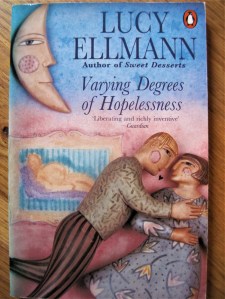 *However, I was delighted to find a copy of her 1991 novel, Varying Degrees of Hopelessness (just 182 pages, with short chapters often no longer than a paragraph and pithy sentences) in a 3-for-£1 sale at our local charity warehouse. Isabel, a 31-year-old virgin whose ideas of love come straight from the romance novels of ‘Babs Cartwheel’, hopes to find Mr. Right while studying art history at the Catafalque Institute in London (a thinly veiled Courtauld, where Ellmann studied). She’s immediately taken with one of her professors, Lionel Syms, whom she dubs “The Splendid Young Man.” Isabel’s desperately unsexy description of him had me snorting into my tea:
He had a masculinity.
His broad shoulders and narrow hips gave him a distinctive physique.
He held seminars and wore red socks.
To hold seminars seemed to indicate a wish to develop a rapport with his students.
The red socks seemed to indicate testosterone.
I swooned in admiration of him.
Unfortunately, the Splendid Young Man is more interested in Isabel’s portly flatmate, Pol. There’s a screwball charm to this campus novel full of love triangles and preposterous minor characters. I laughed at many of Ellmann’s deadpan lines, and would recommend this to fans of David Lodge’s academic comedies. But if you wish to, you could read this as a cautionary tale about the dangers of romantic fantasies. Ellmann even offers two alternate endings, one melodramatic and one more prosaic but believable. I’ll seek out the rest of her back catalogue – so thanks to the Booker for putting her on my radar.
In the meantime, I did a bit better with the “Not the Booker Prize” (administered by the Guardian) shortlist, reading three out of their six:
Flames by Robbie Arnott
 This strange and somewhat entrancing debut novel is set in Arnott’s native Tasmania. The women of the McAllister family are known to return to life – even after a cremation, as happened briefly with Charlotte and Levi’s mother. Levi is determined to stop this from happening again, and decides to have a coffin built to ensure his 23-year-old sister can’t ever come back from the flames once she’s dead. The letters that pass between him and the ill-tempered woodworker he hires to do the job were my favorite part of the book. In other strands, we see Charlotte traveling down to work at a wombat farm in Melaleuca, a female investigator lighting out after her, and Karl forming a close relationship with a seal. This reminded me somewhat of The Bus on Thursday by Shirley Barrett and Orkney by Amy Sackville. At times I had trouble following the POV and setting shifts involved in this work of magic realism, though Arnott’s writing is certainly striking.
A favorite passage:
“The Midlands droned on, denuded hill after denuded hill, until I rolled into sprawling suburbs around noon. Here’s a list of the places I’d choose to visit before the capital: hell, anywhere tropical, the Mariana Trench, a deeper pit of hell, my mother’s house.”
My thanks to Atlantic Books for the free paperback copy for review.
See Susan’s review for a more enthusiastic response.
 The Unauthorised Biography of Ezra Maas by Daniel James: A twisty, clever meta novel about “Daniel James” trying to write a biography of Ezra Maas, an enigmatic artist who grew up a child prodigy in Oxford and attracted a cult following in 1960s New York City, where he was a friend of Warhol et al. (See my full review.)
Supper Club by Lara Williams: A great debut novel with strong themes of female friendship and food. The Supper Club Roberta and Stevie create is performance art, but it’s also about creating personal meaning when family and romance have failed you. (See my full review.)
The other three books on the shortlist are:
- Skin by Liam Brown: A dystopian novel in which people become allergic to human contact. I think I’ll pass on this one.
 Please Read This Leaflet Carefully by Karen Havelin: A debut novel by a Norwegian author that proceeds backwards to examine the life of a woman struggling with endometriosis and raising a young daughter. I’m very keen to read this one.
- Spring by Ali Smith: I’ve basically given up on Ali Smith – and certainly on the Seasons quartet, after DNFing Winter.
(The Not the Booker Prize will be announced on the Guardian website this Friday the 11th.)
 Bookish Beck = Rebecca Foster. American transplant to England. Freelance proofreader and book reviewer.
 Bookish Beck