#WITMonth, II: Bélem, Blažević, Enríquez, Lebda, Pacheco and Yu (#17 of 20 Books)
Catching up with my Women in Translation month coverage, which concluded (after Part I, here) with five more short novels ranging from historical realism to animal-oriented allegory, plus a travel book.
The Rarest Fruit, or The Life of Edmond Albius by Gaëlle Bélem (2023; 2025)
[Translated from French by Hildegarde Serle]
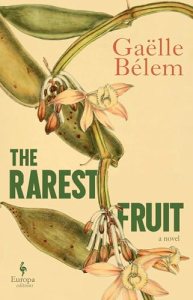 A fictionalized biography, from infancy to deathbed, of the Black botanist who introduced the world to vanilla – then a rare and expensive flavour – by discovering that the plant can be hand-pollinated in the same way as pumpkins. In 1829, the island colony of Bourbon (now the French overseas department Réunion) has just been devastated by a cyclone when widowed landowner Ferréol Bellier-Beaumont is brought the seven-week-old orphaned son of one of his sister’s enslaved women. Ferréol, who once hunted rare orchids, raises the boy as his ward. From the start, Edmond is most at home in the garden and swears he will follow in his guardian’s footsteps as a botanist. Bélem also traces Ferréol’s history and the origins of vanilla in Mexico. The inclusion of Creole phrases and the various uses of plants, including for traditional healing, chimed with Jason Allen-Paisant’s Jamaica-set The Possibility of Tenderness, and I was reminded somewhat of the historical picaresque style of Slave Old Man (Patrick Chamoiseau) and The Secret Diaries of Charles Ignatius Sancho (Paterson Joseph). The writing is solid but the subject matter so niche that this was a skim for me.
With thanks to Europa Editions, who sent an advanced e-copy for review.
In Late Summer by Magdalena Blažević (2022; 2025)
[Translated from Croatian by Anđelka Raguž]
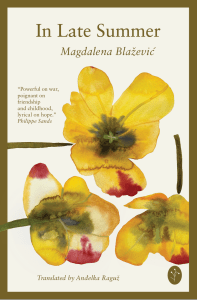 “My name is Ivana. I lived for fourteen summers, and this is the story of my last.” Blažević’s debut novella presents the before and after of one extended family, and of the Bosnian countryside, in August 1993. In the first half, few-page vignettes convey the seasonality of rural life as Ivana and her friend Dunja run wild. Mother and Grandmother slaughter chickens, wash curtains, and treat the children for lice. Foodstuffs and odours capture memory in that famous Proustian way. I marked out the piece “Camomile Flowers” for its details of the senses: “Sunlight and the scent of soap mingle. … The pantry smells like it did before, of caramel, lemon rind and vanilla sugar. Like the period leading up to Christmas. … My hair dries quickly in the sun. It rustles like the lace, dry snow from the fields.” The peaceful beauty of it all is shattered by the soldiers’ arrival. Ivana issues warnings (“Get ready! We’re running out of time. The silence and summer lethargy will not last long”) and continues narrating after her death. As in Sara Nović’s Girl at War, the child perspective contrasts innocence and enthusiasm with the horror of war. I found the first part lovely but the whole somewhat aimless because of the bitty structure.
With thanks to Linden Editions for the free copy for review.
Somebody Is Walking on Your Grave: My Cemetery Journeys by Mariana Enríquez (2013; 2025)
[Translated from Spanish by Megan McDowell]
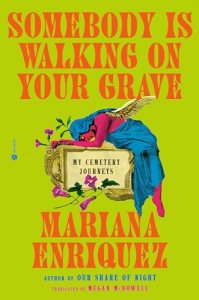 This made it onto my Most Anticipated list for the second half of the year due to my love of graveyards. Because of where Enríquez is from, a lot of the cemeteries she features are in Argentina (six) or other Spanish-speaking countries (another six including Chile, Cuba, Mexico, Peru and Spain). There are 10 more locations besides, and her journeys go back as far as 1997 in Genoa, when she was 25 and had sex with Enzo up against a gravestone. I took the most interest in those I have been to (Edinburgh) or could imagine myself travelling to someday (New Orleans and Savannah; Highgate in London and Montparnasse in Paris), but thought that every chapter got bogged down in research. Enríquez writes horror, so she is keen to visit at night and relay any ghost stories she’s heard. But the pages after pages of history were dull and outweighed the memoir and travel elements for me, so after a few chapters I ended up just skimming. I’ll keep this on my Kindle in case I go to one of her other destinations in the future and can read individual essays on location. (Edelweiss download)
Voracious by Małgorzata Lebda (2016; 2025)
[Translated from Polish by Antonia Lloyd-Jones]
Like the Blažević, this is an impressionistic, pastoral work that contrasts vitality and decay in short chapters of one to three pages. The narrator is a young woman staying in her grandmother’s house and caring for her while she is dying of cancer; “now is not the time for life. Death – that’s what fills my head. I’m at its service. Grandma is my child. I am my grandmother’s mother. And that’s all right, I think.” The house has just four inhabitants – the narrator, Grandma Róża, Grandpa, and Ann – and seems permeable: to the cold, to nature. Animals play a large role, whether pets, farmed or wild. There’s Danube the hound, the cows delivered to the nearby slaughterhouse, and a local vixen with whom the narrator identifies.
 Lebda is primarily known as a poet, and her delight in language is evident. One piece titled “Opioid,” little more than a paragraph long, revels in the power of language: “Grandma brings a beautiful word home … the word not only resonates, but does something else too – it lets light into the veins.” The wind is described as “the conscience of the forest. It’s the circulatory system. It’s the litany. It’s scented. It sings.”
In all three Linden Editions books I’ve read, the translator’s afterword has been particularly illuminating. I thought I was missing something, but Lloyd-Jones reassured me it’s unclear who Ann is: sister? friend? lover? (I was sure I spotted some homoerotic moments.) Lloyd-Jones believes she’s the mirror image of the narrator, leaning toward life while the narrator – who has endured sexual molestation and thyroid problems – tends towards death. The animal imagery reinforces that dichotomy.
The narrator and Ann remark that it feels like Grandma has been ill for a million years, but they also never want this time to end. The novel creates that luminous, eternal present. It was the best of this bunch.
With thanks to Linden Editions for the free copy for review.
Full review forthcoming for Foreword Reviews:
Pandora by Ana Paula Pacheco (2023; 2025)
[Translated from Portuguese by Julia Sanches]
 The Brazilian author’s bold novella is a startling allegory about pandemic-era hazards to women’s physical and mental health. Since the death of her partner Alice to Covid-19, Ana has been ‘married’ to a pangolin and a seven-foot-tall bat. At a psychiatrist’s behest, she revisits her childhood and interrogates the meanings of her relationships. The form varies to include numbered sections, the syllabus for Ana’s course “Is Literature a personal investment?”, journal entries, and extended fantasies. Depictions of animals enable commentary on economic inequalities and gendered struggles. Playful, visceral, intriguing.
#17 of my 20 Books of Summer:
Invisible Kitties by Yu Yoyo (2021; 2024)
[Translated from Chinese by Jeremy Tiang]
 Yu is the author of four poetry collections; her debut novel blends autofiction and magic realism with its story of a couple adjusting to the ways of a mysterious cat. They have a two-bedroom flat on a high-up floor of a complex, and Cat somehow fills the entire space yet disappears whenever the woman goes looking for him. Yu’s strategy in most of these 60 mini-chapters is to take behaviours that will be familiar to any cat owner and either turn them literal through faux-scientific descriptions, or extend them into the fantasy realm. So a cat can turn into a liquid or gaseous state, a purring cat is boiling an internal kettle, and a cat planted in a flowerbed will produce more cats. Some of the stories are whimsical and sweet, like those imagining Cat playing extreme sports, opening a massage parlour, and being the god of the household. Others are downright gross and silly: Cat’s removed testicles become “Cat-Ball Planets” and the narrator throws up a hairball that becomes Kitten. Mixed feelings, then. (Passed on by Annabel – thank you!)
I’m really pleased with myself for covering a total of 8 books for this challenge, each one translated from a different language!
Which of these would you read?
Three on a Theme: Tiger Novels (Polly Clark, Tania James, Téa Obreht)
I was sent Loot for review, picked The Tiger’s Wife – a reread for me – as our February book club book, and then couldn’t resist making it a trio with Tiger as it was also a good excuse to pick up a book that had sat on my shelves unread for several years. In all three, the tiger is an emblem of wildness and mystery – and often of danger, too (“you must rid us of this devil in his fiery pajamas,” the village priest begs the hunter in The Tiger’s Wife).
Tiger by Polly Clark (2019)
 I was fully engaged with the 150 or so pages of Part I, which is narrated by Dr Frieda Bloom, a zookeeper knowledgeable about and fascinated by bonobos. She’s also a morphine addict who continues to justify using at work (not to mention stealing from the veterinary supplies) until she is caught and fired. It’s all in response to a random act of violence: a man attacked her outside a Tube station late one night and she was lucky to have survived the head injury. In ignominy, she moves from a prestigious research institute to a rundown local zoo where the star new acquisition is an injured tiger named Luna. She develops an amazing rapport with Luna, even spending time in the enclosure with her. Meanwhile, the macho behaviour of her colleague Gabriel makes it seem like Frieda could be a victim again at any time.
But then we jump back in time and to the Russian taiga to meet, through third-person segments, a conservationist who hears about a mighty Siberian tigress, and a mother and daughter who encounter her for themselves. This turns out to be “the Countess,” Luna’s mother, and Frieda, a few years on now, travels to Russia herself to bring back one of Luna’s cubs. The focus, as the title signals, is on the tiger herself, but my interest was only ever in Frieda, and it was a little confusing how quickly she switches allegiance from primates to tigers. More first-person narration might have kept me engaged, or maybe a different order to the sections? Anything to keep me latching onto Frieda and missing her for most of the book. (Instagram giveaway win) 
Loot by Tania James (2023)
A halfhearted skim. It’s a shame that when I was offered this for review I didn’t remember I’d read something by Tania James before. The Tusk that Did the Damage, from 2016, is a composite picture of the state of wildlife conservation in India told from three perspectives: an elephant named The Gravedigger, a poacher, and a documentary filmmaker. That was a book I had to force myself through because of the lacklustre storytelling and character development, and I found the same here. Historical fiction can be tedious when it assumes that an unusual setting and intriguing incident are enough to maintain reader interest. Abbas, a woodcarver, is only 17 when he is taken to the sultan’s palace to be apprenticed to a French clockmaker. Together, they create the real-life automaton known as Tippoo’s Tiger and held at the V&A Museum. When the automaton is plundered, Abbas sets out on a quest to rescue it. I never warmed to any of the characters here, even though du Leze’s adopted daughter Jehanne is a promising one. If it’s automata that intrigue you, read The Weather Woman instead. 

[Now on the Carol Shields Prize for Fiction longlist]
With thanks to Harvill Secker for the free copy for review.
The Tiger’s Wife by Téa Obreht (2011)
What I remembered: a wartime Eastern European (Bosnian?) story that incorporated legends.
What I rediscovered:
Natalia, a medical worker in a war-ravaged country, learns of her grandfather’s death away from home. The only one who knew the secret of his cancer, she sneaks away from an orphanage vaccination program to reclaim his personal effects, hoping they’ll reveal something about why he went on this final trip. Something is missing from his belongings: his beloved copy of The Jungle Book, which sparked a lifelong fascination with tigers. When war broke out mid-century and a tiger escaped from the zoo, he was nine years old. He and the butcher’s wife, a pregnant, deaf-mute Muslim woman with whom he communicated by scratching images in the dirt, were thrilled by the tiger’s nocturnal skulking rather than frightened like the rest of the villagers. Her outcast status led people to ignore the fact that she was a victim of domestic violence and to spin tales about her unnatural connection with the tiger, spreading rumours about the child she was carrying (“The Tiger’s Wife”).
 In the years to come, during Natalia’s grandfather’s career as a doctor, he had several encounters with Gavran Gailé, “The Deathless Man,” a troubadour who seemed, vampire- or zombie-like, to survive every attempt on his life. In service to his uncle, Gavran Gailé read people’s coffee grounds to inform them of their impending death, but his own cup was bare and unbreakable. Natalia’s grandfather, a man of science, didn’t believe Gavran Gailé’s claims and agreed to a wager. Gavran Gailé would walk into a lake, tied up in chains attached to cement blocks, and pull on a rope when he started drowning. His pledge was his cup; the doctor’s was The Jungle Book, his most treasured possession. But as promised, Gavran Gailé spent an hour underwater and emerged from the lake none the worse the wear.
Natalia knows her grandfather’s final journey must have been to meet The Deathless Man, who collected on his pledge. She’ll have her own encounter with him before the end.
This is a demanding read, in that there are not a lot of orienting details and the several storylines surge in and out through flashbacks and oral storytelling. It takes effort and commitment to keep reading in the hope that everything will come together. This was a flop for my book club in that only three people had read it so we decided it wasn’t worth meeting. One who did finish it commented that it felt like three separate stories, and I see what she means. Obreht could certainly have made the links and chronology more obvious. Instead, each chapter is such a honed and self-contained narrative, often focused on a different peripheral character, that the book almost reads like a set of linked short stories. On this reread I was absolutely entranced, especially by the sections about The Deathless Man. I had forgotten the medical element, which of course I loved.
It can be depressing looking back at amateur reviews I wrote in my pre-freelancing days because I have not notably advanced since then. This response I wrote when I read the brand-new book in 2011 is allusive, opinionated, and admirably absent of dull plot summary. Could I do any better now if I tried? (Though I think I maybe misunderstood the ending back then.)
Had I reread this sooner, it would have been tough to choose between it and Larry’s Party, my ultimate selection, for the Women’s Prize Winners 25th anniversary reader vote. Were I to vote again today, I’d join Laura in choosing The Tiger’s Wife instead. (Public library)
My original rating (2011): 
My rating now: 
Eleanor recently reviewed it, too.
There was a clear winner here: The Tiger’s Wife!
See also Laura’s fab series on tiger novels from her old blog. This is the first post and there are more listed in the right-hand sidebar.
I searched my Goodreads library for others I’ve read and the only books she didn’t cover were Nick Harkaway’s Tigerman, a disappointment after Angelmaker; and (nonfiction) Margaux Fragoso’s Tiger, Tiger (title from a William Blake line), a memoir of childhood sexual abuse, and Ruth Padel’s Tigers in Red Weather, a travelogue – it happens to share a title with Liza Klausmann’s novel, which is likewise named after a line in the Wallace Stevens poem “Disillusionment of Ten O’Clock.”
Body Kintsugi by Senka Marić: A Peirene Press Novella (#NovNov22)
This is my eleventh translated novella from Peirene Press* and, in my opinion, their best yet. It’s an intense work of autofiction about two years of hellish treatment for breast cancer, all the more powerful due to the second-person narration that displaces the pain from the protagonist and onto the reader.
This is a story about the body. Its struggle to feel whole while reality shatters it into fragments. The gash goes from the right nipple towards your back, and after five centimetres makes a gentle curve up and continues to your armpit. It’s still fresh and red.
How does the story crumbling under your tongue and refusing to take on a firm shape begin to be told?
You knew on that day, sixteen years ago, when your mother’s diagnosis was confirmed, that you’d get cancer?
Or
Ever since that day, sixteen years ago, when your mother’s diagnosis was confirmed, that you’d never get cancer?
Both are equally true.
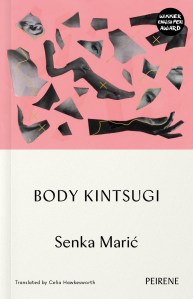 In 2014, just a couple of months after her husband leaves her – making her, in her early forties, a single mother to a son and a daughter – she discovers a lump in her right breast.
As she endures five operations, chemotherapy and adjuvant therapies, as well as endless testing and hospital stays, her mind keeps going back to her girlhood and adolescence, especially the moments when she felt afraid or ashamed. Her father, alcoholic and perpetually ill, made her feel like she was an annoyance to him.
Coming of age in a female body was traumatic in itself; now that same body threatens to kill her. Even as she loses the physical signs of femininity, she remains resilient. Her body will document what she’s been through: “Perfectly sculpted through all your defeats, and your victories. The scars scrawled on it are the map of your journey. The truest story about you, which words cannot grasp.”
As forthright as it is about the brutality of cancer treatment, the novella can also be creative, playful and even darkly comic.
Things you don’t want to think about:
Your children
Your boobs
Your cancer
Your bald head
Your death
Almost unbearable nausea delivers her into a new space: “Here, the only colours are black and red. You’re lost in a vast hotel. However hard you try, you can’t count the floors.” One snowy morning, she imagines she’s being visited by a host of Medusa-like women in long black dresses who minister to her. Whether it’s a dream or a medication-induced hallucination, it feels mystical, like she’s part of a timeless lineage of wise women. The themes, tone and style all came together here for me, though I can see how this book might not be for everyone. I have a college friend who’s going through breast cancer treatment right now. She’s only 40. She was diagnosed in the summer and has already had surgery and a few rounds of chemo. I wonder if this book is just what she would want to read right now … or the last thing she would want to think about. All I can do is ask.
(Translated from the Bosnian by Celia Hawkesworth) [165 pages] 
With thanks to Peirene Press for the free copy for review.
*Other Peirene Press novellas I’ve reviewed:
Mr. Darwin’s Gardener by Kristina Carlson
The Looking-Glass Sisters by Gøhril Gabrielsen
Ankomst by Gøhril Gabrielsen
Dance by the Canal by Kerstin Hensel
The Last Summer by Ricarda Huch
Snow, Dog, Foot by Claudio Morandini
Her Father’s Daughter by Marie Sizun
The Orange Grove by Larry Tremblay
The Man I Became by Peter Verhelst
Winter Flowers by Angélique Villeneuve

Review Catch-Up: The Swimmers, Black Butterflies, Bi, and On the Scent
I have a preposterous backlog of review copies to finish and write about (I’m going to go ahead and blame buying a house, moving and DIY for my lack of focus and diminished time, as I have done most of this year), but I’ve decided to get on top of it by pulling a quartet off of my set-aside shelf each week for short responses. I always like to feature a variety, so here I have two fiction and two nonfiction selections: novels about assisted dying and the Bosnian War that are a lot funnier and more life-affirming than you might expect, and books about bisexuality and the sense of smell – and the effect of its loss.
The Swimmers by Chloe Lane (2020; 2022)
 Erin Moore has returned to her family’s rural home for Queen’s Birthday (now a dated reference, alas!), a long weekend in New Zealand’s winter. Not a time for carefree bank holiday feasting, this; Erin’s mother has advanced motor neurone disease and announces that she intends to die on Tuesday. Aunty Wynn has a plan for obtaining the necessary suicide drug; it’s up to Erin to choreograph the rest. “I was the designated party planner for this morbid final frolic, and the promise of new failures loomed. … The whole thing was looking more and more like the plot of a French farce, except it wasn’t funny.”
Lane renders a potentially maudlin situation merely bittersweet through black comedy. Erin isn’t the most endearing narrator because, Disaster Woman-like, she keeps undertaking weird acts of self-sabotage – at 26, she’s blown her first gallery curation opportunity by sleeping with her boss. Still, the picture of a different sort of dysfunctional family and the contrast between an illustrious past (Erin comes from a line of semi-pro swimmers: Aunty Wynn qualified to compete in the Commonwealth Games) and an iffy future make this fairly memorable, if not so much so as the other 2022 The Swimmers – Julie Otsuka’s.
Readalikes: Sorrow and Bliss by Meg Mason, What Are You Going Through by Sigrid Nunez, The Inland Sea by Madeleine Watts, The Weekend by Charlotte Wood
With thanks to Gallic Books for the proof copy for review.
Black Butterflies by Priscilla Morris (2022)
 Drawing on her own family history, Morris has crafted an absorbing story set in Sarajevo in 1992, the first year of the Bosnian War. Zora, a middle-aged painter, has sent her husband, Franjo, and elderly mother off to England to stay with her daughter, Dubravka, confident that she’ll see out the fighting in the safety of their flat and welcome them home in no time. But things rapidly get much worse than she is prepared for. Phone lines are cut off, then the water, then the electricity. “We’re all refugees now, Zora writes to Franjo. We spend our days waiting for water, for bread, for humanitarian handouts: beggars in our own city.”
When even the haven of her studio is taken away from her, she’s reduced to the bare bones of existence, with just a few beloved neighbours to keep her spirits up. Her painting, more an obsession than a hobby, keeps her human as she awaits space on a Red Cross convoy. The title has heartrending significance: ‘black butterflies’ are fragments of paper carried on the breeze after the burning of the National Library of Sarajevo, 30 years ago last month. It was especially poignant to be reading this during the war in Ukraine and think about the sorts of daily dangers and deprivation that people face in conflict zones. The pages turned quickly and I was reminded of Girl at War, one of my absolute favourites, as well as The Pianist.
With thanks to Duckworth for the proof copy for review.
Bi: The hidden culture, history, and science of bisexuality by Julia Shaw (2022)
I’m tying this in with today’s celebration of Bi Visibility Day. Shaw is a criminal psychologist; her third book is a departure for her thematically, but means a lot to her personally. Bisexuality is the largest minority sexuality group, yet bisexuals are less likely to be out because of misconceptions and stereotypes – there are fewer outward signals and less group identification – which can sometimes result in poor mental health. Shaw realized how tricky bi identity was when a German TV show wanted to base a character on her but didn’t know how to make her sexuality obvious to viewers (lingering glances/flirtations involving both men and women? a backstory about a previous relationship with a woman?), and when trying to figure out what to wear to gay bars.
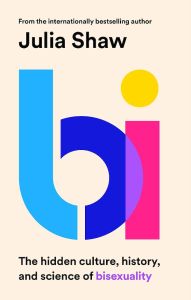 The book aims to situate bisexuality historically and scientifically. The term “bisexual” has been around since the 1890s, with the Kinsey Scale and the Klein Grid early attempts to add nuance to a binary view. Shaw delights in the fact that the mother of the Pride movement in the 1970s, Brenda Howard, was bisexual. She also learns that “being behaviourally bisexual is commonplace in the animal kingdom,” with many species engaging in “sociosexual” behaviour (i.e., for fun rather than out of reproductive instinct). It’s thought that 83% of bisexuals are closeted, mostly due to restrictive laws or norms in certain parts of the world – those seeking asylum may be forced to “prove” bisexuality, which, as we’ve already seen, is a tough ask. And bisexuals can face “double discrimination” from the queer community.
It felt odd to me that a final chapter on bisexual relationships ended up being mostly about threesomes, such that my main question (as she puts it: “what are the problems with the assumed link between bisexuality and non-monogamy?”) only merited four pages. A valuable book, certainly, but one to read for information rather than entertainment or thoughtful prose.
With thanks to Canongate for the free copy for review.
On the Scent: Unlocking the mysteries of smell – and how its loss can change your world by Paola Totaro and Robert Wainwright (2022)
Totaro (co-author Wainwright is her husband) contracted COVID-19 in March 2020 and temporarily lost the ability to smell, prompting her to embark on this investigation into a 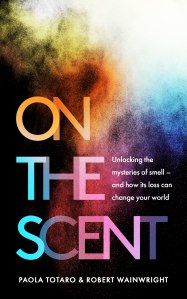 less-understood sense. One in 10,000 people have congenital anosmia, but many more than that experience it at some point in life (e.g., due to head trauma, or as an early sign of Parkinson’s disease), and awareness has shot up since it’s been acknowledged as a symptom of Covid. For some, it’s parosmia instead – smell distortions – which can almost be worse, with people reporting a constant odour of smoke or garbage, or that some of their favourite aromas, like coffee, were now smelling like faeces instead. Such was the case for Totaro.
She visits fascinating places like the Smell and Taste clinic in Dresden and the University of Reading Flavour Centre. “Sniffin’ sticks” are used to put people’s sense of smell to the test, but it’s notoriously difficult, even for those who haven’t had their senses compromised by illness, to name a smell out of context; people generally don’t score over 50%. That’s one of the major questions the book asks: why it is quite so difficult to identify smells, or describe them in words. Totaro also considers perfume-making, the associations of particular smells (bleach, pine or lemon, depending on your country) with cleanliness, and the potential for multisensory experiences, such as releasing odours during film showings. Lots of interesting topics and stories here, but not as compelling on the whole as The Smell of Fresh Rain.
With thanks to Elliott & Thompson for the proof copy for review.
Best of the 4: Black Butterflies
Would you be interested in reading one or more of these?
Lana Bastašić for WIT Month 2021 & September Reading Plans
My literature in translation statistics for 2021 have been abysmal so far, but here’s my token contribution to Women in Translation Month: Catch the Rabbit by Lana Bastašić, originally published in 2018 and translated from the Serbo-Croatian by the author herself.
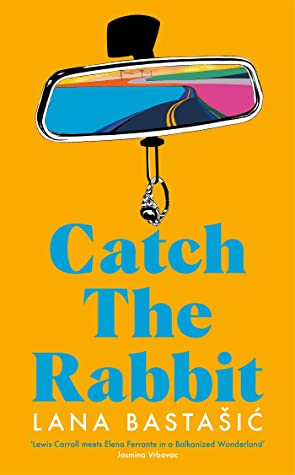 Sara has made a new life for herself in Dublin, with a boyfriend and an avocado tree. She rarely thinks about her past in Bosnia or hears her mother tongue. It’s a rude awakening, then, when she gets a phone call from her childhood best friend, Lejla Begić. Her bold, brassy pal says she needs Sara to pick her up in Mostar and drive her to Vienna to find her brother, Armin. No matter that Sara and Lejla haven’t been in contact in 12 years. But Lejla still has such a hold over Sara that she books a plane ticket right away.
Alternating chapters, with the text enclosed in brackets, dive into the friends’ past: school days, losing their virginity, and burying Lejla’s pet white rabbit, Bunny. Sara often writes as if to Lejla: “I can’t beautify those days, I can’t give them some special, big meaning. You would despise me for it. Besides, I don’t know how to write those two kids: you keep shrinking and growing in my memory, like illusive land to desperate sailors.”
In the road trip scenes, we have to shake our heads at how outrageous Lejla is: peeing in a cornfield, throwing her used tampons out the window, and orchestrating a farcical situation when she lies and tells their host that Sara only speaks English. A lovable rogue, she drives the book’s action. Indeed, Sara realizes, “both the car and I were nothing but an extension of Lejla’s will, she moved us with her words, and we followed obediently.”
This offbeat novel struck me, bizarrely, as a cross between Asylum Road and When God Was a Rabbit. I sometimes find that work in translation, particularly Eastern European, has too much quirkiness for the sake of it. That’s probably true here, and although the nostalgia element was appealing the emotional payoff wasn’t enough to satisfy me. However, I did love a late scene where Sara gazes at Albrecht Dürer’s famous Young Hare painting, and keep an eye out for how the ending connects back to the beginning.
(Simon appreciated this European Union Prize for Literature winner more than I did: his review compares the picture of asymmetrical female friendship favourably to that in Elena Ferrante’s Neapolitan Novels.)
With thanks to Picador for the free copy for review.

Did you do any special reading for Women in Translation month this year?
September Reading Plans
Each September I make a bit more of an effort to read short stories, which otherwise tend to sit on my shelves and Kindle unread. Last year I managed to read eight collections for this challenge. How many will I get to this year?! Here’s my shelf of potential reads:

I’ll reread selections from the Byatt anthology (I’ve read all of her published short story collections before and own two of them, one of which I reread last year) and will otherwise focus on books by women. I’ve had good success with Amy Bloom and Helen Simpson stories in previous years, so I’ll definitely plan to read those plus Bloodchild by Octavia E. Butler (from the university library).
Since I own THREE unread collections by Alice Munro, it’s time to tackle one, probably Dear Life since I’ve owned it the longest – it’s a review copy that arrived before her Nobel Prize win and I’ve (oops) never reviewed it. The World Does Not Require You is also a long-languishing review copy, so might be my one male-penned title.
 Bookish Beck = Rebecca Foster. American transplant to England. Freelance proofreader and book reviewer.
 Bookish Beck