Carol Shields Prize Longlist: A Council of Dolls by Mona Susan Power
my doll is a collector of tragedy … the device I use to hide from something I already know
Mona Susan Power’s fourth novel, A Council of Dolls, is an Indigenous saga that draws on her own family history. Through first-person narratives by three generations of Dakhóta and Lakhóta women, she explores the ongoing effects of trauma resulting from colonialist oppression. The journey into the past begins with Sissy, a little girl in racist 1960s Chicago with an angry, physically abusive mother, Lillian. This section sets up the book’s pattern of ascribing voice and agency to characters’ dolls. Specifically, Sissy dissociates from her own emotions and upsetting experiences by putting them onto Ethel, her Black doll. Power relies on the dramatic irony between Sissy’s childhood perspective and readers’ understanding.
Moving backward: In 1930s North Dakota, we see Lillian coping with her father’s alcohol-fuelled violence by pretending she is being directed in a play. She loses her Shirley Temple doll, Mae, in an act of charity towards a sickly girl in the community. Lillian and her sister, Blanche, attend an Indian school in Bismarck. Run by nuns, it’s even crueller than the institution their parents, Cora and Jack, attended: the infamous Carlisle Indian Industrial School in Pennsylvania (also a setting in Wandering Stars by Tommy Orange). Cora’s beautifully introspective journal from the 1910s reveals the systematic cultural annihilation that took place there. Her doll, Winona, rescued from a massacre in the time of Sitting Bull, was on the pyre of precious belongings – tribal costumes, instruments, medals, sacred feathers – burned on students’ arrival. But her stone heart survives as a totem of resilience.

This is a powerful but harrowing story. The characterization and narration are strong, and the nesting-dolls structure means we get glimpses into the future for all three protagonists. However, I was disappointed by a number of Power’s decisions. It appeared that a fourth and final narrator close to the present day would introduce another aspect, but in fact Jesse is a new name that Sissy chose for herself. Now a 50-year-old academic and writer, she becomes a medium for the dolls’ accounts – but this ends up repeating material we’d already encountered. The personification of familial tragedy in the figure of “the injured woman” who appears to Cora verges on mawkish, and the touches of magic realism to do with the dolls sit uneasily beside clinical discussions of trauma. In Jesse’s section, there is something unsubtle about how this forms the basis of a conversation between her and her friend Izzy:
(Jesse thinks) “I wanted that chance to break the chain of passing on harmful inner scripts, the self-loathing that comes from brutally effective colonization.”
(Izzy says) “whoo, that’s a big fat pipe full of misery … Our people have been pathologized from the very beginning. Still are.”
It’s possible I would have responded to this with more enthusiasm had it been packaged as a family memoir. As it is, I was unsure about the hybridization of autofiction and magic realism and wondered what white readers coming to the novel should conclude. I kept in mind Elaine Castillo’s essay “How to Read Now,” about her sense of BIPOC writers’ job: “if our stories primarily serve to educate, console and productively scold a comfortable white readership, then those stories will have failed their readers”. Perhaps Power’s novel was not primarily intended to serve in that way.
I’ll let her have the last word, via the Author’s Note: “outrageously prejudiced depictions of my ancestors and our people are one reason I became a writer. From childhood I felt an urgent need to speak my truth, which was long suppressed. Writing this book was a healing endeavor. May it support the healing of others.”
With thanks to publicist Nicole Magas and Mariner Books for the free e-copy for review.
This was a buddy read with Laura; see her review here.
Before the shortlist is announced on 9 April, I plan to review my two current reads, Cocktail by Lisa Alward and Land of Milk and Honey by C Pam Zhang, and concoct a personal wish list.
Recent Releases by Nathan Hill, Hisham Matar, Sigrid Nunez and More
One key way in which 2024’s reading has already differed from previous years’ is that I no longer avoid doorstoppers. I now classify any book with over 400 pages as a doorstopper, and by that definition I have already gotten through three this year: The Tidal Year plus two of the below, with Wellness standing out as the true whopper at 597 small-print pages. January offered a set of releases full of variety: gritty yet funny flash fiction; a novel of big ideas and big empathy for its flawed characters; an exile’s elegant love letter to Libya from London; a coy pandemic-era reflection on connection and creation; and a tour of nature close to home.
Universally Adored and Other One Dollar Stories by Elizabeth Bruce
 This was a great collection of 33 stories, all of them beginning with the words “One Dollar” and most of flash fiction length. Bruce has a knack for quickly introducing a setup and protagonist. The voice and setting vary enough that no two stories sound the same. What is the worth of a dollar? In some cases, where there’s a more contemporary frame of reference, a dollar is a sign of desperation (for the man who’s lost house, job and wife in “Little Jimmy,” for the coupon-cutting penny-pincher whose unbroken monologue makes up the whole of “Grocery List”), or maybe just enough for a small treat for a child (as in “Mouse Socks” or “Boogie Board”). In the historical stories, a dollar can buy a lot more. It’s a tank of gas – and a lesson on the evils of segregation – in “Gas Station”; it’s a huckster’s exorbitant charge for a mocked-up relic in “The Grass Jesus Walked On.”
The tone ranges from black comedy (“Festus”) to high tragedy (“Votive Candle”), but the book mostly falls within the realm of dirty realism with the attention to working-class country folk, so I’d recommend the collection to fans of authors who perch on the lighter side of that subgenre, such as Barbara Kingsolver or Denis Johnson. A few of my favorite stories, in addition to the above, were “Ice-Cold Water,” which I appreciated for the Washington D.C. setting and the way that an assumption about who would be racist was overturned by a moment of simple compassion; “Dolores,” in which a slick humanitarian fundraiser meets a waitress who has his number; and “Boiling the Buggers,” a window onto Covid-exacerbated mental illness. (Read via BookSirens)
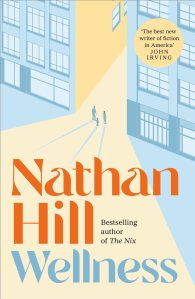
Wellness by Nathan Hill
Somehow nearly eight years have passed since Hill’s debut novel, The Nix, which I dubbed “a rich, multi-layered story about family curses and failure.” I admired it as much for its prose as for its ideas, and Wellness is just as effervescent and insightful. It’s a state-of-the-nation novel filtered through one Chicago family: experimental photographer and underperforming academic Jack; his wife Elizabeth, a placebo researcher at Wellness; and their YouTube-obsessed son Toby. They’ve recently invested their life savings in a new condo and are considering trendy features like open shelves and separate master bedrooms. It would be oversimplifying, but true, to say that this couple is experiencing midlife and marital crises. Their nineties college romance – and a time of life when everything felt open and possible – is so remote now. When Elizabeth suggests they join a friend at a swingers’ club and a patient of hers who’s also a parent at Toby’s school sees them outside, chaos ensues.
Some elements from The Nix carry over, such as campus politics, the American Midwest, and mother–son relationships, but also broader questions of authenticity, purpose and nurture. Is love itself a placebo? The novel spends time with Jack and Elizabeth at the dawn of their relationship and in the present day, but also looks back to their early careers and first years of parenthood. Hill is clearly fascinated with the sort of psychological experimentation Elizabeth engages in (there’s a whole bibliography of scientific papers consulted) but also turns it to humorous effect, as when Elizabeth subjects Toby to the marshmallow test. A lot of information is conveyed through dialogue, yet it never feels forced. A couple of long asides, on Elizabeth’s family history and the algorithms guiding Jack’s interactions with his conspiracy theorist father, tried my patience, but I loved a four-page chapter on a funeral supper where every sentence starts “There was.” Sooooo many quotable lines throughout.
The only fault in an addictive and spot-on novel (how did he know?! you’ll find yourself thinking about your own attitude to work/marriage/children) is that Hill is so committed to excavating these characters’ backstory of stunted emotion – Jack estranged from his religious Kansas farmer parents after a traumatic incident you feel right in the gut; Elizabeth glad to jettison her father’s wealth with his anger – that he hurries through the denouement. Still, this is sure to be a fiction highlight of my year. It’s one for readers of Jonathan Franzen, sure, but I also thought it reminiscent of Katherine Heiny’s Standard Deviation and Meg Wolitzer’s The Interestings.
With thanks to Picador for the proof copy for review.
My Friends by Hisham Matar
“Benghazi was the one place I longed for the most, it was also the place I most feared to return to.”
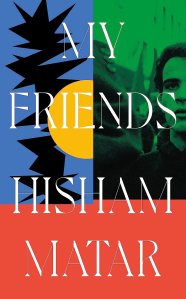 Taking a long walk through London one day, Khaled looks back from midlife on the choices he and his two best friends have made. He first came to the UK as an eighteen-year-old student at Edinburgh University. Everything that came after stemmed from one fateful day. Matar places Khaled and his university friend Mustafa at a real-life demonstration outside the Libyan embassy in London in 1984, which ended in a rain of bullets and the accidental death of a female police officer. Khaled’s physical wound is less crippling than the sense of being cut off from his homeland and his family. As he continues his literary studies and begins teaching, he decides to keep his injury a secret from them, as from nearly everyone else in his life. On a trip to Paris to support a female friend undergoing surgery, he happens to meet Hosam, a writer whose work enraptured him when he heard it on the radio back home long ago. Decades pass and the Arab Spring prompts his friends to take different paths.
I’d previously only read Matar’s short nonfiction work A Month in Siena. The slow, meditative style I enjoyed so much there didn’t translate well into doorstopper length; by the 300-page mark I found myself skimming to see if anything else might happen. Despite the title, we come to know Mustafa and Hosam much less well than we do Khaled. I would happily have had the book’s plot and sentiment concentrated into a taut 200 pages. However, I’m still interested in trying other books by Matar. In the Country of Men is significantly shorter and available from the backroom storage area of my library, and his Folio Prize-winning memoir The Return, too, is on shelf and I reckon will be right up my street.
With thanks to Viking (Penguin) for the proof copy for review.
The Vulnerables by Sigrid Nunez
I’m a huge Nunez fan after reading The Friend, What Are You Going Through, and especially A Feather on the Breath of God. Her last three books have been very much of a piece: autofiction voiced by an unnamed woman who has a duty of care towards a friend or a friend’s pet and ponders, in wry meta fashion, the nature of autobiographical writing and the meaning of life and death at a time of climate breakdown. Alas, The Vulnerables seems like no more than a rehashing of The Friend, with flanking main characters chosen at random from central casting: a parrot named Eureka and a mentally ill college drop-out called Vetch. This quirky trio is thrown together in a lavish New York City apartment during lockdown and nothing much happens but conversation brings them closer.
 A second problem: Covid-19 stories feel dated. For the first two years of the pandemic I read obsessively about it, mostly nonfiction accounts from healthcare workers or ordinary people looking for community or turning to nature in a time of collective crisis. But now when I come across it as a major element in a book, it feels like an out-of-place artefact; I’m almost embarrassed for the author: so sorry, but you missed your moment. My disappointment may primarily be because my expectations were so high. I’ve noted that two blogger friends new to Nunez were enthusiastic about this (but so was Susan, who’d enjoyed her before). That’s not to say this wasn’t a pleasantly fluid and incisive read, even if its message of essential human vulnerability is an obvious one. Anyway, I’ll take Nunez musing on familiar subjects over most other contemporary writers any day:
“Never write ‘I don’t remember,’ Editor says; it undermines your authority. But write as if you remember everything and Reader will smell a rat.”
“You can start with fiction or start with documentary, according to Jean-Luc Goddard. Either way, you will inevitably find the other.”
“I like this clarification by the narrator of a book by Stendhal: ‘It is not out of egotism that I say “I”; it is simply the quickest way to tell the story.’)”
(À propos of the doorstoppers above)
“Does that mean a long novel is easier to write than a short one? / Um, no. But, to borrow from a certain critic, in almost every long book I read I see a short one shirking its job.”
With thanks to Virago for the proof copy for review.
And a bonus work of nonfiction:
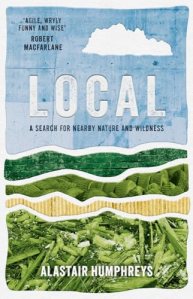
Local: A Search for Nearby Nature and Wildness by Alastair Humphreys
Lev Parikian alerted me to this amiable record of weekly discoveries of the nature on one’s home turf. Humphreys has been an international adventure traveller and written many books about his exploits. Here, by contrast, he zooms the lens in about as far as it will go, ordering a custom-made 20-km-square OS map that has his house at the centre and choosing one surrounding grid square per week (so 52 out of a total of 400) to cycle to and explore. He’s chosen to leave his town unnamed so this can function as an Everyman’s journey through edgelands. And his descriptions and black-and-white photographs really do present an accurate microcosm of modern England: fields, woods, waterways, suburban streets.
 From one November to the next, he watches the seasons advance and finds many magical spaces with everyday wonders to appreciate. “This project was already beginning to challenge my assumptions of what was beautiful or natural in the landscape,” he writes in his second week. True, he also finds distressing amounts of litter, no-access signs and evidence of environmental degradation. But curiosity is his watchword: “The more I pay attention, the more I notice. The more I notice, the more I learn.”
Each week’s observations send him down a research rabbit hole, with topics including caves, land management, mudlarking, plant species, and much more. The nature of the short chapters means that there can only ever be a cursory look at huge issues like rewilding and veganism, but Humphreys is nimble in weaving in the brief, matter-of-fact discussions. His eagerness is irrepressible. “How you look, what you see, and the way all this makes you feel: a single map and the best of all possible worlds.” (See also: Paul’s review.)
With thanks to the author for the free copy for review.
10 Days in the USA and What I Read (Plus a Book Haul)
On October 29th, I went to an evening drinks party at a neighbour’s house around the corner. A friend asked me about whether the UK or the USA is “home” and I replied that the States feels less and less like home every time I go, that the culture and politics are ever more foreign to me and the UK’s more progressive society is where I belong. I even made an offhand comment to the effect of: once my mother passed, I didn’t think I’d fly back there often, if at all. I was thinking about 5–10 years into the future; instead, a few hours after I got home from the party, we were awoken by the middle-of-the-night phone call saying my mother had suffered a nonrecoverable brain bleed. The next day she was gone.
I haven’t reflected a lot on the irony of that timing, probably because it feels like too much, but it turns out I was completely wrong: in fact, I’m now returning to the States more often. With our mom gone and our dad not really in our lives, my sister and I have gotten closer. Since October I’ve flown back twice and she’s visited here once. There are 7.5 years between us and we’ve always been at different stages of life, with separate preoccupations and priorities; I was also lazy and let my mom be the go-between, passing family news back and forth. Now there’s a sense that we are all we have, and we have to stick together.


So it was doubly important for me to be there for my sister’s graduation from nursing school last week. If we follow each other on Facebook or Instagram, you will have already seen that she finished at the top of her cohort and was one of just two students recognized for academic excellence out of the college’s over 200 graduates – and all of this while raising four children and coping with the disruption of Mom’s death seven months ago. There were many times when she thought she would have to pause or give up her studies, but she persisted and will start work as a hospice nurse soon. We’re all as proud as could be, on our mom’s behalf, too.
The trip was a mixture of celebratory moments and sad duties. We started the process of going through our mom’s belongings and culling what we can, but the files, photos and mementoes are the real challenge and had to wait for another time. There were dozens of books I’d given her for birthdays and holidays, mostly by her favourite gentle writers – Gerald Durrell, Jan Karon, Gervase Phinn – invariably annotated with her name, the date and occasion. I looked back through them and then let them go.


Between my two suitcases I managed to bring back the rest of her first box of journals (there are 150 of them in total, spanning 1989 to 2022), and I’m halfway through #4 at the moment. We moved out of my first home when I was nine, and I don’t have a lot of vivid memories of those early years. But as I read her record of everyday life it’s like I’m right back in those rooms. I get new glimpses of myself, my dad, my sister, but especially of her – not as my mother, but as a whole person. As a child I never realized she was depressed: distressed about her job situation, worried over conflicts with her siblings and my sister, coping with ill health (she was later diagnosed with fibromyalgia) and resisting ageing. For as strong as her Christian faith was, she was really struggling in ways I couldn’t appreciate then.

I hope that later journals will introduce hindsight, now that she’s not around to give a more circumspect view. In any case, they’re an incredible legacy, a chance for me to relive much of my life that I otherwise would only remember in fragments through photographs, and perhaps have a preview of what I can expect from the course of our shared kidney disease.
What I Read
 The Housekeepers by Alex Hay – A historical heist novel with shades of Downton Abbey, this comes out in July. Reviewed for Shelf Awareness.

Cowboys Are My Weakness by Pam Houston – Terrific: stark, sexy stories about women who live out West and love cowboys and hunters (as well as dogs and horses). Ten of the stories are in the first person, voiced by women in their twenties and thirties who are looking for romance and adventure and anxiously pondering motherhood (“by the time you get to be thirty, freedom has circled back on itself to mean something totally different from what it did at twenty-one”). The remaining two are in the second person, which I always enjoy. The occasional Montana setting reminded me of stories I’ve read by Maile Meloy and Maggie Shipstead, while the relationship studies made me think of Amy Bloom’s work. 

The Harpy by Megan Hunter – Read for Literary Wives club. Review coming up on Monday. 

The Lake Shore Limited by Sue Miller – A solid set of narratives alternating between the POVs of four characters whose lives converge around a play inspired by the playwright’s loss of her boyfriend on one of the hijacked planes on 9/11. Her mixed feelings about him towards the end of his life and about being shackled to his legacy as his ‘widow’ reverberate in other sections: one about the lead actor, whose wife has ALS; and one about a widower the playwright is being set up with on a date. Fitting for a book about a play, the scenes feel very visual. A little underpowered, but subtlety is to be expected from a Miller novel. She, Anne Tyler and Elizabeth Berg write easy reads with substance, just the kind of book I want to take on an airplane, as indeed I did with this one. I read the first 2/3 on my travel day (although with the 9/11 theme this maybe wasn’t the best choice!).
 For apposite plane reading, I also started Fly Girl by Ann Hood, her memoir of being a TWA flight attendant in the 1970s, the waning glory days of air travel. I’ve read 10 or so of Hood’s books before from various genres, but lost interest in the minutiae of her job applications and interviews. Another writer would probably have made a bigger deal of the inherent sexism of the profession, too. I read 30%.
 Hello Beautiful by Ann Napolitano – I knew I wanted to read this even before it was Oprah’s 100th book club pick. It’s a family story spanning three decades and focusing on the Padavanos, a working-class Italian American Chicago clan with four daughters: Julia, Sylvie, and twins Cecilia and Emeline. Julia meets melancholy basketball player William Waters while at Northwestern in the late 1970s and they marry and have a daughter; Sylvie, a budding librarian, makes out with boys in the stacks until her great romance comes along; Cecilia is an artist and Emeline loves babies and manages a nursery. More than once a character think of their collective story as a “soap opera,” and there’s plenty of melodrama here – an out-of-wedlock pregnancy, estrangements, a suicide attempt, a coming out, stealing another’s man – as well as far-fetched coincidences, including the two major deaths falling on the same day as a birth and a reconciliation.
There is such warmth and intensity to the telling, and brave reckoning with mental illness, prejudice and trauma, that I excused flaws such as dwelling overly much in characters’ heads through close third person narration, to the detriment of scenes and dialogue. I love sister stories in general, and the subtle echoes of Leaves of Grass and Little Women (the connections aren’t one to one and you’re kept guessing for most of the book who will be the Beth) add heft. I especially appreciated how a late parent is still remembered in daily life after 30 years have passed. This is, believe it or not, the second basketball novel I’ve loved this year, after Tell the Rest by Lucy Jane Bledsoe.
I always try to choose thematically appropriate reads, so I also started:
 Circling My Mother by Mary Gordon – A memoir she began after her nonagenarian mother’s death with dementia. Intriguingly, the structure is not chronological but topic by topic, built around key relationships: so far I’ve read “My Mother and Her Bosses” and “My Mother: Words and Music.”
Grave by Allison C. Meier – My sister and I made a day trip up to my mother’s grave for the first time since her burial. She has a beautiful spot in a rural cemetery dating back to the 1780s, but it’s in full sun and very dry, so we tried to cheer up the dusty plot with some extra topsoil and grass seed, marigolds, and a butterfly flag.


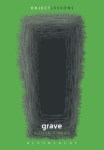 Meier is a cemetery tour guide in Brooklyn, where she lives. In the third of the e-book I’ve read so far, she looks at American burial customs, the lack of respect for Black and Native American burial sites, and the rise of garden cemeteries such as Mount Auburn in Cambridge, Massachusetts. I’ve been reading death-themed books for over a decade and have delighted in exploring cemeteries (including Mount Auburn, as part of my New England honeymoon) for even longer, so this is right up my street and one of the better Object Lessons monographs.
What I Bought
I traded in most of my mother’s books at 2nd & Charles and Wonder Book and Video but, no surprise, promptly spent the store credit on more secondhand books. Thanks to clearance shelves at both stores, I only had to chip in another $12.25 for the below haul, which also covered two Dollar Tree purchases (I felt bad for Susan Minot having signed editions end up remaindered!). Some tried and true authors here, as well as novelties to test out, with a bunch of short stories and novellas to read later in the year.


The #1929Club: Passing and Letters to a Young Poet
A year club hosted by Karen and Simon is always a great excuse to read more classics. I appear to be getting in training for Novellas in November – both of these were notably short at under 100 pages, particularly the Rilke, which is little more than a pamphlet. (Both: )

Passing by Nella Larsen
By the time of her death in 1964, this Harlem Renaissance author had mostly fallen into obscurity, but she has received renewed attention in recent decades. I learned about Passing in connection to Brit Bennett’s The Vanishing Half, which it partially inspired.
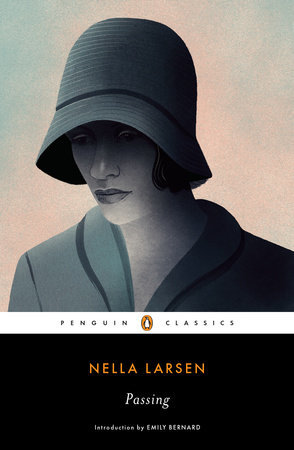 Irene Redfield and Clare Kendry grew up together in Chicago. Both are light-skinned African American women, their features described as “olive” or “golden.” Irene has remained within the Black community, marrying a doctor named Brian and living a comfortable life in Harlem. However, she is able to pass as white in certain circumstances, such as when she and Clare meet for tea in a high-end establishment. Clare, on the other hand, is hiding her ancestry from her white husband, Jack Bellew, who spews hatred for Black people. “It’s such a frightfully easy thing to do. If one’s the type, all that’s needed is a little nerve,” she insists.
Clare and Irene’s relationship could be characterized as that of frenemies, though critics have posited repressed homoeroticism based on how Larsen describes Clare’s beauty from Irene’s perspective. This is very subtle – I only spotted potential infatuation in the letter from Clare that Irene reads in the opening pages. Most of the time, Irene appears to disapprove of Clare for her recklessness, knowing that there could be dire consequences if Jack discovers her deception. She also starts to suspect that Clare is having an affair with Brian, and for these reasons, as well as her own discomfort and guilt, she avoids Clare as much as possible.
The trouble with Clare was, not only that she wanted to have her cake and eat it too, but that she wanted to nibble at the cakes of other folk as well.
Things come to a head in the final six pages, turning what had for much of its length been an ambling read into something of a shocker. Apparently scholars feel that Larsen flubs her endings, but I thought this one was fantastic, giving a Gatsby-esque tragic weight. Comparing Black women’s strategies of coping with a white world was also fascinating. My experience with African American classics is limited, so I was happy to increase my repertoire.
My secondhand copy – a dual volume with Quicksand, which I’ll plan on reading next November – came from the much-mourned Bookbarn International.
Letters to a Young Poet by Rainer Maria Rilke
[Translated from the German by Charlie Louth]
 I’d long wanted to read this and couldn’t find it through a library, so bought a copy as part of a Foyles order funded by last year’s Christmas money. I’m not clear on whether the Penguin Little Black Classics edition is abridged, but the 1929 preface by Franz Xaver Kappus, Rilke’s correspondent, only mentions 10 letters, which is how many are printed here, so I have at least gotten the gist. Most of the letters were sent in 1903–4, with a final one dated 1908, from various locations on Rilke’s European travels.
Kappus sent Rilke his early poetic efforts and received in reply a frank letdown – “the poems are not yet anything in themselves” – but also much kind, general advice about creativity, confidence, post-faith life, and thriving in spite of suffering. Even so tiny a book is almost endlessly quotable, with many self-help-oriented phrases I’d read in other contexts and found wonderfully reassuring:
Go into yourself. Examine the reason that bids you to write; check whether it reaches its roots into the deepest region of your heart, admit to yourself whether you would die if it should be denied you to write.
To be an artist means: not to calculate and count; to grow and ripen like a tree which does not hurry the flow of its sap and stands at ease in the spring gales without fearing that no summer may follow. But it comes only to those who are patient, who are simply there in their vast, quiet tranquillity, as if eternity lay before them.
be patient towards all that is unresolved in your heart and … try to love the questions themselves
I also got this 1929 autobiography out from the library. While I much admire the tone in the first paragraph and final pages (especially that last word!), I find I don’t have enough interest in the WWI poets to read what’s in between. It put a Sufjan Stevens song in my head, though.


I’ve previously participated in: 1920 Club, 1956 Club, 1936 Club, 1976 Club and 1954 Club.
Short Stories in September, Part II: Andreades, Ferris, Fliss and Mulvey
It’s my aim to read as many short story collections as possible in September. After a first three earlier in the month, here are my next four.
Brown Girls by Daphne Palasi Andreades (2022)
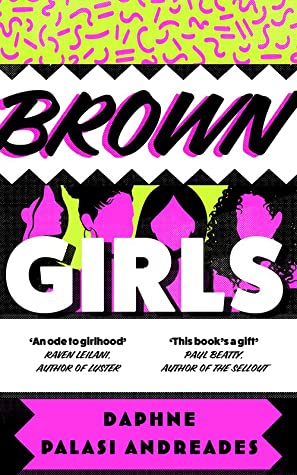 It was Susan’s review that first enticed me to read this linked story collection. I’m always intrigued by the use of the first-person plural, though it can have downsides – in trying to be inclusive of the breadth of experiences of the “us,” the content can edge toward generic. I worried things were going that way in the early chapters about girlhood “in the dregs of Queens, New York,” but the more I read the more I admired Andreades’s debut. Each chapter is a fantastic thematic fragment adding up to a glistening mosaic of what it means to be a woman of colour in the USA. Desires and ambitions shift as they move from childhood to adolescence to college years to young adulthood, but some things stay the same: their parents’ high expectations, the pull of various cultures, and near-daily microaggressions.
Our families’ legacies, the histories we’ve inherited: grandparents who never learned to read, U.S.-backed dictatorships, bombs, wars, refugee camps, naval bases, canals, gold, diamonds, oil, missionaries, brain drain, the American Dream.
No matter their zip code or tax bracket, listen as these white people deem us and our families the good immigrants, the hard-working ones—not like the lazy people in this country who are a burden on the system.
The fulcrum is the sudden death of one of their number, Trish, which has repercussions through the second half of the book. It raises questions of mental health and whether friendships will last even when they move beyond Queens.
I especially loved Part Five, about a trip back to the motherland that leaves the brown girls disoriented from simultaneous sensations of connection, privilege and foreignness. “The colonized, the colonizer. Where do we fall?” My individual favourite chapters were “Duty,” about giving up on parentally prescribed medical studies to pursue a passion for art; “Patriotic,” about deciding whether or not to have children; and “Our Not-Reflections,” about age allowing them to understand what their mothers went through when they were new to the country. One critique: I would have omitted the final Part Eight, which is about Covid and death in general; the book didn’t need an update to feel timely. It’s a shame this wasn’t at least longlisted for the Women’s Prize this past year. (New purchase with a book token)
The Dinner Party by Joshua Ferris (2017)
 I’ve read a couple of Ferris’s novels but this collection had passed me by. “More Abandon (Or Whatever Happened to Joe Pope?)” is set in the same office building as Then We Came to the End. Most of the entries take place in New York City or Chicago, with “Life in the Heart of the Dead” standing out for its Prague setting. The title story, which opens the book, sets the tone: bristly, gloomy, urbane, a little bit absurd. A couple are expecting their friends to arrive for dinner any moment, but the evening wears away and they never turn up. The husband decides to go over there and give them a piece of his mind, only to find that they’re hosting their own party. The betrayal only draws attention to the underlying unrest in the original couple’s marriage. “Why do I have this life?” the wife asks towards the close.
Marital discontent and/or infidelity is a recurring feature, showing up in “A Night Out” and “The Breeze,” which presents the different ways a couple’s evening might have gone. I liked this line about the difficulty of overcoming incompatibilities: “Why could she not be more like him and why could he not be more like her?” It seems from my short story reading that there is always one story I would give a different title. Here I would rename “The Valetudinarian” (about a Florida retiree who ends up in a comical health crisis) “They don’t give you a manual” after his repeated catchphrase.
A few of the 11 stories weren’t so memorable, but the collection ends with a bang. “A Fair Price” appears to have a typically feeble male protagonist, frustrated that the man he’s hired to help move his belongings out of a storage unit is so taciturn, but the innocuous setup hides a horrific potential. (Public library)
The Predatory Animal Ball by Jennifer Fliss (2021)
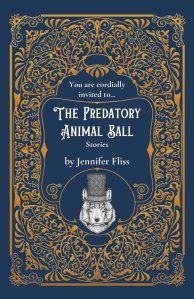 These 40 flash fiction stories try on a dizzying array of genres and situations. They vary in length from a paragraph (e.g., “Pigeons”) to 5–8 pages, and range from historical to dystopian. A couple of stories are in the second person (“Dandelions” was a standout) and a few in the first-person plural. Some have unusual POV characters. “A Greater Folly Is Hard to Imagine,” whose name comes from a William Morris letter, seems like a riff on “The Yellow Wallpaper,” but with the very wall décor to blame. “Degrees” and “The Thick Green Ribbon” are terrifying/amazing for how quickly things go from fine to apocalyptically bad.
Grief and especially pregnancy loss are repeated elements. In “Yolk,” a woman finds a chicken embryo inside a cracked egg and it brings back memories of her recent stillbirth. In “All Your Household Needs,” a bereaved voice-over artist sympathizes with a child who picks up a stuffed Lucky the Dog whose speech she recorded. In “What Goes with Us,” an unreturned library book is a treasured reminder of a dead partner; “May His Memory Be a Blessing” lists many other such mementoes. Even the title story, whose main character is a mouse, opens with the loss of a loved one and posits compassion from an unexpected source.
It’s hard to get a sense of an author’s overall style from such disparate material, so I was pleased to learn that Fliss is working on her first novel, which I’ll be keen to read.
With thanks to publicist Lori Hettler for the e-copy for review.
Hearts & Bones: Love Songs for Late Youth by Niamh Mulvey (2022)
 Having read these 10 stories over the course of a few months, I now struggle to remember what many of them were about. If there’s an overarching theme, it’s (young) women’s relationships. “My First Marina,” about a teenager discovering her sexual power and the potential danger of peer pressure in a friendship, is similar to the title story of Milk Blood Heat by Dantiel W. Moniz. In “Mother’s Day,” a woman hopes that a pregnancy will prompt a reconciliation between her and her estranged mother. In “Childcare,” a girl and her grandmother join forces against the mum/daughter, a would-be actress. “Currency” is in the second person, with the rest fairly equally split between first and third person. “The Doll” is an odd one about a ventriloquist’s dummy and repeats events from three perspectives.
I had two favourites: “Feathers” and “Good for You, Cecilia.” In the former, a woman rethinks her relationship with her boyfriend when the 2010 volcanic eruption restricts her to his French flat and she gets chatting with his cleaner. In the latter, a mother and daughter go to watch their daughter/sister’s dance recital in Dublin and witness the fall of a statue of St. Cecilia in a church they stop into. These are all matter-of-fact, somewhat detached stories set in European cities over the last decade or so. None of the protagonists had me particularly emotionally engaged with their plights. Overall, this felt reminiscent of Wendy Erskine’s work (I’ve reviewed Dance Move), but not as original or powerful.
With thanks to Picador for the proof copy for review.
Currently reading: Ms. Hempel Chronicles by Sarah Shun-lien Bynum, Delicate Edible Birds by Lauren Groff, Playing Sardines by Michèle Roberts
Up next: The High Places by Fiona McFarlane, Birds of America by Lorrie Moore
Six Degrees of Separation: From Sorrow and Bliss to Weather
This month we begin with Sorrow and Bliss by Meg Mason. (See also Kate’s opening post.) This is my personal favourite from the Women’s Prize shortlist and couldn’t be a better pick for the Six Degrees starter this month because I’ll be skimming back through the novel this weekend in advance of my book club’s discussion of it on Monday. (We’re one of this year’s six book groups shadowing the Women’s Prize through a Reading Agency initiative, so we then have to give semi-official feedback on our experience of the book by Wednesday.)

 #1 Sorrow and Bliss is a terrific tragicomedy about sisterhood and mental health – as is All My Puny Sorrows by Miriam Toews, with which it shares a loaded title word as well.
 #2 Toews grew up in a Canadian Mennonite community, which leads me to my second choice, Mennonite in a Little Black Dress by Rhoda Janzen, a set of droll autobiographical essays that I read on a USA trip in 2017.
 #3 During the same trip, I read Dear American Airlines by Jonathan Miles, a witty novel about Bennie Ford’s rather miserable life, presented in the form of his longwinded complaint letter to the airline that has treated him to an unexpected overnight layover in Chicago.
 #4 Another laugh-out-loud book in the form of unlikely letters: Dear Committee Members by Julie Schumacher, in which Jason Fitger, an irascible middle-aged English professor in the Midwest, writes ambivalent letters of recommendation for students and colleagues.
 #5 One more “Dear” book of letters – I just can’t get enough of the epistolary form: Dear Fahrenheit 451 by Annie Spence. As the subtitle states, it’s a librarian’s love letters and breakup notes to books she’s adored and loathed. Casual and amusing, with good book recs.
 #6 I’ll finish with Weather by Jenny Offill, one of my favourites from 2020, which is also voiced by a librarian. Through Lizzie, Offill captures modern anxiety about Trump-era politics, the climate crisis and making meaningful use of time.
I have read all the books in this month’s chain (the links above are to my Goodreads reviews), and in a time of relentless bad news have chosen to prioritize humour and keep my descriptions short and light. These are all books that made me laugh, sometimes despite their weighty content, and half of them are built around letters. I’ve also looped from one Women’s Prize-shortlisted title to another.
Where will your chain take you? Join us for #6Degrees of Separation! (Hosted on the first Saturday of each month by Kate W. of Books Are My Favourite and Best.) Next month’s starting point will be Wintering by Katherine May – though it’s summer here, it’s winter where Kate is in Australia!
Have you read any of my selections? Tempted by any you didn’t know before?
Love Your Library, November 2021
It’s the second month of the new Love Your Library feature.

I’d like to start out by thanking all those who have taken part since last month’s post:
Adrian shared lovely stories about the libraries he’s used in Ireland, from childhood onwards.
Laila, Lori and Margaret highlighted their recent loans and reads.
Laura sent a photo of her shiny new library copy of Sally Rooney’s latest novel.

Finally, Marcie contributed this TikTok video of her library stacks!
As for my recent library experiences…
A stand-out read:
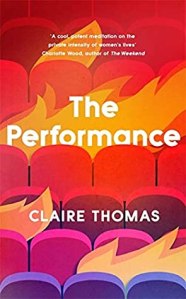 The Performance by Claire Thomas: What a terrific setup: three women are in a Melbourne theatre watching a performance of Samuel Beckett’s Happy Days. Margot is a veteran professor whose husband is developing dementia. Ivy is a new mother whose wealth hardly makes up for the devastating losses of her earlier life. Summer is a mixed-race usher concerned about her girlfriend during the fires rampaging outside the city. In rotating close third person sections, Thomas takes us into these characters’ inner worlds, contrasting their personal worries with wider issues of women’s and indigenous people’s rights and the environmental crisis, as well as with the increasingly claustrophobic scene on stage. In “The Interval,” written as a script, the main characters interact with each other, with the “forced intimacy between strangers” creating opportunities for chance meetings and fateful decisions.
Doorstoppers: A problem
Aware that I’m heading to the States for Christmas on the 14th of December (only a couple of weeks from now!), I’ve started culling my library stacks, returning any books that I’m not super-keen to read before the end of the year. A few I’ll borrow another time, but most I decided weren’t actually for me, even if raved about elsewhere.
I mentioned in a post last week that I’ve had a hard time finding the concentration for doorstoppers lately, which is ironic giving how many high-profile ones there have been this year – or even just this autumn. (For example, seven of BookPage’s top 20 fiction releases of 2021 are over 450 pages.) I gave up twice on Great Circle by Maggie Shipstead, swiftly abandoned Cloud Cuckoo Land by Anthony Doerr (a silly bookish attempt at something like Cloud Atlas), didn’t have time to attempt Tenderness by Alison Macleod and The Magician by Colm Tóibín, and recently returned The Morning Star by Karl Ove Knausgaard unread.
Why so many chunky reads this year, and this season in particular? I’ve wondered if it has had something to do with the lockdown mentality – for authors or readers, or both. It can be awfully cozy, especially as winter advances (in this hemisphere), to sink into a big book. But I find that I’m always looking for an excuse to not engage with a doorstopper.
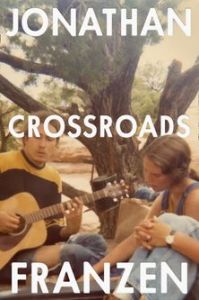 I generally enjoy the scope, detail and moral commentary of Jonathan Franzen’s novels; his previous two, Freedom and Purity, which also numbered 500+ pages, were fantastic. But Crossroads wasn’t happening for me, at least not right now. I only got to page 23 on this attempt. The Chicago setting was promising, and I’m there for the doubt and hypocrisy of church-bound characters. But with text this dense, it feels like it takes SO MANY WORDS to convey just one scene or conversation. I was finding the prose a little obnoxious, too, e.g.
Of Santa the Hildebrandts had always said, Bah, humbug. And yet somehow, long past the age of understanding that presents don’t just buy and wrap themselves, he’d accepted their sudden annual appearance as, if not a miraculous provision, then a phenomenon like his bladder filling with urine, part of the normal course of things. How had he not grasped at nine a truth so obvious to him at ten? The epistemological disjunction was absolute.
Problems here: How many extra words do you need to say “He stopped believing in Santa at age 10”? When is the phrase “epistemological disjunction” ever anything other than showing off? And why did micturition present itself as an apt metaphor?
But anyway, I’ve hardly given this a fair shake yet. I daresay I’ll read it another time; it’ll be my eighth book by Franzen.
Do share a link to your own post in the comments, and feel free to use the above image. I’ve co-opted a hashtag that is already popular on Twitter and Instagram: #LoveYourLibrary.
Here’s a reminder of my ideas of what you might choose to post (this list will stay up on the project page):
- Photos or a list of your latest library book haul
- An account of a visit to a new-to-you library
- Full-length or mini reviews of some recent library reads
- A description of a particular feature of your local library
- A screenshot of the state of play of your online account
- An opinion piece about library policies (e.g. Covid procedures or fines amnesties)
- A write-up of a library event you attended, such as an author reading or book club.
If it’s related to libraries, I want to hear about it!
Barbellion Prize Shortlist: Golem Girl by Riva Lehrer
Three memoirs remain on the shortlist; three windows onto living with disability or caring for a relative with an incapacitating mental illness.
First up is a visual artist’s account of growing up with spina bifida, entering Disabled culture, and forming a collaborative style all her own.
Golem Girl: A Memoir by Riva Lehrer (2020)
“My first monster story was Frankenstein,” Lehrer writes. Like Dr. Frankenstein’s creation or the Golem of medieval Jewish legend, she felt like a physical monstrosity in search of an animating purpose. Born with spina bifida, she spent much of her first two years in Cincinnati Children’s Hospital and would endure dozens of surgeries in years to come to repair her spine and urinary tract and attempt to make her legs the same length. In 1958, when she was born, 90% of children with her condition died before age two. Lehrer’s mother, Carole, who grew up in a family pharmacy business and had worked as a medical researcher, was her daughter’s dogged health advocate. Carole fought for Riva even though she was caught up in her own chronic pain after a botched back surgery that left her addicted to painkillers.
Lehrer went to a special school for the disabled in Ohio. It was racially integrated (rare at that time) and offered children physical therapy and normal experiences like Girl Scouts and day camp. But it was clear the teachers didn’t expect these children to achieve anything or have a family life; home ec classes just taught how to wash up from a wheelchair and make meals for one. One horrible day, a substitute teacher locked a classroom door and hectored the children, saying their parents must have drunk and fornicated and they were the wages of sin.
Between the routine or emergency surgeries and family heartaches, Lehrer grew up to attend art school at the University of Cincinnati and Art Institute of Chicago. Professors (most of them male) found her work grotesque and self-indulgent, and she struggled with how to depict her body. There were boyfriends and girlfriends, even a wife (though in the late 1980s, before same-sex marriage was legally recognized). In 1996 she joined the Chicago Disabled Artists Collective and it was a revelation. She learned that Disabled (like Deaf) is a cultural identity as much as a physical reality, adopted vocabulary like crip (a reclaimed term, like queer) and ableism, and began painting fellow artists with dwarfism, prostheses, or wheelchairs.

Becoming a member of the Medical Humanities faculty as well as a visiting artist at two Chicago universities, the School of the Art Institute and Northwestern, gave Lehrer access to Gross Anatomy Labs, where she found in the historical collections – just as she had at the Mütter Museum of medical curiosities in Philadelphia – a fetus in a jar with her very condition. Knowing that she might be the first Disabled person her budding doctors met, she was determined to give them an “inclusive vision” of “the reality of human divergence.” She would have the medical students draw one of the jarred specimens, not as an oddity but as an individual, and give a 15-minute presentation about someone who lives with that disability.
Golem Girl is a touching family memoir delivered in short, essay-like chapters, most of them named after books or films. It is also a primer in Disability theory and – what truly lifts it above the pack – a miniature art gallery, with reproductions of paintings from various of Lehrer’s series as well as self-portraits, family portraits, and photographs. “I fiercely wanted to see a gallery filled with portraits of luminous crips,” she writes; “I suspected I was going to have to make them myself.” And that is just what she has done. The “Circle Stories” featured the Chicago Disabled Artists Collective and “Mirror Shards” included animal daimons, while “The Risk Pictures” of some of her personal heroes were daringly collaborative: she would give the subject an hour alone in her studio with their portrait in progress and allow them to amend it as they wished. Much of her work has bright colors and involves anatomical realism and symbols personal to herself and/or the subject – with Frida Kahlo an acknowledged influence.
I’ve now (just about) read the whole Barbellion Prize shortlist. For how it illuminates a life of being different – through queerness in addition to disability, engages with the academic fields of anatomy and Disability studies, and showcases the achievements of Disabled artists, this would be my clear winner of the inaugural award, with Sanatorium my backup choice. It is also a finalist for the National Book Critics Circle Award for Autobiography.
Readalikes I have also reviewed:
- Constellations by Sinéad Gleeson
- I Am, I Am, I Am by Maggie O’Farrell
Favorite lines:
“The hospital demands surrender. You accept the piercing, the cutting, the swallowing of noxious chemicals. You roll over and stand up even when it’s as impossible as flying around the ceiling. Whoever has authority can remove your clothes and display your stitched-up monster body to crowds of young white-coated men. You’re an assemblage of parts that lack gender and those elusive things called feelings.”
“‘Normal’ beauty is unmarked, smooth, shiny, upright; but my gaze began to slip past normal beauty as if it was coated in baby oil. I wanted crip beauty—variant, iconoclastic, unpredictable. Bodies that were lived in with intentionality and self-knowledge. Crip bodies were fresh.”
With thanks to Virago for the free copy for review.
See my introductory post for more about the Barbellion Prize, which is in its first year and will be awarded on Friday “to an author whose work has best represented the experience of chronic illness and/or disability.”
I will review the final two on the shortlist, The Fragments of My Father by Sam Mills and Kika & Me by Amit Patel, tomorrow.
A Look Back at 2020’s Reading Projects, Including Rereads
Major bookish initiatives:
- Coordinated a Not the Wellcome Prize blog tour to celebrate 2019’s health-themed books – in case you missed it, the winner was Sinéad Gleeson for Constellations.
- Co-hosted Novellas in November with Cathy (746 Books).
- Hosted Library Checkout each month.


Reading challenges joined:
- 12 blog tours
- Six Degrees of Separation: I started participating in February and did nine posts this year
- Paul Auster Reading Week
- Reading Ireland month
- Japanese Literature Challenge
- 1920 Club
- 20 Books of Summer
- Women in Translation Month
- Robertson Davies Weekend
- Women’s Prize winners (#ReadingWomen)
- 1956 Club
- R.I.P.
- Nonfiction November
- Margaret Atwood Reading Month
This works out to one blog tour, one reading project, and one regular meme per month – manageable. I’ll probably cut back on blog tours next year, though; unless for a new release I’m really very excited about, they’re often not worth it.


Buddy reads:
 Crossing to Safety with Laila (Big Reading Life)
- 6 Carol Shields novels plus The Trick Is to Keep Breathing, Deerbrook, and How to Be Both with Marcie (Buried in Print)
- A Visit from the Goon Squad and The Idea of Perfection with Laura T.
- Mother’s Milk with Annabel
- 666 Charing Cross Road with Liz
Self-set reading challenges:
- Seasonal reading
- Classic of the Month (14 in total; it’s only thanks to Novellas in November that I averaged more than one a month)
- Doorstopper of the Month (just 3; I’d like to try to get closer to monthly in 2021)
- Wainwright Prize longlist reading
- Bellwether Prize winners (read 2, DNFed 1)
- Short stories in September (8 collections)
- Young Writer of the Year Award shortlist reading
- Thematic roundups – I’m now calling these “Three on a Theme” and have done 2 so far
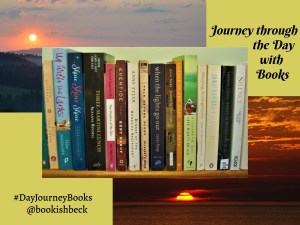
- Journey through the Day with Books (3 new reviews this year):
- Zennor in Darkness by Helen Dunmore
 Rise and Shine by Anna Quindlen
- [Up with the Larks by Tessa Hainsworth – DNF]
- [Shine Shine Shine by Lydia Netzer – DNF]
- Three-Martini Lunch by Suzanne Rindell – existing review
- The Shadow of the Sun by Ryszard Kapuściński – read part of
- Eventide by Kent Haruf
- Dinner at the Homesick Restaurant by Anne Tyler – existing review
- Talk before Sleep by Elizabeth Berg – existing review
- When the Lights Go Out by Carys Bray
- Journey by Moonlight by Antal Szerb
- Voyage in the Dark by Jean Rhys
- Late Nights on Air by Elizabeth Hay – existing review
- Sleeping Arrangements by Laura Shaine Cunningham
- The House of Sleep by Jonathan Coe
- Bodies in Motion and at Rest by Thomas Lynch – read but not reviewed
- Silence by Shūsaku Endō
- Arctic Dreams by Barry Lopez – read part of
- The Four in a Row Challenge – I failed miserably with this one. I started an M set but got bogged down in Tales of the City by Armistead Maupin (also a bibliotherapy self-prescription for Loneliness from The Novel Cure), which I had as a bedside book for much of the year, so only managed 1.5 out of 4; I also started an H quartet but set both Tinkers and Plainsong aside. Meanwhile, Debbie joined in and completed her own 4 in a Row. Well done! I like how simple this challenge is, so I’m going to use it next year as an excuse to read more from my shelves – but I’ll be more flexible and allow lots of substitutions in case I stall with one of the four books.

Rereading
At the end of 2019, I picked out a whole shelf’s worth of books I’d been meaning to reread. I kept adding options over the year, so although I managed a respectable 16 rereads in 2020, the shelf is still overflowing!

Many of my rereads have featured on the blog over the year, but here are two more I didn’t review at the time. Both were book club selections inspired by the Black Lives Matter movement. (We held a rally and silent protest in a park in the town centre in June.)
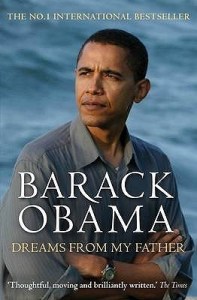 Dreams from My Father by Barack Obama: Remember when there was a U.S. president who thought deeply, searched his soul, and wrote eloquently? I first read this memoir in 2006, when Obama was an up-and-coming Democratic politician who’d given a rousing convention speech. I remembered no details, just the general sweep of Hawaii to Chicago to Kenya. On this reread I engaged most with the first third, in which he remembers a childhood in Hawaii and Indonesia, gives pen portraits of his white mother and absentee Kenyan father, and works out what it means to be black and Christian in America. By age 12, he’d stopped advertising his mother’s race, not wanting to ingratiate himself with white people. By contrast, “To be black was to be the beneficiary of a great inheritance, a special destiny, glorious burdens that only we were strong enough to bear.” The long middle section on community organizing in Chicago nearly did me in; I had to skim past it to get to his trip to Kenya to meet his paternal relatives – “Africa had become an idea more than an actual place, a new promised land”.
 The Immortal Life of Henrietta Lacks by Rebecca Skloot: This Wellcome Book Prize winner about the use of a poor African-American woman’s cells in medical research was one of the first books to turn me onto health-themed reads. I devoured it in a few days in 2010. Once again, I was impressed at the balance between popular science and social history. Skloot conveys the basics of cell biology in a way accessible to laypeople, and uses recreated scenes and dialogue very effectively. I had forgotten the sobering details of the Lacks family experience, including incest, abuse, and STDs. Henrietta had a rural Virginia upbringing and had a child by her first cousin at age 14. At 31 she would be dead of cervical cancer, but the tissue taken from her at Baltimore’s Johns Hopkins hospital became an immortal cell line. HeLa is still commonly used in medical experimentation. Consent was a major talking point at our book club Zoom meeting. Cells, once outside a body, cannot be owned, but it looks like exploitation that Henrietta’s descendants are so limited by their race and poverty. I had forgotten how Skloot’s relationship and travels with Henrietta’s unstable daughter, Deborah, takes over the book (as in the film). While I felt a little uncomfortable with how various family members are portrayed as unhinged, I still thought this was a great read.
  then / now
 I had some surprising rereading DNFs. These were once favorites of mine, but for some reason I wasn’t able to recapture the magic: Middlesex by Jeffrey Eugenides, Everything Is Illuminated by Jonathan Safran Foer, Gilead by Marilynne Robinson, and On Beauty by Zadie Smith. I attempted a second read of John Fowles’s postmodern Victorian pastiche, The French Lieutenant’s Woman, on a mini-break in Lyme Regis, happily reading the first third on location, but I couldn’t make myself finish once we were back home. And A Visit from the Goon Squad by Jennifer Egan was very disappointing a second time; it hasn’t aged well. Lastly, I’ve been stalled in Watership Down for a long time, but do intend to finish my reread.
In general, voice- and style-heavy fiction did not work so well for me on rereading. Autobiographical essays by Anne Lamott and Abigail Thomas worked best, but I also succeeded at rereading some straightforward novels and short stories. Next year, I’d like to aim for a similar number of rereads, with a mixture of memoirs and fiction, including at least one novel by David Lodge. I’d also be interested in rereading earlier books by Ned Beauman and Curtis Sittenfeld if I can find them cheap secondhand.
What reading projects did you participate in this year?
Done much rereading lately?
Two Bellwether Prize Winners by Heidi Durrow and Hillary Jordan
I conceived of the idea to read all of the Bellwether Prize winners because I loved Lisa Ko’s The Leavers so much. The PEN/Bellwether Prize for Socially Engaged Fiction is a biennial award given since 2000 by PEN America and Barbara Kingsolver, who created and funds the prize, “to a U.S. citizen for a previously unpublished work of fiction that addresses issues of social justice.” (More information can be found here.) Earlier this year, I found secondhand or cheap new copies of two of the winners and tried another one from the library.
The Girl Who Fell from the Sky by Heidi W. Durrow (2010)
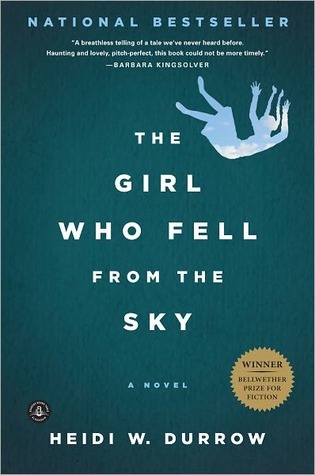 This review is ALL SPOILER because there isn’t really a way to discuss the book otherwise, so skip onwards if you think you might want to read this someday. Durrow was inspired by her own family history – she is biracial, her father a Black serviceman and her mother from Denmark – and by a newspaper story about a woman who jumped off the top of a multi-story building with her small children. Only one daughter survived the fall. Durrow was captivated by that girl’s story and wanted to imagine what her life would be like in the wake of tragedy.
In 1982, Rachel has come to live with her father’s mother in Portland, Oregon. She’s starting a new life there after a long time in the hospital. She survived her mother Nella’s leap from their Chicago apartment building because she landed on the top of the heap of three siblings. As her teen years unfold, she struggles to incorporate her European heritage with her African American identity and turns to promiscuity. Details of what happened that day in Chicago unfold gradually.
The secondary characters are more interesting than Rachel herself, even though she narrates, and I felt more sympathy for her when she was a child. I would have liked more of the mother’s journal entries, showing how her depression and alcoholism developed. The coincidence of the one eyewitness to the jump ending up in Portland was too much for me. Overall, this was fairly dismal and didn’t make enough of its compelling premise. It was an easy read, but had it been much longer than 260 pages I would likely have DNFed.
My rating: 
Mudbound by Hillary Jordan (2008)
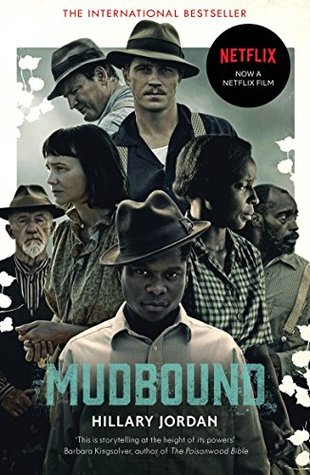 1946: Two servicemen return from fighting in Europe, headed to the same Mississippi farm. Jamie McAllan was a fighter pilot and Ronsel Jackson was part of a tank division. Both are dependent on alcohol to help them cope with the memories of what they have seen and done. But Jamie can get away with drunk driving and carousing with local women, knowing that his big brother, Henry, will take him back in no matter what. Ronsel, though, has to keep his head down and be on his guard at every moment: war hero or not, no one in Mississippi is going to let a Black man walk in through the front door of a store or get a lift home in a white man’s truck. His sharecropping family’s position at the McAllan farm, Mudbound, is precarious, with the weather and the social hierarchy always working against them.
This story of love, betrayal, and the obsession with land is told through rotating first-person narration from six key players, three McAllans and three Jacksons. Each voice is distinct and perfectly captures the character’s personality and level of education. Jordan uses this kaleidoscope view to explore how fateful decisions bind the two families together. I particularly loved the two female voices: Laura, Henry’s wife; and Florence, Ronsel’s mother. Though they’re often stuck inside cooking and delivering babies, they still play their roles in the farm’s drama. The novel opens with a burial scene, but readers get faked out not once but twice about how the character died. I raced through the last three-quarters, and the final 50–100 pages are a real doozy. This feels like a modern classic of the segregated South and I’d recommend it for those looking for a follow-up to The Vanishing Half.
My rating:
And a DNF:
Running the Rift by Naomi Benaron (2010)
I read 25 pages and didn’t feel drawn into the characters’ story. When the main characters are from a persecuted ethnic minority and one boy is a star runner, you sort of know where things are heading. (I’m also perhaps too familiar with Rwandan history from We Wish to Inform You that Tomorrow We Will Be Killed with Our Families by Philip Gourevitch.)
Remaining Bellwether Prize winners:
 2019 Katherine Seligman, If You Knew [retitled At the Edge of the Haight – publication forthcoming in January 2021]
2014 Ron Childress, And West Is West
2012 Susan Nussbaum, Good Kings Bad Kings
2004 Marjorie Kowalski Cole, Correcting the Landscape
2002 Gayle Brandeis, The Book of Dead Birds
2000 Donna Gershten, Kissing the Virgin’s Mouth
 Bookish Beck = Rebecca Foster. American transplant to England. Freelance proofreader and book reviewer.
 Bookish Beck