Two Memoirs of Women’s Freedom: Lara Feigel and Rebecca Loncraine
I have read some truly phenomenal memoirs this year, most of them by women. These two have rather different starting points – frustration with the constraints of marriage and motherhood, and breast cancer treatment – but I’ve paired them because both are journeys of self-discovery in which the author commits to determining how to live a free and true life.
Free Woman: Life, Liberation and Doris Lessing by Lara Feigel
 It started with a spate of weddings one summer. Lara Feigel, a literature lecturer at King’s College London, found herself strangely irked at all this capitulation to marital convention, even though she herself had married in her twenties and had a young son. What did her mild outrage signify? At the same time, she was rereading the works of Doris Lessing, whom she found simultaneously admirable and vexing: Lessing lived by her ideals of free love and Communism, but it came at the price of abandoning her children. Feigel could identify with Lessing in some ways but not in others, and as she entered a rocky time in her mid-thirties – a miscarriage followed by IVF, which was a strain on her marriage; the death of a close friend; and ongoing worry over how motherhood might affect her academic career – she set out to find what Lessing could teach her about how to be free.
Throughout, Feigel holds up her own experiences of marriage and motherhood in parallel to Lessing’s. She maintains a delicate balance between biographical and autobiographical information and brings in references to other writers – everyone from Rachel Cusk to D.H. Lawrence – to explore various opinions on maternal ambivalence and sexual fulfillment. I could relate to the bookworm’s impulse to turn to literature for comfort and direction – “the most enduring novelists … illuminate our lives,” and “we live differently as a result of reading them,” Feigel insists. Lessing seemed to her the perfect “writer to discover in your thirties; a writer who wrote about the lives of grown-up women with an honesty and fullness I had not found in any novelist before or since.”
And yet a familiarity with or fondness of the works of Doris Lessing is not a prerequisite to enjoying this book. I’ve only ever read The Golden Notebook (1962) and Alfred and Emily (2008), a fictionalized biography of Lessing’s parents, both during my mid-twenties. The former I almost certainly read before I could fully appreciate it. It’s about the ways in which women compartmentalize their lives and the struggle to bring various strands into harmony; that’s what Free Woman is all about as well. Feigel often looks for clues in Lessing’s heavily autobiographical Martha Quest novels, which I’d like to read, and also travels to California to meet one of Lessing’s lovers and to Zimbabwe to see the farm where Lessing grew up.
Like Samantha Ellis’s How to Be a Heroine and Rebecca Mead’s My Life in Middlemarch, this is a richly satisfying hybrid of biography, literary criticism and memoir. I would also recommend it to readers of Alexandra Fuller’s Don’t Let’s Go to the Dogs Tonight, Nancy Horan’s Loving Frank, and Adrienne Rich’s Of Woman Born. Feigel’s is a particularly brave and forthright book. I feel proud of her in an oddly personal way: during my years as a library assistant at King’s, I saw her chair countless literature and life writing events. She seemed impossibly young for a professor type, and wore her navy blue shift dress and string of pearls like it was her grown-up’s uniform. I can tell that the years since, including the difficult experiences she recounts here, have both softened and toughened her, sandpapering away what she calls her “diffident angularity” and replacing it with womanly wisdom.
My rating: 
Free Woman was published by Bloomsbury UK on March 8th. My thanks to the publisher for the free copy for review.
Skybound: A Journey in Flight by Rebecca Loncraine
 In 2016 it was When Breath Becomes Air by Paul Kalanithi; in 2017 it was The Bright Hour by Nina Riggs. And now Skybound. Each year seems to bring one exquisite posthumous memoir about facing a death from cancer with dignity. For Rebecca Loncraine, after treatment for breast cancer in her early thirties, taking flying lessons in an unpowered glider was her way of rediscovering joy and experiencing freedom by facing her fears in the sky.
She was a freelance writer based on her parents’ farm in the Black Mountains of Wales, an area that’s familiar to me from trips to Hay-on-Wye and from my reading of Bruce Chatwin’s On the Black Hill. The history and geography of the region, as revealed from the air, weave through the book, as do childhood memories and recollections of chemotherapy. Loncraine discovered a particular love for flying alongside birds: the red kites in Wales, and later vultures in Nepal. The most remarkable passages of the book are the exhilarating descriptions of being thousands of feet up in the air and the reflections on why humans are drawn to flight and what it does for our bodies and spirits. She learned from a British Airways pilot that 500,000 people are airborne at any one moment! We take for granted what should still be acknowledged as a miraculous feat.
“There’s no road in the sky. Each individual glider pilot finds a new pathless way through the air, a unique scribble. We locate a bit of ridge lift, here; fly out to a thermal, there; we wind and manoeuvre over the curving land. We never take the same route twice, so flight offers me a new perspective each time I fly.”
“Influenced by the ancient seam of human thought that associates the sky with the imagination, weaving and circling in the sky begins to feel like sailing through the realm of the subconscious itself.”
This hobby-turned-obsession was not without its inconveniences and dangers. Even when it’s warm at ground level it’s frigid at 13,000 feet, so you have to bundle up. Meanwhile, the strength of the sun means you keep guzzling water and have to wear either a urine-collecting device or adult diapers. The earliest attempts at unpowered flight were generally fatal, and when Loncraine went to New Zealand for a bonus season of flying to replace the Welsh winter, one of her fellow flyers died in a crash. Her instructor told her she’d become fearless, even reckless. But when she met one of the pioneers of gliding, then in his nineties, in New Zealand he spoke an aphorism that perfectly captures the role flying played for Loncraine: “The antidote to fear is fascination.”
There’s a brief afterword by Loncraine’s mother, Trisha. Her daughter had virtually finished this manuscript when the cancer returned, and underwent another 14 grueling months of treatment before her death in September 2016. This is a simply wonderful book; what a shame that we won’t get another.
My rating: 
Skybound was published by Picador on April 19th. My thanks to the publisher for a proof copy for review.
Love and Lust: Four Books for Valentine’s Day
Got any romantic plans for the morrow? I’ll be having my first of six evening yoga classes at our local Waitrose (was a more middle-class phrase ever written?!), but I’ve been promised a nice dinner with dessert on my return.
Like last year, I’ve been reading a few books with “love” in the title – plus one featuring “lust” this time – in advance of the day and can report back on what I’ve gleaned. Nothing particularly optimistic about marriage or true love, I’m afraid.

Lust in Translation: Infidelity from Tokyo to Tennessee by Pamela Druckerman (2007)
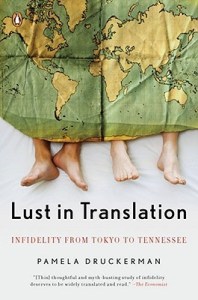 Druckerman travels from France (where she lives) to the United States, Russia, Japan, South Africa, Indonesia and China, interviewing professionals and anonymous adulterers and pondering what makes people cheat and what difference country of origin makes. Boiling it down, people in poor countries, even in parts of Africa where AIDS is a huge threat, are more likely to have multiple sexual partners than those in wealthy countries. Statistically speaking, there’s also a slight bias towards adultery in warmer countries. However, some factors that you might expect to have a big effect on the adultery rate, like religiosity (e.g. America vs. France), actually hardly do. What does differ is the level of guilt experienced over infidelity and its concomitant offense, lying. In places like France and Japan she discovers more of a don’t-ask-don’t-tell attitude: as long as the straying partner is discreet enough not to be caught, the other turns a blind eye.
Travel-based quest narratives like this usually have a personal element that helps to anchor a book. The other direction Druckerman might have taken would be a straightforward academic study, which her journalistic tone wouldn’t suit. Because this book hovers between genres/levels of discourse, it didn’t quite work for me, but if you think you might find the subject matter interesting it’s at least worth skimming.
A representative line:
“The pursuit of happiness, or true love, is one of the most salient stories that Americans use to justify affairs and overcome their moral qualms about cheating.”
My rating: 
Loving Frank by Nancy Horan (2007)
 Even if you don’t have any particular interest in architect Frank Lloyd Wright, this carefully crafted and lovingly written historical novel is well worth reading. Mamah (“May-muh”) Borthwick Cheney and her husband Edwin hired Wright to design their suburban Chicago home in 1903, and in 1907 she and Wright embarked on an affair. The novel covers roughly the next seven years of their lives, and is particularly illuminating about relationships, the rights of women and the morality code of the time. Through Mamah’s eyes Horan shows just why this affair was irresistible: “Frank Lloyd Wright was a life force. He seemed to fill whatever space he occupied with a pulsing energy that was spiritual, sexual, and intellectual all at once.” But in the eyes of the public, and of their families, it was a selfish choice that left her two children adrift. Beside Mamah, Catherine Wright was held up as a paragon of fidelity, waiting patiently for Frank to come back to her and their seven children.
If you think you are at all likely to read this book, DO NOT GOOGLE Mamah Borthwick Cheney, or Frank Lloyd Wright’s life in these years. I’m now keen to compare this with T.C. Boyle’s The Women, which is about Catherine, Mamah and two other important female figures in Frank Lloyd Wright’s life.
A representative passage:
“Does that mean I have to play this hand to the bitter end, full of regret? Knowing I might have had the happiest life imaginable with the one man I love more than any other I have ever known?”
My rating: 
I Love Dick by Chris Kraus (1997)
 This is one of the stranger novels I’ve ever read. It’s December 1994 and failed filmmaker Chris Kraus, 39, and her husband, 56-year-old professor Sylvère Lotringer, spend a night at the home of Dick, one of his California colleagues, to mark the end of Sylvère’s sabbatical. When they wake up the next morning Dick is gone, but he’s made a huge impression on Chris. She decides she and Dick have had something like D.H. Lawrence’s ‘sex in the head’, and becomes obsessed with him. Chris and Sylvère address reams of letters and journal entries to Dick. Some they send and some they don’t; Dick is a total blank, which allows the couple to build fantasies around him. It’s a chance for Chris to reimagine a life that’s gotten away from her and regain her voice.
I preferred Part 1, which I found quite funny. Kraus lost me a bit in Part 2, with a trip to Guatemala plus random exhibits and performance art. I think the whole thing would have been more effective at novella length. But it’s intriguing how it blends fact and fiction (Dick Hebdige is a real person, and apparently not happy about the invasion of his privacy) and adapts the epistolary form. An afterword by Joan Hawkins notes the similarity to Dangerous Liaisons, in which a couple exchange letters about a seduction plot.
A representative passage:
“Dear Dick,
No woman is an island-ess. We fall in love in hope of anchoring ourselves to someone else, to keep from falling,
Love,
Chris”
My rating:
The Pursuit of Love by Nancy Mitford (1945)
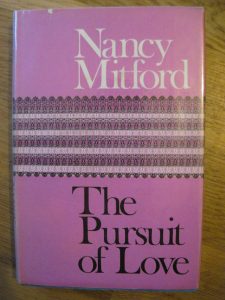 Last year I unwittingly read the 1949 sequel, Love in a Cold Climate, first. I rather enjoyed that one, but somehow wasn’t in the mood for Mitford this time around, and ended up just skimming this one. Once again Fanny traces the love life of one of her posh cousins. This time it’s Linda Radlett, whose two marriages – to a Conservative and a Communist – are doomed to failure. Then she finds her true love, too late. I liked the ball scene, and the image of Uncle Matthew using his bloodhounds to hunt down his children. Mitford mixes the lighthearted and the caustic in an amusing way. The last two pages of this novel turn particularly nasty, though, which made me wonder how people can call this a comfort read.
A representative passage:
“What we would never admit was the possibility of lovers after marriage. We were looking for real love, and that could only come once in a lifetime; it hurried to consecration, and thereafter never wavered. Husbands, we knew, were not always faithful, this we must be prepared for, we must understand and forgive.”
My rating:
Have you read anything love-ly lately?
November’s Novellas: A Wrap-Up
Yesterday was my husband’s birthday. Baking him the world’s most complicated cake on Wednesday evening and taking Thursday off for a birthday outing to Salisbury for the Terry Pratchett exhibit at the town’s museum and the Christmas-decorated rooms at Mompesson House are my collective excuse for not writing up the last of November’s novellas until now.


For the most part I had a great time reading novellas last month. However, there were three I abandoned: Mornings in Mexico by D.H Lawrence (p. 11), whose random, repetitive observations lead to no bigger picture; So Long, See You Tomorrow by William Maxwell (p. 28), which is understated to the point of nothing really happening; and Jaguars and Electric Eels by Alexander von Humboldt (p. 6), which has that dry old style that’s hard to engage with. (I’ll plan to encounter snatches of his writing via Andrea Wulf’s biography instead.)
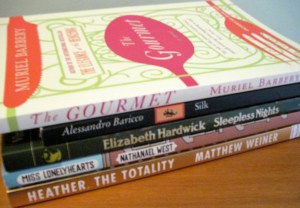 To my disappointment, I find I can’t make generalizations about the correlation between a book’s page count and its quality: a great book stands out no matter its length. But as Joe Hill (Stephen King’s son) said of his latest work, a set of four short novels, a novella should be “all killer, no filler.” Three of the five I review today definitely meet those criteria, impressing me with the literal and/or emotional ground covered.
Below are the novellas I didn’t manage to get to this past November. Perhaps they’ll hang around until next year, unless I get a burning urge to read one or more of them before then:
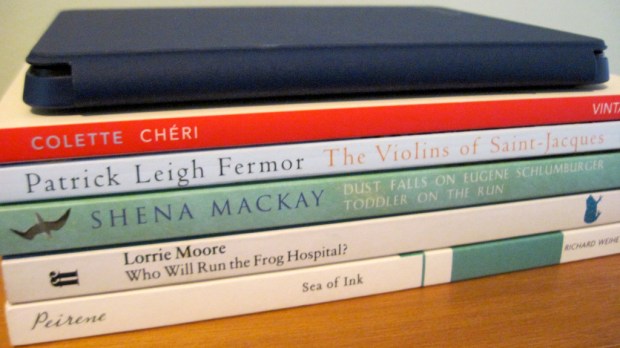
(On the Kindle: Record of a Night Too Brief by Hiromi Kawakami and Spring Garden by Tomoka Shibasaki.)
The Gourmet by Muriel Barbery
(translated from the French by Alison Anderson)
[112 pages]
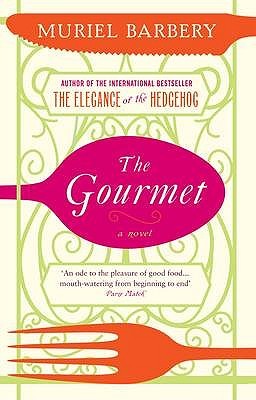 Pierre Arthens, France’s most formidable food critic, is on his deathbed reliving his most memorable meals and searching for one elusive flavor to experience again before he dies. He’s proud of his accomplishments – “I have covered the entire range of culinary art, for I am an encyclopedic esthete who is always one dish ahead of the game” – and expresses no remorse for his affairs and his coldness as a father. This takes place in the same apartment building as The Elegance of the Hedgehog and is in short first-person chapters narrated by various figures from Arthens’ life. His wife, his children and his doctor are expected, but we also hear from the building’s concierge, a homeless man he passed every day for ten years, and even a sculpture in his study. I liked Arthens’ grandiose style and the descriptions of over-the-top meals but, unlike the somewhat similar The Debt to Pleasure by John Lanchester, this doesn’t have much of a payoff.
A favorite passage:
“After decades of grub, deluges of wine and alcohol of every sort, after a life spent in butter, cream, sauce, and oil in constant, knowingly orchestrated and meticulously cajoled excess, my trustiest right-hand men, Sir Liver and his associate Stomach, are doing marvelously well and it is my heart that is giving out.”
Silk by Alessandro Baricco
(translated from the Italian by Guido Waldman)
[104 pages]
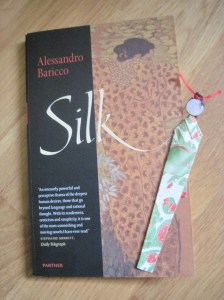 The main action is set between 1861 and 1874, as married French merchant Hervé Joncour makes four journeys to and from Japan to acquire silkworms. “This place, Japan, where precisely is it?” he asks before his first trip. “Just keep going. Right to the end of the world,” Baldabiou, the silk mill owner, replies. On his first journey, Joncour is instantly captivated by his Japanese advisor’s concubine, though they haven’t exchanged a single word, and from that moment on nothing in his life can make up for the lack of her. At first I found the book slightly repetitive and fable-like, but as it went on I grew more impressed with the seeds Baricco has planted that lead to a couple of major surprises. At the end I went back and reread a number of chapters to pick up on the clues. I’d had this book recommended from a variety of quarters, first by Karen Shepard when I interviewed her for Bookkaholic in 2013, so I’m glad I finally found a copy in a charity shop.
Sleepless Nights by Elizabeth Hardwick
[151 pages]
 Hardwick’s 1979 work is composed of (autobiographical?) fragments about the people and places that make up a woman’s remembered past. Elizabeth shares a New York City apartment with a gay man; lovers come and go; she mourns for Billie Holiday; there are brief interludes in Amsterdam and other foreign destinations. She sends letters to “Dearest M.” and back home to Kentucky, where her mother raised nine children. (“My mother’s femaleness was absolute, ancient, and there was a peculiar, helpless assertiveness about it. … This fateful fertility kept her for most of her life under the dominion of nature.”) There’s some astonishingly good writing here, but as was the case for me with Jenny Offill’s Dept. of Speculation, I couldn’t quite see how it was all meant to fit together.
Some favorite passages:
“The stain of place hangs on not as a birthright but as a sort of artifice, a bit of cosmetic.”
“The bright morning sky that day had a rare and blue fluffiness, as if a vacuum cleaner had raced across the heavens as a weekly, clarifying duty.”
“On the battered calendar of the past, the back-glancing flow of numbers, I had imagined there would be felicitous notations of entrapments and escapes, days in the South with their insinuating feline accent, and nights in the East, showing a restlessness as beguiling as the winds of Aeolus. And myself there, marking the day with an I.”
Miss Lonelyhearts by Nathanael West
[110 pages]
 West was a contemporary of F. Scott Fitzgerald; in fact, the story goes that when he died in a car accident at age 37, he had been rushing to Fitzgerald’s wake, and the friends were given adjoining rooms in a Los Angeles funeral home. Like The Great Gatsby, this is a very American tragedy and state-of-the-nation novel. “Miss Lonelyhearts” (never given any other name) is a male advice columnist for the New York Post-Dispatch. His letters come from a pitiable cross section of humanity: the abused, the downtrodden, the unloved. Not surprisingly, the secondhand woes start to get him down (“his heart remained a congealed lump of icy fat”), and he turns to drink and womanizing for escape. Indeed, I was startled by how explicit the language and sexual situations are; this doesn’t feel like a book from 1933. West’s picture of how beleaguered compassion can turn to indifference really struck me, and the last few chapters, in which a drastic change of life is proffered but then cruelly denied, are masterfully plotted. The 2014 Daunt Books reissue has been given a cartoon cover and a puff from Jonathan Lethem to emphasize how contemporary it feels.
Heather, the Totality by Matthew Weiner
[134 pages]
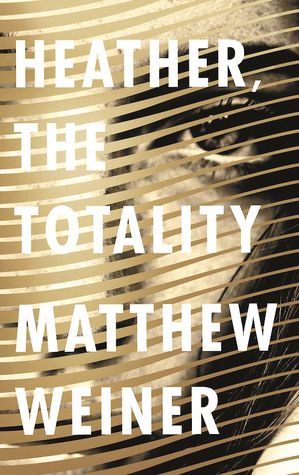 This was very nearly a one-sitting read for me: Clare gave me a copy at our Sunday Times Young Writer Award shadow panel decision meeting and I read all but a few pages on the train home from London. Famously, Matthew Weiner is the creator of Mad Men, but instead of 1960s stylishness this debut novella is full of all-too-believable creepiness and a crescendo of dubious decisions. Mark and Karen Breakstone have one beloved daughter, Heather. We follow them for years, getting little snapshots of a normal middle-class family. One summer, as their New York City apartment building is being renovated, the teenaged Heather catches the eye of a construction worker who has a criminal past – as we’ve learned through a parallel narrative about his life. I had no idea what I would conclude about this book until the last few pages; it was all going to be a matter of how Weiner brought things together. And he does so really satisfyingly, I think. It’s a subtle, Hitchcockian story, and that title is so sly: We never get the totality of anyone; we only see shards here and there – something the cover portrays very well – and make judgments we later have to rethink.
Have you read any of these novellas? Which one takes your fancy?
9 Things that Surprised Me about Madame Bovary
My classic for September was one of those books that are so ingrained in the canon you most likely know the basic story line even if you’ve never read a word Gustave Flaubert wrote. I’d happened to read a fair bit about Madame Bovary (1857), mostly via Julian Barnes, and had also encountered some modern novels that might be said to be updates (Hausfrau by Jill Alexander Essbaum and perhaps even George and Lizzie by Nancy Pearl), but never picked up the book itself until earlier this month. While the essential turns of the plot were indeed familiar to me, there was also plenty that surprised me in terms of the details and the mechanics. I’ve set this out in nine points below; if you’re determined to avoid anything that seems like spoilers, I’d suggest skipping over #6–8.
#1. We open with Charles Bovary.
And in the first-person plural: “We were studying when the headmaster came in, followed by a new boy”. I suppose I assumed the book would open immediately on Emma Bovary, already married to Charles. Instead, we get a quick tour through Charles’s adolescent schooling and independent medical studies.
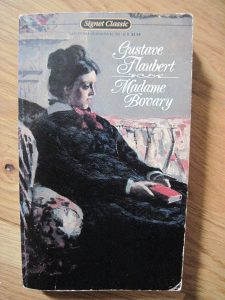 #2. There are two “Madame Bovarys” before the one we’re interested in.
The original Madame Bovary, and the only one to survive the book, is Charles’s mother. Charles also has a brief first marriage to Heloise, an older widow. Conveniently, she dies by the end of the second chapter, in which Charles met Emma when he went to set her farmer father’s broken leg.
#3. There’s a lovely Hardyesque flavor to the novel.
Flaubert’s original subtitle was “Provincial Morals,” and the scenes set among country folk – especially Emma and Charles’s wedding procession and reception and the later agricultural fair – reminded me of Far from the Madding Crowd.
#4. Emma has a child.
Despite all I’d absorbed about the book, I never knew Emma had a baby girl, Berthe. They lodge the infant with a wet nurse and servants do most of the hard work of raising her, so Berthe has only a tiny role. The scene in which Emma violently pushes the little girl away from her is meant, I think, to reflect her fundamental unfitness for motherhood.
#5. In the world of the novel, literature is a danger and religion is no balm.
On the advice of Charles’s mother, he cancels Emma’s lending library subscription lest novels exacerbate her discontent. Manual labor is what Emma needs, Old Madame Bovary proclaims. When Emma goes to the parish priest for advice about her angst, he tells her she must be ill if she benefits from all the physical comforts she could need yet cannot be happy. (An excellent and wrenching scene.)

Gustave Flaubert. (Public domain, via Wikimedia Commons.)
#6. There’s a strong medical theme.
Charles is a doctor, of course, but I didn’t know his profession would enter into the plot. There’s a crucial sequence in which he performs a groundbreaking operation on a stable boy with a clubfoot, but gangrene sets in and the leg has to be amputated. (Emma guiltily buys the boy a false leg.) Emma’s somewhat prolonged death by poisoning, and the appearance of her corpse, are also described in recognizable medical detail.
#7. Emma’s death isn’t the end.
There’s still two more chapters to go, and things only get worse. It’s as if Emma is still a negative influence after her death: pushing Charles on to extravagances he can’t afford, and sending him deeper into despair when he finds undeniable evidence of her two affairs.
#8. Homais, the arrogant pharmacist, is triumphant.
Monsieur Homais is one of the key secondary characters in Yonville, this small town near Rouen. He’s a middling community member who’s gotten above himself, yet he succeeds whereas Emma is crushed. The very last line of the novel goes to him: “He has just received the Legion of Honor.” In the introduction to my Signet Classic edition, Mary McCarthy suggests that Homais is “not just Emma’s foil; he is her alter ego.”
#9. Madame Bovary went on trial.
Appended to my copy is a 78-page transcript of the novel’s trial. As I skimmed it, I was reminded of the Lady Chatterley’s Lover obscenity case, which took place just over 100 years later (1959–60). Flaubert and his publisher were accused of “offenses against public morality and religion,” specifically of portraying Emma as lascivious and making adultery appealing compared to the banality of marriage. The defense countered that Charles receives all the reader’s sympathy and Emma all the reader’s revulsion. Flaubert was acquitted (as was Lady Chatterley), but the judge’s ruling was essentially “Naughty boy, don’t you know literature has a mission to exalt the spirit, not to hold up vice as an object of horror?”
Now for what doesn’t surprise me about Madame Bovary: the beautiful writing and the enduring power of what is ultimately a rather commonplace story line. The percentage of novels with an adultery subplot must be very high nowadays, but Madame Bovary and Anna Karenina were two of the first to consider the female experience.
Flaubert famously declared “Madame Bovary, c’est moi” (“Madame Bovary is me”), and I think every reader must see something of him-/herself in this character: the lure of a romantic and luxurious life, the boredom of the day to day, the longing to make something more out of existence, and an increasing desperation to cover up one’s mistakes. A book that has had meaning for generations, Madame Bovary is a true classic.
Some favorite lines:
“But her life was as cold as an attic with northern exposure, and boredom, that silent spider, was spinning its web in all the dark corners of her heart.”
“Mealtime was the worst of all in that tiny room on the ground floor, with the smoking oven, the creaking door, the damp walls, and the moist flagstones; all the bitterness of her existence seemed to be served up to her on her plate, and the steam from the boiled beef brought up waves of nausea from the depths of her soul.”
“No one can ever express the exact measure of his needs, or conceptions, or sorrows. The human language is like a cracked kettle on which we beat out a tune for a dancing bear, when we hope with our music to move the stars.”
(Isn’t that last sentence incredible?!)
My rating:
I read a Signet Classic edition of Mildred Marmur’s 1964 translation.
See also Susan’s review of Sophie Divry’s recent update, Madame Bovary of the Suburbs, at A life in books.
Classic of the Month: Anna of the Five Towns
This was my first experience with Arnold Bennett’s fiction; I’d previously read his Literary Taste. (He is not to be confused, as I’ve done in the past, with novelist and playwright Alan Bennett (An Uncommon Reader, etc.)!) Bennett (1867–1931) was from the Potteries region of Staffordshire and moved to London in his early twenties to work in a law office. Anna of the Five Towns (1902) was his second novel and first moderate success, but it was The Old Wives’ Tale (1908) and the Clayhanger trilogy (1910–16) that truly made his name.
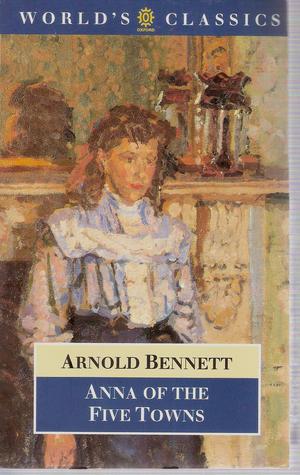 Bennett was a contemporary of D.H. Lawrence, James Joyce and Thomas Hardy (though Hardy had given up on novels by that point), and Anna reminds me of each of these authors to an extent – but particularly of Lawrence, what with his working-class Midlands roots. I also frequently thought of A Portrait of the Artist as a Young Man (religious angst) and Far from the Madding Crowd (a heroine who faces romantic entanglements and financial responsibility for the first time).
Twenty-year-old Anna Tellwright is a Methodist Sunday school teacher and lives with her twelve-year-old sister, Agnes, and their ill-tempered father, Ephraim, in “Bursley” (Bennett’s name for Burslem, now part of Stoke-on-Trent). The family is well off thanks to Ephraim’s canny property investments and inheritances he and his late wife received. Yet Anna is still dumbfounded to learn, on her twenty-first birthday, that she’s worth £50,000. Ephraim, generally referred to as “the miser” – there’s no nuance here; he’s typecast and never rises above the label – is happy to turn over certain aspects of the business to Anna, like hounding their tenants the Prices for late rent, but doesn’t give her autonomy over her daily spending. She must meekly approach her father each time she wants to purchase something for herself.
Anna has a suitor, Henry Mynors, whose business Ephraim supports as a sleeping partner. She loves the idea of being loved – and the suspicion that she has unwittingly wrenched a desirable prospect away from pretty Beatrice Sutton. But she doesn’t seem to be truly in love with Henry, just like her heart isn’t fully committed to the local revival put on by the Methodists. After all, she hasn’t had the emotional conversion experience that would prove irrefutably that she is saved. Much as she beats herself up over her so-called sins, the desired transformation never arrives. Instead, the closest thing she has to an epiphany comes when she’s standing atop a hill on the Isle of Man on her first-ever holiday:
She perceived that the monotony, the austerity, the melancholy of her existence had been sweet and beautiful of its kind, and she recalled, with a sort of rapture, hours of companionship with the beloved Agnes, when her father was equable and pacific. Nothing was ugly nor mean. Beauty was everywhere, in everything.
The Prices take on unforeseen significance in the novel, and in her dealings with them Anna is caught between a wish to be Christlike in her compassion and the drive to act as the shrewd businesswoman her father expects. Though she is eventually able to wrest back something like financial independence, she remains bound by the social convention of marrying well.

Arnold Bennett.
Anna is more timid and introspective than your average heroine; I felt great sympathy for her not in spite of but because of those character traits. I recently took the Myers-Briggs test for the first time, and wondered if Anna could be an ISTJ like me – she dreads having to visit her pupils’ homes and make small talk with the parents, comes across as curt when nervous, and can’t seem to turn her brain off and just feel instead. (Kate Scott of Parchment Girl runs a blog series about characters who exemplify the different Myers-Briggs personality types.)
There’s a lack of subtlety to Bennett’s writing, something I particularly noted in the physical descriptions (“She was tall, but not unusually so, and sturdily built up. Her figure, though the bust was a little flat, had the lenient curves of absolute maturity”) and some heavy-handed foreshadowing (“It was on the very night after this eager announcement that the approaching tragedy came one step nearer”). But I can let him off considering that this was published 115 years ago. It’s an excellent example of regional literature (can you think of another book set in Staffordshire?), with Anna’s visit to Henry’s pottery works a particular highlight. Bennett takes an unpromising setting and rather humble people and becomes their bard:
Nothing could be more prosaic than the huddled, red-brown streets; nothing more seemingly remote from romance. Yet be it said that romance is even here—
Several miles away, the blast-furnaces of Cauldron Bar Ironworks shot up vast wreaths of yellow flame with canopies of tinted smoke. Still more distant were a thousand other lights crowning chimney and kiln, and nearer, on the waste lands west of Bleakridge, long fields of burning ironstone glowed with all the strange colours of decadence. The entire landscape was illuminated and transformed by these unique pyrotechnics of labour atoning for its grime, and dull, weird sounds, as of the breathings and sighings of gigantic nocturnal creatures, filled the enchanted air.
The tea, made specially magnificent in honour of the betrothal, was such a meal as could only have been compassed in Staffordshire or Yorkshire—a high tea of the last richness and excellence, exquisitely gracious to the palate, but ruthless in its demands on the stomach. At one end of the table … was a fowl which had been boiled for four hours; at the other, a hot pork-pie, islanded in liquor, which might have satisfied a regiment. Between these two dishes were … hot pikelets, hot crumpets, hot toast, sardines with tomatoes, raisin-bread, currant-bread, seed-cake, lettuce, home-made marmalade and home-made jams. The repast occupied over an hour, and even then not a quarter of the food was consumed.
I enjoyed this for the pacey plot, the religious theme, the sympathetic protagonist, and the loving look at an industrial area. I’ll certainly be looking out for copies of Bennett’s other novels in secondhand bookshops; meanwhile, Project Gutenberg also has a good selection of his writings. (My copy was withdrawn from Lambeth Libraries stock and sold for 10 pence.)
My rating:
Making Plans (and Book Lists) for America
On Tuesday we leave for two weeks in America. It’s nearly a year and a half since our last trip – much too long – so we’ll be cramming in lots of visits with friends and family and doing a fair bit of driving around the Mid-Atlantic states. I’m giving myself the whole time off, which means I’ve been working flat out for the past two weeks to get everything done (including my U.K. and U.S. taxes). I’m nearly there: at the 11-day countdown I still had 12 books I wanted to finish and 12 reviews to write; now I’m down to five books, only one of which might be considered essential, and all the reviews are ready to submit/schedule. What with the holiday weekend underway, it should all be manageable.
I’m a compulsive list maker in general, but especially when it comes to preparing for a trip. I’ve kept adding to lists entitled “Pack for America,” “Do in America,” “Buy in America,” and “Bring back from America.” But the more fun lists to make are book-related ones: what paper books should I take to read on the plane? Which of the 315 books on my Kindle ought I to prioritize over the next two weeks? Which exclusively American books should I borrow from the public library? What secondhand books will I try to find? And which of the books in the dozens of boxes in the closet of my old bedroom will I fit in my suitcase for the trip back?
I liked the sound of Laila’s habit of taking an Anne Tyler novel on every flight. That’s just the kind of cozy reading I want, especially as I head back to Maryland – not far at all from Tyler’s home turf of Baltimore. I browsed the blurbs on a few of her paperbacks I have lying around and chose Back When We Were Grownups to be my fifth Tyler and one of my airplane reads.
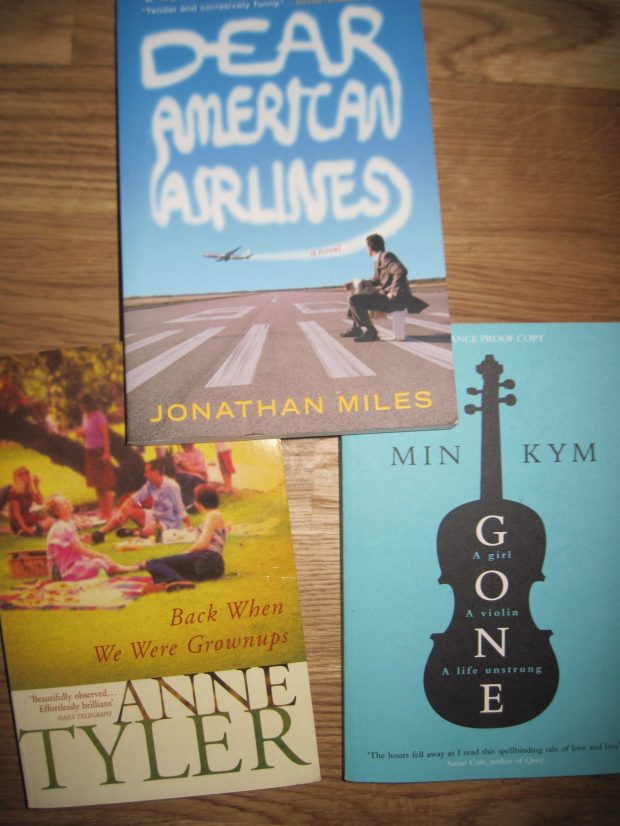
I’m also tempted by Min Kym’s Gone, a memoir by a violin virtuoso about having her Stradivarius stolen. I picked up a proof copy in a 3-for-£1 charity sale a couple of weeks ago. And then I can’t resist the aptness of Jonathan Miles’s Dear American Airlines (even though we’re actually flying on Virgin). I’ll start one or more of these before we go, just to make sure they ‘take’.
I almost certainly won’t need three print books for the trip, particularly if I take advantage of the in-flight entertainment. We only ever seem to watch films while we’re in America or en route there, so between the two legs I’ll at least try to get to La La Land and The Light between Oceans; I’m also considering Nocturnal Animals, Silence, and the live-action Beauty and the Beast – anyone seen these?
However, I’ll also keep my Kindle to hand, as I find it easier to pick up and put down on multi-part journeys like ours to the airport (train ride + coach ride). Some of the books on my Kindle priority list are: The Day that Went Missing by Richard Beard, Cork Dork by Bianca Bosker, Eleanor Oliphant Is Completely Fine by Gail Honeyman, The Fact of a Body by Alexandria Marzano-Lesnevich, Mrs. Fletcher by Tom Perrotta (out in August), The Power by Naomi Alderman, Reservoir 13 by Jon McGregor, The Rules Do Not Apply by Ariel Levy, See What I have Done by Sarah Schmidt, You Should Have Left by Daniel Kehlmann … and the list continues, but I’ll stop there.

My book shopping list is an ongoing one, as the many cross-outs and additions on this sheet show. Finding specific books at my beloved Wonder Book can be a challenge, so I usually just keep in mind the names of authors I’d like to read more by. This time that might include Arnold Bennett, Geoff Dyer, Elizabeth Hay, Bernd Heinrich, W. Somerset Maugham, Haruki Murakami and Kathleen Norris. In addition to the couple of secondhand bookstores we always hit, I hope to visit a few new-to-me ones on stays with friends in Virginia.
As for those poor books sat in boxes in the closet, I have plans to unearth novels by Anita Brookner, Mohsin Hamid, Kent Haruf, Penelope Lively, Howard Norman and Philip Roth – for reading while I’m there and/or bringing back with me. I’m also contemplating borrowing my dad’s omnibus edition of the John Updike “Rabbit” novels. From my nonfiction hoard, I fancy an Alexandra Fuller memoir, D.H. Lawrence’s travel books and more of May Sarton’s journals. If only it weren’t for luggage weight limits!
On Monday I’ll publish my intercontinental Library Checkout, on Tuesday I have a few June releases to recommend, and then I’m scheduling a handful of posts for while I’m away – a couple reviews I happen to have ready, plus some other lightweight stuff. Alas, I read no doorstoppers in May, but I have a list (of course) of potential ones for June, so will attempt to resurrect that monthly column.
Though I may be slow to respond to comments and read your blogs while I’m away, I will do my best and hope to catch up soon after I’m back.
Failing at Classics of the Month
I’ve attempted two Dickens novels in the last five years, and left both unfinished. I at least got about 200 pages into Dombey and Son in 2012 before I gave up, but my recent attempts to get past the first couple of chapters in Our Mutual Friend have been utterly unsuccessful. I finally gave myself permission to set it aside at page 41 – and I didn’t even read all of that; I’d started skimming in a last-ditch attempt to get myself hooked by the story. Have I lost my Dickens mojo? Do I not have sufficient patience to read Victorian triple-deckers anymore? I truly hope this is just a phase and I’ll be able to get back into Dickens someday. I certainly intend to read his whole oeuvre eventually, even the obscure ones.
So I don’t have a classic for April, nor a true doorstopper (I’ve classified David France’s How to Survive a Plague as such – a bit of a cheat since I only skimmed it). Instead what I have to offer are a modern classic and a graphic adaptation of another Dickens novel.
On the Black Hill by Bruce Chatwin, which I mostly read during our trip to Hay-on-Wye earlier in the month, is worthy of being called a modern classic. It has echoes of D.H. Lawrence and especially Thomas Hardy, and it’s a pleasantly offbeat look at the developments of the twentieth century as seen through the lives of Welsh identical twins Benjamin and Lewis Jones. Opening in the 1980s, when the brothers are eccentric old gents sleeping side by side in their late parents’ bed, the book then retreats to the beginning: at the turn of the last century ornery Amos Jones fell for an educated rector’s daughter and their volatile relationship played out at The Vision farm. One son was caught up in the First World War, one had love affairs; neither “ever strayed further than Hereford.” Through sickness, community scandal, and the rise and fall of fortunes, they remain wedded to Welsh village life.

“The Vision” farm is in the background to the right.
I especially loved Chatwin’s descriptions of the natural world (he’d visited Radnorshire as a boy and considered it a kind of spiritual home), and the glimpses he gives into the twins’ preternatural closeness:
Lewis and Benjamin gambolled ahead, put up grouse, played finger-football with rabbit-droppings, peered over the precipice onto the backs of kestrels and ravens and, every now and then, crept off into the bracken, and hid. They liked to pretend they were lost in a forest, like the Twins in Grimms’ fairy-tale, and that each stalk of bracken was the trunk of a forest tree. … They lay on their backs and gazed on the clouds that crossed the fretted patches of sky … they would press their foreheads together, each twin losing himself in the other’s grey eye.
(Clearance book from Blackwell’s in Oxford.  )
)
 The David Copperfield graphic novel by Jacqueline Morley (illustrated by Penko Gelev) is part of the Graffex series of graphic novel literary retellings issued by Salariya Book Company. It’s remarkably faithful to Dickens’s original, with just a bit of condensing in terms of the plot and a few secondary characters cut out or greatly reduced in importance. Although this is no substitute for reading David Copperfield itself (my favorite book), I could see it being useful for high school or college students who need a quick recap of what happens when preparing for a quiz or essay. The three main young females are amusingly similar and idealized, but all the other characters’ looks are true to the novel’s descriptions (and previous adaptations). The end matter – a brief biography of Dickens, commentary on the novel, a timeline of stage and screen versions – is particularly helpful, though in the chronology of Dickens’s works they forgot Dombey and Son!

(Remainder copy from Addyman Books in Hay-on-Wye.  )
)
Next month: I’ve pulled out a couple of short (~210 pages each) classics from the shelf. I recently read a graphic novel about Gauguin that I’ll be reviewing on Monday, so I fancy following it up with W. Somerset Maugham’s The Moon and Sixpence, which is said to be based on Gauguin’s life. It’ll be only my second Maugham after Of Human Bondage, which I loved in 2015. Anna of the Five Towns will be my first taste of Arnold Bennett’s fiction (though I’ve read his Literary Taste).
The Doll’s Alphabet: Stories by Camilla Grudova
Camilla Grudova lives in Toronto and has a degree in Art History and Germany from McGill University of Montreal. The Doll’s Alphabet, her debut collection, sets surreal tales of women’s inner lives against ruined cityscapes. These 13 stories are like perverted fairytales or fragmentary nightmares, full of strange recurring imagery and hazily dystopian setups. Flash fiction-length stories alternate with longer ones that move at a dizzying pace, and the book is roughly half third-person and half first-person – a balance I always appreciate.
 “Unstitching,” the two-page opener, introduces the metaphors and gender politics that form the backdrop for Grudova’s odd imagination. One day Greta realizes she can unstitch herself, removing an outer covering to reveal her true identity; “It brought great relief … like undoing one’s brassiere before bedtime or relieving one’s bladder after a long trip.” Her neighbor Maria does the same, but men – including Greta’s husband – find this intimidating, and are jealous because they don’t seem to have a deeper self to uncover. I was tickled by the idea of women having a secret life unshared by men, but had trouble grasping the actual mechanics of the unstitching: “She did not so much resemble a sewing machine as she was the ideal form on which a sewing machine was based. The closest thing she resembled in nature was an ant.” Huh? This is a case where keeping things vague might have been a better strategy.
Sewing machines keep popping up, along with mermaids, dolls, babies, zoos, factories, and old-fashioned or derelict shops. For example, the narrator of “The Mouse Queen” is a clerk in a doll’s house shop, while her husband Peter works in a graveyard. One night he brings home the corpse of an old dwarf woman, which the narrator decides to stow in the abandoned grocery store under their apartment. Um, naturally.
In “Waxy” (full text available on the Granta website) the narrator works at a sewing machine factory and unlawfully acquires a baby by her sub-par Man, Paul. The sexual violence in this one and in “Moth Emporium” is deeply unsettling: even in these off-kilter fictional worlds women’s bodies are considered a threat and pregnancy is never innocuous.
My two favorites were “Agata’s Machine” (full text available at The White Review) and “Notes from a Spider.” The former is perhaps indebted to D.H. Lawrence’s “The Rocking-Horse Winner” in its picture of obsessive and ultimately self-destructive activity. It features two Eastern European eleven-year-olds: the narrator is bullied, while her friend Agata is an aloof genius. In her attic room Agata keeps what looks like a sewing machine, but pushing its treadle creates flickering images of Pierrot (a clown) or an angel. This one has a chilling ending. The last story, “Notes from a Spider,” is told by a half-man, half-spider with eight legs. He keeps a zoo for vermin and opens – what else? – a sewing machine museum.
I’ve discovered that I have limited tolerance for outlandish tales like these. I’d be intrigued to find one of Grudova’s stories in an anthology, and I might be happy to read the best four or five of these. But because the same images and concepts keep repeating, the book feels twice as long as it needs to be. Ultimately this book was not for me, but I would not hesitate to recommend it to you if you have enjoyed the more fantastical of the feminist short stories by Karen Russell, Alexandra Kleeman and Helen Simpson.
The Doll’s Alphabet was published on February 14th by Fitzcarraldo Editions. With thanks to publicist Nicolette Praça for the review copy.
My rating:
London-based publisher Fitzcarraldo Editions produces elegantly simple volumes of long-form essays and niche contemporary fiction, with much of the latter appearing in English translation for the first time. I’ve enjoyed a number of Fitzcarraldo books – particularly On Immunity by Eula Biss, The Hatred of Poetry by Ben Lerner, and Second-Hand Time by Svetlana Alexievich – and even when the topics don’t hold any particular interest for me (as was the case with Football by Jean-Philippe Toussaint and Pretentiousness by Dan Fox), they are still thought-provoking, out-of-the-ordinary discourses on the topic at hand.

Coming up next from Fitzcarraldo (March 22nd) is French author Mathias Enard’s novel Compass, which won the 2015 Prix Goncourt. On one sleepless night in Vienna Franz Ritter, an ailing musicologist, entertains memories of travels in the Middle East and his unrequited love for Sarah. Here’s part of the first run-on paragraph as a preview of the hypnotic style:
We are two opium smokers each in his own cloud, seeing nothing outside, alone, never understanding each other we smoke, faces agonizing in a mirror, we are a frozen image to which time gives the illusion of movement, a snow crystal gliding over a ball of frost, the complexity of whose intertwinings no one can see, I am that drop of water condensed on the window of my living room, a rolling liquid pearl that knows nothing of the vapour that engendered it, nor of the atoms that still compose it but that, soon, will serve other molecules, other bodies, the clouds weighing heavy over Vienna tonight: over whose nape will this water stream, against what skin, on what pavement, towards what river, and this indistinct face on the glass is mine only for an instant, one of the millions of possible configurations of illusion …
My (Tiny) Collection of Signed Copies
The other day I discovered a pencil-written recipe in the back of a secondhand book I got for Christmas. It got me thinking about handwriting in books: signatures, inscriptions, previous owners’ names, marginalia, and so on. If I can find enough examples of all those in my personal library, I might turn this into a low-key series. For now, though, I’ve rounded up my signed copies for a little photo gallery.
I’ve never placed particular value on owning signed copies of books. I’m just as likely to resell a signed book or give it away to a friend as I am a standard copy. The signed books I do have on my shelves are usually a result of having gone to an author event and figuring I may as well stick around for the signing. A few were totally accidental in secondhand purchases.
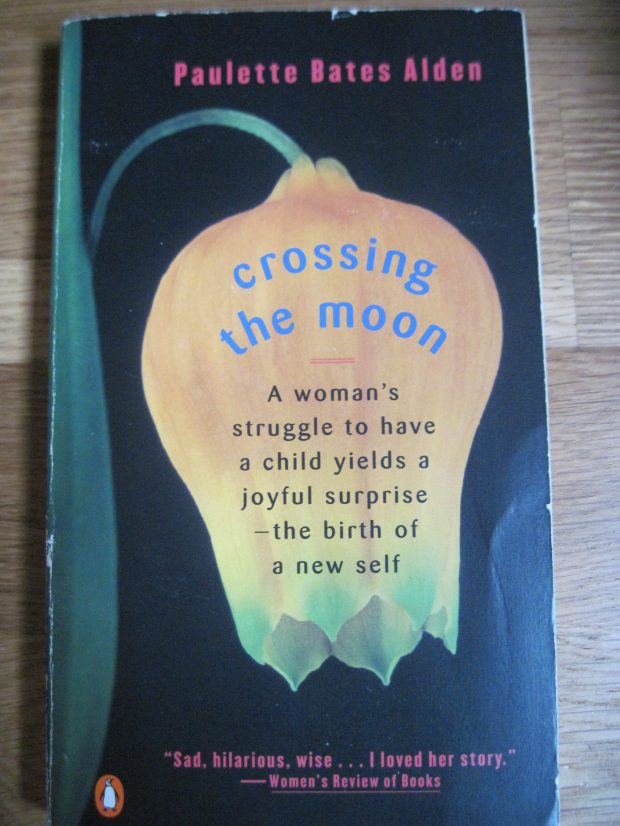
Though I’ve had personal correspondence with Paulette Bates Alden and love the three books of hers that I’ve read, this signature is entirely coincidental, in a used copy from Amazon. Shame on Patti for getting rid of it after Paulette’s book club visit in 2000!

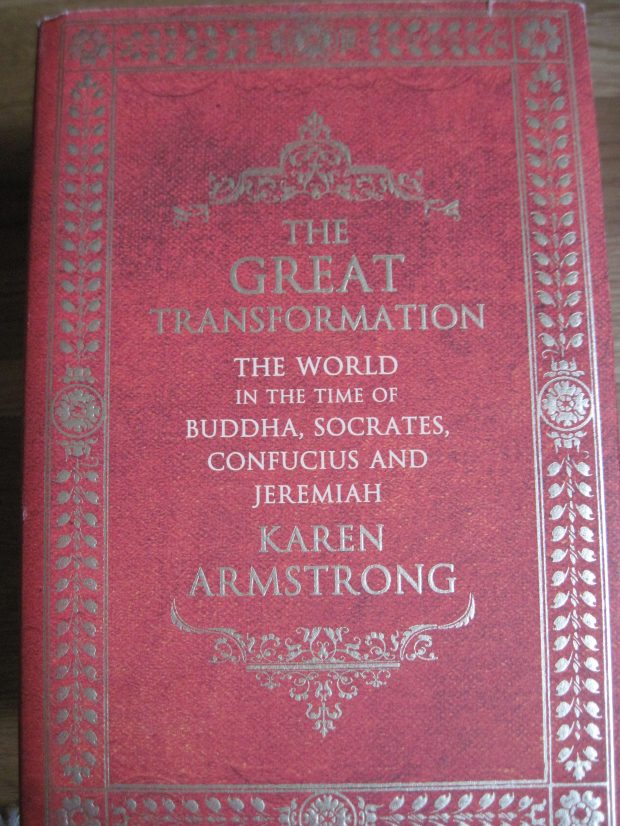
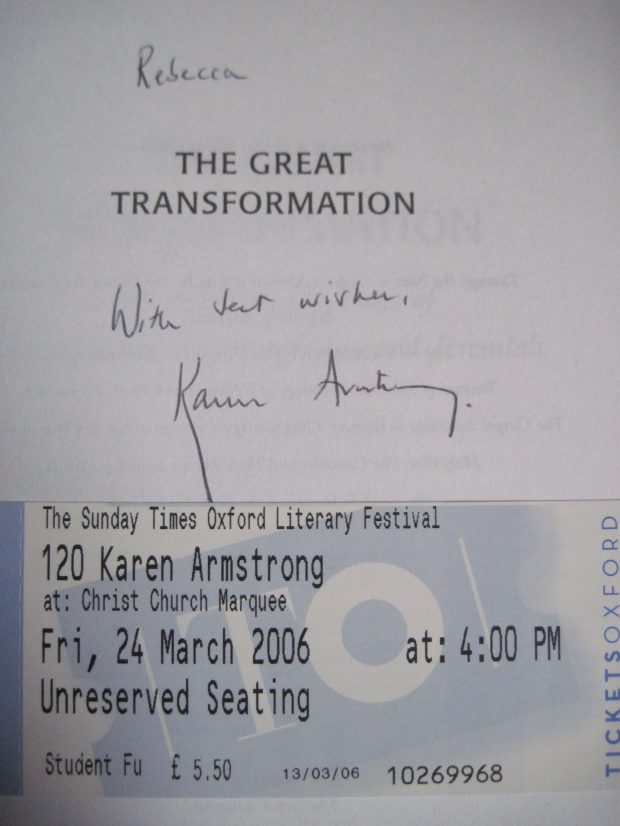
I love Karen Armstrong’s work, especially her two memoirs about deciding not to be a nun, and A History of God. I’ve seen her speak twice and am always impressed by her clear reasoning. (Tell you a secret, though: I couldn’t get through this particular book.)
While my husband worked at Royal Holloway we saw Alain de Botton speak at the Runnymede Literary Festival and I had him sign a copy of my favorite of his books.


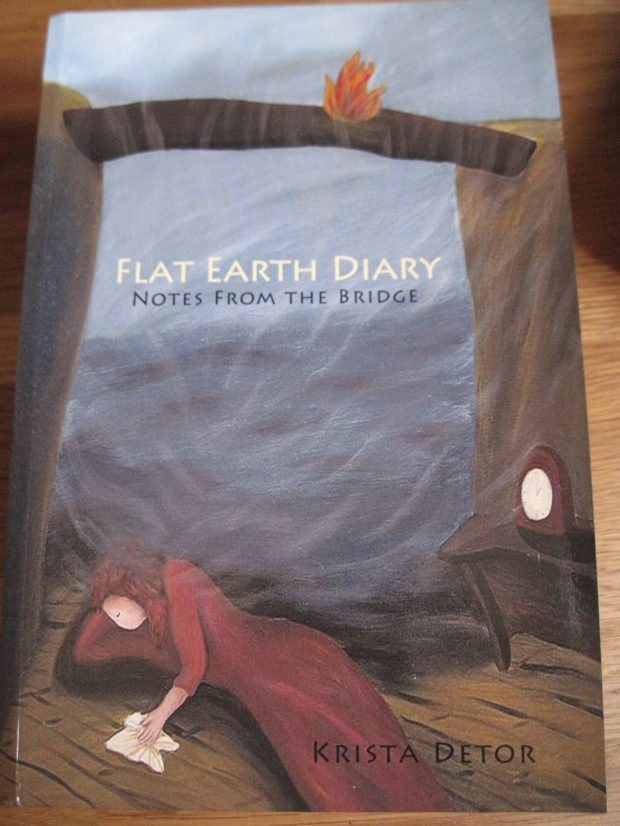
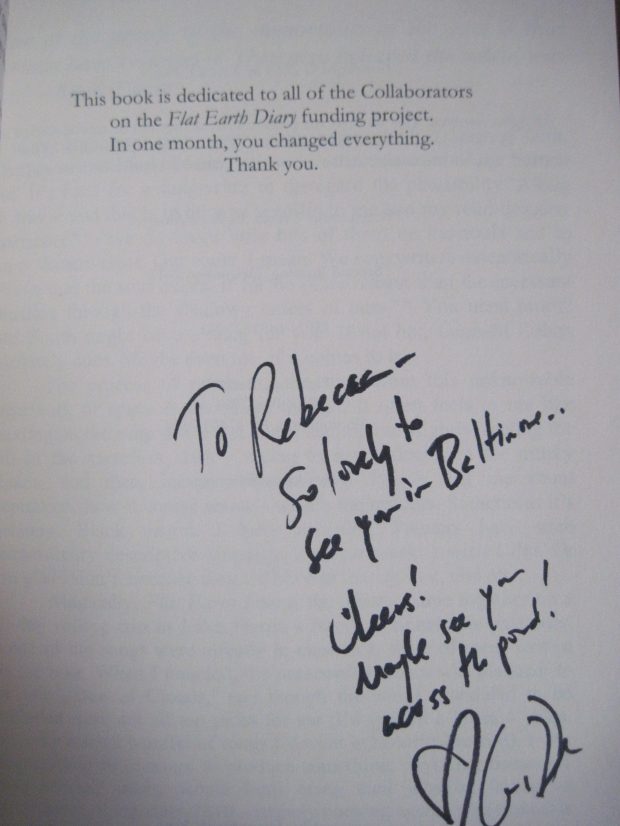
Krista Detor is one of our favorite singer-songwriters. We’ll be seeing her play for the fourth time in March. Luckily for us (but unluckily for the world, and for her coffers), this folk songstress from Indiana is unknown enough to play folk clubs and house concerts on both sides of the Atlantic. She wrote a book documenting the creative process behind her next-to-last album; when I saw her in Maryland she signed it with “Maybe see you across the pond!”
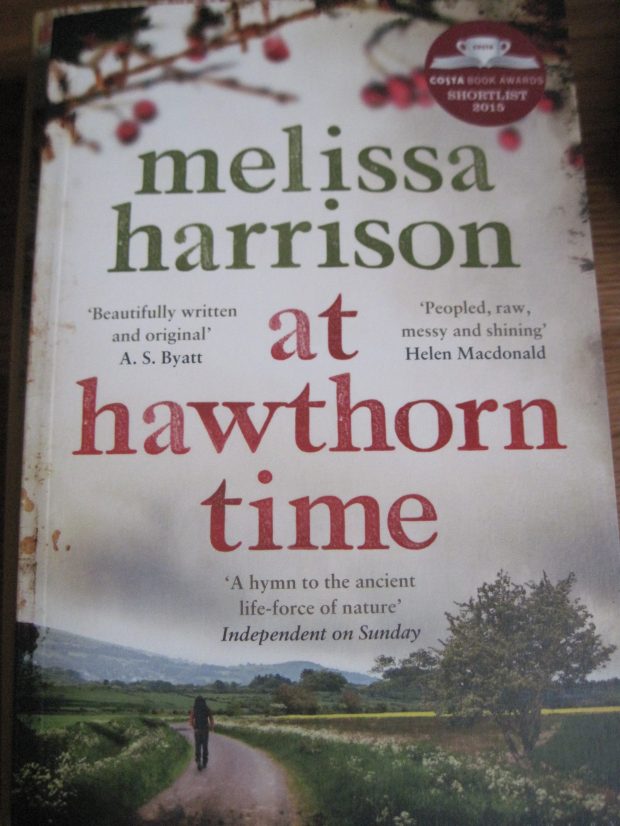
I have yet to read one of Melissa Harrison’s books, though I’m interested in her novels and her book on British weather. However, she edited the Seasons anthologies issued by the Wildlife Trusts last year – two of which my husband’s writing appeared in. When she spoke on the University of Reading campus about notions of the countryside in literature, my husband went along to meet her and bought a paperback of her second novel for her to sign.

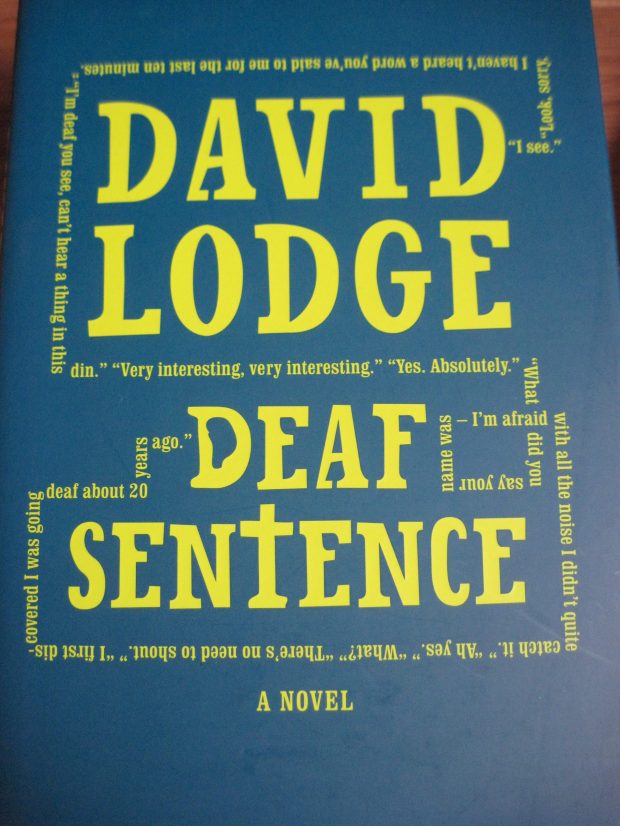
I’ve seen David Lodge speak twice, both times at the London Review Bookshop. He’s one of my favorite authors ever but, alas, isn’t all that funny or personable live; his autobiography is similarly humorless compared to his novels. Deaf Sentence was a return to his usual comic style after his first stab at historical fiction (Author, Author, about Henry James’s later life). The second time I saw him he was promoting A Man of Parts, which again imagines the inner life of a famous author – this time H.G. Wells.

An obscene bargain from Amazon that just happened to be signed. I’m looking forward to starting this one soon: books about book are (almost) always such a cozy delight.

-
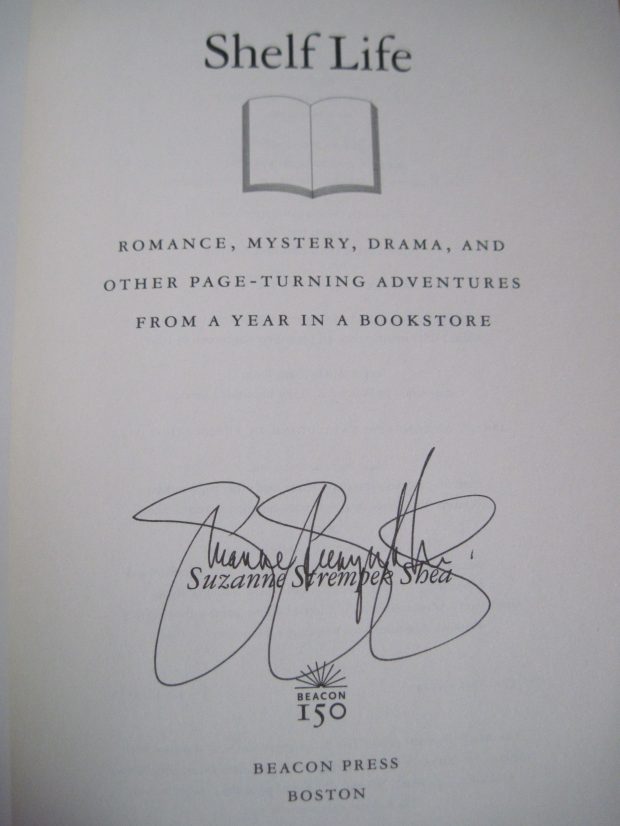
- You can tell she enjoys her S’s.
Plus three signed copies languishing in boxes in America:
- Blue Shoe by Anne Lamott: I love Lamott’s nonfiction but have never tried one of her novels. I found this one at a library book sale, going for $1; I guess nobody noticed the signature.
- The Sixteenth of June by Maya Lang: I originally read the book via NetGalley, but it quickly became a favorite. After she saw my five-star review, Maya asked me to help her out with word-of-mouth promotion and was kind enough to send me a signed copy as thanks.
- The Life of D.H. Lawrence: An Illustrated Biography by Keith M. Sagar: Sagar was one of the keynote speakers at the D.H. Lawrence Society of North America conference I attended in the summer of 2005.
Do you deliberately buy signed copies? What are some of the jewels in your collection?
Starting the Year as I Mean to Go On?
The houseguests have gone home, the Christmas tree is coming down tomorrow, and it’s darned cold. I’m feeling stuck in a rut in my career, the blog, and so many other areas of life. It’s hard not to think of 2017 as a huge stretch of emptiness with very few bright spots. All I want to do is sit around in my new fuzzy bathrobe and read under the cat. Luckily, I’ve had some great books to accompany me through the Christmas period and have finished five so far this year.
I thought I’d continue the habit of writing two-sentence reviews (or maybe no more than three), except when I’m writing proper full-length reviews on assignment or for blog tours or other websites. Granted, they’re usually long and multi-part sentences, and this isn’t actually a time-saving trick – as Blaise Pascal once said, “I’m sorry I wrote you such a long letter; I didn’t have time to write a short one” – but it feels like good discipline.
So here’s some mini-reviews of what I’ve been reading in late December and early January:
The Dark Flood Rises, Margaret Drabble
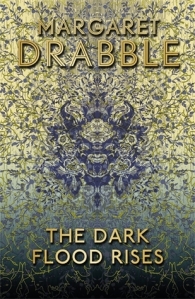 The “dark flood” is D.H. Lawrence’s metaphor for death, and here it corresponds to busy seventy-something Fran’s obsession with last words, obituaries and the search for the good death as many of her friends and acquaintances succumb – but also to literal flooding in the west of England and (dubious, this) to mass immigration of Asians and Africans into Europe. This is my favorite of the five Drabble books that I’ve read – it’s closest in style and tone to her sister A.S. Byatt as well as to Tessa Hadley, and the themes of old age and life’s randomness are strong – even though there seem to be too many characters and the Canary Islands subplot mostly feels like an unnecessary distraction. (Public library)
Hogfather, Terry Pratchett
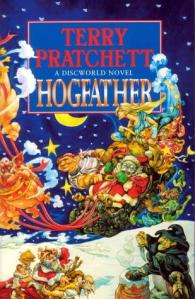 In Discworld belief causes imagined beings to exist, so when a devious plot to control children’s minds results in a dearth of belief in the Hogfather, the Fat Man temporarily disappears and Death has to fill in for him on this Hogswatch night. I laughed aloud a few times while reading this clever Christmas parody, but I had a bit of trouble following the plot and grasping who all the characters were given that this was my first Discworld book; in general I’d say that Pratchett is another example of British humor that I don’t entirely appreciate (along with Monty Python and Douglas Adams) – he’s my husband’s favorite, but I doubt I’ll try another of his books. (Own copy)
Love of Country: A Hebridean Journey, Madeleine Bunting
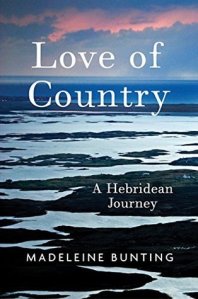 In a reprise of childhood holidays that inevitably headed northwest, Bunting takes a series of journeys around the Hebrides and weaves together her contemporary travels with the religion, folklore and history of this Scottish island chain, an often sad litany of the Gaels’ poverty and displacement that culminated with the brutal Clearances. Rather than giving an exhaustive survey, she chooses seven islands to focus on and tells stories of unexpected connections – Orwell’s stay on Jura, Lord Leverhulme’s (he of Port Sunlight and Unilever) purchase of Lewis, and Bonnie Prince Charlie’s landing on Eriskay – as she asks how geography influences history and what it truly means to belong to a place. (Public library)
Cobwebs and Cream Teas: A Year in the Life of a National Trust House, Mary Mackie
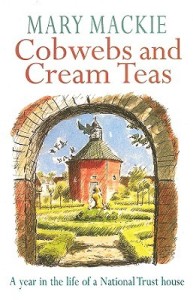 Mackie’s husband was Houseman and then Administrator at Felbrigg Hall in Norfolk in the 1980s – live-in roles that demanded a wide range of skills and much more commitment than the usual 9 to 5 (when he borrowed a pedometer he learned that he walked 15 miles in the average day, without leaving the house!). Her memoir of their first year at Felbrigg proceeds chronologically, from the intense cleaning and renovations of the winter closed season through to the following Christmas’ festivities, and takes in along the way plenty of mishaps and visitor oddities. It will delight anyone who’d like a behind-the-scenes look at the life of a historic home. (Own copy)
The Bridge Ladies: A Memoir, Betsy Lerner
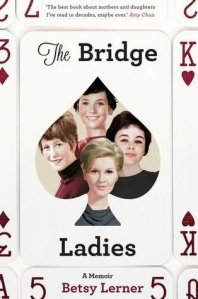 When life unexpectedly took the middle-aged Lerner back to her hometown of New Haven, Connecticut, she spent several years sitting in on her mother’s weekly bridge games to learn more about these five Jewish octogenarians who have been friends for 50 years and despite their old-fashioned reserve have seen each other through the loss of careers, health, husbands and children. Although Lerner also took bridge lessons herself, this is less about the game and more about her ever-testy relationship with her mother (starting with her rebellious teenage years), the ageing process, and the ways that women of different generations relate to their family and friends. It wouldn’t be exaggerating to say that every mother and daughter should read this; I plan to shove it in my mother’s and sister’s hands the next time I’m in the States. (Own copy)
Waiting on the Word, Malcolm Guite
 Guite chooses well-known poems (by Christina Rossetti, John Donne, Alfred Lord Tennyson, Samuel Taylor Coleridge et al.) as well as more obscure contemporary ones as daily devotional reading between the start of Advent and Epiphany; I especially liked his sonnet sequence in response to the seven “O Antiphons.” His commentary is learned and insightful, and even if at times I thought he goes into too much in-depth analysis rather than letting the poems speak for themselves, this remains a very good companion to the Christmas season for any poetry lover. (E-book from NetGalley)
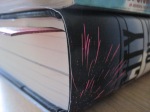 I started too many books over Christmas and have sort of put six of them on hold – including Titus Groan, which I’m thinking of quitting (it takes over 50 pages for one servant to tell another that the master has had a son?!), and City on Fire, which is wonderful but dispiritingly long: even after two good sessions with it in the days after Christmas, I’ve barely made a dent.
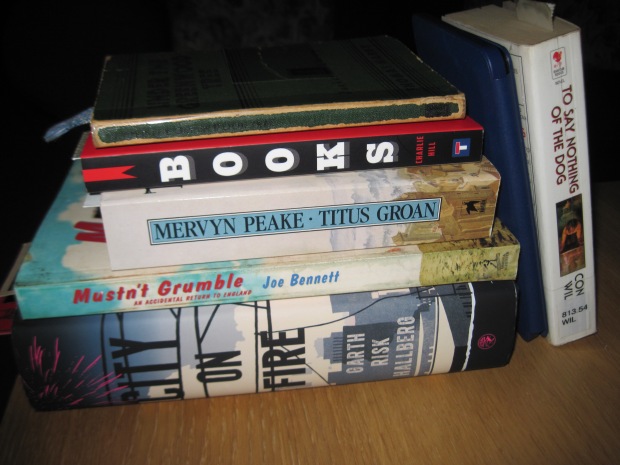
Stack on left = on hold (the book on top is Under the Greenwood Tree); standing up at right = books I’m actually reading.
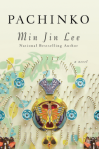
However, the three books that I am actively reading I’m loving: To Say Nothing of the Dog by Connie Willis is an uproarious blend of time travel science fiction and Victorian pastiche (university library), Pachinko by Min Jin Lee is a compulsive historical saga set in Korea (ARC from NetGalley), and the memoir Birds Art Life by Kyo Maclear has been compared to H Is for Hawk in the way she turns to birdwatching to deal with depression (e-book from Edelweiss). I also will be unlikely to resist my e-galley of the latest Anne Lamott book, Hallelujah Anyway (forthcoming in April, ARC from Edelweiss), for much longer.



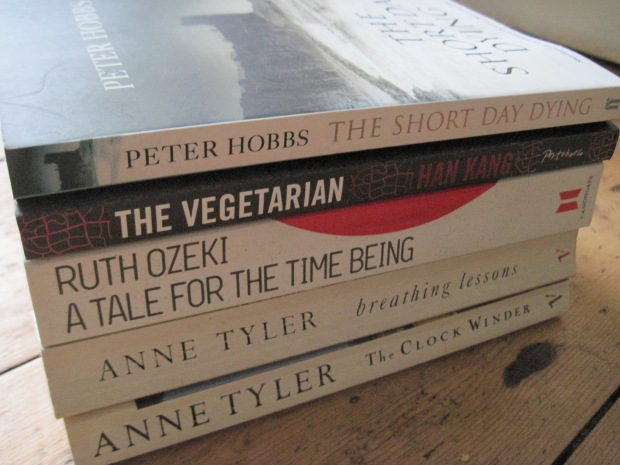
Meanwhile, in post-holiday charity shopping I scored six books for £1.90: one’s been tucked away as a present for later in the year; the Ozeki I’ve already read, but it’s a favorite so I’m glad to own it; and the rest are new to me. I look forward to trying Han Kang; Anne Tyler is a reliable choice for a cozy read; and the Hobbs sounds like a wonderful Victorian-set novel.
All in all, I seem to be starting my year in books as I mean to go on: reading a ton; making sure I review most or all of the books, even if I write just a few sentences; maintaining a balance between my own books, library books, and recent or advance NetGalley/Edelweiss reads; and failing to restrain myself from buying more.
Now if I could just work on my general attitude…
 Bookish Beck = Rebecca Foster. American transplant to England. Freelance proofreader and book reviewer.
 Bookish Beck