This and That (The January Blahs)
The January blahs have well and truly arrived. The last few months of 2023 (December in particular) were too full: I had so much going on that I was always rushing from one thing to the next and worrying I didn’t have the time to adequately appreciate any of it. Now my problem is the opposite: very little to do, work or otherwise; not much on the calendar to look forward to; and the weather and house so cold I struggle to get up each morning and push past the brain fog to settle to any task. As I kept thinking to myself all autumn, there has to be a middle ground between manic busyness and boredom. That’s the head space where I’d like to be living, instead of having to choose between hibernation and having no time to myself.
At least these frigid January days are good for being buried in books. Unusually for me, I’m in the middle of seven doorstoppers, including King by Jonathan Eig (perfect timing as Monday is Martin Luther King Jr. Day), Wellness by Nathan Hill, and Babel by R.F. Kuang (a nominal buddy read with my husband).
Another is Carol Shields’s Collected Short Stories for a buddy rereading project with Marcie of Buried in Print. We’re partway through the first volume, Various Miracles, after a hiccup when we realized my UK edition had a different story order and, in fact, different contents – it must have been released as a best-of. We’ll read one volume per month in January–March. I also plan to join Heaven Ali in reading at least one Margaret Drabble book this year. I have The Waterfall lined up, and her Arnold Bennett biography lurking. Meanwhile, the Read Indies challenge, hosted by Karen and Lizzy in February, will be a great excuse to catch up on some review books from independent publishers.
Literary prize season will be heating up soon. I put all of the Women’s Prize (fiction and nonfiction!) dates on my calendar and I have a running list, in a file on my desktop, of all the novels I’ve come across that would be eligible for this year’s race. I’m currently reading two memoirs from the Nero Book Awards nonfiction shortlist. Last year it looked like the Folio Prize was set to replace the Costa Awards, giving category prizes and choosing an overall winner. But then another coffee chain, Caffè Nero, came along and picked up the mantle.
This year the Folio has been rebranded as The Writers’ Prize, again with three categories, which don’t quite overlap with the Costa/Nero ones. The Writers’ Prize shortlists just came out on Tuesday. I happen to have read one of the poetry nominees (Chan) and one of the fiction (Enright). I’m going to have a go at reading the others that I can source via the library. I’ll even try The Bee Sting given it’s on both the Nero and Writers’ shortlists (ditto the Booker) and I have a newfound tolerance of doorstoppers.
As for my own literary prize involvement, my McKitterick Prize manuscript longlist is due on the 31st. I think I have it finalized. Out of 80 manuscripts, I’ve chosen 5. The first 3 stood out by a mile, but deciding on the other 2 was really tricky. We judges are meeting up online next week.
I’m listening to my second-ever audiobook, an Audible book I was sent as a birthday gift: There Plant Eyes by M. Leona Godin. My routine is to find a relatively mindless data entry task to do and put on a chapter at a time.
There are a handful of authors I follow on Substack to keep up with what they’re doing in between books: Susan Cain, Jean Hannah Edelstein, Catherine Newman, Anne Boyd Rioux, Nell Stevens (who seems to have gone dormant?), Emma Straub and Molly Wizenberg. So far I haven’t gone for the paid option on any of the subscriptions, so sometimes I don’t get to read the whole post, or can only see selected posts. But it’s still so nice to ‘hear’ these women’s voices occasionally, right in my inbox.
My current earworms are from Belle and Sebastian’s Late Developers album, which I was given for Christmas. These lyrics from the title track – saved, refreshingly, for last; it’s a great strategy to end on a peppy song (an uplifting anthem with gospel choir and horn section!) instead of tailing off – feel particularly apt:
Live inside your head
Get out of your bed
Brush the cobwebs off
I feel most awake and alive when I’m on my daily walk by the canal. It’s such a joy to hear the birdsong and see whatever is out there to be seen. The other day there was a red kite zooming up from a field and over the houses, the sun turning his tail into a burnished chestnut. And on the opposite bank, a cuboid rump that turned out to belong to a muntjac deer. Poetry fragments from two of my bedside books resonated with me.
This is the earnest work. Each of us is given
only so many mornings to do it—
to look around and love
the oily fur of our lives,
the hoof and the grass-stained muzzle.
Days I don’t do this
I feel the terror of idleness
like a red thirst.
That is from “The Deer,” from Mary Oliver’s House of Light, and reminds me that it’s always worthwhile to get outside and just look. Even if what you’re looking at doesn’t seem to be extraordinary in any way…
Importance leaves me cold,
as does all the information that is classed as ‘news’.
I like those events that the centre ignores:
small branches falling, the slow decay
of wood into humus, how a puddle’s eye
silts up slowly, till, eventually,
the birds can’t bathe there. I admire the edge;
the sides of roads where the ragwort blooms
low but exotic in the traffic fumes;
the scruffy ponies in a scrubland field
like bits of a jigsaw you can’t complete;
the colour of rubbish in a stagnant leat.
There are rarest enjoyments, for connoisseurs
of blankness, an acquired taste,
once recognised, it’s impossible to shake,
this thirst for the lovely commonplace.
(from “Six Poems on Nothing,” III by Gwyneth Lewis, in Parables & Faxes)
This was basically a placeholder post because who knows when I’ll next finish any books and write about them … probably not until later in the month. But I hope you’ve found at least one interesting nugget!
What ‘lovely commonplace’ things are keeping you going this month?
My Most Anticipated Releases of 2024
I feel a sense of freedom and anticipation about the reading opportunities stretching out ahead of me and want to preserve that, so apart from participating in my usual challenges and trying to read more from my own shelves, I have no specific reading goals for the year. (My ever-growing set-aside shelf does make me feel guilty, though.)
Knowing myself, close to half of my reading will be current-year releases. I’ve already read 10 releases from 2024 (8 are written up here), and I’m also looking forward to new work from Julia Armfield, Tracy Chevalier, Matt Gaw, Garth Risk Hallberg, Sheila Heti, Ann Hood, Rachel Khong, Sarah Manguso, Tommy Orange, Francesca Segal, Joe Shute and J. Courtney Sullivan. If there’s a recurring theme here, it’s sophomore novels from authors whose debuts I loved. Only a few nonfiction releases are musts for me.
I’ve chosen the dozen below as my most anticipated titles that I know about so far. They are arranged in UK release date order, within sections by genre. (U.S. details given too/instead if USA-only.) Quotes are excerpts from the publisher blurbs, e.g., from Goodreads. I’ve noted if I have sourced a review copy already.
Fiction
 Wellness by Nathan Hill [Jan. 25, Picador; has been out since September from Knopf] Hill’s debut novel, The Nix, was fantastic. I’ve developed an allergy to doorstoppers over the past year, but am determined to read this anyway. “Moving from the gritty 90s Chicago art scene to a suburbia of detox diets and home renovation hysteria, Wellness mines the absurdities of modern technology and modern love to reveal profound, startling truths about intimacy and connection.” Has been likened to Egan, Franzen and Strout. (Print proof copy)
 The Vulnerables by Sigrid Nunez [Jan. 25, Virago; has been out since November from Riverhead] I’ve read and loved three of Nunez’s novels. I’m a third of the way into this, “a meditation on our contemporary era, as a solitary female narrator asks what it means to be alive at this complex moment in history … Humor, to be sure, is a priceless refuge. Equally vital is connection with others, who here include an adrift member of Gen Z and a spirited parrot named Eureka.” (Print proof copy)
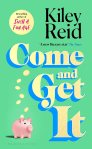 Come and Get It by Kiley Reid [Jan. 30, Bloomsbury / Jan. 9, G.P. Putnam’s] Such a Fun Age was a surprise hit with me, so I’m keen to try her second novel, set on a college campus. “It’s 2017 at the University of Arkansas. Millie Cousins, a senior resident assistant, wants to graduate, get a job, and buy a house. So when Agatha Paul, a [lesbian] visiting professor and writer, offers Millie an easy yet unusual opportunity, she jumps at the chance. But Millie’s starry-eyed hustle becomes jeopardised by odd new friends, vengeful dorm pranks and illicit intrigue.” (NetGalley download / public library reservation)
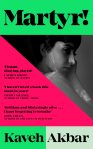 Martyr! by Kaveh Akbar [March 7, Picador /Jan. 23, Knopf] I’ve read Akbar’s two full-length poetry collections and particularly admired Pilgrim Bell. His debut novel sounds kind of unhinged, but I figure it’s worth a try. “When Cyrus’s obsession with the lives of the martyrs – Bobby Sands, Joan of Arc – leads him to a chance encounter with a dying artist, he finds himself drawn towards the mysteries of an uncle who rode through Iranian battlefields dressed as the Angel of Death; and toward his [late] mother, who may not have been who or what she seemed.” (NetGalley download)
 Memory Piece by Lisa Ko [March 7, Dialogue Books / March 19, Riverhead] Ko’s debut, The Leavers, was a favourite of mine from 2018, so it was great to hear that she is coming out with a new book. “Moving from the predigital 1980s to the art and tech subcultures of the 1990s to a strikingly imagined portrait of the 2040s, Memory Piece is an innovative and audacious story of three lifelong [female, Asian American] friends as they strive to build satisfying lives in a world that turns out to be radically different from the one they were promised.”
 The Paris Novel by Ruth Reichl [April 23, Random House] I’m reading this for an early Shelf Awareness review. It’s fairly breezy but enjoyable, with an expected foodie theme plus hints of magic but also trauma from the protagonist’s upbringing. “When her estranged mother dies, Stella is left with an unusual gift: a one-way plane ticket, and a note reading ‘Go to Paris’. But Stella is hardly cut out for adventure … When her boss encourages her to take time off, Stella resigns herself to honoring her mother’s last wishes.” (PDF review copy)
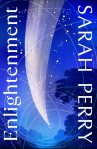 Enlightenment by Sarah Perry [May 2, Jonathan Cape / May 7, Mariner Books] “Thomas Hart and Grace Macauley are fellow worshippers at the Bethesda Baptist chapel in the small Essex town of Aldleigh. Though separated in age by three decades, the pair are kindred spirits – torn between their commitment to religion and their desire for more. But their friendship is threatened by the arrival of love.” Sounds a lot like The Essex Serpent (which is a very good thing) but with astronomy. (Print proof copy)
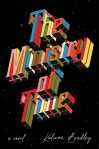 The Ministry of Time, Kaliane Bradley [May 7, Sceptre/Avid Reader Press] “A time travel romance, a speculative spy thriller, a workplace comedy, and an ingeniously constructed exploration of the nature of truth and power and the potential for love to change it. In the near future, a civil servant is offered the salary of her dreams and is, shortly afterward, told what project she’ll be working on. A recently established government ministry is gathering ‘expats’ from across history to establish whether time travel is feasible—for the body, but also for the fabric of space-time.” Promises to be zany and fun.
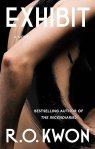 Exhibit by R.O. Kwon [May 21, Virago/Riverhead] I loved The Incendiaries and look forward to reading this next month for an early Shelf Awareness review. “At a lavish party in the hills outside of San Francisco, Jin Han meets Lidija Jung and nothing will ever be the same for either woman. A brilliant, young photographer, Jin is at a crossroads in her work, in her marriage to college sweetheart Phillip, in who she is and who she wants to be. Lidija is a glamorous, injured world-class ballerina on hiatus from her ballet company under mysterious circumstances. Drawn to each other by their intense artistic drives, the two women talk all night.” Bisexual rep from Kwon. (PDF review copy)
Nonfiction
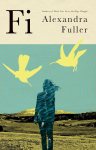 Fi: A Memoir of My Son by Alexandra Fuller [April 9, Grove Press] Fuller is one of the best memoirists out there (Don’t Let’s Go to the Dogs Tonight and Leaving Before the Rains Come), and I read pretty much every bereavement memoir I can get my hands on anyway. “It’s midsummer in Wyoming and Alexandra is barely hanging on. Grieving her father and pining for her home country of Zimbabwe, reeling from a midlife breakup, freshly sober and piecing her way uncertainly through a volatile new relationship with a younger woman, Alexandra vows to get herself back on even keel. And then – suddenly and incomprehensibly – her son Fi, at 21 years old, dies in his sleep.” (PDF review copy)
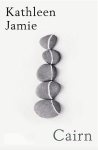 Cairn by Kathleen Jamie [June 13, Sort Of Books] Thanks to Paul (I link to his list below) for letting me know about this one. I’ll read anything Kathleen Jamie writes. “Cairn: A marker on open land, a memorial, a viewpoint shared by strangers. For the last five years … Kathleen Jamie has been turning her attention to a new form of writing: micro-essays, prose poems, notes and fragments. Placed together, like the stones of a wayside cairn, they mark a changing psychic and physical landscape.” Which leads nicely into…
Poetry
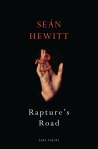 Rapture’s Road by Seán Hewitt [Jan. 11, Jonathan Cape] Hewitt’s debut collection, Tongues of Fire, was brilliant. This sounds like more of the same: “these poems forge their own unique path through the landscape. … Following the reciprocal relationship between queer sexuality and the natural world that he explored in [his previous book, the poet conjures us here into a trance: a deep delirium of hypnotic, hectic rapture where everything is called into question, until a union is finally achieved – a union in nature, with nature.”
Other lists for more ideas:
Electric Lit (all by women of color, as chosen by R.O. Kwon)
Kate – we overlap on a couple of our picks
Laura – we overlap on a few of our picks
Paul (mostly nonfiction)
What catches your eye here? What other 2024 titles do I need to know about?
#NovNov23 Week 4, “The Short and the Long of It”: W. Somerset Maugham & Jan Morris
Hard to believe, but it’s already the final full week of Novellas in November and we have had 109 posts so far! This week’s prompt is “The Short and the Long of It,” for which we encourage you to pair a novella with a nonfiction book or novel that deals with similar themes or topics. The book pairings week of Nonfiction November is always a favourite (my 2023 contribution is here), so think of this as an adjacent – and hopefully fun – project. I came up with two pairs: one fiction and one nonfiction. In the first case, the longer book led me to read a novella, and it was vice versa for the second.

W. Somerset Maugham
The House of Doors by Tan Twan Eng (2023)
&
Liza of Lambeth by W. Somerset Maugham (1897)
I wasn’t a huge fan of The Garden of Evening Mists, but as soon as I heard that Tan Twan Eng’s third novel was about W. Somerset Maugham, I was keen to read it. Maugham is a reliably readable author; his books are clearly classic literature but don’t pose the stylistic difficulties I now experience with Dickens, Trollope et al. And yet I know that Booker Prize followers who had neither heard of nor read Maugham have enjoyed this equally. I’m surprised it didn’t make it past the longlist stage, as I found it as revealing of a closeted gay writer’s life and times as The Master (shortlisted in 2004) but wider in scope and more rollicking because of its less familiar setting, true crime plot and female narration.
The main action is set in 1921, as “Willie” Somerset Maugham and his secretary, Gerald, widely known to be his lover, rest from their travels in China and the South Seas via a two-week stay with Robert and Lesley Hamlyn at Cassowary House in Penang, Malaysia. Robert and Willie are old friends, and all three men fought in the First World War. Willie’s marriage to Syrie Wellcome (her first husband was the pharmaceutical tycoon) is floundering and he faces financial ruin after a bad investment. He needs a good story that will sell and gets one when Lesley starts recounting to him the momentous events of 1910, including a crisis in her marriage, volunteering at the party office of Chinese pro-democracy revolutionary Dr Sun Yat Sen, and trying to save her friend Ethel Proudlock from a murder charge.

It’s clever how Tan weaves all of this into a Maugham-esque plot that alternates between omniscient third-person narration and Lesley’s own telling. The glimpses of expat life and Asia under colonial rule are intriguing, and the scene-setting and atmosphere are sumptuous – worthy of the Merchant Ivory treatment. I was left curious to read more by and about Maugham, such as Selina Hastings’ biography. (Public library) 
But for now I picked up one of the leather-bound Maugham books I got for free a few years ago. Amusingly, the novella-length Liza of Lambeth is printed in the same volume with the travel book On a Chinese Screen, which Maugham had just released when he arrived in Penang.
{SPOILERS AHEAD}
This was Maugham’s debut novel and drew on his time as a medical intern in the slums of London. In tone and content it falls almost perfectly between Dickens and Hardy, because on the one hand Liza Kemp and her neighbours are cheerful paupers even though they work in factories, have too many children and live in cramped quarters; on the other hand, alcoholism and domestic violence are rife, and the wages of sexual sin are death. All seems light to start with: an all-village outing to picnic at Chingford; pub trips; and harmless wooing as Liza rebuffs sweet Tom in favour of a flirtation with married Jim Blakeston.
 At the halfway point, I thought we were going full Tess of the d’Urbervilles – how is this not a rape scene?! Jim propositions her four times, ignoring her initial No and later quiet. “‘Liza, will yer?’ She still kept silence, looking away … Suddenly he shook himself, and closing his fist gave her a violent, swinging blow in the belly. ‘Come on,’ he said. And together they slid down into the darkness of the passage.” So starts their affair, which leads to Liza getting beaten up by Mrs Blakeston in the street and then dying of an infection after a miscarriage. The most awful character is Mrs Kemp, who spends the last few pages – while Liza is literally on her deathbed – complaining of her own hardships, congratulating herself on insuring her daughter’s life, and telling a blackly comic story about her husband’s corpse not fitting in his oak coffin and her and the undertaker having to jump on the lid to get it to close.
Liza isn’t entirely the stereotypical whore with the heart of gold, but she is a good-time girl (“They were delighted to have Liza among them, for where she was there was no dullness”) and I wonder if she could even have been a starting point for Eliza Doolittle in Pygmalion. Maugham’s rendering of the cockney accent is over-the-top –
“‘An’ when I come aht,’ she went on, ‘’oo should I see just passin’ the ’orspital but this ’ere cove, an’ ’e says to me, ‘Wot cheer,’ says ’e, ‘I’m goin’ ter Vaux’all, come an’ walk a bit of the wy with us.’ ‘Arright,’ says I, ‘I don’t mind if I do.’”
– but his characters are less caricatured than Dickens’s. And, imagine, even then there was congestion in London:
“They drove along eastwards, and as the hour grew later the streets became more filled and the traffic greater. At last they got on the road to Chingford, and caught up numbers of other vehicles going in the same direction—donkey-shays, pony-carts, tradesmen’s carts, dog-carts, drags, brakes, every conceivable kind of wheeled thing, all filled with people”
In short, this was a minor and derivative-feeling work that I wouldn’t recommend to those new to Maugham. He hadn’t found his true style and subject matter yet. Luckily, there’s plenty of other novels to try. (Free mall bookshop) [159 pages] 
Jan Morris
Conundrum by Jan Morris (1974)
&
Jan Morris: Life from Both Sides, A Biography by Paul Clements (2022)

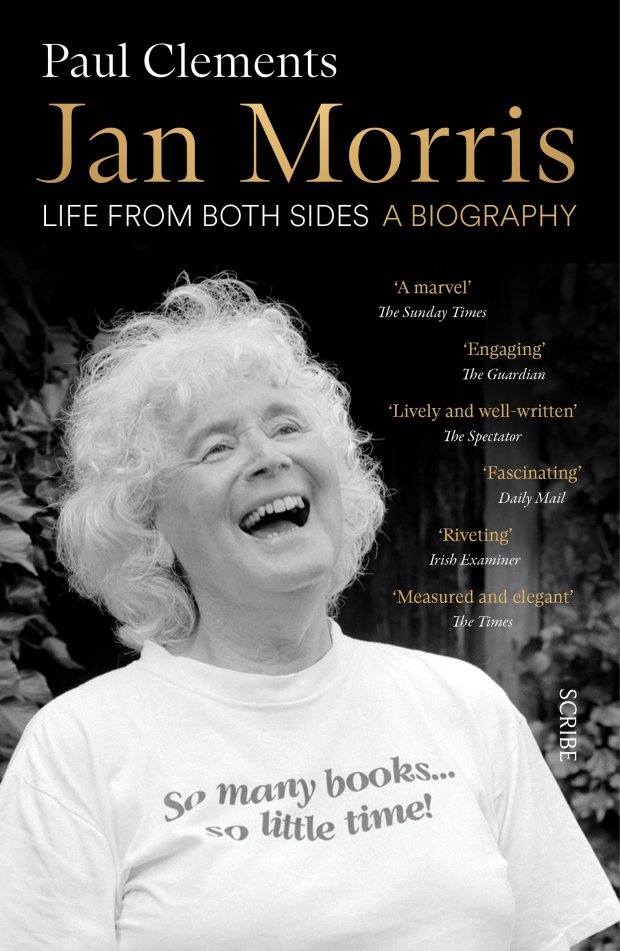
Back in 2021, I reread and reviewed Conundrum during Novellas in November. It’s a short memoir that documents her spiritual journey towards her true identity – she was a trans pioneer and influential on my own understanding of gender. In his doorstopper of a biography, Paul Clements is careful to use female pronouns throughout, even when this is a little confusing (with Morris a choirboy, a soldier, an Oxford student, a father, and a member of the Times expedition that first summited Everest). I’m just over a quarter of the way through the book now. Morris left the Times before the age of 30, already the author of several successful travel books on the USA and the Middle East. I’ll have to report back via Love Your Library on what I think of this overall. At this point I feel like it’s a pretty workaday biography, comprehensive and drawing heavily on Morris’s own writings. The focus is on the work and the travels, as well as how the two interacted and influenced her life.

Vacation Reading Plans: Spain and Scotland
As treats to look forward to after our DIY and moving adventures, we booked ourselves two summer holidays. Next week we’re off to Northern Spain for eight days. Thanks to a Brittany Ferries voucher from a cancelled trip in 2020, it ended up being a really cheap option – but it means I have to go to sea for 20 hours, each way. And I hate boats. My last sea voyage back from France only lasted four hours or so, but I was so sick. This time, I will be packing all the seasickness remedies known to woman. Your ideas are welcome!
I’ve never been to Spain and have lost my kindergarten Spanish beyond the few bits I’ve picked back up from my husband’s Duolingo practice. We’ve had next to no time to plan what we’re going to do while we’re there, but it should be a great place for hiking and wildlife watching, with a more Atlantic than Mediterranean climate. (We’re no beachgoers.)
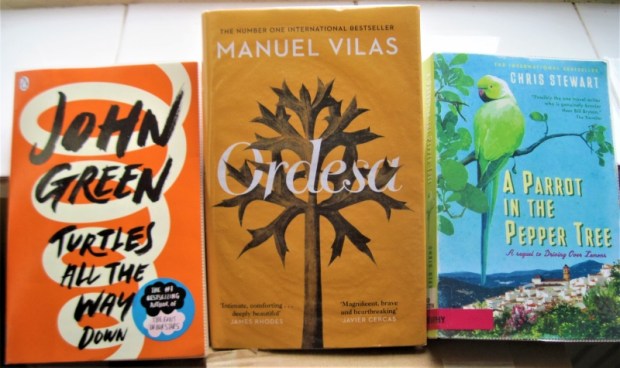
What I have been planning, of course, is what I’ll read. I asked Twitter for recommendations, and got a couple that I followed up on. My library’s holdings weren’t particularly helpful, but I found a few somewhat appropriate reads: As I Walked Out One Midsummer Morning by Laurie Lee, Homage to Catalonia by George Orwell, A Parrot in the Pepper Tree by Chris Stewart, Ordesa by Manuel Vilas, and The Shadow of the Wind by Carlos Ruiz Zafón. Alas that all of these are by men and only two are in translation! For place-specific reading, I’ve supplemented them with Book of Days by Phoebe Power, a book-length poem about the Camino pilgrimage route to Santiago de Compostela, which passes not far from where we’re staying.
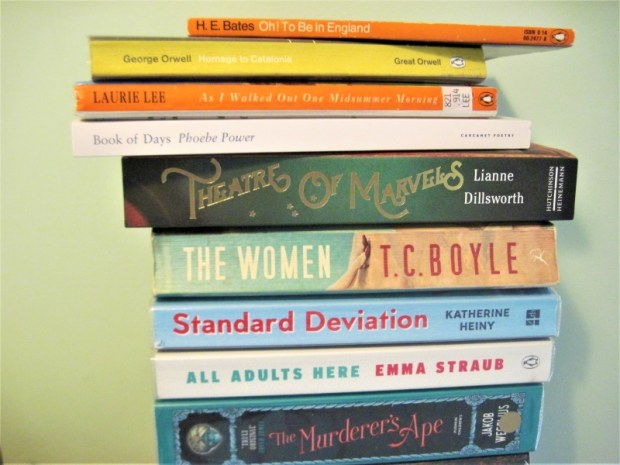
I also amassed a bunch of doorstoppers and slightly lighter literary fiction to help the hours at sea pass. See anything you’d particularly recommend? I’ll likely pack all of these and more (‘sensible’ is not a word that can generally be applied to my reading plans or habits!) because we’re taking a car onto the ferry so space/weight is not an issue.
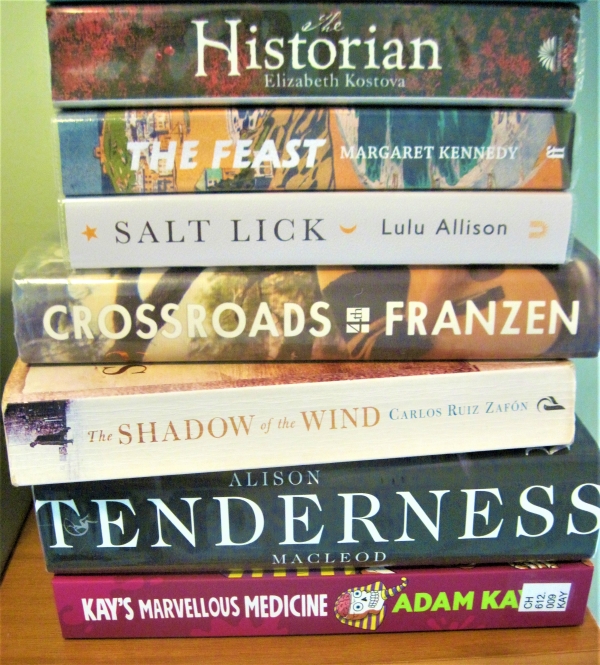
Ironically, I have many more relevant book ideas for our second summer holiday to the Outer Hebrides in late June, but we’re travelling up by train so my book capacity will be minimal! There are loads of novels set on Scottish islands. Here’s what I’m pondering from the library:


Love of Country would be a reread, but is really more for my husband to read. I also fancy a reread of Night Waking by Sarah Moss.
Do you have any trips to look forward to? Will you try for any reading on location?
To Paradise by Hanya Yanagihara (Doorstopper of the Quarter)
When I expressed interest in Hanya Yanagihara’s To Paradise on Twitter, having loved A Little Life and tepidly admired The People in the Trees, I didn’t expect to be chosen to receive one of my most anticipated releases of the year. A proof arrived while I was in the States for Christmas. As soon as I got back, I started it – with a vision of doing little else but reading it for a few days and reviewing it early in January. Instead, I read about 30 pages and set it aside, the 700-page heft mocking me from my coffee table stack for the better part of two months. Finally, I forced myself to set a daily reading goal: first 30 pages, then 40, then 60; and on Friday I read the last 100 pages over a couple sessions in the summerhouse. That regimented approach was what it took for me to get through my first doorstopper of the year.
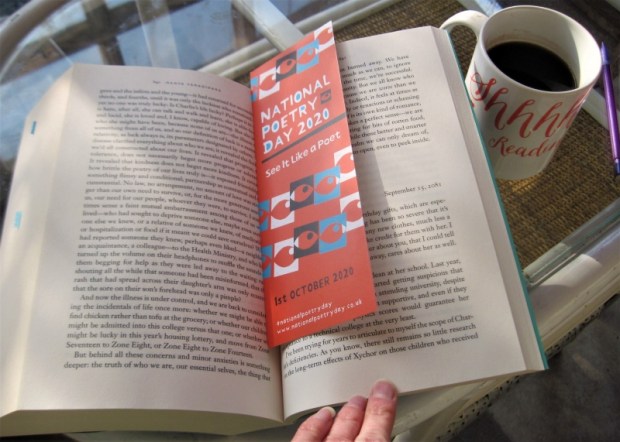
The novel is in three parts – discrete enough to feel like separate books – set largely in 1893, 1993, and 2093. New York City’s Washington Square, even one particular house, recurs as a setting in all three, with some references to the American West and South and with flashbacks to time in Hawaii linking Books II and III.
The overarching theme is the American project: is freedom, both individual and collective, a worthy and attainable goal? Or are the country’s schisms too deep to be overcome? Class, race, sexuality, and physical and mental illness are some of the differences that Yanagihara explores. Even when equality of treatment has been won in one time and scenario – same-sex marriage is de rigueur in her alternative version of the 1890s, where the USA is divided into several nations – there is always the threat of a taken-for-granted right being retracted.
In Book I, David Bingham, who is to inherit his grandfather’s Washington Square property, considers a family-approved arranged marriage with an older man, Charles, versus eloping with a lower-class male teacher, Edward, with whom he has fallen in love. Edward wants them to light out for California, where new opportunities await but homosexuality is outlawed. Can they live in freedom if they’re repressing an essential part of their identity? The austere, elegant tone is a pitch-perfect pastiche of Henry James or Edith Wharton. Although this section took me the longest to read, it was the one I most appreciated for its flawless evocation of the time period and a rigid class structure. As in The Underground Railroad, though, the alt-history angle wasn’t really the most memorable aspect.
In Book II, David Bingham, also known as Kawika, is a paralegal having a secret affair with Charles, a partner in his law firm. Various friends and former lovers in their circle have AIDS, but Charles’s best friend Peter is dying of cancer. Before Peter flies to Switzerland for an assisted death, Charles throws him one last dinner party. Meanwhile, David receives a long letter from his ill father recounting their descent from Indigenous nobility and his failed attempt to set up a self-sufficient farm on their inherited land in Hawaii. This strand is closest to Yanagihara’s previous novels, the gay friendship circle reminiscent of A Little Life and the primitive back-to-the-land story recalling The People in the Trees. I also thought of Mrs Dalloway – David wanted to get the flowers for the party himself – and of Three Junes.
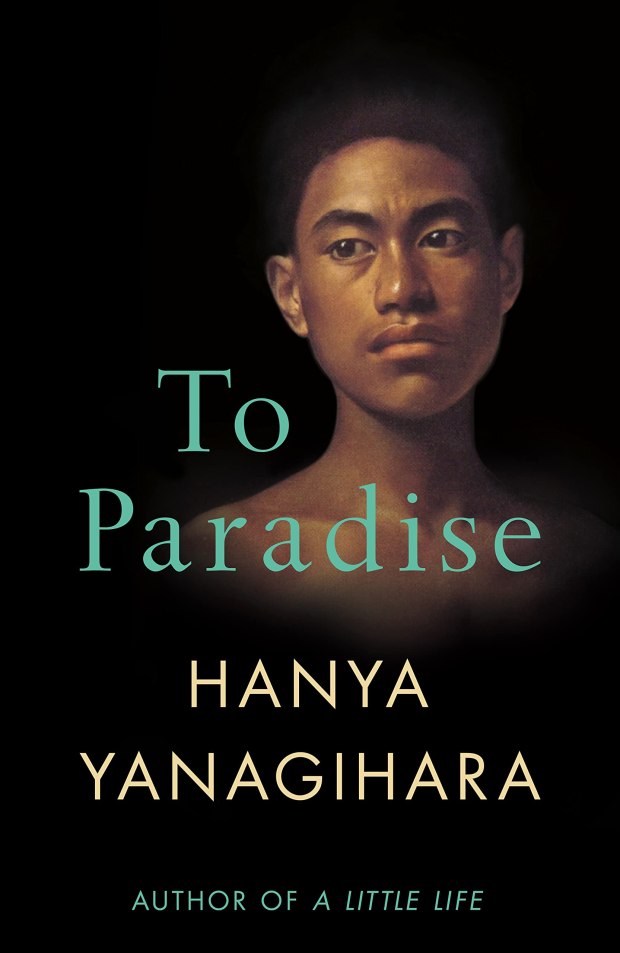 Book III is set in a dystopian future of extreme heat, rationing and near-constant pandemics. The totalitarian state institutes ever more draconian policies, with censorship, quarantine camps and public execution of insurgents. The narrator, intellectually disabled after a childhood illness, describes the restrictions with the flat affect of the title robot from Kazuo Ishiguro’s Klara and the Sun. When a stranger offers her the chance to escape, she is forced to weigh up freedom against safety. An alternating strand, based around letters sent by a Chinese Hawaiian character, traces how things got this bad, from the 2040s onwards.
While the closing speculative vision is all too plausible, two other literary/science fiction releases I’ve read this year, Sea of Tranquillity by Emily St. John Mandel and How High We Go in the Dark by Sequoia Nagamatsu, are more powerful and direct. Book III takes up half of the text and could stand alone, but the fact that it appears as a culmination of two other narratives creates false expectations that it can’t meet. The connections between the three are incidental – abandonment by a mother, a child raised by a grandparent, an arranged marriage, isolating illness – with recurring tactics like stories within stories and epistolary sections. The most overt cohesive strategy, the repeating of names across time periods, feels gimmicky and, again, sets readers up for a letdown by promising meaning that isn’t there.
Ultimately, the message seems to be: America’s problems are inherent, and so persist despite apparent progress. It takes a lot of words to build to that somewhat obvious point. I couldn’t suppress my disappointment that none of the storylines are resolved – this does, however, mean that one can choose to believe things will turn out happily for the characters. Their yearning for a more authentic life, even in a rotten state, makes it easy to empathize with their situations. I had high regard for the self-assured cross-genre prose (my interest waning only during the elder Kawika’s improbably long letter), but felt the ambition perhaps outshone the achievement.
As I learned when reviewing a recent book about American utopian projects, Heaven Is a Place on Earth, and interviewing its author, Adrian Shirk, an imagined utopia and a projected dystopia aren’t actually so different. Here was her response to one of my questions:
At one point you say, “utopia is never far from its opposite.” Dystopian novels are as popular as ever. To what extent do you think real-life utopias and fictional dystopias have the same aims?
I think real-life utopian experiments and fictional dystopias both offer warnings about the dangers of relying too much on ideology, and not enough on living, or choosing the person over the belief. So, in that way, real utopian experiments and fictional dystopian narratives are two sides of the same coin: a dystopia is a utopia that lost sight of—or never included—understanding itself as resistance to a violent empire, and thus starts to look like a violent empire itself.
Both start by diagnosing a societal sickness. The question is how we then get to paradise.
Page count: 701
Book I: 
Book II:
Book III: 
My overall rating:
With thanks to Picador for the proof copy for review.
Quick Thoughts on the Women’s Prize 2022 Longlist & My Reading Plans
Tuesday is my volunteering morning at the library, but at 9:45 I nipped onto one of the public access PCs so I could find out which books were on the Women’s Prize longlist. I just couldn’t wait until I got home! It’s a surprising list. Those who thought Rooney and Yanagihara would be snubbed were absolutely right. Debuts and historical fiction aren’t as plentiful as forecast, but there are two doorstoppers on there, plus another 450+-pager. And it is great to see a list that is half by BIPOC women.
Of my wishes and predictions, 1 and 2 were correct, so I got 3 right overall, with my wildcard choice being the only nominee I’ve read in full so far. I’m currently reading another 2 and have 3 more set to read – the moment I got the news I marched over to borrow a couple more.
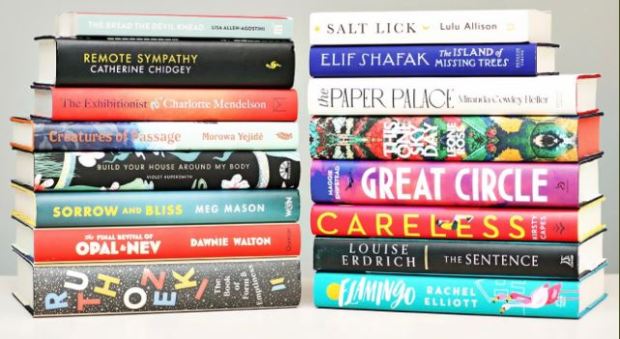
Fair play to the judges – I hadn’t even HEARD of these SIX titles:
- The Bread the Devil Knead by Lisa Allen-Agostini
- Salt Lick by Lulu Allison
- Careless by Kirsty Capes
- Remote Sympathy by Catherine Chidgey
- Flamingo by Rachel Elliott
- Creatures of Passage by Morowa Yejidé
I haven’t had a chance to look into these half-dozen, but will do so later on. I’m only likely to pick them up if a) others rave about them and/or b) they’re shortlisted.
Read:
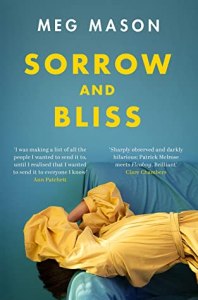 Sorrow and Bliss by Meg Mason: They say turning 40 can do weird things to you. Martha Friel gets a tattoo – so far, so stereotypical – but also blows up her marriage to Patrick, who’s been devoted to her since they were teens and met as family friends. In the year that follows, she looks back on a life that’s been defined by mental illness. As a young woman she was told she should never have children, but recently she met a new psychiatrist who gave her a proper diagnosis and told her motherhood was not out of the question. But is it too late for Martha and Patrick? Martha’s narration is a delight, wry and deadpan but also with moments of wrenching emotion. Her relationship with her sister, Ingrid, who gives birth to her first child on their aunt’s bathroom floor and eventually has four under the age of nine, is a highlight, and it’s touching to see how their mother and their aunt, both initially standoffish, end up being pillars of support. (My full review)
Currently reading:
 Build Your House Around My Body by Violet Kupersmith – I’m just over half done, and loving it. A weird and magical and slightly horror-tinged story set in Vietnam past and present, it builds on her debut ghost stories. Sort of plays the role Our Wives Under the Sea would have had on the longlist (though I dearly wish it could have been nominated as well).
 Set aside last year because it’s twee and annoying, but will now continue (ARGH + le sigh):
The Book of Form and Emptiness by Ruth Ozeki
 Own and will read soon (this was a treat to self with birthday money last year):
The Final Revival of Opal and Nev by Dawnie Walton
 Borrowed from library:
The Paper Palace by Miranda Cowley Heller
The Island of Missing Trees by Elif Shafak
 DNFed last year (twice); will not attempt again:
Great Circle by Maggie Shipstead
 On request from the library:
The Sentence by Louise Erdrich
The Exhibitionist by Charlotte Mendelson
Not interested in reading:
This One Sky Day by Leone Ross – I saw Ross speak about this and read an excerpt as part of a Faber showcase. I have a limited tolerance for magic realism and don’t think this appeals.
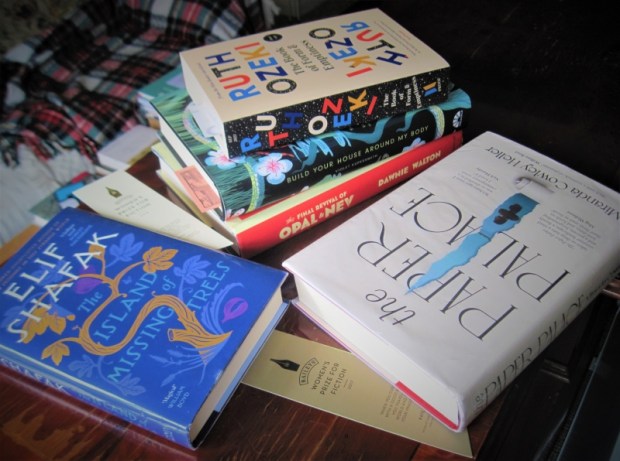
Above: my reading plans. Plenty to be getting on with before the shortlist announcement on 27th April!
What have you read, or might you read, from the longlist?
Some 2022 Reading Goals
First of all, I need to give some proper attention to the books on my set-aside shelf (nearly 40 of them), preferably clearing this in January – while also catching up on review copies from last year and continuing with the January releases.

Thereafter, I’d like to concentrate on backlist books for the year. This may seem ironic given that I review new ones on the blog and for various other outlets, and that I’m going to be featuring my 20 most anticipated titles of 2022 in a post tomorrow, but I have a few reasons for wanting to focus on older material.
One is that backlist reading consistently produces new favourites. Another is that every time I shelve in the library’s back room rolling stacks, I see novels that I’ve always meant to read, or that look fantastic, and think, “I really should borrow more from in here” … then forget all about them and place holds on (sometimes disappointing) new books instead.
A final reason is that, as I pack up my library in preparation for moving and get a good look at the ~500 unread books all over again, I hope and expect that I will be inspired to read them – and also to revisit some long-neglected favourites. (Of course, I may also cull some before the move, which would be fine.) The plan is to eventually replace our fleet of white Billy bookcases with built-in shelving either side of the decorative fireplaces in a few rooms of the new house.


As always, I’d like to get to more classics, doorstoppers and literature in translation (I own hardly any translated titles, so most of this will have to be from the library). I’ll participate in all the usual annual blogger challenges plus any new ones I can fit in, including Annabel’s #NordicFINDS – I’m currently reading Sophie’s World by Jostein Gaarder to review later this month.
I’m sure to follow a similar set of literary prizes as last year, including the Young Writer of the Year Award, the Barbellion Prize, the Rathbones Folio Prize, the Wainwright Prize, and (to a lesser extent) the Dylan Thomas Prize, the Women’s Prize and the Booker Prize. And, of course, I’ll be carefully monitoring the later stages of the McKitterick Prize judging after sending off my own longlist for the unpublished manuscripts. These prize lists plus various review copies will ensure I have a regular influx of recent releases to counterbalance the backlist reads.
Brand new or backlist for you in 2022?
A Look Back at My 2021 Reading: Statistics and Superlatives
I hope everyone passed a lovely holiday week. We had house guests for a few days over New Year’s, so I haven’t had a chance to work up my statistics until now. Marcie sent me a spreadsheet template to keep track of my reading, and my tech whiz husband helped analyze the data. I look forward to catching up on everyone else’s best-of and stats posts, too.
How I did with my 2021 goals
 My simple reading goals for 2021 were to read more biographies, classics, doorstoppers and travel books – genres that tend to sit on my shelves unread. I read one biography in graphic novel form (Orwell by Pierre Christin), but otherwise didn’t manage any. I only read three doorstoppers the whole year, but 29 classics – defining them is always a nebulous matter, but I’m going with books from before 1980 – a number I’m happy with.
 Surprisingly, I did the best with travel books, perhaps because I’ve started thinking about travel writing more broadly and not just as a white man going to the other side of the world and seeing exotic things, since I don’t often enjoy such narratives. Granted, I did read a few like that, and they were exceptional (The Glitter in the Green by Jon Dunn, The Shadow of the Sun by Ryszard Kapuściński and Kings of the Yukon by Adam Weymouth), but if I include essays, memoirs and poetry with significant place-based and migration themes, I was at 26.
The numbers
Exactly the same total as last year (2019 had my maximum-ever of 343). From those three years’ evidence, I’d say I’ve found my natural limit. Next year I will aim for 340 again.
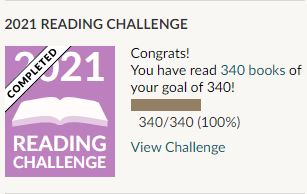
(This is what my lifestyle allows; yours is likely very different. I have bookish friends who read 80 books a year, 120, 150, 180, 200, and so on. My very busy university lecturer/town councillor husband felt bad for ‘only’ reading 65 books this past year, but keep in mind that the average person reads just 12 per year. My message to you, no matter your numbers, is YOU READ LOADS!)
Fiction: 49.7% (6.5% graphic novels; 5.3% short stories)
Nonfiction: 35%
Poetry: 15.3%
(Fiction and nonfiction are usually just about equal for me; I’m surprised that fiction pulled well ahead this year. I also read a bit more poetry this year than last.)
Female author: 66.47%
Male author: 30%
Nonbinary author: 0.88% (Meg-John Barker, Alice Hattrick and Olivia Laing)
Multiple genders (in anthologies): 2.65%
(I’ve been reading more and more by women each year, but this is the first time that female + nonbinary authors have outnumbered men by more than 2:1. I mostly attribute this to my interest in women’s stories. There were also three trans authors on my list.)
BIPOC author: 18.5%
(The first time I have specifically tracked this figure. Not too bad, but I’d prefer 25% or higher.)
Work in translation: 5%
(A decline from last year’s 7.2%. Must try harder!)
E-books: 13.2%
Print books: 86.8%
(Slightly higher than last year because of my new reviewing gig for Shelf Awareness, for which I read almost exclusively e-books.)
2021 releases: 41.8% (add in the 2020 releases and it’s 54.4%)
Pre-release books: 20%
Rereads: 12 (3.5%)
Where my books came from for the whole year:
- Free print or e-copy from publisher: 31.8%
- Public library: 24.7%
- Secondhand purchase: 16.8%
- Free (The Book Thing of Baltimore, the free mall bookshop, a giveaway, Little Free Libraries, etc.): 9.4%
- Downloaded from NetGalley or Edelweiss: 5.9%
- New purchase (sometimes at a bargain price): 5.6%
- University library: 3.8%
- Gifts: 2%
(Decreased from last year: review copies, NetGalley/Edelweiss, gifts; increased from last year: library borrowing, new and secondhand purchases, free books.)
Additional statistics courtesy of Goodreads:
73,520 pages read
Average book length: 216 pages (thank you, novellas and poetry!)
Average rating for 2021: 3.7
Extra Superlatives
First book completed:
Last book completed (also the shortest, at 46 pages)
Longest book, at 628 pages:
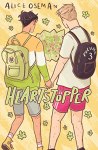
Authors I read the most by: Anne Tyler (5), thanks to Liz’s readalong project; Jim Davis and Alice Oseman cartoons (4 volumes each); Jim Crumley nature books and Emily Rapp Black memoirs (3 each)

Publishers I read the most from: Carcanet (18), then Picador (17), then Bloomsbury and Faber (14 each); in overall first place was undoubtedly Penguin and its many imprints.
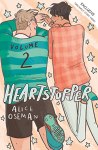
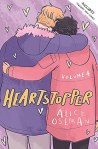
My top discovery of the year: the Heartstopper teen graphic novel series.

My proudest bookish achievement: being asked to be a judge for the McKitterick Prize.
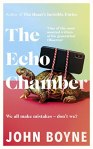
The books that made me laugh the most: The Echo Chamber by John Boyne and Early Morning Riser by Katherine Heiny.
Best book club selections: The Light Years by Elizabeth Jane Howard, Woman on the Edge of Time by Marge Piercy, The Year of Living Danishly by Helen Russell.
Most genuinely helpful book: How to Talk to a Science Denier by Lee McIntyre.
Best last lines encountered: “So where are we gonna go? / I don’t know. Let’s just drive and find out.” (from Heartstopper, Volume 4 by Alice Oseman).
Best 2021 book title: Mrs Death Misses Death.

Shortest book title encountered: In (Will McPhail), followed by Lot (Bryan Washington).
Biggest disappointments: Some of my lowest ratings went to Indelicacy by Amina Cain, Klara and the Sun by Kazuo Ishiguro, and Ness by Robert Macfarlane.
 A 2021 book that everyone loved but me: The Lincoln Highway by Amor Towles.
Themes that kept turning up in my reading: Covid-19, colours (thanks to my summer reading challenge), disability (thanks to shadowing the Barbellion Prize), the mental and physical health benefits of time in nature; perennial topics like friendship, parenting and sisterhood.
Love Your Library, November 2021
It’s the second month of the new Love Your Library feature.

I’d like to start out by thanking all those who have taken part since last month’s post:
Adrian shared lovely stories about the libraries he’s used in Ireland, from childhood onwards.
Laila, Lori and Margaret highlighted their recent loans and reads.
Laura sent a photo of her shiny new library copy of Sally Rooney’s latest novel.

Finally, Marcie contributed this TikTok video of her library stacks!
As for my recent library experiences…
A stand-out read:
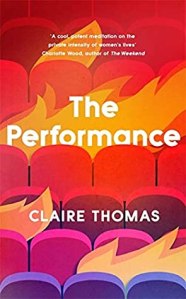 The Performance by Claire Thomas: What a terrific setup: three women are in a Melbourne theatre watching a performance of Samuel Beckett’s Happy Days. Margot is a veteran professor whose husband is developing dementia. Ivy is a new mother whose wealth hardly makes up for the devastating losses of her earlier life. Summer is a mixed-race usher concerned about her girlfriend during the fires rampaging outside the city. In rotating close third person sections, Thomas takes us into these characters’ inner worlds, contrasting their personal worries with wider issues of women’s and indigenous people’s rights and the environmental crisis, as well as with the increasingly claustrophobic scene on stage. In “The Interval,” written as a script, the main characters interact with each other, with the “forced intimacy between strangers” creating opportunities for chance meetings and fateful decisions.
Doorstoppers: A problem
Aware that I’m heading to the States for Christmas on the 14th of December (only a couple of weeks from now!), I’ve started culling my library stacks, returning any books that I’m not super-keen to read before the end of the year. A few I’ll borrow another time, but most I decided weren’t actually for me, even if raved about elsewhere.
I mentioned in a post last week that I’ve had a hard time finding the concentration for doorstoppers lately, which is ironic giving how many high-profile ones there have been this year – or even just this autumn. (For example, seven of BookPage’s top 20 fiction releases of 2021 are over 450 pages.) I gave up twice on Great Circle by Maggie Shipstead, swiftly abandoned Cloud Cuckoo Land by Anthony Doerr (a silly bookish attempt at something like Cloud Atlas), didn’t have time to attempt Tenderness by Alison Macleod and The Magician by Colm Tóibín, and recently returned The Morning Star by Karl Ove Knausgaard unread.
Why so many chunky reads this year, and this season in particular? I’ve wondered if it has had something to do with the lockdown mentality – for authors or readers, or both. It can be awfully cozy, especially as winter advances (in this hemisphere), to sink into a big book. But I find that I’m always looking for an excuse to not engage with a doorstopper.
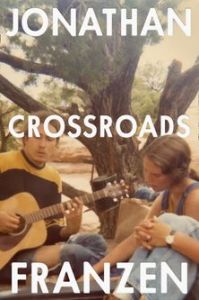 I generally enjoy the scope, detail and moral commentary of Jonathan Franzen’s novels; his previous two, Freedom and Purity, which also numbered 500+ pages, were fantastic. But Crossroads wasn’t happening for me, at least not right now. I only got to page 23 on this attempt. The Chicago setting was promising, and I’m there for the doubt and hypocrisy of church-bound characters. But with text this dense, it feels like it takes SO MANY WORDS to convey just one scene or conversation. I was finding the prose a little obnoxious, too, e.g.
Of Santa the Hildebrandts had always said, Bah, humbug. And yet somehow, long past the age of understanding that presents don’t just buy and wrap themselves, he’d accepted their sudden annual appearance as, if not a miraculous provision, then a phenomenon like his bladder filling with urine, part of the normal course of things. How had he not grasped at nine a truth so obvious to him at ten? The epistemological disjunction was absolute.
Problems here: How many extra words do you need to say “He stopped believing in Santa at age 10”? When is the phrase “epistemological disjunction” ever anything other than showing off? And why did micturition present itself as an apt metaphor?
But anyway, I’ve hardly given this a fair shake yet. I daresay I’ll read it another time; it’ll be my eighth book by Franzen.
Do share a link to your own post in the comments, and feel free to use the above image. I’ve co-opted a hashtag that is already popular on Twitter and Instagram: #LoveYourLibrary.
Here’s a reminder of my ideas of what you might choose to post (this list will stay up on the project page):
- Photos or a list of your latest library book haul
- An account of a visit to a new-to-you library
- Full-length or mini reviews of some recent library reads
- A description of a particular feature of your local library
- A screenshot of the state of play of your online account
- An opinion piece about library policies (e.g. Covid procedures or fines amnesties)
- A write-up of a library event you attended, such as an author reading or book club.
If it’s related to libraries, I want to hear about it!
The Blind Assassin Reread for #MARM, and Other Doorstoppers
It’s the fourth annual Margaret Atwood Reading Month (#MARM), hosted by Canadian blogger extraordinaire Marcie of Buried in Print. In previous years, I’ve read Surfacing and The Edible Woman, The Robber Bride and Moral Disorder, and Wilderness Tips. This year Laila at Big Reading Life and I did a buddy reread of The Blind Assassin, which was historically my favourite Atwood novel. I’d picked up a free paperback the last time I was at The Book Thing of Baltimore. Below are some quick thoughts based on what I shared with Laila as I was reading.

The Blind Assassin (2000)
Winner of the Booker Prize and Hammett Prize; shortlisted for the Orange Prize
I must have first read this about 13 years ago. The only thing I remembered before I started my reread was that there is a science fiction book-within-the-book. I couldn’t recall anything else about the setup before I read in the blurb about the suspicious circumstances of Laura’s death in 1945. Indeed, the opening line, which deserves to be famous, is “Ten days after the war ended, my sister Laura drove a car off a bridge.”
I always love novels about sisters, and Iris is a terrific narrator. Now a cantankerous elderly woman, she takes us back through her family history: her father’s button factory and his clashes with organizing workers, her mother’s early death, and her enduring relationship with their housekeeper, Reenie. Iris and Laura met a young man named Alex Thomas, a war orphan with radical views, at the factory’s Labour Day picnic, and it was clear early on that Laura was smitten, while Iris went on to marry Richard Griffen, a nouveau riche industrialist.

Interspersed with Iris’s recollections are newspaper articles that give a sense that the Chase family might be cursed, and excerpts from The Blind Assassin, Laura’s posthumously published novel. Daring for its time in terms of both explicit content and literary form (e.g., no speech marks), it has a storyline rather similar to 1984, with an upper-crust woman having trysts with a working-class man in his squalid lodgings. During their time snatched together, he also tells her a story inspired by the pulp sci-fi of the time. I was less engaged by the story-within-the-story(-within-the-story) this time around compared to Iris’s current life and flashbacks.
In the back of my mind, I had a vague notion that there was a twist coming, and in my impatience to see if I was right I ended up skimming much of the second half of the novel. My hunch was proven correct, but I was disappointed with myself that I wasn’t able to enjoy the journey more a second time around. Overall, this didn’t wow me on a reread, but then again, I am less dazzled by literary “tricks” these days. At the sentence level, however, the writing was fantastic, including descriptions of places, seasons and characters’ psychology. It’s intriguing to think about whether we can ever truly know Laura given Iris’s guardianship of her literary legacy.
If you haven’t read this before, find a time when you can give it your full attention and sink right in. It’s so wise on family secrets and the workings of memory and celebrity, and the weaving in of storylines in preparation for the big reveal is masterful.
Some favourite passages:
“What fabrications they are, mothers. Scarecrows, wax dolls for us to stick pins into, crude diagrams. We deny them an existence of their own, we make them up to suit ourselves – our own hungers, our own wishes, our own deficiencies.”
“Beginnings are sudden, but also insidious. They creep up on you sideways, they keep to the shadows, they lurk unrecognized. Then, later, they spring.”
“The only way you can write the truth is to assume that what you set down will never be read. Not by any other person, and not even by yourself at some later date. Otherwise you begin excusing yourself. You must see the writing as emerging like a long scroll of ink from the index finger of your right hand; you must see your left hand erasing it. Impossible, of course.”
My original rating (c. 2008): 
My rating now:
What to read for #MARM next year, I wonder??
In general, I have been struggling mightily with doorstoppers this year. I just don’t seem to have the necessary concentration, so Novellas in November has been a boon. I’ve been battling with Ruth Ozeki’s latest novel for months, and another attempted buddy read of 460 pages has also gone by the wayside. I’ll write a bit more on this for #LoveYourLibrary on Monday, including a couple of recent DNFs. The Blind Assassin was only my third successful doorstopper of the year so far. After The Absolute Book, the other one was:
The Lincoln Highway by Amor Towles
 In Towles’ third novel – a big, old-fashioned dose of Americana – brothers and pals set out from Nebraska on road and rail adventures to find a fortune in 1950s New York. The book features some fantastic characters. Precocious Billy steals every scene he appears in. Duchess is a delightfully flamboyant bounder, peppering his speech with malapropisms and Shakespeare quotes. However, Emmett is a dull protagonist, and it’s disappointing that Sally, one of just two main female characters, plays such a minor role. A danger with an episodic narrative is that random events and encounters pile up but don’t do much to further the plot. At nearly 200 pages in, I realized little of consequence had happened yet. A long road, then, with some ups and downs along the way, but Towles’ fans will certainly want to sign up for the ride.
See my full review for BookBrowse; see also my related article on Studebaker cars.
With thanks to Hutchinson for the free copy for review.
 Bookish Beck = Rebecca Foster. American transplant to England. Freelance proofreader and book reviewer.
