#ReadIndies Nonfiction Catch-Up: Ansell, Farrier, Febos, Hoffman, Orlean and Stacey
These are all 2025 releases; for some, it’s approaching a year since I was sent a review copy or read the book. Silly me. At last, I’ve caught up. Reading Indies month, hosted by Kaggsy in memory of her late co-host Lizzy Siddal, is the perfect time to feature books from five independent publishers. I have four works that might broadly be classed as nature writing – though their topics range from birdsong and technology to living in Greece and rewilding a plot in northern Spain – and explorations of celibacy and the writer’s profession.
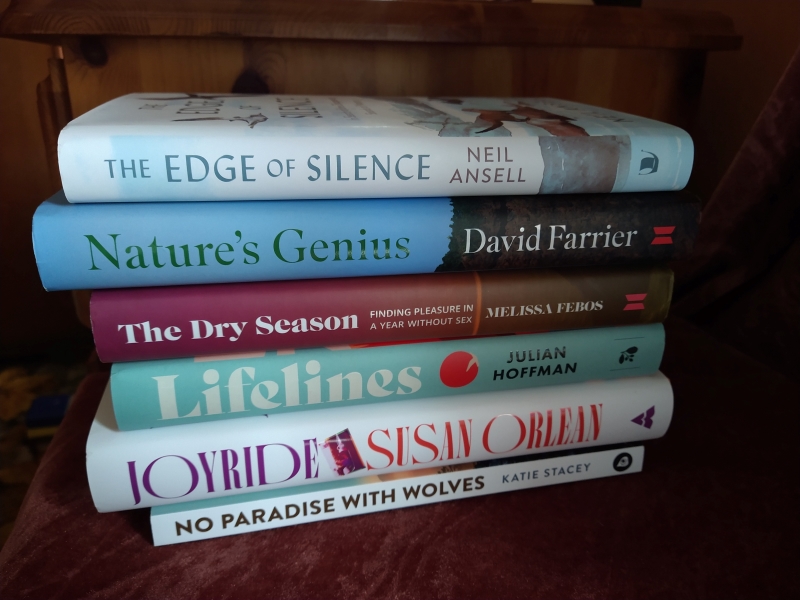
The Edge of Silence: In Search of the Disappearing Sounds of Nature by Neil Ansell
 Ansell draws parallels between his advancing hearing loss and the biodiversity crisis. He puts together a wish list of species – mostly seabirds (divers, grebes), but also inland birds (nightjars) and a couple of non-avian representatives (otters) – that he wants to hear and sets off on public transport adventures to find them. “I must find beauty where I can, and while I still can,” he vows. From his home on the western coast of Scotland near the Highlands, this involves trains or buses that never align with the ferry timetables. Furthest afield for him are two nature reserves in northern England where his mission is to hear bitterns “booming” and natterjack toads croaking at night. There are also mountain excursions to locate ptarmigan, greenshank, and black grouse. His island quarry includes Manx shearwaters (Rum), corncrakes (Coll), puffins (Sanday), and storm petrels (Shetland).
Camping in a tent means cold nights, interrupted sleep, and clouds of midges, but it’s all worth it to have unrepeatable wildlife experiences. He has a very high hit rate for (seeing and) hearing what he intends to, even when they’re just on the verge of what he can decipher with his hearing aids. On the rare occasions when he misses out, he consoles himself with earlier encounters. “I shall settle for the memory, for it feels unimprovable, like a spell that I do not want to break.” I’ve read all of Ansell’s nature memoirs and consider him one of the UK’s top writers on the natural world. His accounts of his low-carbon travels are entertaining, and the tug-of-war between resisting and coming to terms with his disability is heartening. “I have spent this year in defiance of a relentless, unstoppable countdown,” he reflects. What makes this book more universal than niche is the deadline: we and all of these creatures face extinction. Whether it’s sooner or later depends on how we act to address the environmental polycrisis.
With thanks to Birlinn for the free copy for review.
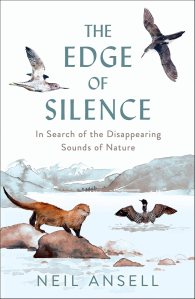
Nature’s Genius: Evolution’s Lessons for a Changing Planet by David Farrier
 Farrier’s Footprints, which tells the story of the human impact on the Earth, was one of my favourite books of 2020. This contains a similar blend of history, science, and literary points of reference (Farrier is a professor of literature and the environment at the University of Edinburgh), with past changes offering a template for how the future might look different. “We are forcing nature to reimagine itself, and to avert calamity we need to do the same,” he writes. Cliff swallows have evolved blunter wings to better evade cars; captive breeding led foxes to develop the domesticated traits of pet dogs.
It’s not just other species that experience current evolution. Thanks to food abundance and a sedentary lifestyle, humans show a “consumer phenotype,” which superseded the Palaeolithic (95% of human history) and tends toward earlier puberty, autoimmune diseases, and obesity. Farrier also looks at notions of intelligence, language, and time in nature. Sustainable cities will have to cleverly reuse materials. For instance, The Waste House in Brighton is 90% rubbish. (This I have to see!)
There are many interesting nuggets here, and statements that are difficult to argue with, but I struggled to find an overall thread. Cool to see my husband’s old housemate mentioned, though. (Duncan Geere, for collaborating on a hybrid science–art project turning climate data into techno music.)
With thanks to Canongate for the free copy for review.
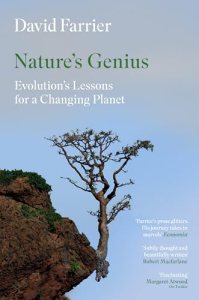
The Dry Season: Finding Pleasure in a Year without Sex by Melissa Febos
Febos considers but rejects the term “sex addiction” for the years in which she had compulsive casual sex (with “the Last Man,” yes, but mostly with women). Since her early teen years, she’d never not been tied to someone. Brief liaisons alternated with long-term relationships: three years with “the Best Ex”; two years that were so emotionally tumultuous that she refers to the woman as “the Maelstrom.” It was the implosion of the latter affair that led to Febos deciding to experiment with celibacy, first for three months, then for a whole year. “I felt feral and sad and couldn’t explain it, but I knew that something had to change.”
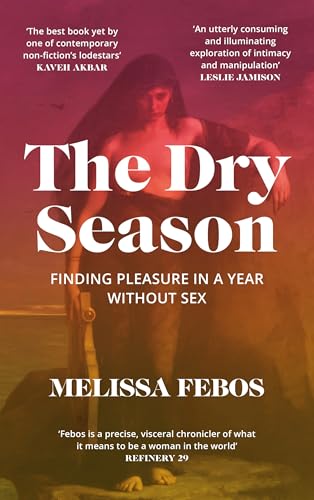 The quest involved some research into celibate movements in history, but was largely an internal investigation of her past and psyche. Febos found that she was less attuned to the male gaze. Having worn high heels almost daily for 20 years, she discovered she’s more of a trainers person. Although she was still tempted to flirt with attractive women, e.g. on an airplane, she consciously resisted the impulse to spin random meetings into one-night stands. (A therapist had stopped her short with the blunt observation, “you use people.”) With a new focus on the life of the mind, she insists, “My life was empty of lovers and more full than it had ever been.” (This reminded me of Audre Lorde’s writing on the erotic.) As Silvana Panciera, an Italian scholar on the beguines (a secular nun-like sisterhood), told her: “When you don’t belong to anyone, you belong to everyone. You feel able to love without limits.”
Intriguing that this is all a retrospective, reflecting on her thirties; Febos is now in her mid-forties and married to a woman (poet Donika Kelly). Clearly she felt that it was an important enough year – with landmark epiphanies that changed her and have the potential to help others – to form the basis for a book. For me, she didn’t have much new to offer about celibacy, though it was interesting to read about the topic from an areligious perspective. But I admire the depth of her self-knowledge, and particularly her ability to recreate her mindset at different times. This is another one, like her Girlhood, to keep on the shelf as a model.
With thanks to Canongate for the free copy for review.
Lifelines: Searching for Home in the Mountains of Greece by Julian Hoffman
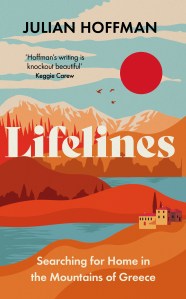 Hoffman’s Irreplaceable was my nonfiction book of 2019. Whereas that was a work with a global environmentalist perspective, Lifelines is more personal in scope. It tracks the author’s unexpected route from Canada via the UK to Prespa, a remote area of northern Greece that’s at the crossroads with Albania and North Macedonia. He and his wife, Julia, encountered Prespa in a book and, longing for respite from the breakneck pace of life in London, moved there in 2000. “Like the rivers that spill into these shared lakes, lifelines rarely flow straight. Instead, they contain bends, meanders and loops; they hold, at times, turns of extraordinary surprise.” Birdwatching, which Hoffman suggests is as “a way of cultivating attention,” had been their gateway into a love for nature developed over the next quarter-century and more, and in Greece they delighted in seeing great white and Dalmatian pelicans (which feature on the splendid U.S. cover. It would be lovely to have an illustrated edition of this.)
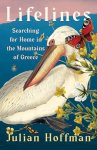 One strand of this warm and fluent memoir is about making a home in Greece: buying and renovating a semi-derelict property, experiencing xenophobia and hospitality from different quarters, and finding a sense of belonging. They’re happy to share their home with nesting wrens, who recur across the book and connect to the tagline of “a story of shelter shared.” In probing the history of his adopted country, Hoffman comes to realise the false, arbitrary nature of borders – wildlife such as brown bears and wolves pay these no heed. Everything is connected and questions of justice are always intersectional. The Covid pandemic and avian influenza (which devastated the region’s pelicans) are setbacks that Hoffman addresses honestly. But the lingering message is a valuable one of bridging divisions and learning how to live in harmony with other people – and with other species.
With thanks to Elliott & Thompson for the free copy for review.
Joyride by Susan Orlean
As a long-time staff writer for The New Yorker, Orlean has had the good fortune to be able to follow her curiosity wherever it leads, chasing the subjects that interest her and drawing readers in with her infectious enthusiasm. She grew up in suburban Ohio, attended college in Michigan, and lived in Portland, Oregon and Boston before moving to New York City. Her trajectory was from local and alternative papers to the most enviable of national magazines: Esquire, Rolling Stone and Vogue. Orlean gives behind-the-scenes information on lots of her early stories, some of which are reprinted in an appendix. “If you’re truly open, it’s easy to fall in love with your subject,” she writes; maintaining objectivity could be difficult, as when she profiled an Indian spiritual leader with a cult following; and fended off an interviewee’s attachment when she went on the road with a Black gospel choir.
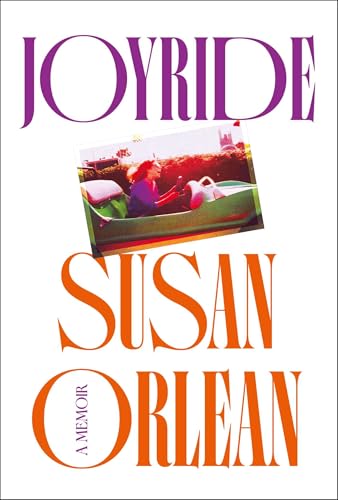 Her personal life takes a backseat to her career, though she is frank about the breakdown of her first marriage, her second chance at love and late motherhood, and a surprise bout with lung cancer. The chronological approach proceeds book by book, delving into her inspirations, research process and publication journeys. Her first book was about Saturday night as experienced across America. It was a more innocent time, when subjects were more trusting. Orlean and her second husband had farms in the Hudson Valley of New York and in greater Los Angeles, and she ended up writing a lot about animals, with books on Rin Tin Tin and one collecting her animal pieces. There was also, of course, The Library Book, about the wild history of the main Los Angeles public library. But it’s her The Orchid Thief – and the movie (not) based on it, Adaptation – that’s among my favourites, so the long section on that was the biggest thrill for me. There are also black-and-white images scattered through.
It was slightly unfortunate that I read this at the same time as Book of Lives – who could compete with Margaret Atwood? – but it is, yes, a joy to read about Orlean’s writing life. She’s full of enthusiasm and good sense, depicting the vocation as part toil and part magic:
“I find superhuman self-confidence when I’m working on a story. The bashfulness and vulnerability that I might otherwise experience in a new setting melt away, and my desire to connect, to observe, to understand, powers me through.”
“I like to do a gut check any time I dismiss or deplore something I don’t know anything about. That feels like reason enough to learn about it.”
“anything at all is worth writing about if you care about it and it makes you curious and makes you want to holler about it to other people”
With thanks to Atlantic Books for the free copy for review.
No Paradise with Wolves: A Journey of Rewilding and Resilience by Katie Stacey
I had the good fortune to visit Wild Finca, Luke Massey and Katie Stacey’s rewilding site in Asturias, while on holiday in northern Spain in May 2022, and was intrigued to learn more about their strategy and experiences. This detailed account of the first four years begins with their search for a property in 2018 and traces the steps of their “agriwilding” of a derelict farm: creating a vegetable garden and tending to fruit trees, but also digging ponds, training up hedgerows, and setting up rotational grazing. Their every decision went against the grain. Others focussed on one crop or type of livestock while they encouraged unruly variety, keeping chickens, ducks, goats, horses and sheep. Their neighbours removed brush in the name of tidiness; they left the bramble and gorse to welcome in migrant birds. New species turned up all the time, from butterflies and newts to owls and a golden fox.
Luke is a wildlife guide and photographer. He and Katie are conservation storytellers, trying to get people to think differently about land management. The title is a Spanish farmers’ and hunters’ slogan about the Iberian wolf. Fear of wolves runs deep in the region. Initially, filming wolves was one of the couple’s major goals, but they had to step back because staking out the animals’ haunts felt risky; better to let them alone and not attract the wrong attention. (Wolf hunting was banned across Spain in 2021.) There’s a parallel to be found here between seeing wolves as a threat and the mild xenophobia the couple experienced. Other challenges included incompetent house-sitters, off-lead dogs killing livestock, the pandemic, wildfires, and hunters passing through weekly (as in France – as we discovered at Le Moulin de Pensol in 2024 – hunters have the right to traverse private land in Spain).
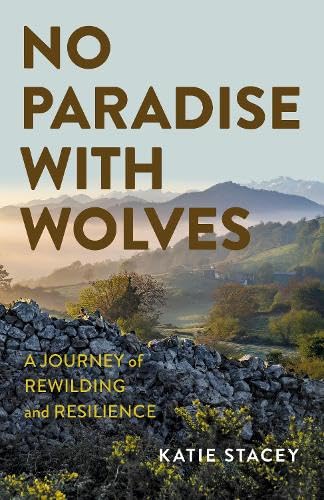
Luke and Katie hope to model new ways of living harmoniously with nature – even bears and wolves, which haven’t made it to their land yet, but might in the future – for the region’s traditional farmers. They’re approaching self-sufficiency – for fruit and vegetables, anyway – and raising their sons, Roan and Albus, to love the wild. We had a great day at Wild Finca: a long tour and badger-watching vigil (no luck that time) led by Luke; nettle lemonade and sponge cake with strawberries served by Katie and the boys. I was clear how much hard work has gone into the land and the low-impact buildings on it. With the exception of some Workaway volunteers, they’ve done it all themselves.
Katie Stacey’s storytelling is effortless and conversational, making this impassioned memoir a pleasure to read. It chimed perfectly with Hoffman’s writing (above) about the fear of bears and wolves, and reparation policies for farmers, in Europe. I’d love to see the book get a bigger-budget release complete with illustrations, a less misleading title, the thorough line editing it deserves, and more developmental work to enhance the literary technique – as in the beautiful final chapter, a present-tense recreation of a typical walk along The Loop. All this would help to get the message the wider reach that authors like Isabella Tree have found. “I want to be remembered for the wild spaces I leave behind,” Katie writes in the book’s final pages. “I want to be remembered as someone who inspired people to seek a deeper connection to nature.” You can’t help but be impressed by how much of a difference two people seeking to live differently have achieved in just a handful of years. We can all rewild the spaces available to us (see also Kate Bradbury’s One Garden against the World), too.
With thanks to Earth Books (Collective Ink) for the free copy for review.
Which of these do you fancy reading?
April Releases by Chung, Ellis, Gaige, Lutz, McAlpine and Rubin
April felt like a crowded publishing month, though May looks to be twice as busy again. Adding this batch to my existing responses to books by Jean Hannah Edelstein & Emily Jungmin Yoon plus Richard Scott, I reviewed nine April releases. Today I’m featuring a real mix of books by women, starting with two foodie family memoirs, moving through a suspenseful novel about a lost hiker, a sparse Scandinavian novella, and a lovely poetry collection with themes of nature and family, and finishing up with a collection of aphorisms. I challenged myself to write just a paragraph on each for simplicity and readability.

Chinese Parents Don’t Say I Love You: A memoir of saying the unsayable with food by Candice Chung
“to love is to gamble, sometimes gastrointestinally … The stomach is a simple animal. But how do we settle the heart—a flailing, skittish thing?”
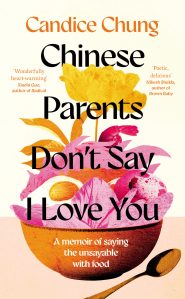 I got Caroline Eden (Cold Kitchen) and Nina Mingya Powles (Tiny Moons) vibes from this vibrant essay collection spotlighting food and family. The focus is on 2019–2021, a time of huge changes for Chung. She’s from Hong Kong via Australia, and reconnects with her semi-estranged parents by taking them along on restaurant review gigs for a Sydney newspaper. Fresh from a 13-year relationship with “the psychic reader,” she starts dating again and quickly falls in deep with “the geographer.” Sharing meals in restaurants and at home kindles closeness and keeps their spirits up after Covid restrictions descend. But when he gets a job offer in Scotland, they have to make decisions about their relationship sooner than intended. Although there is a chronological through line, the essays range in time and style, including second-person advice column (“Faux Pas”) and choose-your-own adventure (“Self-Help Meal”) segments alongside lists, message threads and quotes from the likes of Deborah Levy. My favourite piece was “The Soup at the End of the Universe.” Chung delicately contrasts past and present, singleness and being partnered, and different mental health states. The essays meld to capture a life in transition and the tastes and bonds that don’t alter.
With thanks to Elliott & Thompson for the free copy for review.
Chopping Onions on My Heart: On Losing and Preserving Culture by Samantha Ellis
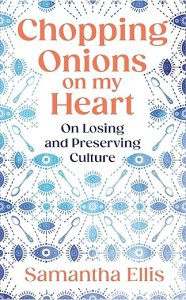 Ellis was distressed to learn that her refugee parents’ first language, Judeo-Iraqi Arabic, is in danger of extinction. Her own knowledge of it is piecemeal, mostly confined to its colourful food-inspired sayings – for example, living “eeyam al babenjan (in the days of the aubergines)” means that everything feels febrile and topsy-turvy. She recounts her family’s history with conflict and displacement, takes a Zoom language class, and ponders what words, dishes, and objects she would save on an imaginary “ark” that she hopes to bequeath to her son. Along the way, she reveals surprising facts about Ashkenazi domination of the Jewish narrative. “Did you know the poet [Siegfried Sassoon] was an Iraqi Jew?” His great-grandfather even invented a special variety of mango pickle. All of the foods described sound delicious, and some recipes are given. Ellis’s writing is enthusiastic and she braids the book’s various strands effectively. I wasn’t as interested in the niche history as I wanted to be, but I did appreciate learning about an endangered culture and language.
With thanks to Chatto & Windus (Vintage/Penguin) for the proof copy for review.
Heartwood by Amity Gaige
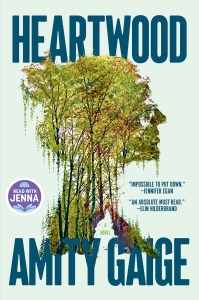 This was on my Most Anticipated list after how much I’d enjoyed Sea Wife when we read it for Literary Wives club. In July 2022, 42-year-old nurse Valerie Gillis, nicknamed “Sparrow,” goes missing in the Maine woods while hiking the Appalachian Trail. An increasingly desperate search ensues as the chances of finding her alive diminish with each day. The shifting formats – letters, transcripts, news reports, tip line messages – hold the interest. However, the chapters voiced by Lt. Bev, the warden who heads the mission, are much the most engaging, and it’s a shame that her delightful interactions with her sisters and nieces are so few and come so late. The third-person passages about Lena Kucharski in her Connecticut retirement home are intriguing but somehow feel like they belong in a different book. Gaige attempts to bring the threads together through three mother–daughter pairs, which struck me as heavy-handed. Mostly, this hits the sweet spot between mystery and literary fiction (apart from some red herrings), but because I wasn’t particularly invested in the characters, even Valerie, this fell a little short of my expectations. (Read via Edelweiss)
Wild Boar by Hannah Lutz (2016; 2025)
[Translated from Swedish by Andy Turner]
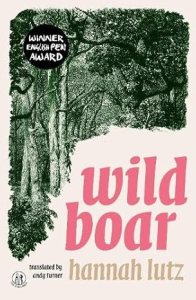 “I have seen them, the wild boar, they have found their way into my dreams!” Ritve travels from Finland to the forests of southern Sweden to track the creatures. Glenn, who appraises project applications for the council, has boar wander onto his property in the middle of the night. Mia, recipient of a council grant for her Recollections of a Sigga Child proposal, brings her ailing grandfather to record his memories for the local sound archive. As midsummer approaches, these three characters plus a couple of their partners will have encounters with the boar and with each other. Short sections alternate between their first-person perspectives. There is a strong sense of place and how migration poses challenges for both the human and more-than-human worlds. But it’s over before it begins. I found myself frustrated by how little happens, how stingily the characters reveal themselves, and how the boar, ultimately, are no more than a metaphor or plot device – a frequent complaint of mine when animals are central to a narrative. This might appeal to fans of Melissa Harrison’s fiction. In any case, I congratulate The Emma Press on their first novel, which won an English PEN Award.
With thanks to The Emma Press for the free copy for review.
Small Pointed Things by Erica McAlpine
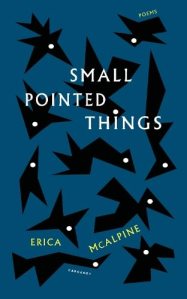 McAlpine is an associate professor of English at Oxford. Her second poetry collection is full of flora and fauna imagery. The title phrase comes from the opening poem, “Bats and Swallows” – in the “gloaming,” it’s hard to tell the difference between the flying creatures. The verse is bursting with alliteration and end rhymes, as just this first one shows (emphasis mine): “we couldn’t see / from where we stood in soft shadows / any signs that they were swallows // or bats”; “One seemed almost iridescent / as I tried to track / its crescent / flight across the hill.” Other poems consider moths, manatees, bees, swans and ladybirds; snowdrops and a cedar tree. Part II expands the view through conversations, theories and travel. What-ifs, consequences and regrets seep in. Parts III and IV incorporate mythical allusions, elegies and the concerns of motherhood. Sometimes the rhyme scheme adheres to a particular form. For instance, I loved “Triolet on My Mother’s 74th Birthday” – “You cannot imagine one season in another. … You cannot imagine life without your mother.” This is just my sort of poetry, sweet on the ear and rooted in nature and the everyday. A sample poem:
“Clementines”
New Year’s Day – another turning
of the sphere, with all we planned
in yesteryear as close to hand
as last night’s coals left unmanned
in the fire, still orange and burning.
It is the season for clementines
and citrus from Seville
and whatever brightness carries us until
leaves and petals once more fill
the treetops and the vines.
If ever you were to confess
some cold truth about love’s
dwindling, now would be the time – less
in order for things to improve
than for the half-bitter happiness
of peeling rinds
during mid-winter
recalling days that are behind
us and doors we cannot re-enter
and other doors we couldn’t find.
With thanks to Carcanet Press for the advanced e-copy for review.
Secrets of Adulthood: Simple Truths for Our Complex Lives by Gretchen Rubin
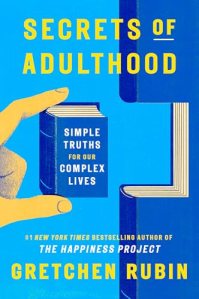 Rubin is one of the best self-help authors out there: Her books are practical, well-researched and genuinely helpful. She understands human nature and targets her strategies to suit different personality types. If you know her work, you’re likely aware of her fondness for aphorisms. “Sometimes, a single sentence can provide all the insight we need,” she believes. Here she collects her own pithy sayings relating to happiness, self-knowledge, relationships, work, creativity and decision-making. Some of the aphorisms were familiar to me through her previous books or her social media. They’re straightforward and sensible, distilling down to a few words truths we might be aware of but hadn’t truly absorbed. Like the great aphorists throughout history, Rubin relishes alliteration, repetition and contrasts. Some examples:
Accept yourself, and expect more from yourself.
I admire nature, and I am also nature. I resent traffic, and I am also traffic.
Work is the play of adulthood. If we’re not failing, we’re not trying hard enough.
Don’t wait until you have more free time. You may never have more free time.
This is not as meaty as her other work, and some parts feel redundant, but that’s the nature of the project. It would make a good bedside book for nibbles of inspiration. (Read via Edelweiss)
Which of these appeal to you?
#ReadIndies Wrap-Up: February Releases (Jukes, Spence) & Review Catch-Up (Buttery, Foust)
Good riddance to February, which added insult to injury on its final day when my in-laws’ neighbour reversed into the car we were borrowing from a book club friend and smashed the driver’s-side window. The blue skies and crocuses of recent days have been most welcome. The best I can say for the month just departed is that I managed to review 15 books for Kaggsy and Lizzy Siddal’s Reading Independent Publishers Month challenge. These came from 10 splendid publishers: Atlantic Books, Backbone Press, Carcanet Press, Counterpoint, Elliott & Thompson, The Emma Press, Faber, Icon Books, Saraband and Sort Of Books.
Mother Animal by Helen Jukes
When she found out she was pregnant, Jukes (author of A Honeybee Heart Has Five Openings) lost herself in research, looking for parallels in the natural world. A friend had told her that “childbirth puts you more in touch with your animal side.” Her daughter was born at the start of the pandemic and so early motherhood was perhaps more than usually isolated and emotionally challenging for her. She had an unexpected C-section after the placenta failed to nourish her daughter sufficiently, and then struggled to breastfeed. “I was, I realised, a little afraid of the baby. I’d expected to feel a sense of recognition – to see in her face some sign of familiarity,” but that wasn’t the case. “She was so … other.”
The long thematic chapters present Jukes’s experiences in parallel to those of other mothering creatures with pregnancy, birth, lactation, making a home (nesting) and enlisting the help of the community. Peppered throughout are trivia she shares with boyfriend, baby and readers. Such as that burying beetles lay eggs on a carcass so their babies feed on carrion from day one. That bonobo females attend births, acting as midwives for each other. That Madrid’s storks have started eating and lining their nests with what they find in landfill instead of migrating to Africa. The “Did you know?” litany quickly becomes precious. The details are not that interesting in themselves, and not sufficiently synthesized to be meaningful. The same factoid about leopard tree iguanas is repeated seven pages apart. A significant amount of information comes from Bitch by Lucy Cooke, which I would recommend instead.
As hybrid scientific memoirs of motherhood go, Lucy Jones’s Matrescence can’t be beat. For its social and political engagement, Jennifer Case’s We Are Animals is a valuable companion. Jukes’s offering pales by comparison because her story – not having the delivery she wanted, struggling to connect with her baby, her relationship with the father falling apart – is all too common, and she doesn’t have the scientific bona fides for readers to accept her as a valid source of zoological facts.
I would make an exception, though, for the central chapter, “Forever Milk,” which might be condensed and published in a big-name newspaper as a Rachel Carson-like exposé about endocrine disruptors and forever chemicals. Like any mother, Jukes wants nothing more than to protect her daughter, but how can she when household products (waterproof clothing, non-stick pans, cleaning sprays) contain toxic chemicals and her breastmilk is sure to be contaminated? Add in microplastics and the situation is bleak. We don’t know singly, let alone collectively, what these pollutants are doing to species in the long term, but most likely they interfere with reproduction and alter behaviour. The central message of this chapter, and the book as a whole, is that animals are amazing but vulnerable. “What is this world if nowhere is separate – nowhere safe?” If you think about this stuff much, you can’t bear it. Yet it’s a truth we all have to live with. It’s a brave author who dares sit with the unthinkable.
With thanks to Elliott & Thompson for the free copy for review.
Daughter of the Sun by Rachel Spence
 The Emma Press has published poetry pamphlets before, but this is their inaugural full-length work. Rachel Spence’s second collection is in two parts: first is “Call & Response,” a sonnet sequence structured as a play and considering her relationship with her mother. Act 1 starts in 1976 and zooms forward to key moments when they fell out and then reversed their estrangement. The next section finds them in the new roles of patient and carer. “Your final check-up. August. Nimbus clouds / prised open by Delft blue. Waiting is hard.” In Act 3, death is near; “in that quantum hinge, we made / an alphabet from love’s ungrammared stutter.” The poems of the last act are dated precisely, not just to a month and year as earlier but down to the very day, hour and minute. Whether in Ludlow or Venice, Spence crystallizes moments from the ongoingness of grief, drawing images from the natural world.
The second part of the book, “Medea’s Song,” is looser in style and more dispersed across the page. It’s a feminist reinterpretation that refuses to make of Medea a simple murderess, instead redeeming her as a wise woman. “Do not call them seers or sisters // They are the owls of history // nightfliers outliers”. I’m not drawn to Greek myth updates but I expect this would be rewarding for fans of similar projects by Fiona Benson and Anne Carson. Some of the specific vocabulary from the first section recurs, linking the two in a satisfying way.
With thanks to The Emma Press for the free copy for review.
I’m also catching up on two 2024 releases from indie publishers that I was sent for review:
Knead to Know: A History of Baking by Neil Buttery
 Not only the pun-tastic title, but also the excellent nominative determinism of chef and food historian Dr Neil Buttery’s name, earned this a place in my 2024 Superlatives post. In not quite 240 pages, it achieves the improbable, producing an exhaustive history of baked goods through miniature essays about every conceivable subcategory. Although the focus is on British baking, the story begins in ancient times with the first grains and the earliest cooking technique of making griddlecakes on a hearthstone. (Speaking of which, make sure you’re prepared for Pancake Day, aka Shrove Tuesday, this week!) Across multi-part chapters about bread, biscuits and cakes, pies and puddings, and patisserie, Buttery spotlights regional specialties, many of them familiar (Cornish pasties and Eccles cakes); a few have fallen into obscurity (Gloucester pancakes and Yorkshire Christmas pyes). Some dishes’ origin stories are apocryphal, while others can be traced back to historical cookbooks.
I was fascinated by the evolution of traditional holiday bakes. “The long tapering shape of the stollen is supposed to represent the infant Christ wrapped in His swaddling.” In general, there is just the right amount of chemistry, and while in places the writing is shaky or at least poorly edited (“populous” instead of populace!), there are good quips, too: “dried fruit haters do have a miserable time at Christmas to be fair.” I read the book in bites across a number of months, which felt appropriate because it’s more a reference text for the kitchen shelf than a narrative to read straight through. Good for picking up now and then over a cup of tea.
With thanks to Icon Books for the free copy for review.
You Are Leaving the American Sector: Love Poems by Rebecca Foust
 Foust’s fifth collection – at 41 pages, the length of a long chapbook – is in conversation with the language and storyline of 1984. George Orwell’s classic took on new prescience for her during Donald Trump’s first presidential term, a period marked by a pandemic as well as by corruption, doublespeak and violence. “Rally Insurrection” is a clever erasure poem illustrating how a propagandist might rebrand the storming of the Capitol on 6 January 2021: instead of “a mob came to Washington to / disrupt the peaceful transfer of power,” the Ministry of Truth bulletin would read “a crowd came to Washington to fight / for their country”. “Language Matters” insists that “language / is the most dangerous weapon in any totalitarian arsenal” and warns “A dictator / might do these things, but surely not // a president.” How much more strongly does this resonate in 2025.
The second and third sections engage directly with the story of Julia and Winston – the collection takes its seemingly inapt subtitle from Foust’s appreciation of 1984’s “idea of love as a subversive act affirming free will, expression, and personal privacy”. Her bold verse also confronts the repeal of abortion rights (“Breaking News”) and toxic masculinity (“Consent: A Primer”). There are some internal rhymes and slant rhymes, as well as a few end rhymes all the more striking for their rarity. I only wish this had been published a few years sooner, when its message might have seemed timelier – though, unfortunately, it is still apropos.
Some favorite lines:
“How can a future exist if we can erase or revise the past?”
“2016, dark year / of the ascension / of our Lord the Mad Clown”
“It’s happening now, / somewhere. Not here, // not yet. But so long as Big Brother is out there— / & he will always be out there—it could, // & one day, maybe it will.”
Published by Backbone Press in the USA. With thanks to the author for the e-copy for review.
Which of these appeal to you? What indie publishers have you read from recently?
Review Catch-up: Matt Gaw, Sheila Heti, Liz Jensen (and a Pile of DNFs)
Today I have a travel book about appreciating nature in any weather, a sui generis memoir drawn from a decade of diaries, and an impassioned cry for the environment in the wake of a young adult son’s death.
I’m also bidding farewell to a whole slew of review books that have been hanging around, in some cases, for literal years – I think one is from 2021, and several others from 2022. Putting a book on my “set aside” shelf can be a kiss of death … or I can go back at a better time and end up loving it. It’s hard to predict which will occur. On these, alas, I have had to admit defeat and will pass the books on to other homes.
In All Weathers: A Journey through Rain, Fog, Wind, Ice and Everything in Between by Matt Gaw
Gaw’s two previous nature/travel memoirs, the enjoyable The Pull of the River and Under the Stars, involve gentle rambles through British landscapes, along with commentary on history, nature and science. The remit is much the same here. The book is split into four long sections: “Rain,” “Fog,” “Ice and Snow,” and “Wind.” The adventures always start from and end up at the author’s home in Suffolk, but he ranges as far as the Peak District, Cumbria and the Isle of Skye. Wild swimming is one way in which he experiences places. He notices a lot and describes it all in lovely and relatable prose.
 I was tickled by the definitions of, and statistics about, a “white Christmas”: in the UK, it counts if there’s even a single snowflake falling, whereas in the US there has to be 2.5 cm or more of standing snow. (Scotland is most likely to experience white Christmases; it has had 37 since 1960 vs. 26 in northern England. The English snow record is 43 cm, at Buxton and Malham Tarn in 1981 and 2009.) There’s underlying mild dread as he notes how weather patterns have changed and will likely continue changing, ever more dramatically, into his children’s future.
I find I don’t have much to say about this book because it is very nice but doesn’t do anything interesting or tackle anything that isn’t familiar from many other nature books (such as Rain by Melissa Harrison and Forecast by Joe Shute). It’s unfortunate for Gaw that his ideas often seem to have been done before – his book on night-walking, in particular, was eclipsed by several other works on that topic that came out at around the same time. I hope that the next time around he’ll get more editorial guidance to pursue original topics. It might take just a little push to get him to the next level where he could compete with top UK nature writers.
With thanks to Elliott & Thompson Books for the free copy for review.
Alphabetical Diaries by Sheila Heti
Heti put the contents of ten years of her diaries into a spreadsheet, alphabetizing each sentence (including articles), and then ruthlessly culled the results until she had a 25-chapter (no ‘X’) book. You could hardly call it a narrative, yet looking for one is so hardwired that every few sentences you are jolted out of what feels like a mini-story and into something new. Instead, you might think of it as an autobiographical mosaic. The recurring topics are familiar from the rest of Heti’s oeuvre, with obsessive cogitating about relationships, art and identity. But there are also the practicalities of trying to make a living as a woman in a creative profession. Tendrils of the everyday poke out here and there as she makes a meal, catches a plane, or buys clothes. Men loom large: explicit accounts of sex with Pavel and Lars (though also Fiona); advising her friend Lemons on his love life. There are also meta musings on what she is trying to achieve with her book projects and on what literature can be.
 Grammatically, the document is a lot more interesting than it could be – or than a similar experiment based on my diary would be, for instance – because Heti sometimes writes in incomplete sentences, dropping the initial pronoun; or intersperses rhetorical questions or notes to self in the imperative. So, yes, ‘I’ is a long chapter, but not only because of self-absorbed “I…” statements; there’s also plenty of “If…” and “It’s…” ‘H’ and ‘W’ are longer sections than might be expected because of the questioning mode. But it’s at the sentence level that the book makes the biggest impression: lines group together, complement or contradict each other, or flout coherence by being so merrily à propos of nothing. Here are a few passages to give a flavour:
Am I wasting my time? Am low on money. Am making noodles. Am reading Emma. Am tired and will go to sleep. Am tired today and I feel like I may be getting a cold. Ambivalence gives you something to do, something to think about.
Best not to live too emotionally in the future—it hardly ever comes to pass. Better to be on the outside, where you have always been, all your life, even in school, nothing changes. Better to look outward than inward. Blow jobs and tenderness. Books that fall in between the cracks of all aspects of the human endeavour.
It’s 2:34 every time I check the time these days. It’s 4 p.m. It’s 4:41 now. It’s a fantasy of being saved. It’s a stupid idea. It’s a yellow, cloudy sky. It’s amazing to me how life keeps going. It’s better to work, to go into the underground cave where there are books, than to fritter away time online. It’s crazy that I need all of these mental crutches in order to live. It’s fiction. It’s fine.
Scrambled eggs on toast at Yaddo. Second-guessing everything. Second, he said that no one is buying fiction. See the complexity. See the souls. See what kind of story the book can accommodate, if any. Seeing her for coffee was not so bad.
It’s surprising how much sense a text constructed so apparently haphazardly makes, perhaps because of the same subject and style throughout. Sometimes aphoristic, sometimes poetic (all that anaphora), the book is playful but overall serious about the capturing of a life on the page. Heti transcends the quotidian by exploding the one-thing-after-another tedium of chronology. Remarkably, the collage approach produces a more genuine, crystalline vision of the self than precise scenes and cause-and-effect chains ever could. A work of life writing like no other, it must be read in a manner all its own that it teaches you as you go along. I admire it enormously and hope I might write something even half as daring one day.
With thanks to Fitzcarraldo Editions for the free copy for review.
Your Wild and Precious Life: On grief, hope and rebellion by Liz Jensen
Jensen’s younger son, Raphaël Coleman, was just 25 when he collapsed while filming a documentary in South Africa and died of a previously undiagnosed heart condition. Raph had been involved in Extinction Rebellion and Jensen is a founding member of Writers Rebel. They both deemed activism “the best antidote to depression.” Her son had been obsessed with wildlife from a young age and was rewilding acres of their land in France, as well as making environmentalist films (he had achieved minor fame as a child actor in Nanny McPhee) and participating in direct action, such as at the Brazilian embassy in London.
 For Jensen, the challenge, especially after lockdown confined her to her Copenhagen flat, was to channel grief into further radicalism rather than retreating into herself or giving in to the lure of suicide. She tried to see personal grief as a reminder of ecogrief, and therefore as a spur. One way that she coped was turning towards the supernatural. She continued to hear and speak to Raph, in daily life as well as through a medium, and interpreted bird sightings as signs of his continued presence. An additional point of interest to me was that the author’s husband is Carsten Jensen, the writer of one of my favourite books, We, the Drowned.
This doesn’t particularly stand out among the dozens of bereavement memoirs I’ve read. (It was also remarkably similar to Alexandra Fuller’s Fi, which I’d read not long before.) Perhaps more years of reflection would have helped – Mary Karr advises seven – though I suspect Jensen felt, quite rightly, that given the current state of the environment we have no time to waste. And I have no doubt that the combination of a mother’s love and an ecological conscience will make this book meaningful to many readers.
With thanks to Canongate for the free copy for review.
And the DNFs…
there are more things, Yara Rodrigues Fowler – I loved Stubborn Archivist so much that I leapt at the chance to read her follow-up, but it was just too dull and involved about Brazilian versus UK politics. Nor did the stylistic tricks feel as novel this time around. I read 66 pages. (Fleet)
The Rabbit Hutch, Tess Gunty – Gunty dazzled critics and prize judges in the USA, winning a National Book Award. I was drawn to her debut novel for the composite picture of the residents of one Indiana apartment building and the strange connections that develop between them over one summer week, including perhaps a murder? Blandine, the central character, is a sort of modern-day mystic but hard to warm to (“She normally tries to avoid saying in which out loud, to minimize the number of people who find her insufferable”), as are all the characters. This felt like try-hard MFA writing. I read 85 pages. (Oneworld)
Eve: The Disobedient Future of Birth, Claire Horn – I usually get on well with Wellcome Collection books. I think the problem here was that there was too much material that was familiar to me from having read Womb by Leah Hazard – even the SF-geared stuff about artificial wombs. I read 45 pages. (Profile Books)
Blessings, Chukwuebuka Ibeh – This debut novel has a confident voice, buttressed by determination to reveal what life is like for queer people living in countries where homosexuality is criminalized. Obiefuna is cast out for having a crush on Aboy, his father’s apprentice, even though the two young men share nothing more physical than a significant gaze into each other’s eyes. The strict boarding school his father sends him to is a place of privation, hierarchy, hazing and, I suspect, same-sex experimentation. I found the writing capable but couldn’t get past a sense of dread about what was going to happen. Meanwhile, I didn’t think the alternating chapters from Obiefuna’s mother’s perspective added anything to the narrative. I read 62 pages. (Penguin Viking)
The War for Gloria, Atticus Lish – Lish’s debut novel, Preparation for the Next Life, was excellent, but I could never get stuck in to this follow-up, despite the appealing medical theme. When Gloria Goltz is diagnosed with ALS, her 15-year-old son Corey turns to his absent father and others for support. It was also unfortunate that Lish mentions the Ice Bucket Challenge: that was popularized in 2014, whereas the book is set in 2010. I read 75 pages. (Serpent’s Tail)
Snow Widows: Scott’s Fatal Antarctic Expedition through the Eyes of the Women They Left Behind, Katherine MacInnes – I seriously overestimated my interest in polar exploration narratives. MacInnes seems to have done quite a good job of creating novelistic scenes through research, though. I read 35 pages. (William Collins)
The Woodcock, Richard Smyth – I feel particularly bad about this one as I’ve read and enjoyed three of Smyth’s nature books and my husband and I are friendly with him on Twitter. Initially, I got Thomas Hardy, D.H. Lawrence and Sarah Perry (The Essex Serpent, anyway) vibes from this 1920s-set novel about the upheaval a naturalist and his wife experience when an American whaler and his daughters arrive in their small coastal English town. I read 90 pages. (Fairlight Books)
Better Broken than New: A Fragmented Memoir, Lisa St Aubin de Terán – I accepted this for review because I’d often seen the author’s name on spines in secondhand bookstores but didn’t know anything about her work. The précis of her globe-trotting life is stranger than fiction: marriage to a Venezuelan freedom fighter, managing a sugar plantation in the Andes, living in an Italian palace for 20 years, founding a charity in Mozambique. The vignettes in the early part of the book (e.g., skipping school and going on daytrips by train at age eight) are entertaining, if written with blithe disregard for a reader’s need for context or perspective. But the fragmented nature means it all feels as random as life, without the necessary authorial shaping. The publisher has done her a disservice as she seeks to relaunch her career by not proofreading properly: Many small errors slipped through the net, making this look like a sloppy manuscript. The worst happen to be other authors’ names: Jane ‘Austin’, ‘Kahil’ Gibran, Virginia ‘Wolfe’. Are you kidding me?! I read 53 pages. (Amaurea Press)
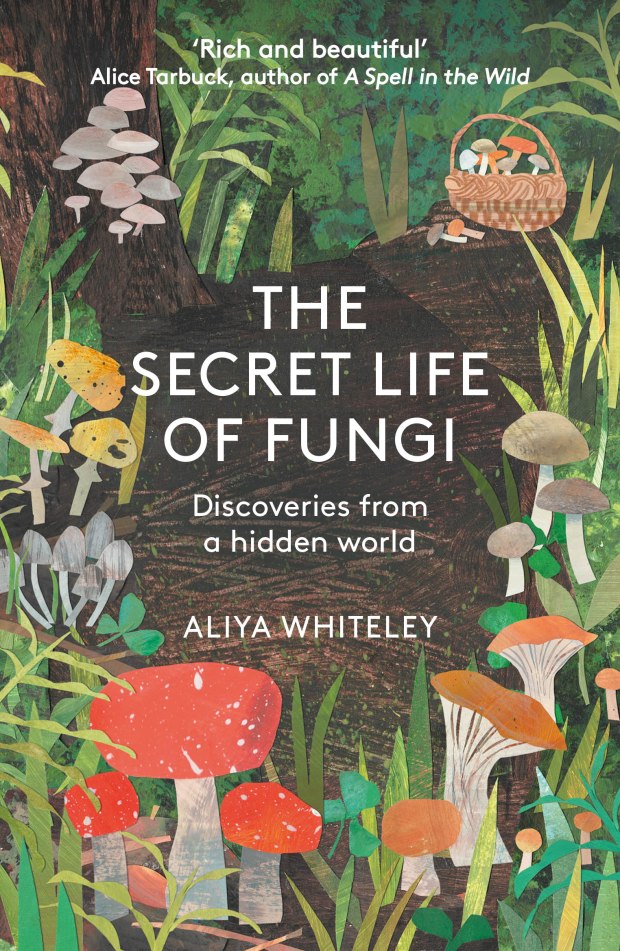
UK Fungus Day: An Extract from Aliya Whiteley’s The Secret Life of Fungi
It’s UK Fungus Day today, and to mark the occasion I’m hosting an extract from The Secret Life of Fungi: Discoveries from a Hidden World by Aliya Whiteley, which came out in paperback last week.
“Nosing”
In 2001 two scientists published a report of a smell test they had conducted on thirty-six volunteers. The volunteers smelled an unspecified mushroom of the Dictyophora genus that was claimed to be incredibly rare, growing only on the lava floes of Hawaii. Six of the women taking part in the study reported experiencing a mild orgasm at the point of inhaling the smell; all the men said the mushroom smelled ‘fetid’.
It’s a tiny sample in an unrepeated experiment, but just the thought of it was enough to intrigue many. News outlets all over the world picked up the story and ran away with it. We don’t imagine that the sight of an object, any object, would be enough to induce such ecstasy, but the sense of smell is different. It cuddles up to our memories, performing the mysterious task of making us experience certain emotions. Nothing is as evocative as a scent thought forgotten. That might explain why we believe it’s possible to take the ultimate pleasure from one.
If some fungi smells are so intense to us, we can only wonder at how incredibly exciting they must be to animals with noses better than our own. A truffle, for instance – truffles have a scent so strong that it can give us headaches, and impregnate every corner of a kitchen so that everything tastes of it. The White Truffle, Tuber magnatum, is the most prized in the world for its rich, unique taste. It has long been foraged throughout Italy and Bosnia–Herzegovina, found buried underground, in the shadows of old trees, often oaks. Pigs were traditionally used to root them out, with an enthusiasm that could lead to the truffle being eaten before it could be retrieved for human consumption, so often dogs are trained to do the task nowadays.
The training of the best truffle hounds starts in puppyhood. There are different methods of reward and encouragement, but an initially expensive tactic outlined in the 1925 book The Romance of the Fungus World, by F.W. and R.T. Rolfe, sounds a great way to get a dog keen to go to work every morning. From early on in the puppy’s life, the Rolfes recommended mixing finely chopped truffle into its usual food, and then, once it has developed a taste for them, burying the truffles nearby and rewarding the puppy once it seeks them out. Then it’s only a matter of encouraging the puppy to give up the truffles in exchange for a piece of meat or a chunk of cheese. That sounds easy, but I have to wonder how straightforward that final step in the training regime might be. It would have to be a magnificent cheese to get my attention once I’d been indoctrinated with truffle love from an early age.
Pigs and dogs aren’t the only animals that love the smell of truffles. Rodents and insects too flock to the scent, and the Rolfes also mention the use of the truffle fly in the hunt for the good stuff. The larvae live in the truffle itself, so the tiny flies are said to hover there above the ground, usually in the evening, in clouds that can be spotted by those with keen eyesight. Is this one of those methods that has been lost? I can’t find any modern mention of it, and there are certainly more reliable methods of finding your truffles, but I love the idea of standing in the forest at sunset, in a glade of oak trees, bent double to look along the ground in the hope of spotting a cloud of flies to give away the position of a rare find.
With thanks to Elliott & Thompson for a free copy.
Review Catch-Up: The Swimmers, Black Butterflies, Bi, and On the Scent
I have a preposterous backlog of review copies to finish and write about (I’m going to go ahead and blame buying a house, moving and DIY for my lack of focus and diminished time, as I have done most of this year), but I’ve decided to get on top of it by pulling a quartet off of my set-aside shelf each week for short responses. I always like to feature a variety, so here I have two fiction and two nonfiction selections: novels about assisted dying and the Bosnian War that are a lot funnier and more life-affirming than you might expect, and books about bisexuality and the sense of smell – and the effect of its loss.
The Swimmers by Chloe Lane (2020; 2022)
 Erin Moore has returned to her family’s rural home for Queen’s Birthday (now a dated reference, alas!), a long weekend in New Zealand’s winter. Not a time for carefree bank holiday feasting, this; Erin’s mother has advanced motor neurone disease and announces that she intends to die on Tuesday. Aunty Wynn has a plan for obtaining the necessary suicide drug; it’s up to Erin to choreograph the rest. “I was the designated party planner for this morbid final frolic, and the promise of new failures loomed. … The whole thing was looking more and more like the plot of a French farce, except it wasn’t funny.”
Lane renders a potentially maudlin situation merely bittersweet through black comedy. Erin isn’t the most endearing narrator because, Disaster Woman-like, she keeps undertaking weird acts of self-sabotage – at 26, she’s blown her first gallery curation opportunity by sleeping with her boss. Still, the picture of a different sort of dysfunctional family and the contrast between an illustrious past (Erin comes from a line of semi-pro swimmers: Aunty Wynn qualified to compete in the Commonwealth Games) and an iffy future make this fairly memorable, if not so much so as the other 2022 The Swimmers – Julie Otsuka’s.
Readalikes: Sorrow and Bliss by Meg Mason, What Are You Going Through by Sigrid Nunez, The Inland Sea by Madeleine Watts, The Weekend by Charlotte Wood
With thanks to Gallic Books for the proof copy for review.
Black Butterflies by Priscilla Morris (2022)
 Drawing on her own family history, Morris has crafted an absorbing story set in Sarajevo in 1992, the first year of the Bosnian War. Zora, a middle-aged painter, has sent her husband, Franjo, and elderly mother off to England to stay with her daughter, Dubravka, confident that she’ll see out the fighting in the safety of their flat and welcome them home in no time. But things rapidly get much worse than she is prepared for. Phone lines are cut off, then the water, then the electricity. “We’re all refugees now, Zora writes to Franjo. We spend our days waiting for water, for bread, for humanitarian handouts: beggars in our own city.”
When even the haven of her studio is taken away from her, she’s reduced to the bare bones of existence, with just a few beloved neighbours to keep her spirits up. Her painting, more an obsession than a hobby, keeps her human as she awaits space on a Red Cross convoy. The title has heartrending significance: ‘black butterflies’ are fragments of paper carried on the breeze after the burning of the National Library of Sarajevo, 30 years ago last month. It was especially poignant to be reading this during the war in Ukraine and think about the sorts of daily dangers and deprivation that people face in conflict zones. The pages turned quickly and I was reminded of Girl at War, one of my absolute favourites, as well as The Pianist.
With thanks to Duckworth for the proof copy for review.
Bi: The hidden culture, history, and science of bisexuality by Julia Shaw (2022)
I’m tying this in with today’s celebration of Bi Visibility Day. Shaw is a criminal psychologist; her third book is a departure for her thematically, but means a lot to her personally. Bisexuality is the largest minority sexuality group, yet bisexuals are less likely to be out because of misconceptions and stereotypes – there are fewer outward signals and less group identification – which can sometimes result in poor mental health. Shaw realized how tricky bi identity was when a German TV show wanted to base a character on her but didn’t know how to make her sexuality obvious to viewers (lingering glances/flirtations involving both men and women? a backstory about a previous relationship with a woman?), and when trying to figure out what to wear to gay bars.
 The book aims to situate bisexuality historically and scientifically. The term “bisexual” has been around since the 1890s, with the Kinsey Scale and the Klein Grid early attempts to add nuance to a binary view. Shaw delights in the fact that the mother of the Pride movement in the 1970s, Brenda Howard, was bisexual. She also learns that “being behaviourally bisexual is commonplace in the animal kingdom,” with many species engaging in “sociosexual” behaviour (i.e., for fun rather than out of reproductive instinct). It’s thought that 83% of bisexuals are closeted, mostly due to restrictive laws or norms in certain parts of the world – those seeking asylum may be forced to “prove” bisexuality, which, as we’ve already seen, is a tough ask. And bisexuals can face “double discrimination” from the queer community.
It felt odd to me that a final chapter on bisexual relationships ended up being mostly about threesomes, such that my main question (as she puts it: “what are the problems with the assumed link between bisexuality and non-monogamy?”) only merited four pages. A valuable book, certainly, but one to read for information rather than entertainment or thoughtful prose.
With thanks to Canongate for the free copy for review.
On the Scent: Unlocking the mysteries of smell – and how its loss can change your world by Paola Totaro and Robert Wainwright (2022)
Totaro (co-author Wainwright is her husband) contracted COVID-19 in March 2020 and temporarily lost the ability to smell, prompting her to embark on this investigation into a  less-understood sense. One in 10,000 people have congenital anosmia, but many more than that experience it at some point in life (e.g., due to head trauma, or as an early sign of Parkinson’s disease), and awareness has shot up since it’s been acknowledged as a symptom of Covid. For some, it’s parosmia instead – smell distortions – which can almost be worse, with people reporting a constant odour of smoke or garbage, or that some of their favourite aromas, like coffee, were now smelling like faeces instead. Such was the case for Totaro.
She visits fascinating places like the Smell and Taste clinic in Dresden and the University of Reading Flavour Centre. “Sniffin’ sticks” are used to put people’s sense of smell to the test, but it’s notoriously difficult, even for those who haven’t had their senses compromised by illness, to name a smell out of context; people generally don’t score over 50%. That’s one of the major questions the book asks: why it is quite so difficult to identify smells, or describe them in words. Totaro also considers perfume-making, the associations of particular smells (bleach, pine or lemon, depending on your country) with cleanliness, and the potential for multisensory experiences, such as releasing odours during film showings. Lots of interesting topics and stories here, but not as compelling on the whole as The Smell of Fresh Rain.
With thanks to Elliott & Thompson for the proof copy for review.
Best of the 4: Black Butterflies
Would you be interested in reading one or more of these?
Reading Across the Seasons: England in All Weathers
Recently, I toured multiple seasons via these three pleasantly meandering books for Anglophiles. All: 
Orchard by Benedict Macdonald and Nicholas Gates (2020)
 Bristol friends and BBC colleagues Ben Macdonald and Nick Gates set out to chronicle a year in the life of a traditional Herefordshire orchard that has been managed differently from the industrial norm. Operations are designed to maximize wildlife as well as production, so the orchard has become a bastion for birds and insects. After a brief history of apple cultivation and orchard design, it’s straight into a month-by-month rundown of what can be seen and heard on this particular patch. For the most part, the co-authors trade off chapters. They observe and describe the kinds of behaviours that most of us never get to see. A central section of remarkable photographs, some of them by the authors, illustrates the year as vividly as the passionate prose. (See my full review at Shiny New Books.)
With thanks to William Collins for the free copy for review.
Light Rains Sometimes Fall by Lev Parikian (2021)
It was only 2018 that I read Why Do Birds Suddenly Disappear? but since then we’ve had another three books from Lev Parikian. It’s now hard to imagine a year without one of his genial nature books. Here he adapts Japan’s famous 72 microseasons to an English year, with every five days or so taking on a slightly different character and welcoming in the subtle changes that add up to big ones. Given the Japanese inspiration, it’s appropriate that his entries sometimes read like haikus. Here’s one from the start of 2–7 September: “The streets. Rumble of traffic. Gentle wind in trees. Soft chrrr of blue tit. Furious cawing, stage left.”
 Parikian’s patch is South London, specifically his local cemetery – which, since the book starts in February 2020, was closed off to him for a short time a month later when the first UK lockdown hit. This only served to increase his appreciation for the place when it reopened. (Cemeteries are amazing places for wildlife in general, especially the more park-like ones: I can remember seeing muntjac at Cemetery Junction in Reading, and red-tailed hawks perched in the trees in Mount Auburn Cemetery in Cambridge, Massachusetts.) Here, his star sighting was an occasional peregrine on the church tower.
The idea behind this book of mini nature essays is to try to see things again as if for the first time. In the pandemic year, he finds that time is elastic: it seems both fast and slow, and paying close attention is a way of valuing nature and experience. After all, as Parikian quotes from Confucius, “Everything has beauty, but not everyone can see it.” This reminded me particularly of Birdsong in a Time of Silence, but the tone is refreshingly light, as readers will have come to expect of Parikian.
Controversially, because I picked this up in September, I started reading it from the first September chapter, carried on to the end and then began again at the beginning and caught myself up, a strategy I have only ever taken with Mark Cocker’s Claxton (another month-by-month nature diary-type narrative) before. Initially, it was a nice way of following along with the seasons. I kept this as a bedside book and would read a chapter before bed. Most of us live in cities or suburbs, so I particularly appreciated the enthusiastic advocacy for the value of urban spaces for nature. I recommend this one for reading your way slowly and attentively through the seasons.
With thanks to Elliott & Thompson for the proof copy for review.
England for All Seasons by Susan Allen Toth (1997)
A reread. As I was getting ready to go overseas for the first time in the summer of 2003, Toth’s trilogy of memoirs whetted my appetite for travel in Britain. (They’re on my Landmark Books in My Life, Part II list.) I loved how warmly she invites readers to join her itineraries and shares tips for lesser-known destinations.
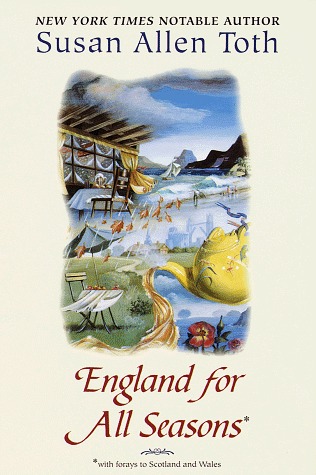 This was her third set of England essays, prompted by a question she frequently got from friends and readers: when is the best time to go? Her answer would be to go whenever you can, as often as you can, because rain can be delightful and in the off season you’ll have special places to yourself. I can see that I have this book to thank for the memorable Cornwall vacation I had with my mom and sister in April 2004, midway through my study abroad year: two of the sites she highlights here, St. Ives and the seal sanctuary at Gweek (part of the “Touring England’s Ark” chapter) were among our chosen stops.
Toth is a particular fan of gardens and literary sites, but loves London museums and theatres as much as windswept coastal and island scenery. When in England she lets herself sample multiple desserts from the sweet trolley, fill her suitcase with secondhand books, and pepper her speech with exclamations of “Lovely!” and “Brilliant!” I was relieved to be reminded of her suggested one-hour time limit for any museum – “depart without guilt, as soon as your eyes droop or your feet hurt or your heavy shoulder bag sinks to the floor. When you begin wondering if it is too early for lunch, head for the door.” (I poop out at museums very quickly.) The practical information she includes at the end of each chapter is probably entirely out of date, but her ideas are solid, and a quick web search will update any details.
The final essay, “Travel Time,” perfectly captures the holiday spirit: “Because our travel time is so densely filled, with intense if often quiet experiences, I am always astonished at what has happened—or rather, what has not happened—when we return home. After two weeks of living so vividly, newness in each hour, I feel as if I must have changed in significant ways.” (Free from The Book Thing of Baltimore)
Summer 2021 Reading, Part II & Transitioning into Autumn
In the past couple of weeks, we’ve taken advantage of the last gasp of summer with some rare chances at socializing, outdoors and in. Our closest friends came to visit us last weekend and accompanied us to a beer festival held in a local field, and this weekend we’ve celebrated birthdays with a formal-wear party at a local arts venue and a low-key family meal.


After my first installment of summer reads, I’ve also finished Klara and the Sun (a bust with me, alas) and the three below: a wildlife photographer’s memoir of lockdown summer spent filming in the New Forest, a record of searching for the summer’s remnants of snow in the Highlands, and an obscure 1950s novel about the psychological connections between four characters in one Irish summer. I close with a summer-into-autumn children’s book.
Goshawk Summer: A New Forest Season Unlike Any Other by James Aldred (2021)
My second nature book about the New Forest this year (after The Circling Sky by Neil Ansell) has only sharpened my hankering to get back there and have a good wander after many years away. In March 2020, Aldred had recently returned from filming cheetahs in Kenya when the UK went into its first national lockdown. He had the good fortune to obtain authorization from Forestry England that allowed him to travel regularly from his home in Somerset to the New Forest to gather footage for a documentary for the Smithsonian channel.
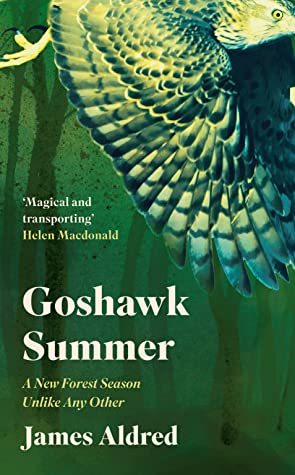 Zooming up on empty roads and staying in local cottages so he can start at 4 each morning, he marvels at the peace of a place when humans are taken out of the equation. His diary chronicles a few months of extraordinary wildlife encounters – not only with the goshawks across from whose nest he built a special treetop platform, but also with dragonflies, fox cubs, and rare birds like cuckoo and Dartford warbler. The descriptions of animal behaviour are superb, and the tone is well balanced: alongside the delight of nature watching is anger at human exploitation of the area after the reopening and despair at seemingly intractable declines – of 46 curlew pairs in the Forest, only three chicks survived that summer.
Despite the woe at nest failures and needless roadkill, Aldred is optimistic – in a similar way to Ansell – that sites like the New Forest can be a model of how light-handed management might allow animals to flourish. “I believe that a little space goes a long way and sometimes all we really need to do is take a step back to let nature do its thing. … It is nature’s ability to help itself, to survive in spite of us in fact, that gives me tentative hope”. (Unsolicited review copy) 
With thanks to Elliott & Thompson for the free copy.
Among the Summer Snows by Christopher Nicholson (2017)
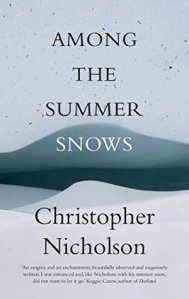 After the death from cancer of his wife Kitty, a botanical illustrator, Nicholson set off for Scotland’s Cairngorms and Ben Nevis in search of patches of snow that persist into summer. “Summer snow is a miracle, a piece of out-of-season magic: to see it is one thing, to make physical contact with it is another.” His account of his travels washed over me, leaving little impression. I appreciated the accompanying colour photographs, as the landscape is otherwise somewhat difficult to picture, but even in these it is often hard to get a sense of scale. I think I expected more philosophical reflection in the vein of The Snow Leopard, and, while Nicholson does express anxiety over what happens if one day the summer snows are no more, I found the books on snow by Charlie English and Marcus Sedgwick more varied and profound. (Secondhand, gifted)
A Shower of Summer Days by May Sarton (1952)
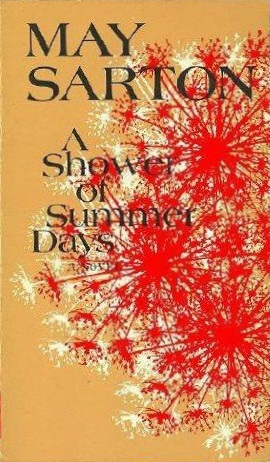 Although I’m more a fan of Sarton’s autobiographical material, especially her journals, I’ve also enjoyed exploring her fiction. This was my seventh of her novels. It’s set in Ireland at Dene’s Court, the grand house Violet inherited. She and her husband Charles have lived in Burma for two decades, but with the Empire on the wane they decide to settle in Violet’s childhood home. Gardening and dressing for dinner fill their languid days until word comes that Violet’s 20-year-old niece, Sally, is coming to stay.
The summer is meant to cure Sally of her infatuation with an actor named Ian. Violet reluctantly goes along with the plan because she feels so badly about the lasting rivalry with her sister, Barbara. Sally is a “bolt of life” shaking up Violet and Charles’s marriage, and when Ian, too, flies out from America, a curious love triangle is refashioned as a quadrilateral. The house remains the one constant as the characters wrestle with their emotional bonds (“the kaleidoscope of feelings was being rather violently shaken up”) and reflect on the transitory splendour of the season (“a kind of timelessness, the warm sun in the enclosed garden in the morning, the hum of bees, and the long slow twilights”). This isn’t one of my favourites from Sarton, but it has low-key charm. I saw it as being on a continuum from Virginia Woolf to Tessa Hadley (e.g. The Past) via Elizabeth Bowen. (Secondhand purchase from Awesomebooks.com) 
And finally, one for the seasons’ transition:
Goodbye Summer, Hello Autumn by Kenard Pak (2016)
 A child and dog pair set out from home, through the woods, by a river, and into town, greeting other creatures and marking the signs of the season. “Hello!” the beavers reply. “We have no time to play because we’re making cozy nests and dens. It will be cold soon, and we want to get ready.” The quaint Americana setting and papercut-style illustrations reminded me of Vermont college towns and Jon Klassen’s work. I liked the focus on nature. (Free from a neighbour)
What books are accompanying you from summer into autumn this year?
Three June Releases: Allen-Paisant, Cowen and Mosse
Two poetry offerings and a short memoir this month. A similar strategy is at work in both verse volumes: Jason Allen-Paisant contrasts Jamaica and England via the medium of trees, and Rob Cowen comments on current events through the prism of the natural world. In Kate Mosse’s first nonfiction book, she reflects on bereavement and caregiving.
Thinking with Trees by Jason Allen-Paisant
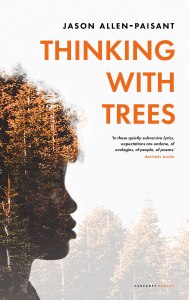 Allen-Paisant, from Jamaica and now based in Leeds, describes walking in the forest as an act of “reclamation.” For people of colour whose ancestors were perhaps sent on forced marches, hiking may seem strange, purposeless (the subject of “Black Walking”). Back in Jamaica, the forest was a place of utility rather than recreation:
In Porus life was un-
pastoral
The woodland was there
not for living in going for walks
or thinking
Trees were answers to our needs
not objects of desire
woodfire
But “I give myself permission / to go outside,” he writes, to notice the turning of the seasons, to commune with trees and birds, even if “there is nobody else like me / around here”. Explicitly calling into question Wordsworth’s model of privileged wandering, he injects a hint of threat into his interactions with nature. Most often this is symbolized by the presence of dogs. Even the most idyllic of scenes harbours the possibility of danger.
beware of spring
believe you are
a sprout of grass
and love all you see
but come out of the woods
before the white boys
with pitbulls
come
The poet cites George Floyd and Christian Cooper, the Central Park birder a white woman called the police on, as proof that being Black outdoors is inherently risky. There’s no denying this is an important topic, but I found the poems repetitive, especially the references to dogs. These felt like overkill. While there is some interesting enjambment, as in the first extended quote above, as well as internal and half-rhymes, I tend to prefer more formal poetry that uses more sonic techniques and punctuation. Still, I would be likely to direct fans of Kei Miller’s work to this collection.
With thanks to Carcanet Press for the free copy for review.
The Heeding by Rob Cowen
This poetry and art collaboration arose out of a “pact to pay attention” during a year of lockdown in the UK and record observations of nature, current events, and everyday life. Cowen is drawn to the moors near his home in Yorkshire, but also yearns to spend time with his friends again. He watches hawks and blue tits, notices the insects that fill his garden, and celebrates the way that allotment gardening brings together all sorts of people.
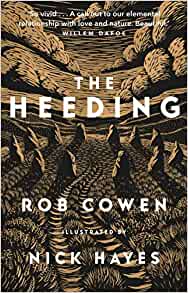 The emotional scope of the poems is broad: the author fondly remembers his brick-making ancestors and his honeymoon; he sombrely imagines the last moments of an old man dying in a hospital; he expresses guilt over accidentally dismembering an ant, yet divulges that he then destroyed the ants’ nest deliberately. There are even a couple of cheeky, carnal poems, one about a couple of teenagers he caught copulating in the street and one, “The Hottest Day of the Year,” about a longing for touch. “Matter,” in ABAB stanzas, is on the theme of racial justice by way of the Black Lives Matter movement.
My two favourites were “Sunday School,” about the rules for life he’s lived by since leaving religion behind, and “The End of This (Drinking Poem),” which serves as a good-riddance farewell to 2020: “Let me shake off / this year the way the otter / slips out of fast, rising water / and makes the holt just in time … / Let me rid my days of caution and fear, / these protocols and tiers / and Zoom funerals for people I love / and will never see again.” The book is worth the price of admission for the latter alone, and Nick Hayes’s black-and-white woodcut-style engravings are a plus.
However, in general I felt that the balance of current events and nature was off, especially compared to books like The Consolation of Nature, and ultimately I was not convinced that this needed to be in verse at all. “Starling,” especially, feels like a straight knockoff of Robert Macfarlane’s The Lost Words (“We forget that you once shimmered through frozen air, ripple bird. / Shape-shifter, dusk-dancer. Murmurer, sky-writer”). Judging from Cowen’s Common Ground, this would have been more successful as a book of short prose diary entries with a few poems dotted through.
With thanks to Elliott & Thompson for the proof copy for review.
An Extra Pair of Hands: A Story of Caring, Ageing and Everyday Acts of Love by Kate Mosse
Mosse’s parents and mother-in-law all moved in to live with her and her husband in their Chichester home when they reached old age. Her father had Parkinson’s and died in 2011, her mother survived him by a few years, and Granny Rosie is still going (reasonably) strong at the age of 90. This is a compact and relatable account of a daughter’s experiences of caregiving and grief, especially with the recent added complications of a pandemic.
 What came through particularly clearly for me was the older generation’s determination to not be a burden: living through the Second World War gave them a sense of perspective, such that they mostly did not complain about their physical ailments and did not expect heroic measures to be made to help them. (Her father knew his condition was “becoming too much” to deal with, and Granny Rosie would sometimes say, “I’ve had enough of me.”) In her father’s case, this was because he held out hope of an afterlife. Although Mosse does not share his religious beliefs, she is glad that he had them as a comfort.
The author recognizes the ways in which she has been lucky: as a full-time writer, she works from home and has the time and energy to devote to caring for elderly parents, whereas for many – generally middle-aged women, who may still have children at home – it is a huge struggle to balance caregiving with the rest of life. What is more, money is no issue for her. Repeating some of the statistics from Madeleine Bunting’s Labours of Love, she acknowledges that the situation is much more challenging for the average person.
I can see how this could serve as a great introduction for someone who hasn’t previously read much about bereavement, caregiving or old age, and I imagine it will especially appeal to existing fans of Mosse’s writing, whereas I was new to her work. I’ve read so much around these topics, including most of the works included in the bibliography, that the book did not offer me anything new, though it was a perfectly pleasant read.
Readalikes I have reviewed:
Notes on Grief by Chimamanda Ngozi Adichie
Be With by Mike Barnes
All Things Consoled by Elizabeth Hay
The Fragments of My Father by Sam Mills
With thanks to Profile Books/Wellcome Collection for the free copy for review.
What recent releases can you recommend?
Christmas and Snow Reading: George Mackay Brown & More
I’ve never had a Christmas Day without my immediate family or in-laws before, but when West Berkshire leapt into the Tier 4 (highest) COVID-19 risk category on Saturday it was clear that even our modest plans to spend 48 hours at my parents-in-law’s home by the coast would be dashed. How we’d looked forward to seeing other people and going somewhere else! Nothing dramatic; just a change of scene and an excuse to pack an overnight bag and a giant tote full of books. The bright side, if there is one, is that we can choose exactly how to spend the holidays, and my husband – a fantastic cook – will have total control over the feast.
To keep our spirits up, we’ve done more Christmas decorating than usual. Our lounge is dominated by the biggest tree we’ve had yet, there’s holly all over, and we strung colored fairy lights across one wall. After Saturday’s bad news, we brought forward our annual viewing of Elf. And of course, I have a stack of seasonally appropriate books at the ready.
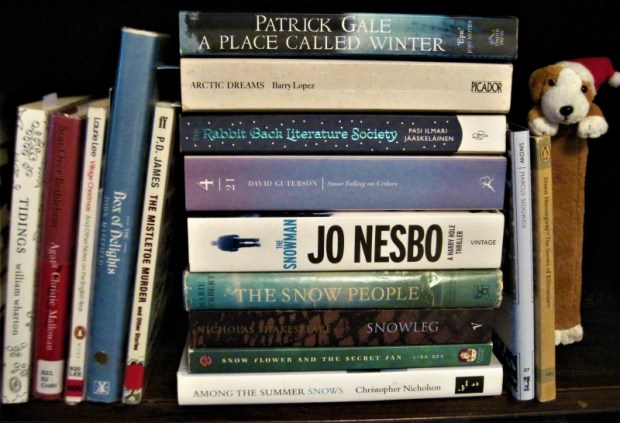
Here’s the first two I managed to read for review:
Christmas Stories by George Mackay Brown
 Many of these 30 short stories originally appeared in publications like the Scotsman, Tablet and Glasgow Herald between the 1940s and 1990s, with some also reprinted in previous Mackay Brown story volumes. This posthumous collection of seasonal tales by Orkney’s best-known writer runs the gamut from historical fiction to timeless fable, and travels from the Holy Land to Scotland’s islands. Often, Orkney is contrasted with Edinburgh, as in one of my favorites, “A Christmas Exile,” in which a boy is sent off to Granny’s house in Orkney one winter while his mother is in hospital and longs to make it home in time for Christmas.
Although the main characters are usually crofters, fishermen and lairds, they take on other roles in Nativity and Christmas Carol-like setups. For instance, a skipper, a miller, and a shepherd play the part of the Three Kings, while a greedy general merchant who won’t close his shop for Christmas Day is like Ebenezer Scrooge. Biblical and Dickensian figures merge in “An Epiphany Tale,” in which a deaf-blind-mute boy is visited by three strangers who give him back each of his senses, in turn, for one magical day. Characters get visions of the past or glimpses of how the other half live (“The Poor Man in His Castle”). Children are disabused of the idea of Santa Claus, but the unexplained still fuels a sense of wonder, as in Jeanette Winterson’s holiday stories. Even the poor have small gifts and pleasures to look forward to.
As editor William S. Peterson notes in his introduction, Calvinism had erased much of the joy from Christmas in Scotland, but in Mackay Brown’s lifetime he saw Yule traditions returning and was keen to emphasize that Christmas was not just about one day of celebration but was a whole season running from Advent through to Epiphany. The story “I Saw Three Ships…” remembers an oppressed past, though: set at the end of the Civil War, after King Charles I was beheaded, it is set at a time when the government declared “‘There will be no more Christmas. Christmas is abolished and forbid in the islands here, as it has been put down everywhere in this commonwealth. We will have no more of such ancient mummery.’ … Men reckoned that that was the longest coldest dreichest winter ever known in Orkney.” Those words might feel gloomily appropriate, but let’s celebrate all the more in defiance.
With thanks to Galileo Publishers for the free copy for review.
Fifty Words for Snow by Nancy Campbell
 Words for snow exist in most of the world’s languages – even those spoken in countries where it rarely, if ever, snows. For instance, Thai has “hima” at the ready even though there were only once claims of a snow flurry in Thailand, in 1955. Campbell meanders through history, legend, and science in these one- to five-page essays. I was most taken by the pieces on German “kunstschnee” (the fake snow used on movie sets), Icelandic “hundslappadrifa” (snowflakes big as a dog’s paw, a phrase used as a track title on one of Jónsi’s albums – an excuse for discussing the amazing Sigur Rós), and Estonian “jäätee” (the terrifying ice road that runs between the mainland and the island of Hiiumaa – only when the ice is 22 cm thick, and with cars traveling 2 minutes apart and maintaining a speed of 25–40 km/hour).
The white and blue tendrils of the naked hardback’s cover creep over onto the endpapers, each essay is headed by a Wilson Bentley photograph of a snowflake, and the type is in a subtle dark blue ink rather than black. Too many of the essays are thin or dull, such that the contents don’t live up to the gorgeous physical object they fill. Still, I imagine you have a snow-loving relative who would appreciate a copy as a seasonal coffee table book.
With thanks to Elliott & Thompson for the free copy for review.
And a bonus:
“The Burglar’s Christmas” by Willa Cather (1896)
 This Renard Press pamphlet supporting the Three Peas charity (in aid of Europe’s refugees) was sent to me as a Christmas card alternative by Annabel/Shiny New Books. A young man wanders the slushy streets of Chicago one Christmas Eve. On this, his 24th birthday, he laments how low he has sunk that he has to rob the rich in order to get money to eat. But in this take on the Prodigal Son story, there is a second chance at forgiveness and a good life. I was reminded of the high society atmosphere of Edith Wharton’s work and the moral fables of O. Henry. The lovely little story has a William Morris design on the cover. I’ll keep it with my small collection of Christmas books and bring it out to reread in future years.
Are you reading any Christmas or wintry books?
What are your plans for the holidays?
 Bookish Beck = Rebecca Foster. American transplant to England. Freelance proofreader and book reviewer.
 Bookish Beck