March Releases by Akbar, Bosker, García Márquez, and Wrenn
I’m catching up after a busy end to last month. Today I have an uneven debut novel from a poet whose work I’ve enjoyed before, a journalist’s jaunty submersion in the world of modern art, a posthumous novella from a famous Colombian author I’d not previously read, and a (literally) trippy memoir about C-PTSD, coral, climate breakdown, queerness and more. I can pinpoint a couple of elements that some or all of them have in common: beauty (whether in art or in nature) and dead mothers.
Martyr! by Kaveh Akbar
I’d read the Iranian American poet’s two full-length collections and particularly admired Pilgrim Bell, one of my favourite books of 2021. That was enough for me to put this on my Most Anticipated list for 2024, even though based on the synopsis I wrote: “His debut novel sounds kind of unhinged, but I figure it’s worth a try.” Here’s an excerpt from the publisher’s blurb: “When Cyrus’s obsession with the lives of the martyrs – Bobby Sands, Joan of Arc – leads him to a chance encounter with a dying artist, he finds himself drawn towards the mysteries of an uncle who rode through Iranian battlefields dressed as the Angel of Death; and toward his [late] mother, who may not have been who or what she seemed.”
 Cyrus Shams is an Iranian American aspiring poet who grew up in Indiana with a single father, his mother Roya having died in a passenger aircraft mistakenly shot down by a U.S. Navy missile cruiser (this really happened: Iran Air Flight 655, on 3 July 1988). He continues to lurk around the Keady University campus, working as a medical actor at the hospital, but his ambition is to write. During his shaky recovery from drug and alcohol abuse, he undertakes a project that seems divinely inspired: “Tired of interventionist pyrotechnics like burning bushes and locust plagues, maybe God now worked through the tired eyes of drunk Iranians in the American Midwest”. By seeking the meaning in others’ deaths, he hopes his modern “Book of Martyrs” will teach him how to cherish his own life.
This document, which we see in fragments, sets up hypothetical dialogues between figures real and imaginary, dead and living, and intersperses them with poems and short musings. But when a friend tells Cyrus about the Brooklyn Museum installation “DEATH-SPEAK,” which has terminally ill Iranian artist Orkideh living out her last days in public, he spies an opportunity to move the work beyond theory and into the physical realm. So he flies to New York City with his best friend (and occasional f**kbuddy), bartender Zee Novak, and visits Orkideh every day until the installation’s/artist’s end.
This is a wildly original but unruly novel with a few problems. One: Akbar has clung too obviously to his own story and manner of speaking with Cyrus (e.g., “I honestly actually do worry about that, no joke. Being a young Iranian man making a book about martyrdom, going around talking to people about becoming a martyr. It’s not inert, you know?”). Another is that the poems, and poetic descriptions, are much the best material. The only exception might be a zany scene where Zee and Cyrus chop wood while high. But the main issue I had is that the plot turns on a twist 50 pages from the end, a huge coincidence that feels unearned. I admire the ambition Akbar had for this – a seething, open-hearted enquiry into addiction, love, suicide and queerness – but look forward to him getting back to poetry. 
With thanks to Picador for the proof copy for review.
Get the Picture: A Mind-Bending Journey among the Inspired Artists and Obsessive Art Fiends Who Taught Me How to See by Bianca Bosker
I was a big fan of Bosker’s Cork Dork (2017), her deep dive into the world of fine wine. Her second book is similarly constructed and equally fun: more personal than authoritative, light yet substantial, and accessible to the uninitiated as well as those with an existing interest in the subject. She begins as a complete novice, wondering if she’ll ever know what art is, let alone what it means and whether it’s any good (“the familiar feeling that everyone got the punch line except me”). By the end, she has discovered that, like the love of wine, art appreciation can be a way of expanding and savouring one’s life.
The aim was to get the broadest experience possible, generally through voluntary placements. She started out as an assistant at Jack Barrett’s 315 Gallery, where one of her tasks was to paint a wall white; she failed miserably to meet his expectations even for this simple task. He never lost his fundamental distrust of her, a writer and outsider, as one of “the enemy.” It was expected that she would attend as many art shows and openings as possible per week. “Talking shit was essentially a job requirement.” Bosker might not have known what to make of the art, but others were gossipy, snobbish and opinionated enough to make up for it. When she was tasked with writing a press release for an exhibit, a gallerist taught her the clichéd shorthand: “Every f**king artist allegedly transforms the familiar into the unfamiliar, or vice versa.”

In the course of the book, the New York City-based author also:
- attends the Art Basel Miami Beach contemporary art fair and sells photographs on behalf of Denny Dimin Gallery;
- befriends performance artist and “ass influencer” Mandy AllFIRE, who – ahem – sits on Bosker’s face as part of a temporary installment;
- serves as a studio assistant for French painter Julie Curtiss, whose work is selling for alarmingly high amounts at auction (not actually what a painter wants, as it tends to signal bad things for a career);
- meets a pair of North Dakota collectors known as “the Icy Gays”; and
- works as a Guggenheim Museum guard.
This last was my favourite episode. Forty-minute placements on particular ramps gave her time to focus on one chosen artwork – for instance, an abstract sculpture. She challenged herself to stay with it for that whole time, doing as one artist advised and simply noticing five things about the work. Before, her “default approach to art had just been to plant myself in front of a piece and wait for the epiphany to wash over me.” Now, she worked at it. In fact, she counsels newcomers to not read a caption because many people take a title at face value and an interpretation as gospel, and so don’t experience the art for themselves.
At times I found the book slightly scattered in the way that it zigzags from one challenge to another. There’s differing attention to various experiences; a week-long art school merits just one paragraph. And there’s no getting past the fact that some art she encounters sounds outlandish or just plain silly. (Is it any surprise that she mistakes part of a wall, and a mousetrap, for art pieces?) Ultimately, I think it’s best if you have at least a modicum of appreciation for modern art, which I don’t; whereas I do enjoy drinking wine even if I don’t have a trained palate.
Even so, Bosker’s writing has such verve (“artists were coyly evasive about their work and treated my questions like I was a cactus running after their balloon”; “a hazy daydream of an idea solidified into a yappy, un-shut-uppable chihuahua of want”) that you’ll be glad you went along for the ride. She concludes that taste is subjective, but “Beauty … pulls you close.” Art is valuable because it “knocks us off our well-worn pathways” into something uncharted, a tantalizing prospect. 
With thanks to Allen & Unwin (Grove Press) for the free copy for review.
{SPOILERS IN THIS NEXT ONE}
Until August by Gabriel García Márquez
[Translated from the Spanish by Anne McLean]
A posthumous ‘lost’ novella was not a good place for me to have started with this celebrated author. García Márquez okayed the fifth draft of the text in 2004, 10 years before his death. By this time he was already suffering with memory loss that interfered with his creativity. His sons got the message that he didn’t think the book worked and should be destroyed. But they didn’t do his bidding and, revisiting the book nearly a decade on from his death, decided it wasn’t that bad, if not up to the standard of his best work, and that it should see the light of day after all.
Every August 16th, Ana Magdalena Bach travels to the island where her mother is buried to visit the grave and lay gladioli on it. (My review book came with a bag of three gladioli bulbs and a mini Colombian chocolate bar.) Each year she takes a different lover for the one night at a hotel. The first time, the man leaves her a $20 bill and she feels ashamed, but it doesn’t stop her doing the same thing again for the next four years in a row. Once it’s a long-ago school friend whom she runs into on the ferry. Another time, by golly, it’s a bishop.

It’s refreshing to have a woman in middle age as protagonist and for her to claim sexual freedom. However, the setup is formulaic and repetitive, the sex scenes are somewhat excruciating, and the hypocrisy of her gleefully having one-night stands while fretting over her husband’s potential infidelity is grating. I did like the ending – Ana hears that an anonymous elderly gentleman has been paying to have gladioli laid on her mother’s grave year-round and she wonders if she is in a sense following in her mother’s footsteps all along without knowing it; and decides she’s had enough and exhumes her mother’s remains, returning to her husband with a bag of bones (gruesome!).
But nothing about the plot or the writing – fluid enough bar one awkward sentence (“She listened to him worried that he meant it, but she had the strength not to appear as easy a woman as he might think”) – suggested to me a master at work. At best, this might be reminiscent of the late work of misogynist-leaning authors like Coetzee or Updike.
In my mind García Márquez is linked with magic realism, so I’d be better off trying one of his more representative works. I have several of his earlier novellas on the shelf (received as review copies as part of the same recent marketing push), and if I get on better with those then I’ll be sure to try one of the most famous full-length novels. 
With thanks to Viking (Penguin) for the free copy for review.
Mothership: A Memoir of Wonder and Crisis by Greg Wrenn
Wrenn is an associate English professor teaching environmental literature at James Madison University. He has also been exploring coral reefs for 25 years, with a love of marine wildlife sparked by growing up in Florida. But all along, he’s been trying (much like Cyrus Shams) to come to terms with addiction, queerness, suicidal inclinations, and especially his mother’s place in his life. She made him feel dirty, that he would never be good enough; she hit him with a wooden spoon and bathed him until he was 17. Though he never found out for sure, he suspects his mother was sexually abused by her father and repeated the cycle of molestation.
 This is the third C-PTSD memoir I’ve read (after What My Bones Know and A Flat Place), and has a lot in common with I’m Glad My Mom Died, which features a co-dependent relationship with an abusive mother. After Wrenn’s parents’ divorce, he and his mother remained close. “I had been her therapist, confessor, girlfriend, and punching bag.” He helped care for her after a stroke but eventually had to throw up his hands at her stubborn refusal to follow doctors’ orders. Drawing on the Greek etymology of ecology (oikos means house or family), Wrenn insists on a parallel between the personal and the environmental here: “What we’re facing amounts to global C-PTSD” as “Mother” Earth turns against us. On each trip to Raja Ampat, he knows the coral reef is dying, his carbon footprint only accelerating it.
There’s a lot in this short memoir. Even the summary had me shaking my head in disbelief. For me, though, the tone and style were too erratic. Wrenn can be wry, sorrowful, or campy; he includes scientific data, letters to Adrienne Rich and an imagined descendent, a chapter riffing on “Otters” (the animal and the gay stereotype), flashbacks, and E.T. metaphors. The final third of the book then takes a left turn as he experiments with therapeutic psychedelics via ayahuasca ceremonies in South America, and ditches dating apps and casual sex to try to find a long-term relationship. The drug literally alters his brain, allowing him to feel trust and love. Add on nature and a husband and that’s why he’s still here rather than dead by suicide.
Like Akbar, Wrenn published poetry before switching genre. Their books are both amazing in premise but wobbly in execution. Still, I’d say both authors are laudable for their effort to depict lives wrenched back from extremity. 
With thanks to Regalo Press (USA) for the proof copy for review.
Writers & Lovers by Lily King
(This was meant to be one entry in a roundup of mini-reviews, but I found that I had far too much to say about it. On Sunday I’ll feature three more May releases I’ve read.)
1997. Following a breakup and her mother’s sudden death, Casey Peabody is drowning in grief and debt. At 31, she lives in a tiny studio apartment off of her brother’s friend’s house and cycles everywhere. Between shifts waitressing at Iris, a trendy restaurant above a Harvard social club, she chips away at the Cuba-set novel she’s been writing for six years.
Through her writer friend Muriel she meets two love interests at a book launch for Oscar Kolton, a former Boston University professor and novelist who’s been leading a fiction workshop since his wife’s death a few years ago. One is the fortysomething Oscar himself; the other, who initially seems more promising, is Silas, a would-be writer from the workshop. But before they have a chance to see if this will go somewhere, Silas is off. He leaves Casey a voicemail saying he needs to get away for a while. Oh well; just another flake, she thinks.
After he and his adorable young sons come in to the restaurant for brunch one day, her interest is squarely in Oscar. Or, that is, until Silas comes back and she finds herself dating two men at the same time. A museum trip with Silas here, a dinner out with Oscar there. As if her love life isn’t complication enough, before long she finds herself looking for a new job, a place to live, a literary agent, and reassurance that she’ll be okay when she takes advantage of her short-lived health insurance to get some minor medical issues checked out.

I almost passed on reading this one because I’d gotten it in my head that it was nothing more than a romantic comedy with a love triangle. I’m so glad that Kate’s review convinced me to give it a try after all. On the face of it this could hardly be more different from King’s previous novel, Euphoria, about anthropologists doing field work in Papua New Guinea in the 1930s, but King’s attention to the intricacies of human relationships links the two. When I read Euphoria in late 2014, I noted the natives’ practice of cutting off a finger for every close relative lost. Here you also get the sense that everyone has lost someone, and that these losses are as visible as physical traits. Casey is only on her second conversation with Silas when she thinks, “I can tell he lost someone close somehow. You can feel that in people, an openness, or maybe it’s an opening that you’re talking into. With other people, people who haven’t been through something like that, you feel the solid wall. Your words go scattershot off of it.”
There are so many things to love about this novel, including the wonderful/terrible scenes where she rattles off her mother’s story to two doctors and her awful father and stepmother show up for lunch. Count the rest: The Boston-area setting, the restaurant bustle, that feeling we’ve all had of wasting our talents while stuck in the wrong job and the wrong living situation. Casey’s confiding first-person, present-tense narration, the little observations on writers (when John Updike comes into the restaurant she touches his loafer for luck; she nearly swoons when Jayne Anne Phillips is at one of her tables—“Black Tickets is like a prayer book to me”; she thinks she’s blown a high school English teacher interview when she states a dislike for Cormac McCarthy—“he seemed to be alternating between imitating Hemingway and imitating Faulkner”), and even the choice between Silas and Oscar (“Fireworks or coffee in bed”). She doesn’t make the ‘right’ choice I was expecting, but if you’ve been following the clues closely you’ll realize it’s the only one she could have made.
What I loved most, though, was that we see this character at rock bottom but also when things start to go well at long last. “There’s a particular feeling in your body when something goes right after a long time of things going wrong. It feels warm and sweet and loose.” I felt I knew Casey through and through, and I cheered for her as I did for Ana in Dominicana by Angie Cruz. Those who have tried writing a book will probably get even more out of this than I did, but it will resonate for anyone who’s ever felt lost and uncertain about life’s direction. “Isn’t our whole life just one long improvisation?” Casey hears at a writing festival.
Think of this as an older, sadder Sweetbitter, perhaps as written by Elizabeth Strout. It gives you all the feels, as they say.
A real standout and one of my few early favorites from 2020.
My rating: 
With thanks to Picador for the unsolicited copy for review.
Plans for 20 Books of Summer

This is my second time taking part in Cathy’s 20 Books of Summer project. Once again I plan to focus solely on books that I own to try to get through a respectable number of them. For 2019 I’ve decided to read books that are about animals or have an animal in the title. I’ve set aside a few back-ups (the ones standing upright in the photos), and if I’m struggling I can cheat a bit by including books that happen to have an animal on the cover.


In the interest of statistics … last year I read eight nonfiction titles and 12 fiction – so that’s exactly what I’ve pulled out for this year. (For the record, I only intend to read the first of Updike’s Rabbit novels at this stage.) I have two re-reads set aside this time (Julian Barnes and Abigail Thomas) versus one last year. Last year I read one doorstopper; this year I don’t have any on the docket. In 2018 I was particularly proud of getting through two short story collections, so this year I’ve chosen one animal-themed one to read. Randomly, three of last year’s books were review copies from publishers or the author, and three were signed copies. This time I have none of either, unless I do some substituting.
Also interesting to note is that this year three of the books I’ve picked are by Canadian authors (André Alexis, Michael Crummey and Mary Lawson), and another has a Canadian setting (The Tenderness of Wolves). Canadian readers, rejoice!
Another project I might join in with this summer is the Robertson Davies reading week – I own his Deptford trilogy, and would at least read one of the books, if not attempt all three.
What are your summer reading plans?
A Publisher Party and a One-Man Play
I was a veritable social butterfly this past week: I went out two evenings in a row! (Believe me, that’s rare.) On Tuesday I met up with bloggers Annabel, Eric and Kim at the Faber Spring Party held at Crypt on the Green in London, and on Wednesday my husband and I attended a performance at the University of Reading of Michael Mears’s one-man play on the plight of Britain’s conscientious objectors during World War I, This Evil Thing.
Faber Spring Party
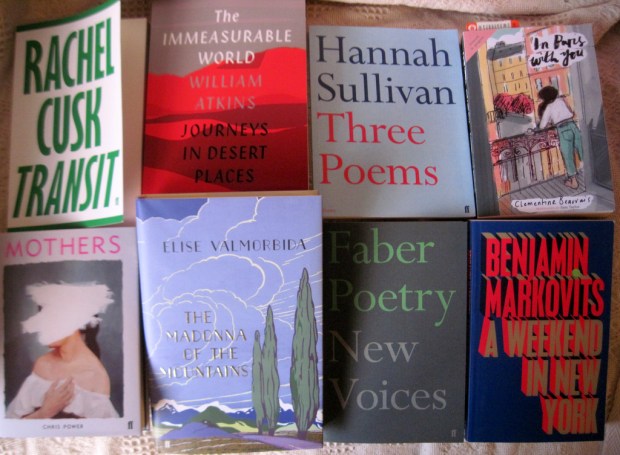
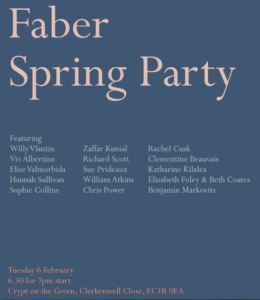 I’ve never been to an event quite like this. Publisher Faber & Faber, which will be celebrating its 90th birthday in 2019, previewed its major releases through to September. Most of the attendees seemed to be booksellers and publishing insiders. Drinks were on a buffet table at the back; books were on a buffet table along the side. Glass of champagne in hand, it was time to plunder the free books on offer. I ended up taking one of everything, with the exception of Rachel Cusk’s trilogy: I couldn’t make it through Outline and am not keen enough on her writing to get an advanced copy of Kudos, but figured I might give her another try with the middle book, Transit.

For the evening’s presentation, each featured author had a few minutes to introduce their new book and/or give a short reading.
Rachel Cusk opened the evening with a reading from Kudos. If you’re familiar with her recent work, you won’t be surprised at this synopsis: a man on a plane recounts having his dog put to sleep. (Out on May 3rd.)
William Atkins’s book on deserts, The Immeasurable World, is based on three years of travel and is, he is not ashamed to say, in the old-fashioned travel writing tradition. (Out on June 7th.)
Hannah Sullivan’s Three Poems is a hybrid work of poem-essays. #2 is more philosophical, she said; #3 is about her father’s death and her son’s birth. She read sonnet 3.21. (Out now.)
Clémentine Beauvais’s In Paris with You is a YA romance in free verse, loosely based on Eugene Onegin. I don’t know the source text but started this on the train ride home and it’s enjoyable thus far. I’m in awe at how translator Sam Taylor has taken the French of her Songe à la douceur and turned it into English poetry. (Out on June 7th.)
Chris Power’s Mothers is a book of linked short stories, three of which are about a character named Eva. He read a portion of a story about her having an encounter with an unpleasant man in Innsbruck. (Out on March 1st.)
Elise Valmorbida’s The Madonna of the Mountains, set in 1923–50, is a saga that resembles “an Italian Mother Courage,” she says. She read a scene in which a character comes across a madwoman. (Out on April 5th.)
Zaffar Kunial read the poem “Spark Hill” from his forthcoming collection Us. It’s about a childhood fight in the area of Birmingham where he grew up. He had a folder open in front of him but, impressively, recited the long poem completely from memory. (Out on July 5th.)
American novelist Benjamin Markovits was a professional basketball player in Germany for six months. Like the tennis-playing protagonist of his upcoming book, A Weekend in New York, he got tired of being measured. After 15 years, his hero is eager to escape a life of being constantly ranked. This is the first in a quartet of novels that inevitably invites comparison with John Updike’s “Rabbit” books. (Out on June 7th.)
I confess I didn’t previously know the name Viv Albertine; she was the guitarist for the female punk band The Slits, and To Throw Away Unopened is her second memoir. Albertine realized that it was her mother who had made her an angry rebel; the title is the label on a bag she found in her mother’s room after her death. (Out on April 5th.)
Sophie Collins incorporates hybrid forms in her poetry – what she calls “lyric essays.” The theme of her book Who Is Mary Sue? is perceptions of women’s writing (with “Mary Sue” as a metonym for the stereotypical good girl). She read from “Engine.” (Out now.)
Katharine Kilalea’s debut novel Ok, Mr Field is about an injured concert pianist who becomes obsessed with a house he buys in South Africa. (Out on June 7th.)
Elizabeth Foley and Beth Coates are the authors of two Homework for Grown-Ups books. Their new book, What Would Boudicca Do?, is about lessons we can draw from the women of history. For instance, the sampler booklet has pieces called “Dorothy Parker and Handling Jerks” and “Frida Kahlo and Finding Your Style.” There’s a heck of a lot of books like this out this year, though, and I’m not so sure this one will stand out. (Out on September 6th.)
Richard Scott read two amazingly intimate poems from his upcoming collection, Soho. One, “cover-boys,” was about top-shelf gay porn; the other was about mutilated sculptures of male bodies in the Athens archaeological museum. If you appreciated Andrew McMillan’s Physical, you need to get hold of this the second it comes out. I went back and read “cover-boys” in the sampler booklet and it wasn’t nearly as powerful as it was aloud; Scott’s reading really brought it to life, in contrast to some other authors’ dull delivery. (Out on April 5th.)
Sue Prideaux’s forthcoming biography of Friedrich Nietzsche is entitled I Am Dynamite! She encountered her subject when she wrote her first biography, of Edvard Munch. Although Nietzsche has been embraced by far-right groups in America, he was in fact against racism, nationalism, and anti-semitism, so he has important messages for us today. I’ll be keen to get hold of this one. (Out on September 6th.)
Guitar in hand, Willy Vlautin closed the evening with a performance of the title track from the soundtrack album to his fifth novel, Don’t Skip Out on Me – he was the singer in Portland, Oregon alt-country band Richmond Fontaine, which has recently stopped touring. He said the novel asks, “can you make the scars of broken people bearable?” (Out now.)

Now that I’ve got this terrific stack of books, wherever do I start?! I’m currently reading the Beauvais; from there I’ll focus on ones that have already been released, starting with Vlautin and the two poetry collections. The titles that aren’t out until June can probably wait – though it’s tempting to be one of the privileged few who get to read them nearly four months early. One Faber book per week should see me getting through all these by the final release date.
This Evil Thing
Michael Mears plays about 50 different characters in this one-man production. He’s an actor and pacifist who has written a number of solo pieces over 20 years. In this commemorative year of the end of the First World War, he knew we would hear a lot about battles, soldiers, and their families back home. But conscientious objectors weren’t likely to be remembered: theirs is a “story that’s rarely told,” he realized. This Evil Thing sets out to correct that omission. The title phrase refers not to war in general but specifically to conscription.
 The two main characters Mears keeps coming back to in the course of the play are Bert Brocklesby, a Yorkshire preacher, and philosopher Bertrand Russell. Brocklesby refused to fight and, when he and other COs were shipped off to France anyway, resisted doing any work that supported the war effort, even peeling the potatoes that would be fed to soldiers. He and his fellow COs were beaten, placed in solitary confinement, and threatened with execution. Meanwhile, Russell and others in the No-Conscription Fellowship fought for their rights back in London. There’s a wonderful scene in the play where Russell, clad in nothing but a towel after a skinny dip, pleads with Prime Minister Asquith.
As in solo shows I’ve seen before (e.g. A Christmas Carol with Patrick Stewart), Mears had to find subtle ways to distinguish between characters: he used a myriad different voices, including regional accents; he quickly donned a jacket, hat, or pair of glasses. Russell was identified by his ever-present pipe. The most challenging scene, Mears said in the Q&A at the end, was one with four characters in a French street café.
Mears reveals during the play that his grandfather fought in WWI and his father in WWII, but he has never had to put his own pacifist views to the test. What about Hitler? people always ask. Mears is honest and humble enough to admit that he doesn’t know what he would have done had he been called on to fight Hitler, or had he faced persecution as a CO in WWI. Ultimately, what Mears hopes audiences take from his play, which won acclaim at the Edinburgh Festival Fringe, is that “this is not an irrelevant piece of history.” Standing up for what you believe in, especially if it goes against the spirit of the times, is always valuable.
Making Plans (and Book Lists) for America
On Tuesday we leave for two weeks in America. It’s nearly a year and a half since our last trip – much too long – so we’ll be cramming in lots of visits with friends and family and doing a fair bit of driving around the Mid-Atlantic states. I’m giving myself the whole time off, which means I’ve been working flat out for the past two weeks to get everything done (including my U.K. and U.S. taxes). I’m nearly there: at the 11-day countdown I still had 12 books I wanted to finish and 12 reviews to write; now I’m down to five books, only one of which might be considered essential, and all the reviews are ready to submit/schedule. What with the holiday weekend underway, it should all be manageable.
I’m a compulsive list maker in general, but especially when it comes to preparing for a trip. I’ve kept adding to lists entitled “Pack for America,” “Do in America,” “Buy in America,” and “Bring back from America.” But the more fun lists to make are book-related ones: what paper books should I take to read on the plane? Which of the 315 books on my Kindle ought I to prioritize over the next two weeks? Which exclusively American books should I borrow from the public library? What secondhand books will I try to find? And which of the books in the dozens of boxes in the closet of my old bedroom will I fit in my suitcase for the trip back?
I liked the sound of Laila’s habit of taking an Anne Tyler novel on every flight. That’s just the kind of cozy reading I want, especially as I head back to Maryland – not far at all from Tyler’s home turf of Baltimore. I browsed the blurbs on a few of her paperbacks I have lying around and chose Back When We Were Grownups to be my fifth Tyler and one of my airplane reads.
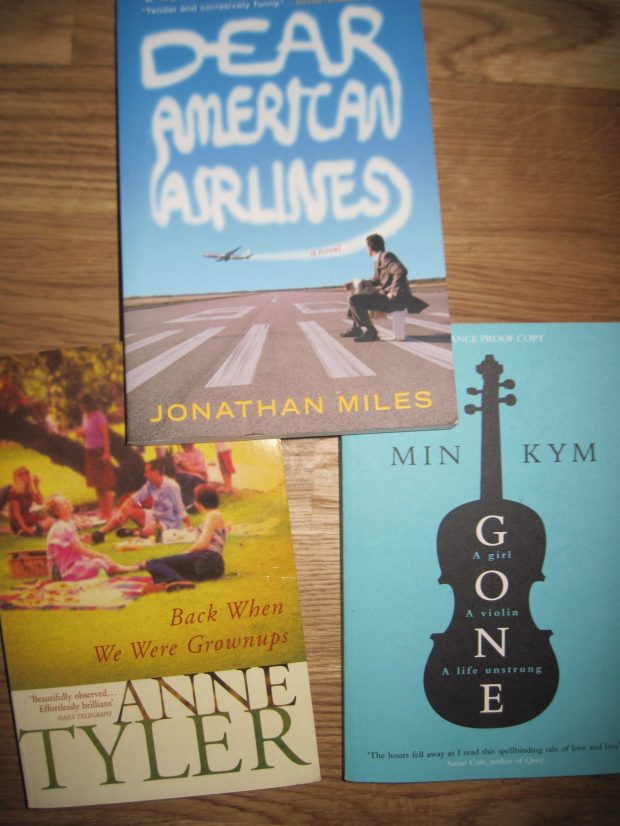
I’m also tempted by Min Kym’s Gone, a memoir by a violin virtuoso about having her Stradivarius stolen. I picked up a proof copy in a 3-for-£1 charity sale a couple of weeks ago. And then I can’t resist the aptness of Jonathan Miles’s Dear American Airlines (even though we’re actually flying on Virgin). I’ll start one or more of these before we go, just to make sure they ‘take’.
I almost certainly won’t need three print books for the trip, particularly if I take advantage of the in-flight entertainment. We only ever seem to watch films while we’re in America or en route there, so between the two legs I’ll at least try to get to La La Land and The Light between Oceans; I’m also considering Nocturnal Animals, Silence, and the live-action Beauty and the Beast – anyone seen these?
However, I’ll also keep my Kindle to hand, as I find it easier to pick up and put down on multi-part journeys like ours to the airport (train ride + coach ride). Some of the books on my Kindle priority list are: The Day that Went Missing by Richard Beard, Cork Dork by Bianca Bosker, Eleanor Oliphant Is Completely Fine by Gail Honeyman, The Fact of a Body by Alexandria Marzano-Lesnevich, Mrs. Fletcher by Tom Perrotta (out in August), The Power by Naomi Alderman, Reservoir 13 by Jon McGregor, The Rules Do Not Apply by Ariel Levy, See What I have Done by Sarah Schmidt, You Should Have Left by Daniel Kehlmann … and the list continues, but I’ll stop there.

My book shopping list is an ongoing one, as the many cross-outs and additions on this sheet show. Finding specific books at my beloved Wonder Book can be a challenge, so I usually just keep in mind the names of authors I’d like to read more by. This time that might include Arnold Bennett, Geoff Dyer, Elizabeth Hay, Bernd Heinrich, W. Somerset Maugham, Haruki Murakami and Kathleen Norris. In addition to the couple of secondhand bookstores we always hit, I hope to visit a few new-to-me ones on stays with friends in Virginia.
As for those poor books sat in boxes in the closet, I have plans to unearth novels by Anita Brookner, Mohsin Hamid, Kent Haruf, Penelope Lively, Howard Norman and Philip Roth – for reading while I’m there and/or bringing back with me. I’m also contemplating borrowing my dad’s omnibus edition of the John Updike “Rabbit” novels. From my nonfiction hoard, I fancy an Alexandra Fuller memoir, D.H. Lawrence’s travel books and more of May Sarton’s journals. If only it weren’t for luggage weight limits!
On Monday I’ll publish my intercontinental Library Checkout, on Tuesday I have a few June releases to recommend, and then I’m scheduling a handful of posts for while I’m away – a couple reviews I happen to have ready, plus some other lightweight stuff. Alas, I read no doorstoppers in May, but I have a list (of course) of potential ones for June, so will attempt to resurrect that monthly column.
Though I may be slow to respond to comments and read your blogs while I’m away, I will do my best and hope to catch up soon after I’m back.
Authors I Keep Meaning to Try
Picking up a book by an author you’ve never encountered before can be a bit daunting. Perhaps, like me, you’ve heard people praise particular authors for a long time and have wanted to give their writing a try, but simply never known quite where to start. For me, a few that keep coming to mind, bringing with them a twinge of guilt each time, are Haruki Murakami, Joyce Carol Oates and John Updike.
Oates published her first novel at age 26 and has written around 50 of them since; she’s also a prolific short story writer and essayist, such that her total output numbers some 70-plus volumes. Yet the only piece I’ve ever read by her is a 1966 short story, “Where Are You Going, Where Have You Been?”, which was assigned reading for my freshman seminar at college. Where in the world should I start with her novels?!
Likewise, Updike is a huge figure in twentieth-century American literature – with, again, about 70 books to his credit, including not just novels but also short stories, poetry, autobiography, and literary criticism – but I’ve barely read a word he wrote.
Rather than shrugging my shoulders in disillusioned frustration and deciding not to try these intimidating authors after all, I’m going to try to put a reasoned plan in place. As I see it, there are five strategies I could take:
- Start with their first book (this is what Laura of Reading in Bed is doing this year, to decide whose complete works to read)
- Start with their most high-profile book – the one that won a major prize, or was on the bestseller list for weeks, or became a ubiquitous book club selection
- Start with their latest book
- Start with their most unconventional work
- Start with whatever comes to hand first (public library holdings might be the limitation)
So, which strategy do you recommend for the three authors I mentioned above? I’ll plan to try all of them this year. Which of their books should I be sure not to miss?
Looking for Community: Oliver Balch’s Under the Tump
My eagle eye for anything related to Hay-on-Wye led me to this book, a memoir of sorts about moving to the Welsh Borders in the search for a sense of community. Journalist Oliver Balch and his wife had previously lived in London and then started a family while living in Argentina. Although they loved the vibrancy and social opportunities of city life, when they moved back to the UK in 2012 they were in search of something different:
I fancied living somewhere with open skies and fresh air; somewhere I could strap on my walking boots and head out for a hike; somewhere alive to the sound of birdsong rather than bus exhausts. I envisioned the same for the boys. Growing up in wellies and with dirty knees. Weekend camping trips. Swimming in the river.
But it was more than just the natural scenery that drew him to the England–Wales border town of Clyro. “I liked the idea of finding a place where I could truly belong. It would be good to be on the inside for once, to be a thread or stitch in the social fabric.” It was John Updike, of all people, who inspired him to seek out small-town life. “For a writer, it’s good to live between a widow and a plumber,” Updike wrote – to be surrounded by different, ordinary people and get to know your neighbors in an old-fashioned but still desirable way.
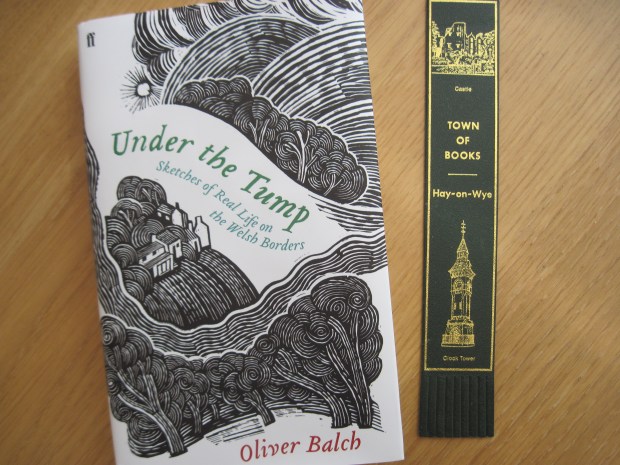
After the family settled in at Pottery Cottage, another of Balch’s guiding spirits was Reverend Francis Kilvert, curate of Clyro from 1865 to 1872. He’s known today for the diary he started keeping in 1870. As he went around visiting, he made pen portraits of his parishioners, often summing people up through one apt phrase of Dickensian description. In a sense, Balch is trying to do the same thing with these sketches of his new community members. Meanwhile, he weaves in biographical information about Kilvert in much the same way that Helen Macdonald does about T.H. White in H is for Hawk.
![Francis Kilvert [Public domain], via Wikimedia Commons.](https://commons.wikimedia.org/wiki/File:Francis_Kilvert.jpg)
Francis Kilvert [Public domain], via Wikimedia Commons.
The Wye is at its nearest to the east, huddled in the dip between two rippled fields of honeyed wheat and brilliant yellow rapeseed, its emerald-green waters rushing fast above the reeds. … Burrowed among the trees above its far bank stands Hay, a blue-grey patchwork of tiled rooftops amid a swathe of sylvan green. Poking above the tree canopy is the castle … And then beyond, of course, the barren bouldery bulk of the Black Mountains. Implacably wild. Their beauty hard, unremitting, almost brutish in their bluntness.
Balch starts trying to fit in by joining the regular drinkers at the Rhydspence Inn, an old-fashioned pub, on Wednesday nights. He’s closest with Tony, a farmer, and subsequently observes the Young Farmers group. In other chapters he profiles the unconventional, hippie types drawn to the area, like the owners of Hay’s fair trade shop; and the locals and shopkeepers involved in the Thursday market. He also sits in on some community planning meetings and learns about a recent anti-supermarket campaign. The Town Council and the “Hay Together” interest group are often at odds, he learns. A Chamber of Commerce meeting turns into an argument about renovating the Castle, one of Hay’s chief landmarks.
![Hay Castle (a partial ruin) with the outdoor 'honesty bookshop' below. Michael Graham [CC BY-SA 2.0], via Wikimedia Commons.](https://commons.wikimedia.org/wiki/File:Hay_Castle_-_geograph.org.uk_-_1452325.jpg)
Hay Castle (a partial ruin) with the outdoor ‘honesty bookshop’ below. Michael Graham [CC BY-SA 2.0], via Wikimedia Commons.
Part of me is elated that the outside world has landed on our doorstep. For a brief window in late spring, everywhere I turn there are urbanites like me. … Simultaneously, part of me recoils. … I feel invaded. Some traitorous wretch has spilled word of our rural haven and now legions of out-of-towners have arrived, overrunning the place with their unmuddied cars and city manners.
Even in the decade that I’ve been visiting, I can recognize some of the processes Balch pinpoints – essentially evidence of gentrification going on in Hay and the surrounding area. Under the ownership of an American female entrepreneur, for instance, Booth’s Bookshop has been transformed from a falling-down jumble sale into a well-presented independent bookstore with a posh café. Some of the locals Balch meets are delighted with the changes, while others feel that the snobs are taking over and driving up prices for regular folk.
If I was a bit disappointed with this book, it’s because I didn’t fully heed the subtitle – “Sketches of Real Life on the Welsh Borders.” It’s not meant to be a chronological narrative of Balch’s time in Clyro but a thematic tour, with some common threads running through. This means that, depending on the reader, certain chapters will probably seem much more interesting than others. So the best part of “The Young Farmers” chapter, for me, was a description of a cow doing a messy poo (“the most splendid jet of steaming gravy-colored excrement”); otherwise I found it entirely tedious.
![The view from the Castle, looking back over the town towards the hills. By Schuy (Own work) [CC BY-SA 4.0-3.0-2.5-2.0-1.0], via Wikimedia Commons.](https://commons.wikimedia.org/wiki/File:Hay.jpg)
The view from the Castle, looking back over the town towards the hills. By Schuy (Own work) [CC BY-SA 4.0-3.0-2.5-2.0-1.0], via Wikimedia Commons.
With thanks to Faber & Faber for the free copy.
My rating: 
Further reading:
- Other books that reference Hay-on-Wye:
- Reading in Bed by Sue Gee opens at the Hay Festival.
- In The Red House by Mark Haddon, a dysfunctional family vacations in the countryside near Hay.
- In Next Life Might Be Kinder by Howard Norman, the main female character is from Hay.
- One of the settings in The Rise and Fall of Great Powers by Tom Rachman is a bookstore in a small Welsh village. (Okay, not quite Hay.)
- Plus one from the TBR: in The Bookman’s Tale by Charlie Lovett, an antiquarian bookseller browsing in a shop in Hay finds a book that sets him off on a quest.
The Violet Hour by Katie Roiphe
I don’t believe that you can learn how to die, or gain wisdom, or prepare, and the work I have done on this book has, if anything, confirmed that suspicion, but I do think you can look at a death and be less afraid.
 The subtitle – “Great Writers at the End” – gives you a hint of what to expect from this erudite, elegiac work of literary biography. In a larger sense, it is about coming to terms with the fear of death, one of the last enduring Western phobias.
Roiphe was a sickly, morbid child. After a serious, extended case of something like pneumonia, she had half a lung removed, and her chosen reading was books about Armenian genocide. Although she was convinced she was going to die at 12, it was only a blip; her next significant encounter with death was her father’s cardiac arrest at age 82. Once again, she was utterly unprepared. In investigating six great authors’ deaths, Roiphe is not so much looking for sage tour guides to the underworld as asking how one faces and narrates death.
To start with I was skeptical about Roiphe’s set of chosen writers. Between Susan Sontag, Sigmund Freud, John Updike, Dylan Thomas, Maurice Sendak and James Salter there’s no class or racial diversity, and the gender balance is poor. Yet as I read on I set these quibbles aside. There are literally hundreds, maybe thousands of subjects Roiphe could have chosen, so in a sense the particular authors discussed here are arbitrary. She’s eschewed more obvious candidates like Christopher Hitchens, probably because he wrote enough about his own impending mortality himself. The criteria were probably as plain as this: an author who meant something to Roiphe, left a lot of documentary evidence, preferably had some living descendants and colleagues to interview, and whose death was drawn out enough that s/he had time to wrestle with the thought of it in writing.
Starting each chapter with the vigil at an author’s deathbed in a hospital room or at home, Roiphe skips back and forth in time to pinpoint where illness and death cropped up in that author’s life and work. For Susan Sontag, dying at New York’s Sloan Kettering in 2004, it was her third bout with cancer. A final extreme intervention, a bone marrow transplant at Seattle, had recently failed. Still Sontag shirked the notion of death, refusing even to talk about it. Work was how she had always transcended the specter of death – by writing books like Illness as Metaphor and inserting scenes of false death into her fiction – and now it was all that kept her going. Perhaps, Roiphe theorizes, there was a kind of solipsism at the heart of Sontag’s denial of death: she just could not believe that anything would continue existing without her. Well before her first experience of cancer in the 1970s, she wrote in a notebook: “Too abstract: death. Too concrete: me.”

Susan Sontag’s grave at the Cimetière du Montparnasse, Paris. (By Wikimedia Commons / Mu (Own work), via Wikimedia Commons.)
One might expect Freud to have been more disciplined about the business of dying, what with his theory of Thanatos (the death drive) and his frequently professed acceptance. However, as Roiphe emphasizes, it is one thing to say you accept death, and quite another thing to actually accept it. In Freud’s case, his refusal to give up cigars despite painful throat cancer and 33 oral surgeries flew in the face of his otherwise rational methods. Cigars were his only vice, he shrugged. Is a cigar just a cigar, or are there overt sexual connotations? For Updike, sex was like Freud’s cigars: sensual evidence that life goes on. Adultery, a frequent theme in his fiction, was perhaps an unconscious strategy for ‘cheating’ death. It was only after his diagnosis with lung cancer that death replaced sex as the central obsession of his work. His last book, like his first, would be poetry: Endpoint, one last valiant effort before death.
![Freud with one of his beloved cigars, 1922. Max Halberstadt [Public domain], via Wikimedia Commons.](https://commons.wikimedia.org/wiki/File:Sigmund_Freud_LIFE.jpg)
Freud with one of his beloved cigars, 1922. Max Halberstadt [Public domain], via Wikimedia Commons.
Each chapter is its own microcosm. The author herself only appears in the prologue and epilogue; in between, although she obviously interviewed survivors (and Salter, who died before he could read the finished book), she edits herself out so we can be right there with the subject. There’s no distance at all. That sense of intimacy is clearest in the chapter-heading photographs of the authors’ (posthumously?) empty studies. These are haunting images. Look at Sendak’s desk covered in paints and drawings, slippers carefully waiting underneath; a cardigan on the back of the chair – there’s such a sense of life. The life continues in the work.
None of these authors got death perfectly right. Several of them fought it right to the end; several of them veered towards faith despite a lifelong antipathy to religion; several of them were ultimately taken aback by the simple realization that they, too, were mortal. Roiphe discovers no magic formula for how a writer should do death. Despite their contradictory approaches, though, all her subjects had the same destination:
here’s what I learned from the deaths in this book: You work. You don’t work. You resist. You don’t resist. You exert the consummate control. You surrender. You deny. You accept. You pray. You don’t pray. You read. You work. You take as many painkillers as you can. You refuse painkillers. You rage against death. You run headlong toward it.
In the end the deaths are the same. They all die. The world releases them.
This would be an ideal book for fans of Olivia Laing (see my review of The Lonely City) or Julian Barnes’s Nothing to Be Frightened of. What Roiphe observes of Sendak’s habit of drawing the dead and dying could equally be applied to The Violet Hour: it’s about seeing the beauty in what terrifies you. One of my top few nonfiction reads of 2016 so far.
With thanks to Grace Vincent of Virago for sending a review copy. The Violet Hour releases today in the UK; it was published on March 8th in the States by The Dial Press.
My rating: 
Reviews Roundup, October–November
One of my goals with this blog is to have one convenient place where I can gather together all my writing that has appeared in disparate online locations. To that end, once a month I provide links to all book reviews I’ve published elsewhere, with a rating (below each description) and a taster so you can decide whether to read more. A few exceptions: I won’t point out my Kirkus Indie, BlueInk or Publishers Weekly reviews since I don’t get a byline.
This month you may recognize a few books I already previewed in my posts on books as beautiful objects and library books read in October.
The Bookbag
Charlotte Brontë’s Secret Love by Jolien Janzing: Charlotte and Emily Brontë’s time in Belgium – specifically, Charlotte’s passion for her teacher, Constantin Heger – is the basis for this historical novel. The authoritative yet inviting narration is a highlight, but some readers may be uncomfortable with the erotic portrayal; it doesn’t seem to fit the historical record, which suggests an unrequited love affair. My other issue with the book is a couple of subplots that only seem to have minor significance.

In Fidelity by Jack Wilson: In this 1970s-set novel, the central couple’s relationship is tested by illness and extramarital sexual experiences. Moving from New England to Nigeria and back, the story asks what loyalty really requires when a once-strong connection has faded over time. Strongly reminiscent of John Updike in Part One, this is the male view of adultery. Something about the self-justifying tone stuck in my craw. A more balanced book would give the wife’s perspective, too, as Carol Shields did in Happenstance, or like Lauren Groff recently did to great success in Fates and Furies.

BookBrowse
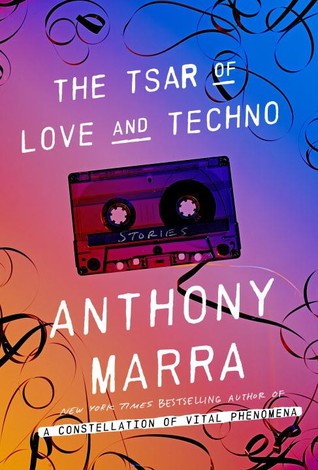 The Tsar of Love and Techno by Anthony Marra [subscription service]: This collection of tightly linked short stories, an intimate look at Russia and Chechnya in wartime and afterwards, reveals how politics, family, and art intertwine. Ranging from 1937 to 2013, the pieces show how fear and propaganda linger in the post-Stalinist era. In art as much as in politics, it can be difficult to distinguish airbrushed history from bitter reality. Just as he did in his excellent debut novel, A Constellation of Vital Phenomena, Marra renders unspeakable tragedies bearable because of his warm and witty writing. All his characters’ voices are well-realized and inviting, and he comes up with terrific one-liners.

BookTrib
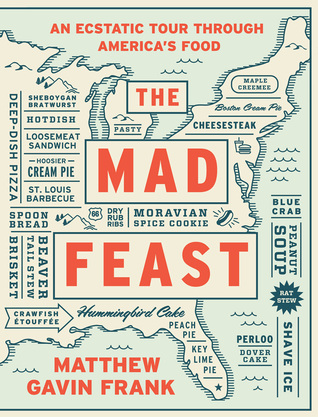 Mad Feast by Matthew Gavin Frank: This is the cookbook David Foster Wallace might have written. In an off-the-wall blend of memoir, travel, history and fiction, Frank proceeds region by region, choosing for each American state one beloved dish and interrogating its origins as well as its metaphors and associations. It’s a mixed bag of familiar foods and ones that only locals are likely to know about. Each chapter ends with a recipe for the signature plate, whether from a Lutheran church or a posh restaurant. Frank’s digressive, anecdotal approach takes some getting used to. If you appreciate the style of writers like Geoff Dyer, Maggie Nelson and Will Self, this should be your next food-themed read.
For Books’ Sake
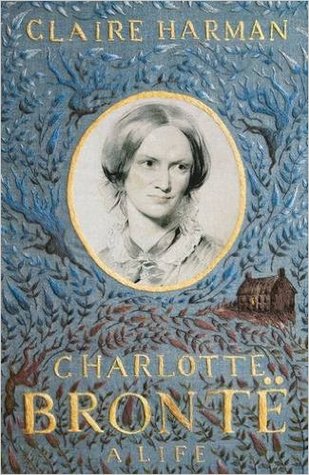 Charlotte Brontë: A Life by Claire Harman: With her bicentennial approaching in April 2016, it’s the perfect time to revisit Charlotte Brontë’s timeless stories. One of the things Harman’s biography does best is trace how the Brontës’ childhood experiences found later expression in fiction. A chapter on the publication of Jane Eyre is a highlight. Diehard fans might not encounter lots of new material, but Harman does make a revelation concerning Charlotte’s cause of death – not TB, as previously believed, but hyperemesis gravidarum (extreme morning sickness). This will help you appreciate afresh a “poet of suffering” whose novels were “all the more subversive because of [their] surface conventionality.”

Cockfosters by Helen Simpson: Simpson’s sixth story collection is full of wry, incisive reflections on aging, loss, regrets, gender roles, and a changing relationship to sex. Most of Simpson’s characters are in their late forties, a liminal time when they’re caught between older parents and still-needy children. Many pieces are dialogue-driven, like scenes in plays. In “Kentish Town,” book club members meet to discuss Dickens’s The Chimes. Simpson weaves in discussion of the plot with commentary on the state of the nation as the ladies set the world to rights and make New Year’s resolutions. It’s a perfect story to read in the run-up to Christmas. The overall stand-out is “Erewhon,” named for Samuel Butler’s 1872 satirical utopian novel. It quickly becomes clear that gender roles are reversed in its fictional world.
Foreword Reviews
 Addiction Is Addiction by Raju Hajela, Paige Abbott and Sue Newton: This comprehensive, well-organized guide discusses the features of addictive thinking and feeling, suggests holistic recovery methods, and offers useful definitions, diagrams, and case studies. The authors are affiliated with Health Upwardly Mobile Inc., Calgary, Alberta. Tracing the history of addiction back to the eighteenth century, when it was first known as “alcoholic disease syndrome,” they present an expert view of the disease’s symptoms and outlook. Strongly recommended to those who have participated in groups like Alcoholics Anonymous or Narcotics Anonymous.
Kirkus
Indie Spotlight: Books about Religion: Self-publishing allows writers to tell their full stories. An article based on interviews with four indie religion authors and mini-reviews of their books.
Nudge
Notes on Suicide by Simon Critchley: Critchley is a philosophy professor at New York’s New School for Social Research. Although he reassures readers with his first line that “This book is not a suicide note,” he also hints that its writing was inspired by personal trouble: “my life has dissolved over the past year or so, like sugar in hot tea.” Not suicidal himself, then, but sympathetic to those who are driven to self-murder. This concise essay illuminates arguments surrounding suicide, with points of reference ranging from Greek philosophers to Robin Williams. Overall, though, it feels cursory and inconclusive.
 The Gratitude Diaries by Janice Kaplan: We can all do with a little encouragement to appreciate what we already have. In so many areas of life – finances, career, relationship, even the weather – we’re all too often hoping for more or better than what we are currently experiencing. Here Kaplan undertakes a year-long experiment to see if gratitude can improve every aspect of her life. She draws her information from interviews with researchers and celebrities, quotes from philosophers, and anecdotes from her own and friends’ lives. It’s easy, pleasant reading I’d recommend to fans of Gretchen Rubin.
 The Water Book by Alok Jha: An interdisciplinary look at water’s remarkable properties and necessity for life on earth. For the most part, Jha pitches his work at an appropriate level. However, if it’s been a while since you studied chemistry at school, you may struggle. Part IV, on the search for water in space, is too in-depth for popular science and tediously long. In December 2013 Jha was part of a month-long Antarctic expedition. He uses the trip as an effective framing device, but I would have liked more memoiristic passages. All in all, I was hoping for less hard science and more reflection on water’s importance to human culture.
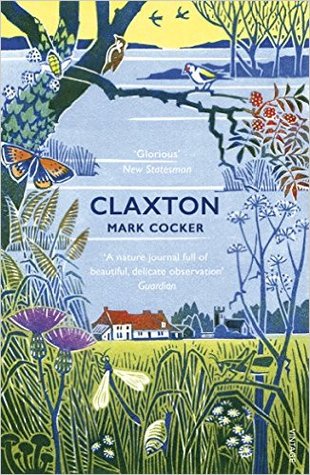 Claxton: Field Notes from a Small Planet by Mark Cocker: Mark Cocker is the Guardian’s country diarist for Norfolk. The short pieces in this book are reprints of his columns, some expanded or revised. I would advise keeping this as a bedside or coffee table book from which you read no more than one or two entries a week, so that you always stay in chronological sync. You’ll appreciate the book most if you experience nature along with Cocker, rather than reading from front cover to back in a few sittings. The problem with the latter approach is that there is inevitable repetition of topics across years. All told, after spending a vicarious year in Claxton, you’ll agree: “How miraculous that we are all here, now, in this one small place.”
 A Mile Down by David Vann: Vann, better known for fiction, tells the real-life story of his ill-fated journeys at sea. He hired a Turkish crew to build him a boat of his own, and before long shoddy workmanship, language difficulties, bureaucracy, and debts started to make it all seem like a very bad idea. Was he cursed? Would he follow his father into suicide? The day-to-day details of boat-building and sailing can be tedious, and there’s an angry tone that’s unpleasant; Vann seems to think everybody else was incompetent or a crook. However, he does an incredible job of narrating two climactic storms he sailed through.
Wasafiri
The Triumph of the Snake Goddess by Kaiser Haq: Beginning with the creation of the world and telling climactic tales of the snake goddess Manasa’s interactions with humans, Haq crafts a uniquely playful set of sacred stories that bear striking similarities to those from other religious traditions. Like Greek myths, the Manasa stories are full of shape-shifting and mistaken identity; rape and incest; jealousy and revenge; and over-the-top exploits of warring gods. She even wears snakes in her hair, like Medusa. Many parallels can also be drawn with the Hebrew and Christian scriptures. Haq’s rendering of the creation account, in particular, resembles the language of Genesis. This book will appeal to students of comparative religion, but can be read with equal enjoyment by laymen in search of engaging storytelling.
I also post reviews of most of my casual reading and skimming on Goodreads.
Mrs. Stevens Hears the Mermaids Singing by May Sarton: Although I’m a huge fan of Sarton’s memoirs, this was my first taste of her fiction. I was underwhelmed: it’s slight and strangely unfeminist. Part of the problem may be that I know so much about Sarton that I couldn’t help but see all the autobiographical detail here. Most of the novel’s action takes place in one day, as Mrs. Stevens awaits the arrival of two interviewers and reflects on past love affairs (some with women) and the meaning of the Muse. For me, Sarton’s journals are a better source of deep thoughts on the writer’s vocation, the value of solitude and the memory of love. This was seen as Sarton’s coming-out book, although it’s not at all sexually explicit.
 Running on the March Wind by Lenore Keeshig: Keeshig is a First Nations Canadian; these poems are full of images of Nanabush the Trickster, language from legal Indian acts, and sly subversion of stereotypes – cowboys and Indians, the only good Indian is a dead Indian (in “Making New”), the white man’s burden, and so on. In places I found these more repetitive and polemical than musical, though I did especially like the series of poems on trees.
The Cartographer Tries to Map a Way to Zion by Kei Miller: Kei Miller is a Jamaican writer who uses island patois and slang, and Rastafarian images and language, alongside standard English. Here he sets up (especially with the long, multi-part title poem) a playful contrast between the cartographer, emblem of civilization and unbiased science, and the rastaman, who takes an altogether more laidback approach to mapping his homeland. This was the perfect poetry collection to be reading in tandem with A Brief History of Seven Killings (see below).
 Very British Problems Abroad by Rob Temple: This is possibly ever so slightly funnier than the original (Very British Problems). A lot of it rings true. Once again the fact that the book originated as tweets means you can’t read too much of it at a time or the one-liners grow tiresome. A couple of my favorites were: “The feeling of dread as you approach the campsite and only then remembering that last year you said you’d never, ever do this again” and “Noticing an avalanche heading your way and hoping your umbrella’s up to the job.”
 Purity by Jonathan Franzen: By starting and ending with Purity ‘Pip’ Tyler, Franzen emphasizes his debt to Dickens: shades of both Bleak House and Great Expectations are there in the discovery of true parentage and unexpected riches. This is strong on the level of character and theme. Secrecy, isolation and compassion are recurring topics. East Germany, Bolivia and Oakland, California: Franzen doesn’t quite pull all his settings and storylines together, but this is close. With a more dynamic opening section, it might have been 5 stars.
 A Brief History of Seven Killings by Marlon James: This is an edgy, worthwhile Booker pick, but not for the faint-hearted. For the most part, James alternates patois and standard speech, but nearly every section is packed with local slang and expletives. Whether in monologue or dialogue, the many voices form a captivating chorus. The novel is in five parts, each named after a popular song or album of the time. James’s scope, especially as he follows Josey Wales to the Bronx, is too wide. All the narrative switches, once so dynamic, grow tiresome. At 350 pages this would have been a 5-star read. Nevertheless, I’ll be watching the HBO miniseries. (Full review to appear in December 2015 issue of Third Way magazine.)
 Kitchens of the Great Midwest by J. Ryan Stradal: One of my favorite debuts of 2015. Stradal has revealed that his grandmother’s Lutheran church cookbook was the inspiration for this culinary-themed novel that takes place over the course of 30 years. His unique structure takes what are essentially short stories from different perspectives and time periods and links them loosely through Eva Thorvald. Eva’s pop-up supper club gains fame thanks to her innovative adaptations of traditional Midwestern foods like venison or Scandinavian lutefisk; it charges $5,000 a head. I loved almost all of Stradal’s ordinary, flawed characters. If you want a peek at how average Americans live (apart from the $5,000 meals), you’ll find it here.
 The Japanese Lover by Isabel Allende: Allende is a wonderful storyteller. This isn’t up to the level of her South American novels (e.g. The House of the Spirits), and in elaborating both Alma’s and Irina’s stories there’s a bit too much telling rather than showing, but I thoroughly enjoyed the book all the same – I devoured it in just a few days. Allende is sensitive to both the process of aging and the various strategies for dealing with traumatic events from the past.
 Accidental Saints: Finding God in All the Wrong People by Nadia Bolz-Weber: I knew of Nadia Bolz-Weber through Greenbelt Festival. She’s a foul-mouthed, tattooed, fairly orthodox Lutheran pastor. This brief, enjoyable memoir is about how she keeps believing despite her own past issues and the many messed-up and outwardly unlovable people who show up at her church, House for All Sinners and Saints in Denver. In my favorite section, she zeroes in on one Holy Week and shows the whole range of emotions and trauma that religion can address. The Ash Wednesday chapter is the overall highlight.
 The Road to Little Dribbling: Adventures of an American in Britain by Bill Bryson: Bryson’s funniest book for many years. It meant a lot to me since I am also an American expat in England. Two points of criticism, though: although he moves roughly from southeast to northwest in the country, the stops he makes are pretty arbitrary, and his subjects of mockery are often what you’d call easy targets. Do we really need Bryson’s lead to scorn litterbugs and reality television celebrities? Still, I released many an audible snort of laughter while reading.
 Shaler’s Fish by Helen Macdonald: I was a huge fan of Macdonald’s memoir, H is for Hawk, so was excited to read her poetry collection, originally published in 2001 but to be reissued by Atlantic Monthly Press. Unfortunately, despite the occasional bird and nature imagery (e.g. in “Monhegan”), I found these poems largely inaccessible. Perhaps it was the sprinkling of archaic vocabulary and spellings, or the general lack of punctuation apart from annoying slashes and ampersands.

Portrait of an Addict as a Young Man: A Memoir by Bill Clegg: One of the finest memoirs I’ve come across (and I read a heck of a lot of them). Through this book I followed literary agent Bill Clegg on dozens of taxi rides between generic hotel rooms and bar toilets and New York City offices and apartments; together we smoked innumerable crack pipes and guzzled dozens of bottles of vodka while letting partners and family members down and spiraling further down into paranoia and squalor. Every structural and stylistic decision works: the present tense, short paragraphs, speech set out in italics, occasional flashback chapters distanced through third-person narration. Clegg achieves a perfect balance between his feelings at the time – being out of control and utterly enslaved to his next hit – and the hindsight that allows him to see what a pathetic figure he was becoming.
 Landfalls by Naomi J. Williams: An enjoyable novel of eighteenth-century maritime adventure, based on a true story and reminiscent of Matthew Kneale’s English Passengers and Peter Carey’s Parrot and Olivier in America. Williams moves between the perspectives of various crew members and outsiders, sometimes employing first person and sometimes third. Key chapters are set in South America, California, Alaska, Macao, and the Solomon Islands. I especially enjoyed a chapter from the point-of-view of a native Alaskan girl – one of the few times the novel focuses on female experience.
 Dept. of Speculation by Jenny Offill: Not as innovative or profound as I was expecting given the rapturous reviews from so many quarters. It’s an attempt to tell an old, old story in a new way: wife finds out her husband is cheating. Offill’s style is fragmentary and aphoristic. Some of the facts and sayings are interesting, but most just sit there on the page and don’t add to the story. What I did find worthwhile was tracing the several tense and pronoun changes: from first-person, past tense into present tense, then to third-person and back to first-person for the final page.
 As Far As I Know by Roger McGough: A bit silly for my tastes; lots of puns and other plays on words. In style they feel like children’s poems, but with vocabulary and themes more suited to adults. I did like “Indefinite Definitions,” especially BRUPT: “A brupt is a person, curt and impolite / Brusque and impatient / Who thinks he’s always right.” The whole series is like that: words with the indefinite article cut off and an explanation playing on the original word’s connotations. From the “And So to Bed” concluding cycle, I loved Camp bed: “A la Recherche du Temps Perdu / on the bedside table / Gardenia on the pillow / Silk pyjamas neatly folded.”
 The Penguin Lessons: What I Learned from a Remarkable Bird by Tom Michell: Marley & Me with a penguin. Well, sort of. A sweet if slight story about the author keeping a Magellanic penguin as a pet while teaching in an Argentina boarding school in the 1970s. On a vacation to Uruguay the twentysomething rescued a penguin from an oil spill and named him Juan Salvado. The uproarious process of cleaning the oil-sodden bird, achieved with a bidet, string bag, and plenty of dish soap, was my favorite passage. However, I’m hesitant about anthropomorphizing, and the language can be stiff – I would have dated this to the 1950s by the speech. Also, there’s precious little evidence of Argentina’s political upheaval.
 Bookish Beck = Rebecca Foster. American transplant to England. Freelance proofreader and book reviewer.
 Bookish Beck