2020 Reading Goals and Anticipated Releases
Review copies have started to feel like an obligation I don’t want. Almost as soon as one comes through the door, I regret having asked for or accepted it. (Now I have to read the danged thing, and follow through with a review!) So I’m going to cut back severely this year. The idea is to wait until late in 2020 to figure out which are the really worthwhile releases, and then only read those instead of wading through a lot of mediocre stuff.
“Until one has some kind of professional relationship with books one does not discover how bad the majority of them are. In much more than nine cases out of ten the only objectively truthful criticism would be ‘This book is worthless,’ while the truth about the reviewer’s own reaction would probably be ‘This book does not interest me in any way, and I would not write about it unless I were paid to’. … The best practice, it has always seemed to me, would be simply to ignore the great majority of books and to give very long reviews … to the few that seem to matter.” (from “Confessions of a Book Reviewer” in Books v. Cigarettes by George Orwell)
These are the January to May 2020 releases I own so far, with perhaps a few more on the way. I acquired a lot of these in September through November, before I made the decision to cut down on review copies.

I’m also looking forward to new books by Sebastian Barry, Susanna Clarke, Stephanie Danler, Anne Enright, Yaa Gyasi, John Irving, Daisy Johnson, Daniel Kehlmann, Sue Monk Kidd, Rebecca Dinerstein Knight, Maya Shanbhag Lang, Helen Macdonald, Hilary Mantel, David Mitchell, Sarah Moss, Mark O’Connell, Maggie O’Farrell, Anne Tyler, Abraham Verghese, Raynor Winn and Molly Wizenberg.
I can still access new/pre-release books via my public library and NetGalley/Edelweiss, especially fiction to review for BookBrowse and nonfiction for Kirkus and the TLS.
This resolution is not about denying or punishing myself, as bloggers’ book-buying bans sometimes seem to be, so if an unmissable book (e.g. HAMNET) is offered on Twitter or via my blog, I won’t consider it cheating to say yes. FOMO will likely be a chronic condition for me this year, but ultimately I hope to do myself a favor.
With the reading time I’m saving, I plan to make major inroads into those 440 print books I own and haven’t read yet, and to do a lot of re-reading (I only managed one and a bit rereads in 2019). I might well blog less often and only feature those books that have been exceptional for me. I’ve set aside this shelf of mostly fiction that I think deserves re-reading soon:

“I do not think we go back to the exciting books,—they do not usually leave a good taste in the mouth; neither to the dull books, which leave no taste at all in the mouth; but to the quiet, mildly tonic and stimulating books,—books that have the virtues of sanity and good nature, and that keep faith with us.” (from “On the Re-Reading of Books” in Literary Values by John Burroughs)
I hope (as always) to read more classics, literature in translation and doorstoppers. Travel and biography are consistently neglected categories for me. Though I won’t set specific goals for these genres, I will aim to see measurable progress. I will also take advantage of the Wellcome Book Prize being on hiatus this year to catch up on some of the previous winners and shortlisted books that I’ve never managed to read.
Mostly, I want to avoid any situations that make me feel guilty or mean (so no more books received direct from the author, and any review books that disappoint will be quietly dropped), follow my whims, and enjoy my reading.
What are some of your goals (reading-related or otherwise) for 2020?
October Recommendations: Ashworth, Donoghue, Kay & McWatt
Intricate essays about writing in the wake of trauma, a feel-good novel about an odd couple on a trip to France, hilarious festive outtakes from a career in medicine, and a race-themed family memoir: I have four very different books to recommend to you this month. All: 
Notes Made while Falling by Jenn Ashworth
(Coming from Goldsmiths Press [UK] on the 15th; already out from MIT Press [USA])
Like Anne Boyer’s The Undying and Sinéad Gleeson’s Constellations, this is an incisive memoir-in-essays about the effects of trauma on a woman’s body. Specifically, Ashworth’s story starts with her son’s birth in 2010, a disaster she keeps returning to over the course of seven sinuous personal essays. A routine C-section was followed by haemorrhaging, blood transfusions and anaphylaxis. The effects lasted for years afterwards: haunted by the sound of her blood dripping and the feeling that her organs could fall out of her abdomen at any time, she suffered from vomiting, insomnia and alcoholism, drinking late into the night as she watched gruesome true crime films.
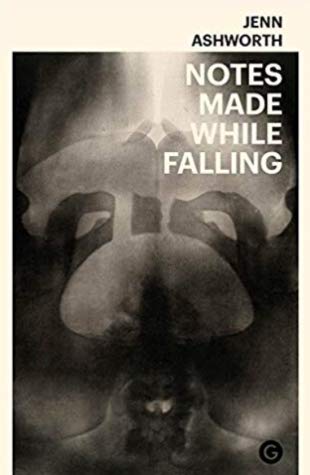 Ashworth toggles between experience, memory, and the transformation of experience into a written record. She admits she has lost faith in fiction, either reading or writing it (she is a lecturer at Lancaster University and the author of four novels). Her Mormon upbringing in Preston is a major part of her backstory, and along with her childhood indoctrination she remembers brief stays in a children’s home and in the hospital with chicken pox.
The essays experiment with structure and content. For instance, “Ground Zero” counts down from #8, with incomplete final lines in each section, then back up to #8, with each piece from the second set picking up where the first left off. Slashes and cross-outs represent rethinking or alternate interpretations. “Off Topic: On Derailment” encompasses so many topics, from excommunication to Agatha Christie to rollercoasters to Charles Dickens, that you have to read it to believe she can make it all fit together (elsewhere she muses on Chernobyl, magic tricks and hating King Lear).
“How to Begin: The Cut” started as a talk given at Greenbelt 2013, when I was in the audience. I especially loved “A Lecture on Influence,” a coy self-examination through creative writing lessons, and “How to Fall without Landing: Celestial City,” a meditation on the precariousness of the human condition. Her frame of literary reference is wide and surprising. This also reminded me of Sight by Jessie Greengrass, The Empathy Exams by Leslie Jamison, I Am, I Am, I Am by Maggie O’Farrell, and In the Days of Rain by Rebecca Stott; I would recommend it to readers of any of the above.
Some favorite lines:
“My God-hurt head has a hole in it or needs one; to let the world in, or out – I can’t ever decide.”
“how to write about everything? How to take in the things that don’t belong to you without being poisoned by them? How to make use of the things that live inside, those seedlings you never asked for? How to breathe in? How to breathe out? How to keep on doing that?”
“Some days it feels like writing truthfully about her own life is the most subversive thing a woman can do.”
My thanks to the publisher for the free copy for review.
Akin by Emma Donoghue
(Coming from Picador [UK] on the 3rd; already out from Little, Brown and Co. [USA])
I’ve read Donoghue’s six most recent works of fiction. Her books are all so different from each other in setting – a one-room prison in contemporary America, bawdy 1870s San Francisco, rural Ireland in the 1850s – that it’s hard to pin her down to one time period or roster of topics. She never writes the same book twice, and that’s got to be a good thing.
 Akin gets off to a slightly slow start but soon had me hooked. Noah Selvaggio, a childless widower and retired chemist in New York City, is looking forward to an imminent trip to Nice, where he was born, to celebrate his 80th birthday. He never guessed that he’d have company on his trip, much less a surly 11-year-old. This is Michael Young, his nephew Victor’s son. Victor died of a drug overdose a year and a half ago; the boy’s mother is in prison; his maternal grandmother has just died. There’s no one else to look after Michael, so with a rush passport he’s added to the itinerary.
In some ways Michael reminded me of my nephews, ages 11 and 14: the monosyllabic replies, the addiction to devices and online gaming, the finicky eating, and the occasional flashes of childlike exuberance. Having never raised a child, Noah has no idea how strict to be with his great-nephew about screen time, unhealthy food and bad language. He has to learn to pick his battles, or every moment of this long-awaited homecoming trip would be a misery. And he soon realizes that Michael’s broken home and troubled area of NYC make him simultaneously tougher and more vulnerable than your average kid.
The odd-couple dynamic works perfectly here and makes for many amusing culture clashes, not so much France vs. the USA as between these Americans of different generations. The dialogue, especially, made me laugh. Donoghue nails it:
[Noah:] “The genre, the style. Is rap the right word for it? Or hip-hop?”
[Michael:] “Don’t even try.” Michael turned his music back on.
(At the cathedral)
[Michael:] “This is some seriously frilly shit.”
[Noah:] “It’s called Baroque style.”
[Michael:] “I call it fugly.”
But there’s another dimension to the novel that keeps it from being pleasant but forgettable. Noah’s grandfather was a famous (fictional) photographer, Père Sonne, and he has recently found a peculiar set of photographs left behind by his late mother, Margot. One is of the hotel where they’re staying in Nice, known to be a holding tank for Jews before they were sent off to concentration camps. The more Noah looks into it, the more he is convinced that his mother was involved in some way – but which side was she on?
This is feel-good fiction in the best possible sense: sharp, true-to-life and never sappy. With its spot-on dialogue and vivid scenes, I can easily see it being made into a movie, too. It’s one of my favorite novels of the year so far.
My thanks to the publisher for the proof copy for review.
Twas the Nightshift before Christmas by Adam Kay
(Coming from Picador on the 17th)
 If you’ve read This Is Going to Hurt, the UK’s bestselling nonfiction title of 2018, you’ll know just what to expect from the comedian’s holiday-themed follow-up. It’s raunchy, morbid and laugh-out-loud funny. In the seven years that Kay was a medical doctor, he had to work on Christmas Day six times. He takes us through the holiday seasons of 2004 to 2009, from the sickeningly festive run-up to the letdown of Christmas day and its aftermath. With his Rudolph tie on and his Scrooge spirit intact, he attends to genital oddities, childbirth crises and infertility clients, and feebly tries to keep up his relationships with his family and his partner despite them having about given up on him after so many holiday absences.
This will be a stocking-stuffer for many this year, and I can see myself returning to it year after year and flicking through for a laugh. However, there’s one story here that Kay regrets omitting from This Is Going to Hurt as being too upsetting, and he also ends on a serious note, urging readers to spare a thought for those who give up their holidays to keep our hospitals staffed.
A favorite passage:
“A lot of the reward for this job comes in the form of a warm glow. It doesn’t make you look any less tired, you can’t pay the rent with it, and it’s worth a lot less than the social life you’ve traded it for, but this comforting aura of goodness and purpose definitely throws light into some dark corners and helps you withstand a lot of the shit.”
My thanks to the publisher for the proof copy for review.
Shame on Me: An Anatomy of Race and Belonging by Tessa McWatt
(Coming from Scribe UK on the 10th)
 “What are you?” This question has followed McWatt since she was eight years old. When her third-grade teacher asked the class if they knew what “Negro” meant, one boy pointed to her. “Oh, no, not Tessa,” the teacher replied, following up with a question: “What are you, Tessa?” But it has always been hard to put her mixed-race background into one word. Her family moved from Guyana to Canada and she has since settled in England, where she is a professor of creative writing; her ancestry is somewhat uncertain but may include Chinese, Indian, indigenous South American, Portuguese, French/Jewish, African, and Scottish.
The book opens with the startling scene of her grandmother, a young Chinese woman brought over to work the sugarcane fields of British Guiana, being raped by her own uncle. “To strangers, even friends—on some days also to myself—I am images of violence and oppression. I am the language of shame and destitution, of slavery and indenture, of rape and murder. I am images of power and privilege, of denial and shades of skin, shapes of faces,” McWatt writes.
Her investigation of the meaning of race takes the form of an academic paper, Hypothesis–Experiment–Analysis–Findings, and within the long third section she goes part by part through the bodily features that have most often been used as markers of racial identity, including the nose, eyes, hair and buttocks. She dives into family history but also into wider historical movements, literature and science to understand her hybrid self. It’s an inventive and sensitive work reminiscent of The Color of Water by James McBride. I would recommend it to anyone who enjoys reading (or feels they should try) interrogations of race.
A favorite line:
“as I try to square my politics with my privilege, it seems that my only true inheritance is that I am always running somewhere else.”
I won a signed proof copy in a Twitter giveaway.
Have you read any October releases that you would recommend? Do any of these tempt you?
Literary Fiction Book Tag
Thanks to the Lauras (Reading in Bed and Dr Laura Tisdall) for making me aware of this tag that is also going around on BookTube. Laura F. specifically tagged me. If you haven’t already taken part and think this looks like fun, why not give it a try? For my examples I’ve chosen books I read this year or last year.
- How do you define literary fiction?
 My inclination is to adapt one of Italo Calvino’s definitions of a classic (recapped here): a book that will never finish saying all it has to say. In other words, a perennially relevant work that speaks to the human condition. Obviously, not all literary fiction can live up to that standard; some will inevitably feel dated due to its setting, slang, technology, and so on. But at its best, literary fiction voices, and makes an attempt at answering, one or more of life’s biggest questions. As Laura F. says, this generally means that it lends itself to discussion and (re)interpretation. I know I can be an awful snob about genre fiction, but I avoid crime, science fiction, etc. because I find these genres less ‘serious’ and thus less worthwhile than literary fiction.
- Name a literary fiction novel with a superb character study.
The first novel that comes to mind here is The Poisonwood Bible, which would be a suitable answer for several of these categories but on rereading struck me most for how well developed its five main characters are. Barbara Kingsolver does an impressive job of distinguishing these multiple narrators from each other based on how they speak/write.
- Name a literary fiction novel that has experimental or unique writing.
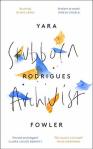 One of the fiction highlights of 2019 so far for me is Stubborn Archivist by Yara Rodrigues Fowler. It stands out from the autofiction field due to its placement of words. Some pages contain just a few lines, or a single short paragraph that reads like a prose poem. Even in the more conventional sections, a lack of punctuation creates a breathless, run-on pace.
- Name a literary fiction novel with an interesting structure.
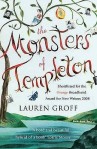 In The Monsters of Templeton, Lauren Groff’s debut novel, Willie Upton is back in her hometown in upstate New York, partway through a PhD and pregnant by her married professor. We hear from various leading lights in the town’s history and/or Willie’s family tree through a series of first-person narratives, letters and other documents.
- Name a literary fiction novel that explores social themes.
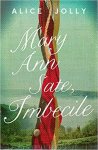 Mary Ann Sate, Imbecile by Alice Jolly, which I reviewed for Nudge, is written entirely in verse and narrated in dialect by an unlearned servant from a cloth mill town in Gloucestershire. With unemployment rising amid the clamor for universal male suffrage, the scene is set for a climactic clash between the common people and the landowning class.
- Name a literary fiction novel that explores the human condition.
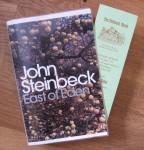 John Steinbeck’s East of Eden has an overarching theme of good and evil as it plays out in families and in individual souls. This weighty material – openly addressed in theological and philosophical terms in the course of the novel – is couched in something of a family saga that follows several generations of the Trasks and the Hamiltons.
- Name a brilliant literary-hybrid genre novel.
 The Sparrow by Mary Doria Russell is a rare sci-fi novel that I loved wholeheartedly. Set on a near-future Jesuit mission to the two alien species on a distant planet, it is about the possibility of believing in God, and doing good works in His name, when suffering seems to be the only result. (See also: The Book of Strange New Things by Michel Faber.)
- What genre do you wish was mixed with literary fiction more?
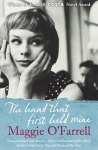 I’ve always felt that Maggie O’Farrell expertly straddles the line between literary and women’s fiction; her books are addictively readable but also hold up to critical scrutiny. Her best is The Hand that First Held Mine, but everything I’ve read by her is wonderful. I’d happily read more books like hers. (Expectation by Anna Hope was slightly less successful.)
Other 2018 Superlatives and Some Early 2019 Recommendations
My Best Discoveries of the Year: Neil Ansell, James Baldwin, Janet Frame, Rohinton Mistry, Blake Morrison, Dani Shapiro, Sarah Vowell; Roald Dahl’s work for adults
The Author I Read the Most By: Anne Tyler (four novels)
 My Proudest Reading Achievement: Getting through a whole Rachel Cusk book (it was my third attempt to read her).
The 2018 Books Everybody Else Loved but I Didn’t: Melmoth by Sarah Perry and Normal People by Sally Rooney
The Year’s Biggest Disappointments: The Travelling Cat Chronicles by Hiro Arikawa and Sabrina by Nick Drnaso
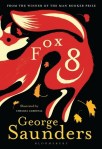 The Funniest Books I Read This Year: Fox 8 by George Saunders and Calypso by David Sedaris
Books that Made Me Cry: Leaving Before the Rains Come by Alexandra Fuller and The Long Goodbye by Meghan O’Rourke
 The Downright Strangest Books I Read This Year: The Bus on Thursday by Sheila Barrett, The Pisces by Melissa Broder and I Love Dick by Chris Kraus
The Debut Authors Whose Next Work I’m Most Looking Forward To: Julie Buntin, Lisa Ko and R.O. Kwon
The Best First Line of the Year: “Dust and ashes though I am, I sleep the sleep of angels.” (from The Western Wind by Samantha Harvey)
Some Early 2019 Recommendations
(in release date order)
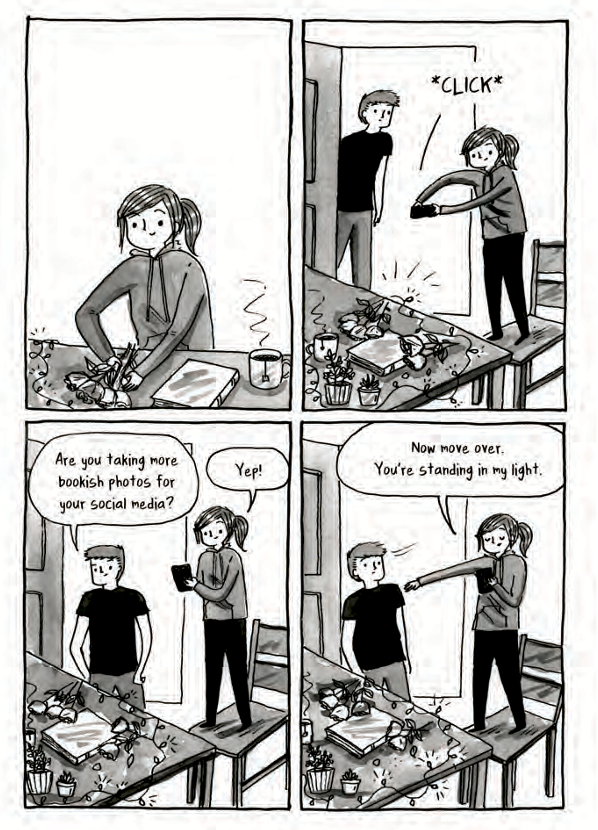
 Book Love by Debbie Tung: Bookworms will get a real kick out of these cartoons, which capture everyday moments in the life of a book-obsessed young woman (perpetually in hoodie and ponytail). She reads anything, anytime, anywhere. Even though she has piles of books staring her in the face everywhere she looks, she can never resist a trip to the bookstore or library. The very idea of culling her books or finding herself short of reading material makes her panic, and she makes a friend sign a written agreement before he can borrow one of her books. Her partner and friends think she’s batty, but she doesn’t care. I found the content a little bit repetitive and the drawing style not particularly distinguished, but Tung gets the bibliophile’s psyche just right. (Out January 1.)
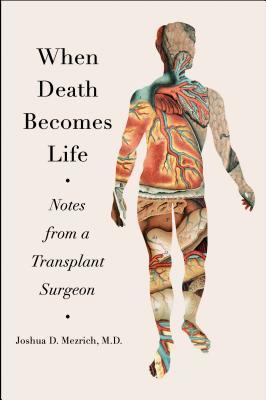 When Death Becomes Life: Notes from a Transplant Surgeon by Joshua D. Mezrich: In this debut memoir a surgeon surveys the history of organ transplantation, recalling his own medical education and the special patients he’s met along the way. In the 1940s and 1950s patient after patient was lost to rejection of the transplanted organ, post-surgery infection, or hemorrhaging. Mezrich marvels at how few decades passed between transplantation seeming like something out of a science-fiction future and becoming a commonplace procedure. His aim is to never lose his sense of wonder at the life-saving possibilities of organ donation, and he conveys that awe to readers through his descriptions of a typical procedure. One day I will likely need a donated kidney to save my life. How grateful I am to live at a time when this is a possibility. (Out January 15.)
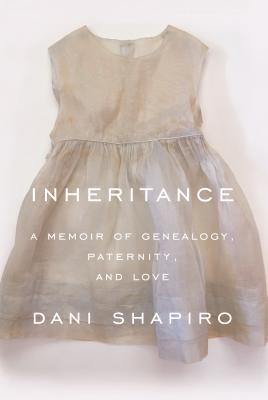 Inheritance: A Memoir of Genealogy, Paternity, and Love by Dani Shapiro: Shapiro was used to strangers’ comments about her blond hair and blue eyes. How could it be that she was an Orthodox Jew? people wondered. It never occurred to her that there was any truth to these hurtful jokes. On a whim, in her fifties, she joined her husband in sending off a DNA test kit. It came back with alarming results. Within 36 hours of starting research into her origins, Shapiro had found her biological father, a sperm donor whom she calls Dr. Ben Walden, and in the year that followed, their families carefully built up a relationship. The whole experience was memoirist’s gold, for sure. This is a moving account of her emotional state as she pondered her identity and what her sense of family would be in the future. (Out January 15.)

 Constellations: Reflections from Life by Sinéad Gleeson: Perfect for fans of I Am, I Am, I Am by Maggie O’Farrell, this is a set of trenchant autobiographical essays about being in a female body, especially one wracked by pain. As a child Gleeson had arthritis that weakened her hip bones, and eventually she had to have a total hip replacement. She ranges from the seemingly trivial to life-and-death matters as she writes about hairstyles, blood types, pregnancy, the abortion debate in Ireland and having a rare type of leukemia. In the tradition of Virginia Woolf, Frida Kahlo and Susan Sontag, Gleeson turns pain into art, particularly in a set of 20 poems based on the McGill Pain Index. The book feels timely and is inventive in how it brings together disparate topics to explore the possibilities and limitations of women’s bodies. (Out April 4.)
 The Hot Young Widows Club: Lessons on Survival from the Front Lines of Grief by Nora McInerny: In June 2016 I read It’s Okay to Laugh (Crying Is Cool Too), McInerny’s memoir about losing her father and her husband to cancer and her second child to a miscarriage – all within a few weeks – when she was 31. In this short book, an expansion of her TED talk, she argues that we are all incompetent when it comes to grief. There’s no rule book for how to do it well or how to help other people who are experiencing a bereavement, and comparing one loss to another doesn’t help anyone. I especially appreciated her rundown of the difference between pity and true empathy. “Pity keeps our hearts closed up, locked away. Empathy opens our heart up to the possibility that the pain of others could one day be our own pain.” (Out April 30.)
Coming tomorrow: Library Checkout & Final statistics for the year
Have you read any 2019 releases you can recommend?
The Language of Kindness: A Nurse’s Story by Christie Watson
After all that Wellcome Book Prize reading, I’ve given myself a break from the medical reads, right? No way! I’m already eagerly looking out for hopefuls for next year’s prize – I’ve amassed quite a nice little pile – and this is a particularly strong candidate, based on the 20 years that Watson spent as a nurse in England’s health system before leaving to write full-time. (Her debut, Tiny Sunbirds Far Away, won the Costa First Novel Award in 2011; she followed it up with Where Women Are Kings in 2013.) It taps into the widespread feeling that medicine is in desperate need of a good dose of compassion, and will ring true for anyone who spends time in hospitals, whether as a patient or a carer.
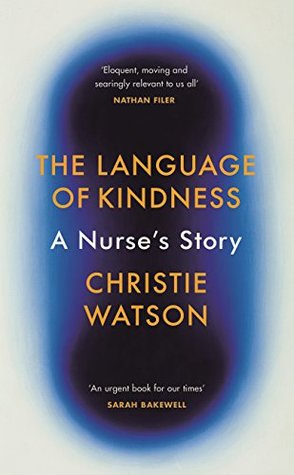 Watson presents her book as a roughly chronological tour through the stages of nursing – from pediatrics through to elderly care and the tending to dead bodies – but also through her own career, as she grows from a seventeen-year-old trainee who’s squeamish about blood to a broadly experienced nurse who can hardly be fazed by anything. The first chapter is set up like a tour of the hospital, describing everything she sees and hears as she makes her way up to her office, and the final chapter takes place on her very last day as a nurse, when, faced with a laboring mother in a taxi, she has to deliver the baby right there in the carpark.
In between we hear a series of vivid stories that veer between heartwarming and desperately sad. Watson sees children given a second shot at life. Aaron gets a heart–lung transplant to treat his cystic fibrosis and two-year-old Charlotte bounces back from sepsis – though with prosthetic limbs. But she also sees the ones who won’t get better: Tia, a little girl with a brain tumor; Mahesh, who has muscular dystrophy and relies on a breathing tube; and Jasmin, who is brought to the hospital after a house fire but doesn’t survive for long. She dies in the nurses’ arms as they’re washing the smoke smell out of her hair.
Although Watson specialized in children’s intensive care nursing, she trained in all branches of nursing, so we follow her into the delivery room, mental health ward, and operating theatre. As in Maggie O’Farrell’s I Am, I Am, I Am, we learn about her links to hospitals over the years, starting with her memories of being nursed as a child. She met her former partner, a consultant, at the hospital; they had a child together and adopted another before splitting 12 years later. And as her father was dying of lung cancer, she developed a new appreciation for what nurses do as she observed the dedicated care he received from his hospice nurse. She characterizes nursing as a career that requires great energy, skill and emotional intelligence, “that demands a chunk of your soul on a daily basis,” yet is all too often undervalued.

(The superior American cover.)
For me the weakest sections of Watson’s book are the snippets of history about hospitals and the development of the theory and philosophy of nursing. These insertions feel a little awkward and break up the flow of personal disclosure. The same applies to the occasional parenthetical phrase that seems to talk down to the reader, such as “women now receive medical help (IVF) to have their babies” and “obstetricians (doctors) run the show.” Footnotes or endnotes connected to a short glossary might have been a less obtrusive way of adding such explanatory information.
I would particularly recommend this memoir to readers of Kathryn Mannix’s With the End in Mind and Henry Marsh’s Admissions. But with its message of empathy for suffering and vulnerable humanity, it’s a book that anyone and everyone should read. I have it on good authority that there has recently been a copy on the desk of Jeremy Hunt, Health Secretary of the UK, which seems like an awfully good start.
A few favorite passages:
“I wanted to live many lives, to experience different ways of living. I didn’t know then that I would find exactly what I searched for: that both nursing and writing are about stepping into other shoes all the time.”
“What I thought nursing involved when I started: chemistry, biology, physics, pharmacology and anatomy. And what I now know to be the truth of nursing: philosophy, psychology, art, ethics and politics.”
“You get used to all sorts of smells, as a nurse. [An amazingly graphic passage!] But for all that I’ve seen and touched and smelled, and as difficult as it is at the time, there is a patient at the centre of it, afraid and embarrassed. … The horror of our bodies – our humanity, our flesh and blood – is something nurses must bear, lest the patient think too deeply, remember the lack of dignity that makes us all vulnerable. It is our vulnerability that unites us. Promoting dignity in the face of illness is one of the best gifts a nurse can give.”
My rating:
The Language of Kindness was published in the UK on May 3rd by Chatto & Windus. My thanks to the publisher for the free review copy. It is released today, May 8th, by Doubleday Canada and Tim Duggan Books in the States.
You Think It, I’ll Say It: Stories by Curtis Sittenfeld
“Oh, our private habits, our private selves—how strange we all are, how full of feelings and essentially alone.”
You could say that Curtis Sittenfeld is the reason I’m a book reviewer. Back when I worked as a library assistant in London, I filled the hours of tedium by writing one- or two-paragraph responses to every book I read, but these just sat in a Word file and never saw the light of day. I had so little confidence in my writing that I didn’t show these proto-reviews to anyone, not even on Goodreads. One day in 2011, though, I saw that Stylist magazine was looking for a temporary books columnist; to be considered you had to submit a 100-word review of your favorite book by a woman. I chose Sittenfeld’s American Wife, her masterfully introspective 2008 novel from the perspective of a fictionalized Laura Bush. It was great practice in being concise, that’s for sure, and Stylist chose me as a finalist. (You can see my 100-word review here.) From there it went to public voting on the website. Alas, I didn’t win, but it was the first time I got recognition for a book review, and I was hooked. When I left my job in 2013 to go freelance, I was determined that reviewing would be part of my work.
Sittenfeld is still one of my favorite authors, and I’ve read everything she’s written. Like Maggie O’Farrell and Carolyn Parkhurst, her work is perfectly balanced between women’s fiction and literary fiction and she describes families and romantic relationships expertly, in prose so deliciously smooth it slides right down. If you’re a fan of her novels, I would certainly recommend these 11 short stories to you. They’re about marriage, parenting, authenticity, celebrity and social media in Trump’s America, with the two key recurring elements of role reversal and retrospect.
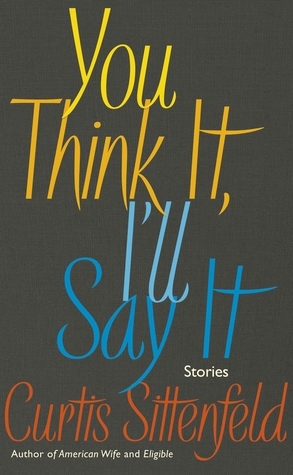 The opening story, “The Nominee,” which only appears in the U.K. edition, feels like a natural follow-up to American Wife. Though never named, the narrator is clearly Hillary Clinton, and in a voice that’s consistent with her memoirs she ponders her struggle to earn popular appeal: “The typical American voter doesn’t wish to share a beer with me.” It’s 2016 and she’s about to be interviewed by a younger female journalist who has written about her dozens of times. Back in 2002 she was compassionate when this journalist fell apart during an interview, but she knows not to expect the same courtesy in return. No, she fully expects to be burned. But still the nominee truly believes she’ll win, as the opposite outcome would be catastrophic.
Yet that’s the reality in the final story, “Do-Over,” which was shortlisted for this year’s Sunday Times EFG Short Story Award. In the wake of Trump’s election, Clay hears from Sylvia, a high school classmate, out of the blue and meets up with her for dinner in Chicago. She’s still sore about the sexist nature of the election at Bishop Academy in which, despite having tied, she was given the patronizing, made-up role of “assistant prefect” while Clay was named senior prefect. Sylvia has engineered this fake date as a gift to herself, to see what could happen, and she’s going to behave as badly as she wants.
The role reversal is clearest in “Gender Studies” and “A Regular Couple.” In the former, Nell, a gender studies professor, accidentally uses a taxi driver for sex. In the latter, Maggie is on her honeymoon with Jason; though they’re both lawyers, she recently handled a sportsman’s rape trial and earns 20 times what Jason does in nonprofit immigration law. There’s another flipping of positions in this one: among the other honeymooners at their ski resort is Ashley Frye, who was one of the popular girls at Maggie’s high school and made her feel awkward and inferior. But Maggie’s TV appearances have given her an aura of celebrity: now she’s the popular one, and she has an idea for how to get revenge on Ashley.
The most similar to Sittenfeld’s early fare is “Vox Clamantis in Deserto,” in which a college student loses her virginity under bizarre circumstances in 1994. Several stories involve a dual time setting: a decade or more later, characters reflect on the strange turns their lives have taken to get them where they are now and have a chance to rethink the decisions they made.
My favorite single story is “Plausible Deniability,” the only time I can think of that Sittenfeld has used a male point-of-view. The narrator is William, a 41-year-old lawyer in St. Louis who has distinctly different relationships with his brother and his sister-in-law. There’s a clever surprise in this one, as there is later on in “The Prairie Wife,” and it makes you ask about the various ways there are of being close with another person.
Other stories concern new mothers’ guilt and compromises, the temptation of adultery, and the danger of jealousy and making up your mind about someone too soon. I was less sure about “Volunteers Are Shining Stars,” voiced by a character with OCD and set among African-Americans at a family shelter in Washington, D.C., and I thought “Off the Record” was a bit too similar to “The Nominee.” Overall, though, this is a whip-smart, current and relatable book, ideal for readers who don’t think they like short stories.
My rating:
You Think It, I’ll Say It is published in the UK today, May 3rd, by Doubleday. My thanks to the publisher for the free review copy.
Quick Reactions to the Wellcome Book Prize Shortlist
From 12, we are now down to six. The 2018 Wellcome Book Prize shortlist is here!

Some quick thoughts:
I sort-of predicted three out of the six in yesterday’s post: The Butchering Art by Lindsey Fitzharris, With the End in Mind by Kathryn Mannix, and To Be a Machine by Mark O’Connell.
I’m relieved that I’d already gotten to two of the shortlisted titles (Fitzharris and Mannix), so I can focus on reading the other four over the next 5+ weeks, and will briefly revisit those first two on my Kindle when it’s decision time.
I am pretty shocked that Maggie O’Farrell’s I Am, I Am, I Am did not advance to the shortlist. Mayhem will have to be a truly amazing memoir to outdo it; I wanted to read it anyway, but now I’m particularly keen – it would be a good one for me to feature on the official blog tour if that happens to work out.
I’m not feeling very cheerful about having to start Stay with Me again (I DNFed it last year), but I’ll try to approach it with an open mind.
To Be a Machine is currently on shelf at my local library (fingers crossed that it’s still there when I go on Friday) and I’ve reserved The Vaccine Race from another branch. I’ll start with one of those.
I’ve also been promised two review copies at random in the post – let’s hope it’s not the two I’ve already read!
(See also Laura’s initial thoughts.)
Feel like joining the shadow panel in reading one or more of these six books?
One More Wellcome Longlist Review & Shortlist Predictions
Tomorrow the six titles on the Wellcome Book Prize shortlist will be revealed. I’ve managed to read one more from the longlist since my last batch.
The Butchering Art: Joseph Lister’s Quest to Transform the Grisly World of Victorian Medicine by Lindsey Fitzharris
 Surgery was a gory business with a notably high fatality rate well into the nineteenth century. Surgeons had the fastest hands in the West, but their victims were still guaranteed at least a few minutes of utter agony as they had a limb amputated or a tumor removed, and the danger wasn’t over after they were sewn up either: most patients soon died from hospital infections. The development of anesthetics and antiseptic techniques helped to change all that.
Fitzharris opens with the vivid and rather gruesome scene of a mid-thigh amputation performed by Robert Liston at University College Hospital in London in 1846. This surgery was different, though: it only took 28 seconds, but the patient felt nothing thanks to the ether he had been administered. He woke up a few minutes later asking when the procedure would begin. In the audience that day was Joseph Lister, who would become one of Britain’s most admired surgeons.
Lister came from a Quaker family and, after being educated at University College London, started his career in Edinburgh. Different to many medical professionals of the time, he was fascinated by microscopy and determined to find out what caused deadly infections. Carbolic acid and catgut ligatures were two of Lister’s main innovations that helped to fight infection. In fact, whether we realize it or not, his legacy is forever associated with antiseptics: Listerine mouthwash (invented in 1879) is named after him, and the Johnson brothers of Johnson & Johnson fame started their business mass-producing sterile surgical dressings after attending one of Lister’s lectures.
My interest tailed off a bit after the first third, as the book starts going into more depth about Lister’s work and personal life: he married his boss’s daughter and moved from Edinburgh to Glasgow and then back to London. However, the best is yet to come: the accounts of the surgeries he performed on his sister (a mastectomy that bought her three more years of life) and Queen Victoria (removing an orange-sized abscess from under her arm) are terrific. The chapter on treating the queen in secret at Balmoral Castle in 1871 was my overall favorite.

It probably wasn’t the best idea to start this book over my lunch one day!
I was that kid who loved going to Civil War battlefields and medical museums and looking at all the different surgical saws and bullet fragments in museum cases, so I reveled in the gory details here but was not as interested in the biographical material. Do be sure you have a strong stomach before you try reading the prologue over a meal. This is a comparable read to The Remedy, about the search for a cure to tuberculosis.
My rating:
Shortlist Predictions
Now, I’ve still only read half of the longlisted titles so far, so it’s hard to make any solid guesses. However, the below fall somewhere between wishes and informed predictions:
- In Pursuit of Memory by Joseph Jebelli: A definitive treatment of an epidemic of our time, Alzheimer’s disease. The neuroscientist author achieves the right balance between history and research on the one hand and personal stories readers can relate to on the other.
- The White Book by Han Kang: The only fiction title from the longlist that I haven’t read at least part of. This is also on this year’s Man Booker International Prize longlist and has been well received. From what I can tell, the health theme seems stronger than that of Stay with Me or Midwinter Break, and it would also be nice for one title in translation to make the shortlist.
- With the End in Mind by Kathryn Mannix: As I said in my review last week, this is an excellent all-round guide to preparation for death, based around touching patient stories plus the author’s experience in palliative care and CBT. Practical, compassionate and helpful.
- I Am, I Am, I Am by Maggie O’Farrell: For me, this book stands out as the one that most clearly illuminates the effects of illness, medical treatment, and other threats to life and limb in the course of an ordinary existence. I’d be very happy to see it win the whole thing.
- EITHER The Butchering Art by Lindsey Fitzharris OR The Vaccine Race by Meredith Wadman: I reckon one history of science title deserves to be on there; I think Wadman might have the slight edge.
- EITHER To Be a Machine by Mark O’Connell OR Behave by Robert Sapolsky: The Wellcome Prize loves big books investigating human tendencies and possibilities. I find the thought of either of these daunting, but I know they would also be illuminating. I’d prefer to read the O’Connell, but I’d give the edge to Sapolsky.
Any predictions of your own to make?
Thoughts on the Wellcome Book Prize Longlist
The 2018 Wellcome Book Prize longlist is here! From the prize’s website, you can click on any of these 12 books’ covers, titles or authors to get more information about them.

Some initial thoughts:
I correctly predicted three of the entries (or 25%) in yesterday’s post: In Pursuit of Memory by Joseph Jebelli, With the End in Mind by Kathryn Mannix, and I Am, I Am, I Am by Maggie O’Farrell. I’m pretty shocked to not see Fragile Lives or Admissions on the list.
Of the remainder, I’ve already read one (Midwinter Break) and DNFed another (Stay with Me). Midwinter Break didn’t immediately suggest itself to me for this prize because its themes of ageing and alcoholism are the background to a story about the disintegration of a long marriage. Nonetheless, it’s a lovely book that hasn’t gotten as much attention as it deserves – it was on my runners-up list from last year – so I’m delighted to see it nominated. Stay with Me was also on the Women’s Prize shortlist; it appears here for its infertility theme, but I wouldn’t attempt it again unless it made the Wellcome shortlist.

As to the rest:
- I’m annoyed with myself for not remembering The Butchering Art, which I have on my Kindle. Sometimes I assume that books I’ve gotten from NetGalley are USA-only and don’t check for a UK publisher. I plan to read this and With the End in Mind (also on my Kindle) soon.
- I already knew about and was interested in Mayhem and The White Book.
- Of the ones I didn’t know about, Plot 29 appeals to me the most. I’m off to get it from the library this very afternoon, in fact. Its health theme seems quite subtle: it’s about a devoted gardener ‘digging’ into his past in an abusive family and foster care. The Guardian review describes it thus: “Like Helen Macdonald’s H Is for Hawk, this is a profoundly moving account of mental trauma told through the author’s encounters with nature. Jenkins sees his garden as a place where a person can try to escape from, and atone for, the darkness of human existence.” This is the great thing about prize lists: they can introduce you to fascinating books you might never have heard of otherwise. Even if it’s just one book that takes your fancy, who knows? It might end up being a favorite.
- While I’m not immediately drawn to the books on the history of vaccines, the evolution of human behavior, and transhumanism, I will certainly be glad to read them if they make the shortlist.
Some statistics on this year’s longlist, courtesy of the press release I was sent by e-mail:
- Three novels, three memoirs, and six nonfiction titles
- Five debut authors
- Three titles from independent publishers (Canongate and Granta/Portobello Books)
- The authors are from the UK, Ireland, USA, Nigeria, Canada, and – making their first appearance – Sweden (Sigrid Rausing) and South Korea (Han Kang)
Chair of judges Edmund de Waal writes: “The Wellcome Book Prize is unique in its reach across genres, and so the range of books that we have considered has been exhilarating in its extent and ambition. This is a remarkable time for readers, with a great flourishing of writing on ideas around science, medicine and health, lives and deaths, histories and futures. After passionate discussions we have arrived at our longlist for the Wellcome Book Prize 2018 and are proud to be part of this process of bringing to a wider public these 12 tremendous books that have moved, intrigued and inspired us. All of them bring something new to our understanding of what it is to be human.”
The shortlist is announced on Tuesday, March 20th, and the winner will be revealed on Monday, April 30th.
Are there any books on here that you’d like to read?
My 2018 Wellcome Book Prize Wish List
Tomorrow the longlist for the 2018 Wellcome Book Prize will be announced. This year’s judging panel is chaired by Edmund de Waal, author of The Hare with Amber Eyes. I hope to once again shadow the shortlist along with a few fellow book bloggers. I don’t feel like I’ve read all that many books that are eligible (i.e., released in the UK in 2017, and on a medical theme), but here are some that I would love to see make the list. I link to all those I’ve already featured here, and give review extracts for the books I haven’t already mentioned.

 I Found My Tribe by Ruth Fitzmaurice
- In Pursuit of Memory: The Fight against Alzheimer’s by Joseph Jebelli
- Goodbye, Vitamin by Rachel Khong
- In Every Moment We Are Still Alive by Tom Malmquist
- Admissions: A Life in Brain Surgery by Henry Marsh
 I Am, I Am, I Am: Seventeen Brushes with Death by Maggie O’Farrell: O’Farrell captures fragments of her life through essays on life-threatening illnesses and other narrow escapes she’s experienced. The pieces aren’t in chronological order and aren’t intended to be comprehensive. Instead, they crystallize the fear and pain of particular moments in time, and are rendered with the detail you’d expect from her novels. She’s been mugged at machete point, nearly drowned several times, had a risky first labor, and was almost the victim of a serial killer. (My life feels awfully uneventful by comparison!) But the best section of the book is its final quarter: an essay about her childhood encephalitis and its lasting effects, followed by another about her daughter’s extreme allergies.
- The Smell of Fresh Rain: A Journey into the Sense of Smell by Barney Shaw
- Fragile Lives: A Heart Surgeon’s Stories of Life and Death on the Operating Table by Stephen Westaby
It’s also possible that we could see these make the longlist:
 History of Wolves by Emily Fridlund: Fridlund’s Minnesota-set debut novel is haunted by a dead child. From the second page readers know four-year-old Paul is dead; a trial is also mentioned early on, but not until halfway does Madeline Furston divulge how her charge died. This becomes a familiar narrative pattern: careful withholding followed by tossed-off revelations that muddy the question of complicity. The novel’s simplicity is deceptive; it’s not merely a slow-building coming-of-age story with Paul’s untimely death at its climax. For after a first part entitled “Science”, there’s still half the book to go – a second section of equal length, somewhat ironically labeled “Health”. (Reviewed for the TLS.)
- Hair Everywhere by Tea Tulić
 Modern Death: How Medicine Changed the End of Life by Haider Warraich: A learned but engaging book that intersperses science, history, medicine and personal stories. The first half is about death as a medical reality, while the second focuses on social aspects of death: religious beliefs, the burden on families and other caregivers, the debate over euthanasia and physician-assisted suicide, and the pros and cons of using social media to share one’s journey towards death. (See my full Nudge review.)
Of 2017’s medical titles that I haven’t read, I would have especially liked to have gotten to:
- Sound: A Story of Hearing Lost and Found by Bella Bathurst
 This Is Going to Hurt: Secret Diaries of a Junior Doctor by Adam Kay
- With the End in Mind: Dying, Death, and Wisdom in an Age of Denial by Kathryn Mannix [I have this one on my Kindle from NetGalley]
- Into the Grey Zone: A Neuroscientist Explores the Border between Life and Death by Adrian Owen
- Patient H69: The Story of My Second Sight by Vanessa Potter
We are also likely to see a repeat appearance from the winner of the 2017 Royal Society Science Book Prize, Testosterone Rex: Myths of Sex, Science, and Society by Cordelia Fine.
Other relevant books I read last year that have not (yet?) been released in the UK:
 The Education of a Coroner: Lessons in Investigating Death by John Bateson
- The Family Gene: A Mission to Turn My Deadly Inheritance into a Hopeful Future by Joselin Linder
- Last Things: A Graphic Memoir of Loss and Love by Marissa Moss
- Love and Laughter in the Time of Chemotherapy by Manjusha Pawagi
 No Apparent Distress: A Doctor’s Coming-of-Age on the Front Lines of American Medicine by Rachel Pearson: Pearson describes her Texas upbringing and the many different hands-on stages involved in her training: a prison hospital, gynecology, general surgery, rural family medicine, neurology, dermatology. Each comes with memorable stories, but it’s her experience at St. Vincent’s Student-Run Free Clinic on Galveston Island that stands out most. Pearson speaks out boldly about the divide between rich and poor Americans (often mirrored by the racial gap) in terms of what medical care they can get. A clear-eyed insider’s glimpse into American health care.
- The Bright Hour: A Memoir of Living and Dying by Nina Riggs
 The Tincture of Time: A Memoir of (Medical) Uncertainty by Elizabeth L. Silver: At the age of six weeks, Silver’s daughter suffered a massive brain bleed for no reason that doctors could ever determine. Thanks to the brain’s plasticity, especially in infants, the bleed was reabsorbed and Abby has developed normally, although the worry never goes away. Alongside the narrative of Abby’s baffling medical crisis, Silver tells of other health experiences in her family. An interesting exploration of the things we can’t control and how we get beyond notions of guilt and blame to accept that time may be the only healer.
 Bookish Beck = Rebecca Foster. American transplant to England. Freelance proofreader and book reviewer.
 Bookish Beck