20 Books of Summer, 6–7: Helen Dunmore and Stephen King
At least, I managed a pretty terrific pair, and completed half of my intended 4-in-a-row (the second row) on the Bingo card.


(Book featuring ice cream or summer foods)
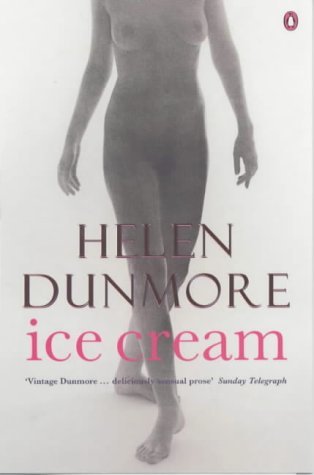
Ice Cream by Helen Dunmore (2000)
These 18 pieces are quite varied: a few have historical settings, two are written in the second person, and several return to the life of Ulli (a recurring character from Love of Fat Men), a Finnish teenager who faces an unexpected pregnancy. Even the slight-seeming ones are satisfying slices of fiction. The title story and its follow-up, “Be Vigilant, Rejoice, Eat Plenty” advocate sensual indulgence, which I guess is the reason for the cover image – which I couldn’t decide whether to hide or flaunt as I was reading it in public.
 Often, there is a hint of menace, whether the topic is salmon fishing, raspberry picking or the history of a lost ring. “The Clear and Rolling Water” has the atmosphere of a Scottish folk ballad, which made it perfect reading for our recent holiday to Scotland. “Leonardo, Michelangelo, SuperStork” and “Mason’s Mini-break” stand out for their dystopian and magic realist touches, respectively. In the former, couples are only allowed to conceive via state- sanctioned services; in the latter, an arrogant Booker Prize-winning author is patronizing when he meets a would-be writer while on holiday in Yorkshire.
Two of my favourites were “The Lighthouse Keeper’s Wife” and “Swimming into the Millennium,” which might have been written by Helen Simpson. All are of a high standard, and though they don’t fit together per se and mostly won’t stay with me, I really do rate Dunmore as a short story writer. (Secondhand – Community Furniture Project, Newbury) 
(Book from a genre you rarely read)
Pet Sematary by Stephen King (1983)
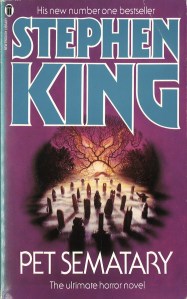 I’d only ever read King’s On Writing and worried I wouldn’t be able to handle his fiction. I could never watch a horror film, but somehow the same content was okay in print. For half the length or more, it’s more of a mildly dread-laced, John Irving-esque novel about how we deal with the reality of death. Dr. Louis Creed and his family – wife Rachel, five-year-old daughter Ellie, two-year-old son Gage and cat Church (short for Winston Churchill) – have recently moved from Chicago to Maine for him to take up a post as head of University Medical Services. Their 83-year-old neighbour across the street, Judson Crandall, becomes a sort of surrogate father to Louis, warning them about the dangerous highway that separates their houses and initiating them with a tour of the pet cemetery and Micmac burial ground that happen to be on their property. Things start getting weird early on: Louis’s first day on the job sees a student killed by a car while jogging; the young man’s cryptic dying words are about the pet cemetery, and he then visits Louis in a particularly vivid dream.
The family surname is no coincidence. “I believe that we go on,” Louis says when Ellie asks him about what happens when we die. “But as to what it’s like, I have no opinion.” So King interrogates what it would be like for the dead to go on literally instead of just figuratively in the remembrance of loved ones. Would bringing the dead back be a cure for grief or a horrible mistake? This sleepy New England town harbours many cautionary tales, and the Creeds have more than their fair share of sorrow. Rachel witnessed her sister’s death from a long illness when she was just a child and has always repressed her memories of it.
Louis is a likable protagonist whose vortex of obsession and mental health (“He walked the balance-beam of rationality”) is gripping. As can be the case with genre fiction, King prioritizes readability over writing quality, though I did pick out an occasional glistening metaphor. It doesn’t get gruesome or schlocky until right towards the end. In the last quarter, which I read on the long train ride home from Edinburgh, I couldn’t get the book closer to my face or the pages turning any faster. It helped that it was a beat-up small-format paperback. When we arrived into London I was about six pages from the end and it was so frustrating to have to wait until I got on my next train to read the rest.


This also counted towards one of my low-key ongoing challenges: reading works published in my birth year. I could imagine the Eighties stylings of an adaptation, especially Rachel’s power suit and pumps when she’s on her race-against-the-clock flight and road trip. I did find the book dated in some of its Murakami-like descriptions (“The … double doors were set into a grassy rise of hill, a shape as natural and as attractive as the swell of a woman’s breast”) and cringey sex scenes, and I wondered if King would get away with using imagery of the Windigo these days. Still, on this evidence, I’ll seek out more of his classic horror – do give me your recommendations. So long as they’re this addictive (and no scarier), I’m game. Pet Sematary was sterling entertainment, but also surprisingly poignant. A message I took away: you just have to live with the pain of loss, not fight it or deny it. “When it started not to hurt, it started not to matter.” (Little Free Library) 
September Releases, Part II: Antrobus, Attenberg, Strout and More
As promised yesterday, I give excerpts of the six (U.S.) September releases I reviewed for Shelf Awareness. But first, my thoughts on a compassionate sequel about a beloved ensemble cast.
Tell Me Everything by Elizabeth Strout
“People always tell you who they are if you just listen”
Alternative title ideas: “Oh Bob!” or “Talk Therapy in Small-Town Maine.” I’ve had a mixed experience with the Amgash novels, of which I’ve now read four. Last year’s Lucy by the Sea was my favourite, a surprisingly successful Covid novel with much to say about isolation, political divisions and how life translates into art. Oh William!, though shortlisted for the Booker, seemed a low point. It’s presented as Lucy’s published memoir about her first husband, but irked me with its precious, scatter-brained writing. For me, Tell Me Everything was closer to the latter. It continues Strout’s newer habit of bringing her various characters together in the same narrative. That was a joy of the previous book, but here it’s overdone and, along with the knowing first-person plural narration (“As we mentioned earlier, housing prices in Crosby, Maine, had been going through the roof since the pandemic”; “Oh Jim Burgess! What are we to do with you?”), feels affected and hokey.
Strout makes it clear from the first line that this novel will mostly be devoted to Bob Burgess, who is not particularly interesting but perhaps a good choice of protagonist for that reason. A 65-year-old semi-retired lawyer, he’s a man of integrity who wins confidences because of his unassuming mien and willingness to listen and help where he can. One doesn’t read Strout for intrigue, but there is actually a mild murder mystery here. Bob ends up defending Matt Beach, a middle-aged man suspected of disposing of his mother’s body in a quarry. The Beaches are odd and damaged, with trauma threading through their history.
Sad stories are indeed the substance of the novel; Lucy trades in them. Literally: on her visits to Olive Kitteridge’s nursing home room, they swap bleak stories of the “unrecorded lives” they have observed or heard about. Lucy and Bob, who are clearly in love with each other, keep up a similar exchange of gloomy tales on their regular walks. Lucy asks Bob and Olive the point of these anecdotes, pondering the very meaning of life. Bob dismisses the question as immature; “as we have said, Bob was not a reflective fellow.” And because the book is filtered through Bob, we, too, feel this is just a piling up of depressing stories. Why should I care about Bob’s ex-wife’s alcoholism, his sister-in-law’s death from cancer, his nephew’s accident? Or any of the other unfortunate occurrences that make up a life. Bob and Lucy are appealingly ordinary characters, yet Strout suggests that they function as secular “sin-eaters,” accepting confessions. Forasmuch as they focus on others, they do each come to terms with childhood trauma and the reality of their marriages. Strout majors on emotional intelligence, but can be clichéd and soundbite-y. Such was my experience of this likable but diffuse novel.
With thanks to Viking (Penguin) for the proof copy for review.
Reviewed for Shelf Awareness:
Poetry:
 Signs, Music by Raymond Antrobus – The British-Jamaican poet’s intimate third collection contrasts the before and after of becoming a father—a transition that prompts him to reflect on his Deaf and biracial identity as well as the loss of his own father.
With thanks to Picador for the free copy for review.
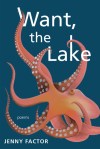 Want, the Lake by Jenny Factor – Factor’s long, intricate second poetry collection envisions womanhood as a tug of war between desire and constraint. “Elegy for a Younger Self” poems string together vivid reminiscences.
 Terminal Maladies by Okwudili Nebeolisa – The Iowa Writers’ Workshop graduate’s debut collection is a tender chronicle of the years leading to his mother’s death from cancer. Food and nature imagery chart the decline in Nkoli’s health and its effect on her family.
Fiction:
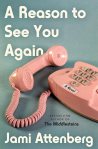 A Reason to See You Again by Jami Attenberg – Her tenth book evinces her mastery of dysfunctional family stories. From the Chicago-area Cohens, the circle widens and retracts as partners and friends enter and exit. Through estrangement and reunion, as characters grapple with sexuality and addictions, the decision is between hiding and figuring out who they are.
Nonfiction:
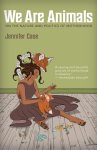 We Are Animals: On the Nature and Politics of Motherhood by Jennifer Case – Case’s second book explores the evolution, politics, and culture of contemporary parenthood in 15 intrepid essays. Science and statistics weave through in illuminating ways. This forthright, lyrical study of maternity is an excellent companion read to Lucy Jones’s Matrescence.
 Question 7 by Richard Flanagan – Ten years after his Booker Prize win for The Narrow Road to the Deep North, Richard Flanagan revisits his father’s time as a POW—the starting point but ultimately just one thread in this astonishing and uncategorizable work that combines family memoir, biography, and history to examine how love and memory endure. (Published in the USA on 17 September.)
With thanks to Emma Finnigan PR and Vintage (Penguin) for the proof copy for review.
Any other September releases you’d recommend?
A Review for PKD Awareness Day: The Mourner’s Bestiary by Eiren Caffall
Today is PKD Awareness Day. Because the author and I both have polycystic kidney disease, I’m doing something I rarely do and reprinting an early review of mine that has already appeared on Shelf Awareness. I could hardly believe it when I was trawling through the list of review book offers and saw that Eiren Caffall also has PKD, then even more astonished to learn that it is a major theme in her memoir, which also weaves in marine biology and environmental concerns. An altogether intriguing book that, of course, held personal interest for me.
The Mourner’s Bestiary by Eiren Caffall
Eiren Caffall’s debut is an ardent elegy for her illness-haunted family and for the ailing marine environments that inspire her.
For centuries, the author’s family has been subject to “the Caffall Curse.” Polycystic kidney disease, a degenerative genetic condition, causes fluid-filled cysts to proliferate in a person’s enlarged kidneys. PKD can involve pain, fatigue, high blood pressure, kidney failure, and a heightened risk of brain aneurysm. Given Caffall’s paternal family history, she expected to die before age 50.
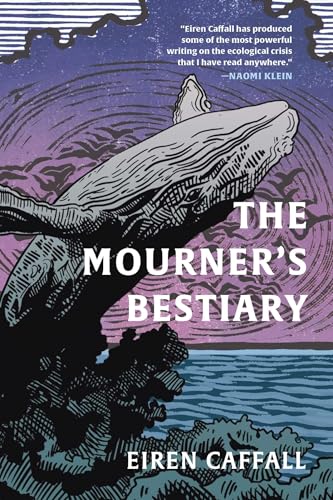 Caffall’s melancholy memoir spotlights moments that opened her eyes to medical and environmental catastrophe. In 1980, when she was nine years old, she and her parents vacationed at a rental cottage on Long Island Sound. They nicknamed the pollution-ridden site “Dogshit Beach”—her mother spent idyllic summers there as a child, yet now “both the ecosystem and my father were slipping away.” For the first time, Caffall became aware of her father’s suffering and lack of energy. She realized that she, too, might have inherited PKD and could face similar struggles as an adult.
In 2014, Caffall, then a single mother, took her nine-year-old son, Dex, on vacation to the Gulf of Maine. During the trip, she had a fall that prompted a seizure, and she and Dex were evacuated from Monhegan Island by Coast Guard ship. Although no further seizures ensued and no clear cause emerged, the crisis served as a wake-up call, reminding her of how serious PKD is and that it might afflict her son as well.
The book draws fascinating connections between personal experiences and ecological threats. Caffall structures her story as a gallery of endangered marine animals such as the Longfin Inshore Squid and Humpback Whale, tracing their history and exposing the dangers they face in degraded environments. Red tides (massive algal blooms) and floods are apt metaphors for physical trials: “the Sound was dying, hypoxic … from an overwhelm of nutrients flooding an ecosystem—nitrogen, phosphorus, imbalanced saline—the same things that overwhelm a body when kidneys can no longer filter blood properly.”
Re-created scenes enliven accounts of family illness and therapeutic developments. The lyrical hybrid narrative, informed by scientific journals and government publications, is as impassioned about restoring the environment as it is about ensuring equality of access to health care. Personal and species extinction are just cause for “permanent mourning,” Caffall writes, but adapting to change keeps hope alive.
(Coming out in the USA from Row House Publishing on October 15th)
Posted with permission from Shelf Awareness.
[I couldn’t help but compare family members’ trajectories. Like her father, my mother was on dialysis for a time before getting a transplant, from her cousin. Like her aunt, my uncle died of a brain aneurysm, which is an associated risk. It sounds like Caffall has been much more severely affected than I have thus far. She is 53 and on Tolvaptan, a cutting-edge drug that slows the growth of cysts and thus the decline in kidney function. But even within families, the disease course is so varied. A cousin of mine was in her thirties when she had a transplant, whereas I am still very much in the early stages.]
A shout-out to the PKD Foundation in the States and the PKD Charity here in the UK.
A related post: In 2017 I reviewed four books for World Kidney Day.
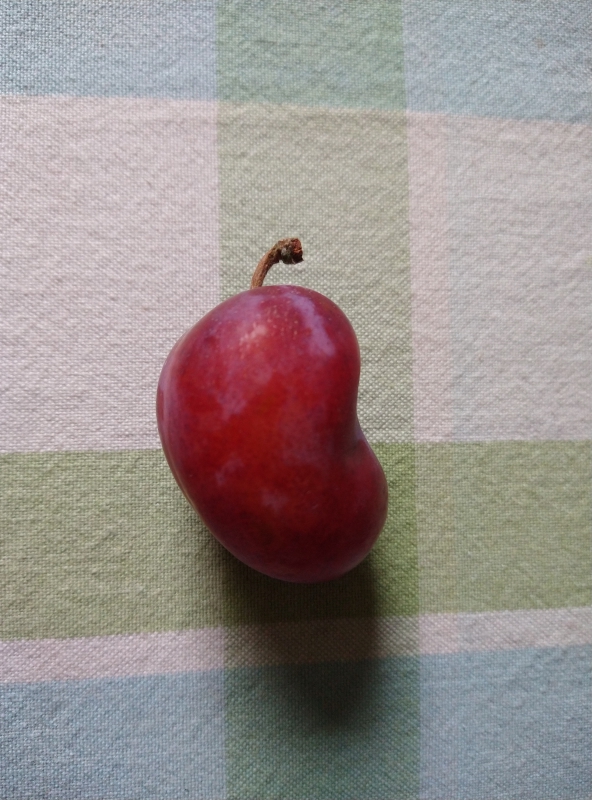
From the supermarket last week: a plum that wanted to be a kidney.
20 Books of Summer, 11–13: Campbell, Julavits, Lu
Two solid servings of women’s life writing plus a novel about a Chinese woman stuck in roles she’s not sure she wants anymore.
Thunderstone: A true story of losing one home and discovering another by Nancy Campbell (2022)
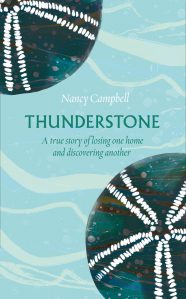 Just before Covid hit, Campbell’s partner Anna had a partially disabling stroke. They had to adjust to lockdown and the rigours of Anna’s at-home care at once. It was complicated in that Campbell was already halfway out the door: after 10 years, their relationship had run its course and she knew it was time to go, but guilt lingered about abandoning Anna at her most vulnerable (“How dare I leave someone who needed me”). That is the backdrop to a quiet book largely formed of a diary spanning June to September 2021. Campbell recounts settling into a caravan by the canal and railway line in Oxford, getting plenty of help from friends and neighbours but also finding her own inner resources and enjoying her natural setting.
The title refers to a fossil that has been considered a talisman in various cultures, and she needed the good luck during a period that involved accidental carbon monoxide poisoning and surgery for an ovarian abnormality (but it didn’t protect her books, which were all destroyed in a leaking shipping container – the horror!). I most enjoyed the longer entries where she muses on “All the potential lives I moved on from” during 20 years in Oxford and elsewhere, which makes me think that I would have preferred a more traditional memoir by her. Covid narratives feel really dated now, unfortunately. (New (bargain) purchase from Hungerford Bookshop with birthday voucher)
Directions to Myself: A Memoir by Heidi Julavits (2023)
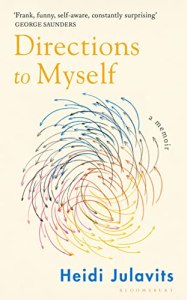 Julavits is a novelist and founding editor of The Believer. I loved her non-standard diary, The Folded Clock, back in 2017, so jumped at the chance to read her new memoir but then took more a year over reading it. The U.S. subtitle, “A Memoir of Four Years,” captures the focus: the change in her son from age five to age nine – from little boy to full-fledged individual. In later sections he sounds so like my American nephew with his Fortnite obsession and lawyerly levels of argumentation and self-justification. A famous author once told Julavits that writers should not have children because each one represents a book they will not write. This book is a rebuttal: something she could not have written without having had her son. Home is a New York City apartment near the Columbia University campus where she teaches – in fact, directly opposite a dorm at which rape allegations broke out – but more often the setting is their Maine vacations, where coastal navigation is a metaphor for traversing life.
Mostly the memoir takes readers through everyday conversations the author has with friends and family about situations of inequality or harassment. Through her words she tries to gently steer her son towards more open-minded ideas about gender roles. She also entrances him and his sleepover friends with a real-life horror story about being chased through the French countryside by a man in a car. The tenor of her musings appealed to me, but already the details are fading. I suspect this will mean much more to a parent.
With thanks to Bloomsbury for the free copy for review.
The Funeral Cryer by Wenyan Lu (2023)
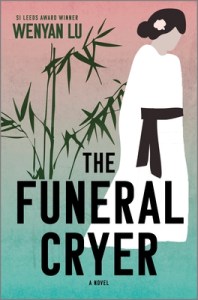 The title character holds a traditional position in her Chinese village, performing mourning at ceremonies for the dead. It’s a steady source of income for her and her husband, but her career choice has stigma attached: “Now that I brought bad luck and I smelt of the dead, nobody would step into our house to play mah-jong or chat.” Exotic as the setup might seem at first, it underpins a familiar story of a woman caught in frustrating relationships and situations. A very readable but plain style to this McKitterick Prize winner.
With thanks to the Society of Authors for the free copy.
Literary Wives Club: Mrs. March by Virginia Feito (2021)
{SPOILERS IN THIS REVIEW!}
What a deliciously odd debut novel, reminiscent of Patricia Highsmith’s work for how it places a neurotic outsider at the heart of an unlikely murder investigation. George March is a popular author whose latest novel stars Johanna, a prostitute so ugly that men feel sorry for her and can’t bear to sleep with her. Meanwhile, the news cycle is consumed with the strangling of a young woman named Sylvia Gibbler in Gentry, Maine, where George goes on hunting trips with his editor. Mrs. March takes two misconceptions – that George modeled Johanna on her, and that he was somehow involved in Sylvia’s death because he kept newspaper clippings about it on his desk – and runs with them, to catastrophic effect.
Mrs. March’s usual milieu is the New York City apartment she shares with George and their son, Jonathan. Martha, the housekeeper, keeps the daily details under control, leaving Mrs. March with little to do. She doesn’t seem very interested in her son, and resents George. Each morning she walks to the bakery to buy olive bread. Every so often she’ll host an extravagant dinner party. But there is plenty of time in between to fill with flashbacks to shameful memories (having an imaginary friend, wetting the bed, her mother’s favoritism towards her sister, being raped in Cádiz) and hallucinations (a dead pigeon in the bathtub, cockroaches scuttling around the apartment). She decides to travel to Maine herself to investigate Sylvia’s death; it’s not what she finds there but what she returns to that changes things forever.

There are so many intriguing factors. One is the nebulous time period: what with Mrs. March’s fur coat and head scarf, the train cars and payphone calls, it could be the 1950s; but then there are more modern references (a washing machine, holiday flights) that made me inclined to point to the 1980s. It couldn’t be the present day unless Feito is deliberately setting the story in an alternative world without much tech. As in Highsmith, we get mistaken identity and disguises. Feito really ramps up the psychological elements, interrogating how trauma, paranoia and extreme body issues may have led to dissociation in her protagonist. Mrs. March is both obsessed with and repulsed by bodily realities. It’s only through other characters’ reactions, though, that we see just how mentally disturbed she is. Worryingly, patterns seem to be repeating with her son, who is suspended for ‘doing something’ to a girl.
I can see how this would be a divisive read: the characters are thoroughly unlikable and it can be difficult to decide what is real and what is not. Incidents I took at face value may well be symbolic, or psychological manifestations of trauma. But I found it morbidly fascinating. I never knew what was going to happen next. (Public library/NetGalley) 
The main question we ask about the books we read for Literary Wives is:
What does this book say about wives or about the experience of being a wife?
In terms of Literary Wives reads, this reminded me most of The Harpy by Megan Hunter because of its eventual focus on adultery and revenge. Notably, until the very last sentence, we only know Mrs. March’s identity through her relationship to her husband. (Her first name is finally revealed to be Agatha, which of course made me think of Agatha Christie and detection, but its meaning is “good” or “honorable” – there was a martyred saint by the name.) What I took from that is that defining oneself primarily through marriage is dangerous because personality and control can be lost. This character was in need of a wider purpose to take her outside of her home and family – though those would always be her refuge to return to. Even setting Mrs. March’s mental problems aside, it is frighteningly easy to indulge in delusions about oneself or one’s spouse, so getting a reality check via communication is key.
See Kay’s and Naomi’s reviews, too!
We’ve recently acquired a new member – welcome to Kate of Books Are My Favourite and Best! – and chosen our books for the next two and a bit years. Anyone is welcome to join us in reading them. Here’s the club page on Kay’s blog, and our schedule through the end of 2026:
June 2024 Recipe for a Perfect Marriage by Karma Brown
Sept. 2024 Their Eyes Were Watching God by Zora Neale Hurston
Dec. 2024 Euphoria by Elin Culhed
March 2025 Lessons in Chemistry by Bonnie Garmus
June 2025 The Constant Wife by W. Somerset Maugham
Sept. 2025 Novel about My Wife by Emily Perkins
Dec. 2025 The Soul of Kindness by Elizabeth Taylor
March 2026 Mrs. Bridge by Evan S. Connell
June 2025 Interpreter of Maladies by Jhumpa Lahiri
Sept. 2026 Family Family by Laurie Frankel
Dec. 2026 The Eden Test by Adam Sternbergh
My Best Backlist Reads of the Year
Like many bloggers, I’m irresistibly drawn to the new books released each year. However, I consistently find that many of my more memorable reads were published earlier – most of these happen to have been published between one and a few years ago, with the ‘oldest’ being from 2004. These dozen selections – alphabetical within genre but in no particular rank order – together with my Best of 2023 post (coming up tomorrow), make up about the top 10% of my year’s reading.

Fiction
 Loved and Missed by Susie Boyt: The heart-wrenching story of a woman who adopts her granddaughter because of her daughter’s drug addiction. The prose is stunning as Boyt traces the history of this complicated, makeshift family. The title has a wry double meaning, but also connotations of anticipatory grief. There can be love even where there is estrangement, or eternal separation. That is one of the enduring messages of this gem of a short novel.
 Homesick by Jennifer Croft: Each vignette – some just a paragraph long – is perfectly chosen to reveal a family dynamic and a moment in American history. What Croft does so brilliantly is to chart the accretion of ordinary and landmark events that form a life. In the end it didn’t matter whether this was presented as memoir or autofiction, so true was it to the experience of 1990s girlhood, as well as to sisterhood and coming of age.
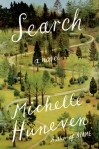 Search by Michelle Huneven: When middle-aged restaurant critic Dana Potowski is invited to be on the search committee to appoint the next minister for her California Unitarian church, she reluctantly agrees but soon wonders whether the experience could be interesting fodder for a new book… The setup might seem niche but will resonate with anyone who’s had a brush with bureaucracy. Pure pleasure; lit fic full of gossip and good food.
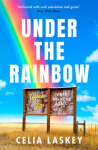 Under the Rainbow by Celia Laskey: Researchers identified Big Burr, Kansas as the most homophobic town in America. An Acceptance Across America task force descends on the rural backwater for a two-year program promoting education and friendship. Each chapter in the linked short story collection is a first-person, present-tense confession from a local or a queer visitor, whose stories interlock. Laskey inhabits all 11 with equal skill and compassion.
 The Chosen by Elizabeth Lowry: This utterly immersive novel examines Thomas Hardy’s relationship with his first wife, Emma Gifford. It opens on the morning of her death. The couple had long been estranged, but Hardy was instantly struck with grief – and remorse, his guilt compounded by what he found in her journals. A universal tale of waning romance, loss, and regret. Beautifully understated; perfectly convincing for the period but also timeless.
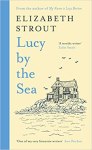 Lucy by the Sea by Elizabeth Strout: As Covid hits, William whisks Lucy from her NYC apartment to a house at the Maine coast. She’s an Everywoman recounting the fear and confusion of the early pandemic. Isolation has benefits: the first ‘room of her own’ she’s ever had, and time to ponder her childhood trauma and what went wrong in her marriage. Astute on American politics and writers’ inspirations; an effortless voice and emotional intelligence.
Nonfiction
 Bibliomaniac by Robin Ince: Ince was meant to undertake a stadium tour in Autumn 2021, but a Covid resurgence put paid to that. Not one for sitting around at home, he formulated Plan B: 100+ events, most of them in independent bookshops, over the course of two months, criss-crossing Britain and hitting many of my favourites. He’s not just a speaker at them but, invariably, a customer. I sensed a kindred spirit in so many lines. Witty and open-minded.
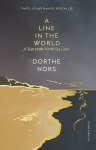 A Line in the World by Dorthe Nors: Nors lives in rural Jutland along the west coast of Denmark – little visited and largely unknown to foreigners. This can be both good and bad. Tourists feel they’re discovering somewhere new, but the residents are insular. Local legends and traditions, bird migration, reliance on the sea, wanderlust, maritime history, a visit to church frescoes, and more. Gorgeous writing and atmosphere, despite the bleakness.
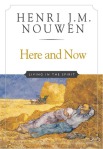 Here and Now by Henri Nouwen: This collection of micro-essays under themed headings like “Living in the Present” and “Suffering” is a perfect introduction to the Dutch Catholic priest’s theology. I marked out many reassuring or thought-provoking passages. I was taken by his ideas that the life of compassion is one of “downward mobility” and that inner freedom comes when you don’t judge anyone. Peaceful and readable; a good bedside devotional.
Poetry
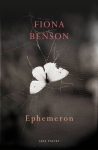 Ephemeron by Fiona Benson: Exquisite poems about the ephemeral, whether that be insect lives, boarding school days, primal emotions or moments from her children’s early years. The book is in four discrete corresponding sections but themes and language bleed from one into another and the whole is shot through with astonishing corporeality and eroticism. The form varies but the alliteration, slant rhymes and unexpected metaphors make each poem glisten.
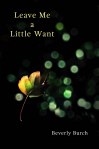 Leave Me a Little Want by Beverly Burch: Burch’s fourth collection juxtaposes the cosmic and the mundane, marvelling at the behind-the-scenes magic that goes into one human being born but also making poetry of an impatient wait in a long post office queue. Beset by environmental anxiety and the scale of bad news during the pandemic, she pauses in appreciation of the small and gradual.
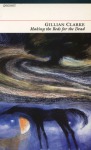 Making the Beds for the Dead by Gillian Clarke: Full of colour and nature imagery, profuse with alliteration and slant rhymes, relishing its specialist terminology, and taking on the serious subject matter of manmade disasters. Several sequences are devoted to gardening and geology; some pieces are ekphrastic, or dedicated to particular poets. The title sequence tackles the 2001foot and mouth disease outbreak. “The Fall” is on 9/11. Very affecting stuff.
My overall favourites were: in novels, Search and The Chosen (one contemporary and one historical) and in poetry, Ephemeron.
What were your best backlist reads this year?
Rathbones Folio Prize Fiction Shortlist: Sheila Heti and Elizabeth Strout
I’ve enjoyed engaging with this year’s Rathbones Folio Prize shortlists, reading the entire poetry shortlist and two each from the nonfiction and fiction lists. These two I accessed from the library. Both Sheila Heti and Elizabeth Strout featured in the 5×15 event I attended on Tuesday evening, so in the reviews below I’ll weave in some insights from that.
Pure Colour by Sheila Heti
 Sheila Heti is a divisive author; I’m sure there are those who detest her indulgent autofiction, though I’ve loved it (How Should a Person Be? and especially Motherhood). But this is another thing entirely: Heti puts two fingers up to the whole notion of rounded characterization or coherent plot. This is the thinnest of fables, fascinating for its ideas and certainly resonant for me what with the themes of losing a parent and searching for purpose in life on an earth that seems doomed to destruction … but is it a novel?
My summary for Bookmarks magazine gives an idea of the ridiculous plot:
Heti imagines that the life we live now—for Mira, studying at the American Academy of American Critics, working in a lamp store, grieving her father, and falling in love with Annie—is just God’s first draft. In this creation myth of sorts, everyone is born a “bear” (lover), “bird” (achiever), or “fish” (follower). Mira has a mystical experience in which she and her dead father meet as souls in a leaf, where they converse about the nature of time and how art helps us face the inevitability of death. If everything that exists will soon be wiped out, what matters?
The three-creature classification is cute enough, but a copout because it means Heti doesn’t have to spend time developing Mira (a bird), Annie (a fish), or Mira’s father (a bear), except through surreal philosophical dialogues that may or may not take place whilst she is disembodied in a leaf. It’s also uncomfortable how Heti uses sexual language for Mira’s communion with her dead dad: “she knew that the universe had ejaculated his spirit into her”.
Heti explained that the book came to her in discrete chunks, from what felt like a more intuitive place than the others, which were more of an intellectual struggle, and that she drew on her own experience of grief over her father’s death, though she had been writing it for a year beforehand.
Indeed, she appears to be tapping into primordial stories, the stuff of Greek myth or Jewish kabbalah. She writes sometimes of “God” and sometimes of “the gods”: the former regretting this first draft of things and planning how to make things better for himself the second time around; the latter out to strip humans of what they care about: “our parents, our ambitions, our friendships, our beauty—different things from different people. They strip some people more and others less. They strip us of whatever they need to in order to see us more clearly.” Appropriately, then, we follow Mira all the way through to her end, when, stripped of everything but love, she rediscovers the two major human connections of her life.
Given Ali Smith’s love of the experimental, it’s no surprise that she as a judge shortlisted this. If you’re of a philosophical bent, don’t mind negligible/non-existent plot in your novels and aren’t turned off by literary pretension, you should be fine. If you are new to Heti or unsure about trying her, though, this is probably not the right place to start. See my Goodreads review for some sample quotes, good and bad. 
Lucy by the Sea by Elizabeth Strout
This was by far the best of the three Amgash books I’ve read. I think it must be the first time that Strout has set a book not in the past or at some undated near-contemporary moment but in the actual world with its current events, which inevitably means it gets political. I had my doubts about how successful she’d be with such hyper-realism, but this really worked.
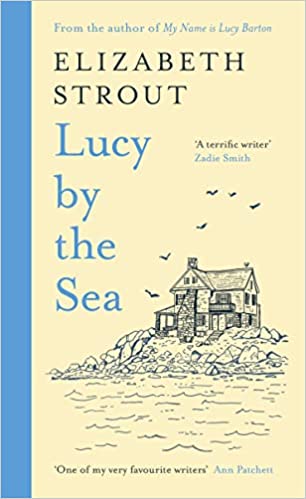 As Covid hits, William whisks Lucy away from her New York City apartment to a house at the coast in Crosby, Maine. She’s an Everywoman recounting the fear and confusion of those early pandemic days, hearing of friends and relatives falling ill and knowing there’s nothing she can do about it. Isolation, mostly imposed on her but partially chosen – she finally gets a writing studio, the first ‘room of her own’ she’s ever had – gives her time to ponder the trauma of her childhood and what went wrong in her marriage to William. She worries for her two adult daughters but, for the first time, you get the sense that the strength and wisdom she’s earned through bitter experience will help her support them in making good choices.
Here in rural Maine, Lucy sees similar deprivation to what she grew up with in Illinois and also meets real people – nice, friendly people – who voted for Trump and refuse to be vaccinated. I loved how Strout shows us Lucy observing and then, through a short story, compassionately imagining herself into the situation of conservative cops and drug addicts. “Try to go outside your comfort level, because that’s where interesting things will happen on the page,” is her philosophy. This felt like real insight into a writer’s inspirations.
Another neat thing Strout does here, as she has done before, is to stitch her oeuvre together by including references to most of her other books. So she becomes friends with Bob Burgess, volunteers alongside Olive Kitteridge’s nursing home caregiver (and I expect their rental house is supposed to be the one Olive vacated), and meets the pastor’s daughter from Abide with Me. My only misgiving is that she recounts Bob Burgess’s whole story, replete with spoilers, such that I don’t feel I need to read The Burgess Boys.
Lucy has emotional intelligence (“You’re not stupid about the human heart,” Bob Burgess tells her) and real, hard-won insight into herself (“My childhood had been a lockdown”). Readers as well as writers have really taken this character to heart, admiring her seemingly effortless voice. Strout said she does not think of this as a ‘pandemic novel’ because she’s always most interested in character. She believes the most important thing is the sound of the sentences and that a writer has to determine the shape of the material from the inside. She was very keen to separate herself from Lucy, and in fact came across as rather terse. I had somehow expected her to have a higher voice, to be warmer and softer. (“Ah, you’re not Lucy, you’re Olive!” I thought to myself.) 
Predictions
This year’s judges are Guy Gunaratne, Jackie Kay and Ali Smith. Last year’s winner was a white man, so I’m going to say in 2023 the prize should go to a woman of colour, and in fact I wouldn’t be surprised if all three category winners were women of colour. My own taste in the shortlists is, perhaps unsurprisingly, very white-lady-ish and non-experimental. But I think Amy Bloom and Elizabeth Strout’s books are too straightforward and Fiona Benson’s not edgy enough. So I’m expecting:
Fiction: Scary Monsters by Michelle de Kretser
Nonfiction: Constructing a Nervous System by Margo Jefferson
Poetry: Quiet by Victoria Adukwei Bulley (or Cane, Corn & Gully by Safiya Kamaria Kinshasa)
Overall winner: Constructing a Nervous System by Margo Jefferson (or Quiet by Victoria Adukwei Bulley)
This is my 1,200th blog post!
Booker Prize Longlist Reading & Shortlist Predictions
I’ve polished off another four from the Booker Prize longlist (my initial reactions and excerpts from existing reviews are here), with one more coming up for me next month.
Trust by Hernan Diaz
“History itself is just a fiction—a fiction with an army. And reality? Reality is a fiction with an unlimited budget.”
My synopsis for Bookmarks magazine:
Set in the 1920s and 1930s, this expansive novel is about the early days of New York City high finance. It is told through four interlocking narratives. The first is Bonds, a novel by Harold Vanner, whose main character is clearly based on tycoon Andrew Bevel. Bevel, outraged at his portrayal as well as the allegation that his late wife, Mildred, was a madwoman, responds by writing a memoir—the book’s second part. Part 3 is an account by Ida Partenza, Bevel’s secretary, who helps him plot revenge on Vanner. In the final section, Mildred finally gets her say. Her journal caps off a sumptuous, kaleidoscopic look at American capitalism.
 Ghostwriter Ida’s section was much my favourite, for her voice as well as for how it leads you to go back to the previous part – some of it still in shorthand (“Father. Describe early memories of him. … MATH in great detail. Precocious talent. Anecdotes.”) and reassess its picture of Bevel. His short selling in advance of the Great Depression made him a fortune, but he defends himself: “My actions safeguarded American industry and business.” Mildred’s journal entries, clearly written through a fog of pain as she was dying from cancer, then force another rethink about the role she played in her husband’s decision making. With her genius-level memory, philanthropy and love of literature and music, she’s a much more interesting character than Bevel – that being the point, of course, that he steals the limelight. This is clever, clever stuff. However, as admirable as the pastiche sections might be (though they’re not as convincing as the first section of To Paradise), they’re ever so dull to read.
With thanks to Picador for the free copy for review.
Case Study by Graeme Macrae Burnet
 That GMB is quite the trickster. From the biographical sections, I definitely assumed that A. Collins Braithwaite was a real psychiatrist in the 1960s. A quick Google when I got to the end revealed that he only exists in this fictional universe. I enjoyed the notebooks recounting an unnamed young woman’s visits to Braithwaite’s office; holding the man responsible for her sister’s suicide, she books her appointments under a false name, Rebecca Smyth, and tries acting just mad (and sensual) enough to warrant her coming back. Her family stories, whether true or embellished, are ripe for psychoanalysis, and the more she inhabits this character she’s created the more she takes on her persona. (“And, perhaps on account of Mrs du Maurier’s novel, Rebecca had always struck me as the most dazzling of names. I liked the way its three short syllables felt in my mouth, ending in that breathy, open-lipped exhalation.” I had to laugh at this passage! I’ve always thought mine a staid name.) But the different documents don’t come together as satisfyingly as I expected, especially compared to His Bloody Project. (Public library)
Those two are both literary show-off stuff (the epistolary found documents strategy, metafiction): the kind of book I would have liked more in my twenties. I’m less impressed with games these days; I prefer the raw heart of this next one.
Nightcrawling by Leila Mottley
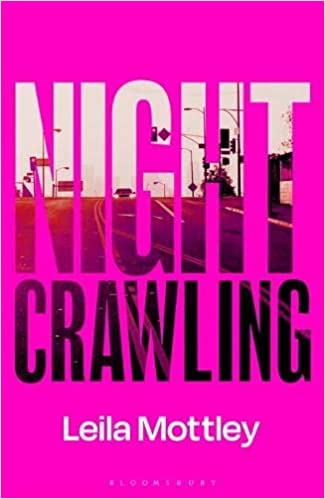 She may be only 20 years old, but Leila Mottley is the real deal. Her debut novel, laden with praise from her mentor Ruth Ozeki and many others, reminded me of Bryan Washington’s work. The first-person voice is convincing and mature as Mottley spins the (inspired by a true) story of an underage prostitute who testifies against the cops who have kept her in what is virtually sex slavery. At 17, Kiara is the de facto head of her household, with her father dead, her mother in a halfway house, and her older brother pursuing his dream of recording a rap album. When news comes of a rise in the rent and Kia stumbles into being paid for sex, she knows it’s her only way of staying in their Oakland apartment and looking after her neglected nine-year-old neighbour, Trevor.
I loved her relationships with Trevor, her best friend Alé (they crash funerals for the free food), and trans prostitute Camila, and the glimpses into prison life and police corruption. This doesn’t feel like misery for the sake of it, just realistic and compassionate documentation. There were a few places where I felt the joins showed, like a teacher had told her she needed to fill in some emotional backstory, and I noticed an irksome habit of turning adjectives into verbs or nouns (e.g., “full of all her loud,” “the sky is just starting to pastel”); perhaps this is an instinct from her start in poetry, but it struck me as precious. However, this is easily one of the more memorable 2022 releases I’ve read, and I’d love to see it on the shortlist and on other prize lists later this year and next. (Public library)
Oh William! by Elizabeth Strout
 This was a DNF for me last year, but I tried again. The setup is simple: Lucy Barton’s ex-husband, William, discovers he has a half-sister he never knew about. William and Lucy travel from New York City to Maine in hopes of meeting her. For both of them, the quest sparks a lot of questions about how our origins determine who we are, and what William’s late mother, Catherine, was running from and to in leaving her husband and small child behind to forge a different life. Like Lucy, Catherine came from nothing; to an extent, everything that unfolded afterwards for them was a reaction against poverty and neglect.
The difficulty of ever really knowing another person, or even understanding oneself, is one of Strout’s recurring messages. There are a lot of strong lines and relatable feelings here. What I found maddening, though, is Lucy’s tentative phrasing, e.g. “And I cannot explain it except to say—oh, I don’t know what to say! Truly, it is as if I do not exist, I guess is the closest thing I can say.” She employs hedging statements like that all the time; it struck me as false that someone who makes a living by words would be so lacking in confidence about how to say what she means. So I appreciated the psychological insight but found Lucy’s voice annoying, even in such a short book. (Public library)
A Recap
I’ve read 6 of the 13 at this point, have imminent plans to read After Sappho for a Shelf Awareness review, and would still like to read the Mortimer if my library system acquires it. The others? Meh. I might consider catching up if they’re shortlisted.
My book group wasn’t chosen to shadow the Booker Prize this year, which is fair enough since we already officially shadowed the Women’s Prize earlier in the year (here are the six successful book clubs, if you’re interested). However, we have been offered the chance to send in up to five interview questions for the shortlisted authors. The Q&As will then be part of a website feature. And I was pleasantly surprised to see that my non-holiday snap of a Booker Prize nominee turned up in this round-up!
Here’s my (not particularly scientific) reasoning for what might make the shortlist:
A literary puzzle novel
Trust by Hernan Diaz or Case Study by Graeme Macrae Burnet
- Trust feels more impressive, and timely; GMB already had his chance.
A contemporary novel
Nightcrawling by Leila Mottley or Oh William! by Elizabeth Strout
- Oh William! is the weakest Strout novel I’ve read. Mottley’s is a fresh voice that deserves to be broadcast.

A satire
The Trees by Percival Everett or Seven Moons of Maali Almeida by Shehan Karunatilaka
- Without having read either, I’m going to hazard a guess that the Everett is too Ameri-centric/similar to The Sellout. The Booker tends to reward colourful Commonwealth books. [EDITED to add that I forgot to take into my considerations Glory by NoViolet Bulawayo; while it doesn’t perfectly fit this category, as a political allegory it’s close enough that I’ll include it here. I would not be at all surprised if it made the shortlist, along with the Karunatilaka.]

A couple of historical novels
Booth by Karen Joy Fowler or After Sappho by Selby Wynn Schwartz
and/or
A couple of Irish novels
Small Things Like These by Claire Keegan or The Colony by Audrey Magee
- I’m hearing such buzz about the Magee, and there’s such love out there for the Keegan, that I reckon both of these will make it through.


The odd one out?
Treacle Walker by Alan Garner or Maps of Our Spectacular Bodies by Maddie Mortimer
- Maybe nostalgia will spur the judges to give Garner a chance in his 80s.

My predicted shortlist:

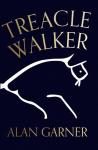


On Tuesday evening we’ll find out if I got any of these right!
What have you read from the longlist? What do you most want to read, or see on the shortlist?
Doorstopper of the Month: The Cider House Rules by John Irving (A Reread)
Next month will be all about the short books (#NovNov!), but first it was time to get this excessively long one out of the way. My husband’s and my reading tastes don’t overlap in many areas, but John Irving is our mutual favorite author. I first started The Cider House Rules (1985) on our second honeymoon – being from two different countries, we had two nuptial ceremonies and two honeymoons, one per continent – which was a road trip through New England. We drove from Maryland to Maine and back; I have a specific memory of reading the chunky Irving hardback at our B&B in Stowe, Vermont. I was a much less prolific reader in those days, so I had to return my American library copy partially read and then pay to reserve one from the Hampshire Libraries system once we were back in the UK.
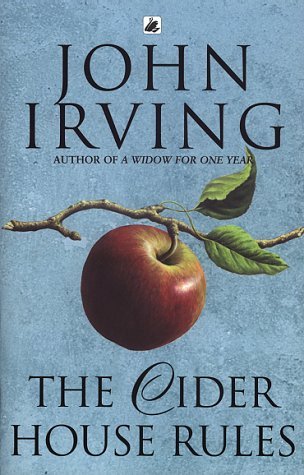
Thirteen years on, I remembered the orphanage and cider farm settings, the dynamic between Doctor Wilbur Larch and his protégé, Homer Wells, and Homer’s love for his best friend’s girl, Candy. I also remembered that this is a Trojan horse of a novel: it advocates, not very subtly, for abortion rights through pictures of women in desperate situations. Luckily, by the time I first read it I was no longer slavishly devoted to the American Religious Right. But this time I felt that even readers who consider themselves pro-choice might agree Irving over-eggs his argument. My memory of the 1999 film version is clearer. It severely condenses the book’s 40 years or so of action, cutting subplots and allowing Tobey Maguire and Charlize Theron to play the leads all the way through. A shorter timeframe also more neatly draws a line between Rose Rose’s experience and Homer’s change of heart about offering abortions.
I had a strong preference for the scenes set at St. Cloud’s orphanage in Maine. Dr. Larch is celibate and addicted to ether – all a result of his first sexual encounter with a prostitute. He has an ironclad conviction that he is doing the Lord’s work for the pregnant women who get off the train at St. Cloud’s, whether they come for an abortion or to leave a live baby behind. Homer Wells is the one orphan who never finds an adoptive home; he stays on and becomes Larch’s trainee in obstetrics, but vows that he won’t perform abortions. As a young adult, Homer is pulled away from the orphanage by his puppy love for Wally and Candy, a couple-in-trouble who come up from his family’s apple farm. Homer thinks he’ll go back with his new friends for a month or two, but instead he stays at Ocean View orchard for decades, his relationship with Candy changing when Wally goes off to war and comes back disabled.
I had forgotten the bizarre scenario Larch has to set up for the orphanage’s board of trustees to accept his chosen successor, and the far-fetched family situation Homer, Candy and Wally end up in. The orchard sections could feel endless, so I always thrilled to mentions of what was happening for Dr. Larch and the nurses back at St. Cloud’s.

Oktoberfest reading and snacking.
The Dickensian influence – lots of minor characters and threads tying up nicely by the end; quirks of speech and behavior – has generally been the aspect I like the most about Irving’s work, and while I loved the explicit references to David Copperfield here (a few kids get their names from it, it’s read aloud to the boy orphans every night, and its opening question about whether the protagonist will be the hero of his own life or not applies to Homer, too), I did find the novel awfully baggy this time. I even put in a slip of paper where I felt that things started to drift: page 450.
One further note to make about the film: it, rather unforgivably, eliminates Melony, a larger-than-life character and necessary counterpart to the book’s multiple passive females. She’s the de facto head of the girl orphans, as Homer is for the boys, and initiates Homer into sex. But her feelings for him are more of hero worship than of romantic love, and when he breaks his promise and leaves St. Cloud’s without her, she sets off to hunt him down. Her odyssey, delivered in parallel, is nearly as important as Homer’s (see what I/Irving did there?).
While I loved the medical history material and Dr. Larch’s moral fiber, this time I found Homer a little insipid and annoying (he answers nearly every question with “Right”), and the plot somewhat slack and obvious. In my memory this is probably #3 out of the Irving novels I’ve read, below A Prayer for Owen Meany and The World According to Garp – both of which I’d also like to reread to see if they’ve retained their power.
Page count: 731
My original rating (July–September 2007):
My rating now: 
Done any rereading, or picked up any very long books, lately?
Six Degrees of Separation: From The Turn of the Screw to The Cider House Rules
This month we’re starting with The Turn of the Screw, a Gothic horror novella about a governess and her charges – and one of only two Henry James novels I’ve read (the other is What Maisie Knew; I’ve gravitated towards the short, atypical ones, and even in those his style is barely readable). Most of my links are based on title words this time, along with a pair of cover images.
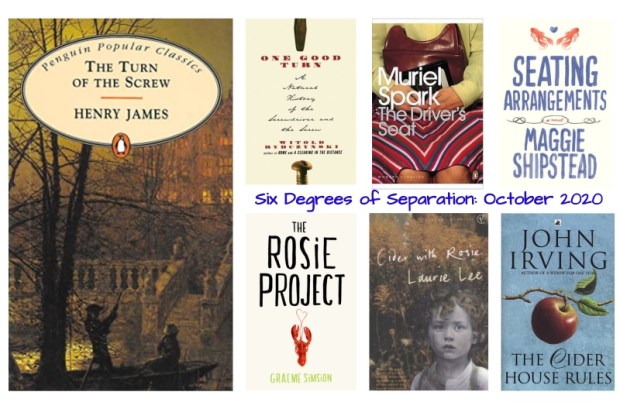
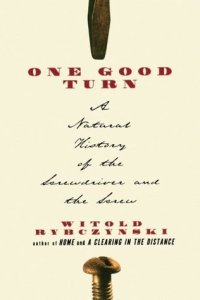
#1 On our trip to Hay-on-Wye last month, I was amused to see in a shop a book called One Good Turn: A Natural History of the Screwdriver and the Screw (2000) by Witold Rybczynski. A bit of a niche subject and nothing I can ever imagine myself reading, but it’s somehow pleasing to know that it exists.

#2 I’m keen to try Muriel Spark again with The Driver’s Seat (1970), a suspense novella with a seam of dark comedy. I remember reading a review of it on Heaven Ali’s blog and thinking that it sounded deliciously creepy. My plan is to get it out from the university library to read and review for Novellas in November.
#3 Seating Arrangements by Maggie Shipstead was one of my favorite debut novels of 2012. An upper-middle-class family prepares for their heavily pregnant daughter’s wedding weekend on an island off Connecticut. Shipstead is great at capturing social interactions. There’s pathos plus humor here; I particularly liked the exploding whale carcass. I’m still waiting for her to come out with a worthy follow-up (2014’s Astonish Me was so-so).

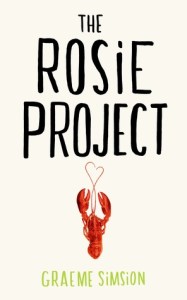
#4 The cover lobsters take me to The Rosie Project (2013) by Graeme Simsion, the first and best book in his Don Tillman trilogy. A (probably autistic) Melbourne genetics professor, Don decides at age 39 that it is time to find a wife. He goes about it in a typically methodical manner, drawing up a 16-page questionnaire, but still falls in love with the ‘wrong’ woman.
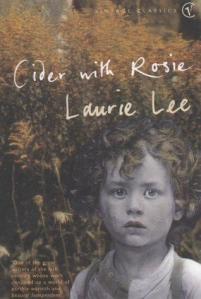
#5 Earlier in the year I reviewed Cider with Rosie (1959) by Laurie Lee as my classic of the month and a food-themed entry in my 20 Books of Summer. It’s a nostalgic, evocative look at a country childhood. The title comes from a late moment when Rosie Burdock tempts the adolescent Lee with alcoholic cider and kisses underneath a hay wagon.
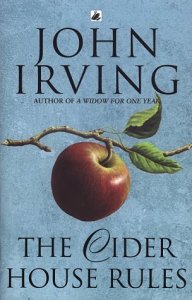
#6 My current reread is The Cider House Rules (1985), one of my favorite John Irving novels. Homer Wells is the one kid at the St. Cloud’s, Maine orphanage who never got adopted. Instead, he assists the director, Dr. Wilbur Larch, and later runs a cider factory. Expect a review in a few weeks – this will count as my Doorstopper of the Month.
Going from spooky happenings to apple cider, my chain feels on-brand for October!
Join us for #6Degrees of Separation if you haven’t already! (Hosted the first Saturday of each month by Kate W. of Books Are My Favourite and Best. Her introductory post is here.) Next month is a wildcard: start with a book you’ve ended a previous chain with.
Have you read any of my selections? Are you tempted by any you didn’t know before?
 Bookish Beck = Rebecca Foster. American transplant to England. Freelance proofreader and book reviewer.
 Bookish Beck