#ReadIndies Nonfiction Catch-Up: Ansell, Farrier, Febos, Hoffman, Orlean and Stacey
These are all 2025 releases; for some, it’s approaching a year since I was sent a review copy or read the book. Silly me. At last, I’ve caught up. Reading Indies month, hosted by Kaggsy in memory of her late co-host Lizzy Siddal, is the perfect time to feature books from five independent publishers. I have four works that might broadly be classed as nature writing – though their topics range from birdsong and technology to living in Greece and rewilding a plot in northern Spain – and explorations of celibacy and the writer’s profession.
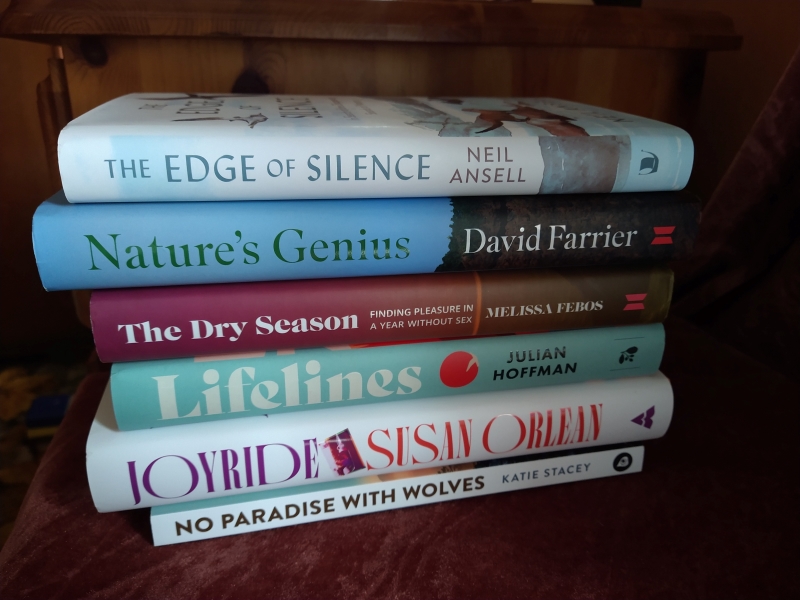
The Edge of Silence: In Search of the Disappearing Sounds of Nature by Neil Ansell
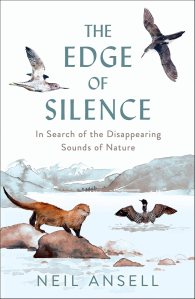 Ansell draws parallels between his advancing hearing loss and the biodiversity crisis. He puts together a wish list of species – mostly seabirds (divers, grebes), but also inland birds (nightjars) and a couple of non-avian representatives (otters) – that he wants to hear and sets off on public transport adventures to find them. “I must find beauty where I can, and while I still can,” he vows. From his home on the western coast of Scotland near the Highlands, this involves trains or buses that never align with the ferry timetables. Furthest afield for him are two nature reserves in northern England where his mission is to hear bitterns “booming” and natterjack toads croaking at night. There are also mountain excursions to locate ptarmigan, greenshank, and black grouse. His island quarry includes Manx shearwaters (Rum), corncrakes (Coll), puffins (Sanday), and storm petrels (Shetland).
Camping in a tent means cold nights, interrupted sleep, and clouds of midges, but it’s all worth it to have unrepeatable wildlife experiences. He has a very high hit rate for (seeing and) hearing what he intends to, even when they’re just on the verge of what he can decipher with his hearing aids. On the rare occasions when he misses out, he consoles himself with earlier encounters. “I shall settle for the memory, for it feels unimprovable, like a spell that I do not want to break.” I’ve read all of Ansell’s nature memoirs and consider him one of the UK’s top writers on the natural world. His accounts of his low-carbon travels are entertaining, and the tug-of-war between resisting and coming to terms with his disability is heartening. “I have spent this year in defiance of a relentless, unstoppable countdown,” he reflects. What makes this book more universal than niche is the deadline: we and all of these creatures face extinction. Whether it’s sooner or later depends on how we act to address the environmental polycrisis.
With thanks to Birlinn for the free copy for review.
Nature’s Genius: Evolution’s Lessons for a Changing Planet by David Farrier
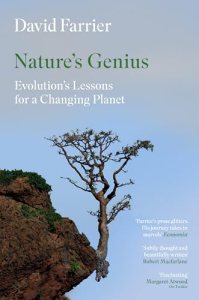 Farrier’s Footprints, which tells the story of the human impact on the Earth, was one of my favourite books of 2020. This contains a similar blend of history, science, and literary points of reference (Farrier is a professor of literature and the environment at the University of Edinburgh), with past changes offering a template for how the future might look different. “We are forcing nature to reimagine itself, and to avert calamity we need to do the same,” he writes. Cliff swallows have evolved blunter wings to better evade cars; captive breeding led foxes to develop the domesticated traits of pet dogs.
It’s not just other species that experience current evolution. Thanks to food abundance and a sedentary lifestyle, humans show a “consumer phenotype,” which superseded the Palaeolithic (95% of human history) and tends toward earlier puberty, autoimmune diseases, and obesity. Farrier also looks at notions of intelligence, language, and time in nature. Sustainable cities will have to cleverly reuse materials. For instance, The Waste House in Brighton is 90% rubbish. (This I have to see!)
There are many interesting nuggets here, and statements that are difficult to argue with, but I struggled to find an overall thread. Cool to see my husband’s old housemate mentioned, though. (Duncan Geere, for collaborating on a hybrid science–art project turning climate data into techno music.)
With thanks to Canongate for the free copy for review.
The Dry Season: Finding Pleasure in a Year without Sex by Melissa Febos
Febos considers but rejects the term “sex addiction” for the years in which she had compulsive casual sex (with “the Last Man,” yes, but mostly with women). Since her early teen years, she’d never not been tied to someone. Brief liaisons alternated with long-term relationships: three years with “the Best Ex”; two years that were so emotionally tumultuous that she refers to the woman as “the Maelstrom.” It was the implosion of the latter affair that led to Febos deciding to experiment with celibacy, first for three months, then for a whole year. “I felt feral and sad and couldn’t explain it, but I knew that something had to change.”
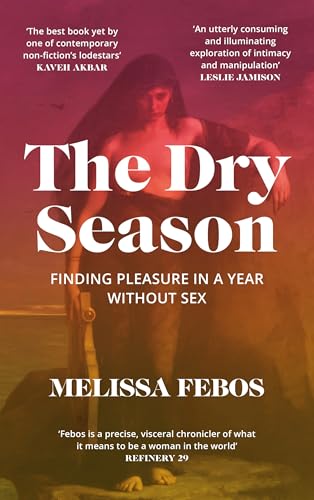 The quest involved some research into celibate movements in history, but was largely an internal investigation of her past and psyche. Febos found that she was less attuned to the male gaze. Having worn high heels almost daily for 20 years, she discovered she’s more of a trainers person. Although she was still tempted to flirt with attractive women, e.g. on an airplane, she consciously resisted the impulse to spin random meetings into one-night stands. (A therapist had stopped her short with the blunt observation, “you use people.”) With a new focus on the life of the mind, she insists, “My life was empty of lovers and more full than it had ever been.” (This reminded me of Audre Lorde’s writing on the erotic.) As Silvana Panciera, an Italian scholar on the beguines (a secular nun-like sisterhood), told her: “When you don’t belong to anyone, you belong to everyone. You feel able to love without limits.”
Intriguing that this is all a retrospective, reflecting on her thirties; Febos is now in her mid-forties and married to a woman (poet Donika Kelly). Clearly she felt that it was an important enough year – with landmark epiphanies that changed her and have the potential to help others – to form the basis for a book. For me, she didn’t have much new to offer about celibacy, though it was interesting to read about the topic from an areligious perspective. But I admire the depth of her self-knowledge, and particularly her ability to recreate her mindset at different times. This is another one, like her Girlhood, to keep on the shelf as a model.
With thanks to Canongate for the free copy for review.
Lifelines: Searching for Home in the Mountains of Greece by Julian Hoffman
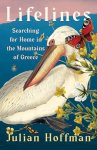
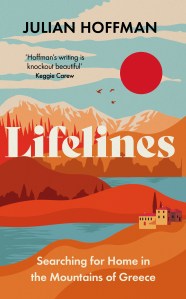 Hoffman’s Irreplaceable was my nonfiction book of 2019. Whereas that was a work with a global environmentalist perspective, Lifelines is more personal in scope. It tracks the author’s unexpected route from Canada via the UK to Prespa, a remote area of northern Greece that’s at the crossroads with Albania and North Macedonia. He and his wife, Julia, encountered Prespa in a book and, longing for respite from the breakneck pace of life in London, moved there in 2000. “Like the rivers that spill into these shared lakes, lifelines rarely flow straight. Instead, they contain bends, meanders and loops; they hold, at times, turns of extraordinary surprise.” Birdwatching, which Hoffman suggests is as “a way of cultivating attention,” had been their gateway into a love for nature developed over the next quarter-century and more, and in Greece they delighted in seeing great white and Dalmatian pelicans (which feature on the splendid U.S. cover. It would be lovely to have an illustrated edition of this.)
 One strand of this warm and fluent memoir is about making a home in Greece: buying and renovating a semi-derelict property, experiencing xenophobia and hospitality from different quarters, and finding a sense of belonging. They’re happy to share their home with nesting wrens, who recur across the book and connect to the tagline of “a story of shelter shared.” In probing the history of his adopted country, Hoffman comes to realise the false, arbitrary nature of borders – wildlife such as brown bears and wolves pay these no heed. Everything is connected and questions of justice are always intersectional. The Covid pandemic and avian influenza (which devastated the region’s pelicans) are setbacks that Hoffman addresses honestly. But the lingering message is a valuable one of bridging divisions and learning how to live in harmony with other people – and with other species.
With thanks to Elliott & Thompson for the free copy for review.
Joyride by Susan Orlean
As a long-time staff writer for The New Yorker, Orlean has had the good fortune to be able to follow her curiosity wherever it leads, chasing the subjects that interest her and drawing readers in with her infectious enthusiasm. She grew up in suburban Ohio, attended college in Michigan, and lived in Portland, Oregon and Boston before moving to New York City. Her trajectory was from local and alternative papers to the most enviable of national magazines: Esquire, Rolling Stone and Vogue. Orlean gives behind-the-scenes information on lots of her early stories, some of which are reprinted in an appendix. “If you’re truly open, it’s easy to fall in love with your subject,” she writes; maintaining objectivity could be difficult, as when she profiled an Indian spiritual leader with a cult following; and fended off an interviewee’s attachment when she went on the road with a Black gospel choir.
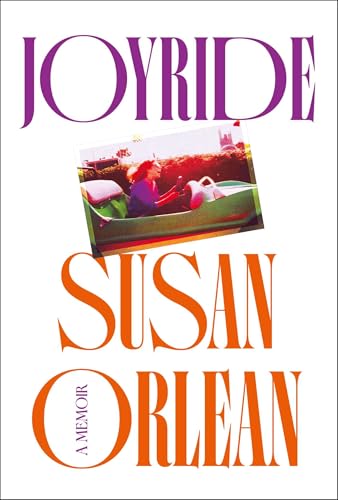 Her personal life takes a backseat to her career, though she is frank about the breakdown of her first marriage, her second chance at love and late motherhood, and a surprise bout with lung cancer. The chronological approach proceeds book by book, delving into her inspirations, research process and publication journeys. Her first book was about Saturday night as experienced across America. It was a more innocent time, when subjects were more trusting. Orlean and her second husband had farms in the Hudson Valley of New York and in greater Los Angeles, and she ended up writing a lot about animals, with books on Rin Tin Tin and one collecting her animal pieces. There was also, of course, The Library Book, about the wild history of the main Los Angeles public library. But it’s her The Orchid Thief – and the movie (not) based on it, Adaptation – that’s among my favourites, so the long section on that was the biggest thrill for me. There are also black-and-white images scattered through.
It was slightly unfortunate that I read this at the same time as Book of Lives – who could compete with Margaret Atwood? – but it is, yes, a joy to read about Orlean’s writing life. She’s full of enthusiasm and good sense, depicting the vocation as part toil and part magic:
“I find superhuman self-confidence when I’m working on a story. The bashfulness and vulnerability that I might otherwise experience in a new setting melt away, and my desire to connect, to observe, to understand, powers me through.”
“I like to do a gut check any time I dismiss or deplore something I don’t know anything about. That feels like reason enough to learn about it.”
“anything at all is worth writing about if you care about it and it makes you curious and makes you want to holler about it to other people”
With thanks to Atlantic Books for the free copy for review.
No Paradise with Wolves: A Journey of Rewilding and Resilience by Katie Stacey
I had the good fortune to visit Wild Finca, Luke Massey and Katie Stacey’s rewilding site in Asturias, while on holiday in northern Spain in May 2022, and was intrigued to learn more about their strategy and experiences. This detailed account of the first four years begins with their search for a property in 2018 and traces the steps of their “agriwilding” of a derelict farm: creating a vegetable garden and tending to fruit trees, but also digging ponds, training up hedgerows, and setting up rotational grazing. Their every decision went against the grain. Others focussed on one crop or type of livestock while they encouraged unruly variety, keeping chickens, ducks, goats, horses and sheep. Their neighbours removed brush in the name of tidiness; they left the bramble and gorse to welcome in migrant birds. New species turned up all the time, from butterflies and newts to owls and a golden fox.
Luke is a wildlife guide and photographer. He and Katie are conservation storytellers, trying to get people to think differently about land management. The title is a Spanish farmers’ and hunters’ slogan about the Iberian wolf. Fear of wolves runs deep in the region. Initially, filming wolves was one of the couple’s major goals, but they had to step back because staking out the animals’ haunts felt risky; better to let them alone and not attract the wrong attention. (Wolf hunting was banned across Spain in 2021.) There’s a parallel to be found here between seeing wolves as a threat and the mild xenophobia the couple experienced. Other challenges included incompetent house-sitters, off-lead dogs killing livestock, the pandemic, wildfires, and hunters passing through weekly (as in France – as we discovered at Le Moulin de Pensol in 2024 – hunters have the right to traverse private land in Spain).
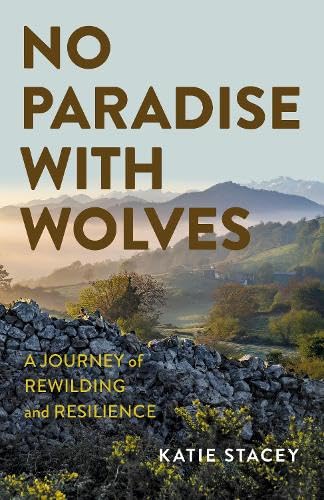
Luke and Katie hope to model new ways of living harmoniously with nature – even bears and wolves, which haven’t made it to their land yet, but might in the future – for the region’s traditional farmers. They’re approaching self-sufficiency – for fruit and vegetables, anyway – and raising their sons, Roan and Albus, to love the wild. We had a great day at Wild Finca: a long tour and badger-watching vigil (no luck that time) led by Luke; nettle lemonade and sponge cake with strawberries served by Katie and the boys. I was clear how much hard work has gone into the land and the low-impact buildings on it. With the exception of some Workaway volunteers, they’ve done it all themselves.
Katie Stacey’s storytelling is effortless and conversational, making this impassioned memoir a pleasure to read. It chimed perfectly with Hoffman’s writing (above) about the fear of bears and wolves, and reparation policies for farmers, in Europe. I’d love to see the book get a bigger-budget release complete with illustrations, a less misleading title, the thorough line editing it deserves, and more developmental work to enhance the literary technique – as in the beautiful final chapter, a present-tense recreation of a typical walk along The Loop. All this would help to get the message the wider reach that authors like Isabella Tree have found. “I want to be remembered for the wild spaces I leave behind,” Katie writes in the book’s final pages. “I want to be remembered as someone who inspired people to seek a deeper connection to nature.” You can’t help but be impressed by how much of a difference two people seeking to live differently have achieved in just a handful of years. We can all rewild the spaces available to us (see also Kate Bradbury’s One Garden against the World), too.
With thanks to Earth Books (Collective Ink) for the free copy for review.
Which of these do you fancy reading?
#ReadingtheMeow2025, Part II: Books by Mayo, Reinhold, Taylor and More
This year’s Reading the Meow challenge is drawing to a close. I’m adding to my first set of reviews with these selections: a novelty book about women and cats, an autobiographical sequel about an animal-lover’s menagerie in Provence, and a travel book about Scottish wildcats – plus a one-off essay that drew me in for its title and one more children’s book.
Behind Every Great Woman Is a Great Cat (2019)
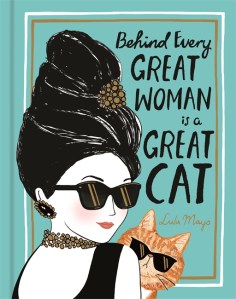 The only name on the cover is Lulu Mayo, who does the illustrations. That’s your clue that the text (by Justine Solomons-Moat) is pretty much incidental; this is basically a YA mini coffee table book. I found it pleasant enough to read bits of at bedtime but it’s not about to win any prizes. (I mean, it prints “prolificate” twice; that ain’t a word. Proliferate is.) Among the famous cat ladies given one-page profiles are Georgia O’Keeffe, Jacinda Ardern, Vivien Leigh, and Anne Frank. I hadn’t heard of the Scottish Fold cat breed, but now I know that they’ve become popular thanks Taylor Swift. The few informational interludes are pretty silly, though I did actually learn that a cat heads straight for the non-cat person in the room (like our friend Steve) because they find eye contact with strangers challenging so find the person who’s ignoring them the least threatening. I liked the end of the piece on Judith Kerr: “To her, cats were symbols of home, sources of inspiration and constant companions. It’s no wonder that she once observed, ‘they’re very interesting people, cats.’” (Christmas gift, secondhand)
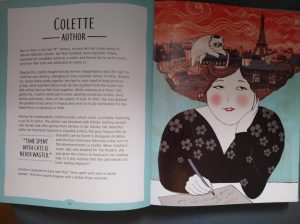
Watchers in the Sun: Life at Mas des Chats by Margaret Reinhold (1994)
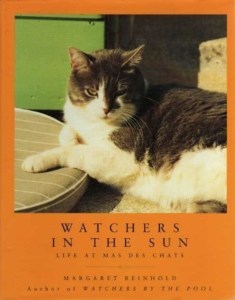 Last year I read the previous book, Sanctuary in the South (also titled Watchers by the Pool) on holiday. This is more of the same: pleasant stories about the personalities and interactions of a rotating cast of cats, some of whom she’d brought with her from England to Provence, others who transformed from strays she fed outdoors to part of the indoor hierarchy. Lily is the grande dame with private quarters upstairs; Monsieur le Gris is the top cat, bullying several younger cats but forming strong bonds with others. Most of the time Reinhold seems to hit a natural limit of nine, but that’s with several dying and being replaced by cats who wandered in or kittens people brought her. She also has two dogs and at one point rescues an old, deaf spaniel from drowning. Her French neighbours seem (to her, and probably us readers) strangely unsentimental about their pets by comparison. I enjoyed this a bit less than the first book because it was so similar – again with the Doreen Tovey-like anecdotes about the local humans – and because with the former I had the benefit of reading it on location in the South of France. The photographs by William Gooddy are a quaint reminder of the days when you shot a roll of film and had no idea how your photos had turned out until you got it developed. Even if some were blurry or underexposed, you used them because that was the best you had! (Secondhand purchase – Awesomebooks.com)
Tracking the Highland Tiger: In Search of Scottish Wildcats by Marianne Taylor (2019)
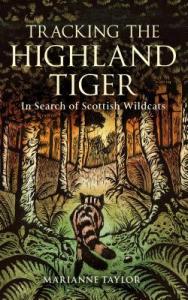 A perfect segue from Reading the Meow to our Scotland holiday coming up on Friday. I’d not heard of Taylor although she’s a prolific natural history writer. Such species quest narratives have become very common. The contextual information about the world’s cat species and the difference between Scottish wildcats and domestic cats, including the example of a half-feral cat she adopted, is fairly interesting, but the way she separates it from her trips to Speyside and Ardnamurchan to look for wildcats in 2013–18, which are each given their own chapter, feels odd. A similar book being published today would have blended the travel, research, and autobiographical information better. There’s plenty of habitat in the Scottish mountains for wildcats; the problem they face is hybridization with domestic cats. There’s no such thing as a purebred anymore. Captive breeding and reintroductions are the only way the species is likely to survive. “Timing a trip to look for Scottish wildcats is difficult in a way, but in another way it’s not: no matter what time you go, you’re almost guaranteed not to see one.” (At least she’s self-deprecating about it.) For most of the way through, you’re convinced the author will never find one. But you’ve got to keep hoping…
[I got this from a Little Free Library on Lewis, probably the most remote one I’ve ever frequented. Alas, it’s the only one in the Outer Hebrides and there aren’t any others that we’ll pass by on our travels in the Highlands.]
And a couple of bonus books:
 The Mousehole Cat by Antonia Barber; illus. Nicola Bayley (1990) – The town of Mousehole in Cornwall (the far southwest of England) relies on fishing. Old Tom brings some of his catch home every day for his cat Mowzer; they have a household menu with a different fishy dish for each day of the week. One winter a storm prevents the fishing boats from leaving the cove and the people – and kitties – start to starve. Tom decides he’ll go out in his boat anyway, and Mowzer goes along to sing and tame the Great Storm-Cat. This story of bravery was ever so cute, words and pictures both, and I especially liked how Mowzer considers Tom her pet. (Free from a neighbour)
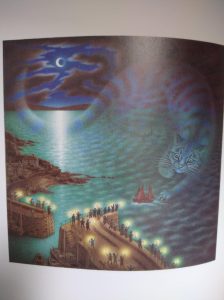
“A Conversation with a Cat” from A Conversation with a Cat and Others by Hilaire Belloc (1931) – I have no idea how I came across this but I had to borrow it for the title. Alas, only the six-page opening story is actually about a cat; the rest is, I suspect, light essays in the vein of Jerome K. Jerome. In the title piece, a man stops for a beer at a railway station bar and a beautiful long-haired cat jumps up onto his lap. “If it be true that nations have the cats they deserve, then the English people deserve well in cats, for there are none so prosperous or friendly in the world,” he thinks. He considers himself chosen and names the cat “Amathea.” He monologues to her about how comforting her presence is (“there is not a man living who knows better than I that the four charms of a cat lie in its closed eyes, its long and lovely hair, its silence, and even its affected love”) and how wonderful it is that she knows nothing of mortality. “You will never leave me. I will respect your sleep and we will sit here together through all uncounted time,” he vows. At which point she, of course, hops down and promptly approaches another patron for attention. Just like a cat. (University library)


I also enjoyed this page from Awkward Family Photos by Mike Bender and Doug Chernack, which I perused from the Little Free Library:

I’ve had such fun with Reading the Meow this year! Thanks again to Mallika for hosting it. My favourite read of the challenge was Poets Square, followed by Mornings without Mii. The Mousehole Cat was great, too. (All are pictured below apart from Mii, which I read on Kindle.)

Spring Reading: Simon Barnes, Jackie Kay, and Michael Morpurgo
With all the roses in full bloom and the swifts back and nesting in the corner of our eaves, it’s been feeling more like summer than high spring as we approach the end of May. I didn’t amass many spring-themed books this year, but managed to piece together the below trio of library books. They feel quite England- (and Scotland-) specific; I wonder how well these authors are known outside the UK. All: 
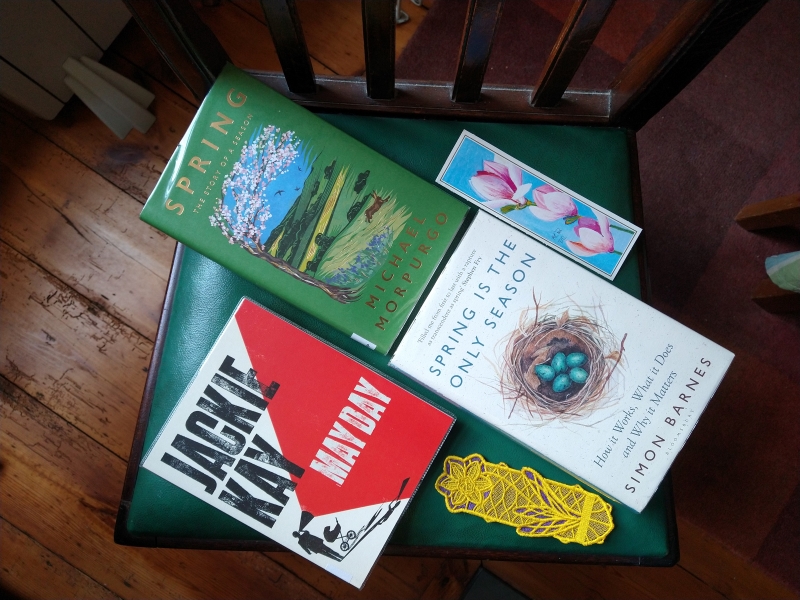
May Day by Jackie Kay (2024)
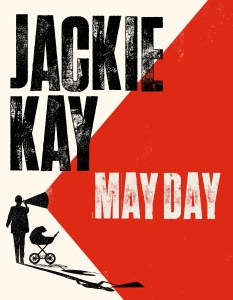 May Day is a traditional celebration for the first day of May, but it’s also a distress signal – as the megaphone and stark font on the cover reflect. Aptly, there are joyful verses as well as calls to arms here. Kay devotes poems to several of her role models, such as Harry Belafonte, Paul Robeson, Peggy Seeger and Nina Simone. But the real heroes of the book are her late parents, who were very politically active, standing up for workers’ rights and socialist values. Kay followed in their footsteps as a staunch attendee of protests. Her mother’s death during the Covid pandemic looms large. There is a touching triptych set on Mother’s Day in three consecutive years; even though her mum is gone for the last two, Kay still talks to her. Certain birds and songs will always remind her of her mum, and “Grief as Protest” links past and future. The bereavement theme resonated with me, but much of the rest made no mark (especially not the poems in dialect) and I don’t find much to admire poetically. I love Kay’s memoir, Red Dust Road, which has been among our most popular book club reads so far, but I’ve not particularly warmed to her poetry despite having read four collections now.
Spring: The Story of a Season by Michael Morpurgo (2025)
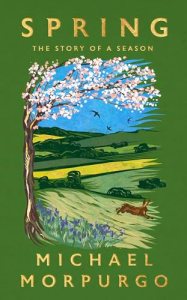 I’d not read Morpurgo before. He’s known primarily as a children’s author; if you’ve heard of one of his works, it will likely be War Horse, which became a play and then a film. This is a small hardback, scarcely 150 pages and with not many words to a page, plus woodcut illustrations interspersed. As revered English nature authors such as John Lewis-Stempel and Richard Mabey have also done, he depicts a typical season through a diary of several months of life on his land. For nearly 50 years, his Devon farm has hosted the Farms for City Children charity he founded. He believes urban living cuts people off from the rhythm of the seasons and from nature generally; “For so many reasons, for our wellbeing, for the planet, we need to revive that connection.” Now in his eighties, he lives with his wife in a small cottage and leaves much of the day-to-day work like lambing to others. But he still loves observing farm tasks and spotting wildlife (notably, an otter and a kingfisher) on his walks. This is a pleasant but inconsequential book. I most appreciated how it captures the feeling of seasonal anticipation – wondering when the weather will turn, when that first swallow will return.
And a skim:
Spring Is the Only Season: How It Works, What It Does, and Why It Matters by Simon Barnes (2025)
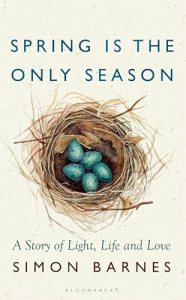 This 400+-page tome has an impressive scope. Like Mark Cocker does in One Midsummer’s Day, Barnes retreats all the way back to the Big Bang and then slowly zooms in, via the evolution of plants and the phenology of birds and insects. He also covers every possible topic you could think of relating to spring: religious festivals, mythology, literature, art, farming, and so on. Had I never read another book on spring, perhaps I would find this compendium satisfying, but it is rather meandering and too many of its points of reference are familiar. Moreover, the overall project is too similar to Tim Dee’s extraordinary Greenery. Alas, Barnes isn’t half the writer Dee is, so this ends up being a rather workmanlike survey. I most enjoyed the chapter-ending “Signs of Spring” lists from his Norfolk home. These more than illustrate how seasonality has gone awry due to climate change; a whole chapter wasn’t necessary to spell it out.
Winter Reads, I: Michael Cunningham & Helen Moat
It’s been feeling springlike in southern England with plenty of birdsong and flowers, yet cold weather keeps making periodic returns. (For my next instalment of wintry reads, I’ll try to attract some snow to match the snowdrops by reading three “Snow” books.) Today I have a novel drawing on a melancholy Hans Christian Andersen fairy tale and a nature/travel book about learning to appreciate winter.
The Snow Queen by Michael Cunningham (2014)
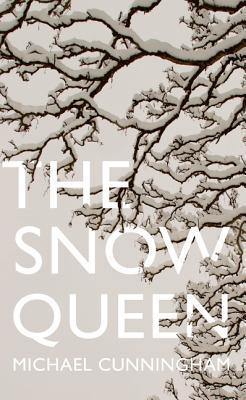 It was among my favourite first lines encountered last year: “A celestial light appeared to Barrett Meeks in the sky over Central Park, four days after Barrett had been mauled, once again, by love.” Barrett is gay and shares an apartment with his brother, Tyler, and Tyler’s fiancée, Beth. Beth has cancer and, though none of them has dared to hope that she will live, Barrett’s epiphany brings a supernatural optimism that will fuel them through the next few years, from one presidential election autumn (2004) to the next (2008). Meanwhile, Tyler, a stalled musician, returns to drugs to try to find inspiration for his wedding song for Beth. The other characters in the orbit of this odd love triangle of sorts are Liz, Beth and Barrett’s boss at a vintage clothing store, and Andrew, Liz’s decades-younger boyfriend. It’s a peculiar family unit that expands and contracts over the years.
Of course, Cunningham takes inspiration, thematically and linguistically, from Hans Christian Andersen’s tale about love and conversion, most obviously in an early dreamlike passage about Tyler letting snow swirl into the apartment through the open windows:
He returns to the window. If that windblown ice crystal meant to weld itself to his eye, the transformation is already complete; he can see more clearly now with the aid of this minuscule magnifying mirror…
I was most captivated by the early chapters of the novel, picking it up late one night and racing to page 75, which is almost unheard of for me. The rest took me significantly longer to get through, and in the intervening five weeks or so much of the detail has evaporated. But I remember that I got Chris Adrian and Julia Glass vibes from the plot and loved the showy prose. (And several times while reading I remarked to people around me how ironic it was that these characters in a 2014 novel are so outraged about Dubya’s re-election. Just you all wait two years, and then another eight!)
I fancy going on a mini Cunningham binge this year. I plan to recommend The Hours for book club, which would be a reread for me. Otherwise, I’ve only read his travel book, Land’s End. I own a copy of Specimen Days and the library has Day, but I’d have to source all the rest secondhand. Simon of Stuck in a Book is a big fan and here are his rankings. I have some great stuff ahead! (Secondhand – Awesomebooks.com)
While the Earth Holds Its Breath: Embracing the Winter Season by Helen Moat (2024)
 Like many of us, Moat struggles with mood and motivation during the darkest and coldest months of the year. Over the course of three recent winters overlapping with the pandemic, she strove to change her attitude. The book spins short autobiographical pieces out of wintry walks near her Derbyshire home or further afield. Paying closer attention to the natural spectacles of the season and indulging in cosy food and holiday rituals helped, as did trips to places where winters are either a welcome respite (Spain) or so much harsher as to put her own into perspective (Lapland and Japan). My favourite pieces of all were about sharing English Christmas traditions with new Ukrainian refugee friends.
There were many incidents and emotions I could relate to here – a walk on the canal towpath always makes me feel better, and the car-heavy lifestyle I resume on trips to America feels unnatural.
Days are where we must live, but it didn’t have to be a prison of house and walls. I needed the rush of air, the slap of wind on my cheeks. I needed to feel alive. Outdoors.
I’d never liked the rain, but if I were to grow to love winters on my island, I had to learn to love wet weather, go out in it.
What can there be but winter? It belongs to the circle of life. And I belonged to winter, whether I liked it or not. Indoors, or moving from house to vehicle and back to house again, I lost all sense of my place on this Earth. This world would be my home for just the smallest of moments in the vastness of time, in the turning of the seasons. It was a privilege, I realised.
However, the content is repetitive such that the three-year cycle doesn’t add a lot and the same sorts of pat sentences about learning to love winter recur. Were the timeline condensed, there might have been more of a focus on the more interesting travel segments, which also include France and Scotland. So many have jumped on the Wintering bandwagon, but Katherine May’s book felt fresh in a way the others haven’t.
With thanks to Saraband for the free copy for review.
Any wintry reading (or weather) for you lately?
Three on a Theme: English Gardeners (Bradbury, Laing and Mabey)
These three 2024 releases share a passion for gardening – but not the old-fashioned model of bending nature to one’s will to create aesthetically pleasing landscapes. Instead, the authors are also concerned with sustainability and want to do the right thing in a time of climate crisis (all three mention the 2022 drought, which saw the first 40 °C day being recorded in the UK). They seek to strike a balance between human interference and letting a site go wild, and they are cognizant of the wider political implications of having a plot of land of one’s own. All three were borrowed from the public library. #LoveYourLibrary
One Garden against the World: In Search of Hope in a Changing Climate by Kate Bradbury
Bradbury is Wildlife Editor of BBC Gardeners’ World Magazine and makes television appearances in the UK. She’s owned her suburban Brighton home for four years and has tried to turn its front and back gardens into havens, however small, for wildlife. The book covers April 2022 to June 2023, spotlighting the drought summer. “It’s about a little garden in south Portslade and one terrified, angry gardener.” Month by month, present-tense chapters form not quite a diary, but a record of what she’s planting, pruning, relocating, and so on. There is also a species profile at the end of each chapter, usually of an insect (as in the latest Dave Goulson book) – she’s especially concerned that she’s seeing fewer, yet she’s worried for local birds, trees and hedgehogs, too.
Often, she takes matters into her own hands. She plucks caterpillars from vegetation in the path of strimmers in the park and raises them at home; protects her garden’s robins from predators and provides enough food so they can nest and raise five fledglings; undertakes to figure out where her pond’s amphibians have come from; rescues hedgehogs; and bravely writes to neighbours who have scaffolding up (for roof repairs, etc.) beseeching them to put up swift boxes while they’re at it. Sometimes it works: a pub being refurbished by new owners happily puts up sparrow boxes when she tells them the birds have always nested in crevices in the building. Sometimes it doesn’t; people ignore her letters and she can’t seem to help but take it personally.
For individuals, it’s all too easy to be overtaken by anxiety, helplessness and despair, and Bradbury acknowledges that collective action and solidarity are vital. “I am reminded, once again, that it’s the community that will save these trees, not me. I’m reminded that community is everything.” She bands together with other environmentally minded people to resist a local development, educate the public about hedgehogs through talks, and oppose “Drone Bastard,” who flies drones at seagulls nesting on rooftops (not strictly illegal; disappointingly, their complaint doesn’t get anywhere with the police, RSPB or RSPCA).

Along the way, there are a few insights into the author’s personal life. She lives with her partner Emma and dog Tosca and accesses wild walks even right on the edge of a city in the Downs. Separate visits to her divorced parents are chances for more nature spotting – in Suffolk to see her father, she hears her first curlew and lapwings – but also involve some sadness, as her mother has aphasia and fatigue after a stroke.
Nearly every day of the chronology seems to bring more bad news for nature. “It’s hard, sometimes,” she admits, “trying to enjoy natural, wonderful events, trying to keep the clawing sense of unease at bay”. She is staunch in her fond stance: “I will love it, with all my heart, whatever has managed to remain, whatever is left.” And she models through her own amazingly biodiverse garden the ways we can extend refuge to other creatures if we throw out that pointless notion of ‘tidiness.’ “The UK’s 30 million gardens represent 30 million opportunities to create green spaces that hold on to water and carbon, create shade, grow food and provide habitats for wildlife that might otherwise not survive.” Reading this made me feel less guilty about the feral tangle of buddleia, ragwort, hemp agrimony and bindweed overtaking the parts of our back garden that aren’t given over to meadow, pond and hedge. Every time I venture back there I see tons of insects and spiders, and that’s all that matters.
My main critique is that one year would have been adequate, cutting the book to 250 pages rather than 300 and ensuring less repetition while still being a representative time period. But Bradbury is impressive for her vigilance and resolve. Some might say that she takes herself and life too seriously, but it’s really more that she’s aware of the scale of destruction already experienced and realistic about what we stand to lose. 
The Garden Against Time: In Search of a Common Paradise by Olivia Laing
I consider Laing one of our most important public thinkers. I saw her introduce the book via the online Edinburgh Book Festival event “In Search of Eden,” in which she appeared on screen and was interviewed by JC Niala. Laing explained that this is not a totally new topic for her as she has been involved in environmental activism and in herbalism. But in 2020, when she and her much older husband bought a house in Suffolk – the first home she has owned after a life of renting – she started restoring its walled garden, which had been created in the 1960s by Mark Rumary. For a year, she watched and waited to see what would happen in the garden, only removing obvious weeds. This coincided with lockdown, so visits to gardens and archives were limited; she focused more on the creation of her own garden and travelling through literature. A two-year diary resulted, in seven notebooks.
Niala observed that the structure of the book, with interludes set in the Suffolk garden, means that the reader has a place to come back to between the deep dives into history. Why make a garden? she asked Laing. Beauty, pleasure, activity: these would be pat answers, Laing insisted. Instead, as with all her books, the reason is the impulse to make complicated structures. Repetitive tasks can be soothing; “the drudgery can be compelling as well.”
Laing spoke of a garden as both refuge and resistance, a mix of wild and cultivated. In this context, Derek Jarman’s Dungeness garden was a “wellspring of inspiration” for her, “a riposte to a toxic atmosphere” of nuclear power and the AIDS crisis (Rumary, like Jarman, was gay). It’s hard to tell where the beach ends and his garden begins, she noted, and she tried to make her garden similarly porous by kicking a hole in the door so frogs could get in. She hopes it will be both vulnerable and robust, a biodiversity hotspot. With Niala, she discussed the idea of a garden as a return to innocence. We have a “tarnished Eden” due to climate change, and we have to do what we can to reverse that.
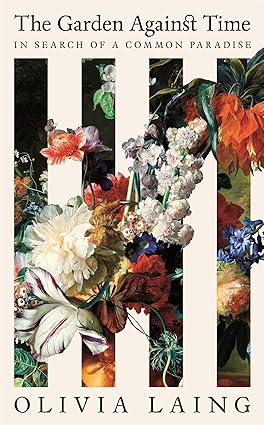
The event was brilliant – just the level of detail I wanted, with Laing flitting between subjects and issuing amazingly intelligent soundbites. The book, though, seemed like page after page about Milton (Paradise Lost) and Iris Origo or the Italian Renaissance. I liked it best when it stayed personal to her family and garden project. There are incredible lyric passages, but just stringing together floral species’ names – though they’re lovely and almost incantatory – isn’t art; it also shuts out those of us who don’t know plants, who aren’t natural gardeners. I wasn’t about to Google every plant I didn’t know (though I did for a few). Also, I have read a lot about Derek Jarman in particular. So my reaction was admiration rather than full engagement, and I only gave the book a light skim in the end. It is striking, though, how she makes this subject political by drawing in equality of access and the climate crisis. (Shortlisted for the Kirkus Prize and the Wainwright Prize.) 
Some memorable lines:
“A garden is a time capsule, as well as a portal out of time.”
“A garden is a balancing act, which can take the form of collaboration or outright war. This tension between the world as it is and the world as humans desire it to be is at the heart of the climate crisis, and as such the garden can be a place of rehearsal too, of experimenting with this relationship in new and perhaps less harmful ways.”
“the garden had become a counter to chaos on a personal as well as a political level”
“the more sinister legacy of Eden: the fantasy of perpetual abundance”
The Accidental Garden: Gardens, Wilderness and the Space in Between by Richard Mabey
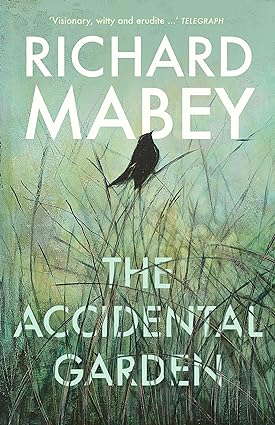 Mabey gives a day-to-day description of a recent year on his two-acre Norfolk property, but also an overview of the past 20 years of change – which of course pretty much always equates to decline. He muses on wildflowers, growing a meadow and hedgerow, bird behaviour, butterfly numbers, and the weather becoming more erratic and extreme. What he sees at home is a reflection of what is going on in the world at large. “It would be glib to suggest that the immeasurably complex problems of a whole world are mirrored in the small confrontations and challenges of the garden. But maybe the mindset needed for both is the same: the generosity to reset the power balance between ourselves and the natural world.” He seeks to create “a fusion garden” of native and immigrant species, trying to intervene as little as possible. The goal is to tend the land responsibly and leave it better off than he found it. As with the Laing, I found many good passages, but overall I felt this was thin – perhaps reflecting his age and loss of mobility – or maybe a swan song. Again, I just skimmed, even though it’s only 160 pages.
Some memorable lines:
“being Earth’s creatures ourselves, we too have a right to a niche. So in our garden we’ve had more modest ambitions, for ‘parallel development’ you might say, and a sense of neighbourliness with our fellow organisms.”
“We feel embattled at times, and that we should try to make some sort of small refuge, a natural oasis.”
“A garden, with its complex interactions between humans and nature, is often seen as a metaphor for the wider world. But if so, is our plot a microcosm of this troubled arena or a refuge from it?”
You might think I would have been more satisfied by Mabey’s contemplative bent, or Laing’s wealth of literary and historical allusions. It turns out that when it comes to gardening, Bradbury’s practical approach was what I was after. But you may gravitate to any of these, depending on whether you want something for the hands, intellect or memory.
Review Catch-up: Matt Gaw, Sheila Heti, Liz Jensen (and a Pile of DNFs)
Today I have a travel book about appreciating nature in any weather, a sui generis memoir drawn from a decade of diaries, and an impassioned cry for the environment in the wake of a young adult son’s death.
I’m also bidding farewell to a whole slew of review books that have been hanging around, in some cases, for literal years – I think one is from 2021, and several others from 2022. Putting a book on my “set aside” shelf can be a kiss of death … or I can go back at a better time and end up loving it. It’s hard to predict which will occur. On these, alas, I have had to admit defeat and will pass the books on to other homes.
In All Weathers: A Journey through Rain, Fog, Wind, Ice and Everything in Between by Matt Gaw
Gaw’s two previous nature/travel memoirs, the enjoyable The Pull of the River and Under the Stars, involve gentle rambles through British landscapes, along with commentary on history, nature and science. The remit is much the same here. The book is split into four long sections: “Rain,” “Fog,” “Ice and Snow,” and “Wind.” The adventures always start from and end up at the author’s home in Suffolk, but he ranges as far as the Peak District, Cumbria and the Isle of Skye. Wild swimming is one way in which he experiences places. He notices a lot and describes it all in lovely and relatable prose.
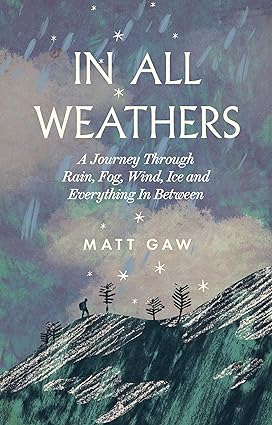 I was tickled by the definitions of, and statistics about, a “white Christmas”: in the UK, it counts if there’s even a single snowflake falling, whereas in the US there has to be 2.5 cm or more of standing snow. (Scotland is most likely to experience white Christmases; it has had 37 since 1960 vs. 26 in northern England. The English snow record is 43 cm, at Buxton and Malham Tarn in 1981 and 2009.) There’s underlying mild dread as he notes how weather patterns have changed and will likely continue changing, ever more dramatically, into his children’s future.
I find I don’t have much to say about this book because it is very nice but doesn’t do anything interesting or tackle anything that isn’t familiar from many other nature books (such as Rain by Melissa Harrison and Forecast by Joe Shute). It’s unfortunate for Gaw that his ideas often seem to have been done before – his book on night-walking, in particular, was eclipsed by several other works on that topic that came out at around the same time. I hope that the next time around he’ll get more editorial guidance to pursue original topics. It might take just a little push to get him to the next level where he could compete with top UK nature writers.
With thanks to Elliott & Thompson Books for the free copy for review.
Alphabetical Diaries by Sheila Heti
Heti put the contents of ten years of her diaries into a spreadsheet, alphabetizing each sentence (including articles), and then ruthlessly culled the results until she had a 25-chapter (no ‘X’) book. You could hardly call it a narrative, yet looking for one is so hardwired that every few sentences you are jolted out of what feels like a mini-story and into something new. Instead, you might think of it as an autobiographical mosaic. The recurring topics are familiar from the rest of Heti’s oeuvre, with obsessive cogitating about relationships, art and identity. But there are also the practicalities of trying to make a living as a woman in a creative profession. Tendrils of the everyday poke out here and there as she makes a meal, catches a plane, or buys clothes. Men loom large: explicit accounts of sex with Pavel and Lars (though also Fiona); advising her friend Lemons on his love life. There are also meta musings on what she is trying to achieve with her book projects and on what literature can be.
 Grammatically, the document is a lot more interesting than it could be – or than a similar experiment based on my diary would be, for instance – because Heti sometimes writes in incomplete sentences, dropping the initial pronoun; or intersperses rhetorical questions or notes to self in the imperative. So, yes, ‘I’ is a long chapter, but not only because of self-absorbed “I…” statements; there’s also plenty of “If…” and “It’s…” ‘H’ and ‘W’ are longer sections than might be expected because of the questioning mode. But it’s at the sentence level that the book makes the biggest impression: lines group together, complement or contradict each other, or flout coherence by being so merrily à propos of nothing. Here are a few passages to give a flavour:
Am I wasting my time? Am low on money. Am making noodles. Am reading Emma. Am tired and will go to sleep. Am tired today and I feel like I may be getting a cold. Ambivalence gives you something to do, something to think about.
Best not to live too emotionally in the future—it hardly ever comes to pass. Better to be on the outside, where you have always been, all your life, even in school, nothing changes. Better to look outward than inward. Blow jobs and tenderness. Books that fall in between the cracks of all aspects of the human endeavour.
It’s 2:34 every time I check the time these days. It’s 4 p.m. It’s 4:41 now. It’s a fantasy of being saved. It’s a stupid idea. It’s a yellow, cloudy sky. It’s amazing to me how life keeps going. It’s better to work, to go into the underground cave where there are books, than to fritter away time online. It’s crazy that I need all of these mental crutches in order to live. It’s fiction. It’s fine.
Scrambled eggs on toast at Yaddo. Second-guessing everything. Second, he said that no one is buying fiction. See the complexity. See the souls. See what kind of story the book can accommodate, if any. Seeing her for coffee was not so bad.
It’s surprising how much sense a text constructed so apparently haphazardly makes, perhaps because of the same subject and style throughout. Sometimes aphoristic, sometimes poetic (all that anaphora), the book is playful but overall serious about the capturing of a life on the page. Heti transcends the quotidian by exploding the one-thing-after-another tedium of chronology. Remarkably, the collage approach produces a more genuine, crystalline vision of the self than precise scenes and cause-and-effect chains ever could. A work of life writing like no other, it must be read in a manner all its own that it teaches you as you go along. I admire it enormously and hope I might write something even half as daring one day.
With thanks to Fitzcarraldo Editions for the free copy for review.
Your Wild and Precious Life: On grief, hope and rebellion by Liz Jensen
Jensen’s younger son, Raphaël Coleman, was just 25 when he collapsed while filming a documentary in South Africa and died of a previously undiagnosed heart condition. Raph had been involved in Extinction Rebellion and Jensen is a founding member of Writers Rebel. They both deemed activism “the best antidote to depression.” Her son had been obsessed with wildlife from a young age and was rewilding acres of their land in France, as well as making environmentalist films (he had achieved minor fame as a child actor in Nanny McPhee) and participating in direct action, such as at the Brazilian embassy in London.
 For Jensen, the challenge, especially after lockdown confined her to her Copenhagen flat, was to channel grief into further radicalism rather than retreating into herself or giving in to the lure of suicide. She tried to see personal grief as a reminder of ecogrief, and therefore as a spur. One way that she coped was turning towards the supernatural. She continued to hear and speak to Raph, in daily life as well as through a medium, and interpreted bird sightings as signs of his continued presence. An additional point of interest to me was that the author’s husband is Carsten Jensen, the writer of one of my favourite books, We, the Drowned.
This doesn’t particularly stand out among the dozens of bereavement memoirs I’ve read. (It was also remarkably similar to Alexandra Fuller’s Fi, which I’d read not long before.) Perhaps more years of reflection would have helped – Mary Karr advises seven – though I suspect Jensen felt, quite rightly, that given the current state of the environment we have no time to waste. And I have no doubt that the combination of a mother’s love and an ecological conscience will make this book meaningful to many readers.
With thanks to Canongate for the free copy for review.
And the DNFs…
there are more things, Yara Rodrigues Fowler – I loved Stubborn Archivist so much that I leapt at the chance to read her follow-up, but it was just too dull and involved about Brazilian versus UK politics. Nor did the stylistic tricks feel as novel this time around. I read 66 pages. (Fleet)
The Rabbit Hutch, Tess Gunty – Gunty dazzled critics and prize judges in the USA, winning a National Book Award. I was drawn to her debut novel for the composite picture of the residents of one Indiana apartment building and the strange connections that develop between them over one summer week, including perhaps a murder? Blandine, the central character, is a sort of modern-day mystic but hard to warm to (“She normally tries to avoid saying in which out loud, to minimize the number of people who find her insufferable”), as are all the characters. This felt like try-hard MFA writing. I read 85 pages. (Oneworld)
Eve: The Disobedient Future of Birth, Claire Horn – I usually get on well with Wellcome Collection books. I think the problem here was that there was too much material that was familiar to me from having read Womb by Leah Hazard – even the SF-geared stuff about artificial wombs. I read 45 pages. (Profile Books)
Blessings, Chukwuebuka Ibeh – This debut novel has a confident voice, buttressed by determination to reveal what life is like for queer people living in countries where homosexuality is criminalized. Obiefuna is cast out for having a crush on Aboy, his father’s apprentice, even though the two young men share nothing more physical than a significant gaze into each other’s eyes. The strict boarding school his father sends him to is a place of privation, hierarchy, hazing and, I suspect, same-sex experimentation. I found the writing capable but couldn’t get past a sense of dread about what was going to happen. Meanwhile, I didn’t think the alternating chapters from Obiefuna’s mother’s perspective added anything to the narrative. I read 62 pages. (Penguin Viking)
The War for Gloria, Atticus Lish – Lish’s debut novel, Preparation for the Next Life, was excellent, but I could never get stuck in to this follow-up, despite the appealing medical theme. When Gloria Goltz is diagnosed with ALS, her 15-year-old son Corey turns to his absent father and others for support. It was also unfortunate that Lish mentions the Ice Bucket Challenge: that was popularized in 2014, whereas the book is set in 2010. I read 75 pages. (Serpent’s Tail)
Snow Widows: Scott’s Fatal Antarctic Expedition through the Eyes of the Women They Left Behind, Katherine MacInnes – I seriously overestimated my interest in polar exploration narratives. MacInnes seems to have done quite a good job of creating novelistic scenes through research, though. I read 35 pages. (William Collins)
The Woodcock, Richard Smyth – I feel particularly bad about this one as I’ve read and enjoyed three of Smyth’s nature books and my husband and I are friendly with him on Twitter. Initially, I got Thomas Hardy, D.H. Lawrence and Sarah Perry (The Essex Serpent, anyway) vibes from this 1920s-set novel about the upheaval a naturalist and his wife experience when an American whaler and his daughters arrive in their small coastal English town. I read 90 pages. (Fairlight Books)
Better Broken than New: A Fragmented Memoir, Lisa St Aubin de Terán – I accepted this for review because I’d often seen the author’s name on spines in secondhand bookstores but didn’t know anything about her work. The précis of her globe-trotting life is stranger than fiction: marriage to a Venezuelan freedom fighter, managing a sugar plantation in the Andes, living in an Italian palace for 20 years, founding a charity in Mozambique. The vignettes in the early part of the book (e.g., skipping school and going on daytrips by train at age eight) are entertaining, if written with blithe disregard for a reader’s need for context or perspective. But the fragmented nature means it all feels as random as life, without the necessary authorial shaping. The publisher has done her a disservice as she seeks to relaunch her career by not proofreading properly: Many small errors slipped through the net, making this look like a sloppy manuscript. The worst happen to be other authors’ names: Jane ‘Austin’, ‘Kahil’ Gibran, Virginia ‘Wolfe’. Are you kidding me?! I read 53 pages. (Amaurea Press)
Spring Journeys with Edwin Way Teale and Edward Thomas
When I heard that Little Toller were reissuing their edition of Edward Thomas’s In Pursuit of Spring, I couldn’t resist pairing it with Edwin Way Teale’s book about the progress of the season up the United States, North with the Spring. These spring journeys, documented by authors delighting in nature’s bounty and responding with poetry, inspired mixed feelings in me: vicarious nostalgia, but also sadness for all that has been lost since they set out in the 1910s and 1950s, respectively.
It’s hard to live joyfully when evidence of the destruction of nature is overwhelming. Enjoying what still exists doesn’t seem like enough. But it’s a start. So this year I’ve been careful to note every phenological landmark: the first swift, the first hearing of a cuckoo, a rare sighting of a live hedgehog. One day in late April I stood on the towpath for hours watching a cloud of swallows and martins swooping for insects. I’ve also enjoyed watching from my office window as sparrows come and go from a nest box.
North with the Spring by Edwin Way Teale (1951)
I’ve previously reviewed Teale’s Autumn Across America and Springtime in Britain and consider him one of the classic – and most underrated – American nature writers. I was delighted to find a copy of this first seasonal volume on our trip to Northumberland a few years ago. As in the autumn book, he and his wife Nellie undertake a road trip, this time travelling from Florida up to New England, a total of 17,000 miles. Their journey lasted 130 days because instead of waiting for 21 March they started weeks before; spring comes early to the Gulf coast. Their time in Florida feels endless, constituting over a third of the book. Although it’s true that there are (were?) many peerless ecosystems there between the scrub and swamp, I grew impatient to move on to other states. The meet-up with Marjorie Kinnan Rawlings, who took them on a picnic to ‘The Yearling country,’ was a highlight.
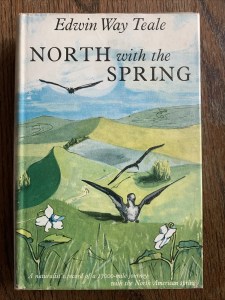 They travel alongside the spring warblers; past river deltas and barrier islands, by mountain meadows and forests. Other stops include Monticello and New Jersey’s pine barrens. A stopover in New York City dramatizes the difference between civilization and relative wilderness. I particularly enjoyed a pair of chapters set in Tennessee: first the wonder of Nickajack Cave, then the horror of the deforested and poisoned Ducktown Desert. Teale seems ahead of his time in decrying people’s wilful ignorance – one man they met denied the fact of migration, insisting the birds were always around – and failure to consider nature. His scenes and conversations feel fully natural; he’s as interested in people as in wildlife, and that humanism comes across in his writing.
“We longed for a thousand springs on the road instead of this one. For spring is like life. You never grasp it entire; you touch it here, there; you know it only in parts and fragments.”
(Secondhand – Barter Books, Alnwick)
In Pursuit of Spring by Edward Thomas (1914)
On Good Friday, 21 March 1913, Edward Thomas set off on his bicycle from his parents’ home in South London. He was bound southwest, toward Somerset and the height of spring. At cycling and walking pace, he would truly experience the development of the season, whereas
“Many days in London have no weather. We are aware only that it is hot or cold, dry or wet; that we are in or out of doors; that we are at ease or not.”
He prepares himself for hardship and slog:
“Spring would come, of course – nothing, I supposed, could prevent it – and I should have to make up my mind how to go westward. Whatever I did, Salisbury Plain was to be crossed”
 It’s remarkable both how much and how little has changed in the intervening century and more. The place names, plant and bird species, and alternation of town and countryside are all familiar, but the difference is stark when you see Thomas’s black-and-white photographs that illustrate the text. These dirt roads are empty. You’d have to search high and low today to find the kind of unspoiled fields, rivers, churchyards, hedgerows and stone walls that he memorializes.
Everything he sees drives him back to poetry, with long passages quoted from authors who have fallen somewhat out of fashion, such as George Herbert and Alexander Pope. I loved the scene where he buys a book at a secondhand furniture shop (for two pence, mind you) and then ignores it to eavesdrop on fellow diners at a restaurant. He has words of high praise for W.H. Hudson:
“Were men to disappear they might be reconstructed from the Bible and the Russian novelists; … Hudson so writes of birds that if ever … they should cease to exist, and should leave us to ourselves on a benighted planet, we should have to learn from him what birds were.”
Thomas also mentions William Cobbett, whose Rural Rides this reminded me of strongly. Both are slow-paced journeys around a rural England that no longer exists. Today Thomas is better remembered as a poet; he would be one of the fallen in a First World War battle just four years after this expedition. It was great to have a chance to read his nature writing, too.
With thanks to Little Toller for the free copy for review.
We’re off to rural France on Wednesday for eight days of relaxation and nature-watching; it’s not a sight-seeing or foodie trip like our time in Paris back in December. Ironically, it seems that it may be cold and rainy for much of the holiday, having been gorgeous in both countries this past week. We will hope for some sun and warmth, but have packed plenty of books and board games (and will acquire much wine) for when the weather is to be avoided inside.
What signs of the spring have you been seeing?
Six Degrees of Separation: Romantic Comedy to Wild Fell
This is a fun meme I take part in every few months.
For August we begin with Romantic Comedy by Curtis Sittenfeld, one of my top 2023 releases so far. (See Kate’s opening post.)
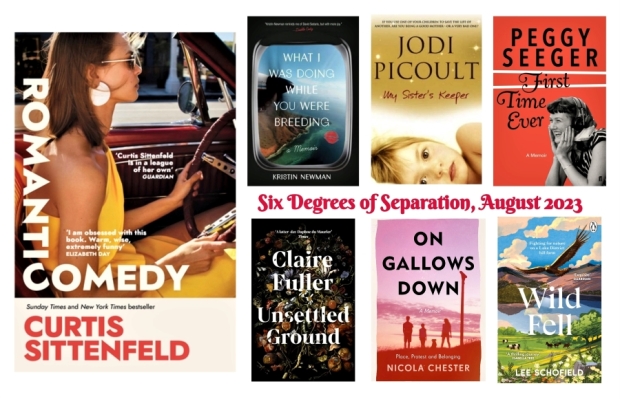
 #1 Sittenfeld’s protagonist, Sally Milz, writes TV comedy, as does Kristin Newman (That ’70s Show, How I Met Your Mother, etc.), author of What I Was Doing While You Were Breeding, a lighthearted record of her travels and romantic conquests. (She even has a passage that reminds me of Sally’s Danny Horst Rule: “I looked like a thirty-year-old writer. Not like a twenty-year-old model or actress or epically legged songstress, which is a category into which an alarmingly high percentage of Angelenas fall. And, because the city is so lousy with these leggy aliens, regular- to below-average-looking guys with reasonable employment levels can actually get one, another maddening aspect of being a woman in this city.”)
 #2 I didn’t realize when I picked it up in a charity shop that my copy smelled strongly of cigarette smoke. I aired it in kitty litter, then by scented candles, and it still reeks. I reckon I can tolerate the smell long enough to finish it and put it in the Little Free Library, which gets good ventilation. A novel I acquired from the free bookshop we used to have in the mall in town was the only book I can remember having to get rid of before reading because it just smelled too bad (also of cigarettes in that case): My Sister’s Keeper by Jodi Picoult.
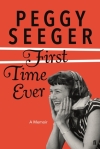 #3 So I didn’t read that, but I have read another Picoult novel, Sing You Home. The author is known for picking a central issue to address in each work, and in that one it was sexuality. Zoe, a music therapist, is married to Max but leaves him for Vanessa – and then decides to sue him for the use of the embryos they created together via IVF. It was the first book I’d read with that dynamic (a previously straight woman enters into a lesbian partnership), but by no means the last. Later came Untamed by Glennon Doyle, Hidden Nature by Alys Fowler, The Fixed Stars by Molly Wizenberg … and one you maybe weren’t expecting: the fantastic memoir First Time Ever by Peggy Seeger. The authors vary in how they account for it. They were gay all along but didn’t realize it? Their orientation changed? Or they just happened to fall in love with someone of the same gender? Seeger doesn’t explain at all, simply records how head-over-heels she was for Ewan MacColl … and then for Irene Pyper Scott.
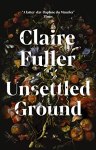 #4 Peggy Seeger is one of my heroes these days. I first got into her music through the lockdown livestreams put together by Folk on Foot and have since seen her live and acquired several of her albums, including a Smithsonian Folkways collection of her best-loved folk standards. One of these is, of course, “I’m Gonna Be an Engineer,” which was one of the inspirations for Claire Fuller’s Unsettled Ground.
 #5 Unsettled Ground, an unusual story of rural poverty and illiteracy, is set in a fictional village modelled on Inkpen, where Nicola Chester lives. Her memoir On Gallows Down, which held particular local interest for me, was shortlisted for the Wainwright Prize last year.
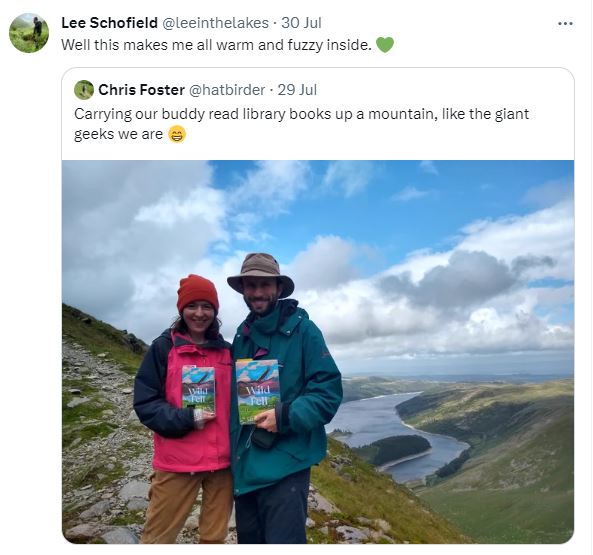
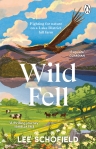 #6 Also shortlisted that year was Wild Fell by Lee Schofield, about his work at RSPB Haweswater. Like Chester, he’s been mired in the struggle to balance sustainable farming with conservation at a beloved place. And like a fellow Lakeland farmer (and previous Wainwright Prize winner for English Pastoral), James Rebanks, he’s trying to be respectful of tradition while also restoring valuable habitats. My husband and I each took a library copy of Wild Fell along to Cumbria last week (about which more anon) and packed it in a backpack for an on-location photo during our wild walk at the very atmospheric Haweswater.
Where will your chain take you? Join us for #6Degrees of Separation! (Hosted on the first Saturday of each month by Kate W. of Books Are My Favourite and Best.) Next month’s starting book is Wifedom by Anna Funder.
Have you read any of my selections? Tempted by any you didn’t know before?
Prize Updates: McKitterick Prize Winner and Wainwright Prize Longlists
It was my second year as a first-round manuscript judge for the McKitterick Prize; have a look at my rundown of the shortlist here.
 The winner, Louise Kennedy, and runner-up, Liz Hyder, were announced on 29 June. (Nominee Aamina Ahmad won a different SoA Award that night, the Gordon Bowker Volcano Prize for a novel focusing on the experience of travel away from home.) Other recipients included Travis Alabanza, Caroline Bird, Bonnie Garmus and Nicola Griffith. For more on all of this year’s SoA Award winners, see their website.


I’m a big fan of the Wainwright Prize for nature and conservation writing, and have been following it particularly closely since 2020, when I happened to read most of the nominees. In 2021 I also managed to read quite a lot from the longlists; 2022, the first year of an additional prize for children’s literature, saw me reading about a third of the total nominees.
This is the third year that I’ve been part of an “academy” of bloggers, booksellers, former judges and previously shortlisted authors asked to comment on a very long list of publisher submissions. I’m delighted that a few of my preferences made it through to the longlists.
My taste generally runs more to the narrative nature writing than the popular science or travel-based books. I find I’ve read just two from the Nature list (Bersweden and Huband) and one each from Conservation (Pavelle) and Children’s (Hargrave) so far.

The 2023 James Cropper Wainwright Prize for Nature Writing longlist:
- The Swimmer: The Wild Life of Roger Deakin, Patrick Barkham (Hamish Hamilton)
- The Flow: Rivers, Water and Wildness, Amy-Jane Beer (Bloomsbury)
- Where the Wildflowers Grow, Leif Bersweden (Hodder)
- Twelve Words for Moss, Elizabeth-Jane Burnett (Allen Lane)
- Cacophony of Bone, Kerri ní Dochartaigh (Canongate)
- Sea Bean, Sally Huband (Hutchinson)
- Ten Birds that Changed the World, Stephen Moss (Faber)
- A Line in the World: A Year on the North Sea Coast, Dorthe Nors, translated by Caroline Waight (Pushkin)
- The Golden Mole: And Other Living Treasure, Katherine Rundell, illustrated by Talya Baldwin (Faber)
- Belonging: Natural Histories of Place, Identity and Home, Amanda Thomson (Canongate)
- Why Women Grow: Stories of Soil, Sisterhood and Survival, Alice Vincent (Canongate)
- Landlines, Raynor Winn (Penguin)

The 2023 James Cropper Wainwright Prize for Writing on Conservation longlist:
- Sarn Helen: A Journey Through Wales, Past, Present and Future, Tom Bullough, illustrated by Jackie Morris (Granta)
- Beastly: A New History of Animals and Us, Keggie Carew (Canongate)
- Rewilding the Sea: How to Save Our Oceans, Charles Clover (Ebury)
- Birdgirl, Mya-Rose Craig (Jonathan Cape)
- The Orchid Outlaw, Ben Jacob (John Murray)
- Elixir: In the Valley at the End of Time, Kapka Kassabova (Jonathan Cape)
- Rooted: How Regenerative Farming Can Change the World, Sarah Langford (Viking)
- Black Ops and Beaver Bombing: Adventures with Britain’s Wild Mammals, Fiona Mathews and Tim Kendall (Oneworld)
- Forget Me Not, Sophie Pavelle (Bloomsbury)
- Fen, Bog, and Swamp: A Short History of Peatland Destruction and its Role in the Climate Crisis, Annie Proulx (Fourth Estate)
- The Lost Rainforests of Britain, Guy Shrubsole (HarperCollins)
- Nomad Century: How to Survive the Climate Upheaval, Gaia Vince (Allen Lane)

The 2023 James Cropper Wainwright Prize for Children’s Writing on Nature and Conservation longlist:
- The Earth Book, Hannah Alice (Nosy Crow)
- The Light in Everything, Katya Balen, illustrated by Sydney Smith (Bloomsbury)
- Billy Conker’s Nature-Spotting Adventure, Conor Busuttil (O’Brien)
- Protecting the Planet: The Season of Giraffes, Nicola Davies, illustrated by Emily Sutton (Walker)
- Blobfish, Olaf Falafel (Walker)
- A Friend to Nature, Laura Knowles, illustrated by Rebecca Gibbon (Welbeck)
- Spark, M G Leonard (Walker)
- A Wild Child’s Book of Birds, Dara McAnulty (Macmillan)
- Leila and the Blue Fox, Kiran Millwood Hargrave, illustrated by Tom de Freston (Hachette Children’s Group)
- The Zebra’s Great Escape, Katherine Rundell, illustrated by Sara Ogilvie (Bloomsbury)
- Archie’s Apple, Hannah Shuckburgh, illustrated by Octavia Mackenzie (Little Toller)
- Grandpa and the Kingfisher, Anna Wilson, illustrated by Sarah Massini (Nosy Crow)
It’s impressive that women writers are represented so well this year: 9/12 for Nature, 8/12 for Conservation, and 8/12 for Children’s. Amusingly, Katherine Rundell is on TWO of the lists. There are also, refreshingly, several BIPOC authors, and – I think for the first time ever – a work in translation (A Line in the World by Dorthe Nors, which I have as a set-aside proof copy and will get back into at once).
Here is where I have to admit that quite a number of the nominees, overall, are books I DNFed, authors whose work I’ve tried before and not enjoyed, or books I’ve been turned off of by the reviews. I’ll not mention these by name just now, and will leave any predictions for a future date when I’ve read a few more of the nominees. It seems that I’m most likely to catch up with the majority of the children’s longlist, if anything.
The shortlists will be announced on 10 August, and winners will be announced on 14 September at a 10th Anniversary live event held as part of the Kendal Mountain Festival in Cumbria (tickets available here).
See any nominees you’ve read? Who would you like to see shortlisted?
Recent Writing for BookBrowse, Foreword, Shelf Awareness, Shiny New Books, and the TLS
I’ve compiled excerpts from some reviews I’ve contributed to other websites and publications this year. I link to the full text where available. (When writing a paid review, I seek to be balanced but positive. Ratings reflect my personal response.)
BookBrowse
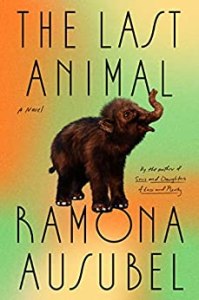 The Last Animal by Ramona Ausubel: In Ausubel’s offbeat third novel, a widowed scientist and her two daughters embark on a rogue plan to make history by resurrecting the woolly mammoth. There is a quirky combination of cosmic and domestic concerns here. A winsome sister duo is at the heart of the unusual and timely story, with priority given to the points of view of teenagers Eve and Vera, whose banter is a highlight. Ausubel has wisely chosen not to dwell on the scientific details of de-extinction, yet that means that this becomes more like speculative fiction or a fairy tale. Ironically, the fabulist-leaning novel is best when most realist, documenting struggles with bereavement, sexism and parenting teens.
 The Lost Wife by Susanna Moore: Moore’s hard-hitting novella is based in part on the memoir Six Weeks in the Sioux Tepees: A Narrative of Indian Captivity. In Moore’s version, Sarah, 25, leaves her baby behind when she flees an abusive husband, and once in Minnesota Territory marries John Brinton, who becomes a doctor on a Sioux reservation. By 1862, Sarah is friendly with the Native women. Although the Civil War is unfolding, the greater threat here is of revolt by the starving Indigenous residents. There is much of anthropological and historical interest, but Sarah’s flat storytelling, which may represent a pastiche of period style, means threatening or climactic scenes lose some of their potential gravity.
Foreword
 My Mother Says by Stine Pilgaard (trans. from the Danish by Hunter Simpson): After breaking up with her zookeeper girlfriend over their age gap and their conflicting takes on motherhood, the heroine moves back in with her father, a pastor who’s obsessed with Pink Floyd, and her stepmother. Her mother visits often, nagging her to finish her thesis. The line between her conversations and internal thoughts is thin. From her mansplaining doctor, she learns that the brain’s hippocampus is named for its seahorse shape. This inspires “Monologues of a Seahorse,” interludes of stream-of-consciousness association. Experimental and whimsical, this delivers deadpan narration of everyday woes.
 In Vitro: On Longing and Transformation by Isabel Zapata (trans. from the Spanish by Robin Myers): A Mexican poet probes the enduring mysteries of pregnancy and birth in a memoir in fragments that travels from fertility treatment through to the early weeks of pandemic-time motherhood. The clinical language of a gynecological history—late menstruation, polycystic ovary syndrome, eighteen years on the pill, and infertility—and the embryo transfer process contrasts with Zapata’s mystical thinking. The microessays integrate family stories, history, and artistic explorations. This resolute account of a personal metamorphosis alchemizes tender experiences into enchanting vignettes.
Shelf Awareness
Fiction
 Daughters of Nantucket by Julie Gerstenblatt: This engrossing debut novel explores the options for women in the mid-19th century while bringing a historical tragedy to life. Metaphorical conflagrations blaze in the background in the days leading up to the great Nantucket fire of 1846: each of three female protagonists (a whaling captain’s wife, a museum curator, and a pregnant Black entrepreneur) holds a burning secret and longs for a more expansive, authentic life. The action spans two tense weeks, one week before the fire through eight days after. The women’s lives collide in two climactic scenes. Gerstenblatt’s eye for detail results in sultry historical fiction for Sue Monk Kidd’s readers.
 Camp Zero by Michelle Min Sterling: Sterling’s brilliantly unsettling debut novel is set in mid-21st-century, post-oil North America. Prioritizing perspectives from two all-female communities, it contrasts the heights of opulence and technology with the basic instinct for survival. How the strands connect is a mystery sustained through much of the book. Characters go by multiple names and harbor ulterior motives; scenes echo each other as disparate subplots meet in unexpected ways. The background is all too plausible. Sterling also takes to its logical extreme the state of being constantly online. Compelling dystopian cli-fi with three-dimensional characters—perfect for fans of Station Eleven and To Paradise.
 Dear Chrysanthemums by Fiona Sze-Lorrain: In this elegant collection of 11 linked short stories by a poet and translator, China’s mid-20th-century political upheaval casts a long shadow. Music and food, not to mention love, bring meaning to those displaced in the aftermath of dissent. The stories—set in China, Singapore, Paris, and New York—span seven decades but always take place in a year ending in a six, a sacred number in Chinese divination. A highlight is “News from Saigon,” in which a prostitute meets Marguerite Duras in a Paris café. The connections are subtle, with the final story pulling together many strands. Ideal for readers of Madeleine Thien’s Do Not Say We Have Nothing.
Nonfiction
 Stranded by Maddalena Bearzi: Bearzi developed a deep love for marine fauna during childhood summers in Sardinia and cofounded the Ocean Conservation Society in the 1990s. Temporarily confined to land by Covid-19 lockdowns, she adopts a different tactic for exploring animal behavior: “an urban safari in my backyard and neighborhood.” These nature essays exemplify evenhandedness, curiosity, and close observation. From wasps to night-blooming flowers, her interest is wide-ranging. Gardening is a relaxing pastime and a connection to her mother while they are separated. As a behavioral ecologist, she views even her dog as a subject of study. A passionate primer to appreciating everyday nature.
Poetry
 Lo by Melissa Crowe: This incandescent autobiographical collection travels from girlhood to marriage and motherhood in post-pandemic USA. Crowe delves into sexual abuse and growing up in rural poverty. Yet the collection is so carefully balanced in tone that it never feels bleak. The emotional range is enhanced by alliteration and botanical imagery.
 Dislocations by Karen Enns: The fourth collection by Canadian poet Enns skillfully evokes a rural upbringing and revels in the beauty of nature and music. One of its aphorisms could encapsulate the entire collection: “The ratio of love to grief / we understood as music.” Updating the pastoral tradition, the bittersweet verse also takes solace in the past.
Shiny New Books
A Fortunate Woman by Polly Morland & A Fortunate Man by John Berger: The similarities go much further than the title and subject matter: these two biographical works, both illustrated with black-and-white photographs, are set in the same English valley and the female subject of Morland’s is the next-but-one successor of the doctor who stars in Berger’s.
 Berger (1926–2017), an art critic and Booker Prize-winning novelist, spent six weeks shadowing the doctor, to whom he gives the pseudonym John Sassall, with Swiss documentary photographer Jean Mohr, his frequent collaborator. Sassall’s dedication was legendary: he attended every birth in this community, and nearly every death. Sassall’s middle-class origins set him apart from his patients. There’s something condescending about how Berger depicts the locals as simple peasants. Mohr’s photos include soft-focus close-ups on faces exhibiting a sequence of emotions, a technique that feels outdated in the age of video. Along with recording the day-to-day details of medical complaints and interventions, Berger waxes philosophical on topics such as infirmity and vocation. A Fortunate Man is a curious book, part intellectual enquiry and part hagiography.
 With its layers of local history and its braided biographical strands, A Fortunate Woman takes up many of the same heavy questions but feels more subtle and timely. It also soon delivers a jolting surprise: the doctor Berger called John Sassall was likely bipolar and, soon after the death of his beloved wife Betty, committed suicide in 1982. His story still haunts this community, where many of the older patients remember going to him for treatment. Like Berger, Morland keenly follows a range of cases. As the book progresses, we see this beautiful valley cycle through the seasons, with certain of Richard Baker’s landscape shots deliberately recreating Mohr’s scene setting. The timing of Morland’s book means that it morphs from a portrait of the quotidian for a doctor and a community to, two-thirds through, an incidental record of the challenges of medical practice during COVID-19.
 The Memory of Animals by Claire Fuller: Neffy has nothing to lose when she enrolls in a controversial vaccine trial in a familiar mid-pandemic landscape. The novel is presented as her journal. The bulk takes place in two weeks she spends on a locked unit with four fellow test subjects. In the meantime, she is introduced to an experimental technology for reliving memories. The characterisation of the four other cast members is somewhat thin, and the elements feel randomly assembled. The world-building and tech are unlikely to stand up to science fiction fans’ scrutiny, but this has just the right dose of the speculative for literary fiction readers. It also happens to fit into a recent vogue for octopus novels.
Times Literary Supplement
A late-twenties journalist sets out to survey the situation on the ground for ten British species being squeezed out by anthropogenic climate change: The mission is very similar, and both authors embody passionate dedication to conservation, but the difference in tone of these travel narratives makes them likely to appeal to separate audiences…
In Search of One Last Song by Patrick Galbraith & Forget Me Not by Sophie Pavelle:
 Galbraith’s is an elegiac tour through imperilled countryside and urban edgelands. Each chapter resembles an in-depth magazine article: a carefully crafted profile of a beloved bird species, with a focus on the specific threats it faces. Galbraith recognises the nuances of land use. However, shooting plays an outsized role. (Curious for his bio not to disclose that he is editor of the Shooting Times.) The title’s reference is to literal birdsong, but the book also celebrates birds’ cultural importance through their place in Britain’s folk music and poetry. He is clearly enamoured of countryside ways, but too often slips into laddishness, with no opportunity missed to mention him or another man having a “piss” outside. Readers could also be forgiven for concluding that “Ilka” (no surname, affiliation or job title), who briefs him on her research into kittiwake populations in Orkney, is the only female working in nature conservation in the entire country; with few exceptions, women only have bit parts: the farm wife making the tea, the receptionist on the phone line, and so on.
 Pavelle’s book is a tonic in more ways than one. Employed by Beaver Trust, she is enthusiastic and self-deprecating. Her nature quest has a broader scope, including insects like the marsh fritillary and marine species such as seagrass and the Atlantic salmon. Travelling between lockdowns in 2020–1, Pavelle took low-carbon transport wherever possible and bolsters her trip accounts with context, much of it gleaned from Zoom calls and e-mail correspondence with experts from museums and universities. Refreshingly, around half of these interviewees are women, and the animal subjects are never the obvious choices. Instead, she seeks out “underdog” species. The explanations are at a suitable level for laymen, true to her job as a science communicator. The snappy, casual prose (“the future of the bilberry bumblebee and its Aperol arse can be bright, but only if we get off our own”) could even endear her to teenage readers. As image goes, Pavelle’s cheerful naïveté holds more charm than Galbraith’s hardboiled masculinity.
 Taking Flight by Lev Parikian: Parikian’s accessible account of the animal kingdom’s development of flight exhibits a layman’s enthusiasm for an everyday wonder. He explicates the range of flying strategies and the structural adaptations that made them possible. The archaeopteryx section, chronicling the transition between dinosaurs and birds, is a highlight. Though the most science-heavy of the author’s six works, this, perhaps ironically, has fewer footnotes. His usual wit is on display: he describes the feral pigeon as “the Volkswagen Golf of birds” and penguins as “piebald blubber tubes”. This makes it a pleasure to tag along on a journey through evolutionary time, one sure to engage even history- and science-phobes.
 Bookish Beck = Rebecca Foster. American transplant to England. Freelance proofreader and book reviewer.
 Bookish Beck