Three Reads for Women in Translation Month 2018
An offer of the latest Latin American import from Charco Press prompted me to scour my shelves and see what other books I might add for #WITMonth. I dug out two novella-length books I’d bought secondhand over the past year to make it a trio. My rating for all: 
The Lost Daughter by Elena Ferrante
[Translated from the Italian by Ann Goldstein]
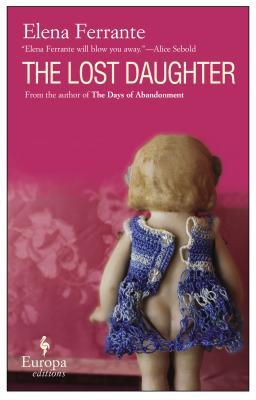 Leda is a 47-year-old teacher on holiday in southern Italy. She mostly sits on the beach, minding her own business, but still gets drawn into the minor daily dramas of a large Neapolitan family. One woman is pregnant; another has a small child named Elena who is devastated at losing her doll. Their mother–daughter dynamic takes Leda back to the time when she abandoned her own daughters and didn’t see them for three years. She temporarily found it impossible to reconcile motherhood with her career and her general sense of herself. Leda sees herself as part of a “chain of mute or angry women” – “I seemed to be falling backward toward my mother, my grandmother.”
I was definitely on board for the memories of motherly guilt. Where Ferrante lost me was when Leda steals the doll the child left behind and takes it up to her room to care for it – washing it, buying it new clothes, etc. Every time she sets out to give the doll back or at least leave it somewhere it will be found, she finds another excuse to put it off. Leda herself is unsure why she’s fixated on the doll; “The hardest things to talk about are the ones we ourselves can’t understand,” she says early on.
Most likely the doll could be interpreted as a symbol of Leda’s desire to be part of a functional family, to get a second chance at perfection with her daughters. But the book was a little too strange for me, and I never really engaged with the Neapolitan characters. After this and a skim of My Brilliant Friend a couple years back, I doubt I’ll pick up anything else by Ferrante. The themes and style of this one reminded me of Rachel Cusk’s Outline trilogy, A Separation by Katie Kitamura, and Hot Milk by Deborah Levy.
Favorite passage:
“Life can have an ironic geometry. Starting from the age of thirteen or fourteen I had aspired to a bourgeois decorum, proper Italian, a good life, cultured and reflective. Naples had seemed a wave that would drown me. I didn’t think the city could contain life forms different from those I had known as a child, violent or sensually lazy, tinged with sentimental vulgarity or obtusely fortified in defense of their own wretched degradation. I didn’t even look for them, those forms, in the past or in a possible future. I had run away like a burn victim who, screaming, tears off the burned skin, believing that she is tearing off the burning itself.”
Fish Soup by Margarita García Robayo
[Translated from the Spanish by Charlotte Coombe]
 Fish Soup contains two novellas (one of them, Sexual Education, was previously unpublished) separated by a set of seven short stories, and marks the first time the Colombian author Margarita García Robayo’s work has appeared in English. I especially liked the title story, in which a widower starts to smell his dead wife Helena’s fish soup in the bar that he owns and goes to investigate, all the while mixing up his dreams and memories with what’s really happening.
My other favorite piece was the opening novella, Waiting for a Hurricane, in which the narrator longs for escape from her seaside home, wanting nothing more than to be a “foreigner.” She starts a law degree but gives it up to become an air hostess, making flights to and from Miami and elsewhere. From her childhood onward, Gustavo has been a major presence in her life, teaching her to prepare fish and telling her stories, but there’s an uncomfortable element to their relationship that’s never really addressed. The mixture of quirky happenings and darker material reminded me of Swallowing Mercury, while the cancer theme of the story “Like a Pariah” recalls Hair Everywhere.
One of my frequent issues with short fiction is a preponderance of inconclusive endings that make you wonder what the point could be. I experienced that a few times with this collection, especially at the close of Waiting for a Hurricane. Judging by the title, though, the main message I drew from the novella is that you can’t just go around waiting for momentous things to happen to you, for your ‘real’ life to start; you have to recognize that this is life, here and now: in storytelling, in spicy stews, in everyday moments with friends and family.
With thanks to Charco Press for the free copy for review.
Sky Burial: An Epic Love Story of Tibet by Xinran
[Translated from the Chinese by Julia Lovell and Esther Tyldesley]
 In 1994 Xinran, a Chinese journalist who later moved to London, met a woman whose story captured her imagination. Shu Wen received word that her husband, Kejun, had died just months into their marriage. A doctor in the People’s Liberation Army, he’d been sent into Tibet in the 1960s after its ‘liberation’. With no details or body to confirm his demise, though, Wen refused to believe Kejun was gone, and traveled to Tibet to find him. She stayed there for over 30 years – more than half her life – living with a Tibetan family and adjusting to their culture and rituals as she sought word of her husband. The gender roles surprised her: men did the sewing and women had multiple husbands. It was a land of lamas and temples; “the whole of Tibet was one great monastery,” she felt.
Wen does eventually learn the truth of what happened to her husband (whew!), and after decades of living as a superstitious Buddhist in primitive conditions has to readjust to life in a new China, having completely missed the Cultural Revolution. She clings to words of wisdom from a military official: “Whatever happens, remember one thing: just staying alive is a victory” and “Writing can be a source of strength.” He then gave her a diary that she filled with letters to Kejun over the years.
It’s a pleasant, short book made up of layers of tales: the legends and history lessons Wen hears from Tibetans; what she conveys to Xinran during their two intense days together; and the resulting narrative Xinran spent nearly a decade imagining herself into. Kejun’s fate is worth waiting around to hear about (but if you know what the title refers to you might consider it a spoiler), though this is something of a thin story overall. I’ve seen it referred to as a novel, though I consider it more of a stylized biography.
Did you do any special reading for Women in Translation month this year?
20 Books of Summer, #5–8: Anderson, Cusk, Fitch & L’Engle
I’ve been reading a feminist memoir set on Cape Cod, a subtle novel about the inner life and outward experiences of a writer, a soapy literary thriller about a troubled mother and teen daughter, and a slightly melancholy reminiscence of an aged mother succumbing to dementia.
A Walk on the Beach: Tales of Wisdom from an Unconventional Woman by Joan Anderson (2004)
 This is the third volume in a loose autobiographical trilogy about Anderson’s experiment with taking a break from her marriage and living alone in a Cape Cod cottage to figure out what she really wanted from the rest of her life. Specifically, this book is about the inspirational relationship she formed with Joan Erikson, who moved to the area in her eighties when her husband, the famous psychologist Erik Erikson, was admitted to a care home. Joanie was a thinker and author in her own right, publishing books on life’s stages, especially those of older age. She encouraged Anderson to have the confidence to write her own story, and to take up challenges like a trip to Peru and learning to weave on a loom. Joanie’s aphoristic advice is valuable, but there’s a fair bit of overlap between this book and A Year by the Sea, which I would recommend over this.
My rating:
Some of Joan Erikson’s words of wisdom:
“Doing something with your hands, rather than your head, is often the best route to clarity.”
“wisdom comes from life’s experiences well digested. Stop relying so much on your mind and get in touch with experience.”
“The struggle is to try and obtain a sense of participation in your life the whole way through. We must treasure old age, but not wallow in nostalgia.”
Transit by Rachel Cusk (2016)
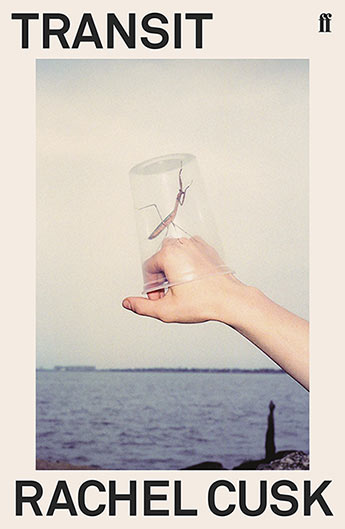 I finally made it through a Rachel Cusk book! (This was my third attempt; I made it just a few pages into Aftermath and 60 pages through Outline.) I suspected this would make a good plane read, and thankfully I was right. Each chapter is a perfectly formed short story, a snapshot of one aspect of Faye’s life and the relationships that have shaped her: a former lover she bumps into in London, a builder who tells her the flat she’s bought is a lost cause, the awful downstairs neighbors who hate her with a passion, the fellow writers (based on Edmund White and Karl Ove Knausgaard?) at a literary festival event who hog most of the time, the jolly Eastern European construction workers who undertake her renovations, a childless friend who works in fashion design, and a country cousin who’s struggling with his new blended family.
Like in Outline, the novel is based largely on the conversations Faye overhears or participates in (“I had found out more, I said, by listening than I had ever thought possible”), but I sensed more of her personality this time, and could relate to her questioning: Why do her neighbors hate her so? How much of her life is fated, and how much has she chosen? I doubt I’ll read another book by Cusk, but I ended up surprisingly grateful to have gotten hold of this one as a free proof copy of the new paperback edition from the Faber Spring Party.
My rating: 
Some favorite lines:
“we examine least what has formed us the most, and instead find ourselves driven blindly to re-enact it.”
“Without children or partner, without meaningful family or a home, a day can last an eternity: a life without those things is a life without a story, a life in which there is nothing – no narrative flights, no plot developments, no immersive human dramas – to alleviate the cruelly meticulous passing of time.”
White Oleander by Janet Fitch (1999)
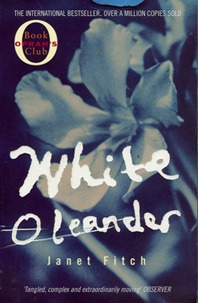 Man, that Oprah knows how to pick ’em! This was a terrific read; I’m not sure why I’d never gotten to it before. I read huge chunks during my travel to the States and then slowed down quite a bit, which was a shame because it meant I felt less connected to Astrid’s later struggles in the foster care system. It’s an atmospheric novel full of oppressive Los Angeles heat and a classic noir flavor that shades into gritty realism as it goes on, taking us from when Astrid is 12 to when she’s a young woman out in the world on her own.
Astrid’s mother Ingrid, an elitist poet, becomes obsessed with a lover who spurned her and goes to jail for his murder. Bouncing between foster homes and children’s institutions, Astrid is plunged into a world of sex, drugs, violence and short-lived piety. “Like a limpet I attached to anything, anyone who showed me the least attention,” she writes. Her role models change over the years, but always in the background is the icy influence of her mother, through letters and visits.
Fitch’s writing is sumptuous, as in a house “the color of a tropical lagoon on a postcard thirty years out of date, a Gauguin syphilitic nightmare.” I might have liked a tiny bit more of Ingrid in the book, but I can still recommend this one wholeheartedly as summer reading.
My rating:
Some favorite lines:
The knock-out opening two lines: “The Santa Anas blew in hot from the desert, shriveling the last of the spring grass into whiskers of pale straw. Only the oleanders thrived, their delicate poisonous blossoms, their dagger green leaves.”
“I couldn’t imagine my mother in prison. She didn’t smoke or chew on toothpicks. She didn’t say ‘bitch’ or ‘fuck.’ She spoke four languages, quoted T. S. Eliot and Dylan Thomas, drank Lapsang souchong out of a porcelain cup. She had never been inside a McDonald’s. She had lived in Paris and Amsterdam. Freiburg and Martinique. How could she be in prison?”
The Summer of the Great-Grandmother by Madeleine L’Engle (1974)
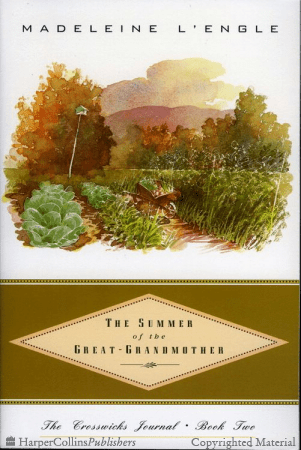 L’Engle is better known for children’s books, but wrote tons for adults, too. In this second volume of The Crosswicks Journal, she recounts her family history as a way of remembering on behalf of her mother, who at age 90 was slipping into dementia in her final summer. “I talked awhile, earlier this summer, about wanting my mother to have a dignified death. But there is nothing dignified about incontinence and senility.” L’Engle found herself in the unwanted position of being like her mother’s mother, and had to accept that she had no control over the situation. “This summer is practice in dying for me as well as for my mother.”
One of the reasons L’Engle was driven to write science fiction was because she couldn’t reconcile the idea of permanent human extinction with her Christian faith, but nor could she honestly affirm every word of the Creed. Hers is a more broad-minded, mystical spirituality that really appeals to me. (Her early life reminds me of May Sarton’s, as recounted in I Knew a Phoenix: both were born right around World War I, raised partially in Europe and sent to boarding school; a frequent theme in their nonfiction is the regenerative power of solitude and of the writing process itself.)
My rating:
Some favorite lines:
“I said [in a lecture] that the artist’s response to the irrationality of the world is to paint or sing or write, not to impose restrictive rules but to rejoice in pattern and meaning, for there is something in all artists which rejects coincidence and accident. And I went on to say that we must meet the precariousness of the universe without self-pity, and with dignity and courage.”
“Our lives are given a certain dignity by their very evanescence. If there were never to be an end to my quiet moments at the brook, if I could sit on the rock forever, I would not treasure these minutes so much. If our associations with the people we love were to have no termination, we would not value them as much as we do.”
20 Books of Summer #4 + Substitutes & Plane Reading
You’ll have to excuse me posting twice in one day. I’ve just finished packing the last few things for my three weeks in America, and want to get my latest #20BooksofSummer review out there before I fly early tomorrow. What with a layover in Toronto, it will be a very long day of travel, so I think the volume of reading material I’m taking is justified! (See the last photo of the post.)
Four Wings and a Prayer: Caught in the Mystery of the Monarch Butterfly by Sue Halpern (2001)
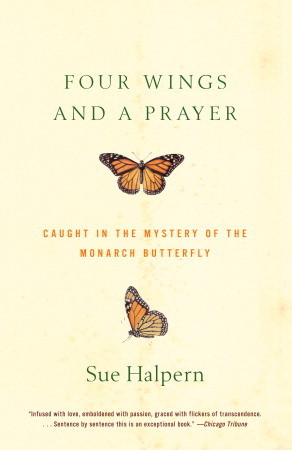 I admire nonfiction books that successfully combine lots of genres into a dynamic narrative. This one incorporates travel, science, memoir, history, and even politics. Halpern spent a year tracking monarch butterflies on their biannual continent-wide migrations, which were still not well understood at that point. She rides through Texas into Mexico with Bill Calvert, field researcher extraordinaire; goes gliding with David Gibo, a university biologist, in fields near Toronto; and hears from scientists and laymen alike about the monarchs’ habits and outlook. It happened to be a worryingly poor year for the butterflies, yet citizen science initiatives provided valuable information that could be used to predict their future.
The book is especially insightful about clashes between environmentalist initiatives and local livelihoods in Mexico (tree huggers versus subsistence loggers) and the joy of doing practical science with simple tools you make yourself. It’s also about how focused attention becomes passion. “Science, like belief, starts with wonder, and wonder starts with a question,” Halpern writes.
The style is engaging, though at nearly 20 years old the book feels a bit dated, and I might have liked more personal reflections than interviews with (middle-aged, white, male) scientists. I only realized on the very last page, through the acknowledgments, that the author is married to Bill McKibben, a respected environment writer. [She frequently mentions Fred Urquhart, a Toronto zoology professor; I wondered if he could be related to Jane Urquhart, a Canadian novelist whose novel Sanctuary Line features monarchs. (Turns out: no relation. Oh well!)]
Readalikes: Farther Away by Jonathan Franzen & Ruins by Peter Kuper
My rating: 
I’ve already done some substituting on my 20 Books of Summer. I decided against reading Vendela Vida’s Girls on the Verge after perusing the table of contents and the first few pages and gauging reader opinions on Goodreads. I have a couple of review books, Twister by Genanne Walsh and The Life and Loves of Lena Gaunt by Tracy Farr, that I’m enjoying but will have to leave behind while I’m in the States, so I may need that little extra push to finish them once I get back. I’ve also been rereading a favorite, Paulette Bates Alden’s memoir Crossing the Moon, which has proved an excellent follow-up to Sheila Heti’s Motherhood.
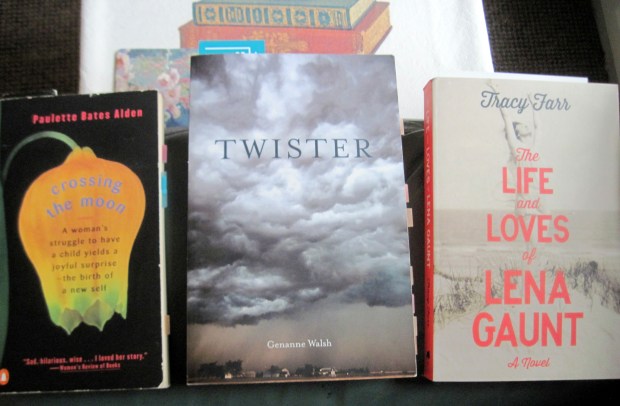
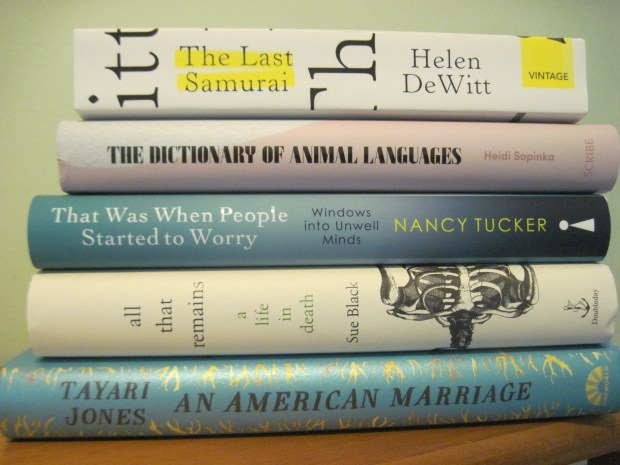
(What I haven’t determined yet is which books these will be standing in for.) Waiting in the wings in case further substitutions are needed is this stack of review books:
Also from the #20Books list and coming with me on the flight are Madeleine L’Engle’s The Summer of the Great-Grandmother and Janet Fitch’s White Oleander, which are both terrific thus far. The final print book joining me for the journey is Transit by Rachel Cusk. I have attempted to read her twice before and failed to get through a whole book, so we’ll see if it’s third time lucky. It seems like the perfect book to read in transit to Canada, after all.
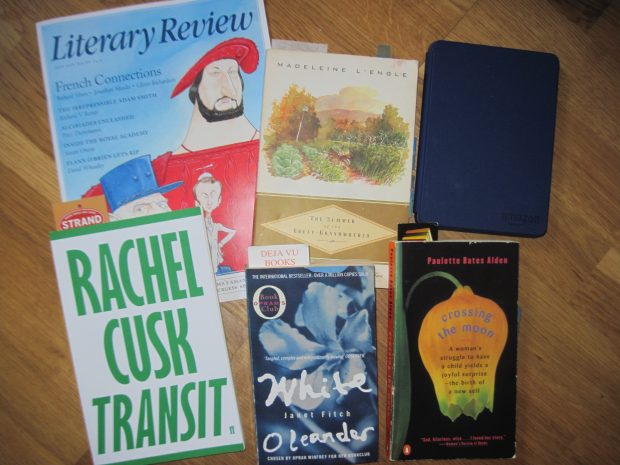
Finally, in progress on the Kindle are Summer by Karl Ove Knausgaard, the last in his set of four seasonal essay collections, and The Late Bloomers’ Club by Louise Miller, another cozy novel set in fictional Guthrie, Vermont, which she introduced in her previous book, The City Baker’s Guide to Country Living.
It’ll be a busy few weeks helping my parents pack up their house and moving my mom into her new place, plus doing a reduced freelance work load for the final two weeks. It’s also going to be a strange time because I have to say goodbye to a house that’s been a part of my life for 13 years, and sort through box after box of mementoes before putting everything into medium-term storage.
I won’t be online all that much, and can’t promise to keep up with everyone else’s blogs, but I’ll try to pop in with a few reviews.
Happy July reading!
How Not to Decide: Motherhood by Sheila Heti
Should one have children? No matter who’s asking the question or in what context, you’re going to get the whole gamut of replies, as proven by this recent Literary Hub survey of authors. Should I have children? Turn the question personal and, even if it’s actually rhetorical, you’ll still get an opinion from every quarter. As The Decision looms over her, the narrator of Sheila Heti’s new novel, a 37-year-old writer from Toronto, isn’t sure who to listen to. Her neurotic inner voice makes her second-guess her life. “The question of a child is a bug in the brain—it’s a bug that crawls across everything, every memory, and every sense of my own future.” Meanwhile, acquaintances and strangers alike all have their two cents to chip in. Everywhere she goes on her book tour, for instance, she hears other people’s stories and has to sift through them. She’s something like the protagonist of Rachel Cusk’s Outline trilogy, though with a stronger personality and internal commentary.
Having a child is an act of creation, and Heti’s narrator worries that she only has sufficient creative energy for one or the other: writing or breeding. Her identity as an artist is so precious to her that she is terrified of giving it up, or watering it down, to risk being a (not very good?) mother. Yet she has the sense that to remain childless she had better come up with a really good excuse. People will want to know what she is going to do with her life instead, and they’re unlikely to be satisfied by the notion that her books are like her babies.

The novel is in short, aphoristic paragraphs and is dominated by cogitation rather than scenes, though there are some concrete events and secondary characters, such as the narrator’s mother; her friend Libby, a new mother; and her partner, Miles, who has a 12-year-old daughter from a previous relationship. The sections are given headings like “PMS,” “Bleeding,” “Follicular,” and “Ovulating,” which suggest the cyclical nature of life: whether she likes it or not, this character is part of a physical process geared towards reproduction.
The cyclical workings of the female body mirror the circularity of her thoughts: she keeps revolving around the same questions, never seeming to get any closer to a decision – though by the end she does decide. The temptation is always to offload the choice onto an external, fate-like force. The narrator wants the oracular voice of the universe to answer everything for her via coin tosses. (Heti writes in a prefatory note that these were based on actual coin tosses.) She asks series of yes/no questions and reports what the coins have to say. It’s a way of avoiding responsibility for her own decision, and produces some truly hilarious passages. Oh, the absurdity of having a dialogue with an impersonal force!
Our heroine does ultimately realize how random and meaningless the coins’ yes/no answers are, but she continues to look outside herself for wisdom: to a fortune teller, psychics, dreams, and even a crazy woman in New York City who hits her up for money. Anything to bypass the wringer of her own mind. She also latches onto the biblical story of Jacob wrestling with the angel, and contrasts this with the symbol of a kitchen knife, which represents a demon that robs her of hope.
 Every woman is a daughter as well as a potential mother, and a particularly moving strand of Motherhood is the narrator’s relationship with her female ancestors. Her Hungarian grandmother, Magda, survived Auschwitz only to die of cancer at 53; her mother, a doctor, devoted herself to her career and left the traditional household and childrearing tasks to her husband. This dual legacy of suffering and professional pride helps explain the narrator’s feelings. Deep down, she believes her family line was meant to end in a concentration camp; how dare she continue it now? She also emulates her mother’s commitment to a cerebral vocation – “So I also wanted to be the brains: to be nothing but words on a page.”
Chance, inheritance, and choice vie for pride of place in this relentless, audacious inquiry into the purpose of a woman’s life. I marked out dozens of quotes that could have been downloaded directly from my head or copied from my e-mails and journal pages. The book encapsulates nearly every thought that has gone through my mind over the last decade as I’ve faced the intractable question of whether to have children. I suspect it will mean the most to people who are still unsure or have already decided against children; parents may interpret Heti’s arguments as personal barbs, even though the narrator insists her own decision is not an inherent comment on anyone else’s. It’s a book I could have written, but now don’t have to; Heti has captured brilliantly what it’s like to be in this situation in this moment in time.
Here are a few of my favorite passages. They should give you an idea of whether this book might resonate with you, or at least interest you academically:
“On the one hand, the joy of children. On the other hand, the misery of them. On the one hand, the freedom of not having children. On the other hand, the loss of never having had them—but what is there to lose?”
“for a woman of curiosity, no decision will ever feel like the right one. In both, too much is missing. What can I say, except: I forgive myself for every time I neglected to take a risk, for all the narrowings and winnowings of my life. I understand that fear beckons to a person as much as possibility does, and even more strongly.”
“I don’t have to live every possible life, or to experience that particular love. I know I cannot hide from life; that life will give me experiences no matter what I choose. Not having a child is no escape from life, for life will always put me in situations, and show me new things, and take me to darknesses I wouldn’t choose to see, and all sorts of treasures of knowledge I cannot comprehend.”
My rating: 
Motherhood was published in the UK by Harvill Secker on May 24th. My thanks to the publisher for the free copy for review. It came out in North America on May 1st (Knopf Canada / Henry Holt and Co.).
Two Memoirs of Women’s Freedom: Lara Feigel and Rebecca Loncraine
I have read some truly phenomenal memoirs this year, most of them by women. These two have rather different starting points – frustration with the constraints of marriage and motherhood, and breast cancer treatment – but I’ve paired them because both are journeys of self-discovery in which the author commits to determining how to live a free and true life.
Free Woman: Life, Liberation and Doris Lessing by Lara Feigel
 It started with a spate of weddings one summer. Lara Feigel, a literature lecturer at King’s College London, found herself strangely irked at all this capitulation to marital convention, even though she herself had married in her twenties and had a young son. What did her mild outrage signify? At the same time, she was rereading the works of Doris Lessing, whom she found simultaneously admirable and vexing: Lessing lived by her ideals of free love and Communism, but it came at the price of abandoning her children. Feigel could identify with Lessing in some ways but not in others, and as she entered a rocky time in her mid-thirties – a miscarriage followed by IVF, which was a strain on her marriage; the death of a close friend; and ongoing worry over how motherhood might affect her academic career – she set out to find what Lessing could teach her about how to be free.
Throughout, Feigel holds up her own experiences of marriage and motherhood in parallel to Lessing’s. She maintains a delicate balance between biographical and autobiographical information and brings in references to other writers – everyone from Rachel Cusk to D.H. Lawrence – to explore various opinions on maternal ambivalence and sexual fulfillment. I could relate to the bookworm’s impulse to turn to literature for comfort and direction – “the most enduring novelists … illuminate our lives,” and “we live differently as a result of reading them,” Feigel insists. Lessing seemed to her the perfect “writer to discover in your thirties; a writer who wrote about the lives of grown-up women with an honesty and fullness I had not found in any novelist before or since.”
And yet a familiarity with or fondness of the works of Doris Lessing is not a prerequisite to enjoying this book. I’ve only ever read The Golden Notebook (1962) and Alfred and Emily (2008), a fictionalized biography of Lessing’s parents, both during my mid-twenties. The former I almost certainly read before I could fully appreciate it. It’s about the ways in which women compartmentalize their lives and the struggle to bring various strands into harmony; that’s what Free Woman is all about as well. Feigel often looks for clues in Lessing’s heavily autobiographical Martha Quest novels, which I’d like to read, and also travels to California to meet one of Lessing’s lovers and to Zimbabwe to see the farm where Lessing grew up.
Like Samantha Ellis’s How to Be a Heroine and Rebecca Mead’s My Life in Middlemarch, this is a richly satisfying hybrid of biography, literary criticism and memoir. I would also recommend it to readers of Alexandra Fuller’s Don’t Let’s Go to the Dogs Tonight, Nancy Horan’s Loving Frank, and Adrienne Rich’s Of Woman Born. Feigel’s is a particularly brave and forthright book. I feel proud of her in an oddly personal way: during my years as a library assistant at King’s, I saw her chair countless literature and life writing events. She seemed impossibly young for a professor type, and wore her navy blue shift dress and string of pearls like it was her grown-up’s uniform. I can tell that the years since, including the difficult experiences she recounts here, have both softened and toughened her, sandpapering away what she calls her “diffident angularity” and replacing it with womanly wisdom.
My rating:
Free Woman was published by Bloomsbury UK on March 8th. My thanks to the publisher for the free copy for review.
Skybound: A Journey in Flight by Rebecca Loncraine
 In 2016 it was When Breath Becomes Air by Paul Kalanithi; in 2017 it was The Bright Hour by Nina Riggs. And now Skybound. Each year seems to bring one exquisite posthumous memoir about facing a death from cancer with dignity. For Rebecca Loncraine, after treatment for breast cancer in her early thirties, taking flying lessons in an unpowered glider was her way of rediscovering joy and experiencing freedom by facing her fears in the sky.
She was a freelance writer based on her parents’ farm in the Black Mountains of Wales, an area that’s familiar to me from trips to Hay-on-Wye and from my reading of Bruce Chatwin’s On the Black Hill. The history and geography of the region, as revealed from the air, weave through the book, as do childhood memories and recollections of chemotherapy. Loncraine discovered a particular love for flying alongside birds: the red kites in Wales, and later vultures in Nepal. The most remarkable passages of the book are the exhilarating descriptions of being thousands of feet up in the air and the reflections on why humans are drawn to flight and what it does for our bodies and spirits. She learned from a British Airways pilot that 500,000 people are airborne at any one moment! We take for granted what should still be acknowledged as a miraculous feat.
“There’s no road in the sky. Each individual glider pilot finds a new pathless way through the air, a unique scribble. We locate a bit of ridge lift, here; fly out to a thermal, there; we wind and manoeuvre over the curving land. We never take the same route twice, so flight offers me a new perspective each time I fly.”
“Influenced by the ancient seam of human thought that associates the sky with the imagination, weaving and circling in the sky begins to feel like sailing through the realm of the subconscious itself.”
This hobby-turned-obsession was not without its inconveniences and dangers. Even when it’s warm at ground level it’s frigid at 13,000 feet, so you have to bundle up. Meanwhile, the strength of the sun means you keep guzzling water and have to wear either a urine-collecting device or adult diapers. The earliest attempts at unpowered flight were generally fatal, and when Loncraine went to New Zealand for a bonus season of flying to replace the Welsh winter, one of her fellow flyers died in a crash. Her instructor told her she’d become fearless, even reckless. But when she met one of the pioneers of gliding, then in his nineties, in New Zealand he spoke an aphorism that perfectly captures the role flying played for Loncraine: “The antidote to fear is fascination.”
There’s a brief afterword by Loncraine’s mother, Trisha. Her daughter had virtually finished this manuscript when the cancer returned, and underwent another 14 grueling months of treatment before her death in September 2016. This is a simply wonderful book; what a shame that we won’t get another.
My rating: 
Skybound was published by Picador on April 19th. My thanks to the publisher for a proof copy for review.
A Publisher Party and a One-Man Play
I was a veritable social butterfly this past week: I went out two evenings in a row! (Believe me, that’s rare.) On Tuesday I met up with bloggers Annabel, Eric and Kim at the Faber Spring Party held at Crypt on the Green in London, and on Wednesday my husband and I attended a performance at the University of Reading of Michael Mears’s one-man play on the plight of Britain’s conscientious objectors during World War I, This Evil Thing.
Faber Spring Party
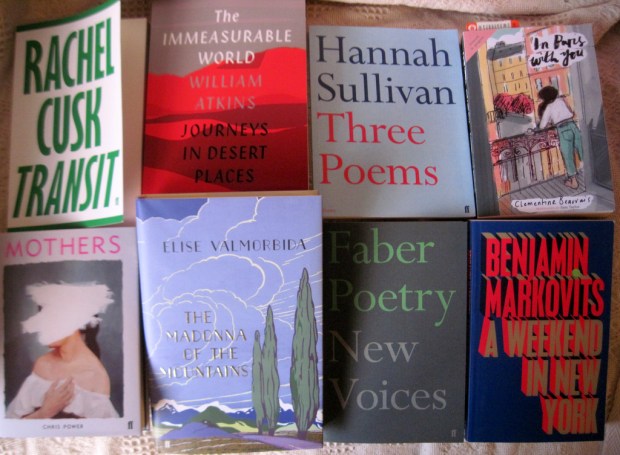
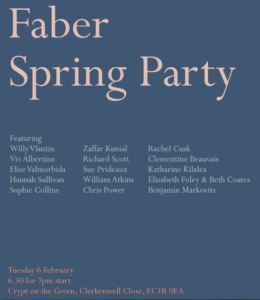 I’ve never been to an event quite like this. Publisher Faber & Faber, which will be celebrating its 90th birthday in 2019, previewed its major releases through to September. Most of the attendees seemed to be booksellers and publishing insiders. Drinks were on a buffet table at the back; books were on a buffet table along the side. Glass of champagne in hand, it was time to plunder the free books on offer. I ended up taking one of everything, with the exception of Rachel Cusk’s trilogy: I couldn’t make it through Outline and am not keen enough on her writing to get an advanced copy of Kudos, but figured I might give her another try with the middle book, Transit.

For the evening’s presentation, each featured author had a few minutes to introduce their new book and/or give a short reading.
Rachel Cusk opened the evening with a reading from Kudos. If you’re familiar with her recent work, you won’t be surprised at this synopsis: a man on a plane recounts having his dog put to sleep. (Out on May 3rd.)
William Atkins’s book on deserts, The Immeasurable World, is based on three years of travel and is, he is not ashamed to say, in the old-fashioned travel writing tradition. (Out on June 7th.)
Hannah Sullivan’s Three Poems is a hybrid work of poem-essays. #2 is more philosophical, she said; #3 is about her father’s death and her son’s birth. She read sonnet 3.21. (Out now.)
Clémentine Beauvais’s In Paris with You is a YA romance in free verse, loosely based on Eugene Onegin. I don’t know the source text but started this on the train ride home and it’s enjoyable thus far. I’m in awe at how translator Sam Taylor has taken the French of her Songe à la douceur and turned it into English poetry. (Out on June 7th.)
Chris Power’s Mothers is a book of linked short stories, three of which are about a character named Eva. He read a portion of a story about her having an encounter with an unpleasant man in Innsbruck. (Out on March 1st.)
Elise Valmorbida’s The Madonna of the Mountains, set in 1923–50, is a saga that resembles “an Italian Mother Courage,” she says. She read a scene in which a character comes across a madwoman. (Out on April 5th.)
Zaffar Kunial read the poem “Spark Hill” from his forthcoming collection Us. It’s about a childhood fight in the area of Birmingham where he grew up. He had a folder open in front of him but, impressively, recited the long poem completely from memory. (Out on July 5th.)
American novelist Benjamin Markovits was a professional basketball player in Germany for six months. Like the tennis-playing protagonist of his upcoming book, A Weekend in New York, he got tired of being measured. After 15 years, his hero is eager to escape a life of being constantly ranked. This is the first in a quartet of novels that inevitably invites comparison with John Updike’s “Rabbit” books. (Out on June 7th.)
I confess I didn’t previously know the name Viv Albertine; she was the guitarist for the female punk band The Slits, and To Throw Away Unopened is her second memoir. Albertine realized that it was her mother who had made her an angry rebel; the title is the label on a bag she found in her mother’s room after her death. (Out on April 5th.)
Sophie Collins incorporates hybrid forms in her poetry – what she calls “lyric essays.” The theme of her book Who Is Mary Sue? is perceptions of women’s writing (with “Mary Sue” as a metonym for the stereotypical good girl). She read from “Engine.” (Out now.)
Katharine Kilalea’s debut novel Ok, Mr Field is about an injured concert pianist who becomes obsessed with a house he buys in South Africa. (Out on June 7th.)
Elizabeth Foley and Beth Coates are the authors of two Homework for Grown-Ups books. Their new book, What Would Boudicca Do?, is about lessons we can draw from the women of history. For instance, the sampler booklet has pieces called “Dorothy Parker and Handling Jerks” and “Frida Kahlo and Finding Your Style.” There’s a heck of a lot of books like this out this year, though, and I’m not so sure this one will stand out. (Out on September 6th.)
Richard Scott read two amazingly intimate poems from his upcoming collection, Soho. One, “cover-boys,” was about top-shelf gay porn; the other was about mutilated sculptures of male bodies in the Athens archaeological museum. If you appreciated Andrew McMillan’s Physical, you need to get hold of this the second it comes out. I went back and read “cover-boys” in the sampler booklet and it wasn’t nearly as powerful as it was aloud; Scott’s reading really brought it to life, in contrast to some other authors’ dull delivery. (Out on April 5th.)
Sue Prideaux’s forthcoming biography of Friedrich Nietzsche is entitled I Am Dynamite! She encountered her subject when she wrote her first biography, of Edvard Munch. Although Nietzsche has been embraced by far-right groups in America, he was in fact against racism, nationalism, and anti-semitism, so he has important messages for us today. I’ll be keen to get hold of this one. (Out on September 6th.)
Guitar in hand, Willy Vlautin closed the evening with a performance of the title track from the soundtrack album to his fifth novel, Don’t Skip Out on Me – he was the singer in Portland, Oregon alt-country band Richmond Fontaine, which has recently stopped touring. He said the novel asks, “can you make the scars of broken people bearable?” (Out now.)

Now that I’ve got this terrific stack of books, wherever do I start?! I’m currently reading the Beauvais; from there I’ll focus on ones that have already been released, starting with Vlautin and the two poetry collections. The titles that aren’t out until June can probably wait – though it’s tempting to be one of the privileged few who get to read them nearly four months early. One Faber book per week should see me getting through all these by the final release date.
This Evil Thing
Michael Mears plays about 50 different characters in this one-man production. He’s an actor and pacifist who has written a number of solo pieces over 20 years. In this commemorative year of the end of the First World War, he knew we would hear a lot about battles, soldiers, and their families back home. But conscientious objectors weren’t likely to be remembered: theirs is a “story that’s rarely told,” he realized. This Evil Thing sets out to correct that omission. The title phrase refers not to war in general but specifically to conscription.
 The two main characters Mears keeps coming back to in the course of the play are Bert Brocklesby, a Yorkshire preacher, and philosopher Bertrand Russell. Brocklesby refused to fight and, when he and other COs were shipped off to France anyway, resisted doing any work that supported the war effort, even peeling the potatoes that would be fed to soldiers. He and his fellow COs were beaten, placed in solitary confinement, and threatened with execution. Meanwhile, Russell and others in the No-Conscription Fellowship fought for their rights back in London. There’s a wonderful scene in the play where Russell, clad in nothing but a towel after a skinny dip, pleads with Prime Minister Asquith.
As in solo shows I’ve seen before (e.g. A Christmas Carol with Patrick Stewart), Mears had to find subtle ways to distinguish between characters: he used a myriad different voices, including regional accents; he quickly donned a jacket, hat, or pair of glasses. Russell was identified by his ever-present pipe. The most challenging scene, Mears said in the Q&A at the end, was one with four characters in a French street café.
Mears reveals during the play that his grandfather fought in WWI and his father in WWII, but he has never had to put his own pacifist views to the test. What about Hitler? people always ask. Mears is honest and humble enough to admit that he doesn’t know what he would have done had he been called on to fight Hitler, or had he faced persecution as a CO in WWI. Ultimately, what Mears hopes audiences take from his play, which won acclaim at the Edinburgh Festival Fringe, is that “this is not an irrelevant piece of history.” Standing up for what you believe in, especially if it goes against the spirit of the times, is always valuable.
All the Books I’ve Abandoned So Far This Year
Last year’s abandoned books posts were popular ones – strangely so considering that, instead of giving recommendations like usual, I was instead listing books I’d probably steer you away from. This is such a subjective thing, though; I know that at least a few of the books I discuss below (especially the Mervyn Peake and Rachel Cusk) have admirers among my trusted fellow bloggers. So consider this a record of some books that didn’t work for me: take my caution with a grain of salt, and don’t let me put you off if you think there’s something here that you’d really like to try. (For some unfinished books I give ratings, while for others where I haven’t read far enough to get a good sense of the contents I refrain from rating. This list is in chronological order of my reading rather than alphabetical by title or author.)
 Titus Groan by Mervyn Peake: Vivid scene setting and amusingly exaggerated characters, but I couldn’t seem to get anywhere. It takes over 50 pages for one servant to tell another that the master has had a son?! Hearing that the book only lasts until Titus’s second birthday made me fear the next 400+ pages would just be more of the same. I bought the whole trilogy secondhand, so I hope I’ll be successful on a future attempt. (Set aside at page 62.)
 Seven Seasons in Siena: My Quixotic Quest for Acceptance among Tuscany’s Proudest People, by Robert Rodi: I read the first 49 pages but found the information about the city’s different districts and horse races tedious. Favorite passage: “it’s what’s drawn me to Italians in general—their theatricality, their love of tradition, their spirit. Ever since my first trip to Rome, some ten years ago, I’ve found the robustness of the Italians’ appetites (for food, for music, for fashion) to be a welcome antidote to the dismaying anemia of modern American culture.”
A Book about Love by Jonah Lehrer: Read the first 31% of the Kindle book. Featured in my Valentine’s Day post about “Love” titles.
 Pondlife: A Swimmer’s Journal by Al Alvarez: I read the first 57 pages but found the entries fairly repetitive. The book spans nine years, but up to that point it was all set in 2002, when Alvarez was 73, and he reported so frequently that the conditions (weather, etc.) at the Hampstead Heath ponds didn’t differ enough to keep this interesting. Unless he’s traveling, you can count on each entry remarking on the traffic getting there, the relative scarcity or overabundance of fellow swimmers at the pond, the chilly start and the ultimately invigorating, calming effect of the water. Impressive that he’d been taking early-morning swims there since age 11, though. Favorite line (from a warm, late June day): “the water is like tepid soup – duck soup with swan-turd croutons.”
 The Best of Adam Sharp by Graeme Simsion: I read the first 36 pages of a library copy and gave up in grave disappointment. Compared to the two Rosie books, this felt like it had no spark. It’s just lots of name-dropping of 1960s and ’70s songs. I felt no connection to either Adam’s current life in England or his memories of his nascent relationship with soap actress Angelina back in Australia.
 The Wild Other: A Memoir by Clover Stroud: Normally I love memoirs that center on bereavement or major illness, but there’s so much going on in this book that drowns out the story of her mother falling off her horse and suffering a TBI when Stroud was 16. For instance, there’s a lot about the blended family she grew up in, embarrassing detail about her early sexual experiences, and an account of postnatal depression that plunges her back into memories of her mother’s accident. “Horses are the source of powerful magic that’s changed my life,” Stroud asserts, so she talks a lot about both real horses and chalk figures of them, but that’s not the same as affirming the healing power of nature, which is how this book has been marketed. Well written, yet I couldn’t warm to the story of a posh Home Counties upbringing, which means I never got as far as the more tantalizing contents set in Ireland and Texas. (Read the first 78 pages.)
 The Evening Road by Laird Hunt: I read about the first 50 pages, skimmed the rest of the first part, and barely glanced at the remainder. Hunt’s previous novel, Neverhome, was a pretty unforgettable take on the Civil War narrative. This latest book is trying to do something new with Jim Crow violence. In the 1920s–30s history Hunt draws on, lynchings were entertainment in the same way other forms of execution were in previous centuries; buses have even been put on to take people to “the show” up at Marvel, Indiana. Hateful Ottie Lee narrates the first half of the novel as she rides with her handsy boss Bud Lancer and her unappealing husband Dale to see the lynching. Their road trip includes a catfish supper, plenty of drinking, and a stop at a dance hall. It ends up feeling like a less entertaining The Help. A feel-good picaresque about a lynching? It might work if there were a contrasting tone, a hint that somewhere in this fictional universe there is an appropriate sense of horror about what is happening. I think Hunt’s mistake is to stick with Ottie Lee the whole time rather than switching between her and Calla Destry (the black narrator of the second half) or an omniscient narrator. I’d long given up on the novel by the time Calla came into play.
 Outline by Rachel Cusk: I read the first 66 pages before setting this aside. I didn’t dislike the writing; I even found it quite profound in places, but there’s not enough story to peg such philosophical depth on. This makes it the very opposite of unputdownable. Last year I read the first few pages of Aftermath, about her divorce, and found it similarly detached. In general I just think her style doesn’t connect with me. I’m unlikely to pick up another of her books, although I have had her memoir of motherhood recommended. Lines I appreciated: “your failures keep returning to you, while your successes are something you always have to convince yourself of”; “it’s a bit like marriage, he said. You build a whole structure on a period of intensity that’s never repeated. It’s the basis of your faith and sometimes you doubt it, but you never renounce it because too much of your life stands on that ground.”
Last but not least, Our Mutual Friend by Charles Dickens, in which I barely made it a few chapters.
Only nine in five months – not too shabby? There’s also a handful of other books that I decided to skim instead of read in their entirety, though.
I’ll be interested to hear if you’ve read any of these books – or plan to read them – and believe that they are worth persisting with.
 Bookish Beck = Rebecca Foster. American transplant to England. Freelance proofreader and book reviewer.
 Bookish Beck