October Poetry Releases: Bergin, Draycott, Lopez, Rizwan, Skoulding
It was a prolific month for poetry. There is so much variety here in form and topic, from the tongue-in-cheek aphorisms of Tara Bergin’s Savage Tales to the maritime and ornithological portrait of Anglesey in Zoë Skoulding’s A Marginal Sea. Something for everyone, I’d like to think, and I hope these capsule reviews and sample poems give you a taste.
Savage Tales by Tara Bergin
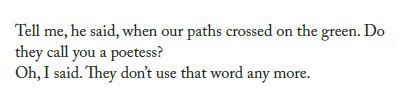
 This is the third collection by the Irish poet; I’d previously read her The Tragic Death of Eleanor Marx. Grouped into nine thematic sections, these very short poems take the form of few-sentence aphorisms or riddles, with the titles, printed in the bottom corner, often acting as something of a punchline – especially because I had them on my e-reader and they only appeared after I’d turned the digital ‘page’. Some appear to be autobiographical, about life for a female academic. Others are political (I loved “Tenants and Landlords”), or about wolves or blackbirds. The verse in “Constructions” takes different shapes on the page. Here are “The Subject Field” and “The Actor”:

With thanks to Carcanet Press for the free e-copy for review.
The Kingdom by Jane Draycott
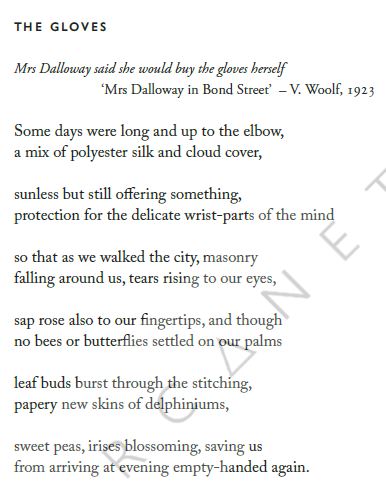
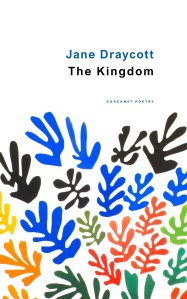 I love the Matisse cut-outs on the cover of Draycott’s fifth collection. The title poem’s archaic spelling (“hyther,” “releyf”) contrast with its picture of a modern woman seeking respite from “the men coming on to you / the taxi drivers saying here jump in no / no you don’t need no money.” Country vs. city, public vs. private, pastoral past and technological future are some of the dichotomies the verse plays with. I enjoyed the alliteration and references to an old English herbarium, Derek Jarman and polar regions. However, it was hard to find overall linking themes to latch onto.
With thanks to Carcanet Press for the free e-copy for review.
We Borrowed Gentleness by J. Estanislao Lopez
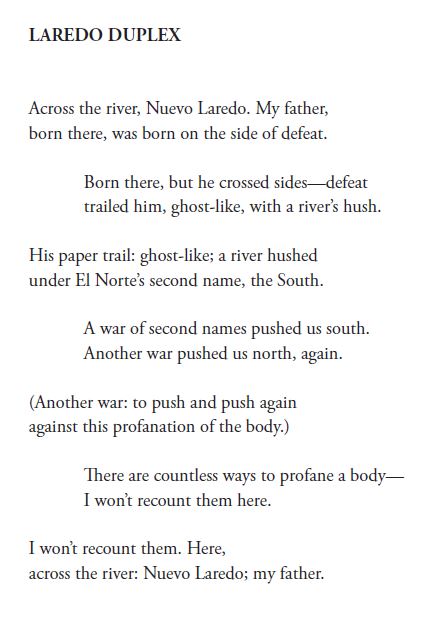
 Brimming with striking metaphors and theological echoes, the first poetry collection by the Houston-based writer is an elegant record of family life on both sides of the Mexican border. “Laredo Duplex” (below) explains how violence prompted the family’s migration. “The Contract” recalls acting as a go-between for a father who didn’t speak English; in “Diáspora” the speaker is dubious about assimilation: “I am losing my brother to whiteness.” The tone is elevated and philosophical (“You take the knife of epistemology and the elegiac fork”), with ample alliteration. Flora and fauna and the Bible are common sources of unexpected metaphors. Lopez tackles big issues of identity, loss and memory in delicate verse suited to readers of Kaveh Akbar. (My full review is on Shelf Awareness.)
With thanks to Alyson Sinclair PR for the free e-copy for review.
Europe, Love Me Back by Rakhshan Rizwan
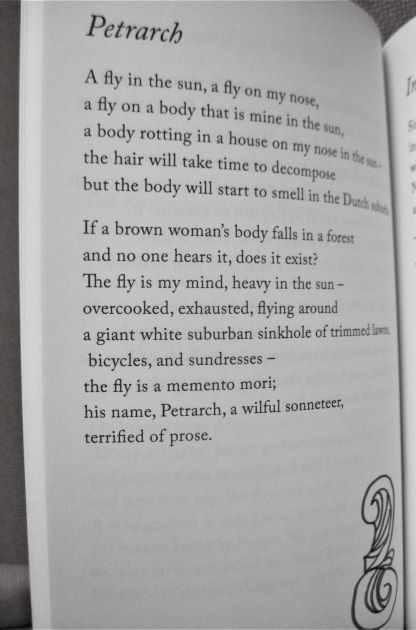
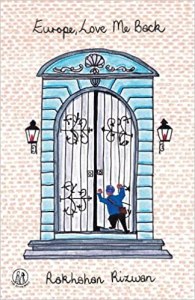 This debut collection has Rizwan juxtaposing East and West, calling out European countries for the prejudice she has experienced as a Muslim Pakistani in academia. She has also lived in the UK and USA, but mostly reflects on time spent in Germany and the Netherlands, where her imperfect grasp of the language was an additional way of standing out. “Adjunct” is the source of the cover image: she knocks and knocks for admittance, but finds herself shut out still. Rizwan takes extended metaphors from marriage, motherhood and women’s health: in “My house is becoming like my country,” she imagines her husband instituting draconian laws; in “I have found in my breast,” a visit to a doctor about a lump only exposes her own exoticism (“Basically, the Muslims are metastasizing”). In “Paris Proper,” she experiences the city differently from a friend because of the colonial history of the art. (See also Liz’s review.)
Some favourite lines:
“my breasts harden / with milk, that peculiar ache of women’s bodies / which do only half the sin / but carry all the history” (from “Half the Sin”)
With thanks to The Emma Press for the proof copy for review.
A Marginal Sea by Zoë Skoulding
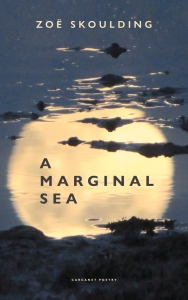 Skoulding’s collection is said to be all about Anglesey in Wales, but from that jumping-off point the poems disperse to consider maps, maritime vocabulary, seabirds, islands, tides and much more. There are also translations from the French, various commissions and collaborations, and pieces about the natural vs. the manmade. Some are in paragraph form and there’s a real variety to how lines and stanzas are laid out on the page. I especially liked “Red Squirrels in Coed Cyrnol.” I’ll read more by Skoulding.
 With thanks to Carcanet Press for the free e-copy for review.
Read any good poetry recently?
20 Books of Summer, 12–13: Black Narcissus & The False Rose
I’m limping towards the finish line with my flora-themed summer reading. Expect the reviews to come fast and furious over the next week and a half. Today’s novels aren’t about flowers, per se, but the title references do play a role. Both: (Public library) 
Black Narcissus by Rumer Godden (1939)
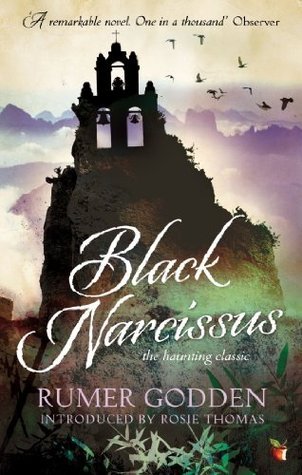 I saw the Deborah Kerr film version of this way back in my teen years but had never read anything by Rumer Godden. My interest was renewed by Laura’s post on nun books. A group of idealistic English nuns sets up a convent school and hospital in the mountains above Darjeeling. “They were going into the wilderness, to pioneer, to endure, to work; but surely not to enjoy themselves.” Much of the appeal of reading about small communities is seeing how different personalities play off each other: aloof leader Sister Clodagh, pensive Sister Philippa, impetuous Sister Ruth. The land belongs to the General, whose teenage son Dilip Rai comes for lessons (he’s a bit of a dandy and wears Black Narcissus perfume); the General’s caretaker, Mr. Dean, is a go-between between the nuns and the natives. Though cynical and often drunk, he pulls through for the sisters more than once.
There are vaguely racist attitudes here, perhaps inevitable for the time this was written, but the English characters do start to change: “[Sister Clodagh] was fond of these people. She could not remember when it was that she began to think of them as people; not as natives, persons apart, but as people like themselves, and she was beginning to see with their eyes.” An erotic undercurrent explodes into a couple of obsessive crushes that threaten the entire mission. I read the first third of this on a bus in the Highlands and when I tried to get back into it a month later, it couldn’t recapture my attention despite an enticing Indian atmosphere.
The False Rose by Jakob Wegelius (2020; 2021)
[Translated from the Swedish by Peter Graves]
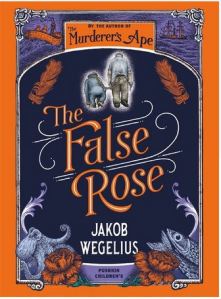 This is why I shouldn’t read sequels. The Murderer’s Ape was a pure delight and perfect companion on my long sea voyage to Spain back in May. Its every character and plot twist twinkle and the pages flew by. By contrast, this was … fine, but unnecessary. The plot turns on a pearl necklace Sally Jones the gorilla and Captain Koskela find hidden on their boat. Its centerpiece is a carved mother-of-pearl and silver rose and it belongs to Rose Henderson, the estranged daughter of Shetland Jack. They decide to return it to the rightful owner, but before they can track Rose down the necklace is stolen and a whole spiral is set underway. Once again, Sally Jones is separated from her captain and has to survive by her wits. Held prisoner by Glasgow bootleggers, she has to let them think her deaf and dumb, but makes friends with a former boxer named Bernie, who’s in thrall to his sister, harsh gang boss Moira. The final 100 pages or so, as everything finally unwinds, is satisfying, but it took me forever to make it there. I missed the supporting characters of the first book and gangster stories aren’t my jam.
Surviving Home by Katerina Canyon & B: A Year in Plagues and Pencils by Edward Carey
Catching up on two recent review books today: a hard-hitting volume of poems about family dysfunction and racism; and the pandemic year as captured in black-and-white illustrations and short autobiographical essays.
Surviving Home by Katerina Canyon
 Katerina Canyon is from Los Angeles and now lives in Seattle. This is her second collection. As the poem “Involuntary Endurance” makes clear, you survive an upbringing like hers only because you have to. This autobiographical collection is designed to earn the epithet “unflinching,” with topics including domestic violence, parental drug abuse, and homelessness. When you hear that her father once handcuffed and whipped her autistic brother, you understand why “No More Poems about My Father” ends up breaking its title’s New Year’s resolution!
Threatening forces are everywhere: bears and sharks recur, and beet juice mimics blood. (Though there’s a nice cornbread metaphor, it, too, holds menace: “I have no trust in humanity / I lost that when I was 3 / It was baked in a pan of / Cornbread and eaten by // Demons.”)
Canyon also has anti-Trump material, and the poems about the ongoing effects of racism reminded me of some of Natasha Trethewey’s work. I particularly liked a poem structured around words and phrases coined in the year of the poet’s birth. There’s plenty of noteworthy language and images here, but the tough subject matter may limit the audience.
With thanks to Kelsay Books and the publicist for the free e-copy for review.
B: A Year in Plagues and Pencils by Edward Carey
 I was a huge fan of Edward Carey’s Little. His black-and-white sketches kept turning up on my Twitter timeline throughout 2020. He sent the first, “A determined young man,” into the world on March 19, 2020, vowing to make a drawing a day until the pandemic was over. Perhaps a rash thing to agree to, and at times he regretted it, but he kept his promise for 500 days and wore out many a B pencil in the process.
This book covers the first 365 days of the project and also provides a rough recap of the turbulent year that was 2020. Carey’s subjects include politicians (his leanings are clear from his unflattering caricatures of Trump and other Republicans), writers, actors, birds and family members. Some were by request; others marked a public figure’s death. You can track the vaccine’s progress and outrage over the deaths of George Floyd, Breonna Taylor and other victims of institutional racism. As an Englishman in Texas, Carey feels he doesn’t understand the country he lives in (though he loves its wildlife) and finds himself missing London.
Carey’s style veers towards the grotesque, so is best suited to fictional characters and those with distinctive features. I particularly liked a drawing of Rudy Guiliani dripping hair dye, the two-part spread of Ebenezer Scrooge on Christmas Eve versus Christmas Day, and a farewell to 2020 as a wizened ogre opposite a hello to 2021 as a cheerful baby.
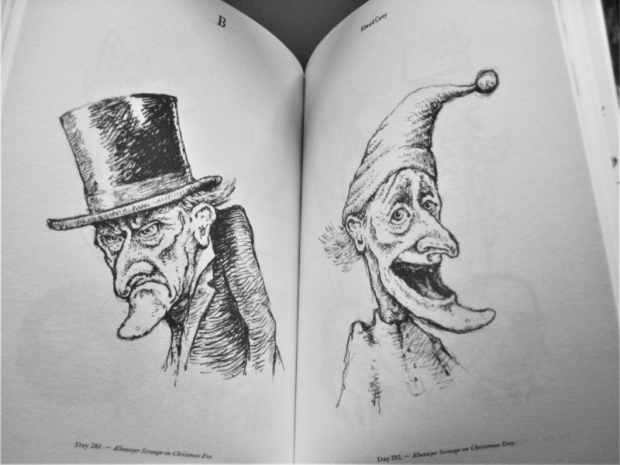
I was also delighted to see a drawing of W.N.P. Barbellion to mark the inaugural Barbellion Prize. In general, though, I doubt the value of simple reproductions of well-known paintings and photographs. If the goal was lifelike versions of real people, some of these miss the mark; the features are simply off. And Carey is not always great at rendering non-white people.
The pleasure of this collection is in seeing the variety from one page to the next: a laughing Albert Einstein, William Shakespeare, a capybara, and so on. There are one to four of the drawings printed per page, with short reflections from Carey interspersed between sections. In these mini-essays he talks about his process, where he got his ideas, and lockdown life with his family (his wife is author Elizabeth McCracken; they have two children and a cat).
One day noses will be permissible again. And then there will be mouths, too. And chins, likewise, shall be popular. … I’m forgetting faces. I miss people, of course, terribly. Yet every day out of the window there are still people there. I see these individuals walking up and down the street. Can’t see their faces. Only their eyes and the top of their heads. Like a new breed of human, with no nose, no mouth, no chin. Who are they? Don’t get too close. Everyone’s keeping their distance.
The drawings were a way of marking time, so the book serves as a time capsule of sorts. The text is perhaps an afterthought, and yet the random assemblage of illustrations couldn’t stand without it (I tried to imagine them filling an exhibit, but extensive captioning would be required). I feel a bit uncharitable for criticizing the artwork, given the constraints and the fact that I couldn’t produce even one sketch of nearly this quality. This was a perfectly pleasant and quick read, just not one that will stay with me. I think the same is true of a number of the other Covid diaries I’ve read: they feel ephemeral. However, it’s an attractive small-format hardback that should make it into many a Christmas stocking this year.
With thanks to Gallic Books for the free copy for review.
P.S. This is my 1,000th post!
20 Books of Summer, #12–13, BLUE: Johnson & MacMahon
Blue has been the most common colour in my themed summer reading, showing up in six out of the 20 titles. In the two books I’m reviewing today, it’s used somewhat ironically, with a YA memoir subverting its association with conventional masculinity and a Women’s Prize-longlisted novel contrasting idyllic holiday weather with the persistence of grief.
All Boys Aren’t Blue: A Memoir-Manifesto by George M. Johnson (2020)
“you sometimes can’t see yourself if you can’t see other people like you existing, thriving”
Growing up in New Jersey in the late 1980s and early 1990s, Johnson knew he was different. He preferred Double-Dutch to football, called his classmates “Honeychild,” and begged for a pair of cowboy boots instead of the sneakers everyone else coveted. His effeminate ways earned the expected epithets. Even though he had plenty of LGBT precedents in his own family – a gay older half-brother, a lesbian aunt, a trans cousin – and his beloved Nanny assured him he was loved for who he was, he didn’t publicly confess his identity until he got to college and felt accepted as part of a fraternity. In fact, there are three instances in the book when, as a teenager, he’s asked directly if he’s gay and he denies it. (Do you hear a rooster?)
 Johnson is a warm, earnest storyteller and deftly chooses moments when he became aware of the social disadvantages inherent to his race and sexuality. His memoir is marketed to teens, who should find a lot to relate to here, such as dealing with bullies and realizing that what you’ve been taught is comforting myth. In the “‘Honest Abe’ Lied to Me” chapter, he discovers in middle school that Lincoln didn’t actually support racial equality and questions whether landmark achievements by Black people are just conciliatory tokens – “symbolism is a threat to actual change—it’s a chance for those in power to say, ‘Look how far you have come’ rather than admitting, ‘Look how long we’ve stopped you from getting here.’”
The manifesto element of the book lies in its investigation of the intersection of Blackness and queerness. Johnson is an activist and wants queer Black kids to have positive role models. He knows he was lucky to have family support and middle-class status; many have it harder, getting thrown out and ending up homeless. Multiple chapters are devoted to his family members, some in the form of letters. The structure didn’t always feel intuitive to me, with direct address to his cousin or grandmother coming seemingly out of nowhere. The language is informal, but that doesn’t excuse “me and so-and-so” constructions or referring to “people that” instead of “who”; young adult readers need to have good grammar reinforced.
I also questioned whether the author needed to be so sexually explicit in describing his molestation at the hands of an older male cousin (he has about a zillion cousins) and losing his virginity at age 20. Then again, today’s teens are probably a lot more sexually knowledgeable than I was 20+ years ago. All in all, I wondered if Johnson is more successful as a motivational speaker than a writer. I think his occasional bravado (he closes his introduction with “This is the story of George Matthew Johnson. This is a story for us all.”) would come across better in person than in print. Still, considering I couldn’t be much further from the target audience, I found this a sweet and engaging read. (Public library) 
Nothing but Blue Sky by Kathleen MacMahon (2020)
“Incongruous, the situations we found ourselves in. To be talking about such sorrow against the backdrop of a Mediterranean summer.”
SPOILERS in the following; otherwise it would be difficult to say anything other than that this novel is a deeply touching look at loss and what comes next. When I read a synopsis, I thought it would be Sue Miller’s Monogamy with the roles reversed, but that’s because the blurb makes it sound like there were secrets in David and Mary Rose’s marriage that only emerge after her death in a plane crash. I was on the alert for something sordid and earth-shattering, but in fact this is a quiet novel about what goes unsaid in any marriage.
 David, a foreign correspondent on Dublin’s television news, always put his career first, his sophistication and wicked humour masking the wounds of an emotionally chilly upbringing. Mary Rose, a hospital midwife, was the perfect foil, deflating his pomposity and calling him out on any unfeeling quips. Her loving nature was the soul of their relationship. Now that’s she gone, David regrets that he didn’t take more seriously her desperation to have children, a desire he didn’t share. His voice, even flattened and numbed by grief, is a delight. For instance, here’s how he describes Irish seaside holidays: “Summer to us was freezing your arse off on a windswept beach, with a trip to the ice-cream shop if you were lucky. Of course, they never had the ice-cream you wanted.”
The novel is set in Aiguaclara, a hidden gem on Spain’s Costa Brava where David and Mary Rose holidayed every summer for 20 years. Against his friends’ advice, he’s decided to come back alone this year. Although most of the book remembers their life together and their previous vacations here, there is also a present storyline running underneath. Initially subtle, it offers big surprises later on. These I won’t spoil; I’ll only say that David’s cynical belief that he’ll never experience happiness again is proven wrong. Grief, memory, fate: some of my favourite themes, elegantly treated. This reminded me of Three Junes and also, to a lesser extent, The Heart’s Invisible Furies. (Public library) 
Coming up next: Pairs of green and red titles.
Would you be interested in reading one of these?
20 Books of Summer, #10–11: Dabiri and McDonald on Whiteness
I didn’t jump on the antiracist books bandwagon last year. Instead, my way into the topic was a work I became aware of through the online Church Times Festival of Faith and Literature. I was on the Church House website to buy books by several of the weekend’s contributors and a forthcoming release being advertised jumped out at me for its provocative title and fabulous cover: God Is Not a White Man. I promptly pre-ordered. It never fails to put this Gungor song in my head, and seemed an ideal way to engage with the issues from a perspective that makes sense to me. So for this latest batch of colour-themed summer reads I’m thinking about whiteness from the point of view of women of colour based in England and Ireland.
God Is Not a White Man (And Other Revelations) by Chine McDonald (2021)
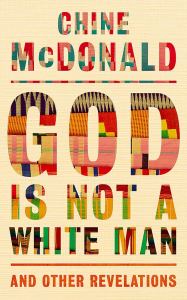 Here’s where McDonald is coming from: she moved to England from Nigeria with her family as a small child, grew up on the Evangelical end of Anglicanism, works for Christian Aid, and is married to a white man. She’s used to being the only Black person in the room when she steps into a church or other Christian setting in the UK. “It is a sad fact that the Church often lags behind on racial justice, remaining intransigent on issues that the world has long since labelled oppressive and unjust [such as opposing interracial marriage].” Always in the background for her is the way Black people are being treated in other parts of the world: although she wrote the bulk of this book before George Floyd’s murder, she has updated it with details about Donald Trump’s late outrages and the Black Lives Matter movement. Her chief concern is for her young son, growing up as a male with brown skin.
The book is shaped around moments of revelation large and small. For instance, McDonald opens with the first time she saw a God who looked like her. It was through The Shack, a bestselling novel by William P. Young in which God the Father is portrayed as a big Black woman (played by Octavia Spencer in the film version). She notes how important such symbolism is: “When a Black woman only sees God reflected as a white man, then somewhere in her subconscious she believes that white men are better representations of God than she is, that she is made less in the image of God than they are.” Other topics are the importance of equal access and education (she went to Cambridge), and standards of beauty. Beyoncé helped her to love her body, curves and all, and feel a sense of Black sisterhood. I liked getting glimpses into her life, such as her big Nigerian wedding to Mark. (New purchase)
Links between the two books: The authors’ Nigerian heritage, plus McDonald mentions that she interviewed Dabiri at Greenbelt Festival in 2019 and has been trying to get up the courage to return to her natural hair, as Dabiri encouraged her (the Natural Hair Movement is the topic of Dabiri’s first book, Don’t Touch My Hair).
What White People Can Do Next: From Allyship to Coalition by Emma Dabiri (2021)
Another terrific cover with a bold sans serif font. This is clearly in the mould of 2020’s antiracist books, but Dabiri wouldn’t thank you for considering her under the same umbrella. She doesn’t like the concept of allyship because it reinforces unhelpful roles: people of colour as victims and white people as the ones with power who can come and save the day.
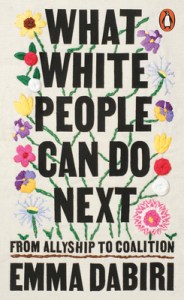 Dabiri is Irish and Nigerian and grew up in the USA and Ireland. Her experience of racism was much more overt than McDonald’s, including verbal and physical abuse. She challenges white people to stop the denial: ‘whiteness’ and ‘blackness’, though artificial constructs, have been with us since at least the 1660s, so racism is a system we have all been born into. “We’ve been conditioned to see the world through that lens for centuries. … over that you have no control. What you do have control over is what you do next.”
Like McDonald, Dabiri emphasizes that monolithic categories like white and Black flatten a huge diversity of people and experiences (McDonald has a chapter entitled “Africa Is Not a Country”). But Dabiri has a more political (as well as, of course, a completely secular) approach: She wants readers to interrogate capitalism and think about how resources can be redistributed more fairly. Her notion of coalition is about identifying common ground and shared goals. “On the most basic level, we have to see our struggles as interconnected because they are, and because we are.”
Reading this was like encountering an extended TED talk. I wasn’t taken enough with Dabiri’s writing style to seek out her previous book, but if you have an interest in the subject matter you may as well pick up this 150-pager. It was small enough for me to pack in the back of our booze bag and read a bit of during a neighbour’s outdoor birthday party last weekend. I got a couple of “huh” looks, but that may have been just for reading during a party at all rather than for the specific content. (Public library)
Would I say that I enjoyed reading these two books? That’s a tough question. They were worthwhile, but also tedious in places, such that I did plenty of skimming. History, politics, sociology: these fields are not my reading comfort zone. The theological bent to McDonald’s work made it more to my taste than Dabiri’s contribution. Still, my whole reason for avoiding antiracist books was that I questioned my motivation. I didn’t want to read them because I felt I should; a sense of obligation is a recipe for resentment when it comes to books. I’m not sure to what extent readers should read things they feel they must. I look to books for learning opportunities, yes, but also for escape and pleasure. But maybe it’s valuable simply to show willing, to get outside your reading comfort zone and be open to hearing new ideas.
How about you? Would you pick up one of these for the educational value?
I have ALL of the rest of my 20 Books of Summer in progress at the moment. The only question is when I will next finish some!
Mary Jane by Jessica Anya Blau (Blog Tour)
Are you having a groovy June yet? If not, I have just the remedy: a juicy coming-of-age novel that drops you directly into the Baltimore summer of 1975. Mary Jane Dillard, 14, lives in the upper-class white neighborhood of Roland Park. Her parents are prim types who attend church every week, belong to a country club, and pray for the (Republican) president’s health before each sit-down family dinner. When Mary Jane starts working as a daytime nanny for five-year-old Izzy, the Cones’ way of life is a revelation to her. They are messy bohemians who think nothing of walking around the house half-naked, shouting up and down the stairs at each other, or leaving a fridge full of groceries to rot and going out for fast food instead.
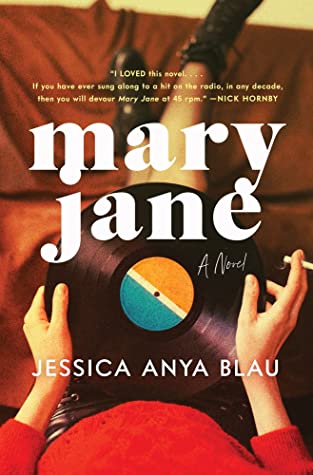 Dr. Cone is a psychiatrist whose top-secret assignment is helping a rock star to kick his drug addiction. Jimmy and his actress wife, Sheba, move into the Cones’ attic for the summer. If they go out in public, they wear wigs and pretend to be friends visiting from Rhode Island. While the Cones are busy monitoring or trying to imitate their celebrity guests, Mary Jane introduces discipline by cleaning the kitchen, alphabetizing the bookcase, and replicating her mother’s careful weekly menus with food she buys from Eddie’s market. In some ways she seems the most responsible member of the household, but in others she’s painfully naïve, entirely ignorant of sex and unaware that her name is a slang term for marijuana.
Open marriage, sex addiction and group therapy are new concepts that soon become routine for our confiding narrator, as she adopts a ‘What they don’t know can’t hurt them’ stance towards her trusting parents. Blau is the author of four previous YA novels, and while this is geared towards adults, it resonates for how it captures the uncertainty and swirling hormones of the teenage years. Who didn’t share Mary Jane’s desperate curiosity to learn about sex? Who can’t remember a moment of realization that parents aren’t right about everything?
Music runs all through the book, creating and cementing bonds between the characters. Mary Jane sings in the choir and shares her mother’s love of both church music and show tunes. Jimmy and Sheba are always making up little songs on which Mary Jane harmonizes, and a clandestine trip to a record store in an African American part of town forms one of the novel’s pivotal scenes. The relationship between Mary Jane and Izzy, who is precocious and always coming out with malapropisms, is touching, and Blau cleverly inserts references to the casual racism and antisemitism of the 1970s.
I love it when a novel has a limited setting and can evoke a sense of wistfulness for a golden time that will never come again. I highly recommend this for nostalgic summer reading, particularly if you’ve enjoyed work by Curtis Sittenfeld – especially Prep and Rodham.
My thanks to Harper360 UK and Anne Cater for arranging my proof copy for review.
I was delighted to be part of the blog tour for Mary Jane. See below for details of where other reviews and features have appeared or will be appearing soon.

An Embarrassment of Riches at the (Digital) Hay Festival 2021
There was a phenomenal program for this year’s digital Hay Festival. I signed up to a whopping eight events and enjoyed them all. If you missed watching live, it’s not too late to donate and catch up on the archived talks. For three of these, the host-cum-interviewer appeared in person on a studio stage, with the guest(s) joining, perhaps from thousands of miles away, on a large screen mounted on the wall behind them. I thought this was a neat hybrid approach. The rest of my sessions had interviewer and interviewee appearing remotely on a split screen. Let me know which, if any, events you attended and how you found them.
Richard Flanagan
Flanagan’s The Living Sea of Waking Dreams is my novel of 2021 so far (my review), so it was a delight to hear him say more (and in that fantastic accent) about it in the course of a conversation with Stephanie Merritt. Tasmania, where he lives, had always seemed like an ark for species, but now they are vanishing. Ninety percent of the kelp forest has disappeared within the last 20 years because of warming oceans; there are only 300 swift parrots remaining; and the bushfires of 2018–19 were unprecedented in severity. Although he had already roughed out the novel by the time of the fires, Flanagan said he rewrote it in response to the sense of accelerating environmental collapse.

The novel’s twin themes are species extinction and personal extinction, with an elderly family matriarch being kept alive at all costs. Flanagan spoke of the “evasions of the soul” that make us ignore the environmental losses around us and refuse to die – “the final avoidance of life.” He thinks the pandemic has forced people to rethink these ideas and ponder the meaning of life. At age 21, he nearly drowned while kayaking, and ever since he has been frightened not of death, but of the pain of dying. He is not optimistic per se, but hopeful because the world is still so beautiful – on the island he goes to for writing, he is surrounded by wild creatures.
 Merritt asked about the novel’s magic realist element and how stylistically different his novels have been from each other. He was glad she found the book funny, as “life is tragicomic.” In an effort not to get stuck in a rut, he deliberately ‘breaks the mould’ after each book and starts over. This has not made him popular with his publisher!
Three take-aways:
- The one obligation of a writer? “Not to be boring.”
- Novels are not about messages; “that’s what Twitter is for.”
- “To despair is rational, but to hope is the very essence of what it means to be human.”
Rachel Clarke interviewing Jim Down and Michael Rosen
All three authors have written books about the coronavirus pandemic (I have reviewed Clarke’s Breathtaking and Rosen’s Many Different Kinds of Love). Clarke said that the belief foundational to the NHS is that all lives have equal value, but as an ICU doctor Down found that the question of who would benefit most from the use of ventilation was creeping in as there was a risk that there would be more patients than there was equipment to treat them with. With decisions needing to be made very quickly, his hospital adopted the “three wise people” collaborative method. The element that often felt lost, however, was the patient’s wishes, since they might be unresponsive and no family or other visitors were around.

Rosen, who contracted Covid-19 in March 2020 and was in an induced coma for six weeks, included letters from his medical team in his book to give a 360° view of NHS treatment. He thinks of the NHS as being almost in the role of parents, giving altruistic care and support. “Tell the truth about herd immunity” was his pithy message to the government. He read the poem “These Are the Hands,” which he wrote for the 60th anniversary of the NHS, to close.


Bryan Washington and Raven Leilani
 Last year’s Dylan Thomas Prize winner interviewed this year’s winner, and it was clear that the mutual admiration was strong. Though I had mixed feelings about Luster (my review), I was blown away by this high-level intellectual discussion. Both authors are invested in the debate around what it means to be a Black artist. Leilani said she did not want to make concessions in the form of Edie comporting herself better; this character is open about her wants, giving the novel a libidinal flavour. She said she almost envies her protagonist her autonomy, and thinks of the novel as a letter to her old self, granting permission and reassuring herself that “the mess has merit.”

Three take-aways:
- Writing offers Leilani a sanctuary or sense of control.
- While Washington sees works full of strife, grief, and malice as most likely to be considered the pinnacle of American literary fiction, he admires Luster for its theme of communion (especially via the character Akila).
- Leilani sees her novel as being in conversation with Queenie, Sula, The New Me, and Detransition, Baby.
Maggie Shipstead
 Shipstead (also a Dylan Thomas Prize winner) echoed something Leilani had said: that she starts a novel with questions, not answers. Such humility is refreshing, and a sure way to avoid being preachy in fiction. Her new novel, Great Circle, is among my most anticipated books of the year and tells the stories of a fictional female pilot from the golden age of aviation and the actress playing her in a biopic. The book was long in the gestation: In 2012 Shipstead saw a sculpture commemorating a female pilot in Auckland, and in 2014 she started researching. She came to appreciate the miracle of flight and read many books by and about female pilots. The book is dedicated to her brother, recently retired from 20 years in the Air Force. She told Sameer Rahim that, although she used to say this is not a love story, she has since changed her mind.

Three take-aways:
- Shipstead was a competitive show jumper and applied to a creative writing program on a whim.
- She has made a name for herself as a travel writer, too, often combining magazine assignments with her research for the novel (e.g., various trips to Antarctica).
- While she has appreciated the year off from Covid, she is looking forward to getting back to travelling; her first booking is a women’s wilderness experience in Alaska.
Patricia Lockwood
 Lockwood is the only novelist to be included on the Atlantic’s roster of best tweets. She and Nina Stibbe, who interviewed her, agreed that 1) things aren’t funny when they try too hard and 2) the Internet used to be a taboo subject for fiction – producing time-stamped references that editors used to remove. “I had so many observations and I didn’t know where to put them,” Lockwood said, and it seems to her perverse to not write about something that is such a major part of our daily lives. The title of her Women’s Prize-shortlisted novel, No One Is Talking About This (my review), refers to many things, including this reticence to grant the Internet a place in our discourse.

Lockwood said she has been delighted by the high-quality literary pieces coming out about her book, often in comparison with Lauren Oyler’s Fake Accounts. The timing of the publication meant that her initial (U.S.) media interviews ended up being more about Trump than she would have liked. “I think I’m not a natural fiction writer,” she said; it’s true that the novel is so autobiographical it can only be described as autofiction – the second half is all true and all sincere, she was careful to point out – but it’s a gem.
Julianne Pachico
 Like Lockwood, Pachico was part of the “10 @ 10” series featuring debut novelists (though her first book, the linked story collection The Lucky Ones, was marketed as a novel in the USA). Her new book, The Anthill, another of my most anticipated books of the year, is about a young woman returning to Medellín, Colombia, where Pachico spent her formative years. Although she is not a citizen and only goes back on a tourist visa, it feels like going home each time. For her, writing fiction has been a way of sorting out her feelings about the place. She wrote 50,000 words of the novel at her sister’s apartment in Medellín. Pachico told Rosie Goldsmith that, though she considers herself part of the Latin American literary tradition, she is conscious of presenting the country to English-speaking readers: a politically divided place that has gentrified in pockets, but is still plagued by extreme poverty and hardship. She described The Anthill as “a ghost story without ghosts.” I can’t wait to dive into my copy.

Brit Bennett
 Speaking to Arifa Akbar about The Vanishing Half, Bennett admitted that she was worried a historical setting was a cop-out, but reassured herself that she was not writing out of nostalgia and that she did not allow readers a sense of distance – the characters are so ordinary that we know we’d do the same sorts of things. She thinks of passing as a distinctly American project of self-reinvention but acknowledged that we have no definitive statistics on it because, if someone succeeds, they disappear. Some of Stella’s psychology – a very interior character who makes decisions that are difficult to understand – came from her reading of Playing Dead by Elizabeth Greenwood. She loves writing about small towns because they force people to interact with each other. Akbar noted that passing is a double-edged sword, involving subterfuge but also offering liberation (e.g. for a trans character later in the book).

Three take-aways:
- “That’s the most exciting place to be, writing into a mystery.”
- “Race is a fiction, but racism is a reality.”
- An HBO adaptation is in the works, but Bennett doesn’t know if it will cast real twins, two actors, or meld separate people using CGI.
Rachel Cusk and Sheila Heti
 I’ve read more of and gotten on better with Heti’s work than Cusk’s, so this was a rare case of being perhaps more interested in interviewer than interviewee. Heti said that, compared with the Outline trilogy, Cusk’s new novel Second Place feels wilder and more instinctual. Cusk, speaking from the Greek island of Tinos, where she is researching marble quarrying, described her book in often vague yet overall intriguing terms: it’s about exile and the illicit, she said; about femininity and entitlement to speak; about the domestic space and how things are legitimized; about the adoption of male values and the “rightness of the artist.”

Ironically, given that Cusk initially hesitated over revealing her debt to Mabel Dodge Luhan’s memoir Lorenzo in Taos, much of the discussion ended up revolving around Luhan and D.H. Lawrence, about whom Cusk now considers herself an amateur scholar. In his personal writings he reserved special scorn for Luhan, with whom he stayed in New Mexico in the 1920s. This was something Cusk wanted to explore: misogyny and Luhan’s “voice of obscurity.” She hopes that her book will contribute to a better understanding of Luhan’s; not vice versa.
Three take-aways:
- A reviewer noted the use of exclamation points, counting 189 of them in the novel. Cusk equates an exclamation point to a laying down of arms – proof that someone (especially her protagonist, M) means to be nonthreatening.
- Cusk thinks of this book as being like a play: staged and in the moment.
- A woman observing but not being noticed is, like in the Outline trilogy, Cusk’s basic framework.
Review Book Catch-Up: Ante, Evans, Foster and White
Today I have a book of poems about the Filipinx experience in the UK, a collection of short stories reflecting on racial injustice, a monograph on a bird that spells summer for many of us, and a biographical investigation into a little-understood medical condition.
Antiemetic for Homesickness by Romalyn Ante
I was drawn to this debut collection by the terrific title and cover, but also by the accolades it received: it was on the Dylan Thomas Prize longlist and the Jhalak Prize shortlist. I hope we’ll see it on the Sunday Times Young Writer of the Year Award shortlist, too. Ante grew up in the Philippines but at age 16 joined her mother in the UK, where she had moved years before to work as a nurse in the NHS. She has since followed in her mother’s footsteps as a nurse – indeed, overseas Filipinx workers (Jamaicans, too) are a mainstay of the NHS.
 Ante remembers the years when her mother was absent but promised to send for the rest of the family soon: “You said all I needed to do was to sleep and before I knew it, / you’d be back. But I woke to the rice that needed rinsing, / my siblings’ school uniforms that needed ironing.” The medical profession as a family legacy and noble calling is a strong element of these poems, especially in “Invisible Women,” an ode to the “goddesses of caring and tending” who walk the halls of any hospital. Hard work is a matter of survival, and family – whether physically present or not – bolsters weary souls. A series of short, untitled poems are presented as tape recordings made for her mother.
Food is inextricably entwined with memory (reminding me of Nina Mingya Powles’s approach in Tiny Moons) and provides some of the standout metaphors, especially in “Patis” and “Ode to a Pot Noodle.” Ante uses a lot of alliteration and adapts various forms. I especially liked “Tagay!”, a traditional drinking song, and “Mateo,” printed in the shape of a pound sign. The nuanced look at the immigrant experience reminded me of Jenny Xie’s Eye Level. Movement entails losses as well as benefits. The focus on the Filipinx experience also made me think of America Is Not the Heart. My favourite single poem was “The Making of a Smuggler,” which opens “Wherever we travel, we carry / the whole country with us – // our rice terraces are folded garments, / we have pillars of trees, a rainforest // on a hairbrush.”
Favourite lines:
“Gone are the nights he steals / the moon with a mango picker / and swaps it for her pocket mirror”
“The yellow admission papers in my hands escaped / flustering at my face into a flight of orioles.”
“I am halved in order to be whole – / I rebuild by leaving / everything I love.”
With thanks to Chatto & Windus for the free copy for review.
The Office of Historical Corrections by Danielle Evans
To boil these six stories and a novella down to the topic of race in America risks painting them as solemn or strident – more concerned with meaning than with art – when the truth is that they are playful and propulsive even though they keep cycling back to bereavement and injustice. Several of the protagonists are young Black women coming to terms with a loss.
 In “Happily Ever After,” Lyssa works in the gift shop of a Titanic replica and is cast as an extra in a pop star’s music video. Mythical sea monsters are contrasted with the real dangers of her life, like cancer and racism. “Anything Could Disappear” was a favourite of mine, though it begins with that unlikely scenario of a single woman acquiring a baby as if by magic. What starts off as a burden becomes a bond she can’t bear to let go. A family is determined to clear the name of their falsely imprisoned ancestor in “Alcatraz.” In “Richard of York Gave Battle in Vain” (a mnemonic for the colours of the rainbow), photojournalist Rena is wary about attending the wedding of a friend she met when their plane was detained in Africa some years ago. The only wedding she’s been in is her sister’s, which ended badly.
Mistakes and deceit seem to follow these characters. In the title novella that closes the book, Cassie and her colleagues combat fake news, going around putting correction labels on plaques that whitewash history. When she and her former colleague meet up in Wisconsin to find the truth behind a complex correction case, a clash with a white supremacist group quickly turns pedantry into a matter of life and death. The story I’d heard the most about beforehand was “Boys Go to Jupiter,” about a college girl who dons a Confederate flag bikini, not caring what message it sends to others in her dorm. It turns out she has history with a Black family, but has chosen to airbrush this experience out of her life.
There was only one story I didn’t care for, “Why Won’t Women Just Say What They Want,” about a celebrity who turns apologizing into performance art. Overall, this is a very strong collection I would recommend to readers of Brit Bennett and Raven Leilani, with some stories also reminding me of recent work by Curtis Sittenfeld and Mary South. I’ll be sure to seek out Evans’s previous book (also short stories), too.
With thanks to Picador for the proof copy for review.
The Screaming Sky by Charles Foster
The other week I was volunteering at our local community garden and looked up to see a dozen common swifts wheeling over the Kennet & Avon canal and picking off insects among the treetops. I hope this fellow Foster (for whom my husband was once confused on a nature conference attendee list) would be proud of me for pausing to gaze at the birds for a while. My impression of the author is as a misanthropic eccentric. A Renaissance man as well versed in law and theology as he is in natural history, he’s obsessed with swifts and ashamed of his own species: for looking down at their feet when they could be watching the skies; for the “pathological tidiness” that leaves swifts and so many other creatures no place to live.
 The obsession began when he was eight years old and someone brought him a dead swift fledgling for his taxidermy hobby. Ever since, he’s dated the summer by their arrival. “It is always summer for them,” though, as his opening line has it. This monograph is structured chronologically. Much like Tim Dee does in Greenery, Foster follows the birds for a year: from their winter territory in Africa to the edges of Europe in spring and then to his very own Oxford street in high summer. When they leave, he’s bereft and ready to book a flight back to Africa.
Along the way, Foster delivers heaps of information: the fossil evidence of swifts, how they know where to migrate (we have various theories but don’t really know), their nesting habits and lifespan, and the typical fates of those individuals that don’t survive. But, thumbing his nose at his “ex-friend” (a closed-minded biologist he repeatedly, and delightfully, rails against), he refuses to stick to a just-the-facts approach. Acknowledging the risks of anthropomorphizing, he speaks of swifts as symbols of aspiration, of life lived with intensity. He believes that we can understand animal emotions analogously through our own, so that, inappropriate as such words might seem, we can talk about what birds hope and plan for. He scorns reductive ecosystem services lingo that defines creatures by what we get out of them.
Also like Dee, Foster quotes frequently from poetry. His prose is full of sharp turns of phrase and moments of whimsy and made me eager to try more of his work (I know the most about but have not yet read Being a Beast).
Swifts know the roar of lions better than the roar of the M25, the piping of hornbills better than the Nunc Dimittis of parish Evensong … Are memories of our eaves spiralling high above the Gulf of Guinea? … They don’t seem to prevaricate. One moment they’re there, the next they’re off, diving straight into the journey. It’s the way we should run into cold water.
 As I’ve found with a number of Little Toller releases now (On Silbury Hill, Snow, Landfill), knowledge meets passion to create a book that could make an aficionado of the most casual of readers. Towards the close I was also reminded of Richard Smyth’s An Indifference of Birds: “When Homo sapiens has gone there will be lots of ideal swift holes in the decaying buildings we’ll leave behind.” It’s comforting to think of natural cycles continuing after we’re gone … but let’s start making the space for them now. Jonathan Pomroy’s black-and-white illustrations of swift behaviour only add to this short book’s charms.
With thanks to Little Toller Books for the free copy for review.
Waiting for Superman: One Family’s Struggle to Survive – and Cure – Chronic Fatigue Syndrome by Tracie White
Like Suzanne O’Sullivan’s books (most recently, The Sleeping Beauties), this is presented as an investigation into a medical mystery. White, a Stanford Medicine journalist, focuses on one family that has been indelibly changed by chronic fatigue syndrome – now linked with myalgic encephalomyelitis and termed ME/CFS for short. Whitney Dafoe was a world traveller and promising photographer before, in 2010, a diagnosis of ME/CFS explained his exhaustion and gastrointestinal problems. By the time White first met the family in 2016, the thirtysomething was bedbound in his parents’ home with a feeding tube, only able to communicate via gestures and rearranging Scrabble tiles. He couldn’t bear loud noises, or to be touched. At times he was nearly comatose.
 Whitney’s father, Ron Davis, is a Stanford geneticist whose research has contributed to the Human Genome Project. He has devoted himself to studying ME/CFS, which affects 20 million people worldwide yet receives little research funding; he calls it “the last major disease we know nothing about.” Testing his son’s blood, he found a problem with the citric acid cycle that produces ATP, essential fuel for the body’s cells – proof that there was a physiological reason for Whitney’s condition. Frustratingly, though, a Stanford colleague who examined Whitney prescribed a psychological intervention. This is in line with the current standard of care for ME/CFS: a graded exercise regime (nigh on impossible for someone who can’t get out of bed) and cognitive behavioural therapy.
White delves into Whitney’s past, looking for clues to what could have triggered his illness (having mono in high school? a parasite he picked up in India?). She also goes back to the mid-1980s to consider the Lake Tahoe outbreak of ME/CFS, whose victims “looked too healthy to be sick and were repeatedly disbelieved.” The media called it “yuppie flu,” downplaying the extreme fatigue involved. White also meets Laura Hillenbrand, author of Seabiscuit, who suffers from ME/CFS and managed to write her bestselling books from bed. Like Whitney, she only has a certain allotment of energy and mustn’t use it up too fast.
- A neat connection: Stephanie Land, author of Maid, was Whitney’s ex-girlfriend when he was 19 and living in Alaska; she wrote a Longreads article about their relationship.
- The title is from a Flaming Lips lyric and expresses Whitney’s trust in his dad’s ability to cure him; the U.S. title is The Puzzle Solver and the working title was The Invisible Patient.
With thanks to Atlantic Books for the free copy for review.
Would you be interested in reading one or more of these?
Booker Prize 2020: Two More Shortlist Reviews and a Prediction
The 2020 Booker Prize will be announced on Thursday the 19th. (Delayed from the 17th, the date on my commemorative bookmark, so as not to be overshadowed by the release of the first volume of Barack Obama’s presidential memoirs.) After I reviewed Burnt Sugar and correctly predicted half of the shortlist in this post, I’ve managed to finish another two of the novels on the shortlist, along with two more from the longlist. As sometimes happens with prize lists – thinking also of the Women’s Prize race in 2019 – this year’s shortlist fell into rough pairs: two stark mother–daughter narratives, two novels set in Africa, and two gay coming-of-age stories.

The New Wilderness by Diane Cook
In a striking opening to a patchy novel, Bea goes off to the woods to give birth alone to a stillborn daughter. It’s such a different experience to when she birthed Agnes in a hospital eight years ago. Now, with coyotes and buzzards already circling, there’s no time for sentimentality; she turns her back on the baby and returns to the group. Bea is part of a wilderness living experiment that started out with 20 volunteers, but illness and accidents have since reduced their number.
 Back in the toxic, overcrowded City, Bea was an interior decorator and her partner a professor of anthropology. Bea left to give Agnes a better chance at life; like so many other children, she had become ill from her polluted surroundings. Now she is a bright, precocious leader in the making, fully participating in the community’s daily chores. Settlement tempts them, but the Rangers enforce nomadism. Newcomers soon swell their numbers, and there are rumors of other groups, too. Is it even a wilderness anymore if so many people live in it?
The cycles of seasons and treks between outposts make it difficult to get a handle on time’s passing. It’s a jolt to realize Agnes is now of childbearing age. Only when motherhood is a possibility can she fully understand her own mother’s decisions, even if she determines to not repeat the history of abandonment. The blurb promised a complex mother–daughter relationship, but this element of the story felt buried under the rigor of day-to-day survival.
It is as if Cook’s primary interest was in how humans would react to being returned to primitive hunter–gatherer conditions – she did a lot of research into Native American practices, for instance, and she explores the dynamics of sex and power and how legends arise. As a child I was fascinated by Native cultures and back-to-the-land stories, so I enjoyed the details of packing lists, habits, and early rituals that form around a porcelain teacup.
But for me some nuts and bolts of storytelling were lacking here: a propulsive plot, a solid backstory, secondary characters that are worthwhile in their own right and not just stereotypes and generic roles. The appealing description induced me to overcome my usual wariness about dystopian novels, but a plodding pace meant it took me months to read. A lovely short epilogue narrated by Agnes made me wonder how much less tedious this chronicle might have been if told in the first person by Bea and Agnes in turn. I’ll try Cook’s story collection, Man V. Nature, to see if her gifts are more evident in short form.
My rating: 
My thanks to Oneworld for the free copy for review.
Real Life by Brandon Taylor
 Over the course of one late summer weekend, Wallace questions everything about the life he has built. As a gay African American, he has always been an outsider at the Midwestern university where he’s a graduate student in biochemistry. Though they vary in background and include several homosexuals, some partnered and some unattached, most of his friends are white, and he’s been so busy that he’s largely missed out on evening socializing by the lake – and skipped his father’s funeral (though there are other reasons for that as well).
Tacit prejudice comes out into the open in ugly ways in these few days. When he finds his nematode experiments sabotaged, a female colleague at his lab accuses him of misogyny, brandishing his identity as a weapon against him: “you think that you get to walk around because you’re gay and black and act like you can do no wrong.” Then, in a deliciously awkward dinner party scene, an acquaintance brings up Wallace’s underprivileged Alabama upbringing as if it explains why he’s struggling to cope in his academic career.
Meanwhile, Wallace has hooked up with a male – and erstwhile straight – friend, and though there is unwonted tenderness in this relationship, there is also a hint of menace. The linking of sexuality and violence echoes the memories of abuse from Wallace’s childhood, which tumble out in the first-person stream of consciousness of Chapter 5. Other male friends, too, are getting together or breaking apart over mismatched expectations. Kindness is possible, but built-in injustice and cruelty, whether vengeful or motiveless, too often take hold.
There are moments when Wallace seems too passive or self-pitying, but the omniscient narration emphasizes that all of the characters have hidden depths and that emotions ebb and flow. What looks like despair on Saturday night might feel like no big deal come Monday morning. I so admired how this novel was constructed: the condensed timeframe, the first and last chapters in the past tense (versus the rest in the present tense), the contrast between the cerebral and the bodily, and the thematic and linguistic nods to Virginia Woolf. A very fine debut indeed.
My rating:
I also read two more of the longlisted novels from the library:
Such a Fun Age by Kiley Reid
 Such a fun book! I’d read the first chapter earlier in the year and set it aside, thinking it was too hip for me. I’m glad I decided to try again – it was a great read, so assured and contemporary. Once I got past a slightly contrived first chapter, I found it completely addictive. The laser-precision plotting and characterization reminded me of Jennifer Egan, Jonathan Franzen and Zadie Smith at their peak, but the sassy voice is all Reid’s own. There are no clear villains here; Alix Chamberlain could easily have filled that role, but I felt for her and for Kelley as much as I did for Emira. The fact that I didn’t think anyone was completely wrong shows how much nuance Reid worked in. The question of privilege is as much about money as it is about race, and these are inextricably intertwined.
Love and Other Thought Experiments by Sophie Ward
 An intriguing set of linked short stories that combine philosophy and science fiction. Rachel and Eliza are preparing to have a baby together when an ant crawls into Rachel’s eye and she falls ill. Eliza wants to believe her partner but, as a scientist, can’t affirm something that doesn’t make sense (“We don’t need to resort to the mystical to describe physical processes,” she says). Other chapters travel to Turkey, Brazil and Texas – and even into space. It takes 60+ pages to figure out, but you can trust all the threads will converge around Rachel and her son, Arthur, who becomes an astronaut. I was particularly taken by a chapter narrated by the ant (yes, really) as it explores Rachel’s brain. Each section is headed by a potted explanation of a thought experiment from philosophy. I wasn’t entirely sure what to make of the alternative future of the two final chapters. Still, I was impressed with the book’s risk-taking and verve. It’s well worth making a rare dip into sci-fi for this one.
Back in September I still thought Hilary Mantel would win the whole thing, but since her surprise omission from the shortlist I’ve assumed the prize will go to Shuggie Bain by Douglas Stuart. This was a DNF for me, but I’ll try it again next year in case it was just a matter of bad timing (like the Reid and The Go-Between – two books I attempted a second time this year and ended up loving). Given that it was my favorite of the ones I read, I would be delighted to see Real Life win, but I think it unlikely. My back-up prediction is The Shadow King by Maaza Mengiste, which I would consider reserving from the library if it wins.

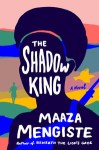
Have you read anything from the Booker shortlist?
Which book do you expect to win?
Doorstoppers of the Month: Americanah and Deerbrook
On one of my periodic trips back to the States, I saw Chimamanda Ngozi Adichie speak at a large Maryland library soon after Americanah (2013) was published. I didn’t retain much from her talk, except that her main character, Ifemelu, was a blogger about race issues and that Black hair also played a role. I was hugely impressed with Adichie in person: stylish and well-spoken, she has calm confidence and a mellifluous voice. In the “question” (comment) time I remember many young African and African American women saying how much her book meant to them, capturing the complexities of what it’s like to be Black in America.
Ironically, I have hoarded Adichie’s work over the years since then but not read it. I did read We Should All Be Feminists from the library for Novellas in November one year, but had accumulated copies of her other five books as gifts or from neighbors or the free bookshop. (Is there a tsundoku-type term for author-specific stockpiling?) Luckily, my first taste of her fiction exceeded my high expectations and whetted my appetite to read the rest.
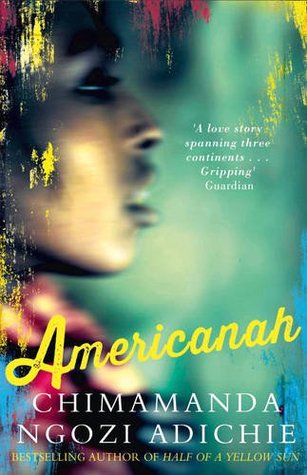
“You can’t write an honest novel about race in this country,” a secondary African American character declares at an evening salon Ifemelu attends. Adichie puts the lie to that statement: her slight outsider status allows her to cut through stereotypes and pretenses and get right to the heart of the issue. The novel may be seven years old (and hearkens back to the optimism of Barack Obama’s first election), but it feels utterly fresh and relevant at a time when we are newly aware of the insidiousness of racism. Again and again, I nodded in wry acknowledgment of the truth of Ifemelu’s cutting observations:
Job Vacancy in America—National Arbiter in Chief of ‘Who Is Racist’: In America, racism exists but racists are all gone. Racists belong to the past. Racists are the thin-lipped mean white people in the movies about the civil rights era. Here’s the thing: the manifestation of racism has changed but the language has not. So if you haven’t lynched somebody then you can’t be called a racist.
Through Ifemelu’s years of studying, working and blogging her way around the Eastern seaboard of the United States, Adichie explores the ways in which the experience of an African abroad differs from that of African Americans. These subtleties become especially clear through her relationships with Curt (white) and Blaine (African American), which involve a performative aspect and a slight tension that were absent with Obinze, her teenage sweetheart. Obinze, too, tries life in another country, moving to the UK illegally. Although they eventually earn financial success and good reputations – with Obinze a married property developer back in Nigeria – both characters initially have to do debasing work to get by.
Americanah is so wise about identity and perceptions, with many passages that resonated for me as an expat. When Ifemelu returns to Nigeria after 13 years, she doesn’t know if she or her country has changed: “She was no longer sure what was new in Lagos and what was new in herself … home was now a blurred place between here and there … there was something wrong with her. A hunger, a restlessness. An incomplete knowledge of herself.”
I loved Ifemelu’s close bond with her cousin, Dike, who is more like a little brother to her, and the way the narrative keeps revisiting a New Jersey hair salon where she is getting her hair braided. These scenes reminded me of Barber Shop Chronicles, a terrific play I saw with my book club last year. The prose is precise, insightful and evocative (“she would not unwrap from herself the pashmina of the wounded,” “There was something in him, lighter than ego but darker than insecurity, that needed constant buffing”).
On a sentence level as well as at a macro plot level, this was engrossing and rewarding – just what I want from a doorstopper. The question of whether Ifemelu and Obinze will get back together is one that will appeal to fans of Normal People – can these sustaining teenage relationships ever last? – but Ifemelu is such a strong, independent character that it’s merely icing on the cake. I’m moving on to her Women’s Prize winner, Half of a Yellow Sun, next.
Page count: 477 (but tiny type)
Source: Free bookshop
My rating: 
Deerbrook by Harriet Martineau (1839)
 This was meant to be a buddy read with Buried in Print, but I fell at the first hurdle and started skimming after 35 pages. I haven’t made it through a Victorian triple-decker in well over a decade; just since 2012, I’ve failed to get through three novels by Charles Dickens, whom I used to call my favorite author. I’m mildly disappointed in myself, but may have to accept the change in my reading tastes. In my early 20s, I loved chunky nineteenth-century novels and got my MA in Victorian Literature, but nowadays I look at one of these 500+-page classics and think, why wade through something so tortuously verbose over a matter of weeks when I could read three or more contemporary novels that will have more bearing on my life, for the same word count and time?
In any case, Deerbrook is interesting from a cultural history point of view, sitting between Austen and the Brontës or George Eliot in terms of timeline, style and themes. In the fictional Midlands village of Deerbrook, the Greys and Rowlands are neighbors engaged in a polite feud while sharing a summer house and a governess. Orphaned sisters Hester and Margaret Ibbotson, 21 and 20, come to live with the Greys, their distant cousins and known dissenters. Hester got “all the beauty,” so it’s no surprise that, after a visit from a local doctor, Edward Hope, everyone is pairing him with her in their minds. I liked an early passage voicing the thoughts of Maria Young, the crippled governess (“How I love to overlook people,—to watch them acting unconsciously, and speculate for them!”), but soon tired of the matchmaking and moralizing. A world in which everyone does their duty is boring indeed.

Martineau, though, seems like a fascinating figure I’d like to read more about. She wrote a two-volume Autobiography, which I would also skim if I could find it from a library. Just her one-page bio at the front of my Virago paperback contained many astonishing sentences: “her education was interrupted by advancing deafness, requiring her to use an ear trumpet in later life”; “Her fiancé, John Hugh Worthington, having gone insane also died”; [after writing Deerbrook] “She then collapsed into bed where she was to remain for the next five years. In 1845 Harriet Martineau was dramatically cured by mesmerism,” etc.
Page count: 523 (again, tiny type)
Source: A UK secondhand bookshop 15+ years ago
 Bookish Beck = Rebecca Foster. American transplant to England. Freelance proofreader and book reviewer.
 Bookish Beck