The Woman in Black, Train Dreams, and Absolutely & Forever (#NovNov23)
I’ve been slow off the mark this year, mostly because instead of reading a sensible one or two novellas at a time, I’ve had 10 or 15 on the go. It might mean I’ll read more overall, but from day to day it feels like crawling through loads of books, never to finish any. Except I did finally finish these three, all of which were great reads. After my thoughts on each, I’ll ponder this week’s prompt, “What Is a Novella?”
The Woman in Black by Susan Hill (1983)
This was a reread for me and our November book club book, as well as part of my casual project to read books from my birth year. I’ve generally been underwhelmed by Hill’s ghost stories, but I found this spookier than remembered and enjoyed spotting the nods to Victorian literature and to classic ghost story tropes. (Best of all, because it was so short, everyone actually read the book and came to the discussion. All 12 group members. I can’t recall the last time that happened!)
 Hill keeps the setting deliberately vague, but it seems that it might be the Lincolnshire Fens in the 1930s or so. Arthur Kipps is a young lawyer tasked with attending the funeral of old Mrs Drablow and sorting through her papers. Locals don’t envy him the time spent in Eel Marsh House, and when he starts seeing a wasting-away, smallpox-pocked woman dressed in black in the churchyard, he understands why. This place harbours a malevolent ghost, and from the empty nursery with its creaking rocking chair to the marsh’s treacherous mud, Arthur fears that it’s out to get him.
The rational male narrator who insists he doesn’t believe in ghosts until he can’t deny an experience of one is a feature of the traditional ghost story à la M.R. James – and indeed, one of the chapter titles here (“Whistle and I’ll Come to You”) is a direct adaptation of a James story title. A framing story has Kipps as an older man writing the ghost story to share with his stepchildren. Some secondary characters have Dickensian names and there’s a Bleak House-esque description of a thick fog. The novel’s title must be an homage to Wilkie Collins’s sensation novel The Woman in White, with which it shares the theme of debated parentage.
A few members of our book club had seen the play or one of two film versions. Curiously, it seems like both movies alter the ending. Why, when the last four pages are such a perfect kicker? I might have dismissed the whole as a bit dull were it not for the brilliant conclusion. (Public library) [160 pages] 
Train Dreams by Denis Johnson (2002)
This is Cathy’s example of a perfect novella. I picked it up on her recommendation and read it within a few days (though you could easily do so in one sitting). Robert Grainier is a manual labourer in the American West. His body shattered by logging before he turns 40 and his spirit nearly broken by the loss of his home to a forest fire, he looks for meaning in the tragedy and a purpose to the rest of his long life. Is he being punished for participating in the attempted lynching of a Chinese worker decried as a thief? Or for not helping an injured man he came across in the woods as a teenager?
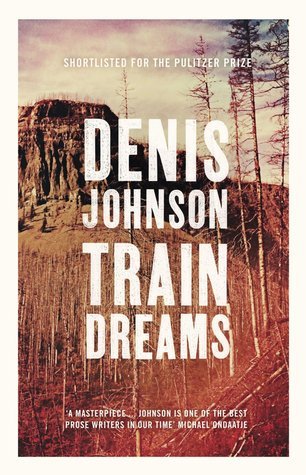 Although Grainier might appear to be a Job-like figure, his loneliness never shades into despair, lightened by comic dialogues and the mildest of supernatural interventions. He starts a haulage business and keeps dogs. There are rumours of a wolf-girl in the area, and, convinced that his dog’s new pups are part-wolf, he teaches them to howl – his own favourite way of letting off steam.
A couple of gratuitously bleak scenes (a confession of incest and an accidental death) made me think Cormac McCarthy would be a major influence, but the tone is lighter than that. Richard Brautigan came to mind, and I imagine many contemporary writers have found inspiration here: Carys Davies, Ash Davidson, Donald Ray Pollock, even Patrick deWitt.
Gritty yet light, this presents life as an arbitrary accumulation of error and incident, longing (“Pulchritude!”) and effort. Grainier is an effective Everyman, such that his story feels not just all-American but universal. (Free from a neighbour) [116 pages] 
Absolutely and Forever by Rose Tremain (2023)
I had lost track of Tremain’s career a bit; I find her work hit and miss – perhaps too varied, though judging by her last five novels, she seems to have settled on historical fiction as her wheelhouse. I wasn’t sure what to expect from this latest book, but seeing that it was novella length, I was willing to give it a try. Tremain follows her heroine, Marianne Clifford, from the 1950s up to perhaps 1970. At age 15, she falls hopelessly in love with an 18-year-old aspiring writer, Simon Hurst, and loses her virginity in the back of his pale blue Morris Minor. She feels grown-up and sophisticated, and imagines their romance as a grand adventure that will whisk her away from her parents’ stultifying ordinariness –
when I thought about my future as Mrs Simon Hurst (riding a camel in Egypt, floating along in a gondola in Venice, driving through the Grand Canyon in an open-topped Cadillac, watching elephants drink from a waterhole in Africa) and about Mummy’s future (in the red-brick house in Berkshire with the shivery birch tree and the two white columns, playing Scrabble with Daddy and shopping at Bartlett’s of Newbury), I could see that my life was going to be more interesting than hers and that she might already be envious
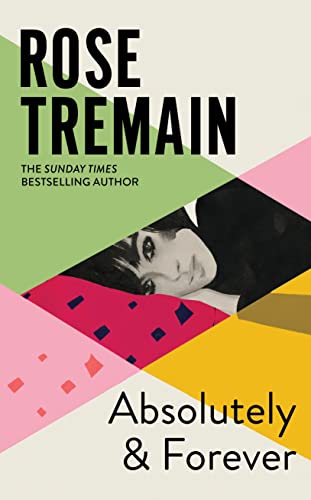 – but his new post-school life in Paris doesn’t have room for her. As she moves to London and trains for secretarial work, Marianne is bolstered by friendships with plain-speaking Scot Petronella (“Pet”) and Hugo Forster-Pellisier, her surfing and ping-pong partner on their parents’ Cornwall getaways. Forasmuch as her life changes over the next 15 years or so – taking on a traditional wife and homemaker role; her parents quietly declining – her attachment to her first love never falters.
This has the chic and convincing 1960s setting of Tessa Hadley’s work. Marianne’s narration is a delight, droll but not as blasé as she tries to appear. Tremain could have easily fallen into the trap of making her purely naïve (in the moment) or nostalgic (looking back), but instead she’s rendered her voice knowing yet compassionate, and made her a real wit (“I thought, Everything in Paris looks as if it’s practising the waltz, whereas quite a lot of things in London … appear as if they’ve just come out of hospital after a leg operation”). Pet is very funny, too. And it’s always fun for me to have nearby locations: Newbury, Reading, Marlborough. In imagining a different life for herself, Marianne resists repeating her mother’s mistakes and coincides with the rising feminist movement. There are two characters named Marianne, and two named Simon; the revelations about these doubles are breathtaking.
This really put me through an emotional wringer. It’s no cheap tear-jerker but a tender depiction of love in all its forms. I think, with Academy Street by Mary Costello, it may be my near-perfect novella. (Public library) [181 pages] 
Novellas in November, Week 2: What Is a Novella?
- Ponder the definition, list favourites, or choose ones you think best capture the ‘spirit’ of a novella.

A novella is defined by its length in words, but because that’s often difficult for readers to gauge, for this challenge we go by the number of pages instead, making 200 an absolute maximum – though some books with wide margins and spacing may top that but still seem slight enough to count (while those with tiny type can feel much longer than 160–200 pages).
Thematically, a novella is said to be concentrated on one character or small set of characters, with one plotline rather than several. This week I’ve been musing on a theory: a novella is to a novel what a memoir is to an autobiography. That is, if the latter is a comprehensive and often chronological story, the former focuses on a particular time or experience and shapes a narrative around it. What it potentially sacrifices in scope it makes up for with intensity.
But as soon as I’d formulated this hypothesis to myself, I started thinking of exceptions on either side. Train Dreams, like Silk by Alessandro Baricco and A Whole Life by Robert Seethaler, conveys a pretty complete life story. And no doubt there are many full-length novels that are almost claustrophobic in their adherence to one point of view and timeline.

The simplest way I’d put it is that a novella is a book that doesn’t outstay its welcome. I think it must be easier to write a doorstopper than a novella. Once you’ve arrived at a voice and a style, just keeping going can become a question of habit. But to continue paring back to get at the essence of a character and a situation – that takes real discipline. My other criterion would be that it has to portray the full range of human emotion, even if within a limited set of circumstances. Based on that, Train Dreams and Absolutely and Forever both triumph.
A few classic novellas that do this particularly well (links to my reviews):
Giovanni’s Room by James Baldwin
A Month in the Country by J. L. Carr
Miss Lonelyhearts by Nathanael West
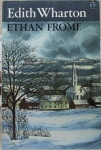
Ethan Frome by Edith Wharton


A few more contemporary novellas that do this particularly well (links to my reviews):
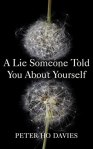
A Lie Someone Told You about Yourself by Peter Ho Davies
Our Souls at Night by Kent Haruf
Foster by Claire Keegan
A Feather on the Breath of God by Sigrid Nunez


Daphne du Maurier Reading Week: Rebecca Reread & Forster Biography
It’s been a couple of years since I took part in HeavenAli’s annual Daphne du Maurier Reading Week (the last time was with a review of My Cousin Rachel; this year, links are being hosted by Liz here).
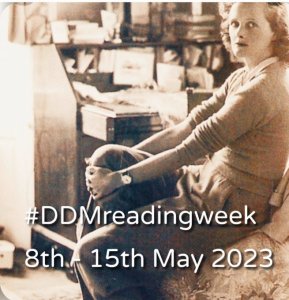
My last-minute and meagre contribution comprises an attempted reread (which ended up being a skim) of Rebecca for book club last month, and a partial, ongoing read of Margaret Forster’s cracking biography of DDM.
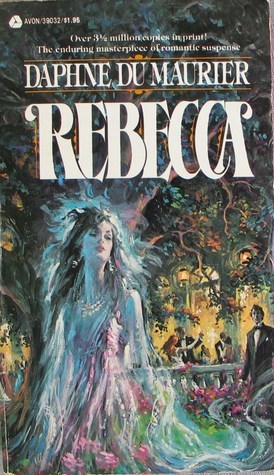
Rebecca (1938)
 I must have first read this in my early twenties, and remembered it as spooky and atmospheric. I had completely forgotten that the action opens not at Manderley (despite the exceptionally famous first line, which forms part of a prologue-like first chapter depicting the place empty without its master and mistress to tend to it) but in Monte Carlo, where the unnamed narrator meets Maxim de Winter while she’s a lady’s companion to bossy Mrs. Van Hopper. This section functions to introduce Max and his tragic history via hearsay, but I found the first 60 pages so slow that I had trouble maintaining momentum thereafter, especially through the low-action and slightly repetitive scenes as the diffident second Mrs de Winter explores the house and tries to avoid Mrs Danvers, so I ended up skimming most of it.
However, it was satisfying to rediscover the Jane Eyre parallels and there are deliciously chilling scenes, like with Mrs Danvers at the window and the way she then sabotages her young mistress at the costume ball. This was one of four rereads for book club already this year, which has the benefit of reducing pressure and sometimes increasing the comfort-read factor. We have two Rebeccas in my book club, so it seemed an appropriate choice. Others found the book as gripping as ever, with one member reading it in a day thanks to long hospital waits. Would you believe, I hadn’t at all remembered the truth of what happened to Rebecca! So there was that surprise awaiting me. In our discussion we remarked that though this has the trappings of a romance novel or mystery (e.g. see my dreadful paperback cover above!), it also has enduring literary weight – it won the National Book Award, for instance.
Daphne du Maurier by Margaret Forster (1993)
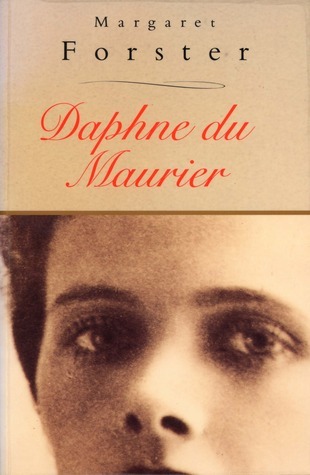 I read my first work by Forster, My Life in Houses, last year, and adored it, so the fact that she was the author was all the more reason to read this when I found a copy in a library secondhand book sale. I started it immediately after our meeting about Rebecca, but I find biographies so dense and daunting that I’m still only a third of the way into it even though I’ve been liberally skimming.
So far I have noted: du Maurier’s artistic pedigree, including her grandfather’s authorship of Trilby and her parents meeting through stage acting; her frank engagement in sexual activity, and presumed bisexuality (so far only evident through a requited crush on a teacher at her French finishing school, though perhaps there will be more to come); her first publications of short stories (“inspired by her three favourite short story writers, Maugham, Mansfield and Maupassant”) and the early novels, including one from a male point of view; her close relationship with her father and the crushing blow of his death; her determination to escape London for Cornwall; and her marriage to a soldier and ambivalent motherhood.
The last chapter I got to was all about the success of Rebecca. Though the critical reaction was generally favourable, reviewers also deemed it melodramatic … fair?
#DDMReadingWeek
Checking Up on My 2023 Reading Goals
In January I set some specific reading goals to help me prioritize books from my own shelves. It’s time to assess my progress in the first quarter.
- Catch up on review copies, e.g., by coinciding with the paperback release dates. I’ve managed to review 9 so far, which works out to three per month. Four or more a month (so, at least weekly) would be preferable.
- Authors I own 2+ unread works by – I must read at least one book by each this year. I have crossed 3 off the list thus far: Amy Bloom, Helen Dunmore and Howard Norman. However, I have also started books by Peter Ackroyd, T.C. Boyle, Brian McLaren, Wendy Perriam and Edwin Way Teale. Considering there are 70 authors on my list, though, I need to pick up the pace. I do have plans to read quite a number in connection with future challenges, but this is a project that is probably going to extend into 2024. I will have to be strict with myself and not acquire more books by these authors in the meantime!
- I will participate in at least one reading challenge per month. Success! Nordic FINDS, Reading Indies and Reading Ireland Month down, and 1940 Club coming up soon.
- Reintroduce one set-aside book to my reading pile each week. I’ve reduced this (part physical and part digital) pile by 6 so far, so I’m only at half my quota. Sigh. Once I set a book aside it seems to be the kiss of death. Only some new deadline or thematic inclusion gets me picking these back up.
- ‘Overhauls’ of earlier book hauls to ensure no more than 3 unread remaining from any one haul. We’ve booked a last-minute overnight in Bridport later this month, so I looked up what I bought on our trip there in 2019. I promptly picked up the two unread books (by Lightman and Orwell) for before we go and/or while there. To tie in with the Dorset locale, I’ll also bring along The Chosen by Elizabeth Lowry, a novel about Thomas Hardy and his first wife. It comes out in paperback this month, so it counts toward the review catch-up, and is also on this year’s Walter Scott Prize for Historical Fiction shortlist.
- At least one “just because” book per fortnight. This means anything from my own shelves that isn’t a review copy. I’m smashing this goal with a whole 15 read so far! That’s more than one per week, a good rate to try to keep up.
- (A goal I added in later.) One reread per fortnight. I’m doing surprisingly well, mostly because everything we choose for book club this year seems to be a reread, but with 4 thus far I’m averaging monthly instead. Still, not a bad effort considering I hardly ever reread.
- Request fewer 2023 review books from publishers. I sent out a big batch of requests recently, but almost all have gone ignored (the story of my year), which is probably for the best. My latest coup was securing review copies of Claire Fuller and Curtis Sittenfeld’s new novels – but each did require 3+ request e-mails!
How are you doing on your (formal/informal, explicit/tacit) 2023 reading goals?
Bill Bryson’s Notes from a Small Island: Reread and Stage Production
Bill Bryson, an American author of humorous travel and popular history or science books, is considered a national treasure in his adopted Great Britain. He is a particular favourite of my husband and in-laws, who got me into his work back in the early to mid-2000s. As I, too, was falling in love with the country, I found much to relate to in his travel-based memoirs of expatriate life and temporary returns to the USA. Sometimes it takes an outsider’s perspective to see things clearly.
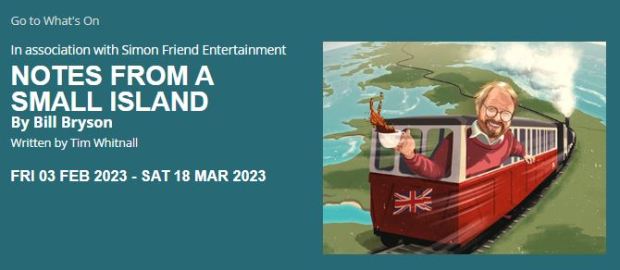
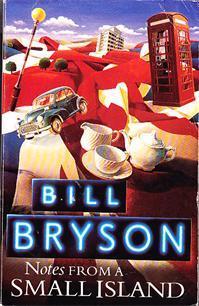 When we heard that Notes from a Small Island (1995), his account of a valedictory tour around Britain before returning to live in the States for the first time in 20 years, had been adapted into a play by Tim Whitnall and would be performed at our local theatre, the Watermill, we thought, huh, it never would have occurred to us to put this particular book on stage. Would it work? we wondered. The answer is yes and no, but it was entertaining and we were glad that we went. We presented tickets as my in-laws’ Christmas present and accompanied them to a mid-February matinee before supper at ours.
A few members of my book club decided to see the show later in the run and suggested we read – or reread, as was the case for several of us – the book in March. I started my reread before attending the play and had gotten through the first 50 pages, which is mostly about his first visit to England in 1973 (including a stay in a Dover boarding-house presided over by the infamously officious “Mrs Smegma”). This was ideal as the first bit contains the funniest stuff and, with the addition of some autobiographical material from later in the book plus his 2006 memoir The Life and Times of the Thunderbolt Kid, made up the entirety of the first act.

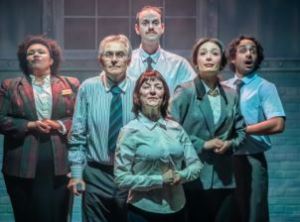
Photos are screenshots from the Watermill website.
Bryson traveled almost exclusively by public transport, so the set had the brick and steel walls of a generic terminal, and a bus shelter and benches were brought into service as the furnishing for most scenes. The problem with frontloading the play with hilarious scenes is that the second act, like the book itself on this reread, became rather a slog of random stops, acerbic observations, finding somewhere to stay and something to eat (often curry), and then doing it all over again.
Mark Hadfield, in the starring role, had the unenviable role of carrying the action and remembering great swathes of text lifted directly from the book. That’s all well and good as a strategy for giving a flavour of the writing style, but the language needed to be simplified; the poor man couldn’t cope and kept fluffing his lines. There were attempts to ease the burden: sections were read out by other characters in the form of announcements, letters or postcards; some reflections were played as if from Bryson’s Dictaphone. It was best, though, when there were scenes rather than monologues against a projected map, because there was an excellent ensemble cast of six who took on the various bit parts and these were often key occasions for humour: hotel-keepers, train-spotters, unintelligible accents in a Glasgow pub.

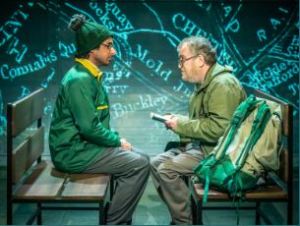
The trajectory was vaguely southeast to northwest – as far as John O’Groats, then back home to the Yorkshire Dales – but the actual route was erratic, based on whimsy as much as the availability of trains and buses. Bryson sings the praises of places like Salisbury and Durham and the pinnacles of coastal walks, and slates others, including some cities, seaside resorts and tourist traps. Places of personal significance make it onto his itinerary, such as the former mental asylum at Virginia Water, Surrey where he worked and met his wife in the 1970s. (My husband and I lived across the street from it for a year and a half.) He’s grumpy about having to pay admission fees that in today’s money sound minimal – £2.80 for Stonehenge!
 The main interest for me in both book and play was the layers of recent history: the nostalgia for the old-fashioned country he discovered at a pivotal time in his own young life in the 1970s; the disappointments but still overall optimism of the 1990s; and the hindsight the reader or viewer brings to the material today. At a time when workers of every type seem to be on strike, it was poignant to read about the protests against Margaret Thatcher and the protracted printers’ strike of the 1980s.
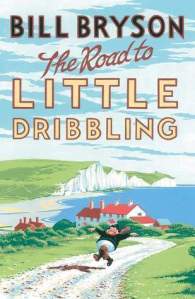 The central message of the book, that Britain has an amazing heritage that it doesn’t adequately appreciate and is rapidly losing to homogenization, still holds. Yet I’m not sure the points about the at-heart goodness and politeness of the happy-with-their-lot British remain true. Is it just me or have general entitlement, frustration, rage and nastiness taken over? Not as notable as in the USA, but social divisions and the polarization of opinions are getting worse here, too. One can’t help but wonder what the picture would have been post-Brexit as well. Bryson wrote a sort-of sequel in 2015, The Road to Little Dribbling, in which the sarcasm and curmudgeonly persona override the warmth and affection of the earlier book.
Indeed, my book club noted that a lot of the jokes were things he couldn’t get away with saying today, and the theatre issued a content warning: “This production includes the use of very strong language, language reflective of historical attitudes around Mental Health, reference to drug use, sexual references, mention of suicide, flashing lights, pyrotechnics, loud sound effect explosions, and haze. This production is most suitable for those aged 12+.”
So, yes, an amusing journey, but a bittersweet one to revisit, and an odd choice for the stage.
A favourite line I’ll leave you with: “To this day, I remain impressed by the ability of Britons of all ages and social backgrounds to get genuinely excited by the prospect of a hot beverage.”
Book:
Original rating (c. 2004):
My rating now:
Play:
Have you read anything by Bill Bryson? Are you a fan?
Winter Reads, Part I: Patrick Gale & Tove Jansson (#NordicFINDS23)
This winter has been a disappointment: it’s bloody cold, but with no snow. It’s impossible to keep our house warm, even with extra loft insulation and new double-glazed windows (home ownership is boring and overrated), so I’m ready for signs of spring. Maybe by the time I review a second batch of seasonal reads in February, winter will truly be on its way out.
A Place Called Winter by Patrick Gale (2015)
 This was our January book club read. We’d had good luck with Gale before: his Notes from an Exhibition received our joint highest rating ever. As he’s often done in his fiction, he took inspiration from family history: here, the story of his great-grandfather Harry Cane, who emigrated to the Canadian prairies to farm in the most challenging of conditions. Because there is some uncertainty as to what precipitated his ancestor’s resettlement, Gale has chosen to imagine that Harry, though married and the father of a daughter, was in fact gay and left England to escape blackmailing and disgrace after his affair with a man was discovered.
There are very evocative descriptions of the pioneer life, lightened for Harry by his relationship with his closest neighbours, siblings Petra and Paul. The novel covers the First World War and the start of the Spanish flu epidemic, which provide much fodder for melodrama, but somehow I don’t mind it from Gale. Harry himself is so diffident as to seem blank, but that means he is free to become someone else in a new land. My other main criticism would be that the villain is implausibly evil. Some of our book club members also thought there were too many coincidences. Gale really makes you feel for these characters and their suffering, though. Sexuality and mental health, both so misunderstood at that time, are the two main themes and he explores them beautifully. In that both are historical fiction where homosexuality is simply a fact of life, not a titillating novelty, this reminded me a lot of Days Without End by Sebastian Barry. (Free from mall bookshop)
A Winter Book: Selected Stories by Tove Jansson (2006)
[Translated from the Swedish by Silvester Mazzarella, David McDuff and Kingsley Hart]
 A brief second review for Nordic FINDS. It’s the third time I’ve encountered some of these autofiction stories: this was a reread for me, and 13 of the pieces are also in Sculptor’s Daughter, which I skimmed from the library a few years ago. And yet I remembered nothing; not a single one was memorable. Most of the pieces are impressionistic first-person fragments of childhood, with family photographs interspersed. In later sections, the protagonist is an older woman, Jansson herself or a stand-in. I most enjoyed “Messages” and “Correspondence,” round-ups of bizarre comments and requests she received from readers. Of the proper stories, “The Iceberg” was the best. It’s a literal object the speaker alternately covets and fears, and no doubt a metaphor for much else. This one had the kind of profound lines Jansson slips into her children’s fiction: “Now I had to make up my mind. And that’s an awful thing to have to do” and “if one doesn’t dare to do something immediately, then one never does it.” A shame this wasn’t a patch on The Summer Book. (Free from a neighbour)

Original rating in 2012: 
Rating now: 
Averaged rating: 
And a DNF:
Winter’s Tale by Mark Helprin (1983)
 Laila (Big Reading Life) and I attempted this as a buddy read, but we both gave up on it. I got as far as page 53 (in the 600+-page pocket paperback). The premise was alluring, with a magical white horse swooping in to rescue Peter Lake from a violent gang. I also appreciated the NYC immigration backstory, but not the adjective-heavy wordiness, the anachronistic exclamations (“Crap!” and “Outta my way, you crazy midget” – this is presumably set some time between the 1900s and 1920s) or the meandering plot. It was also disturbing to hear about Peter’s sex life when he was 12. From a Little Free Library (at Philadelphia airport) it came, and to a LFL (at the Bar Convent in York) it returned. Laila read a little further than me, enough to tell the library patron who recommended it to her that she’d given it a fair try.
Any snowy or icy reading (or weather) for you lately?
Spring Reading, Part II: May, Moving and Swifts
Eight days after our move, there are still piles of boxes, but the furniture is in place and there are clear walkways, so we’ll call that progress. We got a lot of help on moving day from neighbours, one of whom built a tower of book boxes in the corner of the dining room! I had fun dismantling it last week and assigning each box to a particular bookcase. Arranging the contents on shelves will be for once we’re back from Spain.
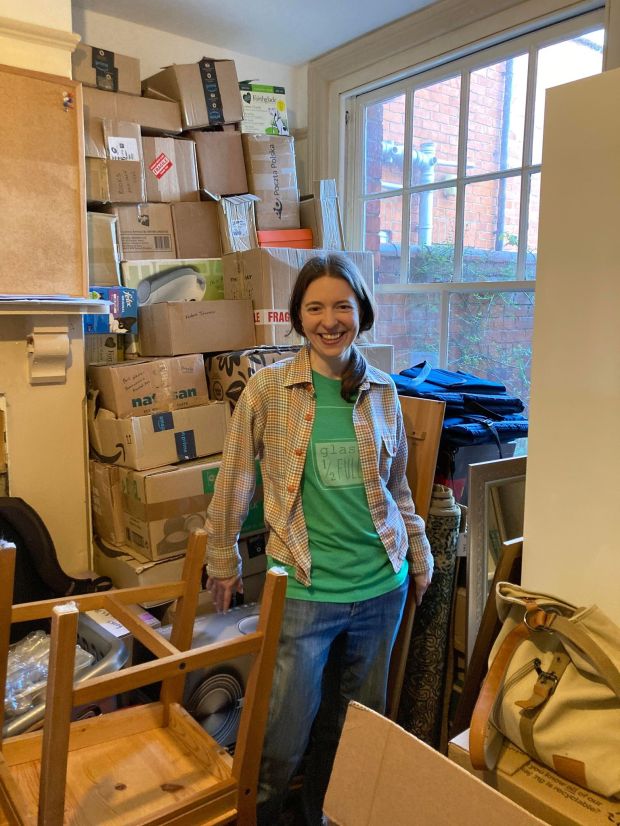
What with moving and DIY, I haven’t had a lot of time for reading lately, so didn’t finish any more of the spring books I’d intended to include – except for one children’s book from the library. I’ll give a little rundown of some of what has been on my coffee table stack.
Busy Spring: Nature Wakes Up by Sean Taylor and Alex Morss; illus. Cinyee Chiu (2021)
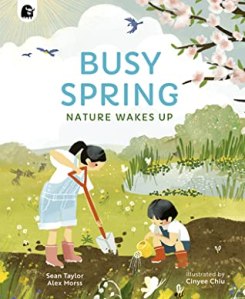 This was a cute read about two little girls helping their father in the garden and discovering the natural wonders of the season, like tadpoles in a pond, birds building nests, and insects and worms in the compost heap. A section at the end gives more information about the science of spring – unfortunately, it mislabels one bird and includes North American species without labelling them as such, whereas the rest of the book was clearly set in the UK. The strategy reminded me of that in Wild Child by Dara McAnulty. This year is the first time a children’s book Wainwright Prize will be awarded, so we’ll see this kind of book being recognized more.
May reads:
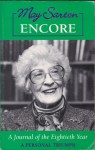 Encore is my last unread journal of May Sarton’s. It begins in May 1991, when she’s 79 and in recovery from major illness. She’s still plagued by pain and fatigue, but her garden and visits from friends are a solace. Although she has to lie down to garden, “to put my hands in the earth to dig is life giving … it is almost as if the earth were nourishing me at the moment.” As usual, there are lovely reflections on the freedoms as well as the losses of ageing. This book, like the previous, was dictated, so there is a bit of repetition. I’ve been amused to see how pretentious she found A.S. Byatt’s Possession! An entry or two at a sitting helped calm my mind during the stress of moving week.
“In a funny way what drives me is the spring, the fleeting spring. Because of the enormous wind and rain we have had, a lot of the daffodils have blown down, though not as many as I feared. But the truth is that their peak is past. We shall have them for another week and then they will be gone. It seems quite unbearable but that is what spring is—the letting go. The waiting and waiting and waiting, and then the letting go.”
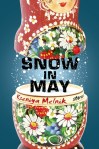
I started a reread of Snow in May by Kseniya Melnik and am partway through the second story. It’s a linked short story collection set in Magadan in northeast Russia – known for Stalin’s forced-labour camps. In “Love, Italian Style, or in Line for Bananas,” it’s 1975 and Tanya is on a shopping spree in Moscow. At a time of deprivation, she buys even things she doesn’t need or that aren’t quite right. Propositioned by an Italian football player on the plane ride over, she fantasizes about the exotic and romantic, juxtaposed against her everyday life.
“The pollen swirled around her like snow. There was a time when the distinctions between right and wrong seemed indisputable, and doing right felt good. When all the decisions had been premade and in her best interest. Back when she didn’t need so much to be happy.”
Belonging
 I saw it on shelf at the library and knew now was the perfect time to read My Life in Houses by Margaret Forster, a memoir via the places she’s lived, starting with the house where she was born in 1938, on a council estate in Carlisle. There’s something appealing to me about tracing a life story through homes – Paul Auster did the same in part of Winter Journal. I’d be tempted to undertake a similar exercise myself someday.
 The swifts come screeching down our new street and we saw one investigating a crevice in our back roof for a nest! In Fledgling by Hannah Bourne-Taylor, she is lonely in rural Ghana, where she and her husband had moved for his work, and takes in a young swift displaced from its nest. I’m only in the early pages, but can tell that her care for the bird will be a way of exploring her own feeling of displacement and the desire to belong. “Although I was unaware of it at the time, the English countryside and the birds had turned into my anchor of home.”
Six Degrees of Separation: True History of the Kelly Gang to Geek Love
This month we begin with True History of the Kelly Gang by Peter Carey. (See also Kate’s opening post.) I feel like I still have an unread copy, but won’t find out now until after we move. I’ve read several of Carey’s novels; my favourite by far was Parrot and Olivier in America, a delightful picaresque set in the early 19th century.

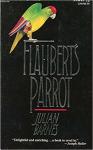 #1 Flaubert’s Parrot by Julian Barnes was one of my most-admired novels in my twenties, though I didn’t like it quite as much when I reread it in 2020. Funnily enough, his new novel has a bird in the title, too: Elizabeth Finch. I’m two-thirds through and it’s feeling like warmed-up leftovers of The Sense of an Ending with extra history and philosophy on the side.
 #2 My latest reread was Falling Angels by Tracy Chevalier, for book club. I’ve read all of her novels and always thought of this one as my favourite. A reread didn’t change that, so I rated it 5 stars. I love the neat structure that bookends the action between the death of Queen Victoria and the death of Edward VII, and the focus on funerary customs (with Highgate Cemetery a major setting) and women’s rights is right up my street.
 #3 Another novel featuring an angel that I read for a book club was The Vintner’s Luck by Elizabeth Knox. It’s set in Burgundy, France in 1808, when an angel rescues a drunken winemaker from a fall. All I can remember is that it was bizarre and pretty terrible, so I’m glad I didn’t realize it was the same author and went ahead with a read of The Absolute Book.
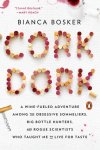 #4 The winemaking theme takes me to my next selection, Cork Dork by Bianca Bosker, which I read on a trip to the Netherlands and Belgium in 2017. Bosker, previously a technology journalist, gave herself a year and a half to learn everything she could about wine in hopes of passing the Court of Master Sommeliers exam. The result is such a fun blend of science, memoir and encounters with people who are deadly serious about wine.
 #5 I have so often heard the title The Dork of Cork by Chet Raymo, though I don’t know why because I can’t think of an acquaintance who’s actually read or reviewed it. The synopsis: “When Frank, an Irish dwarf, writes a personal memoir, he moves from dark isolation into the public eye. This luminous journey is marked by memories of his lonely childhood, secrets of his doomed young mother, and his passion for a woman who is as unreachable as the stars.” Sounds a bit like A Prayer for Owen Meany.
 #6 Another novel with a dwarf: Geek Love by Katherine Dunn, about a carnival of freaks that tours U.S. backwaters. I have meant to read this for many years and was even convinced that I owned a copy, but on my last few trips to the States I’ve not been able to find it in one of the boxes in my sister’s basement. Hmmm.
To the extent that we have ‘a song,’ “Geek Love” by Nerina Pallot would be it for my husband and me. A line from the chorus is “We’re geeks, but we know this is love.” It’s from her breakout album Fires, which came out in 2005 and was almost constant listening fodder for us while we were engaged. We’ve seen her live three times and she always plays this one.
From a gang via dorks to geeks, linked by the fact of books being stuck in (Schrödinger’s) boxes. Where will your chain take you? Join us for #6Degrees of Separation! (Hosted on the first Saturday of each month by Kate W. of Books Are My Favourite and Best.) Next month’s starting point is Sorrow and Bliss by Meg Mason — perfect given that it’s the book my book group has been sent to discuss as we shadow this year’s Women’s Prize.
Have you read any of my selections? Tempted by any you didn’t know before?
Swedish Death Cleaning (#NordicFINDS and #ReadIndies) & Three Rereads
An unexpected opportunity to contribute another post for Nordic FINDS this week (after my skim of Sophie’s World): yesterday we went into London – for just the second time since the pandemic started – and I took along a couple of novella-length books, one of them this Swedish nonfiction work that I picked up from a charity shop the other week. As it was released by Canongate in 2017, it also fits into Karen and Lizzy’s Read Indies challenge.
Our previous London trip was to see Bell X1 play at Union Chapel back in December. Yesterday was also for a gig, this time The Lost Words: Spell Songs playing Cadogan Hall. I’d been dubious about this ensemble project based on Robert Macfarlane and Jackie Morris’s The Lost Words and The Lost Spells but ended up loving both books as well as the two albums of folk/world music based on them, and it was a brilliant evening of music.
Anyway, on to the books. I also reread a novella in advance of book club, so afterwards I’ll take a quick look at the rereading I’ve done so far this year.
Döstädning: The Gentle Art of Swedish Death Cleaning by Margareta Magnusson
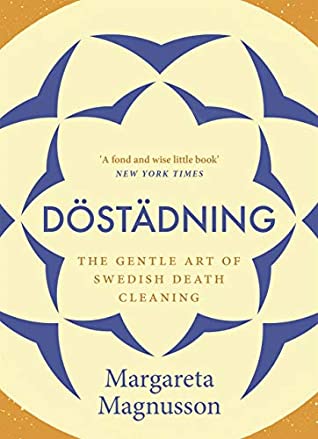 This is not about trauma cleaning, but downsizing and culling possessions so that the burden doesn’t fall to your children or other relatives after your death. Magnusson, who is in her 80s, has experience with death cleaning: first after her mother’s death, then after her mother-in-law’s, and finally after her husband’s, when she decided to move from the family home to a small flat. I enjoyed the little glimpses into her life as a mother of five and an artist. The family moved around a lot for her husband’s work, living in the USA and Singapore. She makes more of an allowance for possessions that hold sentimental value (especially photos and letters), being more concerned about the accumulation of STUFF.
As for general strategies, she suggests starting the process c. age 65 and beginning with the big things, from furniture on down, so that you make visible progress right away. “I’ve discovered that it is rewarding to spend time with these objects one last time and then dispose of them.” She goes category by category through her possessions. Clothing and cookbooks are pretty easy to shed: get rid of whatever doesn’t fit or suit you anymore, and only keep a couple of much-used cookbooks; you can find most any recipe on the Internet these days, after all. Leave the emotional material for last or you’ll get bogged down, she advises – you can take your time and enjoy reminiscing as you look through mementoes later on. She even considers what to do about old pets.
To let things, people and pets go when there is no better alternative is a lesson that has been very difficult for me to learn, and it is a lesson that life, as it goes further along, is teaching me more and more often.
Magnusson writes that she does not intend this to be a sad book, and it’s mostly very practical and unsentimental, even funny at times: on disposing of secret stuff, “save your favourite dildo but throw away the other fifteen!”; a little section on the perils of “man caves” and her memories of her clumsy cat Klumpeduns. I also laughed at the concept of a fulskåp (“a cabinet for the ugly”) for unwanted gifts that must eventually be rehomed or disposed of.
One problem that I have with decluttering books in general is that there isn’t enough of an anti-consumerist and green message. One, don’t accumulate the stuff in the first place (and reuse and buy secondhand wherever possible); two, possessions should almost never be thrown away, and only as an absolute last resort after doing everything possible to repair, refurbish, rehome or recycle them.
This was an enjoyable little book that I’ll pass on to someone else who might find it useful (so long as it’s not considered too on the nose as a book recommendation!), but it didn’t necessarily add anything for me beyond what I’d encountered in Outer Order, Inner Calm by Gretchen Rubin and Year of No Clutter by Eve O. Schaub. (Secondhand purchase) 
[I’m a little confused as to whether this is in translation or not. It first appeared in Swedish, but as no translator is listed anywhere in the copyright info, I assume that Magnusson translated it herself. Apart from some wrong number/amount and during/over choices, it reads like a native speaker’s work.]
2022’s Rereading
I’ve reread three books so far this year, which for me is pretty good going. It helped that all three were novella length, and I had book club as an excuse to return to the two novels.
 The Sense of an Ending by Julian Barnes was the other book I popped in the back of my purse for yesterday’s London outing. Barnes is one of my favourite authors – I’ve read 21 books by him now! – but I remember not being very taken with this Booker winner when I read it just over 10 years ago. (I prefer to think of his win as being for his whole body of work as he’s written vastly more original and interesting books, like Flaubert’s Parrot.) It’s the story of an older man looking back on his youth, and his friend’s suicide, in the light of what he learns after a somewhat mysterious bequest. The themes of history, memory and regret certainly mean more to me now in my late 30s than they did in my late 20s, but I still find this work a little lightweight; sordid, too. (Free from mall bookshop)
Readalikes: Any Human Heart by William Boyd, Moon Tiger by Penelope Lively, The Child in Time by Ian McEwan
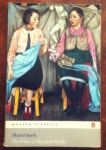 The Prime of Miss Jean Brodie by Muriel Spark was January’s book club selection. I had remembered no details apart from the title character being a teacher. It’s a between-the-wars story set in Edinburgh. Miss Brodie’s pet students are girls with attributes that remind her of aspects of herself. Our group was appalled at what we today would consider inappropriate grooming, and at Miss Brodie’s admiration for Hitler and Mussolini. Educational theory was interesting to think about, however. Spark’s work is a little astringent for me, and I also found this one annoyingly repetitive on the sentence level. (Public library)
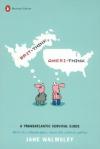 Brit-Think, Ameri-Think: A Transatlantic Survival Guide by Jane Walmsley: This is the revised edition from 2003, so I must have bought it as preparatory reading for my study abroad year in England. This may even be the third time I’ve read it. Walmsley, an American in the UK, compares Yanks and Brits on topics like business, love and sex, parenting, food, television, etc. I found my favourite lines again (in a panel entitled “Eating in Britain: Things that Confuse American Tourists”): “Why do Brits like snacks that combine two starches? (a) If you’ve got spaghetti, do you really need the toast? (b) What’s a ‘chip-butty’? Is it fatal?” The explanation of the divergent sense of humour is still spot on, and I like the Gray Jolliffe cartoons. Unfortunately, a lot of the rest feels dated – she’d updated it to 2003’s pop culture references, but these haven’t aged well. (New purchase?)
Any Nordic reads, or rereads, for you lately?
Some 2022 Reading Goals
First of all, I need to give some proper attention to the books on my set-aside shelf (nearly 40 of them), preferably clearing this in January – while also catching up on review copies from last year and continuing with the January releases.

Thereafter, I’d like to concentrate on backlist books for the year. This may seem ironic given that I review new ones on the blog and for various other outlets, and that I’m going to be featuring my 20 most anticipated titles of 2022 in a post tomorrow, but I have a few reasons for wanting to focus on older material.
One is that backlist reading consistently produces new favourites. Another is that every time I shelve in the library’s back room rolling stacks, I see novels that I’ve always meant to read, or that look fantastic, and think, “I really should borrow more from in here” … then forget all about them and place holds on (sometimes disappointing) new books instead.
A final reason is that, as I pack up my library in preparation for moving and get a good look at the ~500 unread books all over again, I hope and expect that I will be inspired to read them – and also to revisit some long-neglected favourites. (Of course, I may also cull some before the move, which would be fine.) The plan is to eventually replace our fleet of white Billy bookcases with built-in shelving either side of the decorative fireplaces in a few rooms of the new house.


As always, I’d like to get to more classics, doorstoppers and literature in translation (I own hardly any translated titles, so most of this will have to be from the library). I’ll participate in all the usual annual blogger challenges plus any new ones I can fit in, including Annabel’s #NordicFINDS – I’m currently reading Sophie’s World by Jostein Gaarder to review later this month.
I’m sure to follow a similar set of literary prizes as last year, including the Young Writer of the Year Award, the Barbellion Prize, the Rathbones Folio Prize, the Wainwright Prize, and (to a lesser extent) the Dylan Thomas Prize, the Women’s Prize and the Booker Prize. And, of course, I’ll be carefully monitoring the later stages of the McKitterick Prize judging after sending off my own longlist for the unpublished manuscripts. These prize lists plus various review copies will ensure I have a regular influx of recent releases to counterbalance the backlist reads.
Brand new or backlist for you in 2022?
A Look Back at My 2021 Reading: Statistics and Superlatives
I hope everyone passed a lovely holiday week. We had house guests for a few days over New Year’s, so I haven’t had a chance to work up my statistics until now. Marcie sent me a spreadsheet template to keep track of my reading, and my tech whiz husband helped analyze the data. I look forward to catching up on everyone else’s best-of and stats posts, too.
How I did with my 2021 goals
 My simple reading goals for 2021 were to read more biographies, classics, doorstoppers and travel books – genres that tend to sit on my shelves unread. I read one biography in graphic novel form (Orwell by Pierre Christin), but otherwise didn’t manage any. I only read three doorstoppers the whole year, but 29 classics – defining them is always a nebulous matter, but I’m going with books from before 1980 – a number I’m happy with.
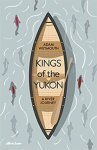 Surprisingly, I did the best with travel books, perhaps because I’ve started thinking about travel writing more broadly and not just as a white man going to the other side of the world and seeing exotic things, since I don’t often enjoy such narratives. Granted, I did read a few like that, and they were exceptional (The Glitter in the Green by Jon Dunn, The Shadow of the Sun by Ryszard Kapuściński and Kings of the Yukon by Adam Weymouth), but if I include essays, memoirs and poetry with significant place-based and migration themes, I was at 26.
The numbers
Exactly the same total as last year (2019 had my maximum-ever of 343). From those three years’ evidence, I’d say I’ve found my natural limit. Next year I will aim for 340 again.
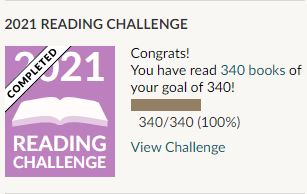
(This is what my lifestyle allows; yours is likely very different. I have bookish friends who read 80 books a year, 120, 150, 180, 200, and so on. My very busy university lecturer/town councillor husband felt bad for ‘only’ reading 65 books this past year, but keep in mind that the average person reads just 12 per year. My message to you, no matter your numbers, is YOU READ LOADS!)
Fiction: 49.7% (6.5% graphic novels; 5.3% short stories)
Nonfiction: 35%
Poetry: 15.3%
(Fiction and nonfiction are usually just about equal for me; I’m surprised that fiction pulled well ahead this year. I also read a bit more poetry this year than last.)
Female author: 66.47%
Male author: 30%
Nonbinary author: 0.88% (Meg-John Barker, Alice Hattrick and Olivia Laing)
Multiple genders (in anthologies): 2.65%
(I’ve been reading more and more by women each year, but this is the first time that female + nonbinary authors have outnumbered men by more than 2:1. I mostly attribute this to my interest in women’s stories. There were also three trans authors on my list.)
BIPOC author: 18.5%
(The first time I have specifically tracked this figure. Not too bad, but I’d prefer 25% or higher.)
Work in translation: 5%
(A decline from last year’s 7.2%. Must try harder!)
E-books: 13.2%
Print books: 86.8%
(Slightly higher than last year because of my new reviewing gig for Shelf Awareness, for which I read almost exclusively e-books.)
2021 releases: 41.8% (add in the 2020 releases and it’s 54.4%)
Pre-release books: 20%
Rereads: 12 (3.5%)
Where my books came from for the whole year:
- Free print or e-copy from publisher: 31.8%
- Public library: 24.7%
- Secondhand purchase: 16.8%
- Free (The Book Thing of Baltimore, the free mall bookshop, a giveaway, Little Free Libraries, etc.): 9.4%
- Downloaded from NetGalley or Edelweiss: 5.9%
- New purchase (sometimes at a bargain price): 5.6%
- University library: 3.8%
- Gifts: 2%
(Decreased from last year: review copies, NetGalley/Edelweiss, gifts; increased from last year: library borrowing, new and secondhand purchases, free books.)
Additional statistics courtesy of Goodreads:
73,520 pages read
Average book length: 216 pages (thank you, novellas and poetry!)
Average rating for 2021: 3.7
Extra Superlatives
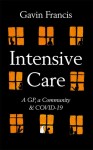
First book completed:
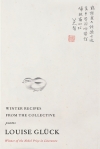
Last book completed (also the shortest, at 46 pages)
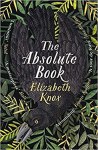
Longest book, at 628 pages:
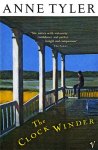
Authors I read the most by: Anne Tyler (5), thanks to Liz’s readalong project; Jim Davis and Alice Oseman cartoons (4 volumes each); Jim Crumley nature books and Emily Rapp Black memoirs (3 each)

Publishers I read the most from: Carcanet (18), then Picador (17), then Bloomsbury and Faber (14 each); in overall first place was undoubtedly Penguin and its many imprints.
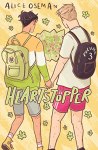
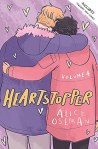
My top discovery of the year: the Heartstopper teen graphic novel series.

My proudest bookish achievement: being asked to be a judge for the McKitterick Prize.
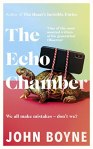
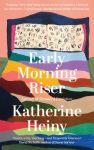
The books that made me laugh the most: The Echo Chamber by John Boyne and Early Morning Riser by Katherine Heiny.
Best book club selections: The Light Years by Elizabeth Jane Howard, Woman on the Edge of Time by Marge Piercy, The Year of Living Danishly by Helen Russell.
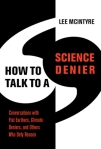
Most genuinely helpful book: How to Talk to a Science Denier by Lee McIntyre.
Best last lines encountered: “So where are we gonna go? / I don’t know. Let’s just drive and find out.” (from Heartstopper, Volume 4 by Alice Oseman).
Best 2021 book title: Mrs Death Misses Death.

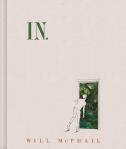
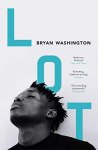
Shortest book title encountered: In (Will McPhail), followed by Lot (Bryan Washington).
Biggest disappointments: Some of my lowest ratings went to Indelicacy by Amina Cain, Klara and the Sun by Kazuo Ishiguro, and Ness by Robert Macfarlane.
 A 2021 book that everyone loved but me: The Lincoln Highway by Amor Towles.
Themes that kept turning up in my reading: Covid-19, colours (thanks to my summer reading challenge), disability (thanks to shadowing the Barbellion Prize), the mental and physical health benefits of time in nature; perennial topics like friendship, parenting and sisterhood.
 Bookish Beck = Rebecca Foster. American transplant to England. Freelance proofreader and book reviewer.
