Humiliation: Stories by Paulina Flores
Paulina Flores, a young Chilean author and high school teacher, won the Roberto Bolaño Short Story Prize for the title story in her debut collection. These nine stories are about how we relate to the past, particularly our childhood – whether with nostalgia or regret – and about the pivotal moments that stand out in the memory. The first two, “Humiliation” and “Teresa,” I previewed in one of my Women in Translation Month posts. They feature young fathers and turn on a moment of surprise: An unemployed father takes his two daughters along to his audition; a college student goes home with a single father for a one-night stand.
 Of the rest, my favorites were “Talcahuano,” about teenage friends whose plan to steal musical instruments from the local evangelical church goes awry when there’s a crisis with the narrator’s father, a laid-off marine (readalike: Sweet Sorrow by David Nicholls); and “Forgetting Freddy,” in which a young woman who ends up back in her mother’s apartment after a breakup listens to the neighbors fighting and relives childhood fears during her long baths (readalike: History of Wolves by Emily Fridlund).
“American Spirit” recalls two friends’ time waitressing (readalike: Sweetbitter by Stephanie Danler), and in “Last Vacation” a young man recounts his last trip to La Serena with his aunt before everything went wrong for his family. “Laika” is a troubling one in that the protagonist remembers her childhood brush with pedophilia not with terror or disgust but with a sort of fondness. A number of the stories conclude that you can’t truly remake your life, nor can you escape the memories that have shaped you – even if you might like to.
A fairly common feature in story volumes is closing with a novella. Almost invariably, I like these long stories the least, and sometimes skip them. Here, the 72-page “Lucky Me” could easily be omitted. Denise, a librarian who watches porn and reads the Old Testament in her spare time (“what she needed was to feel something. She needed pleasure and spirituality”), lets the upstairs neighbor use her bedroom for sex; Nicole, a fourth-grader, has her world turned upside down when her best friend’s mother becomes their housekeeper. Although the story brings its strands, one in the first person and one in the third (giving the book an even 4.5/4.5 split), together in a satisfying manner, it was among my least favorites in the collection.
Overall, though, these are sharp and readable stories I can give a solid recommendation.
My rating: 
Humiliation (2016; English translation by Megan McDowell, 2019) is published by Oneworld today, November 7th,; it came out on the 5th from Catapult in the USA. My thanks to Margot Weale for a proof copy for review.
Ake Book Festival: An Extract from Manchester Happened
Africa’s leading literary festival, Ake Book Festival in Lagos, Nigeria, is in its seventh year. Appearing this year are 100 authors including Ayobami Adebayo, Oyinkan Braithwaite, Reni Eddo-Lodge, Bernadine Evaristo, Jennifer Nansubuga Makumbi and Nnedi Okarafor. I was asked to take part in a blog tour celebrating the festival and the authors involved – specifically, to host an extract of Makumbi’s Manchester Happened, which I’ve been especially keen to read since hearing her in conversation with Evaristo last week.
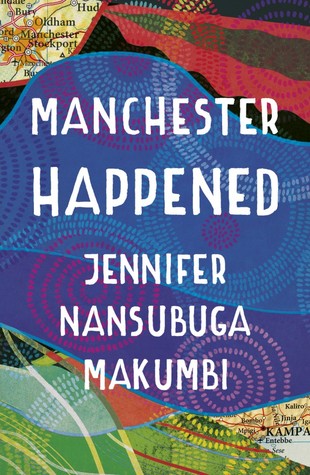
This is the opening few pages of “Our Allies the Colonies,” the first story following the Prologue. I hope it whets your appetite to read the whole thing.
First he felt a rush of dizziness like life was leaving his body, then the world wobbled. Abbey stopped and held onto a bollard outside the Palace Theatre. He had not eaten all day. He considered nipping down to Maama Rose’s for fried dumplings and kidney beans, but the thought of eating brought nausea to his throat. He steered his mind away from food. He gave himself some time then let go of the bollard to test his steadiness. His head felt right, and his vision was back. He started to walk tentatively at first then steadily, down Oxford Road, past the Palace Hotel, under the train bridge, upwards, towards the Grosvenor Picture Palace.
Abbey was set to return to Uganda. He had already paid for the first leg of the journey – the passage from Southampton to Mombasa – and was due to travel within six months. For the second and third legs of the journey – Mombasa to Nairobi, then Nairobi to Kampala – he would pay at the ticket offices on arrival. He had saved enough to start a business either dealing in kitenge textiles from the Belgian Congo or importing manufactured goods from Mombasa. Compete with the Indians even. As a starter, he had bought rolls of fabric prints from Summer Mist Textiles for women’s dresses and for men’s suits, to take with him. All that commercial development in Uganda he had read about – increased use of commercial vehicles; the anticipated opening of the Owen Falls Dam, which would provide electricity for everyone; he had even heard that Entebbe had opened an airport back in 1951 – was beckoning.
But his plan was in jeopardy. It was his one-month-old baby, Moses. Abbey had just returned from Macclesfield Children’s Home, where the baby’s mother, Heather Newton, had given him up for adoption, but he had not seen his son. In fact, he did not know what the baby looked like: he never saw him in hospital when he was born. Abbey suspected that Heather feared that one day she might bump into him and Moses. But Heather was fearful for nothing. Abbey was taking Moses home, never to return.
Suppose the children’s home gave you the child, what then, hmm? the other side of his mind asked. What do you know about babies? The journey from Southampton to Mombasa is at least two weeks long on a cheap vessel. The bus ride from Mombasa to Nairobi would last up to two days. Then the following night you would catch the mail train from Nairobi to Kampala: who knows if it is still running? All those journeys with luggage and a six-month-old ankle-biter on your own. Yet Abbey knew that if he left Britain without his boy, that would be it. Moses would be adopted, given a new name and there would be no way of finding him. Then his son would be like those rootless Baitale children you heard of in Toro, whose Italian fathers left them behind.
He was now outside Manchester Museum, by the university. He was on his way to his second job, at the Princess Road bus depot, where he cleaned Manchester Corporation buses. His shift began at 9 p.m. It was almost 8 p.m., but the day was bright. He could not wait to get home and tell people how in Britain the sun had moods. It barely retired in summer yet in winter it could not be bothered to rise. He could not wait to tell them things about Britain. It was a shame he had stayed this long. But having a job and saving money made him feel like he was not wasting his youth away in a foreign land. His day job paid the bills while the evening job put savings away in his Post Office account. His mind turned on him again: Maybe Heather had a point – you don’t have a wife to look after Moses while you work. You still have five months before you set off; if the home gives him to you, how will you look after him? But then shame rose and reason was banished. Blood is blood, a child is better off with his father no matter what.
He reached Whitworth Park. It was packed with people sunning themselves, young men throwing and catching Frisbees, families picnicking. At the upper end, close to Whitworth Art Gallery, he caught sight of a group of Teddy boys who, despite the warm evening, wore suits, crêpe-soled shoes and sunglasses, their greased hair slicked back. They looked like malnourished dandies. Even though Teddy Boys tended to hunt blacks in the night, Abbey decided against crossing the park. Instead, he walked its width to Moss Lane East. The way the sun had defrosted British smiles. ‘Enjoy it while it lasts,’ strangers will tell you now.
Bernardine Evaristo and Jennifer Nansubuga Makumbi in Conversation
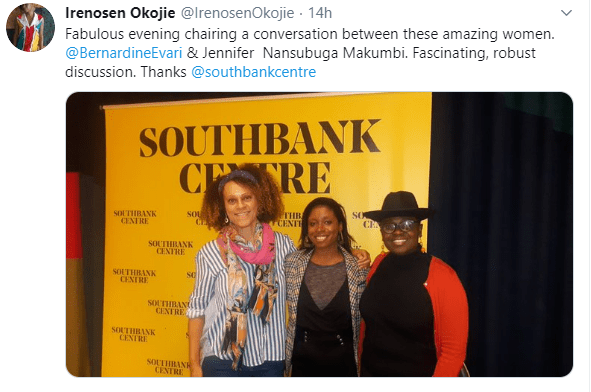
Through a giveaway on Eric’s blog, I won tickets to see Bernardine Evaristo and Jennifer Nansubuga Makumbi speak about their latest books at the London Literature Festival (this year’s theme: “Once Upon Our Times”) at the Southbank Centre yesterday. It was great to meet up with fellow bloggers Eric and Eleanor to hear these two black women writers read from their recent work and discuss feminism, the political landscape for writers of African descent, and their experiments with form.


Frustrated by the lack of black women in British literature, Evaristo started writing Girl, Woman, Other in 2013. She began with Carole (Anglo-Nigerian, like herself), who has to change to fit in, first at Oxford and then as a City banker. Next she moved on to the stories of Carole’s mother and school friend, and the book grew from there. All told, there are four mother–daughter pairs. Evaristo believes her background as an actress (in her twenties) allowed her to almost become these characters and write them from the inside, so that even though the chapters are written in the third person they feel like first-person narratives. The 12 flawed, complex main characters are “equal protagonists,” she insisted. Her aim was “to explore multiplicity to address our invisibility.” She characterizes the book’s style as “fusion fiction”: an accessible take on the experimental novel, with unorthodox, free-flowing language that allows readers to move easily between the different characters’ storylines.
Both Evaristo and Makumbi admitted to having a complicated relationship with feminism, Evaristo because the feminism of the 1980s did not seem to include black women and Makumbi because the fight for equality is still ongoing in patriarchal African societies like her native Uganda’s. Evaristo feels that feminism is now more inclusive and, also thanks to the #MeToo movement, there has been a place for her book that may not have been there five or 10 years ago. (The same goes for Makumbi, who has only now found a publisher for her very feminist first novel, which was rejected in the 2000s.) Both authors spoke of the ways in which people are made to feel “Other”: through sex, race and class. Makumbi pointed out that Africans experience a specific racism separate from other blacks in Britain. “I’m not racist, but I draw the line at Africans” is how she caricatured this view.
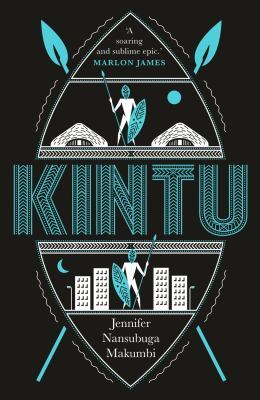 Makumbi’s novel Kintu is a sprawling family saga that has been compared to Roots, but she has recently released a collection of short stories that focus on Ugandan immigration to Britain between the 1950s and today. She envisioned Manchester Happened as “a letter back home” to tell people what it’s really like to settle in a new country, as well as a chance to reflect on the underrepresented East African immigration experience. Much of the book is drawn from her life, such as working as an airport security officer to fund her creative writing degree. Her mentor recommended that she start writing stories as a way to counterbalance the intensity of Kintu – a chance to see the beginning, middle and end as a simple arc. She assumed short stories would be easier than a novel, yet her first story took her four years to write. It is as if she can only look into her past for brief moments, anyway, she explained, so the story form has been perfect. She has deliberately avoided the negativity of many migration narratives, she said: Things have in fact gone well for her, and we’ve heard about things going wrong many times before.
I’m over halfway through Girl, Woman, Other now, and enjoying it very much – but wondering if its breadth sacrifices some depth. Evaristo acknowledged that she felt a bit less attached to these characters than she has in novels where she followed just one or two characters all the way through. Still, she feels that she knows and understands these women, even if she doesn’t like or approve of all of them. She read excerpts from the sections about Yazz, a feisty and opinionated young woman waiting for her mother’s play to start, and Hattie, a strong-willed 93-year-old from a Northumberland farming family. Makumbi read from two stories, one about a Ugandan couple arriving in Manchester in 1950 and the other set in the airport security area. In the latter the protagonist confiscates a whip from a priest, a funny moment that seems to represent Makumbi’s style – moderator Irenosen Okojie, a Nigerian author, mentioned another notable story from the perspective of a Ugandan street dog newly pampered in Britain.
I hope to read Manchester Happened soon, and should be featuring an extract from it next week as part of the Ake Book Festival blog tour. I’ll also finish the Evaristo this week and expect it to be on my Best of 2019 fiction list.
Short Story Collections Read Recently
This is the fourth year in a row that I’ve made a concerted effort to read more short stories in the alliterative month of September. (See also my 2016, 2017 and 2018 performances.) Short story collections are often hit and miss for me, and based on a few recent experiences I seem to be prone to DNFing them after two stories – when I’ve had my fill of the style and content. I generally have better luck with linked stories like Olive Kitteridge and its sequel, because they rely on a more limited set of characters and settings, and you often get intriguingly different perspectives on the same situations.
So far this year, I’ve read just five story collections – though that rises to 13 if I count books of linked short stories that are often classed as novels (Barnacle Love, Bottled Goods, Jesus’ Son, The Lager Queen of Minnesota, Olive Kitteridge, Olive, Again, That Time I Loved You and The Unchangeable Spots of Leopards). Twelve is my minimum goal for short story collections in a year – the equivalent of one per month – so I’m pleased to have surpassed that, and will continue to pick up the occasional short story collection as the year goes on.
The first two books I review here were hits with me, while the third disappointed me a bit.
The Assassination of Margaret Thatcher by Hilary Mantel (2014)
 Four of these 10 stories first appeared in the London Review of Books, and another four in the Guardian. Most interestingly, the opening story, “Sorry to Disturb,” about a bored housewife trying to write a novel while in Saudi Arabia with her husband in 1983–4, was published in the LRB with the subtitle “A Memoir.” That it’s one of the best few ‘stories’ here doesn’t negate Mantel’s fictional abilities so much as prove her talent for working in the short form.
My other few favorites were the very short ones, about a fatal discovery of adultery, an appalling accident on a holiday in Greece, and a sighting of a dead father on a train. I also enjoyed “How Shall I Know You?” in which an author is invited to give a talk to a literary society. I especially liked the jokey pep talks to self involving references to other authors: “come now, what would Anita Brookner do?” and “for sure A.S. Byatt would have managed it better.” Other topics include children’s horror at disability, colleague secrets at a Harley Street clinic, and a sister’s struggle with anorexia. The title story offers an alternative history in which Thatcher is assassinated by the IRA upon leaving an eye hospital after surgery.
In her stories Mantel reminds me most of Tessa Hadley. It’s high time I read another Mantel novel; most likely that will be the third Thomas Cromwell book, due out next year.
My rating: 
In the Driver’s Seat by Helen Simpson (2005)
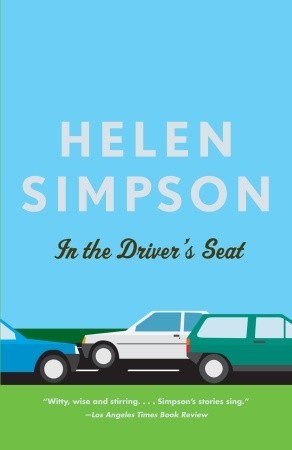 I liked this even more than Simpson’s first book, Four Bare Legs in a Bed, which I reviewed last year. The themes include motherhood (starting, in a couple of cases, in one’s early 40s), death versus new beginnings, and how to be optimistic in a world in turmoil. There’s gentle humor and magic to these stories that tempers some of the sadness. I especially liked “The Door,” about a grieving woman looking to restore her sense of security after a home break-in, “The Green Room,” a Christmas Carol riff (one of two Christmas-themed stories here) in which a woman is shown how her negative thoughts and obsession with the past are damaging her, and “Constitutional,” set on a woman’s one-hour circular walk during her lunch break and documenting her thoughts about everything from pregnancy to a nonagenarian friend’s funeral. [The UK title of the collection is Constitutional.]
In two stories, “Every Third Thought” and “If I’m Spared,” a brush with death causes a complete change of outlook – but will it last? “The Year’s Midnight” creates a brief connection between frazzled mums at the swimming pool in the run-up to the holidays. “Up at a Villa” and the title story capture risky moments that blend fear and elation. In “The Tree,” which is funny and cringeworthy all at the same time, a man decides to take revenge on the company that ripped off his forgetful old mother. Prize for the best title goes to “The Phlebotomist’s Love Life,” though it’s the least interesting story of the 11.
(Found in a Little Free Library at the supermarket near my parents’ old house.)
Some favorite lines:
“the inevitable difficulty involved in discovering ourselves to others; the clichés and blindness and inadvertent misrepresentations”
“Always a recipe for depression, Christmas, when complex adults demanded simple joy without effort, a miraculous feast of stingless memory.”
“You shouldn’t be too interested in the past. You yourself now are the embodiment of what you have lived. What’s done is done.”
My rating: 
The Lager Queen of Minnesota by J. Ryan Stradal (2019)
I had sky-high hopes for Stradal’s follow-up after Kitchens of the Great Midwest (it was on my Most Anticipated list for the second half of the year). Theoretically, a novel about three pie-baking, beer-making female members of a Minnesota family should have been terrific. Like Kitchens, this is female-centered, on a foodie theme, set in the Midwest and structured as linked short stories. Here the chapters are all titled after amounts of money; they skip around in time between the 1950s and the present day and between the perspectives of Edith Magnusson, her estranged younger sister Helen Blotz, and Edith’s granddaughter, Diana Winter.
 Edith and Helen have a rivalry as old as the Bible, based around an inheritance that Helen stole to reopen her husband’s family brewery, instead of sharing it with Edith. Ever since, Edith has had to work minimum-wage jobs at nursing homes and fast food restaurants to make ends meet. When Diana comes to live with her as a teenager, she, too, works hard to contribute to the family, but then gets caught up in a dodgy money-making scheme. It’s in penance for this error that she starts working at a local brewery, but beer soon becomes as much of an obsession for Diana as it once was for her great-aunt Helen.
I had a few problems with the book’s setup: Helen is portrayed as a villain, and never fully sheds that stereotypical designation; meanwhile, Edith is passive and boring, just a bit “wet” (in British slang). Edith and Diana suffer more losses than seems likely or fair, and there are too many coincidences involved in Diana’s transformation into a master brewer. I also found it far-fetched that a brewery would hire her as a 19-year-old and let her practice making many, many batches of lager, all while she’s still underage. None of the characters fully came alive for me, though Diana was the closest. The ending wasn’t as saccharine as I expected, but still left me indifferent. I did like reading about the process of beer-making and flavor development, though, even though I’m not a beer drinker.
My rating: 
Short story DNFs this year (in chronological order):
Mr Wrong by Elizabeth Jane Howard – I read the two shortest stories, “Summer Picnic” and “The Proposition.” The former was pleasantly like Elizabeth Taylor or Tessa Hadley lite; I got zero out of the latter.
 I Want to Show You More by Jamie Quatro – I read the first two stories. “Decomposition,” about a woman’s lover magically becoming a physical as well as emotional weight on her and her marriage, has an interesting structure as well as second-person narration, but I fear the collection as a whole will just be a one-note treatment of a woman’s obsession with her affair.
Multitudes: Eleven Stories by Lucy Caldwell – I read the first two stories. I enjoyed the short opener, “The Ally Ally O,” which describes a desultory ride in the car with mother and sisters with second-person narration and no speech marks. I should have given up on “Thirteen,” though, a tired story of a young teen missing her best friend.
The Country Ahead of Us, the Country Behind by David Guterson – I read “Angels in the Snow” (last Christmas) and “Wood Grouse on a High Promontory Overlooking Canada” (the other week). Both were fine but not particularly memorable; a glance at the rest suggests that they’ll all be about baseball and hunting. If I wanted to read about dudes hunting I’d turn to Ernest Hemingway or David Vann. Nevertheless, I’ll keep this around in case I want to try it again after reading Snow Falling on Cedars this winter.
Currently reading:
 Ship Fever by Andrea Barrett – Elegant stories about history, science and human error. Barrett is similar to A.S. Byatt in her style and themes, which are familiar to me from my reading of Archangel. This won a National Book Award in 1996.
- Descent of Man by T. Coraghessan Boyle – Even in this slim volume, there are SO MANY stories, and all so different from each other. Some I love; some are meh. I’m tempted to leave a few unread, though then I can’t count this towards my year total…
- Sum: Tales from the Afterlives by David Eagleman – A bibliotherapy prescription for reading aloud. My husband and I read a few stories to each other, but I’m going it alone for the rest. This is fairly inventive in the vein of Alan Lightman’s Einstein’s Dreams, yet I find it repetitive.
Future prospects:
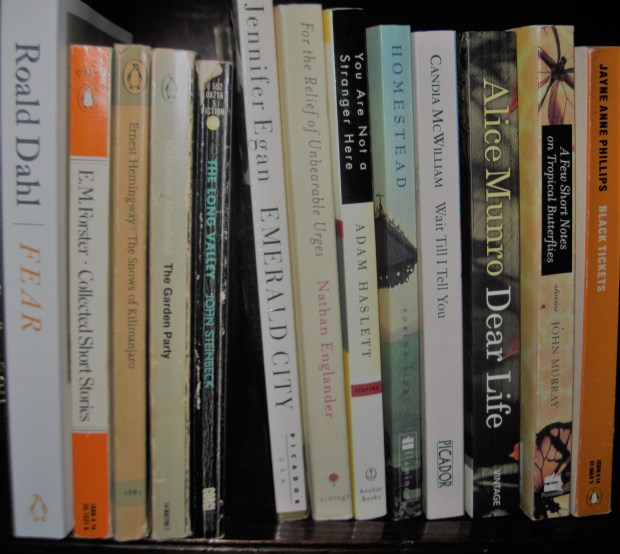
See also Laura’s excellent post about her favorite individual short stories.
Are you a short story fan? Read any good ones recently?
Women in Translation Month 2019, Part II: Almada and Fenollera
All Spanish-language choices this time: an Argentinian novella, a Spanish novel, and a couple of Chilean short stories to whet your appetite for a November release.
The Wind that Lays Waste by Selva Almada (2012; English translation, 2019)
[Translated by Chris Andrews]
 Selva Almada’s debut novella is also her first work to appear in English. Though you might swear this is set in the American South, it actually takes place in her native Argentina. The circadian narrative pits two pairs of characters against each other. On one hand we have the Reverend Pearson and his daughter Leni, itinerants who are driven ever onward by the pastor’s calling. On the other we have “The Gringo” Brauer, a mechanic, and his assistant, José Emilio, nicknamed “Tapioca.”
On his way to visit Pastor Zack, Reverend Pearson’s car breaks down. While the Gringo sets to work fixing the vehicle, the preacher tries witnessing to Tapioca. He senses something special in the boy, perhaps even recognizing a younger version of himself, and wants him to have more of a chance in life than he’s currently getting at the garage. As a violent storm comes up, we’re left to wonder how Leni’s cynicism, the Reverend’s zealousness, the Gringo’s suspicion, and Tapioca’s resolve will all play out.
Different as they are, there are parallels to be drawn between these characters, particularly Leni and Tapioca, who were both abandoned by their mothers. I particularly liked the Reverend’s remembered sermons, printed in italics, and Leni’s sarcastic thoughts about her father’s vocation: “They always ended up doing what her father wanted, or, as he saw it, what God expected of them” and “she admired the Reverend deeply but disapproved of almost everything her father did. As if he were two different people.”
The setup and characters are straight out of Flannery O’Connor. The book doesn’t go as dark as I expected; I’m not sure I found the ending believable, even if it was something of a relief.
My rating: 
My thanks to Charco Press for the free copy for review. Last year I reviewed two Charco releases: Die, My Love and Fish Soup.
See also Susan’s review.
The Awakening of Miss Prim by Natalia Sanmartin Fenollera (2013; English translation, 2014)
[Translated by Sonia Soto]
 San Ireneo de Arnois is a generically European village that feels like it’s been frozen in about 1950: it’s the sort of place that people who are beaten down by busy city life retreat to so they can start creative second careers. Prudencia Prim comes here to interview for a job as a librarian, having read a rather cryptic job advertisement. Her new employer, The Man in the Wingchair (never known by any other name), has her catalogue his priceless collection of rare books, many of them theological treatises in Latin and Greek. She’s intrigued by this intellectual hermit who doesn’t value traditional schooling yet has the highest expectations for the nieces and nephews in his care.
In the village at large, she falls in with a group of women who have similarly ridiculous names like Hortensia and Herminia and call themselves feminists yet make their first task the finding of a husband for Prudencia. All of this is undertaken with the aid of endless cups of tea or hot chocolate and copious sweets. The village and its doings are, frankly, rather saccharine. No prizes for guessing who ends up being Prudencia’s chief romantic interest despite their ideological differences; you’ll guess it long before she admits it to herself at the two-thirds point.
As much as this tries to be an intellectual fable for bibliophiles (Prudencia insists that The Man in the Wingchair give Little Women to his niece to read, having first tried it himself despite his snobbery), it’s really just a thinly veiled Pride and Prejudice knock-off – and even goes strangely Christian-fiction in its last few pages. If you enjoyed The Readers of Broken Wheel Recommend and have a higher tolerance for romance and chick lit than I, you may well like this. It’s pleasantly written in an old-fashioned Pym-homage style, but ultimately it goes on my “twee” shelf and will probably return to a charity shop, from whence it came.
My rating: 
Humiliation by Paulina Flores (2016; English translation, 2019)
[Translated by Megan McDowell]
I’ve read the first two stories so far, “Humiliation” and “Teresa,” which feature young fathers and turn on a moment of surprise. An unemployed father takes his two daughters along to his audition; a college student goes home with a single father for a one-night stand. In both cases, what happens next is in no way what you’re expecting. These are sharp and readable, and I look forward to making my way through the rest over the next month or two.
My rating:
Humiliation will be published by Oneworld on November 7th. My thanks to Margot Weale for a proof copy. I will publish a full review closer to the time.
Did you do any special reading for Women in Translation month this year?
20 Books of Summer, #11–13: Harrison, Pym, Russell
It’s cats and butterflies in the spotlight this time, adding in a gazelle as a metaphor for Freddie Mercury’s somebody to love.
Travelling Cat: A Journey round Britain with Pugwash by Frederick Harrison (1988)
If Tom Cox had been born 20 years earlier, this is the sort of book he might have written. In 1987, saddened more by his cat Podey being run over than by the end of his marriage, Harrison set out from South London in his Ford Transit van for a seven-month drive around the country. He decided to take Pugwash, one of his local (presumably ownerless) cats, along as a companion.
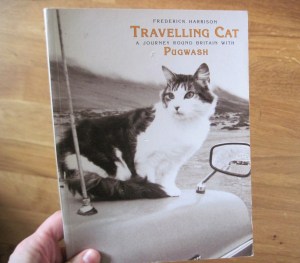 They encountered Morris dancers, gypsies, hippies at Stonehenge for the Summer Solstice, sisters having a double wedding, and magic mushroom collectors. They went to a county fair and beaches in Suffolk and East Yorkshire, and briefly to Hay-on-Wye. And on the way back they collected Podey, whom he’d had stuffed. Harrison muses on the English “vice” of nostalgia for a past that probably never existed; Pugwash does what cats do, and very well.
It’s all a bit silly and dated and lightweight, but enjoyable nonetheless. Plus there are tons of black-and-white photos of “Pugs” and other feline friends. This was a secondhand purchase from The Bookshop, Wigtown.
Favorite lines:
“Cats hate to make prats of themselves. But then, don’t we all?”
(last lines) “Warm, fed, contented, unemployable, and entirely at peace with the world. Yes indeed. Cats certainly know something we don’t.”
Some Tame Gazelle by Barbara Pym (1950)
(An example of a book that just happens to have an animal in the title.) I’d only read one other Pym novel, Quartet in Autumn, a late and fairly melancholy story of four lonely older people. With her first novel I’m in more typical territory, I take it. The middle-aged Bede sisters are pillars of the church in their English village. Harriet takes each new curate under her wing, making of them a sort of collection, and fends off frequent marriage proposals from the likes of a celebrity librarian and an Italian count.
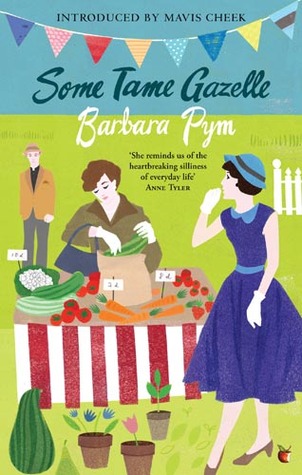 Belinda, on the other hand, only has eyes for one man: Archdeacon Hochleve, whom she’s known and loved for 30 years. They share a fondness for quoting poetry, the more obscure the better (like the title phrase, taken from “Some tame gazelle, or some gentle dove: / Something to love, oh, something to love!” by Thomas Haynes Bayly). The only problem is that the archdeacon is happily married. So single-minded is Belinda that she barely notices her own marriage proposal when it comes: a scene that reminded me of Mr. Collins’s proposal to Lizzie in Pride and Prejudice. Indeed, Pym is widely recognized as an heir to Jane Austen, what with her arch studies of relationships in a closed community.
There were a handful of moments that made me laugh, like when the seamstress finds a caterpillar in her cauliflower cheese and has to wipe with a Church Times newspaper when the Bedes run out of toilet paper (such mild sacrilege!). This is enjoyable, if fluffy; it was probably a mistake to have read one of Pym’s more serious books first: I expected too much of this one. If you’re looking for a quick, gentle and escapist read in which nothing awful will happen, though, it would make a good choice. Knowing most of her books are of a piece, I wouldn’t read more than one of the remainder – it’ll most likely be Excellent Women.
An Obsession with Butterflies: Our Long Love Affair with a Singular Insect by Sharman Apt Russell (2003)
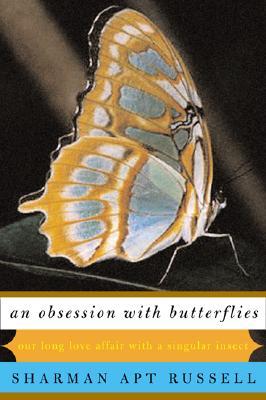 This compact and fairly rollicking book is a natural history of butterflies and of the scientists and collectors who have made them their life’s work. There are some 18,000 species and, unlike, say, beetles, they are generally pretty easy to tell apart because of their bold, colorful markings. Moth and butterfly diversity may well be a synecdoche for overall diversity, making them invaluable indicator species. Although the history of butterfly collecting was fairly familiar to me from Peter Marren’s Rainbow Dust, I still learned or was reminded of a lot, such as the ways you can tell moths and butterflies apart (and it’s not just about whether they fly in the night or the day). And who knew that butterfly rape is a thing?
The final third of the book was strongest for me, including a trip to London’s Natural History Museum; another to Costa Rica’s butterfly ranches, an example of successful ecotourism; and a nicely done case study of the El Segundo Blue butterfly, which was brought back from the brink of extinction by restoration of its southern California dunes habitat. Russell, a New Mexico-based author of novels and nonfiction, also writes about butterflies’ cultural importance: “No matter our religious beliefs, we accept the miracle of metamorphosis. One thing becomes another. … Butterflies wake us up.”
 I also recently read the excellent title story from John Murray’s 2003 collection A Few Short Notes on Tropical Butterflies. Married surgeons reflect on their losses, including the narrator’s sister in a childhood accident and his wife Maya’s father to brain cancer. In the late 1800s, the narrator’s grandfather, an amateur naturalist in the same vein as Darwin, travelled to Papua New Guinea to collect butterflies. The legends from his time, and from family trips to Cape May to count monarchs on migration in the 1930s, still resonate in the present day for these characters. The treatment of themes like science, grief and family inheritance, and the interweaving of past and present, reminded me of work by Andrea Barrett and A.S. Byatt.
(I’ve put the book aside for now but will go back to it in September as I focus on short stories.)
Other butterfly-themed books I have reviewed:
- Four Wings and a Prayer: Caught in the Mystery of the Monarch Butterfly by Sue Halpern (one of last year’s 20 Books of Summer)
- Ruins by Peter Kuper (a graphic novel set in Mexico, this also picks up on monarch migration)
- Magdalena Mountain by Robert Michael Pyle (a novel about butterfly researchers in Colorado)
August’s Reading Plans: Too Many Projects!
My August is looking chock-full of reading projects – many of them self-imposed, to be fair.
20 Books of Summer: I’ve finished a few more books and just need to write them up; I’m in the middle of another nine, including Tisala as my doorstopper for the month.
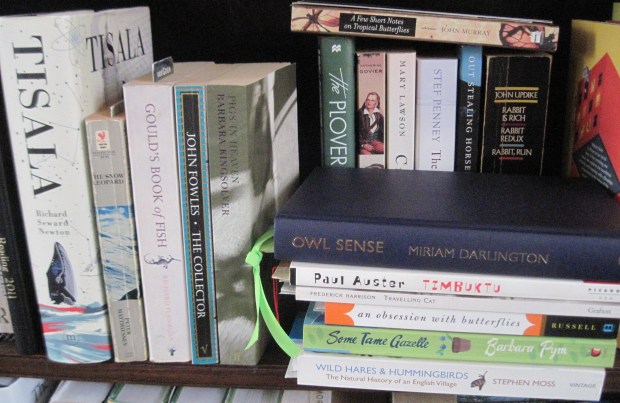
Summer theme: Books with summer/sun/shine in the title, and others set in summer, like The Go-Between by L.P. Hartley, my classic for the month.

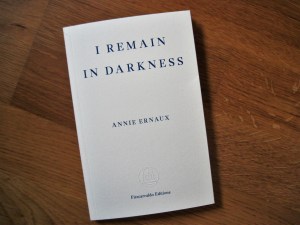
Women in Translation month: I’ve started the Ferrante and also want to get to the Fenollera and start the Flores stories (all those Fs!), which are coming out from Oneworld in November. Also, in yesterday’s post I received a surprise copy of a forthcoming Fitzcarraldo Editions essay by Annie Ernaux about her mother’s dementia, so I will squeeze that in too.

Robertson Davies week: In the final week of August I’ll be joining in with Lory’s (The Emerald City Book Review) Robertson Davies readalong by starting Fifth Business, the first volume in The Deptford Trilogy.

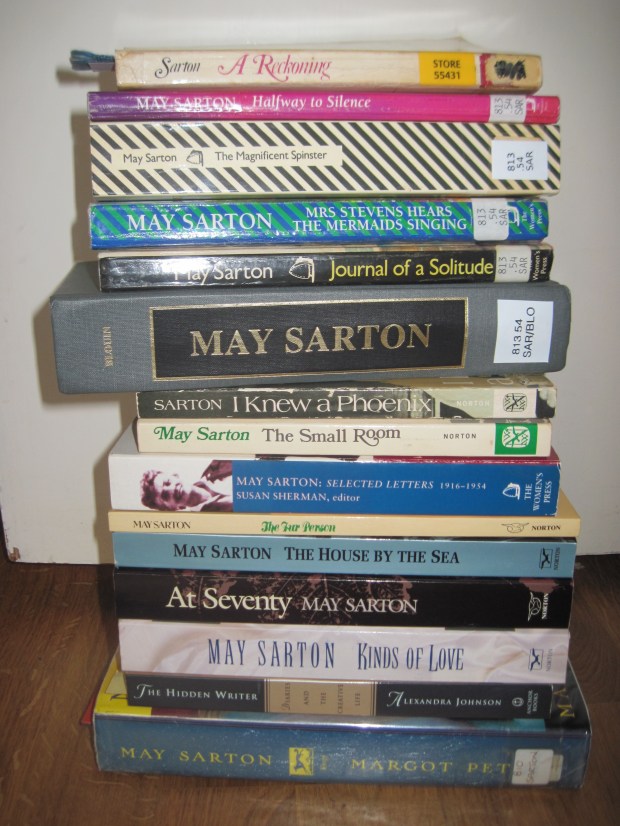
May Sarton article: I’m writing a profile for Bookmarks magazine this month, and am currently in the throes of research: finishing the Margot Peters biography I started last year and set aside for ages; reading another novel or two by Sarton; skimming back through various of the journals, novels and poems I’ve read before; and exploring other external sources. Luckily, my husband was able to forage for loads from his university library for me.
What’s keeping you busy this month?
#5–6 Short Fiction: Animal Crackers and Barnacle Love
I may have fallen behind on my 20 Books of Summer reading – August is going to have to be jam-packed! – but I have been enjoying the all-animals challenge. One of these two collections of short fiction sustains an animal theme for most of its length, while the other draws on metaphors from a fishing community but isn’t specifically about nature.
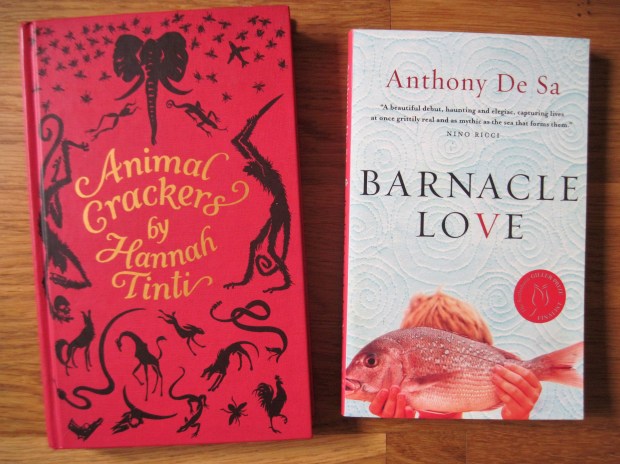
Animal Crackers by Hannah Tinti (2004)
A zoo, a circus, a turkey farm, a natural history museum, an African hunting expedition: several of the 11 stories are set in locales where human–animal interactions are formalized and exploitative, but all mention an animal at least once. In two cases the animal reference seems incidental and the stories really belong elsewhere – “Home Sweet Home,” which opens with the excellent line “Pat and Clyde were murdered on pot roast night,” appeared in Best American Mystery Stories 2003; “Hit Man of the Year” feels like a trial run for The Twelve Lives of Samuel Hawley – and in others there are gratuitous animal deaths at the hands of disturbed boys or angry men, which is always a strike against a book for me.
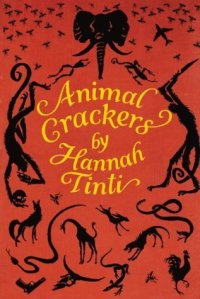 I only found four stand-outs here. “Reasonable Terms” is a playful piece of magic realism in which a zoo’s giraffes get the gorilla to write out a list of demands for their keepers and, when agreement isn’t forthcoming, stage a mass mock suicide. In “How to Revitalize the Snake in Your Life,” a woman takes revenge on her boa constrictor-keeping boyfriend. In “Miss Waldron’s Red Colobus,” which reminded me of Ned Beauman’s madcap style, a boarding school teenager eludes the private detectives her parents have hired to keep tabs on her and makes it all the way to Ghana, where a new species of monkey is named after her. My favorite of all was “Preservation,” in which Mary saves wildlife paintings through her work as an art conservator but can’t save her father from terminal illness.
Barnacle Love by Anthony De Sa (2008)
When I plucked this Giller Prize finalist from a secondhand bookshop’s clearance shelf, I assumed it was a novel. The 10 titled chapters are in chronological order and recount the Rebelos’ experiences in Canada between the mid-1950s and the early 1980s, but in that each focuses on a discrete incident from the family’s history, they are more like linked short stories. Manuel, a fisherman from the Azores, is shipwrecked on the coast of Newfoundland and begins a new life in Canada. He’s deliberately gone far from his home village, far from his controlling mother and the priest who abused him: “I knew that if I stayed in our town, on our stifling island, I’d be consumed by what it was you [his mother] hoped and dreamed for me.” He moves from St. John’s to Toronto, brings over a Portuguese wife, and raises two children while hopping from one unsuccessful money-making scheme to another.
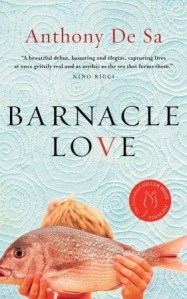 The first half of the book reports Manuel’s life in the third person, while the second is in the first person, narrated by his son, Antonio. Through that shift in perspective we come to see Manuel as both a comic and a tragic figure: he insists on speaking English, but his grammar and accent are atrocious; he cultivates proud Canadian traditions, like playing the anthem on repeat on Canada Day and spending Christmas Eve at Niagara Falls, but he’s also a drunk the neighborhood children laugh at. Although the two chapters set back in Portugal were my favorites, Manuel is a compelling, sympathetic character throughout, and I appreciated De Sa’s picture of the immigrant’s contrasting feelings of home and community. Particularly recommended if you’ve enjoyed That Time I Loved You by Carrianne Leung.
Representative passages:
Manuel’s mother: “My husband used to say that men are all barnacles. A barnacle starts out life swimming freely in the ocean. But, when it matures, it must settle down and choose a home. My dear husband used to say that it chooses to live with other barnacles of the same kind so that they can mate.”
Manuel: “I leave Portugal on fishing boat and I know I not going to come back. I give everything away to follow something new. I no understand what but something inside push me here—to make something of myself in this land. I come to be someone in this world.”
Late in the Day by Tessa Hadley & Improvement by Joan Silber
Late in the Day by Tessa Hadley (2019)
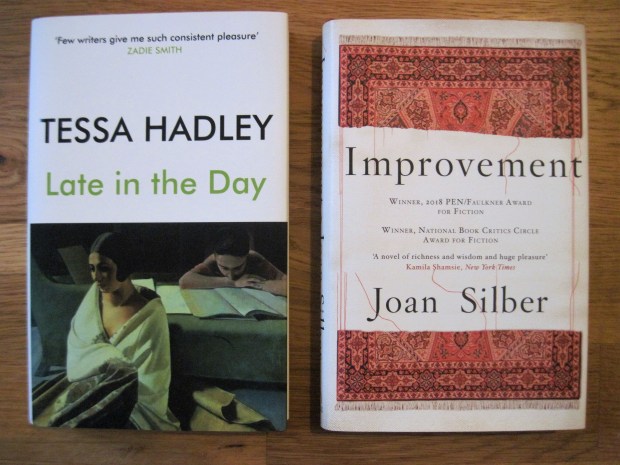
Two London couples: Christine and Alex, and Lydia and Zachary. They’ve known each other for decades, and their affiliations have changed in major, even ironic ways. It was Lydia who was initially infatuated with Alex when he taught both her and Christine, and Christine and Zachary who dated for a time. But this is how things ultimately fell out, each marriage resulting in one daughter. Christine with Alex; Lydia with Zachary.

The cover image is Raja (1925) by Felice Casorati.
Except now Zachary is dead. The phone call comes in the novel’s very first sentence. How Lydia and her friends – not to mention her daughter, Grace, who’s studying art in Glasgow – will cope with the loss, and rearrange what was once such a comfortable quadrilateral, is the ostensible subject of the rest of the book. There’s a funeral to plan and a future for Lydia to construct. But the problem, for me, is that every other chapter hosts a seemingly endless flashback to the couples’ backstory. Apart from an odd, titillating moment when the four nearly let down their guard together, these sections don’t reveal an awful lot.
This is my sixth book by Tessa Hadley. Her eye is always sharp on how families work, how relationships fall apart, and how memories form and linger as we age. She’s also a master of third-person omniscience, moving effortlessly between characters’ perspectives. The writing here is exquisite; there’s no question about that. I especially love the descriptive passages, full of so much sensual detail that you can imagine yourself right into a scene:
A breeze fanned the newspaper on the table, the smells of a city summer were wafted through the open window: tar and car exhaust, the bitter-green of the flowering privet hedge. Police horses went past in the broad street, their hooves clip-clopping conversationally alongside the voices of the women who rode them; the stables were nearby.
Her perception was a skin stretched taut, prickling with response to each change in the light outside as it ran through the drama of its sunset performance at the end of the street, in a mass of gilded pink cloud. When eventually the copper beech was only a silhouette cut out against the blue of the last light, Christine pulled down the blinds, put on all the lamps, turned her awareness inwards.
Despite the fine prose, I found the past strand of this novel tedious. If you’re new to Hadley, I’d recommend starting with Clever Girl and/or Bad Dreams and Other Stories.
Late in the Day was published in the UK by Jonathan Cape on February 14th, and in the USA by Harper on January 15th. My thanks to the publisher for the free copy for review.
Improvement by Joan Silber (2017)
I’ve been thinking a lot about linked short story collections, having written a brief article about them for BookBrowse to accompany my review of Carrianne Leung’s That Time I Loved You (those who contributed ideas on Twitter, thank you!). I find them easier to read than the average short story volume because there are fewer characters and settings to keep track of, and you get the fun of tracing unexpected connections between characters. Improvement didn’t quite work for me in that way, mostly because you can tell that it started as one short story, “About My Aunt”: now the untitled first chapter, it is, as you might guess, a solid stand-alone narrative about Reyna and her aunt Kiki. It was originally published in Tin House and collected in The Best American Short Stories 2015.
 I was most interested in Kiki, a terrific character with a completely unsuitable name. Her marriage to a Turk failed – but hey, at least she got a great rug out of it, as well as the fun but temporary challenge of third-world life. (“For a hardheaded person, she had let herself be flung about by the winds of love, and she wasn’t sorry either.”) Back in New York City she directs a house-cleaning agency and babysits for Reyna’s four-year-old son, Oliver. Tattooed Reyna’s African-American boyfriend, Boyd, is in prison for three months for selling pot; when he gets out he comes up with the bright idea of smuggling cigarettes between Virginia and New York to profit from the tax difference. He asks Reyna to make one of the pick-ups, but she chickens out at the last minute. Boyd’s friend Claude drives instead, and is killed instantly in a crash.
Part II reaches into the lives of some of the minor characters on the fringes: Claude; Teddy, the truck driver who was the other party in the car accident; Osman, Kiki’s ex-husband; a trio of Germans who passed through their Turkish town in the summer of 1977 with smuggled antiquities in their possession; and so on. For me, these narratives were too diffuse and didn’t hang together as a novel. I had hoped to enjoy this more since it won the National Book Critics Circle Award for Fiction and Silber is one of those writer’s writers you always hear about but never get to read. I found her voice similar to Anne Tyler’s or perhaps Julia Glass’s, but I’m not sure I’d try another book by her.
Improvement was published by Allen & Unwin on February 7th. It came out in the USA from Counterpoint Press in 2017. My thanks to the publisher for the free copy for review.
Bottom line for both:
Subtle, sophisticated but underwhelming.
Best Backlist Reads of 2018
Like a lot of book bloggers, I’m irresistibly drawn to the shiny new books released each year. However, I’ve noticed recently that many of my most memorable reads were published years or even decades ago. In 2018 I even came across a handful of books that are for me among the very best representatives of their genre, whether that’s nature, travel, family memoir, historical fiction or science fiction. The below selections are in alphabetical order by author name, and account for all the rest of my 4.5- and 5-star ratings of the year (another 27!).

My best backlist reads of the year (most of the ones I own in print, anyway).
Fiction
 March by Geraldine Brooks (2005): The best Civil War novel I’ve read. The best slavery novel I’ve read. One of the best historical novels I’ve ever read, period. Brooks’s second novel uses Little Women as its jumping-off point but is very much its own story. The whole is a perfect mixture of what’s familiar from history and literature and what Brooks has imagined.
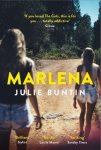 Marlena by Julie Buntin (2017): The northern Michigan setting pairs perfectly with the novel’s tone of foreboding: you have a sense of these troubled teens being isolated in their clearing in the woods, and from one frigid winter through a steamy summer and into the chill of the impending autumn, they have to figure out what in the world they are going to do with their terrifying freedom. It’s basically a flawless debut, one I can’t recommend too highly.
 Reading in the Dark by Seamus Deane (1996): Ireland’s internecine violence is the sinister backdrop to this family’s everyday sorrows, including the death of a child and the mother’s shaky mental health. The book captures all the magic, uncertainty and heartache of being a child, in crisp scenes I saw playing out in my mind.
 The Life and Loves of Lena Gaunt by Tracy Farr (2013): Lena Gaunt: early theremin player, grande dame of electronic music, and opium addict. I loved how Farr evokes the strangeness and energy of theremin music, and how sound waves find a metaphorical echo in the ocean’s waves – swimming is Lena’s other great passion.
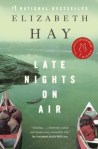 Late Nights on Air by Elizabeth Hay (2007): A tight-knit cast gathers around the local radio station in Yellowknife, a small city in Canada’s Northwest Territories: Harry and Gwen, refugees from Ontario starting new lives; Dido, an alluring Dutch newsreader; Ralph, the freelance book reviewer; menacing Eddie; and pious Eleanor. This is a marvellous story of quiet striving and dislocation; I saw bits of myself in each of the characters, and I loved the extreme setting, both mosquito-ridden summer and bitter winter.
 The Leavers by Lisa Ko (2017): An ambitious and satisfying novel set in New York and China, with major themes of illegal immigration, searching for a mother and a sense of belonging, and deciding what to take with you from your past. This was hand-picked by Barbara Kingsolver for the 2016 PEN/Bellwether Prize for Socially Engaged Fiction.
 The Invisible Bridge by Julie Orringer (2010): Hungarian Jew Andras Lévi travels from Budapest to Paris to study architecture, falls in love with an older woman who runs a ballet school, and – along with his parents, brothers, and friends – has to adjust to the increasingly strict constraints on Jews across Europe in 1937–45. It’s all too easy to burn out on World War II narratives these days, but this is among the very best I’ve read.
 The Sparrow by Mary Doria Russell (1996): For someone like me who struggles with sci-fi at the best of times, this is just right: the alien beings are just different enough from humans for Russell to make fascinating points about gender roles, commerce and art, but not so peculiar that you have trouble believing in their existence. All of the crew members are wonderful, distinctive characters, and the novel leaves you with so much to think about: unrequited love, destiny, faith, despair, and the meaning to be found in life.
 Salt Creek by Lucy Treloar (2015): Hester Finch is looking back from the 1870s – when she is a widowed teacher settled in England – to the eight ill-fated years her family spent at Salt Creek, a small (fictional) outpost in South Australia, in the 1850s–60s. This is one of the very best works of historical fiction I’ve read; it’s hard to believe it’s Treloar’s debut novel.
 Christmas Days: 12 Stories and 12 Feasts for 12 Days by Jeanette Winterson (2016): I treated myself to this new paperback edition with part of my birthday book token and it was a perfect read for the week leading up to Christmas. The stories are often fable-like, some spooky and some funny. Most have fantastical elements and meaningful rhetorical questions. Winterson takes the theology of Christmas seriously. A gorgeous book I’ll return to year after year.
Poetry
 Available Light by Marge Piercy (1988): The subjects are diverse: travels in Europe, menstruation, identifying as a Jew as well as a feminist, scattering her father’s ashes, the stresses of daily life, and being in love. Some of my favorites were about selectively adhering to the lessons her mother taught her, how difficult it is for a workaholic to be idle, and wrestling the deity for words.
Nonfiction
 Deep Country: Five Years in the Welsh Hills by Neil Ansell (2011): One of the most memorable nature/travel books I’ve ever read; a modern-day Walden. Ansell’s memoir is packed with beautiful lines as well as philosophical reflections on the nature of the self and the difference between isolation and loneliness.
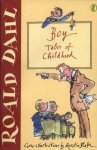 Boy by Roald Dahl (1984): Pranks and larks and holidays: these are all here; so is crushing homesickness and a bitter sense of injustice at being at the mercy of sadistic adults. Nearly 60 years later, Dahl could use memory and imagination to fully inhabit his childhood self and give a charming survey of the notable events of his life up to age 20.
 This Cold Heaven: Seven Seasons in Greenland by Gretel Ehrlich (2001): I thoroughly enjoyed my armchair trek across a frigid island nation in the company of Gretel Ehrlich, who traveled here repeatedly between 1995 and 2001 and intersperses her journeys with those of her historical model, Inuit–Danish explorer Knud Rasmussen, whose seven Arctic expeditions took in the west coast of Greenland and the far north of the North American continent. Every time she finds a fresh way to write about ice and sun glare and frigid temperatures.
 Ali: A Life by Jonathan Eig (2017): It’s a riveting account of outliving segregation and developing a personal style and world-beating confidence; it’s a sobering tale of facing consequences and having your own body fail you. I’m the furthest thing from a sports fan you could imagine, but I approached this as a book about a cultural icon and read it with a spirit of curiosity about how Eig would shape this life story and separate the facts from the legend. I loved it.
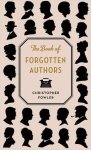 The Book of Forgotten Authors by Christopher Fowler (2017): A charming introduction to 99 more or less obscure writers. Each profile is a perfectly formed mini-biography with a survey of the author’s major work: in just two or three pages, Fowler is able to convey all a writer’s eccentricities and why their output is still worth remembering.
 To the Is-Land: An Autobiography by Janet Frame (1982): This is some of the best writing about childhood and memory that I’ve ever read, infused with music, magic and mystery. The prose alternates between dreamy and matter-of-fact as Frame describes growing up in New Zealand one of five children in the Depression and interwar years.
 Leaving Before the Rains Come by Alexandra Fuller (2015): This poignant sequel to Don’t Let’s Go to the Dogs Tonight is a portrait of Fuller’s two-decade marriage, from its hopeful beginnings to its acrimonious end. What I most appreciated about the book was Fuller’s sense of being displaced: she no longer feels African, but nor does she feel American.
 West With the Night by Beryl Markham (1942): Markham writes so vividly about the many adventures of her life in Africa: hunting lions, training race horses, and becoming one of the continent’s first freelance pilots, delivering mail and locating elephant herds. Whether she’s reflecting on the many faces of Africa or the peculiar solitude of night flights, the prose is just stellar.
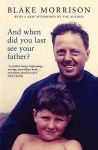 And When Did You Last See Your Father? by Blake Morrison (1993): An extraordinary memoir based around the author’s relationship with his father. Alternating chapters give glimpses into earlier family life and narrate Morrison’s father’s decline and death from cancer. This is simply marvelously written, not a bad line in the whole thing.
 The Seabird’s Cry: The Lives and Loves of Puffins, Gannets and Other Ocean Voyagers by Adam Nicolson (2017): This is an extraordinarily well-written and -researched book (a worthy Wainwright Prize winner) about the behavior, cultural importance, and current plight of the world’s seabirds. Each chapter takes up a different species and dives deep into everything from its anatomy to the legends surrounding it, simultaneously conveying the playful, intimate real lives of the birds and their complete otherness.
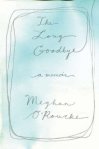 The Long Goodbye: A Memoir of Grief by Meghan O’Rourke (2011): I read a whole lot of bereavement memoirs; this has been one of the very best. O’Rourke tells her story with absolute clarity – a robust, plain-speaking style that matches her emotional transparency. The heart of the book is her mother’s death from colorectal cancer on Christmas Day 2008, but we also get a full picture of the family life that preceded it and the first couple of years of aftermath.
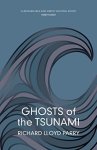 Ghosts of the Tsunami: Death and Life in Japan’s Disaster Zone by Richard Lloyd Parry (2017): Eighteen and a half thousand people died in the earthquake and tsunami that hit Japan in March 2011. It’s not really possible to get your head around a tragedy on that scale so, wisely, Parry focuses on a smaller story within the story: 74 died at Okawa primary school because the administration didn’t have a sufficient disaster plan in place. This is a stunning portrait of a resilient people, but also a universal story of the human spirit facing the worst.
 Lots of Candles, Plenty of Cake by Anna Quindlen (2012): A splendid memoir-in-essays that dwells on aging, parenting and female friendship. Some of its specific themes are marriage, solitude, the randomness of life, the process of growing into your own identity, and the special challenges her generation (roughly my mother’s) faced in seeking a work–life balance. Her words are witty and reassuring, and cut right to the heart of the matter in every case.
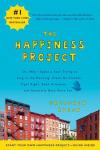 The Happiness Project: Or, Why I Spent a Year Trying to Sing in the Morning, Clean My Closets, Fight Right, Read Aristotle, and Generally Have More Fun by Gretchen Rubin (2009): Probably the best self-help book I’ve read; dense (in the best possible way) with philosophy, experience and advice. What I appreciated most is that her approach is not about undertaking extreme actions to try to achieve happiness, but about finding contentment in the life you already have by adding or tweaking small habits – especially useful for pessimists like me.
 In the Days of Rain: A daughter. A father. A cult by Rebecca Stott (2017): This was a perfect book for my interests, and just the kind of thing I would love to write someday. It’s a bereavement memoir that opens with Stott’s father succumbing to pancreatic cancer and eliciting her promise to help finish his languishing memoir; it’s a family memoir that tracks generations through England, Scotland and Australia; and it’s a story of faith and doubt, of the absolute certainty experienced inside the Exclusive Brethren (a Christian sect that numbers 45,000 worldwide) and how that cracked until there was no choice but to leave.
 Writers & Company by Eleanor Wachtel (1993): Erudite and fascinating author interviews from Wachtel’s weekly Canadian Broadcasting Corporation radio program. Whether I’d read anything by these authors (or even heard of them) or not, I found each Q&A chock-full of priceless nuggets of wisdom about creativity, mothers and daughters, drawing on autobiographical material, the writing process, and much more.
And if I really had to limit myself to just two books – my very best fiction and nonfiction reads of the year – they would be March by Geraldine Brooks and And When Did You Last See Your Father? by Blake Morrison.

 Bookish Beck = Rebecca Foster. American transplant to England. Freelance proofreader and book reviewer.
 Bookish Beck