Book Serendipity, Mid-November–Early January
This is a short set but I’ll post it now to keep things ticking over. I’ve lost nearly a week to the upper respiratory virus from hell, and haven’t felt up to sitting at my computer for any extended periods of time. I had to request extensions on a few of my work deadlines; I’ll hope to be back to normal blogging next week, too.
I call it “Book Serendipity” when two or more books that I read at the same time or in quick succession have something in common – the more bizarre, the better. This is a regular feature of mine every couple of months. Because I usually have 20–30 books on the go at once, I suppose I’m more prone to such incidents. People frequently ask how I remember all of these coincidences. The answer is: I jot them down on scraps of paper or input them immediately into a file on my PC desktop; otherwise, they would flit away! Feel free to join in with your own.
The following are in roughly chronological order.
- Ayot St Lawrence as a setting in Q’s Legacy by Helene Hanff and Flesh by David Szalay.
- A man who has panic attacks in Pan by Michael Clune and All the World Can Hold by Jung Yun.
- Two of my Shelf Awareness PRO (early) reviews in a row were of 2026 novels set on a celebrity/reunion cruise: All the World Can Hold by Jung Yun, followed by American Fantasy by Emma Straub. In both, the narrative alternates between three main characters, the cruise is to celebrate a milestone birthday for a passenger’s relative, and there’s a celebrity who’s in AA.
- A teacher–student relationship develops into a friendship in The Irish Goodbye by Beth Ann Fennelly (with Molly McCully Brown, whose Places I’ve Taken My Body I’ve reviewed) and Lessons from My Teachers by Sarah Ruhl (with Max Ritvo, about whom she wrote a whole book).
 Someone becomes addicted to benzodiazepines in The Pass by Katriona Chapman and All the World Can Hold by Jung Yun (both 2026 releases).
- A New York City event scheduled to occur on September 15 or 16, 2001 is postponed because of 9/11 in Joyride by Susan Orlean (her wedding) and All the World Can Hold by Jung Yun (a cruise departure – it’s moved to Boston).
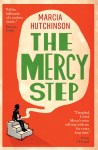
- A 1960s attempted suicide by putting one’s head in a gas oven in The Mercy Step by Marcia Hutchinson and The Soul of Kindness by Elizabeth Taylor.
- A plan to eat cheese to induce dreams in The Reservation by Rebecca Kauffman and Slags by Emma Jane Unsworth.
- An author is (at least initially) aghast at the liberties taken with an adaptation of her book in Spent by Alison Bechdel and Joyride by Susan Orlean (the film Adaptation, one of my favourites, bears little relation to her nonfiction work The Orchid Thief, which I also love).
- A North American author meets her British publishers, André Deutsch and Diana Athill, in Book of Lives by Margaret Atwood and Q’s Legacy by Helene Hanff. (Atwood also mentions Sir Arthur Quiller-Couch, the title reference in the Hanff.)
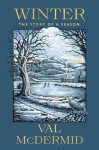
- An older white woman feels compelled to add, as an aside after a memory of slightly dodgy behaviour observed, that cultural appropriation was not a thing in those days in Book of Lives by Margaret Atwood and Winter by Val McDermid.
- I read two books in 2025 with a title taken from a Christian Wiman poem: A Truce that Is Not Peace by Miriam Toews, then Some Bright Nowhere by Ann Packer.
- A special trip undertaken for a younger sister’s milestone birthday: a road trip through Scotland in a campervan in Slags by Emma Jane Unsworth for a 40th; and a boy band reunion cruise to the Bahamas for a 45th in American Fantasy by Emma Straub.
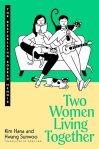
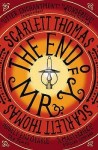
- A reference to Sartre’s “hell is other people” line (paraphrased) in Two Women Living Together by Kim Hana and Hwang Sunwoo and The End of Mr Y by Scarlett Thomas.
- The clock-drawing test as a shorthand for assessing a loved one’s dementia in Book of Lives by Margaret Atwood (her partner Graeme) and Joyride by Susan Orlean (her mother).
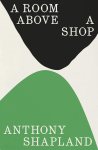 A sexual encounter between two men is presaged by them relieving themselves side by side at urinals in A Room Above a Shop by Anthony Shapland and The End of Mr Y by Scarlett Thomas.
- An older man who knows he’s having a stroke just wants to sit quietly in a chair and not be taken to hospital in Book of Lives by Margaret Atwood (her partner Graeme) and The Boy from the Sea by Garrett Carr.
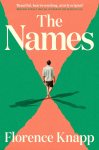
- A man who’s gone through Alcoholics Anonymous gets dangerously close to falling off the wagon: picks up a bottle of gin in a shop in The Names by Florence Knapp / buys a drink at a bar in All the World Can Hold by Jung Yun.
- I was reading two nonfiction books with built-in red ribbon bookmarks at the same time: Book of Lives by Margaret Atwood and Robin by Stephen Moss.
- Homoeopathy is an element in The Names by Florence Knapp and The End of Mr Y by Scarlett Thomas.
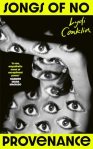
- A character named Sparrow in Spent by Alison Bechdel and Songs of No Provenance by Lydi Conklin.

- A mention of special celebrations for a Korean mother’s 70 birthday in Two Women Living Together by Kim Hana and Hwang Sunwoo and All the World Can Hold by Jung Yun.
- Some kinky practices in Songs of No Provenance by Lydi Conklin and Mr Norris Changes Trains by Christopher Isherwood.
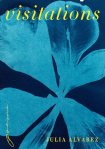
- A girl from an immigrant family reads Greek mythology for escape in Visitations by Julia Alvarez and The Mercy Step by Marcia Hutchinson.
- “View halloo” (originally a fox-hunting term) is used as a greeting in Talking It Over by Julian Barnes and Arsenic for Tea by Robin Stevens.
What’s the weirdest reading coincidence you’ve had lately?
Seasons Readings: Winter, The Robin, & An Almost Perfect Christmas
I’m marking Christmas Eve with cosy reflections on the season, a biography of Britons’ favourite bird (and a bonus seasonal fairy tale), and a mixed bag of essays and stories about the obligations and annoyances of the holidays.
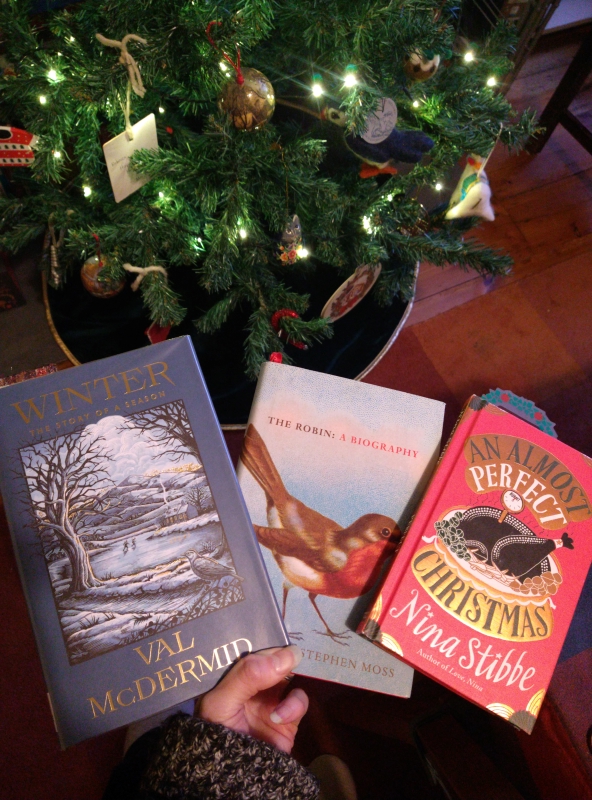
Winter by Val McDermid (2025)
 I didn’t realize that Michael Morpurgo’s Spring was the launch of a series of short nonfiction books on the seasons. McDermid writes a book a year, always starting it in early January. She evokes the Scottish winter’s “Janus-faced” character: cosy but increasingly storm-tossed. In few-page essays, she looks for nature’s clues, delves into childhood memories, and traverses the season through traditional celebrations as she has experienced them in Edinburgh and Fife: Hallowe’en, Bonfire Night, Christmas, and New Year’s Eve. The festivities are a collective way of taking the mind off of the season’s hardships, she suggests. I was amused by her mother’s recipe for soup, which she described as more of a “rummage” for whatever vegetables you have in the fridge. It was my first time reading McDermid and, while I don’t know that I will ever pick up one of her crime novels, this was pleasant. I reckon I’d read Bernardine Evaristo on summer and Kate Mosse on autumn, too. (Public library)
The Robin: A Biography – A Year in the Life of Britain’s Favourite Bird by Stephen Moss (2017)
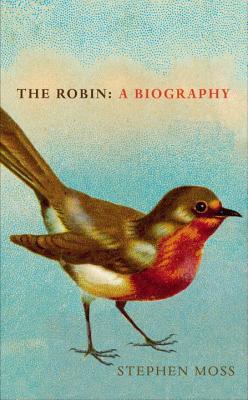 I’ve also read Moss’s most recent bird monograph, The Starling. Both provide a thorough yet accessible introduction to a beloved species’ history, behaviour, and cultural importance. The month-by-month structure works well here: Moss’s observations in his garden and on his local patch lead into discussions of what birds are preoccupied with at certain times of year. Such a narrative approach makes the details less tedious. European robins are known for singing pretty much year-round, and because hardly any migrate – only 5%, it’s thought – they feel like constant companions. They are inquisitive garden guests, visiting feeders and hanging around to see if we monkey-pigs might dig up some juicy worms for them.
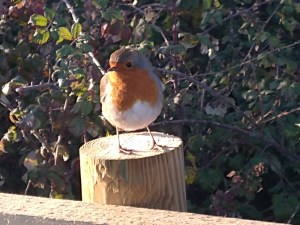
(Last month, this friendly chap at an RSPB bird reserve near Exeter wondered if we might have a snack to share.)
Although we like to think we see the same robins year after year, that’s very unlikely. One in four robins found dead has been killed by a domestic cat; most die of old age and/or starvation within a year. Robin pairs raise one or two broods per year and may attempt a third if the weather allows, but that high annual mortality rate (62%) means we’re not overrun. Compared to other notable species, then, they’re doing well. There are loads of poems and vintage illustrations and, what with robins’ associations with Christmas, this felt like a seasonally appropriate read. At Christmas 2022 I read the very similar Robin by Helen F. Wilson, but this was more engaging. (Free from C’s former colleague)
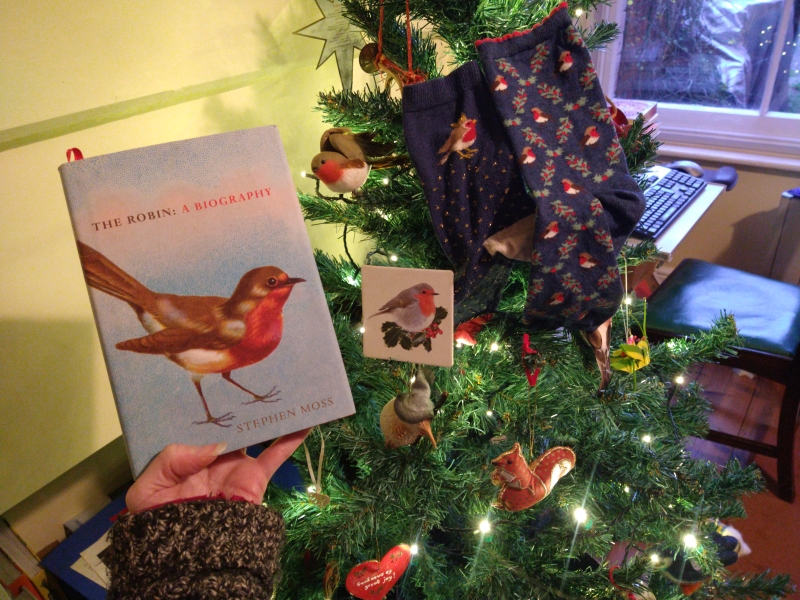
Our small collection of Christmas robin paraphernalia.
&
The Robin & the Fir Tree by Jason Jameson (2020)
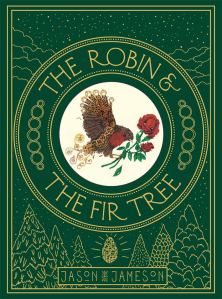 Based on a Hans Christian Andersen fairy tale, this lushly illustrated children’s book stars a restless tree and a faithful robin. The tree resents being stuck in one place and envies his kin who have been made into ships to sail the world. Although his friend the robin describes everything and brings souvenirs, he can’t see the funfair and the flora of other landscapes for himself. “Every season will be just the same. How I long for something different to happen!” he cries. Cue a careful-what-you-wish-for message. When men with axes come to chop down the fir tree and display him in the town square, he feels a combination of trepidation and privilege. Human carelessness turns his sacrifice to waste, and only the robin knows how to make something good out of the wreckage. The art somewhat outshines the story but this is still a lovely hardback I’d recommend to adults and older children. (Public library)
An Almost Perfect Christmas by Nina Stibbe (2017)
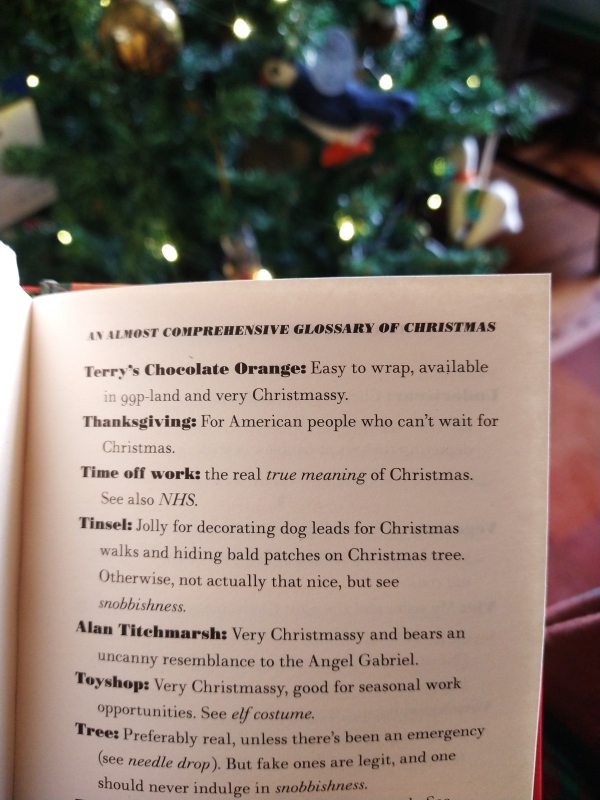
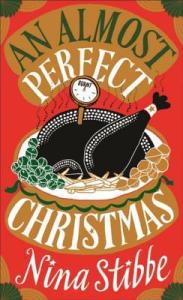 I reviewed this for Stylist magazine when it first came out and had fond memories of a witty collection I expected to dip into again and again. This time, though, Stibbe’s grumpy rants about turkey, family, choosing a tree and compiling the perfect Christmas party playlist fell flat with me. The four short stories felt particularly weak. I most recognized and enjoyed the sentiments in “Christmas Correspondence,” which is about the etiquette for round-robin letters and thank-you notes. The tongue-in-cheek glossary that closes the book is also amusing. But this has served its time in my collection and it’s off to the Little Free Library with it to, I hope, give someone else a chuckle on Christmas day. (Review copy)
My original rating (2017):
My rating now: 
It’s taken me a long time to feel festive this year, but after a couple of book club gatherings and a load of brief community events for the Newbury Living Advent Calendar plus the neighbourhood carol walk, I think I’m finally ready for Christmas. (Not that I’ve wrapped anything yet.) I had a couple of unexpected bookish gifts arrive earlier in December. First, I won the 21st birthday quiz on Kim’s blog and she sent a lovely parcel of Australian books and an apt tote bag. Then, I was sent an early finished copy of Julian Barnes’s upcoming (final) novel, Departure(s). We didn’t trust Benny to be sensible around a real tree so got an artificial one free from a neighbour to festoon with non-breakable ornaments. He discovered the world’s comfiest blanket and spends a lot of time sleeping on it, which has been helpful.
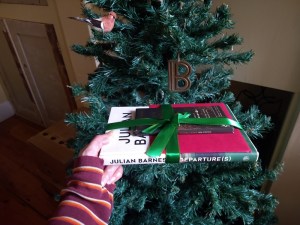


Merry Christmas, everyone! I have a bunch of year-end posts in preparation. It’ll be a day off tomorrow, of course, but here’s what to expect thereafter:
Friday 26th: Reporting back on Most Anticipated Reads of 2025
Saturday 27th: Reading Superlatives
Sunday 28th: Best Backlist Reads
Monday 29th: Love Your Library
Tuesday 30th: Runners-Up
Wednesday 31st: Best Books of 2025
Thursday 1st: Final Statistics for 2025
Friday 2nd: Early Recommendations for 2026
Monday 5th: Most Anticipated Titles of 2026
October Books: Ballard, Czarnecki, Moss, Oliver, Ostriker, Steed & More
Apparently October is THE biggest month of the year for new releases. A sterling set came my way this year, including two beautiful novella-length memoirs, a luxuriantly illustrated work dedicated to an everyday bird species, two very different but equally elegant poetry collections, and a book of offbeat comics. Time and concentration only allow for a paragraph or so on each, but I hope that gives a flavour of the contents and will pique interest in the ones that suit you best. Plus I excerpt and link to my BookBrowse review of a poignant story of sisters and mental illness, and my Shelf Awareness review of a fantastic graphic novel adaptation.
Bound: A Memoir of Making and Remaking by Maddie Ballard
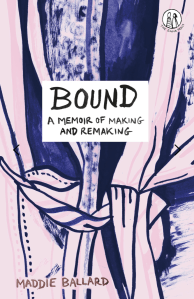 This collection of micro-essays considers sewing and much more. Each piece is headed by a pattern name and list of materials that Ballard made into an article of clothing for herself or for someone else. Among the minutiae of the craft, she slips in so many threads: about her mixed Chinese heritage and her relationship with her grandmother, about the environmental and financial benefits of making one’s own clothing, and especially about the upheaval of her twenties: the pandemic, a break-up, leaving a job to go back to school, finding roommates. I can barely mend a sock and I’m clueless when it comes to fashion, yet I can appreciate how sewing blends comfort and creativity. Ballard presents it as a meditative act of self-care:
I lower the needle and the world recedes. The process of sewing a garment – printing the pattern, tracing and cutting, sewing the first and the second and the fiftieth seam – is a lesson in taking your time.
Like gardening, sewing is an investment in the future – in what sort of person your future self will be, and how she will feel about her body, and what she will want to wear.
Similar to two other very short works of nonfiction I’ve read from The Emma Press, How Kyoto Breaks Your Heart by Florentyna Leow and Tiny Moons by Nina Mingya Powles (Ballard, too, is from New Zealand), this is a graceful, enriching book about a young woman making her way in the world and figuring out what is essential to her sense of home and identity. I commend it whether or not you have any particular interest in handicraft.
With thanks to The Emma Press for the free copy for review.
Encounters with Inscriptions: A Memoir Exploring Books Gifted by Parents by Kristin Czarnecki
When Kristin Czarnecki got in touch to offer a copy of her bibliomemoir about revisiting the books her late parents gifted her, I was instantly intrigued but couldn’t have known in advance how perfect it would be for me. Niche it might seem, but it combines several of my reading interests: bereavement, books about books, relationships with parents (especially a mother) and literary travels.
 The book starts, aptly, with childhood. A volume of Shel Silverstein poetry and A Child’s Christmas in Wales serve as perfect vehicles for the memories of how her parents passed on their love of literature and created family holiday rituals. Thereafter, the chapters are not strictly chronological but thematic. A work of women’s history opens up her mother’s involvement in the feminist movement; reading a Thomas Merton book reveals why his thinking was so important to her Catholic father. The interplay of literary criticism, cultural commentary and personal significance is especially effective in pieces on Alice Munro and Flannery O’Connor. A Virginia Woolf biography points to Czarnecki’s academic specialism and a cookbook to how food embodies memories.
It seems fitting to be reviewing this on the second anniversary of my mother’s death. The afterword, which follows on from the philosophical encouragement of a chapter on the Rubaiyat of Omar Khayyam, exhorts readers to cherish loved ones while we can – and be grateful for the tokens they leave behind. I had told Kristin about books my parents inscribed to me, as well as the journals I inherited from my mother. But I didn’t know there would be other specific connections between us, too, such as being childfree and hopeless in the kitchen. (Also, I have family in South Bend, Indiana, where she’s from, and our mothers were born in the first week of August.) All that to say, I felt that I found a kindred spirit in this lovely book, which is one of the nicest things that happens through reading.
With thanks to the author for the advanced e-copy for review.
The Starling: A Biography by Stephen Moss
 Moss has written a whole series of accessible bird species monographs suitable for nature buffs; this is the sixth. (I’ve not read the others, just Moss’s Wild Hares and Hummingbirds and Skylarks with Rosie, but we do have a copy of The Robin on the shelf that I’ve earmarked for Christmas.) The choice of the term ‘biography’ indicates the meeting of a comprehensive aim and intimate detail. The book conveys much anatomical and historical information about the starling’s relatives, habits, and worldwide spread, yet is only 187 pages – and plenty of those feature relevant paintings and photographs, too. It’s well known that starlings were introduced to Anglophone countries as part of misguided “acclimatisation” projects that we would now dub cultural imperialism. In the USA and elsewhere, the bird is still considered common. But with the industrialisation of agriculture, starlings are actually having less breeding success and thus are in decline.
Overall, the style of the book is dry and slightly workmanlike. However, when he’s recounting murmurations he’s seen in Somerset or read about, Moss’s enthusiasm lifts it into something special. Autumn dusk is a great time to start watching out for starling gatherings. I love observing and listening to the starlings just in the treetops and aerials of my neighbourhood, but we do also have a small local murmuration that I try to catch at least a few times in the season. Here’s how he describes their magic: “At a time when, both as a society and as individuals, we are less and less in touch with the natural world, attending this fleeting but memorable event is a way we can reconnect, regain our primal sense of wonder – and still be home in time for tea.”
With thanks to Square Peg, an imprint of Vintage (Penguin Random House) for the free copy for review.
The Alcestis Machine by Carolyn Oliver
 Carolyn is a blogger friend whose first collection, Inside the Storm I Want to Touch the Tremble, was on my Best Books of 2022 list. Her second is again characterized by precise vocabulary and crystalline imagery, often related to etymology, book history, or pigments (“You and I are marginalia shadowed / by a careless hand, we are gall-soaked vellum / invisible appetites consume.”). Astronomy and technology are a counterpoint, juxtaposing the ancient and the cutting-edge. I loved the language of sea creatures in “Strange Attractor” and the oblique approach to the passage of time (“Three popes ago, you and I”). The repeated three-word opening “In another life” gives a sense of many worlds, e.g., “In another life I’m a florist sometimes accused of inappropriate gravity.” Prose poems relay childhood memories. Love poems are tantalizing and utterly original: “If I promise not to describe the moon, will you / come with me a ways further into the night? / We’ll wash the forest floor / of ash and find a fairy ring / half-eaten, muted crescent bereft of power.” And alliteration never fails to win me over: “Tonight, snow tumbles over sophomores and starlings” and “the pillars in the water make a pillory not a pier”. Some of the collection remained cryptic for me; there was a bit less that grabbed me emotionally. But it’s still stirring work. And how flabbergasted was I to spot my name in the Acknowledgments? (Read via Edelweiss)
The Holy & Broken Bliss: Poems in Plague Time by Alicia Ostriker
“The words of an old woman shuffling the cards of her own decline the decline
of her husband the decline of her nation her plague-smitten world”
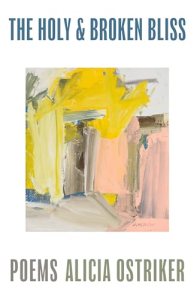 Out of pandemic isolation come new rituals: watching days and seasons pass, fighting for her own health but mostly her husband’s, and lamenting public displays of hate. Lines feel stark with honesty; some poems are just haiku length. Elsewhere, repetition and alliteration create a wistful tone. Jewish scripture and mysticism are the source of much of the language and outlook. Music and nature, too, promise the transcendent. Simple and remarkable. Here’s a stanza about late autumn:
It is almost winter and still
as I walk to the clinic the gingkos
sing their seraphic air
as if there is no tomorrow
With thanks to Alice James Books for the advanced e-copy for review.
Forces of Nature by Edward Steed
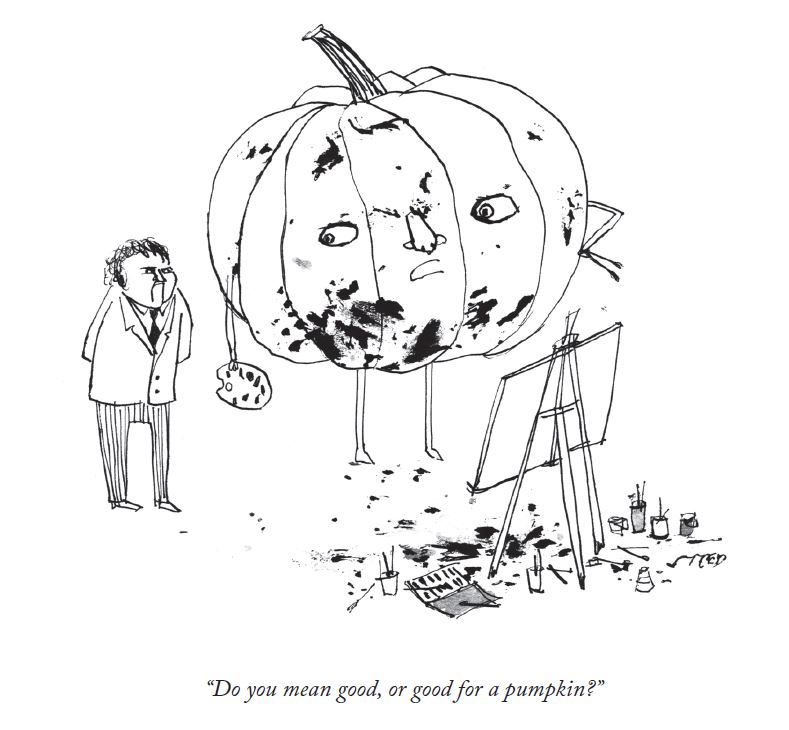
 Steed is a longtime New Yorker cartoonist who produces single panels. This means there is no story progression (as in a graphic novel), just what you see on one page. Some of the comics are wordless; many scenes are visual gags which, to be entirely honest, I didn’t always grasp. Steed’s recurring characters are unhappy couples, exiles on desert islands, and dumb cops or criminals. His style is deliberately simplistic: the people not much more advanced than stick figures and the animals especially sketchy. There are multiple attempted prison breaks and satirical depictions of God and the Garden of Eden. Many of the setups are contrived, and the tone can be absurd or prickly, even shading into gruesome. These comics weren’t altogether my cup of tea, though I did get a laugh out of a few of them (a seasonal example is below). Endorsed if you fancy a cross between Edward Gorey and The Book of Bunny Suicides.
With thanks to Drawn & Quarterly for the e-copy for review.
Reviewed for BookBrowse:
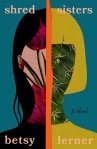 Shred Sisters by Betsy Lerner – “No one will love you more or hurt you more than a sister” is a wry aphorism that appears late in Lerner’s debut novel. Over the course of two decades, there is much heartache for the Shred family, but also moments of joy. Ultimately, a sisterly bond endures despite secrets, betrayals, and intermittent estrangement. Through her psychologically astute portrait of Olivia (“Ollie”) and Amy Shred, Lerner captures the lasting effects that mental illness can have on not just an individual, but an entire family.
Reviewed for Shelf Awareness:
 The Worst Journey in the World, Volume 1: Making Our Easting Down: The Graphic Novel by Sarah Airriess – The thrilling opening to a cinematically vivid adaptation of Apsley Cherry-Garrard’s 1922 memoir. He was an assistant zoologist on Robert Falcon Scott’s 1910-13 Terra Nova expedition to the South Pole. Even before the ship entered the pack ice, the journey was perilous. The book resembles a full-color storyboard for a Disney-style maritime adventure film. There is jolly camaraderie as the men sing sea shanties to boost morale. The second volume can’t arrive soon enough.
#NonFicNov: Being the Expert on Covid Diaries
This year the Be/Ask/Become the Expert week of the month-long Nonfiction November challenge is hosted by Veronica of The Thousand Book Project. (In previous years I’ve contributed lists of women’s religious memoirs (twice), accounts of postpartum depression, and books on “care”.)
I’ve been devouring nonfiction responses to COVID-19 for over a year now. Even memoirs that are not specifically structured as diaries take pains to give a sense of what life was like from day to day during the early months of the pandemic, including the fear of infection and the experience of lockdown. Covid is mentioned in lots of new releases these days, fiction or nonfiction, even if just via an introduction or epilogue, but I’ve focused on books where it’s a major element. At the end of the post I list others I’ve read on the theme, but first I feature four recent releases that I was sent for review.
Year of Plagues: A Memoir of 2020 by Fred D’Aguiar
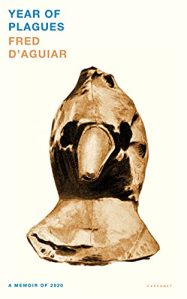 The plague for D’Aguiar was dual: not just Covid, but cancer. Specifically, stage 4 prostate cancer. A hospital was the last place he wanted to spend time during a pandemic, yet his treatment required frequent visits. Current events, including a curfew in his adopted home of Los Angeles and the protests following George Floyd’s murder, form a distant background to an allegorized medical struggle. D’Aguiar personifies his illness as a force intent on harming him; his hope is that he can be like Anansi and outwit the Brer Rabbit of cancer. He imagines dialogues between himself and his illness as they spar through a turbulent year.
Cancer needs a song: tambourine and cymbals and a choir, not to raise it from the dead but [to] lay it to rest finally.
Tracing the effects of his cancer on his wife and children as well as on his own body, he wonders if the treatment will disrupt his sense of his own masculinity. I thought the narrative would hit home given that I have a family member going through the same thing, but it struck me as a jumble, full of repetition and TMI moments. Expecting concision from a poet, I wanted the highlights reel instead of 323 rambling pages. 
(Carcanet Press, August 26.) With thanks to the publisher for the free copy for review.
100 Days by Gabriel Josipovici
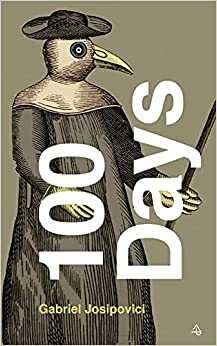 Beginning in March 2020, Josipovici challenged himself to write a diary entry and mini-essay each day for 100 days – which happened to correspond almost exactly to the length of the UK’s first lockdown. Approaching age 80, he felt the virus had offered “the unexpected gift of a bracket round life” that he “mustn’t fritter away.” He chose an alphabetical framework, stretching from Aachen to Zoos and covering everything from his upbringing in Egypt to his love of walking in the Sussex Downs. I had the feeling that I should have read some of his fiction first so that I could spot how his ideas and experiences had infiltrated it; I’m now rectifying this by reading his novella The Cemetery in Barnes, in which I recognize a late-life remarriage and London versus countryside settings.
Still, I appreciated Josipovici’s thoughts on literature and his own aims for his work (more so than the rehashing of Covid statistics and official briefings from Boris Johnson et al., almost unbearable to encounter again):
In my writing I have always eschewed visual descriptions, perhaps because I don’t have a strong visual memory myself, but actually it is because reading such descriptions in other people’s novels I am instantly bored and feel it is so much dead wood.
nearly all my books and stories try to force the reader (and, I suppose, as I wrote, to force me) to face the strange phenomenon that everything does indeed pass, and that one day, perhaps sooner than most people think, humanity will pass and, eventually, the universe, but that most of the time we live as though all was permanent, including ourselves. What rich soil for the artist!
Why have I always had such an aversion to first person narratives? I think precisely because of their dishonesty – they start from a falsehood and can never recover. The falsehood that ‘I’ can talk in such detail and so smoothly about what has ‘happened’ to ‘me’, or even, sometimes, what is actually happening as ‘I’ write.
You never know till you’ve plunged in just what it is you really want to write. When I started writing The Inventory I had no idea repetition would play such an important role in it. And so it has been all through, right up to The Cemetery in Barnes. If I was a poet I would no doubt use refrains – I love the way the same thing becomes different the second time round
To write a novel in which nothing happens and yet everything happens: a secret dream of mine ever since I began to write
I did sense some misogyny, though, as it’s generally female writers he singles out for criticism: Iris Murdoch is his prime example of the overuse of adjectives and adverbs, he mentions a “dreadful novel” he’s reading by Elizabeth Bowen, and he describes Jean Rhys and Dorothy Whipple as women “who, raised on a diet of the classic English novel, howled with anguish when life did not, for them, turn out as they felt it should.”
While this was enjoyable to flip through, it’s probably more for existing fans than for readers new to the author’s work, and the Covid connection isn’t integral to the writing experiment. 
(Carcanet Press, October 28.) With thanks to the publisher for the free copy for review.
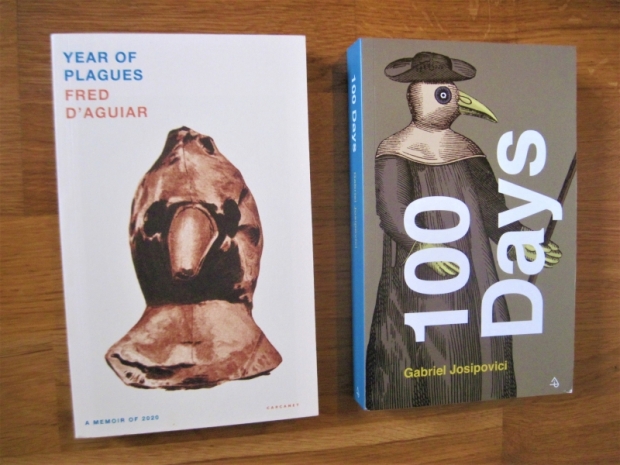
A stanza from the below collection to link the first two books to this next one:
Have they found him yet, I wonder,
whoever it is strolling
about as a plague doctor, outlandish
beak and all?
The Crash Wake and Other Poems by Owen Lowery
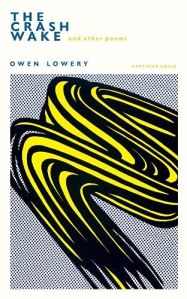 Lowery was a tetraplegic poet – wheelchair-bound and on a ventilator – who also survived a serious car crash in February 2020 before his death in May 2021. It’s astonishing how much his body withstood, leaving his mind not just intact but capable of generating dozens of seemingly effortless poems. Most of the first half of this posthumous collection, his third overall, is taken up by a long, multipart poem entitled “The Crash Wake” (it’s composed of 104 12-line poems, to be precise), in which his complicated recovery gets bound up with wider anxiety about the pandemic: “It will take time and / more to find our way / back to who we were before the shimmer / and promise of our snapped day.”
As the seventh anniversary of his wedding to Jayne nears, Lowery reflects on how love has kept him going despite flashbacks to the accident and feeling written off by his doctors. In the second section of the book, the subjects vary from the arts (Paula Rego’s photographs, Stanley Spencer’s paintings, R.S. Thomas’s theology) to sport. There is also a lovely “Remembrance Day Sequence” imagining what various soldiers, including Edward Thomas and his own grandfather, lived through. The final piece is a prose horror story about a magpie. Like a magpie, I found many sparkly gems in this wide-ranging collection. 
(Carcanet Press, October 28.) With thanks to the publisher for the free e-copy for review.
Behind the Mask: Living Alone in the Epicenter by Kate Walter
[135 pages, so I’m counting this one towards #NovNov, too]
For Walter, a freelance journalist and longtime Manhattan resident, coronavirus turned life upside down. Retired from college teaching and living in Westbeth Artists Housing, she’d relied on activities outside the home for socializing. To a single extrovert, lockdown offered no benefits; she spent holidays alone instead of with her large Irish Catholic family. Even one of the world’s great cities could be a site of boredom and isolation. Still, she gamely moved her hobbies onto Zoom as much as possible, and welcomed an escape to Jersey Shore.
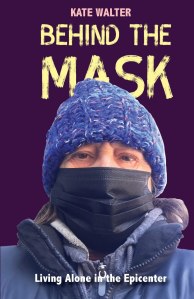 In short essays, she proceeds month by month through the pandemic: what changed, what kept her sane, and what she was missing. Walter considers herself a “gay elder” and was particularly sad the Pride March didn’t go ahead in 2020. She also found herself ‘coming out again’, at age 71, when she was asked by her alma mater to encapsulate the 50 years since graduation in 100 words.
There’s a lot here to relate to – being glued to the news, anxiety over Trump’s possible re-election, looking forward to vaccination appointments – and the book is also revealing on the special challenges for older people and those who don’t live with family. However, I found the whole fairly repetitive (perhaps as a result of some pieces originally appearing in The Village Sun and then being tweaked and inserted here).
Before an appendix of four short pre-Covid essays, there’s a section of pandemic writing prompts: 12 sets of questions to use to think through the last year and a half and what it’s meant. E.g. “Did living through this extraordinary experience change your outlook on life?” If you’ve been meaning to leave a written record of this time for posterity, this list would be a great place to start. 
(Heliotrope Books, November 16.) With thanks to the publicist for the free e-copy for review.
Other Covid-themed nonfiction I have read:
Medical accounts
 Breathtaking by Rachel Clarke
 - Intensive Care by Gavin Francis
- Every Minute Is a Day by Robert Meyer and Dan Koeppel (reviewed for Shelf Awareness)
- Duty of Care by Dominic Pimenta
- Many Different Kinds of Love by Michael Rosen
+ I have a proof copy of Everything Is True: A Junior Doctor’s Story of Life, Death and Grief in a Time of Pandemic by Roopa Farooki, coming out in January.
Nature writing
 Goshawk Summer by James Aldred
 - The Heeding by Rob Cowen (in poetry form)
- Birdsong in a Time of Silence by Steven Lovatt
- The Consolation of Nature by Michael McCarthy, Jeremy Mynott and Peter Marren
- Skylarks with Rosie by Stephen Moss
General responses
 Hold Still (a National Portrait Gallery commission of 100 photographs taken in the UK in 2020)
 - The Rome Plague Diaries by Matthew Kneale
- Quarantine Comix by Rachael Smith (in graphic novel form; reviewed for Foreword Reviews)
- UnPresidented by Jon Sopel
+ on my Kindle: Alone Together, an anthology of personal essays
+ on my TBR: What Just Happened: Notes on a Long Year by Charles Finch
If you read just one… Make it Intensive Care by Gavin Francis. (And, if you love nature books, follow that up with The Consolation of Nature.)
Can you see yourself reading any of these?
Reading from the Wainwright Prize Longlists
The Wainwright Prize is one that I’ve ended up following closely almost by accident, simply because I tend to read most of the nature books released in the UK in any given year. A few months back I cheekily wrote to the prize director, proffering myself as a judge and appending a list of eligible titles I hoped were in consideration. Although they already had a full judging roster for 2021, I got a very kind reply thanking me for my recommendations and promising to bear me in mind for the future. Fifteen of my 25 suggestions made it onto the lists below.
This is the second year that there have been two awards, one for writing on UK nature and the other on global conservation themes. Tomorrow (August 4th) at 4 p.m., the longlists will be narrowed down to shortlists. I happened to have read and reviewed 12 of the nominees already, and I have a few others in progress.
UK nature writing longlist:

 The Circling Sky by Neil Ansell: Hoping to reclaim an ancestral connection, Ansell visited the New Forest some 30 times between January 2019 and January 2020, observing the unfolding seasons and the many uncommon and endemic species its miles house. He weaves together his personal story, the shocking history of forced Gypsy relocation into forest compounds starting in the 1920s, and the unfairness of land ownership in Britain. The New Forest is a model of both wildlife-friendly land management and freedom of human access. (On my Best of 2021 so far list.)
T he Screaming Sky by Charles Foster: A Renaissance man as well versed in law and theology as he is in natural history, Foster is obsessed with swifts and ashamed of his own species: for looking down at their feet when they could be watching the skies; for the “pathological tidiness” that leaves birds and other creatures no place to live. He delivers heaps of information on the birds but refuses to stick to a just-the-facts approach. The book quotes frequently from poetry and the prose is full of sharp turns of phrase and whimsy. (Also on my Best of 2021 so far list.)
 Featherhood by Charlie Gilmour: As an aimless twentysomething, Gilmour tried to rekindle a relationship with his unreliable poet father at the same time that he and his wife were pondering starting a family of their own. Meanwhile, he was raising Benzene, a magpie that fell out of the nest and ended up in his care. The experience taught him responsibility and compassionate care for another creature. Gilmour makes elegant use of connections and metaphors. He’s so good at scenes, dialogue and emotion – a natural writer.
 Seed to Dust by Marc Hamer: Hamer paints a loving picture of his final year at the 12-acre British garden he tended for decades. In few-page essays, the book journeys through a gardener’s year. This is creative nonfiction rather than straightforward memoir. The prose is adorned with lovely metaphors. In places, the language edges towards purple and the content becomes repetitive – a danger of the diary format. However, the focus on emotions and self-perception – rare for a male nature writer – is refreshing. (Reviewed for Foreword.)
 The Stubborn Light of Things by Melissa Harrison: A collection of five and a half years’ worth of Harrison’s monthly Nature Notebook columns for The Times. Initially based in South London, Harrison moved to the Suffolk countryside in late 2017. In the grand tradition of Gilbert White, she records when she sees her firsts of a year. I appreciate how hands-on and practical Harrison is. She never misses an opportunity to tell readers about ways they can create habitat for wildlife and get involved in citizen science projects. (Reviewed for Shiny New Books.)
 Birdsong in a Time of Silence by Steven Lovatt: During the UK’s first lockdown, with planes grounded and cars stationary, many remarked on the quiet. All the better to hear birds going about their usual spring activities. For Lovatt, it was the excuse he needed to return to his childhood birdwatching hobby. In between accounts of his spring walks, he tells lively stories of common birds’ anatomy, diet, lifecycle, migration routes, and vocalizations. Lovatt’s writing is introspective and poetic, delighting in metaphors for sounds.
 Vesper Flights by Helen Macdonald: Though written for various periodicals and ranging in topic from mushroom-hunting to deer–vehicle collisions and in scope from deeply researched travel pieces to one-page reminiscences, these essays form a coherent whole. Equally reliant on argument and epiphany, the book has more to say about human–animal interactions in one of its essays than some whole volumes manage. Her final lines are always breath-taking. I’d rather read her writing on any subject than almost any other author’s. (My top nonfiction release of 2020.)
 Skylarks with Rosie by Stephen Moss: Devoting a chapter each to the first 13 weeks of the initial UK lockdown, Moss traces the season’s development in Somerset alongside his family’s experiences and what was emerging on the national news. He welcomed migrating birds and marked his first sightings of butterflies and other insects. Nature came to him, too. For once, he felt that he had truly appreciated the spring, noting its every milestone and “rediscovering the joys of wildlife-watching close to home.”
 Thin Places by Kerri ní Dochartaigh: I received a proof copy from Canongate and twice tried the first few pages, but couldn’t wade through the excessive lyricism (and downright incorrect information – weaving a mystical description of a Winter Moth’s flight, she keeps referring to the creature as “she,” whereas when I showed the passage to my entomologist husband he told me that the females of that species are flightless). I’m told it develops into an eloquent memoir of growing up during the Troubles. Perhaps reminiscent of The Outrun?
 Into the Tangled Bank by Lev Parikian: A delightfully Bryson-esque tour that moves ever outwards, starting with the author’s own home and garden and proceeding to take in his South London patch and his journeys around the British Isles before closing with the wonders of the night sky. By slowing down to appreciate what is all around us, he proposes, we might enthuse others to engage with nature. With the zeal of a recent convert, he guides readers through momentous sightings and everyday moments of connection. (When I reviewed this in July 2020, I correctly predicted it would make the longlist!)
 English Pastoral by James Rebanks: This struck me for its bravery, good sense and humility. The topics of the degradation of land and the dangers of intensive farming are of the utmost importance. Daring to undermine his earlier work and his online persona, the author questions the mythos of modern farming, contrasting its practices with the more sustainable and wildlife-friendly ones his grandfather espoused. Old-fashioned can still be best if it means preserving soil health, river quality and the curlew population.
 I Belong Here by Anita Sethi: I recently skimmed this from the library. Two things are certain: 1) BIPOC writers should appear more frequently on prize lists, so it’s wonderful that Sethi is here; 2) this book was poorly put together. It’s part memoir of an incident of racial abuse, part political manifesto, and part quite nice travelogue. The parts don’t make a whole. The contents are repetitive and generic (definitions, overstretched metaphors). Sethi had a couple of strong articles here, not a whole book. I blame her editors for not eliciting better.
 The Wild Silence by Raynor Winn: I only skimmed this, too. I got the feeling her publisher was desperate to capitalize on the popularity of her first book and said “give us whatever you have,” cramming drafts of several different projects (a memoir that went deeper into the past, a ‘what happened next’ sequel to The Salt Path, and an Iceland travelogue) into one book and rushing it through to publication. Winn’s writing is still strong, though; she captures dialogue and scenes naturally, and you believe in how much the connection to the land matters to her.
Global conservation longlist:

Like last year, I’ve read much less from this longlist since I gravitate more towards nature writing and memoirs than to hard or popular science. So I have read, am reading or plan to read about half of this list, as opposed to pretty much all of the other one.
 Islands of Abandonment by Cal Flyn: This was on my Most Anticipated list for 2021 and I treated myself to a copy while we were up in Northumberland. I’m nearly a third of the way through this fascinating, well-written tour of places where nature has spontaneously regenerated due to human neglect: depleted mining areas in Scotland, former conflict zones, Soviet collective farms turned feral, sites of nuclear disaster, and so on. I’m about to start the chapter on Chernobyl, which I expect to echo Mark O’Connell’s Notes from an Apocalypse.
 What If We Stopped Pretending? by Jonathan Franzen: The message of this controversial 2019 New Yorker essay is simple: climate breakdown is here, so stop denying it and talking of “saving the planet”; it’s too late. Global warming is locked in; the will is not there to curb growth, overhaul economies, and ask people to relinquish developed world lifestyles. Instead, start preparing for the fallout (refugees) and saving what can be saved (particular habitats and species). Franzen is realistic about human nature and practical about what to do next.
 Entangled Life by Merlin Sheldrake: Sheldrake’s enthusiasm is infectious as he researches fungal life in the tropical forests of Panama, accompanies truffle hunters in Italy, and takes part in a clinical study on the effects of LSD (derived from a fungus). More than a travel memoir, though, this is a work of proper science – over 100 pages are taken up by notes, bibliography and index. This is a perspective-altering text that reveals our unconscious species bias. I’ve recommended it widely, even to those who tend not to read nonfiction.
 Ice Rivers by Jemma Wadham: I have this out from the library and am two-thirds through. Wadham, a leading glaciologist, introduces readers to the science of glaciers: where they are, what lives on and under them, how they move and change, and the grave threats they face (and, therefore, so do we). The science, even dumbed down, is a little hard to follow, but I love experiencing extreme landscapes like Greenland and Antarctica with her. She neatly inserts tiny mentions of her personal life, such as her mother’s death, a miscarriage and a benign brain cyst.
The rest of the longlist is:
- A Life on Our Planet by David Attenborough – I’ve never read a book by Attenborough (and tend to worry this sort of book would be ghostwritten), but wouldn’t be averse to doing so.
 Fathoms by Rebecca Giggs – All about whales. Kate raved about it. I have this on hold at the library.
- Net Zero: How We Stop Causing Climate Change by Dieter Helm
- Under a White Sky by Elizabeth Kolbert – I have read her before and would again.
- Riders on the Storm by Alistair McIntosh – My husband has read several of his books and rates them highly.
- The New Climate War by Michael E. Mann
- The Reindeer Chronicles by Judith D. Schwartz – I’ve been keen to read this one.
- A World on the Wing by Scott Weidensaul – My husband is reading this from the library.
My predictions/wishes for the shortlists:
It’s high time that a woman won again. And why not for both, eh? (Amy Liptrot is still the only female winner in the Prize’s seven-year history, for The Outrun in 2016.)
UK nature writing:
- The Circling Sky by Neil Ansell
- The Screaming Sky by Charles Foster
- Featherhood by Charlie Gilmour
- Vesper Flights by Helen Macdonald*
- English Pastoral by James Rebanks
- I Belong Here by Anita Sethi
- The Wild Silence by Raynor Winn
Writing on global conservation:
- Islands of Abandonment by Cal Flyn*
- Fathoms by Rebecca Giggs
- Under a White Sky by Elizabeth Kolbert
- Entangled Life by Merlin Sheldrake
- Ice Rivers by Jemma Wadham
- A World on the Wing by Scott Weidensaul
*Overall winners, if I had my way.


Have you read anything from the Wainwright Prize longlists?
Do any of these books interest you?
Spring Reading 2021: Birdsong, Cherry Blossom & More
It’s been a gorgeously sunny spring here – how about where you are? Although there have still been some frosty nights troubling the gardeners among us, it’s been warm in the daytime and the flowers and blossom are coming on apace.
Recently I’ve read a couple of books reflecting on the spring of 2020, specifically the opportunities it offered to reconnect with local nature at a time when we were isolated and couldn’t travel.
I’ve also been feeling nostalgic for Washington, D.C. and the Maryland suburbs, where I grew up. It’s been two years since my last trip back, but I’m holding out hope that I can make it over in June for a family wedding.
Rounding out my selection of “Spring” titles is an offbeat Japanese novella.
Looking back to the coronavirus spring:
On Thursday evening I watched “The Act of Nature Watching,” a special Earth Day Zoom talk for West Berkshire Libraries by local nature writer Nicola Chester, whose memoir is coming out in the autumn. The UK is one of the most nature-depleted countries, she lamented. We are hardwired to watch and love nature, she noted, yet have never been more alienated from it. Reading from her columns and anthology contributions (as well as the Lovatt, below) and giving tips on recognizing birdsong and mammal signs, she spoke of nature-watching as a form of mindfulness – an approach that chimed with the first three books I feature here.
Birdsong in a Time of Silence: An Awakening by Steven Lovatt (2021)
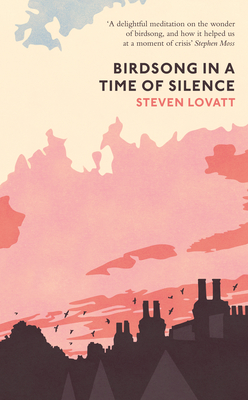 During the UK’s first lockdown, with planes grounded and cars stationary, many remarked on the quiet. All the better to hear birds going about their usual spring activities. For Lovatt, from Birmingham and now based in South Wales, it was the excuse he needed to return to his childhood birdwatching hobby. In between accounts of his spring walks, he tells lively stories of common birds’ anatomy, diet, lifecycle, migration routes, and vocalizations. (He even gives step-by-step instructions for sounding like a magpie.) Birdsong takes him back to childhood, but feels deeper than that: a cultural memory that enters into our poetry and will be lost forever if we allow our declining bird species to continue on the same trajectory.
Mentions of current events are sparse and subtle, so the spring feels timeless, as it should. I worried there might be too much overlap with A Sweet, Wild Note by Richard Smyth, but there’s room for both on your shelf. Lovatt’s writing is introspective and poetic, delighting in metaphors for sounds: “The song of a turtle dove is like the aural equivalent of a heat-haze, the gentlest corrugation of air, always just on the edge of your hearing.”
Skylarks with Rosie: A Somerset Spring by Stephen Moss (2021)
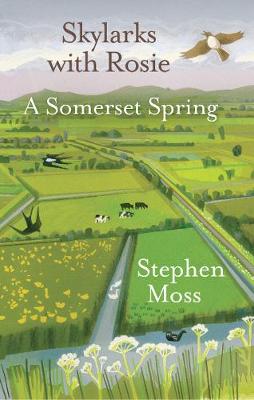 Lovatt must have been a pupil of Moss’s on the Bath Spa University MA degree in Travel and Nature Writing. The prolific Moss’s latest also reflects on the spring of 2020, but in a more overt diary format. Devoting one chapter to each of the 13 weeks of the first lockdown, he traces the season’s development alongside his family’s experiences and the national news. With four of his children at home, along with one of their partners and a convalescing friend, it’s a pleasingly full house. There are daily cycles or walks around “the loop,” a three-mile circuit from their front door, often with Rosie the Labrador; there are also jaunts to corners of the nearby Avalon Marshes. Nature also comes to him, with songbirds in the garden hedges and various birds of prey flying over during their 11:00 coffee breaks.
His speaking engagements and trips cancelled, Moss turns to online events instead. Twitter serves as a place for sharing outrage over UK politics and world events like George Floyd’s murder, but also as a welcoming community for sharing nature sightings. As the lockdown come to a close, he realizes that this time has had unexpected benefits: “Having to press the pause button … has made me rethink my life, in a good way.” He feels that, for once, he has truly appreciated the spring, “rediscovering the joys of wildlife-watching close to home”. This made for perfect reading in Somerset last week.
Also recommended: The Consolation of Nature by Marren, McCarthy and Mynott
Remembering springs back home:
Spring in Washington by Louis J. Halle (1947)
“The discovery of spring each year, after the winter’s hibernation, is like a rediscovery of the universe … knowledge of spring gives me the freedom of the world.”
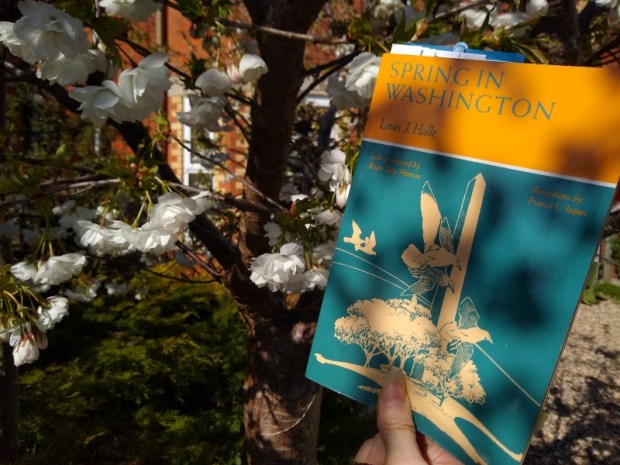 For Halle, who worked in the State Department, nature was an antidote to hours spent shuffling papers behind a desk. In this spring of 1945, there was plenty of wildfowl to see in central D.C. itself, but he also took long early morning bike rides along the Potomac or the C&O Canal, or in Rock Creek Park. From first migrant in February to last in June, he traces the spring mostly through the birds that he sees. More so than the specific observations of familiar places, though, I valued the philosophical outlook that makes Halle a forerunner of writers like Barry Lopez and Peter Matthiessen. He notes that those caught up in the rat race adapt the world to their comfort and convenience, prizing technology and manmade tidiness over natural wonders. By contrast, he feels he sees more clearly – literally as well as metaphorically – when he takes the long view of a landscape.
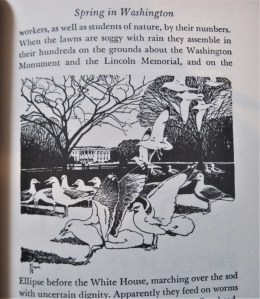 I marked so many passages of beautiful description. Halle had mastered the art of noticing. But he also sounds a premonitory note, one that was ahead of its time in the 1940s and needs heeding now more than ever: “When I see men able to pass by such a shining and miraculous thing as this Cape May warbler, the very distillate of life, and then marvel at the internal-combustion engine, I think we had all better make ourselves ready for another Flood.”
This was a lucky find at Hay Cinema Bookshop back in September. For me it was the ideal combination of thoughtful prose and vicarious travel, though I imagine it might not mean as much to those without a local connection. The black-and-white in-text illustrations by Francis L. Jaques are a particularly nice addition.
Pussy cat, pussy cat, where have you been? I’ve been to Washington, and guess what I’ve seen… by Russell Punter and Dan Taylor (2019)
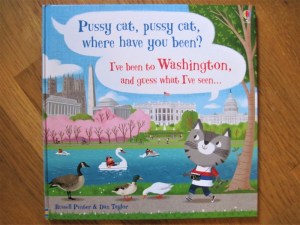 More cherry blossoms over tourist landmarks! This is part of a children’s series inspired by the 1805 English rhyme about London; other volumes visit New York City, Paris, and Rome. In rhyming couplets, he takes us from the White House to the Lincoln Memorial via all the other key sights of the Mall and further afield: museums and monuments, the Library of Congress, the National Cathedral, Arlington Cemetery, even somewhere I’ve never been – Theodore Roosevelt Island. Realism and whimsy (a kid-sized cat) together; lots of diversity in the crowd scenes. What’s not to like? (Titled Kitty cat, kitty cat… in the USA.)
And, as a bonus, some fiction in translation:
Spring Garden by Tomoka Shibasaki (2014; 2017)
[Translated from the Japanese by Polly Barton]
 Like a Murakami protagonist, Taro is a divorced man in his thirties, mildly interested in the sometimes peculiar goings-on in his vicinity. Rumor has it that his Tokyo apartment complex will be torn down soon, but for now the PR manager is happy enough here. “Avoiding bother was Taro’s governing principle.” But bother comes to find him in the form of a neighbor, Nishi, who is obsessed with a nearby house that was the backdrop for the art book Spring Garden, a collection of photographs of a married couple’s life. Her enthusiasm gradually draws Taro into the depicted existence of the TV commercial director and actress who lived there 25 years ago, as well as the young family who live there now. This Akutagawa Prize winner failed to hold my interest – like The Guest Cat, it’s oddly preoccupied with architectural detail, a Japanese fascination that doesn’t translate so well.
Have you been reading anything particularly appropriate for spring this year?
Somerset Trip & Bookbarn Haul and Overhauls
Last week we managed a few days’ holiday in Somerset – our first trip away from home in over seven months (the last one was to Hay-on-Wye). Though only an hour and a half from where we live, it felt like a world away. We were very lucky with the weather, too. We wandered the quiet nature reserves of the Avalon Marshes, toured Glastonbury and Wells (the smallest cathedral city in the UK; alas, we missed the limited cathedral opening hours, but had a nice walk around the outside and saw a plaque marking where Elizabeth Goudge lived), and climbed Glastonbury Tor and Ebber Gorge. Not wanting to chance any pubs, we ate daytime meals outdoors at a few cafés and brought posh supermarket takeaways with us to heat up in the Airbnb kitchen for dinners.


(Photos by Chris Foster)
I read from lots of different books on the trip, but my most appropriate selection was Skylarks with Rosie, Stephen Moss’s diary of the coronavirus spring experienced in Somerset. By coincidence, my husband saw Moss (a mentor of his; we’ve met him a number of times before) filming at Ham Wall when he went back there early one morning!
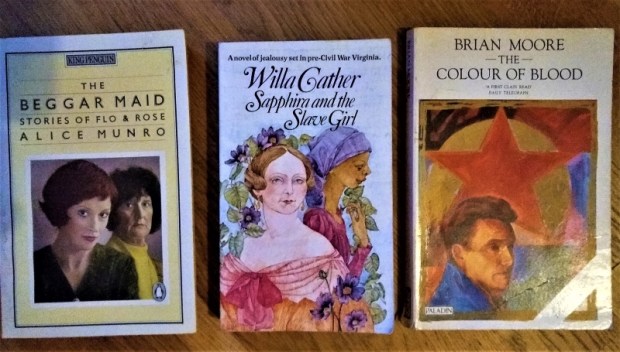
On the last day, we drove back via Bookbarn International, a favourite secondhand bookshop of mine. Below is my book haul from the trip: the top five were from a Little Free Library we found in a bus shelter in the delightfully named town of Queen Camel and the bottom stack was from Bookbarn, which was looking well stocked after the lockdown. I was particularly pleased to find books by Amy Bloom, Sue Miller, and Jane Smiley, authors you don’t come across so often in the UK. Some of the LFL books have rather hideous covers, but it’s the inside that counts, yes?

Overhaul of Previous Trips’ Purchases
This was our seventh trip to Bookbarn since June 2013. I don’t seem to have any photos of that first visit, but for all the rest I have at least one book haul photo.
Simon of Stuck in a Book runs a regular blog feature he calls “The Overhaul,” where he revisits a book haul from some time ago and takes stock of what he’s read, what he still owns, etc. (here’s the most recent one). With his permission, I’m borrowing the title and format to look back at what I’ve bought at Bookbarn over the years and how much I still have left to read.
Date: July 2015
Number of books bought: 8 [the Allen and Cobbett are reference books for my husband]

- Read: 7
- No longer owned: 2 (I resold the Fitzgerald and Levy)
- Remaining unread: 1 (Drowning Ruth by Christina Schwarz – so I took it with me on the Somerset trip and have read the first 50 pages so far.)
This is a very good showing for me! I suppose I did have nearly six years to get through them all. I’ve done less well on the other years’ hauls…
Date: July 2016
Number of books bought: 10
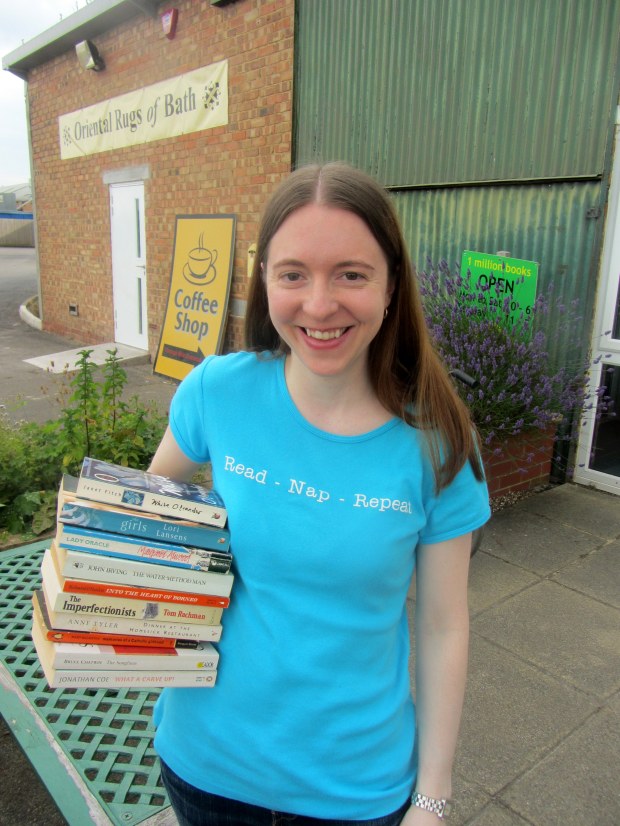
- Had read already: 1 (Rachman)
- Read since: 4
- No longer owned: 1 (Irving’s early work hasn’t been to my taste, so after my husband read The Water-Method Man, I donated it; its only virtue in my eyes is that the main character is called “Bogus Trumper”)
- Remaining unread: 4 (Chatwin, Coe, McCarthy, O’Hanlon)
Date: December 2016
Number of books bought: 13 (the two pictured at left were from another shop)
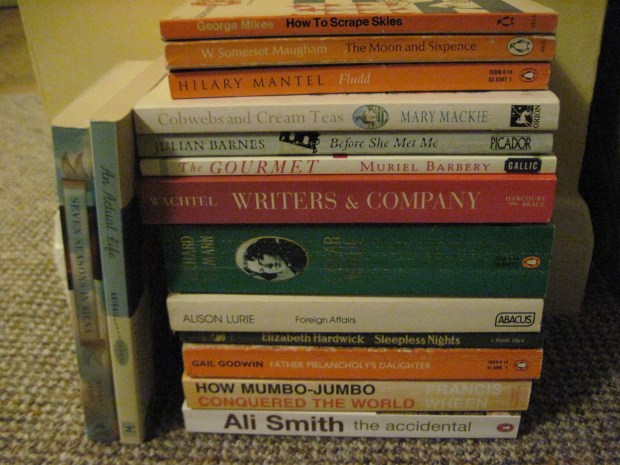
- Read: 6
- DNFed and gave away: 3 (Lurie, Smith, Wheen)
- Remaining unread: 4 (Barnes, Ellman biography, Godwin, Mantel)
Date: October 2017 (multiple photos in this post)
Number of books bought: 15
- Read: 5
- Skimmed: 1 (McCarthy)
- DNFed: 1 (McNeillie)
- Remaining unread: 8! (I have a bad habit of letting biographies sit around unread)
Date: February 2020
Number of books bought: 14
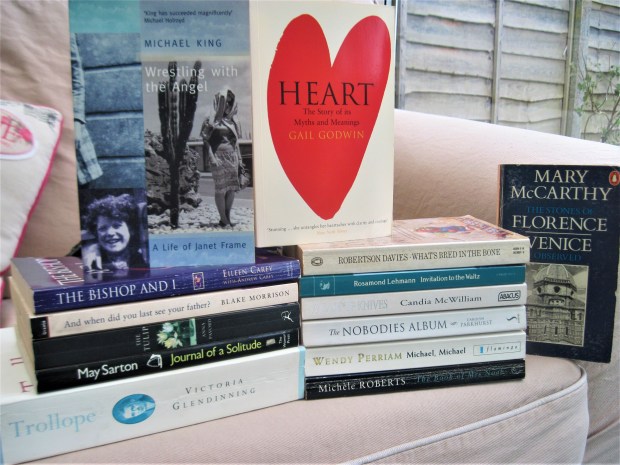
- Had read already: 2
- Skimmed: 2
- Started reading but set aside: 2, so…
- Remaining unread: 10!
To encourage myself to get to more of these previous acquisitions, I’ve added six of them to my bedside stack.
20 Books of Summer, #14–15: Mary Lawson and Stephen Moss
Approaching the home straight with these two: another novel that happens to have an animal in the title, and a pleasant work of modern nature writing set in an English village. My rating for both:
Crow Lake by Mary Lawson (2002)
I’ve meant to read more by Lawson ever since I reviewed her latest book, Road Ends, for Nudge in May 2015. All three of her novels draw on the same fictional setting: Struan, Ontario. Lawson grew up in a similar Canadian farming community before moving to England in the late 1960s. After an invitation arrives for her nephew’s birthday party, narrator Kate Morrison looks 20 years into the past to remember the climactic events of the year that she was seven. When she and her siblings were suddenly orphaned, her teenage brothers, Luke and Matt, had to cobble together local employment that allowed them to look after their little sisters at home. With the help of relatives and neighbors, they kept their family of four together. All along, though, their lives were becoming increasingly entwined with those of the Pyes, a troubled local farming family.
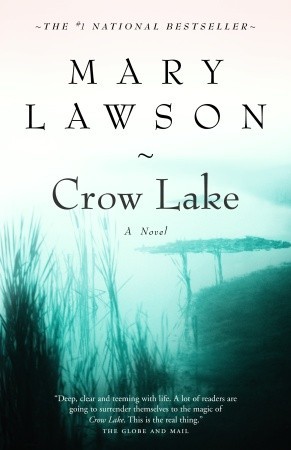 Matt inspired Kate’s love of pond life – she’s now an assistant professor of invertebrate ecology – but never got to go to college himself. Theirs was a family that prized schooling above all else (legend has it that Great-Grandmother installed a book rest on her spinning wheel so she could read while her hands were busy*) and eschewed emotion. “It was the Eleventh Commandment,” Kate recalls: “Thou Shalt Not Emote.”
This is a slow burner for sure, but it’s a winning picture of a family that stuck together despite the odds, as well as an appeal to recognize that emotional intelligence is just as important as book learning. The novel reminded me a lot of Surfacing by Margaret Atwood and The Girls by Lori Lansens, and I’d also recommend it to readers of Elizabeth Hay and Jane Urquhart.
*Delightfully, this detail was autobiographical for Lawson.
Wild Hares and Hummingbirds: The Natural History of an English Village by Stephen Moss (2011)
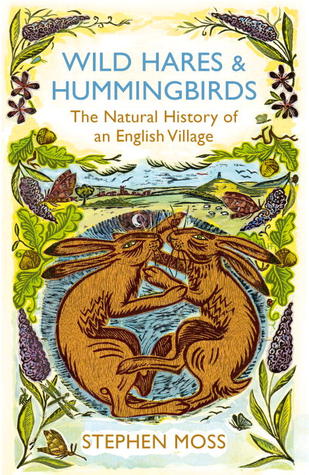 England doesn’t have any hummingbirds, but it does have hummingbird hawkmoths, which explains the title. In the tradition of Gilbert White, Moss writes a month-by-month tribute to what he regularly sees on his home turf of Mark, Somerset. As I did with Mark Cocker’s Claxton, I picked up the book partway – at the month in which I started reading it – and when I reached the end, returned to the beginning and read up to my starting point. Controversial, I know, but that July to June timeline worked fine: it gave me familiar glimpses of what’s going on with English nature now, followed by an accelerated preview of what I have to look forward to in the coming months.
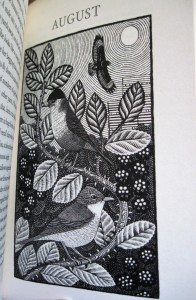 Moss is primarily a birder, so he focuses on bird life, but also notes what’s happening with weather, trees, fungi, and so on. In the central and probably best chapter, on June, he maximizes wildlife-watching opportunities: going eel fishing, running a moth trap, listening for bats, and looking out for unfamiliar plants. My minor annoyances with the book were the too-frequent references to “the parish,” which makes the book’s concerns seem parochial rather than microcosmic, and the common use of semicolons where commas and dashes would be preferable. But if you’re fond of modern nature writing, and have some familiarity with (or at least interest in) the English countryside, I highly recommend this as a peaceful, observant read. Plus, Harry Brockway’s black-and-white engravings heading each chapter are exquisite.
Favorite lines:
“Being in one place is also the best way to understand the passing of the seasons: not the great shifts between winter and spring, summer and autumn, which we all notice; but the tiny, subtle changes that occur almost imperceptibly, from week to week, and day to day, throughout the year.”
“For me, one of the greatest pleasures of living in the English countryside is the way we ourselves become part of the natural cycle of the seasons.”
New Networks for Nature 2018
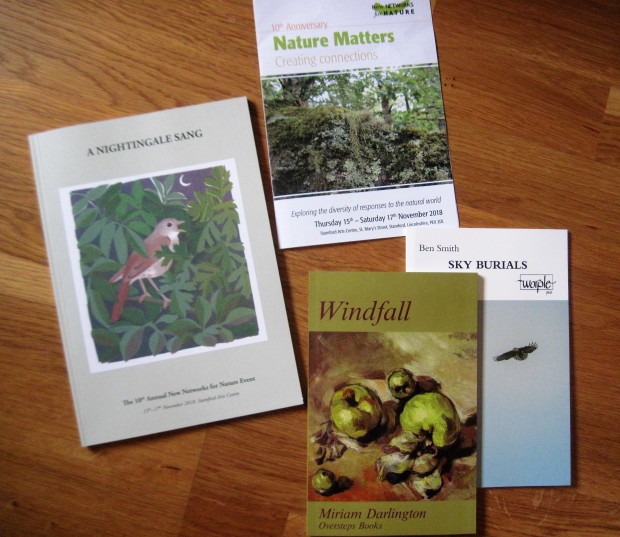
This past weekend was my fourth time attending part of Nature Matters, the annual New Networks for Nature conference. I’ve written about it here a couple of times, once when there was a particular focus on nature poetry and another time when it was held in Cambridge. This year it was back in Stamford for a last time for the 10th anniversary. Next year: York.
What’s so special about the conference is its interdisciplinary nature: visual artists, poets, musicians, writers, politicians, academics and conservationists alike attend and present. So although the event might seem geared more towards my biologist husband, there’s always plenty to interest me, too. The roster is a who’s who of British nature writing: Mark Avery, Tim Birkhead, Mark Cocker, Mary Colwell, Miriam Darlington, Richard Kerridge, Peter Marren, Michael McCarthy, Stephen Moss, Adam Nicolson, Katharine Norbury, Ruth Padel, Laurence Rose and Mike Toms were all there this year. I also appreciate the atmosphere of friendly disagreement about what nature is and how best to go about conserving it.
I attended on Friday, a jam-packed day of sessions that began with Bob Gibbons presenting on the flowers and wildlife of Transylvania, a landscape and culture that are still almost medieval in character. Then Jeremy Mynott interviewed Mark Cocker about his latest book, Our Place: Can We Save Britain’s Wildlife before It Is Too Late? I’ve read other Cocker books, but not this one yet. Its main point seems to be that the country’s environmental organizations need to work together. Individuals and NGOs are doing passionate and wonderful things towards nature conservation, Cocker said, but overall “we ain’t getting there.” Bad news doesn’t sell, though, he noted: his book has sold just 6,000 copies compared to 30,000 for Wilding, Isabella Tree’s story of the rewilding success at Knepp.
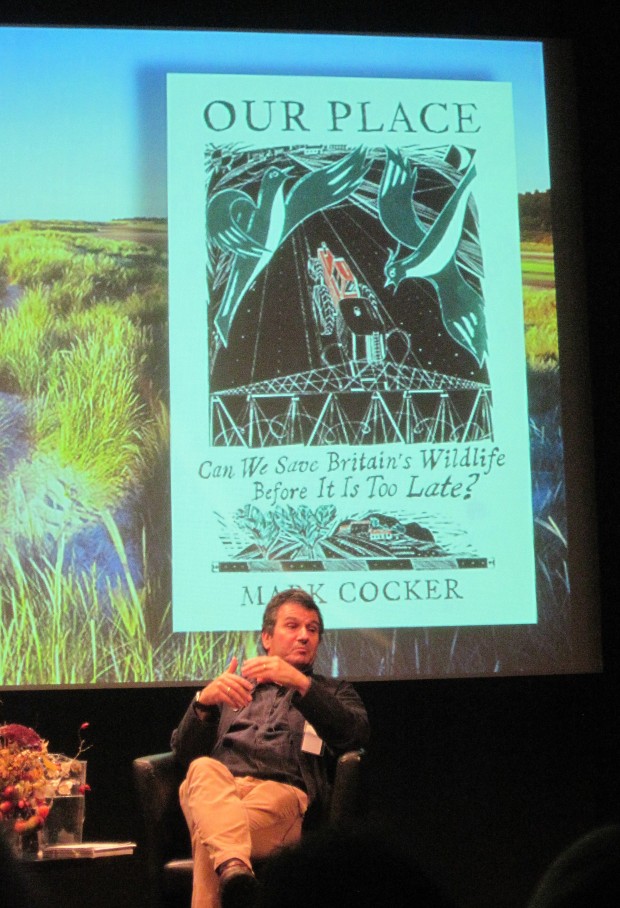
Mark Cocker
Cocker refused to define nature in a one-sentence soundbite, but argued that we have to consider ourselves a part of it rather than thinking about it as a victim ‘out there’ (the closest he came to a definition was “the totality of the system we are a part of”). “Our responsibility, terrifyingly, is unending,” he said – every time you open a new plastic toothbrush, you can’t forget that the old one you throw away will effectively be around forever. Our Place isn’t just composed of polemic, though: it’s structured around six beloved landscapes and finds moments of transcendence in being out in nature. You find hope by walking out the door, feeling the wind on your face and hearing the starling singing, Cocker remarked. He closed by reading a description from the book of the north Norfolk coast.
Either side of lunch were panels on how social media (mostly Twitter, plus smartphone apps) can serve nature and the role that poetry might play in environmental activism, with a brief interlude from visual artist Derek Robertson, who responded to the refugee crisis by traveling to Calais and Jordan and painting human figures alongside migratory birds. In the poetry session I especially enjoyed hearing from Ben Smith, a University of Plymouth lecturer and poet with a debut novel coming out in April 2019 (Doggerland, from Fourth Estate). He recently collaborated with Dr. Lee de Mora on a set of poems inspired by the Earth System Model, which provides the data for the International Panel on Climate Change. Climate modeling might seem an odd subject for poetry, but it provides excellent metaphors for failure and hope in “Spinning Up,” “Data Sets” and “Alternate Histories.”
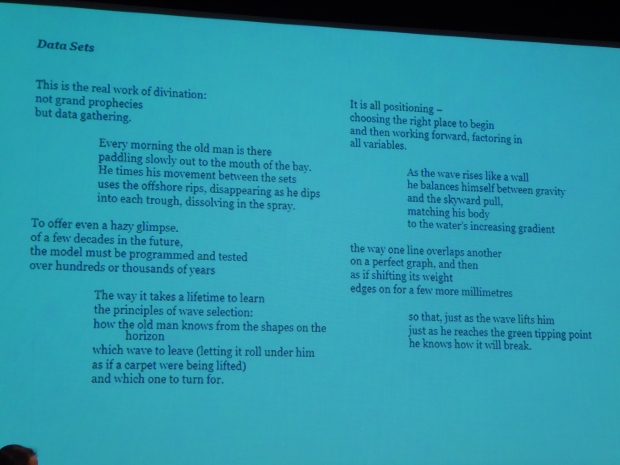
Ben Smith’s poem links unlikely subjects: surfing and climate modeling. Photo by Chris Foster.
Birmingham lecturer Isabel Galleymore, whose debut collection Significant Other is coming out from Carcanet Press in March, talked about how she uses the tropes of love poetry (praise, intimacy, pursuit and loss) when writing about environmental crisis. This shift in her focus began at university when she studied Wordsworth through an ecocritical lens, she said. Jos Smith and Luke Thompson were the other two poets on a panel chaired by Matt Howard. Howard quoted Keats – “We hate poetry that has a design on us” – and asked the poets for reactions. Smith agreed that polemic and poetry don’t mix well, yet said it’s good to have a reason for writing. He thinks it’s best when you can hold two or more ideas in play at a time.
After tea and a marvelous cake spread, it was time for a marathon of three sessions in a row, starting with three short presentations on seabirds: one by a researcher, one by a nature reserve manager, and one by a young artist who produced Chinese-style scroll paintings of the guillemot breeding colonies on Skomer and exhibited them in Sheffield Cathedral.
Next up was a highlight of the weekend: Green Party MP Caroline Lucas and Labour peer Baroness Barbara Young conversed with Michael McCarthy on the topic “Can Conventional Politics Save the Environment?” Both decried short-term thinking, the influence of corporations and the media, and government departments not working together. No one was ever elected on the promise of “less,” McCarthy suggested, but in reply Lucas talked about redefining terms: less of what? more of what? If we think in terms of quality of life, things like green energy and the sharing economy will become more appealing. She also believes that more people care about green issues than we think, but, e.g., a London mum might speak out about air quality without ever using the word “environment.” Baroness Young concluded that “adversarial politics, flip-flopping between parties, isn’t working” and we must get beyond it, at the local level if nothing else. That rang true for me for American politics, too.
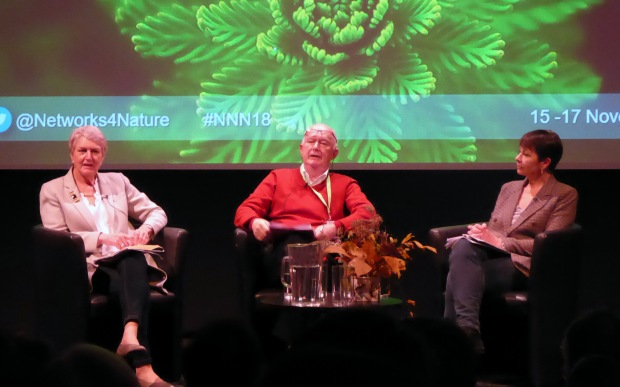
Young, McCarthy and Lucas. Photo by Chris Foster.
Before the day ended with a drinks reception, we were treated to a completely different presentation by Lloyd Buck, who raises and trains birds, mostly for television footage. So, for instance, the greylag geese flying in formation alongside the boat in David Attenborough’s 2012 Sixty Years in the Wild TV special had imprinted on Lloyd’s wife, Rose. Buck spoke about bonding with birds of very different personalities, and introduced the audience to five starlings (who appeared in Poldark), a peregrine, a gyrfalcon, a golden eagle, and Bran the raven, who showed his intelligence by solving several puzzles to find hidden chunks of meat.


I purchased two books of poetry from the bookstall – I had no idea Darlington had written poetry before her nature books – and the conference brochure itself is a wonderful 75-page collection of recent artwork and short nature writing pieces, including most of the presenters but also Patrick Barkham, Tim Dee, Paul Evans, Philip Hoare, Richard Mabey, Helen Macdonald and Chris Packham – a keynote speaker announced for next year. I’ve been skipping through the booklet and have most enjoyed the pieces by Melissa Harrison and Helen Scales so far. Altogether, an inspiring and worthwhile weekend.
 Bookish Beck = Rebecca Foster. American transplant to England. Freelance proofreader and book reviewer.
 Bookish Beck