Three for #ReadingWales26: Tishani Doshi, Gwyneth Lewis & Jan Morris
As well as Reading Ireland Month, it’s Reading Wales Month, hosted by Karen of BookerTalk and Kath of Nut Press. I read three relevant books by women – my ideal trio of a novel, a poetry collection and a memoir – and also experienced some additional poetry via a special church service.
Fountainville by Tishani Doshi (2013)
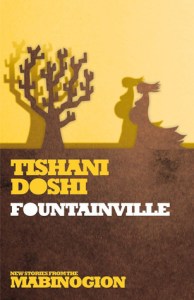 This is part of a Seren series retelling the medieval Welsh legends in the Mabinogion. Doshi has Welsh and Indian parentage; here she blends her knowledge of both countries and their stories. Luna, the narrator, works as an assistant to Begum, the Lady of the Fountain. Begum and her husband Kedar, a gangster, operate a shady surrogacy clinic. Then Owain Knight comes to town and makes Luna a proposition and things get complicated. Though this is novella length, it took me ages to slog through it. My lack of familiarity with the source text felt like a problem – I’d rather it had been summarized in a foreword rather than an afterword – and Doshi’s narrative is insipid despite the soap opera-ready content; I saw none of the spark and originality I’ve found in her excellent poetry. On this evidence I’m unlikely to pick up any more of her fiction. In any case, it was appropriate that I bought an ex-Swansea Libraries copy from Richard Booth’s Bookshop in Hay-on-Wye. (Secondhand purchase)
First Rain in Paradise by Gwyneth Lewis (2025)
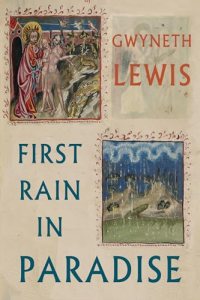 I’ve read a couple of Lewis’s poetry collections before (e.g. Parables and Faxes), as well as her memoir of depression and her travel book about sailing with her husband. She was Wales’s first poet laureate in 2005–6 and this is her sixth collection in English. The first section about her childhood with an emotionally abusive mother envisions her mother as a spider. The rest of the book traces the effects of that early trauma into chronic illness and mental health struggles. There is a sense of lost time. “Late Blackberries” opens “Where was I during the glut? I missed / the first sweetness, alluring and glossy // black as a dormouse’s eye, when pickings / were easy. A decade lost being ill tastes // bitter.” The imagery is drawn from physics, the countryside, medieval religious art, and the discovery of mummies. The two most quintessentially Welsh poems are “Red Waistcoat,” about coming across a dead ewe in a field, and “Under,” commemorating a fatal 2011 mining accident. Forasmuch as the book’s themes seemed perfectly assembled to appeal to me, I never felt they’d been brought to life in the language. (Secondhand purchase – Exeter charity shop)
A Writer’s House in Wales by Jan Morris (2002)
“My house is so absolutely of its setting, is rooted so profoundly not just in the soil, but in the very idea of Wales, that anywhere else it would lose all charisma.”
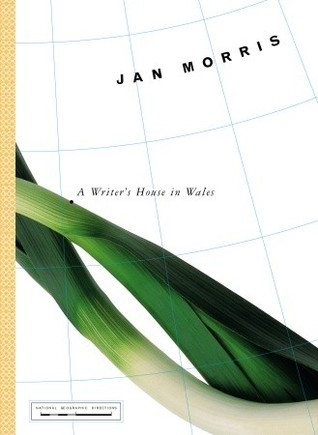 Although Jan Morris was famous for travelling the world and writing all about it, she equally loved being able to retreat to Trefan Morys, “for me … a summation, a metaphor, a paradigm, a microcosm, an examplar, a multum in parvo, a demonstration, a solidification, an essence, a regular epitome of all that I love about my country.” That excerpt from the first paragraph is a typical example of her effusive overwriting. This short book was clearly written for people (Americans) who know nothing about Wales, not even where on earth it is. I love her cosy evocation of her home – actually the renovated 18th-century stable block of the former family home, ample for her and Elizabeth in their dotage – and its bookshelves and animal life, whether domestic (Ibsen the Norwegian forest cat) or wild (bats in the attic!).
However, this was a reread and I found it indulgent as well as quaint this time around. It reminded me most of her diaries (the first volume was In My Mind’s Eye) and would be ideal for reading in tandem with those. Morris writes, “I am emotionally in thrall to Welshness.” I couldn’t help but think of biographer Sara Wheeler’s words about Morris’s contradictions: “she was a famous chronicler of the British Empire (some say an apologist for it) and a card-carrying Welsh nationalist. She was singular and contrary”. Wheeler slept in this house, in Morris’s bed, after her death while working through the papers.
I’ve always meant to source more from this National Geographic Directions series of brief travel books in which authors celebrate a beloved place. The only other I’ve read is Land’s End, Michael Cunningham’s book on Provincetown. (Free from The Book Thing of Baltimore)
For Advent last year and Lent this year, my church put on special evening compline services that combine liturgy and folk-inspired music my husband helped with. Earlier this month we had an extraordinary R.S. Thomas-themed service with some poems read aloud from the pulpit and others set to avant-garde music (a theremin was ruled out, but a harmonium, melodeon and glockenspiel featured, as well as a mandolin, banjo, toy piano and electric guitar). I was mostly unfamiliar with Thomas, who was a priest as well as a poet, and was gobsmacked by the commingling of scientific and theological vocabulary and the tolerance of doubt. Here are some extracts.
It is this great absence
that is like a presence,
that compels me to address it without hope
of a reply.
You speak
all languages and none,
answering our most complex
prayers with the simplicity
of a flower, confronting
us, when we would domesticate you
to our uses, with the rioting
viruses under our lens.
You have made God small,
setting him astride
a pipette
And all this in a carefully assembled pamphlet that I’ve kept as a souvenir.
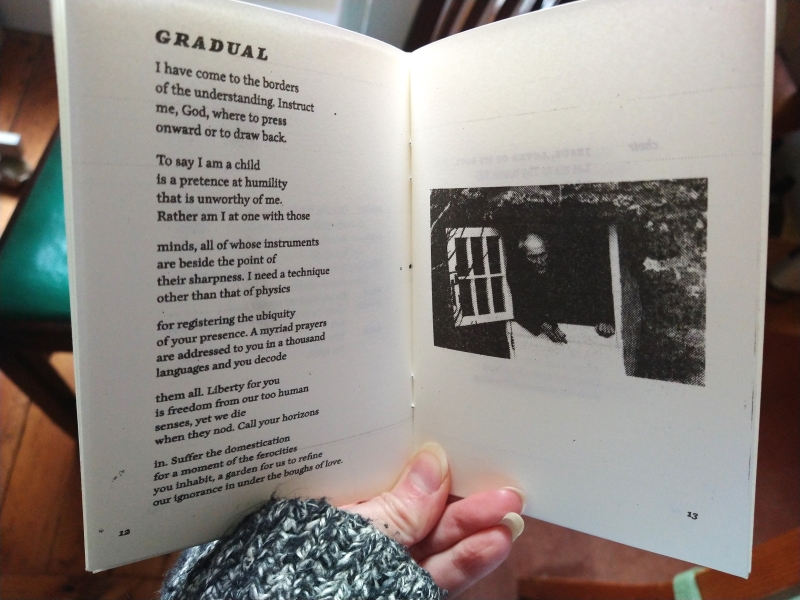
I might not have chosen the best books this year, but I’m still feeling well disposed towards the Welsh. A nice link is that Thomas lived just a few miles from Morris. In her book she calls him “perhaps the greatest Welsh poet writing in English since George Herbert.” She describes him thus: “I last set eyes on R. S. Thomas standing all alone beside our coastal road gazing silently into an adjacent wood, as though communing with the crows and blackbirds in its branches … Whenever I recall him at the roadside that day, looking silently into the trees as though the answer to all things was to be found among them, the memory gives me a sense of calm and liberation, as Wales itself does”.
Three for the First Day of Spring: Renkl, Sukegawa and Tucker
I suppose the best kind of spring morning is the best weather God has to offer.
~I Capture the Castle by Dodie Smith
Happy spring! (Although the blossom is fading and, going by the temperature the past few days, you might think it was early summer here.) When I borrowed the psychological thriller The First Day of Spring from the library, I decided to consider that my built-in review deadline. As is my wont, I’ve turned it into a trio with two books more laterally related to spring: a lovely book of miniature autobiographical essays about interactions with family and the natural world, and a short Japanese novel about misfits who find belonging at a pancake restaurant.
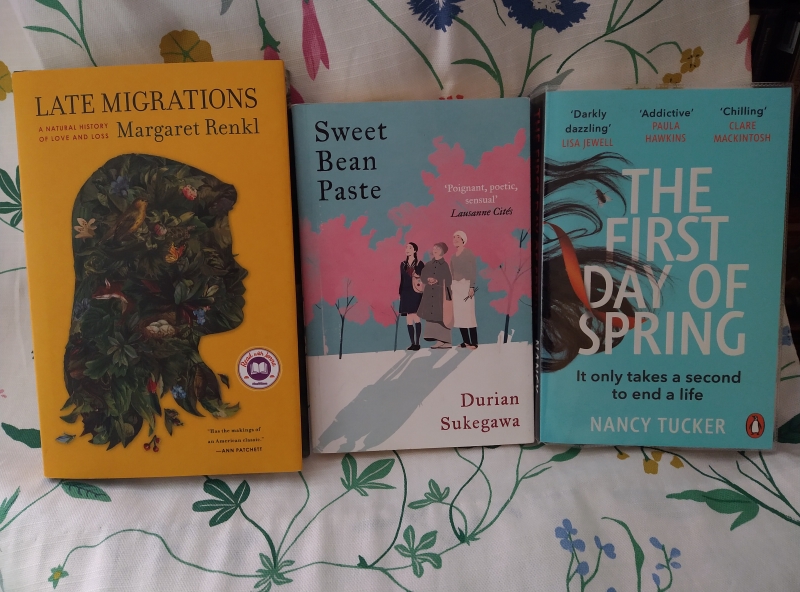
Late Migrations: A Natural History of Love and Loss by Margaret Renkl (2019)
My favorite season is spring—until fall arrives, and then my favorite season is fall: the seasons of change, the seasons that tell me to wake up, to remember that every passing moment of every careening day is always the last moment, always the very last time, always the only instant I will ever take that precise breath or watch that exact cloud scud across that particular blue of the sky.
 The memoir in flash essays is one of my favourite niche forms. (Beth-Ann Fennelly and Abigail Thomas also do it exceptionally well.) It took me a long time to promote this book from occasional bedside reading pile to daytime stack, but at a certain point it became impossible to let it out of my hands for very long. I had to smell it and browse her brother Billy’s collage artworks. Each piece is somewhere between a paragraph and several pages long, and they make up a rough chronology of a life, from her grandmother’s memories of the 1930s onward (the passages in italics are interview transcripts) through to the present day.
Renkl grew up in Alabama in the 1960s–70s, in the sort of mildly dysfunctional family that most of us probably have. She contrasts what she knew as a child with what she didn’t. It was a happy childhood but. (Her mother’s recurring mental health problems and racial tensions in the South would be two ways to finish that sentence.) There were hounds and porch seats and three kids in the backseat on vacations. There were funerals and old love songs and Bible verses and playing in the woods. Grandmother tells of births and deaths, and Renkl remembers life’s transitions: getting her first period, being so homesick that she couldn’t finish college in Philadelphia, adjusting to early motherhood and then to an empty nest – an appropriate metaphor because many of the essays are about birds Renkl watches feeding and nesting. She isn’t naïve; she knows nature is cruel. Not every fledgling will survive and majestic hawks will kill equally beautiful songbirds. She realizes how dire the situation is for monarch butterflies, too, but keeps planting milkweed at her Nashville home.
This balancing of appreciation for life and acceptance of death is at its finest in the late pieces on her parents’ death. Her mother, like mine, died suddenly after a stroke, and her words on that loss are exquisite as well as painful. Still, she asserts, “Human beings are creatures made for joy. Against all evidence, we tell ourselves that grief and loneliness and despair are tragedies, unwelcome variations from the pleasure and calm and safety that in the right way of the world would form the firm ground of our being.”
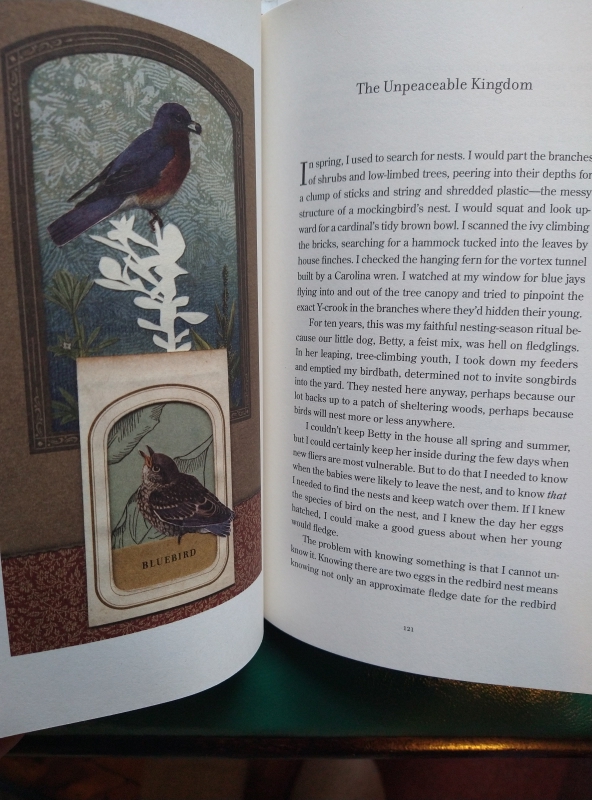
Like Ross Gay and Aimee Nezhukumatathil, Renkl brings a poet’s eye for language and an amateur’s awe at the natural world to her micro-essays. She calls a cedar waxwing “An operatic aria of a bird. A flying jungle flower. A weightless coalescence of air and light and animation.” This is a book to cherish and learn from and reread. (Birthday gift from my sister from my wish list) 
{SPOILERS IN THESE NEXT TWO REVIEWS}
Sweet Bean Paste by Durian Sukegawa (2013; 2017)
[Translated from Japanese by Alison Watts]
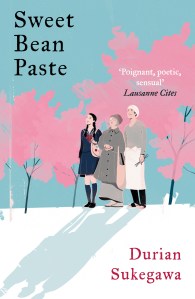 It was the colours (especially that wash of cherry-blossom pink) that first attracted me to this book, and the foodie theme that kept me reading. Sentaro manages a small shop on Cherry Blossom Street, Doraharu, which sells dorayaki – pancakes filled with sweet bean paste (“during cherry-blossom season petals sometimes drifted in, falling into the pancakes as they cooked”). He takes little pride in the work; it’s just a way to keep busy and pay off his debts from the time he was in prison for drug-dealing. When an elderly woman named Tokue offers to make the sweet bean paste for a pittance, he decides to give her a trial even though he usually orders it in bulk. Tokue’s homemade is so much better that the shop is soon making record profits. She trains Sentaro up in the art of making the perfect paste, which to her is a mystical process that involves listening to the beans. Not only does Tokue have new ideas for the menu, but she also makes troubled teenage customers such as Wakana welcome with friendly conversation. Along with Marvy the canary, these three form a fragile little family.
But then rumours start spreading about Tokue and her health, and Doraharu’s owner threatens to shut the place down if Sentaro doesn’t let her go. It turns out that she had Hansen’s disease (the preferred term for leprosy) and lives in a sanatorium. Even though she has long since been cured, there is still a stigma, and when she was young she could only find love and community among her fellow patients. In an Author’s Note, Sukegawa explains that the legislation keeping Hansen’s patients isolated was only repealed in 1996. His philosophy, made explicit in the letters Tokue writes to Sentaro after leaving the shop, is that one doesn’t have to be useful to have a meaningful life; simply being alive and observing is enough. I found Tokue saccharine: too wise, good and all-forgiving. This is easy reading, yet the dialogue felt stiff, the characterization thin, the letters unsubtle, and the detail of confectionery-making too technical. Secondhand – public library book sale) 
The First Day of Spring by Nancy Tucker (2021)
I’d very much admired Tucker’s first two books – The Time in Between, a memoir of her childhood anorexia; and especially That Was When People Started to Worry, case studies of young women’s mental health – so asked my library to purchase her debut novel. Tucker is a trainee clinical psychiatrist. The psychological insight she’s developed professionally and through writing about herself and others served her well in crafting this portrait of a deprived girl who murders other children. I could have included it in my Mother’s Day post because, as in the similarly dark Like Mother (by Jenny Diski), it’s the lack of a mother’s love that leaves the protagonist numb and unsure of how to bring up her own daughter.
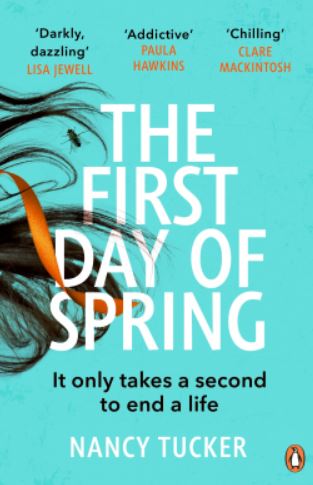 It’s no whodunit because eight-year-old Chrissie admits in the novel’s first line, “I killed a little boy today.” The mystery is why, and how she’s ultimately caught. It’s the first day of spring when she commits that first murder, of a toddler who lives on the same rough housing estate. Her house isn’t much of a home with no money for electricity, no food in the cupboards, an emotionally absent mother and a father who comes and goes without warning. Chrissie is always hungry, always craving. She couldn’t stand that Steven was loved and coddled while she had nothing. Harbouring “a delicious secret” gives her a “belly-fizzing feeling … like sherbet exploding in my guts. … That was all it took for me to feel like I had all the power in the world.” She wants to tell people what she’s done, but knows she mustn’t.
It’s also the first day of spring when five-year-old Molly falls from a seawall and breaks her wrist. Her mum, Julia, panics when she gets a call from child social services. It becomes clear by the second chapter that Julia is the new name Chrissie was given when she left the residential home for child offenders to start a new life. Sure that they’ll blame her and take Molly away, she gets on a train back to her old neighbourhood to see Mam and her childhood best friend, Linda. “I remembered this in Mam – the pull and push, cling and reject.” The subject matter might have become unbearable had Tucker emphasized the salacious details. Instead, she casts a compassionate eye on generational patterns of neglect and incompetence – patterns that can be broken through hard work. It’s riveting reading, and Julia’s love for Molly and Linda’s enduring friendship brought tears to my eyes. (Public library) 
Three on a Theme for Mother’s Day: Baker, Diski and Sampson
It’s Mothering Sunday in the UK today, so, like last year, I’m featuring three very different books about mothers and motherhood: a memoir, a novel and a poetry anthology. There are complex emotions at play in the first two due to grief, abuse and disability. The poems are cheerier (thankfully) and reflect on the experience of motherhood but also of being mothered. On that last point, I’ve added my response to a relevant short story I happened to read today.
Reading My Mother Back: A memoir in childhood animal stories by Timothy C. Baker (2022)
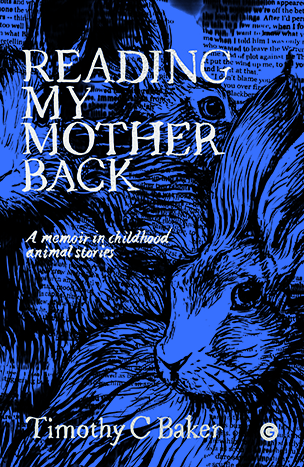 Baker is a lecturer in Scottish literature at the University of Aberdeen. His first non-academic publication is a curiously beguiling novella-length reappraisal of favourite children’s books. “To misquote Heraclitus, you cannot read the same book twice.” While he’s sheepish about including so many 19th- and early-20th-century white male authors, he can’t do otherwise as these are the texts that first taught him about death, loneliness and friendship: Charlotte’s Web, The Wind in the Willows, The Magician’s Nephew and Watership Down. (Also The Secret Garden.) Baker grew up in Maryland and Vermont, lonesome and closeted, with parents who briefly joined a cult. In his memory, his mother (who had been abused) always suffered with chronic illness and pain. In each chapter, he weaves together a discussion of a plot with stories from his early life and critical opinion on the value of rereading. It helped that I was familiar with six of the nine books Baker features (and others by Gallico, though not The Man Who Was Magic); I’d not even heard of Merle the High Flying Squirrel or The Book of the Dun Cow.
I spotted this in the Wigtown Festival Shop* on our 2023 visit to Scotland’s Book Town and could hardly believe it existed because it seemed so perfectly suited to me: I loved animal books, especially Watership Down, as a child; I’ll read any bereavement memoir going; I grew up 30 miles from Baltimore, where Baker spent his early life; he and I both had strict religious upbringings; and his mother experienced kidney failure (after eating a foxglove??), a link to my family’s history of kidney disease. There are plentiful differences, too, of course, but Baker emphasises connection. “If reading these books has taught me anything,” he concludes, “it is that all of my stories are individual, and all of them are universal. What we share is the unshareability of our grief … [but also] the joy of knowing that we have loved.” And for such a seemingly niche book (from Goldsmiths Press), I have actually found myself mentioning it to two blogger friends in recent days, so that’s proof he was right. 
[*As to how the book finally came into my possession: I added it to my wishlist and an acquaintance (a former mayor of Newbury, in fact) bought it for me for my 40th birthday. However, he forgot to bring the gift to our joint party and it took another 2+ years to extract it from him – through explicit reminders when we invited him to join us on a quiz team.]
Like Mother by Jenny Diski (1988)
I’ve enjoyed the late Jenny Diski’s travel memoirs (Skating to Antarctica and Stranger on a Train) and essays (On Trying to Keep Still). This novella was my first taste of her fiction and, while it’s dark as hell, I admired the psychological acuity and playfulness with narration. Occasional chapters introduce a dialogue between Nony and an imaginary interlocutor whose role is to listen to the story of her mother, Frances, a former dancer. That family history is the substance of the rest of the book, which is in an omniscient third person. The artificiality of the setup is blatant, though; Nony can neither think nor speak, having been born without a brain (hydranencephaly). Nony’s full name is thus Frances’s cruel joke.
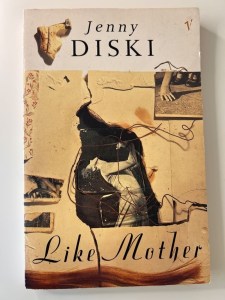
By necessity, the story stretches back to Frances’s parents, Ivy and Gerald, whose postwar optimism soon ceded to the reality of addiction, adultery and the attrition of love. A semiferal Frances escaped her unhappy home for the streets of London and engaged in sex play with Stuart on a bombsite. This went on for years. For Stuart, it blossomed into genuine love, but the numb Frances could never return his feelings and only used him. There are some really painful scenes here, such as Stuart stealing ether from the chemistry supply cupboard so she can huff herself into temporary oblivion, and a drunk Ivy molesting adolescent Frances. “Like mother, like daughter” is a bitter confirmation of inherited trauma. Nony might well be a symbolic manifestation of Frances’s desire to cultivate nothingness. To the extent that she is a literal baby – I’m really not sure – Frances does seem to love her and care for her physical needs, even as she’s grateful that the relationship will be short-lived.
Diski draws attention to the falsity of her narrative technique at the very end. It’s a disturbing yet intriguing novel that I think must be trying to make a wider point about postwar disillusionment. (Enough to make one question one’s growing antipathy towards Boomers?) I was reminded faintly of Nutshell by Ian McEwan, which is from the perspective of a fetus, and I Am Clarence by Elaine Kraf, a troubling story of a mentally ill mother and her disabled son. I have another novella plus a short story collection by Diski on the shelf, and I daresay after those I’ll have to seek out everything else she wrote. (University library)
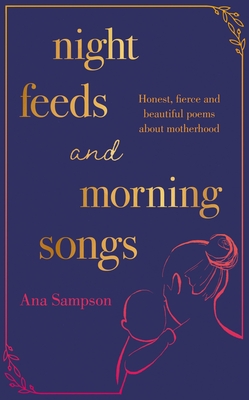
Night Feeds and Morning Songs, ed. Ana Sampson (2021)
“I crossed the border into the Republic of Motherhood
and found it a queendom, a wild queendom.”
~Liz Berry
It would have been easy to make such an anthology samey and sentimental, so kudos to Sampson for curating a solid mix of contemporary and period work. The poems are grouped into loose categories covering pregnancy, the sleepless nights of early motherhood, the power of womanly solidarity, the legacy (or absence) of one’s own mother, and the milestones of life as a child grows up and moves away. (Jackie Kay marvels that her baby boy is now a 6-foot-2 world traveller.) However, there are almost as many emotional approaches and poetic forms as there are contributors. Exhilaration meets exhaustion; guilt and grief threaten to overwhelm the good times. Sometimes the infant is addressed directly. The tone might be sombre, outraged or satirical. A few excerpts:
from “Labour Ward Prayer” by Vicky Thomas
Give us this day our daily miracle.
Exchange our offering of sweat and tears
and, most of all, of blood,
for new life, crumpled as a new leaf bud.
 from “The Visitor” by Idra Novey
…more dragon
than spaniel, more flammable
than fluid …
All wet mattress to my analysis,
he’s stayed the loudest and longest
of any houseguest
from “What My Kids Will Write about Me in Their Future Tell-All Book” by January Gill O’Neil
They will say that no was my favourite word,
More than stop, or eat, or love.
That some morning, I’d rather stay in bed,
laptop on lap, instead of making breakfast
…
They will say they have seen me naked.
Front side, back side – none of which
were my good side.
I enjoyed re-encountering work by some personal favourite poets such as Caroline Bird, though most entries were new to me. Sampson’s section introductions aren’t particularly illuminating and often reference poems that aren’t actually in the part in question. Some of the 19th-century and earlier material is quaintly twee, but I did love discovering Christina Rossetti’s “To My First Love, My Mother.” This is the poem that made me cry, though:
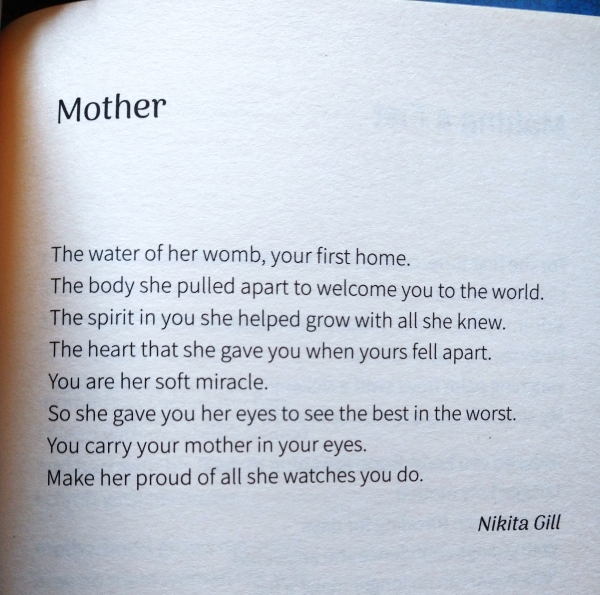
(Little Free Library)
And a bonus short story:
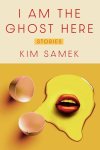 “Egg Mother” by Kim Samek (from I Am the Ghost Here): I’m two stories into Samek’s gently surreal collection. This second story combines the themes of parenting and grief prevalent above. Her openings are knockout: “At thirty-six I turn into a scrambled egg. It happens a few months after I give birth.” In therapy, the narrator discovers that she’s been repressing her grief over her mother, who died of cancer when the narrator was 13. The therapist suggests that she and her husband hold a joint ‘funeral’ for her mother and her younger self in a graveyard. But even after the ritual, she doesn’t return to herself. It’s a sobering but realistic message: some things one just doesn’t get over.
“Every story that I read becomes the story of my mother.”
~Timothy C. Baker
Last night, we saw Brooklyn expat singer-songwriter Annie Dressner (and Sean Duggan of Steady Habits) in concert at a church hall. I was mostly underwhelmed by her quirky confessional songs and little-girl voice, but a couple of songs stood out for me. One, “I Just Realized,” includes the line “And I hope that I can be just like my mother.”
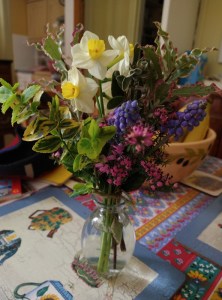
Today was a more emotional day than I was expecting. I got a sweet posy from church, but having a whole service focussed on mothers and mothering was hard for me. I had to mostly switch off to get through it.
Just in my current stack, there are so many books about mothers or mothering…
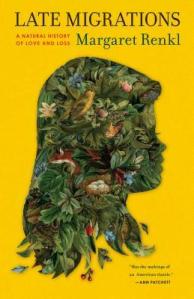 the loss of a mother (Eva Luna by Isabel Allende; The Memory of Borrowed Books by Meg Anderson; The Curious Incident of the Dog in the Night-Time by Mark Haddon; Late Migrations by Margaret Renkl; I Capture the Castle by Dodie Smith) – so common an element in novels that I have to think it’s shorthand for a character who has to pluckily rely on their own psychological resources
- mothers’ protective instinct (The Benefactors by Wendy Erskine)
- emotional distance from an unstable mother (Carrie by Stephen King; First Rain in Paradise by Gwyneth Lewis; Blonde by Joyce Carol Oates; The First Day of Spring by Nancy Tucker, which also includes the struggle to be a good mother in turn)
- mixed feelings about the inability to have a child (Mare by Emily Haworth-Booth)
- a mother’s grief at the loss of a child (Ordinary Saints by Niamh Ni Mhaoileoin)
I know it’s a subject I’ll be reading and thinking about for the rest of my life.
Three on a Theme: English Seasons and Flora (Brazier, Lamb and Parker)
These three books trace the turning of a typical year of the English seasons, especially as experienced through flora: produce for a veg stall, plants laid into a traditional hedge, and “weeds” celebrated for their wild beauty.
The Honesty Box: The diary of a broken marriage, a mental health crisis and a large marrow by Lucy Brazier (2025)
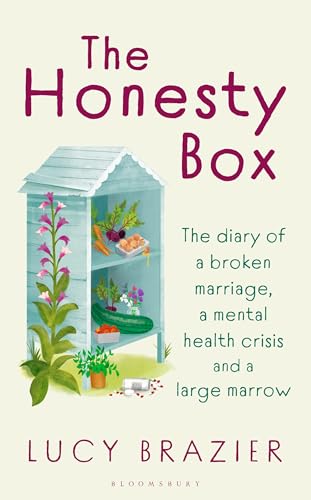 From one Christmas season to the next, Brazier highlights the delights and challenges of rural living (in the Bridport–Lyme Regis area of Dorset). She takes on a project of setting up and stocking her own honesty box – an unmanned roadside produce stall where visitors pay into a cashbox – with garden produce, preserves and baked goods, plus friends’ crafts. All along, her marriage is in an extended, low-level crisis: Steve’s bluntness, lack of social skills, and panicked inability to do his share of household tasks have long been issues. When he gets a combined ADHD and autism diagnosis, he has a roadmap but no easy solution. Going on medication and finding peers in a similar situation help somewhat, but he still struggles.
Brazier draws clever parallels between the turning of the seasons and the ebb and flow of a marriage. Wild swimming with friends and countryside walks with Margot the dog are ways of communing with nature. She incorporates all the daily concerns of her midlife existence, including home repairs, menopause and seeing Raff, the oldest of their three children, off to university. Brazier used to be a PFD talent agent in London, dealing with the likes of Anna Maxwell Martin, then worked for Hugh Fearnley-Whittingstall and his River Cottage cookery empire (she wrote their Christmas book); she’s now a freelance ghostwriter. She’s gently nostalgic for the days of balancing early motherhood and a stressful career, but also grateful for the slower pace of life she’s found in the countryside. There are also some amusingly ill-fated holidays (camping and boating), contrasted with a luxurious one in Italy.
It’s all very affable, the month-by-month present-tense write-ups offering an appealing blend of realism about life’s unpredictability and strategies for muddling through. While it may mean most to women of a certain age or those with neurodivergence in the family, anyone in a long-term relationship will find much to relate to. (Public library)
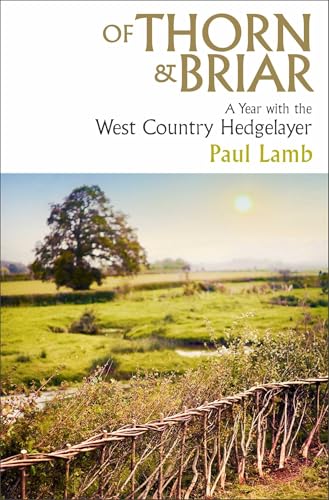
Of Thorn and Briar: A Year with the West Country Hedgelayer by Paul Lamb (2025)
I picked this up after it was shortlisted (and highly commended) for the Wainwright Prize for Nature Writing. Lamb’s lifestyle could be from the 19th century: he lives in a sparse, cosy wagon, driving it from place to place and pausing for weeks-long projects laying traditional hedges across southwest England. Autumn through late winter is his key work period, to avoid the bird-nesting season. It’s gruelling physical labour. Sometimes he sees he’s made a difference; when he gets discouraged, he has to remind himself to take a longer view. “The hedger, like the forester, has to think of his work not as something completed in days or weeks or even months, but instead in years, decades and centuries.” Lamb can’t help but notice the daily shifts in weather adding up to changing seasons; it all affects his daily work.
 This gets reasonably technical about the different qualities of tree species and what they’re like to work with. I learned, or at least was reminded of, the vocabulary word “pleaching,” which means cutting a thin tree trunk vertically – almost but not all the way through – and laying horizontal branches into the crease. It takes skill to describe practical actions in a way that laypeople can picture. However, this account, which covers one August through the following July, is quite monotonous and repetitive. I blame the simple past-tense narration, which quickly becomes an ‘I did this, then I did that’ rundown and had me skimming more than half of the time. Literary techniques would have helped break up the format: extended flashbacks to his apprenticeship or family life, more scenes and dialogue, and some lyrical or imagined passages. (There is one particularly nicely done Hardy-esque vignette where he converses with Dorset locals in a pub.)
During the pandemic, Lamb’s daughters encouraged him to start an Instagram account, which now has 195,000 followers. No doubt it was his social media fame that led to this book deal. His writing, though serviceable, lacks sparkle. I enjoyed it as a window onto a rare profession and nearly forgotten way of life, but would hesitate to recommend unless you have patience and a greater-than-average interest in the subject matter. (Public library) 
Understorey: A Year Among Weeds by Anna Chapman Parker (2024)
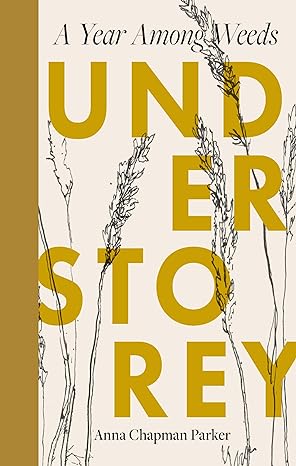 (One of my best backlist reads of last year.) Parker set out to study and sketch weeds as a way of cultivating attention and stillness as well as celebrating the everyday and overlooked. Her quick black-and-white drawings and written observations bear witness to the seasons changing but also to the minute alterations she observes in herself and her children. Here are a couple of examples of shorter entries:
25 April
Wild garlic flowers are explosive. As so often in drawing[,] there is a slippery negotiation between fidelity (getting the shape right) and spirit (capturing the feel of it). By the third drawing I’ve got my eye in and the balance between the two is nearer the mark. If I stayed here a week in the grass, drawing a single flower in a single stroke with my eyes closed, maybe eventually I’d hit it bang-on true.
10 December
On my way back from the shops, I find myself detouring to check in on the sowthistle again. Its leaves are drier now and the crisping at the edges is spreading inward. The leftward lean is more pronounced. A few more of the flowers have gone over. But there’s something else, as well – some impression of a former intimacy. A sensation not only of the past flower, but of my past self here, two days ago. Through the drawn encounter, the plant allows me to recognise myself, passing.
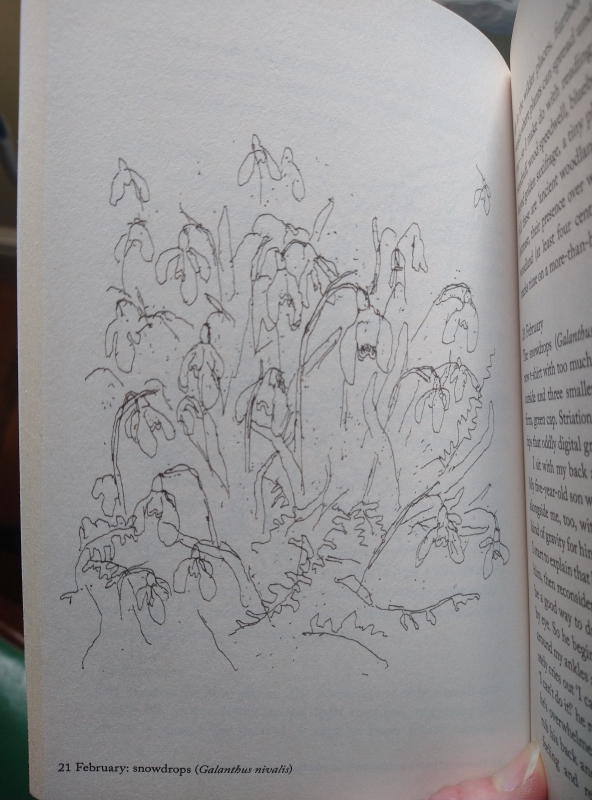
Taking a half-hour out of her day to find a subject feels transgressive in one sense, but dutiful – even holy – in another. Along with her frequent illustrations, there are reproductions of other artworks that depict wildflowers in situ, such as Albrecht Dürer’s Great Piece of Turf (1503). The tone is high-brow, meditative, introspective as she focuses on being present. This was just my kind of nature book, and all the more special because I’ve holidayed in her home of Berwick-on-Tweed so could picture some of the ‘overgrown’ spaces she honours. 
With thanks to Duckworth for the proof copy for review.
Three on a Theme (Valentine’s Day): “Love” Books by Amy Bloom, George Mackay Brown & Hilary Mantel
Every year I say it: I’m really not a Valentine’s Day person and yet it’s become a tradition to put together a themed post featuring one or more books with “Love” or “Heart” in the title. This is the tenth year in a row, in fact – after 2017, 2018, 2019, 2020, 2021, 2022, 2023, 2024 and 2025. As you might expect, none of the three below contains a straightforward love story. The relationships portrayed tend to be unequal, creepy or doomed, but the solid character work and use of setting and voice was enough to keep me engaged with all of the books.
Love Invents Us by Amy Bloom (1997)
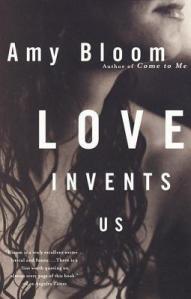 I’ve found Bloom’s short stories more successful than her novels. This is something of a halfway house: linked short stories (one of which was previously published in Come to Me; another that gives the title line to her 2000 collection A Blind Man Can See How Much I Love You) about Elizabeth Taube. When we first meet her on Long Island in the 1960s, she’s a rebellious and sexually precocious Jewish girl; by the time we’ve journeyed through several decades of vignettes, she’s a flighty and psychologically scarred single mother. Stories of her Lolita-esque attractiveness to grown salesmen and teachers, her shoplifting, her casual work for elderly African American Mrs. Hill, and her great love for Horace, nicknamed Huddie, a Black basketball player, are in the first person. The longer second part – about the aftermath of her physical affair with Huddie and her ongoing emotional entanglement with her English teacher, Max Stone – is in the third person yet feels more honest. Liz seems like bad news for everyone she meets. Bloom shows us some of the reasons for what she does, but I still couldn’t absolve her protagonist. I’d also reverse the title: We Invent Love. Liz is responsible for irrevocably altering two lives besides her own based on what she needs to feel secure. This is very much Lorrie Moore territory, but Moore leaves less of a bitter taste. (Secondhand – Community Furniture Project)
A Calendar of Love and Other Stories by George Mackay Brown (1967)
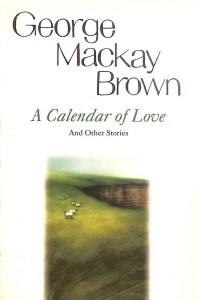 The title story opens a collection steeped in the landscape and history of Orkney. Each month we check in with three characters: Jean, who lives with her ailing father at the pub they run; and her two very different suitors, pious Peter and drunken Thorfinn. When she gives birth in December, you have to page back to see that she had encounters with both men in March. Some are playful in this vein or resemble folk tales: a boy playing hooky from school, a distant cousin so hapless as to father three bairns in the same household, and a rundown of the grades of whisky available on the islands. Others with medieval time markers are overwhelmingly bleak, especially “Witch,” about a woman’s trial and execution – and one of two stories set out like a play for voices. I quite liked the flash fiction “The Seller of Silk Shirts,” about a young Sikh man who arrives on the islands, and “The Story of Jorfel Hayforks,” in which a Norwegian man sails to find the man who impregnated his sister and keeps losing a crewman at each stop through improbable accidents. This is an atmospheric book I would have liked to read on location, but few of the individual stories stand out. (Secondhand – Community Furniture Project, Newbury)
An Experiment in Love by Hilary Mantel (1995)
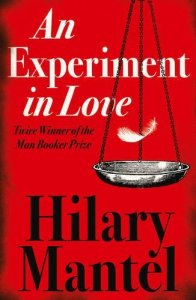 Mantel is best remembered for the Wolf Hall trilogy, but her early work includes a number of concise, sharp novels about growing up in the north of England. Carmel McBain attends a Catholic school in Manchester in the 1960s before leaving to study law at the University of London in 1970. In lockstep with her are a couple of friends, including Karina, who is of indeterminate Eastern European extraction and whose tragic Holocaust family history, added to her enduring poverty, always made her an object of pity for Carmel’s mother. But Karina as depicted by Carmel is haughty, even manipulative, and over the years their relationship swings between care and competition. As university students they live on the same corridor and have diverging experiences of schoolwork, romance, and food. “Now, I would not want you to think that this is a story about anorexia,” Carmel says early on, and indeed, she presents her condition as more like forgetting to eat. But then you recall tiny moments from her past when teachers and her mother shamed her for eating, and it’s clear a seed was sown. Carmel and her friends also deal with the results of the new-ish free love era. This is dark but funny, too, with Carmel likening roast parsnips to “ogres’ penises.” Further proof, along with Every Day Is Mother’s Day, that it’s well worth exploring authors’ back catalogue. (Public library)
Plus a DNF:
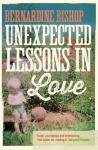 Unexpected Lessons in Love by Bernardine Bishop (2013): I loved Bishop’s The Street, and this posthumous novel initially drew me in with its medical detail (two friends who both had stoma operations) and the exploration of different forms of love – romantic, parental, grandparental – before starting to feel obvious (two adoptions, one historical and one recent), maudlin and overlong. With some skimming, I made it to page 120. (Secondhand – Awesomebooks.com)
Other relevant reading on the go:
I would have tried spinning this one into another thematic trio, but ran out of time…
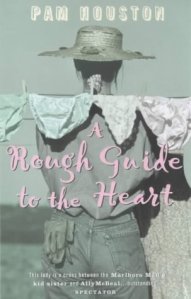 A Rough Guide to the Heart by Pam Houston (1999): A mix of personal essays and short travel pieces. The material about her dysfunctional early family life, her chaotic dating, and her thrill-seeking adventures in the wilderness is reminiscent of the highly autobiographical Waltzing the Cat. Amusingly, this has a previous price label from Richard Booth’s Bookshop in Hay-on-Wye, where it was incorrectly classed as Romance Fiction – one could be excused the mistake based on the title and cover! (Secondhand – Community Furniture Project)
And three books about marriage…
 The Honesty Box by Lucy Brazier – A pleasant year’s diary of rural living and adjusting to her husband’s new diagnosis of neurodivergence.
- Strangers by Belle Burden – A high-profile memoir about her husband’s strange and marriage-ending behaviour (his affair was only part of it) during the 2020 lockdown.
- Mrs. Bridge by Evan S. Connell – For Literary Wives Club in March. I’m in the early pages but it seems comparable to Richard Yates.
Three on a Theme of Sylvia Plath (The Slicks by Maggie Nelson for #NonfictionNovember & #NovNov25; The Bell Jar and Ariel)
A review copy of Maggie Nelson’s brand-new biographical essay on Sylvia Plath (and Taylor Swift) was the excuse I needed to finally finish a long-neglected paperback of The Bell Jar and also get a taste of Plath’s poetry through the posthumous collection Ariel, which is celebrating its 60th anniversary. These are the sorts of works it’s hard to believe ever didn’t exist; they feel so fully formed and part of the zeitgeist. It also boggles the mind how much Plath accomplished before her death by suicide at age 30. What I previously knew of her life mostly came from hearsay and was reinforced by Euphoria by Elin Cullhed. For the mixture of nonfiction, fiction and poetry represented below, I’m counting this towards Nonfiction November’s Book Pairings week.
The Slicks: On Sylvia Plath and Taylor Swift by Maggie Nelson (2025)
 Can young women embrace fame amidst the other cultural expectations of them? Nelson attempts to answer this question by comparing two figures who turn(ed) life into art. The link between them was strengthened by Swift titling her 2024 album The Tortured Poets Department. “Plath … serves as a metonym – as does Swift – for a woman who makes art about a broken heart,” Nelson writes. “When women make the personal public, the charge of whorishness always lurks nearby.” What women are allowed to say and do has always, it seems, attracted public commentary, and “anyone who puts their work into the world, at any level, must learn to navigate between self-protectiveness and risk, becoming harder and staying soft.”
Nelson acknowledges a major tonal difference between Plath and Swift, however. Plath longed for fame but didn’t get the chance to enjoy it; she’s the patron saint of sad-girl poetry and makes frequent reference to death, whereas Swift spotlights joy and female empowerment. It’s a shame this was out of date before it went to print; my advanced copy, at least, isn’t able to comment on Swift’s engagement and the baby rumour mill sure to follow. It would be illuminating to have an afterword in which Nelson discusses the effect of spouses’ competing fame and speculates on how motherhood might change Swift’s art.
Full confession: I’ve only ever knowingly heard one Taylor Swift song, “Anti-Hero,” on the radio in the States. (My assessment was: wordy, angsty, reasonably catchy.) Undoubtedly, I would have gotten more out of this essay were I equally familiar with the two subjects. Nonetheless, it’s fluid and well argued, and I was engaged throughout. If you’re a Swiftie as well as a literary type, you need to read this.


[66 pages]
With thanks to Vintage (Penguin) for the advanced e-copy for review.
The Bell Jar by Sylvia Plath (1963)
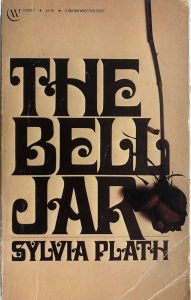 Given my love of mental hospital accounts and women’s autofiction, it’s a wonder I’d not read this before my forties. It was first published under the pseudonym “Victoria Lucas” because Plath thought it immature, “an autobiographical apprentice work which I had to write in order to free myself from the past.” Esther Greenwood is the stand-in for Plath: a talented college student who, after working in New York City during the remarkable summer of 1953, plunges into mental ill health. Chapter 13 is amazing and awful at the same time as Esther attempts suicide thrice in one day, toying with a silk bathrobe cord and ocean waves before taking 50 pills and walling herself into a corner of the cellar. She bounces between various institutional settings, undergoing electroshock therapy – the first time it’s horrible, but later, under a kind female doctor, it’s more like it’s ‘supposed’ to be: a calming reset.
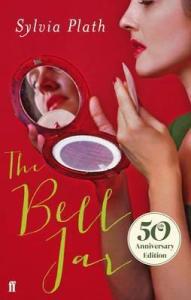 The 19-year-old is obsessed with the notion of purity. She has a couple of boyfriends but decides to look for someone else to take her virginity. Beforehand, the asylum doctor prescribes her a fitting for a diaphragm. A defiant claim to the right to contraception despite being unmarried is a way of resisting the bell jar – the rarefied prison – of motherhood. Still, Esther feels guilty about prioritizing her work over what seems like feminine duty: “Why was I so maternal and apart? Why couldn’t I dream of devoting myself to baby after fat puling baby? … I was my own woman.” Plath never reconciled parenthood with poetry. Whether that’s the fault of Ted Hughes, or the times they lived in, who can say. For her and for Esther, the hospital is a prison as well – but not so hermetic as the turmoil of her own mind. How ironic to read “I took a deep breath and listened to the old brag of my heart. I am, I am, I am” knowing that this was published just a few weeks before this literary genius ceased to be.
Apart from an unfortunate portrayal of a “negro” worker at the hospital, this was an enduringly relevant and absorbing read, a classic to sit alongside Emily Holmes Coleman’s The Shutter of Snow and Janet Frame’s Faces in the Water.
(Secondhand – it’s been in my collection so long I can’t remember where it’s from, but I’d guess a Bowie Library book sale or Wonder Book & Video / Public library – I was struggling with the small type so switched to a recent paperback and found it more readable)
Ariel by Sylvia Plath (1965)
Impossible not to read this looking for clues of her death to come:
Dying
Is an art, like everything else.
I do it exceptionally well.
(from “Lady Lazarus”)
Eternity bores me,
I never wanted it.
(from “Years”)
The woman is perfected.
Her dead
Body wears the smile of accomplishment
(from “Edge”)
 I feel incapable of saying anything fresh about this collection, which takes no prisoners. The images and vocabulary are razor-sharp. First and last lines or stanzas are particularly memorable. (“Morning Song” starts “Love set you going like a fat gold watch”; “Lady Lazarus” ends “Out of the ash / I rise with my red hair / And I eat men like air.”) Words and phrases repeat and gather power as they go. “The Applicant” mocks the obligations of a wife: “A living doll … / It can sew, it can cook. It can talk, talk, talk. … // … My boy, it’s your last resort. / Will you marry it, marry it, marry it.” I don’t know a lot about Plath’s family life, only that her father was a Polish immigrant and died after a long illness when she was eight, but there must have been some daddy issues there – after all, “Daddy” includes the barbs “Daddy, I have had to kill you” and “If I’ve killed one man, I’ve killed two— / The vampire who said he was you / And drank my blood for a year, / Seven years, if you want to know.” It ends, “Daddy, daddy, you bastard, I’m through.” Several later poems in a row, including “Stings,” incorporate bee-related imagery, and Plath’s father was an international bee expert. I can see myself reading this again and again in future, and finding her other collections, too – all but one of them posthumous. (Secondhand – RSPCA charity shop, Newbury)
Three on a Theme: Armchair Travels at the Italian Coast (Rachel Joyce, Sarah Moss and Jess Walter – #18 of 20 Books)
I’ve done a lot of journeying through Italy’s lakes and islands this summer. Not in real life, thank goodness – it would be far too hot! – but via books. I started with the Moss, then read the Joyce, and rounded off with the Walter, a book that had been on my TBR for 12 years and that many had heartily recommended, so I was delighted to finally experience it for myself.
The Homemade God by Rachel Joyce (2025)
Joyce has really upped her game. I’ve somehow read all of her books though I often found them, from Harold Fry onward, disappointingly sentimental and twee. But with this she’s entering the big leagues, moving into the more expansive, elegant and empathetic territory of novels by Anne Enright (The Green Road), Patrick Gale (Notes from an Exhibition), Maggie O’Farrell (Instructions for a Heatwave) and Tom Rachman (The Italian Teacher). It’s the story of four siblings, initially drawn together and then dramatically blown apart by their father’s death. Despite weighty themes of alcoholism, depression and marital struggles, there is an overall lightness of tone and style that made this a pleasure to read.
Vic Kemp, the title figure, was a larger-than-life, womanizing painter whose work divided critics. After his first wife’s early death from cancer, he raised three daughters and a son with the help of a rotating cast of nannies (whom he inevitably slept with). At 76 he delivered the shocking news that he was marrying again: Bella-Mae, an artist in her twenties – much younger than any of his children. They moved from London to his second home in Italy just weeks before he drowned in Lake Orta. Netta, the eldest daughter, is sure there’s something fishy; he knew the lake so well and would never have gone out for a swim with a mist rolling in. Did Bella-Mae kill him for his money? And where is his last painting? Funny how waiting for an autopsy report and searching for a new will and carping with siblings over the division of belongings can ruin what should be paradise.
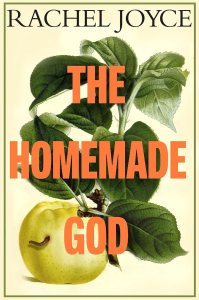
The interactions between Netta, Susan, Goose (Gustav) and Iris, plus Bella-Mae and her cousin Laszlo, are all flawlessly done, and through flashbacks and surges forward we learn so much about these flawed and flailing characters. The derelict villa and surrounding small town are appealing settings, and there are a lot of intriguing references to food, fashion and modern art.
My only small points of criticism are that Iris is less fleshed out than the others (and her bombshell secret felt distasteful), and that Joyce occasionally resorts to delivering some of her old obvious (though true) messages through an omniscient narrator, whereas they could be more palatable if they came out organically in dialogue or indirectly through a character’s thought process. Here’s an example: “When someone dies or disappears, we can only tell stories about what might have been the case or what might have happened next.” (One I liked better: “There were some things you never got over. No amount of thinking or talking would make them right: the best you could do was find a way to live alongside them.”) I also don’t think Goose would have been able to view his father’s body more than two months after his death; even with embalming, it would have started to decay within weeks.
You can tell that Joyce got her start in theatre because she’s so good at scenes and dialogue, and at moving people into different groups to see what they’ll do. She’s taken the best of her work in other media and brought it to bear here. It’s fascinating how Goose starts off seeming minor and eventually becomes the main POV character. And ending with a wedding (good enough for a Shakespearean comedy) offers a lovely occasion for a potential reconciliation after a (tragi)comic plot. More of this calibre, please! (Public library) 
Ripeness by Sarah Moss (2025)
One sneaky little line, “Ripeness, not readiness, is all,” a Shakespeare mash-up (“Ripeness is all” is from King Lear vs. “the readiness is all” is from Hamlet), gives a clue to how to understand this novel: As a work of maturity from Sarah Moss, presenting life with all its contradictions and disappointments, not attempting to counterbalance that realism with any false optimism. What do we do, who will we be, when faced with situations for which we aren’t prepared?
Now that she’s based in Ireland, Moss seems almost to be channelling Irish authors such as Claire Keegan and Maggie O’Farrell. The line-up of themes – ballet + sisters + ambivalent motherhood + the question of immigration and belonging – should have added up to something incredible and right up my street. While Ripeness is good, even very good, it feels slightly forced. As has been true with some of Moss’s recent fiction (especially Summerwater), there is the air of a creative writing experiment. Here the trial is to determine which feels closer, a first-person rendering of a time nearly 60 years ago, or a present-tense, close-third-person account of the now. [I had in mind advice from one of Emma Darwin’s Substack posts: “What you’ll see is that ‘deep third’ is really much the same as first, in the logic of it, just with different pronouns: you are locking the narrative into a certain character’s point-of-view, but you don’t have a sense of that character as the narrator, the way you do in first person.” Except, increasingly as the novel goes on, we are compelled to think about Edith as a narrator, of her own life and others’.
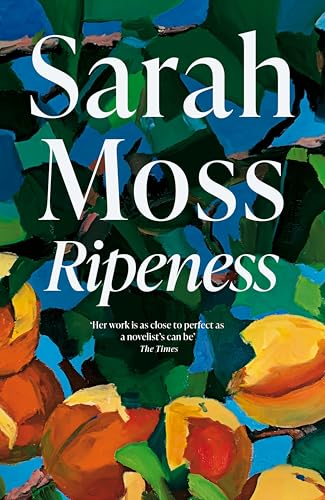
In the current story line, everyone in rural West Ireland seems to have come from somewhere else (e.g. Edith’s lover Gunter is German). “She’s going to have to find a way to rise above it, this tribalism,” Edith thinks. She’s aghast at her town playing host to a small protest against immigration. Fair enough, but including this incident just seems like an excuse for some liberal handwringing (“since it’s obvious that there is enough for all, that the problem is distribution not supply, why cannot all have enough? Partly because people like Edith have too much.”). The facts of Maman being French-Israeli and having lost family in the Holocaust felt particularly shoehorned in; referencing Jewishness adds nothing. I also wondered why she set the 1960s narrative in Italy, apart from novelty and personal familiarity. (Teenage Edith’s high school Italian is improbably advanced, allowing her to translate throughout her sister’s childbirth.)
Though much of what I’ve written seems negative, I was left with an overall favourable impression. Mostly it’s that the delivery scene and the chapters that follow it are so very moving. Plus there are astute lines everywhere you look, whether on dance, motherhood, or migration. It may simply be that Moss was taking on too much at once, such that this lacks the focus of her novellas. Ultimately, I would have been happy to have just the historical story line; the repeat of the surrendering for adoption element isn’t necessary to make any point. (I was relieved, anyway, that Moss didn’t resort to the cheap trick of having the baby turn out to be a character we’ve already been introduced to.) I admire the ambition but feel Moss has yet to return to the sweet spot of her first five novels. Still, I’m a fan for life. (Public library) 
#18 of my 20 Books of Summer
(Completing the second row on the Bingo card: Book set in a vacation destination)


Beautiful Ruins by Jess Walter (2012)
 I loved how Emma Straub described the ideal summer read in one of her Substack posts: “My plan for the summer is to read as many books as possible that make me feel that drugged-up feeling, where you just want to get back to the page.” I wish I’d been able to read this faster – that I hadn’t had so much on my plate all summer so I could have been fully immersed. Nonetheless, every time I returned to it I felt welcomed in. So many trusted bibliophiles love this book – blogger friends Laila and Laura T.; Emma Milne-White, owner of Hungerford Bookshop, who plugged it at their 2023 summer reading celebration; and Maris Kreizman, who in a recent newsletter described this as “One of my favorite summer reading novels ever … escapist magic, a lush historical novel.”
I’m relieved to report that Beautiful Ruins lived up to everyone’s acclaim – and my own high expectations after enjoying Walter’s So Far Gone, which I reviewed for BookBrowse earlier in the summer. I was immediately captivated by the shabby glamour of Pasquale’s hotel in Porto Vergogna on the coast of northern Italy. With refreshing honesty, he’s dubbed the place “Hotel Adequate View.” In April 1962, he’s attempting to build a cliff-edge tennis court when a boat delivers beautiful, dying American actress Dee Moray. It soon becomes clear that her condition is nothing nine months won’t fix and she’s been dumped here to keep her from meddling in the romance between the leads in Cleopatra, filming in Rome. In the present day, an elderly Pasquale goes to Hollywood to find out whatever happened to Dee.
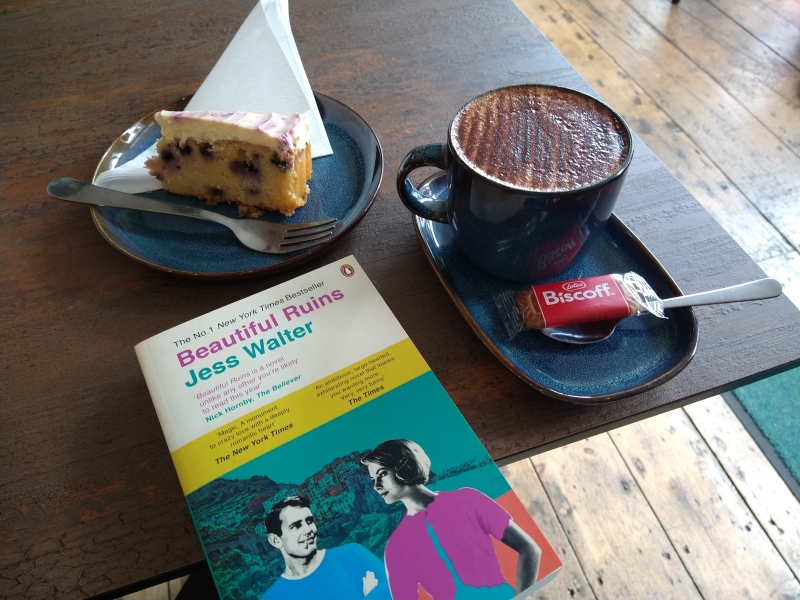
A myriad of threads and formats – a movie pitch, a would-be Hemingway’s first chapter of a never-finished wartime masterpiece, an excerpt from a producer’s autobiography and a play transcript – coalesce to flesh out what happened in that summer of 1962 and how the last half-century has treated all the supporting players. True to the tone of a novel about regret, failure and shattered illusions, Walter doesn’t tie everything up neatly, but he does offer a number of the characters a chance at redemption. This felt to me like a warmer and more timeless version of A Visit from the Goon Squad. There are so many great scenes, none better than Richard Burton’s drunken visit to Porto Vergogna, which had me in stitches. Fantastic. (Hungerford Bookshop – 40th birthday gift from my husband from my wish list)
Every Day Is Mother’s Day (Three on a Theme)
It’s Mother’s Day in the UK today, so I’m featuring three books about mothers and motherhood: a poetry collection, a memoir, and a novel. There are complicated emotions at play in all of these books, whether because of the loss of a child, a mother’s misbehaviour, or a combination of abuse and unfitness.
Her Birth by Rebecca Goss (2013)
 Goss’s first child, Ella, died at 16 months of a rare heart condition, Severe Ebstein’s Anomaly. This collection is in three parts, the first recreating vignettes from her daughter’s short life, the purgatorial central section dwelling in the aftermath of grief, and the third summoning the courage to have another baby. “So extraordinary was your sister’s / short life, it’s hard for me to see // a future for you. I know it’s there, … yet I can’t believe // my fortune”. The close focus on physical artefacts and narrow slices of memory wards away mawkishness. The poems are sweetly affecting but never saccharine. “I kept a row of lilac-buttoned relics / in my wardrobe. Hand-knitted proof, something/ to haul my sorry lump of heart and make it blaze.” (New purchase from Bookshop UK with buyback credit)
How to Survive Your Mother by Jonathan Maitland (2006)
 I can’t remember where I came across this in the context of recommended family memoirs, but the title and premise were enough to intrigue me. I’d not previously heard of Maitland, who at the time was known for a TV investigative reporting show called Watchdog exposing con artists. The irony: he was soon to discover that his own mother was a con artist. By chance, he met a journalist who recalled a scandal involving his parents’ old folks’ homes. Maitland toggles between flashbacks to his earlier life and fragments from his investigation, which involved archival research but mostly interviews with his estranged sister, his mother’s ex-husbands, and more.
Bru was a larger-than-life character: Israeli, obsessed with cars and personal upkeep – she once lied to her son that she’d had “eyebrow cancer” rather than admit to having had a facelift, and prone to suicide attempts and other grand gestures, such as opening a “gay hotel” in the 1970s. It eventually emerges that she talked an old man under her care into changing his will to make her his sole beneficiary; she and Maitland’s father also borrowed money from other vulnerable elderly customers. No doubt Bru had narcissistic personality disorder. This was interesting for the psychological insight but not so much for the blow-by-blow. It might have made a better novel. (Secondhand – Awesomebooks.com) 
Every Day Is Mother’s Day by Hilary Mantel (1985)
 If you mostly know Mantel for her Thomas Cromwell trilogy, her debut novel, a black comedy, will come as a surprise. Two households become entangled in sordid ways in 1974. The Axons, Evelyn and her intellectually disabled adult daughter, Muriel, live around the corner from Florence Sidney, who still resides in her family home and whose brother Colin lives nearby with his wife and three children (the fourth is on the way). Colin is having an affair with Muriel’s social worker, Isabel Field. Evelyn is dismayed to realize that Muriel has, somehow, fallen pregnant.
Everyone in this short, spiky novel has been neglected by or separated from a mother, and/or finds motherhood oppressive. The picture is bleak indeed. Colin and Florence’s mother is institutionalized; Muriel’s pregnancy is an embarrassment to be hidden; childbirth is a traumatic memory for Evelyn: “She had been left alone to scream, on a high white bed. … The parasite was straining to be away.” But you’ll find humour and delicious creepiness here, too: a dinner party so atrocious you have to laugh; Evelyn’s utter lack of manners and house that seems to be haunted by poltergeists. The offspring of Barbara Comyns and Shirley Jackson, this is also reminiscent of Muriel Spark or early Margaret Atwood.
I could see the seeds of future Mantel (Evelyn is a retired amateur medium – a precursor of the psychic in Beyond Black) but enjoyed this for its own sake. Very annoyingly, when I started reading this and saw on Goodreads that it has a sequel, I glanced at the page for the latter and there was a huge spoiler. Harrumph. Not sure I’ll read Vacant Possession, but this was strong evidence that it’s worth diving into the back catalogue of big-name authors. (Public library)
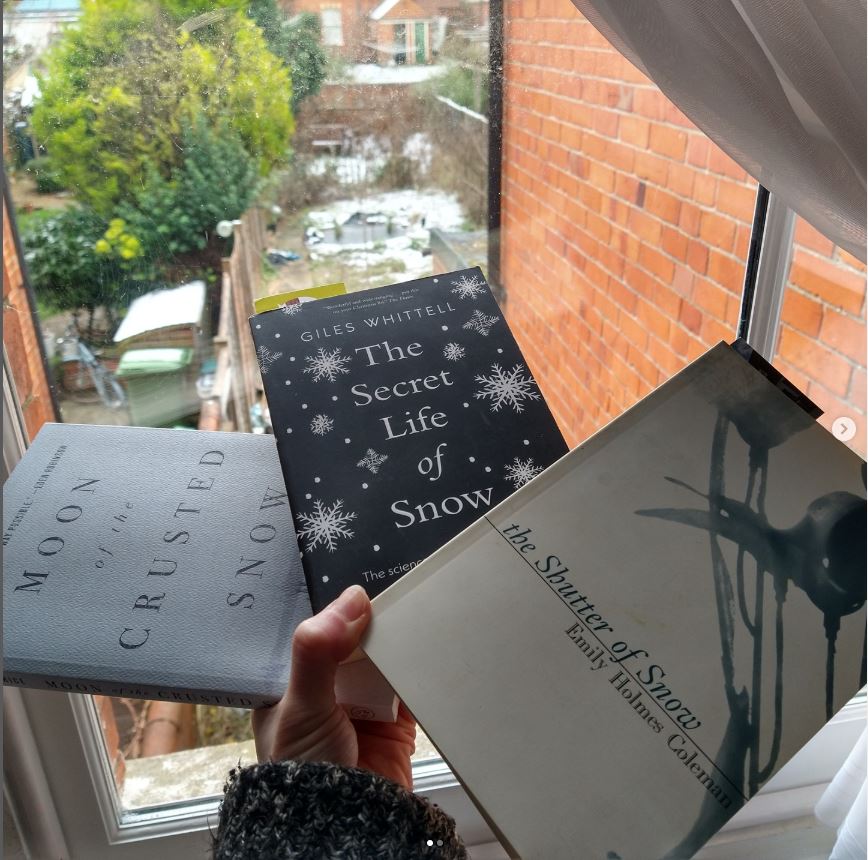
Winter Reading, Part II: “Snow” Books by Coleman, Rice & Whittell
Here I am squeaking in on the day before the spring equinox – when it’s predicted to be warmer than Ibiza here in southern England, as headlines have it – with a few snowy reads that have been on my stack for much of the winter. I started reading this trio when we got a dusting back in January, in case (as proved to be true) it was our only snow of the year. I have an arresting work of autofiction that recreates a period of postpartum psychosis, a mildly dystopian novel by a First Nations Canadian, and a snow-lover’s compendium of science and trivia.
 As it happens, I’ll be starting the spring in the middle of We Do Not Part by Han Kang, which is austerely beautiful and eerily snowy: its narrator traverses a blizzard to rescue her friend’s pet bird; and the friend’s mother recalls a village massacre that left piles of snow-covered corpses. Here Kang muses on the power of snow:
Snow had an unreality to it. Was this because of its pace or its beauty? There was an accompanying clarity to snow as well, especially snow, drifting snow. What was and wasn’t important were made distinct. Certain facts became chillingly apparent. Pain, for one.
The Shutter of Snow by Emily Holmes Coleman (1930)
 Coleman (1899–1974), an expatriate American poet, was part of the Paris literary milieu in the 1920s and then the London scene of the 1930s. (She worked with T.S. Eliot on editing Djuna Barnes’s Nightwood, for instance.) This novella, her only published work of fiction, was based on her experience of giving birth to her son in 1924, suffering from puerperal fever and a mental breakdown, and being incarcerated in Rochester State Hospital. Although the portrait of Marthe Gail is in the omniscient third person, the stream-of-consciousness style – no speech marks or apostrophes, minimal punctuation – recalls unreliable first-person narration. Marthe believes she is Jesus Christ. Her husband Christopher visits occasionally, hoping she’ll soon be well enough to come home to their baby. It’s hard to believe this was written a century ago; I could imagine it being published tomorrow. It is absolutely worth rediscovering. While I admired the weird lyrical prose (“in his heart was growing a stern and ruddy pear … He would make of his heart a stolen marrow bone and clutch snow crystals in the night to his liking”; “This earth is made of tar and every morsel is stuck upon it to wither … there were orange peelings lying in the snow”), the interactions between patients, nurses and doctors got tedious. (Secondhand – Community Furniture Project, Newbury)
Moon of the Crusted Snow by Waubgeshig Rice (2018)
 A mysterious total power outage heralds not just the onset of winter or a temporary crisis but the coming of a new era. For this Anishinaabe community, it will require a return to ancient nomadic, hunter-gatherer ways. I was expecting a sinister dystopian; while there are rumours of a more widespread collapse, the focus is on adaptation versus despair, internal resilience versus external threats. Rice reiterates that Indigenous peoples have often had to rebuild their worlds: “Survival had always been an integral part of their culture. It was their history. The skills they needed to persevere in this northern terrain … were proud knowledge held close through the decades of imposed adversity.” As an elder remarks, apocalypse is nothing new. I was more interested in these ideas than in how they played out in the plot. Evan works snow-ploughs until, with food running short and many falling ill, he assumes the grim task of an undertaker. I was a little disappointed that it’s a white interloper breaks their taboos, but it is interesting how he is compared to the mythical windigo in a dream sequence. As short as this novel is, I found it plodding, especially in the first half. It does pick up from that point (and there is a sequel). I was reminded somewhat of Sherman Alexie. It was probably my first book by an Indigenous Canadian, which was reason enough to read it, though I wonder if I would warm more to his short stories. (Birthday gift from my wish list last year)
The Secret Life of Snow: The science and the stories behind nature’s greatest wonder by Giles Whittell (2018)
 This is so much like The Snow Tourist by Charlie English it was almost uncanny. Whittell, an English journalist who has written history and travel books, is a snow obsessive and hates that, while he may see a few more major snow events in his lifetime, his children probably won’t experience any in their adulthood. Topics in the chatty chapters include historical research into snowflakes, meteorological knowledge then and now and the ongoing challenge of forecasting winter storms, record-breaking snowfalls and the places still most likely to have snow cover, and the depiction of snow in medieval paintings (like English, he zeroes in on Bruegel) and Bond films. There’s a bit too much on skiing for my liking: it keeps popping up in segments on the Olympics, avalanches, and how famous snow spots are reckoning with their uncertain economic future. It’s a fun and accessible book with many an eye-popping statistic, but, coming as it did a decade after English’s, does sound the alarm more shrilly about the future of snow. As in, we’ll get maybe 15 more years (until 2040), before overall warming means it will only fall as rain. “That idea, like death, is hard to think about without losing your bearings, which is why, aware of my cowardice and moral abdication, I prefer to think of the snowy present and recent past rather than of the uncertain future.” (Secondhand – Community Furniture Project, Newbury)
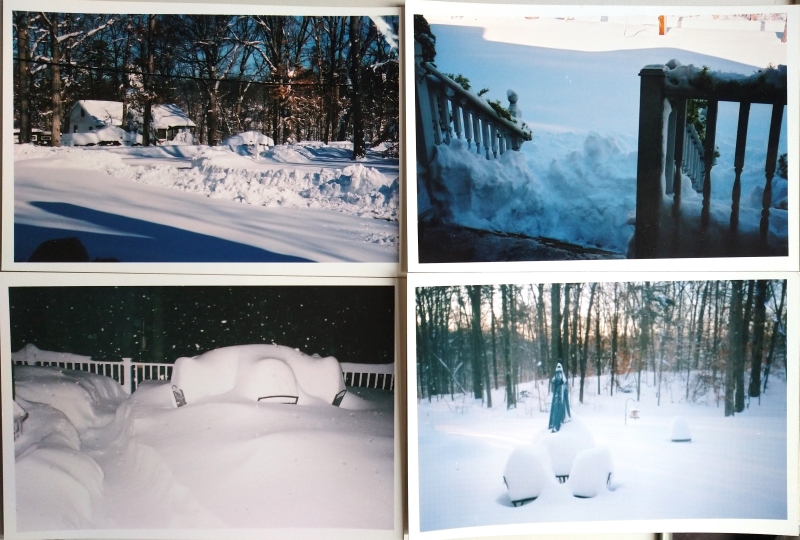
Whittell’s mention of the U.S. East Coast “Snowmaggedon” of February 2010 had me digging out photos my mother sent me of the aftermath at our family home of the time.
Any wintry reading (or weather) for you lately? Or is it looking like spring?
Three on a Theme: Christmas Novellas I (Re-)Read This Year
I wasn’t sure I’d manage any holiday-appropriate reading this year, but thanks to their novella length I actually finished three, two in advance and one in a single sitting on the day itself. Two of these happen to be in translation: little slices of continental Christmas.
Twelve Nights by Urs Faes (2018; 2020)
[Translated from the German by Jamie Lee Searle]
 In this Swiss novella, the Twelve Nights between Christmas and Epiphany are a time of mischief when good folk have to protect themselves from the tricks of evil spirits. Manfred has trekked back to his home valley hoping to make things right with his brother, Sebastian. They have been estranged for several decades – since Sebastian unexpectedly inherited the family farm and stole Manfred’s sweetheart, Minna. These perceived betrayals were met with a vengeful act of cruelty (but why oh why did it have to be against an animal?). At a snow-surrounded inn, Manfred convalesces and tries to summon the courage to show up at Sebastian’s door. At only 84 small-format pages, this is more of a short story. The setting and spare writing are appealing, as is the prospect of grace extended. But this was over before it began; it didn’t feel worth what I paid. Perhaps I would have been happier to encounter it in an anthology or a longer collection of Faes’s short fiction. (Secondhand – Hungerford Bookshop)
Through a Glass, Darkly by Jostein Gaarder (1993; 1998)
[Translated from the Norwegian by Elizabeth Rokkan]
On Christmas Day, Cecilia is mostly confined to bed, yet the preteen experiences the holiday through the sounds and smells of what’s happening downstairs. (What a cosy first page!)
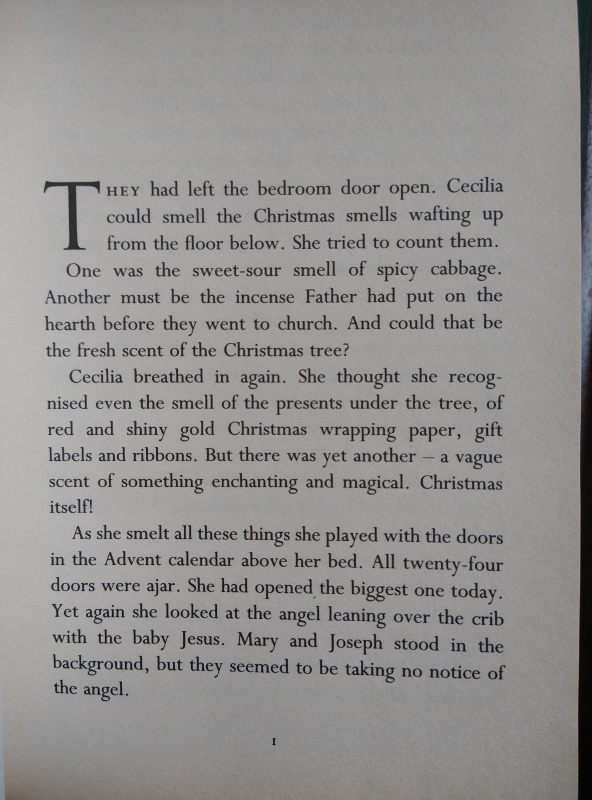
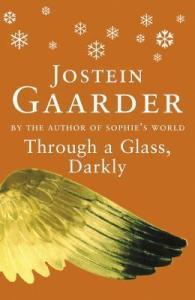 Her father later carries her down to open her presents: skis, a toboggan, skates – her family has given her all she asked for even though everyone knows she won’t be doing sport again; there is no further treatment for her terminal cancer. That night, the angel Ariel appears to Cecilia and gets her thinking about the mysteries of life. He’s fascinated by memory and the temporary loss of consciousness that is sleep. How do these human processes work? “I wish I’d thought more about how it is to live,” Cecilia sighs, to which Ariel replies, “It’s never too late.” Weeks pass and Ariel engages Cecilia in dialogues and takes her on middle-of-the-night outdoor adventures, always getting her back before her parents get up to check on her. The book emphasizes the wonder of being alive: “You are an animal with the soul of an angel, Cecilia. In that way you’ve been given the best of both worlds.” This is very much a YA book and a little saccharine for me, but at least it was only 161 pages rather than the nearly 400 of Sophie’s World. (Secondhand – Community Furniture Project, Newbury)
Small Things Like These by Claire Keegan (2021)
I idly reread this while The Muppet Christmas Carol played in the background on a lazy, overfed Christmas evening.
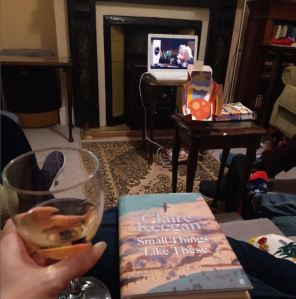
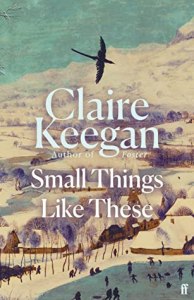 It was an odd experience: having seen the big-screen adaptation just last month, the blow-by-blow was overly familiar to me and I saw Cillian Murphy and Emily Watson, if not the minor actors, in my mind’s eye. I realized fully just how faithful the screenplay is to the book. The film enhances not just the atmosphere but also the plot through the visuals. It takes what was so subtle in the book – blink-and-you’ll-miss-it – and makes it more obvious. Normally I might think it a shame to undermine the nuance, but in this case I was glad of it. Bill Furlong’s midlife angst and emotional journey, in particular, are emphasized in the film. It was probably a mistake to read this a third time within so short a span of time; it often takes me more like 5–10 years to appreciate a book anew. So I was back to my ‘nice little story’ reaction this time, but would still recommend this to you – book or film – if you haven’t yet experienced it. (Free at a West Berkshire Council recycling event)
Previous ratings: (2021 review); (2022 review)
My rating this time:
We hosted family for Christmas for the first time, which truly made me feel like a proper grown-up. It was stressful and chaotic but lovely and over all too soon. Here’s my lil’ book haul (but there was also a £50 book token, so I will buy many more!).
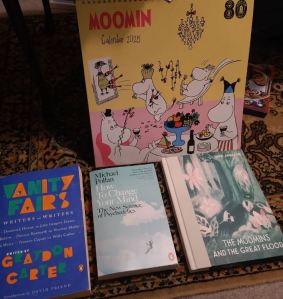
I hope everyone has been enjoying the holidays. I have various year-end posts in progress but of course the final Best-of list and statistics will have to wait until the turning of the year.
Coming up:
Sunday 29th: Best Backlist Reads of the Year
Monday 30th: Love Your Library & 2024 Reading Superlatives
Tuesday 31st: Best Books of 2024
Wednesday 1st: Final statistics on 2024’s reading
 Bookish Beck = Rebecca Foster. American transplant to England. Freelance proofreader and book reviewer.
 Bookish Beck