Victorian-Themed Novels by Annie Elliot and Livi Michael (#ReadIndies)
I’m going back to my roots as a Victorianist (I completed an MA in Victorian Literature at the University of Leeds in 2006) with these two new novels, the one about Charles Dickens’s turbulent marriage and the other about the real-life inspiration for Elizabeth Gaskell’s Ruth. Both redress the balance of Victorian literature by placing women at the centre of the action, and both were comfortably in the 200–300-page range: turns out that’s how I like my Victoriana these days; none of your triple-decker nonsense.
Mr & Mrs Charles Dickens: Her Story by Annie Elliot
I used to proclaim Dickens my favourite author yet haven’t managed to read one of his novels in 15+ years; I seem to be allergic to all that verbiage. He managed to write all those millions of words thanks to his increasing status and wealth, but also thanks to his long-suffering wife, Catherine. Kate sacrificed her health and ambitions to bear and raise his nine children (along with one who died) and – along with sisters and servants – keep a house calm and quiet enough to enable his work.
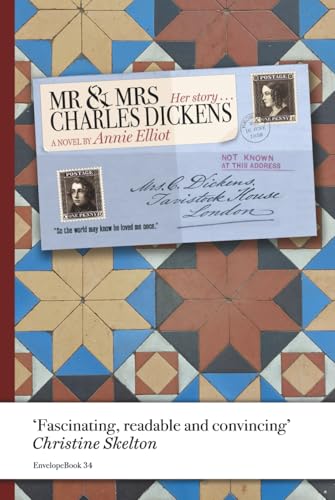 On her deathbed, Kate begged her daughter to give her love letters from Charles to the British Museum “so the world may know he loved me once.” Annie Elliot has used that phrase as the tagline for her absorbing and vigilantly researched debut novel. The structure perfectly mimics romantic illusions ceding to disenchantment. The framing story is set on 10 June 1870 – the day Kate, the estranged wife, learns of Charles’s death. Sections alternate between the bereaved Kate’s fragile state of mind (depicted in the third person) and first-person flashbacks to their relationship, from first meeting in 1834 to infamous separation in 1858.
It’s all narrated in the present tense, which creates an eternal now: nothing can be dated when it’s all happening at once for Kate. To start with, the Dickens marriage seems to be based on real love and physical passion. But before long it’s clear that he’s using Kate as ego boost and sexual outlet. She walks on eggshells lest anything shake his confidence. While the death of their baby daughter Dora nearly breaks her, he keeps up a frenzy of writing, travel, property acquisition, and new ventures such as public speaking and the theatre. And, of course, it’s through dramatics that he meets young Nelly Ternan and finds his excuse to push Kate aside.
Though much of this material was familiar to me from Claire Tomalin’s biographies as well as Gaynor Arnold’s novel about Kate, Girl in a Blue Dress, I appreciated the recreation of Kate’s perspective, the glimpses of their children’s lives, and the flashes of humour such as the proliferation of Pickwick memorabilia and a visit from Hans Christian Andersen. This is – yes, still – a necessary corrective to Dickens’s image as the dutiful husband and paterfamilias. And such a beautifully presented book, too. I wish Elliot well for next year’s McKitterick Prize race.
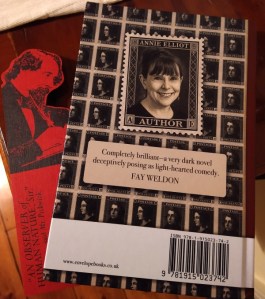
To be published on 1 March. With thanks to the author and EnvelopeBooks for the free copy for review.
Elizabeth and Ruth by Livi Michael
The Manchester of 1849 is a sordid complex of sweatshops, brothels and workhouses – if you’re Pasley, an Irish teenager abandoned by her mother and shunted from one bad situation to another. Or the Manchester of 1849 is a rarefied colloquium of forward-thinking authors, ministers and politicians – if you’re Elizabeth Gaskell, who’s been revealed as the mind behind the anonymously published sensation Mary Barton.
The two worlds collide when Elizabeth visits Pasley at the New Bailey Prison. She feels for this young woman who’s been a victim of deception, trafficking, and rape and narrowly escaped death by suicide only to end up imprisoned for theft when she made a desperate bid for freedom. There’s only so much that Pasley can bear to tell Mrs Gaskell on these short visits, though; her past would shock a preacher’s wife. Through euphemisms and evasions, Pasley is able to convey that she was taken advantage of by a doctor. Elizabeth suspects that there was a baby, but only readers know the whole truth.
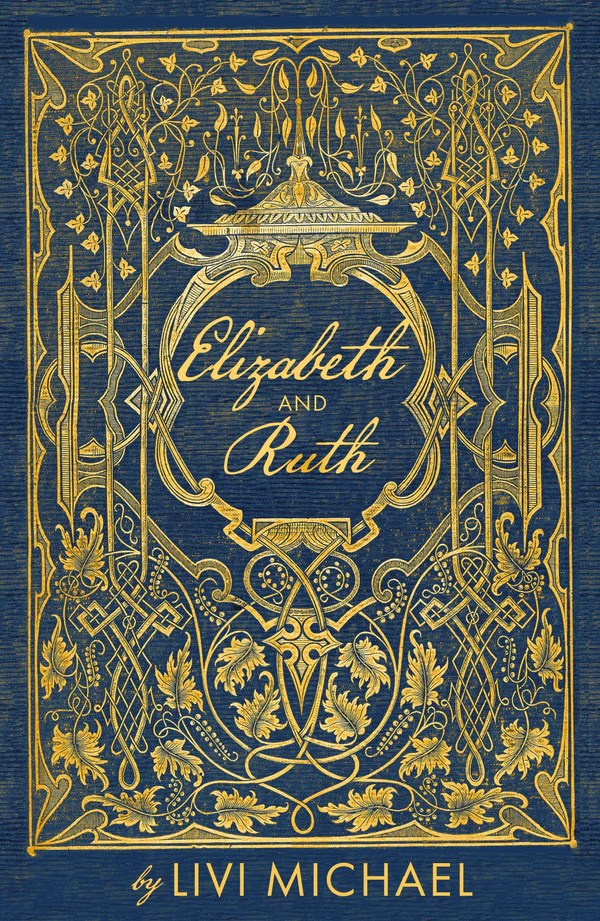
Chapters alternate between Elizabeth’s experience – in an omniscient third person cleverly reminiscent of Victorian prose – and Pasley’s first-person recollections. Elizabeth wants to follow through on her do-gooder reputation and truly help Pasley, who reminds her of her own infant and pregnancy losses. Achieving justice for the girl would be a bonus. All she knows to do is use her pen to change hearts and minds, as she has before (including for Dickens’s magazine) to draw attention to the plight of the poor. Thus, Ruth was born.
This is a riveting and touching novel about the rigidity of convention and the limits of compassion. Livi Michael is a prolific author of whom I’d not heard before Salt sent me this surprise, perfectly suited parcel. Her vivid scenes bring the two-tiered Manchester society to life and reminded me of my visit to the Gaskell House in 2015. My only small complaint would be that the blurb makes it sound as if Gaskell’s correspondence with Dickens will be a central element, when in fact it only appears once, two-thirds of the way through, with one cameo appearance by Dickens right at the end. He’s the better-known author, but after reading this you’ll agree that Gaskell was the subtler, more elegant chronicler.
Published on 9 February. With thanks to Salt Publishing for the proof copy for review.
Guest Review of Greene Ferne Farm by Richard Jefferies (#NovNov25)
As busy as he is as a lecturer in animal ecology at the University of Reading (and a multi-instrumentalist in several folk/Americana bands), my husband, Dr Chris Foster, managed to find time to read and review (below) something for Novellas in November. This is a random, obscure Victorian novel (from 1880) that we picked up at a book sale in Kingsclere last month.
“The 19th-century author Richard Jefferies is better remembered as a nature writer than as a novelist, and in this slight early novella (albeit published only seven years before his death from tuberculosis at age 38) it is indeed his evocation of the landscapes, wildlife and weather of rural Wiltshire that stand out most.
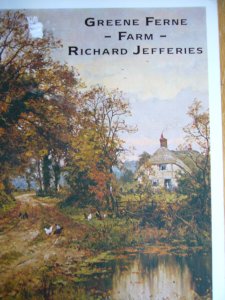 “Jefferies conjures atmosphere skilfully, from an uneasy night lost on chalk downland in thick fog to the lonely, dust-filled room where an avaricious old farmer looks out at the sunset from his armchair. There’s a sense of abundant nature as a backdrop for rural life that can be taken for granted, a sense of connectivity across generations – “the cuckoo came and went; the swallows sailed for the golden sands of the south; the leaves, brown and orange and crimson, dropped and died” – but also a prescient fear expressed here by a landowning squire that modern farming methods such as ‘ploughing engines’ might “suck every atom out of the soil.” The abundance of corncrakes portrayed around Greene Ferne is just one reminder for contemporary readers of how much wildlife has been lost from farmland since Jefferies was writing.
“The plot is lacklustre in comparison to the prose: a Hardyesque blend of love triangles and scenes from rural life, with no sense that the occasionally dramatic events portrayed are helping to build any narrative momentum. The portrayals of rustic village folk, complete with thick country accents, feel clichéd and idealised, especially given the decidedly un-Hardyesque happy ending, but the quality of Jefferies’ writing for much of Greene Ferne Farm is at least an encouragement to check out his other, better-known work.” [126 pages] 
20 Books of Summer, 11–12 (Victoriana): Edward Carey & George Grossmith
Neither of these appeared on my initial list, but I thought a middle-grade novel and a classic would be good for variety. Though I have an MA in Victorian Literature, I don’t often read from the period anymore because I’m allergic to wordy triple-deckers, so it was a delight to encounter something short and lighthearted. I’ve always been partial to a contemporary Victorian pastiche, though.
Heap House (Iremonger, #1) by Edward Carey (2013)
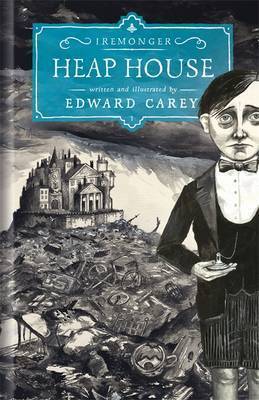 The Iremonger family wealth came from salvaging treasure from the rubbish heaps surrounding their London mansion. Every Iremonger has a birth object (like a daemon?) associated with them. Clodius Iremonger, adolescent descendant of the great family, has a special skill: he hears each birth object speaking its name. His own bath plug, for instance, cries out, “James Henry Hayward.” These objects house enchanted souls; people can change back into objects and vice versa. The narration alternates between Clod and plucky Lucy Pennant, who arrives from a local orphanage to work as a house servant. All staff and heap-workers are called “Iremonger,” but Lucy refuses to cede her identity and wants justice for the oppressed workers. She and Clod form a bond against the odds and there’s an upstairs–downstairs tinge to their ensuing adventures in the house and on the heaps.
Carey’s trademark twisted combination of Dickensian charm and Gothic gloom is certainly on display here. All the other names are slightly off-kilter: Rosamud, Moorcus, Aliver, Pinalippy and so on. I laughed out loud at a passage about the dubious purpose of doilies. Little truly won me over, but all my experiences with Carey’s work since then (also including The Swallowed Man, B: A Year in Plagues and Pencils, and Edith Holler) have been a slight letdown. This was highly readable and I galloped through the midsection, but I found the whole thing overlong; I’m undecided about reading the other books, though they do have higher average ratings on Goodreads. I got the second, Foulsham, from the Little Free Library and it’s significantly shorter. Shall I continue? (Secondhand – Awesomebooks.com) 
The Diary of a Nobody by George Grossmith; illus. Weedon Grossmith (1892)
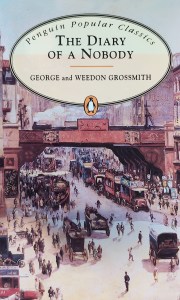 It must be rare for a fictional character to be memorialized in the dictionary. I was vaguely aware of the word “Pooterism” but thought it referred to small-minded, pompous, fussy individuals, so my preconception of City clerk Charles Pooter was probably more negative than is warranted. (In fact, “Pooterish” means taking oneself too seriously.) He’s actually a lovable, hapless Everyman who tries desperately to keep up with middle-class society but often gets it wrong. He can’t handle his champagne; and he wants so much to be funny – his are definite dad jokes avant la lettre – but only sometimes pulls it off. He regularly offends tradesmen, servants and neighbours alike, and tries but fails to ingratiate himself with his betters. Luckily, his mistakes are mild and just leave him out of favour – or pocket.

Charles and Lupin Pooter, as depicted by
Weedon Grossmith. Public domain, via Wikimedia Commons.
Originally serialized in Punch, the book is in short entries of one paragraph to a few pages, recounting the Pooters’ first 15 months in their new home. Events range from the mundane – home repairs and decoration – to the great excitement of being invited to the mayor’s ball. Charles and Carrie’s young adult son, Lupin (surely a partial inspiration for Roger Mortimer’s Dear Lupin and its sequels?), who comes back to live with them partway through, is a feckless bounder always being taken in by new money-making schemes and unsuitable ladies. Charles hopes to find Lupin steady employment and steer him away from his infatuation with Daisy Mutlar.
It’s well worth reading for its own sake, but also for the window onto daily Victorian life, including things that aren’t always recorded, such as fashion and slang. And it’s clever how Pooter’s pretensions get punctured by the others around him: longsuffering Carrie (“He tells me his stupid dreams every morning nearly”), insolent Lupin (“Look here, Guv.; excuse me saying so, but you’re a bit out of date”), and testy Gowing – that’s right, the neighbours are named Cummings and Gowing (“I would add, you’re a bigger fool than you look, only that’s absolutely impossible”). All very amusing. (Free from mall bookshop c. 2020) 

Never fear, I’m still on track to finish the challenge by the 31st!
Nonfiction November Book Pairings: Hardy’s Wives, Rituals, and Romcoms
Liz is hosting this week of Nonfiction November. For this prompt, the idea is to choose a nonfiction book and pair it with a fiction title with which it has something in common.

I came up with three based on my recent reading:
Thomas Hardy’s Wives
On my pile for Novellas in November was a tiny book I’ve owned for nearly two decades but not read until now. It contains some of the backstory for an excellent historical novel I reviewed earlier in the year.
Some Recollections by Emma Hardy
&
The Chosen by Elizabeth Lowry


The manuscript of Some Recollections is one of the documents Thomas Hardy found among his first wife’s things after her death in 1912. It is a brief (15,000-word) memoir of her early life from childhood up to her marriage – “My life’s romance now began.” Her middle-class family lived in Plymouth and moved to Cornwall when finances were tight. (Like the Bennets in Pride and Prejudice, you look at the house they lived in, and read about the servants they still employed, and think, “impoverished,” seriously?!) “Though trifling as they may seem to others all these memories are dear to me,” she writes. It’s true that most of these details seem inconsequential, of folk historical value but not particularly illuminating about the individual.
An exception is her account of her dealings with fortune tellers, who often went out of their way to give her good – and accurate – predictions, such as that she would marry a writer. It’s interesting to set this occult belief against the traditional Christian faith she espouses in her concluding paragraph, in which she insists an “Unseen Power of great benevolence directs my ways.” The other point of interest is her description of her first meeting with Hardy, who was sent to St. Juliot, where she was living with her parson brother-in-law and sister, as an architect’s assistant to begin repairs on the church. “I thought him much older than he was,” she wrote. As editor Robert Gittings notes, Hardy made corrections to the manuscript and in some places also changed the sense. Here Hardy gave proof of an old man’s continued vanity by adding “he being tired” after that line … but then partially rubbing it out. (Secondhand, Books for Amnesty, Reading, 2004) [64 pages] 
The Chosen contrasts Emma’s idyllic mini memoir with her bitterly honest journals – Hardy read but then burned these, so Lowry had to recreate their entries based on letters and tone. But Some Recollections went on to influence his own autobiography, and to be published in a stand-alone volume by Oxford University Press. Gittings introduces the manuscript (complete with Emma’s misspellings and missing punctuation) and appends a selection of Hardy’s late poems based on his first marriage – this verse, too, is central to The Chosen.
Another recent nonfiction release on this subject matter that I learned about from a Shiny New Books review is Woman Much Missed: Thomas Hardy, Emma Hardy and Poetry by Mark Ford. I’d also like to read the forthcoming Hardy Women: Mother, Sisters, Wives, Muses by Paula Byrne (1 February 2024, William Collins).
Rituals
The Ritual Effect by Michael Norton
&
The Rituals by Rebecca Roberts


Last month I reviewed this lovely Welsh novel about a woman who is an independent celebrant, helping people celebrate landmark events in their lives or cope with devastating losses by commemorating them through secular rituals.
Coming out in April 2024, The Ritual Effect is a Harvard Business School behavioral scientist’s wide-ranging study of how rituals differ from habits in that they are emotionally charged and lift everyday life into something special. Some of his topics are rites of passage in different cultures; musicians’ and sportspeople’s pre-performance routines; and the rituals we develop around food and drink, especially at the holidays. I’m just over halfway through this for an early Shelf Awareness review and I have been finding it fascinating.
Romantic Comedy
(As also featured in my August Six Degrees post)
What I Was Doing While You Were Breeding by Kristin Newman
&
Romantic Comedy by Curtis Sittenfeld


Romantic Comedy is probably still the most fun reading experience I’ve had this year. Sittenfeld’s protagonist, Sally Milz, writes TV comedy, as does Kristin Newman (That ’70s Show, How I Met Your Mother, etc.). What I Was Doing While You Were Breeding is a lighthearted record of her sexual conquests in Amsterdam, Paris, Russia, Argentina, etc. (Newman even has a passage that reminds me of Sally’s “Danny Horst Rule”: “I looked like a thirty-year-old writer. Not like a twenty-year-old model or actress or epically legged songstress, which is a category into which an alarmingly high percentage of Angelenas fall. And, because the city is so lousy with these leggy aliens, regular- to below-average-looking guys with reasonable employment levels can actually get one, another maddening aspect of being a woman in this city.”) Unfortunately, it got repetitive and raunchy. It was one of my 20 Books of Summer but I DNFed it halfway.
The Woman in Black, Train Dreams, and Absolutely & Forever (#NovNov23)
I’ve been slow off the mark this year, mostly because instead of reading a sensible one or two novellas at a time, I’ve had 10 or 15 on the go. It might mean I’ll read more overall, but from day to day it feels like crawling through loads of books, never to finish any. Except I did finally finish these three, all of which were great reads. After my thoughts on each, I’ll ponder this week’s prompt, “What Is a Novella?”
The Woman in Black by Susan Hill (1983)
This was a reread for me and our November book club book, as well as part of my casual project to read books from my birth year. I’ve generally been underwhelmed by Hill’s ghost stories, but I found this spookier than remembered and enjoyed spotting the nods to Victorian literature and to classic ghost story tropes. (Best of all, because it was so short, everyone actually read the book and came to the discussion. All 12 group members. I can’t recall the last time that happened!)
 Hill keeps the setting deliberately vague, but it seems that it might be the Lincolnshire Fens in the 1930s or so. Arthur Kipps is a young lawyer tasked with attending the funeral of old Mrs Drablow and sorting through her papers. Locals don’t envy him the time spent in Eel Marsh House, and when he starts seeing a wasting-away, smallpox-pocked woman dressed in black in the churchyard, he understands why. This place harbours a malevolent ghost, and from the empty nursery with its creaking rocking chair to the marsh’s treacherous mud, Arthur fears that it’s out to get him.
The rational male narrator who insists he doesn’t believe in ghosts until he can’t deny an experience of one is a feature of the traditional ghost story à la M.R. James – and indeed, one of the chapter titles here (“Whistle and I’ll Come to You”) is a direct adaptation of a James story title. A framing story has Kipps as an older man writing the ghost story to share with his stepchildren. Some secondary characters have Dickensian names and there’s a Bleak House-esque description of a thick fog. The novel’s title must be an homage to Wilkie Collins’s sensation novel The Woman in White, with which it shares the theme of debated parentage.
A few members of our book club had seen the play or one of two film versions. Curiously, it seems like both movies alter the ending. Why, when the last four pages are such a perfect kicker? I might have dismissed the whole as a bit dull were it not for the brilliant conclusion. (Public library) [160 pages] 
Train Dreams by Denis Johnson (2002)
This is Cathy’s example of a perfect novella. I picked it up on her recommendation and read it within a few days (though you could easily do so in one sitting). Robert Grainier is a manual labourer in the American West. His body shattered by logging before he turns 40 and his spirit nearly broken by the loss of his home to a forest fire, he looks for meaning in the tragedy and a purpose to the rest of his long life. Is he being punished for participating in the attempted lynching of a Chinese worker decried as a thief? Or for not helping an injured man he came across in the woods as a teenager?
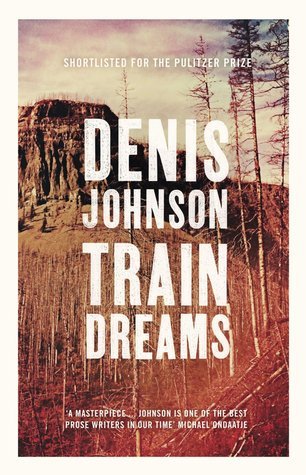 Although Grainier might appear to be a Job-like figure, his loneliness never shades into despair, lightened by comic dialogues and the mildest of supernatural interventions. He starts a haulage business and keeps dogs. There are rumours of a wolf-girl in the area, and, convinced that his dog’s new pups are part-wolf, he teaches them to howl – his own favourite way of letting off steam.
A couple of gratuitously bleak scenes (a confession of incest and an accidental death) made me think Cormac McCarthy would be a major influence, but the tone is lighter than that. Richard Brautigan came to mind, and I imagine many contemporary writers have found inspiration here: Carys Davies, Ash Davidson, Donald Ray Pollock, even Patrick deWitt.
Gritty yet light, this presents life as an arbitrary accumulation of error and incident, longing (“Pulchritude!”) and effort. Grainier is an effective Everyman, such that his story feels not just all-American but universal. (Free from a neighbour) [116 pages] 
Absolutely and Forever by Rose Tremain (2023)
I had lost track of Tremain’s career a bit; I find her work hit and miss – perhaps too varied, though judging by her last five novels, she seems to have settled on historical fiction as her wheelhouse. I wasn’t sure what to expect from this latest book, but seeing that it was novella length, I was willing to give it a try. Tremain follows her heroine, Marianne Clifford, from the 1950s up to perhaps 1970. At age 15, she falls hopelessly in love with an 18-year-old aspiring writer, Simon Hurst, and loses her virginity in the back of his pale blue Morris Minor. She feels grown-up and sophisticated, and imagines their romance as a grand adventure that will whisk her away from her parents’ stultifying ordinariness –
when I thought about my future as Mrs Simon Hurst (riding a camel in Egypt, floating along in a gondola in Venice, driving through the Grand Canyon in an open-topped Cadillac, watching elephants drink from a waterhole in Africa) and about Mummy’s future (in the red-brick house in Berkshire with the shivery birch tree and the two white columns, playing Scrabble with Daddy and shopping at Bartlett’s of Newbury), I could see that my life was going to be more interesting than hers and that she might already be envious
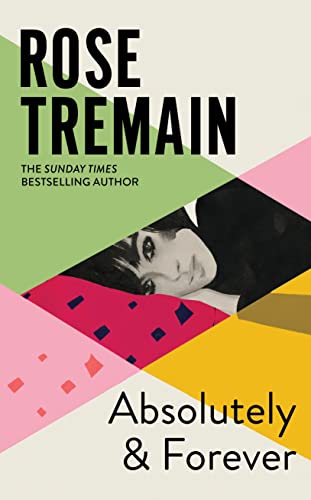 – but his new post-school life in Paris doesn’t have room for her. As she moves to London and trains for secretarial work, Marianne is bolstered by friendships with plain-speaking Scot Petronella (“Pet”) and Hugo Forster-Pellisier, her surfing and ping-pong partner on their parents’ Cornwall getaways. Forasmuch as her life changes over the next 15 years or so – taking on a traditional wife and homemaker role; her parents quietly declining – her attachment to her first love never falters.
This has the chic and convincing 1960s setting of Tessa Hadley’s work. Marianne’s narration is a delight, droll but not as blasé as she tries to appear. Tremain could have easily fallen into the trap of making her purely naïve (in the moment) or nostalgic (looking back), but instead she’s rendered her voice knowing yet compassionate, and made her a real wit (“I thought, Everything in Paris looks as if it’s practising the waltz, whereas quite a lot of things in London … appear as if they’ve just come out of hospital after a leg operation”). Pet is very funny, too. And it’s always fun for me to have nearby locations: Newbury, Reading, Marlborough. In imagining a different life for herself, Marianne resists repeating her mother’s mistakes and coincides with the rising feminist movement. There are two characters named Marianne, and two named Simon; the revelations about these doubles are breathtaking.
This really put me through an emotional wringer. It’s no cheap tear-jerker but a tender depiction of love in all its forms. I think, with Academy Street by Mary Costello, it may be my near-perfect novella. (Public library) [181 pages] 
Novellas in November, Week 2: What Is a Novella?
- Ponder the definition, list favourites, or choose ones you think best capture the ‘spirit’ of a novella.

A novella is defined by its length in words, but because that’s often difficult for readers to gauge, for this challenge we go by the number of pages instead, making 200 an absolute maximum – though some books with wide margins and spacing may top that but still seem slight enough to count (while those with tiny type can feel much longer than 160–200 pages).
Thematically, a novella is said to be concentrated on one character or small set of characters, with one plotline rather than several. This week I’ve been musing on a theory: a novella is to a novel what a memoir is to an autobiography. That is, if the latter is a comprehensive and often chronological story, the former focuses on a particular time or experience and shapes a narrative around it. What it potentially sacrifices in scope it makes up for with intensity.
But as soon as I’d formulated this hypothesis to myself, I started thinking of exceptions on either side. Train Dreams, like Silk by Alessandro Baricco and A Whole Life by Robert Seethaler, conveys a pretty complete life story. And no doubt there are many full-length novels that are almost claustrophobic in their adherence to one point of view and timeline.

The simplest way I’d put it is that a novella is a book that doesn’t outstay its welcome. I think it must be easier to write a doorstopper than a novella. Once you’ve arrived at a voice and a style, just keeping going can become a question of habit. But to continue paring back to get at the essence of a character and a situation – that takes real discipline. My other criterion would be that it has to portray the full range of human emotion, even if within a limited set of circumstances. Based on that, Train Dreams and Absolutely and Forever both triumph.
A few classic novellas that do this particularly well (links to my reviews):
Giovanni’s Room by James Baldwin
A Month in the Country by J. L. Carr
Miss Lonelyhearts by Nathanael West
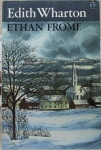
Ethan Frome by Edith Wharton


A few more contemporary novellas that do this particularly well (links to my reviews):
A Lie Someone Told You about Yourself by Peter Ho Davies
Our Souls at Night by Kent Haruf
Foster by Claire Keegan
A Feather on the Breath of God by Sigrid Nunez


In Memoriam by Alice Winn: Review & Author Event
I read In Memoriam by Alice Winn last month, then had the chance to see the author in conversation at Hungerford Town Hall, an event hosted by Hungerford Bookshop, on Friday evening. Here’s what I thought of the novel, which is on my Best of 2023 list.
Review
Heartstopper on the Western Front; swoon! It’s literary fiction set in the trenches of WWI, yes, but also a will-they-won’t they romance that opens at an English boarding school. Oh they will (have sex, that is), before the one-third point, but the lingering questions are: will Sidney Ellwood and Henry Gaunt both acknowledge this is love and not just sex, as it is for many teenage boys at their school (either consensually, as buddies; or forced by bullies); and will one or both survive the war? “It was ridiculous, incongruous for Ellwood to be bandying about words like ‘love’ when they were preparing to venture out into No Man’s Land.”
Winn is barely past 30 (and looks like a Victorian waif in her daguerreotype-like author photo), yet keeps a tight control of her tone and plot in this debut novel. She depicts the full horror of war, with detailed accounts of battles at Loos, Ypres and the Somme, and the mental health effects on soldiers, but in between there is light-heartedness: banter, friendship, poetry. Some moments are downright jolly. I couldn’t help but laugh at the fact that Adam Bede is the only novel available and most of them have read it four times. Gaunt is always the more pessimistic of the two, while Ellwood’s initially flippant sunniness darkens through what he sees and suffers.

I only learned from the Acknowledgements and Historical Note that Preshute is based on Marlborough College, a posh school local to me that Winn attended, and that certain particulars are drawn from Siegfried Sassoon, as well as other war literature. It’s clear the book has been thoroughly, even obsessively, researched. But Winn has a light touch with it, and characters who bring social issues into the narrative aren’t just 2D representatives of them but well rounded and essential: Gaunt (xenophobia), Ellwood (antisemitism), Hayes (classism), Devi (racism); not to mention disability and mental health for several.
I also loved how Ellwood is devoted to Tennyson and often quotes from his work, including the book-length elegy In Memoriam itself. This plus the “In Memoriam” columns of the school newspaper give the title extra resonance. I thought I was done with war fiction, but really what I was done with was worthy, redundant Faulks-ian war fiction. This was engaging, thrilling (a prison escape!), and, yes, romantic. (Public library) 
Readalike: The New Life by Tom Crewe, another of my early favourites of 2023, is set in a similar time period and also considers homosexual relationships. It, too, has epistolary elements and feels completely true to the historical record.
Some favourite lines:
“If Ellwood were a girl, he might have held his hand, kissed his temple. He might have bought a ring and tied their lives together. But Ellwood was Ellwood, and Gaunt had to be satisfied with the weight of his head on his shoulder.”
“Gaunt wished the War had been what Ellwood wanted it to be. He wished they could have ridden across a battlefield on horseback, brandishing a sword alongside their gallant king. He put on his gas mask. His men followed.”
Buy In Memoriam from Bookshop.org [affiliate link]
Event
Winn is in the UK on a short book tour; although she is English, she now lives in Brooklyn and recently had a baby. She was in conversation with AJ West, the author of The Spirit Engineer, also set on the cusp of WWI. Unrecognizable from her author photo – now blonde with glasses – she is petite rather than willowy. As I was leaving, two ladies remarked to each other how articulate she was. Indeed, she was well spoken and witty and, I expect, has always been precocious and a high achiever. I think she’s 32. Before this she wrote three novels that remain unpublished. She amazed us all by admitting she wrote the bulk of In Memoriam in just two weeks, pausing only to research trench warfare, then edited it for a year and a half.
West asked her about the genesis of the novel and she explained her obsession with the wartime newspapers of Sassoon’s school and then the letters sent home by soldiers, tracking the shift in tenor from early starry-eyed gallantry to feeling surrounded by death. She noted that it was a struggle for her to find a balance between the horrors of the Front and the fact that these young men come across in their written traces as so funny. She got that balance just right.
Was she being consciously anti-zeitgeist in focusing on privileged white men rather than writing women and minorities back into the narrative, as is so popular with publishers today, West asked? She demurred, but added that she wanted to achieve something midway between being of that time and a 2023 point-of-view in terms of the sexuality. Reading between the lines and from secondary sources, she posited that it was perhaps easier to get away with homosexuality than one might think, in that it wasn’t expected and so long as it was secret, temporary (before marrying a woman), or an experiment, it was tolerated. However, she took poetic licence in giving Gaunt and Ellwood supportive friends.

Speaking of … West (a gay man) jokingly asked Winn if she is actually a gay man, because she got their experiences and feelings spot on. She said that she has some generous friends who helped her with the authenticity of the sex scenes. In the novel she has Ellwood interpret Tennyson’s In Memoriam as crypto-homosexual, but scholars do not believe that it is; Gaunt’s twin sister Maud also, unconsciously in that case, has a Tennysonian name. This was in response to an audience question; this plus another one asking if Winn had read The New Life reassured me that my reaction was well founded! (Yes, she has, and will in fact be in conversation with Crewe in London on the 23rd. She’s also appearing at Hay Festival.)
If you’ve read the book and/or are curious, Winn revealed the inspirations for her three main characters, the real people who are “in their DNA,” as she put it: Gaunt = Robert Graves (half-German, interest in the Greek classics); Ellwood = Sassoon; Maud = Vera Brittain. She read a 5-minute passage incorporating a school scene between Gaunt and Sandys and a letter from the Front. She spoke a little too quickly and softly, such that I was glad I was within the first few rows. However, I’m sure this is a new-author thing and, should you be so lucky as to see her speak in future, you will be as impressed as I was.
The Suspicions of Mr Whicher Stage Production
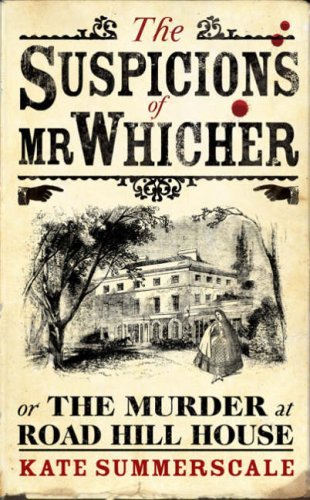
Just a few months after Notes from a Small Island, it was back to one of my local theatres, The Watermill, for the stage adaptation of another book club selection, this time the Victorian true crime narrative The Suspicions of Mr Whicher by Kate Summerscale, which won the Samuel Johnson Prize (now called the Baillie Gifford Prize) for non-fiction in 2008.
{SPOILERS ENSUE}
I must have read the book in 2009, the year after it first came out, and while I had the best intentions of rereading it in time for our book club meeting earlier this month, I didn’t even manage to skim it. I remembered one fact alone, the method of murder, which is not surprising as it was particularly gruesome: A young boy had his throat slit and was stuffed down the privy. But that was all that had remained with me. My husband filled me in on the basics and the discussion, held at our house, reminded me of the rest. We then made it a book club outing to the theatre.
The crime took place in late June 1860 at the Wiltshire home of the Kent family: the patriarch, a factory inspector; his four children from his first marriage; his second wife, formerly the older set’s governess; and their three young children. Jonathan “Jack” Whicher, sent by Scotland Yard to investigate, was one of London’s first modern detectives and inspired Wilkie Collins and Charles Dickens. Constance Kent, 16, later confessed to the murder of her three-year-old half-brother, Saville, motivated by anger at her stepmother for replacing her mentally ill mother, but uncertainty remained as to whether she had acted alone.
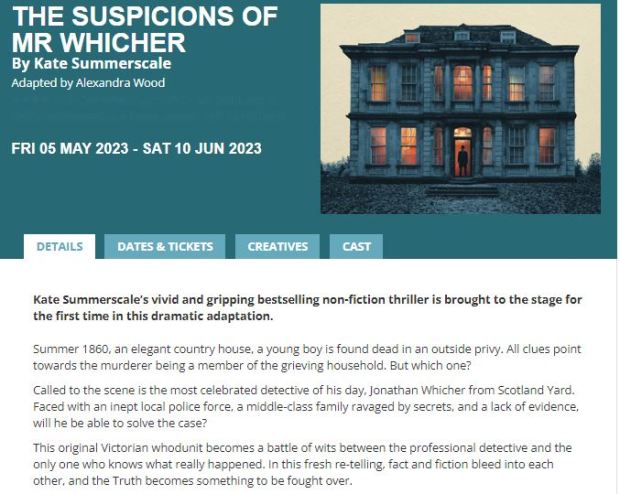
The play was very well done, maintaining tension even though there was a decision to introduce Constance as the killer immediately: the action opens on her and Mr Whicher in her cell at Fulham Prison in the 1880s. This is an invented scene in which he has come to visit, begging her to tell him the whole truth in exchange for him writing a letter to try to secure her early release. (She appealed four times but ended up serving a full 20-year sentence.)
Cold, stark lighting and a minimal set of two benches against a backdrop of steel doors and a mullioned window evoke the prison setting, with only the subtle change to warmer lighting indicating flashbacks as Constance and Whicher remember or act out events from 20 or more years before. These two remain on stage for the entirety of the first act. Four other actors cycle in and out, playing Kent family members and various other small roles. For instance, the bearded middle-aged actor who plays Mr Kent also appears as a coroner giving a precis of Saville’s autopsy – he mentions Collins and Dickens, but the evolution of the Victorian detective is, by necessity, a much smaller element of the play than it was in the book.
It’s a tiny theatre, but projections on a screen (such as a sinuous family tree) and a balcony, used for wordless presence or loud pronouncements, made it seem bigger than it was. Saville himself is only depicted as a mute figure on that upper level, in the truly spooky scene that closes the first act. I remember when the Watermill put out a discreet call for child actors, warning parents about the sort of content to expect. Three children play the role (plus one other bit part) in rotation. Pulsing violin music enhanced the feeling of dread, and each act was no more than 45 minutes, so the atmosphere remained taut.

Production photographs by Pamela Raith.
A missing nightdress – presumably blood-stained – as well as her own father’s hunch, were among the main evidence against Constance, so Whicher did not secure a conviction at the time and was publicly ridiculed for his failure to crack the case. That and his own loss of a child are suggested to be behind his obsession with tying up loose ends. While Constance expresses regret for her actions and calmly takes him through the accepted timeline of the murder, she refuses to give him anything extra.
The second act delves into what happened next for Constance: living among nuns in France and then in Brighton, where she decided to confess, and then relocating to Australia, where she worked in a halfway house for lepers and troubled youth, as if to make up for the harm she caused earlier in her life (and she lived to age 100!). This involved the most significant change of set and actors, with the former Mr. and Mrs. Kent now filling in as the older Constance and William, the brother closest to her in age.
The play fixates on the siblings’ relationship, returning several times to their whim to run away to Bristol and be “cabin boys” together. I wondered if there was even meant to be a sexual undercurrent to their connection. William Savill-Kent went on to be a successful marine biologist specialising in corals and Australian fisheries. One theory is that they were accomplices in the murder but Constance took the fall so that her brother could live a full life.
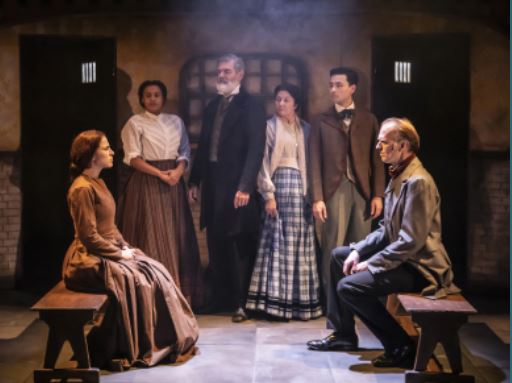
Intriguingly, the team behind the production decided to espouse this hypothesis explicitly. In the chilling final scene, then, a crib is wheeled out to the centre of the stage and Constance floats on in a white nightdress to lower the side closest to the audience. Just before the lights go down, William, too, appears in a white nightdress and stands over the far side of the crib.
Although I referred to the book as “compulsive” in the one mention I find of it in my computer files, from 2011, I only gave it 3 stars – my most common rating in those years, an indication that a book was alright but I moved right along to the next in the stack and it didn’t stick with me. My book club had mixed feelings, too, generally feeling that there was too much extraneous detail, which perhaps kept a narrative that could have read as fluidly as a novel from being truly gripping. The play, though, was thrilling.
Book (c. 2009): 
Play:
Buy The Suspicions of Mr. Whicher from Bookshop.org [affiliate link]
The Chosen by Elizabeth Lowry (2022)
“What’s lost when your idea of the other dies? He knows the answer: only the entire world.”
Elizabeth Lowry’s utterly immersive third novel, The Chosen, currently on the shortlist for the Walter Scott Prize for Historical Fiction*, examines Thomas Hardy’s relationship with his first wife, Emma Gifford. The main storyline is set in November–December 1912 and opens on the morning of Emma’s death at Max Gate, their Dorchester home of 27 years. The couple had long been estranged and effectively lived separate lives on different floors of the house, but instantly Hardy is struck with pangs of grief – and remorse for how he had treated Emma. (He would pour these emotions out into some of his most famous poems.)
That guilt is only compounded by what he finds in her desk: her short memoir, Some Recollections, with an account of their first meeting in Cornwall; and her journals going back two decades, wherein she is brutally honest about her husband’s failings and pretensions. “I expect nothing from him now & that is just as well – neither gratitude nor attention, love, nor justice. He belongs to the public & all my years of devotion count for nothing.” She describes him as little better than a jailor, and blames him for their lifelong childlessness.
It’s an exercise in self-flagellation, yet as weeks crawl by after her funeral, Hardy continues to obsessively read Emma’s “catalogue of her grievances.” In the fog of grief, he relives scenes his late wife documented – especially the composition and controversial publication of Tess of the d’Urbervilles. Emma hoped to be his amanuensis and so share in the thrill of creation, but he nipped a potential reunion in the bud. Lowry intercuts these flashbacks with the central narrative in a way that makes Hardy feel like a bumbling old man; he has trouble returning to reality afterwards, and his sisters and the servants are concerned for him.

Hardy was that stereotypical figure: the hapless man who needs women around to do everything for him. Luckily, he’s surrounded by an abundance of strong female characters: his sister Kate, who takes temporary control of the household; his secretary, Florence Dugdale, who had been his platonic companion and before long became his second wife; even Emma’s money-grubbing niece, Lilian, who descends to mine her aunt’s wardrobe.
I particularly enjoyed Hardy’s literary discussions with Edmund Gosse, who urged him to temper the bleakness of his plots, and the stranger-than-fiction incident of a Chinese man visiting Hardy at home and telling him his own story of neglecting his wife and repenting his treatment of her after her death.
For anyone who’s read and loved Hardy’s major works, or visited his homes, this feels absolutely true to his life story, and so evocative of the places involved. I could picture every locale, from Stinsford churchyard to Emma’s attic bedroom. It was perfect reading for my short break in Dorset earlier in the month and brought back memories of the Hardy tourism I did at the end of my study abroad year in 2004. Although Hardy’s written words permeate the book, I was impressed to learn that Lowry invented all of Emma’s journal entries, based on feelings she had expressed in letters.
But there is something universal, of course, about a tale of waning romance, unexpected loss, and regret for all that is left undone. This is such a beautifully understated novel, perfectly convincing for the period but also timeless. It’s one to shelve alongside Winter by Christopher Nicholson, another favourite of mine about Hardy’s later life.
With thanks to riverrun (Quercus) for the free copy for review. The Chosen came out in paperback on 13 April.
*The winner will be announced on 15 June.
R.I.P. Reads, Part I: Ahlberg, Gaskell, Hinchcliffe and Watson
I don’t generally read horror or suspense, but the R.I.P. challenge is my annual excuse to pick up some slightly scarier material. For this first installment of super-short responses, I have a children’s book about a seriously problematic cat, a Victorian ghost story, and two recent Scotland-set novels about exiles haunted by the unexplained. (All: Public library)

The Improbable Cat by Allan Ahlberg (2003)
 I picked this up expecting a cute cat tale for children, only realizing afterwards that it’s considered horror. When a grey kitten wanders into their garden, Davy is less enamoured than the rest of the Burrell family. His suspicion mounts as the creature starts holding court in the lounge, expecting lavish meals and attention at all times. His parents and sister seem to be under the cat’s spell in some way, and it’s growing much faster than any young animal should. Davy and his pal George decide to do something about it. Since I’m a cat owner, I’m not big into evil cat stories (e.g., Cat out of Hell by Lynne Truss), and this one was so short as to feel underdeveloped.
 “The Old Nurse’s Story” by Elizabeth Gaskell (1852)
(collected in Gothic Tales (2000), ed. Laura Kranzler)
I had no idea that Gaskell had published short fiction, let alone ghost stories. Based on the Goodreads and blogger reviews, I chose one story to read. The title character tells her young charges about when their mother was a child and the ghost of a little girl tried to lure her out onto the Northumberland Fells one freezing winter. It’s predictable for anyone who reads ghost stories, but had a bit of an untamed Wuthering Heights feel to it.
Hare House by Sally Hinchcliffe (2022)
 The unnamed narrator is a disgraced teacher who leaves London for a rental cottage on the Hare House estate in Galloway. Her landlord, Grant Henderson, and his rebellious teenage sister, Cass, are still reeling from the untimely death of their brother. The narrator gets caught up in their lives even though her shrewish neighbour warns her not to. There was a lot that I loved about the atmosphere of this one: the southwest Scotland setting; the slow turn of the seasons as the narrator cycles around the narrow lanes and finds it getting dark earlier, and cold; the inclusion of shape-shifting and enchantment myths; the creepy taxidermy up at the manor house; and the peculiar fainting girls/mass hysteria episode that precipitated the narrator’s banishment and complicates her relationship with Cass. The further you get, the more unreliable you realize this narrator is, yet you keep rooting for her. There are a few too many set pieces involving dead animals, and, overall, perhaps more supernatural influences than are fully explored, but I liked Hinchcliffe’s writing enough to look out for what else she will write. (Readalikes: The Haunting of Hill House and Wakenhyrst)
Metronome by Tom Watson (2022)
 Ever since I read Blurb Your Enthusiasm, I’ve been paying more attention to jacket copy. This is an example of a great synopsis that really gives a sense of the plot: mysterious events, suspicion within a marriage, and curiosity about what else might be out there. Aina and Whitney believe they are the only people on their island. They live simply on a croft and hope that, 12 years after their exile, they’ll soon be up for parole. Whitney stubbornly insists they wait for the warden to rescue them, while Aina has given up thinking anyone will ever come. There’s a slight Beckettian air, then, to the first two-thirds of this dystopian novel. When someone does turn up, it’s not who they expect. The eventual focus on parenthood meant this reminded me a lot of The Road; there are also shades of The Water Cure and Doggerland (though, thankfully, the dual protagonists ensure a less overly male atmosphere than in the latter). This was an easy and reasonably intriguing read, but ultimately a bit vague and bleak for me, and not distinguished enough at the level of the prose (e.g., way too many uses of “onside”).
September Poetry & Nonfiction: Antrobus, Benning, Carey; Bowler, Lister
September is a major month for new releases. I’ve already reviewed two fiction titles that came out this month: Blank Pages and Other Stories by Bernard MacLaverty and Bewilderment by Richard Powers. I’m still working through the 500+ pages of Ruth Ozeki’s new novel, The Book of Form and Emptiness, and hope to report back on it before too long.
Today I have poetry volumes reckoning with race and disability and with modern farming on the Canadian prairie, as well as a centuries-spanning anthology; and, in nonfiction, memoirs of living with advanced cancer and adjusting to widowhood in one’s thirties.
All the Names Given by Raymond Antrobus
 Antrobus, a British-Jamaican poet, won the Rathbones Folio Prize, the Ted Hughes Award, and the Sunday Times Young Writer of the Year Award for his first collection, The Perseverance. I reviewed it for the Folio Prize blog tour in 2019 and was in attendance at the Young Writer ceremony when he won. Its themes carry over into this second full-length work: again, he reflects on biracial identity, deafness, family divisions, and the loss of his father. Specifically, he is compelled to dive into the history of his English mother’s ancient surname, Antrobus: associated with baronets, owners of Stonehenge, painters – and slavers.
Tell me if I’m closer
to the white painter
with my name than I am
to the black preacher,
his hands wide to the sky,
the mahogany rot
of heaven. Sorry,
but you know by now
that I can’t mention trees
without every shade
of my family
appearing and disappearing. (from “Plantation Paint”)
Other poems explore police and prison violence against Black and deaf people, and arise from his experiences teaching poetry to students and inmates. Captions in square brackets are peppered throughout, inspired by the work of Deaf sound artist Christine Sun Kim. These serve as counterparts to the sign language illustrations in The Perseverance. There are also unsentimental love poems written for his wife, Tabitha. This didn’t captivate me in the same way as his first book, but I always enjoy experiencing the work of contemporary poets and would recommend this to readers of Jason Allen-Paisant, Caleb Femi and Kei Miller.
With thanks to Picador for the free copy for review.
Field Requiem by Sheri Benning
Benning employs religious language to give structure to her solemn meditations on the degraded landscape of Saskatchewan, a place where the old ways have been replaced by impersonal, industrial-scale farming. Poems are titled “Plainsong,” “Minor Doxology,” “Intercession” and “Compline.” You can hear the rhythms of psalms and the echoes of the requiem mass in her verse.
 There’s a prophetic tone behind poems about animal casualties due to pesticides, with “We were warned” used as a refrain in “1 Zephaniah”:
Everything swept away.
Everything consumed. Sky bled dry
of midges. Locusts, bees, neurons frayed.
Antiseptic silence of canola
fields at dusk, muted
grasshopper thrum.
Alliteration pops out from the lists of crops and the prairie species their cultivation has pushed to the edge of extinction. This is deeply place based writing, with the headings of multipart poems giving coordinates. Elegies tell the stories behind the names in a local graveyard, including Ukrainian immigrants. Many of these are tragic tales of failure: “neck in the noose of profit margins and farm credit” (from “NE 10 36 22 W2ND”). Benning and her sister, Heather, who took the Ansel Adams-like black-and-white photographs that illustrate the book, toured derelict farms and abandoned homes:
pull yourself through the kitchen window,
glass shot out decades ago. Breathe the charnel reek,
the cracked-open casket of the nation’s turn-of-the-century bullshit-
promises, adipose gleam of barley and wheat. (from “SW 26 36 22 W2ND”)
I attended the online launch event last night and enjoyed hearing Benning read from the book and converse with Karen Solie about its origins. Benning’s parents were farmers up until the late 1990s, then returned to diversified farming in the late 2000s. Solie aptly referred to the book as “incantatory.” With its ecological conscience, personal engagement and liturgical sound, this is just my kind of poetry. If you’ve been thinking about the issues with land use and food production raised by the likes of Wendell Berry and James Rebanks, you shouldn’t miss it.
With thanks to Carcanet Press for the free copy for review.
100 Poets: A Little Anthology by John Carey
John Carey is among the UK’s most respected literary critics. I’ve read several of his books over the years, including his outstanding memoir, The Unexpected Professor. This anthology, a sort of follow-up to his A Little History of Poetry (2020), chooses 100 top poets and then opines on what he considers their best work. The book is organized chronologically, proceeding from Homer to Maya Angelou. Sticking mostly to English-language and American, British or Commonwealth poets (with just a handful of Continental selections, like Charles Baudelaire and Rainer Maria Rilke, in translation), Carey delivers mini-essays with biographical information and historical background.
 There is some inconsistency in terms of the amount of context and interpretation given, however. For some poets, there may be just a line or two of text, followed by a reprinted poem (Richard Wilbur, Les Murray); for others, there are paragraphs’ worth of explanations, interspersed with excerpts (Andrew Marvell, Thomas Gray). Some choices are obvious; others are deliberately obscure (e.g., eschewing Robert Frost’s and Philip Larkin’s better-known poems in favour of “Out, Out” and “The Explosion”). The diversity is fairly low, and you can see Carey’s age in some of his introductions: “Edward Lear was gay, and felt a little sad when friends got married”; “Alfred Edward Housman was gay, and he thought it unjust that he should be made to feel guilty about something that was part of his nature.” There’s way too much First and Second World War poetry here. And can a poet really be one of the 100 greatest ever when I’ve never heard of them? (May Wedderburn Cannan, anyone?)
Unsurprisingly, I was most engaged with the pieces on Victorian and Modernist poets since those are the periods I studied at university and still love the most, but there were a few individual poems I was glad to discover, such as Ben Jonson’s “On My First Sonne,” written upon his death from bubonic plague, and Edward Thomas’s “Old Man,” as well as many I was happy to encounter again. This would be a good introduction for literature students as well as laypeople wanting to brush up on their poetry.
With thanks to Yale University Press, London for the proof copy for review.
Nonfiction
No Cure for Being Human (And Other Truths I Need to Hear) by Kate Bowler
(Below is my Shelf Awareness review, reprinted with permission.)
 In her bittersweet second memoir, a religion professor finds the joys and ironies in a life overshadowed by advanced cancer.
When Kate Bowler, an associate professor at Duke Divinity School, was diagnosed with advanced colon cancer at age 35, her chances of surviving two years were just 14%. In No Cure for Being Human, her wry, touching follow-up to her 2018 memoir Everything Happens for a Reason (And Other Lies I’ve Loved) and its associated podcast, she continues to combat unhelpful religious/self-help mantras as she ponders what to do with the extra time medical breakthroughs have given her.
After multiple surgeries, a promising immunotherapy drug trial gave Bowler hope that she would live to see her 40th birthday and her young son starting kindergarten. Working on her bucket list, she found that small moments outshined large events: on a trip to the Grand Canyon, what stood out was a chapel in the ponderosa pinewoods where she added a prayer to those plastering the walls. In the Church calendar, “Ordinary Time” is where most of life plays out, so she encourages readers to live in an “eternal present.”
The chapters function like stand-alone essays, some titled after particular truisms (like “You Only Live Once”). The book’s bittersweet tone finds the humor as well as the tragedy in a cancer diagnosis. Witty recreated dialogue and poignant scenes show the type-A author learning to let go: “I am probably replaceable,” she acknowledges, but here in the shadow of death “the mundane has begun to sparkle.” These dispatches from the “lumpy middle” of life and faith are especially recommended to fans of Anne Lamott.
(If you’ve read her previous book, Everything Happens for a Reason, you may find, as I did, that there is a little too much repetition about her diagnosis and early treatment. The essays could also probably be structured more successfully. But it’s still well worth reading.)
With thanks to Rider Books for the free copy for review.
The Elements: A Widowhood by Kat Lister
 This story hit all too close to home to me: like Kat Lister, my sister was widowed in her thirties, her husband having endured gruelling years of treatment for brain cancer that caused seizures and memory loss. Lister’s husband, Pat Long, was a fellow journalist. Cancer was with them for the entire span of their short marriage, and infertility treatment didn’t succeed in giving them the children they longed for.
Although it moves back and forth in time, the memoir skims over the happy before and the torturous middle, mostly shining a light on the years after Pat died in 2018. Lister probes her emotional state and the ways in which she met or defied people’s expectations of a young widow. Even when mired in grief, she was able to pass as normal: to go to work, to attend social functions wearing leopard print. She writes of a return trip to Mexico, where she’d gone with Pat, and in some detail of the sexual reawakening she experienced after his death. But everyday demands could threaten to sink her even when life-or-death moments hadn’t.
Writing helped her process her feelings, and the Wellcome Library was a refuge where she met her predecessors in bereavement literature. While some of the literary points of reference are familiar (Joan Didion, Elisabeth Kübler-Ross, C.S. Lewis), others are unexpected, and the overall Fire–Water–Earth–Air structure creates thematic unity in a similar way as the constellations do in Molly Wizenberg’s The Fixed Stars. Giving shape and dignity to grief, this is a lovely, comforting read.
A favourite passage:
When I talk of my husband, I often speak of disparate worlds. Mine is inside time, his is supertemporal. I continue to age whilst my husband stays fixed in a past I am drifting further away from with every sentence that I type. And yet, like those luminous balls of plasma in the sky, we are still connected together, for all time is cyclical. I hold the elements within me.
With thanks to Icon Books for the free copy for review.
 Bookish Beck = Rebecca Foster. American transplant to England. Freelance proofreader and book reviewer.
 Bookish Beck