Adventures in Rereading: The Sixteenth of June by Maya Lang
Last year I reviewed Tenth of December by George Saunders on its title date; this year I couldn’t resist rereading one of my favorites from 2014 for today’s date (which just so happens to be Bloomsday, made famous by James Joyce’s Ulysses), The Sixteenth of June.
I responded to the novel at length when it first came out. No point in reinventing the wheel, so here are mildly edited paragraphs of synopsis from my review for The Bookbag:
 Maya Lang’s playful and exquisitely accomplished debut novel, set on the centenary of the original Bloomsday, transplants many characters and set pieces from Ulysses to near-contemporary Philadelphia. Don’t fret, though – even if, like me, you haven’t read Ulysses, you’ll have no trouble following the thread. In fact, Lang dedicates her book to “all the readers who never made it through Ulysses (or haven’t wanted to try).” (Though if you wish to spot parallels, pull up any online summary of Ulysses; there is also a page on Lang’s website listing her direct quotations from Joyce.)
On June 16, 2004, brothers Leopold and Stephen Portman have two major commitments: their grandmother Hannah’s funeral is happening at the local synagogue in the morning; and their parents’ annual Bloomsday party will take place at their opulent Delancey Street home in the evening. Around those two thematic poles – the genuine emotions of grief and regret on the one hand, and the realm of superficial entertainment on the other – the novel expands outward to provide a nuanced picture of three ambivalent twenty-something lives.
The third side of this atypical love triangle is Nora, Stephen’s best friend from Yale – and Leo’s fiancée. Nora, a trained opera singer, is still reeling from her mother’s death from cancer one year ago. She’s been engaging in self-harming behavior, and Leo – a macho, literal-minded IT consultant – just wants to fix her. Nora and Stephen, by contrast, are sensitive, artistic souls who seem better suited to each other. Stephen, too, is struggling to find a meaning in death, but also to finish his languishing dissertation on Virginia Woolf.
Literature is almost as potent a marker of upper-class status as money here: some of the Portmans might not have even read Joyce’s masterpiece, but that doesn’t stop them name-dropping and maintaining the pretense of being well-read. While Lang might not mimic the extremes of Joyce’s stream-of-consciousness style, she prioritizes interiority over external action by using a close third-person voice that shifts between her main characters’ points of view. Their histories and thoughts are revealed mostly through interior monologues and conversations. Lang’s writing is full of mordant shards of humor; one of my favorite lines was “No one in a eulogy ever said, She watched TV with the volume on too loud.”
During my rereading, I was captivated more by the portraits of grief than by the subtle intellectual and class differences. I appreciated the characterization and the Joycean peekaboo, and the dialogue and shifts between perspectives still felt fresh and effortless. I could relate to Stephen and Nora’s feelings of being stuck and unsure how to move on in life. And the ending, which I’d completely forgotten, was perfect. I didn’t enjoy this quite as much the second time around, but it’s still a treasured signed copy on my shelf.
My original rating (June 2014): 
My rating now: 
Readalikes: Writers & Lovers by Lily King and The Emperor’s Children by Claire Messud (my upcoming Doorstopper of the Month).
(See also my review of Lang’s recent memoir, What We Carry.)
Alas, I’ve also had a couple of failed rereading attempts recently…
Everything Is Illuminated by Jonathan Safran Foer (2002)
 I remembered this as a zany family history quest turned into fiction. A Jewish-American character named Jonathan Safran Foer travels to (fictional) Trachimbrod, Ukraine to find the traces of his ancestors and, specifically, the woman who hid his grandfather from the Nazis. I had totally forgotten about the comic narration via letters from Jonathan’s translator/tour guide, Alexander, who fancies himself a ladies’ man and whose English is full of comic thesaurus use (e.g. “Do not dub me that,” “Guilelessly yours”). This was amusing, but got to be a bit much. I’d also forgotten about the dense magic realism of the historical sections. As with A Visit from the Goon Squad, what felt dazzlingly clever on a first read (in January 2011) failed to capture me a second time. [35 pages]
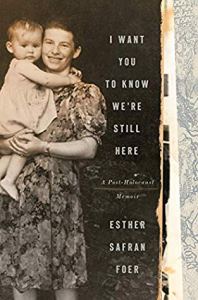 Interestingly, Foer’s mother, Esther, released a memoir earlier this year, I Want You to Know We’re Still Here. It’s about the family history her son turned into quirky autofiction: a largely fruitless trip he took to Ukraine to research his maternal grandfather’s life for his Princeton thesis, and a more productive follow-up trip she took with her older son in 2009. Esther Safran Foer was born in Poland and lived in a German displaced persons camp until she and her parents emigrated to Washington, D.C. in 1949. Her father committed suicide in 1954, making him almost a belated victim of the Holocaust. The stories she hears in Ukraine – of the slaughter of entire communities; of moments of good luck that allowed her parents to, separately, survive and find each other – are remarkable, but the book’s prose, while capable, never sings. Plus, she references her son’s novel so often that I wondered why someone would read her book when they could read his instead.
On Beauty by Zadie Smith (2005)
 This was an all-time favorite when it first came out. I remembered a sophisticated homage to E.M. Forster’s Howards End, featuring a biracial family in Cambridge, Mass. I remembered no specifics beyond a giant music store and (embarrassingly) an awkward sex scene. Howard Belsey’s long-distance rivalry with a fellow Rembrandt scholar gets personal when the Kipps family relocates from London to the Boston suburbs for Monty to be the new celebrity lecturer at the same college. Howard is in the doghouse with his African-American wife, Kiki, after having an affair. The Belsey boy and Kipps girl have an awkward romantic history. Zora Belsey is smitten with a lower-class spoken word poet she meets after a classical concert in the park when they pick up each other’s Discmans by accident (so dated!). All of the portraits felt like stereotypes to me, and there was so much telling, so much backstory, so many unnecessary secondary characters. Before I would have said this was my obvious Women’s Prize winner of winners, but now I have no idea what I’ll vote for. [107 pages]
Currently rereading: Watership Down by Richard Adams, Ella Minnow Pea by Mark Dunn, Dreams from My Father by Barack Obama
To reread soon: Heaven’s Coast by Mark Doty & Animal, Vegetable, Miracle by Barbara Kingsolver
Done any rereading lately?
Women’s Prize Longlist 2020 Thoughts & Other Prize Reading Projects
Next Wednesday the 22nd, the Women’s Prize shortlist will be revealed. However, the winner announcement has been delayed until September 9th, so we all get extra time to read the finalists (which is handy since the 900-page Hilary Mantel is a shoo-in). I happen to have gotten through half of the longlist so far. There were some books I cared for more than others. Of the remainder, I plan to pick up a few more once my library reopens.
Here’s how I’ve fared this year, in categories from best to worst, with excerpts and links to any I’ve reviewed in full:
Loved! (5)
 Dominicana by Angie Cruz: In 1965, 15-year-old Ana Canción, married off to an older man, leaves the Dominican Republic for New York City. With not a word of English, she feels trapped in her apartment and in this abusive relationship. Yet Ana is such a plucky and confiding narrator that you’re drawn into her world and cheer for her as she figures out what she wants from her life. This compassionate novel is proof that not all the immigration stories have been told yet.
 Girl, Woman, Other by Bernardine Evaristo: A terrific linked short story collection about 12 black women in twentieth-century and contemporary Britain balancing external and internal expectations and different interpretations of feminism to build lives of their own. The prose is more like poetry: a wry, radical stream of consciousness. A warm, spirited book, it never turns strident. It’s timely and elegantly constructed – and, it goes without saying, a worthy Booker Prize winner. To win the Women’s Prize too would be unprecedented, I think? But no surprise.
 Weather by Jenny Offill: Could there be a more perfect book for 2020? It’s a blunt, unromanticized but wickedly funny novel about how eco-anxiety permeates everyday life. Set either side of Trump’s election, it amplifies many voices prophesying doom, from environmentalists to Bible-thumpers. Lizzie’s sardonic narration is an ideal way of capturing relatable feelings of anger and helplessness. Don’t expect to come away with your worries soothed, though there is some comfort to be found in the feeling that we’re all in this together.
 The Dutch House by Ann Patchett: A memorable exploration of family secrets and memories. Maeve and Danny Conroy are an inseparable brother-and-sister pair. When their father dies, they become like Hansel and Gretel: cast out into the wilds by an evil stepmother who takes possession of the only home they’ve ever known, a suburban Philadelphia mansion built on the proceeds of the VanHoebeek cigarette empire. Patchett always captures the psychology of complicated families, and her sharp prose never fails to hit the nail on the head.
 Red at the Bone by Jacqueline Woodson: Like a family saga in miniature, this short novel stretches backward from Melody’s 16th birthday party, held in Brooklyn in 2001, to explore previous generations of the African American experience. Chapters alternate between first- and third-person narration, highlighting the perspectives of all the major family members. I raced through to see who would follow in family footsteps, or not. The title is apt: the book is sometimes raw and sometimes tender. It’s an emotionally engaging story of loss and memory.
Currently skimming (1)
 The Mirror and the Light by Hilary Mantel: I’ve stalled around page 200. I’ll be totally engrossed for a few pages of exposition and Cromwell one-liners, but then everything gets talky or plotty and I skim for 20‒30 pages and put it down. My constant moving between 10‒20 books and the sudden loss of a deadline have not served me well: I feel overwhelmed by the level of detail and the cast of characters, and haven’t built up momentum. Still, I can objectively recognize the prose as top-notch.
Did not particularly enjoy (3)
 Fleishman Is in Trouble by Taffy Brodesser-Akner: To me this didn’t stand out at all from the sea of fiction about crumbling marriages and upper-middle-class angst.
- Actress by Anne Enright: A slow-burning backstory of trauma and mental illness. I found I wasn’t warming to the voice or main characters and mostly skimmed this.

- Hamnet by Maggie O’Farrell: In comparison with other historical fiction, this fell short. Overall, I found the prose flat and repetitive, which diluted the portrait of grief.

Attempted but couldn’t get through (1)
 Djinn Patrol on the Purple Line by Deepa Anappara – I’m wary of child narrators anyway, and the voice didn’t grab me within the first few pages.
Still plan to read (3)
 Queenie by Candice Carty-Williams
- How We Disappeared by Jing-Jing Lee
- The Most Fun We Ever Had by Claire Lombardo
Not interested (3)
 Nightingale Point by Luan Goldie: Sounds subpar.
- A Thousand Ships by Natalie Haynes: Say no to updated Greek classics.
- Girl by Edna O’Brien: I don’t care for O’Brien’s writing. Though this was well received by the critics, it’s not finding much love among my trusted bloggers. (Plus there’s the cultural appropriation issue.)
My ideal shortlist
(A wishlist based on my reading and what I want to read)
 Dominicana by Angie Cruz
Girl, Woman, Other by Bernardine Evaristo
How We Disappeared by Jing-Jing Lee
The Mirror and the Light by Hilary Mantel
Weather by Jenny Offill
The Dutch House by Ann Patchett
vs.
My predicted shortlist
 Queenie by Candice Carty-Williams
Actress by Anne Enright
Girl, Woman, Other by Bernardine Evaristo
The Mirror and the Light by Hilary Mantel
Girl by Edna O’Brien OR Hamnet by Maggie O’Farrell
The Dutch House by Ann Patchett
Callum, Eric, Laura and Rachel have been posting lots of reviews and thoughts related to the Women’s Prize. Have a look at their blogs!
In this 25th anniversary year of the Women’s Prize, readers are also being encouraged to catch up on previous winners.
- I’ve read 13 so far (and am currently rereading On Beauty by Zadie Smith).
 I already had Half of a Yellow Sun by Chimamanda Ngozi Adichie and The Idea of Perfection by Kate Grenville on my shelves, plus The Song of Achilles by Madeline Miller on my Nook.
- I recently found a copy of A Crime in the Neighborhood by Suzanne Berne at the free bookshop where I volunteer.
- On my current library stack are When I Lived in Modern Times by Linda Grant, Property by Valerie Martin and Fugitive Pieces by Anne Michaels.
I can’t promise to be a completist about this project because the prospect of reading A Girl Is a Half-formed Thing and The Glorious Heresies fills me with dread, but we’ll see…
Other Prize Reading Projects
 I’d been trying to make my way through some previous Wellcome Book Prize winners and nominees, but have been scuppered by my library’s closure. At the moment I have Adam Rutherford’s A Brief History of Everyone Who Ever Lived (2017 longlist; passed on from my father-in-law) and Steve Silberman’s Neurotribes (2016 shortlist; from the library) on my pile to read or, more likely, skim.
 I also had the idea to read all the Bellwether Prize winners because I loved The Leavers so much. (Known in full as the PEN/Bellwether Prize for Socially Engaged Fiction, it is a biennial award given by PEN America and Barbara Kingsolver, who created and funds the prize, “to a U.S. citizen for a previously unpublished work of fiction that address issues of social justice.”) This project did not start particularly well as I DNFed Running the Rift by Naomi Benaron. However, I own copies of Mudbound by Hillary Jordan and The Girl Who Fell from the Sky by Heidi W. Durrow and hope I’ll have better luck with them.
What prize lists or other reading projects are keeping you busy?
Adventures in Rereading: Julian Barnes and Jennifer Egan
My last two rereads ended up being as good as or better than they had been the first time around; these two, however, failed to live up to my memory of them, one of them dramatically so. My increased literary experience and/or the advance of years meant these works felt less fresh than they did the first time around.
Flaubert’s Parrot by Julian Barnes (1984)
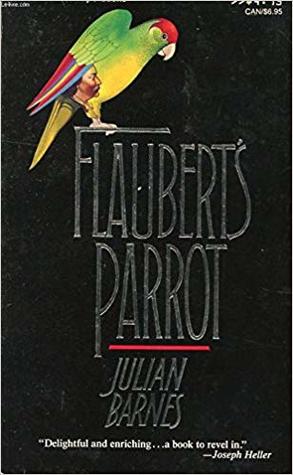 Barnes is in my trio of favorite authors, along with A. S. Byatt and David Lodge. He’s an unapologetic intellectual and a notable Francophile who often toggles between England and France, especially in his essays and short stories. This was his third novel and riffs on the life and works of Gustave Flaubert, best known for Madame Bovary.
Odd-numbered chapters build a straightforward narrative as Geoffrey Braithwaite, a widower, retired doctor and self-described “senile amateur scholar,” travels to Rouen for five days to see the sites associated with Flaubert and becomes obsessed with determining which of two museum-held stuffed parrots Flaubert used as his inspiration while writing the story “A Simple Heart.” Even-numbered chapters, however, throw in a variety of different formats: a Flaubert chronology, a bestiary, an investigation of the contradictory references to Emma Bovary’s eye color, a dictionary of accepted ideas, an examination paper, and an imagined prosecutor’s case against the writer.
There are themes and elements here that recur in much of Barnes’s later work:
- History – what remains of a life? (“He died little more than a hundred years ago, and all that remains of him is paper.”)
- Love versus criticism of one’s country (“The greatest patriotism is to tell your country when it is behaving dishonourably, foolishly, viciously.”)
- Time and its effects on relationships and memory
- How life is transmuted into art
- Languages and wordplay
- Bereavement
Indeed, I was most struck by Chapter 13, “Pure Story,” in which Dr. Braithwaite finally comes clean about his wife’s death and the complications of their relationship. Barnes writes about grief so knowingly and with such nuance, yet his own wife, Pat Kavanagh, didn’t die until 2008. Much of what he’s published since then has dwelt on loss, but more than two decades earlier he was already able to inhabit that experience in his imagination.
As a 22-year-old graduate student, I gobbled this up even though I knew very little about French literature and history and hadn’t yet read any Flaubert. I wasn’t quite as dazzled by the literary and biographical experimentation this time. While I still admired the audacity of the novel, I wouldn’t call it a personal favorite any longer. I think others of Barnes’s works will resonate for me more on a reread.
My original rating (c. 2006):
My rating now:
A Visit from the Goon Squad by Jennifer Egan (2010)
This makes up a pleasing pair as it shares Barnes’s experimentation with form and meditation on time. Before my reread I only remembered that it was about washed-up musicians and that there was one second-person chapter and another told as a PowerPoint presentation. Looking back at my original review, I see I was impressed by how Egan interrogated “society’s obsession with youth and celebrity, the moments of decision that can lead to success or to downfall … and the way time (the ‘goon’ of the title) and failure can wear away at one’s identity.” Back then I called the Pulitzer Prize-winning novel “achingly fresh, contemporary and postmodern. It is, in fact, so up-to-the-minute that one wonders how long that minute can last.” I was right to question its enduring appeal: this time I found the book detached, show-offy and even silly in places, and the characterization consistently left me cold.
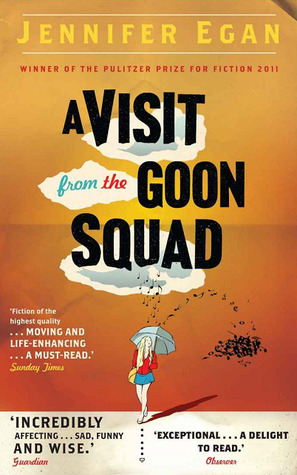 This was probably the first linked short story collection I ever read (now a favorite subgenre), and the first time I’d encountered second-person narration in fiction, so it’s no wonder I was intrigued. “Each chapter involves a very clever shift in time period and point of view,” I noted in 2011. This time, though, I found the 1970s–2020s timeline unnecessarily diffuse, and I was so disinterested in most of the characters – kleptomaniac PA Sasha, post-punk music producer Bennie, musician turned janitor turned children’s performer Scotty, a disgraced journalist, a starlet, and so on – that I didn’t care to revisit them.
The chapter in which Scotty catches a fish and takes it into Bennie’s office was a favorite, along with the PowerPoint presentation Sasha’s daughter puts together on the great pauses of rock music (while also revealing a lot about her family dynamic), but I found the segment on PR attempts to burnish an African general’s reputation far-fetched and ended up mostly skimming five of the last six chapters.
This was a buddy read with Laura T. (see her review); we came to similar conclusions: this may have felt fresh and even prescient about technology in 2010–11, but it didn’t stand up to a reread; still, we’ll keep our copies if just for the 75-page PowerPoint presentation.
Note: Egan has said that her next project is a companion piece to Goon Squad that uses a similar structure and follows some of its peripheral characters into new territory. Based on this rereading experience, I don’t think I’ll seek out the sequel.
My original rating (June 2011):
My rating now:
To reread next: Everything Is Illuminated by Jonathan Safran Foer and On Beauty by Zadie Smith
Done any rereading lately?
Paul Auster Reading Week: Oracle Night and Report from the Interior
Paul Auster Reading Week continues! Be sure to check out Annabel’s excellent post on why you should try Auster. On Monday I reviewed Winter Journal and the New York Trilogy. Adding in last year’s review of Timbuktu, I’ve now read six of Auster’s books and skimmed another one (the sequel to Winter Journal). It’s been great to have this project as an excuse to get more familiar with his work and start to recognize some of the recurring tropes.
Oracle Night (2003)
This reminded me most of The Locked Room, the final volume of the New York Trilogy. There’s even a literal locked room in a book within the book by the narrator, a writer named Sidney Orr. It’s 1982 and Orr is convalescing from a sudden, life-threatening illness. At a stationer’s shop, he buys a fine blue notebook from Portugal, hoping its beauty will inspire him to resume his long-neglected work. When he and his wife Grace go to visit John Trause, Grace’s lifelong family friend and a fellow novelist, Orr learns that Trause uses the same notebooks. Only the blue ones, mind you. No other color fosters the same almost magical creativity.
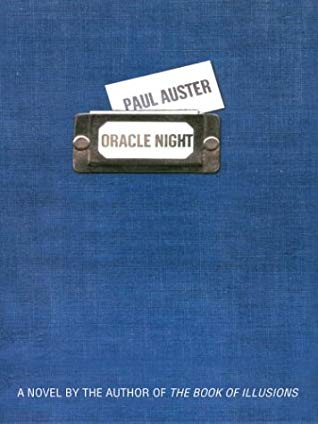 For long stretches of the novel, Orr is lost in his notebook (“I was there, fully engaged in what was happening, and at the same time I wasn’t there—for the there wasn’t an authentic there anymore”), writing in short, obsessive bursts. In one project, a mystery inspired by an incident from The Maltese Falcon, Nick Bowen, a New York City editor, has a manuscript called Oracle Night land on his desk. Spooked by a near-death experience, he flees to Kansas City, where he gets a job working on a cabdriver’s phone book archive, “The Bureau of Historical Preservation,” which includes a collection from the Warsaw ghetto. But then he gets trapped in the man’s underground bunker … and Orr has writer’s block, so leaves him there. Even though it’s fiction (within fiction), I still found that unspeakably creepy.
In the real world, Orr’s life accumulates all sorts of complications over just nine September days. Some of them are to do with Grace and her relationship with Trause’s family; some of them concern his work. There’s a sense in which what he writes is prescient. “Maybe that’s what writing is all about, Sid,” Trause suggests. “Not recording events from the past, but making things happen in the future.” The novel has the noir air I’ve come to expect from Auster, while the layering of stories and the hints of the unexplained reminded me of Italo Calvino and Haruki Murakami. I even caught a whiff of What I Loved, the novel Auster’s wife Siri Hustvedt published the same year. (It wouldn’t be the first time I’ve spotted similar themes in husband‒wife duos’ work – cf. Jonathan Safran Foer and Nicole Krauss; Zadie Smith and Nick Laird.)
This is a carefully constructed and satisfying novel, and the works within the work are so absorbing that you as the reader get almost as lost in them as Orr himself does. I’d rank this at the top of the Auster fiction I’ve read so far, followed closely by City of Glass.
Report from the Interior (2013)
This sequel to Winter Journal came out a year later. Again, the autobiographical rendering features second-person narration and a fragmentary style. I had a ‘been there, done that’ feeling about the book and only gave it a quick skim. It might be one to try another time.
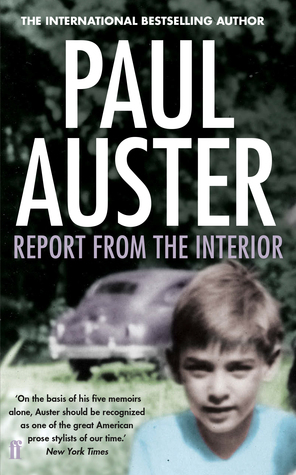 In the first 100-page section Auster highlights key moments from the inner life of a child. For instance, he remembers that the epiphany that a writer can inhabit another mind came while reading Robert Louis Stevenson’s poetry, and he emulated RLS in his own first poetic attempts. The history and pop culture of the 1950s, understanding that he was Jewish, and reaping the creative rewards of boredom are other themes. I especially liked a final anecdote about smashing his seventh-grade teacher’s reading challenge and being driven to tears when the man disbelieved that he’d read so many books and accused him of cheating.
Other sections give long commentary on two films (something he also does in Winter Journal with 10 pages on the 1950 film D.O.A.), select from letters he wrote to his first wife in the late 1960s while living in Paris, and collect an album of black-and-white period images such as ads, film stills and newspaper photographs. There’s a strong nostalgia element, such that the memoir would appeal to Auster’s contemporaries and those interested in learning about growing up in the 1950s.
Ultimately, though, this feels unnecessary after Winter Journal. Auster repeats a circular aphorism he wrote at age 20: “The world is in my head. My body is in the world. You will stand by that paradox, which was an attempt to capture the strange doubleness of being alive, the inexorable union of inner and outer”. But I’m not sure that body and mind can be so tidily separated as these two works posit. I got more of an overall sense of Auster’s character from the previous book, even though it was ostensibly focused on his physical existence.
The library at the university where my husband works holds another four Auster novels, but I’ll wait until next year to dive back into his work. After reading other people’s reviews, I’m now most keen to try The Brooklyn Follies, Invisible and In the Country of Last Things.
Have you tried anything by Paul Auster this week?
Adventures in Rereading: A. S. Byatt and Abigail Thomas
At the end of last year, I picked out a whole shelf’s worth of books I’ve been meaning to reread. I know that others of you are devoted re-readers, returning to childhood favorites for comfort or poring over admired novels two or three times to figure out how they work. Alas, I’m usually resistant to rereading because I feel like it takes away time that I could be spending reading new or at least new-to-me books. Yet along with the nostalgia there is also a certain relief to returning to a favorite: here’s a book that is guaranteed not to disappoint.
So far this year I’ve finished two rereads, and I’m partway through a third. I’m not managing the one-every-other-week pace I would need to keep up to get through the whole shelf this year, but for me this is still good progress. I’ll report regularly on my experience of rereading.
The Matisse Stories by A. S. Byatt (1993)
Byatt is my favorite author. My memory for individual short stories is pitiful, yet I have never forgotten the first of three stories in this volume, so I focus on it here with a close rereading. In “Medusa’s Ankles,” a middle-aged woman goes berserk in a hair salon but it all turns out fine. I remember imagining what that would be like: to let go, to behave badly with no thought for others’ opinions, to act purely on instinct – and for there to be no consequences.
I’d forgotten all the particulars of the event. Susannah, a linguist, is drawn to the salon by the Rosy Nude reproduction she sees through the window. She becomes a reluctant receptacle for her stylist Lucian’s stories, including tales of his wife’s fat ankles and his mistress’ greater appeal. He confides in her his plan to run away. “I don’t want to put the best years of my life into making suburban old dears presentable. I want something more.”
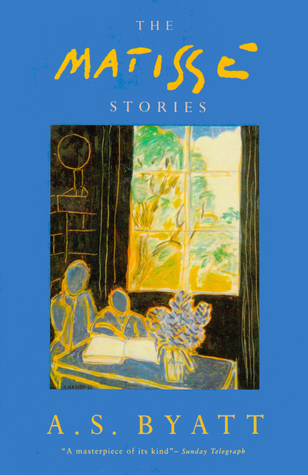 Susannah holds in all her contempt for Lucian and his hip shop redesign until the day he fobs her off on another stylist – even though she’s said she needs an especially careful job this time because she is to appear on TV to accept the Translator’s Medal. When Deirdre is done, Susannah forgets about English politeness and says just what she thinks: “It’s horrible. I look like a middle-aged woman with a hair-do.” (Never mind that that’s exactly what she is.)
In a whirlwind of fury, she trashes the salon. Byatt describes the aftermath, indulging her trademark love of colors: “It was a strange empty battlefield, full of glittering fragments and sweet-smelling rivulets and puddles of venous-blue and fuchsia-red unguents, patches of crimson-streaked foam and odd intense spills of orange henna or cobalt and copper.”
You can just imagine the atmosphere in the salon: everyone exchanging horrified looks and cautiously approaching Susannah as if she’s a dangerous dog. Lucian steps in to reassure her: “We all feel like that, sometimes. Most of us don’t dare. … The insurance’ll pay. Don’t worry. … You’ve done me a good turn in a way.” Maybe he’ll go off with his girlfriend and start a new business, after all. Predictably, the man has made it all about him.
The ironic kicker to this perfect story about middle age and female rage comes after Susannah goes home to a husband we hadn’t heard about yet. “He saw her. (Usually he did not.) ‘You look different. You’ve had your hair done. I like it. You look lovely. It takes twenty years off you. You should have it done more often.’”
“Art Work” briefly, unnecessarily, uses a Matisse painting as a jumping-off point. A bourgeois couple, a painter and magazine design editor, hire Mrs. Brown, a black woman, to clean their house and are flabbergasted when she turns out to be an artist in her own right. “The Chinese Lobster,” the final story, is the only one explicitly about Matisse. An academic dean invites her colleague out to lunch at a Chinese restaurant to discuss a troubled student he’s supervising. This young woman has eating disorders and is doing a portfolio of artwork plus a dissertation on Matisse’s treatment of female bodies. Her work isn’t up to scratch, and now she’s accused her elderly supervisor of sexual harassment. The racial and sexual politics of these two stories don’t quite hold up, though both are well constructed.
I reread the book in one morning sitting last week.
My original rating (c. 2005):
My rating now: 
A Three Dog Life by Abigail Thomas (2006)
In April 2000 Thomas’s husband Rich was hit by a car and incurred a traumatic brain injury when their dog Harry got off the leash and Rich ran out into the road near their New York City home to save him. It was a miracle that Rich lived, but his disability was severe enough that he had to be moved to an upstate nursing home. This is one of the first memoirs I ever remember reading, and it made a big impression. I don’t think I realized at the time that it was written in discrete essays, many of which were first published in magazines and anthologies. It represents an advance on the highly fragmentary nature of her first memoir, Safekeeping.
 Thomas maintains a delicate balance of emotions: between guilt every time she bids Rich goodbye in the nursing home and relief that she doesn’t have to care for him 24/7; between missing the life they had and loving the cozy one she’s built on her own with her three dogs. (The title is how Aborigines refer to the coldest nights.) As in One Hundred Names for Love and All Things Consoled, Rich’s aphasia produces moments of unexpectedly poetic insight.
Before rereading I remembered one phrase and one incident (though I’d thought the latter was from Safekeeping): doctors described Rich’s skull as “shattered like an eggshell,” and Thomas remembers a time she was driving and saw the car ahead hit a raccoon; she automatically swerved to avoid the animal, but saw in her rearview mirror that it was still alive and realized the compassionate thing would have been to run it over again. I’ve never forgotten these disturbing images.
Unassuming and heart on sleeve, Thomas wrote one of the most beautiful books out there about loss and memory. I’d recommend this to fans of Anne Lamott and readers of bereavement memoirs in general. This is what I wanted from the rereading experience: to find a book that was even better the second time around.
My original rating (c. 2006):
My rating now:
Currently rereading: Flaubert’s Parrot by Julian Barnes
Considering rereading next: On Beauty by Zadie Smith
Done any rereading lately?
Women’s Prize 2019: Longlist Review Excerpts and Shortlist Thoughts
There’s a reason I could never wholeheartedly shadow the Women’s Prize: although each year the prize introduces me one or two great novels I might never have heard of otherwise, inevitably there are also some I don’t care for, or have zero interest in reading. Here’s how I fared this year, in categories from best to worst, with excerpts and links to any I’ve reviewed in full:
Loved! (5)
- The Pisces by Melissa Broder: This starts off as a funny but somewhat insubstantial novel about a thirtysomething stuck with a life she isn’t sure she wants, morphs into a crass sex comedy (featuring a merman), but ultimately becomes a profound exploration of possession, vulnerability and the fluidity of gender roles. It’s about the prison of the body, and choosing which of the many different siren voices calling us we’ll decide to listen to. It’s a Marmite book, but perfect Women’s Prize material.
 Ordinary People by Diana Evans: Reminds me of On Beauty by Zadie Smith, one of my favorite novels of this millennium. It focuses on two Black couples in South London and the suburbs who, in the wake of Obama’s election, are reassessing their relationships. Their problems are familiar middle-class ones, but Evans captures them so candidly that many passages made me wince. The chapter in which two characters experience mental instability is a standout, and the Black slang and pop music references a nice touch.
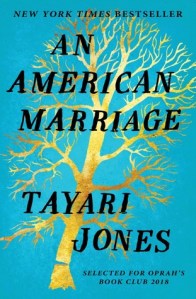
- An American Marriage by Tayari Jones: Roy and Celestial only get a year of happy marriage before he’s falsely accused of rape and sentenced to 12 years in prison in Louisiana. I ached for all three main characters: It’s an impossible situation. There’s a lot to probe about the characters’ personalities and motivations, and about how they reveal or disguise themselves through their narration. I found it remarkable how the letters, which together make up not even one-fifth of the text, enhance the raw honesty of the book.
- Ghost Wall by Sarah Moss: It’s the late 1980s and teenager Silvie Hampton and her parents have joined a university-run residential archaeology course in the North of England, near the bogs where human sacrifice once took place. Nationalism, racism, casual misogyny – there are lots of issues brewing under the surface here. Women’s bodies and what can be done to them is central; as the climax approaches, the tricksy matter of consent arises. I ended up impressed by how much Moss conveys in so few pages. Another one custom-made for the Women’s Prize.
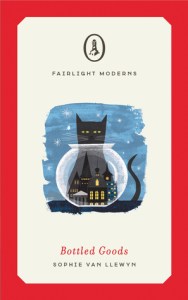 Bottled Goods by Sophie van Llewyn: I just finished this the other day. It’s a terrific hybrid work that manages to combine several of my favorite forms: a novella, flash fiction and linked short stories. The content is also an intriguing blend, of the horrific and the magical. After her brother-in-law’s defection, Alina and her husband Liviu come under extra scrutiny in Communist Romania. Bursts of magic realism and a delightful mixture of narrative styles (lists and letters; alternating between the first and third person) make all this material bearable.
Did not particularly enjoy (2)
- Freshwater by Akwaeke Emezi: Magic realism and mental illness fuel a swirl of disorienting but lyrical prose. Much of the story is told by the ọgbanje (an Igbo term for evil spirits) inhabiting Ada’s head. The conflation of the abstract and the concrete didn’t quite work for me, and the whole is pretty melodramatic. Although I didn’t enjoy this as much as some other inside-madness tales I’ve read, I can admire the attempt to convey the reality of mental illness in a creative way.
 Normal People by Sally Rooney: This book’s runaway success continues to baffle me. I kept waiting for more to happen, skimming ahead to see if there would be anything more to it than drunken college parties and frank sex scenes. It is appealing to see into these characters’ heads and compare what they think of themselves and each other with their awareness of what others think. But page to page it is pretty tedious, and fairly unsubtle.
Attempted but couldn’t get through (3)
- Remembered by Yvonne Battle-Felton: A historical novel marked by the presence of ghosts, this is reminiscent of the work of Cynthia Bond, Toni Morrison and Jesmyn Ward. It’s the closest thing to last year’s Sing, Unburied, Sing. I only read the first 36 pages as neither the characters nor the prose struck me as anything special.
 Swan Song by Kelleigh Greenberg-Jephcott: Full of glitzy atmosphere contrasted with washed-up torpor. I have no doubt the author’s picture of Truman Capote is accurate, and there are great glimpses into the private lives of his catty circle. I always enjoy first person plural narration, too. However, I quickly realized I don’t have sufficient interest in the figures or time period to sustain me through nearly 500 pages. I read the first 18 pages and skimmed to p. 35.
- Number One Chinese Restaurant by Lilian Li: Vague The Nest vibes, but the prose felt flat and the characters little more than clichés (especially scheming ‘Uncle’ Pang). I grew up in Silver Spring, Maryland so was expecting there to be more local interest for me, but this could be taking place anywhere. Reviews from trusted Goodreads friends suggested that the plot and characterization don’t significantly improve as the book goes on, so I gave up after the first two chapters.
Not interested (6)
(Don’t you go trying to change my mind!)

- The Silence of the Girls by Pat Barker: Updated Greek classics are so not my bag.
- My Sister, the Serial Killer by Oyinkan Braithwaite: Meh.
- Milkman by Anna Burns: Nah.
- Lost Children Archive by Valeria Luiselli: I’ll try something else by Luiselli.
- Praise Song for the Butterflies by Bernice L. McFadden: The setting of a fictional African country and that title already have me groaning.
- Circe by Madeline Miller: See the note on Barker above.
The shortlist will be announced on Monday the 29th. Broder and Moss will most likely make the cut. I’d love to see the van Llewyn make it through, as it’s my favorite of what I’ve read from the longlist, but I think it will probably be edged out by more high-profile releases. Either Evans or Jones will advance; Jones probably has the edge with more of an issues book. One of the Greek myth updates is likely to succeed. Luiselli is awfully fashionable right now. Emezi’s is an interesting book and the Prize is making a statement by supporting a non-binary author. Rooney has already won or been nominated for every prize going, so I don’t think she needs the recognition. Same for Burns, having won the Booker.
So, quickly pulling a combination of wanted and expected titles out of the air would give this predicted shortlist:
 The Silence of the Girls by Pat Barker
The Pisces by Melissa Broder
Freshwater by Akwaeke Emezi
An American Marriage by Tayari Jones
Lost Children Archive by Valeria Luiselli
Ghost Wall by Sarah Moss
Eleanor, Eric, Laura and Rachel have been posting lots of reviews and thoughts related to the Women’s Prize. Have a look at their blogs!
35 Years, 35 Favorite Books
I love book lists: ticking off what I’ve read from newspaper and website selections, comparing my “best-of” choices and prize predictions with other people’s, and making up my own thematic inventories. Earlier in the year I spotted Desert Island-style 100-book lists on Annabookbel and A life in books, as well as Lonesome Reader’s reconsideration of the 100 favorite books he’d chosen half a lifetime ago. For my 35th birthday today, I’ve looked back at my “Absolute Favorites” shelf on Goodreads and picked the 35 titles that stand out the most for me: some are childhood favorites, some are books that changed my thinking, some I have read two or three times (an extreme rarity for me), and some are recent discoveries that have quickly become personal classics. I’ve listed these in rough chronological order of when I first read them, rather than ranking them, which would be nigh on impossible! Perhaps I’ll revisit the list on future significant birthdays and see how things change. Interesting to note that this works out as about two-thirds fiction and one-third nonfiction.
~
- Miss Rumphius by Barbara Cooney
- The Silver Chair by C.S. Lewis
- Watership Down by Richard Adams
- Anne of Green Gables by L.M. Montgomery
- David Copperfield by Charles Dickens
 The Scarlet Letter by Nathaniel Hawthorne
- Far from the Madding Crowd by Thomas Hardy
- Jane Eyre by Charlotte Brontë
- A Portrait of the Artist as a Young Man by James Joyce
- Possession by A.S. Byatt
- Flaubert’s Parrot by Julian Barnes
- Sixpence House by Paul Collins
 A History of God by Karen Armstrong
- Conundrum by Jan Morris
- The Heart of Christianity by Marcus Borg
- The Blind Assassin by Margaret Atwood
- My Family and Other Animals by Gerald Durrell
- On Beauty by Zadie Smith
- Heaven’s Coast by Mark Doty
 Secrets in the Dark by Frederick Buechner
- A Prayer for Owen Meany by John Irving
- American Wife by Curtis Sittenfeld
- Middlesex by Jeffrey Eugenides
- Caribou Island by David Vann
- To Travel Hopefully by Christopher Rush
- We, the Drowned by Carsten Jensen
 The Emperor of All Maladies by Siddhartha Mukherjee
- Leaving Alexandria by Richard Holloway
- An Exact Replica of a Figment of My Imagination by Elizabeth McCracken
- A Tale for the Time Being by Ruth Ozeki
- Want Not by Jonathan Miles
- Journal of a Solitude by May Sarton
- F by Daniel Kehlmann
 Dinner at the Homesick Restaurant by Anne Tyler
- March by Geraldine Brooks
Are any of these among your favorites, too?
Sunday Times Young Writer of the Year Award shadow panel
I’m delighted to announce that I’ve been invited to be on the official shadow panel for the Sunday Times / Peters Fraser + Dunlop Young Writer of the Year Award, in association with The University of Warwick (to give it its full and proper title). Here’s a bit of background on the prize, from its website:
The prize “is awarded annually to the best work of published or self-published fiction, non-fiction or poetry by a British or Irish author aged between 18 and 35, and has gained attention and acclaim across the publishing industry and press. £5,000 is given to the overall winner and £500 to each of the three runners-up.
“Since it began in 1991, the award has had a striking impact, boasting a stellar list of alumni that have gone on to become leading lights of contemporary literature. The 2016 Award was presented to Max Porter for his extraordinary debut, Grief Is the Thing with Feathers. Following a five-year break, the prestigious award returned with a bang in 2015, awarding debut poet Sarah Howe the top prize for her phenomenal first collection, Loop of Jade.”
Past winners include Ross Raisin, Adam Foulds, Naomi Alderman, Robert Macfarlane, William Fiennes, Zadie Smith, Sarah Waters, Francis Spufford, Simon Armitage and Helen Simpson.
This year’s official judging panel is made up of Andrew Holgate, literary editor of the Sunday Times, and writers Lucy Hughes-Hallett and Elif Shafak.

I’m joined on the shadow panel by four other book bloggers, several of whom you will recognize as long-time friends of this blog:
- Dane Cobain (SocialBookshelves)
- Eleanor Franzen (Elle Thinks)
- Annabel Gaskell (Annabookbel)
- Clare Rowland (A Little Blog of Books)
Here are some key upcoming dates:
- Sunday October 29th: shortlist announced in Sunday Times
- November 18th: book bloggers event with readings from the shortlisted authors (Groucho Club, London)
- November 27th: deadline for shadow panel winner decision
- November 29th: shadow panel winner announced on STPFD website
- December 3rd: shadow panel winner announced in Sunday Times
- December 7th: prize-giving ceremony and winner announcement (London Library)
I’m so looking forward to getting stuck into the shortlisted books and discussing them! I’ll be posting a review of each one in November.
Final Thoughts on the Booker Longlist
On Wednesday the 13th the Man Booker Prize shortlist will be announced. I’d already reviewed six of the nominees and abandoned one; in the time since the longlist announcement I’ve only managed to read another one and a bit. That leaves four I didn’t get a chance to experience. Here’s a run-through of the 13 nominees, with my brief thoughts on each.
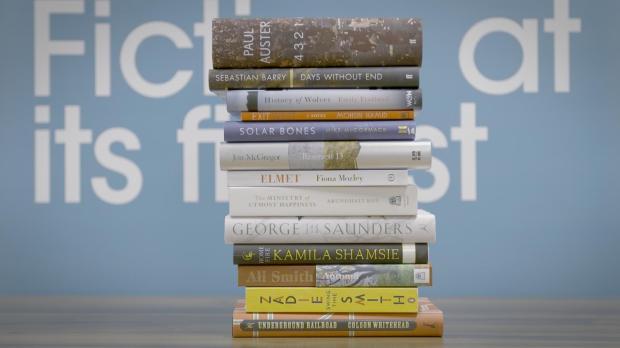
4 3 2 1 by Paul Auster (US) (Faber & Faber): I can’t see myself reading this one any time soon; I’ll choose a shorter work to be my first taste of Auster’s writing. I’ve heard mostly good reports, though.
Days Without End by Sebastian Barry (Ireland) (Faber & Faber): Read in March 2017. This is my overall favorite from the longlist so far. (See my BookBrowse review.) However, it’s already been recognized with the Costa Prize and the Walter Scott Prize for historical fiction, so if it doesn’t make the Booker shortlist I certainly won’t be crushed.
History of Wolves by Emily Fridlund (US) (Weidenfeld & Nicolson): Read in March 2017. A slow-building coming-of-age story with a child’s untimely death at its climax. Fridlund’s melancholy picture of outsiders whose skewed thinking leads them to transgress moral boundaries recalls Lauren Groff and Marilynne Robinson. (Reviewed for the Times Literary Supplement; )
Exit West by Mohsin Hamid (Pakistan-UK) (Hamish Hamilton): I don’t have much interest in reading this one at this point; I didn’t get far in the one book I tried by Hamid (The Reluctant Fundamentalist) earlier this year. I’ve encountered mixed reviews.
Solar Bones by Mike McCormack (Ireland) (Canongate): If you’ve heard anything about this, it’s probably that the entire book is composed of one sentence. Now here’s an embarrassing admission: I didn’t make it past the first page.
Reservoir 13 by Jon McGregor (UK) (4th Estate): I read the first 15% last month and set it aside. I knew what to expect – lovely descriptions of the natural world and the daily life of a small community – but I guess hadn’t fully heeded the warning that nothing much happens. I won’t rule out trying this one again in the future, but for now it couldn’t hold my interest.
Elmet by Fiona Mozley (UK) (JM Originals): Read in August 2017. Simply terrific. (See my full blog review.) Overall, this dark horse selection is in second place for me. I’d love to see it make it through to the shortlist. 
The Ministry of Utmost Happiness by Arundhati Roy (India) (Hamish Hamilton): I was never a huge fan of The God of Small Things, so this is another I’m not too keen to try.
Lincoln in the Bardo by George Saunders (US) (Bloomsbury Publishing): Read in April 2017. An entertaining and original treatment of life’s transience. I enjoyed the different registers Saunders uses for his characters, but was less convinced about snippets from historical texts. So audacious it deserves a shortlist spot; I wouldn’t mind it winning.
Home Fire by Kamila Shamsie (UK-Pakistan) (Bloomsbury Circus): This is the one book from the longlist that I most wish I’d gotten a chance to read. It’s been widely reviewed in the press as well as in the blogging world (A life in books, Elle Thinks, and Heavenali), generally very enthusiastically.
Autumn by Ali Smith (UK) (Hamish Hamilton): Read in November 2016. (See my blog review.) While some of Smith’s strengths benefit from immediacy – a nearly stream-of-consciousness style (no speech marks) and jokey dialogue – I’d prefer a more crafted narrative. In places this was repetitive, with the seasonal theme neither here nor there. 
Swing Time by Zadie Smith (UK) (Hamish Hamilton): Read in October 2016 for a BookBrowse review. The Africa material wasn’t very convincing, and the Aimee subplot and the way Tracey turns out struck me as equally clichéd. The claustrophobic narration makes this feel insular. A disappointment compared to White Teeth and On Beauty.
The Underground Railroad by Colson Whitehead (US) (Fleet): Read in July 2017. (See my blog review.) I’m surprised such a case has been made for the uniqueness of this novel based on a simple tweak of the historical record. I felt little attachment to Cora and had to force myself to keep plodding through her story. Every critic on earth seems to love it, though.
If I had to take a guess at which six books will make it through Wednesday and why, I’d say:
- 4 3 2 1 by Paul Auster – A chunkster by a well-respected literary lion.
- Exit West by Mohsin Hamid – A timely refugee theme and a touch of magic realism.
- Solar Bones by Mike McCormack – Irish stream-of-consciousness. Channel James Joyce and you’ll impress all the literary types.
- Lincoln in the Bardo by George Saunders – Effusive in tone and cutting-edge in form.
- Autumn by Ali Smith – Captures the post-Brexit moment.
- The Underground Railroad by Colson Whitehead – Though it’s won every prize going, the judges probably think they’d be churlish to pass it by.
By contrast, if I were asked for the six I would prefer to be on the shortlist, and why, it’d be:
- Days Without End by Sebastian Barry – Pretty much unforgettable.
- History of Wolves by Emily Fridlund – A haunting novel that deserves more attention.
- Reservoir 13 by Jon McGregor – Though it’s not my personal favorite, I support McGregor.
- Elmet by Fiona Mozley – A nearly flawless debut. Give the gal a chance.
- Lincoln in the Bardo by George Saunders – Show-offy, but such fun to read.
- Home Fire by Kamila Shamsie – Timely and well crafted, by all accounts.
That would be three men and three women, if not the best mix of countries. I’d be happy with that list.
What have you managed to read from the Booker longlist? How do your predictions match up against mine?
Library Checkout: August 2017
A thin month for library books overall, although I did read two very good ones. The Aldo Leopold book is a nature classic I’m pleased we could find via the library of the university where my husband works. In the second week of September I’m going along with him to Ghent, Belgium, where he’ll be presenting a research paper at a landscape ecology conference. Though we’ve been before, it’s a lovely town I’ll enjoy wandering – in between keeping up a normal virtual workload. After that we head on to Amsterdam for a long weekend; it’ll be my first time there and I’m excited to take in all the sights.
LIBRARY BOOKS READ
- The Argonauts by Maggie Nelson
From my parents’ local branch in America:
- Sparky! by Jenny Offill [a picture book illustrated by Chris Appelhans]
CURRENTLY READING
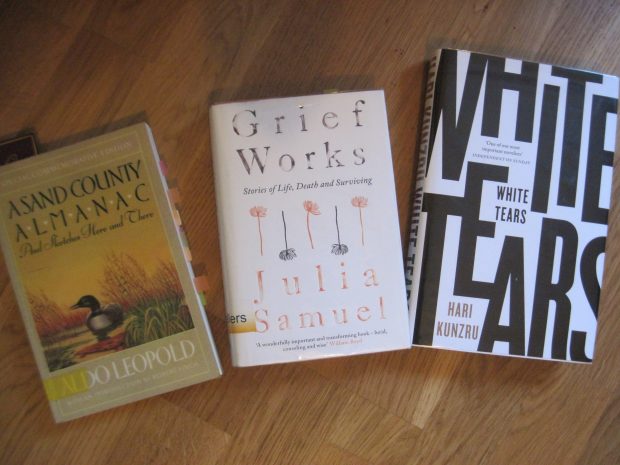
- A Sand County Almanac by Aldo Leopold
CURRENTLY SKIMMING
- Grief Works: Stories of Life, Death and Surviving by Julia Samuel
CHECKED OUT, TO BE SKIMMED
- 2 guide books to Belgium
- 2 guide books to Amsterdam
RETURNED UNFINISHED
- White Tears by Hari Kunzru – I read the first 145 pages, skimmed another 70 or so, then gave up. The vibe is Jonathan Franzen meets Zadie Smith circa The Autograph Man; the theme is cultural appropriation, especially of a blues song by a forgotten master. (I had the song from The Wire in my head the whole time.) My interest started to wane after what happens to Carter happens, and by the time the parallel road trips kicked in I was lost. So to what extent this was realist or magic realist or absurdist or whatever I couldn’t tell you. I liked the writing enough that I would try something else by Kunzru if I thought I’d connect to the subject matter more.
(Hosted by Charleen of It’s a Portable Magic.)
 Bookish Beck = Rebecca Foster. American transplant to England. Freelance proofreader and book reviewer.
 Bookish Beck