20 Books of Summer, 1: Company by Shannon Sanders
I started the summer’s reading right with Company. Shannon Sanders’s energetic debut novel-in-stories traces several generations of the Collins clan, whose experiences at once exemplify African American gentrification and evoke timeless patterns of parental legacy and sibling jealousy. Sisters Cassandra, Fay, Lee and Suzette grew up at their parents’ Atlantic City jazz club before going their separate ways: Cassandra to a PhD and provost position at a college, Fay to painting and the role of family spirit-keeper, Lee to her own brood of four and a no-good jazz musician husband, and Suzette to music and a too-early death. With roots in Mississippi, they have dispersed to Atlanta, New York City and Washington, DC.
We revisit relatives at different points in their lives, mostly between the 1990s and the present day. There are 13 linked stories here, 10 in the third person and three with a first-person narrator. Each focuses on a different individual or set of characters. Celebration scenes make for memorable moments. “Bird of Paradise” is set at the party to commemorate Cassandra’s new position. There’s a Black president at the time and people can’t stop comparing her dress to Michelle Obama’s inaugural ball attire, while she can’t stop fretting that she and her nieces will live up to stereotypes of Black women’s bodies. Later, “La Belle Hottentote” revisits this evening from the nieces’ perspective as they ponder where the family’s money came from. In “Rioja,” Cassandra’s daughter Cecilia, visiting her boyfriend Cole’s family for Thanksgiving, tries not to embarrass him with any pretentious or avant-garde behavior.
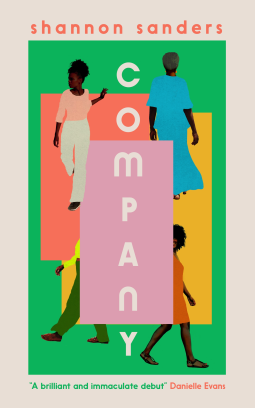
The title story, which is among the stand-outs, is the only one to feature the grandparent generation – though Opal and Centennial are but ghosts commenting on the begrudging welcome Fay offers when her niece Aubrey turns up on her doorstep in New Jersey. Fay is the sole sister without partner or children, but she got the family home as a sort of consolation prize and fills its walls with symbolism-heavy portraits of four sisters. My other favorite, alongside this and “Bird of Paradise,” was “The Opal Cleft,” in which Lee’s son Theo hosts his cousin Cyrus (Cassandra’s son) while the latter performs his drag queen act in the area.
I was reminded by turns of Danielle Evans, Kim Coleman Foote and Deesha Philyaw, while final story “The Everest Society,” about Lee’s daughter Mariolive’s desperation to impress the social worker who has to okay her and Dante adopting, recalls Sidik Fofana with its composite picture of their apartment building’s residents. In a few cases I felt that Sanders might have extended the sphere too wide by moving outside the family: “The Gatekeepers” I assume is about a co-worker or neighbor of Cassandra’s; “Mote” is about Cole’s cousin and his partner (and makes the one white woman in the book evil…); and “Dragonflies” features that cousin’s colleague. It’s not to say that these aren’t good stories, but I wondered why they couldn’t have starred extended family members instead.
Trying to get pregnant and the early days of motherhood are recurring concerns, as is the distribution of talent and wealth around the family and beyond. As these characters reach toward the upper middle class, they keep in mind the struggles they came from. Although the family legends morph over the years, shared habits and heirlooms make connections across the generations. Sanders is strong on characterization, scene-setting and social observation; I would happily have spent even longer with the Collins family. I’ll be keen to follow her career in the years to come. 
With thanks to Pushkin Press for the free copy for review.
Wendell Berry’s “Why I Am Not Going to Buy a Computer” & Why I Acquired My First Smartphone at Age 40.5
Wendell Berry is an American treasure: the 89-year-old Kentucky farmer is also a philosopher, poet, theologian, and writer of fiction, and many of his pronouncements bear the timeless wisdom of a biblical prophet. I’ve read his work from several genres and was curious to see how this 1987 essay – originally published in Harper’s Magazine and reprinted, along with some letters to the editor in response, plus extra commentary in the form of a 1990 essay, by Penguin in 2018 as the 50th and final entry in their Penguin Modern pamphlet series – might resonate with my own reluctance to adopt current technology.
The title essay is brief, barely filling 4.5 pages of a small-format paperback. It’s so concise that it would be difficult to summarize in many fewer words, but I’ll run through the points he makes across the initial essay, the replies to the correspondence, and a follow-up piece entitled “Feminism, the Body and the Machine” (1989). Berry laments his reliance on energy corporations and wants to limit that as much as possible. He decries consumerism in general; he isn’t going to acquire something just to be ‘keeping up with the times’. He doesn’t believe a computer will make his work better, and it doesn’t meet his criteria for a useful tool (smaller, cheaper and less energy-intensive than what it replaces; sourced locally and easily repaired by a non-specialist). He is perfectly happy with his current arrangement: he writes his work by hand and his wife types it up for him. He is loath to lose this human touch.

The letters to the editor, predictably, accuse him of self-righteousness for depicting his choice as the more virtuous one. The correspondents also felt they had to stand up for Berry’s wife, who might have better things to do than act as her husband’s secretary. This is the only time the author becomes slightly defensive, basically saying, ‘you don’t know anything about me, my wife or my marriage … maybe she wants to!’ He doubles down on the environmental harm caused by technology and consumerism, acknowledging his continued dependence on fossil fuels and vowing to avoid them, and unnecessary purchases, where possible.
If some technology does damage to the world, … then why is it not reasonable, and indeed moral, to try to limit one’s use of that technology?
To the extent that we consume, in our present circumstances, we are guilty. To the extent that we guilty consumers are conservationists, we are absurd. … can we do something directly to solve our share of the problem? … Why then is not my first duty to reduce, so far as I can, my own consumption?
If the use of a computer is a new idea, then a newer one is not to use one.
He even appears to speak prophetically to the rise of artificial intelligence:
My wish simply is to live my life as fully as I can. … And in our time this means that we must save ourselves from the products that we are asked to buy in order, ultimately, to replace ourselves. The danger most immediately to be feared in ‘technological progress’ is the degradation and obsolescence of the body.
Certain of his arguments felt relevant to me as I ponder my own relationship to technology. I compose all my reviews on a 19-year-old personal computer that’s not connected to the Internet. I don’t listen to the radio and have seen maybe three films in the past two years. We’ve been television-free for a decade and I have never regretted it (Berry: “It is easy – it is even a luxury – to deny oneself the use of a television set, and I zealously practice that form of self-denial. Every time I see television (at other people’s houses), I am more inclined to congratulate myself on my deprivation.”).
I find it so hard to adjust to new tech that my reluctance may have shaded into suspicion. I’m certainly no early adopter, but I’d also object to the label “Luddite”: since 2013 I’ve been using e-readers, which are invaluable in my reviewing work. But for 15 years or more I have been looking at other people and their smartphones with disdain. I prided myself on my resistance. Stubbornness seemed like a virtue when the alternative was spending a lot of money on something I didn’t need.

Receiving my first cell phone in July 2004 (with my dad at left; at Dulles airport).
Two months ago, though, I finally gave in and accepted a hand-me-down Motorola Android phone from my father-in-law, after nearly 20 years of using an old-style mobile phone. As we were renegotiating our phone and Internet contract, I got virtually unlimited minutes and data on this device for £6/month, with no initial outlay. Had I been forced to make a purchase, I think I would still be holding out. But I had gotten to the point where refusal was cutting off my nose to spite my face. Why keep martyring myself – saying I couldn’t make important household phone calls because they drained my pay-as-you-go credit; learning complex workarounds to post to Instagram from my PC; taking crap photos on a digital camera held together with a rubber band? Why resist utility just for the sake of it?
To be clear, this was not a matter of saving time. I’m not a busy person. Plus I believe there is value in slowing down and acting deliberately. (See this book-based article I wrote for the Los Angeles Review of Books in 2018 on the benefits of “wasting time.”) Mindless scrolling is as much a temptation on a PC as on a phone, so avoiding social media was not a motive for me; others with addictive tendencies may decide otherwise. Nor did I view convenience as reason enough per se. However, I admit I was attracted to the efficiency of a pocket-sized device that can at once replace a computer, pager, telephone, Rolodex, phonebook, camera, photo album, television screen, music player, camcorder, Dictaphone, stopwatch, calculator, map, satnav, flashlight, encyclopaedia, Kindle library, calendar, diary, Post-It notes, notebook, alarm clock and mirror. (Have I missed anything?) Talk about multi-tasking!

Out with the old, in with the new?
I would still say that I object to tech serving as a status symbol or a basis for self-importance, and I’d be pretty dubious about it ever being a worthwhile hobby. Should this phone fail me in future, I’ll copy my husband’s habit of buying a secondhand handset for £60–80. I wouldn’t acquire something that represented new extraction of rare resources. Treating things (or people) as disposable is anathema to me, something about which I know Berry would agree. I’m naturally parsimonious, obsessive about keeping things going for as long as possible and recycling them responsibly when they reach their end of life.
It’s one reason why I’ve gotten involved in the Repair Café movement. I volunteer for our local branch, which started up in February, on the admin and publicity side of things. The old-fashioned, make-do-and-mend ethos appeals to me. It’s the same spirit evoked in the lyrics of American singer-songwriter Mark Erelli’s “Analog Hero”:
He’s the fix-it man, the fix-it man
If he can’t put it back together, then it was never worth a damn
Maybe he’s crazy for trying to save what’s already gone
Now it ain’t even broken and we’re going for the upgrade
Nobody thinks twice ’bout what we’re really throwing away
It’s out with the old, in with the new…
I can imagine Wendell Berry still pecking out his words on a typewriter on his Kentucky farm. He’s an analogue hero, too. And he doesn’t go nearly as far as Mark Boyle, whose radical life experiment is recounted in The Way Home: Tales from a life without technology, which I reviewed for Shiny New Books in 2019.
I have pretty much made my peace with owning a smartphone. I have few apps and am still more likely to work at my PC or on paper. I’ll concede that I enjoy being able to post to X or Instagram wherever I am, and to keep up with messages on the go. (I used to have to say cryptic things to friends like, “once I leave the house, I will be unavailable except by text.”) Mostly, I’m relieved to have shed the frustrations of outmoded tech. Though I still keep my Nokia brick by my bedside as a trusty alarm clock – and a torch for when the cat wakes me between 2 and 5 each morning.

Ultimately, I feel, a smartphone is a tool like any other. It’s how you use it. Salman Rushdie comes to much the same conclusion about the would-be murder weapon wielded against him: “a knife is a tool, and acquires meaning from the use we make of it. It is morally neutral” (from Knife).
Berry’s argument about overreliance on energy remains a good one, but we are all so complicit in so many ways – even more so than in the late 1980s when he was writing – that avoiding the computer, and now the smartphone, doesn’t seem to hold particular merit. While this pamphlet will be but a quaint curio piece for most readers (rather than a parallel to the battle of wills I’ve conducted with myself), it is engaging and convincing, and the societal issues it considers are still ones to be wrestled with.
My copy was purchased with part of a £30 voucher I received free from Penguin UK for being part of their “Bookmarks” online community – answering polls, surveys, etc.
Book Serendipity, April to May 2024
I call it “Book Serendipity” when two or more books that I read at the same time or in quick succession have something in common – the more bizarre, the better. Of course, the truer term would be synchronicity, but the branding has stuck. In Liz Jensen’s Your Wild and Precious Life, she mentions that Carl Jung coined the term “synchronicity” for what he described as “a meaningful coincidence of two or more events where something other than the probability of chance is involved.” I like thinking that it’s not just a matter of luck.
This is a regular feature of mine every couple of months. I would normally have waited until the end of June, but I had way too many coincidences stored up! Because I usually have 20–30 books on the go at once, I suppose I’m more prone to finding them. People frequently ask how I remember all of these incidents. The answer is: I jot them down on scraps of paper or input them immediately into a file on my PC desktop; otherwise, they would flit away.
The following are in roughly chronological order.
- Reading two King Lear updates at the same time: Private Rites by Julia Armfield and Daughter by Claudia Dey. The former has been specifically marketed as a “lesbian Lear,” but I had no idea that the latter also features two sisters plus a younger half-sister and their interactions with a larger-than-life father.

- Eating beans straight out of the tin in The Waterfall by Margaret Drabble and Of Mice and Men by John Steinbeck.
- Dead mice in Of Mice and Men by John Steinbeck and Stone Yard Devotional by Charlotte Wood.

-

- Screenshot
- Cloth holding the jaw of a corpse closed in one story from Barcelona by Mary Costello and A Woman’s Story by Annie Ernaux.
- Others see a character’s wife as a whore but the husband is oblivious in The Shipping News by E. Annie Proulx and Of Mice and Men by John Steinbeck.
 Setting up a game of solitaire in The Snow Hare by Paula Lichtarowicz and Of Mice and Men by John Steinbeck.
- Main character called Mona in Daughter by Claudia Dey and Mona of the Manor by Armistead Maupin.
- Being surprised at an older man still having his natural hair colour in one story of Barcelona by Mary Costello (where he’s aged 76) and Life in the Balance by Jim Down (where it’s Alan Bennett, at 84!).
- A character named Anjali in Brotherless Night by V.V. Ganeshananthan and Moral Injuries by Christie Watson.

- A character named Cherry in Daughter by Claudia Dey and one story of This Is Why We Can’t Have Nice Things by Naomi Wood.
- My second memoir in two months in which a twentysomething son dies suddenly of a presumed heart problem: Fi by Alexandra Fuller, followed by Your Wild and Precious Life by Liz Jensen. (And a third in which his young friend died in the same way: The Uptown Local by Cory Leadbeater.) Also, Fuller and Jensen both see signs of their sons’ continued presence in bird sightings.
- Scratches on the inside of a coffin as proof of being buried alive in one story of Barcelona by Mary Costello and Life in the Balance by Jim Down.


- Surprise that one didn’t know the exact moment that a loved one died in one story of Barcelona by Mary Costello and Your Wild and Precious Life by Liz Jensen.
- Discussion of the meaning of brain stem death and a mention of meningococcal sepsis in Life in the Balance by Jim Down and Moral Injuries by Christie Watson.
- A scene set in a Denny’s diner in The Whole Staggering Mystery by Sylvia Brownrigg and After Dark by Haruki Murakami.


- A description of halal butchery in Barcelona by Mary Costello and Between Two Moons by Aisha Abdel Gawad.
- A mention of ballet choreographer George Balanchine in Dances by Nicole Cuffy and The Uptown Local by Cory Leadbeater.
- A woman has an affair with a female postal worker in Mona of the Manor by Armistead Maupin and The Shipping News by Annie Proulx, both of which I DNFed.
- A character named Magdalena in Cloistered by Catherine Coldstream and The Snow Hare by Paula Lichtarowicz. The latter goes by Lena, which is also the name of the main character in Jungle House by Julianne Pachico. And there’s a character named Lina in Between Two Moons by Aisha Abdel Gawad.


- Being presented with powdered milk in Cloistered by Catherine Coldstream and Whale Fall by Elizabeth O’Connor.
- First I read a novel about a convent plagued by mice (Stone Yard Devotional by Charlotte Wood). Then I read a memoir about a convent plagued by feral cats (Cloistered by Catherine Coldstream).
- Buffalo, New York as a setting in Consent by Jill Ciment and The Age of Loneliness by Laura Marris. It’s also mentioned in Enter Ghost by Isabella Hammad.


- Watching pigeons on one’s balcony in Keep by Jenny Haysom, Your Wild and Precious Life by Liz Jensen, and The Uptown Local by Cory Leadbeater.
 The family’s pet chicken is cooked for dinner in Coleman Hill by Kim Coleman Foote and The Snow Hare by Paula Lichtarowicz.
- The mother is named Gloria in Consent by Jill Ciment and Cold Spring Harbor by Richard Yates (and The War for Gloria by Atticus Lish, a DNF).
- A character named Anton in The Snow Hare by Paula Lichtarowicz and Jungle House by Julianne Pachico.
- A cat named Dog in The Door-to-Door Bookstore by Carsten Henn and a dog named Tiger in Jungle House by Julianne Pachico.
- Two nature books that feature wild cold-water swimming (though don’t they all these days?!): In All Weathers by Matt Gaw and Your Wild and Precious Life by Liz Jensen.

- Two nature books that mention W.H. Hudson: In All Weathers by Matt Gaw and North with the Spring by Edwin Way Teale.
 A large anonymous donation to a church in Slammerkin by Emma Donoghue and Excellent Women by Barbara Pym (£10–11, which was much more in the 18th century of the former than in the 1950s of the latter).
- A mention of Poughkeepsie, New York in Birdeye by Judith Heneghan and Woman of Interest by Tracy O’Neill.
- A 1950s scene of perusing a lipstick display in Recipe for a Perfect Wife by Karma Brown and Excellent Women by Barbara Pym.
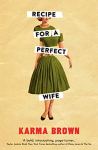

- A woman with a broken leg worries about how her garden will fare in Recipe for a Perfect Wife by Karma Brown and Remarkably Bright Creatures by Shelby Van Pelt.
- The same silent film image of a spaceship entering the moon’s eye (from Georges Méliès’s A Trip to the Moon) appears in Knife by Salman Rushdie and The Invention of Hugo Cabret by Brian Selznick. (I think this is the uncanniest coincidence of all this time!)

- A cleric who wears a biretta in Excellent Women by Barbara Pym and Daughters of the House by Michèle Roberts.
- A Black single mother who believes in the power of crystals in Company by Shannon Sanders and Another Word for Love by Carvell Wallace.


- An older woman really doesn’t want to leave her home but is moving into a retirement facility in Keep by Jenny Haysom and Remarkably Bright Creatures by Shelby Van Pelt. (There’s also a young woman who refuses to leave her house in Recipe for a Perfect Wife by Karma Brown.)
 A man throws his tie over his shoulder before eating in Recipe for a Perfect Wife by Karma Brown and Keep by Jenny Haysom.
- A mother writing a bad check becomes an important plot point in Remarkably Bright Creatures by Shelby Van Pelt and Another Word for Love by Carvell Wallace.
 A scene of self-induced abortion in Recipe for a Perfect Wife by Karma Brown and Sleeping with Cats by Marge Piercy.
- The Yiddish word feh (an expression of disappointment) appears in Feh by Shalom Auslander (no surprise there!) but also in A Reason to See You Again by Jami Attenberg, both of which are pre-release books I am reading for Shelf Awareness reviews.

What’s the weirdest reading coincidence you’ve had lately?
Literary Wives Club: Recipe for a Perfect Wife by Karma Brown (2019)
{SPOILERS IN THIS REVIEW!}
Canadian author Karma Brown’s fifth novel features two female protagonists who lived in the same house in different decades. The dual timeline, which plays out in alternating chapters, contrasts the mid-1950s and late 2010s to ask 1) whether the situation of women has really improved and 2) if marriage is always and inevitably an oppressive force.
Nellie Murdoch loves cooking and gardening – great skills for a mid-twentieth-century housewife – but can’t stay pregnant, which provokes the anger of her abusive husband, Richard. To start with, Alice Hale can’t cook or garden for toffee and isn’t sure she wants a baby at all, but as she reads through Nellie’s unsent letters and recipes, interspersed with Ladies’ Home Journal issues in the boxes in the basement, she starts to not just admire Nellie but emulate her. She’s keeping several things from her husband Nate: she was fired from her publicist job after a pre-#MeToo scandal involving a handsy male author, she’s had an IUD fitted, and she’s made zero progress on the novel she’s supposed to be writing. But Nellie’s correspondence reveals secrets that inspire Alice to compose Recipe for a Perfect Wife.
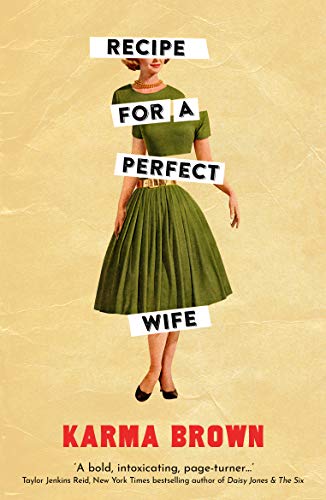
The chapter epigraphs, mostly from period etiquette and relationship guides for young wives, provide ironic commentary on this pair of not-so-perfect marriages. Brown has us wondering how closely Alice will mirror Nellie’s trajectory (aborting her pregnancy? poisoning her husband?). There were clichéd elements, such as Richard’s adultery, glitzy New York City publishing events, Alice’s quirky-funny friend, and each woman having a kindly elderly (maternal) neighbour who looks out for her and gives her valuable advice. I felt uncomfortable with how Nellie’s mother’s suicide makes it seem like Nellie’s radical acts are borne out of inherited mental illness rather than a determination to make her own path.
Often, I felt Brown was “phoning it in,” if that phrase means anything to you. In other words, playing it safe and taking an easy and previously well-trodden path. Parallel stories like this can be clever, or can seem too simple and coincidental. However, I can affirm that the novel is highly readable and has vintage charm. I always enjoy epistolary inclusions like letters and recipes, and it was intriguing to see how Nellie uses her garden herbs and flowers for pharmaceutical uses. Our first foxglove just came into flower – eek! (Kindle purchase) 
The main question we ask about the books we read for Literary Wives is:
What does this book say about wives or about the experience of being a wife?
- Being a wife does not have to mean being a housewife. (It also doesn’t have to mean being a mother, if you don’t want to be one.)
- Secrets can be lethal to a marriage. Even if they aren’t literally so, they’re a really bad idea.
This was, overall, a very bleak picture of marriage. In the 1950s strand there is a scene of marital rape – one of two I’ve read recently, and I find these particularly difficult to take. Alice’s marriage might not have blown up as dramatically, but still doesn’t appear healthy. She forced Nate to choose between her and the baby, and his job promotion in California. The fallout from that ultimatum is not going to make for a happy relationship. I almost thought that Nellie wields more power. However, both women get ahead through deception and manipulation. I think we are meant to cheer for what they achieve, and I did for Nellie’s revenge at Richard’s vileness, but Alice I found brattish and calculating.
See Kate’s, Kay’s and Naomi’s reviews, too!
Coming up next, in September: Their Eyes Were Watching God by Zora Neale Hurston.
The Ministry of Time by Kaliane Bradley
This was one of my Most Anticipated releases of the year and I’m happy to report that it pretty much lived up to my high hopes. I rightly had in mind that it would be a zany time-travel romance involving a modern-day civil servant falling in love with her charge, who was a real-life Victorian polar explorer. The blurb had me expecting something rather light and one-dimensional, so it was a pleasant surprise to find that this nuanced debut novel alternately goes along with and flouts the tropes of spy fiction and science fiction, and makes clever observations about how we frame stories of empire and progress.
The unnamed first-person narrator is, like Bradley, a young British-Cambodian woman. She is blasé about her government work in languages and relishes the chance to do something a bit different. After a rigorous set of interviews for the Ministry’s mysterious new project, she is hired as a “bridge” helping to resettle one of five “expatriates” from history in near-future London. Her expat is “1847,” 38-year-old Commander Graham Gore, rescued before his death on Sir John Franklin’s ill-fated Arctic expedition.
Two of the other expats, Arthur aka “1916” and seventeenth-century nonconformist Margaret Kemble (both queer), become Gore’s close friends. It’s a delight to watch these characters take up new vocabulary and technology and handpick the things they appreciate about popular culture. There are some hilarious scenes of the gang all together, particularly those involving music: Arthur and Graham put on a ‘disco’, the narrator teaches them all to do the electric slide before a clubbing outing, and they have a go on a theremin.
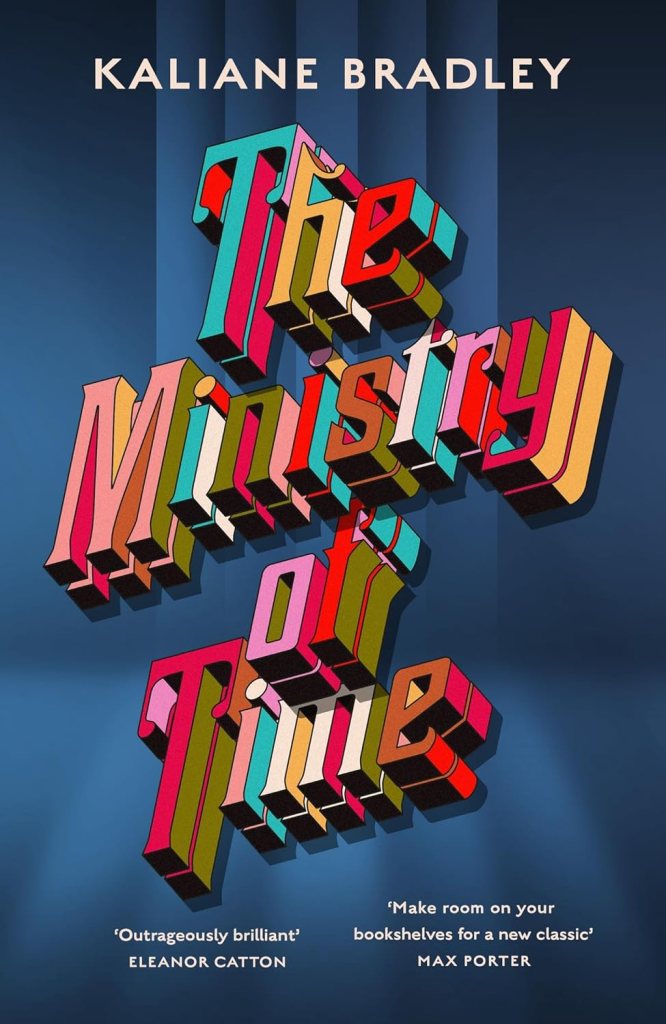
Gore lives in the narrator’s flat while she oversees his adjustment. At times he is like her “overgrown son,” testing the boundaries and expressing knee-jerk disapproval of things he doesn’t understand. Gradually their bizarre housemate situation turns into an odd-couple romance. “He was an anachronism, a puzzle, a piss-take, a problem, but he was, above all things, a charming man. … I was concussed with love for him. I bent my head to the cudgel.”
Although this feels like wish-fulfilment (imagine choosing a historical figure you find vaguely hot, bringing them back to life, and then giving your fictional stand-in a chance with them), Bradley doesn’t completely gloss over the difficulties their backgrounds and mores would cause. Most noteworthy is his exoticization of her as a mixed-race woman. Occasional passages in archaic font introducing vignettes from Gore’s time in the Arctic suggest that his reaction to the narrator may be informed by a pivotal encounter he had with a bereaved Inuit woman. The expats undergo intense sensitivity training, but the imperial mindset is hard to root out, and even the narrator, whose mother was a refugee from the Khmer Rouge, isn’t sure she’s always getting it right when it comes to racism and assimilation.
Bradley’s descriptive prose is a highlight (“he looked oddly formal, as if he was the sole person in serif font”; “A great graphite pencil inscribed the diagonal journey of water on the air”), memorable but never too quirky just for the sake of it. At a certain point, plot starts to take over and pushes aside the quiet playfulness of the culture shock scenes. I did miss the innocent joy, but that’s Bradley’s point: mess around with the past and grave consequences are bound to follow. We learn that the Ministry has a double agent, that there are visitors from later centuries as well as previous ones, and that the narrator’s own future is at stake.
Maybe because I don’t read hard SF, it didn’t bother me that the explanations and world-building are a little bit thin here. You just have to suspend disbelief at the start and then go with it. The result is a witty, sexy, off-kilter gem. I haven’t had so much sheer fun with a book since Curtis Sittenfeld’s Romantic Comedy, and I will be looking out for whatever Bradley writes next.
With thanks to Sceptre for the free copy for review.
Buy a copy from Bookshop.org UK! [affiliate link]
May was a big month for new releases and I have lots more review books on the go or waiting in the wings to be reviewed in catch-up posts!
20 Books of Summer Plan
It’s my seventh year in a row participating in Cathy’s 20 Books of Summer challenge, which starts on 1 June and runs through the 1st of September.

In most previous years I have chosen a theme.
2018: Books by women
2019: Fauna
2020: Food
2021: Colours
2022: Flora
Last year was a grab bag, but about a third of my choices were foodie again. I love picking the books for a themed challenge, but when it comes to actually reading them, I often get bored reading around the same topic, even if I had ensured a variety of fiction/nonfiction, author style, etc.
So this year the plan is simply to read hardback books that I own. I have at least 80–100 options, across genres and of all lengths; review copies, set-aside books and rereads are all possible. I fancy curating a blend of recent acquisitions and long-time shelf sitters. By the end of August I can decide whether they’re keepers or I want to pass them along to make room for others; the width of 20 hardbacks should be significant!
You’ll see options on shelves dotted all around the house:
-
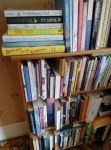
- Miscellaneous on bedroom shelves
-

- Biographies
-

- Bedside table
-

- Classics (mix of read/unread)
-
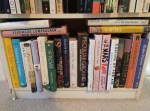
- Shelf of unread hardbacks
-

- Foodie lit shelf with a few options
-
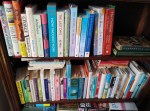
- Three shelves: review copies; set-aside; to reread
-
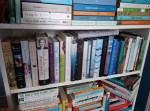
- Life writing case with one shelf of unread hardbacks
Here’s a tentative list of 20 hardbacks that are catching my eye right now – but I reserve the right to change my mind and ditch any or all of them in favour of other books that appeal more at the time!
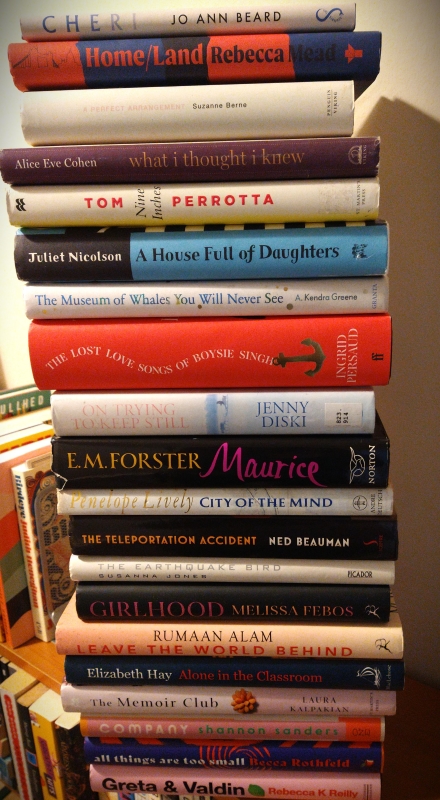
Leave the World Behind by Rumaan Alam (Free from a neighbour) – There was a lot of buzz about this a few years ago and I intended to read it right away but didn’t for whatever reason. My impression is of a literary novel that turns into a domestic thriller.
Cheri by Jo Ann Beard (New, Hungerford Bookshop with birthday voucher last year) – Cathy spoke very highly of this during Novellas in November. I daresay I’ll be grateful for one very short option over the summer. I wish more of my hardbacks were so slender!
The Teleportation Accident by Ned Beauman (Secondhand, Awesomebooks.com) – This would be my one reread of the challenge. I’ve read all but one of Beauman’s novels and this is the one I remember most fondly. Zany historical fiction with a fantasy twist.
A Perfect Arrangement by Suzanne Berne (Secondhand, Community Furniture Project) – I don’t know anything about this but I’m expecting it to be, like her Women’s Prize winner, A Crime in the Neighborhood, light yet substantial and quietly gripping.
What I Thought I Knew by Alice Eve Cohen (Secondhand, Amazon with gift money) – I loved her 2015 memoir, The Year My Mother Came Back, so much that I sought out her previous one … but it has sat on the shelf unread for years.
On Trying to Keep Still by Jenny Diski (Secondhand, Awesomebooks.com) – I’ve loved everything I’ve read by Diski so far. This is a book of travel essays.
Girlhood by Melissa Febos (New, Christmas gift last year) – I was so impressed by her latest essay collection, Body Work, that I knew I had to read everything else she’s written. This previous collection mixes memoir and feminist social history.
Maurice by E.M. Forster (Secondhand, Wonder Book and Video?) – I’ve owned this for so long that I can’t remember when and where I got it, but I’m guessing it came from the used bookstore where I worked in college. My only major Forster work still unread.
The Museum of Whales You Will Never See by A. Kendra Greene (Secondhand, Bas Books & Home) – More essays to slake the desire for armchair travel. This one’s set entirely in Iceland and is all about quirky museum collections.
Alone in the Classroom by Elizabeth Hay (Secondhand, Christmas gift last year) – I’ll read anything Hay writes. This will be my third novel from her.
The Earthquake Bird by Susanna Jones (Secondhand, Hay-on-Wye in 2020) – Doesn’t feel like I bought it ages ago, but nearly four years have passed. I thought her When Nights Were Cold (historical fiction about women’s mountaineering) was fantastic in 2013.
The Memoir Club by Laura Kalpakian (Secondhand, 2nd & Charles) – I’ve long wanted to try this author and finally found one of her books on a clearance shelf in December. I’m expecting slightly fluffy fun à la Elizabeth Berg et al., perfect for summer.
City of the Mind by Penelope Lively (Secondhand, French LFL) – My most recent acquisition; why not get to it right away? Besides, Lively is one of four authors on this list (the others are Diski, Forster and Hay) by whom I own two or more unread books.
Home/Land by Rebecca Mead (Review copy) – An Anglo-American memoir should be right up my street. I don’t know why I’ve let this one sit around for ages.
A House Full of Daughters by Juliet Nicolson (Free from a neighbour) – A family memoir about Vita Sackville-West’s clan. I don’t often read biographical stuff (as opposed to straight autobiographies), so this is a good excuse.
Nine Inches by Tom Perrotta (Free from a neighbour) – Short stories of blue-collar America. I used to love Perrotta and have read most of his books. Maybe I’ll find him a little macho these days, though.
The Lost Love Songs of Boysie Singh by Ingrid Persaud (Signed copy won in a Faber Instagram giveaway) – I loved her debut novel, Love after Love, but have been daunted by the length of this follow-up, which I know to contain multiple POVs and patois.
Greta & Valdin by Rebecca K. Reilly (Review copy) – A quirky novel about queer siblings and their oddball family in New Zealand. I started it in April but haven’t made much of a dent, so this is my strategy for getting back into it.
All Things Are Too Small by Becca Rothfeld (Review copy) – Cultural criticism from the Washington Post’s in-house nonfiction book reviewer, a philosophy PhD candidate. I’ve sampled the first few pages so far.
Company by Shannon Sanders (Review copy) – Linked short stories about the members of one extended Black family. I got partway through one story earlier in the month but it’s time to get back into it in earnest.
What do you make of my list? See any other hardback options in the photos that I should prioritize instead?
Love Your Library, May 2024
Thanks to Eleanor (here and here) and Marcie for posting about their recent library reads! Everyone is welcome to join in with this meme that runs on the last Monday of the month.
Earlier in the month I had an all-volunteering Tuesday where I went from 1) a busy morning library volunteering session straight to 2) a coffee meeting with the local repair café coordinator to discuss publicity, then 3) caught up on receipts and accounts for the suite of community gardening projects for which I’m treasurer and 4) went out to one of the garden sites to help fill newly constructed raised beds with compost, wood chip and veg plants. And of course, as I do every day when I’m not on holiday, I 5) stopped by the neighbourhood Little Free Library I curate to tidy the shelves and check whether any new stock was needed.
Ever since I was invited to become a local school governor last year (I declined) and a trustee of the neighbourhood nonprofit arts venue where I attend gigs and sometimes volunteer tending bar (earlier this year; I’m still thinking about it), I’ve had the feeling that others view me almost like a retiree. I postulate two main reasons. One, as an underemployed freelancer, I don’t appear to have a proper career. I don’t mind people thinking this as it feels true for me much of the time. Secondly, I don’t have children, a major commitment for many women of my age bracket. As Sheila Heti wrote in Motherhood, “There is something threatening about a woman who is not occupied with children. There is something at-loose-ends feeling about such a woman. What is she going to do instead? What sort of trouble will she make?”
I’m not particularly ambitious professionally; I wish I was in a financial situation to be the full-time volunteer that some perceive me to be – after all, my unpaid roles are, in many cases, less annoying and more rewarding than much of what I do for money. Maybe I’ll work out the right balance sometime in the near future. It’s important to feel productive and valued. In the meantime, it is gratifying that my skills are appreciated in my charitable work.
My library use over the last month:
(Links to reviews of books I have not already covered on the site)
READ
- Blossomise by Simon Armitage

- All the Beauty in the World: A Museum Guard’s Adventures in Life, Loss and Art by Patrick Bringley
- Cloistered: My Years as a Nun by Catherine Coldstream
- The Year of the Cat by Rhiannon Lucy Cosslett

- Enter Ghost by Isabella Hammad
- The Door-to-Door Bookstore by Carsten Henn
- Jungle House by Julianne Pachico

- Lunar New Year Love Story by Gene Luen Yang


SKIMMED
- Beautiful Trauma by Rebecca Fogg
- Second Helpings by Sue Quinn (a leftovers cookbook; we’re intrigued by the coffee grounds cookies!)
CURRENTLY READING
- Death Valley by Melissa Broder
- Restless Dolly Maunder by Kate Grenville
- Kay’s Incredible Inventions by Adam Kay
- After Dark by Haruki Murakami
- Excellent Women by Barbara Pym
- The Invention of Hugo Cabret by Brian Selznick
CHECKED OUT, TO BE READ
(The rest of what is pictured in the three photos!)

ON HOLD, TO BE COLLECTED
- Piglet by Lottie Hazell
- Languishing by Corey Keyes
- You Are Here by David Nicholls – The other week when I took this screenshot I thought there were a lot of holds on this one, more than I have seen since Lessons in Chemistry first came out. I looked again yesterday and I am now 1st out of 53. All waiting for one copy!

- Knife by Salman Rushdie
- The Spoiled Heart by Sunjeev Sahota
RETURNED UNFINISHED
- Mona of the Manor by Armistead Maupin – I read the first 30 pages. It seemed fun enough, if edgy for the sake of it (every main character is queer; crass speech). I encountered many more typos than I expected for a published book, including missing articles and quotation marks. Ultimately, I think you have to be invested in this series and its characters, whereas I had only ever read the first book, Tales of the City, and it didn’t captivate me.

RETURNED UNREAD
- Have a Little Faith by Kate Bottley – I admire her as a person but the first few pages made me think she’s not cut out for being a writer. This promised to be generic and twee.
- Learning to Think by Tracy King – Requested after me. Will try another time.
- The Half Bird by Susan Smillie – Did not enjoy the writing style at all.
- Help Wanted by Adelle Waldman – Requested after me. Might try another time.
What have you been reading or reviewing from the library recently?

Share a link to your own post in the comments. Feel free to use the above image. The hashtag is #LoveYourLibrary.
Nine Days in France and What I Read
Who would have predicted that the South of France would be colder and rainier than the England we left behind? Nonetheless, we had a pleasant, low-key week at the Limousin–Dordogne border. We stayed in a gîte at Le Moulin de Pensol, a complex run by an English couple who keep horses, donkeys and chickens but are otherwise rewilding their land (similar to the Wild Finca project we visited in Spain two years ago). Their site is known for butterflies, including multiple almost indistinguishable fritillary species, so there was plenty of insect and bird watching for my husband in brief bursts of sunshine between showers. When it was too wet to go out, we played board games, drank wine and read books.
-

- Our gite. Photos by Chris Foster.
-
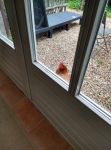
- The chickens wanted in!
-

- Wandering the meadows
-

- Butterfly watching
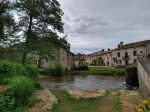
However, we did manage a few short outings: the Trou de Philippou gorge; a peek at a Saturday morning repair café (I’m a volunteer doing admin and publicity for our local repair café, which started in February) and its “recyclerie” charity shop in a nearby village; and St-Jean-de-Côle, “one of the loveliest villages in the Dordogne” according to the Rough Guide. We were taken by the main square’s church, castle and screaming swift parties – so much bigger than back home – which we’d likewise watched circling the château in the attractive medieval town of Saumur on the Loire, where we stopped for a night on the way down. There were also fresh cheeses and produce, including the most delicious strawberries ever (the “Charlotte” variety), from the two closest markets. Piégut’s is the largest market in southwest France but we had to use our imaginations as the downpour kept plenty of sellers away.


-

- St-Jean-de-Cole’s main square
-

- Photo by Chris Foster.
The highlight of the trip was a visit to Grotte de Villars, a cave network with spectacular stalactites and stalagmites. Less well known than Lascaux, which is now inaccessible to visitors except via a reproduction, it too has prehistoric cave paintings of horses and bison, and 20,000-year-old bear claw marks. The paintings are gradually disappearing behind the constant calcite-creating drips; I pondered whether they will vanish before the human race does. We were lucky to find it so quiet that we got a private English-language tour. Proprietors were also so kind as to speak English to us when we shopped at a nano-brewery and did a tasting at a cider and calvados producer in Normandy on our way back to the ferry. Otherwise, we muddled through with the bare minimum of French at shops and eateries.
-

- Abbaye de Nouaillé-Maupertuis (lunch stop en route)
-

- (Photo at left by Chris Foster.)
-

- Saumur castle
My other highlight was finding two Little Free Libraries, a walk-in one that we happened to pass in Saint-Martin-l’Ars on our initial drive down south and another in Abjat-sur-Bandiat. I felt slightly bad about taking a book at the first because of its insistence on returning or replacing once you’d read it, so I made up for it by donating Cold Spring Harbor to the book exchange box in Abjat when we returned to its crêperie for our one meal out of the holiday.
-
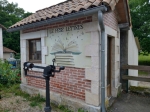
- Le Pese Lettres, Saint-Martin-l’Ars
-
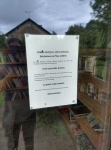
- Stricter than the usual LFL policy
-

- Several English-language shelves
-
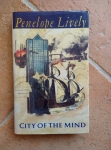
- My chosen book
-

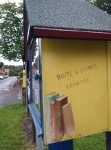
- Abjat-sur-Bandiat book exchange box
-

- Cute cat mural in Abjat
What I Read
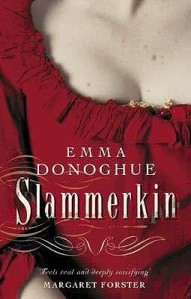 Slammerkin by Emma Donoghue (2000): A slammerkin was, in eighteenth-century parlance, a loose gown or a loose woman. Donoghue was inspired by the bare facts about Mary Saunders, a historical figure. In her imagining, Mary is thrown out by her family at age 14 and falls into prostitution in London. Within a couple of years, she decides to reform her life by becoming a dressmaker’s assistant in her mother’s hometown of Monmouth, but her past won’t let her go. The close third person narration shifts to depict the constrained lives of the other women in the household: the mistress, Mrs Jones, who has lost multiple children and pregnancies; governess Mrs Ash, whose initial position as a wet nurse was her salvation after her husband left her; and Abi, an enslaved Black woman. This was gripping throughout, like a cross between Alias Grace and The Crimson Petal and the White. The only thing that had me on the back foot was that, it being Donoghue, I expected lesbianism. (Secondhand purchase – Awesomebooks.com)
 Paris Trance by Geoff Dyer (1998): Only my second novel from Dyer, an annoyingly talented author who writes whatever he wants, in any genre, inimitably. This reminded me of Jeff in Venice, Death in Varanasi for its hedonistic travels. Luke and Alex, twentysomething Englishmen, meet as factory workers in Paris and quickly become best mates. With their girlfriends, Nicole and Sahra, they form what seems an unbreakable quartet. The couples carouse, dance in nightclubs high on ecstasy, and have a lot of sex. A bit more memorable are their forays outside the city for Christmas and the summer. The first-person plural perspective resolves into a narrator who must have fantasized the other couple’s explicit sex scenes; occasional flash-forwards reveal that only one pair is destined to last. This is nostalgic for the heady days of youth in the same way as Sweetbitter. I was intrigued to learn that random lines were sampled from Fiesta; though it is lad lit, I wouldn’t have expected a Hemingway homage from the style. (Secondhand purchase – Awesomebooks.com)
 Sanctuary in the South: The Cats of Mas des Chats by Margaret Reinhold (1993): Reinhold (still alive at 96?!) is a South African psychotherapist who relocated from London to Provence, taking her two cats with her and eventually adopting another eight, many of whom had been neglected by owners in the vicinity. This sweet and meandering book of vignettes about her pets’ interactions and hierarchy is generally light in tone, but with the requisite sadness you get from reading about animals ageing, falling ill or meeting with accidents, and (in two cases) being buried on the property. “Les chats sont difficiles,” as a local shop owner observes to her. But would we cat lovers have it any other way? Reinhold often imagines what her cats would say to her. Like Doreen Tovey, whose books this closely resembles, she is as fascinated by human foibles as by feline antics. One extended sequence concerns her doomed attempts to hire a live-in caretaker for the cats. She never learned her lesson about putting a proper contract in place; several chancers tried the role and took advantage of her kindness. (Secondhand purchase – Community Furniture Project)
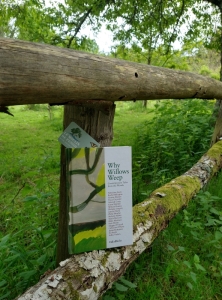
Why Willows Weep: Contemporary Tales from the Woods, ed. Tracy Chevalier and Simon Prosser (2011): These 19 short fictions, rather like Rudyard Kipling’s Just-So Stories, imagine how certain tree species developed their particular characteristics. I wasn’t expecting the fable setup and probably would have preferred a miscellany of essays and various fictional approaches. However, there is a run of great stories in the middle: from Susan Elderkin on “How the Blackthorn Got Its Flowers” to Terence Blacker on “Why Elms Die Young.” The stand-outs for me were by Rachel Billington and Maria McCann. It was a cute touch to have each author’s mini-bio end with their favourite tree, except, um, bamboo isn’t one (it’s a giant grass). I’ll probably keep this for the randomness of where I found it and the Leanne Shapton illustrations. (Secondhand purchase – La Monnerie recyclerie)
 And the first two-thirds of Daughters of the House by Michèle Roberts (1993): Thérèse and Léonie are cousins: the one French and the other English but making visits to her relatives in Normandy every summer. In the slightly forbidding family home, the adolescent girls learn about life, loss and sex. Each short chapter is named after a different object in the house. That Thérèse seems slightly otherworldly can be attributed to her inspiration, which Roberts reveals in a prefatory note: Saint Thérèse, aka The Little Flower. Roberts reminds me of A.S. Byatt and Shena Mackay; her work is slightly austere and can be slow going, but her ideas always draw me in. (Secondhand – Newbury charity shop)
A DNF: Claudine at School by Colette (a free download), which was dull and in way too small a print on my e-reader.
Plus portions of: various e-books for paid reviews, two May review books, and several library books including Moominpappa at Sea by Tove Jansson and The Invention of Hugo Cabret by Brian Selznick.


I’m happy to be home with my cat and canal, the two things I miss most when we’re away.
Spring Reads, Part II: Blossomise, Spring Chicken & Cold Spring Harbor
Our garden is an unruly assortment of wildflowers, rosebushes, fruit trees and hedge plants, along with an in-progress pond, and we’ve made a few half-hearted attempts at planting vegetable seeds and flower bulbs. It felt more like summer earlier in May, before we left for France; as the rest of the spring plays out, we’ll see if the beetroot, courgettes, radishes and tomatoes amount to anything. The gladioli have certainly been shooting for the sky!
I recently encountered spring (if only in name) through these three books, a truly mixed bag: a novelty poetry book memorable more for the illustrations than for the words, a fascinating popular account of the science of ageing, and a typically depressing (if you know the author, anyway) novel about failing marriages and families. Part I of my Spring Reading was here.
Blossomise by Simon Armitage; illus. Angela Harding (2024)
 Armitage has been the Poet Laureate for yonks now, but I can’t say his poetry has ever made much of an impression on me. That’s especially true of this slim volume commissioned by the National Trust: it’s 3 stars for Angela Harding’s lovely if biologically inaccurate (but I’ll be kind and call them whimsical) engravings, and 2 stars for the actual poems, which are light on content. Plum, cherry, apple, pear, blackthorn and hawthorn blossom loom large. It’s hard to describe spring without resorting to enraptured clichés, though: “Planet Earth in party mode, / petals fizzing and frothing / like pink champagne.” The haiku (11 of 21 poems) feel particularly tossed-off: “The streets are learning / the language of plum blossom. / The trees have spoken.” But others are sure to think more of this than I did.
A favourite passage: “Scented and powdered / she’s staging / a one-tree show / with hi-viz blossoms / and lip-gloss petals; / she’ll season the pavements / and polished stones / with something like snow.” (Public library) 
Spring Chicken: Stay Young Forever (or Die Trying) by Bill Gifford (2015)
 Gifford was in his mid-forties when he undertook this quirky journey into the science and superstitions of ageing. As a starting point, he ponders the differences between his grandfather, who swam and worked his orchard until his death from infection at 86, and his great-uncle, not so different in age, who developed Alzheimer’s and died in a nursing home at 74. Why is the course of ageing so different for different people? Gifford suspects that, in this case, it had something to do with Uncle Emerson’s adherence to the family tradition of Christian Science and refusal to go to the doctor for any medical concern. (An alarming fact: “The Baby Boom generation is the first in centuries that has actually turned out to be less healthy than their parents, thanks largely to diabetes, poor diet, and general physical laziness.”) But variation in healthspan is still something of a mystery.
Over the course of the book, Gifford meets all number of researchers and cranks as he attends conferences, travels to spend time with centenarians and scientists, and participates in the Baltimore Longitudinal Study of Aging. There have been some truly zany ideas about how to pause or reverse aging, such as self-dosing with hormones (Suzanne Somers is one proponent), but long-term use is discouraged. Some things that do help, to an extent, are calorie restriction and periodic fasting plus, possibly, red wine, coffee and aspirin. But the basic advice is nothing we don’t already know about health: don’t eat too much and exercise, i.e., avoid obesity. The layman-interpreting-science approach reminded me of Mary Roach’s. There was some crossover in content with Mark O’Connell’s To Be a Machine and various books I’ve read about dementia. Fun and enlightening. (New purchase – bargain book from Dollar Tree, Bowie, MD)
Cold Spring Harbor by Richard Yates (1986)
 Cold Spring Harbor is a Long Island hamlet whose name casts an appropriately chilly shadow over this slim novel about families blighted by alcoholism and poor decisions. Evan Shepard, only in his early twenties, already has a broken marriage behind him after a teenage romance led to an unplanned pregnancy. Mary and their daughter Kathleen seem to be in the rearview mirror as he plans to return to college for an engineering degree. One day he accompanies his father into New York City for an eye doctor appointment and the car breaks down. The men knock on a random door and thereby become entwined with the Drakes: Gloria, the unstable, daytime-drinking mother; Rachel, her beautiful daughter; and Phil, her earnest but unconfident adolescent son.
Evan and Rachel soon marry and agree to Gloria’s plan of sharing a house in Cold Spring Harbor, where the Shepards live (Evan’s mother is also an alcoholic, but less functional; she hides behind the “invalid” label). Take it from me: living with your in-laws is never a good idea! As the Second World War looms, and with Evan and Rachel expecting a baby, it’s clear something will have to give with this uneasy family arrangement, but the dramatic break I was expecting – along the lines of a death or accident – never arrived. Instead, there’s just additional slow crumbling, and the promise of greater suffering to come. Although Yates’s character portraits are as penetrating as in Easter Parade, I found the plot a little lacklustre here. (Secondhand – Clutterbooks, Sedbergh)
Any ‘spring’ reads for you recently?
Review Catch-up: Matt Gaw, Sheila Heti, Liz Jensen (and a Pile of DNFs)
Today I have a travel book about appreciating nature in any weather, a sui generis memoir drawn from a decade of diaries, and an impassioned cry for the environment in the wake of a young adult son’s death.
I’m also bidding farewell to a whole slew of review books that have been hanging around, in some cases, for literal years – I think one is from 2021, and several others from 2022. Putting a book on my “set aside” shelf can be a kiss of death … or I can go back at a better time and end up loving it. It’s hard to predict which will occur. On these, alas, I have had to admit defeat and will pass the books on to other homes.
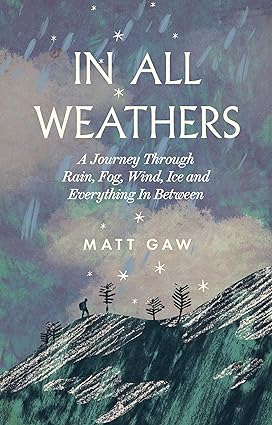
In All Weathers: A Journey through Rain, Fog, Wind, Ice and Everything in Between by Matt Gaw
Gaw’s two previous nature/travel memoirs, the enjoyable The Pull of the River and Under the Stars, involve gentle rambles through British landscapes, along with commentary on history, nature and science. The remit is much the same here. The book is split into four long sections: “Rain,” “Fog,” “Ice and Snow,” and “Wind.” The adventures always start from and end up at the author’s home in Suffolk, but he ranges as far as the Peak District, Cumbria and the Isle of Skye. Wild swimming is one way in which he experiences places. He notices a lot and describes it all in lovely and relatable prose.
 I was tickled by the definitions of, and statistics about, a “white Christmas”: in the UK, it counts if there’s even a single snowflake falling, whereas in the US there has to be 2.5 cm or more of standing snow. (Scotland is most likely to experience white Christmases; it has had 37 since 1960 vs. 26 in northern England. The English snow record is 43 cm, at Buxton and Malham Tarn in 1981 and 2009.) There’s underlying mild dread as he notes how weather patterns have changed and will likely continue changing, ever more dramatically, into his children’s future.
I find I don’t have much to say about this book because it is very nice but doesn’t do anything interesting or tackle anything that isn’t familiar from many other nature books (such as Rain by Melissa Harrison and Forecast by Joe Shute). It’s unfortunate for Gaw that his ideas often seem to have been done before – his book on night-walking, in particular, was eclipsed by several other works on that topic that came out at around the same time. I hope that the next time around he’ll get more editorial guidance to pursue original topics. It might take just a little push to get him to the next level where he could compete with top UK nature writers.
With thanks to Elliott & Thompson Books for the free copy for review.
Alphabetical Diaries by Sheila Heti
Heti put the contents of ten years of her diaries into a spreadsheet, alphabetizing each sentence (including articles), and then ruthlessly culled the results until she had a 25-chapter (no ‘X’) book. You could hardly call it a narrative, yet looking for one is so hardwired that every few sentences you are jolted out of what feels like a mini-story and into something new. Instead, you might think of it as an autobiographical mosaic. The recurring topics are familiar from the rest of Heti’s oeuvre, with obsessive cogitating about relationships, art and identity. But there are also the practicalities of trying to make a living as a woman in a creative profession. Tendrils of the everyday poke out here and there as she makes a meal, catches a plane, or buys clothes. Men loom large: explicit accounts of sex with Pavel and Lars (though also Fiona); advising her friend Lemons on his love life. There are also meta musings on what she is trying to achieve with her book projects and on what literature can be.
 Grammatically, the document is a lot more interesting than it could be – or than a similar experiment based on my diary would be, for instance – because Heti sometimes writes in incomplete sentences, dropping the initial pronoun; or intersperses rhetorical questions or notes to self in the imperative. So, yes, ‘I’ is a long chapter, but not only because of self-absorbed “I…” statements; there’s also plenty of “If…” and “It’s…” ‘H’ and ‘W’ are longer sections than might be expected because of the questioning mode. But it’s at the sentence level that the book makes the biggest impression: lines group together, complement or contradict each other, or flout coherence by being so merrily à propos of nothing. Here are a few passages to give a flavour:
Am I wasting my time? Am low on money. Am making noodles. Am reading Emma. Am tired and will go to sleep. Am tired today and I feel like I may be getting a cold. Ambivalence gives you something to do, something to think about.
Best not to live too emotionally in the future—it hardly ever comes to pass. Better to be on the outside, where you have always been, all your life, even in school, nothing changes. Better to look outward than inward. Blow jobs and tenderness. Books that fall in between the cracks of all aspects of the human endeavour.
It’s 2:34 every time I check the time these days. It’s 4 p.m. It’s 4:41 now. It’s a fantasy of being saved. It’s a stupid idea. It’s a yellow, cloudy sky. It’s amazing to me how life keeps going. It’s better to work, to go into the underground cave where there are books, than to fritter away time online. It’s crazy that I need all of these mental crutches in order to live. It’s fiction. It’s fine.
Scrambled eggs on toast at Yaddo. Second-guessing everything. Second, he said that no one is buying fiction. See the complexity. See the souls. See what kind of story the book can accommodate, if any. Seeing her for coffee was not so bad.
It’s surprising how much sense a text constructed so apparently haphazardly makes, perhaps because of the same subject and style throughout. Sometimes aphoristic, sometimes poetic (all that anaphora), the book is playful but overall serious about the capturing of a life on the page. Heti transcends the quotidian by exploding the one-thing-after-another tedium of chronology. Remarkably, the collage approach produces a more genuine, crystalline vision of the self than precise scenes and cause-and-effect chains ever could. A work of life writing like no other, it must be read in a manner all its own that it teaches you as you go along. I admire it enormously and hope I might write something even half as daring one day.
With thanks to Fitzcarraldo Editions for the free copy for review.
Your Wild and Precious Life: On grief, hope and rebellion by Liz Jensen
Jensen’s younger son, Raphaël Coleman, was just 25 when he collapsed while filming a documentary in South Africa and died of a previously undiagnosed heart condition. Raph had been involved in Extinction Rebellion and Jensen is a founding member of Writers Rebel. They both deemed activism “the best antidote to depression.” Her son had been obsessed with wildlife from a young age and was rewilding acres of their land in France, as well as making environmentalist films (he had achieved minor fame as a child actor in Nanny McPhee) and participating in direct action, such as at the Brazilian embassy in London.
 For Jensen, the challenge, especially after lockdown confined her to her Copenhagen flat, was to channel grief into further radicalism rather than retreating into herself or giving in to the lure of suicide. She tried to see personal grief as a reminder of ecogrief, and therefore as a spur. One way that she coped was turning towards the supernatural. She continued to hear and speak to Raph, in daily life as well as through a medium, and interpreted bird sightings as signs of his continued presence. An additional point of interest to me was that the author’s husband is Carsten Jensen, the writer of one of my favourite books, We, the Drowned.
This doesn’t particularly stand out among the dozens of bereavement memoirs I’ve read. (It was also remarkably similar to Alexandra Fuller’s Fi, which I’d read not long before.) Perhaps more years of reflection would have helped – Mary Karr advises seven – though I suspect Jensen felt, quite rightly, that given the current state of the environment we have no time to waste. And I have no doubt that the combination of a mother’s love and an ecological conscience will make this book meaningful to many readers.
With thanks to Canongate for the free copy for review.
And the DNFs…
there are more things, Yara Rodrigues Fowler – I loved Stubborn Archivist so much that I leapt at the chance to read her follow-up, but it was just too dull and involved about Brazilian versus UK politics. Nor did the stylistic tricks feel as novel this time around. I read 66 pages. (Fleet)
The Rabbit Hutch, Tess Gunty – Gunty dazzled critics and prize judges in the USA, winning a National Book Award. I was drawn to her debut novel for the composite picture of the residents of one Indiana apartment building and the strange connections that develop between them over one summer week, including perhaps a murder? Blandine, the central character, is a sort of modern-day mystic but hard to warm to (“She normally tries to avoid saying in which out loud, to minimize the number of people who find her insufferable”), as are all the characters. This felt like try-hard MFA writing. I read 85 pages. (Oneworld)
Eve: The Disobedient Future of Birth, Claire Horn – I usually get on well with Wellcome Collection books. I think the problem here was that there was too much material that was familiar to me from having read Womb by Leah Hazard – even the SF-geared stuff about artificial wombs. I read 45 pages. (Profile Books)
Blessings, Chukwuebuka Ibeh – This debut novel has a confident voice, buttressed by determination to reveal what life is like for queer people living in countries where homosexuality is criminalized. Obiefuna is cast out for having a crush on Aboy, his father’s apprentice, even though the two young men share nothing more physical than a significant gaze into each other’s eyes. The strict boarding school his father sends him to is a place of privation, hierarchy, hazing and, I suspect, same-sex experimentation. I found the writing capable but couldn’t get past a sense of dread about what was going to happen. Meanwhile, I didn’t think the alternating chapters from Obiefuna’s mother’s perspective added anything to the narrative. I read 62 pages. (Penguin Viking)
The War for Gloria, Atticus Lish – Lish’s debut novel, Preparation for the Next Life, was excellent, but I could never get stuck in to this follow-up, despite the appealing medical theme. When Gloria Goltz is diagnosed with ALS, her 15-year-old son Corey turns to his absent father and others for support. It was also unfortunate that Lish mentions the Ice Bucket Challenge: that was popularized in 2014, whereas the book is set in 2010. I read 75 pages. (Serpent’s Tail)
Snow Widows: Scott’s Fatal Antarctic Expedition through the Eyes of the Women They Left Behind, Katherine MacInnes – I seriously overestimated my interest in polar exploration narratives. MacInnes seems to have done quite a good job of creating novelistic scenes through research, though. I read 35 pages. (William Collins)
The Woodcock, Richard Smyth – I feel particularly bad about this one as I’ve read and enjoyed three of Smyth’s nature books and my husband and I are friendly with him on Twitter. Initially, I got Thomas Hardy, D.H. Lawrence and Sarah Perry (The Essex Serpent, anyway) vibes from this 1920s-set novel about the upheaval a naturalist and his wife experience when an American whaler and his daughters arrive in their small coastal English town. I read 90 pages. (Fairlight Books)
Better Broken than New: A Fragmented Memoir, Lisa St Aubin de Terán – I accepted this for review because I’d often seen the author’s name on spines in secondhand bookstores but didn’t know anything about her work. The précis of her globe-trotting life is stranger than fiction: marriage to a Venezuelan freedom fighter, managing a sugar plantation in the Andes, living in an Italian palace for 20 years, founding a charity in Mozambique. The vignettes in the early part of the book (e.g., skipping school and going on daytrips by train at age eight) are entertaining, if written with blithe disregard for a reader’s need for context or perspective. But the fragmented nature means it all feels as random as life, without the necessary authorial shaping. The publisher has done her a disservice as she seeks to relaunch her career by not proofreading properly: Many small errors slipped through the net, making this look like a sloppy manuscript. The worst happen to be other authors’ names: Jane ‘Austin’, ‘Kahil’ Gibran, Virginia ‘Wolfe’. Are you kidding me?! I read 53 pages. (Amaurea Press)
 Bookish Beck = Rebecca Foster. American transplant to England. Freelance proofreader and book reviewer.
 Bookish Beck